







Abstract
Stereotypes can influence social perceptions in many ways. The current research examined a previously unexplored possibility—that activation of a stereotype can validate thoughts about other people when the thoughts are stereotype consistent (i.e., that stereotype activation can increase people's confidence in their previous stereotype-consistent thoughts). Given previous results for other forms of metacognition, this thought validation from stereotype activation should be most likely when people have the cognitive capacity to carefully process individuating information. In two experiments, participants were given information about a target person and then a description designed to activate a stereotype. When processing capacity was high, confidence in thoughts was greater when the initial information produced thoughts consistent, rather than inconsistent, with the stereotype that was later activated, and higher confidence in thoughts was associated with stronger perception-consistent recommendations related to the target. When processing capacity was low, an activated stereotype served its familiar heuristic role in judgment, and thought confidence played no role in judgment-related recommendations.
Imagine having a conversation with someone new. As you interact with this person, you begin thinking that he or she is unintelligent or uneducated. Finally, just before parting ways, you learn one last thing—this person comes from an economically disadvantaged background (i.e., low socioeconomic status, or SES). How would this affect your judgment of this person?
Past research suggests that stereotypes about low SES (e.g., low intelligence) could influence perceptions in many ways, for example, by serving as a judgmental heuristic (for a review, see Bodenhausen, Macrae, & Sherman, 1999) or by coloring one's thoughts about a person (Wegener, Clark, & Petty, 2006). However, most support for the influence of stereotypes has come from studies in which participants learned about group membership before, rather than after, they acquired individuating information. Recent advances in the study of metacognition (see Petty, Briñol, Tormala, & Wegener, 2007) suggest that learning of someone's group membership “after the fact” might allow stereotypes to influence perceptions in a way that has not been demonstrated. In these situations, we argue, stereotypes can create the metacognition of confidence in one's stereotype-consistent thoughts. In the research reported here, we examined this “shoe fits” source of confidence and how it can be responsible for effects of stereotypes on related judgments.
SELF-VALIDATION AND STEREOTYPES
Metacognition refers to people's thoughts about their own thoughts or thought processes (Petty et al., 2007). One metacognition that has garnered much recent attention is the degree of confidence in the thoughts one produces. According to the self-validation hypothesis (Petty, Briñol, & Tormala, 2002), in addition to traditionally emphasized factors such as the number and valence of thoughts, the amount of confidence in one's own thoughts should have a substantial impact on relevant evaluations. Two perceivers can produce the same positive thought about a target individual, but have differing levels of confidence in that thought. The self-validation hypothesis predicts that the perceiver who has more confidence in the thought will use it more when evaluating the target.
The self-validation hypothesis has received support in several studies in which a persuasion factor (e.g., expertise of the source, positive mood) increased thought confidence when ability to think was high and the persuasion factor appeared after, rather than before, the persuasive message (for a review, see Briñol & Petty, 2009). For example, in one series of studies (Tormala, Briñol, & Petty, 2007), participants were induced to generate positive thoughts (because strong arguments were presented) or negative thoughts (because weak arguments were presented) about some proposal and then learned that the source of the message either was or was not an expert. Participants had more confidence in both their positive and their negative thoughts when the source was said to be an expert than when the source was not an expert. Because of greater reliance on their thoughts, individuals in the expert-source condition showed more polarized evaluations of the proposal than did individuals in the nonexpert-source condition.
We believe that stereotypes can validate certain thoughts in impression-formation settings, but the effects should differ from those of previously studied variables. For example, when expertise of a message source validates thoughts about the message, it does so because people believe that the message is trustworthy, and thus that their thoughts in response to the message can be relied upon. We argue that in the case of stereotypes, because the stereotype information is directly relevant to the target of judgment, it will not globally validate all thoughts about that target. The stereotype of a group supports certain views of the group and opposes others, so stereotype information will have more selective effects on thought confidence than factors that globally validate thoughts.
This perspective follows directly from the long tradition of viewing social perceivers as naive or intuitive scientists (e.g., Heider, 1958; Nisbett & Ross, 1980). Although social perceivers surely do not follow all the criteria put forth by formal science, they attempt to test and seek support for their hypotheses about their social world (see also Fiedler & Walther, 2003). In this context, we consider validation by stereotypes as similar to convergent validity in the realm of science. Convergent validity is obtained when evidence from separate sources (e.g., measures, procedures) comes together (converges) to increase one's confidence in an assessment or scientific belief (e.g., see Campbell & Fiske, 1959). For example, if a scientist conceptually replicates an initial study using an alternative method, the replication provides validation of the initial result. The new study does not change what the scientist believes; it just increases the scientist's confidence in the belief. Similarly, receiving new information consistent with an already-held belief does not necessarily change what a social perceiver believes, but it can increase confidence in the belief.
Stereotypes have the potential to be used in this way. Social stereotypes are mental representations of many aspects of group membership, including (but not limited to) physical features, traits, and behaviors. These representations can guide perceptions relatively independently of individuating information that may be present in the environment (see Bodenhausen et al., 1999). It stands to reason, however, that stereotypes could serve not only as the primary source from which an evaluation is based, but also as confirmation of an existing belief—and thus increase confidence in that belief.
We propose that perceivers will be more confident in their thoughts about a target when they later receive information about the target's group membership that stereotypically matches, rather than mismatches, the content of those thoughts (Hypothesis 1). For example, after thinking that a person seems unintelligent, one's confidence in those initial thoughts (which were based on available individuating information) will increase if one then learns that he or she comes from a stereotypically matching (rather than mismatching) SES background. Moreover, these high-confidence thoughts should play a stronger role in guiding judgments about the target than thoughts that conflict with the group-membership information (Hypothesis 2).
EXPERIMENT 1
Experiment 1 tested these hypotheses using materials and procedures adapted from Wegener et al. (2006). Participants first received a child's supposed answers to an intelligence test (the answers suggested either poor or strong performance) and then received SES information about the child. This set the stage for stereotypes to validate thoughts, and we predicted that participants would make more thought-consistent academic recommendations when stereotypes matched rather than mismatched the child's performance.
Method
Participants and Design
Ninety-two Indiana University undergraduates participated in exchange for partial course credit. Participants were randomly assigned to a 2 (child's test performance: poor vs. strong) × 2 (child's SES: low vs. high) between-participants factorial.
Procedure
The study was introduced as an investigation of how novices evaluate the academic abilities of children. Participants evaluated a child with either poor or strong test performance. All participants were asked to “think hard” about the child's performance by considering the difficulty level of, and answer to, each test question. After reviewing the child's test, participants listed thoughts that came to mind and were then given information about the child's SES (i.e., low or high). Subsequently, participants rated the child's performance, reported their confidence in their previously listed thoughts, rated the valence of each thought, made recommendations regarding the child's participation in future academic programs, and completed a manipulation check. Finally, participants were thanked and debriefed.
Independent Variables
Test Performance.
The test materials consisted of 86 questions presented on 20 randomly ordered computer screens. Each screen contained a number of questions that had the same difficulty level (labeled as “mental age,” ranging from 7 to 11) and tested knowledge in the same content area (logic, mathematics, or language). For each question, a graded answer was provided. In the poor-performance condition, the child answered about 20% of the questions correctly. In the strong-performance condition, approximately 90% of the answers were correct.
Child's SES.
After viewing the test and reporting their thoughts, participants received a purported photograph of the boy whose answers they had seen and some information related to the child's SES. In the low-SES condition, the child's mother waited tables, his father was unemployed, and the child had two younger siblings. Also, the parents resided at different addresses, with the mother's listed as an apartment. In contrast, in the high-SES condition, the mother was depicted as a freelance writer and the father as a physician. The child had no siblings, and his address was listed as a house.
Dependent Measures
Thought Listing.
Immediately after reviewing the child's test, participants were asked to type the thoughts that came to mind. They were given up to 4 min to complete this task and were allowed to list a maximum of 12 thoughts (see Wegener, Downing, Krosnick, & Petty, 1995, for specific instructions).
Perceptions of Test Performance.
After receiving the SES information, participants reported their perceptions of the child's test performance by answering two questions: “In general, how well did the child perform on the test portion you were given?” (1 = performed extremely poorly, 11 = performed extremely well) and “Which choice best reflects the amount of questions this child answered correctly?” (1 = 0%, 11 = 100%). Responses were highly correlated (α = .95), so they were averaged to form an index of perceived test performance.
Thought Confidence.
Next, participants reported the confidence they had in the validity of their previously listed thoughts about the child by answering three questions: “Overall, how valid would you say your thoughts were?” (1 = not at all valid, 11 = extremely valid), “How certain are you that the thoughts you had while viewing the child's test were ‘correct’?” (1 = not at all certain, 11 = very certain), and “How certain are you that of all the possible thoughts that one might have about the child and his/her test, your thoughts generally reflected the ‘right’ way to think and feel about what you saw?” (1 = not at all certain, 11 = very certain). Responses were reliable (α = .86) and were averaged to form an index of thought confidence (as in Petty et al., 2002).
Thought Rating.
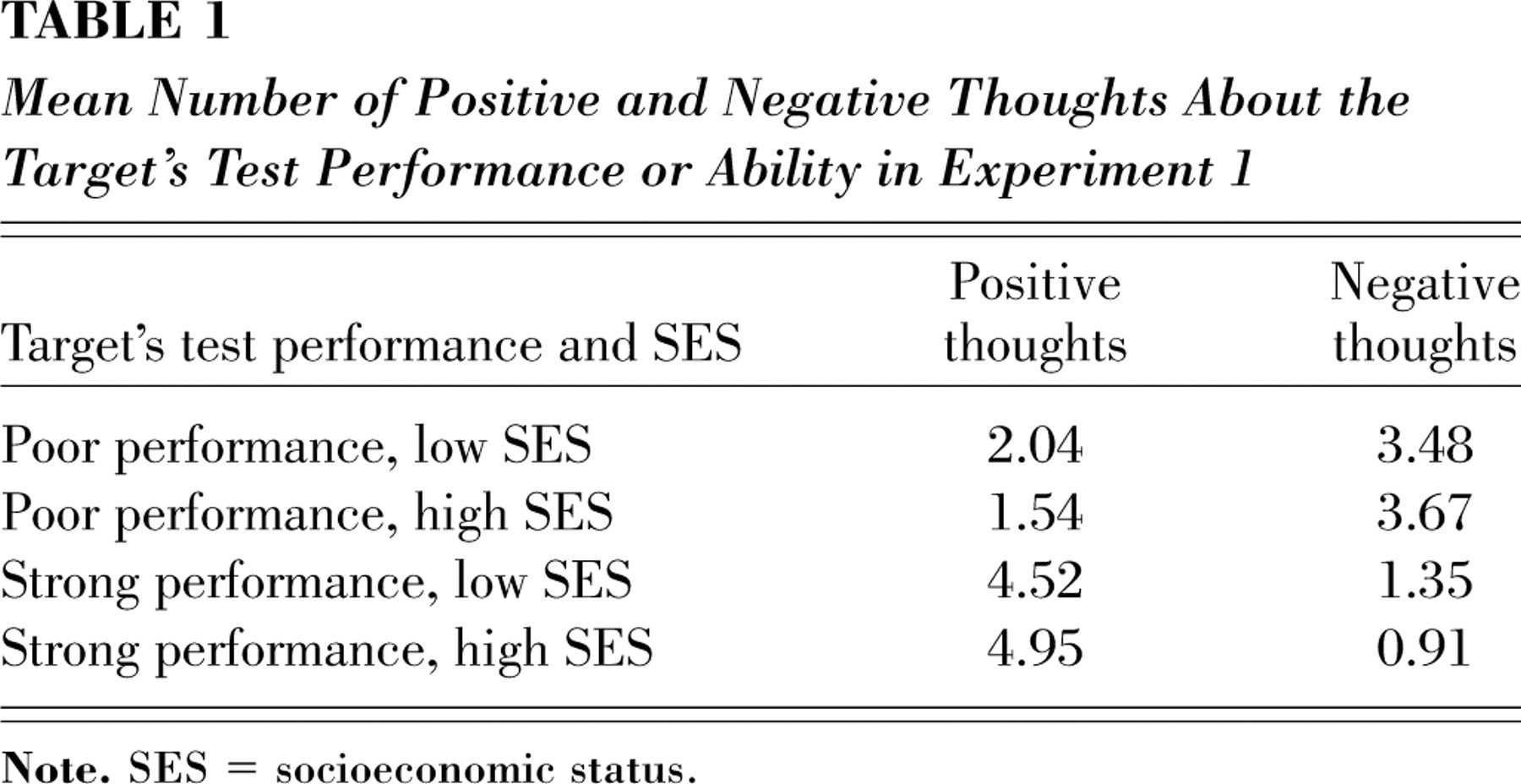
Next, each typed thought was presented sequentially, and participants reported whether each thought was positive, negative, or neutral about the child, or unrelated to the child and his/her test. Subsequent experimenter coding indicated that 96% of listed thoughts were about the child's performance or ability and were, therefore, stereotype related (see Table 1 for the mean number of positive and negative thoughts in each condition). The overall positivity of each participant's thoughts was computed from his or her self-ratings by dividing the number of positive thoughts about the target by the total number of target-related thoughts generated.
Mean Number of Positive and Negative Thoughts About the Target's Test Performance or Ability in Experiment 1
Academic-Program Recommendation.
To examine whether participants used their reactions to make consequential decisions, we asked them to make recommendations for the child's placement into future academic programs. Using scales from 1 (strongly disagree) to 11 (strongly agree), participants answered the following items: “Based on test performance, I would recommend that this child be placed in classes for gifted students” and “Based on test performance, I would recommend that this child be placed in classes for remedial students” (r = −.63). An index of the strength of recommendation for a program that matched the child's performance was created by combining the two ratings after standardizing them (M = 0, SD = 1). 1 In the strong-performance condition, the index was created by subtracting each participant's standardized rating on the “remedial” measure from his or her standardized rating on the “gifted” item. In the poor-performance condition, “gifted” ratings were subtracted from “remedial” ratings.
SES Manipulation Check.
Finally, participants reported the child's socioeconomic background on an 11-point scale (1 = very poor, 11 = very wealthy).
Results
SES Manipulation Check
Responses to the SES item were subjected to a 2 (test performance: poor vs. strong) × 2 (child's SES: low vs. high) between-participants analysis of variance (ANOVA). As expected, a main effect of SES emerged, F(1, 88) = 206.05, p < .001. The high-SES child was perceived as more affluent (M = 7.99) than the low-SES child (M = 3.44). Also, a main effect of test performance was found, F(1, 88) = 4.50, p = .037; strong performance elicited greater perceived affluence than poor performance (M strong = 6.05, M poor = 5.38).
Perceived Test Performance
Analysis of perceived test performance revealed a main effect of test performance, F(1, 88) = 356.43, p < .001 (M strong = 8.89, M poor = 4.41). No significant main effect of SES and no Test Performance × SES interaction were found (ps > .56). This pattern is consistent with participants having formed an “individuated” perception of the child's performance before learning about his SES (cf. Fiske & Neuberg, 1990).
Thought Positivity
As expected, because the thought-listing task preceded receipt of the SES information, thought valence was affected only by test performance, F(1, 88) = 53.11, p < .001 (M strong = .63, M poor = .30).
Thought Confidence
Results for thought confidence were consistent with Hypothesis 1. Analysis of the index of thought confidence revealed a significant Test Performance × SES interaction, F(1, 88) = 5.97, p = .017, r = .25 (see Fig. 1). In the strong-performance condition, participants tended to express greater confidence in their thoughts when the child was of high SES (M = 8.42) rather than low SES (M = 7.64), F(1, 88) = 2.31, p = .132. However, in the poor-performance condition, higher thought confidence was reported when the child's SES was low (M = 7.20) rather than high (M = 6.22), F(1, 88) = 3.75, p = .056. Overall, participants were more confident in their thoughts when the child's performance was strong rather than poor, F(1, 88) = 13.29, p < .001; this finding is consistent with strong academic performance being more diagnostic of ability than poor performance (see Skowronski & Carlston, 1987).
Academic-Program Recommendation
Results were also consistent with Hypothesis 2. Analysis of the index of performance-consistent recommendations revealed a Test Performance × SES interaction, F(1, 88) = 7.54, p = .007, r = .28. In the strong-performance condition, greater agreement with a recommendation for a gifted program was observed when the child's SES was high rather than low (M high = 1.70, M low = 1.13), F(1, 88) = 3.41, p = .068. However, in the poor-performance condition, greater agreement with a recommendation for a remedial program was found when the child's SES was low rather than high (M low = 1.66, M high = 1.05), F(1, 88) = 4.16, p = .044.
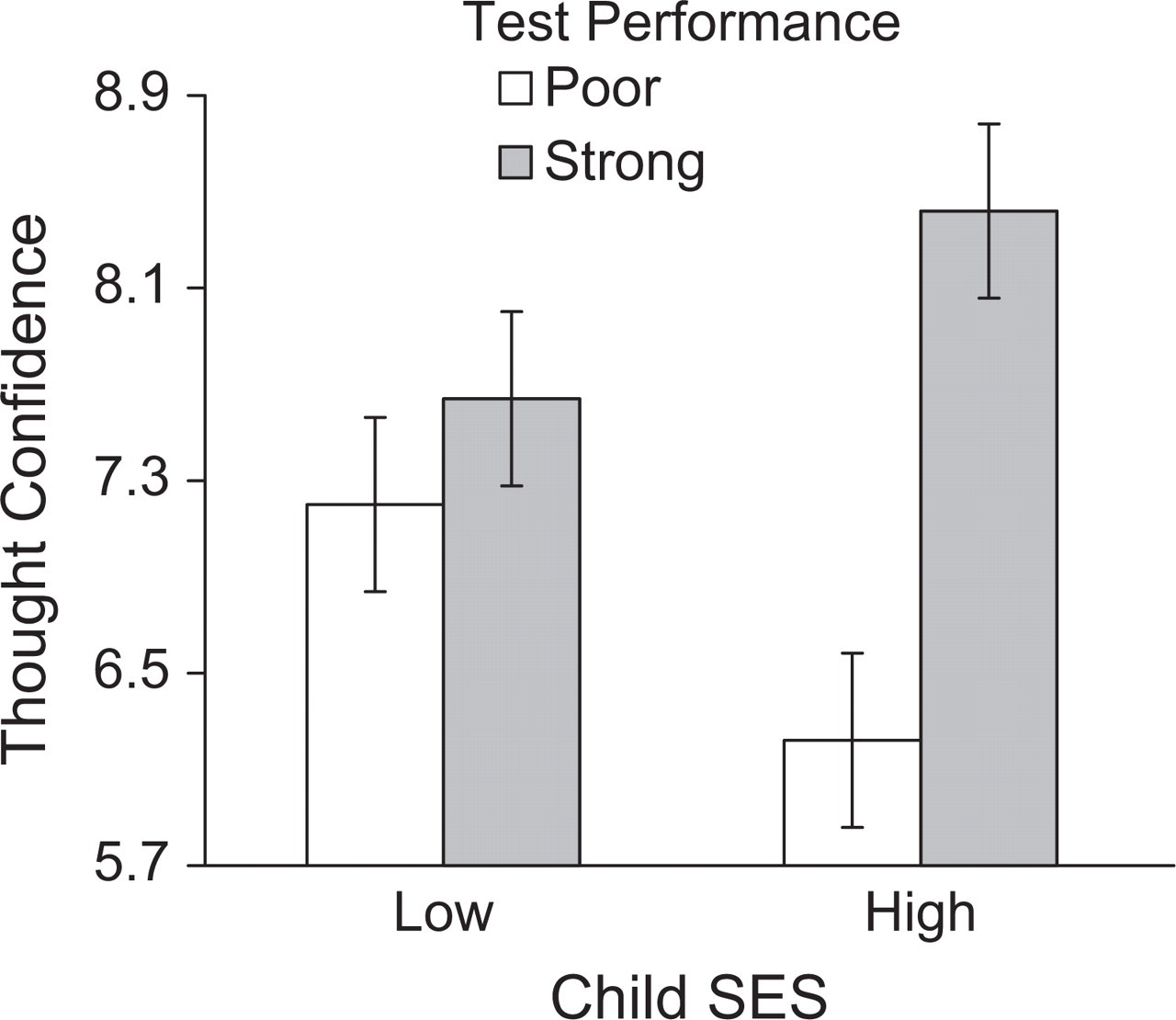
Mean thought confidence as a function of the child's test performance and socioeconomic status (SES) in Experiment 1. Error bars represent standard errors of the means.
Mediation by Thought Confidence
Test performance interacted with SES to increase thought confidence and strength of performance-consistent recommendations when the stereotype matched performance. Did confidence in thoughts account for the interactive effect of test performance and SES on academic recommendations? To answer this question, we used bootstrapping procedures outlined by Shrout and Bolger (2002; see also Preacher & Hayes, 2004) to estimate the indirect effect and the associated 95% confidence interval. Results showed that thought confidence did mediate the interactive effect of test performance and SES on recommendations (estimated mean indirect effect = .29, 95% confidence interval: .0956–.5232). In other words, SES information validated thoughts more when individuating information was consistent rather than inconsistent with SES stereotypes, and stronger performance-consistent academic recommendations were made when initial reactions had been validated. 2
Discussion
Experiment 1 demonstrated that information about a target's group membership can increase confidence in thoughts about the target when the stereotype for the target's group is consistent with those thoughts. We observed this effect when participants learned that a high-performing student came from a high-SES background and when they learned that a low-performing student came from a low-SES background. Also, participants made stronger positive or negative recommendations for academic placement when the child's SES matched rather than mismatched the earlier performance information, and the observed differences in thought confidence accounted for this interactive effect. 3
EXPERIMENT 2
Past studies have shown that variables are more likely to affect self-validation processes when motivation and ability to think are high rather than low (e.g., Briñol & Petty, 2003). Therefore, in addition to replicating Experiment 1, Experiment 2 tested whether content-based validation is limited to situations in which perceivers have the cognitive capacity needed to carefully process individuating information and reflect on its validity (Hypothesis 3; see also Petty et al., 2007).
Method
Participants and Design
One hundred seventeen Indiana University undergraduates participated in exchange for partial course credit. Participants were randomly assigned to a 2 (cognitive load: low vs. high) × 2 (child's SES: low vs. high) between-participants factorial.
Procedure
The procedure, materials, and measures were identical to those used in Experiment 1, with the following exceptions. All participants viewed relatively positive test information indicating performance that was slightly less strong than in the strong-performance conditions in Experiment 1 (i.e., 80% correct responses, to allow stereotype-matching to have stronger effects). Half of the participants viewed the materials under the same conditions as in Experiment 1 (low cognitive load), but the other half received the test information while they counted the number of letters in a sequence of numbers and letters spoken over headphones at a rate of one number or letter every 1.5 s (high cognitive load). Participants in the high-cognitive-load condition also had a limited amount of time to view each screen (exposure rates established by Wegener et al., 2006).
Results
Perceived Test Performance
The average of the perceived-test-performance measures (α = .78) was higher when cognitive load was low (M = 7.76) rather than high (M = 7.23), F(1, 113) = 5.52, p = .021. As in past research on the heuristic impact of stereotypes (e.g., Gilbert & Hixon, 1991), a Cognitive Load × SES interaction was also observed, F(1, 113) = 6.57, p = .012, r = .23. In the high-load condition, the high-SES child was rated higher than the low-SES child (M high = 7.57, M low = 6.89), F(1, 113) = 4.48, p = .036. However, as in Experiment 1, ratings of performance did not differ as a function of SES when cognitive load was low (M high = 7.52, M low = 8.00), F(1, 113) = 2.28, p = .133.
Thought Positivity
A two-way analysis of variance on thought positivity revealed only a significant effect of cognitive load, F(1, 113) = 5.65, p = .019. As in past research in which cognitive load was manipulated and positive information was presented (e.g., Wegener et al., 2006), participants in the low-load condition generated a greater proportion of positive thoughts (M = .61) than participants in the high-load condition (M = .50). Subsequent experimenter coding indicated that 89% of listed thoughts were about the child's performance or ability and were, therefore, stereotype related.
Thought Confidence
We averaged ratings for the confidence measures (α = .93). Mean confidence was higher when cognitive load was low (M = 7.27) rather than high (M = 5.51), F(1, 113) = 20.21, p < .001. This finding is consistent with prior work showing that enhanced thinking leads to more judgmental confidence (Barden & Petty, 2008). More important, in the low-load condition, perceivers had greater thought confidence when the child's SES was high (M = 7.87), and matched the strong performance, rather than low (M = 6.67), F(1, 113) = 4.67, p = .033, r = .20. Yet, as expected, a match between high SES and strong performance did not influence confidence when load was high (M high = 5.45, M low = 5.56; F < 1). This pattern resulted in a marginal Cognitive Load × SES interaction, F(1, 113) = 2.80, p = .097.
Academic-Program Recommendation
Recommendation strength was computed in the same way as in the strong-performance condition of Experiment 1 (r = −.56 between “gifted” and “remedial” recommendations). 4 Performance-consistent recommendations tended to be stronger when cognitive load was low (M = .23) rather than high (M = −.27), F(1, 113) = 2.41, p = .124. More important, performance-consistent recommendations were also stronger when the child's SES was high (M = .30) rather than low (M = −.33), F(1, 113) = 3.86, p = .052, r = .18. The Cognitive Load × SES interaction was not significant, F < 1. Both use of an SES heuristic and use of validated thoughts would predict stronger performance-consistent recommendations for a high-SES than for a low-SES child. To test for these different underlying mechanisms, we examined the mediational role of thought confidence and perceived test performance within each level of cognitive load.
Mediation Analyses
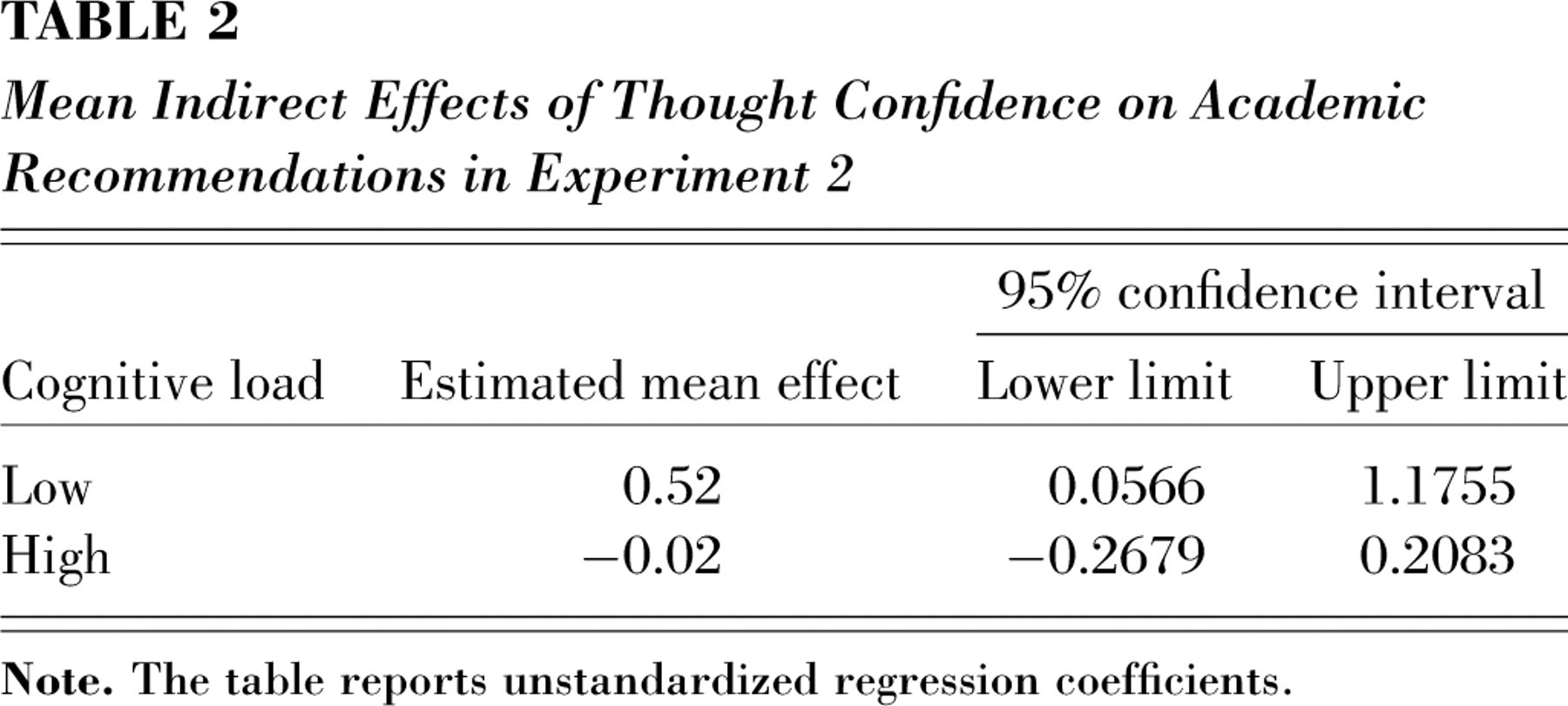
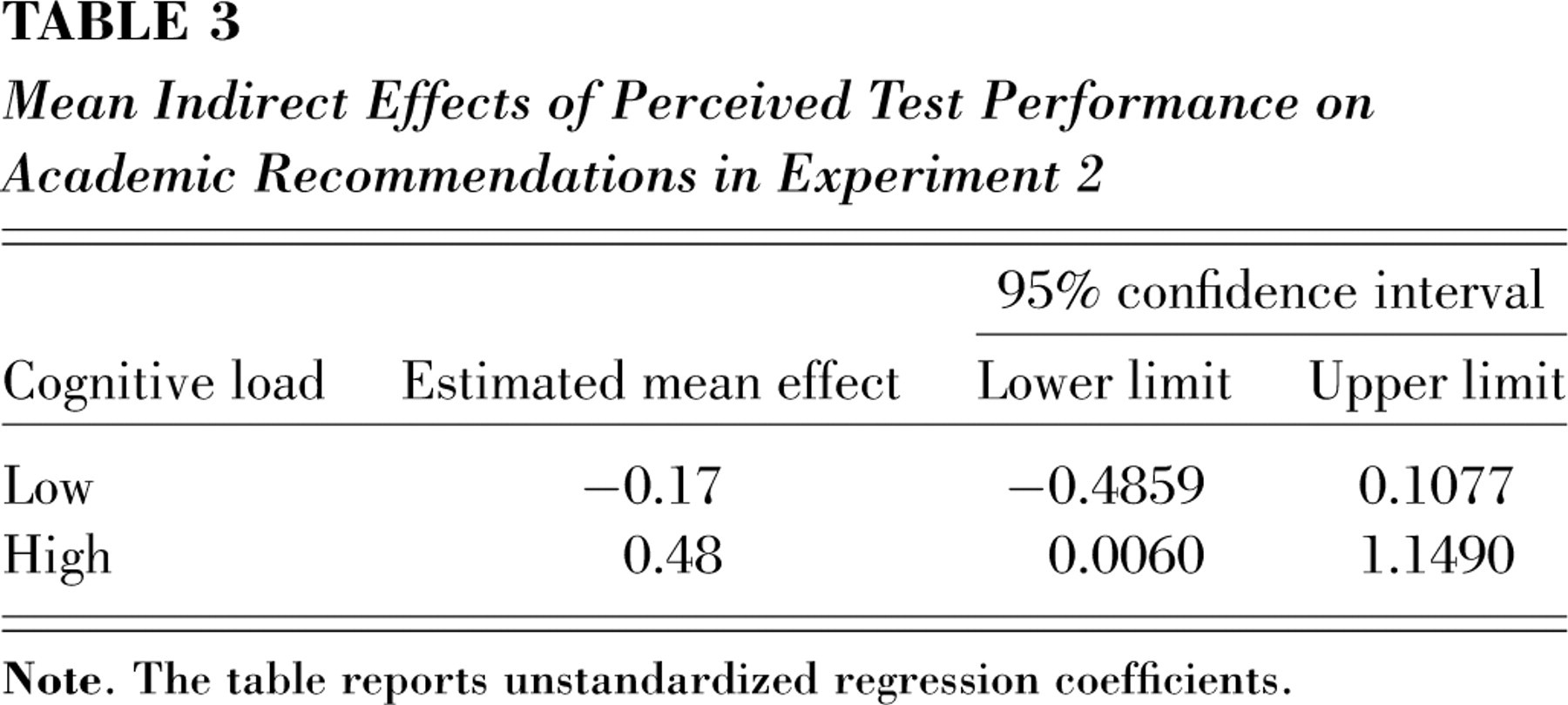
We expected thought confidence to mediate effects of SES on recommendations when cognitive load was low (and SES could validate thoughts), but not when it was high (and SES could serve as a heuristic; see the results for performance ratings). Also, we anticipated that perceptions of test performance would mediate effects of SES on recommendations in the high-load condition (when SES influenced both perceptions of performance and recommendations), but not in the low-load condition (when SES had no influence on perceptions of performance). Each mediation pattern was tested within each level of cognitive load using bootstrapping. Thought confidence significantly mediated the effect of SES on academic recommendations when cognitive load was low, but not when it was high (see Table 2). Furthermore, perceptions of test performance significantly accounted for the impact of SES on recommendations when cognitive load was high, but not when it was low (see Table 3). These patterns are consistent with SES validating thoughts when cognitive load was low and serving as a judgmental heuristic when cognitive load was high. 5
Mean Indirect Effects of Thought Confidence on Academic Recommendations in Experiment 2
Mean Indirect Effects of Perceived Test Performance on Academic Recommendations in Experiment 2
Discussion
The results of Experiment 2 supported our prediction that self-validation occurs primarily when perceivers have the cognitive capacity to process information and assess the validity of their reactions (Hypothesis 3). As in Experiment 1, when cognitive capacity was not constrained, SES information influenced participants' confidence in their thoughts, and this confidence accounted for the effects of SES on the later academic recommendations. This effect was observed even though SES did not bias perceptions of performance (formed during processing, before the SES information was introduced). When the ability to process information was limited, however, information on the child's SES was used as a heuristic for performance judgments and recommendations, but these effects did not involve the self-validation role of SES in influencing thought confidence.
GENERAL DISCUSSION
Prior work has established that stereotypes can serve as judgmental heuristics (e.g., Bodenhausen, 1990), bias interpretation of information (e.g., Kunda & Sherman-Williams, 1993), and guide selective information processing (Bodenhausen, 1988). The current research provides converging evidence that stereotypes can validate thoughts that people produce about others. It is interesting to note that in most studies of stereotyping, category membership is the first information about a target that participants receive. This procedure mirrors what often happens in everyday interactions, especially when a person's appearance makes his or her category membership clear. However, as electronic communication becomes more common, and as possible group-identifying information is removed from documents (e.g., job applications), there are more and more circumstances in which perceivers learn about stereotype-related category membership only after forming an individuated impression.
Much research suggests that high levels of thought on the part of perceivers can help to insulate people from negative effects of stigmatizing beliefs about their group. If one were to look only at judgments of performance in the current experiments, one might conclude that stereotypes had little effect when no cognitive load was present. However, when stereotypes validated perceptions of the target, participants were more likely to use their reactions to make recommendations about special treatment for the target. This meant that within a given performance level, low-SES targets were less likely than high-SES targets to be recommended for gifted classes and more likely to be recommended for remedial classes. Therefore, this study adds to the growing literature on situations in which substantive processing fails to remove effects of stereotypes and instead creates stereotype-consistent perceptions that are consequential (e.g., Wegener et al., 2006).
In addition to demonstrating a new role for stereotypes, the current research extends knowledge of self-validation and opens the door for many future research directions. For example, one interesting direction would be to examine when persuasion variables globally validate thoughts and when they might validate thoughts through their matches with reactions to information in a persuasive message. Prior work on self-validation in persuasion has shown that many factors (e.g., source expertise, emotion, feelings of power; see Briñol & Petty, 2009) can serve to validate thoughts about a message, but these effects occurred regardless of a match between the validating cue (e.g., high or low expertise) and the valence of thoughts (positive or negative). For example, as noted earlier, high source credibility increased message recipients' confidence in their positive thoughts in response to strong messages (match) and also increased recipients' confidence in their negative thoughts in response to weak messages (mismatch; Tormala et al., 2007). In these past persuasion studies, the thoughts were about the tenets of the persuasive appeal rather than about the validating variable itself (e.g., the message source). However, in the current research, both initial thoughts (based on individuating information) and the validating factor (i.e., SES information) provided information about characteristics of the child. Therefore, convergence-based matching effects might occur when initial thoughts and the validating factor both focus on the target, but global validation might be more likely when initial thoughts focus on characteristics of the target, but the validating factor does not.
Footnotes
1Analyses of variance revealed main effects of test performance on “gifted” and “remedial” recommendations (ps < .0001) and main effects of SES on “gifted” (p = .064) and “remedial” (p = .034) recommendations in the expected direction.
2We also tested the possibility that recommendations mediated the interactive effect of test performance and SES on thought confidence. Results did not support this alternative (estimated mean indirect effect = .24, 95% confidence interval: −.0130– +.5629).
3We also included two conditions in which participants received no SES information (additional n = 51). Responses in these control conditions did not differ significantly from those in the high-SES condition (as if participants assumed high SES).
4An analysis of variance on the “gifted” measure revealed main effects of cognitive load (p = .044) and SES (p = .001). No significant effects emerged for “remedial” recommendations.
5Recommendations did not mediate the effects of SES on thought confidence in the low-load condition (estimated mean indirect effect = .46, 95% confidence interval: −.0605–+1.1244).
Acknowledgements
We thank Erin Bailey, Sierra Brumfield, Gabriella Denker, Adam Share, Kari Westerfield, and Yinrou Yak for assistance with data collection.