







Abstract
Theory and research point to different ways moral conviction and religiosity connect to trust in political authorities to decide controversial issues of the day. Specifically, we predicted that stronger moral convictions would be associated with greater distrust in authorities such as the U.S. Supreme Court making the “right” decisions regarding controversial issues. Conversely, we predicted that stronger religiosity would be associated with greater trust in authorities. We tested these hypotheses using a survey of a nationally representative sample of Americans (N = 727) that assessed the degree to which people trusted the U.S. Supreme Court to rule on the legal status of physician-assisted suicide. Results indicated that greater religiosity was associated with greater trust in the U.S. Supreme Court to decide this issue, and that stronger moral convictions about physician-assisted suicide were associated with greater distrust in the U.S. Supreme Court to decide this issue. Also, the processes underlying religious trust and distrust based on moral convictions were more quick and visceral than slow and carefully considered.
In 2006, pro-traditional-marriage groups in California distributed a news release arguing that their supporters should not trust the courts, a surprising reaction to an appellate court decision that had just affirmed their position on the issue (WorldNetDaily, 2006). Specifically, the appellate court had upheld the status of Proposition 22, which defined marriage in California as between a man and a woman. Despite this success, pro-traditional-marriage groups were concerned that this case would be appealed to the California Supreme Court and could be overturned. As a result, they favored taking the decision out of judges' hands by passing a constitutional amendment defining marriage in traditional terms.
The case suggests that when people have strong moral convictions about a cause, they are less likely to trust legal authorities to make the “right” decision. Allowing authorities to decide such issues opens the door to possible compromises, or authorities potentially getting it wrong. When people have moral convictions about things like the sanctity of marriage, however, to compromise or risk that authorities may get it wrong seems to undermine perceivers' commitment to first-order truths or conceptions of the good—it is akin to embracing wickedness, if not evil.
The goals of the present study were threefold: to empirically test whether people are less likely to trust even highly legitimate authorities when perceivers have a strong moral stake in the issue at hand; to examine whether religiosity and morality would have similar effects on trust in political authorities or whether, in contrast to moral conviction, religiosity would be associated with greater rather than less trust in political authorities; and to test whether morally or religiously motivated trust or distrust in authorities is a visceral emotional response or a rationally and carefully considered response. These hypotheses were tested in the context of people's degree of trust in the U.S. Supreme Court to make a decision about the legal status of physician-assisted suicide (PAS). Before turning to additional specifics about the study, we first provide brief reviews of what we know about the psychology of moral conviction, how it might relate to trust or distrust in authority, and why religiosity and moral conviction may have different associations with trust in political authorities.
THE PSYCHOLOGY OF MORAL CONVICTION
Attitudes held with strong moral conviction are likely to be authority independent, and may be based more on visceral emotional responses than on careful deliberation (Mullen & Skitka, 2006). When moral convictions are at stake, people are more likely to believe that duties and rights follow from greater moral purposes than from the rules, procedures, or authorities themselves (Skitka, Bauman, & Mullen, 2008; see also Kohlberg, 1976; Rest, Narvaez, Bebeau, & Thoma, 1999).
A moral perspective also focuses people more on their ideals, and the way they believe things “ought to” or “should” be done. Consistent with this idea, research indicates that people have more difficulty coming up with procedures to resolve conflict when they have strong moral convictions about the issue at hand (Skitka, Bauman, & Sargis, 2005). These results suggest that people do not trust procedural solutions to reach the correct decision. One goal of the current study was to directly test the distrust hypothesis. Specifically, we tested whether people were more likely to distrust highly legitimized political authorities, such as the Supreme Court, when they have a strong moral stake in the issue to be decided. Additionally, we explored the degree to which moral conviction and religiosity have similar or different effects on trust in political authorities to decide issues of the day.
RELIGIOSITY AND TRUST IN AUTHORITY
People's feelings about PAS have clear connections to religiosity. Fundamental Judeo-Christian and Islamic tenets insist that taking a human life defies the divine, and the vast majority of official church positions explicitly forbid the practice of PAS (Melton, 1991). Furthermore, disapproval of PAS is three times higher among self-reported religious people than nonreligious people in the U.S. (Hamil-Luker & Smith, 1998). Given that religious individuals tend to have particularly strong feelings about PAS, stronger religiosity may be associated with weaker trust in secular authorities to decide the issue of PAS. What remains a more open question is whether moral convictions represent the same thing as, or something different from, people's religious beliefs.
Theories in moral development suggest that people's religious beliefs are based more on authorities and rules, whereas people's moral beliefs are comparatively authority independent (Nucci & Turiel, 1978; Turiel, 2002). Religious authorities or institutions determine what is permissible or impermissible, and at least some of these determinations evaporate in the absence of authority or institutional support. Conversely, people's moral imperatives hold even in the absence of authority or institutional support (Nucci & Turiel, 1978). Moreover, belief in God and a general high level of trust in religion load on the same factor structure as general trust in the state and average trust in the government to handle a host of specific issues (Proctor, 2006). In short, these results suggest that religiosity reflects a generalized willingness to trust authority, regardless of whether the authority is secular or religious.
Therefore, we predicted that the effects of moral conviction and religiosity on trust in the U.S. Supreme Court to make a decision about PAS would diverge. Specifically, we predicted that stronger moral convictions about PAS would be associated with greater distrust in the Supreme Court to decide the legal status of this practice, and that stronger religiosity would be associated with greater trust in the Supreme Court to decide the status of this practice. How moral convictions and religiosity related to response latencies to report trust in the court would inform whether trust or distrust in the court is a more visceral or considered response.
IS TRUST IN AUTHORITY VISCERAL OR CONSIDERED?
Psychologists are deeply divided on the question of whether moral judgments are based more on emotion or considered thought. Moral intuitionists argue that people base their moral judgments on fast, affectively laden gut feelings. Reasoning comes into play only in the form of post hoc justifications for these more visceral responses (e.g., Haidt, 2001). Rationalists argue that people's moral sense comes from cognitive appraisal of conditions such as harm or injustice. According to these theories, strong affect follows, rather than precedes, moral cognition (e.g., Kohlberg, 1984; Nucci, 2001).
These different schools of thought yield different predictions about how quickly people decide whether they trust or distrust an authority to make a decision on a moralized issue. If moral convictions are based more on intuition and emotion than rational weighing of alternatives, then people should make their trust/distrust judgments very quickly. Therefore, stronger moral convictions about the issue at hand should be associated with faster response latencies in reporting trust or distrust in authority.
However, if people carefully weigh their trust in authority to make a moral decision, they should take longer to make a decision when moral conviction is high. Legitimacy is believed to create a duty and obligation to obey as an imperative that replaces even personal moral standards as a guide or primary motivation (Kelman & Hamilton, 1989). As a result, people may feel some tension between personal moral convictions and trusting or distrusting an authority. Regardless of whether people report high or low trust in authority, if people are rationally weighing these kinds of considerations, moral conviction should be associated with longer response latencies to provide a trust judgment.
METHOD
Participants
A nationally representative sample of adults (N = 727) completed an on-line survey from a panel of respondents maintained by Knowledge Networks (Menlo Park, CA).
Characteristics of the Sample
The sample was 53% female, ranged in age from 19 to 90 years old (mean age = 45.94 years, SD = 16.24 years), and was 72% White, 12% Black, and 11% Hispanic. Sixteen percent of the sample had less than a high school education, 31% graduated high school but had no college education, 28% had some college education, and 26% had a bachelor's degree or higher. Thirty-eight percent of our sample had no home access to the Internet before joining the Knowledge Networks panel.
Measures
Questions were asked in the order in which they are presented here.
Support of or Opposition to PAS
Participants' support of versus opposition to PAS was assessed with the following item: “Do you support or oppose physician-assisted suicide? Some people think that it is reasonable to let people with terminal illnesses decide with their doctors when to end their lives, that is, they support the legalization of physician-assisted suicide. Others think that suicide is wrong even for people who have terminal illnesses, and they oppose legalizing physician-assisted suicide. How do you feel about this issue?” Half of the participants were presented with a version of the question that placed the “some people support” aspect of the question first, whereas the other half received a version of the item that “some people oppose” PAS first. Response options were support, oppose, or uncertain/don't know.
Attitude Extremity
Participants who designated either support or opposition to PAS branched to the following question: “How weak or strong is your [support of/opposition to] physician-assisted suicide for those with terminal illnesses?” Participants responded on a 7-point scale with the labels very weak, moderately weak, slightly weak, uncertain, slightly strong, moderately strong, and very strong. Participants who initially indicated uncertain support for or opposition to PAS were given an extremity score of 0; all other participants' attitude extremity ranged from 1 to 7.
Moral Conviction
Moral conviction was measured by asking the extent to which participants' feelings about PAS reflected their core moral values and convictions, and how deeply their feelings about PAS were connected to their fundamental beliefs about right and wrong. Participants gave their responses on 5-point scales with labels not at all, slightly, moderately, much, and very much, r(727) =.82.
Issue-Specific Trust in the Supreme Court
Trust in the Supreme Court to decide PAS was measured in terms of agreement or disagreement with the following statement: “I trust the Supreme Court to make the right decision about whether physician-assisted suicide should be allowed.” Participants were given the response options very much agree, moderately agree, slightly agree, uncertain, slightly disagree, disagree, and very much disagree. This item was reverse-scored so that higher scores reflected greater trust.
Response Latency to Trust Item
Response time to the trust item was measured in milliseconds. Following standard practices for analyses of response-time data, these scores were log transformed, and scores more than three standard deviations from the mean were dropped.
Religiosity
Finally, we measured religiosity with three items selected from the Santa Clara Strength of Religious Faith Questionnaire (Plante & Boccaccini, 1997), specifically: “My religious faith is extremely important to me,” “My religious faith impacts many of my decisions,” and “I look to my faith for meaning and purpose in my life.” Participants responded to these items on 7-point scales with the labels of very much agree, moderately agree, slightly agree, neutral or uncertain, slightly disagree, moderately disagree, and very much disagree. Items were reverse-scored so that higher values reflected greater religiosity (α =.96).1
RESULTS
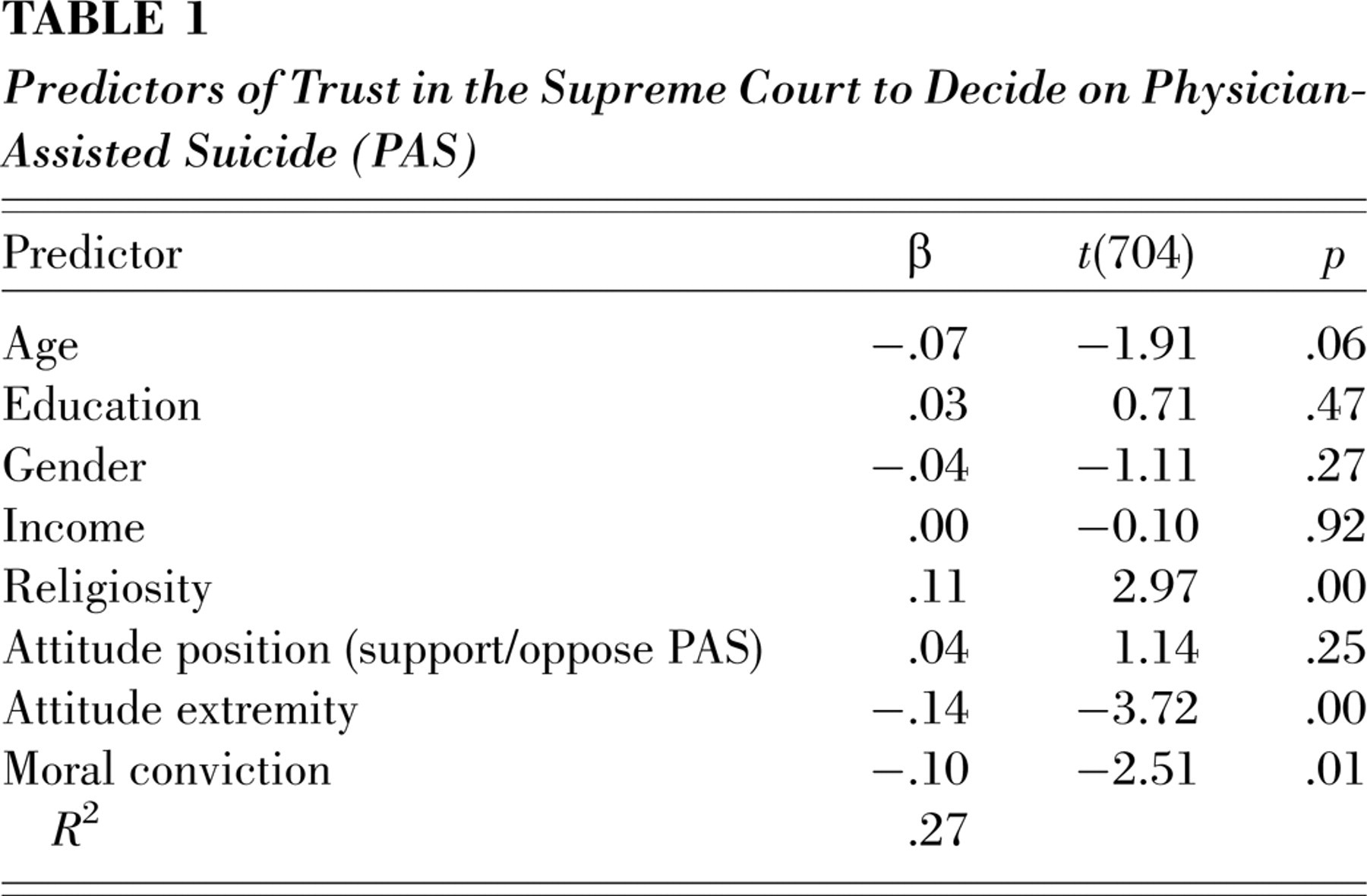
To test the distrust hypothesis, we entered age, education, gender, income, and religiosity, and tested for the effects of support or opposition, strength of participants' support or opposition, moral conviction, and all pair-wise interactions of the last four variables on levels of trust in the Supreme Court using moderated multiple regression (Aiken & West, 1991). After determining that no interaction terms were significant, the interactions were removed and the models were refit. As predicted, stronger moral convictions about PAS were associated with greater distrust in the Supreme Court to make a decision about this issue, β = −.10, t(704) = −2.51, p <.01 (see Table 1). Moreover, in support of the notion that religiosity would be associated with greater trust in authority, results also indicated that people higher in religiosity trusted the Supreme Court more to make this decision than those low in religiosity, β =.11, t(704) = 2.97, p <.01; this finding is the exact opposite of what we found for moral conviction.
Predictors of Trust in the Supreme Court to Decide on Physician-Assisted Suicide (PAS)
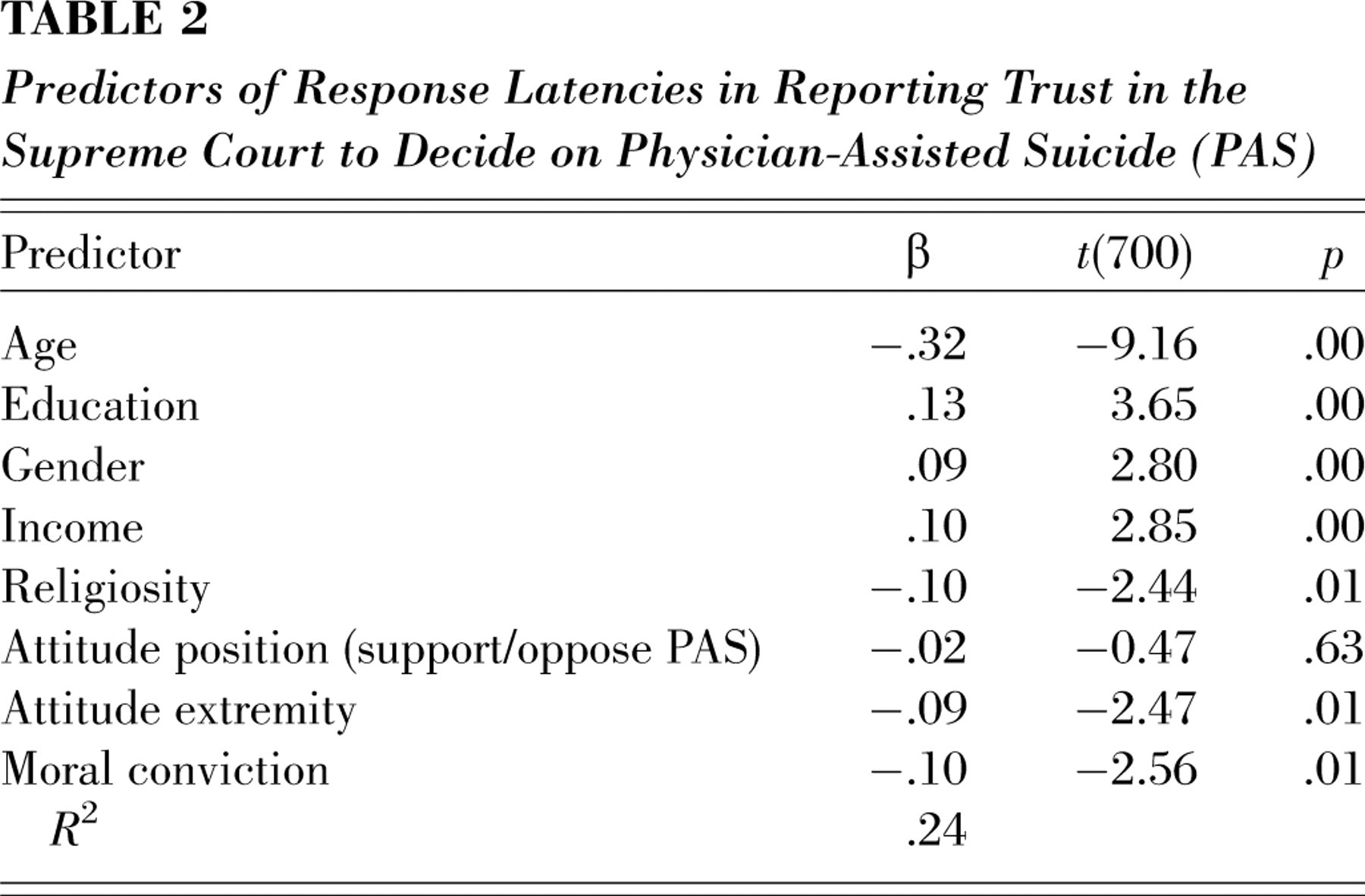
To test whether these trust/distrust judgments were more visceral or considered, we used the same regression model to predict response latencies to the trust item. Results of this analysis were consistent with the hypothesis that moral judgments are more visceral than considered. Specifically, our analysis indicated that stronger moral convictions about PAS were associated with faster response latencies to the trust item, β = −.10, t(704) = −2.56, p <.01 (see Table 2). Increased religiosity was also associated with faster response times to the trust item, β = −.10, t(704) = −2.44, p <.01. In short, the effects of both religiosity and moral conviction on trust or distrust in authority appear to be more the result of visceral and emotional reactions than the result of careful consideration.
Predictors of Response Latencies in Reporting Trust in the Supreme Court to Decide on Physician-Assisted Suicide (PAS)
DISCUSSION
Results supported the prediction that people are less likely to trust legitimate authorities to make decisions about issues they see as moral. Moreover, this finding is not specific to reactions to the Supreme Court. Secondary analysis of Skitka and Mullen (2002) replicated this finding with predecision trust in the Attorney General's office to decide a controversial custody case.
Moreover, morally convicted distrust in authority is a visceral, intuitive reaction rather than something that involves careful and deliberative processes. Religiosity, in contrast, is associated with a visceral trust in authority to make the right decision.
These results represent an important extension of previous research on the connections among people's moral convictions, religiosity, and reactions to authority. Although some might argue that morality and religiosity represent psychologically similar constructs (e.g., Bull, 1969; Geertz, 1968, 1973), these variables have very different connections to trust in authority. The religious viscerally trust authorities to get it right; the morally convicted do not.
Previous research established that strong moral convictions are associated with decreased perceptions of procedural fairness and authority legitimacy when authorities make decisions at odds with perceivers' morally vested attitudes (e.g., Bauman & Skitka, 2009; Skitka & Mullen, 2002). One of the novel contributions of the current study is the discovery that these effects are proactive rather than simply reactive. Although further research is needed to establish the generalizability of these results across different substantive issues and authorities, our results suggest that people do not only react to decisions with which they morally disagree: They do not trust even legitimate authorities to make the right decision in the first place.
Footnotes
1We also measured issue-specific religiosity. Specifically, we measured the degree to which participants' attitudes about PAS were based on their religious beliefs. We observed the same pattern of results as with our more general measure of religiosity.