







Abstract
This article reexamines the prevailing conclusion that people are unaware of the different impressions they make, or that their differential meta-accuracy is poor. This conclusion emerged from research employing contextually undifferentiated designs that may have constrained differences in actual impressions, thereby limiting participants' ability to demonstrate differential meta-accuracy. We argue that an alternative, contextually differentiated approach may reveal evidence for differential meta-accuracy because (a) people tend to behave differently in different social contexts, (b) interaction partners from different social contexts witness differing behaviors and form differing impressions of a target person, and (c) contextual information used to infer the impression one makes on others is relatively differentiated across contexts, resulting in differentiated metaperceptions. We assessed differential meta-accuracy across social contexts (i.e., parents, hometown friends, and college friends) and found that, in contrast to researchers' prevailing conclusion, people can indeed detect the relative impressions they make on others.
People often reflect upon the impressions they create in others. These metaperceptions (Laing, Phillipson, & Lee, 1966) often guide social behavior, and the accuracy of metaperceptions, or meta-accuracy, may have important implications for interpersonal functioning (Anderson, Ames, & Gosling, 2008; Cameron & Vorauer, 2008; Oltmanns, Gleason, Klonsky, & Turkheimer, 2005; Tice & Wallace, 2003). Despite the potential importance of meta-accuracy, it appears that for personality traits, “people seem to have just a glimmer of insight into how they are uniquely viewed by particular other people” (Kenny & DePaulo, 1993, p. 151). This prevailing conclusion has had implications for understanding the processes of metaperception and, most generally, for fundamental beliefs about people's understanding of their social environments (Albright, Forest, & Reiseter, 2001; Albright & Malloy, 1999; Chambers, Epley, Savitsky, & Windschitl, 2008; Oltmanns et al., 2005; Shechtman & Kenny, 1994). The goal of the current study was to revisit this widely accepted conclusion by adopting a novel, contextually differentiated approach to meta-accuracy. Our reexamination of this fundamental issue suggests that an alternative conclusion is warranted.
The conclusion that people fail to detect the different impressions they make is based on studies showing that differential meta-accuracy, or an individual's ability to detect the different impressions other people hold about him or her, is low for many traits and for a variety of levels of acquaintanceship (Kenny & DePaulo, 1993; Levesque, 1997; Shechtman & Kenny, 1994).1 However, these studies assessed meta-accuracy among small groups of people within a single social context. For example, researchers often recruited a small group of unacquainted participants who became acquainted with each other within a limited time frame through a single group-level interaction or through a series of brief, in-lab, one-on-one interactions (DePaulo, Kenny, Hoover, Webb, & Oliver, 1987; Malloy & Janowski, 1992; Reno & Kenny, 1992; Shechtman & Kenny, 1994). Similarly, when researchers recruited well-acquainted participants, they did so on the basis of participants' mutual acquaintanceship in a single social context (Levesque, 1997; Malloy & Albright, 1990). For example, Levesque (1997) recruited small groups of dormitory roommates, obtained their actual impressions and metaperceptions for every other roommate, and—as in studies of first impressions—found that roommates were unable to detect the impressions they made regarding different traits (i.e., the Big Five). Thus, in both types of studies, group members shared the same level of acquaintanceship and knew each other from the same context.
Essentially, these studies assessed people's ability to detect the different impressions they make when others' impressions are relatively similar. In a single social context, group members base their impressions of a “target” member on the same or highly similar behavioral information. Because people form similar impressions when they are exposed to the same behavioral information (Funder & Sneed, 1993), impressions of a target will be relatively undifferentiated within a single context. Differentiation in impressions is important because targets can accurately perceive the differences among other people's impressions only if those other people actually have well-differentiated impressions. In a sense, these studies provided targets with a relatively weak signal to detect, in the form of undifferentiated impressions.
The current study reexamined the long-accepted and somewhat surprising conclusion that differential meta-accuracy is poor by implementing an alternative, contextually differentiated method. Specifically, for all target participants, we recruited informants from different social contexts and assessed participants' ability to detect the different impressions they made on their informants. Thus, unlike in most meta-accuracy research, we assessed differential meta-accuracy across social contexts instead of within a single social context.2
Our emphasis on contextual differentiation has several foundations that, together, suggest that this alternative design will reveal stronger evidence of differential meta-accuracy than undifferentiated designs have. First, targets are likely to behave differently in dissimilar social contexts (Furr & Funder, 2004). Consequently, acquaintances from different social contexts will be exposed to different behavior, therefore forming impressions that are more differentiated than those formed by acquaintances within the same context (Funder, Kolar, & Blackman, 1995; Kenny, 2004; Malloy, Agatstein, Yarlas, & Albright, 1997; Malloy, Albright, Kenny, Agatstein, & Winquist, 1997). In a sense, well-differentiated impressions represent a relatively strong signal for targets to detect. Second, on the basis of knowledge of their own differential behavior across contexts or their observations of acquaintances' reactions to this differentiated behavior, targets may form notably different metaperceptions across social contexts. Thus, given a strong signal to be detected, in the form of well-differentiated actual impressions, and given a well-differentiated set of metaperceptions, a contextually differentiated approach may reveal strong evidence of differential meta-accuracy—that is, a strong correspondence between differences in the actual impressions of a target and differences in the target's metaperceptions.
In sum, we believe that the ability to perceive the differential impressions one makes on people from different social contexts is a meaningful and socially important facet of metaperception that has not yet been examined. Our contextually differentiated design based on real relationships from participants' everyday lives represents an opportunity to evaluate differential meta-accuracy in a manner that is both methodologically rigorous and ecologically valid.
METHOD
Participants
Undergraduates (41 males and 60 females) in introductory psychology classes received course credit for participation. Each participant (i.e., target) was asked to provide contact information for 6 informants: 2 parents, 2 hometown friends, and 2 college friends. Participants named 573 potential informants, who were contacted by e-mail and informed that participation would make them eligible for a $30 gift certificate. The e-mails produced 434 informants, for an overall response rate of 76%. In all, 79% of parents, 69% of hometown friends, and 79% of college friends responded; all three social contexts were represented by at least 1 informant for 72.3% of targets.
Measures
Targets' metaperceptions and informants' actual impressions of the targets were assessed with 30 items adapted from facet definitions of the revised NEO Personality Inventory (NEO-PI-R; Costa & McCrae, 1992), which measures each Big Five trait with six facets. The psychometric strength of multiple-item measures provides a more sound evaluation of meta-accuracy than the single- or two-item measures commonly used in meta-accuracy research. Each item included an adjective accompanied by brief descriptions of low and high poles of the relevant personality dimension (e.g., the item impulsive was described as low if the target “easily resists temptations and has a high tolerance for frustration” and as high if the target “often gives in to cravings and urges”). For each item, targets rated how they thought each informant viewed them, whereas informants rated their impressions of the target. Ratings were made on a scale ranging from 1 (low) to 7 (high).
Procedure
Targets provided names and e-mail addresses of potential informants, as well as their metaperceptions of each informant. Within a day, invitations to participate were e-mailed to potential informants. The invitation explained that the target had listed the recipient as knowing him or her well enough to describe his or her personality and included a link to our personality measure, which informants could complete on-line (Vazire, 2006).
RESULTS
Estimates of the trait scales' internal consistency were generally acceptable. The average metaperception reliability (α) was .69, and the average actual-impression reliability was .76.
Contextual Effects on Impressions and Metaperceptions
We first examined the hypothesis that informants' impressions and targets' metaperceptions would be more differentiated across contexts than within contexts. Specifically, we computed across-context correlations and within-context correlations for actual impressions and metaperceptions, and we compared the general pattern of differentiation across contexts with the pattern of differentiation within contexts.
Actual Impressions
To evaluate across-context similarity in impressions, we correlated informants' impression ratings across contexts (e.g., correlating parents' ratings of targets' neuroticism with hometown friends' ratings of targets' neuroticism).3 To evaluate within-context similarity of impressions, we correlated impression ratings from the two informants within each social context (e.g., we correlated Parent 1's rating of a target's neuroticism with Parent 2's ratings of that target's neuroticism). Because targets arbitrarily chose which informant was labeled “1” and which was labeled “2” within each context, these informants were interchangeable. Thus, within-context agreement was computed via intraclass correlation (Funder et al., 1995; Kenny, Albright, Malloy, & Kashy, 1994).
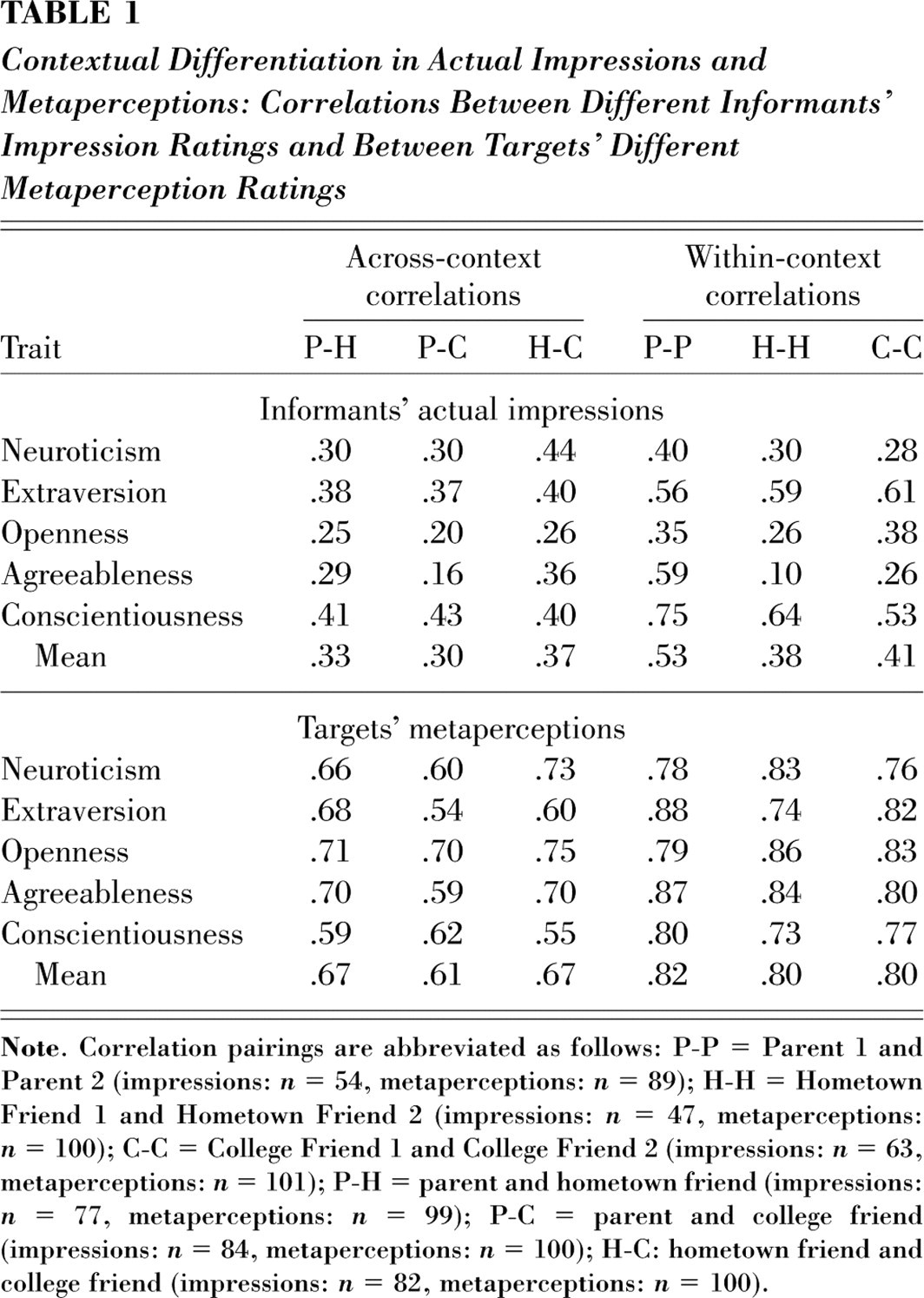
As predicted, the pattern of agreement suggests that informants' actual impressions were somewhat more differentiated across contexts than within contexts (Table 1). Averaged across traits, across-context similarity in impressions (r) ranged from .30 to .37, which was generally lower than the average within-context similarity in impressions, which ranged from .38 to .53. The greater differentiation of impressions across contexts suggests that contextual differentiation provides meaningful differentiation in impressions to be detected by targets.
Contextual Differentiation in Actual Impressions and Metaperceptions: Correlations Between Different Informants' Impression Ratings and Between Targets' Different Metaperception Ratings
Metaperceptions
Contextual effects on metaperception differentiation were examined with the same procedures used for actual impressions. That is, across-context similarity in metaperceptions was assessed by correlating targets' metaperceptions across contexts, and within-context similarity of metaperceptions was assessed by correlating targets' metaperceptions for the two informants within each social context. As predicted, the pattern of agreement indicates that targets' metaperceptions were more differentiated across contexts than within contexts (Table 1). Averaged across traits, across-context similarity in metaperceptions ranged from .61 to .67, whereas within-context similarity in metaperceptions ranged from .80 to .82. Thus, it appears that targets believed that the impressions they made were less similar (i.e., more differentiated) for informants from different contexts than for informants from the same context.
Meta-Accuracy
To examine the hypothesis that targets would be aware of the different impressions they made on different informants (i.e., high differential meta-accuracy), we assessed meta-accuracy via multilevel modeling. We modeled each Big Five trait separately using a two-level model. For all five models, parameters were modeled as random effects:

Conceptually, this approach quantifies differential meta-accuracy for each target at Level 1 and provides an index describing the typical target's level of differential meta-accuracy at Level 2. At Level 1, a target's metaperceptions regarding a given trait (y ij ) were predicted by his or her informants' actual impressions for that trait. Actual impressions were group-centered, reflecting the deviation, if any, from the target's reputation, or average impression among informants. This focused the analysis on differences among informants, providing insight into differential meta-accuracy. The slope from this within-person regression equation (β1j ) represents the target's degree of differential meta-accuracy, the degree to which his or her metaperceptions covaried with his or her informants' actual impressions. A positive slope indicates, for example, that when the target believed an informant perceived him or her as more extraverted than did his or her other informants, that informant actually perceived the target as more extraverted than the other informant did. Of primary interest is the mean meta-accuracy slope across all targets, or γ10, which was estimated at Level 2. The direction, magnitude, and statistical significance of the mean slope reflect the degree to which the average target achieved differential meta-accuracy. In addition, the magnitude and statistical significance of the variability in slopes reflect the degree to which some targets had greater meta-accuracy than others.
In addition to assessing differential meta-accuracy, previous research has often examined generalized meta-accuracy, or awareness of the general impression one makes on other people (Kenny & DePaulo, 1993; Levesque, 1997). To allow comparability to this work, we also modeled generalized meta-accuracy by adding each target's average actual impression across his or her informants as a Level 2 predictor of his or her intercept (β0j ), or average metaperception.4 The Level 2 parameter γ01 reflects the association between targets' average actual impression and average metaperceptions, or generalized meta-accuracy. A positive association suggests that, for instance, when targets believed they were generally seen as highly extraverted, their informants indeed generally viewed them as highly extraverted.
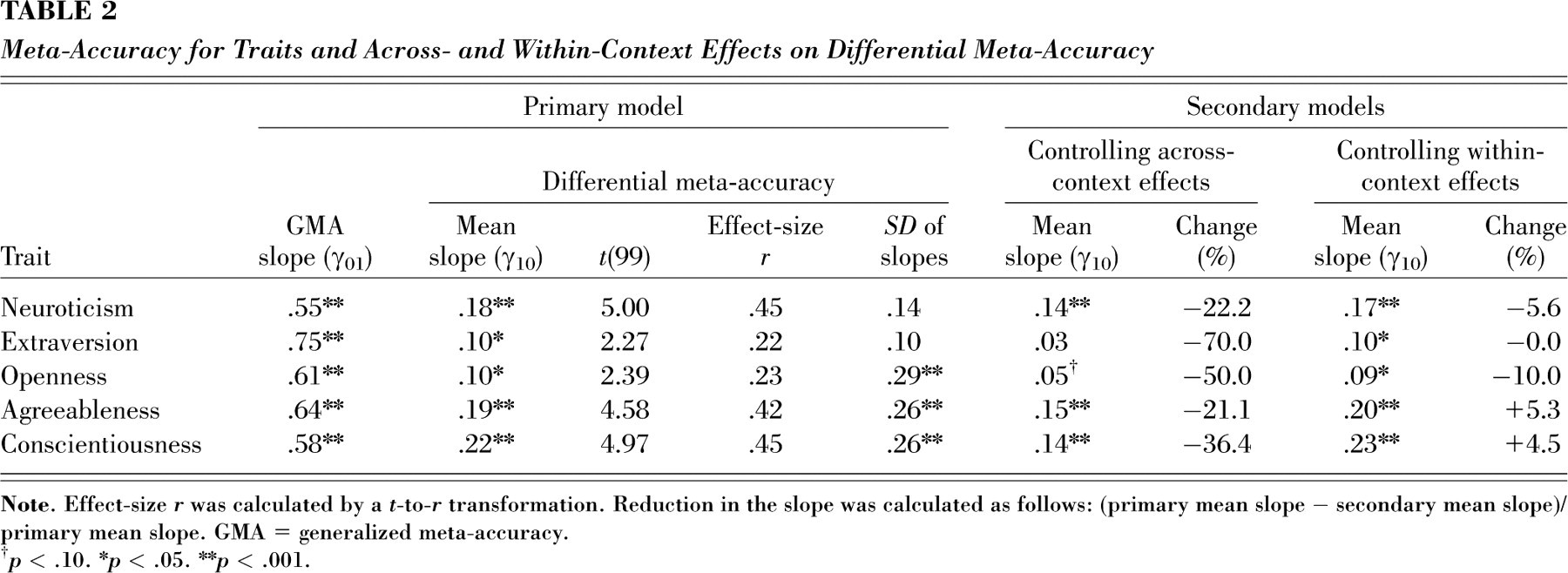
As Table 2 shows, differential meta-accuracy was significant for all five traits. The average slopes (i.e., γ10) for the five models were positive and significant, suggesting that the typical target was able to identify which people viewed him or her as especially high or low on each Big Five trait more than would be expected by chance.5 Thus, unlike in previous work, targets were able to detect the different impressions they made regarding a wide variety of traits.
Meta-Accuracy for Traits and Across- and Within-Context Effects on Differential Meta-Accuracy
p < .10.
p < .05.
p < .001.
These slopes can be interpreted as unstandardized coefficients from regression analyses. For instance, for each 1-point increase in informants' actual impression regarding agreeableness, the typical target's metaperception increased by 0.19. To convey standardized levels of differential meta-accuracy, we converted t values from the significant tests of the slopes into correlation coefficients (e.g., Kashdan & Steger, 2006), using the following formula: r = √(t 2/t 2 + df). The standardized effect size (r) ranged from .22 for extraversion to .45 for neuroticism and conscientiousness (see Table 2).
The significant standard deviations of the slopes for openness, agreeableness, and conscientiousness suggest that differential meta-accuracy regarding these traits was higher for some targets than for others (see Table 2). In other words, there may be reliable individual differences that explain differences in meta-accuracy for these traits.
Table 2 also shows that generalized meta-accuracy was positive and significant for each trait. This suggests that targets who believed their informants generally viewed them as high or low on a given trait were indeed viewed in that way. This high level of generalized meta-accuracy replicates previous research (Kenny & DePaulo, 1993; Levesque, 1997).
Contextual Effects on Differential Meta-Accuracy
These results provide strong support for our hypothesis that people are aware of the different impressions they make on others, in contrast to most previous research on dyadic or differential meta-accuracy. To examine the possibility that contextual differentiation is at least partially responsible for these findings, we examined two additional models for each trait: one controlling for across-context effects and a second controlling for within-context effects. We treated our original model as Step 1, added either the across- or the within-context effects in Step 2, and examined the reduction in the differential meta-accuracy slope from the original model. As in our primary model, all parameters were modeled as random effects. If targets were more able to detect the different impressions they made across contexts than within contexts, the reduction in the slope for differential meta-accuracy for a given trait would be greater in the second step of the model controlling for across-context effects than in the second step of the model controlling for within-context effects.
Across-Context Effects
The across-context effect on differential meta-accuracy was assessed by adding two Level 1 predictors of metaperception to the original model. The first predictor reflected the degree to which metaperceptions differed between parents and friends (i.e., parents = 1, friends = −1), and the second predictor assessed the degree to which metaperceptions differed by type of friend (i.e., parents = 0, hometown friends = 1, college friends = −1). To the degree that differential meta-accuracy (i.e., the association between actual perceptions and metaperceptions) is driven by strong differences between contexts, the addition of these two across-context predictors would be expected to minimize the slope reflecting the association between actual perceptions and metaperceptions (β1j ). Because we were most interested in the degree to which these predictors reduced the value of the original slope for differential meta-accuracy, we report the percentage reduction in differential meta-accuracy.
As Table 2 shows, slopes for the Big Five traits were reduced by as much as 70%. This result suggests that contextual differentiation indeed played a large role in targets' differential meta-accuracy. However, after controlling for across-context effects, the slopes were still significant and relatively high for neuroticism, agreeableness, and conscientiousness. Thus, although the across-context model revealed that targets based their metaperceptions to some degree on the type of context, it appears that targets also based their metaperceptions on information other than the type of context.
Within-Context Effects
The within-context effect on differential meta-accuracy was assessed by including three predictors in Level 1 of the original model. Specifically, the three within-context predictors reflected differences in metaperceptions between parents (i.e., Parent 1 = 1, Parent 2 = −1, other informants = 0), between hometown friends (i.e., Hometown Friend 1 = 1, Hometown Friend 2 = −1, other informants = 0), and between college friends (i.e., College Friend 1 = 1, College Friend 2 = −1, other informants = 0). To the degree that differential meta-accuracy is driven by differences within contexts, the addition of these three within-context predictors would be expected to minimize the slope reflecting the association between actual perceptions and metaperceptions.
Results suggest that targets did not differentiate their metaperceptions within contexts. As Table 2 shows, the inclusion of within-context effects produced only minor reductions in the slopes for differential meta-accuracy. The largest reduction was a 10% reduction in the slope for openness. Although targets might have based their metaperceptions on information other than the type of context, they do not appear to have based their metaperceptions on differences between informants within a context.
DISCUSSION
A strongly held belief in the meta-accuracy literature is that people cannot detect the different impressions they create in others. However, this conclusion is largely based on findings that meta-accuracy is poor in undifferentiated social contexts. We reexamined this conclusion by taking a naturalistic, contextually differentiated approach to meta-accuracy, and in contrast to previous research, our results showed compelling evidence for differential meta-accuracy for core personality traits. Thus, it appears that people can and do detect the different trait impressions they make on others.
We believe that the current findings rest primarily on the differentiation in informants' impressions and targets' metaperceptions across social contexts. As predicted, impressions were more differentiated across contexts than within contexts, which suggests that targets were given meaningful variability in impressions to detect. Metaperceptions were also more differentiated across contexts than within contexts, which suggests that targets believed that they were seen in relatively different ways in different contexts. Furthermore, across-context effects had a greater effect on differential meta-accuracy than within-context effects. This finding suggests that differential meta-accuracy was driven, in large part, by targets' ability to detect the different impressions they made in different contexts. Although targets achieved differential meta-accuracy for all Big Five traits, the effect was stronger for communal traits (i.e., agreeableness, conscientiousness, and neuroticism) than for agentic traits (i.e., extraversion and openness). Levesque (1997) proposed that differential meta-accuracy may be higher for traits that promote “smooth dyadic-level functioning” (p. 72) than for other traits, and we believe that the observed pattern supports his theory that people attend to impressions that are particularly important to the development and maintenance of relationships. Research suggests that the layperson's prototype of the “good person” tends to be defined by characteristics such as kindness, generosity, and dependability, which are similar to agreeableness and conscientiousness (Smith, Smith, & Christopher, 2007). High meta-accuracy for these traits may reflect targets' ability to detect which informants view them as particularly “good” people. Perhaps future research will be aimed at replicating this pattern of meta-accuracy, examining whether it is observed across different types of relationships (e.g., romantic partners), and whether metaperception differentiation is based on targets' perceptions of their relationships (e.g., quality).
The current study also revealed significant and potentially meaningful variability in targets' differential meta-accuracy: Some targets were more capable of detecting the differences in their partners' perceptions than were others. Specifically, results suggest that differential meta-accuracy for openness, agreeableness, and conscientiousness differs across targets more than would be expected by chance. Building on this finding, future research may reveal the psychological causes, consequences, and correlates of these individual differences in meta-accuracy. For example, if people high in a particular trait also achieve high meta-accuracy, perhaps meta-accuracy is mediated by the defining feature of that trait (e.g., attention to one's behavior).
This study was not intended to identify the psychological mechanisms driving metaperceptions; however, previous research has examined several sources of information in the formation of metaperceptions: self-perceptions of one's personality, self-observation of one's behavior, and feedback from others (Albright et al., 2001; Albright & Malloy, 1999; Kenny & DePaulo, 1993; Shechtman & Kenny, 1994). Many researchers assume that, among these potential sources of information, self-perceptions have the greatest influence on metaperceptions. This conclusion is supported by research showing that metaperceptions are undifferentiated and strongly related to self-perceptions (Kenny & DePaulo, 1993; Levesque, 1997; Malloy et al., 2004). In other words, this research seems to suggest that people believe that others view them as they view themselves.
Although our study was not designed to evaluate the relationship between self-perception and metaperceptions, our findings have implications for this issue. First, unlike in previous studies, targets formed relatively differentiated metaperceptions across social contexts, which suggests that targets (accurately) do not necessarily believe they are seen in the same way by all people. Second, although the evidence that self-perceptions do not vary across interaction partners in a single context is inconclusive (Kenny & West, 2008), the fact that targets' metaperceptions varied across social contexts precludes a single monolithic self-concept as the full basis of metaperceptions. Consequently, if metaperceptions in this study were linked to self-perceptions, then those self-perceptions must have varied by social context or relationship (Malloy, Albright, et al., 1997; Wood, 2007). Third, to the degree that metaperceptions are based on self-perceptions, there are two possible explanations of the high levels of differential meta-accuracy achieved in this study. It is possible that self-perceptions do in fact correspond with other people's actual impressions, thereby reflecting people's accurate understanding of themselves and their awareness of the impact they have on others. It is also possible that self-perceptions do not correspond with actual impressions, but that they are not so inaccurate as to overwhelm other more valid sources of information used to form metaperceptions. In either case, our findings suggest that people are aware of the different impressions they make on others across social contexts. Thus, future research investigating the role of different informational sources in the formation of metaperceptions should examine these processes across several well-differentiated contexts.
In sum, we believe that our reexamination of differential meta-accuracy appropriately credits people with a keen understanding of their social environment and with a considerable degree of self-knowledge. In contrast to researchers' prevailing belief to the contrary, our results reveal that people understand the general and unique impressions they make on people important in their daily lives. Our results also suggest that people have a greater awareness of the different ways in which they behave, of the impact they have on others, and of the variability in their social identity than previously thought. We hope that these findings motivate further examination of the mechanisms underlying meta-accuracy, individual differences in meta-accuracy, and the implications of meta-accuracy for interpersonal functioning.
Footnotes
1
Differential meta-accuracy is similar to dyadic meta-accuracy, an index of meta-accuracy that emerges from the social relations model (Kenny, 1994). We believe the term differential meta-accuracy more clearly describes the psychological meaning of the phenomenon we examined. In addition, dyadic meta-accuracy is associated with a specific statistical approach differing from the one we adopted.
2
Malloy, Albright, Kenny, Agatstein, and Winquist (1997) and Malloy, Albright, Diaz-Loving, Dong, and Lee (2004) also recruited informants from different social contexts, obtained actual impressions of target participants, and obtained metaperceptions from target participants. However, these studies assessed generalized meta-accuracy, or the degree to which people are aware of their reputation within social groups, by correlating trait scores averaged within one context with trait scores averaged within another context. The current study extends this work by examining differential meta-accuracy, or the ability to recognize which people view oneself as having relatively high or low levels of a given trait.
3
For targets having two ratings from a context (e.g., two parent informants), we randomly selected one for across-context analysis. Using this procedure, we generated 10 randomized data sets of impressions and metaperceptions and computed across-context similarity for impressions and metaperceptions 10 times.  presents the average of the 10 replications.
5
Targets' gender did not moderate differential meta-accuracy.
Acknowledgements
We thank William Fleeson, David Funder, Christian Miller, Erik Noftle, Simine Vazire, and Dustin Wood for insightful suggestions, and Kari Heuer for assistance with data collection.