







Abstract
How do everyday goals shape the way people categorize others in the social environment? Research on social categorization has emphasized the role of feature-based categories such as race and gender, showing that people rely on such categories when perceiving and remembering others. We tested the hypothesis that social perception may depend on a new type of category—what we call “goal instrumentality,” or the extent to which others are useful for an active goal. We demonstrate that people make more memory errors within the categories of “instrumental” and “noninstrumental,” and fewer between-category errors, when a goal has been subtly activated. We also demonstrate that people perceive others within the categories of “instrumental” and “noninstrumental” to be more similar, and others from the two different categories to be less similar, following subliminal goal activation. We discuss implications for the understanding of social categorization and the influence of goals on social cognition.
People spend much of their everyday lives immersed in the pursuit of personal goals. The current research investigates the role of these everyday goals in directing social categorization: When people navigate their social world, how are their perceptions of and memory for others affected by, for example, their goals to make it to work on time, lose weight, or save for retirement?
SOCIAL CATEGORIZATION
Coping with complex information and constrained resources, people rely on categorization to understand the social world (Allport, 1954; S.T. Fiske & Taylor, 1991). Others' characteristics—such as race and gender—are readily used to form categories, as shown by people's tendency to perceive category members as similar and to confuse them in memory (S.T. Fiske & Neuberg, 1990; Sherman, Judd, & Park, 1989; Taylor, Fiske, Etcoff, & Ruderman, 1978).
Taxonomic categories of this kind, in which perceivers group others by common features like race, are not the only categories available to social perceivers. Barsalou (1983, 1991) found that people also create goal-derived categories, such as “what to take out of the house in a fire,” and that these categories also shape perception (Jee & Wiley, 2007).
In the current research, we propose that one type of goal-derived category may be fundamental. We suggest that perceivers rely on a flexible category when navigating their social environment, which is simply “useful for my active goal” or “not useful for my active goal.” When an achievement goal is active, for example, individuals will categorize their social world into others who advance their achievement goal (instrumental) and others who do not (noninstrumental). That is, we hypothesize that goal instrumentality—the extent to which others are useful for active goals—may drive social categorization in the same fashion as oft-researched feature-based categories such as race and gender.
GOAL EFFECTS ON SOCIAL COGNITION
In accordance with the “selfish goal principle” (Bargh, Green, & Fitzsimons, 2008), goals have been shown to shape cognitive and affective processes in ways that promote goal achievement. Active goals increase the accessibility of means and decrease the accessibility of competing goals (Aarts, Dijksterhuis, & De Vries, 2001; Fishbach, Friedman, & Kruglanski, 2003), generate positive attitudes toward goal-facilitating objects (Ferguson, 2008; Lazarus, 2002; Moors & De Houwer, 2001), and evaluate goal-facilitating others more positively (Fitzsimons & Shah, 2008; Gruenfeld, Inesi, Magee, & Galinsky, 2008).
If these phenomena exist to promote goal achievement—if they are functional for self-regulation—then they may reflect a fundamental role for goals in the categorization of the social world into “things that can help me with my goal” and “things that can obstruct my goal,” helping people construct goal-promoting environments. If so, goals should elicit effects on even basic social categorization.
EXPERIMENT 1
This study tested the hypothesis that goals alter the organization of social representations in memory, with instrumentality for active goals as an organizing factor. If goal activation leads instrumentality to become a meaningful category, goal-primed individuals should make more within-category memory errors (confusing instrumental others and noninstrumental others within their respective categories) than between-category memory errors.
To measure social categorization, we modified the classic “who says what” paradigm (Taylor et al., 1978), in which perceivers watched a videotaped interaction among a group of Black and White actors and then completed a surprise memory test in which they were asked to associate comments made to the correct speaker. Perceivers made more errors within than between racial categories. For example, they were more likely to mistakenly remember a comment made by a White actor as having been made by another White actor than they were to mistakenly remember a comment made by a Black actor as having been made by a White actor, and vice versa.
In the current study, participants read statements in which names of significant others (previously categorized as instrumental or noninstrumental for fitness) were embedded and took a surprise memory test in which they were asked to associate names with the correct sentences. We examined the number of errors they made within the “instrumental” and “noninstrumental” categories and the number of errors they made between categories in goal-priming and control conditions.
Method
Forty-nine students in a university research pool (26 women and 23 men) participated for pay. In a preliminary session, participants completed a computerized goal-instrumentality measure (Fitzsimons & Shah, 2008) that asked about several goals, including goals to be healthy and fit. First, participants listed the names of three friends who were instrumental for each goal (defined as “the presence of this person in your life makes it likelier that you will succeed”) and three friends who were not instrumental for each goal (defined as “the presence of this person in your life doesn't make it likelier that you will succeed”). Instructions explained that noninstrumental others were not necessarily obstructive, but could simply be irrelevant to goal progress. Participants were asked to nominate friends with whom they had positive relationships. Participants then answered several questions about each friend (e.g., friendship length, age, gender, and achievement in the goal domains, such as physical fitness or level of success at the university) 1 as part of the cover story (Fitzsimons & Shah, 2008), and generated a list of all of their friends who had been nominated.
One week later, participants completed a goal-priming procedure (Bargh, Gollwitzer, Lee-Chai, Barndollar, & Troetschel, 2001), in which they constructed four-word sentences out of five sets of words (Srull & Wyer, 1979). Out of the goals that were probed earlier, for this experiment, we only activated the fitness goal. In the fitness-goal condition, 10 of the 16 word sets comprised words designed to activate fitness goals (e.g., healthy or exercise). Control-condition word sets comprised goal-neutral, valence-matched words.
Next, participants read 24 sentences (e.g., “The cashier gave Ian his change”) and pressed a key to indicate whether each sentence had a grammatical error. Fifteen sentences had simple grammatical errors (e.g., “Ben were tired of arguing”). As part of the cover story, participants were told that the sentences would include names of friends they had provided in the prior session and that success required that they not let the names influence their response speed. On average, participants correctly identified the presence or absence of an error 77% of the time. Performance was unaffected by condition or friend type (Fs < 1, ps > .8 and .9, respectively). Each of the six fitness-instrumental or fitness-noninstrumental friends appeared in four different sentences (so each sentence contained one of the friend's names). Participants then completed a surprise memory task, in which they saw each sentence in the same order as earlier but with a blank space for the name. They were asked to provide the name originally in that sentence. As an example of how we scored errors, imagine that a participant nominated Ian, Susan, and Joe as fitness instrumental and Nancy, Ben, and Lori as fitness noninstrumental. Associating the sentence “The cashier gave Ian his change” with Susan or Joe would be a within-category error; associating it with Nancy, Ben, or Lori would be a between-category error. Finally, participants completed a standard funneled debriefing (Bargh & Chartrand, 2000).
Results and Discussion
Preliminary Computations
If participants used instrumentality as an encoding category, they should make more within-category errors (i.e., between two people both designated as instrumental or as noninstrumental) than between-category errors (i.e., between one person designated as instrumental and one person designated as noninstrumental). To assess this, we needed to correct for the number of possible within- and between-group errors (Biernat & Vescio, 1993). Each statement could produce two within-category errors and three between-category errors. With 24 statements, there were 48 possible within-category errors and 72 possible between-category errors. We summed the number of errors of each type and then divided by the possible number of errors for that type, resulting in a proportion of possible errors. Reported analyses used these proportions 2 (Biernat & Vescio, 1993; Taylor et al., 1978).
Awareness of Prime
No participant reported seeing fitness-related words in the sentence task or suggested any influence of the prime on her or his memory.
Main Analyses
We performed a repeated measures analysis of variance (ANOVA) on the error data, with priming condition (fitness goal or control) as a between-subjects factor and error type (within category or between category) as a within-subjects factor. No main effect of priming condition emerged (F < 1, p > .7), but a main effect of error type did emerge, indicating that within-category errors (M = .12) were more likely than between-category errors (M = .08), F(1, 47) = 30.8, p < .001.
As predicted, a significant interaction between condition and error type emerged, F(1, 47) = 13.94, p = .001. As shown in Figure 1, the pattern supported our hypothesis that social categorization effects would emerge in the goal-priming condition. Control participants were no more likely to make within-category errors than they were to make between-category errors, F(1, 25) = 2.00, p = .17. In the goal-priming condition, however, within-category errors occurred more often than between-category errors, F(1, 22) = 35.73, p < .001. The goal-priming manipulation increased the proportion of within-category errors, F(1, 47) = 5.91, p = .02, and decreased the proportion of between-category errors, F(1, 47) = 7.29, p = .01.
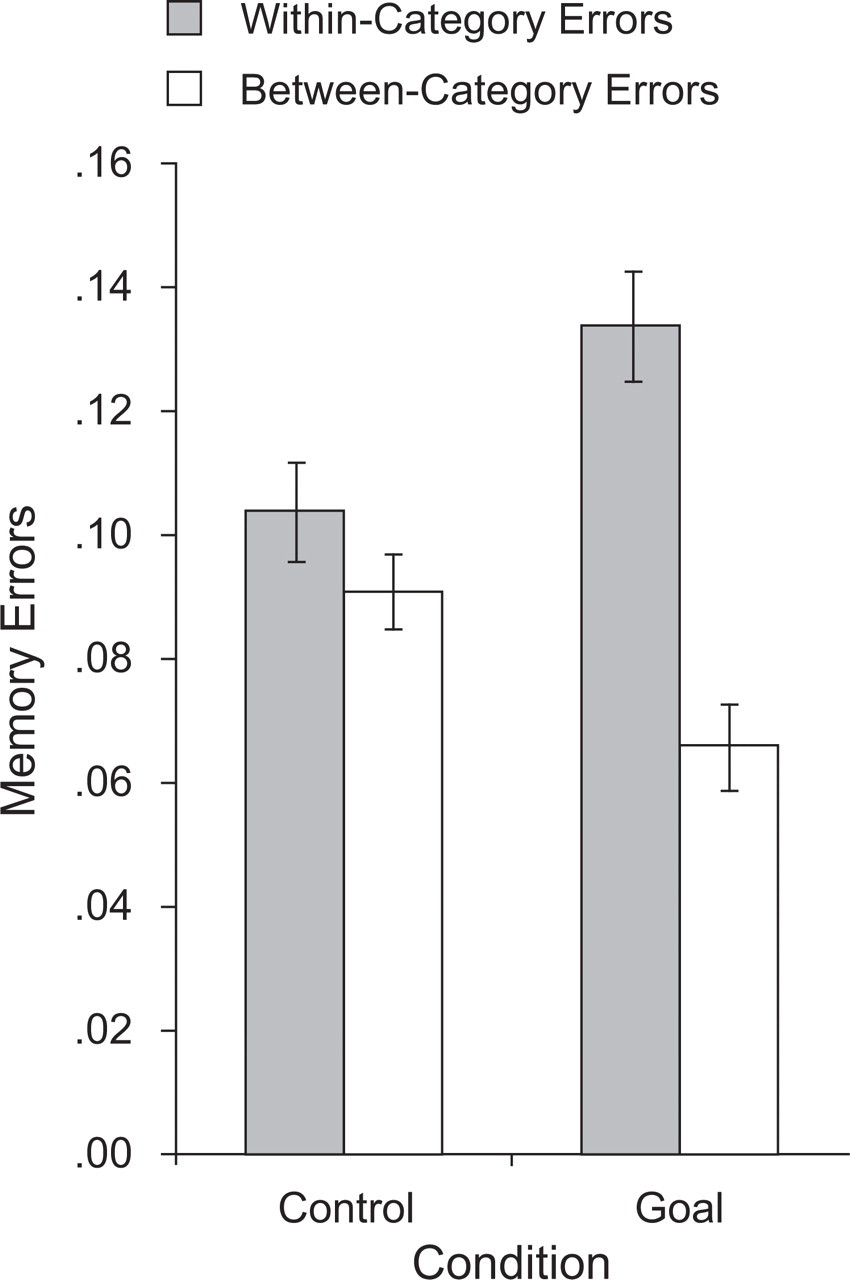
Mean proportion of within-category and between-category errors in the goal-priming and control conditions of Experiment 1. Error bars represent ±1 SD.
When a goal was subtly activated, individuals used others' goal instrumentality as the basis for social categorization, as indicated in the higher proportion of within-category errors in the goal-priming condition.
EXPERIMENT 2
Experiment 2 replicated Experiment 1 in another goal domain and further disentangled goal instrumentality from other links between significant others and goals (e.g., others' goal success or shared goals). Relying on the long-established finding that members of the same social category are perceived as more similar to each other than are members of different social categories (Billig & Tajfel, 1973; Campbell, 1958; Tajfel, 1969, 1978), we examined whether instrumentality for a primed achievement goal would lead to changes in perceptions of the similarity of significant others. If goal activation leads instrumentality to become a meaningful category, goal-primed individuals should see others within a given category (goal instrumental or noninstrumental) as more similar to each other than others in different categories are.
Method
Thirty-six students from a university research pool (13 men and 23 women) participated for pay. In Session 1, they completed a computerized goal-instrumentality measure, modified from that used in Experiment 1, in which they provided the names of two instrumental and two noninstrumental others for each of several goals, including academic achievement and fitness. However, following a procedure in Fitzsimons and Shah (2008) designed to rule out variables that may co-occur with instrumentality, in this task we asked participants to name others who were instrumental for the goal (e.g., achievement) but did not share the goal (e.g., were not fellow students or achievement-oriented themselves). Participants then rated the extent to which the nominated others themselves were successful at achievement and felt that achievement was important on scales ranging from 1, not at all, to 7, extremely. 3 Next, participants listed all of their significant others, completed fillers, and completed a lexical decision task, which served as the subliminal goal-priming task. In each of 64 trials, participants pressed one of two keys to indicate whether a presented on-screen target was a word or nonword string (Meyer & Schvaneveldt, 1971). Before each lexical decision, a foveal prime appeared (for 13 ms) between letter-string masks (500 ms). For participants in the goal-priming condition, half of the trials primed one of two achievement-related words (achieve or succeed). For control participants, all trials primed nonword strings. Next, participants answered a one-item measure of similarity, “How similar are person X and person Y?” on scales ranging from not at all, 1, to extremely, 7, for 12 pairs of others: The 6 items critical to our hypotheses compared similarity perceptions of the two achievement-instrumental others, the two achievement-noninstrumental others, and the cross-achievement-category pairs. To ensure that the effect was specific to the activated achievement goal, and to distract attention from achievement, participants also completed 6 items rating the similarity of instrumental or noninstrumental others for fitness goals. Finally, participants completed a funneled debriefing (Bargh & Chartrand, 2000).
Results and Discussion
Awareness of Prime
No participant reported seeing achievement words in the subliminal task or suggested any influence of that task on their similarity ratings.
Main Analyses
A repeated measures ANOVA, with priming condition (achievement goal or control) as a between-subjects factor and category comparison type (within category or between category) as a within-subjects factor, was performed on the mean similarity ratings of achievement-instrumental and achievement-noninstrumental others. There was no main effect of priming condition (F < 1, p > .4), but a main effect of category type emerged, indicating that within-category pairs (M = 3.54) were rated as more similar than between-category pairs (M = 2.82), F(1, 34) = 5.33, p = .03.
As predicted, a significant interaction between condition and category type emerged, F(1, 34) = 8.21, p = .007. As shown in Figure 2, the pattern supported our hypothesis that social categorization effects would emerge in the goal-priming condition. Control participants did not differ in similarity ratings (F < 1, p > .7). Goal-primed participants, however, rated within-category pairs as more similar than between-category pairs, F(1, 19) = 16.69, p = .001. The goal prime increased similarity ratings of within-category pairs, F(1, 34) = 6.17, p = .02, and decreased similarity ratings of between-category pairs, F(1, 34) = 4.28, p = .05. 4
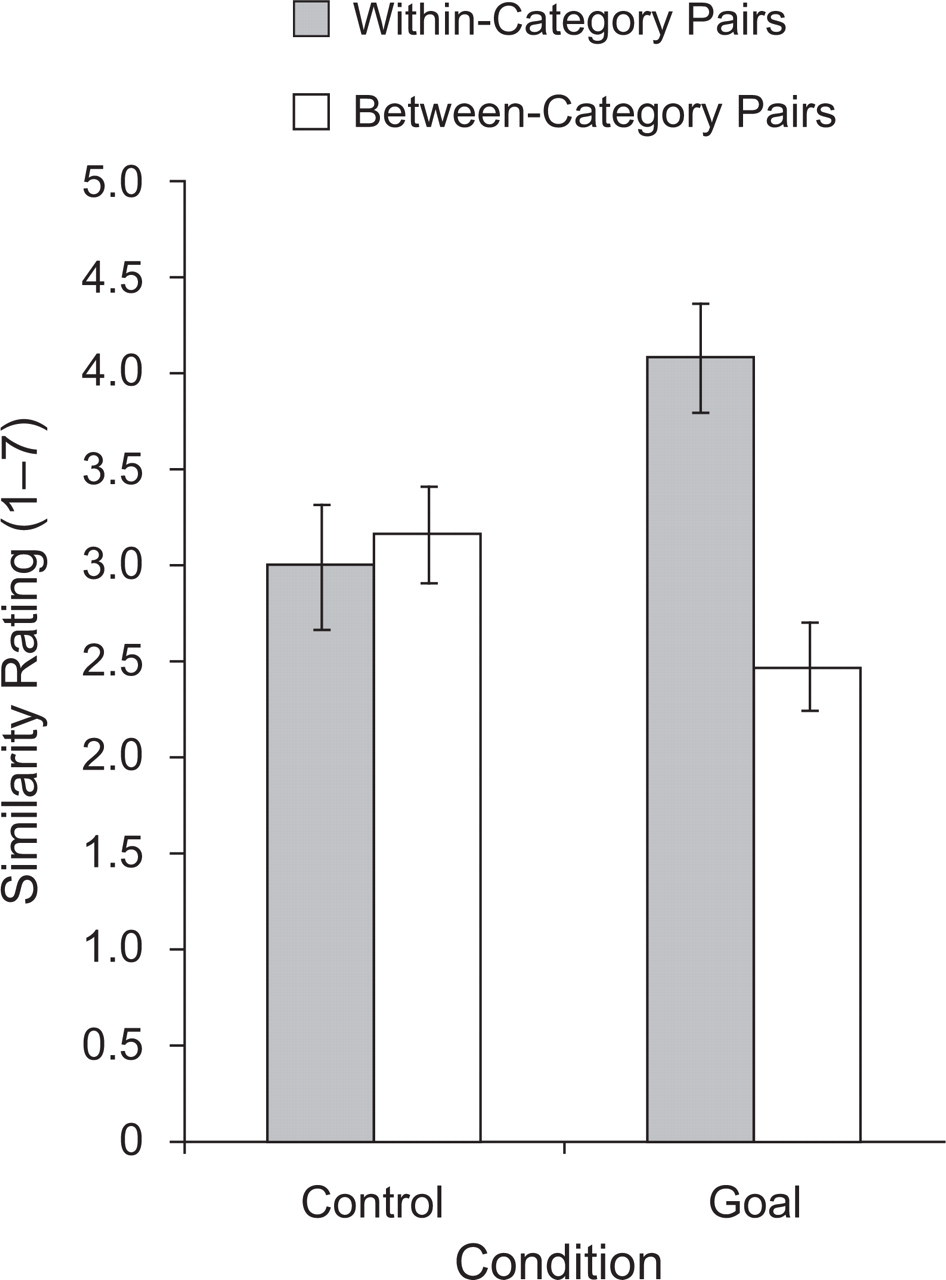
Mean similarity ratings of within-category and between-category pairs among participants in the goal-priming and control conditions of Experiment 2. Ratings could range from not at all, 1, to extremely, 7. Error bars represent ±1 SD.
When an achievement goal was subliminally activated, individuals used others' achievement instrumentality as the basis for social categorization: They saw greater similarity within the instrumental group and within the noninstrumental group and less similarity between members of opposite categories. Because participants nominated others who did not share the achievement goal or context (and controlling for others' goal importance and success had no effect), this study helps to disentangle instrumentality from other variables that quite likely co-occur in everyday life.
GENERAL DISCUSSION
These findings demonstrate that goals shape both basic relationship cognition (how people mentally represent ongoing relationships) and social categorization, suggesting the usefulness of integrating goals into the study of social categorization. Although past research has demonstrated that features of targets, such as race and gender, shape social categorization (e.g., Taylor et al., 1978), our findings are the first to demonstrate the influence of goals on social categorization and to show evidence for a new type of social category: goal instrumentality. Across the studies, we accumulated evidence that instrumentality produced these effects—we controlled for other links between instrumental others and the activated goals, such as perceptions of the importance of the goal to the other, and showed that the effects were limited to those others instrumental for the primed goal only, not for other important goals.
Furthermore, we showed that active goals led to categorization based on complex relational associations (Andersen & Chen, 2002; Baldwin, 1992), supporting the theory that social categorization reflects not only individual information (e.g., race and age) but also information about the relationship between perceiver and target (A.P. Fiske, Haslam, & Fiske, 1991).
These findings also highlight the usefulness of integrating studies of goals and social relationships. Personal goals may affect how people feel about others, and relationships may affect how people pursue their goals. Indeed, the role of relationships in goal pursuit is a rich and underexplored topic, the study of which will greatly increase our understanding of successful goal progress.
Footnotes
1The two groups (fitness instrumental and noninstrumental) did not differ in gender, age, or length of friendship. Instrumental friends, predictably, were rated as fitter (M = 4.97) than noninstrumental friends (M = 4.63), on a scale ranging from 1 to 7; controlling for this variable did not affect the results.
2Results were identical if the analyses used total errors instead of proportions of possible errors (total errors: M control-within = 5.00, M control-between = 6.54, M goal-within = 6.44, M goal-between = 4.74).
3Controlling for these variables did not alter the results.
4The same ANOVA was performed on similarity ratings of fitness-instrumental and noninstrumental others, to determine whether effects extended to all instrumental others. The interaction was not significant (F < 1, p > .8), indicating that instrumentality for the specific primed goal produced the effect.