






Abstract
Scotland is often seen as a good example of a civic/territorial rather than an ethnic/cultural form of nationalism. From the 1970s the campaign for a Scottish parliament stressed an inclusive, residence based, civic sense of being Scottish, and more recently, Scotland's political elites have seen the new parliament as an endorsement of territorial belonging. How valid are these assumptions? To what extent is political ideology at odds with people's sense of their national identity? Using a qualitative approach, we explore different identity claims currently being made in post-devolution Scotland – those based on blood, birth and belonging. We argue that these are better conceptual tools for the purpose of unravelling the complexities of identity politics in this context than the contrast between civic and ethnic. Our data come from the Scottish part of a study in England and Scotland, and focus on three sets of respondents: English migrants to Scotland making blood or birth claims to Englishness and/or Britishness; English migrants making belonging claims to Scottishness; and Scottish nationals making claims for themselves as well as assessing migrants’ claims. We also explore the significance of constitutional change in the context of respondents’ identity negotiations, and examine whether it has affected their understandings of Scottishness.
Introduction
The vocabulary of nationalism frequently involves comparison between civic/territorial forms and ethnic/cultural forms. In Jonathan Hearn's words: ‘It has been common to make a distinction between “ethnic” and “civic” forms of nationalism, the former involving beliefs in biological and cultural essentialisms, and the latter involving commitments to ideas of citizenship and the rule of law’ (2000: 7). The distinction is not simply a matter of political rhetoric (frequently, civic ‘good’; ethnic ‘bad’), but of academic analysis. Thus, Rogers Brubaker (1992) has argued that whereas in France citizenship was based on ‘ius soli’ – literally, the law of the soil, a territorial jurisdiction, in Germany, it was historically based on a community of descent, on ‘ius sanguinis’ – the law of blood. On the face of it, the Scottish case seems to provide a good instance of the former, a civic, residential basis for belonging. From the 1970s the campaign for a Scottish parliament stressed this inclusive, civic sense of being Scottish, and political elites have seen the new parliament set up in 1999 as a celebration and endorsement of territorial belonging. This is a view which runs across the political divide in Scotland, including the Scottish National Party. Here, for example, is a comment from a prominent nationalist politician, currently a Westminster MP:
Scotland is a country with many different peoples from many different backgrounds. We are described by one of our most famous writers as a ‘mongrel’ nation. We are a mixed country, people from all kinds of backgrounds, that's the kind of Scotland that we are hoping will flourish. We believe it will only flourish with independence. One of the sources of great pride for the SNP is the fantastic support we receive from the Scots Asian community, people who have moved here from Pakistan, India and Bangladesh. (SNP spokesperson, Angus Robertson, 7/5/1999 – Broadcast on Radio Free Europe)
This appeal to social inclusion extends to the largest ‘minority’ in Scotland, those of English birth, who number 8 percent of the Scottish population. The SNP has made a pitch for what it terms ‘New Scots’, nicely captured in this comment:
Fellow Scots! It gives me great pleasure to welcome you all here tonight. And when I say fellow Scots, I include all those categories excluded by Sir Nicholas Fairbairn 2 . And I also include all our English friends who live among us, and who have chosen to throw in their lot with us, more than a few. (Chairperson, SNP meeting, Brechin, 7/4/92 – originally cited in Reicher and Hopkins, 2001: 165)
These statements from Scotland's political elites downplay birth as a marker of Scottish identity, while highlighting issues of ‘belonging’ based on residence and commitment to Scotland. We have examined elsewhere the process whereby commitment may lead to both self-identification as Scottish and acceptance by others of an acquired Scottish identity rather than one ascribed by birth and or ancestry (Bechhofer et al., 1999 and Kiely et al., 2001).
How valid are such assumptions? To what extent is political ideology at odds with what people in Scotland actually think? Take, for example, this piece of survey evidence in 1997 from the Scottish Election Study (see Table 1 below).
Question: ‘How important/unimportant is each of the following to being truly Scottish?’
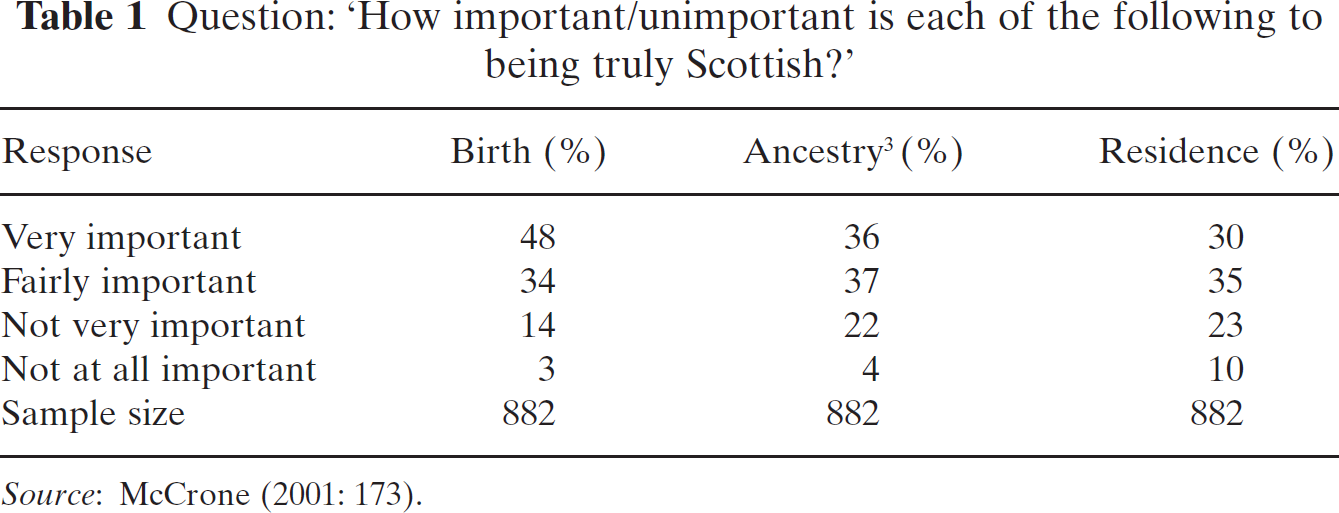
Source: McCrone (2001: 173).
A straightforward reading of this table suggests (a) most people treat all three criteria as important; and (b) that birth and ancestry matter marginally more than residence. It is true that as many as 65% say that residence is important, but it lags behind birth and ancestry as a criterion of being ‘truly Scottish’. One might expect that those who place emphasis on residence, which
we might take as a ‘civic’ marker, would downgrade ancestry, an ‘ethnic’ marker, but in fact this does not seem to be the case. Among those who say residence is very important, four in every five (80%) say birth is very important and two-thirds (67%) say ancestry is very important. It seems, then, that those people who rate one of these criteria as very important tend to rate the others similarly. On reflection, perhaps, this should not surprise us.
One cannot simply add up criteria of Scottishness so that one person is more Scottish than another. Most people going about their daily lives do not find it necessary to stack up degrees of Scottishness. When called upon to make the claim for themselves or judge that of others, it is sufficient that they are able to mobilise one or more markers appropriate to the situation. In addition, in the survey question used in Table 1, the phrase ‘truly Scottish’ further muddies the waters somewhat because it invokes an ideal type and thus stringent criteria which in everyday life may not be necessary.
It might seem reasonable to map ‘residence’ on to ‘civic’, and ‘blood’ and/or ‘birth’ on to ‘ethnic’. There is, however, a conceptual difficulty, for there is something of a false dichotomy involved. As Hearn comments:
The difference between a useful distinction and a misleading dichotomy can be difficult to discern, and this is so for both civic versus ethnic, and liberal versus communitarian constructions of reality. Minimally, we should bear in mind that what these conceptual pairs ultimately define is opposing styles of arguments about what nations are and how social values are created, rather than actual types of nations or societies. (2000: 194)
This raises two issues. First, to contrast ethnic with civic conceptions is to oppose ideal types. When markers of identity such as birth, ancestry and residence are used in practice they may not be seen as representations of either civic or ethnic identity but rather a subtler combination of the two. Secondly, many people in Scotland recognise that what the question presents to them are key ‘identity markers’, and are happy to rate them in terms of importance. This is, however, an area where survey results do not tell the whole story. The praxis of ‘doing Scottishness’ involves claiming Scottishness or accepting a claim for the purpose in hand in a particular context. The survey is not the appropriate methodology with which to investigate the subtlety with which these markers are used, their deeper meaning for people, or the rules for operating them (see Bechhofer et al., 1999, and Kiely et al., 2001). As we shall see, our qualitative data, which are admittedly drawn from a somewhat more restricted sample than the national representative one used in the Scottish Social Attitudes survey from which the data in the above table come, show a different picture because they derive from a very different research process. Therefore, using a more qualitative methodology, we explore in this paper different types of identity claims which we find empirically are currently being made in post-devolution Scotland – those based on blood, birth and belonging.
The first claim we have termed that of ‘blood’. This is an identity marker of Scottish ancestry, which is linked to birth, but is retrospective, referring back to the person's forebears, rather than forward to their upbringing. In the survey question in Table 1, ‘ancestry’ alluded to parents and grandparents, though obviously the term can include previous generations. It can even imply that certain understandings of Scottish culture and primordial feelings of attachment and commitment are longstanding, and even innate.
The second claim, based on being born in Scotland, whether of Scottish or non-Scottish parents, is prospective, links birth to upbringing (‘born and brought up’, as the phrase has it), and treats ancestry as unimportant at most or irrelevant. What is important to this claim is that upbringing introduces aspects of cultural, linguistic and emotional attachment to Scotland through early socialisation, most obviously through schooling.
Finally, there are claims to Scottishness based on ‘belonging’. People can make claims to being Scottish because of a commitment they feel to Scotland. There may be all sorts of grounds for claiming such a commitment, including birth and ancestry, but for our purposes here their importance is dismissed or played down. The key markers for belonging claims are demonstrable forms of commitment and contribution to the country. They usually rely upon residence, as a result of which cultural aspects and feelings of attachment and commitment to Scotland are acquired through late rather than through early socialisation. Recognition as a Scot may result primarily from choosing to be one; in other words, living the identity, even if, as we shall see, seldom explicitly or definitively claiming it.
For these reasons, we suggest that blood, birth and belonging are better conceptual tools than the contrast of civic and ethnic for unravelling the complexities of identity politics in post-devolution Scotland. Despite describing blood, birth and belonging as distinct types, they may well be inter-related in practice. People may mix different markers together in what on closer examination turns out to be an appropriate way. They may even follow different procedures when claiming, attributing or receiving identities, and recognise that others they interact with do identity differently. That degree of flexibility still does not fully capture the complexity we encountered in our respondents’ accounts. However, our greater understanding of this more fluid approach to conceptions of identity allows us to go beyond our previous work in emphasising that the rules of national identity (Kiely et al., 2001) must always be seen as being applied flexibly in a manner appropriate to a particular context.
Methodology
Our data come from the Scottish part of a qualitative study in England and Scotland 4 based around repeated interviews with panels of respondents, something more common in quantitative studies. The panel composition has been critical. In Scotland we recruited ‘Scottish nationals’, people born and still living in Scotland, as well as ‘English migrants’, people born in England but now living in Scotland, with a length of residence ranging between one and sixty years. 5 These two groups allow us to tap into a range of claims involving blood, birth and belonging.
The interview extracts used here come primarily from the first wave of interviews in 2001, shortly after the setting up of the Scottish Parliament, when we interviewed 72 migrants and 60 nationals, recruited in two distinctive contexts, a large urban centre, Glasgow, and a small rural town, Crieff. The majority of nationals were chosen at random from the Electoral Register. A minority of English migrants were recruited that way, while most came via associational and occupational groups, advertising in the local media, and snowballing from those already interviewed 6 .
The topic-driven, conversational interviews lasted, on average, 1.5 hours, were tape-recorded, transcribed and entered into Hypersoft – a computer package that aids qualitative analysis. We followed procedures of repeated reading and tagging extracts that highlighted a particular issue. The extracts have been examined to agree on their interpretation and so as not to do the respondent an injustice. The analysis was strengthened by systematically searching for counter-examples: respondents whom we may have expected to express a particular view, but who did not, or those that we may have expected to disagree, but did not. Our use of counter-examples is demonstrated later in the paper.
We discussed a wide range of topics with respondents, primarily around questions of local, national, and state identity, varying the contexts both for themselves and others, as well as discussing issues relating directly to constitutional change. In this paper, we will discuss the approach to blood, birth and belonging of three groups:
English migrants who continue to make blood or birth claims to Englishness and/or Britishness English migrants who make belonging claims to Scottishness and Scottish nationals making claims for themselves as well as assessing such claims made by English migrants. We start by looking at their own claims.
Scottish nationals on their own national identity
In our interviews with Scottish nationals, we used various ways of getting at what made them and others Scottish. These included: asking direct questions, examining nationals’ own claims to Scottishness, looking at examples of how they attributed national identity to others, and how they accepted or rejected the claims of others. By definition, some nationals could make blood claims to Scottishness, while others could only make claims on grounds of birth as they didn't have Scottish ancestry. What was striking was that even those who could make a blood claim seldom did, preferring instead to claim Scottish birth and upbringing. They almost always used the birthplace marker, confirming what we had found in previous research that it is generally the strongest card to play, and sufficient for the purpose in hand (Kiely et al., 2001). It was often supported by markers of belonging but seldom supported by those of blood. We should emphasise however that blood and ancestry remain valuable concepts in the study of national identity. Claims based on blood can be found among certain groups of Scots. For instance, in a previous study 7 we found rather more comments about Scottish identity being based on blood and lineage among a small if influential group – the landed elite in Scotland.
English migrants: birth and blood claims
As regards their sense of national identity, many English migrants chose to talk in terms of Englishness and/or Britishness. Indeed, many chose to use both terms, and altered their frame of reference according to the particular context being discussed. For some, Englishness was used when discussing family, history, language and sport, whilst Britishness was invoked when talking about the media, politics or issues of geography. Some English migrants, rather than differentiating according to context, tended to use Englishness and Britishness interchangeably. This is in contrast to the vast majority of Scottish nationals for whom national identity related primarily to being Scottish, with Britishness usually reserved for state identity and related issues of passports or formal citizenship. 8
Conceptions of national identity and the way identity is deployed shift as the context changes. This makes eliciting and understanding migrants’ processes of national identity construction more complex. For many migrants, English national identity was something which they felt they and their fellow English in general had difficulty articulating and to which they attached little importance or pride. For example:
9
: There's more of a sense of Scottishness [in Scotland]. In England it doesn't mean anything to be English. I don't think I thought that much about being English. I've never really thought about it before but I do think that the English don't have a strong sense of Englishness.
It appears that, to many, Englishness is largely construed in terms of its absence or weakness.
I think it's a peculiarly English trait. I find it quite frustrating that we, the English, I, as an Englishman or the English, as a generic group of people, probably don't have an identity that you're proud of. We don't kind of have a heritage that we're proud of.
Given this weak sense of being English, did our migrants think they could become Scottish? The vast majority of our English migrants to Scotland did not make belonging claims to being Scottish, despite the fact that many regarded Scotland as home and had no plans to leave. They spoke of what prevented them from being Scottish, and then went on to articulate what made them English. We used the prompt ‘Can you become Scottish?’ to see how migrants conceived of Scottish identity and the possibility of changing one's national identity. The question turned out serendipitously to have the added value of making manifest their more elusive sense of Englishness, because it implicitly required them to articulate their taken-for-granted Englishness. The examples that follow were either collected around this topic or come from rarer occasions where English migrants provided more spontaneous accounts of their Englishness.
For the majority of our migrants, their English nationality was essentially a fact of birthplace, for many, simply an accident of birth, and not something to which they attached importance or pride. Ancestry seldom figured in their ideas of national identity and was never prioritised over birth.
I'm just aware that I was born in England so I'm English only through my birth. Nationality is really an accident of birth. I don't see it as something to be ashamed of but I don't see it as something to be terribly proud of.
For Scots, birth tends to be linked to upbringing (as in ‘born and brought up’), and these in turn to a stronger sense of and pride in culture, attachment and commitment to place. Migrants, when talking about England, made fewer connections than Scottish nationals between birth and early upbringing on the one hand, and a sense of attachment and commitment to place, on the other. Because for migrants of this turn of mind, nationality and identity derive strictly from birth, it could be that most English migrants found it impossible to conceive of themselves as Scottish, however much they wished to do so; it was literally unthinkable. Many saw it as tantamount to claiming a false identity.
A small atypical minority did go further, seeing Scottish national identity as deriving from blood as well as birth, strongly so in the case of C24 below and by implication through the clan names for C03.
I wouldn't want to be perceived as being, trying to adopt something that didn't belong to me and I think Scottishness is something you're born to through generations. I think you can certainly adopt a fondness for the culture and you can admire it and criticise it and pick the best or the worst as you perceive it to be but you can't become Scottish. Can I ask why you don't think that you can claim to be Scottish? Because I'm being honest. I like being here, I like being associated with the people but I don't like to go out into the street and say ‘Yeah, I'm a better Scot than you.’ Because people could quite rightly turn round and say, ‘You're an Englishman.’ So it's because of your place of birth that you can never think of yourself as being Scottish? Not really, because I think it goes back to where you were born. It doesn't have to be I suppose but I think if you are here, born in Scotland and your name is Mc-something it's 10:1 you'll have a tartan attached to your name and you can find lists of them. So people can go ‘Oh aye, he's a McDiarmid or he's a Cameron’ and you can practically then identify it with a part of Scotland also, that the name historically came from. There's no sense that because you're living in Scotland, you're then Scottish? Not really, I live the Scottish way, let's put it that way but that doesn't make me a Scotsman. Even if you might choose to want to make that claim? (Pause) There's a possibility that could be so but to me if you were to cast it down in writing there's an element to it not being true. If I'm writing a thing down it should be factually correct.
Although birthplace is taken to be the key marker of national identity, the above respondents evidently, and ironically in the light of what Scots themselves believe, see ancestry as an integral part of being Scottish. They also connected ancestry with territory and a powerful association with place over time. For this very small minority, it is not just their English birthplace which prevents them from becoming Scottish; it is that they cannot call on ‘past generations’ evoked especially in a name and clan which acts as either a straightforward proxy for ancestry or indirectly through strong associations with place.
The profound significance of ancestry to a few migrant respondents is revealed when, C24 above, describes how she, and in her view, others, see the nationality of her Scots-born children.
I still see my children as being English, in a Scottish environment. I think my English friends see them as being Scottish in a Scottish environment and I think the Scots would perceive them as being English in a Scottish environment, because English people don't know what Scotland is, they don't know all about it. Even if the children, having been born in Scotland, brought up, schooled and continued to live in Scotland, you wouldn't tend to think of them as … ? ‥ No, only for humble reasons. I wouldn't want to, I don't know, I suppose we, I wouldn't want to adopt something that I didn't think was ours by right and I think Scottishness is … I think we respect it so much and we're so aware of it that it would be presumptuous to assume it without earning it. You have a sense that ancestry, family connection is as important if not more important than where your children were born? Yes.
In short, for her, Scottish national identity is defined by blood plus birth, rather than simply birth and upbringing. Her focus is on what has preceded her children's birth rather than where they are born and brought up. It is perhaps significant that this respondent's views did not derive from close involvement with Scots. She numbered very few Scots in her network of friends, especially Scots local to Crieff.
Her view is, however, held by only a small minority in our sample. Looking at migrants whose children had been born and brought up in Scotland, we find that almost all regarded their children as Scottish.
Our two kids, they're just Scottish. People say ‘oh gosh, (son's name)'s got a good Scottish accent there’. Is that how you would tend to think of the boys, as being … ? … Oh yes, to me they're Scottish and I don't think of them as anything else. In fact I think they'd be rather insulted if I did. C26: All my children regard themselves as Scottish. I don't think there's any doubt about that and they all have Scottish accents. Both the girls think of themselves very strongly as being Scottish.
It seems that the majority of migrants attributed Scottish identity to their children because the children themselves thought they were Scottish, and their parents unproblematically accepted this birth claim made by their children. Significantly, from these accounts, it was clear that the identity marker of a Scottish accent was also an important element of most of these children's claims.
Were English migrants happy to see their children as Scottish? We found no examples of parents rejecting their children's claim to be Scottish, suggesting that the overwhelming majority were content, and that for them, a birth conception of Scottishness is the norm. It even provides indirect evidence that most also define Englishness in terms of birth rather than blood. No-one attempted to prioritise the importance of their children's English ancestry over their actual Scottish birth.
We encountered, however, a couple of examples where English migrant parents encouraged some recognition by their children of their English ‘roots’.
I'm quite happy about them thinking of themselves as Scottish. I'd like them to give me a mention from time to time but I feel this is their place. I guess they'll grow up being Scottish really but I want them to remember, know that they're English and (son's name)'s very aware. He says ‘I'm half English and I'm half Scottish’.
These respondents were fairly short-term residents of Scotland. For them, this modest counter balance to the Scottish claims of their children may have involved a perception that they might well return to England. These migrants may even have placed value on hybrid national identities as more ‘cosmopolitan’, something we aim to explore in our next round of interviews.
One migrant commented that having English parents and being brought up in such a home could dilute their child's Scottishness:
Our son will grow up thinking of himself as Scottish. He's going to grow up in Glasgow schools – that will be the environment that he'll grow up in. But then he'll grow up in a home with people who don't particularly think of themselves as being Scottish because they haven't come from here so it will be a slightly diluted form.
In general, then, migrants perceived Scots as holding a birth conception of Scottishness and it was also, in general terms, hard to find migrants who had a strong blood conception of their own English nationality, even as a secondary criterion to birth. One exception said:
I think of it as where you're born and your parentage. My parents are both English and I was born in England so that's clear cut for me….
Even this respondent, however, did not apply this to their own children's nationality:
… but already it's confused, perhaps, for our children because I'm quite happy about them thinking of themselves as Scottish.
In fact, in this case, this was what the children chose to claim, primarily on the grounds that they were born in Scotland.
How important are devolution and constitutional change as contextual factors in identity negotiation? On whatever basis they defined English national identity, constitutional change did not figure prominently in accounts of migrants’ own national identity. This was either because they did not care about such developments, or because they saw national identity as so fixed by birth that such developments could not have any effect upon their rigidly established English or British identities.
10
Constitutional change was seen as unproblematic by most of this group but a very small minority such as this next respondent felt that it might present future challenges rather than opportunities in terms of identity politics:
With the Scottish Parliament and devolution and things, it becomes quite, not threatening, but it's sad, really, because it's almost like you're being rejected which is probably a pretty dramatic way of saying it but I also don't see how it's going to work and what happens to people like us that are English, that are living in Scotland, if the thing is taken to its final end. It could end up being antagonistic. I certainly don't feel that at the moment but worry about the future.
To summarise our argument so far, the vast majority of our migrants, like the Scots nationals, defined identity in terms of where they or their children were born. A few conceived of their own English national identity in those terms, but believed that most Scots defined their national identity much more by blood.
English migrants: belonging claims to Scottishness
Migrants who made claims to Scottishness based on belonging had certain common characteristics. The claims were based upon lengthy residence – often they had lived for longer in Scotland than in England – which engendered a major sense of commitment to Scottish society: in other words, being Scottish by living the identity.
I don't think of myself as English at all. Really, I feel, as much as anything, Scottish, if you want to … because I've been here so long now, 35 years. My wife's been here longer than she lived in England. Our home is here now. We're not moving from here. I'll die here and, as I say, 3 of my children are living here and I identify with it. The charities I contribute to, the charitable things I try to do, are for Scotland. Scotland's given me a lot and I owe something. I'd probably say I was Scottish because I've lived here mostly … I have a stronger sense of being Scottish but then that's a culture thing. It's more the things you do, the people you see, the places you're used to going to, to the kind of lifestyle we lead. I think the Scottish way of life is slightly different to the English way of life. It's much faster down south unless you're in a really rural area, I would say. I find we have a lot more personal space in Scotland.
Our migrants commonly stressed living in Scotland out of choice, for instance saying ‘It's not just an accident of birth that I live here, I chose to live here’. Some explicitly commented that many ‘native’ Scots choose to live elsewhere, neither showing commitment nor making any direct contribution to Scotland.
If they wanted me to make my case, I think I've not come into Scotland, as many people do who were born here, and just pushed off to London as quickly as they could. Just because they happen to have been born here and I wasn't, I think I just demonstrated that. I'm quite happy with independence, I can't see Scotland can suffer from independence in any way.
Many said that Scotland and England are culturally different, and that they felt greater affinity with Scotland's culture. Some made belonging claims for their Scots-born children in cultural terms:
I wouldn't say I was truly Scottish, simply because I've no accent. I've no Scottish accent but I would say the children are because they talk more Scottish than us and because they've been to a Scottish school and with them playing bagpipes and the Scottish dancing, with them wearing tartan.
Children and partners were frequently mentioned by English migrants in their claims to be Scottish. In other words, although they themselves are migrants, they have produced through their children a new generation of ‘birth Scots’. This further contributes to their claim of belonging:
I feel so strongly that I am Scottish and that is possibly the only, and I'm just thinking, my kids are Scottish. You said have my kids made any difference, you know, my partner's Scottish, my kids are Scottish, in that case, I'm Scottish.
A key feature of belonging claims to Scottishness was the qualified and internal way migrants made them. Phrases like ‘I feel I am Scottish’ or ‘I think I am Scottish’ were used, but very rarely the definitive ‘I am Scottish’. Migrants also tended to temper their Scottish claims by saying that they weren't ‘true’ Scots or ‘real’ Scots.
I'm very proud that we live in Scotland even though I'm perhaps not entirely Scottish but I'd like to think of me as Scottish, because I do live here.
The qualified nature of their claims sometimes reflects a perception that Scots by birth or blood judge the claims to be weak:
I don't think we can say we're truly Scottish because we were born in England, we've still got that nationality, you know, originally, because you were simply born in England, you can't take that, you can't scrub it out and say you're Scottish. Once you've been born in England, they will still think of you as English.
Belonging claims to Scottishness, then, were seldom made definitively, because of a widespread perception that they could be challenged and rejected. This, in identity terms, would be a painful experience so, as often as not, the claim was not made at all:
You wouldn't feel able to say ‘I'm Scottish’? Well I'm not because I was born in England. I feel Scottish but I can't introduce myself as Scottish because of the importance of where you're born … I would feel that if I'm talking to someone that I don't know, they'll say ‘Well you haven't got a Scottish accent so you can't be.’ It's as if you're claiming something for yourself to make yourself socially acceptable. So I wouldn't tend to do that. I would say that I'm from Glasgow and I would say that I've lived in Glasgow for x years. But I wouldn't say that I was Scottish because if you met someone in an argumentative form of mind, they'd wonder why you were saying that when you didn't sound Scottish … I like not to get into an argument and I don't like to leave myself open to an argument. I might say as a joke that I'm a naturalised Scot because then they can identify with that because they can see the point of you wanting to be Scottish and not wanting to be English, because they can't imagine anyone wanting to be English. (laughs) G14: I've been in Scotland longer than I've been in England so this is home and it's where I spent all my adult life so I kind of identify myself as Scottish but I know that I have no right in the eyes of Scottish people to identify myself as Scottish … a large proportion of me thinks I'm Scottish or relates, yeah, I can never call myself Scottish because I'm not Scottish but I feel Scottish. If that makes sense. You say that you could never claim to be Scottish? Uhuh. Even though you yourself feel that sense of identification? Yes, because other people in Scotland wouldn't accept me as being Scottish. I would be making almost a false claim in the eyes of other Scottish people … To all intents and purposes I am Scottish and I would say that to people. I feel Scottish, you know which is very different from saying ‘I am Scottish’. To say ‘I am Scottish’, I probably wouldn't say that but I am to all intents and purposes Scottish. There's a difference between those two statements and I would be wary of the ‘I am Scottish’ and I think that's because it lays myself open to being told I'm not. I don't want to be told I'm not and therefore I don't.
That it is the possible rejection by Scots that prevents migrants from claiming Scottishness is further evident from this comment made by G14:
When I go to France, if someone says ‘You're English?’ I'd say ‘no, Scottish’. I wouldn't bother with a life story the amount of French that I have (laughs). You'd tend to say that you were from Scotland? I would say that I was from Scotland, I'm Scottish, because no one can catch me out because they don't know the accent.
When researching national identity, counter-examples often prove to be revealing. Consider this comment from a migrant who makes a firm claim on the basis of belonging, and in turn is dismissive of birth claims:
I regard myself as Scottish now. I live here, I work here, I'm planning to spend the rest of my life here so I certainly wanted a vote on it (Scottish Parliament), yeah absolutely. I wasn't someone who was only going to be here a couple of years and buggering off again. And the issue of who is or isn't Scottish is very much, for yourself, bound up with notions of residence and, in a way, commitment to a place. C45: Yes, yes absolutely. Rather than issues to do with place of birth? Yes, place of birth has got nothing to do with it. It's where you are now and are you planning to stay there.
What gives this person the confidence to do this is having encountered Scots accepting belonging claims as well as simply hearing Scots advocating them:
I mean at work, the ones who are the SNP hard-liners and activists treat me as Scottish as well. Because when we have our debates in the coffee room they say ‘But yeah you're Scottish. You're working here, you're living here, your roots are now here, you want to stay here so you're as Scottish as we are. We are not against people like you, we're against people who are using Scotland for their own ends.’ sort of thing. So I think, even hard-line activists don't treat me like an incomer or whatever.
That the firmness of this respondent's claim was so unusual may indicate that she was atypical in the strength of support she got from those receiving her claim.
Constitutional change does figure prominently in the example above, as it does for some others. For them, devolution presented an opportunity to strengthen their belonging claims to Scottishness, while independence has the potential to reshape the ruling conventions of Scottishness, in such a way that belonging claims to Scottishness are legitimised through formal Scottish citizenship.
Two migrants, making tentative claims to Scottishness, saw devolution as providing a context in which their sense of Scottishness is less problematic:
At the time of the vote for Parliament, did you ever have any sense of thinking ‘oh, is this a Scottish issue? Is this something I shouldn't have a say in?’ No. No. I am Scottish. No. I'm changing my language here. In that context? In that context, very clearly, I am Scottish. I would have a right to vote. It is my Parliament, I am part of Scotland and it's part of me.
This is the migrant who distinguished between feeling Scottish and definitively saying ‘I am Scottish’, only doing so when abroad and in the context of devolution where votes are indeed based on residence, not birth or blood. Another respondent developed this idea further.
Was there ever a time where you thought ‘is this a Scottish issue? Do I have a vote on this or a role in this or not at all?’ G44: Oh yes, I feel Scots, in that sense. Oh quite clearly, yes, uhuh. Yes, I don't have a problem about that. I don't feel separate in that way at all.
(Later in the same interview)
Do you feel a sense of your national identity, nationality, having changed over time? I suppose so. Yes, I suppose it has to, particularly over the thing about Devolution. I've said that's changed quite a bit and that's quite a significant change because it is more of a, not just a personal ‘I'm happy here’ but it's more of a commitment to something bigger than that, isn't it? So I suppose it has changed, yes. And you feel that connection between your sense of identification personally and with almost that as a, I don't know, project? I think so. I've moved along with it, is what I suppose I'm saying.
The potential which the changing political context has for changing the meaning of Scottishness was brought into sharper relief when migrants reflected on full independence, and how it might affect their sense of national identity. Again, these migrants had already made tentative claims to Scottishness:
I would have to feel happy that my affiliations with Scotland were strong enough, that if somebody said to me ‘well how can you be Scottish with an accent like yours?’ I would be able to substantiate that…. If Scotland went independent and I took out a Scottish passport, which I would certainly do and somebody said ‘how can you be Scottish with your accent?’ I'd say, ‘well as far as I'm concerned, I committed myself to Scotland by taking out a Scottish passport and that makes me Scottish.’ And that's stamped on it. Ironically it (Scottish Independence) would mean I would have a Scottish passport because I would be Scottish according to the last set of rules they pulled out. It's that sort of thing that I'm interested in.
I: Would that be something you'd feel quite positively about?
I would, yes. It would perhaps give me the legal right to say that I am Scottish, wouldn't it?
These accounts help to convey that these migrants already feel and live out one form of Scottishness but are looking for external acceptance or legitimation of identity based upon belonging. If, for example, Scottishness was based primarily on citizenship, obtained through a period of residence, then this has the potential to provide such legitimation. In the medium term it is likely that this would create, perhaps confusingly, two kinds of Scottishness – a legal, formal civic kind, and another kind based on birth or blood. Whether such a dichotomy could endure is of course an empirical matter.
Scottish nationals on the identity of migrants
How then did Scottish nationals attribute identity to and receive claims from others, especially migrants? We asked our nationals whether migrants could become Scottish. The most common response was to deny that it was possible. Some could not even comprehend that anyone would want to claim a nationality other than one based on their birthplace. It is a dramatic confirmation of the salience and importance of Scottish identity to Scots that they see it in this way.
Do you think people would want to claim to be Scottish if they weren't? (laughs) Certainly if I was in that position, I would certainly claim to be Scottish. I don't think there's any point in claiming to be something that you're not. I think if somebody was born in England, they'd always class ther-selves as English. Well personally, I was born in Scotland. There is no way I'd ever class myself as being English or British. I'm Scottish.
Scottish nationals tended to conceive of their own Scottish identity and national identities more generally as a matter of birth, and to a much lesser extent belonging. They also believed, as we have just seen, that others ‘do identity’ in similar ways to themselves. It seems likely that claims by migrants based on belonging would be rejected by most nationals, given the emphasis they placed on birth. Consider this national's comment:
They can't become Scottish, they can be integrated into a Scottish community. I think that's fine but as far as becoming Scottish. To go back to what I said before, not that generation but then the next generation. So if their kids are born in Scotland, if they choose to become, I think that's fine.
This national clearly challenges the right of a first generation (non-birth) belonging claim to Scottishness, yet unproblematically sees the next generation as having full rights to (birth) claim Scottishness, should people wish it. There is, however, a belonging element involved, given the active choice to commit to Scotland. This was the majority view of our nationals when assessing the nationality of migrants’ children born in Scotland. A number of nationals said that migrants to Scotland might see themselves as Scottish but they would not share this perception. For instance, they drew attention to the way that migrants’ accents contradicted and undermined their Scottish claim.
The following quote however suggests that although a national may not conceive of Scottishness in a belonging sense, some would not, by and large, publicly challenge it.
Become Scots? I would say no, myself, but there are certain people I've met, from other countries, that they just seem to fall in love with Scotland and they've been here for quite a few years and they like to sort of think thersel as Scots and I wouldnae knock that. I would accept it but I think deep down, I would accept it to their face but I think deep down I would say to masel ‘well he wants to be Scots, he loves it up here’ and I wouldnae knock but he'll never be Scots.
Someone making a belonging claim, then, would not necessarily have it challenged or rejected overtly by Scottish nationals. Such claims, as we showed earlier, tend to be of a qualified nature reducing the likelihood of overt rejection and indeed we have no examples of it occurring.
A small minority of nationals, however, were willing to a degree to accept belonging claims. Some did so with reservations. For example, it would apply only in very specific personal circumstances such as coming to live in Scotland at a very young age, or attempting to erase a negative experience of living elsewhere:
From an early age, yes. I don't think if they're in their 20s and 30s and they move up here, and they're up here for another 20 or 30 years then they are still English more than Scottish. I think your first years, up to 10 years old or so, really is where you learn about where you live and the culture you live. If you didn't have a strong association with wherever you did come from to start with, I suppose it would be, over a lot of time. Yeah, I suppose so but then you'd have to have presumably not a lot of pride in wherever you did come from, to be willing to become Scottish, I think.
Accepting the claim of migrants to be Scottish also depended on context:
Do you think it would be possible for someone to become Scottish? Absolutely. John (pseudonym), the English guy, he's English but his father was Asian and he becomes more and more Scottish every day. He's just basically one of the boys and the only time basically it's remembered that he's English is when we play them at football and that's it, suddenly John's English again. But his accent has even changed, he's as Scottish as anyone else, because now he's lived here for this long that this is his patch as well. Would he, in any way, describe himself as being Scottish? He probably could do if the boys didn't remind him, at times, as I say, usually sporting times, that he was English. He probably could do. Put it this way, to his mates in Bradford, he's like Scottish John. They'll wind him up about his accent or just the way that he talks and does things because he does things Scottish, stupid things. Aye, to his Bradford mates he's became Scottish John but to us he has became Scottish John but really he's still English John, I know it sounds daft but (pause) (laughs).
Another form, of accepting belonging claims with reservations, depended on creating a kind of half-way status:
I mean, residence, is that significant, in terms of … ? Well you're an adopted Scot then, aren't you? You've adopted the country. And in Scotland, residence confers adopted Scots … ? … Adopted Scots status, because you're no’ truly a Scot. Because truly a Scot … ? … is born here, it's as simple as that.
There are, however, instances where nationals accept unproblematically claims based on belonging:
I think that people can. I'm sure, I mean, a couple of authors was it come up here and wrote Scottish history books and they've probably lived up here most of their life. They have a bigger interest in Scotland and know more about Scotland than most of us do so why, if they feel Scottish, who am I to tell them that they're not. Who am I to say ‘no, no, you're no Scottish, you werenae born here.’ So living here, taking an interest in a particular place, residence and a desire to want to claim to be … ? Yes, that's what people will do. I don't have a problem with people doing that. If somebody then said to you, ‘I'm proud to be Scottish’ but said it in what might be perceived to be an English accent, would you think that was an unusual claim to make? G02: No, I don't, I don't have a problem with that. If people come up here and they love it, they're quite welcome to it. I'm sure there's a lot of folk that have maybe come up or come from somewhere and after so many years, just think that they are Scottish and why not? If that's what you feel, why not? Who's to say you haven't got that right to, if that's what you feel, if this is your home and this is where you want to be, then why not? So is it an issue of what you feel and what you decide to claim? I think so. Yes, that's it. I wouldn't say to anybody ‘oh no you're not’.
In other words, such nationals champion belonging markers such as lengthy residence, commitment and contribution to Scotland as another route to Scottishness.
How did our nationals think constitutional change might affect conceptions of Scottishness? Firstly, there was very little evidence to suggest that our nationals viewed devolution as a means of re-conceptualising Scottish national identity. That English migrants could vote in Scottish elections was neither seen problematically nor as tantamount to them being Scottish. It was simply the expected right of any resident to vote in their respective geographical territory. In other words, political rights in Scotland did not confer Scottish national identity, nor for that matter, did birth convey the right to vote in Scottish elections. Although Scots-born people living elsewhere were seen as indubitably Scottish given their birthplace, very few nationals felt they should have a vote in Scottish elections, mainly because their absence demonstrated a lack of commitment to Scotland.
Fewer nationals felt able to comment on the possible effects of independence on conceptions of Scottishness, given its hypothetical nature. We asked ‘Do you think if Independence came, who is then considered Scottish will mainly be a matter of who lives in Scotland?’ Most said they did not know, although those providing answers suggested not.
I don't think it would ever just be as cut and dried as that. I suppose it could. I suppose it depends on the place, the neighbourhood. It depends on how biased people are. It's not a thing that I am but you do get a few who are. I don't think so. I don't think that'll ever happen. As I say, second and third generations feel they're Scottish but there's also other one's that'll always feel say that they're Indian. It's the same if you emigrated from Scotland to somewhere else. It depends on how your children feel, some of them will feel Scottish, others might feel Australian or whatever.
As we suggested earlier, this is an empirical question unanswerable at present though it is likely that for a good while after independence, claims to belonging through commitment might still be assessed and found wanting.
Conclusion
What do our findings tell us about claims from some of the political elite that a ‘civic’ sense of Scottishness has overtaken an ‘ethnic’ one? Rather than simply take for granted that this is the appropriate conceptualisation, we have explored these issues with migrants to Scotland born in England, as well as Scots-born nationals. In the first place, most English migrants adopted an unproblematic view of their own national identity based, in a matter of fact way, on place of birth. A few tended to take the view however that Scots defined nationality in terms of a birth-blood criterion such that there was close affinity between blood, ancestry and place. Most English migrants, moreover, felt that they themselves could never become Scottish, although they recognised that their (Scots-born) children could be accepted as Scots, especially if they spoke with Scottish accents.
A minority of migrants, on the other hand, sought to make claims based on their choice and commitment to Scotland, that they were ‘living the identity’ rather than it being an accident of their birth. This was especially reinforced for some when native Scots confirmed their identity for them by accepting their claim.
For Scottish nationals, who are of course the crucial audience for migrants’ claims, being Scottish was a pragmatic matter of birth-place rather than birth-blood. Those English migrants who felt that ancestry was especially significant in Scotland appear for whatever reason to overestimate its importance. A significant finding which chimes with much of our earlier research is that, for Scottish nationals, ‘blood’ is relatively unimportant as a marker of identity.
Has devolution made a difference? For Scottish nationals, political identity is a matter of where you live and not where you happened to be born. Thus, in their view, English migrants had every right to vote in Scottish elections, and Scots-born migrants to England had none. This chimed with the views of most English migrants to Scotland who did not, by and large, regard political participation in the new parliament as a way of ‘becoming Scottish’. Only those migrants who made strong belonging claims on the basis of their commitment to Scotland invoke the ability to be a ‘political’ Scot.
What are the wider lessons of this research? Celebrations of a new sense of Scottishness based on belonging rather than birth, ushered in by the new dawn of constitutional change, seem somewhat premature. Indeed, if anything, birth matters more than any other marker both north and south of the border, although, as our English migrants tell it, in England it tends to carry weaker emotive content. To be sure, devolution is still in its infancy and may still prove in the longer term to have a major impact on how Scottishness is conceived and identity politics renegotiated. Ironically, full independence has the potential to have a major effect insofar as it requires definitions of formal citizenship whereby everyone living in Scotland would have the right to be Scottish. As yet, however, the actors involved on these stages do not appear to be acting out the parts written for them by the political elite.
Footnotes
1
This paper is the product of a collegiate form of working in which the fieldwork, the analysis and the drafts of the paper have been discussed by the authors throughout. The interviews were carried out by Richard Kiely. The first named author has been responsible for initially drafting the paper and seeing it into print.
2
The Fairbairn reference is to a speech given days earlier. He ridiculed the SNP's plans on citizenship, saying they meant that all in Scotland could vote on Scotland's future, when they weren't really Scottish, whilst ‘real’ Scots elsewhere would be disqualified. Interestingly Fairbairn, the local MP, prioritised an ancestral over a birth definition of real Scots, accepting the claim of those with Scottish ancestry, born overseas as Scots and rejecting those ‘simply’ born in Scotland with other national ancestry and those ‘merely’ residing in Scotland.
3
Defined as having Scottish parents or grandparents.
4
The English part of the study is being carried out by our colleagues Jackie Abell, Susan Condor and Clifford Stevenson at the University of Lancaster. Collaboration has undoubtedly influenced our thinking in various ways and we are especially grateful to Clifford Stevenson for his incisive and helpful comments on an earlier draft. However, the views and interpretations of data expressed in this paper are those of the authors alone and are not necessarily shared by all members of the research team. The study is funded by The Leverhulme Trust as part of the programme on Constitutional Change and National Identity. See 
5
The researchers in England recruited the equivalent groups: English nationals and Scottish migrants.
6
Potential respondents were contacted and were selected for interview after initial screening in order to build up a sample balanced by social class, gender, age, and ethnicity, and for the English Migrants, differing lengths of residence in Scotland. Although not statistically a nationally representative sample, it provides us with material from a wide cross section of people.
7
We carried out research on members of the landed and cultural elites in Scotland including both English migrants and Scottish nationals. See Ethnicity, Identity and Locality: arts and landed elites in Scotland, ESRC grant R000234675.
8
Kiely R. et al., (2005), discuss this in detail.
9
Throughout the document the letter ‘G’ indicates a Glasgow respondent and the letter ‘C’ one from Crieff. The number that follows identifies a specific respondent. ‘I:’ is used throughout to refer to the interviewer.
10
This is particularly interesting for the British identity claim, because logically one would think it difficult to uphold were Scotland to become independent.