






Abstract

Introduction
An important strand of feminist practice has been the reconstruction of women's experience historically, using auto/biographical sources. This process has gone under the metaphorical banner of retrieving the hidden from history, bringing the invisible into visibility, giving voices to the silenced. The language of illumination and speech thus aligns such projects with a still vibrant Enlightenment project even as they draw attention to the ways in which the Enlightenment (and the Renaissance earlier) intensified women's marginalisation within Western bourgeois society.
One social mechanism that has been significant as a first stage towards remembering individuals has been the publication of an obituary on their death. A particularly influential form of collective memory, I want to claim, is derived from these literary memorials. Obituaries reveal and actively shape “how societies remember”: indeed, in doing so, they parallel the school history textbook in shaping a whole generation's stock of knowledge. They do not do so neutrally. As Connerton remarks: ‘The control of a society's memory largely conditions the hierarchy of power’ (1989:1). Obituaries should not be seen merely as homage to individuals but as part of a wider play of symbolic power. Yet they have received very little attention either from sociology, feminism or Marxist cultural studies. The present essay is intended to develop an empirically-based approach to obituary narratives and to propose Bourdieusian theory, supplemented by the work of Paul Ricoeur, to understand this neglected form.
We might think of obituaries as commemorative pacts that help explain the inertia – the continuous reproductive re-enactment – of social structures (see, eg, Halbwachs, 1991). Of course, the obituary is a less cultic and more individualised form, unlike the ritualised institutions which other practices of social remembering, such as Armistice Day or May Day have taken. Yet, despite their appearance as a mere series of individual portraits, the written texts of the obituary possess a certain authority and their subjects receive from such accolades the stamp of legitimacy. Indeed, this social order of remembrance appears only to offer an anticipated bestowal of dignity on those who are in any case ‘naturally’ distinguished. Such an apparently obligatory social order allows us to see in the newspaper obituary something of the character of modern invented traditions (Connerton, 1989:63–64; cf. Hobsbaum and Ranger, 1983).
Yet where there is collective memory there is also organised forgetting. Thus one concern we might have is the question of who is deemed worthy of an obituary – are both genders, all nationalities and all ethnic groups equally represented? Are obituaries restricted to a traditional elite? Or are there specific obituary authors – analogous to Solzenitsyn, for the Gulag victims, and Toni Morrison, for slaves – who purposively stand out so as to rectify such collective oblivion? In such cases, we might say that they personally offer ‘the struggle of their memory against forced forgetting’ (Connerton, 1989). Examples might be the project of the M.P., Tam Dalyell, of contributing to the obituaries of Scottish political figures, or Philip Hobsbaum's sustained work of writing obituaries of poets. The sociological interest in the obituary as a realm of collective memory thus turns out to contain issues of cultural politics of canonisation (or cultural consecration), but also to spread a net wider than these.
Part of the fascination of the obituary is that it represents a contested space – between journalism and literature. That is to say, the obituary shares with journalism the imperatives of truth, to tell things how they really were, and with literature, the concern for form – or at least for a rarity and economy of expression. This literary defamiliarization of the obituary form emerges more in some national traditions than others, the French rather than the American, and especially in the obituaries for jazz singers and poets, more than those for other figures.
There is also the well-known tension between the claims of truth and elements shared by the obituary with religious rites de passage – the comfort to the survivors, the celebration of the life lived well. Thus the day of the obituary might be seen as a secularised judgement day on one's calling, the social equivalent to the figure of God weighing up one's sins and virtues in a divine settling of accounts. But it also raises crucial debates about the status of the obituary, whether as a genre of mere hagiography or, alternatively, as an instrument of realist honesty, and indeed, about the continuation of political battles within the obituary's newspaper columns. 1
Bourdieu
Bourdieu is the trailblazer in the sociological analysis of obituaries. Indeed, Bourdieu, at his most cynical, regards some individuals as even able to elude death:
Death, from the point of view of groups, is only an accident, and personified collectives organise themselves in such a way that the demise of the mortal bodies which once embodied the group – representatives, delegates, agents, spokesmen – does not affect the existence of the group […] If this is accepted […] then capital makes it possible to appropriate the collectively-produced and accumulated means of really overcoming anthropological limits. The means of escaping from generic alienations include representation, the portrait or statue which immortalises the person […] Thus it can be seen that eternal life is one of the most sought-after social privileges (Bourdieu, 1984:72).
The obituary is another such ‘portrait’ allowing the escape from some of the ‘generic alienations’ imposed by death.
Bourdieu's models help to illuminate the world of the dominants, the world that is being negotiated by editors when they make their more difficult and daring choices of obituary subjects. It is The State Nobility (1996b) which offers the best theoretical tools for a critical analysis of the obituaries in general. It is also this book which contains Bourdieu's own analyses of obituaries, using the poignant memorials of recently dead academics as evidence of different modes of university existence. More particularly, the concepts of The State Nobility can aid us in evaluating the frequent contention that an important, pioneering segment of this obituary newspaper field has now moved outside the ‘old boys’ ‘circle of a ‘parochial’ ‘Establishment’ and become – in effect – democratized. This appeal to democratization and the alternative stress on a more meritocratic or varied criteria for memory are key features of modern newspaper obituaries. Take, as an example, James Fergusson's claims that The Independent obituary columns are now open to any one who has made their mark in the world in a significant, striking or surprising way:
I think […] of the multitude who might never have had obituaries written about them if the Independent […] had not come along. Of all the photographers, monks, bookplate designers, chair makers, suffragettes, graffiti artists, jazz saxophonists, lexicographers, cartoonists, pulp publishers, puppeteers, mimes, weavers, ferrymen, schoolteachers and master plasterers; of Tom Forster, Britain's oldest working ploughman; Roly Wason, 91, Professor of Archaeology turned Hartlepool bus conductor […], Mr. Sebastian, 63, body piercer and tattooist […]; Winifred (‘Winnie the Hat’) Wilson, 88, fearless sometime picture dealer to Walter Sickert; … Donald MacLean, 66, for twenty-five years director of the Crieff Highland gathering and ‘the greatest of all private collectors of the potato’ (Fergusson 1999:159–160).
Bourdieu's extensive empirical analyses underpin a more disenchanted vision than that of Fergusson (1984; 1989, 1996). He thus offers what we might call ‘an ethic of suspicion’ with regard to such a democratic or universalistic claim. The second reason for choosing Bourdieu as a major source for understanding obituaries is his theory that the dominant class has changed its mode of legitimation. He comments that the dominants' spiritual ‘point d'honneur’ was once religion: in its most famous Weberian version, such rationalisations depend on an assumption that those in a higher caste are there because they are closer to nirvana within the cycle of rebirths, or (in Calvinism) that the asceticism signifying election is divinely favoured by abundant profits. In other words, those most embodying the sacred ideal were recognized as exemplary models (Bourdieu, 1998). In contrast, Bourdieu's distinctive model of the transition from pre-capitalist to capitalist societies contains a theory of secularization.
On this account, the contemporary spiritual ‘soul’, has migrated to creative artists, with their characteristically non-economic actions, or to the aristocracy of culture, with their spiritual devotion or ‘love of art’. Such a nobility of culture possesses an aesthetic attitude, which is principally revealed by a formalist commitment to beauty or style for its own sake (Bourdieu, 1984).
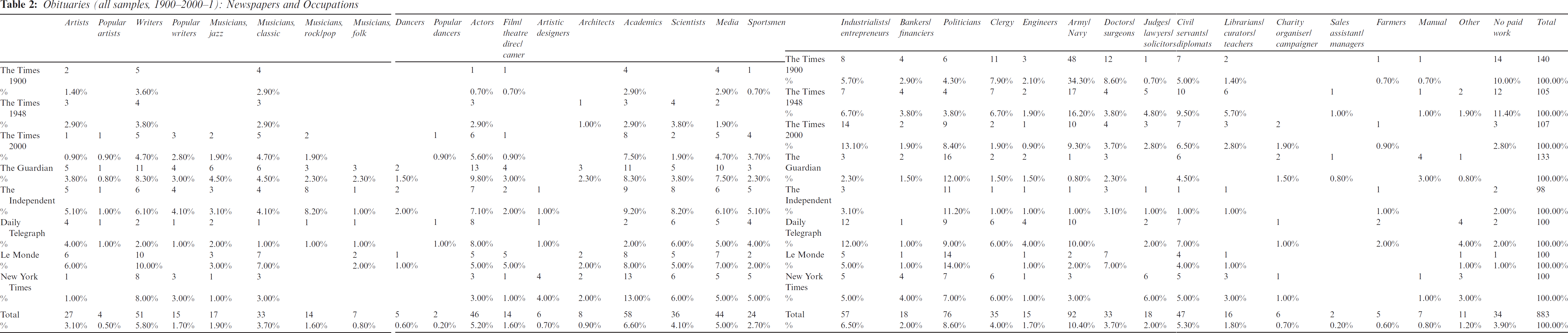
My own study shows that telling traces of these social changes appear in the sampled obituaries. 2 For example, in the earlier British obituaries of 1900, clergy and missionaries made up 8% of the total known occupations (The Times). In contrast, by 2000–1, they were only 2% in The Times and The Guardian, even fewer (1%) in The Independent. The numbers of those in the arts is vastly higher than it once was, having expanded in The Times from 12% in 1900 to the contemporary 30% and much more spectacularly in The Guardian and The Independent (both 51%). 3 Moreover, obituary subjects whose distinction lies outside the artistic field are now more often given additional seriousness and stature by reference to their love of art: ‘he was a keen opera-goer’ or ‘he collected paintings’ is a frequent signifier of a magnanimous and sensitive character.
Thirdly, in a period some have labelled the ‘auto/biographical society’, Bourdieu offers a critique of an important ‘biographical illusion’ (1986; 1994: 81–89). In a sense his whole theory of practice offers an approach to this, especially its tight-rope passage between Sartrian voluntarism and mechanistic materialism. An article in Actes allows us to pinpoint more exactly his precise critique of commonsense life-histories, which is especially productive for those studying popular biographies or the newspaper obituary (compare, say, the earlier studies by Kracauer, 1995:101–7; and Lowenthal, 1961).
This Actes essay offers us a vantage point from which to criticise the atomized, pre-Freudian, unified self of liberal humanism, without abandoning altogether the notion of an authentic (Kantian) ‘me’. In applying this to the obituary, I accept Bourdieu's view that we must avoid the seductive commonsense inherent in the unitary view of the subject. In clarifying what he calls the ‘biographical illusion’, Bourdieu discusses the ‘contraband’ of the ‘mountain path view’ of life's route. The ‘rhetorical illusion’ he suggests is that life makes up a homogeneous whole, a coherent, directed ensemble, which can be understood as the single arena of a subjective – or even ‘objective’ – intention. Signalled by terms like ‘already’, or ‘from a very young age’ this implies an:
original project in the Sartrean sense … This life organized like a history unrolls according to a chronological order which is also a logical order, from a beginning, which is […] a first cause, but also a raison d'être, to its final point, which is also its goal (Bourdieu, 1986:70).
Against this, Bourdieu argues, in an act of ‘rhetorical revolution’, that the biography could be better seen as Macbeth's ‘tale, told by an idiot, a tale full of sound and fury, but signifying nothing’ (Bourdieu, 1986:69–70). Yet his specific critique of the biographical illusion does not imply that subjects or agents are merely clusters of fleeting, refugee selves, caught up in an endless mobile flux created by contingency: the chaotic vision on which some recent writers put too much weight. Bourdieu's concept of the habitus saves us from total contingency, although we should constantly recall also that in his usage, the habitus represents durable dispositions, not an eternal destiny (Bourdieu and Wacquant, 1992; Bourdieu, 2002a). His general critique of the biographical illusion serves usefully to remind us that the ‘life history approach’ has been shaped overwhelmingly by the structuring mechanism of a steady progression within a career, coupled with the youthful anticipation of this. But this is an upward ascendancy which is more typical of an aristocratic or bourgeois élite than of the lower classes, whose less ordered experience makes their members forcibly more attuned to cyclical or even disrupted rhythms (cf Connerton, 1989:19; Maynes, 1989:105).
Such questions about time and the anticipation of the future are crucial to Bourdieu, as I have argued earlier (Fowler, 1997). The profound difficulty on the part of the subordinates in adopting a rational, future-oriented, progressive model of time is a matter of frequent insistence in both the early and very late work of Bourdieu (Travail et Travailleurs en Algérie, 1964 and Pascalian Meditations, 2000). Indeed, in the picture of the unemployed given in Pascalian Meditations, with its recognition of a Kafka-like fragility in the possession of a justified social existence, we have some of Bourdieu's most compelling and convincing writing.
In brief, as Bourdieu has taught us, when we confront the study of obituaries, we must be wary of those constructions that identify success too much with an individual's self-avowed objectives. Instead, we shall focus on empowerment as a result of birth into an élite or the esprit de corps within great public schools or Oxford and Cambridge (in France, within the grandes écoles) (Bourdieu, 1996b). Moreover, Bourdieu's sociological account of the art-world also appears a promising beginning to understanding the recent European and British obituaries. His approach to the ‘world in reverse’ inhabited by bohemian cultural producers and the position-taking available for the avant-garde, opens an under-explored new path for the qualitative study of the artistic biography.
The sociogenesis of the obituary
In order to understand any contemporary institution, we need to trace it back to its origins. Thus we shall explore briefly points in the genealogy of the obituary. In written form, the original British starting-point for the obituary is commonly thought to be John Aubrey's Brief Lives (1898 – originally 1669 and 1696). The newspaper form became current by the middle of the eighteenth century (O.E.D.). The official History of The Times refers to the inclusion of obituaries from its earliest days (1785) but the form was then already a standard element within all the daily newspapers (Anonymous, 1935, see also Grant, 1871). We therefore chose 1900, as a point at which the obituary was already well-established in a routinised and anonymous column of biographies. By that time the obituary was more than a bare announcement of death, but it was hardly ever as lengthy, elaborate and individuated as the genre that emerged by the mid-twentieth century.
The 1900 obituaries
The ranking of the dead in 1900 is still cast in terms of an estate society, where the obituaries of the higher species (royalty and the barons) have priority in terms of length and precedence over mere gentry and the plebeian strata. Of course there is some fusion of the old and the new in this form. The ‘old’ – the aristocrats of the Regiment and the Navy in particular, representing as many as 34% of the total – are now joined by the ‘new’ with the emergence of certain more modern figures, such as the ‘electrician’ (electrical engineer, Prof. D.E.Hughes, F.R.S.), who invented the telegraph or the chairman of a steamship company.
Women are curiously non-existent within these columns, appearing where they do principally as units of alliance in noble kinship networks. Thus it is extremely rare to read anything much about their individual distinction. The following – which gives a flavour of this whole category – is a complete (and typically stark) entry:
Viscountess Newry died on Saturday at her residence, 98, Eaton Place, aged 80 years. Anne Amelia, Lady Newry, was the daughter of Gen. the Hon. Sir Charles Colville, and was married in 1839 to Francis, Viscount Newry and Morne, the eldest son of the second Earl of Kilmorey. She is the mother of the third Earl and was left a widow in 1851. [Note that The Times at this period finds it unnecessary to add ‘London’ to the Eaton Place address.]
There are only two 1900 exceptions to this. The Hon. Mrs. James Stuart Wortley appears as a ‘one of the most interesting women of the epoch’, while Mary Kingsley's obituary honours a short, but distinguished life as an anthropologist in Africa.
The men in the 1900 obituaries are all exemplary figures, many described in the language of medieval warriors. None descend into barbarism; none are brutalized by the closeness of violence. But the key point is surely this. If there was a fusion by 1834, of the middle class and aristocracy, blood and gold, this was a fusion that left aristocratic culture uppermost in many crucial forms (Mayer, 1981).
Industrial capital does not appear in the 1900 obituaries. There is one exception: an unprepossessing mine owner, who is symptomatically objectified in a manner similar now to the white working-class, in a language saturated with all the ambiguities of class racism:
Though not a miner, but the owner of several coal-mines, Mr Cowan was not essentially different either externally or intellectually, from some of the rough, keen colliers of Northumberland today [who possess] a mental activity and a grasp rarely to be found among working people in other parts of the country. […] Short in stature, uncouth in dress and figure, and speaking a tongue the peculiarities of which are admired only to the manner born, he commanded in his early appearances anything but respect (The Times 19/2/1900).
Thus even in ‘the age of capital’, the merely ‘regional’ industrialists are put in their place.
There are occasional exceptions to the ideal-type warriors who dominated these columns. The second or third sons of aristocrats became Classics-trained clergyman. A minority of these led exemplary lives, living and working in the East End of cities. One such sacrificial figure is a Bristol vicar with a huge parish who died young, of a heart-attack.
Ruskin is another such exception. But with him we see the mould broken, for he is a heretical figure, even nicknamed “the Prophet of Brantwood”. His death established a new way of seeing in the obituary. For it provoked not just a long regular obituary, but an accompanying obituary article, as well as an appreciation from the Chief Rabbi. Within these, Ruskin is heralded, as the inventor of a new artistic field, that of art criticism itself – ‘Through him’ says the main obituarist, ‘a new life was infused into English art’.
Contemporary obituaries
There is a sense in which obituaries offer us not theodicies but sociodicies, accounts which serve to legitimate the social order (Bourdieu and Passeron 1979). They are tiny exemplary tales of our times. We expect these narratives to reveal the heroic individuals of our society, even while, as sociologists, we take our distance from them. But there are also negative biographies – those of anti-heroes, villains, call them what you will.
For example, in 2000–1, while post-colonial writing is celebrated, post-colonial politicians, unsurprisingly, may be castigated. Joe Modise can stand for the rest (The Guardian 29/11/01). His obituary charts his rise from street fighter to chief of the armed wing of the ANC, in which capacity he had the Communist, Chris Hani killed in the brutal Quattro camp. As Defence Minister he amassed £5.6 million in shares, but died decorated by Mbeki with the South African Grand Cross.
The obituarist progressively sows the seeds of doubt: his ‘staggering brutality, extraordinary abuse of power’ is followed by later by evidence of corruption. He ends using Shakespearean innuendo to reinforce Modise's critics: ‘So his friends say, for all his sins, Joe Modise served the new South Africa well’. By this mustering of the evidence, the reader realises the verdict should not rest with his friends.
That the obituary is more geared to celebration rather than defamation appears most clearly when its ‘rules’ are flouted. This is the case with the prominent obituary of Lord Shore (Edward Pearce The Guardian: 26/9/01), which uses the impersonal gravitas granted to each individual obituarist for an unusually destructive judgement of the subject's entire personal reputation, a judgement that is underpinned, more evidently than is usual, by its author's antagonistic political agenda. The obituary savagely writes him off for ‘dullmindedness’, reassessing Shore's unsuccessful political odyssey in a series of barbed attacks on his radicalism, consistency and intellectual credibility:
But Shore's political career involved a long dwindling without there ever having been quite a solid achievement to dwindle from. […] He might even have had a reputation for magnificent independence like Tam Dalyell, but the melancholy truth was that undoubted courage, furious contradictions, and some force as a speaker were never enough to make Shore interesting […]
The obituary includes words all the more savage for having the authority of a direct quotation: ‘Wilson's comment to Richard Crossman was the more deadly for lacking anger: “I over-promoted him. He's no good”’. And much more. We might see this as the point-zero of the critical genre.
Obituary samples 2000–1
The decline of the aristocracy
In contrast with the remorseless procession of noble figures in The Times for 1900, we have to see the partial democratization of the obituary as the main feature of our own time. Some would call it a ‘revolution’.
The obituary still represents the peerage who entirely populated the older columns – Lord Hailsham, Lord Catto, The Earl of Onslow, Lord Aldington, Princess Margaret. But it is conspicuous today for portraits which would have been unthinkable a hundred years ago. Take Emil Zatopek, the Czech marathon runner, for example, whose Independent obituary unfolded an extraordinary historical document in which the runner's micro world refracts in crystal-clear light the changes occurring on the world's stage, with regime changes and failed revolutions. This shoe-factory apprentice, a carpenter's son, ran in the manner of a country boy, grimacing and torturing himself, even practicing in Army boots through snow. Yet he became ‘the man of legend – the greatest runner of all time’. Seen by some as mad, he won 18 World records and 3 events in the 1948 Olympics. His contrariness might have given Zatopek the resources to oppose the Soviet invasion of his country – for which he was confined to manual labour for seven years.
In this context, we might mention the less spectacular but equally sustained performances of Irene Thomas, the daughter of a gas-meter official and a seamstress. She had been to a grammar school but her parents could not afford University. She became Brain of Britain as well as Brain of Brains on the Radio Round Britain Quiz, despite having been rejected for seven years for the contest, and only eventually being permitted to take part in the absence of a suitable man. (The Guardian 4/4/01).
Again, there is the Nigerian-born London fitter, Michael Akintaro, who through this unusually lengthy piece gradually gains status as one who embodied the collective memory of immigrants. His obituary is absorbing not because of his competitive achievements but because of whom he was and whom he knew. He was counted by the legendary figure, George Padmore, as amongst the ‘foot-soldiers in the fight against colonial rule’ (The Guardian 7/10/00). It is therefore, something of a paradox that this foot-soldier of anti-imperialism was finally to be awarded an Imperial Services Medal for his work as a fitter from Whitehall to Buckingham Palace.
Yet it would be wrong in other ways for a sociologist to take at face-value this apparent transformation of élites. For the British equivalent of the State Nobility still dominate the obituary columns. There were no manual workers represented in the 2000–1 obituary sample of The Daily Telegraph and only 2% of those in The Guardian. And those with social origins in the manual working-class were still only a tiny proportion of the whole.
What we are witnessing is a shift towards occupations dominated by the possession of cultural capital rather than the old criterion of blood. Yet the dominant families are still able to retain their hegemony, although in changed terms. As evidence for this, one might simply note the educational origins of those featured. If the obituary were genuinely meritocratic and less geared to an Establishment, should we expect that 72% of the British figures in the 2000–1 British newspapers would have been to a public school? Or that 34% would have been to Oxford and Cambridge? These Universities, we argue, following Bourdieu, serve magically to consecrate the bearers of their degrees (1996b).
Class origins, 2000–1
The contemporary obituaries have an aura of upward social mobility about them, just as Trilling writes about the classic American novel as possessing, as its great masterplot, the individuals' unaided success (1961:247). The default mode, so to speak, of the obituary, is the anticipated tale of individual, hard-won success.
Yet the cultural reality of the obituary, between the lines, is actually divergent from this, and reveals instead the high likelihood of the continuing reproduction, or ossification, of the class order. Clearly, this does not mean a precise generational replication of a given occupation. Many patterns of overall class reproduction involve a change in class fraction. A conversion of economic capital into cultural capital, for example, occurs when a banker's son's refuses the bank so as to become an artist: as Bourdieu points out, a sense of novelty resonates from such subjectively risky choices. But given all those obituary portrayals where the parents' work or class position is also described, as many as 47 (64%) of The Guardian's, 30, or 58%, of The Independent's and 62% of The Times’ subjects revolve around the inheritance of the class position of the parents in this broader sense. 23 (31%) of The Guardian's stories are of upward mobility – broadly similar to the 17 out of 52 (33%) in The Independent but contrasting with the smaller 15 (22%) in The Daily Telegraph. Downwards social mobility only occurs exceptionally: the total consists of in four cases in The Times and two in The Guardian. Perhaps the most dramatic instance of such a fraught and anomic trajectory is the sad history of Benno Schultz, the boxer, who, having risen to prominence from the slums of Berlin, killed his wife in a fit of drunken jealousy at the height of his career and then sank, after prison, into the social ‘living death’ of poverty.
Migration
Perhaps the most startling revelation is the number of figures in the obituary landscape who had migrated across national borders. Migration was charted initially because of the importance of post-colonial theory, and especially because of the new phenomenon of writers from the Third World moving into the metropolises of the First World (Ahmad, 1991). But the correlation between the experience of migration and distinction appears to be more widespread than I had imagined, extending throughout many fields of British society. If élite or voluntary migration is included, then this category embraces 34% of the Guardian and Independent. In The Times and the Daily Telegraph, where the Forces or transnational diplomatic career feature particularly prominently, such migration includes as many as 45%. Even in the usual – more restrictive – sense of political exiles or economic migrants, 11 (10%) of The Times come into this category. The very telling presence of such a migrant minority most sharply differentiates the 2000–1 group from the 1900 subjects (0.8%).
Theorizing women's marginality within the obituary
Obituaries continue to be predominantly narratives of men. Nevertheless, one element within the selective democratisation of the genre since 1900 is the reduced marginalization of women, now 19% overall (cf. 11% in 1900). There is even a tiny minority of women whose deaths have been recorded in more than one newspaper, such as Barbara Cartland, or Lorna Sage, the literary critic.
When we begin to look more closely at those who do appear, one immediate generalization emerges: these women are distinctive collectively in having had very few children. From 1900 to the contemporary samples, over a third have not had children at all (36%) and a clear majority (53%), either one child only or none. 4 In The Independent of 2000–1, as many as 75% are stated to have had one or no children and 63% had been childless. It should not be assumed that such women always chose not to have children. These were the years of either a marriage bar or institutionalized anti-natalist policies for women employees. Professional motherhood had as its other side, compulsory spinsterhood: a historic concession by women in their subversion of male professional closure. As a consequence, it is difficult to establish the mixture of autonomous choice and structural pressures towards celibacy that were responsible for the childlessness of figures such as Brigadier Helen Meechie, Lieutenant-Commander Dame Anne Stephens, the journalist Muriel Bowen or Vera Atkins, the Assistant Head of the Special Operations Executive in the Second World War. We should not expect such childlessness in a later generation, where marriage bars have been swept away. Or should we? There is undoubtedly still a wider structural tension between women having children and what Bourdieu calls ‘the male monopoly of noble tasks’ (2001). I will consider this further later.
We need to pursue a closer, qualitative study of the obituaries of women to see what kind of interpretative analysis is given them. I shall offer this approach to women's obituary discourses through the prism of different genres. These are best approached by illustration, with ideal typical accounts of life histories. I shall then make some general explanatory comments on the rarity of women in the form.
Types of obituary for women
First, none of the obituaries for women have the grand heroic stature of those portrayals of the State Nobility, such as the full-page for Viscount Hailsham (The Guardian 15/10/01). Male figures, like Hailsham, lie in the most venerable tradition of the obituary, as we have seen. They represent old money, allied to noble tasks of domination: they are credited with untrammelled excellence of character. Even in the Centre-Left papers like The Guardian, their personalities are depicted as moulded like gloves for their offices. For these heroic figures, Bourdieu's words on the State Nobility and its training in the elite schools are memorable. They have both technical skills and the magic derived from office: both feed beneficially off each other.
1. The positive traditional obituary for women
There are obituaries which praise women who are exemplars of traditional femininity. One such was Lady Mary Townley, a Catholic, with seven children, married to Sir Simon Townley, a businessman and also the owner of an old Northern landed estate. She had no paid work but was a good wife, always extremely careful not to neglect her philanthropic work. Despite her love of riding, she insisted on undertaking all the menial tasks in the household, proof of an extraordinary and positive capacity for acts of self-abasement. This type of exemplary woman is extremely rare in the contemporary obituaries, although she had many predecessors earlier.
There is also a category of positive vocational obituary for women, that is to say, there are women who had an inner certainty of their virtuosity but who may also have had several children. One such is Noor Jehan (The Guardian), the Punjabi singer, whose extraordinary range combined Indian and Pakistani, high and low cultures. She excelled equally with popular songs, folksongs and works with modern settings by the great Pakistan poet, Faiz. Grief at her death, we learn, united the whole Indian subcontinent. In this category also appears the Wittgensteinian philosopher, Elizabeth Anscombe, of whom we read that she kept her name of Miss Anscombe, much to the discomfort of medical staff when she attended hospital for her sixth and seventh babies. Or there is the geneticist, Julia Bodmer, whose pioneering work at Oxford in the study of Hodgkins' disease gives her that rare distinction for a woman of being labelled ‘brilliant’. With her husband, Walter Bodmer, she brought up three children, all of whom turned out well. Julia Bodmer is untroubled, free of conflict, moving with extraordinary harmony between the public and the private spheres.
2. The negative obituary
The negative obituary, rare for men, is even rarer for women. The obituary confers on such stigmatized individuals a certain niche within historical memory, but – as in the cases of Anne Lindbergh, the writer of space fantasies, or Lida Baarova, the Czech actress – as deeply flawed figures. Both were prominent collaborators with Naziism. Lindbergh, a feminist, was also a notorious patrician appeaser. She urged the Roosevelt Government in the 1930s to accommodate to the new German Government of a Hitler whom, she claimed, was not ‘greedy for power’ and whom Roosevelt should realise, was in any case ‘unstoppable’. Lida Baarova, a beautiful Czech actress of great talent and presence, the well-heeled daughter of a civil servant, became Goebbels' mistress. By her fateful choice of complicity with Fascist power, she indelibly enhanced the aura of both Goebbels himself and the Nazis.
What is important in this category is that such women – clearly deservedly – are not ultimately ‘one of us’ but representatives of the Other. Like the obituaries of Laurent Kabila, the Congo leader, and the former Lebanese prime minister, Hadid Hélou, they had their opportunities and used them poorly. Nevertheless, one senses a certain reluctance to place women into this category. In the case of Diana Mitford, Oswald Mosley's wife, for example, it is conspicuous how charitable is the posture adopted in The Independent (13.8.2003) towards this pro-fascist devotee of the Hitler cult: here perhaps is the obituary's most clear-cut example of a fairy-tale re-enchantment lent by time and distance.
3. The ironic obituary
There is a category of negative obituary which is perhaps distinctive to women – not ‘the other’, but nevertheless sharply satirised, often in Flaubertian tones. Such women represent a style of life which, in terms of sexual and class doxa, has now become seen as outmoded, even ludicrous. Yet far from being interpreted as part of a destructive system of injustice, or class racism, they are seen in a comic mode. One example is Betty Kenward, the long-term writer of Jennifer's Diary in The Tatler. She was the living embodiment of a set of aristocratic rules, now dead, which extended to inventing linguistic markers of the social order:
[S]he had developed her own rules about punctuation: charming, perversely logical, a mine-field for the sub-editors. Monarchs […] must be hedged about with semi-colons, the Duke of Edinburgh must always be protected with a comma. Otherwise both semi-colons and commas were rather scarce (The Independent 27/1/01).
4. The Tragic genre of obituary
Here are the women of noble families, traditional women, caught in a structural incongruity, which destroyed their happiness. These lives are dogged by reversals. Raised and elevated for great things, they embody the romantic sadness of those with legitimate hopes whose lives are brutally and unavoidably destroyed. The ex-queen of Iran, Soraya, is one such figure (Independent), whose future was irretrievably bound up with that of the Shah's Pahlavi regime. Thus, in matter-of fact tones, the obituary narrates the history of the Shah's access to power by force, through an Anglo-American manipulated coup d'état. Such manoeuvring wrested Anglo-Burma Oil from a democratic Iranian government, intent on nationalizing the oil. In this obituary, Soraya's collusion with the Pahlavis' illegitimate minority power is passed over as a mere background detail. Soraya is portrayed instead as a woman caught in an arbitrary Greek tragedy: her personal misfortune is her barrenness, leading to her divorce from the Shah she loved. Her subsequent unhappy nomadic exile, mainly in France, is summed up in the Parisian song ‘Pleurez comme Soraya …’.
Another such tragic woman, Ruth Werner, the daughter of a prosperous German bourgeois family, was appalled to see dead babies littering the gutters of the street as the inter-war depression accelerated. She became an activist within the Communist Party, a stance for which the obituary author initially has sympathy. This sympathy is forfeited by her later actions, especially her assistance to Fuchs in passing Harwell atomic secrets to the Soviets. Werner's vital intermediary role led eventually to her rapid departure for East Germany. Her subsequent arid experience in the Eastern bloc is implicitly viewed as a punishment for her unwomanly and misguided activism earlier.
5. The celebratory, untraditional obituary for women
Compared with the obituaries of men, even the most celebrated of female figures have rarely had a regular career, appear more divided against themselves and were often no longer at home in their own countries. In brief, the obituary of women can come in the same ‘mould breaking’ shape that I described with Michael Akintaro, the Whitehall Nigerian fitter.
Take the long and vividly-written obituary of Joan Littlewood, the theatre director. 5 Her life does not take the pattern of a gradual upward ascent and such divergent experience thus indirectly illuminates what Bourdieu means by ‘the biographical illusion’. Joan's international heyday was short, restricted to her 40s and 50s. Her trajectory in spatial terms was also highly unusual. Her odyssey was from a poor London district to RADA, then to Liverpool and the North, back to the East End of London again, but this time with crucial links to the West End. Defeated over funding at the height of her powers, she retreated to work with Soyinka in Nigeria and finally to France.
Yet it is not this which really distinguishes her, it is that she represents a type of modernism which flared briefly, being eclipsed in Britain by more politically-conservative and nostalgic forms (for example, of T.S. Eliot and Pound). Her theatre, which carried on the experimental innovations of Meierhold and German expressionism, was also a modernism which aspired to be accessible, democratic and popular. It is this which is so successfully at stake for her, in the collective production of Oh What a Lovely War.
Littlewood was an illegitimate child, who often felt ugly. When married to Ewen MacColl and penniless, she had an abortion. In brief she put her work first, at the cost of her life. Much later in the obituary, there is an inconspicuous reprise of this theme of children. The very last paragraph describes how her achievement was to have pioneered fringe theatre, pointing out that in London alone, when she died, there were 100 fringe groups. She commented near the end of her life: ‘I have many children – all over the world’.
Tellingly, this obituary carefully deconstructs the language of genius. The accompanying obituary note, by Michael Billington, reverts to the old Romantic image of genius, but purloins it, by applying it to a woman. The main obituary breaks with it even more thoroughly by locating creativity in the social, quoting Littlewood direct: ‘I really do believe in the community. […] I really do believe in the genius of every person. And I've heard that greatness comes out of them, that great thing which is the people. And that's not romanticism, d'you see?’ (The Guardian 23/9/02).
The stakes in the game
How then should we understand the obituary in general as a power-soaked, authoritative discourse? I want to expand Bourdieu's model of biographical illusion, taking into account his Pascalian Meditations on modes of anticipating the future. I shall consider especially the investment of time – as well as other stakes – in the illusio of professional fields: art, architecture, politics, science. Here I shall move on from his late works, like The Rules of Art, to a consideration of the games of art and science, both being characterized by their considerable scope for autonomy. Within these, Bourdieu perceives a sphere for indeterminacy, in the sense that the artist or writer is able to put into specific novels or poems a view of more than one social world, made possible through the writer's dream of social flying. Far from a reductively determinist view of the writer, etc. these late works – and especially Science de la science (2002b) – develop a view that succeeds in both objectivating the writer or scientist and in adopting a more generous interpretation of their potential for reflexivity (1996, 2000; Guillory, 1997). Indeed, Bourdieu here emphasizes the ways in which the professional world itself encourages such reflexivity (2002b).
One way to elaborate further on Bourdieu's notion of the vocational habitus is to take up, as McNay has done, Ricoeur's ideas about the phenomenology of time. This allows me to theorize further the transformative aspects of agency which may be disclosed in the obituary (McNay, 2000; Ricoeur, 1984). 6
The key determinant of whether or not women receive obituaries is not just the question of how active they have been in the artistic or political field. Nor is it just a consequence of the filters used in interpreting their action: those interpretative practices of women obituarists or feminist men which enhance their historical visibility. My view is rather that the fundamental issue for women concerns their own perception of time and their involvement in a specific game. This is another way of approaching the thorny problem of canonisation, or, in Terry Lovell's concept, the notion of ‘literary survival value’ (Lovell 1987). It is also another way of returning to the fact that 36% of the women subjects overall do
not have children. 7
Bourdieu prompts us to ask: ‘What stakes have women acquired in a game? To what degree has your fundamental sense of yourself and what you live for become tied up in that field?’ Here he has some important points about the pre-reflexive ‘protension’ or imagining of the future, in which the future unfolds as part of the logic of the habitus, as in the case of the male State Nobility and their great worldmaking activities. In fact, as Bourdieu insists, it is only at a certain level of distance from necessity that alternative projects for the future can be anticipated: the future loses its doxic, taken-for-granted character and becomes a changed place, collectively achieved as in the classic trade-union imaginary or through individual practice (2000:216–7). Such active projects for the future – along with obligations to others – serve to distinguish those individuals with a ‘justified’ ‘social existence’ from those without. The power of ‘symbolic baubles’ (entry to Who's Who, honours etc) is to act as a support for the social game. That is, they act as buttresses for the decision to cope with one's own finitude or mortality, not by fleeing the world, but by seeking social esteem. This is the fundamental source of investment in a specific field:
With investment in the game and the recognition that can come from cooperative competition with others, the social world offers humans that which they most totally lack, a justification for existing. (Bourdieu, 2000:239)
The possibility of a celebratory obituary could clearly count as one of the long string of ‘symbolic baubles’.
Earlier, Bourdieu writes about the harsher face of competitive struggles – for example, when the surrealist, André Breton broke Pierre de Massot's arm in an argument about the future of art (1996:383). Now when we raise questions about women and time, it is to these kinds of phenomenological questions about the future that we should be turning. The issue raised by the surrealists' conflict is this: when does your artistic or craft effort seem so important that you will dedicate your whole life to it? Such an engagement is in part a question of not being caught up in other experiences of time: revolutionaries' ‘disruptive’ commitments, for example. In terms of those scientists or artists not so directly caught up, the passion with which you throw yourself into these disinterested fields or vocations is a key determinant of achievement. The performance of the work-in-hand becomes infused with an extraordinary importance. Undergoing this routine activity everyday, seeking, say, to understand cancer cells may be your way of changing the world …
Bourdieu writes of the doxa which preserves noble tasks for men. But women- or any carers – of very young children, cannot be involved in the same sense with the illusio of their work as a life and death struggle. Instead they are constrained to participate in other more pressing life and death struggles, such as their children's vulnerability to fatal illness or to ontological insecurity. Hence, one might write without any essentialist presuppositions, of their deficit of professional engagement, for they show, reluctantly, a suspension of effort.
What I have called here the necessary suspension of professional effort is neither lifelong nor found in all professional working women. Sarah Checkland, for example, writes vividly of Barbara Hepworth being accepted for a Venice Biennale, and of her husband Ben Nicolson – who had not been picked – enviously smashing her sculpted maquette. Hepworth's young triplets did not impede her artistic ‘worldmaking activities’, nor, indeed, her participation in the international constructivist group, the Circle, which enfolded both husband and wife (Checkland, 2000).
Bourdieu took from Husserl and Heidegger certain approaches to time which he went on to fuse with a more relationist historical sociology. Now Ricoeur has developed further one aspect of this earlier German phenomenology which may help theorise agency, as McNay also argues (McNay, 2000:85–96).
I note in particular Ricoeur's distinction between the contrasting experiences of ‘linear, calendar time’ and ‘eternal time’ (Ricoeur, 1984:25). Now we might call such ‘eternal time’, following Bourdieu, the time of posterity, the future in which the scientist or artist might make his or her mark. More interestingly, for feminism, Ricoeur has also stressed the effects of the imagination and utopia in freeing agency (1991:319–324). He has addressed Proust's long novel, Remembrance of Things Past, (tr. 1941) as a story about the author's oscillation between a vivid sensual understanding of the lost childhood time and the adult sense of disillusionment and knowledge of power, via his narrator, Marcel. The novel culminates in a commitment to vocational time as Marcel learns to unify these different worlds in order to become a writer (Ricoeur, 1985:144–5). Perhaps we can salvage something from this novel and go beyond its privileged milieu? Then this narrative might reveal for women on the ground more broadly the nature and dynamics of the engagement or illusion with modern fields of cultural production or the public sphere.
Now, from a critical perspective, the subjects of obituaries are often authority figures, linked more closely to what Ricoeur labels ‘monumental’ and ‘official time’ than to his ‘eternal time’ or Bourdieu's time of posterity (Ricoeur, 1985:106, 112). The obituary genre as a whole is wider than the depiction of original or distinctive achievements as in the meritocratic model, still being caught up with old forms of elitism. But with the narrowing of the gender difference in terms of a full engagement with the illusio of the field, the disparity between the numbers of obituaries for men and women will undoubtedly become less marked. Ricoeur's approaches to what he calls ‘temporal refiguring’, the enhancing of imaginative possibilities through the narratives in modernist novels, may turn out to clarify those forms of often transformative agency on which the modern meritocratic obituary typically draws (1988:274). But we would then have to remember that it is not simply the raising of consciousness that is at stake, but rather an activity as thorough and remorseless as ‘involving repeated exercises [which alone] can, like an athlete's training, durably transform habitus' (Bourdieu, 2000:172).
Conclusion
Perhaps it is now possible to sketch further components of the obituary. First, holding economic capital on its own is only rarely a prerequisite for an obituary, at any point in the 100-odd year selection. Lowenthal – writing about such American ‘heroes of production’, in the early twentieth century – may be describing a distinctively American cast of biography (Lowenthal, 1961). The closest to this in Britain is The Times (2000) with still only 15% industrialists and bankers.
Second, I note the importance of art in the prophetic figure of Ruskin, in the 1900 The Times. In 2000–1 there has been a much greater increase in the arts-based occupations (see Appendix). This, and especially the turn to the popular arts, indicates the undeniable resonance with Lowenthal's 1960s analysis, and its stress on the growing significance of the ‘heroes of consumption’. It is in this context that Bourdieu's recent diagnosis of contemporary practices in the arts is especially telling.
Finally, there has been a decline from 1900 in portrayals of hard-working, exemplary lives. Not only are there virtually no manual workers, but no teachers and nurses appear now. Since women particularly are linked with these professions, this may be related to their relative lack of representation. Given the importance of the obituary as an accolade and as a measure of valued activities, it is surprising that there are not more exemplary headteachers or self-sacrificing trade-unionists to stand alongside the outstanding achievements of the Hoyles, Anscombes, Bodmers and Quines.
Footnotes
1
I write after the death of Edward Said whose obituaries (and post-obituary notes) reveal with the utmost clarity the clash of perspectives which allowed some to celebrate him in the highest possible terms and others to engage in a systematic defamation of his actions or writings.
2
This study is based on a quantitative content analysis of a minimum of 100 sampled obituaries in each newspaper, from The Times in 1900 and 1948, to the 2000–1 British papers, The Times, The Independent, The Guardian and the Daily Telegraph; for comparison, Le Monde and The New York Times are also assessed. The qualitative analysis of obituary discourses includes, but goes beyond, these samples.
3
These overall figures for the arts include film critics and the media (journalists etc.).
4
These statistics include The New York Times and Le Monde.
5
The Guardian 23/9/02: 20.
6
There remains a certain tension between Ricoeur as the theorist of phenomenology and Bourdieu as the theorist of practice. It is important to note that I am not claiming here that the two sets of concepts are interchangeable: indeed Ricoeur is notably more prone to refer to the spiritual in some of his textual analysis than I would want to advocate. However, it is my view that Ricoeur does have an approach which permits us to fill out or supplement aspects of Bourdieusian theory, and this is at its most illuminating in his theory of the imagination.
7
This proportion varies sharply within the 2000–1 British newspapers, with between 16% of the recent Guardian female subjects, 24% of the Daily Telegraph, 44% Times and 63% The Independent having no children.
Appendix
Obituaries (all samples, 1900–2000–1): Newspapers and Occupations
| Artists | Popular artists | Writers | Popular writers | Musicians, jazz | Musicians, classic | Musicians, rock/pop | Musicians, folk | Dancers | Popular dancers | Actors | Film/theatre direc/camer | Artistic designers | Architects | Academics | Scientists | Media | Sportsmen | Industrialists/entrepreneurs | Bankers/financiers | Politicians | Clergy | Engineers | Army/Navy | Doctors/surgeons | Judges/lawyers/solicitors | Civil servants/diplomats | Librarians/curators/teachers | Charity organiser/campaigner | Sales assistant/managers | Farmers | Manual | Other | No paid work | Total | ||
|---|---|---|---|---|---|---|---|---|---|---|---|---|---|---|---|---|---|---|---|---|---|---|---|---|---|---|---|---|---|---|---|---|---|---|---|---|
| The Times 1900 | 2 | 5 | 4 | 1 | 1 | 4 | 4 | 1 | The Times 1900 | 8 | 4 | 6 | 11 | 3 | 48 | 12 | 1 | 7 | 2 | 1 | 1 | 14 | 140 | |||||||||||||
| % | 1.40% | 3.60% | 2.90% | 0.70% | 0.70% | 2.90% | 2.90% | 0.70% | % | 5.70% | 2.90% | 4.30% | 7.90% | 2.10% | 34.30% | 8.60% | 0.70% | 5.00% | 1.40% | 0.70% | 0.70% | 10.00% | 100.00% | |||||||||||||
| The Times 1948 | 3 | 4 | 3 | 3 | 1 | 3 | 4 | 2 | The Times 1948 | 7 | 4 | 4 | 7 | 2 | 17 | 4 | 5 | 10 | 6 | 1 | 2 | 12 | 105 | |||||||||||||
| % | 2.90% | 3.80% | 2.90% | 2.90% | 1.00% | 2.90% | 3.80% | 1.90% | % | 6.70% | 3.80% | 3.80% | 6.70% | 1.90% | 16.20% | 3.80% | 4.80% | 9.50% | 5.70% | 1.00% | 1.00% | 1.90% | 11.40% | 1.00% | ||||||||||||
| The Times 2000 | 1 | 1 | 5 | 3 | 2 | 5 | 2 | 1 | 6 | 1 | 8 | 2 | 5 | 4 | The Times 2000 | 14 | 2 | 9 | 2 | 1 | 10 | 4 | 3 | 7 | 3 | 2 | 1 | 3 | 107 | |||||||
| % | 0.90% | 0.90% | 4.70% | 2.80% | 1.90% | 4.70% | 1.90% | 1.50% | 9.80% | 3.00% | 2.30% | 8.30% | 3.80% | 7.50% | 2.30% | % | 13.10% | 1.90% | 8.40% | 1.90% | 0.90% | 9.30% | 3.70% | 2.80% | 6.50% | 2.80% | 1.90% | 0.90% | 2.80% | 1.100% | ||||||
| The Guardian | 5 | 1 | 11 | 4 | 6 | 6 | 3 | 3 | 2 | 13 | 4 | 3 | 11 | 5 | 10 | 3 | The Guardian | 3 | 2 | 16 | 2 | 2 | 1 | 3 | 6 | 2 | 1 | 4 | 1 | 133 | ||||||
| % | 3.80% | 0.80% | 8.30% | 3.00% | 4.50% | 4.50% | 2.30% | 2.30% | 1.50% | 9.80% | 3.00% | 2.30% | 8.30% | 3.80% | 7.50% | 2.30% | % | 2.30% | 1.50% | 12.00% | 1.50% | 1.50% | 0.80% | 2.30% | 4.50% | 1.50% | 0.80% | 3.00% | 0.80% | 100.00% | ||||||
| The Independent | 5 | 1 | 6 | 4 | 3 | 4 | 8 | 1 | 2 | 7 | 2 | 1 | 9 | 8 | 6 | 5 | The Independent | 3 | 11 | 1 | 1 | 1 | 3 | 1 | 1 | 1 | 1 | 2 | 98 | |||||||
| % | 5.10% | 1.00% | 6.10% | 4.10% | 3.10% | 4.10% | 8.20% | 1.00% | 2.00% | 7.10% | 2.00% | 1.00% | 9.20% | 8.20% | 6.10% | 5.10% | % | 3.10% | 11.20% | 1.00% | 1.00% | 1.00% | 3.10% | 1.00% | 1.00% | 1.00% | 1.00% | 2.00% | 100.00% | |||||||
| Daily Telegraph | 4 | 1 | 2 | 1 | 2 | 1 | 1 | 1 | 1 | 8 | 1 | 2 | 6 | 5 | 4 | Daily Telegraph | 12 | 1 | 9 | 6 | 4 | 10 | 2 | 7 | 1 | 2 | 4 | 2 | 100 | |||||||
| % | 4.00% | 1.00% | 2.00% | 1.00% | 2.00% | 1.00% | 1.00% | 1.00% | 1.00% | 8.00% | 1.00% | 2.00% | 6.00% | 5.00% | 4.00% | % | 12.00% | 1.00% | 9.00% | 6.00% | 4.00% | 10.00% | 2.00% | 4.00% | 1.00% | 1.00% | 1.00% | 100.00% | ||||||||
| Le Monde | 6 | 10 | 3 | 7 | 2 | 1 | 5 | 5 | 2 | 8 | 5 | 7 | 2 | Le Monde | 5 | 1 | 14 | 1 | 2 | 7 | 4 | 1 | 1 | 1 | 100 | |||||||||||
| % | 6.00% | 10.00% | 3.00% | 7.00% | 2.00% | 1.00% | 5.00% | 5.00% | 2.00% | 8.00% | 5.00% | 7.00% | 2.00% | % | 5.00% | 1.00% | 14.00% | 1.00% | 2.00% | 7.00% | 4.00% | 1.00% | 1.00% | 1.00% | 100.00% | |||||||||||
| New York Times | 1 | 8 | 3 | 1 | 3 | 3 | 1 | 4 | 2 | 13 | 6 | 5 | 5 | New York Times | 5 | 4 | 7 | 6 | 1 | 3 | 6 | 5 | 3 | 1 | 1 | 3 | 100 | |||||||||
| % | 1.00% | 8.00% | 3.00% | 1.00% | 3.00% | 3.00% | 1.00% | 4.00% | 2.00% | 13.00% | 6.00% | 5.00% | 5.00% | % | 5.00% | 4.00% | 7.00% | 6.00% | 1.00% | 3.00% | 6.00% | 5.00% | 3.00% | 1.00% | 1.00% | 3.00% | 100.00% | |||||||||
| Total | 27 | 4 | 51 | 15 | 17 | 33 | 14 | 7 | 5 | 2 | 46 | 14 | 6 | 8 | 58 | 36 | 44 | 24 | Total | 57 | 18 | 76 | 35 | 15 | 92 | 33 | 18 | 47 | 16 | 6 | 2 | 5 | 7 | 11 | 34 | 883 |
| % | 3.10% | 0.50% | 5.80% | 1.70% | 1.90% | 3.70% | 1.60% | 0.80% | 0.60% | 0.20% | 5.20% | 1.60% | 0.70% | 0.90% | 6.60% | 4.10% | 5.00% | 2.70% | % | 6.50% | 2.00% | 8.60% | 4.00% | 1.70% | 10.40% | 3.70% | 2.00% | 5.30% | 1.80% | 0.70% | 0.20% | 0.60% | 0.80% | 1.20% | 3.90% | 100.00% |