






Abstract

The turn of the millennium may have come and gone, but the Mazda Millenia [sic] is still with us. Hyped in a 1994 ad as ‘so advanced, it required a whole factory’, the Millenia is a determinedly futuristic (and orthographically challenged) luxury sedan. 2 Ads for the Millenia update the snob appeal that has been a mainstay of luxury car advertising for decades, retrofitting it with geek-appeal technobabble – a tacit acknowledgement of the cyborging of the automobile in recent years, as electronic components have infiltrated braking, steering, and suspension systems. The automobile industry is accelerating onto Bill Gates's Road Ahead, literally as well as figuratively.
To be sure, the bullying SUV and its even nastier, more brutish successor, the Hummer – two giant steps backward for fuel efficiency, passenger safety, and inconspicuous consumption – are the undisputed Kings of the Road in America. Even so, visions of smart cars still dance in tech heads. In late 2004, Honda debuted the 2005 Acura RL and the Odyssey, both of which combine navigation systems, voice-recognition technology, and text-to-speech programmes to create cars that ‘converse’ with their drivers, talking them to their destinations, one turn at a time (Gartner, 2004). In a similar vein, MIT's Media Lab is experimenting with a prototype smart car that DaimlerChrysler hopes will anticipate the driver's needs ‘as intelligently as a horse, which is intelligent enough to compensate momentary inattention on the part of the driver’ (High Tech Report, 2002; cf. Howard, 2003). Fitted with sensors and dash-mounted video cameras that monitor the driver's actions, the Chrysler 300M IT-Edition is intended to prevent accidents by guarding against driver distraction. The goal, says DaimlerChrysler, is accident-free driving ‘through an improved human-machine interface’ (High Tech Report, 2002). Ironically, the company's smartmobile musters a high-tech arsenal to combat the sensory assault of too much technology – the cell phones, dashboard instrumentation, and electronic signage clamouring for our attention.
The most futuristic of the 300M's technologies is ‘affective computing’ – a touchy-feely species of artificial intelligence intended to ‘sense the emotional state and stress levels of the operator (in this case, the driver)’ and react accordingly (High Tech Report, 2002). According to DaimlerChrysler, the empathic car of the future will respond ‘to different types of drivers, their driving style and their emotional state at the time’ (High Tech Report, 2002). Its cameras and sensors will tell it if you're holding the gearshift calmly or gripping it with white-knuckled tension; if you're scanning your surroundings, indicating alertness, or if you're gazing fixedly with a thousand-yard stare, the sure sign of a tired or wandering mind. ‘Based on the perception of the momentary driving situation’, notes DaimlerChrysler,
the 300M IT-Edition can act like spouse or co-pilot, providing information to the driver appropriately. […] So if the phone rings while the driver is changing lanes on a busy freeway, the 300M IT-Edition suppresses the ringing tone, diverts the call to voicemail, and informs the driver when it is safe to do so. […] Because the 300M IT-Edition monitors driver activity so closely, it is also able to help the driver avoid potentially hazardous developments. If, for example, it detects that the driver has not glanced at the side mirrors for an extended period, the computer causes an LED in the mirror to blink, attracting the driver's attention in a very non-intrusive way. (High Tech Report, 2002)
The obvious endpoint of this trajectory is the development of an artificially intelligent car that acts not only as helpful spouse or steed but shrink as well, providing push-button psychoanalysis in the anodyne tones of 2001's HAL. (‘Look, Dave, I can see you're really upset about that Range Rover cutting you off. I honestly think you ought to take a stress pill and think things over.') During uneventful stretches of midwestern highway or big-city traffic jams, smart cars could analyse their drivers, exploring the depth psychology of the American motorist: the Electra Complex haunting her fetish for big, swinging SUVs; the sadism inherent in her tendency to tailgate slow-moving subcompacts, bearing down on them in her Hummer like the Exterminating Angel; the death drive lurking in her devotion to her Ford Explorer, rollovers be damned.
Of course, advertisers have courted male buyers by extolling the technical sweetness of this year's model virtually since the car entered the public imagination. With the dawn of the Digital Age, ad copywriters have increasingly targeted the cash-flush, gadget-happy nerdoisie, who until the dotcom flameout had money to burn on boy toys like that electronic tape measure with the LCD readout in the Hammacher Schlemmer catalogue. A 1993 ad for the Mazda 929 touted it as ‘a luxury sedan that thinks like a human… thanks to its advanced “fuzzy logic” computer’, which automatically adjusted cruise control, air conditioning, and ventilation. By 1997, the Nissan Infiniti Q45 – ballyhooed in an earlier ad as ‘one of the most intelligent automobiles ever conceived’ – was not only artificially intelligent, but possessed of a divine spark as well. 3 ‘Introducing the new Infiniti Q45’, trumpeted the campaign. ‘Everything changes but the soul.’ 4 Any who doubted that the Infiniti's gleaming hood concealed the soul of a new machine were exhorted to take the car out for a test drive to ‘see why the soul is eternal’. Ascending even further into the empyrean, an ad for the Toyota Avalon showed the car sailing through Sistine Chapel clouds, over the tagline, ‘Experience the tranquility’ – a somewhat ominous enticement, given Avalon's original status, in Arthurian legend, as a hereafter for fallen heroes.
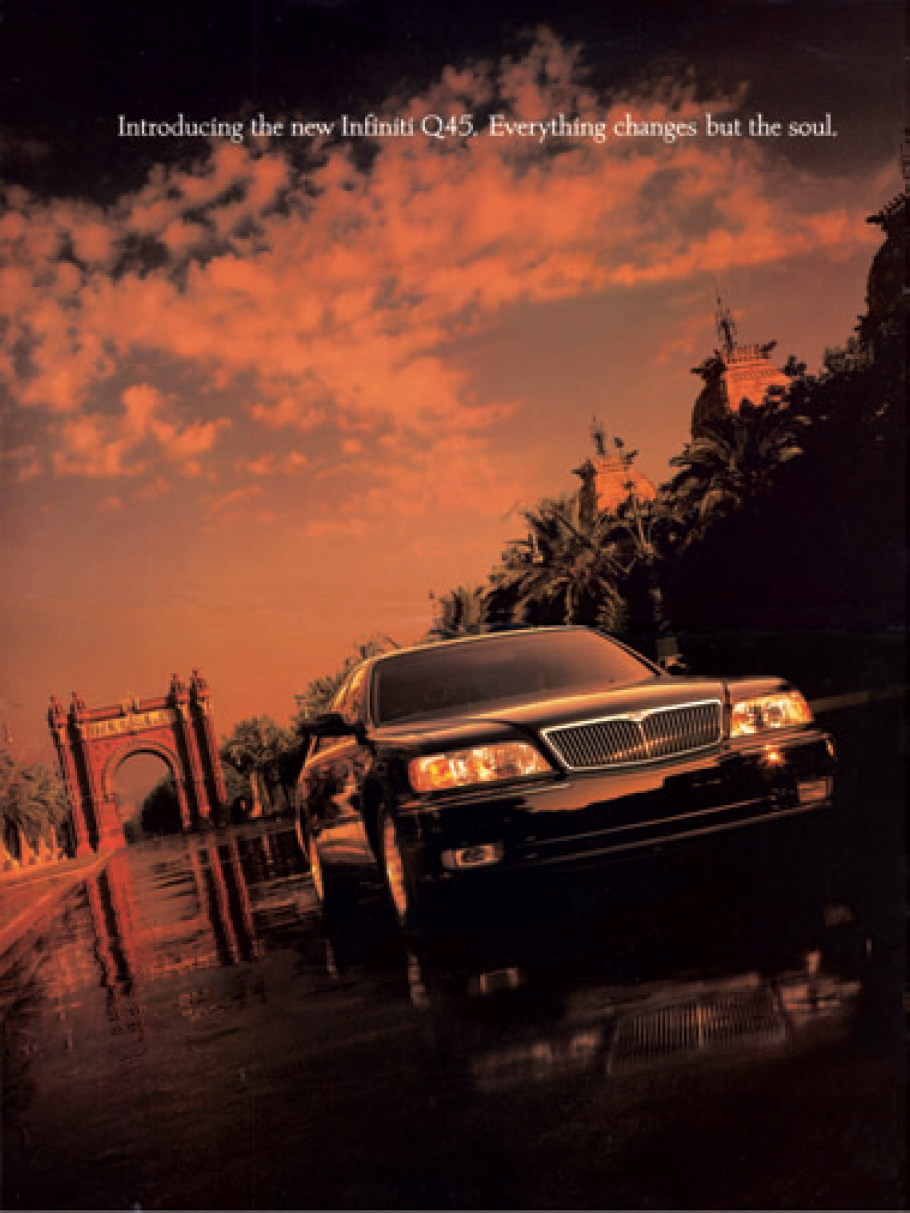
The Soul of the New Machine: The ultimate factory add-on for the Smart Car that has Everything – conciousness. © Infiniti; reprinted under Fair Rights clause of U.S. copyright law.
Then again, the association of auto and thanatos makes perfect sense, in light of the overlapping vocabularies of car and casket advertising, with their shared emphasis on gracious living – or dying, as the case may be. The language of the luxury car ad is echoed in trade publications for the funeral industry: in The American Way of Death, Jessica Mitford quotes an ad for the ‘Monaco’ model casket, a deluxe vehicle that features ‘Sea Mist Polished Finish’ and an interior ‘richly lined in… velvet, magnificently quilted and shirred’ (Mitford, 1979: 57). Of course, the connection between car and coffin runs deeper than polished finish; both are abject objects in the sense that they remind us of our own mortality. 5 They infect life with death, and in so doing unsettle the neat distinction we make between the two. Seen not as a gleaming totem of unbridled freedom but as a steel-paneled, leather-upholstered coffin, ready to receive its roadkill-to-be, the car flickers disconcertingly between meanings, and thus becomes abject. But, as the Critical Art Ensemble points out in its essay, ‘Human sacrifice in a rational economy’, awareness of the car's status as a death trap is crowded out of the conscious mind: ‘Recognition of the car as an abject object is extremely temporary… Signs of safety abound – traffic laws, safety inspections, the highway code –and so the auto is disassociated even further from death’ (Critical Art Ensemble, 1996: 101). At the same time, the authors note, ‘we know that more than 50,000 will die in the US this year in motor vehicle mishaps’ (1996: 101).
The Freudian question looms, dead ahead: Is our motorphilia rooted in suicidal impulses? Who among us hasn't flirted, if only for an instant, with the fantasy harbored by Annie's abnormally normal brother Duane (Christopher Walken) in Annie Hall (1977):
Can I confess something? I tell you this because, as an artist, I think you'll understand. Sometimes when I'm driving on the road at night, I see two headlights coming toward me, fast. I have this sudden impulse to turn the wheel quickly, head on, into the oncoming car. I can anticipate the explosion, the sound of shattering glass, the flames rising out of the flowing gasoline.
(That, Virginia, is why they call it the death drive.) Risking bathos, we can read Duane's monologue (delivered in a hilariously edgy deadpan by Walken) as a comic take on the psychic collision of eros and thanatos (definitively theorized by Georges Bataille in Erotism: Death and Sensuality). Here, accelerating into the oncoming headlights of certain death culminates in the ecstatic (if fatal) release of psychic tensions, in fulfillment of the Freudian death instinct. Extinguishing the self in a fiery car crash is synonymous, in Duane's fantasy, with that other consummation devoutly to be wished, the ego-obliterating orgasm, which in French slang is known, tellingly, as ‘the little death’. (As we shall see in a few pages, the SF writer J.G. Ballard improvises virtuosically on this theme in his novel Crash.) The delicious anticipation, the ejaculatory ‘explosion’ followed by the ‘shattering’ climax, the flow of post-coital juices: Duane merely makes manifest the latent content of all those car chases that are a staple of Hollywood action movies. With their immersive, videogame-like P.O.V. and their adrenalin-pumping footage of rear-ending, sideswiping vehicles, car chases put our reptilian hindbrains in the driver's seat. And they tease our desire, crescen-doing in fiery wipeouts that are the action-movie version of porn's ‘money shot’.
Then, too, the fantasy of swerving, suddenly, into an oncoming car offers cathartic release, venting the repressed awareness that, every time we climb into a car, we stand a chance of dying. (According to the National Highway Traffic Safety Administration, motor vehicle crashes were the eighth leading cause of all deaths in 2001, when vehicular accidents killed 42,196 Americans. They were the number one cause of deaths for Americans from age four through 33, that year.) 6 As the tension of waiting for our seemingly unavoidable date with death mounts, the perverse fantasy of taking control of our destinies by choosing the time and place of our autos-da-fé grows increasingly seductive.
Some drivers cross the double yellow line between wish-fulfillment fantasy and deadly reality. Whether they do so to break the unbearable tension of waiting to become another one of the NHTSA's grim statistics, as a sacrifice to the psychopathology of everyday life (specifically, the death drive), or as a final solution to their problems can never be known, in many cases. According to the cultural critic Mikita Brottman, in her introduction to the essay collection Car Crash Culture, ‘investigators have speculated that a certain percentage of the single-vehicle car crashes that happen every year may in fact be deliberate suicides, disguised as accidents either because of the social stigma frequently attached to suicide or in order to let surviving relatives claim substantial insurance policies’ (Brottman, 2001). In ‘Suicide and homicide by automobile’, the psychiatrist John M. MacDonald mentions several incidents straight out of Duane's suicidal ideation: ‘A middle-aged woman while driving down a highway suddenly swerved her car into the path of a large semi-trailer truck and was killed. There were no skid marks, and she had made no effort to avoid collision’ (MacDonald, 2001: 92). ‘A young sociopath drove into the path of an oncoming car whose driver swerved into the wrong lane to avoid collision. This evasive action was not successful, as the sociopath corrected his aim and both cars were badly damaged’ (MacDonald, 2001: 94–5).
Naturally, death is the last thing on the minds of car advertisers, who conjure images of gravity defied and immortality attained, draping their product in the macho myth of the Top Gun pilot or the rocket jock with the Right Stuff. Such imagery draws on a tradition of four-wheeled futurism as old as the tailfins of the 1948 Cadillac, famously inspired by General Motors designer Harley Earl's tour of a Lockheed hanger, where a test model of the viciously cool twin-tailed P-38 Lightning fighter plane took his breath away. Earl's jet-age streamlining and the mythic language it spoke still reverberate, loud and clear, in ad campaigns such as the one for the 1997 Acura NSK, whose ‘sweeping lines and forward-poised cockpit’ mimic the design of the F-16, mythologizing the car as a spacecraft for Major Dad, guaranteed not to ‘burn up on reentry’. Likewise, Chrysler's Eagle Talon was hyped as a ‘rocket full of miracles… ungodly good at flying on the ground’.
Rocket-sled fantasies for wannabe flyboys may have peaked in the high-flying, tech-crazy ‘90s, but they live on, somewhat more discreetly, in those stealth ads passing as product reviews that The New York Times sneaks into its ‘Automobiles’ section, where a puff piece on the Mercedes-Benz SL500 (‘one of the world's most technologically competent and complicated cars') worshipped the $100,000 ‘touring machine’ as ‘the four-wheeled, leather-upholstered equivalent of a private Gulfstream IV jet’ (Martin, 2002: 1). Likewise, a 2002 ad for the Lexus ES 300 announced, ‘Rain-sensing windshield wipers. Even Jules Verne didn't see this one coming.’ The copy swooned over the car's sensors, which detect raindrops on the windshield (can someone, anyone, explain why any driver not drunk or asleep at the wheel would need to be told that it's raining?), as well as its Navigation System, which can ‘verbally direct you to any destination within the contiguous United States’. (A footnote, in microscopic print, advised, ‘Rely upon your common sense to decide whether or not to follow a specified route’, an admonition that conjures sick-funny visions, in cynical minds, of Lexuses hurtling confidently off half-built freeway ramps.) With their microchip implants and post-Moderne streamlining (the ‘blob’ aesthetic made possible by computer modeling and popularized by product designer Karim Rashid), the RoboCars of ad myth and pop-science journalism invoke a sleek, technocratic Tomorrow. Nonetheless, despite the ministrations of overworked ad agencies, the automobile remains a supreme anachronism: a metal box on wheels, propelled by an engine that guzzles fossil fuels and spews toxic effluvia. In an age consecrated to escape velocity, when scientists have already begun to chafe at the speed-of-light barrier that limits the millions of operations per second a computer can perform, the near-permanent congestion around many big cities dramatizes the contrast between data traffic streaking along the Information Superhighway and rush-hour traffic crawling along real-world freeways. ‘To the telematic nomad, a car is pure nostalgia, a sign of lost time’, argues the semiotician Marshall Blonsky (1992: 27), improvising in the key of Baudrillard. At a time when cell phones, laptops, and the wiring of the world have made a mockery of time and geography, the car is a nagging reminder that we still haven't figured out how to zap our Darwinian luggage – the body – from here to there, in Star Trek's transporter.
Of course, the car crash, which will kill one of every 75 Americans and is the US's leading cause of untimely death, is the cruellest reminder of that fact – a whiplash reality check to cyberbole like the Progress and Freedom Foundation's now laughably dated ‘Magna Carta for the Knowledge Age’ (1994), which proclaimed that ‘the central event of the 20th century is the overthrow of matter… The powers of mind are everywhere ascendant over the brute force of things’ (quoted in Seabrook, 1997: 274). Undoubtedly, the manipulation of symbols is fast superseding heavy manufacturing as the economic engine of post-industrial culture. Nonetheless, the messy reality of what happens when flesh and metal collide at high speed is a powerful reminder, to those of us who spend entirely too much time online, that ‘the powers of mind’ are not everywhere ascendant.
The car is a Second Wave totem: ever-present reminder of the assembly line that made industrial modernity possible, Ur-commodity at the heart of postwar consumer culture, essential ingredient in the rise of suburbia and the dereliction of the nation's inner cities, prime mover behind the strip-malling of America. ‘The road is now like television, violent and tawdry’, writes James Howard Kunstler in The Geography of Nowhere. ‘The landscape it runs through is littered with cartoon buildings and commercial messages… There is little sense of having arrived anywhere, because everyplace looks like noplace in particular’ (Knustler, 1993: 131). The car (specifically, American consumers’ insistence on cheap, plentiful gas) was a primary impetus behind the Persian Gulf War, a self-evident truth acknowledged at both extremes of the political spectrum, from Jello Biafra's patriot-baiting punk rock song, ‘Die for Oil, Sucker’, to the pugnacious slogan popular with the pro-war faction, ‘Kick their ass, take their gas’.
Although in Madison Avenue myth it sings the song of the open road, conjuring all-American visions of unbounded freedom and ceaseless progress, the automobile has in truth been an implacable foe of progress in the broadest social sense. In its ‘Futurama’ exhibit at the 1939 World's Fair, General Motors supplanted the monorails of pulp SF with teardrop-shaped cars that zipped along fourteen-lane expressways – a science-fiction echo of its covert campaign, then well under way, to derail mass transportation by buying up streetcar lines and scrapping them (Klein and Olson, n.d.).
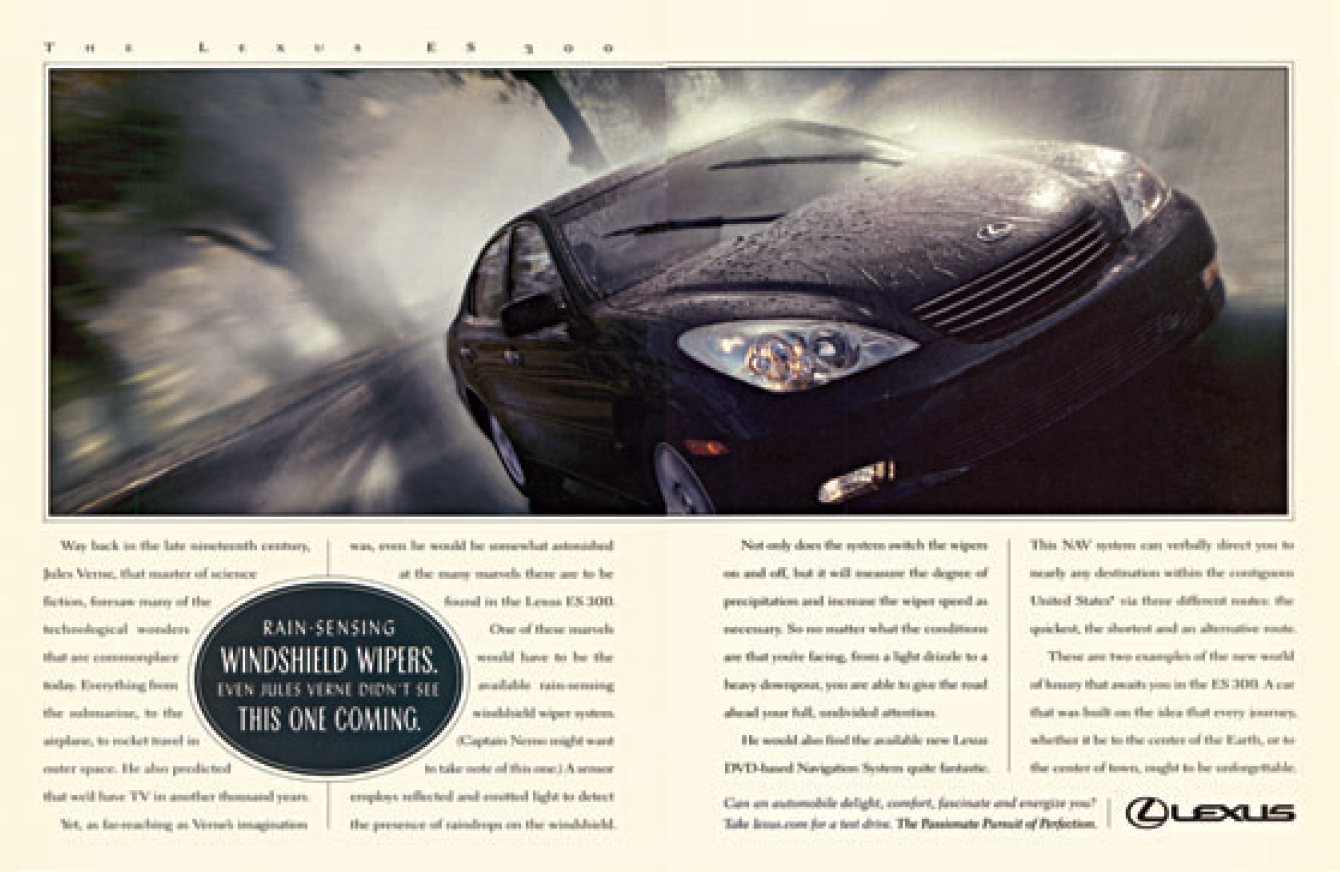
Futurrific! Selling the car – an industrial throwback if ever there was one – as a Vision of Things to Come. © Lexus; reprinted under Fair Rights clause of U.S. copyright law.
* * *
“‘In my humble opinion,” said Rick Schmidt, founder of the International Hummer Owners Group, “the [Hummer] H-2 is an American icon… it's a symbol of what we all hold so dearly above all else, the fact we have the freedom of choice, the freedom of happiness, the freedom of adventure and discovery, and the ultimate freedom of expression. Those who deface a Hummer in words or deed deface the American flag and what it stands for.“’ (quoted in Weinberger, 2005: 116)
The most potent symbol of everything that's wrong with car culture, and the gasoholic, environmentally toxic mentality behind it, is of course the SUV, the huge – and, in this country, hugely popular – ‘light truck’ that embodies Imperial America, early in the twentyfirst century. Like too many of us, it is a four-wheeled monument to morbid obesity. According to Greg Critser's (2003) book Fat Land, Americans now enjoy the unenviable distinction of being the fattest people in the world (one-fifth of us are obese), a status that is partly the result of federal subsidies for agribusiness, which make food cheap and plentiful, and partly the result of the marketing genius that hooked Americans on ‘supersized’ portions (the Big Gulp, the Big Mac).
As the Last Remaining Superpower™, we have a lot of military and economic weight to throw around, too – a fact of geopolitical life that is making our allies increasingly uneasy about the 7,000-pound Hummer in the middle of the room. And well they should be: the foreign-policy road map in the Bush administration's glove compartment is Rebuilding America's Defenses: Strategy, Forces, and Resources for a New Century, a spooky, Strangelove-ian report issued in September 2000 (in other words, before the 9/11 terror attacks, instructively) by the Project for the New American Century, a conservative brain trust. 7 Many of the report's recommendations – that the administration repudiate the anti-ballistic missile treaty, embark on the creation of a global missile defense system, pump up defense spending, and cast the net of American military power around the planet – have been taken to heart by the administration. Dreaming of empire, George II and his post-cold warriors imagine a Pax Americana – a global lock-down ensured by an America unafraid to administer a little rough justice, nuclear or otherwise, in the performance of what the report wryly calls its ‘constabulary duties’, duties that necessarily ‘demand American political leadership rather than that of the United Nations’ (Bookman, 2002). Call it SUV foreign policy, a my-way-or-the-highway attitude toward what Defence Secretary Donald Rumsfeld likes to refer to as ‘Old Europe’, not to mention the irrelevant ragtag and bobtail offstage, somewhere in the developing world.
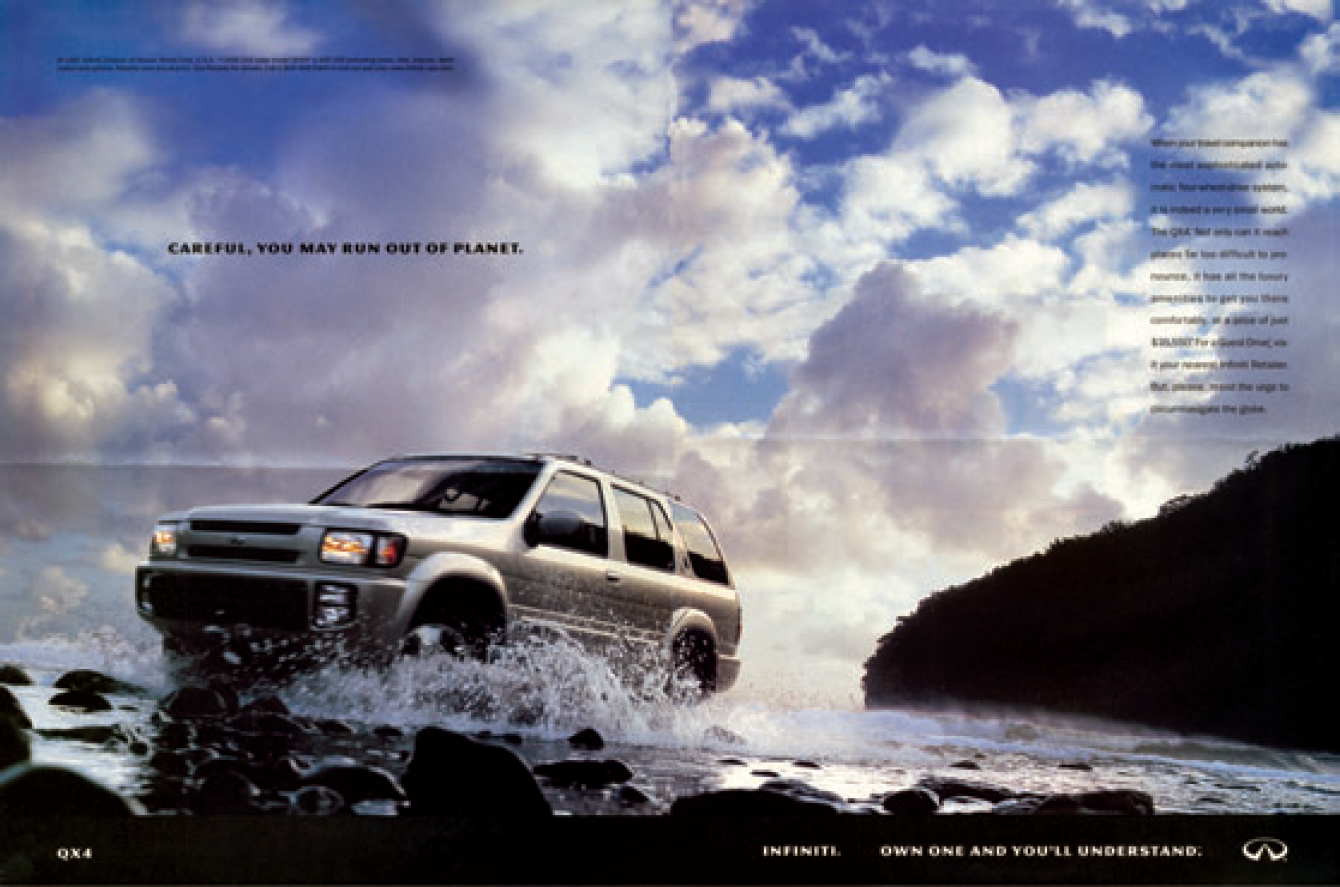
The Subtext That Speaks the Truth: Our fossil-fueled habit of riding roughshod over the natural world is on a collision course with the disaster-movie reality of global warnning. In a near-future world where tsunamis and hurricanes will turn the pump-and-dump schemes of coastal developers into Donald Trump's idea of Atlantis, even Infiniti will have its limits. © Infiniti; reprinted under Fair Rights clause of U.S. copyright law.
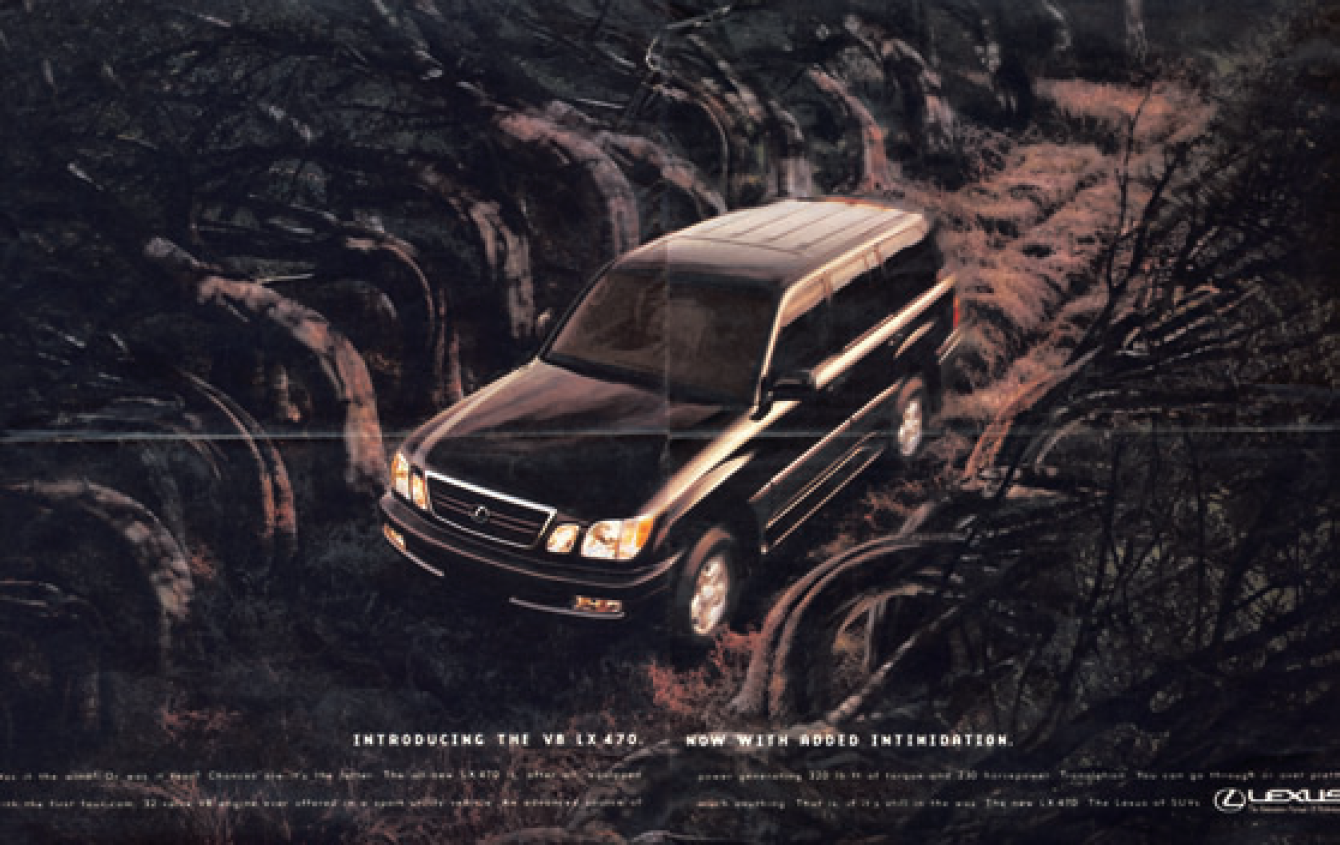
My Way or the Highway: In the Age of Bush, even nature cowers before the Last Action Superpower. A geopolitical parable for the New American Century. © Lexus; reprinted under Fair Rights clause of U.S. copyright law.
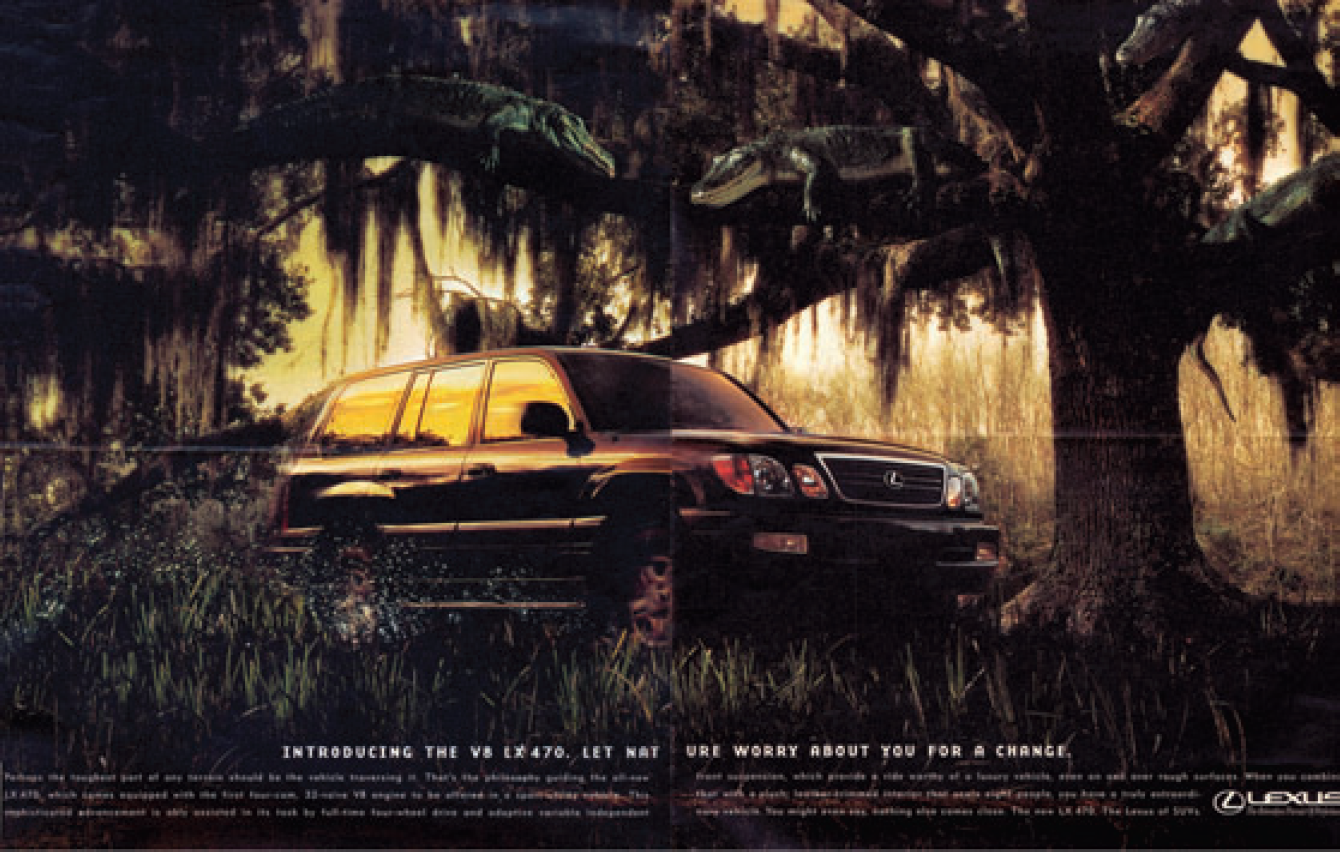
Ecology of Fear: Through the smoked glass window of my GPS-equipped SUV, exurban sprawl, species extinction, and extreme weather are mere mirages, conjured by calamity-howling liberals. Who needs nature when you've got culture? © Lexus; reprinted under Fair Rights clause of U.S. copyright law.
And it is a policy with consequences, as our Beloved Leader likes to say, when in finger-wagging mode. There's a zigzagging but unbroken line, here: it begins with our love affair with the hideously fuel-inefficient ‘light trucks’ (sport utility vehicles, pickups, and minivans) and leads, naturally, to off-the-charts profits for Detroit automakers and a what, me-worry? attitude, among American voters, toward oil addiction. From there, it's but a minute's drive to the US government's all-too-happy willingness to exempt such engines of job creation, stock inflation, and consumer confidence from Federal standards for pollution and fuel-consumption. (Light trucks are becoming ‘the fastest-growing source of global warming gases in the United States, exceeding the increase in all industrial emissions combined’, according to an Environmental Protection Agency researcher (Bradsher, 1997: 42). In such a political climate, our industry-friendly refusal to sign off on environmental agreements such as the Kyoto Accords is a no-brainer. Meanwhile, our dependence on oil mandates a growingly interventionist role in the Middle East, a ‘constabulary’ role that inflames the blood-and-soil jihadi, who would rather die than suffer the presence of hated infidels in their sacred lands. Righteously angry at US military support for Israel's collateral damage-heavy suppression of the Palestinian uprising and America's historical role as the cosy bedfellow of authoritarian regimes throughout the Middle East, the jihadi will happily kamikaze US planes into Trade Towers, Pentagons, and other symbols of the Great Satan. Granted, the United States's refusal to swerve in its global game of chicken with bin Laden, barrelling head-on into the bearded one's demented dream of a pan-Islamic Caliphate, may have something to do with fundamentalist ire. But long before the rise of the House of Saud's answer to Dr. Evil, America's colonial presence in the region, aiding and abetting human-rights abusers in Israel, Iran, Egypt, Saudi Arabia, and, irony of ironies, Iraq, sewed the dragon's teeth from which bin Laden's shock troops have sprung. Plagued by historical blindspots and prone to geopolitical rollover, the SUV world-view is unsafe at any speed.
* * *
Paradoxically, we can also read the automobile not as some Second Wave holdover but as a premonition of the slow-motion collision of biology and technology that began with the Industrial Revolution and accelerated with the Information Age (transistor, integrated circuit, microchip, network), skidding out of control in the wired 1990s. Now, the point of impact, in which organic and synthetic meet (at least metaphorically, though increasingly literally, in genetic engineering and bionic medicine), seems only split-seconds away, in an age of cloned sheep, bacterial computing, pigs with human hemoglobin, and artificially intelligent cyberpets, such as the Sony Aibo. In retrospect, the car seems a likely candidate for the bifurcation between the born and the ‘borged’, a clunky presentiment of myoelectric prostheses, teleoperation, and the Holy Grail of cyberpunk SF, the brain jack that would dissolve the membrane between mind and machine altogether. ‘When driving a car, one's nervous system becomes linked with the vehicle in a very basic way’, writes David Paul, in his essay, ‘Man a Machine’. In a sense, Paul argues, ‘the car is the driver's body and is directly controlled by the driver's brain and central nervous system. The driver “feels” other objects external to the vehicle and judges distances from the car in a manner crudely analogous to the operations involved in judging one's environment from the physical body’ (Paul, 1987: 169).
Paul isn't the only one to note the cyborgian nature of car and driver, a relationship immortalized in Enzo Ferrari's maxim that ‘between man and machine there exists a perfect equation: fifty percent machine and fifty percent man’ (cited in Bayley, 1986: 34). Here is professional driver Lyn St. James on her relationship to her racecar: ‘You're strapped in so tightly that you end up wearing it. You become one with the car… This is where… I'm in my most powerful form’ (Leiber, 1993: 55). Jacques Villeneuve, who won the 1995 Indy 500 in a sensor-studded, microprocessor-enhanced machine that looks more like a cruise missile than a car, seconds her emotion: ‘You forget that it's a separate thing. You feel everything. You feel what is happening to the car through the steering wheel, your hands, your feet, your butt, and your back… [O]nce you get used to it, it feels natural… like walking…’ (cited in Lapin, 1995: 130). Even at a mere 110 miles per hour – a veritable crawl compared to the 220-plus speeds clocked by Villeneuve – the car columnist Lesley Hazleton bonded with her Porsche 911: ‘It was as though I became the car, or the car became me… Road, driver, and machine were blended into a single entity, an unholy union of asphalt and steel and flesh’ (Hazleton, 1992: 22).
Hazleton's ‘unholy union’ will become a fixture of Tomorrowland's fourteen-lane expressways if technoscience starts spawning drivers like Cowboy, the cyborged road warrior, in Walter Jon Williams's cyberpunk novel Hardwired, who ‘drives without the use of hands or feet, his mind living in the cool neural interface that exists somewhere between the swift images that pass before his windscreen and the electric awareness that is the alloy body and liquid crystal heart of the Maserati’ (Williams, 1987). Recalling ‘an experimental automobile braking system which was to be engaged by simply lifting an eyebrow’, David Paul (1987: 169) speculates that ‘we appear to be approaching a time when “willing” a machine into action will be relatively common’. J.G. Ballard imagined just such an interface when he told me, in an interview, ‘It's possible that the driver will not just put on his seatbelt but will also put on some sort of cranial harness so that the onboard computer of the car will pick up various responses by the driver – brain waves, blood pressure, you name it – to the terrain. There will no longer be an accelerator, because the car will respond to the driver's instructions before he's even realized that he's made them.' 8
For the immediate future, however, the Futurist poet F.T. Marinetti's fist-banging declaration that ‘we will conquer the seemingly unconquerable hostility that separates our human flesh from the metal of motors’ remains a posthumanist pipe dream (cited in Mackintosh, 1992: 12). The tension generated by this seemingly unresolvable situation seeks release in the car crash, in which man and machine are conjoined, once and for all.
Intriguingly, Jacob Kulowski's 1960 study, Crash Injuries: The Integrated Medical Aspects of Automobile Injuries and Deaths, is tinged with the influence of cybernetics and human engineering, both of which are concerned, to varying degrees, with optimizing the man-machine interface. ‘I believe it to be true that crash-impact engineering’ – elsewhere defined as ‘the distinctive art of delethalizing automobiles’ – ‘is a mirror image of human engineering’, writes Kulowski, who calls human engineering ‘the field of activities wherein special emphasis is placed on determining optimum mode of interaction between man and machine systems of which he is a part’ (Kulowski, 1960: xxi; xix; xx, emphasis added). The phrase is instructive, presuming as it does that the human is an organic component in a larger technological system – the proverbial ‘cog in the machine’ – rather than a co-evolutionary factor in an environment that is equal parts organism and mechanism.
Tellingly, Crash Injuries is shadowed by vague forebodings about the fate of the human in an ever more technological landscape, betrayed in Kulowski's tragicomic observation that the ‘mechanical efficiency of the human body is a refreshing commentary on man's… supremacy over at least some elements of [the] mechanical environment’ (1960: 14). Elsewhere, he notes, tellingly, that ‘the epidemic frequency of these accidental injuries and deaths is thought to derive from… stress-strain patterns of behaviour peculiar to the age of power and speed in which we live, work and play’ (1960: vii).
In mythic terms, the car crash – memorably defined by one of Kulowski's sources as ‘an extremely complicated phenomenon of a very brief duration ending in destruction’ – is at once a precognitive dream of our fusion with our machines and a ritualized enactment of the moment when we lose control of them. Obviously, the escalating number of fiery rollovers, head-on collisions, and multiple-car pileups in action-adventure movies is a concession to the Lowest Common Denominator in a channel-surfing culture afflicted with Attention-Deficit Disorder. But on the more profound level of science-fiction myth, the liberation of special effects from what McLuhan might call the ‘Gutenbergian’ constraints of narratives rooted in Oedipal psychology suggests the first stirrings of sedition in the technosphere – the machine kingdom's dream of taking the human out of the loop altogether, the moment when SkyNet becomes self-aware. 9
Ironically, the car crash (again, considered mythically, as opposed to matter-of-factually) also recalls us to our humanity. Deadened and decentered by the ceaseless shocks and jolts of consumer culture and the mass media, more and more of us have come to resemble crash test dummies, existentially speaking. In this light, the crash functions as a bracing blow that re-connects us with our own bodies and other people at a time when our interaction with the world around us consists, increasingly, of headfirst immersion in machines with screens or human contact squeezed through wires, whether they're connected to phones, fax machines, or networked computers. In Ballard's novel Crash, the terminally numb narrator is jolted out of his postmodern autism by a collision, ‘the only real experience I had been through for years’ (1985: 39). He reflects, ‘For the first time I was in physical confrontation with my own body, an inexhaustible encyclopedia of pains and discharges, with the hostile gaze of other people, and with the fact of the dead man.’
Inspired in part by Crash Injuries, Crash is among other things a science-fiction response to what the author calls ‘the most terrifying casualty of the [20th] century: the death of affect’ (1985: 1). In the detached, exact language of the forensic pathologist and the engineer, Ballard shadows forth a ‘sexuality born from a perverse technology’, a new entry for Krafft-Ebing's Psychopathia Sexualis written in the mutilations of Crash's protagonists, ‘her uterus pierced by the heraldic beak of the manufacturer's medallion, his semen emptying across the luminescent dials that registered forever the last temperature and fuel levels of the engine’ (1985: 8). Vaughan, the car-crash fetishist around whom the plot revolves, savors the pornography of slow-motion collisions in technical films and dreams of dying, at the moment of orgasm, in a spectacular accident with Elizabeth Taylor's limousine.
Violent and passionless, beyond ego psychology or social mores, this is a posthuman sexuality ‘without referentiality and without limits’, as Jean Baudrillard puts it in his essay on Crash (1991: 313). Alienated from a body that seems, more and more, like a preindustrial artifact, it fetishizes urban desolation, televised disasters, celebrities, and commodities, above all the automobile.
In Crash, sex happens almost entirely in cars; removed from that context, it loses its appeal. The body is erotic only when it intersects with technology or the built environment, either literally (punctured by door handles, impaled on steering-columns) or figuratively (‘[t]he untouched, rectilinear volumes of this building fused in my mind with the contours of her calves and thighs pressed against the vinyl seating’ (Ballard, 1985: 74)).
Here, as in SF films such as 2001 and Blade Runner, humans are dispassionate mannequins while the technology around them is disconcertingly anthropomorphic: the ‘grotesque overhang of an instrument panel forced on to a driver's crotch’ in an accident conjures a ‘calibrated act of machine fellatio’, while the ‘elegant aluminized air-vents’ in a hospital ‘beckon as invitingly as the warmest organic orifice’ (Ballard, 1985: 12, 41). In the depraved geometry of Crash, semen and engine coolant, crotches and chromium instrument heads are congruent. ‘I believe that organic sex, body against body, skin area against skin area, is becoming no longer possible’, said Ballard, in a 1970 interview, ‘simply because if anything is to have any meaning for us it must take place in terms of the values and experiences of the media landscape’ (in Vale and Juno, 1984: 157).
Crash refracts human psychology through the fractured windshield of postmodern culture, with its flattened affect, celebrity worship, obsessive documentation of every lived moment, and psychotic confusion of subjective experience and filmic fiction. Like David Cronenberg's Videodrome, Don DeLillo's White Noise, and Ballard's own Atrocity Exhibition, the novel represents a poetic attempt to psychoanalyse the cybernetic subjectivity borne of the late twentieth century – a century characterized by speed and sensory overload, by the supersession of embodied experience by media simulation, and by the over-arching dynamics of disembodiment and dematerialization. Ballard has long maintained that the psychology of the mainstream novel – introspective and solipsistic, an artifact of the book – is a remnant of the nineteenth century, and that science fiction is the only literature capable of making sense of the moment we live in. It is a moment whose psychological torque is centripetal, not centrifugal – a moment where ‘social relationships are no longer as important as the individual's relationship with the technological landscape’, which is another way of saying that interpersonal psychology has been displaced by a new, cyborgian psychology: the feedback loop between human and machine (Ballard, 1996: 205).
As Crash brilliantly illustrates, the relationship between car and driver offers a convenient metaphor for our present psychological (and, increasingly, physiological) symbiosis with our machines. Moreover, the image of freeway drivers jockeying for position, each sealed in his or her climate-controlled conveyance, reminds us of the increasingly atomized nature of our society, where many among the growing ranks of the self-employed live wired lives, communing virtually while physically isolated in their electronic cocoons.
But, as argued earlier, the car–driver relationship is more than a handy metaphor; it is an ubiquitous example, hidden in plain sight, of our everyday psychological symbiosis with our machines. As Deleuze and Guattari argue in A Thousand Plateaus, ‘tools exist only in relation to the interminglings they make possible or that make them possible. The stirrup entails a new man-horse symbiosis that at the same time entails new weapons and new instruments. Tools are inseparable from symbioses or amalgamations defining a Nature-Society machinic assemblage… a society is defined by its amalgamations, not by its tools’ (Deleuze and Guattari, 1987: 90).
Incredibly, over a century after the invention of the automobile, we have only begun to scratch the surface of the psychological relationship between driver and car, or driver and driver. Deborah Lupton's (1999) ‘Monsters in metal cocoons: “Road rage” and cyborg bodies’ (in which the author argues that car and driver fuse, psychologically, to form a cyborg body); Jörg Beckmann's ‘Mobility and safety’ (a meditation on traffic accidents highlighting the role of the car–driver hybrid), Mimi Sheller's ‘Automotive emotions: Feeling the car’ (which straddles the phenomenology of car use and the sociology of emotions), Mike Featherstone's inquiry into the ‘car-driver-software assemblage’, and Tim Dant's ‘The Driver-car’ (an analysis of the sociological aspects of that cyborgian assemblage, the ‘driver-car’), all of which appear in the Automobilities issue of Theory, Culture & Society (Featherstone, Thrift and Urry, 2004), John Urry's Sociology Beyond Societies: Mobilities for the Twenty-First Century; and the essays collected in Brottman's (2001) Car Crash Culture, as well as those in this anthology, most notably Peter Merriman's “‘Mirror, signal, manoeuvre”: assem- bling and governing the motorway driver in late fifties Britain’ (in this volume), have opened the discursive territory of the cyberpsychology of the car-driver hybrid, but only just.
We might begin our inquiries into the cyberpsychology of car and driver by asking: do other drivers subconsciously perceive our grilles and headlights as our faces? Are fender-benders assaults on our metallized bodies? Is the rearender sublimated sodomy? Most important, what is the precise psychological mechanism that enables us to ‘feel’ the boundaries of our cars when negotiating tricky maneuvers such as parallel parking?
This last question goes to the heart of human–machine interaction. Describing the eerie sensation of ‘telepresence’ experienced when operating a rocket launcher with the aid of virtual-reality goggles that give the operator a weapon's-eye view of the target, machine artist Mark Pauline noted, ‘The depth perception is incredible, and once you get all the little adjustments right, you just sink into it. You start to imagine your body in different ways just like you do when you're in an isolation tank; it becomes transparent, really, because of the comfort level, which is the key feature in any of these input devices. Once you achieve transparency, interesting things start to occur. It doesn't take much, because the mind is looking for these things, actively trying to meld with anything’ (quoted in Dery, 1995: 52).
Understanding the phenomena Pauline describes – the seeming mutability of the body image in the mind's eye, our eagerness to project ourselves into our technological interfaces (amply evidenced in the widespread experience of virtual spaces such as chat rooms and online role-playing games as ‘places’) –will yield a skeleton key to the emerging psychology of the Information Age. We've caught fleeting glimpses of the cybernetic self in McLuhan's Understanding Media and Sherry Turkle's Life on the Screen; in Fredric Jameson's visions of the ‘psychic fragmentation’, decentering, and death of the subject; and in Scott Bukatman's ‘terminal identity’ (‘an unmistakably doubled articulation in which we find both the end of the subject and a new subjectivity constructed at the computer station or television screen’ (Bukatman, 1993: 9).
But sustained scrutiny is imperative if we're going to understand the cultural g-force warping and buckling the bounded, coherent psyche of modernist humanism and Enlightenment rationalism. Since few of us use teleoperated rocket-launchers, the car–driver relationship suggests itself as a more suitable locus of inquiry. Obviously, the psychosexual subtext of automobile design and advertising has been exhaustively mined, most notably in Crash, Marshall McLuhan's The Mechanical Bride: Folklore of Industrial Man, Stephen Bayley's Sex, Drink, and Fast Cars, and Kenneth Anger's underground classic of auto erotica, Kustom Kar Kommandos. 10 But the latent sexual content of car styling is only the most prominent landmark in a much larger territory – the cyborg psychology of the car-driver hybrid, a territory that has lain largely hidden from view, until recently. Now, one of the great remaining terra incognitas of inner space awaits the Sigmund Freud of the driver's-side air bag and the C.G. Jung of the anti-locking brake.
Footnotes
1
The title is taken from David Bowie's song of the same name, on his album Low.
2
Mazda ad, 1994.
3
Infiniti ad, 1993.
4
Infiniti ad, 1997.
5
The ‘abject’, as theorized by Julia Kristeva in Powers of Horror: An Essay on Abjection, is that which unsettles us by destabilizing the philosophical dualisms, or binary oppositions, that structure the Western world-view – specifically, the distinction between subject and object, and self and other. Shit, sewage, and especially corpses, the abject object par excellence, force us to confront what we ‘permanently thrust aside in order to live’,  : 3).
: 3).
6
7
8
Unpublished excerpt from a 1989 interview with the author.
9
For non-geek readers, SkyNet is the SDI-like military computer network in Terminator 2: Judgment Day. According to the hunter-killer ‘terminator’ cyborg (played by Arnold Schwarzenegger), ‘The system goes online on August 4th, 1997. Human decisions are removed from strategic defense. SkyNet begins to learn at a geometric rate. It becomes self-aware at 2:14 A.M. Eastern time, August 29th.’
10
Not to mention, at the risk of immodesty, my chapter ‘Sex times technology equals the future’ in Escape Velocity (Dery, 1996).