






Abstract
Becoming a proficient glassblower involves an indispensable shift away from cognitive readings of practice towards corporeal readings, marking the development of proficient practical knowledge. In learning glassblowing myself in the course of an ethnography of handicrafts in New York City, the subtleties of apprenticeship, the modes of reading and understanding the practice, both cognitive and corporeal, have emerged, complexifying our understanding of the transmission, development, and modalities of practical knowledge. Such ethnographic dissection brings phenomenological considerations to bear on the question of achieving proficient practical knowledge, and enables us to sharpen our understanding of the role of meaning in practice.
Introduction: Coming to glassblowing
Embodiment characterizes our experience of the world. It is through embodied relations with the world, tacitly understood, that we accrue practical knowledge. Thus, when concretizing a research design for a project on craft skills, I situated myself in the field of craft, hoping to unearth and access in practice itself the tacit understandings of practical knowledge rather than pursuing purely aesthetic debates. While my research began as a comparative ethnography of ceramics, fibre arts and glassblowing, the impossibility of gaining proficiency within all three fields simultaneously soon became apparent. This is the context in which I focused on glassblowing, conducting field research at New York Glass, a not-for-profit glassblowing studio in New York City since September 2003.
New York Glass is the largest and most comprehensive public educational glass facility on the east coast. 1 Though the use of the facility is rumoured to have declined over the last seven years due to political struggles for power within the board of directors, which resulted in loss of endowments and consequent difficulty in maintaining the facilities, New York Glass is still a-bustle, used by both artists and students alike. 2 The studio offers courses throughout the year, including basic to advanced glassblowing, hot casting, kiln casting, lampworking, fusing, neon, stained glass, coldworking and bead-making. There are weekend intensive courses, one-day courses, demonstrations by visiting artists, glassblowers in residence and, of course, the daily workings of self-employed production glassblowers and glass artists.
A glassblowing studio consists of a furnace (which ‘cooks’ and holds molten glass at approximately 1800 degrees Fahrenheit, the glory hole (a small cylindrical furnace located in front of the workbench of the glassblower in which the glass is continuously reheated while being worked upon), and an annealer (an insulated box usually at least eight cubic feet with heating elements in which finished glass pieces are placed and then slowly brought down to room temperature). For public access use, New York Glass has two large furnaces, as well as numerous glory-holes and annealers. When arriving at New York Glass, one typically finds glassblowers at their benches, blowing vessels or sculpting objects, their assistants hustling about, top-loading finished pieces into the annealer and opening the furnace door for the glassblower to gather out glass. In a moment, one glimpses the ever-emergent inferno-like orange of molten glass from the furnace, is mesmerized by the blaze of the glory-hole at which the undulating glass is reheated to be shaped, and overwhelmed by the heady smoky scent of burning newspaper and pure unadulterated heat.
I had been blowing glass for six months when I attempted to blow a rudimentary goblet. I had accrued through practice a basic set of glassblowing skills which utilized numerous hand tools. These included gathering glass from the furnace, blowing a bubble, and forming shapes such as cylinders, bowls and plates. Though blowing a goblet called upon these skills, the process required both new skills as well as new configurations of those previously acquired. The challenge of blowing the goblet therefore was to combine learned with unlearned skills, a situation which afforded me the opportunity to evaluate how glassblowing is read by the glassblower, in varying stages of proficiency, and to reflect upon the ebb and flow of sensations, techniques, and modes of consciousness.
Reading the practice
A goblet begins with that invariable gather of glass from the furnace. I withdrew the blowpipe, a broomstick-length hollow steel tube, from the warming rack where its tip rested in a row of low blue-orange gas flames, and walked, the pipe's hot tip down, towards the furnace to gather. At the furnace my partner for the evening, Heather, slid open the coal-chute-sized iron door at hip height. I quickly dipped the heated tip of the pipe into the water bucket to remove any carbon, sending small streams of steam to my knees from the sizzling water. Between the door and the vat of molten glass was a small ledge, about six inches wide. I lifted the pipe with both hands to a horizontal position level with the ledge and gently rested the pipe, nearly at its tip, upon it. Withdrawing my left hand, I pushed the warm tip into the furnace until the edge of the ledge reached the pipe's mid-point where my left hand had been, effectively becoming a mid-point of balance. It was here, at the ledge's edge, that I felt the pipe. Just as the child tries to become more buoyant on the see-saw so that her friend may come to the ground through her effect on the mid-point of balance, I let my right hand, which still gripped the steel at the pipe's other end, become light until the pipe's warm tip within the furnace lowered toward and into the slightly undulating molten glass. Seized by the viscosity of the glass, the pipe, without a counterforce from the right hand outside, would have sunk. Instantly, my right hand set to work, the left too taking up a place just below the right, quickly rotating the pipe clockwise so as to both keep the pipe from sinking beyond three inches deep and to ‘gather’ the glass through twirling – much as one would gather honey by twirling a teaspoon in the honey-jar at the breakfast table. I gathered with a sense of confidence, though the over-zealousness of the grip of the glass on the blowpipe told me that the blowpipe had gone too deep. Pushing directly down on the end of pipe closest to me with my right hand, I brought the other tip out of the glass and swiftly withdrew the pipe with a mango-sized gather of glass at its tip from the furnace – the gather would be adequate for the task at hand. Heather slid the furnace door closed. 3
I had seen gathering demonstrated, had been instructed in how to gather, and had gathered many times prior to the above-mentioned gather to blow the goblet. By the fifth week of a beginner's intensive class in the winter of 2004, we had stopped following Rob, the instructor, to the furnace to watch his initial gather. The technique of gathering had been broken down into successive moments as I had noted in my field notes during my first glassblowing days:
We were asked to step forward individually to the furnace with our blowpipes and ‘gather’. ‘Just rest your pipe on the little ledge here,’ Rob advised, ‘just like you would on a windowsill and then just lower the tip into the glass with your right hand on the end of the pipe. Watch the reflection of the pipe in the glass rise to meet the pipe, then lower it in just a few inches and give it a few swift twirls – one, two, three – that's all you should need. Keep it on the ledge, and bring the tip of the pipe up. Place your left hand on the pipe just beneath the right, pull it up and out. Don't worry, you'll do it quick enough, because this isn't the sort of place you want to hang around too long’ (Field notes, October 19, 2003).
Bringing the blowpipe into the proper holding posture, twirling the blowpipe strongly and with a steady cadence, placing it at the proper leverage point on the ledge, lowering it at the proper speed and placing its tip into the glass at the proper depth – these were all vital components to gathering successfully. We would practise these component skills independent of each other, abstracted from the actual process, as when Paul, my glassblowing instructor in the fall of 2003, recommended that we twirl broomsticks while watching TV at home to improve our finger dexterity. Although, however, the steps of the gather are explained and sometimes demonstrated distinctly, like successive points on a line, to gather proficiently is not just a matter of linking together these successive actions.
Gathering from the furnace.
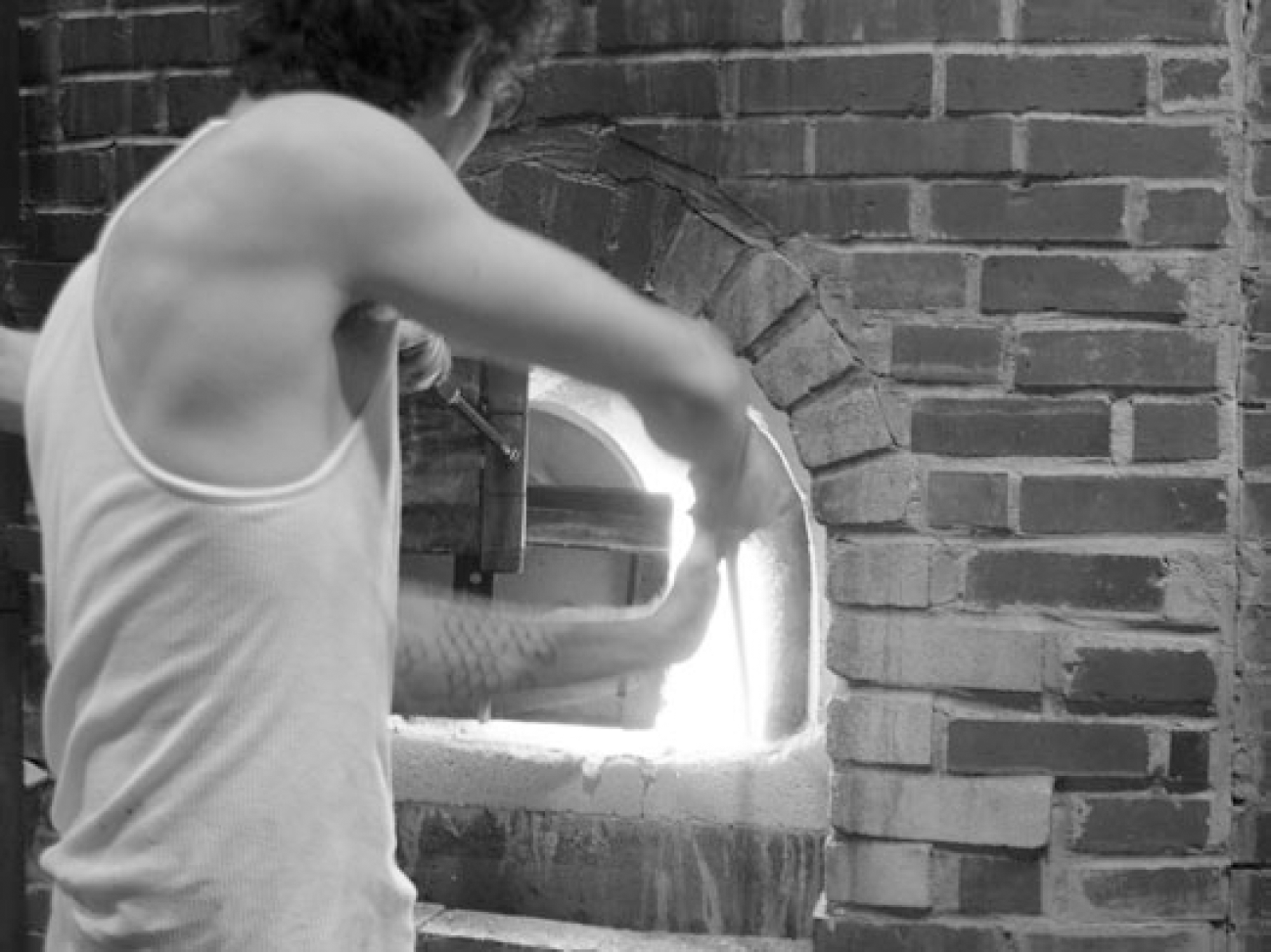
The difference in moving from one step (lifting) to the next (lowering) to the next (twirling) and yet the next (lifting again) and so forth, and being able to ‘gather’ begins to differentiate the gather of a novice and the gather of a proficient glassblower: the novice tends to proceed in distinctive, successive steps. Here we already see two possible sets of objects of attention for the glassblower to read amidst her practice: 1) the part that is an end in itself and 2) the part as it serves a project, a whole. When gathering for the goblet, I looked to the gather's mass and its position on the tip of the pipe in anticipation of working on it towards a goblet. Towards this end, I registered the efficacy of the gather, not the successive components or techniques of the gather, upon which my attention had been riveted in my first days of glassblowing. I did not consciously decide to continue to twirl when removing the blowpipe from the furnace, only sensed that, though a bit deep, the gather had been proficient for the purpose of blowing a goblet. This is a marked progress for the novice, who accustomed to serving the instrument then finds the ‘instrument through techniques’ actually becoming a part of her. In Personal Knowledge, Michael Polanyi discusses this process through which instruments recede from consciousness and become extensions of the body: ‘[T]ools… can never lie in the field of… operations; they remain necessarily on our side of it, forming part of ourselves, the operating persons. We pour ourselves out into them and assimilate them as parts of our own existence. We accept them existentially by dwelling in them’ (Polanyi, 1962: 59). I had developed what Polanyi terms, a subsidiary awareness of the blowpipe. 4
The objects of our subsidiary awareness ‘are not watched in themselves; we watch something else while keeping intensely aware of them’ (Polanyi, 1962: 55). Though my technical capability enabled my gather, I did not pay heed to each step, the distinctness of which had been insisted upon in my early days of glassblowing, but rather attended the gather itself, the correctness of which informed, if necessary, immediate adjustments to my techniques. I knew my gathering had been apt by virtue of the gather. The objects of subsidiary awareness were not objects of attention, but rather instruments of attention. As I began the process of gathering the glass, my awareness of the blowpipe's weight in my palm receded and in its stead advanced the sensation of the ledge's edge at the blowpipe's mid-point followed by the weight of the gathering glass on the blowpipe's tip, and finally the gather towards a goblet. David Sudnow discusses the shift away from an awareness of the particularities towards the whole in regard to his jazz piano playing as an ‘express aiming’ or ‘melodic intentionality’: ‘The emergence of a melodic intentionality, an express aiming for sounds, was dependent in my experience upon the acquisition of facilities that made it possible, and it wasn't as though in my prior work I had been trying and failing to make coherent note-to-note melodies’ (Sudnow, 1978: 44).
As our awareness of a practice shifts into focal awareness, so too does that practice take on a lived character, a graceful extended movement, an arc of embodied techniques. Rob and Paul's instruction, intentional or not, had consistently encouraged a shift towards this lived type of awareness. While Rob may instruct, ‘Bring the pipe up level with the ledge’ or Paul may instruct, ‘Twirl the pipe at an even pace’ – bringing our attention to what had been subsidiary – they often countered this with a quick counter-instruction to refocus on the project at hand, in this case, blowing the goblet. So while Paul, observing me warming my gather in the glory-hole as prior preparation for blowing out into a bubble, would call my attention to the pace of my twirling – ‘Slow it down there cowgirl. Keep it steady.’ – he would also quickly thereafter refocus my attention to the task of getting the glass to the desired end, calling out over my shoulder, ‘But keep your eyes on the glass!! Don't take your eyes off the glass! It's starting to hang.’ By bringing the technique into focal awareness, we could hone that technique. But we were quickly urged to allow what had become a momentary object of focal awareness, the technique and tool, to slip back into subsidiary awareness, a movement of attention which, having consciously attempted to mimic the correct technique, forged a slow process of restructuring.
This is the defining exercise of apprenticeship: the apprentice fashions her practice by making an implicit technique explicit, improving and re-aligning that technique with its intended purpose, and allowing the revised technique to again recede into unconsciousness, with the effect of shaping the still nascent glassblowing element of her habitus, ‘the system of structured, structuring dispositions’ (Bourdieu, 1990: 50). Paul and Rob's direction of our attention towards technique is an abstraction of a moment from the process in which it is embedded; a moment of reflection, evaluation and decision, a moment to which we may properly refer to as reading, that process through which we retrospectively discern the meaning of, in this case, our actions or technique. That an evaluation of the gather, a reading of the glass, would necessarily be retrospective leads me to suggest that reading a skill, like glassblowing, may be the mark of the novice and, while it can improve technique through bringing it into a state of exception, it can never be an operative mechanism of proficiency. When gathering for the goblet, I did not need to evaluate each of its constitutive moments to understand the deftness of the gather. Sense-making happened otherwise than through this retrospective meaning-making.
Meaning in practice
To understand the gather was not an intellectual synthesis of successive acts by a discerning consciousness. Rather, it was bodily intentionality: ‘practical, non-thetic intentionality, which has nothing in common with a cogitatio (or a noesis) consciously orientated towards a cogitatum (a noema), is rooted in a posture, a way of bearing the body (a hexis), a durable way of being of the durably modified body which is engendered and perpetuated, while constantly changing (within limits), in a twofold relationship, structured and structuring, to the environment’ (Bourdieu, 2000: 143–144). Moreover, this bodily intentionality ‘is a kind of necessary coincidence – which gives it the appearance of a pre-established harmony’ (Bourdieu, 2000: 143). When I understood I effectively aligned the particular techniques with the whole intended end through bodily intentionality: ‘to understand is to experience the harmony between what we aim at and what is given, between the intention and the performance – and the body is our anchorage in a world’ (Merleau-Ponty, 1962: 144). The body is itself able to assimilate new significances – the ‘body is that meaningful core’ (Merleau-Ponty, 1962: 147). Thus, in virtue of bodily intentionality, the particular techniques become ‘sense-full’. 5 That is, the meaning of the particular lies in its incorporated lived service to, or functioning towards, the whole, not within the abstracted retrospective interpretation and consequent understanding of its function. When the interpretive effort of ‘reading’ the practice, understanding how the parts fit into the whole, remains salient to that practice (as essentially a semantic understanding of meaning) it forms an immense barrier to the lived experience of the craft as meaningful. 6
It is not so easy as either/or, however. In fact, both types of meaning are often co-existent for novice and master. We have discussed how semantic readings of meaning are more or less necessary, depending upon the extent of incorporation of the practice. For the novice, her lived experience is likely to be informed, not from a lived practice of the meaning of the particular technique as it serves the whole, but rather from other areas of her life which help her to handle the newly encountered situation. Her adaptation is not wholly conscious; it happens at the level of the body. Her body ‘catches’ already-known components of glassblowing, like heat and retrieval and with some adjustments handles and gets through the new situation with greater or lesser degrees of success. These adaptations are specifically in response to what she finds herself confronted with and, in this sense, lack an anticipatory quality. They do, however, in re-positioning the body, set up the opportunity for the restructuring of the novice's habitus, that system of dispositions that can anticipate, in accord with the field, those rules of glassblowing. Thus, through the adaptations, the glassblowing habitus begins to take shape and she develops a ‘feel for the game’ (Bourdieu, 1990: 66). As the novice progresses, her adaptations to newly presented situations in glassblowing are grounded less and less in previous non-glassblowing experiences and more and more in her solidifying glassblowing skills, accomplished through a process of bodily restructuration.
In my attempt to blow the goblet I found that while I was able to complete the first steps (the gather and blowing the initial bubble proficiently), attaching the stem and foot were extremely difficult. Sensing the inevitability of the upcoming technical difficulty, anxiety flowed into my hands as I carried the gather on the blowpipe back to the workbench from the furnace. I blew out the bubble, paddled its bottom flat and asked my partner, Heather, to bring me a bit. A bit is made by gathering a small amount of glass onto the tip of the punty and shaping that gather into a slightly tapered cylinder by rolling it, called marvering, on a steel table, called a marver. I would then attach this finger-like piece of glass to the bottom of the bubble to serve as the goblet stem.
When Heather returned with the bit I was waiting with my blowpipe positioned vertically before me, mouthpiece resting on the top of my right shoe, bubble positioned right in front of my face, left hand holding the diamond sheers that are used to pull, attach, and cut through the still hot glass bit. Heather positioned herself to my left, aligning her right shoulder with my left and centered the punty vertically in front of her body, the hot bit of gathered glass hovering just above her feet. ‘Check your hands,’ I called to her, attempting to linger on that sense of assuring composure and exaggerated confidence that accompanies the initial posture of a practice. She did, consciously shuffling her feet forward, closer to me, lining up our shoulders, testing that the width between us equalled the length of the punty. She placed her left hand above the right on the punty and set it into a pendulum-like swing (Field notes, April 8, 2004).
It needed to happen in a blink of an eye, as Rob and Jane, his teaching assistant, had demonstrated. It hadn't and we had to re-heat our already-too-cold pieces. Re-positioned, Heather again swung the hot bit. Intense anticipation filled my body: ‘Rob and Jane were both calling out to me, “Take it with the shears! Pull it onto the bubble!“’ (Field notes, April 8, 2004). Their words called for action: I knew I needed to do as they had demonstrated – I needed to take hold of the punty with the diamond shears (imagine large scissors with curved blades that leave a diamond-shaped hole in the middle when closed), pull it towards the bubble before me and set the glass bit onto the bubble. I had no established rhythm, such as I had when gathering, to carry my actions. I was seized by a type of stage-fright: my body could not anticipate the right moment. Consequently, I looked for it: ‘My eyes jumped between my stagnant bubble, Heather's swinging punty swinging with the bit and the space passing in between. I felt impotent standing there, waiting for, rather than bringing about, the correct alignment of the swinging punty and bit with the standing blowpipe and bubble’ (Field notes, April 8, 2004). I visually scanned the arrangement of the object's positions, for the proximity necessary to take the punty with the diamond shears, guide it towards center of the bubble, and finally with a straight downward pull, bring the bit into contact with the bubble. I could feel the rapid movement of my eyes – it made me even more nervous – they couldn't keep the tempo, were not the proper organ, could not anticipate, but waited to receive.
Popping the bubble.
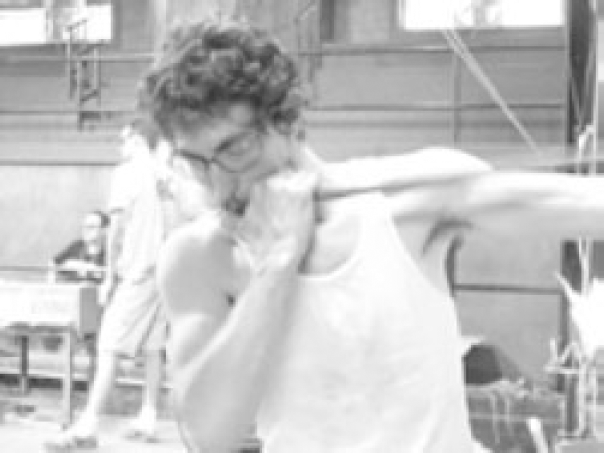
Letting the bubble blow out.
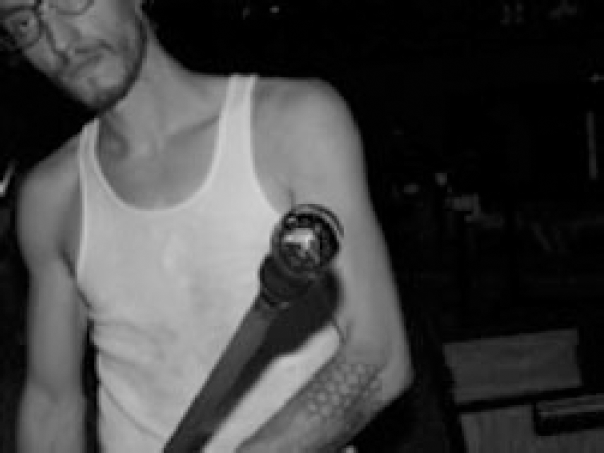
Paddling the bottom of the bubble.
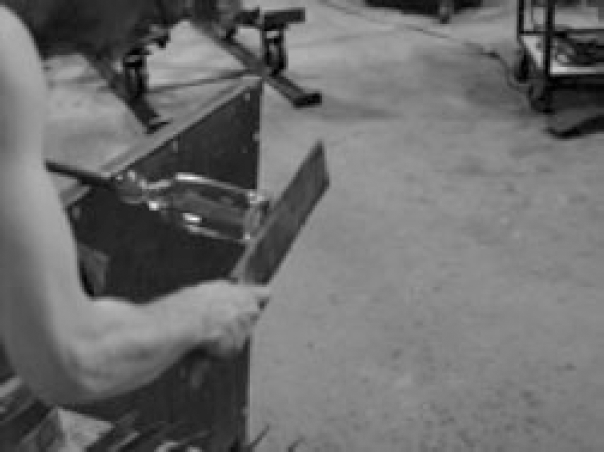
Marvering the bit for the stem.
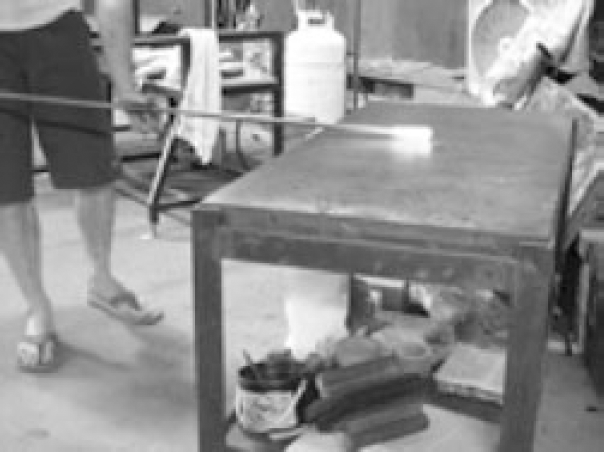
I did not and in fact could not catch the spatial synthesis for which I waited. I wrote in my field notes that day:
Heather delayed the punty in its downswing, it was stagnant. I grabbed onto it with the diamond shears, with the unease of catching baited game, and pulled it towards the bubble, and attempting to center the bit on the bottom of the bubble, began to pull it down. The irrevocable touch down of the bit upon the bubble happened before I could notice and Rob and Jane were already calling, ‘Pull off! Pull off! You've got to pull the bit up and off the bubble!’ My body was both numb and abuzz in the agitation of the unknown, hands shaking, heart racing. I drew the punty away from the bubble with the diamond shears so that the bit elongated into a semblance of a stem. They continued, ‘It's going cold! Cut it! Don't wait to cut it!’ Not seeing the cold of which they spoke, but knowing that I had to act immediately, I hurriedly took the shears with my right hand, clumsily positioned them on my fingertips for leverage and clamped down onto the glass: quartz-like veins of opacity broke through its clarity, as I exerted as much brute pressure as I could muster; the glass moaning under the bandying shears like paper-thin ice of a frosted sidewalk puddle under foot on a February morning (Field notes, April 8, 2004).
In my attempt to take the bit for the stem of my goblet, I had lost the ability to synthesize the movements of my hand with a greater whole body movement toward the goblet and found myself unable to attend to the technique as a whole, let alone to the goblet (something which had been possible in the initial gather and blowing of the bubble). There was no recession of a trained body into unconsciousness, operating of its own accord, as I had experienced in the gather for the goblet. In its stead, arose the bare punty, blowpipe and glass – each distinct – seemingly unrelated, but needing to be brought together as had been demonstrated. My efforts, however, to read spatially for the right moment of bodily intervention, to see when the time was right, were doomed to fail: ‘Motion perceived visually remains purely kinematic. Because sight follows movement so effortlessly, it cannot help us to make that movement an integral part of our inner lives’ (Bachelard, 1971: 8). Such efforts forsake what is essential to practice: temporality. Practice, whether novice or proficient, must be temporally not spatially motivated, the hallmark of non-reflective corporeal readings. Rob and Jane, in their efforts to instruct with their calls to action, set me into motion, made me temporal – my temporality needed to be primary to my corporeal configuration. Though I answered their calls with motion, I could not find quite the right way to handle the situation and therefore crassly mimicked what I had seen in the demonstration – the reaching out for the swinging punty and adherence of the bit to the bubble – gauging this spatially with my vision not temporally with my body. In my interjection into the process I seemed out-of-time, an interloper.
The inability to experience the particulars within a lived relation to the whole – when the glass, pipe, and shears become separated from blowing the goblet – when we are frozen in a moment of ek-stasis from the practice – lacks corporeal comprehension. Until the moment of taking the bit for the stem, we have seen that the embodied knowledge accrued was informed through a certain guided instruction that led my body to a better practice – a ‘practical mimesis (or mimeticism) which implies an overall relation of identification and has nothing in common with an imitation that would presuppose a conscious effort to reproduce a gesture, an utterance or an object explicitly constituted as a model’ (Bourdieu, 1990: 73). Similarly, Loïc Wacquant deemed mimesis the vehicle of transmission of pugilistic knowledge: ‘Pugilistic knowledge is thus transmitted by mimeticism or countermimeticism, by watching how others do things, scrutinizing their moves, spying on their responses to DeeDee's [the coach's] instructions, copying their routine, by imitating them more or less consciously – in other words, outside the explicit intervention of the coach’ (Wacquant, 2004: 117). Imitation, for Wacquant, like Bourdieu, is not the reproduction of an object in an image, but rather is the transformative process, both dynamic and corporeal, by which the novice translates visual observations into corporeal action and incorporation: ‘It's exhilarating to be shadowboxing next to the Illinois state champion! I watch Curtis like a hawk out of the corner of my eye and try to reproduce all of his gestures: hooks and short jabs; nervous, fast, sharp movements with a “give” of the shoulder; nimble and precise footwork. I imitate him as best I can, and in the enthusiasm of the moment I frankly feel like a real boxer’ (Wacquant, 2004: 118). It is this corporeal comprehension through practical mimesis that lacked in my practice, such that following my attempt to take the bit, I daydreamed while heating at the glory hole – an additional form of ekstasis, non-integrated and irrelevant to the task at hand.
Placing the bit onto the bubble had been gruelling and I was exhausted. I turned, pipe with glass in hand, towards the comforting glory-hole, that blazing barrel-like furnace, where the glassblower warms the glass on the end of her pipe with soothing rhythmic rotations.
Heating the piece at the glory hole.
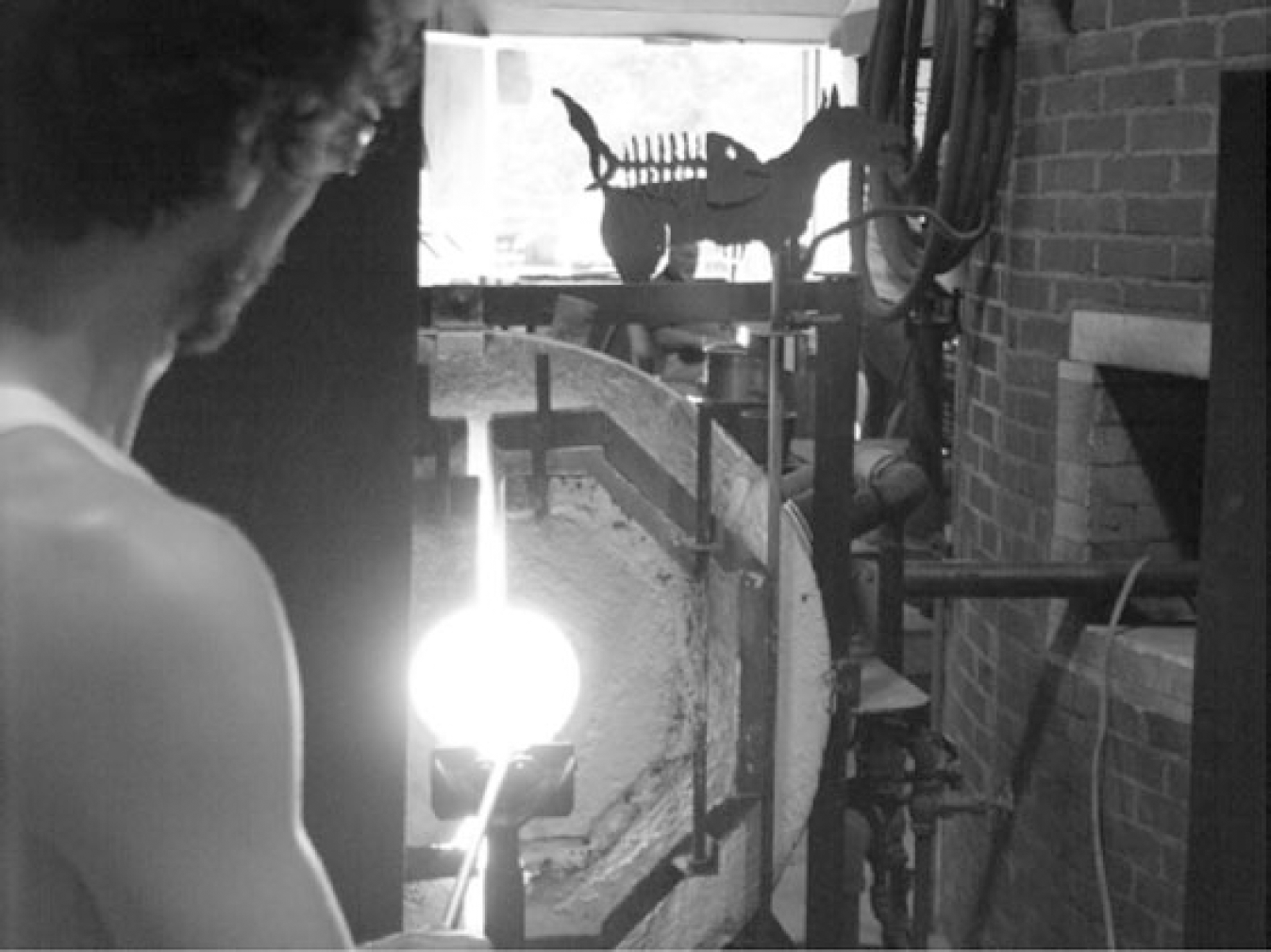
I was immensely relieved and my body fell into that familiar mode, my fingers automatically twirling the pipe to that long-established rhythm, my eyes looking nowhere into the glory-hole. Slowly becoming caught up in the flickering texture of heat – its white, orange and grey hues running around the furnace's walls, framing the rotating glass – I became mesmerized and I day-dreamed:
During the process of reheating the bit three times in order for me to ‘shorten’ it, I had amazing visions at the glory hole. Not amazing visions, but I can't escape the glass constantly conforming to phallic or sexual images. The glass started to move, the heat of the glory hole awakening its fluidity, its rounded end making gentle revolutions. I could not act on it; it was too charming, too intimate: I wanted to follow it, to see where it was going, where it could take me. I just stared at these still timid revolutions, pleased that it answered within a moment my own gestures. I kept the bubble, the goblet's bowl, and the bit, the goblet's stem, rotating. My body faded away – into the rotating blowpipe, my eyes becoming increasingly captivated by the movements of the softening glass. My bubble became testicles, flaming orange, and the bit, the stem, on the end became a searching penis, swirling around as it softened with the heat. Though attached to my pipe it seemed to swim outwards, bounded within the course white-peach-tangerine walls of the glory hole – the breathing red embers below, the roar of the bathing gas flame – was it nice in there? Why did I seem to be cutting through the lake? Moving ever-outwards within the brilliant fiery red of the glory hole, the bit shortened and the penis reformed to a sperm, swimming towards me, the short tail struggling to propel the head up my blowpipe. I withdrew the blowpipe slightly, leaving only the bit under the flame: it sauntered and swayed round and round, directing the piece towards me. The sauntering amused me – I didn't mind. I wanted to keep the glass in the glory hole: I was relieved to become a spectator, to become captivated. The stem recklessly overheated, sauntered and swayed round and round – an enraged white sperm swimming towards me. (Field notes, April 8, 2004).
‘Ok, flash! You're going to lose the piece’ Jane called, waiting for me at the bench. ‘Oh yeah,’ I thought, both jumping and responding with lethargic reluctance to the call to make myself vulnerable once again to the unknown of blowing the goblet. (Field notes, April 8, 2004).
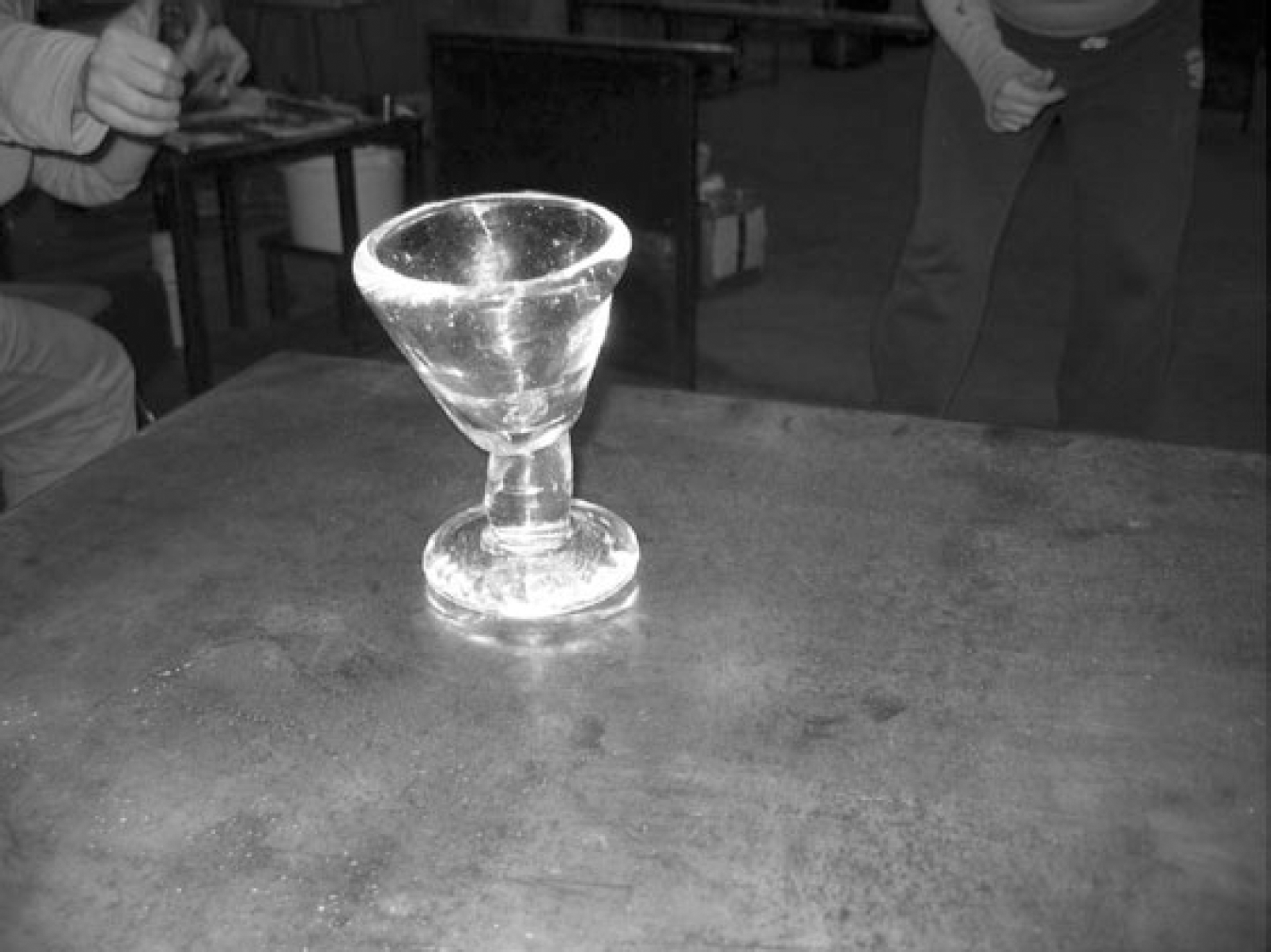
Jane called my attention back to the piece, directing me to heat the stem – reasonably – and then to shorten it by holding the pipe, glass up, when coming out of the glory hole so that the hot glass sagged. I began to once again recognize the piece as a ‘goblet’ and eagerly worked toward that end, sincerely evoking my skills to the best of my ability – I had the impression of finishing an elegant piece. To my surprise, when I returned to the studio a few days later to pick it up, my goblet in no way resembled the elegant goblet I remembered placing in the annealer to cool. My goblet, Rob joked, had turned ‘globlet’.
Proficiency in pactice
Looking at the inelegant goblet, I recalled each step of making the piece, blowing out the bowl of the goblet, attaching and pulling out the stem, humming a smooth rhythm for the turns of the pipe to fall into, pressing the small glass disc for the foot of the goblet – in the end everything had seemed to fall together, but these memories and impressions were at odds with what I held in my hand. How did I go wrong?
The ‘globlet’.
We have already discussed how a reading of the practice cannot be an operative principle of proficiency, as it calls for an interruption of practice, in virtue of the abstraction and reflection it requires. We have also seen that confronted with the new, a type of interruption, an individual will draw from previous experience in order to manage the new situation, a type of corporeal adaptation anchored in the person's already established habitus. Proficient glassblowers have often said that glassblowing is not about blowing the perfect piece of glass, but coming up with effective solutions to all the problems that consistently present themselves in the process of glassblowing (Field notes, March 19, 2004). They nudge towards the idea that non-reflective anticipation is the force of proficiency, neither non-reflective, nor reflective adaptation. It is ‘[that] almost miraculous encounter between the habitus and a field, between incorporated history and an objectified history, which makes possible the near-perfect anticipation of the future inscribed in all the concrete configurations’ (Bourdieu, 1990: 66).
This anticipation that marks proficient practical knowledge is not a reflective forward-looking gesture. It is a non-reflective corporeal forward-going movement beyond adaptation achieved through training: ‘Training teaches the movements – that is the most obvious part – but it also inculcates in a practical manner the schemata that allow one to better differentiate, distinguish, evaluate, and eventually reproduce these movements. It sets into motion a dialectic of corporeal mastery and visual mastery: to understand what you have to do, you watch the others box, but you do not truly see what they are doing unless you have already understood a little with your eyes, that is to say, with your body’ (Wacquant, 2004: 118). My body, while making the goblet, did not have this corporeal sight. Does an account, however, of corporeal anticipation achieved through training or rather the lack of it, help us fully to understand the failure of the goblet? It seems that an account of the development of proficiency must attend not only to the development of bodily techniques, those dispositions through which one can anticipate, but also to the material of practice itself and the forged sensibilities of the material's properties in practice. That is, to an account of the body of the practitioner, we must also bring an account of the body, or bodies, with which he or she works – whether glass, or other boxers.
Consider Jane's direction of my attention towards the heats of the glass to form the stem. She bid me to pay attention to the material in hand, to attend to the glass. The greater part of my focus, however, was towards vision of a goblet of elegance and grace. Perhaps, this vision itself was immature and Jane's encouragement to tend the glass not only directed my attention towards technique, but towards understanding the properties of the material itself, such as the relationship between degrees of heat and the ability to lengthen or shorten a piece. While the blindness of my body surely limited my ability to achieve the goblet, so also, it seems in retrospection, did my inability to ‘see’ despite how eagerly I ‘looked’ and ‘saw’.
The image towards which I consciously executed techniques was itself, despite its exquisiteness before me, a caricature: a big ballooned goblet from a Crate & Barrel window, or a festive wedding scene from Boccaccio's Decamerone. I wanted to see, but perhaps could not yet see that which had animated my nascent envisioned piece, the glass itself. As Bachelard writes of the poet in his contemplation of nature, of which fire, heat and glass surely belong, ‘[C]ontemplated nature aids contemplation, [in] that it already contains some means of contemplation’ (Bachelard, 1971: 77). In making the goblet, my imagination, though reaching towards, was not yet animated by the glass. It was not yet material – material imagination is ‘this amazing need for penetration which, going beyond the attractions of the imagination of forms, thinks matter, dreams it, lives in it, or, in other words, materializes the imaginary’ (Bachelard, 1971: 37). It is not the positing of material, or substance, or content, but the opening of a material dimension within training, within mimeticism and countermimeticism, that simultaneously opens the possibility for proficiency in glassblowing.
When we write that the proficiency of corporeal knowledge is defined by the interrelatedness of habitus and field and the body's consequent ability to anticipate and that this anticipation is possible only when the practitioner understands the world's imminence in which she operates and is therefore able to act immediately, we must flesh out the flesh of that world, its materiality.
Conclusion
I now remember the hesitance that flitted across the face of my instructor, Rob, when I suggested that he demonstrate how to blow a goblet:
‘Anything but that,’ he said slightly bowing and waving his hands as if before a daunting task, ‘For a goblet, I have to be warmed up. Maybe at the end of class.’ Since no one else had another suggestion, however, Rob begrudgingly began the demonstration, ‘I guess that I could show you how to blow out the bottom for a goblet at least.’ But, he did it all and the demonstration was more daunting than any of us could have foreseen; the complexity of blowing the piece was unparalleled to anything we had done before. I felt amazed and moved by something completely new. When Rob asked what I was going to blow, I answered with a semi-shrug – ‘A goblet, I guess.’ (Field notes, April 8, 2004).
The shrug came not from my indifference, but rather from the humility brought on by the complexity of the demonstration. I was unsure of my ability to navigate myself through the making journey.
I had not yet realized that ‘navigation’, though perhaps seeing me through to the end, and consequently landing me with a stout ‘globlet’, involved an extremely complex set of readings, informed by sensation, reverie, imagination, memory, reflection, adaptation. Nor had I realized that it was not and never would be any of these readings, though necessary as they may be to the dialectic of apprenticeship, through which the habitus is restructured. Only through the arduous process of developing that corporeal sight, a indubitably materially embedded endeavor in glassblowing, does the glassblower become proficient and house the capacity to anticipate the necessary.
Footnotes
Acknowledgements
I am very grateful to everyone at New York Glass for allowing me to carry out my research in their facilities and for the time they have taken for casual discussions and interviews. Special thanks to my beginning glassblowing instructors, Rob Panepinto and Jane Royal. Their patient instruction was the backbone of this article. I am incredibly indebted to the ongoing support and valuable insights of Craig Calhoun, Richard Sennett and Terry Williams. I would also like to thank Edward S. Casey, Michael Jackson, Chris Shilling and Loïc Wacquant for their encouragement and constructive comments. A version of this chapter was first published in Ethnography.
1
Glassblowing requires a serious commitment as well as a significant financial investment. The facilities needed to blow glass are too expensive for but a few to afford for themselves, so studios tend to be shared by both novices and experts, hobbyists and professionals. Few students continue the practice beyond a beginning level and even fewer intend to become professionals. The professionals work freelance, generally selling their pieces for resale in department stores or boutiques in the city or to private individuals. They also subsidize their freelance earnings through teaching enrolled courses or as a private instructor. Many are also artists in other mediums, such as music, painting and drawing. The students vary from dissatisfied bankers to retired physics teachers to searching hipsters. For most students a general yearning to create, to make, to express themselves, coupled with some previous exposure to and consequent fascination with glassblowing, a TV programme or a demonstration seen in a tourist artisan village, brought them to glass. Most glassblowing in the United States is ‘studio’ glassblowing, as distinct from Venetian style.
2
New York Glass claims use of its facilities by over 350 artists and 900 students a year. The number of ‘regulars’ is not nearly so high.
3
This particular gather was in April 2004. By the fall of 2005, my understanding of how to gather had dramatically changed. Rather than gathering by lowering and raising the pipe like a see-saw, one should push the pipe into and pull out of the glass. By pulling the pipe out of the glass with a rather quick motion the glass ‘falls’ off the end of the pipe, meaning that while some of the glass is wrapped around the pipe itself, most of it is ‘off’ the end of the pipe, like a push-up popsicle is frozen not around, but ‘off’ the stick.
4
Merleau-Ponty's famous discussion of the incorporation of the blind man's stick from an object in hand to an extension of his phenomenal body: ‘The blind man's stick has ceased to be an object for him, and is no longer perceived for itself; its point has become an area of sensitivity, extending the scope and active radius of touch, and providing a parallel to sight. In the exploration of things, the length of the stick does not enter expressly as a middle term: the blind man is rather aware of it through the position of objects than of the position of objects through it…. To get used to a hat, a car or a stick is to be transplanted into them, or conversely, to incorporate them into the bulk of our own body. Habit expresses our power of dilating our being-in-the-world, or changing our existence by appropriating fresh instruments’ (Merleau-Ponty, 1962: 143).
5
‘To understand practical understanding, one has to move beyond the alternatives of thing and consciousness, mechanistic materialism and constructive idealism. More precisely, one has to discard the mentalism and intellectualism which lead to a view of the practical relation to the world as a “perception” and of that perception as a “mental synthesis” – without ignoring the practical work of construction, which as Jacques Bourveresse observes, “implements non-conceptual forms of organization” that owe nothing to the intervention of language’ (Bourdieu, 2000: 136).
6
In this sense I disagree with William Sewell who, taking culture to be ‘the semiotic aspect of human social practice,’ argues that ‘to engage in cultural practice is to make use of a semiotic code to do something in the world’ (Sewell, 1999: 48–51). Tacit understandings are accrued through practice and make experience meaningful. Meaningful practice is not couched in an understanding of the relations of signs, but rather in corporeality and materiality.