






Abstract
The concept of ‘doing gender’ was placed on the sociological agenda by West and Zimmerman. In their seminal paper published in 1987, they provided a systematic theory of gender as a routine and ongoing process and outlined a distinctly ethnomethodological approach to investigating how gender is enacted, understood and rendered accountable. West and Zimmerman's notion of ‘doing gender’ has subsequently become a central concept in many fields of sociological research, however, upon closer examination although many authors claim to be using the concept – in effect to be doing ‘doing gender’ – the concept's intellectual roots in ethnomethodology are not always recognised or reflected: in short not all are passing. The purpose of our study is to explore the career trajectory of this concept and to systematically assess the manner in which ‘doing’ has been employed. From a review of 226 journal articles, books, dissertations and association papers, we provide an overview of the uses of this construct and examine the ways in which ‘doing gender’ has been assimilated into current theoretical and methodological practice.
Introduction
The concept of ‘doing gender’, first formulated nearly three decades ago by Candace West and Don Zimmerman, has become one of the most influential and widely appropriated ideas in many fields of social research. Their seminal paper, Doing Gender (West and Zimmerman, 1987) has had a considerable influence on the development of feminist scholarship and gender studies but its uptake has not been restricted to these arenas. As evidenced by the ISI Web of Science citation search, their article has been cited over 650 times across disciplines such as education, criminology, communication and cultural studies, political science, management and organizational studies, as well as sociology. The status of ‘doing gender’ as one of the most celebrated concepts to enter the sociological lexicon seems assured.
In this paper we want to raise some critical questions about the manner in which the appropriation of this concept has taken place. Our central concern will be to demonstrate that although there are numerous studies citing the concept, the vast majority are doing so in ways that do not reflect the concept's intellectual roots in ethnomethodology and the study of social practice. Taking our inspiration, in part, from an earlier study of the reception of Max Weber's work (Adatto and Cole, 1981) we want to suggest that many of the citations of the concept have a purely ceremonial quality.
Adatto and Cole (1981) observed that the social sciences in general and sociology in particular, exhibit a curious ambivalence towards the work of their classical forebears. Whereas in the physical and natural sciences the accumulation of antecedent knowledge can be undertaken in the form of standardised textbook reconstructions, graduate students in sociology are expected to become knowledgeable with the original works of their founders and to include references to this theoretical work in their own publications. Focusing specifically on the case of Max Weber, Adatto and Cole noted how contemporary scholars (in their case the 1960s and 1970s) appear compelled to incorporate Weber's ideas into their own studies but that they did so in a way which often fails to demonstrate their theoretical relevance.
In a study of some 156 published articles in the four leading US Sociology journals which had cited Weber, Adatto and Cole (1981) discovered that only 36 percent of the articles had used Weber's work in ways which they considered to be ‘central’ or ‘substantive’. In contrast 64 percent had used Weber's concepts in ways which were ‘peripheral’ to the author's own research questions. One of the ways in which this was evident was through citations which they characterised as ‘ceremonial’, ‘… in which Weber's status or authority is invoked rather than the substantive content of his ideas’ (Adatto and Cole, 1981: 146). Adatto and Cole, however, were at pains to point out the term ‘ceremonial’ did not carry any pejorative connotations and a good deal of their paper is taken up with outlining the ‘functions’ which ceremonial citations perform. For example such citations are a convenient way of demonstrating one's membership of a particular research community and of signalling the general thrust and orientation of the research reported. 2
In this paper we argue that the concept of ‘doing gender’ has endured a similar fate in the hands of a different group of scholars and that it, too, has become for many researchers simply a way of signalling membership in the gender studies community. We develop our argument firstly by undertaking a review of the various journal articles, book chapters, dissertations and association papers appearing between 1987 and 2005 through which the concept's rise to prominence can be charted. We demonstrate that the vast majority of the ways in which ‘doing gender’ has been assimilated into the research literature can be considered ceremonial and we distinguish this category from two smaller groupings which we identify as ‘intermediate’ and ‘core’. We show how these latter categories develop from, and are grounded within, current debates in qualitative inquiry, particularly ethnomethodology's insistence on the use of naturally occurring data rather than the more widely adopted method of interviewing to generate research information. We offer some reflections on the specificity of our case study and the extent to which ceremonial citations are an inevitable ingredient in the practice of social science research. Finally we briefly consider the relevance of our findings for the wider debates about the study of gender and how this can be best advanced both theoretically and methodologically.
Doing gender: an ethnomethodological approach
Although the article in which the concept first officially appeared was published in 1987, its genesis can be traced to 1977 when West and Zimmerman attempted a theoretical shift away from an understanding of sex as a set of ascribed characteristics and gender as an achieved status towards a conception of gender as emergent feature of social interactions (Fenstermaker and West, 2002). However, it took ten years for their innovative approach to studying gender to reach a wider audience as the original manuscript faced repeated rejection in journal reviews. Their article finally found acceptance in 1987 with the then newly founded journal, Gender & Society.
By the time Doing Gender was eventually published, West and Zimmerman had already established reputations, both individually and collectively, as proponents of ethnomethodological and conversation analytic informed research on gender issues. Their co-authored papers on conversational interruptions (West and Zimmerman, 1976; Zimmerman and West, 1975) had demonstrated the potential of Sacks et al.'s (1974) conversation turn-taking model for unpacking the issue of dominance in face-to face interaction (although see Schegloff (1991) for a more critical assessment). West's subsequent work on the role of gender in physician-patient encounters (West, 1984a, 1984b) had also drawn significantly on the analysis of naturally occurring interaction in medical settings. Zimmerman's track record as an exponent of ethnomethodologically informed sociology had an even longer pedigree (eg Zimmerman, 1971, 1978).
Somewhat ironically, however, Doing Gender does not stand as an exemplar of ethnomethodological inquiry. Although West and Zimmerman state that the purpose of their article ‘… is to propose an ethnomethodologically informed … understanding of gender as a routine, methodical, and recurring accomplishment’ (1987: 126), the bulk of the paper is, contrary to the ethnomethodological focus on empirical inquiry, given over to theoretical considerations. The final section of the article provides a brief discussion of ‘… fruitful directions for empirical research’ (1987: 127), but West and Zimmerman refrain from explicit methodological directives as to how such research should proceed opting instead to canvass a number of substantive areas – the division of labour, the recruitment to gender identities, and so on – where the concept of doing gender could prove instructive. One consequence of this is that readers of their article from non-ethnomethodological backgrounds, and therefore unlikely to be familiar with their previous work, may have come to regard the concept simply as a theoretical tool which could be utilised in conjunction with a range of methodological approaches. We return to this point later in our article.
West and Zimmerman's starting point was to propose a distinction between sex, sex category and gender. Whereas sex was the determination of persons as female or male on the basis of agreed upon biological criteria, placement in a sex category ‘… is established and sustained by socially required identificatory displays’ (1987: 127). But sex and sex category can vary: it is possible to claim membership of a sex category even in the absence of the agreed biological criteria. Gender, finally, ‘… is the activity of managing situated conduct in the light of normative conceptions of attitudes and activities appropriate for one's sex category’ (ibid). Seen in this way, the received wisdom which had seen gender as sex-linked behaviour, or alternatively, even a socially constructed role, was untenable. Taking their lead from a number of authors critiquing the application of role theory to gender (eg Connell, 1985; Stacey and Thorne, 1985), West and Zimmerman proposed that gender was ‘… not a set of traits, nor a variable, nor a role, but the product of social doings’ (1987: 129).
To the extent that ‘doing gender’ is constituted through interaction, then West and Zimmerman saw the concept as having affinities with Goffman's (1976) notion of ‘gender display’. For Goffman, gender display can be understood as a socially scripted performance of society's idealization of feminine and masculine natures. But West and Zimmerman found problems with this in that Goffman seemed to treat the display of gender as something occasioned, that can be entered into (and exited) when deemed appropriate. For them gender was more than a matter of a ritualized performance, ‘… something that happens in the nooks and crannies of interaction … and not interfering with the serious business of life’ (1987: 130). In order to stress that doing gender is not ‘optional’ but something that is inescapably ongoing and embedded in everyday interaction they revisited Garfinkel's (1967) well-known discussion of Agnes the transsexual.
Space precludes a detailed account of this case study and the various commentaries that it has subsequently received (Denzin, 1990; Hilbert, 1991; Kessler and McKenna, 1978). For West and Zimmerman the importance of Agnes’ case is that it provides a vivid empirical illustration of their distinction between sex, sex category and gender. Biologically equipped with male genitalia, Agnes claimed membership in the opposing female sex category. The practical problem Agnes thus faced was that of ‘passing’ as female – of being seen by others as unquestionably female at all times but without the cultural knowledge of how this was to be done. It was her mastery of the methods of how this could be accomplished – her ‘secret apprenticeship’ – which served as the basis for both Garfinkel's original interest and subsequently that of West and Zimmerman, and which provides the concept of ‘doing gender’ with the clearest evidence of its ethnomethodological credentials. As Agnes discovered there is no ‘time out’ from ‘doing gender’, no moment when one's gender is not an observable and reportable matter. As West and Zimmerman comment:
Doing gender consists of managing such occasions so that, whatever the particulars, the outcome is seen and seeable in context as gender-appropriate or, as the case may be, gender-inappropriate, that is, accountable (1987: 133 emphasis in original).
West and Zimmerman's approach to understanding gender, not as what one is but what one does in recurrent interactions with others, has been hailed as a significant contribution to feminist research. For example, scholars such as Judith Lorber (Lorber and Farrell, 1991) and Dorothy Smith (2002) have both commented on how their work provides an important direction for the sociology of gender to proceed. To the extent that society is partitioned by biological differences between men and women and sex category placement an omnirelevant phenomenon, then doing gender is arguably unavoidable. As a phenomenon it should be researchable in a multitude of settings and institutional sites. This is in fact the case as evident by the growing number of publications which cite the concept. What is less apparent, however, is whether the fundamental tenets of the construct's theoretical and methodological framework have found their way into the research that purports to have been inspired by this approach. A cursory inspection of the published literature reveals that many researchers are relying on interviews and even questionnaires to further West and Zimmerman's (1987) original approach and West and Fenstermaker's (1995) later developments of the thesis. Research that relies on situated, observational methods or the collection and analysis of naturally occurring data seems to be the exception rather than the rule. This raises several important questions. Has the fundamental essence of the approach been misunderstood? Are they all ‘doing gender’, but some just aren't passing or has the idea of ‘doing gender’ superseded its ethnomethodological origins? In the following sections of the article we present the results of our investigation into the appropriation of the concept since 1987. We look first at a summary quantitative picture of its uptake and then consider the qualitatively different forms through which the concept has been put to use.
Researching ‘doing gender’
As we have indicated above, the notion of ‘doing gender’ has proliferated over the last decade with scholars from many disciplines enthusiastically embracing the concept. To review all the publications that have cited West and Zimmerman's 1987 article would entail an extensive multidisciplinary study. As our interest was to examine the sociological uses of this concept, we limited our search to publications that appear in the Sociological Abstracts Database from 1987 to 2005. Sociological Abstracts is part of Cambridge Scientific Abstracts which indexes literature in sociology and related disciplines in the social and behavioural sciences. This database provides abstracts of journal articles and citations to book reviews drawn from over 1,700 journals, as well as abstracts of books, book chapters, dissertations, book reviews, and conference papers.
To obtain the records that would comprise our dataset, we instructed the search engine to locate any publications with the exact phrase ‘doing gender’ as either key words, descriptors or words anywhere. The total number of records for the combined searches was 368. The analysis of the publications then proceeded in two stages. The first stage was to examine each record to eliminate any duplication or irrelevant use of the search instructions. For example, many of the publications from the ‘doing gender’ as ‘words anywhere’ command had cited West and Zimmerman's 1987 article, but did not evoke the concept of ‘doing gender’ anywhere in the paper. These records were therefore omitted from the analysis. Overall, our final sample comprised 226 journal articles, books, book reviews, dissertations and association papers. These records were then categorised by publication year to provide a trajectory of the uptake of ‘doing gender’.
The second stage of our analysis was to examine the precise ways the in which the concept of ‘doing gender’ was being employed in sociological research. For this component of our research we included only empirically focussed journals articles and chapters in edited works. Dissertations and association papers are often difficult and time consuming to obtain and were therefore excluded. A number of non-English journals not available from the major university libraries in Brisbane, Queensland were also removed from the database as were book reviews and purely theoretical discussions. This then left us with a sample of 149 sources from which to derive a classification scheme. The articles comprised our unit of analysis and each article was classified according to the extent of its utilisation of the ‘doing gender’ thesis. 3
In their analysis of the citations of Weber's work Adatto and Cole (1981) distinguished between ‘substantive’ and ‘peripheral’ uses of his concepts. Our investigation lead to the creation of three qualitatively distinct descriptive categories. The first, which we have termed ‘core’, is analytically similar to Adatto and Cole's substantive category. Two conditions were required to be fulfilled before an article was deemed eligible for ‘core’ status. Articles were assigned to this category if 1) the deletion of references to either ‘doing gender’ or West and Zimmerman's article would significantly alter the integrity of the research, and if 2) the methodological orientation of the article was broadly congruent with the principles of ethnomethodology. Our rationale for this classification follows from our earlier discussion of the theoretical underpinnings of the concept and the ontological status West and Zimmerman assign to gender. It is clear that they envisage ‘doing gender’ as an interactional phenomenon, something researchable through observational or situated methods, and consequently those articles which involved the collection of naturally occurring data through audio-recording or which took an ethnomethodological position on the use of interview material (eg Baker, 1997, 2001; Dingwall, 1997) were therefore placed in this category. As we discuss shortly such core articles were very much in the minority.
Rather than consigning all other articles which had cited ‘doing gender’ to a ‘peripheral’ category as was the case in Adatto and Cole's (1981) research, we drew a distinction between two further categories: ‘intermediate’ and ‘ceremonial’. The allocation of articles to the ‘intermediate’ category was, again, primarily on methodological grounds. Intermediate articles had theoretical goals which were consistent with West and Zimmerman's (1987) research agenda, namely to further an understanding of gender as actively created and sustained in interaction, but in contrast to the core articles their methodologies did not invoke the use of direct observation or recording of social interaction. Typically such articles relied upon the use of qualitative interviews and occasionally even survey instruments. We expand on our rationale for this shortly. Approximately 16 percent of our sample fell into the intermediate category.
For our third category we adopted the term originally employed by Adatto and Cole in their discussion of the peripheral uses of Weber, namely ‘ceremonial’. We found this term – and Adatto and Cole's discussion of it – to be eminently suited for a large number of the articles which had cited West and Zimmerman's notion of ‘doing gender’. As we have noted earlier, ceremonial citations are a convenient way of demonstrating or claiming membership of a research community. They are thus an important and widely accepted part of the process of scientific communication. They also conform to an implicit norm in scientific communication which is ‘… to cite those who ought to have influenced your research’ (Adatto and Cole, 1981: 150). Articles deemed to be ceremonial had thus recognised the importance of the West and Zimmerman's contribution – and so something which should be cited – but had not attempted any further conceptual work regarding ‘doing gender’ in their research. As with Adatto and Cole's use of the term, an article was deemed ceremonial if the removal of the reference to ‘doing gender’ would not impact on its theoretical or methodological integrity. However we wish to re-emphasise that our use of the term ‘ceremonial’ is in no way pejorative and does not reflect the overall quality of an article.
Results
‘Doing gender': a career trajectory
Figure 1 presents the results for the yearly citations of the concept looking at the complete sample of all 226 journal articles, books, dissertations and association papers. It is clear that the career trajectory of ‘doing gender’ has been one marked by accelerated popularity since the 1987 publication.
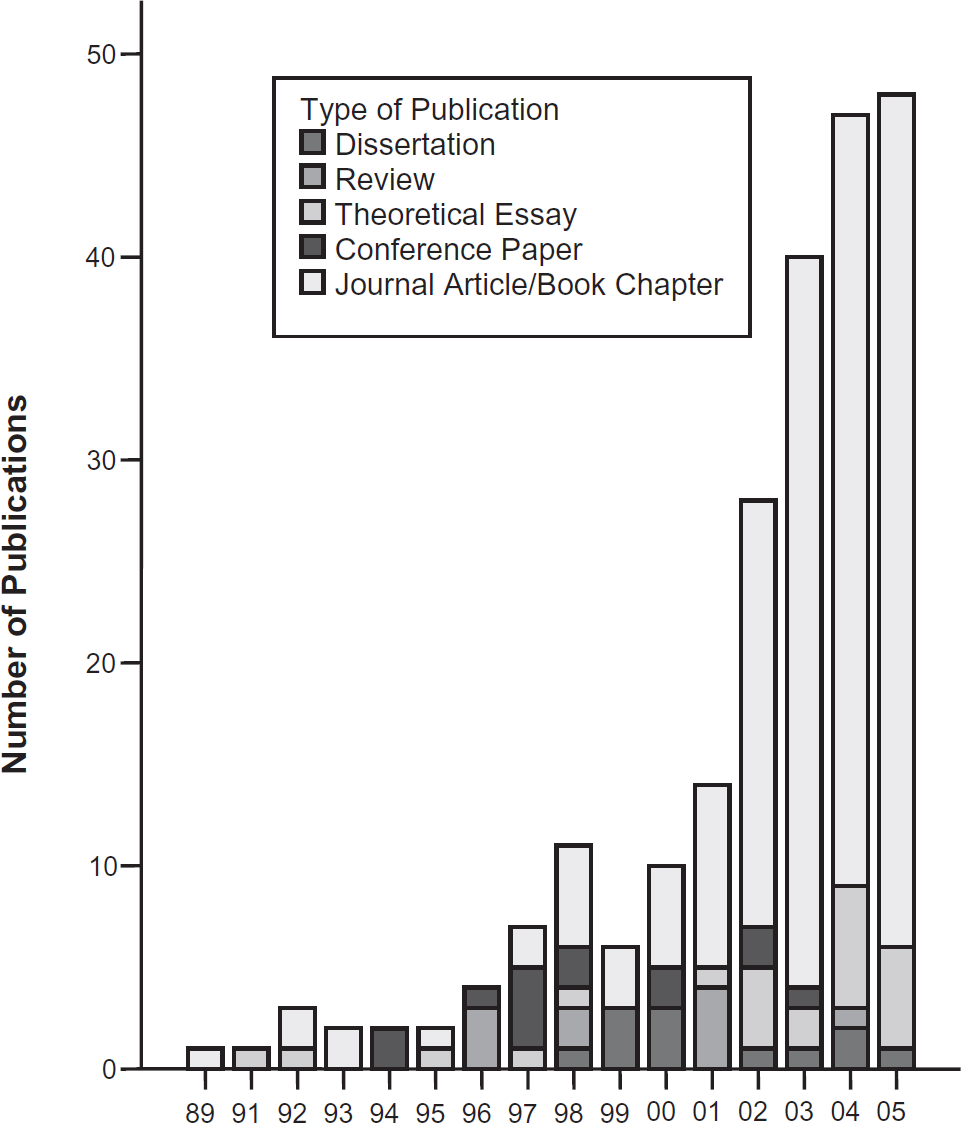
Number of publications citing West and Zimmerman's 1987 ‘Doing Gender’ thesis from 1989–2005 by publication type
Interestingly, as with West and Zimmerman's original manuscript, the notion of doing gender was initially slow to catch on. It wasn't until 1997 that ‘doing gender’ began to make its mark in the social sciences. From 2001 onwards we can see a significant increase in the number of academic publications listed in the Sociological Abstracts database.
‘Doing gender': usage patterns
The second stage of our analysis was carried out on the more restricted sub-sample of 149 empirically focussed journals articles and chapters in edited works which we had available for consideration. Each of the 149 articles was allocated to one of our 3 qualitative categories. 4 From Figure 2, we can see that the highest number of articles in the core, intermediate and ceremonial categories peak from 2001 onwards. However, what is even more striking is the sheer number of ceremonial citations that occur in the same period. Of the 149 publications that formed our total sample, almost 73% (n = 108) of these fell into this category. Between 2001 and 2005, 99 of the 131 empirical research articles or chapters were classified as ceremonial. For this same period, only 14 publications had fulfilled the criteria necessary for inclusion in the core category and 18 publications were deemed ‘intermediate’.
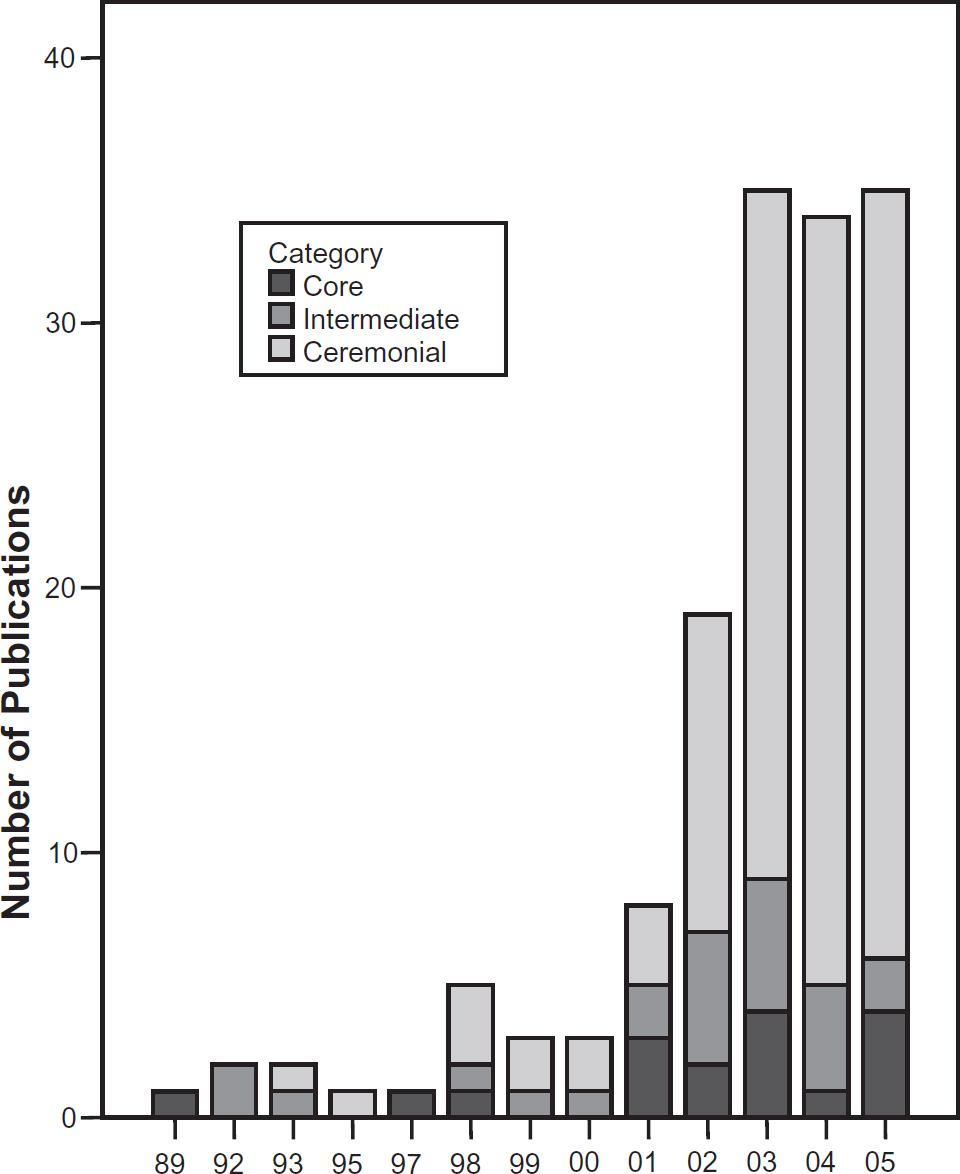
Number of publications citing West and Zimmerman's 1987 ‘Doing Gender’ thesis from 1989–2005 by category type
Researching ‘doing gender’: methodological constraints and considerations
As we have noted, and discuss in more detail shortly, ceremonial citations are relatively easily identified. However the distinction between articles labelled ‘core’ and articles deemed ‘intermediate’ is more subtle and requires further explication. Our argument, in brief, is that the phenomenon of ‘doing gender’ can only be faithfully researched – and the status of the concept scientifically advanced – when observational methods are employed. Researching ‘doing gender’ through interview methods will not yield data that are ontologically consistent with the essence of the concept as a routine accomplishment of everyday interaction.
In developing this position we turn to the burgeoning literature that has emerged in qualitative sociology over the last ten years or so concerning the epistemological status of interview data. A core theme running through this literature has been a critical reassessment of the conventional assumption concerning the interview as a research method, namely that it is a neutral conduit for accessing an external pre-existing reality.
In contrast to this conventional image of the interview as a ‘pipeline’ transporting ‘knowledge’ from the interviewee to the interviewer – or in Potter's (1997: 149) elegant phrase, ‘machinery for harvesting data’ – an alternative perspective drawing upon themes from postructuralism, feminism as well as ethnomethodology has emerged. A number of ‘versions’ of this alternative viewpoint can be identified. One, most closely associated with the work of Gubrium and Holstein (eg Gubrium and Holstein, 1997; Holstein and Gubrium, 1995, 2004), conceptualises the interview as an occasion in which both interviewer and interviewer ‘actively’ engage in a complex process of meaning construction. Here the interview subject is no longer to be seen as a ‘vessel’ of answers and the interview simply a means of extracting these answers. Instead attention needs to be paid to the ways – the interactional narrative procedures – through which knowledge is assembled.
Researchers more closely aligned with ethnomethodology are, however, dubious about the capacity of interview data to offer any insights which are theoretically relevant to the perspective. Ten Have (2004) has recently summarised the ethnomethodological position on the use of interviews in the following manner. According to ten Have, most qualitative social research is interested in ‘people’ as individuals or as members of collectives and their corresponding orientations, values, motivations and so on. The concern is with what people think, feel or experience and the most convenient way to ‘access’ these phenomena is through the use of questions delivered via an interview format. In contrast ten Have argues
For ethnomethodology, the interest is not in people as such, but in people as members, as competent practitioners, because ultimately ethnomethodology is interested in order-producing practices … . Although order-producing practices may have general features, their ultimate effect is considered to depend on their context-sensitivity. Because of these rather specific aspects of ethnomethodology's interests, interviews are of limited usefulness. The ‘reality’ to be studied in ethnomethodology is a local accomplishment of members’ practices’ (ten Have, 2004: 75, emphasis in original)
Interviews could be utilised by ethnomethodologists, as ten Have notes, to study the ‘methods’ through which members ‘tell stories’ or describe their experiences (eg Wooffitt, 1992) or, for example, as sites for the display of cultural competence as witnessed by the invocation of appropriate membership categorization devices (eg Baker, 1997). But in each of these cases the interview is seen as offering ‘specimens’ of the interactional phenomena under consideration rather than having a ‘factual’ relation to an external reality (c/f Alasuutari, 1995).
Our argument, then, is that interviews are inappropriate techniques for accessing the situated practices that characterises the doing of ‘doing gender’ and of members’ practices which concern ethnomethodologists more broadly. To help flesh out the statistical picture we have drawn of the incidence of the three citation categories we turn to consider examples of research articles which illustrate these three categories. We look first at some articles which feature ceremonial citations of ‘doing gender’ and then explicate in more detail the difference between our ‘intermediate’ and ‘core’ categories via two case studies.
Doing gender: ceremonial citations
The defining feature of a ceremonial citation is that it does not play any role in the chosen conceptual framework, methodology or analysis. However, its actual function can vary widely. In our examination of the ceremonial citations we found that this category was not one-dimensional, rather several variations were present.
In some articles the reference to ‘doing gender’ was ultra-ceremonial. Examples of this would be two papers both examining domestic labour: Youm and Laumann's (2003) article ‘The Effect of Structural Embeddedness on the Division of Household Labour: A Game-Theoretic Model Using a Network Approach’, and Gupta's (1999) article ‘The Effects of Transitions in Martial Status on Men's Performance of Housework'. In both cases, the inclusion of West and Zimmerman's concept bore no discernible relationship to the research undertaken. Both articles set out to investigate factors which effect the division of housework between couples using complex statistical models and data obtained from large scale surveys. Youm and Laumann include their reference to ‘doing gender’ in a perfunctory footnote which discusses ‘gender theory’. In Gupta's case the citation is more prominent but his equating the concept to ‘a perspective that views domestic labour as a process by which individuals define their gender identities’ (Gupta, 1999: 701), is a rendition which bears no almost relationship to its original formulation. Both articles are exemplars of quantitative inquiry published in prestigious journals and no doubt each makes a contribution to knowledge on its own terms. However, neither article advances our understanding of the routine ways in which gender is accomplished. We are lead to the conclusion that the authors have included a reference to the concept simply because of its perceived relevance to their topic of inquiry. Housework is an activity which is gendered. A paper on ‘doing gender’ must therefore be included.
Although a considerable number of articles using large scale surveys – and consequently methodologically ‘light years’ from ethnomethodology 5 – were evident in the ceremonial category, the majority of the publications which were classified in this manner did utilize qualitative research designs. However, they were still deemed ceremonial. Qualitative ceremonial articles generally acknowledged that gender was an interactional or relational construct but made little or no attempt to document the processes through which this was achieved. Instead they appeared to appropriate the concept of ‘doing gender’ as a way of grounding, legitimating or validating their own research findings. Hill's paper ‘Teaching and Doing Gender in African American Families’, (Hill, 2002) is an example of this. Hill examines the socialisation process of children in African-American families using parental interview data and finds evidence of support for teaching children gender role equality. However, the primary thrust of her article concerns the impact that social class and social mobility have on this outcome. Although she states an interest in examining how gender ‘gets done’, her interview data do not – and cannot – shed light on this process. Her article could easily have been titled ‘Teaching Gender Roles in African American families’ without any loss to its substantive findings and message. Once again we see the inclusion of ‘doing gender’ as a way of displaying her recognition of West and Zimmerman's contribution to the field of gender studies.
Finally we identified a number of articles as ceremonial not only on methodological grounds such as those outlined above but also because they relied on secondary distillations of the ‘doing gender’ thesis and thus misattributed the genesis of this concept to scholars other than West and Zimmerman. This was especially true of articles looking at crime or criminality. For example, in examining the relationship of gender and gang membership, Dukes and Stein (2003) refer to Chesney-Lind and Hagedorn's (1999) article ‘Doing Gender in Times of Economic and Social Change’ rather than citing West and Zimmerman's original article. Citations such as this, we believe, provide evidence that the distinctive roots of the concept are being forgotten – even traduced – and that its development and refinement is not part of the author's agenda.
Doing gender: intermediate article case study
Intermediate citations of the concept, on the other hand, did express a concern for adding to our knowledge of how gender is a situated accomplishment but fell short in delivering on this objective. As an example of an intermediate use of the concept we have selected Alexis Walker's 1996 article ‘Couples Watching Television: gender, power and the remote control’ published in Journal of Marriage and the Family, which was first delivered as the Presidential Address to the National Council on Family Relations.
Walker's article aims to investigate how couples in both heterosexual and gay or lesbian relationships employed the remote control device (RCD) when watching television. She states early in her article that she ‘… expected that heterosexual couples would ‘do gender’ even in such a mundane activity as joint television watching’ (1996: 814 emphasis added). Framing the research issue in this way is intriguing in that one might expect that everyday activities like this are precisely the kind of interactional sites where, ethnomethodologically speaking, gender is done.
In other respects Walker's research is adequately contextualised. She demonstrates a sound grasp of the literature in a number of fields relevant to the topic: communications research, family and leisure research and so on. She refers to ‘… observational, survey, in-depth interview and ethnographic data’ that when heterosexual families watch television ‘… fathers dominate in program selection and in the use of the RCD’ (Walker, 1996: 814). In essence she already has her ‘finding’ in advance of the research being conducted. What one might expect from a researcher interested in the minutiae of how gender is done is an attempt to explore the actual ‘real-time’ interaction which occurs in families as they engage in television watching with the concomitant ‘struggle’ over which channel to view. But Walker does not carry out her research using observational methods or via the proxies of audio- or video-recordings. Instead she relies on ‘semi-structured’ interviews (carried out by ‘trained student interviewers’) which were undertaken with each member of the couple.
It is the reliance on this method to collect her data that we find questionable and which is the reason we have assigned her article to the ‘intermediate category’. What Walker provides us with is not the ‘doing of gender’ as a situated, naturally occurring phenomenon, but interview ‘accounts’ which are not the same thing. The distinction is subtle but it is important. We cannot do better than refer the reader to Dingwall's (1997) insightful reflections on this matter. As he argues
‘… the data produced by interviews are social constructs, created by the self-presentation of the respondent and whatever interactional cues have been given off by the interviewer about the acceptability or otherwise of the accounts being presented’ (Dingwall, 1997: 59).
Consequently, interview data are never able to provide us with ‘literal descriptions of the respondents’ reality':
‘Interviews tell us about the construction of mundane reality in the interview. They are documents of the researcher-researched relationship. Observation is a document of the transactions between members themselves’ (Dingwall, 1997: 61)
Doing gender: core article case study 6
In contrast to Walker's interview based study the article we have selected to illustrate the core category does rely explicitly and exclusively on observation and the use of naturally occurring data. The article we examine is Lindsey Meǎn's, ‘Identity and Discursive Practice: doing gender on the football pitch’ which was published in Discourse & Society in 2001.
Meǎn observes that in the UK, where her research was conducted, (and elsewhere) an increasing number of women are taking up the game of football (aka ‘soccer’), a sport which has been seen as a traditionally masculine preserve. Consequently she suggests, women ‘… entering the game pose a direct threat to a highly salient masculine identity category’ (Meǎn, 2001: 791). Drawing upon concepts from identity theory, discursive psychology and ethnomethodology, Meǎn argues that the reproduction, maintenance and defence of masculinity should be apparent in the act of ‘doing’ the game of football at an ‘everyday’ level. It is the way she conceptualizes the ‘doing of the game’ for the purposes of her study that we find her core credentials displayed. Rather than seek to interview women participants in the sport or alternatively provide an ethnographic description of the game, Meǎn focuses instead on the ‘work’ of the referees who control (or umpire) the games. Data for her study are provided by tape recordings of on-field comments, rulings, terms of address and so forth of the (male) referees umpiring ‘5 a side’ football games.
Meǎn's research therefore sets out to capture the ‘doing of gender’ in a naturally occurring situation as her research design involves analysing recordings made of the same referees in charge of games played by men and games featuring women. As she argues, recordings made of the same referee on the same pitch ‘meant that it was more likely that any observed difference could be attributed to the gender of the players’ (Meǎn, 2001: 794). Unlike the ‘11 a side’ version of the game where the referees are generally less conspicuous, the 5 a side referees are much more visible and verbally interactive with the players. In part this is because the game is played on a smaller pitch which is enclosed by wooden boards four feet high and which can be used to deflect the ball. A large part of the referee's work consists of the enforcement of the ‘head rule’ which states that the ball cannot be purposively kicked over 7 feet high.
Her research shows that the male referees perform very different ‘work’ when interacting with the male players compared with the female footballers. One of her main findings concerns the disparity in the way the referees deal with appeals made by the players about their (the referees') rulings. For example, when umpiring the men's games the referees will invariably provide an ‘account’ which justifies their ruling: in contrast when they are in charge of women's games such accounts are largely absent. By providing an account the referee is implicitly acknowledging that the male players have a much greater shared knowledge of the rules of game. In contrast when dealing with appeals made by female players the referee will typically only cite the rule which he has deemed to be infringed. As Meǎn argues, ‘Citing the rule frames the player as lacking this knowledge, hence not a category member’ (Meǎn, 2001: 805). In a host of subtle discursive ways such as this, the male players are thereby constituted as ‘proper’ players of the game and we can see precisely how gender is ‘done’ on the football pitch.
Discussion
In this paper we have presented a study of the appropriation of one particular sociological concept and have sought to show that the overwhelming majority of the citations of the concept have been ceremonial in character. One obvious issue for consideration concerns the uniqueness of the case of doing gender: that is to what extent are ceremonial citations a characteristic – rather than exceptional – feature of the social sciences? The studies of the citations of Weber referred to earlier clearly suggest that this is not atypical. Indeed there are a number of additional factors which are likely to accentuate this phenomenon. One is the sheer increase in the amount of published literature that is available for citation as new journals are established for increasingly niche markets. A second factor is the relative ease through which this literature can be identified and accessed via electronic databases. An inevitable consequence of these changes is, as Clive Seale (1999) has observed, a steady lengthening in the reference lists of academic writing in recent years. In social research reports from the 1950s and earlier it was common to encounter only one or two references. Now the figure is typically well over 30 and reference lists in excess of 50 are not unusual. Although he does not invoke the concept of ceremoniality, Seale's comments are entirely apposite to our case. Such lengthening reference lists, he argues, can be seen as ‘a textual strategy to persuade readers of writers’ authority to speak … [Y]et it is clear that many works to which authors refer have not been closely read by them'(Seale, 2000: 181). 7
We can be reflexive about our own citation practices to illustrate this very point. That is we could have just argued in the previous paragraph that, on the basis of our own judgement alone, the number of article references appears to be increasing. However we were aware that Seale had made this point himself and so felt obliged to increase the number of our own citations from 46 to 47 to accommodate this. Is our citation of Seale therefore a ceremonial one? The answer is probably ‘yes’ in that its removal would certainly not affect the integrity of our article. However, even if our citation of Seale is deemed ceremonial it is still substantively accurate in that it provides a faithful account of what he has to say. Many ceremonial citations in the social sciences are similarly innocuous in that they do not involve any distortion of authorial intent and we have no quarrel with these. But the case of ‘doing gender’ has specificity which we must not overlook. Our argument is not simply that the concept has been ceremonially invoked but that as a consequence of such misappropriation, its potential value as a theoretical device for advancing feminist scholarship and gender studies is being overlooked and even occluded. To the extent that ceremonial and intermediate citations of the concept ignore the concept's distinct ethnomethodological provenance then its potential remains ignored and unexploited.
To what extent does it matter that West and Zimmerman's concept of ‘doing gender’ has been read or appropriated by a majority of researchers in the way we have outlined? Let us be clear that it is not our argument that the field of gender studies, and feminist scholarship more broadly, can only be advanced by observational research and ethnomethodological principles. We are not seeking to impose a theoretical uniformity on these historically pluralistic fields. Many of the topics that exercise gender studies scholars – the domestic division of labour, the balance between work and family lives, and so on – are eminently suited for quantitative research and these will no doubt continue to be empirically explored with these techniques. Our concern is that this exploration is done under false pretenses to the extent that the banner of ‘doing gender’ is raised by such scholars as the context for such inquiries. What is not being advanced is the very concept which is frequently cited as the raison d'ětre for this work.
For West and Zimmerman, the practice of gender within a constructed gendered order lies at the heart of the ‘doing gender’ thesis and their suggestion to gender scholars was to critically reflect upon this dynamic. For West and Zimmerman's work to be interpreted in a way that waters down this approach is problematic, not only for ethnomethodology, but for gender scholarship more broadly. Gender is not a static attribute – it is a dynamic process that must be investigated as such. The challenge for research, therefore, is to contrast how gender is done with how gender is constructed to not only capture the fluidity of this construct, but to provide critical insight that might confront commonly held assumptions of gendered practices.
In her foreword to West and Fenstermaker's book, Doing Gender, Doing Difference: Inequality, Power and Institutional Change (2002), Dorothy Smith comments on the ways in which they, with Zimmerman, have advanced sociological knowledge on gender. She states
In contrast, therefore, to the tendency of sociology to generate master theories … [they] have worked their way forward exploring the potentialities of ethnomethodology for the feminist problematic of gender … they have not displaced people's everyday knowledge with the claimed superiority of sociological interpretation. They have, however brought to light dimensions of gender of which we had been unaware (2002).
In the light of this endorsement it is somewhat disappointing, therefore, to find so many inappropriate citations of their work and so little development and exploration of the original concept. As with Adatto and Cole's (1981) analysis of Weber's ceremonial role in contemporary sociological research, West and Zimmerman's concept of ‘doing gender’ seems to be meeting the same fate. Most of the research citing their work does so in a way which fails to demonstrate the relevance of its distinctly ethnomethodological approach to understanding gender or to build upon these theoretical foundations. 8 Whilst this may be an indication of sociology's preference for local truths, its leaning towards a plurality of viewpoints or its a rejection of master narratives in gender studies, the ceremonial misappropriation of ‘doing gender’ is nonetheless an impediment in the advancement of a way of understanding gender that obviously many believe is worthy of recognition. Adatto and Cole have succinctly summarised the situation in these terms:
Ceremonial citation is an efficient and expedient form of communication. There are problems, however, with this format. As long as critical theoretical and methodological assumptions remain extrinsic to the article, the possibilities for miscommunication, misinterpretation or outright distortion of the original source material increases (1981: 151)
The present research highlights this problem. As many have commented over the last decade, the advancement of sociological knowledge will be impeded if scholars cannot agree on central ideas, concepts or theories. As Cole has elsewhere argued (Cole, 1994) the true measure of a discipline's progress lies in its capacity to accumulate core knowledge. The problem confronting Sociology in Cole's view is that it has a booming frontier but almost none of this research activity makes its way to the core. Our case study of the fate of ‘doing gender’ provides a timely illustration of this phenomenon. As we have demonstrated in our examination of the appropriation of West and Zimmerman's thesis, fewer than 10 per cent of the articles citing the concept utilised their theoretical and methodological framework in a way reflects the unique contribution they have made. 9
The challenge facing sociologists is to develop of consensual core knowledge which will allow us to systematically build and expand upon and even, following Weber's own advice, eventually supersede the work of key scholars in the paradigms that comprise our sociological field. The case of West and Zimmerman's ‘doing gender’, appears to demonstrate a lost opportunity for this to happen leading us to question whether we have indeed advanced our understanding and exploration of gender in the terms they envisaged.
Footnotes
1
An earlier version of this paper was presented at the Australian Sociological Association Conference in December 2004. We wish to thank the members of audience, in particular Kris Natalier, for their helpful comments. We also acknowledge the comments offered by the journal's reviewers. This paper is a revised and much expanded version of a University of Queensland Honours assignment written by the senior author in 2002. We have subsequently discovered that the title of our paper is very similar to one published by Zimmerman in 1992. However we feel justified in retaining our title. Zimmerman uses the concept of ‘passing’ in its original ethnomethodological sense of ‘the work of achieving’ a particular, gendered status. The use of ‘passing’ in our title is, of course, intended as a pedagogical assessment of the theoretical credentials of the various published articles employing the concept of ‘doing gender’ which we examine.
2
3
In preparing the paper we came across a few articles that discussed the ‘idea’ of doing gender but without mentioning the actual concept or citing West and Zimmerman's Doing Gender article and which had consequently failed to show up on our citation searches. We speculate that the idea which the concept signifies might be in the process of becoming part of the received or taken for granted ‘wisdom’ of sociology and it is possible that some researchers no longer feel compelled to include the term, even though they are still doing ‘doing gender’ (see, for example, Martin, 1998 and Evaldsson, 2003). Future research should be able to shed light on this possibility.
4
As  have suggested, definitions or classifications are more precise and reliable when two researchers code the data. With this in mind, utilising the classification system outlined above, the two authors independently coded the articles. There was very little disagreement between the coders for articles that were deemed ‘ceremonial’ with close to 100% inter-rater reliability. For the ‘intermediate’ and ‘core’ categories, inter-rater reliability was approximately 85%. Each of the ‘contested’ articles was examined closely before arriving at a final categorisation.
5
Ethnomethodology's relation to survey research has recently become an object of investigation from both ‘sides’ of the methodological divide but this is not a debate we can enter into here. Our argument is simply that one cannot do ethnomethodology with survey materials but the collection of survey data can be an object for ethnomethodological investigation. On this point see, for example, .
6
The selection of one article to represent the ‘core’ category was a matter we deliberated over for some time and we canvassed several alternatives before making our decision. One of the paper's reviewers suggested that an article by could be an alternative. Although we agree that Nilan's article is clearly a core use of the ‘doing gender’ thesis we have chosen not to use it for two quite different, but equally important, reasons. The first is that the paper is published in a relatively obscure journal – Social Semiotics – which is not included in the Sociological Abstracts data base. It is therefore not included in our sample. Secondly the paper covers three separate instances of the discursive construction of gender ‘boundary maintenance work’ which would make its summary as a case study somewhat piecemeal and disjointed.
7
One additional factor is the degree of familiarity which researchers have with their rapidly expanding fields. Paradoxically, conscientious researchers are likely to encounter more potential citations and thus be ‘guilty’ of ceremonially using these than their less well prepared cousins.
8
Although we do not have sufficient space to explore this in depth, there is also the possibility that ‘hybrid’ formulations of the doing gender thesis may emerge as a consequence of theoretical reworking from non-ethnomethodological scholars more closely aligned with constructionist or performative approaches. As Liz has astutely noted this creates a different order of problems for successful empirical research programs.
9
A telling indicator of this indifference towards the concept shown by mainstream sociology is the number of core articles published, particularly in the last few years, by scholars with backgrounds in other disciplines such as discursive psychology, discourse studies and so on.