






Abstract

Historical analysis offers a number of different visions of the role of cultural consumption in the operation of social relations of power in modern western societies. There are perhaps four versions. In one, dominant social classes intervene to prohibit, sponsor or channel the pleasures and recreations of subordinate social classes with a view to achieving social stability and moral hegemony. Second, dominant classes engage in exclusive activities, marking their separation from other groups in society by their prestige and refinement. Cultural consumption organizes social distinction, the notorious example being Sumptuary Laws. Third, cultural practices express social divisions within the dominant classes. Cultural conflicts and competition – at Court, between the aristocracy and bourgeoisie, and later between people of business and intellectuals – mark divisions among fractions of the powerful. Fourth, cultural engagement is a means of establishing connections within the dominant classes, sealing the sense of belonging to an identifiable superior stratum of society. Cultural participation provides a platform on which to acquire and use social capital; meeting the right people lubricates the social life of members of the upper echelons of society. To be sure, this is a rather truncated functionalist schematization of processes that are complex and often ambivalent, and ones which moreover operated rather differently from country to country (Coulangeon, 2004). 1 Nevertheless, it is possible to see in this sketch a role for cultural consumption in the service of dominant groups in class societies.
All these accounts assume that classes with disproportionate power in society can be identified and that they are able to define and sustain a shared cultural universe, albeit sometimes contested, with consequences for other classes. What is unclear among the competing accounts are:
whether the concept of cultural capital any longer has purchase in understanding the operation and distribution of cultural practices; whether there is any longer a legitimate culture whose boundaries can be determined, the command of which delivers social distinction; whether cultural taste has become a much more individualized property whose distribution no longer follows the contours of social class; whether the relationship between the elite fractions of the managerial class and the rest of the population has altered.
In order to explore these issues we conducted a small number of interviews exploring the cultural practices of people occupying powerful positions in British society as part of a larger study of the whole population, ‘Cultural Capital and Social Exclusion’ (for preliminary results see Cultural Trends, 2006). The aim of the chapter is to report on the general content and tenor of those interviews and thereby to describe the nature and distribution of cultural tastes among the managerial elite in prestigious positions in British business, politics and administration. This allowed identification of rarely addressed social and cultural differences. The chapter uses this evidence to analyse the distinctiveness of elite consumption and the role of people in powerful positions in the cultural field at the beginning of the 21st century.
In the first section of this chapter, we describe the study, our interviewees and the strategy of data collection. In section two, we explore the extent to which these people could be said to share a definite set of cultural tastes and commitments. In section three, we examine their reactions to ‘popular’ culture to explore the contemporary provenance of distinction. In section four, we describe the extent of their investments in cultural activity with a view to estimating the value of cultural capital. In section five we attempt to draw some conclusions about the implications of these features for the extent to which this managerial elite forms a cohesive and integrated group in relation to the rest of the professional and managerial classes and the wider population. When compared to other parts of the population this is a culturally highly active group, playing a significant role in the organization of, usually rather traditional, types of cultural activity. Their interests are wide-ranging and there is a good deal of variety in their leisure and cultural attachments, particularly in relation to gender. Nonetheless, these people have enough in common in terms of their preoccupations and tastes to justify seeing them as members of a shared culture. We also find a powerful role for social connections in determining the rhythms of their cultural practice, and show how their cultural life is embedded within work and social milieu.
The study
This chapter arises from a study which systematically explores the organization and distribution of cultural capital in Britain, using focus-group discussions, semi-structured household interviews and a questionnaire, applied nationally to both a random sample and an ethnic boost sample, to examine the cultural tastes, forms of cultural participation and cultural knowledge of the population. It also involved interviews with eleven people who had achieved particular prominence in business, public service, political or academic life. 2 These interviews are the focus for our discussion here.
Semi-structured interviews were conducted with four women and seven men in the early summer of 2004. Our strategy was to find some people who fill positions that are unquestionably ones from which institutional power is exercised and to inquire about their cultural practices. The sample was opportunistic, derived from institutional and personal contacts of the research team. It included CEOs and a Finance Director of large corporations, proprietors and directors of large family businesses, very senior administrative staff of the Civil Service and Members of Parliament. Their average age – reflecting their achievements – was well above the main sample mean of 48: most were over 50 and some were in their 60s and 70s. Except for one woman, who had risen to political prominence through the trade-union movement, and one of the men, who did officer training at Sandhurst, all had university educations, to postgraduate level in some cases. Behind these common educational careers, however, were significant differences in social origins and background. While some of those we interviewed had ascended to prominent positions from working-class backgrounds, others had built their careers on the basis of their parents' middle-class social positions and, in two cases, had inherited property, a country estate in one case and a stake in a major family retail business in another.
In the terms of Savage et al. (1992), the interviewees were predominantly bureaucrats (managers) though three were propertied (two by inheriting family capital). Those who began as professionals early moved into more general management roles. We might therefore characterize the group as a managerial elite. They constitute an elite in the sense that they have power and influence that affects a large number of other people, including other members of their occupational class. We will see whether they deserve to be called members of a social class later.
Most interviews were held at some place of work, for although several were officially retired, they continued to hold positions in various organizations. Interviews asked questions about personal and family biography, cultural practice and taste, and roles in organizations responsible for the delivery of cultural services. In the first area interviews covered careers, family of origin and education and current domestic situation, including education of children. Regarding the second, interviewees were asked about their cultural activities and tastes, moving through television, cinema, visual arts, music, sport, reading, and other fine arts. They were also asked about collecting. In the third part, we asked about the organizations they belonged to and whether they played any role in the management or administration of arts organizations.
Analysis has been the product of several careful readings, organized by theme, with attention being paid to the range and distribution of the cultural activities that the interviewees participated in, the understandings supporting such activities, and the social contexts in which they were framed. We looked for similarities and differences in the experience of each individual and considered to what degree these could be understood as aspects of a shared social condition.
Shared commitments
If one were to select eleven people at random from the British population and ask about their participation and their tastes, one would certainly find much greater heterogeneity than was revealed by our elite interviews. Both by way of norm and of practice they are strikingly similar in their tastes. Of course, there are personal deviations from their common cultural commitments, but it is the similarities that stand out.
One indicator of this was the taken-for-grantedness of the value of certain practices and artefacts. No one questioned the relevance of being asked to focus on the domains identified; no one seemed surprised about being asked about paintings or music. No one made disparaging remarks about the fields of the fine arts or high culture. On occasions people said that they were not very interested in some domain or other, but they never denied their validity. Moreover, there were few, if any, instances of one interviewee describing something as execrable while another attributed it great intellectual or cultural value.
A second indicator was the degree to which certain areas of cultural practice appeared to be obligatory. All read. Materials were varied. Newspapers and current affairs magazines were common. Several expressed a liking for nonfiction of a political or biographical nature. Some read very little, if any, fiction. But everyone read and many would have liked to read more. All bar one said that they liked classical music. Almost everyone went to orchestral concerts and, more significantly, everyone had at some stage of their lives been a regular visitor to the opera and, for some, this was a continuing involvement. In a couple of cases it had become less feasible because of living in a rural location. For another two, no longer attending was something of a blessing as they confessed to not liking opera very much and had done so mainly out of a sense of professional and social obligation. Timothy, a senior civil servant, was one such; he observed that ‘it would be fair comment to say that a lot of senior civil servants meet each other at the opera and the ballet’. Cynthia, who was married to a Member of Parliament and, through her own career, held a number of nonexecutive directorships and was a member of several national regulatory bodies and commissions, reported that in the 1960s and 1970s, living in metropolitan political circles, exchange of invitations to the opera was a key form of sociability which resulted in very frequent visits. That only 15 percent of the British population, as reported in the survey, ever go to opera and only 5 percent with any degree of regularity, indicates its special significance for the elite. There is almost no doubt that it played a central role in the mobilization, organization and connections of this stratum, especially in London, in the second half of the 20th century. The same was true of their frequent visits to art galleries, concerts and the theatre, activities which formed a part of the regular social rhythms and expectations of their professional lives. To be an effective manager at a senior level apparently requires some engagement, in association with clients and contacts (but mostly not colleagues), in visits to the theatre and opera as well as to sports events and restaurants.
There thus appears to be an established core of practices which professional and corporate elites participate in, with some items more central than others. Classical music, painting and reading are more or less compulsory. Other activities attract quite a number of participants disproportionately – a liking for modern jazz being one of them – but are clearly optional. Everyone visited art galleries regularly, in London especially but also when travelling. As part of a work trip or a holiday, this group attended art galleries in foreign cities and were thus able to comment on, for example, the virtues of the Hermitage Museum in St Petersburg, the Van Gogh Museum in Amsterdam, and the Museum of Modern Art in New York.
A closer examination of the visual arts will allow us to probe the cultural practices of this group more deeply. What stood out most here was the strong preference for Impressionism which, for most of our interviewees, served as the organizing centre of the likes and dislikes – of types of art and of artists –through which the interviewees positioned themselves in the art field. This was partly a consequence of our showing the interviewees two pictures – J.M.W. Turner's The Fighting Temeraire Tugged to her Last Berth to be Broken Up (1838) and David Hockney's Paper Pools (1980) – and asking them whether they recognized the paintings, knew who the painters were, and whether they liked them. Turner's position as a precursor of Impressionism and, more generally, as the key mediator between earlier traditions of British art and European modernism, helped to bring Impressionism into the discussion if, which was rare, it hadn't been raised already.
The rate of recognition was, unsurprisingly, much higher for the Turner painting than it was for the Hockney, as was the rate of liking but in ways that differed in accordance with both age and gender. The response of Beverley – the CEO of a financial consultancy company, and in her late 50s at the time of the interview – was typical of many in linking a liking for Turner to a fondness for Impressionism:
I like all the Turner paintings. I like them because they seem to me to be a combination of attention to detail, like the Salisbury Cathedral ones, and that kind of thing. But also with an almost Impressionist sort of ease so – you know, so I – well I don't have a lot of language I can use for art because again I'm not knowledgeable about it but I like that one. I like most of his paintings.
For James, a retired senior servant, a liking for Turner and for Impressionism flow seamlessly into one another:
Yes, yes, all of the Impressionists yes is approachable, I get into that. I mean Lucien Freud, seen quite a lot of that once or twice recently, just to pick a modern artist. Wouldn't go a million miles to see that (the Hockney: AW, TB), a Turner, yes. I think the one, the Turner, Whistler, Monet Exhibition is a very interesting one to see.
Impressionism also occupies a central place in the tastes of Keith, a director of a family-owned national retail chain, providing the point of reference in relation to which he locates his other tastes:
Yes, well starting, I mean actually Impressionism because I covered quite a bit of that in History, the sort of Monets and Manets and what have you, I mean I do think that is particularly striking art. So I mean I enjoy Impressionism and if there's an exhibition on in London of an Impressionist painter, I'll try and go along. Landscapes, I find very stirring, I mean having grown up in such a bold landscape as … you know, which has got so many different types of geography so I enjoy sort of rural landscapes and paintings. I'm not particularly turned on by portraiture or indeed still life.
Ralph, 70 years old at the time of the interview, but still working part-time in honorary scientific positions after a career as a highly successful scientist and, later, a university vice chancellor, expressed his fondness for Impressionism in ways that connected with his professional interests:
Yes, I mean the ones that I guess I've liked for a long time and still do are the Impressionists where I'd go anywhere to see. And I, you know, I also feel that they got an insight into the physics of seeing things, and also when I look at them you know I also get an aesthetic thrill out of seeing them.
Responses to the Hockney and to modern art more generally were more ambivalent. Ralph recognized the painting but was lukewarm: he and his wife liked some of Hockney's paintings, but not others, just as they liked and owned some modern art but were also left cold by much of it ‘especially if it's just a black, sort of black square or something’. Robert, the Cambridge-educated CEO of a major international company, and in his late 50s, was similarly open to the challenges of modern art while also wanting to keep the art itself at a distance. While intrigued by ‘the Damien Hirst type stuff’, he told us that ‘I wouldn't have it in my own home, even if I could afford it’ preferring, when it came to buying art, to stay with work influenced by the Impressionists. Alistair, also in his fifties and, by inheritance, a landowner, expressed a similar ambivalence in his reactions to the Hockney painting:
It's an interesting picture, – to be honest I haven't got a clue who it's by but I find it you know, I like the colours on that. But it's – it's something I wouldn't find easy to sort of live with but, it's something I would expect to see in what is it the Tate Modern or something.
James was more forthright, telling us that ‘abstract art doesn't do anything for me and it doesn't inform me,’ going on to say ‘I'm traditional; I don't regard that as art’.
Keith, who was about 50 at the time of the interview, was the only one of the men who responded positively to modern art, welcoming the intellectual challenge that it posed.
When you get to somebody like Damien Hirst I find that, find his work quite extraordinary but thought-provoking at the same time. You know the sort of, is it The Cow in formaldehyde or something, and you just, I mean it clearly stirs one to think, well really what all that's about?
Like all of the men, however, he had little liking for the Hockney picture. By contrast, the women we interviewed were more open to Hockney and to modern art in general, and often in ways which stressed continuities with both Turner and Impressionism. Beverley, while saying that she didn't like modern art much, both recognized and liked the Hockney: ‘I like the light, I like the light and Turner's sort of style but I like the colours and the broadness of it’. Caroline –who had risen to a position of political and public prominence through the trade union movement and the Labour Party – also instantly recognized and liked the Hockney, seeing a place for it in her bathroom. She also liked the Turner, seeing both pictures as having a strong visual impact, as did Cynthia who was absolutely bowled over by the Hockney (‘Wow, yes. Yes.’).
It is clear, then, that Impressionism occupies a distinctive position in the tastes of these interviewees as the most consistently liked art genre. Only Eleanor liked portraits, and still lifes were also unpopular. Attitudes toward modern art ranged from indifferent to hostile on the part of the older men interviewed, through a sceptical curiosity on the part of the younger men, to a more open response on the part of the women interviewees. With regard to named artists, Impressionist painters or related painters in the tradition of European modernism were the most frequently mentioned (van Gogh, Monet, Picasso, Magritte, Manet, Whistler, Munch, Gaugin) followed by artists with Renaissance associations (Titian, Raphael, Breugel and Rembrandt) and some modern British artists (Hockney, Spencer).
The survey data showed that a preference for Impressionism was second only to a preference for Renaissance art in strength of connection with regular art gallery attendance (several times a year or more), followed by modern art, but with weak connections in the case of still lifes, portraits and landscapes (see Silva, 2006: Figure 3). In class terms, Renaissance art was the most strongly connected to the higher professional and managerial classes, and was followed in this by Impressionism, while landscapes, still lifes and portraits did not generally recruit much support from these classes. Modern art stood out in being liked most by women and by younger members of the survey (see Silva, 2006, Table 2).
The strong interest in Impressionism, and the more divided views about modern art that we have reported above, are consistent with these wider tendencies. Where our interviewees might seem to be most at odds with these is in the relatively little attention they paid to Renaissance art. Yet, apart from the fact of not being prompted by the two pictures we showed, this perhaps also reflects the key historical role that Impressionism has played in the formation of the professional middle classes in Britain. While, as we have noted, there is plenty of evidence of a cosmopolitan involvement in art institutions internationally, the Tate, both Tate Britain and Tate Modern, is the most frequently cited, albeit in different registers. Tate Britain was usually referred to as a place for frequent visits – Robert and his wife were members – whereas, except for Eleanor, who lived nearby and often popped in for short visits, going to the Tate Modern was viewed more as an experiment, a voyage into new territory prompted by a sense that, while doubtful about the aesthetic merits of the art on display, one really ought to learn to like it.
This connection between a strong liking for Impressionism and a close relationship with the Tate is no accident. Between its opening in 1897 and its extension in 1926 the Tate served as the primary artistic site through which the meritocratic professional middle classes sought to distance themselves from the working classes while simultaneously laying a claim to independent cultural leadership and distinctiveness, differentiating themselves from earlier hegemonic fractions of the English aristocracy by claiming an exclusive title to, and familiarity with, European modernism, and French Impressionism in particular (Taylor, 1999). Impressionism has thus played a key role in organizing the historicity of the British art field. Michael Grenfell and Cheryl Hardy (2003) argue that this historicity takes the form of a division between a rear-garde (Titian, Michaelangelo, Poussin, Gericault, Goya), representing a class/art connection that is most deeply rooted in tradition, and a consecrated avant-garde consisting mainly of representatives of European modernism (van Gogh, Monet, Bonnard, Picasso, Mondrian, Duchamp) on the one hand, and two newer formations on the other: an American avant-garde (Hopper, Pollock, Rothko, Twombly, Koons, and Basquiat) and a British avant-garde (Sickert, Spencer, Moore, Hockney, Bacon, Gilbert and George, and Hirst). It is notable, and clearly a function of their age, that none of our elite sample made any reference to the American artists named here. They were instead most strongly related to the historical formation of the consecrated avant-garde. Their relation to the current British avant-garde was tentative and tremulous, combining a hesitant liking with recognition of how this art had constituted a disconcerting challenge to their tastes and of the role that this had played in their educational and social trajectories.
Distinction and a commitment to legitimate culture
In the context of great controversy as to whether or not it now makes any sense to identify some tastes and practices as ‘legitimate’ (eg Coulangeon, 2004; Glevarec, 2006) we are wary of classifying items in terms of high and popular culture, or high and lowbrow taste. We did, however, using our survey data, calculate whether some items were more preferred by those with the highest institutionalized cultural capital. That is to say, we compared the practices and the tastes of those with degrees and those with no qualifications. From this we constructed a ranking of the legitimacy of cultural items in our survey. Table 1 identifies the cultural activities in which graduates were more likely to participate than were the unqualified.
This provides one context against which to consider the expressed preferences of our elite interviewees. Seven activities were ‘legitimate’ by the criterion that graduates were more than twice as likely to participate, namely: going to the opera; attending rock concerts; going to the theatre; attending orchestral concerts; visiting art galleries; engaging in body maintenance activity; and going to night clubs. The last was shown by correlation analysis to be unrelated to the rest and might be ignored. The other six formed a coherent cluster of activities: participation in one was likely to entail participation in the others. Our elite interviewees were very likely to be heavily involved in most of these. Of course, we should not be surprised that this group liked what graduates like, since all but two of them held degrees themselves. But, except for rock concerts, which are preferred by younger graduates, they were disproportionately likely to participate in these activities when compared to the average university-educated Briton. A strong commitment to legitimate culture is thus apparent. To the extent that command of legitimate culture signifies distinction, these are people of ‘refined taste’.
Cultural Participation
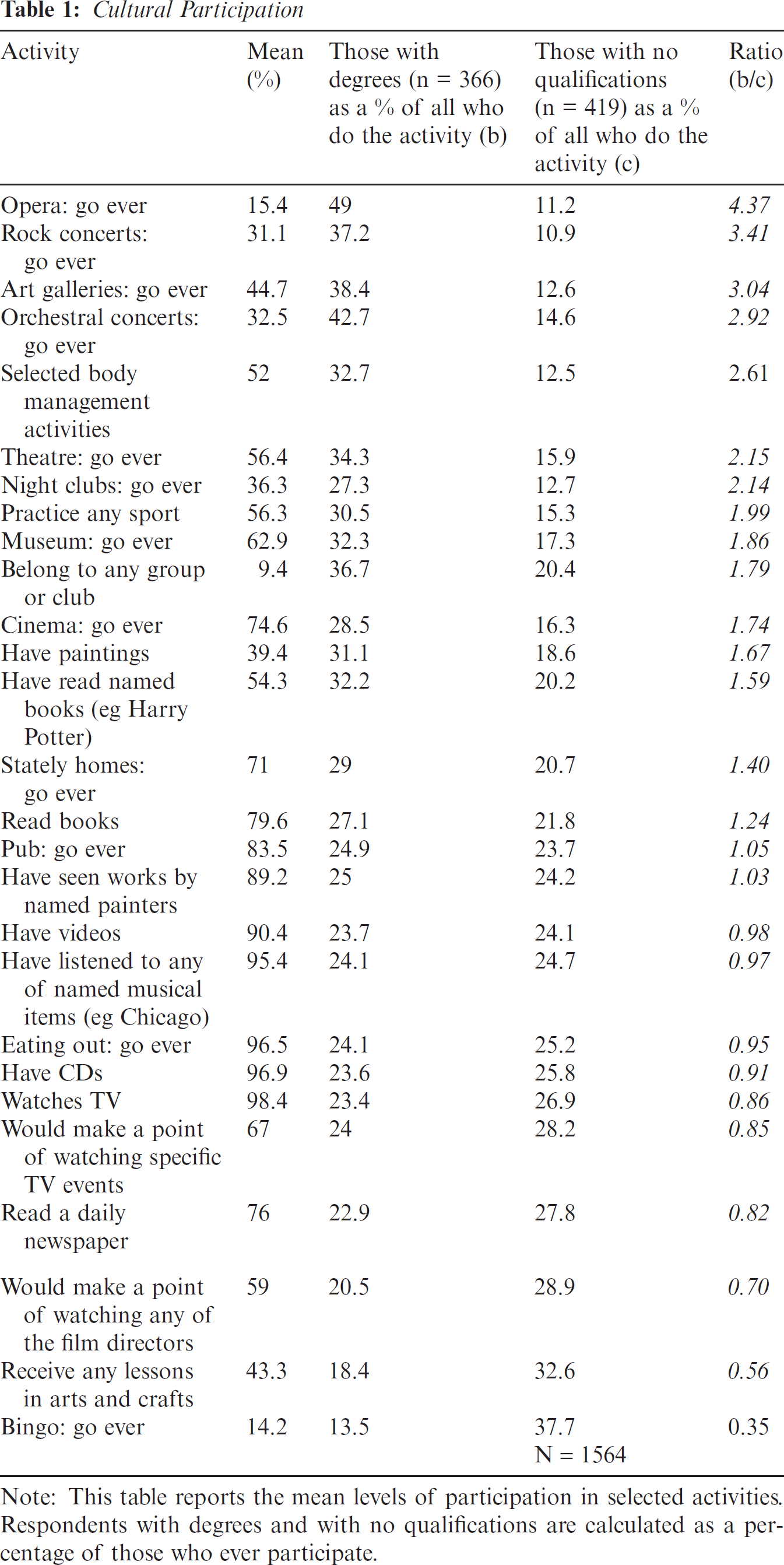
Note: This table reports the mean levels of participation in selected activities. Respondents with degrees and with no qualifications are calculated as a percentage of those who ever participate.
Most of our interviewees also expressed a liking for some forms of popular culture, with James, a retired higher civil servant, the sole exception in having preferences exclusively for legitimate culture. James expressed a liking for opera, chamber music concerts, Impressionism and contemporary fiction while distancing himself from popular culture, prefacing his answers to specific questions, as did others, with a somewhat horrified series of ‘No, no's. Thus:
Do you ever watch TV during the day time or mornings?
No, no.
Have you ever been concerned with keeping fit and running or anything?
Oh no, good gracious no.
Is sport something that is important to you?
Not at all. It is something to be avoided at all costs.
Among his explicit dislikes were jazz, musicals, abstract art, Damien Hirst, Harry Potter, Lord of the Rings. Other men also refused items vehemently. Thus Ralph:
Home and Away?
No, no. I don't even know what it is.
Reality?
No, and never.
And Timothy:
Contemporary music of any kind, country and western?
Not really, no.
Harry Potter books?
No, and almost as a matter of principle … no.
You wouldn't watch soap operas or chat shows?
No, or reality, awful.
Despite some of these perhaps predictable aversions, however, with the exception of James all had some overtly popular culture items in their portfolios of preferences.
The extent to which the interviewees sought explicitly to distinguish their cultural interests and practices from popular ones varied across different domains. The differences between the ways in which television and film viewing were described are significant in this regard.
A distancing from television was most evident in the rarity of television viewing among our sample. And even when television was watched, it was presented as if it were another kind of activity. Many of the men thus reported that they watched television a lot for sport, but in ways that suggested this was not really watching television – it was the sport they were interested in, not television, as if they were watching sport through television rather than actually watching television. As far as more general patterns of viewing were concerned, the response of Eleanor, indicating decreased viewing with age (in marked contrast to the overall tendency of our main sample in which television viewing increases significantly with age) was typical:
I was one of the sort of people who would, if … I was at home on my own in the evening, I'd put the television on … I can't give you the moment when I stopped and for a long time I knew what was on television and then would switch the television on because I knew what was on. I've moved even further down that line so that now unless somebody says hey by the way there's a good programme on, you should watch it, I am very unlikely to turn the television on.
The distinction that is enunciated here between purposive viewing, as opposed to watching whatever happens to be on, is a recurring theme in the interviews and, as such, one which rehearses long-established divisions between practices of attentive viewing on the one hand and the allegedly distracted viewer of popular entertainment media (Crary, 2001). This is clear in the landowner Alistair's reflections on the subject in which he goes to some pains to make it clear that he and his wife ‘are not addicts at all’ and that, when they watch television, it will usually be to watch for a specific purpose citing news, current affairs programmes and documentaries as his favourite genres. Most of all, though, it was the fact of not watching much that he dwelt on most:
But I wouldn't class ourselves as big television watchers. We watch it when it sort of suits us and if there's something that we think might be quite interesting is on. We watch a little bit of, sometimes a little bit of sport, things like Wimbledon Fortnight we particularly enjoy. If (Local F.C.; Aw playing I might well watch that. But I don't watch, we don't watch a lot of television.
Preferences were consistently for BBC channels in both the terrestrial and digital environments – where history channels were also frequently referred to – and the preferred genres were history documentaries, news and current affairs, and television dramas with programmes like Panorama, News Night, Question Time, University Challenge, A Touch of Frost, The Bill, Spooks, Absolutely Fabulous, Midsummer Murders, Pride and Prejudice and In the Footsteps of Churchill being specifically mentioned, as also were satirical shows like Have I got News for You and Dead Ringers. Soap operas, however, were almost universally disliked. For Caroline, soaps were to be avoided in view of their potential to corrupt and degrade:
I can't be doing for one iota with a soap or reality TV. I think reality TV is just banal, really and soaps, they're so…I was thinking to myself last night that Eastenders, I think it was, came on and before I switched over, they were having a row already, you know and I felt, you know, why doesn't somebody make a programme about people who are nice to each other, it's just so miserable and I think it has a huge impact on the way people behave, you know, just shouting at people's faces, that all becomes quite acceptable. One of my daughters won't let her girls watch it anymore because she says they pick up such awful bad habits and ways of speaking to people that it's not nice.
Robert had similarly strong aversions to reality television:
I'll walk out of the room if my son has got Big Brother on or any of these bloody things where they vote for people who then get kicked off. I literally you know, walk out of the room and go read a book or get away from it, I can't handle it, right. I hate them, right, with a vengeance.
The opposition to reality television was not, however, universal. Indeed, Keith, who had been educated at Eton and, subsequently, at universities in Scotland and the United States, and had widespread cultural interests in the arts and theatre, found reality TV fascinating. Clearly a little perplexed as to why this should be so, he justified his interest in this genre as a form of learning, thus bringing it into line with his other television interests which had a strong documentary and current affairs accent.
There is plenty of evidence here, then, that, for our elite interviewees, all of whom had considerable resources of cultural capital, a sense of the division between ‘serious’ and ‘improving’ programmes on the one hand, and less respectable, ‘trashy’ and, in some respects, depraving programmes on the other, informed the choices they make.
The picture is more mixed with regard to their film preferences. James disliked going to the cinema because of the ways in which it bombarded the senses, leaving little room for the more critical mood he preferred when watching films. He described the atmosphere of the cinema as ‘somewhat repellent’, objecting to the smell of popcorn and the overwhelming noise. It was not just the occasion of popular cinema that James found offensive, but its content too, describing The Lord of the Rings as ‘simply ghastly’ and the Harry Potter films as ‘awful’ – mere ‘spectacle, technological spectacle’. Just as averse to Hollywood epics and musicals, his preference was for films by European art directors. While Ralph also had a particular liking for French films, this European art director focus was not shared by the other interviewees. A more typical response was to opt for instances of comedy, literary adaptations or costume dramas. This was true for Eleanor. Her favourite films were romantic comedies – Pretty Women, Four Weddings and a Funeral and Notting Hill – or comedies, like The Full Monty. And neither Eleanor nor Alistair were guided in their film choice by any knowledge of film directors. As Alistair put it:
Directors? No I'm not very knowledgeable about that, I'm afraid I'm the type of person who almost leaves when the credits flash up. And, no, I don't, we don't really go and see a film on the basis of a director, you do get to know of some of them but it's been something that's never really particularly interested me. As I say we go because we've heard the film's good or it's on a subject that we know we will like.
As was the case with their tastes in relation to art, where references were made to films or directors with high cultural associations, these were mostly European. America was identified primarily in terms of Hollywood, with little reference being made to contemporary American film directors who have challenged the hegemony of European art cinema (Hitchcock is referred to, but his role is similar to that of the consecrated avant-garde in the art field). We should note, however, that in this respect our elite interviewees were at odds with our main sample where references to American cinema were far more common than to European cinema, especially among younger managers and professionals (see Savage, Wright and Gayo-Cal, forthcoming).
This lack of interest in directors was also frequently accompanied by a disavowal of any serious purpose when going to the cinema. Although Keith and his wife went to the cinema only rarely, he told us that ‘when we do I find it generally speaking terrific entertainment, a great sense of escape and we would typically go and watch the sort of, I suppose blockbusters and secondary blockbusters that are being advertised’. And Robert, who loathed reality television and who had quite high tastes in other areas – he was very knowledgeable about modern art, particularly about Impressionism, and went to the theatre regularly – had self-confessedly popular tastes in film citing The Bourne Supremacy, Spiderman, and, in contrast to James, the Harry Potter series and The Lord of the Rings as films he liked, and The Return of the Jedi as ‘my favourite all time film’.
In summary, then, the evidence of these interviews suggests that a combination of high levels of cultural capital and significant levels of economic capital associated with senior management or professional positions is likely to result in a more distinctive set of relations to television than to film, where responses are more mixed and varied.
Heavy investments
A third feature of the cultural habits of this elite group, hinted at already, is the extent of their participation. They go out to cultural events comparatively often, and even if not very interested, are fluent and have more than a smattering of knowledge about many forms of culture. They collect things. Almost all say they eat out often – and those who say it is a rare occurrence still mostly do so more frequently than the national average. They support cultural organizations. For example, they are likely to be supporters of arts organizations (eg. Friends of the Tate (several), the Royal Academy, the National Trust, English Heritage, the Roy al Society of the Arts). They are occasionally trustees, by invitation, of arts organizations (Royal College of Music, Provincial Theatre and City Operatic Society) and their companies sponsor art events. That said, their charitable and public roles are at least as likely to be in their own professional world (Chair of Trustees of an educational charity, Institute of Directors) or in local good works voluntary associations (military cadets, organizations for deprived young people) as in culture and the arts. Despite being enormously busy otherwise, they invested heavily in a wide range of cultural activities –except, as we have seen, for television, which they said they rarely had time to watch.
Paradoxically, this extensive involvement appears not to be a consequence of any great commitment to culture for its own sake. One or two are specialists or enthusiasts. Theatre was a passion for Robert and for Eleanor. Robert explained how he and his wife had developed a passion for theatre, at one time, when in their 20s, watching ten Royal Shakespeare Company performances in six weeks. He had had his company become involved in sponsoring theatre, and now, in his 50s, he made theatre a priority: ‘live theatre in London is a big part [of our recreational time]’, having been ‘thirty or forty times in the last four years [since returning from working abroad]’. Robert had also invested much time and effort in learning about painting. But Robert and Eleanor were exceptions. Indeed, in some ways the greatest apparent enthusiastic obsession was among men associating themselves with soccer and with the professional soccer clubs of their city of birth. Generally, however, culture was a high priority not as end in itself but, rather, as a corollary of work. (It should be noted that none of these people are primarily engaged in the culture industries; none were professionals or managers in the world of the arts.) The elite presents itself first and foremost as professionally engaged. Their jobs and careers came first; and not only because we asked questions about biography at the beginning of the interview. Even for the enthusiastic Robert, a good deal of his engagement was through his company with a view to entertaining clients. For the rest, culture was mostly a complementary activity, but none the less essential for that. The participation of some men was ensured by their partners (and to a much lesser extent their children). Men followed their wives tastes more, and often to a significant degree. Men reporting their preferences often said ‘we’, meaning themselves and their partners. Women, by contrast, always said ‘I’. Ralph used ‘we’ so often that he felt obliged to define who ‘we’ were, attributing to his wife his own consumption of art objects, paintings, TV programmes, concert-going and novels. He relies on his wife to lead him beyond his conservatism in aesthetic matters, making him take more seriously trends in modern art he would otherwise dismiss out of hand, and also follows his wife's choice in the novels he reads; ‘anything that my wife says “look, I really recommend that”, I'll read’. Culture was a family business with primary responsibility for organizing it being delegated to their wives, surely a sign of its limited centrality for most of the men we interviewed.
One point of importance is precisely that the elite seem to recognize that they derive profits from the time invested in cultural activities. Their behaviour would be hard to understand if they did not believe that there is some gain from investing in the acquisition of cultural capital. They do not refuse opportunities for cultural participation, nor ever denigrate the value of culture. Rather they participate heavily. This seems to imply that they recognize the value of cultural capital. But is it part of a strategy of distinction through refined taste?
Social integration
Probably taste is not what is primarily at stake. Rather is seems to be more a matter of connections. Frequent attendance at (selective) events outside the home implies some imperative to join in a cultural life in public. This may well be a prerequisite of networking. The webs of privileged connections deliver invitations to arts events: Robert said, ‘as CEO you could spend your whole life going to the opera, going to ballet, going to the theatre’. Contacts provide opportunities to take up positions on voluntary bodies – sport, arts, young people, military and church – but also to ones beyond their main career which are paid. Almost everyone has some such position, and many have a large number. They are members of clubs and dining circles. They also boast connections to practicing artists. Painters, potters and sculptors are mentioned as parts of a network of friends or acquaintances, and their work is quite often purchased or collected (in small amounts) directly from such people. Connections are very important, and are different for this category of person, probably both in volume and capacity to deliver profits.
Thus it seems likely that the role which command of cultural capital plays in the formation and organization of managerial elites is primarily that it eases social relations within the stratum. Participation provides a platform upon which to acquire and use social capital; meeting the right people beyond the orbit of economic organizations does indeed lubricate the social life of the elite. Familiar cultural commitments serve, when necessary, as a repository of shared experience and a means of mutual recognition. What differences exist – and there are some differences between men and women, younger and older, and first and second generation middle class – are not obviously being used to mark internal cultural differences within the elite. This integration of members of the upper middle class offers them opportunities and secures privilege for them and also for their children.
Their integration is not, however, based upon condescension, or revulsion, towards members of other social classes. The evidence is not consistent with a view that higher classes express hostility towards lower classes through their cultural practice. Never did their occasional distaste for elements of popular culture spread over into condemnation of those people who had a consuming interest in reality TV or country and western music. This elite is also probably not very different in the content of its tastes and practices from other members of the professional and upper managerial classes. Professionals and executives are, according to our survey data, more likely than other classes to attend opera, concerts, art galleries, etc. The elite group. however, is more heavily engaged in cultural activities with tastes that are probably more attuned to legitimate culture than the rest of the middle class. More important, perhaps, they are themselves – as trustees and sponsors – actively involved in the processes through which official forms of cultural legitimation are organized and enacted. That this occurs for most in the absence of an enthusiastic orientation towards the fine arts suggests that Britain is more like the USA (where, according to Ostrower, 1998, participation in the arts is better explained by its role in the social organization of the elite) than France, where effortless command of legitimate culture is a powerful symbol of high social status (Bourdieu, 1984; Lamont, 1992). Nonetheless, their behaviour can be expected to reinforce a definition of legitimate culture, at least for their own generation.
It is important to note that our interviewees are of a particular generation and it may be that the cultural patterns are in process of change. Those born after 1945 have a greater smattering of popular and commercial culture in their repertoires, and this holds a fortiori for those who were also first generation middle class. But the shift is hardly momentous and it would seem that effective dominant class reproduction continues to make use of the symbolic items of legitimate culture. The experience of the upwardly mobile suggests though that it is possible to acquire and to learn the rudiments of that culture, perhaps through the shared experience of higher education, even if the formal curriculum is not responsible, and probably also through a process of occupational socialization associated with higher managerial positions. It would not be entirely wayward, then, to suggest that the lifestyles of the higher managerial positions in the occupational field includes the introduction and reinforcement of the value of culture, especially of legitimate culture as a set of practices they have in common. We would, though, be cautious about describing this as a shared habitus in view of the general difficulties that now beset this concept (Lahire, 2003, 2004; Bennett 2007).
Conclusions
The eleven people we interviewed proved to be more homogeneous in practice and taste than might reasonably have been anticipated. An engagement with classical music was apparent in all but one case, and opera in particular seemed to play a strategic and obligatory role in the cultural portfolio of people in this stratum of British society. Universally they expressed interest in the visual arts and went to art galleries regularly, with visits to famous galleries in other countries part of their itineraries when on holiday and when travelling abroad for work reasons. Participating by attending live performances or visiting cultural sites was an especially prominent feature of their behaviour – all activities that we might reasonably describe as key elements of legitimate culture in Britain. They also shared other elements of lifestyle which, while not necessarily so symbolically distinctive, indicate a shared set of practices and values in the cultural domain. All travelled a lot, most had second homes, all but one ate out very regularly, all were members of cultural organizations and most held positions of authority in voluntary associations. While some of the above appeared almost to be obligatory for people in the sort of positions that they held, there were also some equally significant, if more optional, commitments.
There was some evidence of differences within the group being structural. There was some difference between those who were first generation middle class and those who had had parents in the upper middle class. The first generation had a tendency to be more heavily specialized in their most preferred activities, and to appreciate rather more elements of more recent culture, including modern art and rock music. Second generation interviewees seemed somewhat more comfortable with a wider range of legitimate culture. The differences, however, were not great. This supports Erickson's (1996) claim that secondary cultural socialization in adulthood is an important and effective process in acquiring tastes; and also probably an indication that being in a managerial position encourages, if not entirely requires, wider cultural engagement as a means of communication for work purposes. There were also some differences in tastes between men and women, though rather less than might have been predicted on the basis of their very different career trajectories.
A second key feature of the cultural activities of these individuals was the extent of their investment in cultural activities. This arose partly as a function of their work. Many of their cultural visits and engagements were with colleagues or clients, including cultural activities organized by firms for public relations or commercial purposes. Frequency of attendance at concerts, however, and visits to theatres and galleries was far above the British norm, and also well above the norm for those holding equivalent levels of institutional cultural capital. One explanatory factor is the coincidence of opportunities for accumulating and displaying cultural and social capital. One of the most striking features of this group was the extent to which those who had retired were invited to take on other jobs and projects, in the commercial, voluntary and state sectors. Another feature was the wide span of activities reported. Though we might not want to describe them as cultural omnivores on the basis of the composition of their tastes (they often avoided activities symbolic of popular taste, though mostly without disparaging or claiming to dislike the culture of groups less elevated in the social hierarchy), in terms of volume of engagement these were highly active people across the range of legitimate and mainstream culture. Moreover, culture was very much a family affair, with partners, and especially wives, clearly knowledgeable and committed, and devoting energy to organizing and validating cultural activity. Since the primary impression is that culture was not a burning passion of most of our interviewees, it is hard not to conclude that at least they believe that cultural capital is of value, that it is something that one might accumulate and expect to profit from in other avenues in life. If no one else does, the powerful believe that command of legitimate culture is a worthwhile form of investment.
A third conclusion is that these patterns of cultural engagement do confer and signal social distinction. We have seen that cultural capital is accorded value by this group. It generates social capital (jobs after retirement, invitations on the social circuit to opera, positions in voluntary associations). It is heavily loaded towards the inclusion of traditionally legitimate cultural items. And most notably the range and types of cultural activity that characterize this group are not widely accessed by the majority of the population, and even less so by the working and lower middle classes. These would seem to be exactly the conditions for the operation of distinction, in the terms proposed by Bourdieu. The picture is somewhat complicated, however, when we consider newer forms of culture, like television and cinema, where tastes are much more popularly shared. The image of an upper middle class repelled by the tastes of lower classes and rejecting them as vulgar or demeaning, was not much apparent. James's dispositions had echoes of this type of response to popular culture, but he was exceptional, for most interviewees expressed few strong or hostile dislikes of commercial popular culture. More significant perhaps was their failure to engage with contemporary music, modern art and American cinema, probably largely a feature of their age and generation, though it might equally be read as a defence of the most legitimate and orthodox cultural items. So it was less an overt expressed hostility, more a quiet and tacit avoidance of a range of the cultural options now available. Rarely if ever was there anything but silence regarding more popular working-class cultural pursuits – they would simply never think about playing bingo or going to watch a boxing match. De facto, their practices exhibit some real distinction; they do things which other people like them also do in disproportionately large amounts, things which are, if not denied to, then at least not encouraged among the subordinate classes. But this is not evidence of the sort of snobbery that once associated popular taste with social inadequacy. The elite hold particularly strongly to the tolerant cultural attitudes that are now common among the educated liberal professional and managerial classes.
Finally, though it may be controversial on the basis of interviews with just eleven individuals, it seems possible to draw some tentative conclusions regarding the implications of our findings for the four positions on class analysis with which this chapter began. These people constitute a stratum of top managers, a managerial elite. Although one or two had had professional careers, they had all been for some long period in the highest executive positions in large organizations. Shared understandings about culture and its qualities serve to bind this group together, allowing a sense of mutual belonging and respect even when coming from different economic fields. Culture produces affinities within the group without necessarily or intentionally excluding others. Nothing in our evidence suggests that their attachment to a dominant culture is an attempt to exercise social control over subordinate classes. Neither does our managerial elite seem to be engaging in activities which are exclusive to people in their very elevated social stratum. Their pursuits are neither rare nor arcane. They are ones shared, though probably less intensively, by other sections of the middle class. Nor does our evidence indicate the use of culture to mark divisions within the elite. Their preferences and practices are not uniform, to be sure. But there is a strong common core of activities in which they engage and value; some essential, some normal and some strategic among this group. Alongside these are optional tastes, some of which suggest distinctiveness, for example shooting, attending church and arts performances, and others which are unremarkable, including listening to Radio 4 and Classic FM and playing or having played sports. It would seem then that cultural consumption primarily serves to integrate the upper middle class, symbolizing their membership of a superior social stratum. It arises in the context of social connections offering opportunities to secure privileges. The overall picture is one of considerable cultural coherence at the top of the social and economic hierarchy.
Acknowledgement
This chapter draws on data produced by the research team for the ESRC project Cultural Capital and Social Exclusion: A Critical Investigation (Award no R000239801). The team comprised Tony Bennett (Principal Applicant), Mike Savage, Elizabeth Silva, Alan Warde (Co-Applicants), David Wright and Modesto Gayo-Cal (Research Fellows). The applicants were jointly responsible for the design of the national survey and the focus groups and household interviews that generated the quantitative and qualitative date for the project. Elizabeth Silva, assisted by David Wright, coordinated the analyses of the qualitative data from the focus groups and household interviews. Mike Savage and Alan Warde, assisted by Modesto Gayo-Cal, co-ordinated the analyses of the quantitative data produced by the survey. Tony Bennett was responsible for the overall direction and coordination of the project.
Footnotes
1
2
The survey was administered to a main (random) sample of 1564 respondents. Data was collected between November 2003 and March 2004 by the National Centre for Social Research. See Thomson (2004) for the technical report. For preliminary analysis of the findings of the survey see  .
.
3
This was in marked contrast to the focus groups and household interviews which we conducted, where we often found either opposition or indifference to these institutions and practices.