






Abstract

Introduction
Since the Second World War, the exploration and commercial development of space have created an increasingly complex material record of places and objects. In 1947, four rocket ranges were established in Algeria, Australia, the USSR and the USA, the first generation of Cold War facilities where the production of missiles also created the capability of penetrating outer space. In 1957, the launch of Sputnik 1 heralded the beginning of the orbital age. In 1969, humans first set foot on the surface of another celestial body when the Apollo 11 mission landed on the Moon, leaving behind a flag, bootprints, and a myriad of other material remains. After 50 years of rocket launches, there are now more than 10,000 pieces of human-manufactured material in Earth orbit alone.
These places and objects have been extensively documented and are represented in space museums across the world; but until recently they have not been considered as an archaeological record. To do so raises a number of questions: what can the artefacts of the space age tell us that the documentary record cannot? How has space exploration altered or created landscapes on Earth and in space? How do people interact with the artefacts and landscapes of space exploration? And, perhaps most importantly, what are the heritage values of this archaeological record?
For many, the history of space exploration is also that of the ‘Space Race’: a narrative that emphasizes the adversarial relationship of the Cold War superpowers and downplays international collaboration and the contributions of ‘Third’ and ‘Fourth’ world people. In this chapter I propose to sidestep the ‘Space Race’ approach and examine the archaeological record of space exploration with particular reference to launch facilities in Australia and Algeria, and early amateur satellites such as Australis Oscar V.
The material culture of the space age
Space travel begins on Earth, where the principle classes of space sites include launch areas, research and development facilities, and ground stations. There are also places on the continents and the bottom of the ocean where human artefacts, such as the Mir space station, have fallen from orbit. Earth orbit itself contains millions of objects from the micromillimetre size to massive satellites weighing thousands of kilogrammes; and spacecraft orbit the Sun and several planets in the solar system. Of the celestial bodies, the Moon, Mars, Venus, Titan and the asteroids carry the traces of crewed and robotic landings.
Two factors have impeded the recognition of this material as amenable to analysis in the same way as other material culture: its relatively recent date, and what had been called ‘technological somnambulism’ (Winner, 1977: 324): the assumption that technologies are culturally neutral, developing under their own imperatives divorced from social forces (see also Lubar, 1993: 211). This traditional ontological division between technology and society, ‘between the moral purposes of human beings and the instrumental work of technology’ (Brown, 2007: 331), is a disjunction through which archaeologists can examine the interaction of humans and the matériel of space.
In the absence of written documents and living memories, archaeologists study artefacts, spatial and chronological relationships and landscapes to make hypotheses about past human behaviour, inferring the intangibles of social relations and beliefs from the physical remains of both human bodies and objects. Closer to the present, historical archaeologists use material culture to understand the lives of those excluded from documentary records dominated by literate and political elites, for reasons of race, class, gender and ethnicity, in the period of European colonial expansion, from the 1400s until the 1900s (eg Hall and Silliman, 2006; Orser, 1996).
More recently, archaeologists have also been considering how to approach the ‘contemporary past’ which coincides with living memory (Buchli and Lucas, 2001), looking at World War I and II, the Cold War, ephemeral processes like protests, and the ‘conquest’ of outer space (eg Cocroft and Thomas, 2004; Gorman, 2005a; Saunders, 2004, Schofield et al., 2002; Schofield et al., 2003; Spenneman, 2004; O'Leary, 2006). As Schofield has commented, several factors mitigate against comprehensive knowledge of the contemporary past: its very familiarity undermines its perceived value; military and commercial secrecy prevent public access to information, and a rapid rate of change means that 20th century technology may be less understood than life inside an Iron Age hill fort (Schofield, pers. comm.). Given this situation, archaeological methodologies have the potential to illuminate aspects of the culture of space exploration that are unremembered or undocumented.
An archaeological approach to the material culture of the space age employs the same approaches used to investigate the far distant past: chronological and technological trajectories, deep time spans, the influences of climate and landscape, sources of raw material, cultural exchange and cultural contact. By doing this, we can contextualize cultures of space travel against the background of broader human engagements with technology and the environment.
Alternative narratives of spacefaring
Much of the development of space exploration has coincided with and been driven by the Cold War; the Space Race is inextricably intertwined with the Arms Race. The pervasiveness of this trope obscures other motivations and directions in the history of space exploration, such as the scientific exploration of the solar system, the participation of non-spacefaring nations and Indigenous people, international co-operation in space, and amateur space initiatives. Running parallel with the Space Race narrative are others which draw our attention to different kinds of objects and places (Gorman, 2005a).
Two of the early Cold War launch sites, Woomera in Australia and Colomb-Béchar-Hammaguir in Algeria, are no longer in the mainstream of space exploration. They represent the early period of military space development, before telecommunications opened space to civil and commercial enterprises. They were also technological enclaves in colonized territories, where high technology came face-to-face with the Stone Age (Gorman, 2005b). Neither Algeria nor Australia became a spacefaring nation with its own launch capacity; but the resources provided by these colonies were crucial in the development of the European Space Agency, a contribution which is often overlooked. But in addition to their role in developing rocket and satellite technology, these launch sites were places of cultural contact between locals, Indigenous people and the new sciences of space.
Fire across the desert: launch sites in Algeria and Australia
In 1947, two years after the end of WW II hostilities, those nations which had been fortunate enough to secure the physical remnants and personnel of the German V2 program established rocket ranges with the initial purpose of developing nuclear missiles. The US began its launch programme from the White Sands Proving Ground in New Mexico; the USSR built a vast range which crossed the border into Kazakhstan at Kapustin Yar; in Australia, a joint project with the UK saw the creation of the massive Woomera Prohibited Area. France utilized its colonial territories in Algeria.
This first generation of launch sites had a common thread: the influence of German design from Peenemunde and Mittelbau, and a location in desert/ steppe regions, far from populated centres. Rocket and missile tests had a high failure rate; and metropolitan populations could not be put at risk from explosions and crashes. Moreover, in order to test a missile designed to reach another continent, a very long firing range was needed. Neither France nor Britain could meet these conditions within their national borders.
Algeria: une rencontre ‘lunaire‘
In 1903 the French General Lyautey, charged with establishing order in the frontier zone, established a military post just outside the Saharan oasis of Béchar on the Moroccan border, to control frequent border disputes and subdue local resistance. The oasis was a rich date cultivation area with well-fed aquifers (Moyal, 1959: 331). Two years later, the railroad from Oran reached the settlement, now called Colomb-Béchar (Trout, 1970). The discovery of coal at nearby Kenadza, after World War I, led to further development in the region.
The presence of existing military and civil infrastructure, as well as water, reliable weather, clear and dry conditions, and relative low population, made Colomb-Béchar an attractive base for France's first long range weapons testing range. The Centre Interarmées d'Essais d'Engins Spéciaux (CIEES) was established there in 1947. Soon, hundreds of men were stationed around the oasis, and accommodation, administrative buildings, workshops, test facilities, research offices, power plants, communications and transport networks, hangars, cinetheodolites, tracking antennae, and launch pads sprang up in the formerly featureless desert (Ducarre, 1959; Penot, 2000: 16).
B0 was the first launch area to be constructed, intended for light missiles (Wade, 2008). From 1949, the B1 launch pad for heavier missiles was in operation (Wade, 2008). The Véronique sounding rocket was approved by the French Government in 1949 (Penot, 2000: 9) and required more extensive facilities: these were constructed at Hammaguir (Hamada du Guir), 120 km southwest of Colomb-Béchar. Hammaguir was upgraded in the late 1950s to accommodate ballistic missile launches, with four new launch areas: Blandine and Bacchus were used for sounding rockets, Béatrice was used for surface-to-air missile tests and the Cora rocket, part of the cooperative Europa program in the 1960s, and Brigitte was assigned to the satellite launch series Pierres Précieuses. In 1965, the satellite Astérix 1 was launched on the Diamant rocket from Hammaguir (Figure 1), and three small geodetic satellites were launched in early 1967.
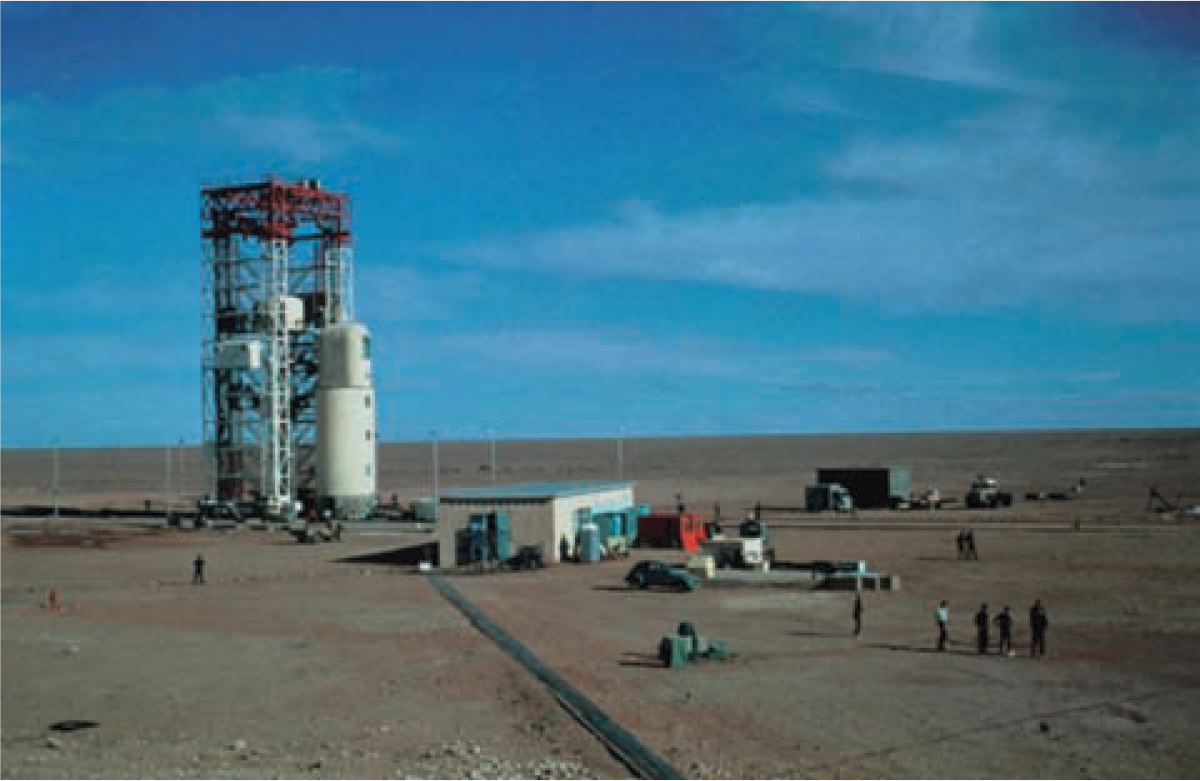
The Diamant launch pad at Hammaguir. Image courtesy of CNES/L. Laidet.
The growth of the rocket range reflected international changes in the focus of rocket technology, from missiles to orbital space, as the International Geophysical Year of 1957–58 approached. But there was much more going on in the desert. Colomb-Béchar-Hammaguir was a community of engineers and scientists who imprinted the infrastructure of space on the desert environment. Redfield (1996: 252) has commented that space technology is often represented as universal, modern and placeless: but in every location, the new space migrants had to adapt to local conditions and carry out the activities of everyday life.
Diversions on the range included open-air film screenings, at which spectators could look above them to see the passing of satellites (Marcel Lebaron, quoted in Penot, 2000: 19). For recreation, people roamed the dunes, marvelling at the tenuous life of the desert and collecting faked stone points from the Late Stone Age (Lebaron in Penot, 2000: 20). To Marcel Lebaron, who joined the sounding rocket program at Hammaguir in 1965, the Sahara seemed as alien as a lunar landscape (Lebaron in Penot, 2000: 19).
Conflict with France had been almost continuous since the annexation of Algeria in 1843. Having served with the French military during the Algerian War of Independence (1954–1962), Lebaron regarded Algerian Arabs as the enemy. His perceptions altered entirely as he made friends with those at Hammaguir. There were other surprises too. One day, while exploring the desert, he encountered a Tuareg camp, where he was offered desert truffles, and photographed the camels. He conceptualized it as culture contact: ‘Une rencontre ‘lunaire’ avec quelqu'un d'un autre monde’ (A lunar encounter with someone from another world; Lebaron in Penot, 2000: 20).
The Tuareg were a loose confederation of Berber-speaking tribes who had controlled the trans-Saharan trade routes for two millennia prior to French invasion, which they resisted vigorously (Rodd, 1926). The arrival of French roads and rail radically disrupted this trade monopoly, and Tuareg lives were further impacted by a policy of forced sedentism, aimed at controlling Tuareg movements and preventing uprisings. High security military establishments required political stability, which was far from the case in Algeria. In 1958 and 1959, the Doui-Menia group who lived in the Colomb-Béchar region were confined to a ‘tent village’ surrounded by barbed-wire fences. Air traffic from the bases at Colomb-Béchar and Hammaguir ensured that they were under constant surveillance (Belaid, 2008). Despite this, Lebaron's encounter demonstrates that Tuareg people continued to resist French control and move freely around the launch polygons.
In 1967, the CIEES facilities were handed to the Algerian government as part of the Evian Accords. Equipment was dismantled or destroyed (Azoulay, 2006). By this time France had established Kourou in French Guiana, and presumably much that was usable found its way to the new launch site, soon to become the base for the Ariane rocket. There was no question of equipping Algeria to establish its own space programme; and after only twenty years of launch activity, Colomb-Béchar-Hammaguir was abandoned.
The red sands of Woomera
By contrast, the Woomera rocket range in Australia resembled a Martian landscape with its red sands (there is even a mock-up of a Martian surface in South Australia; Clarke et al., 2004). Many saw it as ‘one of the greatest stretches of uninhabited wasteland on earth, created by God specifically for rockets… .’ (Southall, 1962: 3). In 1946, the UK government approached Australia to set up the Anglo-Australian Joint Defence Program (Morton, 1989). The headquarters for the resultant Weapons Research Establishment (WRE) was a former munitions factory at Salisbury, on the outskirts of Adelaide. The actual rocket range extended from the rangehead area, 450 km northwest of Adelaide, into Western Australia, enclosing an area larger than the UK and containing the Woomera Village, nine launch areas, workshops, instrumentation buildings, hangars, tracking and meteorological stations, and roads where none had existed before.
Launches from Woomera included a wide range of missiles from the antiaircraft Sea Dart to the Blue Streak ICBM, sounding rockets like Long Tom and Skylark, and Europa, a joint European vehicle aimed at launching a satellite. The Europa did not succeed in its mission, but in 1967, WRESAT 1, an Australian-designed scientific satellite, was launched on a Redstone rocket donated by the USA.
Although the desert was supposedly empty, the evidence of Aboriginal occupation was everywhere. An early reconnaissance mission in 1947 found that:
Lying on the ground, here, there and everywhere, were tens of thousands of artefacts, discarded knives and spear-points of faked and chipped stone, dropped by unencumbered generations of black men, and one had to accept the artefacts at their face value. Where one found artefacts, one found water (Southall, 1962: 41).
Woomera village was like ‘an oasis in the wilderness’ (Chambers, 2000: 20), but the rocket range itself was far from deserted. The area around Woomera was the traditional country of the Kokatha, and the entire Woomera Prohibited Area crossed the country of many Aboriginal groups.
Since the 1800s, Aboriginal people had been alienated from their country by the usual array of colonial processes; they were considered to be a ‘dying race’ (Gorman, 2005a; Bates, 1938). Residents of Woomera, like the colonial administrators of the preceding century, were fascinated by the culture they saw themselves as superseding. In the 1960s, a Natural History Society was established at Woomera. They organized guest speakers such as Norman Tindale, one of the founders of archaeology in Australia, and undertook expeditions to the gibber desert to collect geological, biological and cultural objects, such as stone tools and artefacts like the woomera or spear-thrower after which the range was named. Souvenirs of Aboriginal inspiration were also purchased by visitors, often making their way back to the UK and other countries (eg Chambers, 2000: 6). While Aboriginal people were regarded as having passed on, leaving the way open for the Space Age, ‘half-caste’ girls were employed as domestic staff at Woomera, and Native Patrol Officers kept in touch with all those still living in the desert in order to warn them of impending launches (Morton, 1989). At the Giles Meteorological station far in the desert, a fringe camp sprang up: both whites and blacks were sharing the same water resources (Morton, 1989, Gorman, 2009). The ‘Space Age’ had not replaced the ‘Stone Age’; the avatars of both were shaping a new kind of landscape where the wreckage of a rocket might lie undisturbed amidst a stone tool scatter, while the children or grandchildren of those who knapped the tools camped nearby.
Woomera is still used today for various launches; but Australia is no longer a spacefaring state. When the demise of the Apollo missions ended Australia's involvement in the US space programme, and the Europa rocket was moved to Kourou in 1970, Woomera went into decline. Much of the Europa material was sent to French Guiana, and bitterness at the end of Australian space dreams resulted in infrastructure being unnecessarily destroyed (Morton, 1989; Figure 2). As security diminished on the range, Kokatha people were able to re-assert their ties to country through Native Title claims and the resumption of ceremonial activities in places formerly closed to them (Andrew Starkey, pers.comm.).
Cultural exchange on the range
Despite their different imperial origins, the Algerian launch sites and Woomera have much in common. Both had camels (the Bactrian camel having been introduced to Australia in the 1880s; Finlayson, 1943: 107); and ‘nomads’ in the Tuareg and Aboriginal people who remained on their country. The launch sites were oases of high technology in hostile environments, but the high security boundaries were permeable: space scientists interacted with the environment and the locals. One aspect of cultural exchange was the traditional colonial activity of collecting the artefacts of the vanquished race. In the other direction, we know little about how the presence of this new technology affected the existing technologies of Aboriginal and Tuareg people.
Within the same landscape, we can interrogate spatial relationships between the location of space infrastructure and the places and artefacts left by the non-European inhabitants as they adapted to the imposed barriers of high security military facilities. Material culture was used to survive and adapt in different ways for both Aboriginal and Tuareg groups in the desert, and the Cold War migrants. Domination and resistance, themes of archaeological enquiry at sites such as plantations, penal settlements and internment camps, can be explored through the archaeological record (eg Miller et al., 1989). Principally, the artefacts of everyday life and their distribution on these rocket ranges can tell us not just what people said they did, but what they actually did.
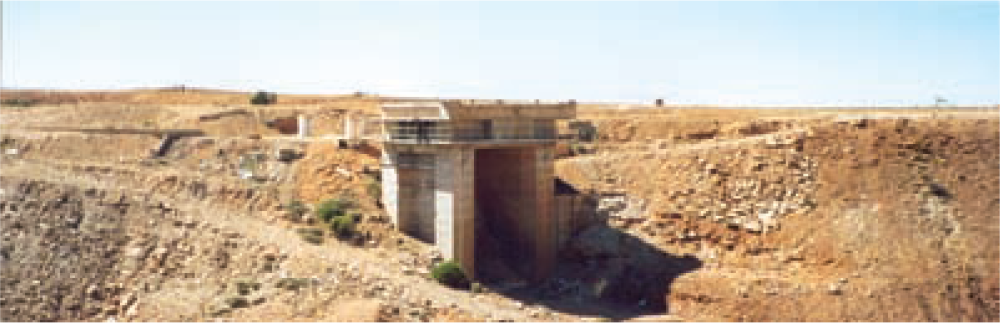
Europa launch pad, Woomera. Author's photo.
The basis of the technology and design derived from the common heritage of the V2 in both places, and both bequeathed material and technology to the Kourou launch site in French Guiana, established in 1964. Following this journey enables us to examine the adoption of national, international and transnational technology in a context of global capitalist economies dating from the industrial revolution. The Algerian and Australian rocket ranges, however, can also tell the story of Indigenous interactions with space in common landscapes, enabling a far more complex understanding of the social significance of space material culture than a focus on technology alone would allow.
Just as Indigenous people rarely figure in the popular and scholarly presentation of space history, the contribution of amateurs and enthusiasts to high technology in the Cold War is frequently relegated to the sidelines. Nevertheless, before the development of the V2 rocket, with its obvious military applications, in the late 1930s, rocket science was dominated by amateur groups and isolated researchers like Robert Goddard in the US and Konstantin Tsiolkovsky in the USSR. The adoption of rocket technology by the Allied powers following World War II did nothing to deter amateur organizations from pursuing their dreams of space travel with any means at their disposal. The materials and approaches they used provide another avenue for exploring the archaeology of space.
Kitchen satellites and space hitchhikers: amateur space programmes
Space technology has not only been pursued at the level of national space agencies or governments. From the time Sputnik 1 started sending its distinctive signal towards Earth, the amateur radio community was keen to participate in the action. Despite the nationalist and ideological motivations for satellite launch, the reality was that anyone with the right optical or receiving equipment could track satellites and intercept their telemetry. Space was also being conquered by passionate individuals who wanted simply to communicate with each other.
Radio hams in space: Project OSCAR
In 1958, a group of radio hams on the west coast of the USA formed Project OSCAR (Orbiting Satellites Carrying Amateur Radio), initiating a tradition of volunteer, international space participation that continues to this day (Baker and Jansson, 1994). In 1961, only four years after Sputnik 1, the tiny 4.5 kg OSCAR 1 satellite left Earth on an Agena rocket from Vandenberg Air Force Base in the US, re-entering the Earth's atmosphere approximately 6 weeks later (Figure 3). It was the first secondary payload to be ejected into a separate orbit. Oscar II followed in 1962, and OSCAR III and IV in 1965. The scientific missions of these satellites were facilitated by the return of data from volunteers across the world: for OSCAR I, more than 570 people from 28 countries participated.
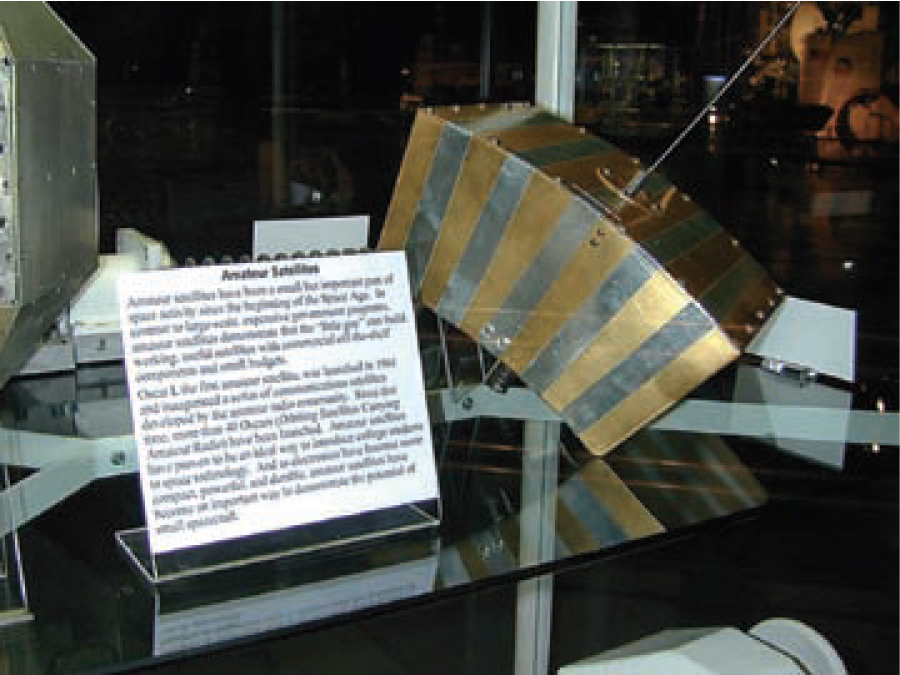
OSCAR 1. SETI League Photo, used by permission.
OSCAR III was an active telecommunications satellite, carrying a transponder designed to receive uplink signals and re-transmit them to enable radio hams to communicate. Until this time, telecommunications satellites had been passive, mere reflectors of radio signals. OSCAR III was in progress at the time that Telstar 1, the first commercial active telecommunications satellite, was being planned, and according to one story, the Telstar team were not best pleased at the prospect of being beaten into space by an amateur satellite (Baker and Jansson, 1994). In the end, they had nothing to worry about: Telstar 1 was launched in 1962, three years before OSCAR III achieved orbit.
Australis Oscar V
In 1965, the Melbourne University Astronautical Society were already tracking Project Oscar satellites, as well as US and Soviet lunar probes (Hammer and Mace, 1970: 2) when they decided to make their own contribution. The team was led by physics student Richard Tonkin, with Les Jenkins, a senior electronics technician with the CSIRO, Peter Hammer, who was studying the physics of the ionopshere, Owen Mace, studying infrared astronomy, and Paul Dunn, a computer expert (Goode, 1970; Atkinson, 1970). Other collaborators included the Wireless Institute of Australia and the Melbourne University Union, who provided funding; local electrical companies who donated equipment (Goode, 1970); and various Melbourne University clubs and societies (Jones, 1970: 45).
By 1967 they had designed and constructed a satellite aimed at testing the suitability of the 10 m amateur radio band as a downlink frequency for satellite transponders, and a passive magnetic attitude stabilization scheme (Baker and Jansson, 1994). A high frequency transmitter would provide data about the ionosphere. The satellite was a tiny aluminium box weighing 17.7 kg, with dimensions 30.4 × 43.1 × 15.2 cm, powered by a battery and thermally insulated. The antennae were made from spring steel carpenters' tape so they could be wrapped around the satellite to extend on ejection (Jones, 1970). Australis Oscar V was the first amateur satellite to be remote-controlled and to have a complete telemetry system (Hammer and Mace, 1970: 2).
Once again, an amateur satellite threatened the professionals: Australis Oscar V looked as if it might become the first Australian-designed satellite to reach orbit, ahead of WRESAT 1. It was shipped to California in June 1967 but the launch was repeatedly delayed (Atkinson, 1970). By 1969 the Project Australis team despaired of achieving a launch. The foundation of AMSAT (the Radio Amateur Satellite Corporation) from the original Project OSCAR group and an east coast group in 1969 provided impetus for the project: the newly formed corporation made the launch of Australis Oscar V its priority (Hammer and Mace, 1970: 2).
Finally, Australis Oscar V was launched in 1970 on a Thor-Delta rocket from the Vandenburg Air Force Base, piggy-backed onto a TIROS-M weather satellite. It was the first OSCAR satellite to be launched by NASA. To enable tracking, orbital predictions and reporting information were disseminated by radio announcements and newsletters (OSCAR News, 1967). Twenty-seven countries sent in data from tracking Australis Oscar V to contribute to its scientific mission.
According to USSPACECOM data, Australis Oscar V is still in orbit, although its telemetry ceased after 46 days as the batteries ran out. An engineering prototype of Australis Oscar V is in the Scienceworks Museum in Melbourne (James, 1992: 319).
Suburban space: Australis Oscar V ground segments
Like all orbital objects, Australis Oscar V is associated with a range of terrestrial places. They include ‘a particular refrigerator and a famous Carlton oven’ (Jones, 1970: 45), and a shack in the garden of a house in the Melbourne suburb of Highett, where the team listened to the launch via a radio link (Goode, 1970). Subsequent tracking of Australis Oscar V took place from a station on the roof of the physics building at Melbourne University (Hammer and Mace, 1970: 2). According to an unattributable newstory in the Museum of Victoria's archives, the tracking station consisted of old car parts, second-hand electric motors, and pieces of an air conditioning plant.
In the Canberra suburb of Torrens, Dr C. Rann, a chemist from the National Biological Standards Laboratory, built a tracking station specifically for Australis Oscar V, with the help of Mr E. Penikis and Mr G. Hover from the Australian National University (Bickel, 1970). They worked for six months to construct an automatically controlled antenna with 50 ft high aerials. Much of it was also made from scavenged junk, including the rear axle of a 10-ton truck, and aircraft propeller pitch motors. NASA lent them two signal converters (Bickel, 1970).
This pattern was by no means unusual. The success of OSCAR I's ‘bargain basement’ approach to procurement and management provided the philosophy for all following OSCARS. The satellites were frequently constructed in the basements and garages of people's homes (Baker and Jansson, 1994). For example, the fibreglass mounting rails for OSCAR 13 were cured in the kitchen oven of one of the AMSAT Vice Presidents (Baker and Jansson, 1994). The satellites were often built with donated leftovers from aerospace industry, and components from hardware and electronic stores (Baker and Jansson, 1994): a domestic, small-scale space technology.
In later years, AMSAT has become truly international, arranging launches for satellites built by amateurs, students, universities and even governments from countries such as Malaysia, Saudi Arabia, Mexico, Korea, Denmark, and Argentina. Most spacefaring nations have provided launch vehicles for AMSAT satellites, including the US, USSR, Japan and France. Of 98 OSCAR and other AMSAT satellites launched since 1961, 89 appear to be still in orbit according to AMSAT's data (AMSAT, 2004–2006).
Despite being outside aerospace industry, AMSAT satellites proved that innovation was not the sole province of the well-funded. AMSAT satellites were among the first to use voice transponders. They also pioneered microsatellite technology – of necessity – at a time when commercial and military satellites were becoming larger and larger (Baker and Jansson, 1994). Today, the trend is towards micro- and nano-satellites.
The amateur satellites demonstrate the diversity of space artefacts and the capacity of the public to participate in high technology. These satellites look vastly different from ‘professional’ satellites. Their design and construction reflect the resources available on low budgets and the ingenuity of scarcity. When it is possible to study orbital hardware from space, these little satellites will stand out from the thousands of commercial, military and scientific satellites by their appearance. In the cultural landscape of orbital space (Gorman, 2005c), their heritage significance is enhanced by their relative rarity; and their very presence in orbit undermines the dominance of the spacefaring states.
Conclusions
These space places exist in vastly different environments: ‘remote’ terrestrial deserts and the largely invisible umbrella of Earth orbit. A consideration of their social contexts allows us to see a range of different types of places, not usually considered as space sites, that can tell us something about the values of emerging spacefaring societies in the 20th century.
The installations and artefacts demonstrate the use of resources to adapt to new environments. The Australian and Algerian launch sites were positioned to take advantage of a colonial asset, ‘empty’ lands where nuclear missiles could be tested without impacting on urban populations. On the rocket ranges, ephemeral Tuareg and Aboriginal camps are juxtaposed with the monuments of space infrastructure. Two cultures were simultaneously using the same landscapes, shaped by the expansion of one and the constraint of the other. To see them as part of the same process enables the heritage significance of Woomera and Colomb-Béchar-Hammaguir to be assessed in a way that takes into account not only the achievements of space exploration, but also the impacts on those ostensibly left behind in the Space Race.
The OSCAR satellites and their infrastructure were improvizations, creating high technology out of the everyday. Suburban places in Melbourne and Canberra are linked to a small and silent black box still orbiting the Earth among the surveillance, earth observation and meteorological satellites of large corporations and national governments. These satellites may not be grand technological breakthroughs, but their social significance to those involved in the international community of amateur space, and to the local communities who supported them, renders them worthy of preservation when proposed orbital debris removals take place (Gorman, 2005c).
Human material culture associated with space travel has created an archaeological record that reflects technology and society as a globalized space-based culture emerges (Gorman in press). From the desert spacescapes to the kitchen-sink mechanics of the OSCARs, we can discern the diverse ideologies of space exploration. But space exploration has not yet led us to the ultimate encounter, ending our loneliness in the universe. Instead, on the lunar and Martian surfaces of the desert launch sites, imperial scientists encountered those who adapted to life on Earth long ago.