






Abstract
Through an examination of Bourdieu's Algerian fieldwork the article raises general questions regarding the place of photography in sociological research. In the midst of a colonial war Bourdieu used photography to make visual fieldnotes and record the mixed realities of Algeria under colonialism. Bourdieu also used photography to communicate to the Algerians an ethical and political commitment to their cause and plight. It is argued that his photographs do not simply portrayal or communicate the realities of Algeria. They are, paradoxically, at the same time full of information and mysterious and depthless. In order to read them it is necessary to ethnographically situate them in their social and historical context. It is suggested that the photographs can also be read as an inventory of Bourdieu's attentiveness as a researcher, his curiosity and ultimately his sociological imagination. They betray his concerns as a researcher but also can be used to raise ethical and political questions beyond Bourdieu's own attempts at reflexive self-analysis. The article concludes with a discussion of how Bourdieu's sociological life might contribute to the craft of sociology today.
Why do sociologists take photographs? Howard Becker observed that if we date the beginning of sociology with the publication of Comte's work, then it coincides almost exactly with Daguerre's production in 1839 of the first photographic images (Becker, 1974). Yet, photography has an ambiguous place within sociological practice. Graphic illustration was a central element of the portraits of urban life in the work of 19th-century social commentators such as Henry Mayhew (1971, 1985) but by the mid-20th century the sociological monograph is almost entirely picture-less. 1 Regardless of the increased interest in visual sociology and multi-media methodologies, photography continues to have something of a marginal place within a discipline that remains dominated by the word and figure. On the surface the situation in anthropology appeared different. Jay Ruby points out that the camera became an essential ethnographic accessory and ‘an identity badge for the fieldworker’ (Ruby, 1973: 13). While the camera was almost as necessary as a notebook, Ruby argues that the images which resulted were like ‘vacation photographs’ indistinguishable from what a tourist might take. Anthropological photography here is little more than fieldwork postcards used to decorate book covers and illustrate lectures. The images themselves were not part of the main descriptions and arguments and the intellectual event on the page.
The emergence of Pierre Bourdieu's archive of photographs taken in Algeria between 1958 and 1961 is particularly relevant in this context. Bourdieu had been drafted into the French army and sent to Algeria as a result of disciplinary action. Bourdieu was just 25 when he arrived in Algeria. In the French army he was harassed and humiliated by his military superiors. He wrote in his memoir of self-analysis that during his training in Chartres: ‘every week I had to step out from the ranks at the call of my name to be presented, before the assembled troops, with my copy of L'Express, the magazine that had become the symbol of progressive policy in Algeria and to which I had somewhat naively subscribed’ (Bourdieu, 2004a: 416). The only use the arrogant young officers had for him was to enlist his help to complete the La Figaro crossword in front of the other soldiers. ‘My fellow soldiers did not understand why I was not an officer. Finding it hard to sleep, I would often take their place on guard duty. They would ask me to help them write to their girlfriends. I would write their letters in doggerel. Their extreme submissiveness towards the military hierarchy and everything that it imposes put to a severe test what populism remained in me’ (Bourdieu, 2004a: 418).
He served in an air unit in the Chellif Valley, 150 kilometres west of Algiers. Bourdieu languished in the army subject to the whims of ignorant officers and suffocated by the colonial racism of his fellow soldiers. It was the intervention of his parents that saved him. They approached the relatives of a colonel from his native Béarn and appealed to them to ask their relative to use his influence on Bourdieu's behalf. Tassadit Yacine has outlined the circumstances that culminated in Bourdieu's reprieve (Yacine, 2004). In 1956 Colonel Ducourneau, a member of the Lacoste Cabinet, arranged for Bourdieu to be re-assigned to the documentation and information service of the General Government. The service had the ‘country's best-stocked library’ and here Bourdieu ‘could embrace and absorb the existing knowledge on a colonial society being torn apart before his eyes’ (Yacine, 2004: 491).
Bourdieu left the army in 1957. It had been a gruelling period but he stayed in Algeria and embarked on perhaps the most intense scholarly and political engagement of his life. In an interview published in 1986 he reflected:
After two hard years during which it was not possible to do anything. I devoted myself to fieldwork. I began by writing a book with the purpose of casting light on the drama of the Algerian people and also on the colonists, whose situation was no less dramatic beyond their racism (Bourdieu, 1986: 38).
He conducted extensive fieldwork in Algeria in the midst of a colonial war and yet the photographs he took, numbering originally more than 2,500, only appear fleetingly in his writing about the period (Bourdieu, 1958, 1977; Bourdieu and Sayad, 1964). The relationship between his photographic record and issues of politics, sociological ethics and aesthetics provided an impetus to gather the photographs and exhibit them at Goldsmiths in autumn 2006 to spring 2007. The re-assessment of Bourdieu's work on colonialism was made more pressing by the contemporary military interventions in Afghanistan and Iraq in which sociologists and anthropologist are deployed by the military in ‘Human Terrain Teams’. Bourdieu's example provided an opportunity to draw parallels between the complicity of ethnographers in today's colonial adventures and those of the past. As Bourdieu himself commented:
To conduct sociological fieldwork in a situation of war compels one to reflect upon everything, to monitor everything, and in particular all that is taken for granted in the ordinary relation between the observer and the informant, the interviewer and the interviewee (Bourdieu, 2004a: 426).
The result was the Pierre Bourdieu in Algeria: Testimonies of Uprooting series. The exhibition and the events that took place around it provided the context for the following discussion and indeed the special issue as a whole. It was an extraordinary opportunity not only to see over 200 images together in one space, a quarter of his remaining archive of photographs, but also to live with them as an example of the craft of ethnography in action and indeed under fire.
The seminars and discussions that took place around the exhibition explored issues of the relation between colonialism and sociological witness, politics and phenomenology and the impact of the Algerian war on French social theory. Not all of the events took place at Goldsmiths but it was uncanny that while we so often moved through and looked at the photographs they almost never cropped up in the debates and discussions which took place in the seminars. Our inability to admit the photographs within the theoretical debate and sociological imagination echoed the shortcomings outlined by Jay Ruby. This experience served as a reminder that as a profession we are just not very good at looking at photographs for their sociological value (Becker, 1974). We decided to have one final seminar and invite people to return to the exhibition, look at it again and choose just one photograph to discuss. The remaining part of this article is dedicated to what emerged from my own attempt at this discipline of looking, which was really not very disciplined at all. What was Bourdieu trying to record in his Algerian photography? How did he use the photographs? Why did he choose not to publish the images in his books and essays? I first want to discuss Bourdieu's writings on photography and also the interplay between Bourdieu's Algerian fieldwork and his background in Béarn in rural France and research he did simultaneously among the French peasantry, including some of his own relatives.
Photographic betrayal
Before discussing the images Bourdieu made in Algeria I want to situate his interest in photography within a wider context of his sociological work and also in relation to his biography. For Bourdieu photography is sociologically interesting because it both portrays the social world and it betrays the choices made by the person holding the camera. I suggest that an appreciation of his relationship to photography provides insights that can be used to understand his own photographic practice. This interrupts the sequence of events because before discussing Bourdieu's experience in Algeria I first explore the work he did on photography on his return.
Bourdieu left Algeria in May 1961. Back in France he dedicated himself to writing a book about photography. In Photography: a middle-brow art (Bourdieu, 1990) Bourdieu's focus is less on what photographs depict but on the aesthetics and tastes that are revealed in the process of framing what should be photographed and therefore valued. For him this ordinary art form is a mechanism through which class taste is pictured, be it in family snapshots, holiday prints or wedding portraits. It is part of the accessibility of photography that makes it available to researchers and indeed ethnographers. The reluctance of Bourdieu to publish his photographs may well have been a resistance to being drawn onto the aesthetic ground of this ‘middlebrow artform’. However, I think there was more to Bourdieu's reluctance to show his photographic work.
Photography is interesting for Bourdieu because it manifests decisions about judgment and value. It reveals the social and cultural forces that guide the process of training the photographer's lens, whether amateur or professional. He writes: ‘Adequately understanding a photograph, whether it is taken by a Corsican peasant, a petit-bourgeois from Bologna or a Parisian professional, means not only recovering the meanings which it proclaims, that is, to a certain extent, the explicit intention of the photographer; it also means deciphering the surplus of meaning which it betrays by being part of the symbolism of an age, a class or an artistic group’ (emphasis in original) (Bourdieu, 1990: 6–7). The notion that photography betrays the symbolism of a class or group challenges us to think about not only the interpretation of what an image contains but also the social and historical dispositions of photographer. In a sense the biography of the photographer is revealed in the choice s/he makes and yet at the same time the image-maker remains visibly absent.
Bourdieu applied this to brilliant effect in his analysis of the place of photography in the peasant society of Béarn in the early 1960s. Here the wedding photographer was prized as a resource to produce a sociogram of family relations. The photograph was a special extravagance fitting for the occasion and the purchase of a wedding photograph reciprocated the gift of the invitation. Here the pictures ‘capture behaviours that are socially approved and socially regulated, that is to say already solemnised’ (Bourdieu, 2004: 605). As a result, peasant photographs were tightly controlled, often kept out of sight in a box, with a few exceptions that were displayed discreetly such as wedding pictures and specific portraits. The use of the photographs betrays the values and cultural mores that produce them and determine their use. Amateur photography within this peasant context was viewed as a ‘frivolous luxury’ and a waste of money associated with urban life, acceptable as a youthful extravagance but to be abandoned after marriage and the assumption of adult responsibilities. One wonders how the brilliant young sociologist from Béarn, with a fascination for photography, might have been the object of ridicule amongst his family and open to accusations of getting above his station. For Bourdieu even the pose that the peasant adopts in front of the camera betrays peasant values: ‘adopting the most dignified, the most sober and most ceremonial attitude, to stand stiffly upright, feet joined together, arms flat by the sides … Solemnization, hieratism and eternalisation are inseparatable’ (2004b: 612). In between the lines of this elegant analysis is the plight of Bourdieu himself, a bright local boy who left for the city and picked up a camera.
As Bourdieu and others have argued, the simultaneous investigations into his own peasant background and his Algerian ethnographic work are profoundly connected (Wacquant, 2004). It was through Algeria that he reconciled himself to the world that he left in order to embrace education and intellectual life. There is also a betrayal here of another kind which I want to point to briefly. Bourdieu wrote his famous paper on the plight of the awkward bachelors, eldest sons, who hovered at the edge of the dance floor at country balls. In Bourdieu's account the bachelors are condemned because they inhabit an embodied culture that is out of step with the rhythm and style of the city. Trapped in their ‘empeasanted bodies’ and rooted through their ties to the land it is impossible for the bachelors to appear attractive to women: ‘a consequence of the differential penetration of urban cultural models among the two sexes, women judge the peasant men folk by criteria that leave them no chance’ (Bourdieu, 2004c: 591). The essay, originally published in 1962, contains touching descriptions of the men sentenced to this lonely fate. In fact Bourdieu returns to this fieldwork three times during his career (Bourdieu, 1962, 1972, 1989). He describes this research as a ‘kind of intellectual Bildungsroman’ (Bourdieu, 2004a: 433), a series of sociological novellas that contains the psychological, moral and social shaping of intellectual personality. It is an attempt to connect back and reconcile himself to the world he left, while trying to generate a scientific account of it. However, he writes: ‘The return to my origins was accompanied by a return, but a controlled return, of the repressed. Of that, the text itself bears hardly any trace’ (2004a: 436). There is another twist in the reconciliation that Bourdieu seeks through his writing. His father often accompanied him to the interviews he conducted with the old bachelors to help gain their trust. The interviews were painful to hear and yet they are analysed without any explicit reference to the author's relation to them. Bourdieu comments:
And the objectivist restraint of my remarks is no doubt partly due to the fact that I felt the sense of committing something like a betrayal – which led me to refuse to this day any re-publication of texts whose appearance in scholarly journals with small readerships protected them against ill-intentioned or voyeuristic readings (Bourdieu, 2004a: 437, emphasis added).
What Bourdieu shows here is the relationship between portrayal and betrayal, what is included and omitted in scholarly work and the affective dimensions of this process that are only revealed through the passage of time. Is not until after his death that the three articles are brought together in La Bal des Célibataires (The Bachelors' Ball), perhaps fittingly his very last book (Bourdieu, 2002). This is not to minimise his poignant observations but it is to suggest that sociologists and ethnographers are always struggling with the balance between self-knowledge and estrangement, portrayal and betrayal and perhaps the lesson, or the suggestion here, is to harness this tension explicitly in the service of understanding.
Bourdieu's own critique can be brought to bear on his fieldwork images or indeed more widely in relation to an ethnographic way of seeing. Precisely through paying close attention to Bourdieu's photographic practice we can deduce not only the ‘symbolism of an age’ but also ethnographic desires, insights and uses. In this sense we can read Bourdieu's photographs not just as autobiography but also as marked by a kind of scholarly attention and vocational disposition.
Colonial light
The task that Bourdieu set himself was to ‘cast light’ on the unfolding drama of de-colonisation in Algeria for both the colonised and the colonisers (Figure 1). In France this colonial war was dismissed as merely ‘events.’ Yet for Bourdieu the intensity of his encounter with the realities of colonial devastation, uprooting and encampment is hard to overstate. He was driven by a powerful desire to know and understand that reality, exposing himself to considerable risk and personal danger.
This total engagement and disregard for danger owed nothing to any sort of heroism but rather was rooted, I believe, in the extreme sadness and anxiety in which I lived and which, with the desire to decipher a conundrum of ritual, to collect a game, to see such and such an artifact (a wedding lamp, an ancient coffer of the inside of a well preserved house, for instance) or, in other cases, the simple desire to observe and witness, led me to invest myself, body and soul, in the frantic work that would enable me to measure up to experiences of which I was the unworthy and disarmed witness, and I wanted to account for at all costs (Bourdieu, 2004a: 424).
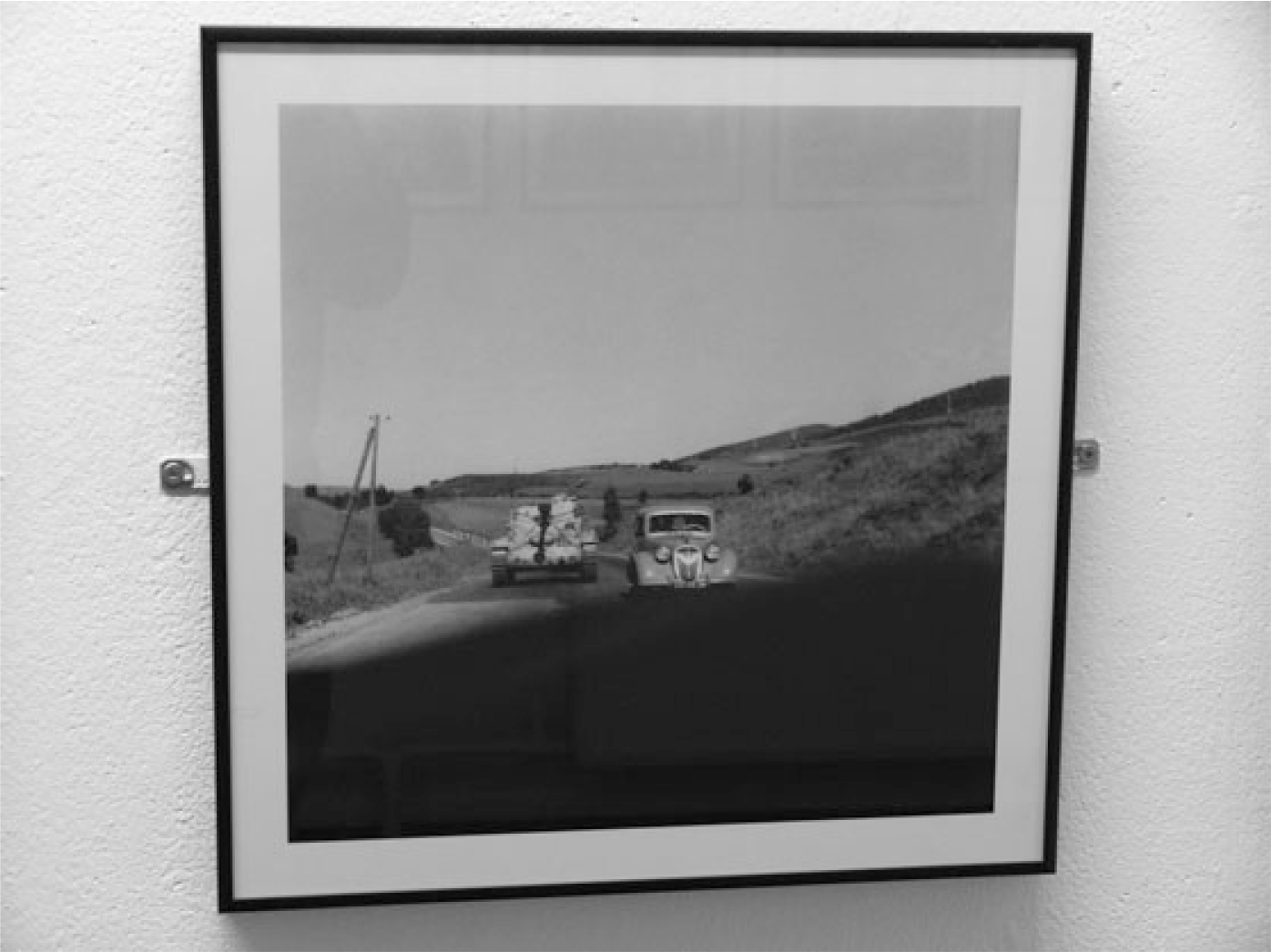
French colonial tank taken from the rear window of Bourdieu's car (photograph by author)
He interviewed people who had been tortured, witnessed the peasantry being forced off the land and he saw in the faces of the Kabyle peasants a likeness of his own relatives in Béarn. By this time, he had taken up a position at the University of Algiers as an assistant professor teaching philosophy and sociology amidst the colonial intelligentsia (Yacine, 2004). Some of his Algerian students became his co-researchers and lifelong colleagues such as Abdelmalek Sayad with whom he co-authored Le Déracinement (The Uprooting) in 1964. Bourdieu used a whole range of research techniques to try and represent this fast unfolding reality, what he refers to later as ‘pathetic instruments’ (Schultheis and Bourdieu, 2001), including even something close to a quantitative survey of consumer habits. Photography was one way to try to record what was happening.
For the young Bourdieu taking photographs in Algeria posed a practical problem. The intense brilliant white light made it difficult for him to open the camera's shutter without burning the film. This might be taken as a metaphor not only for the photographer's practical craft but also the ethics and politics of sociology in a time of war. Bourdieu used a Zeiss Ikoflex camera that he bought in Germany with a special lens able to cope with the searing light.
Bourdieu's photographs contain more than that which is portrayed within them. They illustrate the conditions of their historical possibility, the mixed realities of the colonial situation and the imperial grid of power that moulds and orders the physical landscape. In an interview conducted by Franz Schultheis in 2001 Bourdieu explained the ‘ticklish situation’ of taking photographs in the midst of a colonial war. The Zeiss Ikoflex had a viewfinder on the top of the camera so that Bourdieu would look down. ‘This way I could take them without anyone noticing,’ he explained (Schultheis and Bourdieu, 2001: 1). The angle of Bourdieu's view is surreptitious, a kind of ‘belt-buckle view’ of the world. Sometimes people turn their backs to the lens and refuse to be captured by it. There is a tension that Bourdieu hints at but does not really confront – between images that are given or taken – that I will to return to.
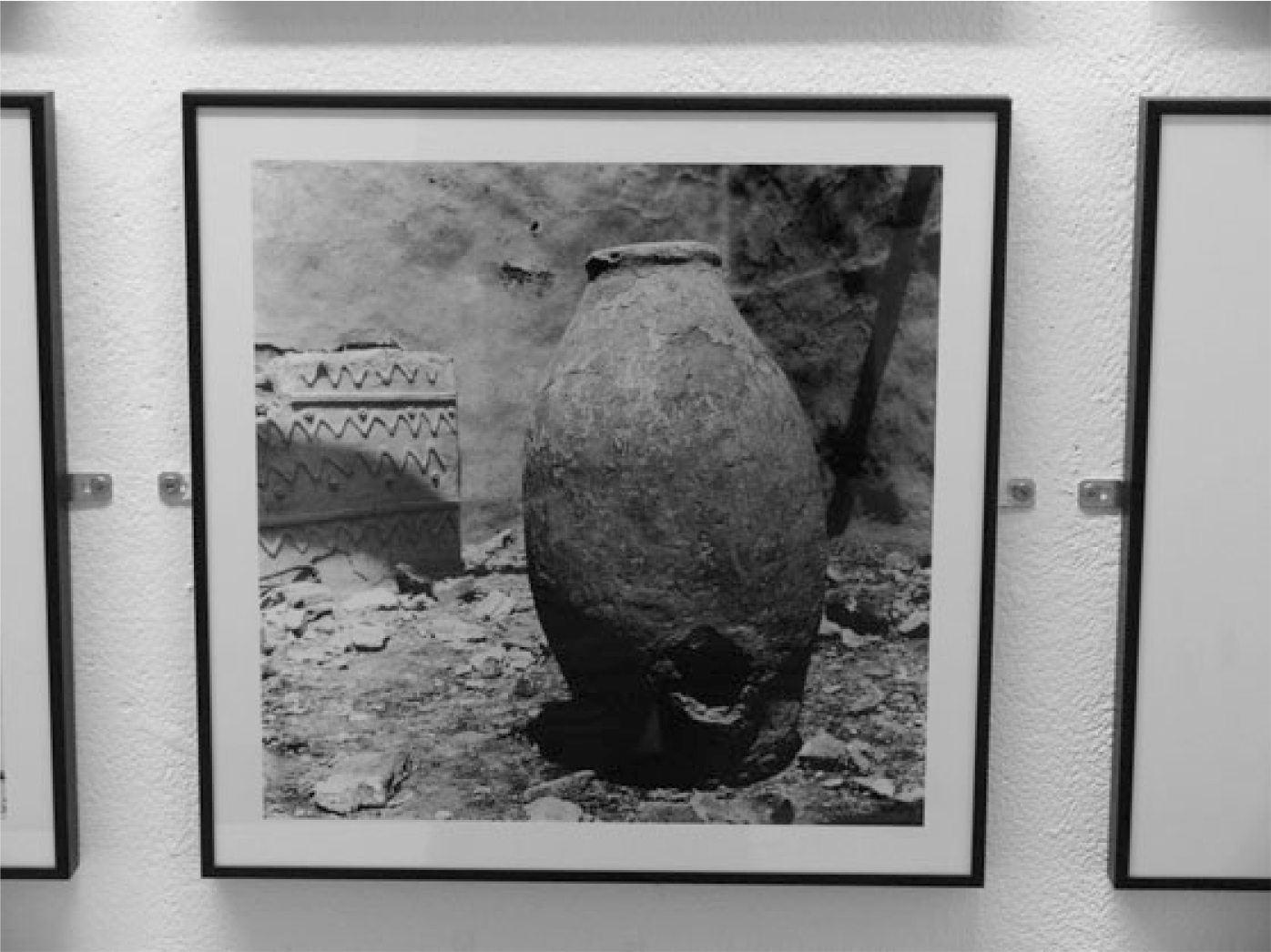
A Kabyle grain pitcher (photograph by author)
The image that fascinated me is a quite unspectacular anthropological record of a clay pot. The photograph is shown here, a Kabyle grain pitcher adorned with snakes (see Figure 2.). At first sight this is a fairly innocent image of Kabyle culture, a kind of traditional relic. However, it provides a perfect witness to the colonial conditions of possibility and the violence of dispossession. Bourdieu explained:
Against the advice of my friends, I had set out into the mountains on foot to look at the destroyed villages, and I found houses that had had their roofs taken off to force people to leave. They had not been burned down, but they were no longer inhabitable. And I came across clay pitchers in the houses (something I had already begun researching in a different village, Aïn Aghbel: there are places where everything that we would call furnishings is made of fired clay, made and shaped by women); in Kabylia they call them aquoifis, those big clay grain pitchers decorated with drawings. The drawings are often of snakes, snakes being a symbol of resurrection. And although the situation was so sad, I was happy to be able to take photographs – it was all so contradictory. I was only able to take photos of these houses and immovables because they had no roofs anymore (Schultheis and Bourdieu, 2001: 3).
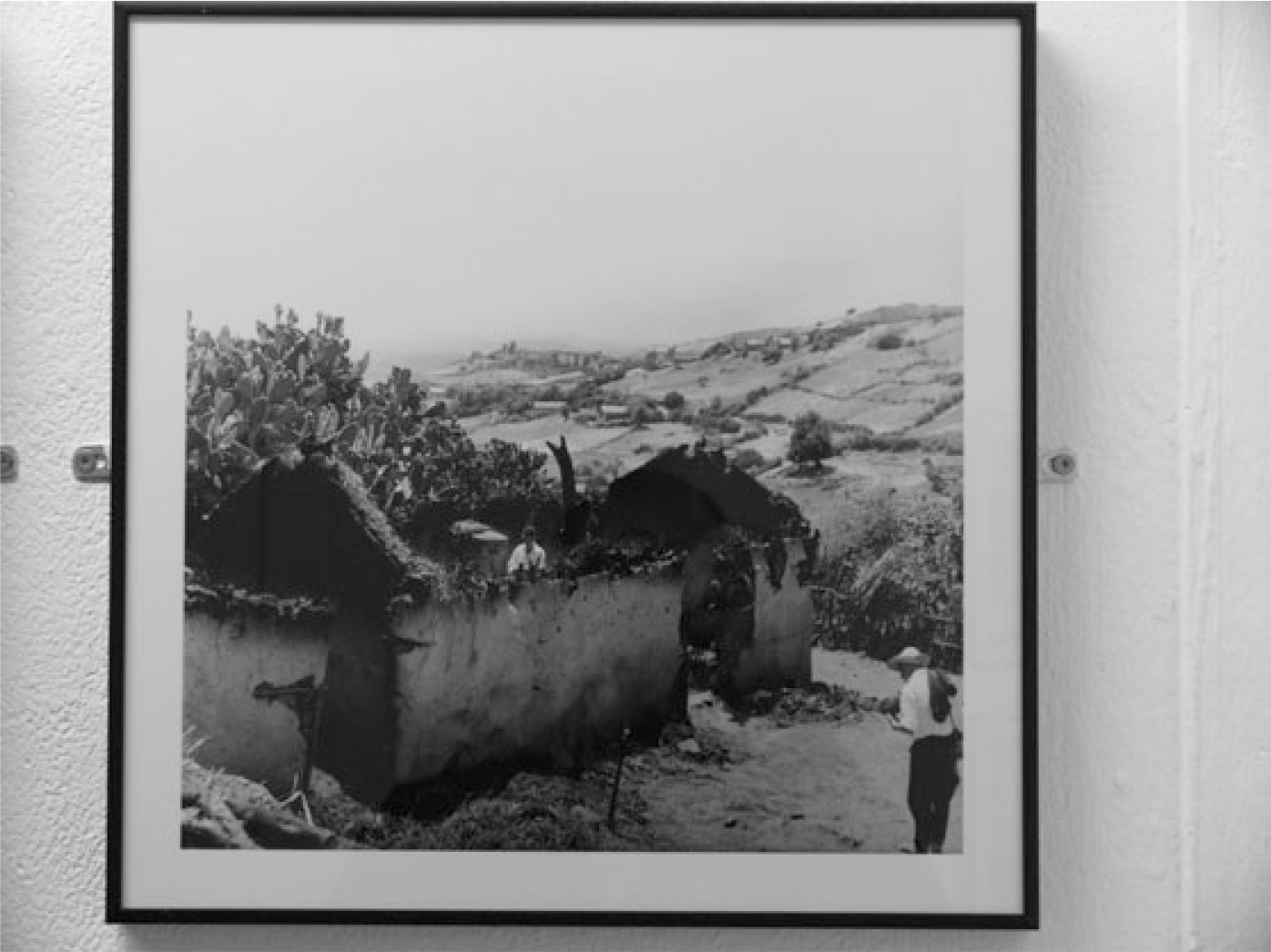
Colonial light (photograph by author)
The photograph is made possible by a colonial light, produced by the violence of dispossession that chased peasants off the land and a light that is allowed in by roof burning intended to prevent them from returning (see Figure 3.). In the midst of this Bourdieu takes a photograph that is a ‘dialectical image’ in the Benjaminian sense. It is a moment of anthropological portrayal containing historical witness to the scene of its political occasion: ‘not a process of exposure which destroys the secret, but a revelation which does justice to it’ (Benjamin, 1998: 31). There are two points that need to be stressed here. First, the photograph both shows and hides the context of its creation. Therefore the photographic image does not communicate simply or speak for itself. Secondly, in order for the photograph to be read it needs to be both contextualised and historicised. This is illustrated here through the dramatic and violent conditions (the burning of the roof) that make the photograph of the Kabyle grain pitcher possible in the first place. This is perhaps a lesson of sociological photography today – ie, how to avoid a naive realism that conceals its social staging.
As Loïc Wacquant (2004) pointed out Bourdieu's photography has a pragmatic dimension because it provided a condensed way to store information. He did not keep a field diary – the days were simply too long and exhausting. Instead he kept notebooks in which he stuck his negatives, placing the photographs in celluloid bags. The photographs here served a ‘documentary function’ (Schultheis and Bourdieu, 2001: 3) enabling him to retain information. Walking through the Bourdieu in Algeria exhibition was like encountering a gallery full of ethnographic impressions, as if reading from Bourdieu's never completed field diary, albeit with the pages ripped out and re-ordered. The photographs could capture the ‘mixed realities’, or what Wacquant calls the ‘jarring comingling’ of the Algerian situation (Wacquant, 2004: 400): Cassoulet tin used in a graveyard as part of a funeral rite or two turbaned men in the city locked in an intense discussion in front of Bourdieu's Renault Daphine. Photography was also a way of sharpening Bourdieu's look, pausing the flow of social action – often in dangerous situations – so that these stolen moments could be studied safely at a later point.
Photography was not just an aide memoire, a fast and efficient way to store information. Bourdieu aimed to train an ethical form of attention producing a photography that was also committed to listening. Here visual sociology is partisan, aspiring to be on the side of its subjects, and yet at the same time scholarly and removed: ‘there was this objectifying and loving, detached and yet intimate relationship to the object’ (Schultheis and Bourdieu, 2001: 2). He counterpoised this form of photography with the vulgar tourist photographers who were only interested in exotic appearances and not what their Algerian subjects had to say. Bourdieu's images were often made in situations of real danger in the midst of a colonial war. For Bourdieu taking photographs was a way of communicating to the Algerians that he was on their side, bearing witness to what they were enduring and struggling against. In this sense, photography became a way of displaying political commitment and ethos. This comes through very strongly in the portraits where the address and presence of the person being photographed is direct, as if the look is an exchange of recognition and political acknowledgement.
Bourdieu's Zeiss Ikoflex camera was also a way ‘of trying to come to terms with the shock of this devastating reality’ (Schultheis and Bourdieu, 2001: 2). The camera's lens was both a means to focus on a world being torn asunder but also a prophylactic against the trauma of seeing what that looked like: simultaneously able to bring people and things up close and then put them at a distance. This is not a matter of callousness or lack of interest but endurance, a way of continuing the arduous work of historical witness and maintaining the emotional energy required for serious ethnographic attention. Wacquant suggests that photography for Bourdieu was a means to ‘anchor and facilitate the emotional work necessary to carry out first hand observation’ (Wacquant, 2004: 402). The emotional costs of fieldwork are particularly acute here but Bourdieu's example is more widely applicable. The barrier that the camera's lens places between the world and the ethnographer can guard against paralysis and resignation and keep the writer to the task of taking in what is happening.
I want now to examine more critically the relationship between Bourdieu's commitment to engagement and passionate scholarship, reflexivity and social science.
Total science and the original sin of colonialism
Loïc Wacquant concluded that in Algeria Bourdieu's fieldwork photography was central to the realisation of his scientific and civic aspirations:
Through the photographic prism, one discerns better how the project of a total science of society, capable of embracing all aspects of reality, visible and invisible, embodied and objectified, and of laying bare the social causes and reasons for its unruly course, not only made intellectual sense. It met a vital existential need and harnessed the impetuous civic urges of Bourdieu by giving him a concrete task and an urgent mission in which to lose himself (Wacquant, 2004: 403).
Bourdieu was committed all his life to a scientific project. He was scathing of the forms of textual reflexivity connected with anthropology criticism in the 1980s (Clifford and Marcus, 1986, Rosaldo, 1989, Geertz, 1988) that ‘substitute the facile delights of self-exploration for the methodical confrontation with the gritty realities of the field’ (Bourdieu, 2003: 282). For him the task was to achieve ‘participant objectivation’ which he conceived of as a device for interpretation and understanding. His model of fieldwork is neither a naive form of ethnographic immersion, nor the critical distance of a scholar's ‘view from afar’; rather the ethnographer's task is to submit subjective relations to objective scrutiny. Objectifying subject relations also involves a critical scepticism of the ‘spontaneous sociology’ contained in informants' accounts, as well as a rigorous critique of the academic field of knowledge production. In this sense, reflective work on the self is a resource to achieve both political engagement and scientific objectivity without the repression of the scholar's social position.
Bourdieu's scepticism of scholastic postures is a valuable and lasting legacy of his sociological work and yet his own thought is both humble in the attention to reflexivity and arrogant in its claim that social science can tell a superior truth. Bourdieu in his writings sometimes appears beyond reproach. His self-analysis is bounded or has limits and he seems to signal this incompleteness in his final attempt at reflexive sociology and account of his life in scholarship that is entitled – Sketch for a Self-Analysis (Bourdieu, 2007). By definition a sketch is incomplete, a rough outline lacking full colour and nuances of shade. Here his photographs provide another kind of resource because they are a record of his sociological attentiveness, showing the scenes and information that he wanted to remember. This makes the photographs at once compelling and frustrating: they beg more questions than they can answer, which in turn opens up Bourdieu's writing in another way.
Shortly after the opening of the ‘Bourdieu in Algeria exhibition’ at Goldsmiths we received a complaint from a student about one of the photographs. It was a picture of a child who had been circumcised. The student described herself as a mother of two children and in an email she protested against the portrayal of what she saw as a girl aged about 6 or 7, naked from the waist down ‘spread eagled to reveal her vagina’. The complainant suggested that the child looked stressed and that there was evidence its leg was stained with blood. The email questioned the motives behind the image. Perhaps it was an attempt to raise issues ‘regarding female circumcision’ the petitioner conjectured but then protested that the end result was an image of child being raped. It was also suggested that the image could be exploited by pedophiles that might take copy of the picture on their mobile phones and circulate it. The suggestion was that this image was violating and unethical, as it depicted child abuse. It was suggested that the image begged questions: What happened to the child? Was it taken with the consent of the parents? The student concluded: ‘If it had been in the UK it would be a case for the Social Services!’ 2 We took the student's complaint very seriously and – at least initially – accepted the parameters of the objection. It wasn't a dramatic or violent image and the photograph had been altered to blur the child's genitals. There was something very disturbing and haunting about the image, in which the child looks as if to ask ‘Why are you looking at me?’ We debated whether or not to take the photograph down. Our intention was to use Bourdieu's photographic work to ask searching questions including whether there are places where a camera should never be pointed and whether there are some photographs that should not be taken. Was this photograph itself an instance of the symbolic violence that Bourdieu himself had so often criticised? Were we not also complicit through our commitment to show all the photographs? The answer is undoubtedly ‘yes’ and yet at the same time we wanted to open up such questions for debate and reflection: to censor the image would have been concealment.
There is a further twist here and another dimension to the controversy. The meaning of any photography is always achieved through social relationships between the image, the context and those who view it and the circulation of discourses they used to make meaning (Mitchell, 1994). The photograph cannot reach back in time, its referent has disappeared, life has passed on, the image is an epitaph to the life that is frozen within the frame. As Barthes once commented, the photograph is only a ‘certificate of presence’ (Barthes, 2000: 87). This general lesson is specifically pertinent to the dilemma raised by the image of circumcision. It is not what it seemed to be to the outraged student. There is no tradition of female circumcision in the Maghreb. The picture in question is not of a girl. Rather, the photograph is of a boy dressed in a gandora. The meaning of the image is made through a kind of Orientalist logic (Said, 1978) that equates not only Africa but also all of the Middle East with abusive and oppressive sexual practices. The complainant suggested in her email that the image was possibly from ‘Afghanistan’. In his classic formulation of Orientalism Edward Said argued that Western representation of the Orient do not simply distort patterns of culture, rather it produces meaning and knowledge for its own historical and political purposes: ‘as a cultural activity Orientalism is all aggression, activity, judgment, will-to-truth, and knowledge’ (Said, 1978: 204). Significantly, Said notes that this is not only maintained through stigma and hate but also through sympathy and even a kind of advocacy. In this case, it is the advocacy of the non-Western child that authorises the students' outrage. The social context in which these judgments are made are furnished with structures of knowledge and judgment that give the photograph meaning. The historical specificities of Berber gender relations in Kabyle society are thus displaced. Through accepting the terms of the complaint we were initially drawn into these Orientalist structures of knowledge and judgment. Having said all this, what difference does it make ethically that the photograph is of a boy?
Male circumcision – the removal of some or all of the foreskin from the penis – is a common practice throughout the world associated with Jewish and Islamic faiths as well advocated widely on health grounds. It is estimated that a third of males in the world are circumcised (Crawford, 2002). Bourdieu spoke of this photograph in his interview with Franz Schultheis. He does not refer to issues of gender or ethics, rather it is presented as another example of recognition, trust and mutuality. ‘These photos also include a series of pretty dramatic pictures of a circumcision – the father asked me to take them: ‘Come and take some pictures’. Photography was a way of relating to people and of being welcome. Afterwards I would send the photos' (Schultheis and Bourdieu, 2001: 1). Bourdieu was invited to the celebration, a rite of passage and he takes a photograph at the father's request. The fact that it is of a boy makes a difference because it situates and historicized the image and the father's expression of masculine pride and gendered divisions that are at play within it. Fowler has argued that in Bourdieu's account the ‘orchestrated grandeur of circumcision’ and male coming-of-age ceremonies reveal the ways in which gendered orthodoxy is marked and represents ‘a kind of fetishism of virility’ (Fowler, 2000: 42, see also Bourdieu, 2001: 26). Bourdieu was fascinated by the manifestations of male pride and honour and developed a critique of masculine domination and gendered social relations (Fowler, 2003) and feminist scholars have combined Bourdieu's theoretical schema with their own sociological agendas (Adkins and Skeggs, 2004).
There is pain and objectification here but it is not genital mutilation of the order being suggested by the outraged student. Is that all there is to say? What is Bourdieu doing with his camera? Isn't there another kind of violence in his intrusion whether invited or not? In a sense Bourdieu is complicit with the gendered orthodoxy and taking a photograph is ‘a way of relating to’ the proud father. However, the child does not feature within these relations and interactions. Bourdieu does not extended the critical discipline of participant objectivation to his relationship to the child or the ethics of making the image. What remains is Bourdieu's implication in the symbolic violence enacted through the objectification of the son. This is not to condemn Bourdieu casually, for also we were culpable. Reflecting with the benefit of hindsight, I feel personally, it was a photograph that should not have been shown. In the end, I found myself in the same position as the outraged student albeit via a very different route. The result is to suggest a double critique: first, one that is critical of the Orientalist premise on which the complaint was founded; and secondly, to also point to the danger of objectification and intrusiveness in the act of taking a photograph. Perhaps, it is only when photographers cross that line that we find out where it is. Returning to the issue raised at the very beginning, this image is an example of a photograph that should not have been taken.
The pilfered and surreptitious nature of many of his images that look so much like stolen moments (see Figure 4) is also at odds with his claim that taking photographs was a means of communicating to the Algerians, ‘I'm interested in you, I'm on your side’ (Schultheis and Bourdieu, 2001: 2). What the images reveal is that Bourdieu is also cast within a colonial light. His images are photographic betrayals in the Bourdieusian sense. To his credit he confronts this when he writes in Travail et travailleurs en Algérie (Work and Workers in Algeria) that: ‘the ethnographer, by virtue of his membership of the colonising society, bears the weight of the original sin of colonialism’ (quoted in Bourdieu, 2008: 5). There are other complicities and compromises. Remember Bourdieu was saved from the ravages of colonial military service by the intervention of a Béarnais colonel. He taught at the University of Algiers that was dominated by a powerful far-right lobby and some of his early papers were published by the government's Social Secretariat and circulated locally (Yacine, 2004: 497). This is not to minimise the threats to his life that finally forced him to leave Algeria in May 1961, or the fact that he developed reflection and critique of the ‘colonial question’ from the inside. It is to suggest though that there is a silent narrative in these photographic images that betrays Bourdieu's position in the colonial order and his necessary – if only partial – accommodation to it. Perhaps, this is part of the reason why he kept the photographs lying in boxes unseen for close to 40 years.
During the discussion of the exhibition several commentators observed that Bourdieu's Algerian photographs seemed ‘too French’ and not the ‘Algeria of the coffee houses’. Rather, what the photographs illuminate is what Edward Said would have called colonialism's contrapuntal quality, in which the map of France is overlaid on Algeria and vice versa and the histories of Algiers and Paris are inseparable (Said, 1993). While the secrets of the images are Bourdieu's, they are an inventory of what Bourdieu thought merited attention and closer scrutiny. Less a ‘total science of society’ than the desperate struggle to record the colonial drama in snapshots, revealing the details of its mixed realities as well as the searing light cast over the Algerian landscape. Here the grids of power that ordered ‘the settlements’ in which the uprooted peasants were forced to live are betrayed, perhaps, along with the limited and partial nature of his account.
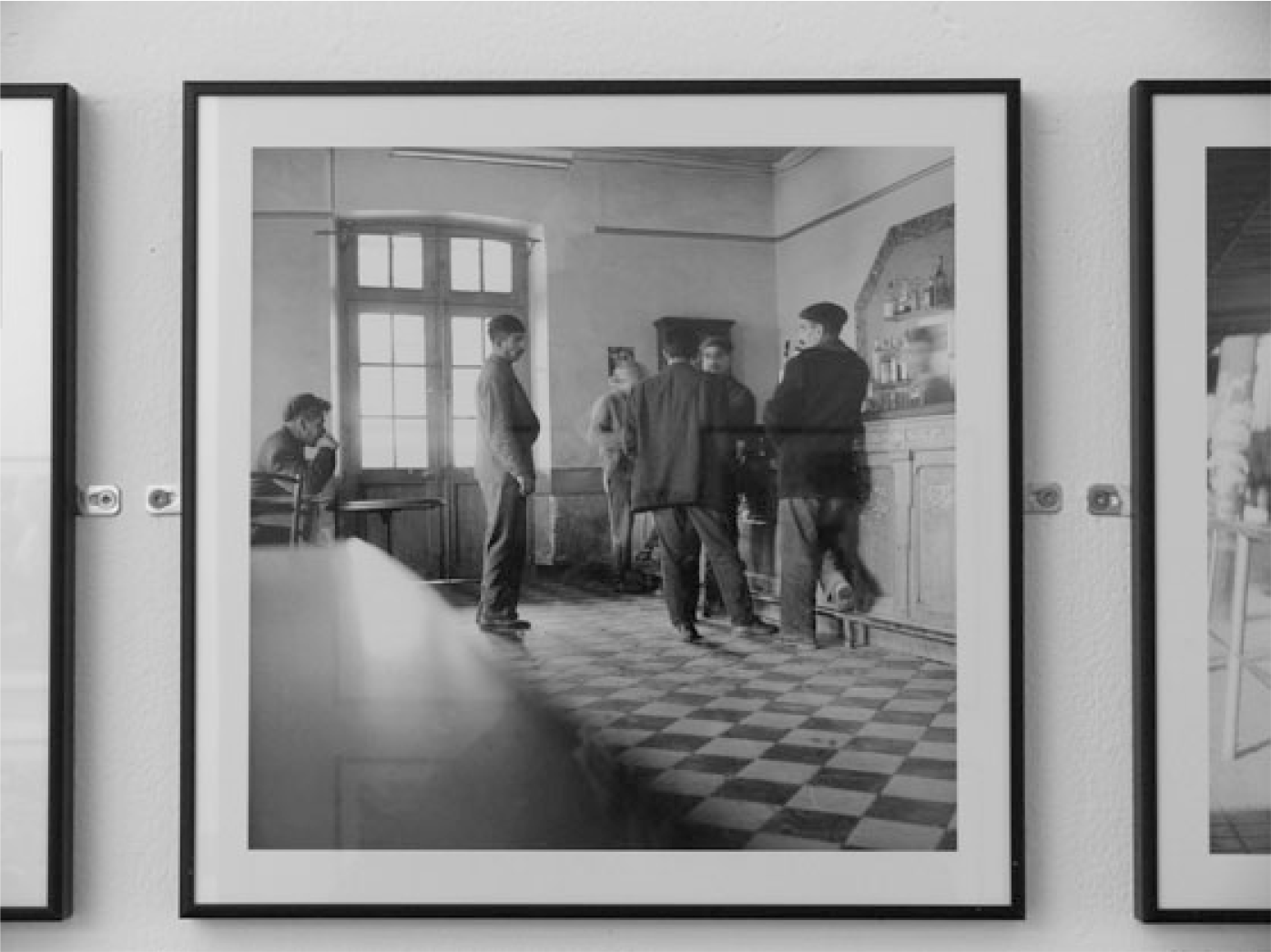
A belt-buckle view' – workers in a bar (photograph by author)
There is a tension in Bourdieu's sociology between his aspirations for scientific objectivity and a sociological authority that can claim to have the final word and what might be called a nearsighted humility. He asks in Pascalian Meditations ‘How can one avoid succumbing to this dream of omnipotence?’ The answer lies in an attention to the situated quality of social life but also of scholarship itself:
I think it important above all to reflect not only on the limits of thought and of the powers of thought, but also on the conditions in which it is exercised, which lead so many thinkers to overstep the limits of a social experience that is necessarily partial and local, both geographically and socially (Bourdieu, 2000: 2).
The task to for him is not to be confined by incorrigible local difference; rather the challenge is to shuttle between these social experiences (ie the likeness of the Béarnais peasant in Kabyle society and vice versa) in order to find continuities as well as contrasts. There is the danger here though of another order of colonisation, in which the other becomes a device through which self-knowledge is achieved. It is partly through Algeria that Bourdieu comes to terms with his own sense of exile from the world of his childhood in Béarn and a peasant society in the midst of rapid social transformation.
In answer to the question posed at the beginning of this article, Bourdieu took photographs for a combination of pragmatic, ethical and political reasons. These are equally relevant today and can be found in the practice of visual sociologists in very different geopolitical contexts (Harper, 1982, Knowles and Sweetman, 2004). The camera here is a recording device that can also register traces outside language, a medium for recognition and affinity that both connects the researcher to the damaged world while placing it at a distance. The photographs cannot and do not speak for themselves. They are, to use Barthes' phrase, ‘chaffed by reality’ (Barthes, 2000: 115) and a presence that has passed. The trick that photography plays is that it seems to have the power to document ‘the real’ unproblematically. The images show but also hide meaning. Bourdieu wanted to capture the reality of Algeria but inevitably this complex situation escapes and cannot be reduced to sociological facts, his snapshots cannot be the whole picture. Perhaps, this is what makes sociology interesting, not as a ‘total science’, but rather as engaged in the task of the interpretation of meaning that inevitably must be left open. Here the slippages, the insights, as well as the blindness, are what make it valuable and where the incomplete record is nonetheless compelling.
I have argued that there is another way that we might view photography: as a means of accessing reflections and thoughts that are beyond the sociologist's understanding or appreciation. As I have suggested, Bourdieu's photographs contain a record of his attentiveness, his curiosity and ultimately his sociological imagination. Perhaps, there is lesson in that what sociologists bring back from fieldwork is sometimes mysterious and not always altogether clear to them. We cannot always know the value of what we return with from risky and precious forms of sociality that ethnography demands. This would perhaps undermine Bourdieu's scientific aspirations for universal meaning but not necessarily the value of his work found in his intense and particular search for understanding.
Wandering repeatedly through the exhibition I started to wonder if all portrayals involve betrayal of some form and I don't mean this only in a pejorative sense. We might think of the betrayal of the effects of power or the ways in which our sociological endeavors betray the damaged nature of the world and its injustices. It seems to me that the relationship between portrayal and betrayal is alive in all ethnographic practice. It is no coincidence that it is only at the very end of Bourdieu's life that he allows a wider reading public access to the lonely drama of the bachelor's ball in Béarn or for us to see his Algerian photographs. I am not suggesting that betrayal of this sort is necessarily an ethnographic vice – but it is there to be reckoned with regardless of the hyper political postures we might strike or the bureaucratic details of ‘consent forms’ or the pronouncements of university ethics committees. As Bourdieu would have said, this should be one of our key commitments – to face the politics of knowledge rather than withdraw from empirical engagement or reside in the false comforts of critical distance. However, it needs also to be realised that this process is never complete or settled once and for all.
Conclusion: sociological life
Pierre Bourdieu died on 23 January, 2002. I don't know if I am alone in thinking this but as I look at my bookshelves it seems that many of the most insightful figures of the late 20th century, who helped make sense of senselessness, are leaving us one by one. The names on the spines of those books include Jacques Derrida, Edward Said, Gillian Rose and Clifford Geertz. This loss should not simply result in an impulse to preserve their legacy akin to a form of intellectual embalming. Fred Inglis wrote, rather smugly, in an obituary to Bourdieu that such a move was underway in France. ‘This is what it means to leave an intellectual inheritance. It isn't the way things happen in England.’ 3 The lesson and legacy that figures like Bourdieu offer to the time that is beyond them is: how to conduct criticism and a kind of sociology in public that is for and sometimes against the public.
Pierre Carles' film Pierre Bourdieu: La Sociologie est un sport de combat (Sociology as a Martial Art) – released in the year of Bourdieu's death – is a record of his sociological life. For Bourdieu, sociology's relationship to society's damaged body should not be parasitic. Here sociology is a martial art: ‘Like all martial arts it is to be used in self defence and foul play is strictly forbidden.’ 4 Thinking with Bourdieu and taking some lessons from his life, we might add other things. First, the service that sociology can perform in our time is to point to those things that cannot be said. ‘The preconstructed is everywhere. The sociologist is literally beleaguered by it, as everybody else is,’ Bourdieu observed (Bourdieu and Wacquant, 1992: 235). It is in silence that inequitable relations and gross political complicities are hidden and this was certainly the case with regard to French public opinion during the colonial war in Algeria. Here the sociologist is a guide to those things that are muted or ignored. Second, sociological thinking is required to provide a sensitivity to and respect for the uncelebrated. This is not simply a matter of giving ordinariness a voice, and Bourdieu was deeply sceptical about the ‘spontaneous sociology’ that could be found in Kabyle society or rural Béarn. Rather his device for critical reflection makes the familiar strange and investigates the self-evident. Third, Bourdieu's sociology aspired to create an ethical and critical imagination that transcends provincialism and operates on an international scale. In a sense, Bourdieu's early fieldworks provide a model for contrapuntal cross-cultural understanding in which the rural France and the Algerian colony are brought into dialogue with each other. Recalling Levi Strauss he called this a ‘Tristes tropiques 5 in reverse’ (Bourdieu, 2004a: 436) and pointed to the implication of what happens close-by with the elsewhere of empire. Fourth, and not least, the kind of sociology that he argues for is one that is attentive. There is an astonishing moment at the end of the film when he is faced with a quite hostile and anti-intellectual audience in a community centre in the banlieu composed of social workers, migrants and local political activists. In response to their dismissal of sociology he says defiantly ‘intellectualism is not a disease.’ He appeals to his audience not to reject thinking and learning and invokes his long-time colleague and co-author Abdelmalek Sayad with whom he worked with in Algeria. Bourdieu characterises Sayad ‘as a great listener.’ He told the room full of migrants some of whom are probably of Algerian descent that they might learn something about immigration and racism from reading Sayad's work. Finally, Bourdieu's sociology is a form of historical witness – not the whole story but a compelling one that ‘brush[es] history against the grain’ (Benjamin, 2003: 407). Bourdieu's Algerian photographs are fragments of an alternative history not only of colonial Algeria but also of his sociological triumphs and frustrations.
Part of Bourdieu's martial art strikes against ignorance, self-delusion and hypocrisy and lies. Even when he is winning the argument, Bourdieu scolds his audience in the banlieu community centre who clap their hands in admiring approval: ‘truth isn't measured in clapometers’. 6 Unthinking approval or uncritical applause is of little use to him. And yet, watching La Sociologie est un sport de combat one gets the sneaking feeling that even the great sociologist remains something of a stranger to himself. There is perhaps an unspoken lesson for us all in this: we cannot control what we betray in our sociological work, or for that matter, in our lives.
Footnotes
Acknowledgement
I would particularly like to thank Azzedine Haddour for his critical reflections on the argument developed here. Also, I would like to thank Nirmal Puwar and Beverley Skeggs for their suggestions and also Judith Barrett for her keen editorial eye.
1
I am thinking here of the Chicago School ethnographers from Anderson (1961) to Whyte (1943) but this observation is also true of sociological community studies in Britain eg Young and Willmott (1957) or  .
.
2
Email 2nd November, 2006.
3
Fred Inglis, ‘France still feels the force of his habitus,’ The Times Higher, February 8th 2002.
4
Quoted from Pierre Bourdieu: La Sociologie est un sport de combat C-P Productions et VF Films 2002. Directed by Pierre Carles.
5
A reference here to Claude Lévi Strauss' anthropological memoir translated initially as ‘World on the Wane’ (Levi Strauss, 1961) but then later with a new English translation but keeping the French title ‘Triste Tropique’ (Levi Strauss, 1989).
6
Quoted from Pierre Bourdieu: La Sociologie est un sport de combat C-P Productions et VF Films 2002. Directed by Pierre Carles.