






Abstract

This note uses two photographs by Pierre Bourdieu of his collaborator in Algeria, Abdelmalak Sayad. The paper uses Sayad's ‘awkward’ posture to explore the notion of ethnography as a craft and as a disposition, relating this to the insider/outsider position of ethnographers like Bourdieu, Sayad and Maloud Mammeri. Bourdieu described Mammeri's career as ‘an odyssey of reappropriation’, a notion which can help us conceptualise class, migration and ethnography itself.
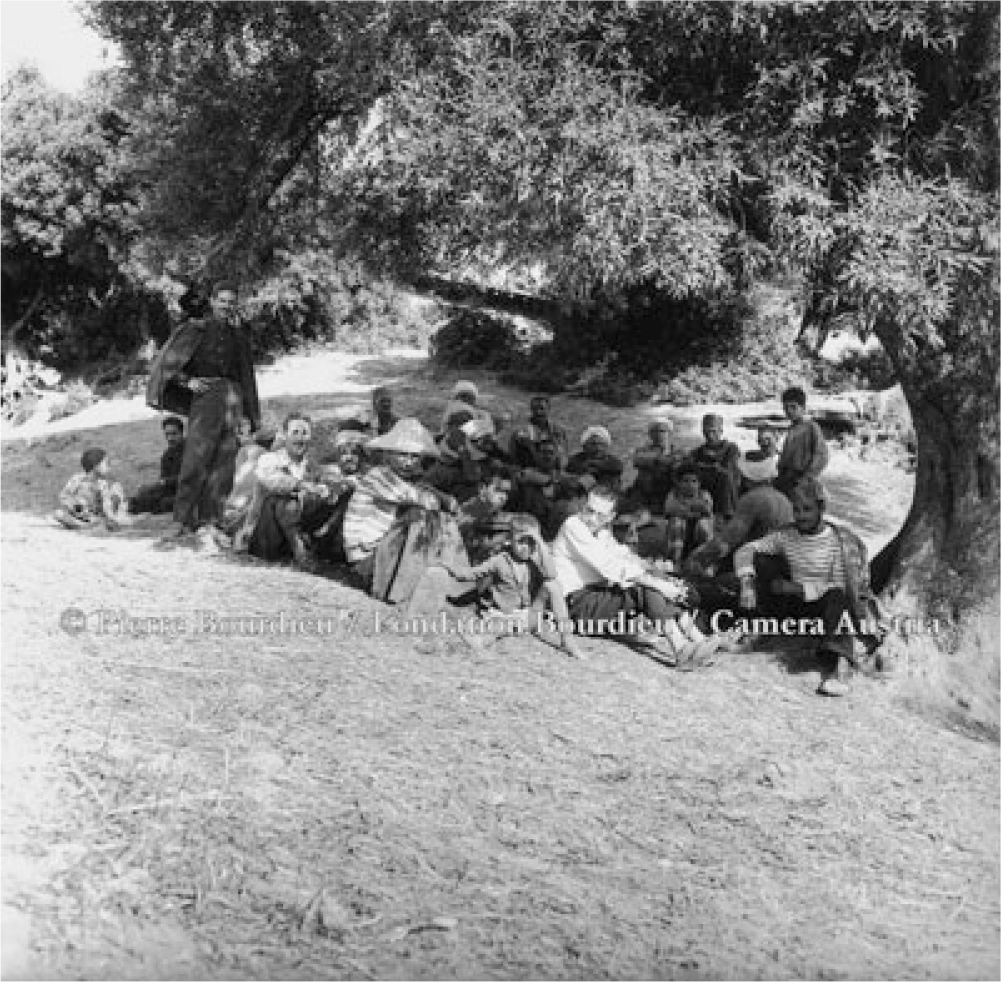
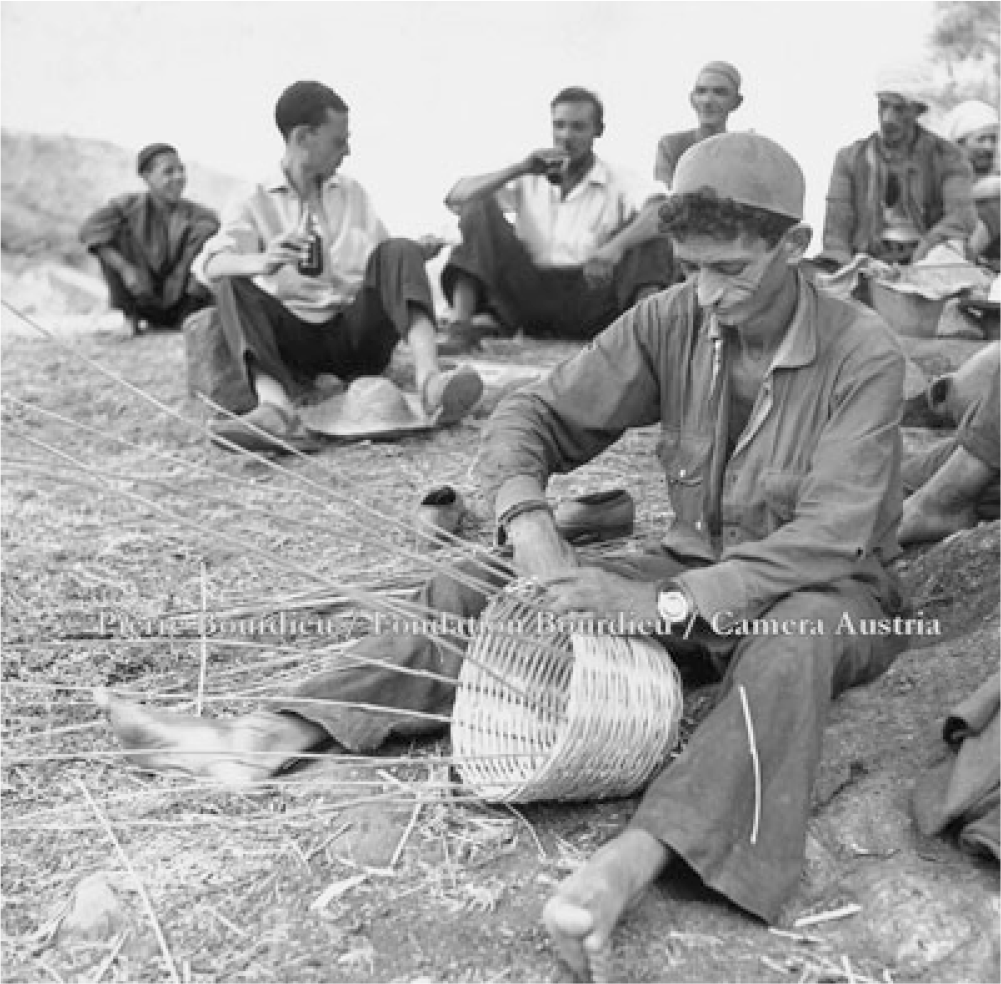
Two photos, both entitled ‘Aïn Aghbel, Collo’, and then, in brackets, ‘in white shirt: Abdelmalek Sayad’. In the first, a large group of men and boys sit on the ground in a glade of trees; Sayad, the Kabyle ethnographer who worked with Pierre Bourdieu, sits with them. In the foreground of the second, a barefoot man weaves a basket, calm concentration on his face; Sayad sits in the background with a boy and some men. In the first image, the group are resting in the shade. Sayad, at the edge of the group, is in the sun; he squints as he looks at the camera. His body is positioned at an angle to the men. His hands are clasped awkwardly together around his knees – he is clearly not a man used to sitting on the ground. His trousers ruck up to expose his pale shins. In the second image, Sayad appears slightly more comfortable, but his knees are at a somewhat awkward angle. He seems to look down at something in his hand. The men in the background look at him, perhaps with mild amusement, while the boy behind his back laughs.
In both images, the visual relationship between the ethnographer and the group is defined by a series of oppositions. The men have moustaches and hats; Sayad is clean-shaven and bare-headed. The men have old leather shoes or are barefoot; Sayad is in sandals. They wear heavy, dark jackets; his shirt is impossibly white.
My eyes are drawn to the basket-weaver. His grasp seems firm and steady. Looking at him at work, I know it would be too fiddly for my clumsy hands.
When I teach research methods to students, I quote C. Wright Mills to them and describe research as a craft skill. In my head I have the image of my uncle, a cabinet-maker, and the ark he made to hold the Torah scroll in my grand-parents' synagogue. I suggest to students that we all could, given some wood and some basic tools, make something on which to place a book, but that few of us could make a truly beautiful bookcase. To do that requires a long period of practice, of apprenticeship, and perhaps also something of a gift. Ethnography is the same, I suggest. What these photographs show is Abdelmalek Sayad's apprenticeship; his awkwardness is partly that of the young man learning his craft.
But when I think of my uncle's hands, when I look at this basket-weaver's hands, I feel there is something empty about this claim of ethnography as a craft. This basket, that ark, is useful – but of what use is my craft? Perhaps, then, another aspect of Abdelmalek's awkwardness is this sense of uselessness, a sense which is surely heightened amongst men, in a peasant culture, where usefulness is so highly valued.
In one sense, Sayad is an ‘insider’ – an Algerian researching Algerians (as Bourdieu was an ‘insider’ when researching his native Béarn). But of course, the education required to become an ethnographer is enough, for those that come from any sort of subaltern world (peasant Béarn, colonised Algeria), to rip them from that world, to place them on its edge. Gérard Noirie comments:
When speaking about [Sayad] on the day after his death, Pierre Bourdieu recalled the ‘difficult existence of renegades who are desperately faithful’ such as Abdelmalek Sayad … This characterization is also true of Pierre Bourdieu himself. He often recalled his ‘renegade's’ position, appropriate for the children of those obliged ‘to uproot’ themselves in order to join the ranks of the Parisian elite. 1
Bourdieu makes a similar point in ‘The odyssey of reappropriation’, his testimony to another Kabyle ethnographer, Maloud Mammeri. Here, Bourdieu describes the shame and disavowal required – shame at and disavowal of the dominated culture one has emerged from – as the price for entry into dominant academia, and the journey Mammeri (or Sayad) took ‘to find again the hill, for a moment forgotten’ – that is, to reappropriate ‘one's culture of origin, through a victory over cultural shame’, using the masters' tools of ethnography. 2
For Sayad, then, uprooted or exiled from his Kabyle culture by education, ethnography was a mode of return. But, he was to realise, there is an impossibility in this homecoming:
When people return home they are never the same as they were when they started out; they never return to the place they think they have left. The homecoming, for exiles, is a return to themselves, to the time preceding their departure … A return is possible in space but not in time. It gives rise to all sorts of hopes, but it is a source of disappointment and frustration. 3
Moreover, something of this gap, this exile – if not always its violence – is necessary in all ethnography, as ethnography requires both closeness and distance: the closeness needed to hear others' voices, look into others' eyes, touch others' hands; the distance needed to ‘objectify’ (in Bourdieu's words) and thus to understand. For Bourdieu, ethnography is a craft, but also a disposition, ‘a disposition to the truth’, ‘a kind of intellectual love’, a passion for listening. 4 Looking at Sayad's awkward perching on the edge of these groups of men, I wonder if awkwardness is actually inherent in this disposition itself. Perhaps perching on the edge is our disposition. Honing the craft skill of ethnography, pursuing its disposition, is enough to put us on edge in any social situation – the ethnographer is always at an angle to those they study. Indeed, the ethnographer's craft is precisely to hold a social world, a social fact, at an awkward angle, to look at it with a squint, in order to see it differently.
Footnotes
1
Gérard Noirie ‘Colonialism, Immigration, and Power Relations’ Qualitative Sociology, Vol. 29, No. 1, Spring 2006: 105–6
2
Pierre Bourdieu ‘The odyssey of reappropriation’ Ethnography 2004; 5: 619. In this text, Bourdieu talks again of craft: ‘the poets-blacksmiths, the poets-demiurges [of the Kabyle] and … the poems they craft’ (ibid 618).
3
Abdelmalek Sayad ‘A land of no return – exile’ UNESCO Courier, October 1996.
4
Pierre Bourdieu ‘On Understanding’ The Weight of the World.