






Abstract
The Chinese communist party dissolved powerful local clans into modular individuals loyal to the central state and easily mobilized for government projects. Now migrants must redefine home and family for an era where government safety nets are no longer reliable and mobility yields economic returns. We discuss female migrant factory worker's attitudes towards home and traditional and modern values and implications for themselves and family who remain behind. Methods: We surveyed 1,017 rural female migrants in Guangdong factories. Measures included the General Health Questionnaire 20 and the Chinese Individual Traditional and Modern Values Scale, as well as other relevant attitudes. Results: Participants supported filial piety but rejected other aspects of traditional society, instead emphasizing values such as personal ability that contribute to success in modern society. These value judgments did not vary with duration of residence in the city. Participants did not sever ties with home or assimilate into urban culture. A case study illustrates contradictions involved in combining mobility, individualism and devotion to distant family. Conclusion: Rural migrants unable to change their legal place of residence maintain psychological and economic ties with their former homes even if they plan not to return.
Rural Chinese peasants have migrated to cities in unprecedented numbers since the 1980's, forming the largest rural-urban labor migration in human history. 1 These migrant workers are called the ‘floating population’ (liudong renkou), a label that aptly describes both the legal and psychological aspects of their situation. Structural and cultural barriers bar migrants from fully entering urban society: the Chinese residential registration (hukou) system contains ‘two separate systems for urban and rural workers’ such that ‘even if rural people move to the city they have no way to enjoy the well-being, career prospects, educational opportunities, etc., that urban residents enjoy’ (Bai, 2007: 59; see Cheng and Selden, 1994, for explanation of the hukou system). Institutionalized differences between rural and urban China are so pronounced that rural-urban migration is ‘more like international labor migration between developing and developed countries than internal migration within developing countries’ (Roberts, 1997: 251). These legal restrictions have social implications, suspending migrants between rural and urban society as ‘strangers in the midst of established communities’ (Friedmann, 2005: 51). Some long-term migrants no longer consider themselves peasants but lack an urban identity: such people are ‘caught in an awkward middle ground … neither urban nor rural; living in the city, with “roots” in the countryside; reluctant to leave the city but unable to genuinely partake in city life’ (Bai, 2007: 59). As their visit to the city stretches on, they can feel estranged from both their place of residence and their old home.
In this essay, we present results from a survey of how rural migrant women combine urban and rural identities. We discuss historical context as well as implications for the Chinese family in an era where government safety nets have disappeared. Changes in the family in precommunist and communist China will be introduced using Gellner's concept of modular people, highlighting the fact that the family has become an economically important unit in China again after decades of reforms designed to dismantle powerful clans into modular individuals. Although rural Chinese who work in cities donate part of their earnings to support other family members, local involvement may not take priority in a new era where flexibility and mobility have replaced loyalty as the key survival strategy. On an individual level, migrants' attitudes towards clan affiliation and filial piety 2 will affect the well-being of elderly relatives, children, or younger siblings at home who seek their care, as well as their personal sense of identity. On a societal level, married migrant women can redefine or reject the patrilinear system by carving out nuclear families and incorporating modern values into their lessons for the next generation.
A historical review of modularity and the Chinese extended family
In his analysis of societal social structures and their contribution to government development, Gellner drew a distinction between modular people whose ‘individual actions are taken seriously and relied upon’ (his emphasis) and people whose actions have meaning only as part of ‘a kind of interdependent and ritually orchestrated totality’ (Gellner, 1995). By these standards precommunist Chinese society was collectivist: weddings were affairs between two clans rather than intimate ceremonies connecting two individuals (his example). Social security was tied to clan membership, such that educated men cared for weaker members of the group in times of crisis or family tragedy (Ebrey, 2002). Agnate groups have ceremonially gathered to honor their shared ancestors for millenia, in ceremonies such as grave sweeping day (formalized in the mid-Tang dynasty); some wealthy men still maintain temples or shrines representing the connectivity between people of their surname. Joint property ownership before 1949 also ensured that large families lived and worked together, and any members who were became government servants would represent the interests of the family to higher officials.
In precommunist China, strong local clans hindered the central leadership's ability to make systemic changes or control individual citizens. National leaders can easily persuade individuals without local connections to comply with their wishes but pressuring powerful local agnates is more difficult; furthermore, it is impossible to industrialize a country while maintaining a land-based extended family structure (Lin, 1936; Zeng, 1991). The agnate system also restricted the actions of individuals, because family members policed each other carefully to preserve their collective reputation and income. According to Gellner's theory, people escaped the ‘tyranny of kings’ only to be subjected to the ‘tyranny of cousins’ (Gellner, 1995: 34).
After the Communist era began in 1949, however, a series of reforms and campaigns culminating in the Cultural Revolution silenced powerful partilocal agnates by replacing them with a national ‘family.’ According to a popular Cultural Revolution era song, ‘Father and mother are dear, but dearer still is Chairman Mao.’ Teenage Red Guards sang, ‘The Party is my birth parents’ (Lu, 2004: 106, 113). After the 1950's land reallocation, people worked in cooperatives with non-relatives on national farming and industry projects and their income was assigned by the state, such that ‘the advantages of maintaining a large family in which married brothers lived together and worked at private production were suppressed’ and the state replaced family as the main source of insurance against illness or other difficulties (Zeng, 1991: 19). The Marriage Law, forced migration and aggressive anti-traditional and reeducation movements also weakened extended families: divorce became legal, multiple marriages became illegal, and people could be moved to different locales or jobs by state assignment. By 1987, 80% of families were nuclear compared to only 51% in 1930 (Zeng, 1991). With the state rebranded as the sole source of resources, the voices of powerful clans were muted and the communist government could quickly mobilize their nationalist citizenry.
The modular Chinese woman and social security
After 1978, familial connections became essential for economic survival again just as economic reforms created a new era of modularity. Many state owned companies, rural farming collectives and social security policies were dissolved after the Reform and Opening Up movement, such that loyalty and service to the state could no longer ensure a person's income. Instead, cross-regional business connections and mobility were essential to taking advantage of the new job market. People with rural hukou who were willing and able to migrate sought better opportunities, remitting supplementary income to family members who stayed home because of preference, age or illness (see Hu, Cook, and Salazar, 2008, for a discussion about how the Chinese countryside ‘exports health’). Young women from rural areas participated in short term wage work in the foreign owned factories of the Deng Xiaoping era as part of their ‘premarital life cycle’ (Ngai, 2005: 5; see also Tong, 2001). By serving in shifts at the new southern Chinese factories, female migrants provided inexhaustible ‘cannon fodder for China's industrial revolution’ during the 1980's and 1990's (Friedmann, 2005: 67). As young women started sending money home they raised their social status in the family, and many were empowered to start businesses or pursue further education (Gaetano, 2004). 3
With time, however, the stereotype of the ‘young unmarried factory worker who lives in a dormitory and returns to her village to marry and bear children’ became no longer accurate (Roberts, 2002: 493). According to 1993 census data, nearly half of the 9,124 female migrants in Shanghai were married including 87% of women workers aged 25 to 34. Nine percent of migrant women sampled had lived in the city over three years, and many women workers, especially those accompanying their husbands, planned to stay indefinitely (Roberts, 2002). As migration patterns shift and diversify, migrant women face the puzzle of how to frame their long term presence in the city.
These choices have implications for the future of the countryside and for the well-being of their relatives. ‘In the face of a rapidly aging population of staggering size, the Chinese government is continuing to place primary responsibility for care of the aged on adult children,’ a difficult task for rural migrant laborers with non-migrant parents (Miller, 2004: 34). Demographic trends have created an expanded burden for Chinese women. A girl who survived to 18 in 1981 would spend about 10.5 more years with both parents alive than she would have under 1950–1970 demographic trends, and for 28 years – about 50% of her adult life – she would have parents over 65 or children under 18 (Zeng, 1991).
The Chinese Women's Federation, an arm of the government focused on women's affairs, has sought to address this potentially difficult economic and care situation in rural areas by encouraging rural migrant women to return home to develop and enrich their villages. According to the Federation, the ideal Chinese woman is independent (zili), strong (ziqiang), confident (zixin), and holds herself in high esteem (zizun), but she uses her strength and ability to contribute to and maintain connectivity with her home community. The Women's Federation of Anhui lauded women who ‘return to their villages with entrepreneurial skills and capital,’ whereas those who go out and ‘do not return to the village, or become fallen by turning to vice or crime, are not seen as good or ideal’ (Sun, 2004: 112).
Sun concluded that this rhetoric evoked precommunist ideals of the virtuous wife and good mother (xianqi liangmu), placing the Party in the paradoxical position of evoking traditional standards of local and familial responsibility to encourage return migration. The potency of this appeal lies in the enduring power of traditional mores in rural China. One observer visiting a migrant factory worker's hometown noted that family was still the dominant social institution. ‘Almost everything’ was a communal family activity, and ‘there was little sign of government … In the two weeks I lived in Min's home I did not see a single official, and the law did not seem to cut very deep’ (Chang, 2008: 289–91). Some families had five to seven children and even the poorest families buried their dead, adhering to traditional rites and values while risking fines for noncompliance with cremation and birth planning policies (Chang; see also Ikels, 2004 for exploration of this theme in urban Guangzhou). Ideal traditional households involved parents ‘surrounded by filial sons and daughters in law,’ and divergence from this standard creates resentment of migrant women (Wang, 2004: 23). 4
Faced with pressures from rural communities and rejection from urban communities, migrant women must ‘tenuously balance’ their ‘new identity as a modern, urban woman … against rural norms of gender and kinship’ (Gaetano, 2004: 72). In the winter of 2007, we conducted a survey to examine female Chinese migrant workers' orientation toward the urban and rural societies they float between. We operationalized ‘rural norms of gender and kinship’ as patriarchy, filial piety, and other Confucian values, 5 whereas ‘modern, urban’ values included focus on independence and personal ability, variants of the modularity concept discussed above (Yang, 2004). We hypothesized that the contradictory demands of different historical Chinese family systems would become manifest in migrants' concurrent commitment to filial piety and personal agency, and that levels of concurrent commitment to these ideals would correlate with participants' psychological well-being. The social constructions migrants create will have implications for their own well-being and the well-being of dependents left behind.
Method
We polled migrant women about their assimilation related goals and behaviors, their connectivity with their families, and modern and traditional values. Our analysis is based on survey data collected from 1,017 female factory workers in Guangdong province and interviews of 30 female migrant factory workers in Beijing and Guangdong province. Surveys were collected in factories in Foshan, Dongguan and Guangzhou during the winter of 2007. These areas have been profoundly influenced by factory related mass migration for almost 30 years due to their proximity to original 1980 Special Economic Zones of Shenzhen and Zhuhai in Guangdong province.
Survey measures included a series of questions on life background factors, long-term hopes, reasons for coming to the city, and connectivity with home, as well as the Chinese Individual Traditional and Modern Values Scale, the Chinese translation of the General Health Questionnaire 20, and other psychological measures used for a different study. Each participant was randomly assigned one of four questionnaires and each questionnaire contained a different subset of the measures. All participants answered questions about their background, attachment to home, and hopes for the future. The protocol was approved by the Harvard University Internal Review Board.
In total, 425 participants completed the Chinese Individual Traditional and Modern Values Scale representing a completion rate of 82%, and 733 participants completed the GHQ questionnaire representing a completion rate of 70%. Before formal data collection, all measures were tested among three groups of female migrant workers in Beijing and revised according to their concerns. We eliminated an item about virginity from the tradition and modern values checklist because it made participants uncomfortable. Furthermore, we altered the contents and wording of items related hopes and background information according to the participants' feedback.
Life background information questions were included on all surveys, but participants did not write their names and factory management was not permitted to see completed surveys. Before completing the survey or being interviewed, all participants were given a sheet explaining the confidentiality of the study and asserting that factory managers would not be allowed to see the data. Instructions preceding each survey reminded participants that we were only interested in their personal opinions and that there were no right or wrong answers. Study participation took about a half an hour, and participants were thanked with either 10 RMB cash, or a small gift worth around 10 RMB ($1.50, or about twice the workers' average hourly wage).
Life background questions and hopes for the future
Life background questions included marriage status, age, age upon migration to the city, reasons for coming out to work, and location of hometown area. We also included social behavior factors such as whether or not participants knew others from their home area in the city, how many times participants contacted their parents every month, and how many times participants went home every year. We also asked participants how much of their monthly salary they sent home.
We assessed participants' hopes using items created specifically for this study. Participants were given the prompt ‘What are your greatest hopes right now?’ and chose as many as applied from the list reproduced in the appendix. Contents of this list were honed and verified during the interview process. Participants also rated their happiness at home and their happiness in the city on a 1–5 Likert scale, ranging from ‘completely unhappy’ to ‘completely happy.’ They also indicated the degree to which they wished to stay here or remain home on a 1–5 Likert scale ranging from ‘very much don't wish to’ to ‘very much wish to.’
Chinese Individual Traditional and Modern Values Checklist
Participants' modern and traditional values were measured using a checklist designed specifically for a Chinese population (Yang, 2004). The original checklist comprised 90 items, each containing a value judgment related to five dimensions of traditionalism and five dimensions of modernity. We removed one item in response to feedback from test participants; thus, our final questionnaire comprised only 89 items. Traditionalism dimensions included superstition, belief in Confucian values, belief in the patriarchy, reliance on personal connections, and filial piety. Modernity dimensions included belief in equality, belief in regulation and planning ahead, focus on personal ability and effort, consumerism and focus on personal independence.
Traditionalism and modernity were measured separately, rather than as opposites on a continuum, and the order of the items was randomized to encourage participants to consider each item separately. Individuals indicated the degree to which they agreed with each value judgment on a 1–5 Likert scale where 1 meant ‘completely disagree’ and 5 meant ‘completely agree.’ Participants' scores on each dimension were computed by multiplying their responses on all pertinent questions with corresponding factor loadings. A total sum of the five traditionalism dimensions and five modernity dimensions was also computed. Cronbach's α was 0.85 for both the modernity and traditionalism subscales and higher than 0.60 for all individual subscales, as calculated using this population's data.
General Health Questionnaire 20
General psychological well-being was measured by the 20 item version of the General Health Questionnaire (GHQ 20). The questionnaire is commonly used in China and abroad (Chan, 1993) and the Chinese version has shown good reliability and validity (Li and Wei, 2007). This questionnaire measured three dimensions of everyday psychological functioning: self approval, depression, and anxiety. Participants were presented with a list of 20 phrases in first-person narrative describing feelings about their life such as ‘I felt like there is no meaning to life.’ If they had experienced the listed feeling at all during the past few weeks, they selected ‘yes’ if not, they selected ‘no’. The sum of the items with a ‘yes’ response from each dimension was taken to yield the score for that dimension. Cronbach's α using data from this population was 0.53 for the self approval subscale, 0.58 for the depression subscale, and 0.61 for the anxiety subscale.
Participants
Included participants and completion of the questionnaires
We surveyed 1,055 female factory workers. 1,047 women completed enough of the survey correctly that some part of their data could be utilized. Thirty additional participants were excluded, because it could not be confirmed that they were migrant workers, leaving a sample of 1,017.
Life background information
Participants came to the city to work when they were an average of 22.0 years old (SD = 6.8); age at first migration ranged from 10 years old to 45 years old. Participants came from 17 provinces: Anhui, Chongqing, Gansu, Guangdong, Guangxi, Guizhou, Hebei, Heilongjiang, Henan, Hubei, Hunan, Jiangsu, Jiangxi, Shaanxi, Shanxi, Sichuan, and Yunnan. The most popular province of origin was Guangxi (18.2%) followed by Hunan (17.4%). See Figure 1.
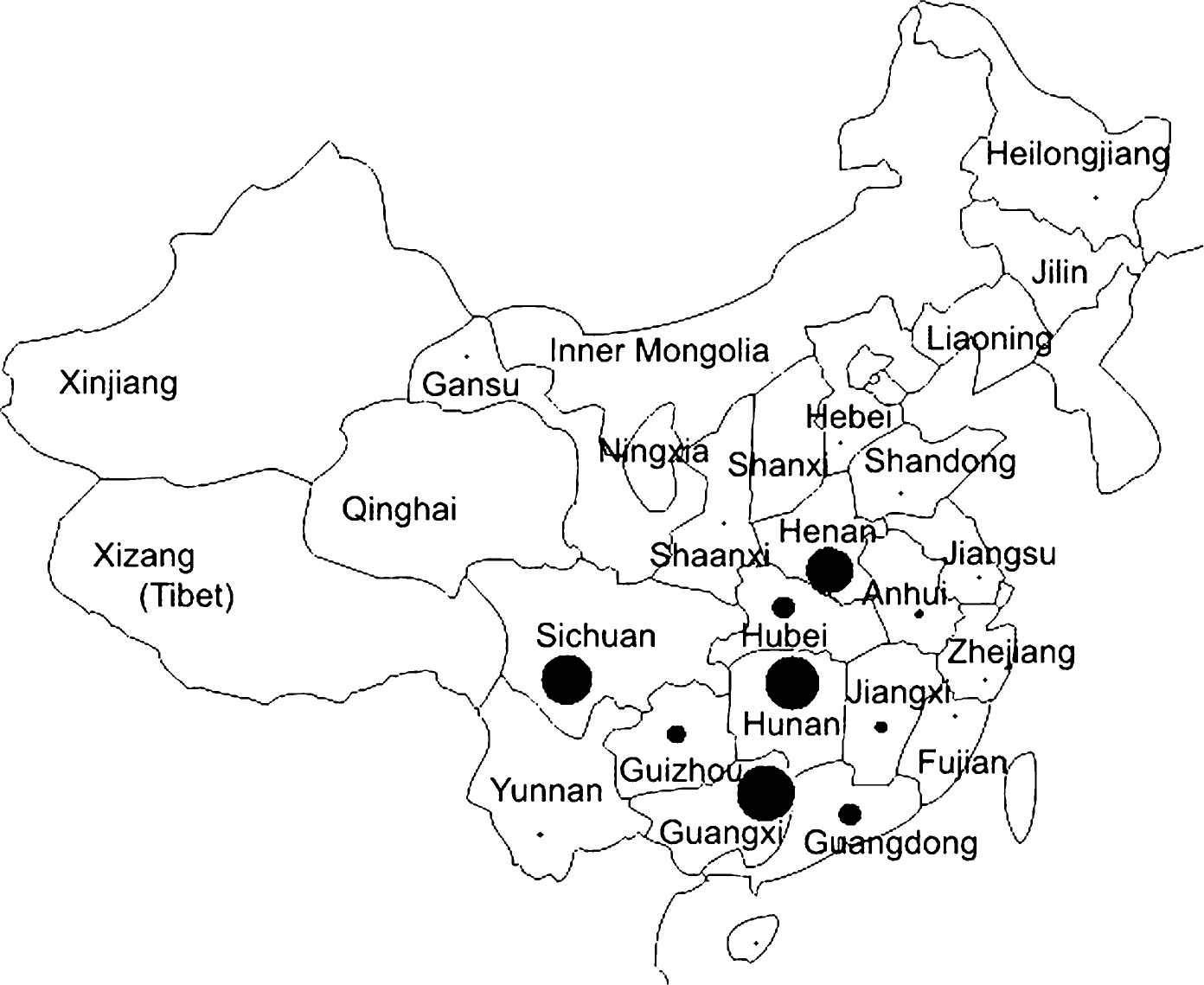
Although most participants were originally from southern China, few had migrated from within Guangdong province
Table 1 lists demographic information for the present survey population and the survey populations of similar previous studies. In the current study, participants were an average of 25.4 years old (SD = 7.9). The oldest participant was 50 years old and the youngest was 15 years old. Although this age spread was almost identical to the age spread found in a comparable 2003 survey of migrant women in the same geographic area, the present survey included a larger number of older participants: only 47.9% of respondents to the present survey were aged 18–28 as compared to 81.6% of those sampled five years before (Mi, 2003). A 1999 study of female migrants in Fuzhou based on government statistics indicated a result within this range, such that 61.8% of female migrants were younger than 30 (Wang, 1999).
Comparing present sample with previous samples of female migrant workers to southern China: Comparable age and marriage rates
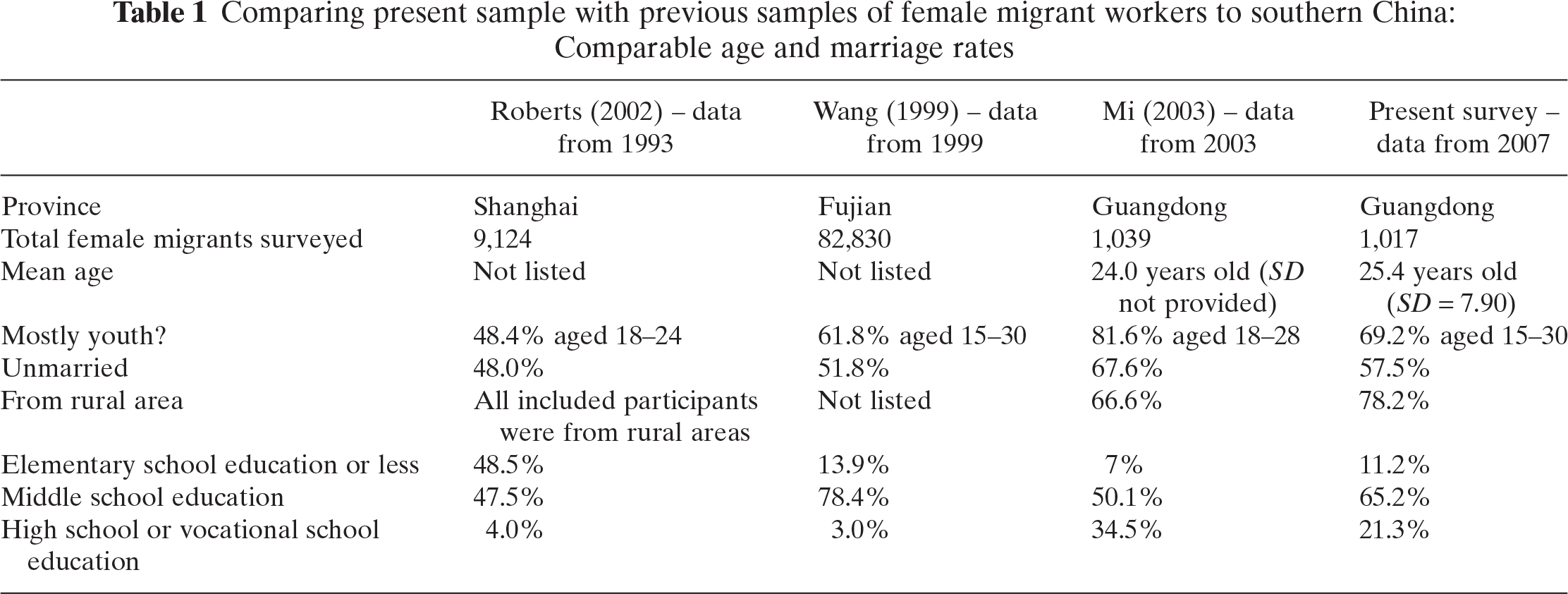
412 (42.5%) participants were married, 513 participants (52.9%) were unmarried, 40 (4.1%) were engaged, and 5 (0.5%) were divorced. The present sample included more married women than did Mi's (2003) survey of Guangdong female migrants, likely because the present population was older than Mi's population. Among younger members of the population, marriage patterns were consistent with previous surveys of female migrants: Tong's (2001) survey of female migrants in Beijing indicated that 72% of female migrants aged 20–25 were unmarried, compared with 78.2% in the present survey population. 7.2% of included participants had migrated from the countryside of Guangdong province. 78.2% of participants had migrated to the city from rural areas, and 76.4% had not received education beyond the middle school level. Only 33.5% of participants indicated that they had family in the city. Participants earned an average of 1,029 RMB (SD = 306 RMB) per month.
Some women were excluded because they could not read well enough to complete the survey. However, this bias was not stronger than in previous comparable surveys. Wang's (1999) survey of over 80,000 female migrant workers in Fujian province found that 13.9% of surveyed female migrants had not studied beyond the primary school level, and a comparable survey of over 1,000 female migrants in Guangdong province found that 7% had not studied beyond the primary school level (Mi, 2003). By comparison, 111 (11.2%) of the participants included in this project had not studied beyond the primary school level.
Results
We produced descriptive results using T-tests and correlation analysis. Although unweighted averages of participants' scores on each dimension of the Chinese Individual Traditional and Modern Values Scale are presented in the second columns of Tables 2 and 3, factor loadings were taken into account for all scores used in further analysis.
Migrants selectively supported both modern and traditional values, and these value judgments did not vary with duration of time in the city
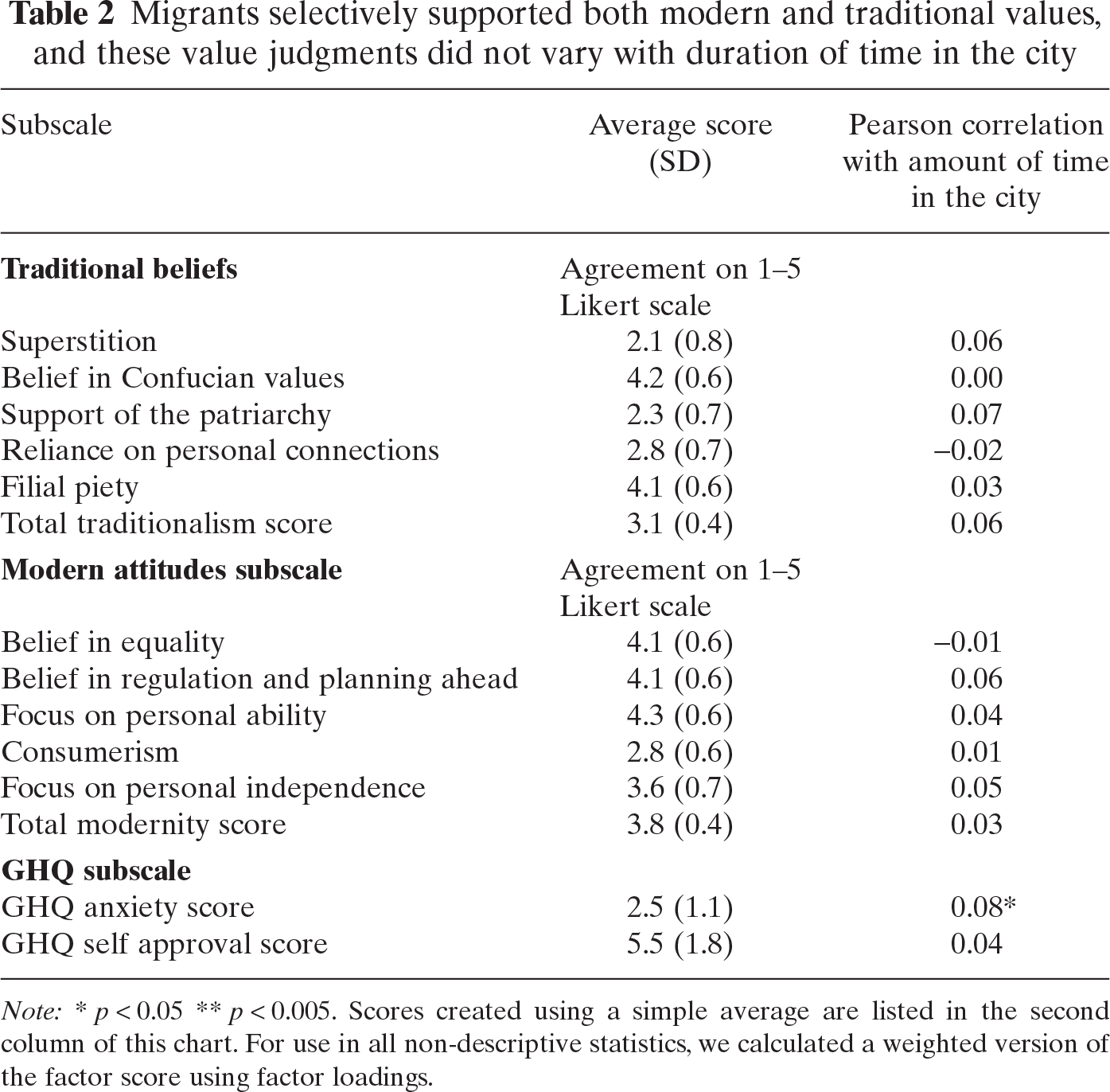
Note: * p < 0.05 ** p < 0.005. Scores created using a simple average are listed in the second column of this chart. For use in all non-descriptive statistics, we calculated a weighted version of the factor score using factor loadings.
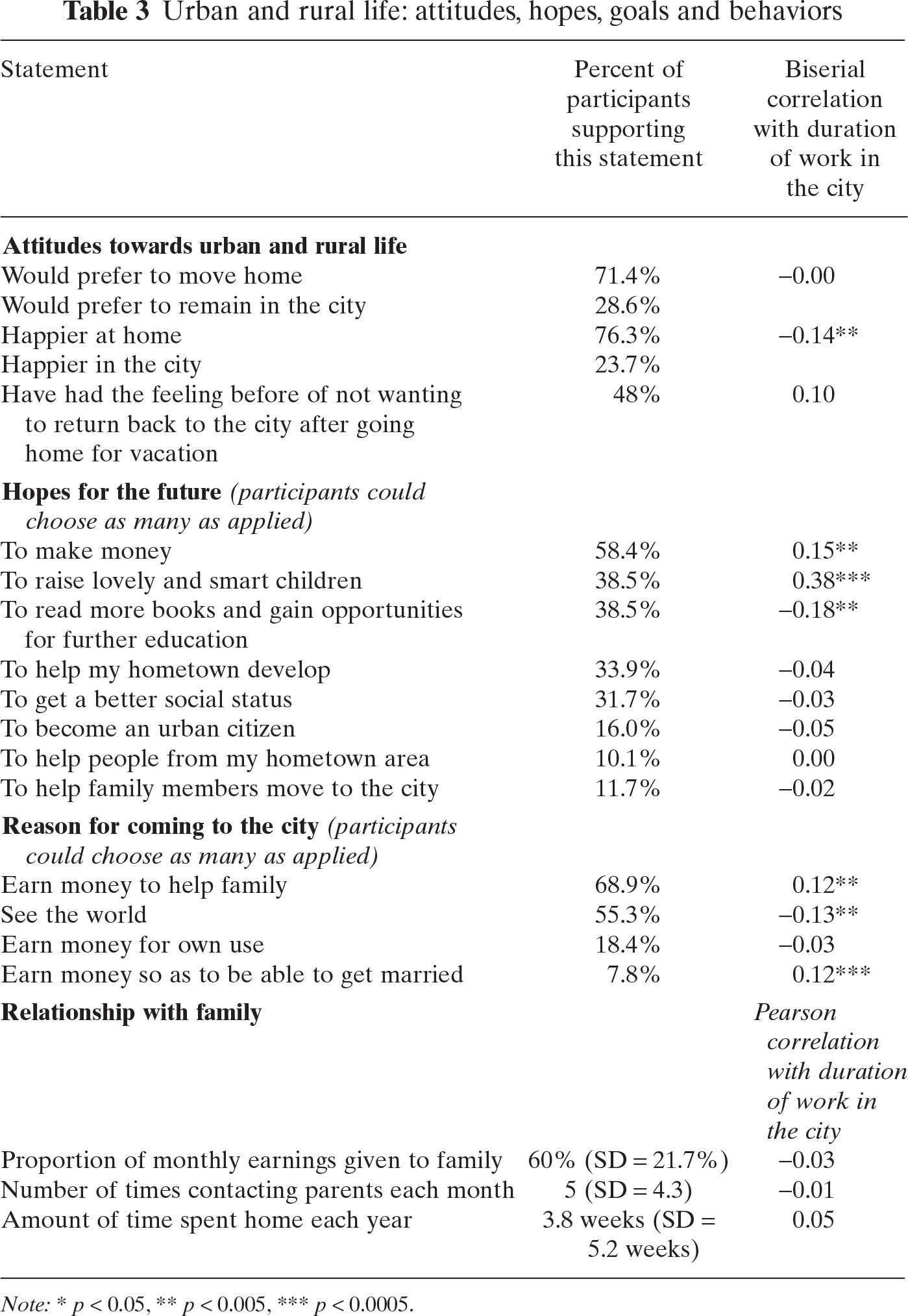
Urban and rural life: attitudes, hopes, goals and behaviors
Note: * p < 0.05
p < 0.005
p < 0.0005.
Participants were selectively supportive of both traditional and modern ideals. The most highly endorsed concept was personal ability, and the second most highly endorsed concept was filial piety. Participants supported all modern values included in the survey except for consumerism, and they rejected superstition, patriarchal tradition, and taking advantage of personal connections. Psychological results showed that balancing these disparate values may be beneficial in a migration situation (see also Nicholson, 1997). A T-test indicated that participants showing above average support for both filial piety and personal ability reported significantly higher self approval (M = 5.8, SE = 0.22) than those who did not combine these beliefs (M = 5.2, SE = 0.20; T(178) = −2.03, p < 0.05).
Integration into urban society was not a primary goal for female migrant workers in this sample, such that their beliefs and level of connectivity with their village did not vary by length of time in the city. Only 23.4% of participants hoped to become urban citizens or help their families move to the city. Pearson correlation analysis found no significant relationship between women's value judgments and length of time in the city, as indicated in Table 2. Most participants were happier at home than in the city (76.3%), and expressed a preference for living at home rather than in the city (71.4%). Pearson correlation analysis also indicated that participants' social and monetary ties with their family did not diminish over years of work in the city. That is, participants on average sent the bulk of their salary home, called home about once a week and visited home about five weeks of each year regardless of the amount of time passed since migration.
Working as a migrant laborer may have changed the women in other ways, however. According to Pearson correlation analysis, participants who had been in the city longer were less likely to hope for further education (R = −0.12, p < 0.001), and less likely to believe that people could change (R = −0.12,p < 0.005) (see Hou, 2004; Hou, 2007). They also were more anxious (r = 0.08, p < 0.05) and depressed (R = 0.08, p < 0.05) than participants who had only recently moved to the city, although few participants met cutoffs for potentially clinical psychological distress. See Table 2. These results support the Hu, Cook, and Salazar hypothesis that the Chinese countryside is ‘exporting health’ (Hu et al., 2008).
As shown in Table 3, participants' goals and justification for migration provided further evidence of their commitment to the their families. The majority of participants (68.9%) came to the city in order to earn money to help their family, and most common hopes included leaving the city to return home (71.4%), and earning more money (58.4%). Furthermore, biserial correlation analysis indicated that women who migrated in order to fulfill traditional role obligations stayed in the city longer than women who came for personal exploration: women stayed in the city longer if they had come to earn money to help their families (R = 0.12, p < 0.001) or to save for marriage expenses (R = 0.12, p < 0.001) than if they had come to see more of the world (R = −0.13, p < 0.001).
Case study
The following is a narrative from one of the women workers we interviewed. This narrative illustrates the layering of modern and traditional personas characteristic of the women factory workers we surveyed.
Her husband and she moved from a village in rural Hubei when she was 16 and had been working in shoe factories in Guangdong province for five years at the time of the interview. Since leaving her village she had gone home only twice, both times to give birth.
She worked on the farm after school when she was little. The family grew sweet potatoes, cabbage, and even tea leaves, and raised a variety of animals. She decided to quit school after she finished middle school. School fees were getting expensive, she explained, and the money would be better used if spent on concrete, practical things.
After some time she felt morose at home (yumen) and wished to go out to work like her cousins. She said that ‘everyone else’ – all the other young people –in the village had gone out to work. However, her father did not give her permission to leave. Her brother died when she was young, so she was the only child. Her help was needed at home. Furthermore, her parents feared that she would meet a man outside the village, marry him, and never come home again.
To prevent this possibility, the village midwife helped her parents introduce a young man in the village as a potential husband. The young man came over to their home to see her about twice a month, and slowly got to know her over almost a year. After a brief engagement, the two got married. She was 15 years old. Yet even after the marriage, she said, her parents did not give her permission to leave town.
She eventually decided to elope with her husband. When she called her mother from the road to say she had left, her mother ‘cried to death.’ The two newlyweds found jobs in a shoe factory and stayed in their own room together for 250 RMB a month.
She worked through most of her first pregnancy, mostly because she did not notice the changes in her body she was until she was four months pregnant. She returned to her husband's home to give birth. After less than a month's rest, she went back to the factory, leaving the child to her husband's parents' care. At the time of the interview, she was 21 years old and had two children, aged one and three years old.
Although she talked to the children and her parents on the phone every day, she almost never saw them in person. Our interview occurred right before Chinese New Year and her family wanted her to come home so they could celebrate together. ‘They really want me to come home. They say to me every day: “When will you come home? We haven't killed the pig yet, we haven't killed the chickens yet.”’ She had no intention of going home, however. The tickets to go home were expensive, and she had decided that she would rather send more money home than ‘waste’ (bai hua) money in order to go home herself.
She insisted that everything she did was for her family at home. She and her husband lived very frugally, forgoing all entertainment and eating only the cheapest food so they could send every penny possible to his parents, their children, and her parents. As we talked, she listed the family's needs: school fees, clothes, and hospital fees for the aging parents. She calculated the funeral expenses that would be required when her and her husband's four aging parents passed away. Her in-laws had attempted to claim some of her and her husband's money so they could buy a washing machine, a new house, or a motorbike. She had denied these requests. What was the use of a motor bike? How much would oil cost? She put her children's studies and more urgent matters first.
She often used the phrase ‘can't move, only eat,’ to describe other young people who had become dependents as a result of laziness or poor luck. She told the story of a crippled young woman who became a dependent. This young woman was pretty, but couldn't find a husband because of her disability, and could not go out to work either for the same reason. ‘She couldn't move, only eat. But her parents were getting old, and shouldn't have to take care of her.’ In the end, the young woman overdosed on medicine and killed herself. ‘She didn't want to hurt her parents anymore.’
Her devotion to taking care of her husband's parents, her parents, and her children was a theme in her narrative: ‘I am young; if I am a bit tired it doesn't matter. But they [her and her husband's parents and the children] are old, or small. They cannot work like me. I want to make more money and give them an easy life.’ However, she planned to almost never see the people she will spend her life supporting. When asked about her future plans she said, ‘I want to work five more years. The two of us [she and her husband] together will then have several 10,000 RMB.’ She paused, and then added, ‘After a bit we can come out again. By that time the children will be old enough to go to school. They can just live at school. We can come back out and there will be no need to go back there.’
Although reluctant to move home, she idealized village life. When I asked whether she preferred city or country life, she replied without hesitation that life at home was better. ‘I remember we would work in the fields all day and then in the evening watch TV together. Just laughing and watching TV.’ But there would be no way to maintain that lifestyle now and also maintain her pride. Thanks to her and her husband's salaries, their parents could sharecrop their land to other, poorer farmers and didn't have to work all the fields themselves.
She summarized her decisions thusly: ‘You can sit and watch TV, but you won't have enough food to eat that way. You won't have anything. Other people's children will have nice clothes and your family will have no new things; you'll have no face [credibility] at all. I want the other people in the village to say that my family doesn't need to work hard, and that they have nice and new clothes.’
Discussion
Chinese migrant women float between rural and urban society in an era where the renewed bonds between family members are taxed by economic necessity. Chang's (2008) observations from her ethnographic study of Dongguan exemplify the psychological difficulties of this lack of fixed social structure:
‘Out in the city, they were tired and lonely and talked constantly of going home; once home, they quickly grew bored and longed to go out again. If a girl decided to leave the factory, it sent ripples of shock and uncertainty through everyone around her. To be a migrant was to be constantly abandoned by the people closest to you.’ (104)
In this study, we examined how migrant women's value judgments reflected redefinitions of home and family, and influenced their psychological well-being.
In some ways, participants' narratives resembled the Anhui Chinese Women's Federation story of the ideal female migrant, a woman who leaves to help her family and plans to return home to enrich her community. Most migrants asserted that they moved so as to help their family economically, and they would prefer to move home. There was no evidence that women workers wished to assimilate into urban society. Hopes to become an urban citizen or bring one's family to the city were the least endorsed options on the hopes checklist, and participants' beliefs and values did not vary with duration of time in the city.
A closer look reveals a more ‘tenuously’ balanced multifaceted identity, with the values of ‘a modern, urban woman’ paired with or perhaps concealed behind adherence to rural norms (Gaetano, 2004: 72). Survey participants rejected superstition and patriarchy, key aspects of the traditional family system, even as they supported concepts like Confucian values and filial piety. Survey participants also believed in equality, precluding deferential behaviors characteristic of classical filial piety and mother-in-law daughter-in-law relationships (Wang, 2004). These values implicate a new family ideal: a smaller family unit composed of equals who are devoted to one another without much concern for lineage or heritage. Such revision of traditional structures reflects participants' ability to successfully balance disparate social systems, and our psychological results indicated that support of both filial piety and personal ability may be associated with stronger self approval.
Our interviewee's story also demonstrates this layering of modern and traditional personas. Even though she resembled an independent, feminist figure, she portrayed herself as a loyal and selfless daughter. She defied her father's restrictions on her mobility and rejected her husband's family's unreasonable demands on their money. She also seemed mobile and independent, planning to spend almost all of her adult life away from home with her children in the care of her parents. Yet, her work was an expression of devotion to her family. She denied herself every expense so that she could send every possible yuan home. ‘I am young. If I am a bit tired it doesn't matter. But they are old, or small … I want the other people in the village to say that my family is not working hard, and they have nice and new clothes.’ She planned to work at the factory for as long as she remained healthy because she believed that was how she could be the best mother and daughter possible. Personal expenses, even tickets home to see her family, were indulgences that would compromise her mission.
This narrative exemplifies the psychological balance between the seemingly contradictory goals of filial piety and personal agency. By contrasting herself with the young disabled woman who ‘hurt her parents’ because she ‘could not move, only eat,’ the young woman working in the shoe factory lauded herself for both her independence and her devotion to her parents. The disabled young woman could not ‘move’ and could not support her parents, whereas the narrator was able and thereby virtuous. Through their work at the factory, she and her husband earned enough money to take care of six dependents. In her narrative she did not address the fact that her parents had vehemently opposed her move to the city, or the fact that her parents would raise their grandchildren with little help, a predicament that many grandparents resent (Wang, 2005). Rather, she focused on her sacrifice: by enduring long hours and difficult working conditions she not only demonstrated her personal strength, but also showed her family members loyalty and love.
LaFramboise, Coleman, and Gerton (1993) called people who are products of an interaction between two cultures ‘cosmophiles,’ a term that captures their independence and wisdom. Indeed, the progress of humankind depends on this ‘process of cultural negotiation and exchange’ (Park, 1928). As China returns to a system where family is a majorsource of insurance against unemployment or ill health, families that were cleaved into modular, nationalist citizens must once again form self-supporting units (Lin, 1936: 173). China's generations of migrants seeking opportunity in the cities bear the responsibility of finding a compromise between the tightly knit agrarian family, the mobile capitalist family, and the modular, nationalist ideal communist citizens. Our results indicated that women maintained close economic and emotional ties with their home over extended visits to the city, even as they selected among traditional and modern values to construct a new family ideal, in which devotion to older generations in tempered by a focus on personal ability and equality. Their choices will define the psychological and sociological ties between the generations of the new Chinese family, as well as the economic security of the old and young generations.
Footnotes
Acknowledgements
We would also like to thank all our friends and contacts in China who made data collection and interviews possible, and all those who commented on earlier drafts of this paper. We would also like to thank the Harvard IRB (Institutional Review Board) for reviewing the protocol. This project was made possible through the generosity of a US Fulbright grant.
1
Despite their status as marginal citizens, migrant workers are an overwhelmingly large group. In Shenzhen, an influx of rural migrant laborers expanded the city's workforce from 30,000 people in 1980 to 3.09 million people in 2000, and migrant workers constituted nearly all (3.08 million) of this expanded population (Ngai, 2004). In Shanghai there is one migrant worker for every four official residents (Roberts, 2002). It is estimated that one-third of China's population is urban now, but two-thirds will be urban in 30 years, and the continued influx of rural migrant workers will account for much of this change (Friedmann, 2005).
2
Filial piety refers to individuals' duty to respect their parents and elders. Each family member's performance of their proper role is seen as key to maintaining harmony, both within the household and throughout the nation (guo zhi ben zai jia). Items related to filial piety in the Chinese Individual Traditional and Modern Values Scale (Yang, 2004) included: 1. It is impossible to repay all the kind favors our parents do for us. 2. Even if children are grown, their parents still may teach them. 3. In the eyes of parents, their offspring are always children. 4. If there is conflict in a household, it doesn't matter who is right or wrong;what matters is that it is should be resolved quickly. 5. A married woman's most important responsibility is attending to and revering her husband's mother. 6. When faced with important issues, one should ask elders for their opinions. 7. Work that parents ask us to do we should do immediately, and not put off. 8. After parents die, their children should offer sacrifices to the gods/ancestors in a timely manner, to express filial devotion.
3
4
According to  User's Manual for Rural People Entering the City to Work: ‘Many married women who go out to work (dagong) and get pregnant come back to the countryside to give birth, and when their month of confinement [a Chinese tradition for a woman who has just given birth] is barely completed they go out again, leaving their child to the care of the older generation. These children will grow up and rely on old people to shuttle them around, make them food and wash their clothes … More than a few old people say, “Old age is really tiring and bitter. I piss when I sleep and my clothes get dirty, and then every day before dawn I have to get out of bed to make food for my grandson. Young people run away and get an easy life, leaving the bitterness for us old bones back at home.” … Some people just send a bit of money back and think they are being filial.’ (18–20)
5
Confucian values refer to the standards of good conduct listed in the Analects of Confucius as the basis for a proper society. In 's Chinese Individual Traditional and Modern Values Scale, the following items refer to Confucian values: 1. People should be modest towards others and scrupulous in their actions. 2. Before entering into new affairs, one should listen carefully to other people's different opinions. 3. Upon discovering that they did something wrong, people should bravely take responsibility for their misdoings. 4. Upon joining a group, one should try their best to understand the way the other people in the group think. 5. In a meeting, all group members should listen to one another's' views before taking a vote. 6. People should unceasingly inspect their own behavior, and correct their faults. 7. In dealings with people, harmony with friends is extremely important. 8. Even if a person is very capable, they should be modest and study from others. 9. When friends encounter troubles, don't wait for them to articulate their need; help them immediately.