






Abstract
This article is about family day care and the reproduction of identity at the intersection of public and private domains. It uses mealtimes as a lens to elucidate the social relations which popular fictive kinship ideologies at once suggest and obscure. Drawing on ethnographic fieldwork with childminders in an inner London borough, the paper explores some of the ways in which boundaries – principally of class and ethnicity – are dissolved and reproduced in everyday food practices within and between families. The paper suggests that food is an important medium for symbolic and material boundary work in home based childcare. Describing a continuum from incorporation to segregation, the paper suggests that the ‘objective’ description of home based childcare (as asymmetrical) and the subjective representation (as family like) are not mutually exclusive, but mutually constitutive, constructions.
The domain of social life is essentially a domain of differences. (Mauss, [1930] 1969: 456)
One cannot share the food prepared by people without sharing in their nature. (Douglas, [1966] 1996: 127)
Introduction
All the children I've had I've looked after for a long time. Sort of five years or something, so, we've built up good sort of relationships and, they're all part of the family. You know? More a family sort of atmosphere, rather than a business sort of thing, do you know what I mean? (interview, Ruth, 1 childminder, 28.06.05)
Oh I hate thinking about class, cause its just, ooh, you know, it just seems so … irrelevant nowadays, but it is still there, there is, it's still there, there is something there isn't there? So I'm being very honest about that but I find it a bit um … tasteless somehow … (interview, Rachel, mother, 25.02.05)
Known internationally as ‘family day care’, childminding is the provision of childcare in domestic premises – usually the childminder's home – for reward. It is generally regarded as ‘family like’ care. Childminders are popularly referred to as ‘second mothers’, childminders' and childminded children as ‘siblings’ and the domestic interior as more ‘homelike’ than the ‘institutional’ environment of the day nursery. But the qualifier ‘like’ indicates that childminding is also ‘not family’ (Hill Collins, 2001). Commodified childcare is ‘misrecognised’ (MacDonald and Merill, 2002) and poorly remunerated labour. Like other care work, it is disproportionately carried out by working class, black and ethnic minority women. Because it is performed in the ‘private’ sphere, home based childcare work is further devalued, symbolically and materially. Since the parents of the children for whom childminders care tend to be more highly educated and better paid than childminders, the relationship between them is characteristically asymmetrical. Whilst both groups, ‘are caught in the squeeze of reproduction’ employers can, to some extent, ‘buy their way out of their squeeze: their solutions [are] predicated on the availability of low-waged reproductive labor’ (Colen, 1995: 97).
Whilst reflection upon them is considered ‘distasteful’, at least by some factions of the white middle classes, issues of sameness and difference, belonging and distinctiveness, particularly of class – and also of ethnicity – permeate childminding practice. 2 Because of this, and almost without exception, researchers, childcare ‘experts’ and (feminist) activists alike have dismissed familial characterisations of home based childcare as ‘ideological’ mystifications of inequitable material relations (Castro, 1989; Colen, 1995; Anderson, 2000). ‘False kinship’, according to these analyses, is a way of dealing with and deepening ‘difference’ by evading it.
On the other hand, it has been suggested that more careful attention should be paid to the meaning of childminding from practitioners' and users' perspectives (Emlen and Prescott, 1992: 275). As the quote at the start of this introduction indicates, familial metaphors are rarely used easily or satisfactorily by childminding providers or consumers (cf. Mooney, 2003). Most usually they are employed haltingly and hesitantly – a characteristic of talk which, as Ardener (1975a,b), Gilligan (1982) and DeVault (1991) suggest, may indicate a lack of appropriate terminology rather than ‘false consciousness’. 3 Following the relatively recent turn from the ‘semantic’ to the ‘pragmatic’ (Faubion, 2001; Morgan, 1999, 2002) this article attempts to elucidate the meaning of the relationships entailed by examining their operation in practice. To do so it focuses on food.
Practices surrounding food and eating ‘are an important measure of the nature of a relationship’ (Hondagneu-Sotelo, 2001 in Cox and Narula, 2003: 341) and food has been recognised as a medium through which family relationships can be negotiated and constructed. Whilst providing and eating food are not the only ways in which people construct identities through consumption, the exploration of mealtimes and foodways more generally is nevertheless a particularly fruitful means of examining them (Valentine, 1999). Because food mediates and expresses social relations, consideration of the consumption of food within the home can shed light on ‘the situated daily practices of individual and household identity formation and identity crises’ (ibid: 492).
The article begins by examining childminding's popularity in relation to hegemonic ideologies of childcare and maternal employment. A brief description of food and processes of inclusion and exclusion as they have been explored in relation to families follows a reflection on ‘boundary work’. Having outlined fieldwork methods, the paper moves on to the presentation and analysis of ethnographic data. A continuum, from integration to segregation, is described in three sections. First, some ways in which children are symbolically incorporated into childminders' families, the boundaries of which are thereby expanded, are explored. Second, some of the compromises made by parents, children and childminders as they negotiate identity across boundaries of difference in everyday practices in the domestic domain are described. The final part examines some ways in which children are ‘segregated’ through the reproduction of symbolic and material boundaries between families.
The meaning of family day care
More women in Britain are in the workplace now than ever, and the main component of this rise has been the increase in the number with young children (Berthoud, 2007). Attitudes towards ‘working mothers’ have, however, remained critical (Brannen and Moss, 1990; 2003) and mothering may still be seen as women's ‘primary mission and chief source of satisfaction’ (Glenn, 1994: 1; Russo, 1976). Intensive Mothering Expectations (IME) (Hays, 1996) do not preclude paid employment, but the ‘ideal’ mother ‘does not work outside the home when her children are very young, nor does she ever allow paid work to take precedence over mothering’ (Lewis, 1991: 196; Johnston and Swanson, 2006). Mothers in paid employment face ‘cultural contradictions’ as they try to meet the differing demands of the work-place and home (Vincent, 2010).
The continuing dominance in British society of this ideology of intensive motherhood ‘may be expressed in outright opposition to women with young children going out to work or a search for solutions that might avoid the perceived dangers of day care’ (Melhuish and Moss, 1992: 169). 4 Many British middle-class mothers in dual career households find ‘the spatially prescriptive’ component of home based childcare ideology ‘not just persuasive but vital in negotiating the guilt of being a ‘working mother’ (Gregson and Lowe, 1995: 231). In the public world, according to the historical characterization, relationships may remain impersonal, competitive, contractual and temporary, but in the private world, ideally, relationships are nurturing, enduring, noncontingent and governed by feelings of morality (Thorne, 1982: 18). The location and nature of home based childcare, such as childminding, may encourage the development of affective relations which blur the boundaries between work and non-work, business and family (Cox and Narula, 2003: 335). Indeed, this is part of what commends it as a service to many working parents: childminding is popularly characterised as ‘home-’ or ‘family-like’ care (Sure Start, 2005; Babycentre, 2007; Taylor et al., 1999; Mooney, 2003; Mooney et al., 2001). Children, according to this model, are ‘part of the family’.
But, despite growing professionalization, 5 childcare is poorly paid work. As homeworkers, childminders are among the lowest paid in the childcare workforce. In the UK, childminders are predominantly drawn from the working classes, disproportionately single, and economically disadvantaged compared to the parents of the children they mind. Parents tend to be in dual earner couples, working full time in higher status and therefore better paid jobs (Mooney, 2003: 112). Compared to the women they work for, childminders generally have fewer formal qualifications (ibid.). The social relations of childcare tend to be characterised by structural inequality; they are ‘asymmetrical’ (Anderson, 2000). But, as Linda McDowell has asked:
If the working class as a group are constructed as conservative, as antimodern, to be feared and despised, as too loud, too flashy, eating, drinking, and smoking too much in their propensity to place immediate pleasures above deferred gratification, then how is it that working-class women may be relied on to care for middle-class children? (McDowell, 2008: 157–8)
Given the differences between care providers and consumers, that is, and the fact that the family is traditionally the key site of the transmission of cultural capital (Bourdieu, 1986; Crompton, 2006), how is ‘difference’ negotiated, and how is middle-class social reproduction achieved, in this context?
Boundary work
Anthropologists have long been concerned with the (re)production of socio-cultural boundaries. ‘Boundary work’, as developed by Lamont (1992) and others, refers to the process by which individuals ‘define their identity in opposition to others by drawing symbolic boundaries’ (Lamont, 1992: 233n5). Along with related ‘border work’ (Thorne, 1993) and ‘boundary maintenance’ (Nippert Eng, 1996), the concept has been used to describe practices associated with social and cultural ‘ordering’ processes of inclusion and exclusion (eg Davidoff, 1995).
A number of researchers have noted, albeit implicitly, the ways in which symbolic and social boundary work may serve to manage tensions arising in home based childcare (eg Pratt, 1997; Cox, 2006). Usually focused on live-in labour and often conceived from mothers' perspectives, ‘boundary work’ in a number of accounts relates to the moderation of ‘psychological harms’ (Honneth, 1995) associated with a consciously or subconsciously perceived threat to maternal attachment. MacDonald (1998), Gregson and Lowe (1994) and Chan (2005) highlight ways in which mothers and home based carers may be complicit in redrawing boundaries which enable the reproduction of Intensive Mothering Expectations (IME) (Hays, 1996) allowing mothers to retain their identity as primary nurturing figure despite a reduction in time spent with children. This is achieved by redefining certain childcare tasks as ‘important’ and ‘unimportant’ or ‘spiritual’ and ‘menial’ (Roberts in MacDonald, 1998). An example would be establishing the bedtime story as the symbolically important parenting task (Chan, 2005) even when the childcare worker shares a room – or even a bed – with the child.
In contrast to these accounts, in childminding it is children who are more or less integrated into the caregiver's domestic domain, rather than the other way round. How does symbolic and social boundary work operate in this form of home based childcare? (How) is childminding family like? And, if such processes are ‘beyond discourse’, how should we explore them? Given the lack of available discourse and a resistance (among some) to discussing ‘difference’, mealtimes and foodways more generally may provide a useful way of exploring the practice of family, the ways in which children are more or less integrated into the families of childminders and the distribution of power within these relations.
Food, taste and identity
Food is central to our sense of identity. The way any given group eats helps it assert its diversity, hierarchy and organization, and at the same time, both its oneness and the otherness of whoever eats differently. (Fischler, 1988: 275)
Food is ‘the symbolic medium par excellance’ (Morse, 1994: 95). Among the ‘family practices’ (Morgan, 1999; 2002) 6 granted greatest salience in popular as well as academic discourse is the ritual of the ‘family meal’. A wealth of sociological and anthropological research has examined the association between food and identity, in particular family meals and the consumption of food within the domestic environment (eg Murcott, 1982, 1983a, 1983b; Charles and Kerr, 1988; DeVault, 1991; Warde and Hetherington, 1994; Lupton, 1996; Caplan, 1997; Grieshaber, 1997; Valentine, 1999). The evidence of such studies is that food plays an important part in the (re)production of ‘family’ identities as well as in the negotiation of gender relationships and other social positionings. Food is bound up with issues of identity and ‘incorporation’, not only of certain symbolic properties of the food into the eater but also of the eater, through consumption of that food, into a particular culture or community (Beardsworth and Keil, 1997: 54; Fischler, 1988; Davidoff, 1995: 75).
But even and perhaps especially within groups such as the family which are reproduced through shared consumption practices (DeVault, 1991), food is also a medium for the construction of individual identity. This is particularly the case for children (Albon and Mukherji, 2008; James, 2008; James et al., 2009), who may exert influence upon the purchase and provision of food (Cook, 2009; Mackereth et al., 1999). Whilst some writers (eg Grieshaber, 1997; Elias, 2000) have emphasised the (Foucauldian) ways in which children are ‘disciplined’ through the ‘normalizing’ processes (especially etiquette) of mealtimes, others, such as Valentine (1999), have been keen to point out that children's own practices do not necessarily simply ‘resist’ parental authority, but can also change overall family and household practices. Children can be ‘agents in their own lives, making independent choices about their own identities and their eating habits, which … can lead to the (re)negotiation of the consumption practices of the entire household’ (Valentine, 1999: 497). As vehicles of culture, ‘mealtimes constitute universal occasions for members not only to engage in the activities of feeding and eating but also to forge relationships that reinforce or modify the social order’ (Ochs and Shohet, 2006: 35–6).
Food also, of course, defines outsiders and marks difference (Douglas, 1975). For scholars such as Bourdieu (1984), consumption is the principal means through which class-based social distinctions are reproduced. Consumption orientations are normative and, as modes of distinction, act to confirm social identities through the relational, and oppositional, character of shared tastes (Wacquant, 2000). To each major social position corresponds a class habitus undergirding three broad kinds of tastes. The ‘sense of distinction’ of the bourgeoisie ‘is the manifestation, in the symbolic order, of the latter's distance from material necessity and long-standing monopoly over scarce cultural goods’ (ibid.). The ‘consumption of particular foods at home’, Valentine (1999: 521) suggests, ‘locate[s] individuals and household members into shared narratives of identity (eg class, political, gender, cultural identities etc), which are often not of their own making’. As taste has become a performance of class, gender and nationality, the body has become a potent symbol of such difference, a way in which one's taste is displayed (Guthman, 2003: 52 and c.f. Bourdieu, 1984: 190).
Differentiations of class are important, but so are other markers of status significant, especially those of gender (Counihan, 1999), age, generation (Grieshaber, 1997) and ethnicity (Lalonde, 1992). Cross culturally, ‘others’ are defined by their culinary practices so that the Belgians to the French are ‘chip eaters’, the French to the English are ‘frogs’ and the English to the French are ‘roast beefs’ (Fischler, 1988). Whether they create distinctions or interdictions, such symbols are an expression of a group's desire to ‘concentrate themselves, separate themselves from others’ (Mauss [1930] 1969: 472 in Lamont and Fournier, 1992: 1).
Childminders' families and those of the children for whom they care are frequently differentiated by class and ethnicity. How then, and in what ways, is childminding ‘like’ or not like family? (How) is social (middle) class reproduction achieved in this context? How do children, parents and childminders negotiate ‘power’? How does food mediate and express these interactions and what does this suggest about boundary work in childcare relations more generally? Following a brief account of methodology and methods, the remainder of this paper focuses on food practices to address these questions.
Methodology and methods
Between November 2003 and August 2005 I conducted ethnographic fieldwork with registered childminders in inner London. The borough in which I worked ranked as one of the most deprived in England (Noble et al., 2004). As with other inner city areas, it was characterised by a greater prevalence of ethnic minority groups than the rest of the country (Source: 2001 Census: Standard Area Statistics (England and Wales), ONS, 2001). A region experiencing localised and frequently contested gentrification, it was also marked by significant social inequalities. The borough was, in this sense, an ideal field for exploring the provision of childminding, a service which, like others in the childcaring industries, is typified by relations of social inequality between care providers and consumers (Mooney et al., 2001). Most (but not all) of the childminders I worked with were working class, defined in terms of income and education. However, I sought and achieved variation in terms of ethnicity, age, marital status, age of children, length of time childminding and material form of the house.
The childminders with whom I worked ‘in depth’ included eight childminders whom I visited at least once a month, on different days and at different times, for a year (Hammersley and Atkinson, 2007); 22 childminders visited at home at least once; and a greater number of women I got to know through drop-ins, training and social events. In addition, the two registered childminders, Maureen and Wendy, who cared (consecutively) for my own children participated in the research. 7 I also worked with other groups, including parents and childminding support workers, and observed mealtimes in three group day care (nursery) settings. In the ethnographic approach employed, a number of methods were drawn upon including survey, interview, photography and the collection of ephemera. The bulk of my research was conducted in the participant observation mode, however, in childminders' homes and public contexts, including parties, fun days, zoo trips, other outings and particularly childminder drop-ins. 8 Over the course of the fieldwork period I spent roughly 140 hours in the 13 different drop-ins I visited.
The fieldwork was directed at developing an understanding of the meaning of childminding from childminders' perspectives. I did not set out to study food and eating and, initially, I asked few direct questions about it. It was only when I had been conducting fieldwork for some time that I began explicitly to see the sharing of food as an important way in which different types of identities and relationships were established and maintained and, especially since the discourse available to describe relationships seemed inadequate, a legitimate way of bringing them into view. 9 Because the logic of inquiry of this study was inductive rather than deductive, the findings presented here are tentative.
Integration: incorporation and the reproduction of ‘family’
Brannen et al. (1994: 147) suggest that ‘family meals, eaten together can serve the purpose of incorporating newcomers … into families’. In this section I describe how this may be achieved in practice, exploring some of the many different ways in which food and eating were involved in integrative processes, dissolving or stretching boundaries (Jamieson et al., 2006: 1.3) to reproduce children as (quasi) members of thereby extended families.
It is common, cross culturally, for food and drink to be offered to welcome people into the home, although as Mary Douglas points out (1975), exactly which (and, I would add, where) they are offered marks their ‘insider’ or ‘outsider’ status. 10 In childminders' homes, as elsewhere, food and drink were used to incorporate newcomers within the setting. A drink and a piece of toast, biscuit or other item were commonly offered to a child when he or she arrived. Childminders' families were frequently present when the children were dropped off and collected and sociality often coincided with eating even if such mealtimes were not formally constructed. One breakfast time at Tina's, her husband Michael and daughter Catherine literally communicated with food when they aided the integration of a (rather sulky) early arrival:
Ryan stood by the table, opposite me, in between where Catherine was still sitting in her pyjamas and where Michael was eating [a bacon bagel]. Michael asked him if he wanted some of his bagel. Still sullen, Ryan shook his head. He didn't want any. Michael made his bagel ‘talk’: ‘Eat me, please!’ Ryan laughed despite himself and said ‘no’. He sat next to Catherine at the table. (fieldnote, 30.06.05)
Homemade food is ‘charged with symbolism’ (Moisio et al., 2004: 362). It is ‘viewed as an “authentic” creation of the family’ (Ibid: 363). Whilst childminded children rarely ate ‘from the same pot’ at the same time, consumption of a family's food directly incorporated them into the host family. Some childminders and their partners cooked extra food for family meals and retained it for the children to eat the following day. Whilst they were sometimes referred to as ‘leftovers’, these were typically quite intentional surpluses. At Naomi's, when I said that the chicken they were having for lunch looked nice, she said she had ‘done this yesterday. We barbequed the chicken in the oven. We had lamb as well. This is left-over food’. Tina's husband, Michael, cooked 5 nights out of 7 and always made enough for the childminded children, keeping some aside, or freezing it (blending it first if it was for a baby). When Gill's family had a Chinese takeaway they kept the prawn crackers for Sorayah, a little girl Gill looked after, and Maureen and Wendy regularly cooked extra vegetables for the Sunday roast so the children could eat roast (which they enjoyed) on a Monday. In this sense children were symbolically reproduced as both part of the family – because of sharing roast dinner – the family meal par excellence – but were also not part of the family because they ate at a different time. At the same time, it could be suggested that this is a ‘generationing’ practice (Alanen, 2001), common to ‘real’ families, wherein young children qua children are reproduced.
Many children shared their childminder's ethnicity or national identity. The children who Mrs B, a Nigerian, looked after were mostly from African families. When I interviewed her she initially emphasised the differences between people in different African countries. When she discussed food however, she talked about a shared African heritage (Petridou, 2001). Food broke down the boundaries between countries so that, as well as ‘English’ food ‘like shepherd's pie’ or ‘mash’ she liked to cook ‘African food like hotpot and jollof rice’ for the children ‘because of how we are almost of the same background’. At Sahira's, Edward was also incorporated into her family (and her ethnic culture) through consumption of South Asian food. As well as ‘English’ food (again, ‘like shepherd's pie’), he often ate samosas and milder curries.
He loves this Sahira said. It was dhal and rice. She sat him in his light blue plastic high chair which was next to the kitchen table and put the tray on it. She changed his bib and put the bowl and a spoon in front of him. He started wolfing it down. (fieldnote, 21.01.05)
Unlike the children at Mrs B's, Diana's and Valrima's who shared (some) ethnic background with their childminders, neither of the two boys Sahira cared for were of Asian or British Asian origin. The children's parents, Sahira said, ‘like the fact that I cook English and Bengali dishes because they want them to experience both’. Here, as at Somaiyah's, ethnic boundaries between the child and the childminder's family – and thereby between families – were broken down through sharing meals and children were identified, symbolically, as kin.
Meals are also ‘events’ (Lalonde, 1992) and a sense of family cohesion is generated by ‘bringing household members together round the table to exchange news, confidences and catch up on each other's lives’ (Valentine, 1999: 493 emphasis added). Among the childminders I knew, a widespread ethical investment in eating ‘round the table’ self-consciously centred on the fostering of a shared family identity through the facilitation of communication. Gill, for example, described ‘talking and sitting at a table’ as defining ‘a true family, or community occasion’ and whilst her own mother ‘never cooked’, Tina also ‘believed’ in ‘eating round the table’. Sahira, likewise, always liked ‘to sit at the table to eat’ because ‘it's a chance for family to sit together and talk’. During the breakfast time, above, while the children ate and drank and sat at the table and played on the floor, the family carried on with food and conversations and getting ready for the day. Watching her use the toaster, Ryan told Tina how they had a ‘new toast-upper’ at home, Michael talked about a parking ticket, the rain outside, and whether he would go to work on his motorbike or use the car and Tina played ‘activity monitor’ (Blum-Kulka, 1997) policing Catherine's tooth- and hair- brushing and asking Ryan about his previous evening. Mealtime conversations tend to follow an established pattern; they possess a ritual quality which helps reproduce the family ‘as such’. ‘There is a cadence to family meal times’, Fiese et al. (2006: 67) suggest, ‘where a review of the day's activities is blended with plans for the future and sprinkled with jokes and nicknames only family members can understand’. Here, an ‘extended’ family was reproduced via an eating event in which children's special words were taken up in family talk and their lives in their other home literally ‘brought to the table’.
The table is a potent symbol, even metonym, of the family itself (Lupton, 1996: 39) and children were integrated by eating in the same place as the family (table or not). Family practices are also ethnic practices and the social, as Gregson and Lowe (1995: 229–30) suggest, is ‘in the spatial’. Somaiyah, a British Asian Muslim, didn't use (or have) a table at all. Whilst her own children ‘often have their breakfast in the bedroom’ they and the childminded children, including a young boy, Callum, usually ate lunch on newspaper on the floor in the childminder's sitting room. ‘It's a blessing’ Somaiyah, told me, ‘in our culture’ to sit on the floor and eat. Callum, the youngest son of a Jewish mother and Black Caribbean father, was incorporated not only into Somaiyah's family, but into its ‘culture’ through sharing the way in which they ate.
It's like, cos we aint got a table, Callum will always sit on the floor and eat and that is actually … something in our religion as well, to sit on the floor and eat, and not on the table… . So Callum eats on the floor. (interview, Soraiyah, childminder, 14.01.05)
At this extreme pole of the integration/segregation continuum, childminded children were so incorporated within the practices of a childminder's family, that these influenced those in which they engaged at home. As Soraiyah described,
[S]ometimes when Callum goes home, he doesn't want dinner on the table. He puts the newspaper out. And he gets on the floor and he actually finishes his meal. Cos he knows that this is how he was eating every day at my house, so, he wants to do it at home as well. (interview, Soraiyah, childminder, 14.01.05)
Indeed, as she wrote in the card she gave to Soraiyah when Callum left to go to nursery, Mary (Callum's mother) regarded Soraiyah and her kin as Callum's ‘other family’. But whilst Sahira also reported that parents were happy about their child's incorporation into another family, other parents were less comfortable. 11
Mary said that Callum's father disapproved of Callum eating South Asian curry at his childminder's so much so that when he visited Mary and the children, he cooked and froze West Indian curries for his children to eat when he was not there. 12 Here, food symbolically retained this father's children as belonging to him – and to his ‘culture’ – even in his absence (cf. Belk and Coon, 1993).
Negotiation and compromise
Since family is reproduced by everyday rituals such as eating together, when children eat the same food as the childminders' child/ren, family boundaries are blurred. But these are not always so easily dissolved. ‘Incorporation’ is a contested process. In this section I describe a number of ‘compromises’ reached in the everyday negotiation of difference. I note some of the ways in which children contested and resisted processes of incorporation into another family, and its ‘culture’, and asserted their agency and influence through refusing particular foodstuffs and/or requesting certain items. I also note how childminders compromised their practice and mothers compromised their expectations to facilitate the incorporation of children into an/other family.
Whilst it operates universally as a symbol and medium of care (Kaplan, 2000), children in all societies habitually reject food and food rules as forms of social control (Grieshaber, 1997) and even young children may use food in ways which challenge – or modify – the social order (Ochs and Shohet, 2006: 35–6; Valentine, 1999). Despite sociologists' calls for more attention to be paid to children's competence (eg James and Prout, 1990) and whilst marketing executives and advertisers clearly recognise the potential of ‘pester power’, children's agency, particularly their ability to influence decision making processes and domestic routines in the home, has, until recently, been overlooked in research (Valentine, 1999: 497). But rather than constituting a single unit of consumption, ‘the home can be a site of multiple and sometimes contradictory consumption practices between adults and children, between siblings, and between adult partners’ (Valentine, 1999: 502). In contrast to models of classical economics in which households are ‘effectively treated as if they were individuals’ in practice complex intra-familial processes directly affect consumption (Campbell, 1995: 107). More attention therefore needs to be paid to processes of conflict, compromise and decision making.
Treating children ‘as individuals’ was central to many childminders' ideas about caring for them ‘properly’. Many childminders held the principle that children are ‘all different’ and it was frequently with regard to food and feeding that this principle was made explicit and operationalized and that children were constructed, and constructed themselves, as idiosyncratic individuals (cf. Litwak, 1960a,b). Children's food practices did not only resist, but modified, ‘the social order’. For example, because Tyrell did not eat pork, Gill rarely cooked it (although she occasionally cooked bacon). But whilst some dietary restrictions could be accommodated within shared meals, responding to children's agency with regard to what they ate frequently obliged childminders to prepare more than one meal. Although food provision in ‘real’ families is frequently characterised by negotiation, because children came from different homes and, were in a multicultural context, the range and extent of differences in preferences from each other and from the childminder were amplified. At Gill's, for example, when Tyrell, a young boy whose parents were of Caribbean origin, first arrived, he only ate ‘Rice. Tinned fish. Tinned macaroni’ Sorayah, the daughter of British Asian and French parents, was ‘fussy’, and the baby, Harvey, of White British origin, was a vegetarian until he reached the age of one. It meant that Gill often had to prepare two, three or even four different meals (including her own) depending on what the children were eating and whether or not she was on a ‘diet’. For example:
I asked what Sorayah was eating. Red and yellow peppers, chicken, noodles, rice and garlic, because she likes garlic. Tyrell has got mackerel and rice because that's what he eats. Harvey has got fresh cauliflower, broccoli, potatoes, carrots and grated cheese. (fieldnote, 27.04.05)
Elaine's ‘lunch situation’ at one point was also ‘basically one lunch each’. When they ‘get back’ from the drop-in she ‘will put Lizzy's dinner in the oven and for Martha I blend stuff and freeze it, so I microwave that’ and two of the children would ‘only eat long tinned spaghetti, not hoops’. Likewise, Susan mentioned in passing that ‘the other little girl likes pasta and this one doesn't so I do her potatoes instead’. When Mala asked Wendy for ‘chicken and rice and peas’, she gave it to her. But ‘it wasn't till after that I realised she didn't mean peas but beans’. This provides an example of Bourdieu's ‘fish out of water effect’, generated by a habitus operating in a foreign field to produce social change (and cf. Sahlins, 1985).
Just as childminders ‘compromised’ across boundaries of ‘difference’ to make the relationship work, so parents altered their expectations to enable incorporation. When I asked Ryan's parents, Darren and Michelle, to place ‘healthy food’ in a ranking exercise about what they looked for when choosing a childminder, they said:
M: Um. I dunno. I had to give Ryan's food for the first year and then … she feeds, I'd … I'd put it at the bottom of very important, I wasn't, um, yeah still a factor but could compromise for the sake of something more important. I mean, I wouldn't be happy if she was giving him …
D: Crap
M … McDonald's every day.
D: But he gets it occasionally with her and he wouldn't get it with us (laughs).
(interview, Darren and Michelle, parents, 08.11.04)
And Liz, a mother who was a health visitor, said that ‘at the beginning there were a couple of things’ that worried her about the childminder, Wendy, including that:
She does feed them junk sometimes. But then you come to realise that it's alright for them to have white toast and butter and crisps at the end of the day if that's what they want and that's what they like. (pilot interview, Liz, mother, 04.07.03)
Whilst childminders were often keen, for reasons related to taste, health and pragmatics, to encourage children to broaden their diets, they were also often prepared to give them what they wanted. Some of them talked about children, as they did about adults, as having their own tastes which stayed with them or changed of their own accord. In their study of food and eating among teenagers in Scotland, Backett-Milburn et al. (2006) suggest that whilst some working-class parents said they would like their children to eat more vegetables, to try different foods, or to ask before taking some foods or snacks, on the whole young people's tastes and preferences were treated as their own concern. This could signal a model of childhood, and intergenerational relations, more associated with a working-class than a middle-class ‘habitus’.
At the same time as advocating children's developing agency, in deferring to the children's tastes these childminders constructed themselves as deferential. Food, especially home cooked, did not only facilitate children's identity construction but simultaneously constructed childminders' identities (and those of women more generally) as (subordinate) carers (Murcott, 1983b; DeVault, 1991).
Childminders usually accounted for observed differences in children's food preferences by reference to ‘personality’ or the food practices of a child's family of origin. In the preceding account it is clear that children's negotiations and performances of identity through consumption (or not) of food were influenced by their family's class and ethnic ‘culture’ – Tyrell preferring mackerel, Mala wanting rice and peas, Henry only eating vegetarian food. Whilst children exercised agency as they negotiated their identities, then, the history of the individual ‘is never anything other than a certain specification of the collective history of his group or class’ (Bourdieu, 1977: 86) and no one makes truly ‘individual’ choices about what to eat (Wills et al., 2009: 54).
But whilst their influence was apparent in children's preferences or choices, a child's family of origin could also intervene more directly. Parents could make rules about their child's food consumption at the childminder's or, even more effectively, they could provide their children's food.
Segregation: the maintenance and reproduction of difference/s
Elaine (childminder) touched her tongue to a spoonful of the food to check the temperature before spooning it into the baby's mouth. ‘Your mum provided it!’ Elaine said when she didn't seem very impressed by the taste. The baby played with Lizzy's Cabbage Patch doll on the kitchen floor. Elaine looked at the jar … I asked what it was. ‘It's supposed to be organic potato, lamb and apricots’ she said disdainfully. ‘You've got dinner and pudding together!’ she joked … ‘No wonder you didn't eat it!’ (fieldnote, 19.01.05)
The ‘settling-in’ period when young children started with a new childminder was often characterised by parents' provision of children's food for consumption in the childminder's home. Mothers usually provided babies' food including formula and breast milk; the practices of expressing milk for the childminder to give to the baby, and/or of retaining breastfeeding at the beginning and end of the day were not unusual. Although childminders sometimes blended food once babies were eating solids, it was common for parents to provide food for babies until they reached the age of around one year. 13 After this they usually ate the childminder's food. But in an increasing number of cases, especially in one particular area, parents continued to provide food and/or apply strict rules with respect to their children's food consumption (cf. Hupkens et al., 1998) well beyond infancy.
Upwell was the most distinctly ‘cosmopolitan’ area in the borough, known for its ‘alternative’ healthy food shops and abundance of trendy cafes. The ‘culture’ of ‘reflexive’ food (Guthman, 2003) here was strong and closely associated with the middle classes who could ‘afford’ to make such choices. 14 Organic food consumption is ‘presently a middle-class privilege, a “class diet” if you will’ (Goodman and DuPuis, 2002: 17). Organic food consumers ‘tend to be well-educated, middle-class professionals who can afford to pay a premium for organic produce’ (Morgan and Murdoch, 2000: 170).
At many drop ins in the Upwell region, I was able to enquire after the contents of children's special, individual, lunch bags and be shown a collection of small Tupperware pots containing (invariably) organic dried and fresh fruit, raw and steamed vegetables, cubes of cheese and ‘healthy’ sandwiches (Photograph 1). Reminiscent of the obentōs (a sort of artistic lunchbox) made by mothers for schoolchildren in Japan (Allison, 1991) these ‘atomised’ meals were carefully constructed by parents and delivered with the children to their daytime setting where they were eaten in place of food provided by the childminder. In other cases, strict rules, rather than food, proscribed what children ate while with their childminders. Most commonly such rules prohibited ‘unhealthy’ snacks.
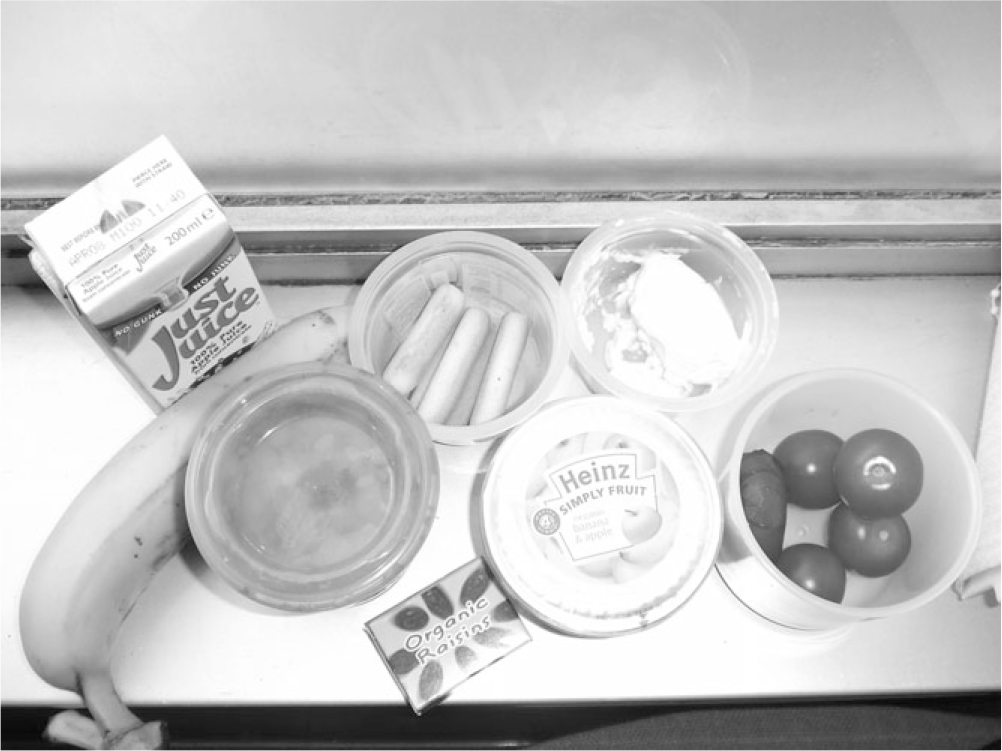
A Child's Organic Lunch Supplied by a Parent in ‘Upwell’
A number of reasons for providing and/or restricting children's food were explicitly suggested by those mothers I spoke to, or reported to me via their childminders. Sometimes these focused on the physical appearance of the child. One of the little boys June looked after, for example, was not allowed ‘Coke’ or ‘unhealthy’ snacks. ‘His mum doesn't want him to have them because he is very “big” for his age and she doesn't want people thinking that he is big because he eats rubbish’. Another mother whom I interviewed gave a similar reason for excluding chocolate from her daughter's diet - ‘she's quite big anyway’. Neither of these parents, it is important to note, were explicitly concerned with their children's health, but rather with their appearance; that is, they seemed to be motivated by other people's perceptions of their children's health and therefore of them as parents (cf. Chan, 2005).
Assigning high priority to health promoting practices is considered a particularly middle-class concern and therefore choosing food or a dietary regime that is considered as promoting health or a slimmer body might signify a particularly middle-class consumption orientation (Wills et al., 2009: 55). Alan Warde (1997) for example, reports heightened self surveillance among the middle classes compared to the working classes (cf. Backet Millburn et al., 2006). Some parents emphasized the health or behavioural consequences for their children of having sugar and/or additives. Edward's mother preferred him to have raisins at Sahira's rather than chocolate because sweets made him ‘hyper’. Other parents, especially those who preferred their children to eat organic food, emphasized ‘ethics’. Emma, for example, who provided her childminder, Gill, with organic food for her child lived an ‘alternative’ lifestyle and emphasized the ‘reflexive’ choice to spend money on food rather than other commodities.
At this pole of the integration/segregation continuum, some children, such as Violet, were not allowed to eat the childminder's food, even though other children for whom the childminder cared did. Pauline told me how she provided James's food, and his mum gave her the money, ‘because he eats more or less what we eat’, but although she added the ‘odd bit’ to Violet's food herself, ‘the parents bring the food’. She explained that this was because Violet's parents were ‘very strict about what she ate’, about her ‘only eating organic’ and how she was ‘not allowed s-w-e-e-t-s’ (she spelled the word out). Some childminders insinuated that parents could ‘afford’ to uphold these ideals not only because they could literally pay for such food, but also because they did not actually look after their children on a day-to-day basis. When discussing Violet's diet, for example, Pauline said that ‘her parents are fairly strict’ and her mum brings her ‘fruit snacks’ but she thought that sweets were ‘useful’ sometimes ‘ooh, for a bit of peace’. When I asked Jenny, a working-class mother of one of the other children Pauline cared for whether she had any rules about what her daughter ate there, she asked an important question which revealed suspicions about other parents' motivations:
I don't know. I, I sometimes think that people … like that are just … what's that about? What's all that about? (interview, Jenny, mother, 26.10.05)
We might read maternal provision of food and rules for children at childminders as practices which mediate ‘attachment’. Food's simultaneously material and symbolic character make it a fruitful medium for the practice and display (Finch, 2007) of mothering and family; homemade food ‘forges a semiotic connection between the producer and the consumer’ (Moisio et al., 2004: 370 and cf. Belk, 1988). Whilst she is writing about children's hospitalization, Roisin Pill's observation is relevant here:
The mother's reluctance to relinquish her control over the child to strangers in a strange place and her ambivalence towards them are expressed by asserting her role as the prime caring responsible … figure, through the medium of food. (Pill, 1983: 117)
But the significance of this food was not only, or even primarily, that it was homemade. It was particularly ‘whole’ and ‘organic’ food which characterised this flow of sustenance from parents to childminders. Although parents did not themselves focus on issues such as ‘boundaries’, ‘class’ and ‘control’, the provision of organic food for a child at a childminder's represents more than just ‘healthy’ or ‘ethical eating’ (Bell and Valentine, 1997). ‘Taste’ plays a major role in defining social rank and identity (Bourdieu, 1984) and organic food consumption is, as Goodman and DuPuis (2002: 17) point out, ‘presently a middle-class privilege, a “class diet” if you will’. The bodies of our children might be seen as an extension of this performance (Goffman, [1959] 2007). Food's unique qualities vis-à-vis incorporation make it a particularly salient medium for the literal embodiment of class (Shilling, 1993) even and especially whilst a child is being otherwise nurtured elsewhere. When middle-class mothers provided food for children to eat while in the care of a childminder, they symbolically and materially asserted their own role as the ‘spiritual’ caring figures (and reproduced childminders as ‘mundane’ carers). Thus this provision posited a hierarchy or, to use Anderson's (2000) phrase, highlighted the asymmetrical nature of such relations. Moreover, this practice worked to maintain boundaries of difference between families, retaining a child as a member of his or her own family – and class – of origin.
Food rules, especially when they applied only to some of the children in the childminder's care, could challenge the incorporation of children into sibling or family-like communities, as well as counter ‘socialisation’ into commensality and broader patterns of sociality. Especially at events such as children's birthday parties, it was difficult to deny some of the children the ubiquitously fat and sugar-laden food which often characterise suc hevents. Acting in accordance with their own, equally ethical, principles, childminders sometimes adapted and contested parental directives. When the mother of an infant who ate an exclusively organic diet was stuck in traffic, for example, Gill decided she would have to feed the child a non-organic banana. Pauline purchased special organic treats for a tailor made ‘goody bag’ for Violet when she attended a children's party and, later in the relationship, told her mother at pick up time that she had let her have ‘just one little fairy cake, just one’, a practice which McDowell would interpret as a ‘micro-scale strategy of resistance’ to parental demands (2007: 140). 15
Conclusion
To state that food is a political object is another way of drawing attention to the fact that many relations that are constituted by and through the medium of food are also power relations, and should be analysed as such. (Lien, 2004: 9)
This article has employed food as a lens to explore the (micro)politics of identity negotiation at the intersection of public and private domains. Drawing on ethnographic fieldwork with childminders in an inner London borough, the paper has examined some of the ways in which symbolic and material boundaries – principally of class and ethnicity – are dissolved and reproduced in everyday food practices within and between families. A continuum, from incorporation to segregation, was used as a heuristic device. At one pole cases were presented where children are symbolically incorporated into childminders' families, the boundaries of which are thereby expanded. At the other, children are ‘segregated’ from the childminder's family. Here ethnicity and especially class intersect with processes of incorporation in such a way that children are reproduced symbolically as members of their own families and with their own social positionings. Between these extremes, it was suggested, many ‘compromises’ are made as children, parents and childminders negotiate belonging and difference in and through their everyday practices.
The purchase of intimacy (Zelizer, 2005) in home based childcare such as childminding may mitigate some of the cultural contradictions faced by ‘working mothers’. But my reading reveals ambivalences, at least in some circumstances, about children's incorporation into an/other family. The observations made above tell us more than mothers and fathers were prepared or able to say about class and ‘difference’. They suggest that, on the one hand, children were like part of the family but, on the other, the word ‘like’ remained. Through the inculcation of tastes and via food proscription and provision, some children's ‘real’ families imposed limitations around the bonds that developed with childminders and their families. Childminders were thereby reproduced as inconsequential caretakers.
This is not to suggest, however, that only the ‘objective’ account is ‘real’. In sociological accounts of domestic work and home based childcare, ‘fictive kinship’ is habitually exposed as the mystification of objective social relations. But in this context food was an important medium for the boundary work which characterised the reproduction of both the distinct class and ethnic identities and the quasi-familial relations upon which the asymmetrical relations of childminding depend. In this setting at least, within and across cases, the ‘objective’ reality (as asymmetrical) and the popular account (as family like) are mutually constitutive constructions (Bourdieu, 1977). 16 Both are necessary for the reproduction of a system of family like childcare that is premised upon the stratification of reproduction (Colen, 1995).
As noted earlier, this paper is based on research which was inductive rather than deductive and therefore the degree to which food serves more broadly as a medium for the reproduction of class, ethnic and ‘individual’ identities in home based and/or group childcare relations remains to be explored. 17 Nevertheless, all commoditised childcare necessarily exists at the intersection of the private and public domains. In the childminding context, in which childcare relations are asymmetrical, children's consumption and taste orientations have been shown to be bounded by parents' and childminders' social class and ethnicity. However, feeding children is part of caring for them. Tensions inevitably emerge and are negotiated around belonging, identity, choice and responsibility. Food mediates and expresses processes of children's integration into and segregation from childminders' families. It reproduces asymmetries of power, albeit that these are contested. There is every reason to expect that food fulfils an equally political role in childcare more generally.
Footnotes
Acknowledgements
The doctoral research upon which this article is based was funded by the Economic and Social Research Council, award no. PTA 030-2002-00546. Sincere thanks to Professors Nanneke Redclift and Julia Brannen for their continued support and guidance and to Dr Hayley Davies and three anonymous referees for invaluable comments on earlier drafts.
1
All names and place names have been changed to protect the anonymity of participants.
2
Some people may be evasive when discussing class (Savage et al., 2001). Talking about ‘working classness’ is, according to the Sure Start worker cited in  , ‘like saying coloured’ – rude, out of date, conservative, ‘tasteless’. Additionally, class and ethnic family practices may be ‘beyond discourse’ because they are (often) carried out habitually and without reflection.
3
‘The vocabulary in common use for child rearing is not precise. When mothers want a homelike atmosphere, or when caregivers say that they are like mothers or that the experience of mothering is valuable, there may be more precise meanings behind this … Perhaps we should be looking for ways to clarify some of these descriptions rather than dismiss them’ (Emlen and Prescott, 1992: 275).
4
A lack of investment in adequate and affordable group provision has reinforced the ideal of home based childcare through the promotion of the ‘childminding solution’ (Tizard, 1991).
5
Cf. O'Connell (forthcoming) for an exploration of childminders' practices in relation to the hegemonic (and contested) mode of professionalisation of the UK Early Years sector.
6
In his influential work David Morgan (1999; 2002) suggests that family may best be understood as a set of practices. The notion of ‘family practices’ entails the idea that ‘what a family is appears intrinsically related to what a family does’ (Featherstone, 2004: 23; Silva and Smart, 1999). The concept ‘reflects the evidence of a dispersal of practices across a range of households and involving a range of blood, kin and non-kin relationships’ (Featherstone, 2004: 52). ‘[S]ociological researchers no longer presume a definition of “the family” but seek to discover what “family” means to research participants. It is generally recognized that this cannot be done adequately by simply asking what people think but, following Morgan (2002), by exploring “family practices” and how people “do family”’ (Jamieson et al., 2006: 3.6).
7
There are three main reasons for Maureen and Wendy's inclusion. First, they were the ‘experts’ with whom I had most contact. It therefore made sense to consult them about empirical issues, their own experiences, and emerging analyses. Their participation as ‘informants’ in these respects was explicit and by mutual consent. Second, within anthropology, there is a long, if not entirely unproblematic, tradition of ‘exploiting’ (and being exploited by) locals for the purposes of ethnographic research (Clifford, 1983: 125) most famously, perhaps, seen in Victor Turner's relationship with his key informant, Muchona (ibid.). Third, (my) life and work were not and are not discrete; it was a desire to do research with childminders which led me to undertake a doctorate and Maureen was the first person to read my funding application. Like childminding, for childminders, it was a way of negotiating the competing demands of motherhood and paid (or, at least, ‘bursaried’) work, based on what were my proclivities and possibilities. Indeed, it was the ways in which mothers from different backgrounds negotiated this tension which formed my main interest at the time.
8
Although people very often build them into their weekly routine, ‘drop-ins’ are informal groups for adults and young children where, as the name implies, parents and/or carers are under no obligation to attend regularly. Parents and carers have the opportunity of adult interaction while the children have the chance to play socially. There were numerous drop-ins in the borough, mostly running in the mornings, but sometimes also in the afternoons (when they are often referred to as ‘one o'clock clubs’). It would be possible to attend a group every working day, at least in the morning, should one have wished. They sometimes catered exclusively for childminders, but were often also for parents and other carers.
9
A ‘personal’ moment also focused the ethnography. After dinner on the evening before I returned to my studies following a brief period of maternity leave, I bent down as usual to open the fridge door and place on the shelf the cling-filmed leftovers for my son's lunch the next day. It was with a physical jerk that I realised he wouldn't eat it. Wendy would feed him lunch from now on. Even though I had, at that point, used childcare for about five years already, I felt it.
10
According to Douglas, offering food, rather than drinks, confers insider status although, of course, we should be aware that her analysis was based on observations of one white, upper middle class, family – her own.
11
Conversations with an ex-childminding worker from a neighbouring borough revealed similar ambivalence. Whilst some parents were more than happy for their children to experience other cuisines, she suggested, others were very much less so and sometimes provided food for their children's consumption.
12
Though there has been less research on how ‘absent’ fathers reproduce children as their own through food, Callum's father's performance of parenting through food suggest that the food practices of children and adults in cases where parents do not live with children, or where children have more than one home, would be a fertile area for further research.
13
A number of reasons were given by childminders, mothers and trainers for the prevalence of this practice. These included the possibility of (as yet unknown) allergies, the incompatibility (for blending) of the food which the childminder was cooking for the other children and/or her own family, and the convenience of jarred food.
14
This was an association made by many childminders who referred to a particular, arty faction of the middle classes interchangeably as ‘Organics’ – because, as one woman told me, ‘they like dirt’.
15
‘[P]erhaps, in homes where … electronic surveillance has not been installed, nevertheless care-givers may behave as if they were watched, although the employers can never be sure, and micro-scale strategies of resistance may include entering forbidden spaces, breaking dietary rules or permitting children greater degrees of freedom than normal’ (McDowell, 2007: 140).
16
For Bourdieu, the objective and the subjective are two sides of the same coin: ‘Gentle, hidden exploitation is the form taken by man's [sic] exploitation of man whenever overt, brutal exploitation is impossible. It is as false to identify this essentially dual economy with its official reality … ie the form which exploitation has to adopt in order to take place, as it is to reduce it to its objective reality’ (Bourdieu, 1977: 192).
17
Children's perspectives on food and eating practices across care contexts are also worthy of investigation. The author is currently undertaking a mixed methods study, with co-investigators Professor Julia Brannen and Ann Mooney, Food Practices and Employed Families with Younger Children, funded by Economic and Social Research Council and Food Standards Agency (RES-190-25-0010). The study explores children's and parents' perspectives and experiences of food and eating within and outside the home, including school and childcare.