






Abstract
This is one of a series of articles which document religious change in Britain by updating the data contained in classic British sociological and anthropological community studies,. The statistical and impressionistic observations on religion in Banbury in 1950 and 1967 in Margaret Stacey's Tradition and Change are augmented with data collected in 2010. The article identifies significant problems in interpreting the original Banbury data and offers some general observations on the advantages and difficulties of piggy-backing on previous research.
Introduction
The research reported here is one of a series of studies of changes in the religious climate of Britain since 1945. 1 The basic contours of the national story are clear. As a proportion of the available population, attendance at Christian churches has been falling since the middle of the nineteenth century and membership has been falling since the Edwardian era. None of the cultural innovations since the war has arrested or slowed that decline. Muslims, Sikhs, Hindus and Buddhists have added variety to our religious culture, as have West African, West Indian and Eastern European Christians. Further diversity has been added by the very small new religious movements of the 1970s and by the increasing popularity of alternative, holistic or ‘New Age’ spirituality. But even taken together, the additions to Britain's religious mosaic are nowhere near large enough to offset the decline of Christianity. The size of the gap depends on what measure of religious involvement one uses but we can get some sense of the scale of the change if we note that, had church-going remained as popular as it was in 1851, in 2001 there would have been at least 20 million more churchgoers than there actually were. Even if we set the proportion of nominal non-Christians who were religiously observant at the high figure of two-thirds, this would only give 2 million observant non-Christians. With the best estimates putting those seriously involved in expressions of alternative spirituality at less than 1 per cent of the population (Heelas and Woodhead, 2005) and even the most popular new religions having memberships in the low thousands, it is clear that decline has been accompanied by increased diversity but not offset by it. Hence it remains reasonable to describe the major trend in religious culture since the war as secularization. A decade ago this would have been so thoroughly taken-for-granted that research intended to demonstrate it would have been rejected as unnecessary. The correct proposition that religion has again become controversial has become confused with the false proposition that it has become more popular and the waters have been muddied by claims that Britain is now ‘post-secular’ (Bruce, 2011).
So one purpose of studying religious change in particular parts of Britain is to set the record straight. A local focus is also valuable because Britain-wide aggregate figures may disguise interesting local differences. These twin aims led me to embark on a series of quasi-longitudinal studies. The sites have been chosen by the expedient of identifying community studies from the period 1940–1980 that contain sufficient detail of the religious life of some place to provide a baseline. Examples include Isabel Emmett's A North Wales Village: a social anthropological study (1964), Ronald Frankenberg's Village on the Border: a social study of religion, politics and football in a north Wales community (1957), and A. D. Rees's Life in a Welsh Countryside (1950). This article summarises and updates the religion parts of Margaret Stacey's studies of Banbury in 1950 and 1967, which at first sight contained a considerable amount of statistical detail on the town's religious life. As will be seen, my attempt to reconstruct Stacey's data identified a significant mistake which has implications for the revisionist argument that secularization is not a long term trend associated with background features of modernization but a recent phenomenon associated with the ‘swinging sixties’ (Brown, 2001). Finally it offers brief observations on the benefits, or otherwise, of the piggy-back study.
The Banbury studies
Margaret Stacey's Tradition and Change (Stacey, 1960) was one of the first major community studies in modern British sociology: a pioneer of what Mike Savage has called ‘the quest for England's Middletown’ (2010: 151–6). The product of three years of fieldwork between 1949 and 1952, it detailed the tensions between the traditional economy, society and culture of a small Oxfordshire market town and the world of the new industries and Labour politics that had arrived in Banbury post-war. Following the town's designation as a centre for expansion and overspill arrangements with London and Birmingham under the 1952 Town Development Act (which funded the council to provide new council housing), population grew from 19,000 in 1951 to 25,000 in 1966. One major source of growth was the re-location from Birmingham of the Bird's Eye custard and instant coffee making factories; a move that was studied in detail by Michael Mann (Mann, 1973). In 1966 a team of three fieldworkers – Colin Bell, Eric Batstone and Anne Murcott – began a follow-up under Stacey's direction that was eventually reported as Power, Persistence and Change; a second study of Banbury (Stacey et al., 1975). The second Banbury study seems to have been a less-than-happy experience (Bell, 1977; Newby, 1977). With Stacey in Swansea and initially exercising oversight rather than direction, the fieldworkers in Banbury seem to have been unsure of just what it was they were supposed to be restudying. Bell became disillusioned with the project and left a year early. When the published report finally emerged six years late, it failed to match the success of the original. Bell later said: ‘I think the book Power, Persistence and Change … is astonishingly superficial’ (Bell and Thompson, 2008: 114).
Banbury churches in 1950
My interest in the two Banbury studies is the limited one of using what they tell us about religion in a small English town as the baseline for measuring subsequent change. Stacey was clearly interested far less in religion than in social class. She collected basic information about religious affiliation, church membership and church attendance but she was opposed to including attitude questions in her initial survey or the 1967 follow-up. The sections on religion in both reports read as if they were there because religion was a major social institution and ought to be important but the authors could not actually think of anything interesting to say about it. Bell later said of the second study: ‘a great insight in my life is that far more people were religiously active at the level of going to church, than were politically active in Banbury, and yet we spent so much more time looking at local politics than we did about religion’ (Bell and Thompson, 2008: 114). Nonetheless, the studies do contain useful information. I will consider first the indices of religious involvement and then turn to more qualitative observations about the town's religious culture.
For 1950, Stacey gives us three forms of statistical information: the number of churches and chapels, church adherence, and church membership. The number of churches and chapels is fairly unambiguous (though Stacey may have overlooked some very small groups). The Church of England and the Methodists each had four congregations; there were two Baptist congregations; and one each for the Roman Catholics, Congregationalists, Salvation Army, Open Brethren, Closed Brethren, Unitarians, Four Square Gospel, Quakers, Jehovah's Witnesses and Christian Scientists. 2 There were in total 20 worship outlets for a population of around 18,000 or on average one outlet for every 900 people.
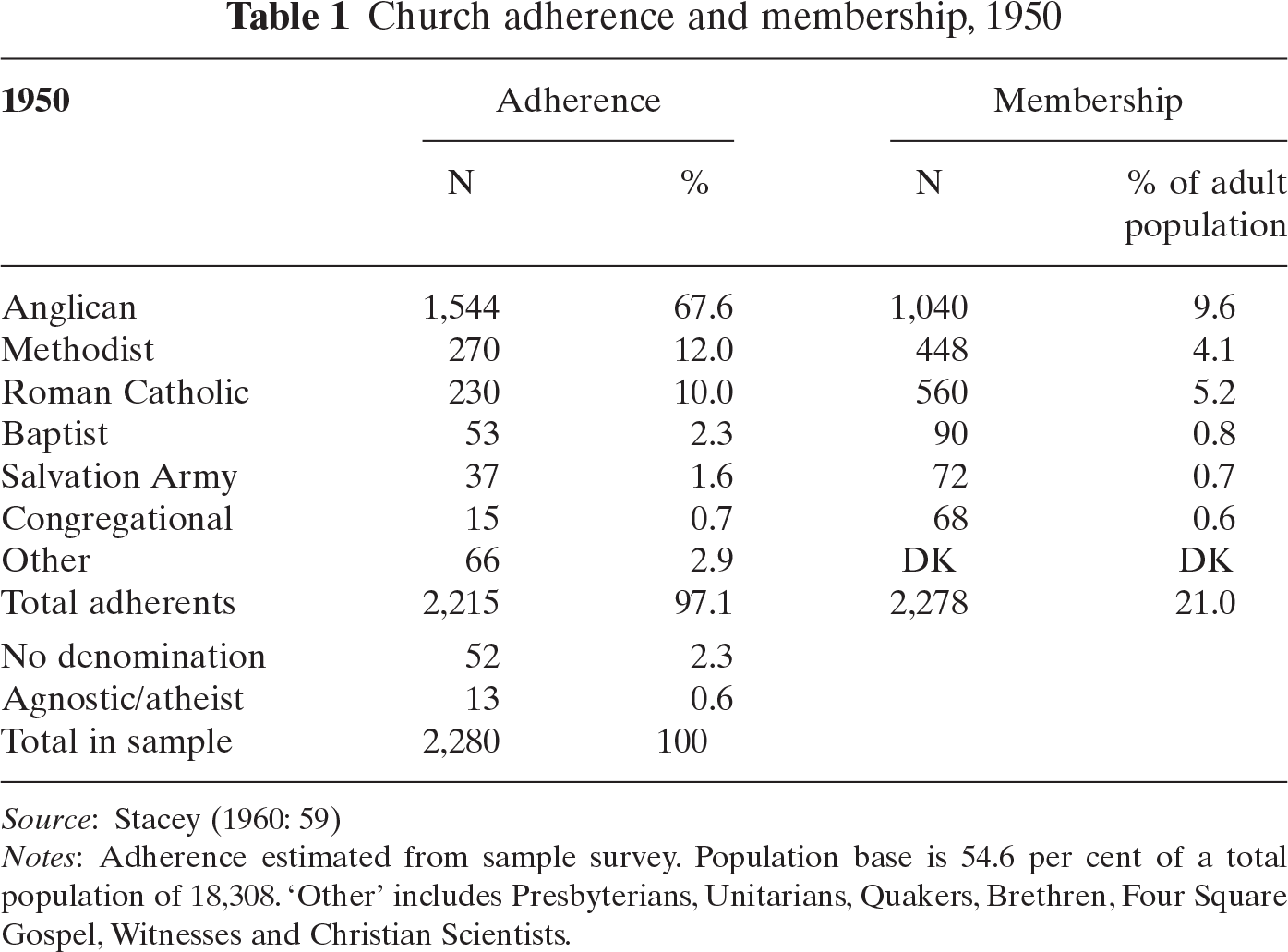
Stacey's church adherence is a very weak notion of affiliation based on respondents in a sample survey of 2,280 people telling the interviewers that they attended church, which most rather implausibly claimed to do. Stacey herself queries these data: ‘When … interviewers asked a respondent whether he attended a place of worship, they were faced with the problem of deciding whether he was telling the truth. Even allowing for the fact that a man who went to church at Christmas or Easter only was classed as an attender, it is certain that interviewers gave too many respondents the benefit of the doubt’ (1960: 57). Her certainty derives from a degree of interviewer variation that was unique to this one question. Six of the ten interviewers made attenders outnumber non-attenders by about two to one; three made attenders and non-attenders roughly equal, and one made non-attenders outnumber attenders by three to two.
Church membership is apparently more reliable. It is usually what officials of the various churches said was their membership. For Nonconformists such as the Methodists and Baptists, the clergy would have had little trouble providing reasonably accurate figures for what most of us would think of as ‘members’ (though the Baptists will have had a narrower notion than the others and might have excluded regular attenders who had not been baptised). For Anglicans it is the electoral roll figure, which in the 1950s was generally a little smaller than our current notions of membership. For Catholics the figure was estimated by scaling up the responses from the sample survey. Adherence and membership is summarised in Table 1, which is extracted from Stacey's table 14 (1960: 59).
Church adherence and membership, 1950
Source: Stacey (1960: 59)
Notes: Adherence estimated from sample survey. Population base is 54.6 per cent of a total population of 18,308. ‘Other’ includes Presbyterians, Unitarians, Quakers, Brethren, Four Square Gospel, Witnesses and Christian Scientists.
Banbury churches in 1967
Power, Persistence and Change devotes only ten pages to religion and two of those are taken up with a large diagram linking Anglicans and Nonconformists to various voluntary associations. The second study updates the descriptive statistics of the first. There had been some small change in the number of congregations. There were still four Anglican churches. The Methodists (now five) and the Catholics (now two) had each added one. The Four Square Gospel church had become an Elim Pentecostal church and the Mormons had joined what was otherwise an unchanged menu of options. There were in total 22 outlets for a population of 26,000 or 1 to 1,182 people: a significant decline in relative presence since 1950. While the number of worship outlets had grown by 10 per cent, the population of the town had grown by over 40 per cent.
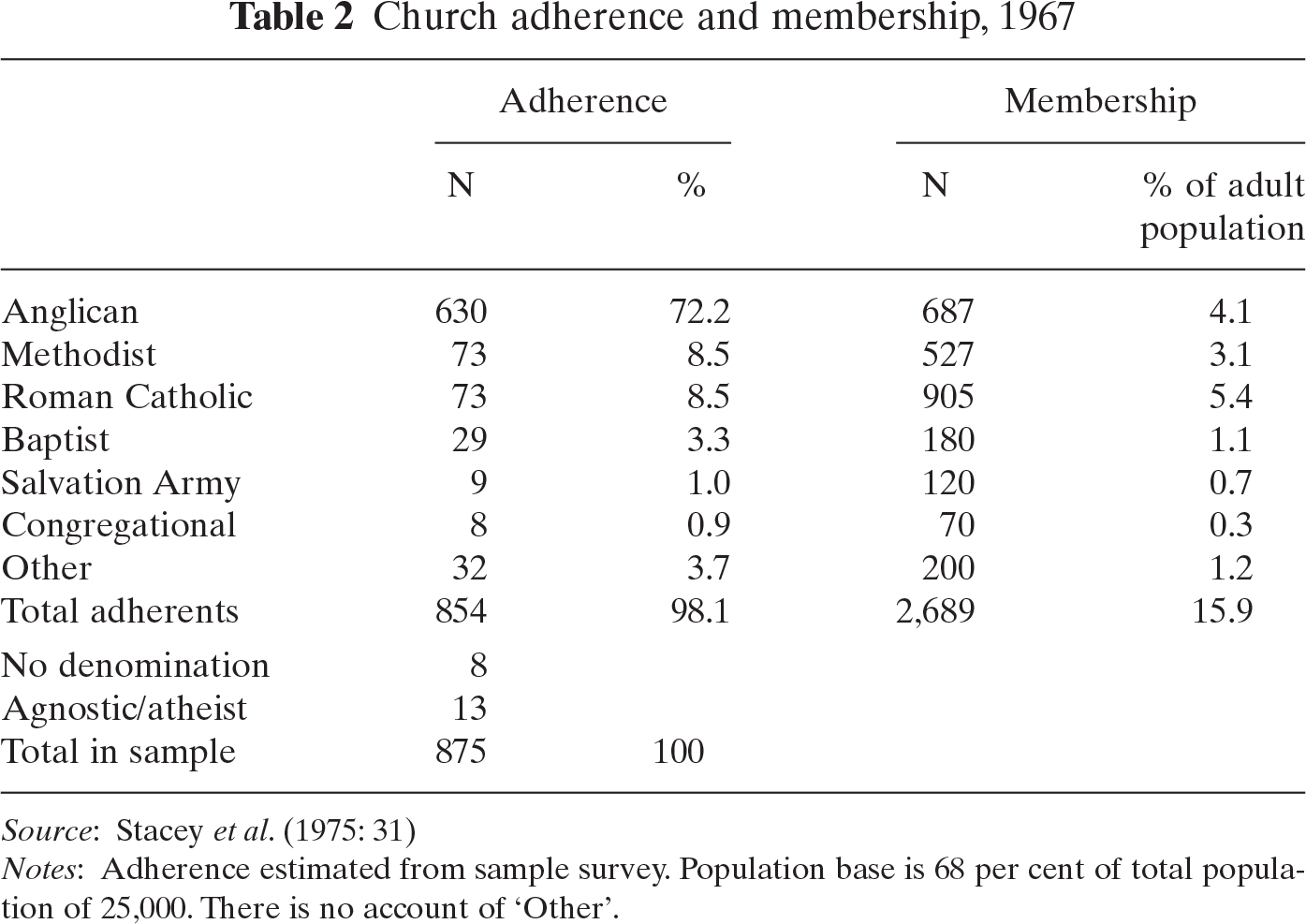
Church adherence and membership figures are given in Table 2. Church adherence was again derived from a sample survey and although there is not the same disclaimer about interviewer consistency, the usual caveats about exaggeration presumably apply. In response to the growth of the town since the first study and the greater range of commuting to work, the 1967 survey covered an area wider than the Banbury Municipal Borough that had been the frame for the 1950 study. To make the church penetration figures comparable, the data from the survey was scaled down so that the 1,403 survey respondents who claimed to attend church regularly are reduced to 854 adherents in Banbury town (Stacey et al., 1975: 31). 3 The scaling principles are not explained. For the largest denominational groups, the Banbury town figure is either 59 or 62 per cent of the survey sample figure. But 73 per cent of the Congregationalists, 74 per cent of the undistinguished ‘Other’ and 100 per cent of Salvationists identified in the survey are allocated to Banbury town. The likely explanation for the 59–62 per cent reduction is that it fits roughly with the number of households in the Municipal Borough as compared with the wider survey area but we can only suppose the deviation for the three small denominational groups represents specialist knowledge of the research team. Fortunately, because those groups are relatively small, this discrepancy does not affect the overall impression of church adherence in Banbury.
Church adherence and membership, 1967
Source: Stacey et al. (1975: 31)
Notes: Adherence estimated from sample survey. Population base is 68 per cent of total population of 25,000. There is no account of ‘Other’.
There is no explanation of the sources for the church membership figures but we must presume that, as in 1950, these data were collected from clergy.
One curious feature of the restudy report is that it barely mentions a major improvement over the first study: an attempt to solve the problem of exaggerated claims for church attendance by counting attenders at all known worship venues on one particular Sunday. This census of church attendance, conducted by the three researchers and a number of volunteers, is mentioned only in passing and the only published report of that census (Bell, 1968) is not listed in the bibliography of Power, Persistence and Change. Murcott suspects this obfuscation is a result of Stacey's unhappiness at Bell publishing the results without acknowledging his fellow researchers. 4 That census showed a total of 2,202 attenders – 12.2 per cent of the estimated adult population – at 40 services, with an average attendance of 55 people per service. 5
A second curious feature of the restudy is that it reports an important counter-intuitive finding but neither tries to explain it nor looks closely at the evidence presented for it. The chapter on religion begins ‘Contrary to some expectations, religious adherence and religious activity have not changed much in Banbury between the two surveys’ (Stacey et al., 1975: 31). Given the looseness of the notion of adherence deployed in the sample survey, it is no surprise that figures for it remain fairly constant, though the authors might have commented on the fact that the census of attendance produced a much lower figure than that derived from the claims made by the survey respondents. But given what we know about the decline of church membership elsewhere in the country, it is a surprise that: ‘Around one in seven adults belongs to a religious body, about the same as in 1950’ (Stacey et al., 1975: 31; my emphasis).
This is certainly a mistake, although it is not easy to identify how the mistake was made. 6 Table 3.1 of Power, Persistence and Change gives church membership for 1950 and 1967 as respectively 14.5 and 14.7 per cent. A footnote to the table says of the 1950 data that they are ‘taken from’ the relevant table of Tradition and Change. Most are but one important figure is not. Stacey lists 1,040 Church of England members for 1950 (1960: 59). The re-study report gives the 1950 Church of England membership as 701: a reduction of almost a third (Stacey et al., 1975: 31).
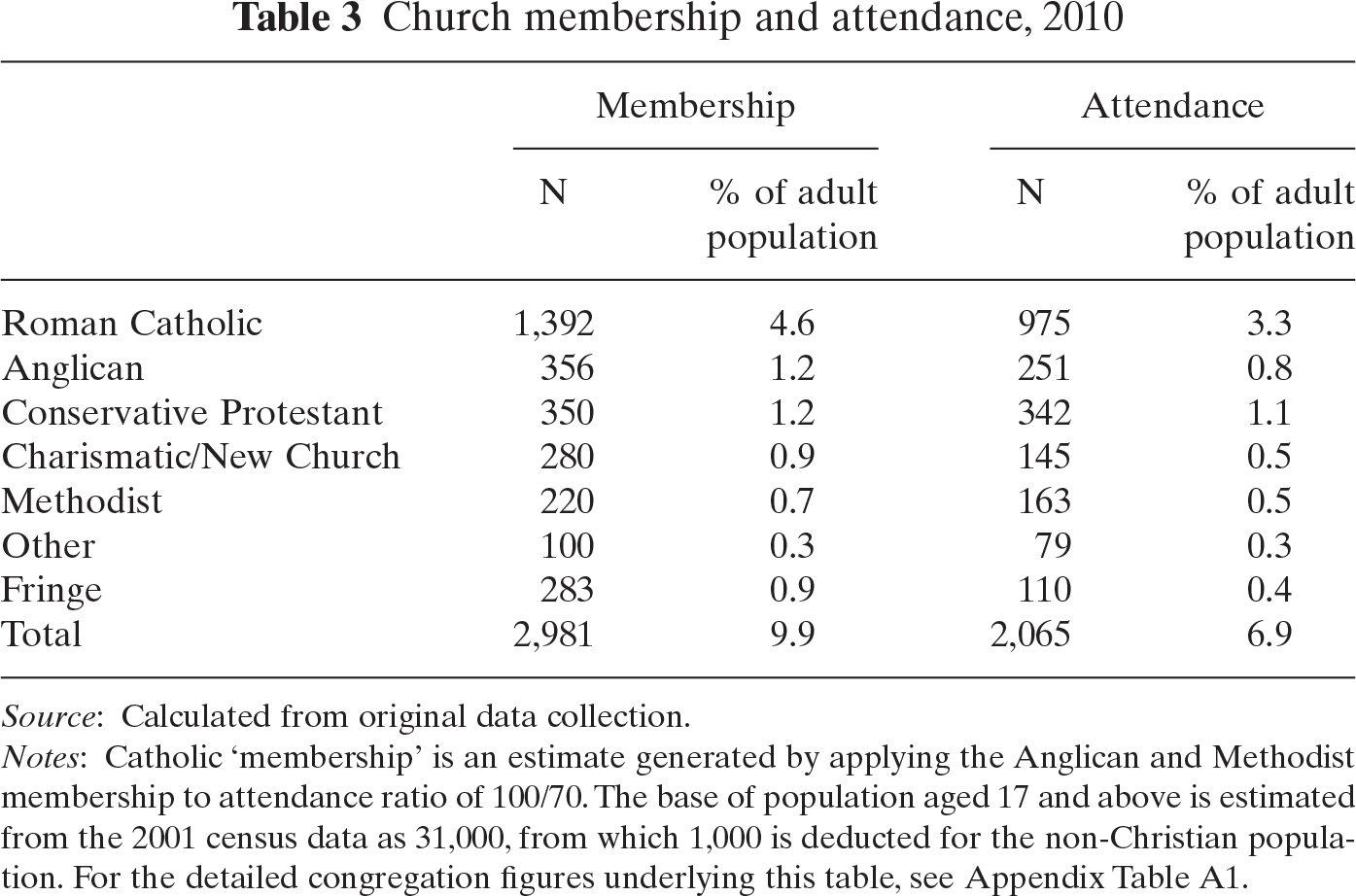
Church membership and attendance, 2010
Source: Calculated from original data collection.
Notes: Catholic ‘membership’ is an estimate generated by applying the Anglican and Methodist membership to attendance ratio of 100/70. The base of population aged 17 and above is estimated from the 2001 census data as 31,000, from which 1,000 is deducted for the non-Christian population. For the detailed congregation figures underlying this table, see Appendix Table A1.
As well as the discrepancy between the two published versions of the 1950 data, there are marked differences between the membership figures reported in the studies and the data recorded by the churches. Although the first study says that its reported Anglican membership is the electoral roll figure, the figure of 1,040 is not the same as that recorded in the relevant Diocese of Oxford Yearbook, which gives 1,138. The 1967 restudy does not give a source for its figure of 687 Anglicans; the Diocesan Yearbook says 854. The 1950 Methodist figure is close to the Methodist Circuit's own figure but the 1967 figure is wrong. Stacey et al estimates it as 527: the Circuit's own data for the chapels in Banbury adds up to 455: a difference of 16 per cent. 7
Catholic data are even more problematic. As the Catholic Church attributes membership to all baptised Catholics irrespective of their later relationship to the Church, we commonly use mass attendance as the Catholic equivalent of Anglican or Methodist membership. This is reasonable because the Catholic Church's Code of Canon Law makes attendance an obligation on all the faithful and the Catechism describes the deliberate missing of Sunday mass as a grave sin (Horwood, 2006: 13). In 1950 Stacey estimated Catholic membership from the number of people identifying as Catholics in the sample survey (although she does not explain exactly how she did this and the original data are not available for checking). In the 1967 table, attendance as measured by Bell's census seems to have been used, with the 961 mass attendances being reduced, by a process which is not explained, to 905 ‘members’. At one-third of church members this seems somewhat high, especially as it would represent a major growth of Catholics relative to other Christians since 1950 when the book's own commentary refers to a slight decline in Catholic numbers (Stacey et al., 1975: 30). The sample survey of 1445 respondents contains only 103 self-identified Catholics or 7 per cent of the sample. If the sample was representative of claimed religious identification, that would scale up to 1,716 Catholics for the survey area and then be scaled down again to around 1,000 to fit just Banbury Municipal Borough. Because Catholicism is a minority faith rather than the default position for England, we can be sure that there was less Catholic than Anglican nominalism but it is still difficult to imagine that 90 per cent of Banbury's notional Catholics attended mass on any particular Sunday.
In brief, the estimate generated from Bell's church attendance census produces a figure considerably greater than that generated by the sample survey. Some of the discrepancy might be explained by the rarity of Catholic churches in North Oxfordshire causing Banbury's Catholic churches to draw worshippers from a wider catchment than did the town's Anglican or Methodist churches. Or it may simply be a mistake. Certainly Murcott's judgement is that the survey is likely to be more reliable than the attendance count. Nonetheless, for completeness we need to generate some sort of estimate. For England and Wales as a whole Horwood (2006: 13) calculates that Catholic mass attendance was 53 per cent of total Catholic population in 1961 and 46.7 per cent in 1971. Assuming the decline was even would give us around 500 mass attendances in Banbury in 1967. Given that not all ‘members’ will attend every week, that seems warrant for guessing (and it is a guess) that Banbury in 1967 had around 700 Catholics whose commitment was much the same as Anglican or Methodist church members.
Finally, we come to the ‘others’ category. Although both studies provide an adherence estimate for the total of Presbyterians, Unitarians, Quakers, Brethren, Jehovah's Witnesses and Mormons, neither published report includes those estimates in the total used to calculate the percentage of the population that belongs to a church. In 1950, when Stacey estimates only 66 ‘others’, the effect of this omission is small. But in 1967 ‘others’ are estimated at 200 or nearly 10 per cent of the town's church membership.
The outcome of all of the above is that we can produce an improved estimate for church membership in 1950 and 1967 (see Appendix Table A2). Between the two dates it fell from 24.4 per cent to 15.1 per cent of the adult population. Far from the religious complexion of Banbury not having changed much, the proportion of the population in church membership had declined markedly. This is important because a popular strand of historical revisionism, articulated most fully by Callum Brown (Brown, 2001) seeks to replace the secularization paradigm's assumption that church involvement, as measured by attendance, has been declining since at least 1851 or, if we take church membership, since the early twentieth century. The revisionists claim that indices of church participation remain relatively unchanged until the early 1960s when major cultural changes prompt a rapid collapse. As the Banbury data only begin in 1950 they cannot positively support the conventional view of long term decline but the mistaken claim in the second Banbury study for relative stability between 1950 and 1967 certainly aids the Brown claim. Hence it is important to have demonstrated that the second Banbury study's data actually shows considerable decline from 1950 to 1967.
In summary, we can say that in both 1950 and 1967 most Banburians claimed a denominational identity but, in common with the rest of the country, there was a marked decline in personal involvement in organized religion between the two studies.
Further observations in 1950 and 1967
The first study contains a number of observations about religion in addition to the descriptive statistics. First, Stacey remarks on the lack of inter-church cooperation. The Clergy and Ministers Fraternal was rarely attended by the Anglican clergy (who saw themselves as superior to the Nonconformist clergy) and never by the Catholic priests. There were no united services, not even on Armistice Day.
Second, Anglicans were generally of a higher social status than the Nonconformists and only the Catholic Church had more manual than non-manual workers among its attenders. Class is also associated with religiosity generally in that manual workers were more likely to decline a religious identification. The general class pattern had a particular expression in political affiliation: with church involvement declining as one moves from Conservative to Liberal to Labour parties. Of sixteen Conservative councillors, eleven were church members; eight Anglicans, two Catholics and one Baptist. Four members of the committee of the local Liberal party were members of Free Church committees. Only one of the Labour councillors was a church member: a Methodist. More than 40 per cent of the survey respondents who claimed no religious affiliation were Labour voters.
Third, there was already evidence of what was to become a major national association: ‘the sample shows that significantly more people under fifty fail to attend church than would be expected from the age structure of the population as a whole’ (Stacey, 1960: 72).
Fourth, the 1967 study notes a small increase in the range of religious options on offer in the town with the addition of the Mormons and the Christadelphians. This may be more of an observer effect than a real change. Barrie Trinder's history of churches in Banbury lists a number of small non-denominational Protestant groups that do not figure in Stacey's 1950 study (Trinder, 1970). They may have died out by 1957 or they may simply have been unknown to Stacey.
Fifth, the restudy notes a softening of inter-denominational hostility; in 1965 a local Council of Churches had been formed and there was an increase in inter-church cooperation. This may have reflected clergy awareness of a loss of relative penetration. It was certainly made easier by the decline of the Liberal party. Although the major religious and political issues that had divided Conservatives from Liberals in the nineteenth century had long been resolved, in 1950 there were still clear links between the state Church of England and the Conservatives on one side and the Nonconformist denominations and sects and the Liberal party on the other. The national decline of the Liberal party, and the growth in Banbury of industrial trade unions and the Labour party broke those historic ties and in so doing, allowed the clergy to see their common interests in trying to maintain the presence and influence of an increasingly unpopular religion.
Banbury churches in 2010
In 2010 I visited Banbury twice, interviewed five clergymen and two lay people, attended three church services, photographed all the listed worship sites, corresponded with local experts, consulted library and archive sources, and read back copies of the Banbury Gazette: a research investment far short of that involved in the original Banbury studies but enough to be reasonably confident of the following observations.
The first major change is a decline in nominal attachment to Christianity. In 1950, 97.1 per cent of survey respondents claimed a church allegiance. In the 2001 Census of England and Wales, only 72 per cent of Banburians claimed to be Christian. Seven per cent did not answer the religion question. At 4 per cent of population, those who identified with non-Christians religions were swamped by the 17 per cent who said they had no religion. 8
Since 1967 there has been a small increase in the number of Christian worship sites but that growth lagged behind the rise in population. There are now 25 sites for a total population of 41,815 people or 1 per 1,672 people: a significant decline since 1967's 1 per 1,182 people.
There has been some change in the church milieu. Two fringe sects – the Christian Scientists and the Christadelphians – have gone, as have the Elim Pentecostalists. The weakening of liberal Protestantism apparent in 1967 has continued. The Unitarians disbanded in 1969 and their chapel was demolished the following year. They re-established a weak presence in 1994 with once a week meeting of nine people in a rented room in the Town Hall. The Congregationalists (who merged with the Presbyterians to form the United Reformed Church in 1972) gave up their premises and now share St Mary's with the Anglicans.
The conservative Protestant block has changed slightly in composition and grown equally slightly. The Open Brethren meeting is now the Southam Road Evangelical Church. The main Baptist congregation has re-named itself the People's Church. The Banbury Evangelical Free Church was founded in 1984 and the tithes of its members permit the employment of a pastor but its current membership is down from its 1990s peak of 28 to just 25 and typical attendances are around 40 adults. The new Grimsbury Baptist congregation numbers around 20 adults.
The most obvious change is the arrival of two Charismatic or ‘New Church’ congregations. The Banbury Community Church (an independent body affiliated to the Evangelical Alliance) was founded in 1995 and Jubilee (part of the New Frontiers network) began regular services in 2003. Neither has yet acquired its own premises: one meets in the local secondary school; the other in a community hall.
Although the Church of England has initiated outreach services in the new estates, both it and the Methodist church have seen a considerable decline in members and attendances. That change, and migration from Eastern Europe, has seen the Catholic Church become the largest Christian body in Banbury. Ethnicity is also relevant for the smallest sector. Web searches show the spectral presence of two Pentecostal bodies: the Tabernacle of Faith and the New Anointing Apostolic Ministries. Both list private houses as their addresses, neither advertises services, and none of the Banbury clergy has heard of them. We may assume these are embryonic African churches with very small memberships which I have not attempted to estimate.
In the terms of the range of religions in Banbury, the greatest change is the addition of a mosque. While the Muslim community is small – the 2001 census recorded 1,126 – it now has a purpose built mosque and a girl's school. 9 In total, nominal non-Christians formed 4.01 per cent of the total population in 2001. As we have no data on what proportion of that small percentage of the population is religiously observant in the ways measured by the two Banbury studies, they cannot be included in Table 3. Instead an estimate of the adult non-Christian population has been used to reduce the population baseline and retain comparability with the earlier studies.
As Table 3 shows, about 10 per cent of the adult population has some sort of church membership and 6.9 per cent of the adult population regularly attends church. 10
All of the above may seem like a very long way round the houses but we finally come to the following summary of religious demography in Banbury over the second half of the twentieth century. Between 1950 and 2010 the proportion of the population that had some sort of enduring membership tie to the Christian churches fell from just under a quarter to just under a tenth. We have no attendance data for 1950 but between 1967 and 2010 church attendance fell from 12 to 7 per cent of the adult population. Given that Banbury seems a thoroughly ordinary small town, it is reassuring that these figures are typical of England as a whole (Brierley, 2006: 12).
Non-statistical observations in 2010
Although there have been no major reunions since the 1972 creation of the United Reformed Church, the last 30 years has seen a great deal of ecumenical cooperation at local level. In Banbury, the main churches advertise each other's special events and cooperate in presenting a united Christian front to the town. Even the former Open Brethren meeting (now Southam Road Evangelical Church) and the Salvation Army join in such activities of Banbury Christians Praying Together as a prayer walk around the town. The weekly local paper carries a church column, authorship of which is rotated around the churches and currently coordinated by the Methodist minister.
Nationwide, the coincidence of shrinking congregations and Victorian buildings now needing either extensive renovation or replacement has prompted much local improvisation. Banbury has three cooperative innovations. The largest Anglican church – St Mary's – is now shared with the URC. Although the two congregations maintain separate structures and meet sequentially most Sundays, they periodically share services. Another Anglican church, St. Francis's, is now a ‘local ecumenical partnership’ or LEP. Initially involving the United Reformed Church, the Southam Road Evangelical Church, and the Catholic Church, three services a month are now run by the Anglicans with the Methodists leading worship on the fourth Sunday. The third venture is the most radical in its use of real estate. In the Grimsbury area of town, the Methodists replaced their inappropriately large Victorian chapel with a block of sheltered housing which contains a small chapel, which the Methodists and the Baptists share.
Although the new Charismatic congregations present themselves as a radical alternative to the other churches in Banbury, they have been assisted by the Methodists. Jubilee avoids contact with the small Anglican congregation (an offshoot from St Francis's) that also uses the Hanwell Community Centre but borrows the large Marlborough Road Methodist church for special events such as the weekend of prayer held in May 2010. The Methodists have also assisted Banbury Community Church by lending Marlborough Road for weddings (for which the Methodist minister acts as registrar).
The ideological underpinning of such cooperation is a marked decline in interest in the theological and ecclesiological arguments that gave shape to British churches, sects and denominations in the nineteenth century; a decline that matches (and is largely explained by) the numerical decline of those churches, sects and denominations. Few churchgoers (and no-one else) now seem much interested in arguing over the nature of Baptism, the Apostolic succession, ecclesiastical structures, or the nature of the Mass (or Eucharist or Holy Communion). Leaving aside the Catholic Church, the main divisions seem to concern the style of worship and the current availability of the Pentecostal ‘gifts of the spirit’ such as healing, prophecy and speaking and singing in tongues (though even this appears less as a theological argument and more as a matter of worship style). Driven by a desire to redress the patent loss of young people to the churches, all the churches have attempted to become less off-puttingly church-like.
The Baptists have led the way in dropping the word ‘Baptist’ from their name. Although the church's website has links that make clear its evangelical Protestant theological basis, it very deliberately plays down religion and promotes the fun aspect of its worship: ‘What happens on a Sunday? Loud and clear. It's different, you won't be bored, it's not for very long and you'll leave with a smile on your face. Every Sunday the worship is inspiring, the prayers are real and the talks speak directly to you. We're a church for people who aren't used to coming to church and so your experience will be different.’ (The People's Church, 2010). The interior of the building reflects this desire to shed the traditional church image: a projection screen in place of stained glass; moveable chairs in place of fixed pews, a lectern in place of an altar, and a distinct absence of religious decoration. Banbury Community Church, Jubilee and the Southam Road Evangelicals all now feature electronic rock bands in their worship.
Charismatic fellowships have generally preferred the flexibility of disused factories to Victorian church buildings, which are both inconvenient and off-putting, and the two Banbury examples are no exception. The school assembly hall and community centre they rent are cheap (because there are no maintenance costs), they are free of what their leaders regard as the stigma of ‘churchianity’, and they do not confront their users with weekly reminders of failure. This last point is important. Robin Gill has made a good case for Victorian over-provision having a subsequent demoralising effect on churchgoers (Gill, 2003). In the second half of the nineteenth century, many congregations built new churches or expanded their existing ones so that the total seating capacity in many towns and villages exceeded the total population. The result was that even growing congregations found themselves surrounded by empty pews: a problem that got steadily worse over the twentieth century. That many tiny congregations doggedly persisted for decades 11 suggests that, for the active core, a survivor's determination to hang on can balance the de-moralising effect of visible failure to attract newcomers but there seems little doubt that joining 20 people in rows of pews with a capacity for 500 is not an experience that potential new members are likely to repeat. Hence the Charismatic fellowship preference for adaptable bare space over redundant churches.
Although more constrained by their traditions and by the expectations of their predominantly elderly congregations, the Anglicans and Methodists now also experiment with various sorts of informal worship styles.
As noted, there has been a major broadening of Banbury's ethnic composition. Almost all of the Muslims, Sikhs, Hindus and Buddhists in Banbury are immigrants or the children and grand-children of immigrants. The Christian population has also become significantly more varied in background. Canon Mervyn Toner noted: ‘From the point of view of the Catholic church, as in many other places, there has been a greater “internationalization” – the Poles, Keralans and Filippinos being the largest groups but there are others from all over the world. We have at least 35 language backgrounds in this parish’. 12
While the most obvious symptom of secularization is the decline in the number of people who are actively involved in Britain's traditionally dominant religion, there is an important secondary symptom: the attenuation of the supernatural in Christianity itself. While the Banbury Evangelical Free Church is clearly partisan, there is a basic truth in their description of what their more popular rivals offer as ‘man-centred rather than God-centred’ (Banbury Evangelical Free Church Elders, 1995: 1). While some aspects of the deliberate playing down of Christian language and symbolism in the presentational styles of The People's Church, Jubilee and the Banbury Community Church are intended by their promoters as marketing strategies, there seems little doubt (though there is not space here to present this case in detail) that overall Christianity in Banbury now differs markedly from what was on offer in 1950 and that the changes – an emphasis on pleasure and personal therapy rather than obedience to an all-powerful God, a focus on this-worldly benefits rather than salvation, a selective attitude to the Church's traditional teachings – can be explained as a consequence of subtle but powerful features of modernization (Wilson, 1966; Bruce, 2011).
What Banbury shows is that traditional Christianity has declined in popularity over the second half of the twentieth century. The churches present in 1950 have made brave efforts to rationalize and to make themselves more popular and there have been important innovations, with the Charismatic sector growing at the expense of the mainstream. The migration of people from more traditionally-religious cultures has boosted the Catholic Church and added to the range of religions found in Banbury but these additions have failed to compensate for the decline elsewhere.
Methodological issues in local restudies
There are three general purposes to my local piggy-back studies. The first is the testing of nationwide church-based and survey-based data on religious activity. Although most British social scientists take the fact (if not the explanation) of secularization for granted, there are still scholars such as Rodney Stark (Stark, Finke and Iannaccone, 1995) who argue that little has changed and revisionist historians such as Brown (Brown, 2001) argue for a new ‘recent-and-rapid’ chronology of decline. Local studies allow a limited but nonetheless novel contribution to the description of secularization.
Second, local studies allow us to study important situational factors in secularization; for example the role of the Welsh language and of geographical isolation in providing some protection against secularization is explored in comparing religiosity in four Welsh rural areas (Bruce, 2010b).
Third, a local focus can identify important phenomena which do not appear in national data sets and do not figure prominently in studies of large religious organizations. For example, if we consider changes in the religious climate primarily through studies of the Church of England, the Methodist Church or even the charismatic movement, we will miss the extent to which improvised local sharing of clergy, worship and church-buildings is profoundly altering Christianity at the congregational level.
We could, of course, study change de novo, as historians often do. The main advantage of the piggy-back study is that by building on an existing account of the time which will serve as the start of our period of comparison, we can save a great deal of time and money. What one discovers of the religious life of Banbury in 1950 in a day of reading Stacey would take months of original work. Given the strains on the resources of universities and research councils, there are obvious benefits in studying change in communities the pasts of which are already well-documented. The same point can be made prospectively: it is obviously of value to future researchers if we bear in mind the possibility of replication when presenting our data.
A second advantage is that the original community study, because it gathered its data from contemporaneous informants, may well tell us things that could not be recovered retrospectively even by the most diligent historian. A. D. Rees's study of Llanfihangel (Rees, 1950: 102), for example, contains a map which shows which chapels were attended by members of which household. Frankenberg (1957) has details of the role of chapel affiliation in everyday social relations that would not have been apparent decades later.
As others have noted, there are theoretical or meta-methodological difficulties with the idea of re-study, especially when the original work has significant ethnographic or participant observation components. Hammersley, for example, questions the value of treating ethnographic records as data which can be replicated (Hammersley, 1997). We may argue that the personal response of the original researcher is such a large part of the research process that others are bound to see things differently. We may add that even within the same culture and class, attitudes change so much over 60 years that subsequent researchers are unlikely to see things the same way as the original researchers. Even if we confine ourselves to a positivist frame of reference, we must recognise that even the most diligent note-taker who publishes an extremely detailed account of his or her observations and impressions will have known far more than is recorded and reported. While subsequent researchers may put themselves in the same place they cannot put themselves in the same ‘shoes’ as the original researcher. That is, with the possible exception of experimental psychology, the social sciences cannot replicate. It is interesting then to note that my frustrations with the second Banbury study echo Bell's frustrations with the first study. In discussing the possibility of replication, Savage notes Bell's growing recognition of the impossibility of re-study: ‘having interviewed many of those whom Stacey had also interviewed in the first study he found them telling completely different things, indeed denying who they were supposed to be’ (2010: 156).
Although fully aware of such problems, I had assumed that it would be possible to re-study the ‘factual’ parts of what the two Banbury studies told us about religion. Sociologists of science such as Harry Collins would challenge the existence of a body of facts entirely separate from the observational methods that produce them and the theoretical interests that make sense of them, but even outright relativists should accept that some observations have more ‘facticity’ than others. We may hesitate to compare the extent to which Banburians are now more or less ‘really’ religious than their grandparents but it should be possible to compare the size or age distribution of populations, or the popularity of church attendance or church membership, at two points in time; hence my belief that at least the outward appearances of Banbury's religious life could be re-studied.
However, it turns out that attempts to build on even the most factual observations from previous studies are constrained by idiosyncrasies of data reporting. For example, in his work on Llanuwchlyn, Trefor Owen (1960: 190) reports church attendance in terms of families, not individuals; one has to estimate typical family size to convert his observations into a form that can be updated. In the case of the first Banbury study, as with A. D. Rees's account of Llanfihangel, some data is presented in accounts of particular congregations, other data is presented in summary form, and it is not clear that all of the former is in the latter or that the latter contains only the former. To put it positively, building on the two Banbury studies would have been considerably easier had appendices contained a comprehensive list of congregations with their associated descriptive statistics (as in Appendix Table A1, which is included here to facilitate future updating).
Clearly we have to take on trust the more impressionistic parts of community studies. At this distance we cannot challenge Emmett's reports of the character of the people of Croesor but it is clear from my attempts to understand how the two Banbury studies confused church membership figures that even the statistical parts of community studies may not readily allow critical re-examination.
Underlying these two problems with using the work of others is a third that I had not anticipated. It is obvious that research interests will be reflected in what is recorded and reported. For example, Marilyn Strathern's well-known study of Elmdon does not mention religion (Strathern, 1981). It is less obvious that relative lack of interest will result in data being collected and reported somewhat carelessly. For Stacey (as for Emmett and Frankenberg) religion was peripheral to her main interests. Had she or her co-workers shared my interest in religious demography, they would have recognised that, given the well-documented links between social class and church involvement, it was unlikely that church membership in a small market town would have remained much the same over a 17 year period during which the population increased by 40 per cent with the import of council house tenants from London and Birmingham. Furthermore, that the Birmingham incomers were less likely than the natives to be church-going was known to Stacey et al because the data are in Michael Mann's detailed study of the Bird's Eye factory workers who relocated and both his doctoral thesis and the published version are cited in the bibliography of the second Banbury report (Mann, 1973). 13 That the team who in 2002 replicated a 1960 study of family and kinship in Swansea shared the same primary focus as the original researchers and included one of the original researchers goes a long way to explaining their success (Harris et al., 2006).
In summary then, the main advantage of the piggyback method was that the original studies provided a useful guide to what data should be sought but for a variety of reasons the data themselves could not simply be taken at face value and up-dating required an unexpected amount of new historical research to clarify and correct the original data.
In most descriptions of change we are concerned not with ‘absolute’ change (for example in the number of women doctors) but with change relative to some base population (in this example, the total number of doctors). We need to describe a numerator and a denominator. Which brings me to a very general problem with all my piggy-back studies that is no fault of the original researchers but is rather endemic to research which defines its subject matter geographically. Estimating typical church attendance in Banbury (and in the four Welsh rural parishes) was relatively easy; observation and the aid of expert witnesses sufficed. However, estimating the denominator was difficult. Thanks to the NOMIS web-site and other resources provided by the Office of National Statistics and to university-run resources such as the Vision of Britain web-site, we have unprecedented access to contemporary and historical demographic data and Vision of Britain does a good job of showing how the units for which it has population figures are related and how the boundaries have changed. In the case of community studies such as Clark's research on Staithes that use an area smaller than those for which census data is available, census data is of limited value, as it is if there is a nine year gap between the most recent census and the restudy date (Clark, 1982; Bruce, 2010a). But even when, as in the Banbury case, recent census data is available for an appropriate geographical area, we still face the problem that people are no longer as constrained as once they were by geography. The construction of the M40 and the very high degree of car ownership means that thousands of people outside the Banbury area could easily now worship in Banbury. The greater the freedom to travel, the less reliable will be any estimate of total population that forms the denominator in a calculation of percentages.
It is still possible to identify settings which can plausibly be treated as bounded units. The choice of Kendal by Paul Heelas and Linda Woodhead as a site for trying to estimate the percentage of the English population engaged in ‘holistic spirituality milieu’ activities was sound. The town is surrounded by such a large sparsely populated area and is sufficiently far from places large enough to offer competing facilities that we can be confident that their estimate of the popularity of New Age activities is not vitiated by missing Kendal residents who do their New Age things elsewhere or by under-estimating the total population of those who could do such things in Kendal (Heelas and Woodhead, 2005). My fear is that such bounded units are increasingly rare.
Conclusion
Despite the methodological problems identified above, updating Stacey's work on religion in Banbury is a useful exercise. Those who are opposed to quantification on principle will take the problems uncovered in trying to untangle the statistical descriptions of religion in Banbury as evidence that such exercises are hopeless. As I prefer knowing something to knowing nothing, I draw three different, if somewhat obvious, conclusions.
First, cumulative social science requires greater attention to explaining one's methods of handling data than was the case with the Banbury reports. Second, we have to accept that each occasion of study adds new weaknesses and be appropriately vague in the claims we make. Hence my description of church membership in Banbury falling from 24.4 per cent in 1950 to 9.9 per cent in 2010 should better be read as ‘the proportion of Banbury people in church membership roughly halved in the second half of the twentieth century’. Third, even when we cannot be more precise than that, local historical demography of religion remains useful because it provides a check on conclusions drawn from national church-based and survey-based statistics.
The secularization paradigm now enjoys a strange zombie-like status. Secularization is taken for granted by most social scientists and, apart from discussions of the rights of minority religions and of the proper public position of religion, it is largely ignored. However, within the sociology of religion there is a strong current that regards the work of such scholars as Bryan Wilson (1966) as hopelessly wrong. US sociologists of religion in particular confidently pronounce the secularization approach dead, even as a treatment of religion in Europe (Berger, Davie and Fokas, 2008: 10). Paradoxically, all indices of interest in organized religion have continued to decline since Wilson published Religion in Secular Society and none of the phenomena that are claimed as evidence of enduring interest in religion or spirituality have attracted anything like the degree of interest required to compensate for the collapse of Christianity (Bruce, 2011). On its own, an account of religious change in Banbury will not persuade the critics of secularization but it is another small brick in the wall. The religious demography of Banbury demonstrates for one small town what national statistics show for Britain as a whole: neither migration from more traditionally religious socities nor Christian innovation has materially slowed the decline of religion.
Footnotes
Appendix
1
I am grateful to the Leverhulme Trust for the senior research fellowship which allowed me to conduct fieldwork around Britain between 2007 and 2009. I am also grateful for the helpful comments of this journal's editor and reviewers for their helpful comments.
2
Although the designation of such groups as the Jehovah's Witnesses, Christian Scientists and Mormons as fringe Christian is casual, what distinguishes them from the Christian mainstream is not important for my purposes in this article.
3
The original questionnaire and summary descriptions of the answers (but no further analysis) are available from the UK Data Archive: Banbury Social Survey 1967 SN 67016. I would like to thank the staff of the Archive for providing this material and Prof. Anne Murcott for her permission to use the material. The absence of any commentary means no further light is cast on the discrepancies in the published sources. Instead two further discrepancies were revealed. The figures in the Data Archive summaries are not the same as those in the published sources nor are they exactly the same as a set of statistics given by Prof. Stacey to Dr Clive Field in the 1970s. Fortunately, the differences are relatively small and do not materially effect the comparisons between 1950. 1967 and 2010.
4
I am grateful to Anne Murcott for this explanation.
5
This may be a slight exaggeration because we have no way of knowing how many people attended more than one service but double attendance would have been rare. The smaller bodies had only one service and were sufficiently sectarian that it is unlikely that their members would also have attended an Anglican service. The two Catholic Churches had 6 masses between them but very few Catholics would attend twice in the same day. The Anglicans (seven services in four outlets) and the Methodists (eight services in five outlets) might have had some double-attending but not much.
6
Anne Murcott and I discussed possible reasons for changing the Anglican membership figure but could find no explanation consistent with the fact that the membership figures for other denominations were not similarly altered.
7
These figures are calculated from the individual chapel totals given in the circuit's preaching plans in the Oxfordshire Record Office: Ref 0194/3/A1–7. I am grateful to the Record Office staff for providing copies.
8
These data were calculated from the 2001 census data available on the NOMIS web-site.
9
A petition to the council for a Muslim community centre attracted what the Banbury Gazette (18 May 2010) called ‘more than 500’ signatures. A mosque trustee claimed 500 families. This suggests a reasonable estimate of 1,500 Muslims, of whom 600 are adults.
10
Penetration estimates clearly vary with the assumed baseline population. For this calculation I have taken the 2001 census data for output areas 38UBGL, GM, GN, GP, GQ and GR (available on the NOMIS website): a total population of 41,819. To make the base comparable to that used in the first two studies, I estimate the population 17 and over as 31,000 and then deduct 1,000 to allow for the presence of adherents of non-Christian religions. Membership and typical attendance figures were solicited from clergy or other congregation leaders. Where such requests brought no response, figures were guessed from my own observations, those of local experts and mass media reports of church services. To give some reassurance, it is worth noting that such non-official estimates form only 4 per cent of the total attendances and, Catholics aside, 12 per cent of members.
11
In reconstructing membership figures for Methodist chapels in a variety of circuits in the North of England, I found a number of chapels that survived for 20 years or more with ten or fewer members.
12
Private communication. 6 April 2010.
13
Mann's survey shows that 46 per cent of the Bird's factory workers who relocated to Banbury ‘never attended’ church, 27 per cent attended ‘less than once a month’, and the same proportion attended within the last month. Given the then-common tendency of people to exaggerate their church-going and the absence from the survey question of any preliminary excluding phrase (such as ‘apart from weddings, christenings and the like’), we can be fairly confident that these figures are an over-estimate of church involvement.