






Abstract
This paper investigates the political possibilities and limitations of compassion. My aim is to consider how and under what conditions compassion is elicited and whether such emotions can institute social transformation. Whilst compassion is understood to be located in political and cultural contexts, this paper investigates the extent to which compassion shapes those contexts in terms of political imaginaries. Drawing on the work of Bourdieu I consider the ways that compassion positions people in relations with ‘sufferers’ affectively, including shaping perceptions and understandings of causes and effects. To illustrate this I examine visual representations of drug use, one from a Barnardo's child poverty advertising campaign and the other a photo-ethnography of drug suffering. Focusing on the imagery of the syringe as a moving device I show how the object reworks the affect of compassion in ways that require critique and contestation.
The weight of the world
In her discussion of the concept of compassion Lauren Berlant suggests this is ‘an emotion in operation’ (2004: 5, emphasis in original). More specifically, compassion she argues is an emotion which enacts the social in particular ways. For Berlant the operation of compassion describes a social relation between a sufferer and the compassionate one. In alleviating the pain of others – who are over there – the compassionate enact their social privilege (Berlant, 2004: 4). This relationship is brought home and made intimate ‘by sensationalist media, where documentary realness about the pain of strangers is increasingly at the centre of both fictional and non-fictional events’ (Berlant, 2004: 5). In addressing the social life of compassion Berlant is concerned with the ‘dynamics of its optimism and exclusions’ (2004: 12). Her central focus is not the intensity of compassionate emotions but ‘how do we know what does and what should constitute sympathetic agency?’ (Berlant, 2004: 5).
Despite her reservations regarding the compassionate turn Berlant finds the emotional effects of Pierre Bourdieu's (1999) ethnographic theoretical work in the The Weight of the World: Social Suffering in Contemporary Society on both the research subjects and the reader confrontational and challenging. The greatest contribution of the text, she argues, is its ability to contest feelings of compassion. The power of the The Weight of the World is that ‘it is hard to know how to respond’ (Berlant, 2004: 8). But whilst Berlant considers the ‘subjective experience of inequality’ in Bourdieu's sociological enterprise to be politically strategic, Angela McRobbie (2002) is less than convinced. The emphasis on extensive recordings and transcriptions of spoken voices, according to McRobbie, overstates the personal experience of suffering at the expense of a broader understanding of the social and cultural context. The ‘voice of pain’, she argues, ‘is not enough’ (2002: 131). McRobbie's criticisms regarding the focus on misery, as opposed to everyday life ‘and the things which co-exist with suffering and disadvantage’ (2002: 136), are directed at the sociologists themselves. The writers in The Weight of the World, she argues, are compromised by their own methodologies of intimacy and empathy. Their emotive tone asks for the reader to respond with empathy, yet the lack of ‘“thick description” disallows a more engaged response’ (2002: 134). What we are left with is a ‘stark atrophied place without hope’ (2002: 136). Despite the researchers’ claims that intimacy with their research subjects produces a critical understanding of the informants structural position, and a subsequent shift in the habitus, McRobbie suggests such political interventions are overstated. ‘[O]n occasion the respondents appear to be exploited for their own grief’ (2002: 135).
If McRobbie's main concern with The Weight of the World is its emphasis on personal suffering, at stake for Berlant is an affective politics of compassion. In not knowing how to respond to the interviewed subjects Berlant suggests the reader is denied both the pleasure of knowing about suffering from a comfortable distance and the privileged gift of compassion. Compassion, she argues, ‘would seem beyond the point – or, more accurately, before the point, since no one in the text, the ethnographers or the interviewees, asks for compassion’ (Berlant, 2004: 8). Instead we learn about ‘the kinds of dignity and indignity produced by the project of survival under the pressure of national and transnational capitalism's inequities’ (Berlant, 2004: 9). The demand not to respond with compassion to lives so overwhelmed by the present and without a certain future creates a political spectacle of suffering without compassion.
In withholding compassion the contributors in The Weight of the World neither liberate their subjects from their experience of suffering nor do they convey a sense of helplessness. Instead, ‘we witness someone's desire to not connect, sympathize, or recognize an obligation to the sufferer’ (Berlant, 2004: 9). These stories of survival demand of the reader – and the interviewers – ‘both analytic and affective presence’ (Berlant, 2004: 9). This presence, Berlant argues, is politically effective in a context ‘where all the spectator wants to do is turn away quickly and harshly’ (Berlant, 2004: 10). Unable to do so the reader moves beyond private compassion or sympathy and begins to forge a ‘personal relation to a politics of the practice of equality’ (Berlant, 2004: 9). What characterises this suffering, according to Berlant, is the extent to which ‘structural subordination is not a surprise to the subjects who experience it, and the pain of subordination is ordinary life’ (2000: 42). Feeling bad for others produces an understanding of the structural conditions of injustice. This pain, she argues, has the potential to create real structural social change.
In order to assess the politics of compassion located in Bourdieu's work, I turn to Philippe Bourgois’ contribution in The Weight of the World, and his photo-ethnography of drug suffering. In so doing I address the social affect of compassion for the distant spectator of injecting drug use. Drawing on Bourgois’ images of injecting drug users in the US context I consider the ways photographs of the syringe move us. My aim is to address the social impact of such images on the general population. Do we feel empathy or simply numb? Is the distant spectator compelled to act or turn a blind eye? Does compassion change the present suffering of injecting drug users? In answering these questions I consider how the syringe constitutes its effects in terms of a political device.
In his much cited and award winning ethnography In Search of Respect: Selling Crack in El Barrio (1995), and the more recent Righteous Dopefeind (2009), Bourgois’ presents a socio-structural analysis of drug addiction which combines image and text. Bourgois’ aim is to show us how heroin injection in inner city spaces concerns ‘extreme forms of structural violence’ (2003: 32), with the highest proportion of addicts found amongst ‘the most exploited population groups suffering from the most intense forms of systematic racial discrimination and spatial segregation’ (2003: 32).
These texts bring us closer to the social suffering of the disenfranchised in two ways – through photography and testimony. Such a method is critical he argues in ‘the face of paralysing, depoliticising postmodernist critiques’ (Schonberg and Bourgois, 2002: 390). Bourgois (2002: 229) bemoans the impact of post-structuralism in the American social sciences, particularly in anthropology, for producing ‘moralistic and depoliticized accounts of urban marginality’. The problem with these deconstructive analyses, according to Bourgois, is the tendency to individualise, moralise and sanitise the social experience of institutional and interpersonal violence amongst the poor. Focusing on the social context of violence, he argues, avoids distinguishing between the worthy and unworthy poor and exposes the reality of social suffering.
What sets Bourgois' ethnographic work apart from others is his commitment not just to ‘the documentation of human pain and social injustice’ but to producing a ‘clearer political critique of how power relations maintain inequality and (useless) social suffering under neo-liberalism’ (2002: 229). For Bourgois a politicised account of social suffering requires both the representation and analysis of pain and social injustice. Using photography as a research tool within ethnographic practice he claims ‘draws emotion, aesthetics, and documentation into social science analysis and theory and strives to link intellect with politics’ (2009: 15). Despite his optimism Bourgois is worried about the political implications of his photo-ethnography for his research subjects and the audience. ‘What are we imposing? What are we missing? What are the stakes of exposure to a wider audience?’ he asks (2009: 15). In addressing these concerns I want to consider if Berlant's critique of compassion expands – rather than abandons – a political analysis of drug suffering.
The politics of drug photography
During his time in the field Bourgois and his photographer Jeff Schonberg set out to capture the physical and emotional lives of homeless injecting heroin users. Combining the methods of participant observation with photography the researchers aim to integrate ‘politics within aesthetics’ (2009: 11). Whilst the method of collaborative photo-ethnography is new, the deployment of photography to capture the lives of marginal drug users is not. As Fitzgerald (2002) explains the photographic work of the artists Larry Clark and Nan Goldin in the 1970s created a particular genre of realist drug photography. What characterises this early body of work as real and authentic is the artist's participation as insiders within the frame. The audience encounters the artist's desires, suffering and personal history as a work of art. In Clark's series Tulsa (1971), junkies shoot up together, often naked in trashed out rooms. Clark captures the cycle of violence, drug abuse and death through close-ups of himself, graphic images of the syringe, the practice of shooting up, and the affect of the rush. According to Fitzgerald (2002: 379) the injecting scene functions as a ‘form of narrative disclosure, it can categorise, individualise or isolate a character. Importantly, the syringe distances the drug user from “normality”’. In these photographs the object of the syringe establishes the drug user as other, as strange, and outside of the social, thus creating a distance between the drug user and the audience.
In his attempt to avoid such an emotional distancing between the audience and the injecting drug user Bourgois de-emphasises the syringe and the drug users face, which is either absent from the frame, shadowy or obscured by cropping and silhouette. Comparing Clark's ‘ethically ambivalent’ (2002: 376) photographs with Bourgois photo-ethnography Fitzgerald considers this work to be ‘ethically inspired inquiry’ (2002: 383). The inclusion of photographic material in academic work, according to Fitzgerald, is effective in ‘making human suffering visible’ (2002: 383). These images ‘bring people closer to suffering’ and ‘connect our lives to the lives of others’ (Fitzgerald, 2002: 384). What interests me here are Fitzgerald's concerns regarding the social impact of such realist images: ‘To what extent [does] a suffering image assist drug users’ (2002: 384)? ‘[W]ill it enable drug users to be anything other than wounded’ (2002: 382)? ‘Are we precluding the opportunity to tell a different story about drug users that may produce better long term political outcomes’ (2002: 384)?
For Bourgois the question of politics and photographic aesthetics demands more (not less) attention to pain, loneliness and suffering. Drug photography should, he insists, give a voice to the disenfranchised drug user in such a way as to produce contemplation, deliberation and critical reflection by the viewer. Bourgois’ main concern is that his images of the world of marginalised drug users confront social suffering in ways that create a level of social perception. ‘Strong photographs oblige viewers to ask questions about what is going on outside of the borders of the image – a suggestive lack of information can provide the impetus for critical thinking fuelled by personal interpretation’ (Schonberg and Bourgois, 2002: 388, my emphasis). But critical social engagement also requires ‘an emotional aesthetic – empathy, horror, awareness and anger’ (Schonberg and Bourgois, 2002: 388).
Discussing the emotional effect of photography in generating a political response in the audience Bourgois is sceptical that the camera alone can address and denounce social injustice. On the one hand, he is critical of the photographer's standpoint as a ‘pornographic voyeur’; ‘the upper class spying on the lower class with their cameras. It is much easier to shoot down than it is to shoot up’ (Schonberg and Bourgois, 2002: 389). On the other, he is concerned about the risk posed by photographs of marginalisation, suffering and destruction; ‘letting a picture speak a thousand words can result in a thousand lies’ (2002: 388). In order to minimise potential misreadings of extreme social suffering Bourgois presents his photographic images alongside his ethnographic field notes:
I frequently selected and edited personal narrative so as to evoke sympathy from readers, so that they would recognize emotionally as well as intellectually their common humanity with the crack dealers, in spite of the many disturbing and potentially alienating details of mutual betrayal and intimate violence that I also documented. Rather than being under-theorized, I believe that my quotes and conversations with the street level participants in East Harlem's drug economy were edited, framed and introduced in a manner that, if anything, clobbers the reader on almost every page with political-economic arguments. (Schonberg and Bourgois, 2002: 227–8)
Whilst the text, narrative and captions are considered crucial for producing a critical emotional connection between the research subjects and the viewing public, the purpose of the photographs is to convey a closeness, familiarity and loyalty to his research subjects without compassion.
Take, for instance, his photo-ethnography of an injecting scene. The photo records the injection of a homeless middle aged man by another in the neck. One is white, the other African American. We see the side profile of Jesse's face and neck and the hand of Hank clutching the syringe. Reflecting on his field notes Bourgois explains this is a photograph of ‘social solidarity and racial tension. Hank is doing a favour for Jesse by injecting him in the jugular and allowing him the full intravenous benefit of the heroin/cocaine speedball high’ (Schonberg and Bourgois, 2002: 391). The decision to present the photo alongside his field notes extends the debate about seeing and feeling to the syringe. The syringe's presence is felt in more ways than one. Bourgois explains that the syringe is a participant in the moral economy of needle sharing amongst homeless users. In this sense the object is looked at as a device of sociality. Without this narrative Bourgois argues ‘viewers might react solely with disgust and only see self-destructive social pathology in this photograph’ (Schonberg and Bourgois, 2002: 391).
Bourgois’ commitment to showing us the social effects of structural and political violence demands we take a closer look. Discussing his conversation with Hank (the injector) immediately after the sharing event (with Jesse), Bourgois explains that Hank's comments reflect ‘essentialised understandings of drugs by race’ (Schonberg and Bourgois, 2002: 391). The preference for intravenous injection as opposed to intramuscular injection as Bourgois sees it concerns racial differences and social hierarchies. If the use of text clarifies for the reader the ‘political, cultural and social meanings’ (Schonberg and Bourgois, 2002: 388) of the injecting scene as a site for the subjective experience of racism and symbolic violence, I want to suggest that the politics of distant suffering involves a particular way of seeing the syringe. In this image the syringe does not individualise or isolate a character. Nor does the text describe a sense of helplessness. This is made possible by Bourgois’ intimacy with his research subjects. What we witness here in the injecting shot is a scene of withholding compassion. The image of the syringe does not ask for empathy but analytic and affective presence. Indeed it is hard to turn away. Readers are asked ‘to keep an open mind’ and ‘to suspend judgement’ (Bourgois and Schonberg, 2009: 7). In making this move Bourgois brings into focus the affective politics of syringe photography.
Whilst my reading of Bourgois’ method suggests his photo-ethnographic critique extends the imaginary of drug suffering beyond that of self-destruction, other commentators are not so convinced that Bourgois overcomes ‘his [own] fear of contributing to a “pornography of violence”’ (Binford, 2002: 211). According to Binford ‘extensive textual inscription of “lurid details of blood, aggression, and gore” often crowd out social and historical analysis, reinforcing rather than challenging many readers’ predispositions to hold the actors individually accountable for their actions’ (2002: 212). The problem, as Binford sees it, is Bourgois’ analysis of symbolic violence makes violence seem ‘self–perpetuating’ (2002: 212). di Leonardo (2000) is equally critical of Bourgois’ representations of US inner city street culture. Bourgois’ gaze, she agues, toes the “underclass” line, legitimising the nations rightward turn. What's at stake in these images of poverty, suffering and the syringe, according to di Leonardo, is the rise of conservative politics. The success of underclass ideologies’ ‘would be impossible without the associated rhetorical “I have seen!” … assertions’ (di Leonardo, 2000: 365, my emphasis). The risk of Bourgois' methodology is that it produces not contemplation and empathic identification with fellow humans but pornographic pleasure for a voyeuristic public fascinated with seeing the suffering of others.
These political concerns about the relationship between spectators and representations of bodily suffering are taken up and explored by Carolyn Dean (2004) in her book The Fragility of Empathy after the Holocaust. What interests Dean is not the success or failure of empathy but what it means to deploy the term ‘pornography of violence’ in scholarly discourse. Whilst the term registers an emotional shift from a compassion for others to the erosion of empathy, this shift according to Dean does not so much involve a loss of feeling, but an analytic framework ‘which shapes our understanding of what appear to be new historical limits on compassion’ (2004: 17, my emphasis). The problem with this line of inquiry, she argues, is that the pornography of violence ‘explains, interprets and constructs the problem of moral habituation to suffering’ (2004: 41) as a moral and political failure, yet the term pornography is an ‘empty category’ that ‘doesn't really explain anything’ (2004: 37). To focus on unfeeling spectators, Dean warns, naturalises the public's incapacity to feel for others. The danger with this critique is that it constitutes ‘a cultural investment in not fully confronting the failure of empathy that we seek to come to terms with’ (Dean, 2004: 136). If references to pornography fail to confront our indifference to suffering how are we to address the publics relationship to representations of drug suffering and imagery around the syringe?
Compassion without feeling
The book Crack Mothers by Laura Gomez (1997) opens with a confronting description of a photograph. ‘A tiny African American baby lies in a hospital incubator, some dozen tubes protruding from his nostrils, head and limbs. “He couldn't take the hit”, the accompanying caption warns. “If you're pregnant, don't take drugs”.’ The image, part of a public health campaign against prenatal drug exposure, appeared in Los Angeles County in 1991. Gomez is interested in how these images so quickly come to be universally understood and taken for granted as natural? Instead of seeing the increasing depths of urban poverty, the desperation of the people burdened by it, and the impact of crack on their lives (Humphries, 1999: 71), portrayals of prenatal drug exposure produced a culture of mother blaming. ‘The crack baby crisis invited people not to think about the economic causes that lead communities of color, and urban youth of whatever race, to be disproportionately involved in the drug trade’ (Oritz and Briggs, 2003: 46, my emphasis). Rather, it focused on punishing poor African American women who used drugs during pregnancy. The rhetorical shift from the socio-economic problem of poverty to that of welfare dependency is well illustrated in the words of the ex Vice-President Dan Quayle:
The inter-generation poverty that troubles us so much today is predominantly a poverty of values. Our inner cities are filled with … people who have not been able to take advantage of educational opportunities, with people who are dependent on drugs or the narcotic of welfare. (Cited in Gomez, 1997, my emphasis)
This political narrative of addiction goes some way to explaining the cultural indignation towards crack mothers. What the public feel for the tiny baby in the incubator is not compassion for the suffering child but anger for the dependant welfare mother.
The shift in focus from the suffering child to the parent as victimizer is described by Kathleen Woodward (2009) as a cultural moment in which a new economy of the emotions is emerging. Drawing on Raymond Williams’ work on structures of feeling Woodward examines the pulse of social change through a politics of emotion. What concerns Woodward is the transformation of public feelings of sympathy. A social affect historically associated with an embodied feeling for the suffering of others, under the Bush administration Woodward points out compassion was emptied out of feeling and emptied out of the body. In its place we find the conservative ideology of effective compassion and a policy of tough love. Woodward also notes that the new cultural script of empathy is much less gendered, more flexible and mixed and has led to ‘the development of a man of feeling’ (2004: 60). The contradiction of ‘flattening out’ feeling on the one hand, and the emergence of the ‘sensitive man’ on the other, she points out, is embodied in the performance of compassion by George W. Bush. Bush's performance of compassion is linked with conservatism, the privatisation of the state, and the government's abdication of responsibility for its citizens. The rise of compassionate conservatism during the Bush years,
shrewdly excised the suffering body – one characterized by difference – from [the] national narrative of the future of the United States. Fore-grounded are not the suffering bodies of African Americans and the poor, but ministers and businessmen. (Woodward, 2004: 79)
In calculating compassion as an economic policy of the future – rather than a redistributive social policy of past injustice – Woodward suggests feeling is eliminated altogether. There is no sense of the others pain. No empathy towards suffering bodies. No concern for social suffering. No responsibility for social injustice. Instead, we find the cultural script of compassion reduced to ‘a short-term intensity of self-satisfied sympathy’ (2004: 61).
This is, as Woodward points out, a brilliant political move. Conservatives not only ‘detach’ compassion from people and ‘attach’ it to policies, practices and faith based programs, they also redirect sympathy without feeling. In describing his budget as compassionate – for reducing the taxes of working nuclear families – Bush was able to replace the sentiments of liberal compassion with that of conservative compassion. This move is summed up by Woodward in her discussion of The Compassionate Conservative, a book written by a former business man and philanthropist, Joseph Jacobs. In his book Jacobs sets out to illustrate the failure of liberal compassion. As Jacobs sees it, compassion as a feeling for the suffering of others, and in particular African Americans, has produced a culture of dependency. For Jacobs the problem with liberal compassion is that it produces not just economic but emotional dependency. What we see in Jacobs’ text and Dan Quayle's speech on drug dependency and the narcotic of welfare is a political redistribution of affect away from structural injustice towards ‘effective compassion with the stress on results and not on sentiment’ (Woodward, 2009: 129).
If the present history of drug addiction concerns a conservative reworking of compassion – rather than the production of deviant bodies – this calls for a closer examination of the spectacle of drug suffering and imagery of the syringe. More specifically, it calls for closer attention to the role representations of drug use play in the new political economy of emotions. In what follows I seek to address the ways in which syringe imagery rework our feelings of sympathy. Focusing on representations of child suffering and injecting drug use in the British context I suggest non-government organizations similarly rework public feelings of compassion through a narrative of drug dependency.
Syringe spectatorship
Between 2000 and 2003 the British charity organization Barnardo's aimed to generate public awareness of child poverty in Britain. A series of highly emotive images of child bodies appeared in daily newspapers throughout the country. The aim of the campaign was to raise donations for the socially vulnerable and disenfranchised. The media campaigns were an overwhelming success. The total income increased by 46.6 million pounds. The majority of new donors were from the targeted group below 55, a significant shift in the recruitment base. The proportion of regular, as opposed to one off donors, increased from 3 to 29% (Barnardo's, cited in Ash, 2008: 189). The success of the campaign suggests the British public were both moved and touched by the suffering of others. This act of benevolence questions scholarly concerns regarding the failure of empathy. More specifically, it questions the assumption of many cultural critics that mediatised suffering fails to generate feelings for others.
In his book Suffering Iain Wilkinson (2005) calls attention to such claims about compassion fatigue. But unlike Dean (2004) who is concerned with the rhetoric of the failure of empathy, Wilkinson is interested in how mediatised suffering has the ‘potential to cultivate [compassion], to the point where it becomes central to our politics' (2000: 156, my emphasis). Wilkinson is particularly interested in the ways audiences actively interpret images of suffering. Wilkinson's concern with distant suffering raises a number of questions: How do we measure politically ‘the cultural conditions in which people acquire a heightened sensibility towards the pain of others’ (Wilkinson, 2005: 141)? Does the act of giving necessarily ‘reveal our social disposition to be outraged by what suffering does to people’ as Wilkinson (2000: 141) claims? Whilst the capacity to respond to suffering certainly highlights a social disposition towards the pain of others I want suggest that the cultural politics of compassion may also involve a heightened sensibility to conservative feeling. This is not to imply audiences want more (or less) images of suffering but that the feelings of the distant spectator may be far from problematic. In order to address the public's responses to mediatised suffering I turn to two recent Barnardo's campaigns on child poverty.
The ‘Silver Spoon’ advertisement, part of The Child Poverty Campaign, ran for four weeks in November 2003 in The Guardian and other daily national newspapers. The campaign featured four separate photographs of newborn children each lying down wearing only a nappy and hospital tag. What is startling about these full-page images is that three of these babies appear with objects violently inserted into and protruding from their mouths. These objects include a giant cockroach (The Guardian: 12/11/03) a life-size bottle of methylated spirits (The Guardian: 17/11/03), a large plastic disposable syringe (The Observer Magazine: 23/11/03) and a silver spoon (The Guardian: 24/11/03 and in colour The Guardian Weekend Magazine: 6/12/03). These images are linked together through the Barnardo's logo, which appears at the bottom left hand corner, and the accompanying slogan ‘Giving children back their future’. What also connects the first three images is the caption ‘There are no SILVER SPOONS for children born into POVERTY’. This contrasts with the final message in the series, ‘IF ONLY every child was born with a SILVER SPOON’. All of the images include a small biography of the child. In the photograph of the syringe baby the accompanying blurb reads:
Baby Mary is three minutes old.
Thanks to poverty she faces a
desperate future. Poverty is waiting
to crush Mary's hope and ambition
and is likely to lead her to a future
of drug use. We can't end poverty
but we can provide the practical
skills that Mary and thousands of
others in the UK need to stop it
predetermining their lives. Don't
let poverty destroy a future.
Call us….
Barnardo's 2003 Silver spoon

The campaign establishes some clear ‘facts’ about poverty. What is most apparent is that poverty leads to a future of drug use, and in turn that drug use is caused by poverty. The child is central here to knowledge claims about suffering. The advert asserts that children born into poverty have no future since the potential (and indeed class privilege) embodied in the silver spoon is replaced with the debilitating syringe. In short, social suffering concerns the future embodiment of addiction. And the degenerative habitus of the child (as having no future) is realised through the image of the syringe.
This move registers a reversal in Barnardo's early photographic campaigns of the late 1800s. In previous campaigns a before and after method was devised to raise affect and money (Ash, 2008). These early campaigns depicted the transition of dirty malnourished children out of poverty (Nunn, 2004). In the ‘Silver Spoon’ campaign we don't so much see this social transformation taking place but rather a future without hope. The striking claims made about the future, particularly regarding injecting drug use as socially predetermined, are not based on observations of adult drug users in the world, but ways of seeing the syringe and the truth of such images of the syringe baby. What kinds of effects do these images have? Are we called on to feel compassion? Or merely pity? I want to suggest that the spectator is not called on to feel compassion for social injustice but individualised pity for the unfortunate child without a future. If we employ this type of analysis, the kind of pity described here, as Arendt explains (see Spelman, 1997: 65), involves being touched not by the other's suffering but the selfish prolonging of feeling in oneself. What interests me here are the ways in which the notion of the degenerative habitus (child with no future) is deployed in the field of cultural production to appeal to the distant spectator.
The cultural production of ‘facts’ about suffering in the ‘Silver Spoon’ campaign produced some rather contradictory responses. On the one hand the advertisement resulted in an increase in the charitable act of donating, and on the other a record number of complaints (466 submissions) to the Advertising Standards Authority, which ultimately led to the advert being banned. How should we understand this paradox of paying up and speaking out? Do they constitute acts of compassion and moral responsibility?
In his discussion of distant suffering and media spectatorship in the late 20th century, Luc Boltanski (1999) critically examines the role of non-government organizations in the humanitarian project. His concern is to address the movement of pity into politics ‘without falling into either a smug celebration of the return to kindness or an easy denunciation of the perverse spectator’ (1999: xiv). In particular, Boltanski is interested in the moral demands placed on the distant spectator to act. He asks ‘on what conditions is the spectacle of distant suffering brought to us by the media morally acceptable?’ (1999: xv). Whilst Boltanski's analysis of the ‘observation of the unfortunate’ (1999: 3) takes into consideration the role of ideology in conditioning a moral response from the distant spectator, his focus is to explore the nature of the spectators commitment, especially its political form. The swing to commitment, he points out, requires an uncertain, detached, impartial observer of suffering moving ‘from a state of being a receiver of information, that is too say, of being a spectator, observer or listener, into that of being an actor’ (1999: 31, my emphasis).
What is crucial for measuring commitment to action is the speech act. Speech, according to Boltanski, bridges the gap between the sufferer and the spectator by joining together ‘a description of the person suffering and the concern of someone informed of this suffering’. Speech about suffering is thus ‘argumentative and affective’ (Boltanski, 1999: xv). But speech is not necessarily action. Telling others about how one was affected by the spectacle may be ‘merely verbal’ and ‘in no way commit the person who utters them’ (Boltanski, 1999: xvi). What matters is the significance of emotions, and in particular, speech that is affected by emotion. The affective dimension of speech coordinates the spectator in the direction of a collective political commitment to action.
What are the implications of Boltanski's analysis of distant suffering for the ‘Silver Spoon’ campaign? Does this spectacle of suffering constitute a political distribution of emotions? Do these affects create a social bond between donors and the unfortunate ones? Can they effect the actions of spectators? Will they constitute political commitments to act? Let's first consider the British public's charitable response. Whilst giving money creates a bond between the spectator and the sufferer, Boltanski suggests this bond is minimal. The drawback of the charitable response, he argues, is that whilst giving money is seen as an action it involves the action of a singular donor whose commitment is hidden. The problem here is that the donation is an individual act ‘a way to rid oneself of guilt, and of obligation itself, cheaply and without genuine involvement in the situation of the unfortunates suffering’ (Boltanski, 1999: 18).
How then should we address the actions of the angry public? What kinds of political functions does anger serve? Is the speech act more effective in connecting the action of the individual spectator with the action of others? Do these denunciations of the ‘Silver Spoon’ advertisement involve ‘certain agents realis[ing] that they are themselves in a causal relationship with this suffering as agents of an oppressive system’ (Boltanski, 1999: 76)? Or does the spectator's anger narrow the possibilities for compassion? According to Boltanski denunciation is often an ‘empty substitute for action’, merely words (1999: 70). The problem with this affective response is the morally indignant spectator directs their anger not towards the spectacle of social suffering and a concern for the drug sufferer, but rather as Boltanski (1999: 72) points out a redirection of passionate emotions to a persecutor, here Barnardo's itself. By denouncing the photographs of the syringe baby the spectator refuses ‘the proposal of commitment’ (Boltanski, 1999: 58, emphasis in original). On this reading, the spectacle of drug suffering becomes a site of rage and condemnation, rather than compassion and responsibility.
The Advertising Standards Authority upheld complaints against Barnardo's and accused the organization of producing ‘shocking images to attract attention and that the photographs were likely to cause serious or widespread offence’ (ASA, cited in Nunn, 2004: 290). In response Barnardo's issues a full apology to the public (The Guardian: 23/11/2003). This time no photograph. In the letter Barnardo's claims the hard hitting advertising campaign ‘was necessary to draw attention to the fact that poverty still seriously damages the lives and prospects of some children in this country’. What I want to draw attention to is the caption at the top of the page ‘It's easy to turn a blind eye to child poverty. Just turn the page’. In the letter Barnardo's positions readers as having the choice to turn away from the writing on the page. But turning away, they recognise, is less of an option when readers are confronted with the photograph of the syringe baby.
Sentimental politics
I want to suggest that what the distant spectator experiences here is not compassion fatigue or political compassion but compulsory compassion, a concept coined by Lisa Cartwright (2008) to describe the way in which choice and inner feeling do not always overlap in practices of moral spectatorship. In contrast to empathy, whereby spectators feel themselves into those not like themselves but their responsibility, Cartwright defines compulsory compassion as a compulsion to act rather than a feeling for the other. The emphasis here is on knowledge and perception not emotion. ‘I may act on the demand even if I do not feel really compelled in my heart to do so, because I believe others would expect me to’ (Cartwright, 2008: 47). What interests me here is Cartwright's claim that compulsory compassion warrants as much critical attention as compulsory heterosexuality. Whilst Cartwright does not expand on the analytical connection between these two conceptual frameworks the link between compulsory compassion and compulsory heterosexuality may be more illustrative of the cultural politics of moral spectatorship than she anticipated.
To explore these connections I turn to the award winning 1999 ‘Heroin Baby’ advertisement, part of the Giving Children Back Their Future (1999–2000) campaign. The advertisement features a photograph of young baby boy in nappies. The boy is sitting alone in a dark abandoned, dilapidated, dirty room, holding a loaded syringe in his left hand with a tourniquet wrapped around his upper right arm held tight by his mouth. Next to the child is a spoon. This time not a silver spoon but an instrument used to cook up heroin. Above the rotated head of the child is the name ‘JOHN Donaldson. AGE 23’. In the right top hand corner the familiar ‘Barnardo's’ logo with the caption ‘Giving children back their futures’ and in the bottom right hand corner John's biography:
Battered as a child
It was always possible that
John would turn to drugs
With Barnardo's help
Child abuse need not lead
to an empty future
Unlike the ‘Silver Spoon’ campaign here the present is conceptualised in relation to the past. The photo of a heroin baby is so shocking precisely because it suggests that the child unconsciously knows the techniques and practices of heroin injection and that this unconscious technically embodied knowingness is part of the habitus (see Vitellone, 2004). Shooting up is ‘second nature’ (Bourdieu, 1990: 56) an instinct hardwired to the habitus. In this sense, the syringe becomes an object of social suffering and an ‘object of affect’ (Cartwright, 2008: 47), the very thing that makes the spectator feel compassion. The degenerative habitus is felt through the image of the syringe and a retrospective emplotment and narrativisation of John's childhood. ‘John Donaldson age 23’- heroin addict – ‘Battered as a Child’. But when an innocent, pure, unfortunate one becomes the object of affect, Boltanski (1999: 98) argues sentimentalism prevails. The emotions of the affected spectator take precedence over feelings for the unfortunate. The issue here is that spectators do not so much experience real emotions but ‘external, imitated or depicted emotions with no inner reference’ (Boltanski, 1999: 99). What motivates this sentimental tender-heartedness is ‘the happiness it arouses’ (Boltanski, 1999: 101). The condition of the spectator's happiness, under these conditions, is created by the desire to feel sorry in oneself for the other, and not by a commitment to end suffering.
Barnardos' 1999 Heroin Baby
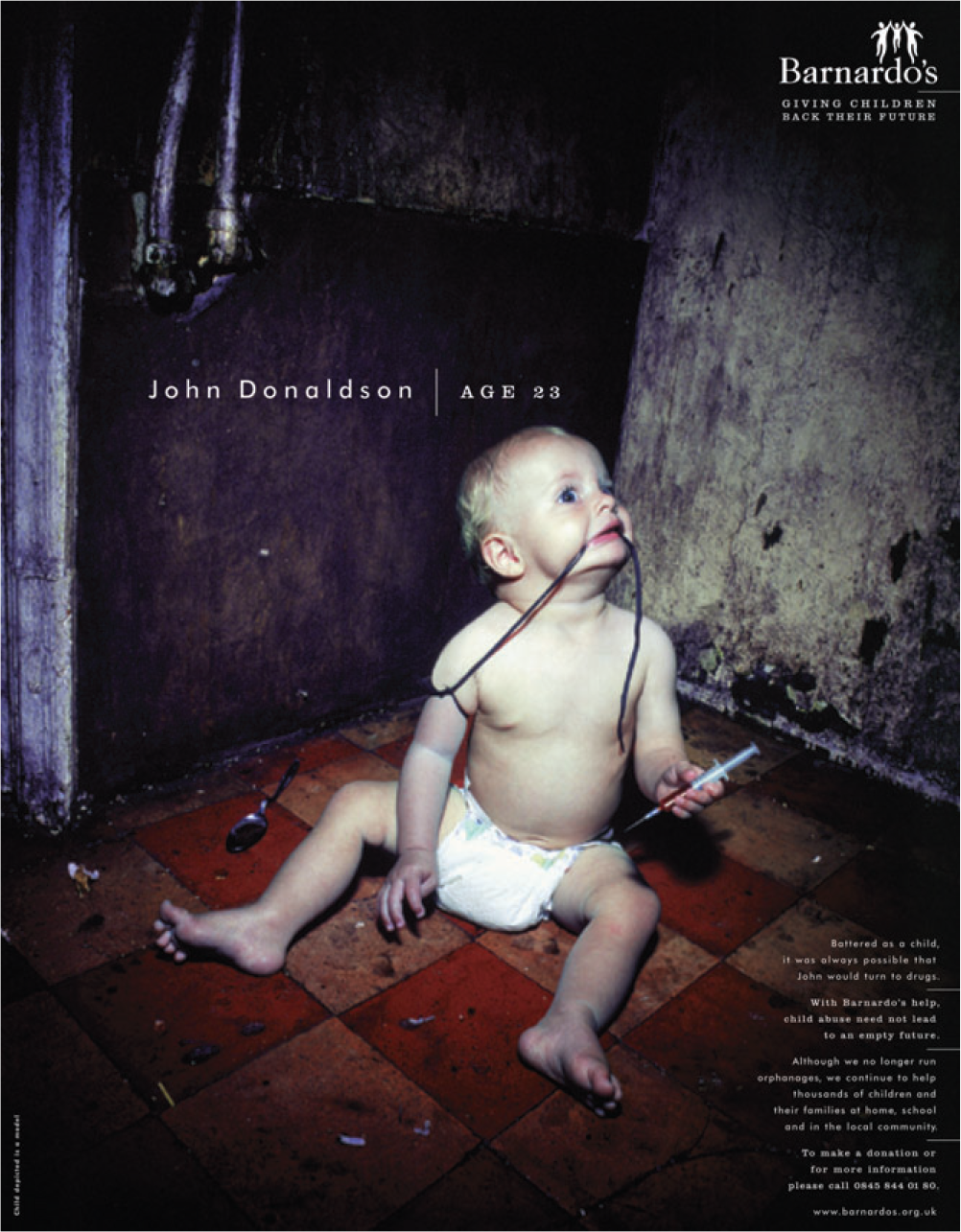
The problem with John Donaldson's personal story does not end here. In Berlant's (1998) account of sentimental politics she argues using personal stories to tell of the structural effects of poverty ‘risks thwarting its very attempt to perform rhetorically a scene of pain that must be soothed politically’ (1998: 641). In the depiction of ‘John Donaldson age 23 – heroin addict – Battered as a Child’ the spectator is unable to see the unfortunate individual's experience of social suffering as ‘different from the causes which are impersonal and depersonalising’ (1998: 641, emphasis in original). What's at stake, according to Berlant, is the political itself. The ethical imperative towards social transformation is ‘replaced by a civic minded but passive ideal of empathy’ (1998: 641). John's story does not make us feel bad about the structural conditions of injustice. The swing to commitment as a political act is ‘replaced by a world of private thoughts, leanings and gestures’ (Berlant, 1998: 641). In the ‘Heroin Baby’ and ‘Silver Spoon’ campaigns this sentimental politics involves the distant spectator's private emotional investment in the child and especially the future of the child. What does it mean for spectators to feel for the child in this way? What does it mean for the distant spectator to ‘give children back their future’? What does it imply for hope to be packaged in this way? I want to suggest this move takes us to the heart of the conservative cultural politics of compassion.
Surprisingly, the ‘Heroin Baby’ advert receives fewer than 33 complaints. Action here is not about speaking out. The Advertising Standards Authority upheld Barnardo's ‘right to circulate an image based on the innocence of a child and potential pain in adult life’ (ASA, cited in Ash, 2008: 180). In this instance Barnardo's attempts to arouse feelings for the future pain of the child (rather than the present suffering of the adult citizen) are deemed legitimate. The image does not appear to produce the same mixed feelings or variety of responses as the ‘Silver Spoon’ campaign. Yet the impact of these campaigns is similar in the sense that the emphasis on the traumatised child does not call for collective responsibility for social change. On the contrary, as Berlant (1997) points out, individuals acting on behalf of traumatised child-citizens distract us from critical engagement with social inequalities. When citizenship is defined in terms of personal acts of ‘giving children back their future’ – rather than public welfare – the distant spectator acts on behalf of the future person conceived of as a child citizen. When compassion involves feeling for vulnerable minor citizens, compassion is rooted in traditional notions of the family. Privately we feel for the child and want to protect its future. In being called on to become the guardians of the child's future the distant spectator becomes a guardian of the nation's future. Compassion which is orientated to the future in this way, according to Lee Edelman, (2004) is always conservative. At the heart of Edelman's critique of compassion is its logic of reproductive futurism which compels the spectator to feel for the child. It is in this context that Berlant (1997: 4) argues ‘the political public sphere becomes an intimate public sphere’. Intimacy is used to distract us from critical engagement with suffering. Intimate privatised citizenship, with its emphasis on a heteronormative familial politics of the national future, involves ‘abstracting the state from its citizens’ (Berlant, 1997: 10). Public intimacy is not simply a distraction from real politics but rather illustrative of the ‘anti-political politics of contemporary conservative culture’ (Berlant, 1997: 10). If images of drug suffering compel the distant spectator to feel for the child it becomes our responsibility to contest compassion and resist the motivation to act for the future in order that we begin the political process of confronting social suffering in the present.
Footnotes
Acknowledgements
Images reprinted with kind permission of Barnardo's and BBU photographer Nick Georghiou.