






Abstract
The relationship between religion and national identity is a contested topic in public debates about cultural diversity and immigration. In sample surveys only a minority the British population identify themselves as belonging to a Christian religion, and far fewer practise their faith. Nevertheless, nearly a quarter of the population think it is important to be Christian to be truly British. This study explores the complex relationships between religious and national identities in Britain, using data from the 2008 British Social Attitudes Survey. Three different forms of national identity were identified through factor analysis: civic-symbolic, cultural-aesthetic and ethnic national identity. Ethnic national identity is the only dimension of national identity that is positively associated with thinking it is important to be Christian to be British. While churchgoing Christians are more likely to feel national in response to secular cultural symbols, they are less likely to associate religion with nationality than those with a nominal Christian affiliation. The results indicate that Christianity has cultural significance for national identity primarily as a proxy for ethnic identity.
Introduction
Despite an abundance of existing literature describing the many connections and similarities between religious and national identification, few empirical studies have investigated the relationship between them (Kunovich, 2006: 437). The shortage of studies of religion and national identity in countries with high levels of secularization is particularly notable considering the reassertion of religious issues in public debates about immigration and multiculturalism in Western Europe. As a country with low levels of religious involvement as well as relatively high degrees of ethnic and religious pluralism, Britain is an interesting country in which to explore the salience of Christianity for national identity.
A theoretical distinction is often made between ‘civic’ and ‘cultural’ nationalism (Smith, 2001: 36). While this dichotomy is a simplification, it points to an important conceptual difference between different definitions of ‘the nation’. In its ideal form civic nationalism is associated with the modern state and French enlightenment (Brubaker, 1992). The civic concept of the nation emphasizes citizenship, residence and political culture as criteria for nationality. Cultural understandings of nationalism on the other hand are primarily associated with German Romantic tradition of Herder and others, who celebrated the nation (or ‘Volk’) as a community of people with a common cultural and genealogical heritage (Barnard, 2003). Religious identity can also take many forms, including active participation in a religious community, private faith and purely nominal affiliation. Since the multidimensional nature of concepts like ‘nationality’ and ‘religiosity’ makes it unlikely that one can find a clear and uniform relationship between them, the purpose of this article is to explore how different forms of national identity relate to religion, and to what extent religion is a salient part of national identity in Britain today.
To describe Britain as ‘religious’ or ‘secular’ is not meaningful without specifying whether this refers to institutions or individual beliefs and practices. While England has an established Church, and there is a national Church in Scotland, this formal institutional religiosity has very little bearing on the life of British citizens (Voas and Day, 2007: 95). The Church of England is still represented by bishops in the House of Lords and its formal ecclesiastical structure is still in place, but the influence of the Church has gradually waned in what Hastings (1997: 51) calls ‘a quietly secularising process’. The 2008 British Social Attitudes Survey shows that less than half of the British population identify themselves as Christian, 1 43 percent regard themselves as having no religion, and 6.7 percent belong to non-Christian religions. Moreover, Britain is not religiously homogenous, nor has it been so for any part of modern history. Methodism, Baptism, Quakerism and other Christian groups emerged and grew independently of the established Churches throughout the period after the Reformation until at least the late 18th century (Beckford, 1991: 179). Catholicism represents another significant minority faith, and since the 1970s, immigration from non-western countries has made Britain more diverse both ethnically and religiously. In particular, immigration from Commonwealth countries in South Asia and the West Indies has increased the number of Muslims, Sikhs, Hindus and Buddhists as well as transforming the Christian population of Britain (Beckford, 1991: 182). As non-Christian religions become more visible, the divisions between Christian denominations seem to have become less salient. Instead, concerns about the cultural and political influence of minority religions may cause some people in Britain to emphasise their Christian identity as a way of distancing themselves from other religious traditions (Day, 2006).
The relationship between religious and national identity is also complicated by the multinationality of Great Britain. Concerning institutional religiosity one could distinguish between British nationalism, which, according to Hastings (1997: 65) is an essentially secular product of the Enlightenment, and English or Scottish nationalism which have historically been closely associated with Protestantism. Nevertheless, Colley (1992: 314) cautions against regarding English, Scottish, Welsh and Irish identities as more fundamental than British identity. ‘Britishness was never just imposed from the center’ she argues. Protestantism was an important forger of British identity from the start because it distinguished Britons from their Catholic neighbours in Ireland and continental Europe (Colley, 1992: 316). A more accurate description should thus acknowledge the inherently ambiguous relationship with religion in all the national identities of Great Britain. While there are important distinctions between English, Scottish and Welsh national identities, the purpose of this paper is to analyse the association between religion and national identities in Great Britain in general, rather than distinguish between the different nationalities.
Three hypothetical relationships between religion and nationality
While this study of religion and national identity in Britain is situated in a particular national context, it must also be grounded in more general theories about the relationship between religiosity and national identity. The historian Adrian Hastings argues that ‘while the role of religion has been far from single-faceted in its relationship to ethnicity and the construction of nations, it has been integral to this wider history, perhaps even determinative’ (Hastings, 1997: 2). We can identify three main ways in which religious and national identities can be seen to intersect and overlap. First, there are structural and ideological similarities between religiosity and national identities. Secondly, religion can be seen as one of several factors supporting a cultural nationalism. Thirdly, religious and national identities can be positioned in a dialectic rather than complementary relationship.
The first point to note is that both the nation and religion are ‘imagined communities’ (Anderson, 1991: 16) in the sense that most of the members will never meet each other, and yet the community is ‘conceived as a deep horizontal comradeship’ (Anderson, 1991: 7) to the point where members are often willing to die for one another. According to Durkheim's (1971 [1915]: 45) classic definition, a fundamental attribute of religion is its capacity to unite the members into a system of mutual obligation, loyalty and social control. The symbols used to represent the nation and religion also have many commonalities. Cultural nationalists often make use of myths to legitimize their cause, typically including a myth of common descent and the memory of a ‘Golden Age’ coupled with a ‘destiny’ to restore former glory (Hall, 1992: 294–5). Use of ritual is also a way of establishing continuity and tradition and of reaffirming these myths of common descent in both religions and nations. Such rituals often make extensive use of symbols connected with family and kinship, for example in ancestor worship and royal weddings. In his seminal essay from 1967, ‘Civil religion in America’, Robert Bellah (2005) argues that American public culture has a number of religious elements such as symbols, myths and rituals, warranting the label ‘civil religion’. The ideological similarities between religious and national identities are supported by studies in social psychology. Both religiosity and nationalism have been found to correlate strongly with certain personality measures, attitudes and values such as conservatism, traditionalism, obedience, intolerance of ambiguity and authoritarianism (see for example Altemeyer, 1981; Jost et al., 2003, Schwartz, 1992). Feeling one's collective identity to be threatened by diversity can result in a religious or nationalistic response. As Kinnvall (2004: 759) points out, ‘religion, like nationalism, supplies existential answers to individuals’ quest for security by essentializing the product and providing a picture of totality, unity and wholeness'.
The second view one might take of the relationship between national identity and religion is to recognize the use of religious symbols and myths for the promotion of cultural nationalism and national tradition. Demerath (2000: 127) uses the term ‘cultural religion’ to describe those situations in which ‘religion affords a sense of personal identity and continuity with the past even after participation in ritual and belief has lapsed’. A related concept, ‘ethnic religion’, is used by Hervieu-Léger (2000: 157) in reference to situations where religious identities (as well as artefacts, buildings etc.) become symbols of national and ethnic heritage rather than faith. Religion may thus be regarded as one of many components of nationality, along with the language, territory and ethnicity (Hastings, 1997: 25; Kunovich, 2009: 579– 60). An example can be found in the Scandinavian countries where, despite the populations being among the most secular in the world in terms of church attendance and religious belief, membership in the state church is considered a tradition and part of the national identity (Bruce, 2000; Hervieu-Léger, 2000: 161). However, ‘ethnic religion’ may also be a reaction against particular circumstances. An example of how religion can become deeply connected with ethnic identity can be found in Northern Ireland, where Catholic resistance to Protestant domination has resulted in a divided society where religious identity is of utmost importance, despite secularisation in the rest of Western Europe (Bruce, 2002: 32). Recent public debates in Europe about the Mohammed cartoon controversy (Cohen, 2009), the building of minarets (Foulkes, 2009) and wearing of religious dress and symbols (Ramdani, 2010), has reintroduced religion as an important field of contention. One way of expressing opposition to minority religious expressions may be to assert one's own Christian heritage.
Thirdly, one could regard nationalism and religion as being in a dialectic rather than symbiotic relationship. Benedict Anderson (1991: 11) argues that nationalism has taken over from religion in modernity. As nationalism and religion are both concerned with collective memory and tradition (Hervieu-Léger, 2000), they both share the function of legitimising unity and power by establishing continuity between the past and the present. Religion is often imagined as ‘the other’ because it is ‘viewed as the opposite of the Enlightenment's principles of rationalism, universalism, secularism, and materialism’ (Kinnvall, 2004: 758). As Özyürek (2005: 510) points out, hostility towards Islam in Europe arises not so much because Muslims are non-Christian, but because in the eyes of the Islamophobes ‘they represent a culture that promotes extreme submission to religion and, hence, does not allow individuals to subscribe to secularist values’.
It should be noted that these hypothetical propositions are not necessarily mutually exclusive, and all three will be considered in the following analysis of the relationship between religion and national identity in Britain.
Data and method
The British Social Attitudes survey (BSA) is conducted annually in Great Britain by the National Centre for Social Research (NatCen). In 2008 the survey included a questionnaire on religion from the International Social Survey Programme (ISSP), which covers the topic of religion extensively and in depth. Moreover, this section was expanded to include questions funded by NORFACE on specific aspects of religion, among them the perceived relationship between religion and national identity.
Another survey module on national identity covers questions on both the civic and ethno-cultural components of national identity, identified in the literature as the most important dimensions of nationalism (Brubaker, 1992; Smith, 2001: 36). The inclusion of both these detailed sets of questions for a sample of 2247 respondents makes the BSA 2008 ideal for the study of religious and national identity in Britain. About half of the items are covered in personal interviews (CAPI) and the other half via a self-completion questionnaire. Those respondents who did not complete the self-completion questionnaire were excluded from the factor and multivariate analyses, leaving a valid sample of 1485 respondents. The sample weight was applied throughout the analysis.
Factor analysis is a statistical technique which investigates whether different observed variables are related to a small number of unobserved latent variables, or ‘factors’. Here it was used in order to identify different dimensions of national identity and to strengthen the reliability of measurement as compared with the observed variables. Because the primary aim was to identify latent variables, factors were extracted by the Principal Axis factoring method (Preacher and MacCallum, 2003: 20). Previous research by Kunovich (2009) into dimensions of national identity in 31 countries included the importance of religion in the factor analysis and found that it was best included in the ‘ethnic’ (as opposed to civic) dimension. As the purpose of this study is to measure specifically the predictors of the importance of Christianity for national identity, the importance of religion is not included in the factor analysis, but rather treated as the dependent variable in a subsequent regression analysis where the extracted factors were included as independent variables This multivariate logistic regression model was used to analyse which forms national identity influence the idea that Christianity is important for being British when controlling for religious, sociodemographic and attitudinal variables.
A Christian nation?
In the context of plural and secular Britain, to what extent do people consider Christianity an important part of British identity? The questionnaire item ‘Some people say that being Christian is important for being truly British. Others say it is not important. How important do you think it is?’ gives an indication of the prevalence of this view. As Table 1 shows, more than 23 percent think it is either very important or fairly important to be Christian to be truly British. In other words, the majority does not think religion is a very important part of national identity, but then this is hardly surprising. Considering that less than half of the British population regard themselves as belonging to a Christian religion, 1 23 percent seems a remarkably large figure. How is it that in spite of secularization and the growth of religious diversity, the association between religious and national identity is not yet dead in Britain?
‘Important to be Christian to be British’ by Christian involvement (%)
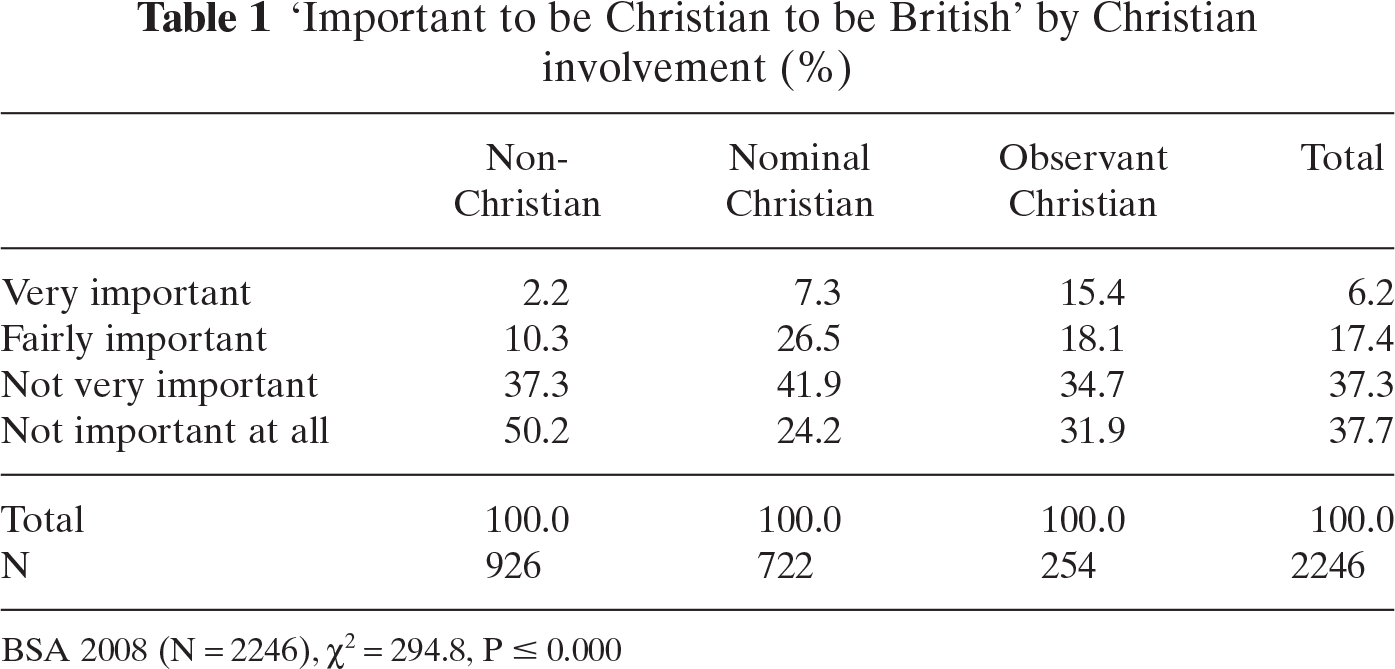
BSA 2008 (N = 2246), χ 2 = 294.8, P ≤ 0.000
It is first important to note that the word ‘belonging’ in the context of religious affiliation is interpreted individually by the respondents and can mean anything from regular practice to a very loose sense of identification with a religious tradition through family or local community. For example 56.2 percent of those ‘belonging’ to the Church of England make an appearance there less often than once a year, which says something about the level of commitment. Less than half of the Anglicans consistently believe in a personal God and 20 percent of them are either agnostics or atheists (the remaining 30 percent either sometimes believe that there is a God or they believe in a ‘Higher power’ or impersonal life force instead). Considering the British population as a whole, 35 percent respond that they consistently believe in God but only 10 percent claim to attend church weekly or more often. It is widely recognized that survey respondents tend to exaggerate their frequency of attendance (Voas, 2009: 419), so the true figures are likely to be somewhat lower than those reported here. It is interesting to note that a sense of belonging is relatively widespread despite the low levels of religious practice. It suggests that nominal adherence to a religion may be a way of identifying with a culture, a set of values or a family tradition, more than it is about actual belonging to a religious community (Voas and Day, 2007; Demerath, 2000).
In order to make the distinction between nominal and active adherents, a composite variable measuring involvement in Christianity was created by combining the variables for religious affiliation and frequency of church attendance. Christian affiliation was measured by combining the responses for ‘Church of England / Anglican’, ‘Roman Catholic’ and ‘Other Christian’. The original variable measuring church attendance which had a range of responses from ‘Never or practically never’ to ‘Once a week or more’, was reduced to a binary variable separating those who attend ‘at least once a month’ from those who attend less often. Church attendance is considered an appropriate measure of religious commitment as it is more costly and time consuming than merely professing personal beliefs. Moreover there are high correlations between church attendance and most other measures of religious practice and belief.
Three categories were created: The ‘non-Christians’ who neither belong to nor attend a Christian Church make up 47 percent of the sample. In other words, about half of the British population identify as Christian. However, among the Christian half of the population, the majority are only ‘nominal Christians’ (36.7 percent), that is they say they belong to a Christian religion but they also report going to church less often than once a month. Less than 13 percent of the population are ‘observant Christians’ who attend church monthly or more often. The proportions of churchgoers are particularly low for those belonging to the Church of England (16%) and Church of Scotland (12%), and higher for smaller Christian denominations. Finally, 3.5 percent of the population responded that they went to Church at least once a month without considering themselves Christians. Because this group is so small and too varied to permit generalization these cases have been included in the analysis but excluded from Table 1 and Figure 1.
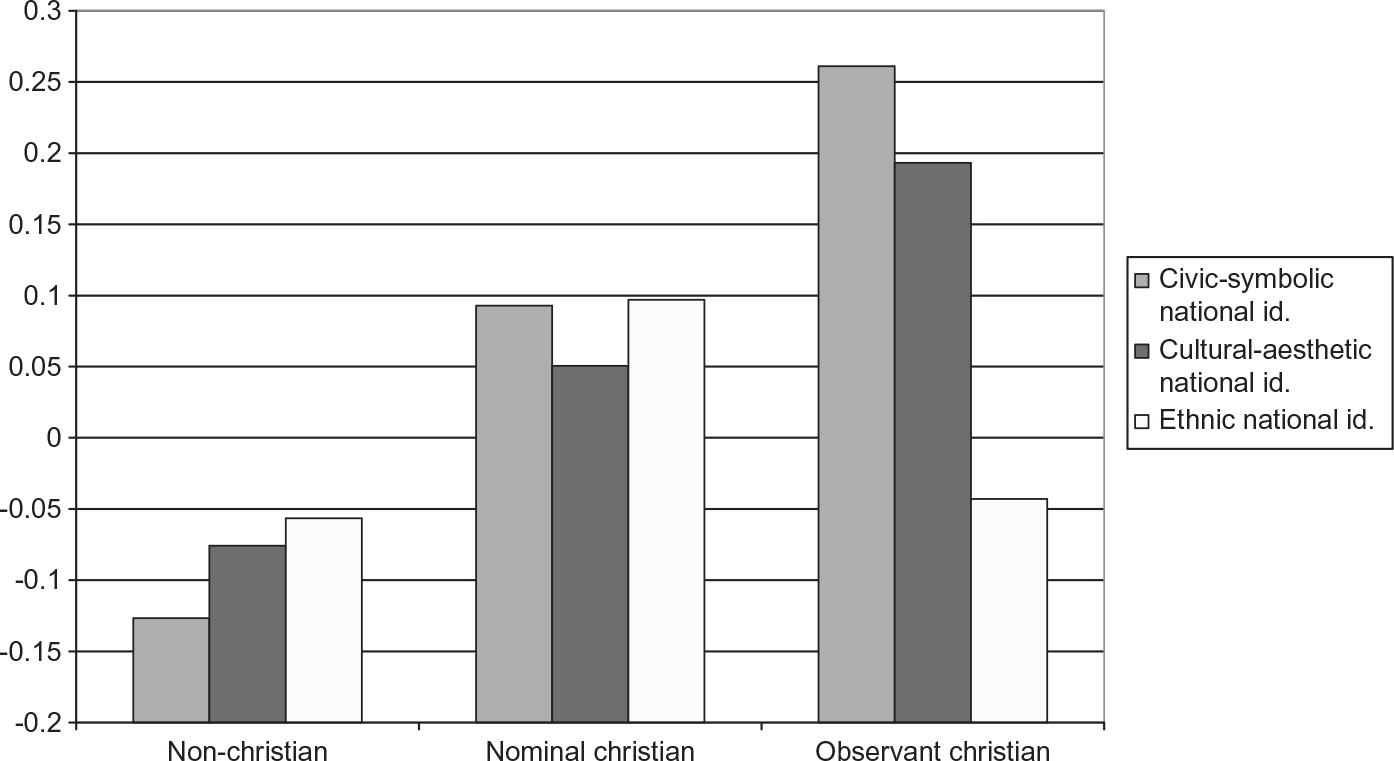
National identity by Religious involvement (Mean values) BSA 2008 (N = 1485)
Cross tabulating these categories with thinking that ‘being Christian is important for being truly British’ shows that the main difference in the prevalence of this attitude is between the Christians and the non-Christian respondents (see Table 1). Even if a surprisingly high percentage (12.5 percent) of the non-Christians think it is fairly or very important to be Christian to be truly British, this is still much lower than the comparable figure for those who identify themselves as Christians. Nevertheless there is very little difference between churchgoers (33.5 percent) and merely nominal Christians (33.8 percent), although a higher proportion of the observant Christians answered ‘very important’. A problem with the question about whether it is important to be Christian to be truly British is its ambiguity. The result thus suggests that a common interpretation of the question is that it asks whether it is important to ‘identify with Christianity’ rather than whether it is important to be an active participant.
Dimensions of national identity
Factor analysis (Principal Axis factoring) was used to identify latent variables from the module on national identity. Eleven variables were included in the analysis. Seven of these were questions about feeling more or less ‘British’ or ‘English/Welsh/Scottish’ 2 in different situations, such as when hearing the national anthem or when the national sports team is competing. 3 Other items that were included in the factor analysis were the importance of national politics and culture to the respondent, as well as two items on immigration and race that were thought to indicate an ethnic sense of nationality. 4
Three factors were retained on the basis of the ‘Kaiser-Guttman criterion’ of retaining all factors with initial eigenvalues above 1. In order to find a simple and interpretable structure, these factors were then rotated. As it is considered likely that different forms of national identity are related to one another, this was done by an oblique rotation method (direct oblimin) which allows the factors to be correlated with one another. The factor loadings after the rotation are shown in Table 2, the pattern matrix shows the unique contribution of each variable to the factors, that is the regression coefficients, while the structure matrix includes the common variance and shows the correlation coefficients. The highest loadings on each factor and by each variable are shown in bold.
Factor loadings
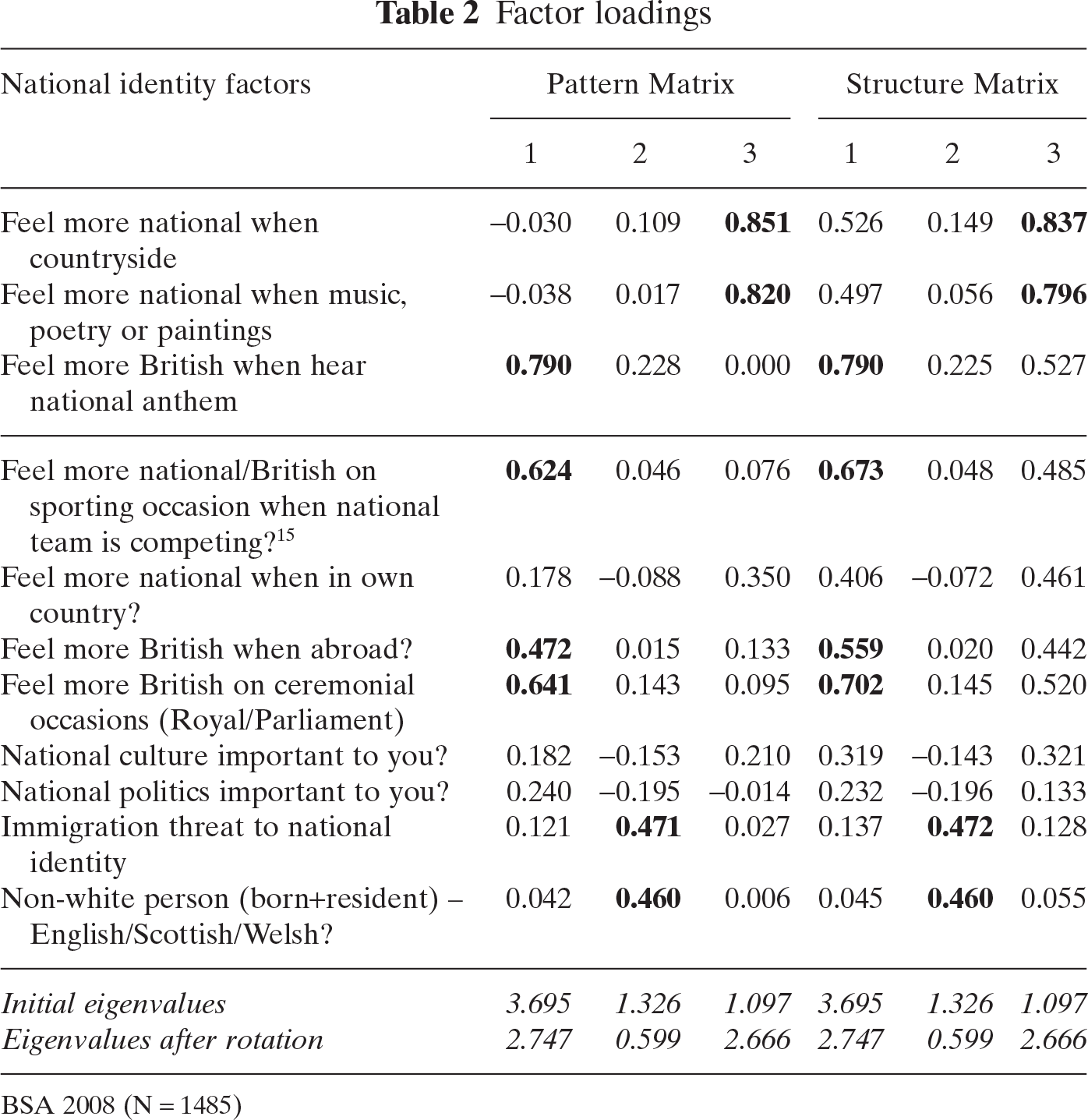
BSA 2008 (N = 1485)
The first factor seems to represent receptivity to national public symbols such as the national anthem, sports teams and ceremonial occasions. These symbols all have in common that they represent a collective vision of the nation, and the public celebration of and fascination for sports (Hervieu-Léger, 2000: 102–5) and royalty (Nairn, 1988: 9) may represent forms of civil religion that inspire feelings of belonging to something larger than oneself. Feeling more British when abroad also suggests a feeling of the nation as a collective unit that the individual remains part of even when geographically absent. Since many of these are symbols of the nation-state, this factor can be labelled ‘civic-symbolic national identity’. The second factor is largely independent of the other two. The two items with high loadings – thinking that immigrants are a threat to the national identity and that non-whites cannot be English, Scottish or Welsh – appear to represent an ethnic or racial understanding of national identity. 5 This factor can be labelled ‘ethnic national identity’. The third factor has high loadings on feeling more national when being in or seeing the countryside or experiencing national art, music or poetry. In contrast to the civic-symbolic national identity, this dimension seems to represent individual lived experiences of the nation that go beyond collective representations to reflect a more personal understanding of nationhood. The relationship between art and nature seems to reflect a kind of national romanticism associated with the early cultural nationalists (Leerssen, 2006: 565). This factor is labelled ‘cultural-aesthetic national identity’.
There is a relatively high correlation (r = 0.653) between civic-symbolic and cultural-aesthetic national identity, which can be attributed to the fact that most of these variables measured feeling more national in various situations. In contrast there is virtually no correlation between ethnic national identity and either civic-symbolic (r = −0.003) or cultural-aesthetic (r = 0.047) national identity. Each form of national identity increases with age and the correlation with age is strongest for ethnic national identity (r = 0.207). This is consistent with Ford's (2008) and Heath and Tilley's (2005) findings that racial and ethnic prejudice is on the decline but one cannot rule out the possibility that it is an age rather than a cohort effect in this instance. There are no significant overall gender differences in type of national identity. Civic-symbolic and ethnic national identity are considerably more prevalent among those identifying as either British or English, whereas the average score on cultural-aesthetic national identity is higher for those identifying as Scottish.
National identity and religious involvement
Controlling for religion reveals a clear contrast between these forms of national identity. Figure 1 shows the mean values of each national identity factor by category of Christian. Civic-symbolic national identity and cultural-aesthetic national identity increase sharply with both Christian affiliation and attendance, and further analysis shows that these dimensions of national identity are positively associated with most variables measuring religiosity, including beliefs in God, importance of religion in daily life and prayer frequency. In contrast to the other two factors, ethnic national identity is highest among those who are only nominally or passively religious and decreases with increased religious involvement. These relationships held when controlling for sociodemographic variables such as age, gender and education. 6
One interpretation of the relationship between nominal Christianity and ethnic national identity is that it is a symptom of ‘ethnic religion’ (Hervieu-Legér, 2000: 157) where religious identities rather than faith become symbols of national and ethnic heritage. Many of the nominal Christians do appear to be what Abby Day (2006) calls ‘ethnic nominalists’, that is they identify with the church or Christianity in order to signal their identity as ‘white British’, and to distance themselves from minority faiths. Churchgoing Christians in contrast have obvious reasons to claim belonging to a religion without it being associated with any other form of identity. When religiosity nevertheless is associated with civic-symbolic national identity this may be partly explained by the similarities between the church and the state. Like the nation-state, religion can be seen as an imagined community of tradition, symbol and ritual. An underlying factor such as conservatism or authoritarian values could be predicting both.
Multivariate analysis
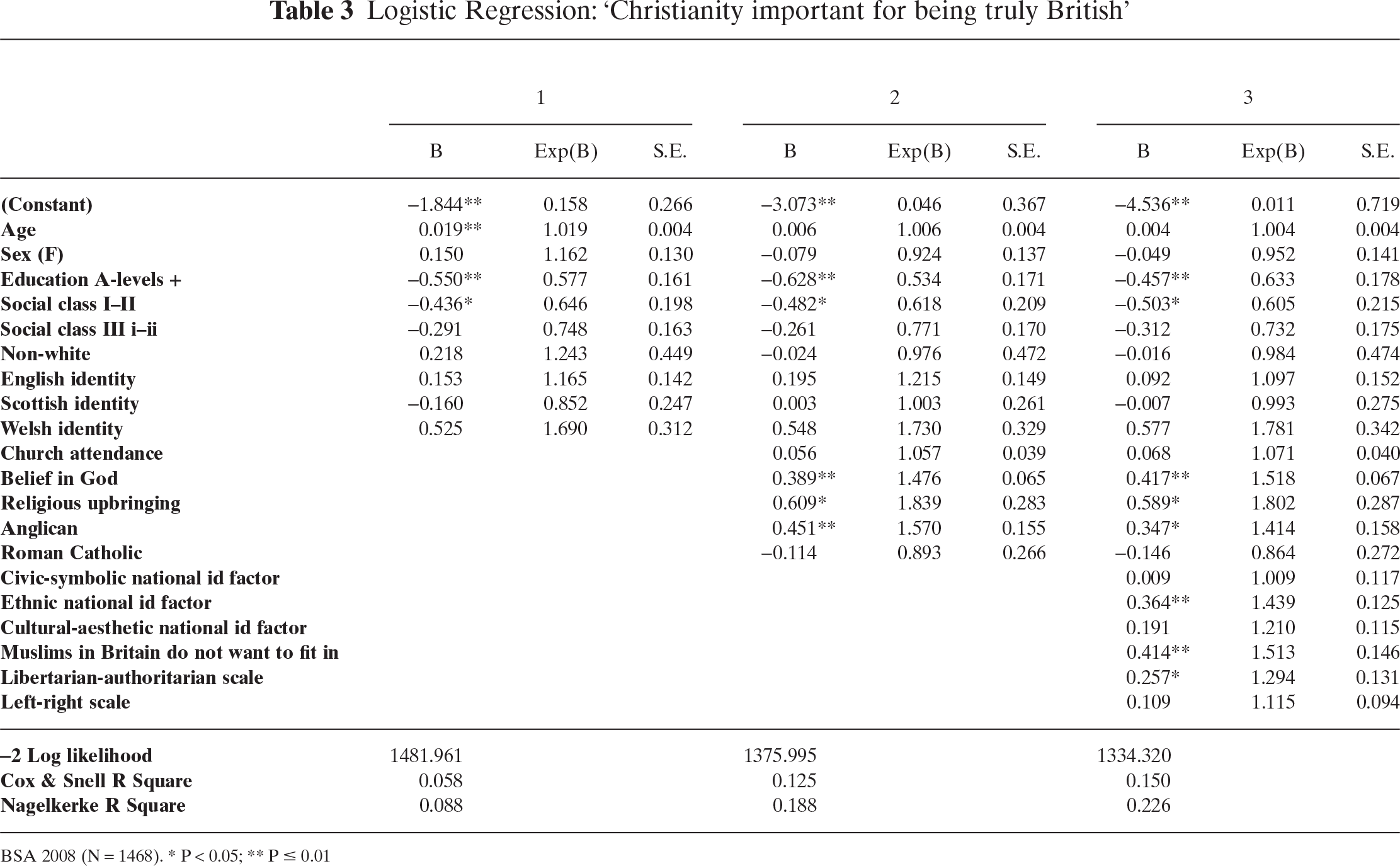
In order to see what effect these different forms of national and religious identity have on the salience of Christianity for British national identity when controlling for background variables, a binary logistic regression model was fitted with ‘Christianity important for being truly British’ as the dependent variable. Logistic regression estimates the probability of an outcome taking place, for each unit increase in the independent variables when all the others are held constant. In this case the outcome is agreeing that Christianity is important for being British. The variable was thus first recoded as a binary variable with ‘fairly important and very important’ as 1 and ‘not very important’ and ‘not at all important’ as 0. The results are shown in Table 3. 7
Logistic Regression: ‘Christianity important for being truly British’
BSA 2008 (N = 1468).
P < 0.05
P ≤ 0.01
The first model controlled for the sociodemographic variables, which included age, gender, education (A-levels, equivalent or higher qualifications), 8 two dummy variables for social class based on the Registrar General's classification: class 1–2 (professional and managerial) and class 3 (non-manual and manual skilled occupations) respectively, using class 4–5 (partly skilled and unskilled occupations) as the reference category 9 and finally a binary ethnicity variable (white / non-white). The first model also included dummy variables for the nationalities English, Scottish and Welsh. The reference group consists of those primarily identifying as British, European, Irish or other.
Model 2 introduces the following religiosity variables: an eight-point scale measuring church attendance, a five point scale measuring belief in God, and a binary variable indicating whether the respondent had a religious upbringing. Dummy variables for Anglican and Catholic affiliation were also included as independent variables. The reference group includes those identifying as non-religious, non-Christian and other Christian. The third model introduces the three national identity factor scores as well as other social attitudes. One of these was disagreement with the statement ‘Nearly all Muslims living in Britain really want to fit in’, which gives an indication of attitudes towards Muslim integration in Britain. The Libertarian-Authoritarian scale, which is a continuous measure made up of six items about the punishment of crime, the authority of various political, educational and legal institutions 10 was included in order to test whether it could be an underlying factor explaining both religiosity and national identity as suggested by the psychological literature on conservatism (Altemeyer's, 1981; Jost et al., 2003). A similar five item scale measuring leftwing political opinions was also included to control for ideological or partisan effects.11,12
Despite its negative relationship with Christian practice, when controlling for background variables, it appears that ethnic national identity is the only national identity factor associated with the view that ‘Christianity important for being British’. This finding is consistent with Kunovich's (2009: 580) factor analysis with ISSP 1995 data from 31 countries, where importance of religion was found to be part of an ethnic dimension of national identity. It suggests that thinking religion is important for nationality may be more a function of associating religion with ethnic background than of any nostalgia for the cultural heritage of religious symbols, morals and institutions associated with civic-symbolic or cultural-aesthetic national identity. In other words the more one regards immigration as a threat to national identity and thinks of race and ethnicity as important for belonging to the nation, the more one is likely to see Christianity as important for being British. As one would expect, people who disagree that most Muslims in Britain try to fit in are also more likely to think Christianity is important for being British, suggesting that concerns about religious minority integration is associated with an increase in religious nationalism, although the causal relationship could go either way.
It is interesting to note that while belief in God has a positive association with the statement ‘Christianity is important for being British’, church attendance has no such significant association. As belief in God has strong correlations with other indicators of Christian religiosity 13 it is not surprising that this variable should be positively associated with a Christian conception of the nation. While there is clearly a difference between thinking Christianity is important in general and thinking it is important to be Christian to be British, it seems unlikely that anyone would hold the latter view without holding the first. What is more curious is that the same is not true for church attendance. This points to a distinction which could be related to the social aspects of churchgoing, between religious practice on the one hand and religious belief and affiliation on the other. Further, those with a religious upbringing were considerably more likely than others to think Christianity is important for being British. Affiliation with the Church of England also has a positive association with thinking it is important to be Christian to be truly British, whereas Catholics are not particularly inclined to hold this opinion. This denominational difference is not surprising considering the historical and current relationship between the Anglican Church and the state.
Valving obedience to authority is also weakly positively associated with thinking Christianity is important for being British. However the introduction of authoritarianism and left-right ideology only slightly decreases the other coefficients. In other words, while authoritarian values or traditionalism may account for some of the variance this is clearly not the whole story. The negative relationship with higher level of education and social class III (skilled occupations) explains some of the variation. The reason there is no apparent effect for social classes I & II is that this is mediated by education. 14 The effect of education is slightly reduced in the third model, suggesting that higher education makes people less likely to have an ethnic national identity, which in turn makes them less likely to think Christianity is important for national identity. No other sociodemographics were significant in the model. Age, which is known to have strong positive bivariate correlations both with religion (Voas and Crockett, 2005) and most ethnocentric attitudes (Ford, 2008; Heath and Tilley, 2005) was not significant beyond the first model. Non-white ethnicity was also not significant and repeating the analysis excluding the 198 non-white respondents makes no difference to the model apart from slightly increasing the coefficient for ethnic national identity. Finally, it makes no significant difference whether one identifies as English, Scottish, Welsh or British.
Discussion
While there are statistically significant associations between religious and national identities in Britain, what is most striking about these associations is not their strength but their diversity. The results lend support to all three hypothetical relationships between religious and national identity that were identified in the first part of this paper. First similarities between religiosity and national identities may explain why civic-symbolic national identity increases with religious involvement. Secondly, among some nominal Christians, religious identity appears to support or serve as a proxy for cultural or ‘ethnic’ national identity. Thirdly, there appears to be a negative relationship between certain aspects of religious and national identity, particularly churchgoing and ethnic national identity.
The two main implications of these findings seem to be first, that there is a fundamental difference between being personally Christian and thinking of the nation as Christian and secondly, that there is little difference between regarding religion and ethnicity respectively as appropriate criteria for nationality. Both Ford (2008) and Scheepers et al. (2002) found that while religious affiliation is positively associated with ethnic prejudice, the more religion is an important part of people's lives the less prejudiced they are likely to be. It is when religion is seen as heritage, tradition and family background that it becomes associated with ethnicity. By implication, for most people who think that it is important to be Christian to be truly British, ‘Christian’ is seen to refer primarily to having a ‘Christian background’ rather than going to Church regularly. Those who interpret the question as referring to regular Church attendance are presumably those most likely to answer ‘no’ to the question, considering that this criterion for Britishness would currently exclude more than half of the population (which would seem a little harsh even for the most fervent defender of the faith). The ambiguity of the question thus means that all exclusive criteria about heritage, whether ethnic or religious, are associated with each other in an ethnic concept of the nation where belonging is dependent on parental or ancestral citizenship and tradition rather than territorial residence.
Reaction against religious minorities is one possible reason why Christianity seems to have cultural significance for national identity primarily as a ‘proxy’ for ethnic identity. Since the late 1970s many politically visible Muslims have begun to define their identity in religious terms, often by privileging religious loyalties to ethnic or national ones (Parekh, 2008: 103). In the West this has been seen not only as a potential hindrance to political and cultural integration of Muslim immigrants and minorities, but also as a profound challenge to the secular nation-state (Parekh, 2008: 113). Anxieties about the Muslim ‘threat’ may lie behind the self-identification as ‘Christian’ among some non-practising Britons who are worried about the effects of immigration. In particular, concern about the integration of Muslims was shown to be significantly associated with viewing Christianity as important for being British. While this could be described as ‘Cultural Religion’ (Demerath, 2000), ‘Ethnic Religion’ (Hervieu-Léger, 2000) or ‘Ethnic nominalism’ (Day, 2006) seems more appropriate labela for a form of religious identification that is unrelated to both religious faith and interests in national cultural traditions more generally.
In light of ongoing debates about the processes of secularization in the West, it is interesting to explore the consequences of such identity constructs for the future of religion. Hervieu-Léger (2000) argues that religious identities can survive in spite of, or even because of, secularization, but that since religion is no longer independently relevant in a modern world where non-observance is an accepted and plausible way of life, this may require that religion serves some ‘non-religious’ function. According to Bruce (1996: 96) ‘modernity undermines religion except when it finds some major social role to play other than mediating the natural and supernatural worlds’. Abby Day (2006) found that many British people identify with a religion based entirely on their traditional connection with it either through their family heritage, their ethnic group or because they identify with the moral values of the religion (Voas and Day, 2007: 104). In other words it is not the otherworldly, transcendent or sacred part of the religion that motivates the affiliation, but the association between religion and other salient identities.
Not everyone identifying themselves as Christian do so for secular reasons, however. In this study, churchgoing Christians were found to be more likely than passive believers and nominal Christians to feel national in response to cultural symbols, but less likely to be ethnically nationalist. They are also less likely than others to find Christianity important for national identity. This raises the question of whether church attendance could promote a more tolerant attitude to religious and ethnic minorities. There is some evidence to suggest that religion may be a way of overcoming ethnic or racial divisions, but it is mixed. Analysing prejudice against ethnic minorities using the British Social Attitudes Survey (1983–1996), Ford (2008: 623) showed, similarly to this study, that affiliation with the Church of England was associated with more prejudice. However, active churchgoers were less likely to have negative attitudes to ethnic minorities. In a cross-national European study Scheepers et al. (2002) similarly found that while overall, religious affiliation is positively associated with ethnic prejudice, the more salient religion is in people's lives the less prejudiced they are likely to be. One possibility is that this association comes from ‘internalizing the tolerant norms of Christian doctrine’ (Ford, 2008: 627). An alternative interpretation is that those who identify with a dominant church, without being actively practising, do so as a way of identifying with an ethnic or national group (Voas and Day, 2007). Supporting this hypothesis, no effect was found for Catholic identification, which is less associated with English national identity.
While both national identity and religion are associated with authoritarianism, this variable only accounts for a fraction of the relationship between them. Ideology measured on a left-right scale was not significant, suggesting that it is wrong to attribute these attitudes and their relationship purely to underlying preference for order and tradition. Nevertheless the positive association between ethnic national identity, Christianity seen as important for being British and authoritarianism, and the negative relationship with educational qualification and, to an extent, social class does lend support to the proposition that this form of identity may be a response to insecurity. One form of insecurity which may be particularly relevant is anxiety about loss of identity and national culture as a result of immigration and the growth of ethnic minority populations. Such insecurities may be inspired by recent real and media-enhanced threats of fundamentalist terrorism as well as reports of human rights violations in the name of religious tradition. Crucially, however, those who fear that national identity is under threat are responding to a question about collective rather than individual identity. In other words the primary concern seems to be a loss of values, symbols and community for the nation as a whole, rather than any threats posed to the individual person. Thinking of Britain as a ‘Christian country’ is one way of ‘imagining the community’ which clearly excludes Islam without excluding non-religious individuals who are considered unproblematically British and thus by definition have a ‘Christian heritage’.
In summary, Christianity does appear to have salience for the national identity of many people in Britain, but this is not a direct consequence of their faith. A view of Christianity as important for being British is frequently coupled with low levels of religious belief and practice, whereas those who regularly attend church are no more likely than others to associate national identity with religion. Instead the attitude appears to be symptomatic of a form of ‘ethnic religion’ (Hervieu-Léger, 2000: 157) whereby religion takes on a symbolic function as a group label to signal cultural tradition and ethnic belonging rather than faith. While this form of identification may be one way in which religion can survive in the face of modernity, it is doubtful whether insecurities about national identity can maintain or increase religious involvement beyond mere nominal affiliation and traditional celebrations.
Footnotes
1
While the 2001 census showed that 71.8 % of the British population called themselves Christian (ONS 2001), this figure has been contested as methodologically problematic (Voas and Bruce, 2004). In the 2001 national census the respondents were asked ‘What is your religion’ with tick box options. In the BSA 2008 the respondent was first asked ‘Do you regard yourself as belonging to any particular religion?’ Only if they answered yes to this were they asked to specify which religion in a follow up question.
2
Because some of these questions asked about Britishness and others about English /Scottish /Welsh (E/S/W) identities, they were not all answered by people who identified as E/S/W but not British or vice versa. Combining ‘British’ with E/S/W specific variables in the factor analysis enabled the study of national identities in Great Britain as a whole.
3
Since hardly anyone felt any less national in any of the listed situations there was an extreme skew in the distribution on these variables. Hence, the original five point scales (from, ‘Feel a lot less [British]’ to ‘Feel a lot more [British]’) were reduced to three point scales (from ‘Feel about the same/less to ‘Feel a lot more [British]’) before the variables were entered into the analysis.
4
All the variables included had Pearson's r correlations above 0.6, and most above 8. The Kaiser-Meyer-Olkin Measure of Sampling Adequacy was 0.819, which is excellent (Kaiser, 1974: 35).
5
One could argue that what these two items have in common is their negative phrasing. However, as these questions were asked in different parts of the survey it is not a case of simple response habituation. Moreover, controlling for general happiness does not alter the results.
6
In a multiple linear regression analysis with civic-symbolic national identity as the dependent variable, a composite measure of religiosity based on factor analysis had B of 0.110 a Beta of 0.112, a standard error of 0.034 and a P-value of 0.000 when controlling for age, sex, education, social class and ethnicity. Similar regressions were carried out for the two other forms of national identity. For Cultural-aesthetic national identity the coefficient for religiosity was non-significant, but for ethnic national identity it was negative when controlling for both sociodemographic and attitudinal variables.
7
Notes for reading the logistic regression table:
8
This was originally coded as a 7 point scale from 0: No qualifications to 6: Postgraduate degree, but was reduced to a dichotomy with A-levels and higher education coded as 1 and O-levels and below as 0. Repeating the analysis with more education categories or as a continuous variable yield similar results.
9
Social class was measured using the Registrar General's scale of Social Class and Socioeconomic groups, from 1: V Unskilled to 6: I Professional. Repeating the analysis treating social class as a continuous variable does not change the overall model results, but none of the social classes were significant as individual dummy variables.
10
For each of the six items the respondent was asked to choose from five responses ranging from agree strongly to disagree strongly: a. Young people today don't have enough respect for traditional British values. b. People who break the law should be given stiffer sentences. c. For some crimes, the death penalty is the most appropriate sentence. d. Schools should teach children to obey authority. e. The law should always be obeyed, even if a particular law is wrong. f. Censorship of films and magazines is necessary to uphold moral standards.
11
For each of the five items the respondent was asked to choose from five responses ranging from agree strongly to disagree strongly. The precise phrasings of the statements were as follows: a. Government should redistribute income from the better-off to those who are less well off. b. Big business benefits owners at the expense of workers. c. Ordinary working people do not get their fair share of the nations's wealth. d. There is one law for the rich and one for the poor. e. Management will always try to get the better of employees if it gets the chance.
12
No Pearson's R correlations among the independent variables was larger than 0.6 and hence multicollinearity should not be a problem. The exception was the correlations between two of the factors from the factor analysis: civic-symbolic and cultural-aesthetic national identity which was 0.752. To control for potential multicolinearity the regression analysis was repeated with only civic-symbolic and only cultural-aesthetic national identity respectively. In the repeated analysis the coefficients were significant, but very small (Beta = 0.023/0.024). In other words the association for both of these are much smaller than for ethnic national identity even when eliminating the effect of colinearity.
13
For example, repeating the analysis with the highly correlated variable ‘importance of religion for daily life’ instead of belief in God yields very similar results.
14
When excluding the education variable from the model, social class I and II had a negative effect of B: −0.683, SE: 0.202, Exp (B): 0.505, significant at the 99% level in the final model including all other variables.
15
The sports item was created by combining two observed variables: ‘Feel more national on sporting occasion when national (English/ Scottish / Welsh) team is competing?’, and ‘Feel more British on sporting occasion when British team is competing?’. For the purposes of this paper these items (which were highly correlated) seemed to measure the same thing since the interest is in national identity in general, rather than in differences between particular national identities.