






Abstract
This article considers the relationship between people and place in the everyday production of the local. Based on empirical research with young people in Russia's far north it offers an empirically substantiated argument that processes of deterritorialization do not necessarily imply the disembedding of people from either the national or the local. Drawing on discursive psychological approaches to the construction of nationhood, the article demonstrates how national and local patriotisms are produced through a post-Soviet project of nationalism and an active programme of flagging the city by the city administration. Through an exploration of the everyday manifestation and articulation of ties between people and place, however, it also suggests some of the limitations to theories of the everyday discursive production of nationhood. Connections to place, it is argued, are not only unconscious or linguistic expressions of discursively produced subjects, but emotional and sensual responses to the material (urban space, nature, climate) and symbolic (hymns, flags, historical narratives) environment. This suggests the need to conceptualize place as a site of the active production and enactment of subjectivity, which is itself not only the product of language and discourse but of experience, affect and ‘matter’.
Introduction
Sociological and anthropological theories of deterritorialization point to the increasing and accelerating mobility (of people, products and practices) and a concomitant loss of territorial roots and the cultural distinctiveness of places (Gupta and Ferguson, 1992). The consequence of a cosmopolitan experience of heightened mobility, migration and virtual community, Appadurai (2003) has argued, is a weakening of the links between people and territories and thus a fundamental shift in cultural reproduction. The ensuing deterritorialization of identities destabilizes the concept of ‘native land’, rendering connection to it a process rather than an essence (Clifford, 1988). This is not to suggest that the ‘national’ has been rendered redundant; while globalization may have made social researchers more sensitive to the dangers of methodological nationalism, the nation-state remains a key factor in the mediation and structuring of flows to which theories of globalization and transnationalism alert us (Pries, 2005). Nor should the ubiquity of ‘global flows’ be seen as necessarily or uniformly empowering. While globally formed media scapes and cultural commodity flows may, in some contexts, enhance local lifestyle repertoires (Kennedy, 2010), it would be wrong to fail to distinguish analytically between observable phenomena (transnational connections, global flows of goods, people and information) and the underlying structures that drive these flows and shape the nature of these movements (Friedman, 2000).
This article contributes to the critical engagement with theories of deterritorialization by drawing on empirical evidence of the continued salience of ties between people and place at national 1 and local level. In seeking to understand the continuing significance of such affective bonds, the article draws on discursive psychological approaches to the everyday production and articulation of ethnicity and nationhood (Billig, 1995, 1996; Brubaker et al., 2006; Dixon and Durrheim, 2000; Fox and Miller-Idriss, 2008a). This approach, which emphasizes the largely unconscious, discursive production of nation, however, is found insufficient on two counts. First, the focus on nationhood comes at the expense of a wider theorization of place capable of explaining the continuing significance of the local as a site of belonging. This is important since, in practice, globalization does not preclude the continuing particularity of place. Indeed, as concrete places become less clearly defined, so ideas of their cultural distinctiveness may become more salient (Gupta and Ferguson, 1992). Thus, rather than thinking of affective poles (typically the nation state) as ‘intraconsistent’ – vertically and hierarchically connected phenomena, this article sees such poles as multiple and rhizomically linked elements of a network (Deleuze and Guattari, 2004). Localities do not fade in significance but become points of intersection where internally generated and external global meanings and interactions merge in ways that are unique to that place (Kennedy, 2010). Localities, therefore, remain important sites of the ‘polarization of matter, inert, living or human’ (Deleuze and Guattari, 2004: 477) and thus also of the active production and enactment of subjectivities.
This raises a second problem with theories of the everyday discursive production of nationhood; a lack of attention to the constitution of subjectivity. Moving beyond the discursive requires an understanding of the subject as something more than the outcome of a complex constellation of textual, material, institutional and historical factors (Blackman et al., 2008). To address this, the article draws on Shields' (1991) understanding of the spatial as a formation of both discursive (ideational, symbolic and linguistic) and non-discursive elements, practices and processes and his notion of ‘imaginary geography’ to show how purely discursive notions of space are transformed into ‘empirically-specifiable’ actions, and gestures. Indeed, the concrete manifestations of connection to place identified in this research are not only unconscious or linguistic expressions of discursively produced national or local subjects, but often emotional, sensual responses to the material and symbolic environment. Understanding the role of such actions and gestures in the production of subjectivity requires both a return to ‘the world as directly experienced’ (Merleau Ponty, 1962: ix) and a conceptualization of subjectivity as the product not only of language and discourse but also of experience (Blackman et al., 2008), affect (Ahmed, 2004) and matter (Deleuze and Guattari, 2004). In this way, it is suggested, empirical attention to the material constellation of locality and the tangible, sensual and emotive experience of it, may enrich our understanding of the production and enactment of subjectivity more widely.
Beyond discourse? People as the subjects of place
There has been growing interest among scholars in how ethnicity and nationhood are produced, articulated and reworked at the everyday level. These works challenge classic understandings of nationhood (and nationalism) as a one-off outcome of macro-structural change (modernization) in which agency is primarily located in an intellectual (political or cultural) elite, which transmits the national idea to the broader population. They argue that nation is achieved, rather, in an ongoing process of the ‘continual “flagging” or reminding, of nationhood’ (Billig, 1995: 8). The production of the nation thus often goes unnoticed; ‘The metonymic image of banal nationalism,’ Billig writes, ‘is not a flag which is being consciously waved with fervent passion; it is the flag hanging unnoticed on the public building’ (1995: 8).
This emphasis on the powerful, and largely unconscious, discursive production of nation has been criticized for suggesting that nationhood is persistently pervasive and not contingent upon human agency (Brubaker et al., 2006; Fox and Miller-Idriss, 2008a: 554; Skey, 2009). Seeking to reinsert ‘ordinary people’ into the process of the construction of nationhood, Brubaker et al. (2006) consider how ethnicity and nationhood, in the western Romanian city of Cluj, are performed and enacted in holidays, commemorations and rituals and through everyday interaction and sociolinguistic practices. This is an important shift because it simultaneously pulls our gaze away from the usual ‘authors of nationalist politics’ to citizens ‘who ordinarily leave no traces in the public record’ (ibid.). Indeed Fox and Miller-Idriss (2008a) argue that contemporary nationhood is ‘the practical accomplishment of ordinary people’ enacted through routine practices of talk, choice, ritual enactment of symbols and consumption by which they give ‘discursive shape and content to their otherwise taken-for-granted understandings of the nation …’ (2008a: 537–9). At the level of the locality, this is recognized in Lefebvre's (1996: 114) understanding of the semiology of the city as a process by which ‘the city receives and emits messages’ and the important role within this of daily life (ways of living and inhabiting the city); in this way the urban becomes ‘the oeuvre of its citizens instead of imposing itself upon them as a system’ (1996: 117).
What is missing from the discursive approach, therefore, is more than the inclusion of ‘the ordinary people’, which is, sociologically, a problematically homogenous category (Smith, 2008). What is lacking is an account of the iterative engagement between people and place in the production of nationhood (or locality) that positions people as the subjects of place rather than the vehicles of its linguistic and discursive production.
Such an account would logically start from Lefebvre's (1991) proposition that space is not the passive locus of social relations and would infer that neither is any concrete place a static structural force acting as a constraint upon agency (Agnew, 1993: 261). Agnew argues, on the contrary, that place should be understood as the site of the reproduction and transformation of social relations. This transformative capacity is, in part, generated by the porous nature of place since the specificity of place is not the product of internalized history but is constructed through the nature of its interaction with other places. Thus place is a dynamic and provisional category, constantly reconstituted ‘by the intersection of ordinary situations, moments, spaces and individuals' (Maffesoli, 1996: 22). This ‘aura’ (ibid.) or ‘sense of place’ (Agnew, 1993: 261) is not only cognitive, therefore, but partly constituted by a sensual engagement with place, which becomes embedded in memory and revealed in embodied and performed place identities. In this way place may be thought of as actualized by agents through a process of the internalization of codes and performative norms (Shields, 1991). An understanding of place, therefore, is not reached solely through ‘reading’ or ‘decoding’ it; codes are part of ‘an interaction between “subjects” and their space and surroundings’ (Lefebvre, 1991: 18).
This is captured eloquently by Bhabha (1994) in his discussion of the production of nation as a process in which ‘the people’ are dually positioned as objects (of a nationalist pedagogy whose authority is rooted in the past) and ‘subjects’ (of the present nation, through which national life is redeemed as a reproductive process).'In the production of the nation as narration,’ he writes, ‘there is a split between the continuist, accumulative temporality of the pedagogical, and the repetitious, recursive strategy of the performative’ (Bhabha, 1994: 146). Edensor (2006: 526–7) takes up Bhabha's (1990) notion of the ‘double time’ of the nation to call for the linear notion of the construction of the nation to be supplemented with attention to ‘the cyclical time of the everyday’. The repetition of everyday routines and habits – everyday performances organized to ‘local’ and ‘national’ rhythms – evoke both ‘a sense of enduring time’ and an intuitive sense of synchronicity with the ‘simultaneous enactions of millions of others’ (2006: 537). This, it is argued here, is important not only because it provides the basis for a sociological understanding of the production of place that can redress the tendency towards ‘historicity’ in the understanding of nation and nationhood (Smith, 2008; Fox and Miller Idriss, 2008b) but also because it implies that the outcome of the engagement between people and place is contested and uncertain.
Thus, to capture the iterative engagement between people and place, we need a notion of subjectivity as the experience of being subjected (the lived multiplicity of positionings) but also as the individual subject holding together and acting upon these positions (Blackman et al., 2008). Goffman's notion of the performative self provides an early account of the subject as situationally defined rather than the stable outcome of social forces (Goffman, 1990; Elliott, 2001). However, it is only with postmodern understandings of subjectivity that the self becomes characterized as acutely emotionally receptive, self-reflexive and tolerant of ambivalence and ambiguity (Elliott, 2001: 149). In the late modern context, Maffesoli (1996: 138) suggests, ‘egocentric’ cultures may be displaced by ‘lococentric’ cultures and ‘losing oneself’ in the mass of others is experienced as liberating. This is not to suggest that subjectivity should be understood as wholly decentred, however, for this elides the question of how we account for the affective ties accruing to the ‘crowd’; that feeling of ‘unicity’ (1996: 19). Ahmed's (2004: 117) theorization of affect is illuminating here; emotions, she suggests, are not private things but ‘play a crucial role in the “surfacing” of individual and collective bodies through the way in which emotions circulate between bodies and signs’. Ahmed's argument is that these emotions, through their very intensity, ‘stick’ together individuals and communities – bodily and social space – thereby creating ‘the effect of a collective’.
The recognition of the role of affect in the production of the subject is particularly important to the empirical study of patriotism addressed here since emotions – love, pride, respect, sacrifice – are central to expressions of belonging to nation or locality. As Ahmed (2004: 121) notes, the circulation of signs of affect shapes the materialization of collective bodies. While, in the case of post-Soviet Russia, patriotic sentiment has been understood primarily as a state-driven and instrumentalist attempt to construct social consensus and encourage young people to complete military service (Laruelle, 2009; Sperling, 2009), nonetheless the continued dominance within patriotic education programmes of the memory of ‘the Great Patriotic War’ (World War II) draws heavily on the accumulated affective value of that experience from Soviet times, providing, according to Oushakine (2009: 53) ‘an emotional anchoring point necessary for producing a feeling of solidarity’. This leads Oushakine to disembed patriotism from place altogether; communities in post-Soviet Russia, he suggests, are created neither at national nor local level but through sharing losses and recreating and reproducing militarized identities in the form of a ‘patriotism of despair’ (2009: 199–201).
This article traces and conceptualizes the relationship between people and place in the everyday production of the local. It adopts the fundamental premise of discursive psychological approaches, which suggest that nationhood is not ‘given’ but ‘accomplished’ through everyday cultural practice (Billig, 1995; Fox and Miller-Idriss, 2008a). In applying this understanding empirically, and in relation to locality rather than nation, however, Shields' (1991: 7) notion of ‘imaginary geography’ is mobilized. This establishes a clear process by which ideational, symbolic and linguistic notions of space – commonly held ‘place-images’ that describe the experience of places – are transformed into ‘empirically-specifiable’ actions taking the form of a ‘place-’ or ‘space-myth’ (1991: 60–61), which both positions subjects and renders them the subjects of place. Finally, it considers how collective bonds and ties are generated from individual, diverse, experiences of place. At the ideational level, this is traced through the establishment of images and myths of place as insider stories, or ‘yarns’ (1991: 262) that mark out members of a community. The emotions circulating between signs and bodies, however, are also shown to be central to the formation of the subject and communicative interaction, providing the affective ‘glue’ of communities.
Method and context
The article draws on empirical research in Russia conducted under the auspices of the AHRC-funded ‘Russian National Identity: Traditions and Deterritorialisation since 1961’ project into young people's articulations of ‘patriotism’ in the context of more than a decade of government programmes of ‘patriotic education’ in the contemporary Russian Federation (Gosudarstvennaia programma ‘Patrioticheskoe vospitanie grazhdan rossiiskoi federatsii na 2011–2015’, 2010). In Western social science literature, ‘patriotism’ has little more than a bit-part in the academic discussion of the everyday production of nationhood. In contrast, ‘patriotism’ features centrally in academic discussions of nationalism and public debate about the nation in post Soviet Russia as consecutive post-Soviet regimes have sought to foster what Laruelle (2009: 153) calls the ‘patriotic brand’ in a project of nationalism that might construct social consensus. This patriotic agenda, Laruelle argues, is focused on the rehabilitation of fatherland symbols and institutionalized historical memory, the instrumentalization of Orthodoxy for symbolic capital, and the development of a militarized patriotism based on Soviet nostalgia (ibid.). The attempt to foster patriotism from above has been codified in three major state programmes of ‘Patriotic Education of the Citizens of the Russian Federation’ instituted for the periods 2001–2005, 2006–2010 and 2011–2015. These programmes – which are heavily dominated by classic Soviet-style pedagogic activities such as museum exhibitions, military-patriotic clubs and competitions and the promotion of amateur military equipment and re-enactment groups – have been widely interpreted as confirming that the post-Soviet Russian regime has set ‘militarized patriotism at the center of its patriotic education’ (Sperling, 2009: 257).
There is of course a strong pragmatic motif in the centrality of the military to patriotic education in post-Soviet Russia; the drive to encourage young people to complete military service. However, Laruelle argues that there is something more than instrumental and ‘statist’ invocations in the post-Soviet campaign to raise patriotic sentiment. As early as 1999, Vladimir Putin argued for a bottom-up rather than top-down patriotism and explicitly defined patriotism as a set of values rather than an ideology and thus as individually rather than collectively experienced and enacted (Laruelle, 2009). Moreover, Laruelle highlights Putin's conscious invocation of the link between individual and national achievement during the 2007–2008 election campaign as he sought to engage young people in particular through slogans such as ‘Believe in Russia, believe in yourself’ (2009: 142). Nonetheless, she concludes, the state programmes of patriotic education continue to posit the individual first and foremost as subject of the state rather than citizen (2009: 180). In the context of this academic and public debate, the primary aim of this part of the wider research project was thus to understand the meanings young people themselves attach to ‘patriotism’.
The research was designed as a mixed-method study comprising a survey (n = 1500) and in-depth interviews (n = 80) with young people aged 15–20 years of age in the Russian cities of Vorkuta (October 2007) and St Petersburg (April–May 2008). This article, however, draws only on the research findings from Vorkuta, as well as visual materials from research visits to that city in 2006 and 2009. In Vorkuta a total of 527 survey questionnaires were completed and 31 interviews were conducted. The survey was based on a quota sample rather than a simple random sample to facilitate the overall mixed method design of the research, which proposed the recruitment of volunteers for interview following completion of the questionnaire. The target population was narrowed therefore to 15–20 year olds attending schools, colleges and universities. The stratification criteria employed in the survey sample were: type of education establishment; year of study; and gender. All higher, secondary specialized and vocational educational institutions were listed based on information provided by the regional education authorities on educational establishments in Vorkuta (including those outlying mining settlements where schools remained open). A sample of institutions was selected taking into account their type and sphere of specialization (humanities, natural sciences, technology). In general educational establishments ninth, tenth and eleventh year classes were selected while in higher and secondary specialized institutions students from first and second years participated. Particular classes were selected bearing in mind the criteria of gender representativeness (a particular issue in the selection of vocational colleges and classes).
Anonymous questionnaires were self-completed within classroom settings but in the absence of teaching staff. Following completion of questionnaires, volunteers were recruited for participation in semi-structured interviews, which were conducted on a one-to-one basis either on site (in corridors or empty classrooms) or at a mutually convenient time and place after the end of the school day. The semi-structured interviews allowed greater informality and exploration of the themes of the questionnaire and comprised a range of question designs including photo elicitation and requests to respondents to draw and talk through their family trees. The interviews were conducted, transcribed, coded and analysed in Russian. Following the ethical protocol of the project all names of respondents have been changed to protect anonymity.
Vorkuta is a mono-industrial city in decline with rapid and chronic outmigration (the population peaked at around 180,000 in 1991 but at the time of research was around half that figure) and a history steeped in Soviet planning and forced labour. The case of Vorkuta is particularly interesting given that much of the contemporary literature on deterritorialization draws on the experience of displaced, diasporic, migrant or other highly mobile communities. Vorkuta, in contrast, is a city located territorially, socially and culturally on the margins of post-Soviet Russia whose inhabitants have physically and materially limited scope for mobility. The city lies at the northern tip of the Urals Mountains, within the Arctic Circle, and has no road connections to other towns. Having its origins in the Gulag system, the original population of Vorkuta consisted of professional criminals, political prisoners, dispossessed kulaks, ordinary people convicted of petty theft or poor labour discipline and an ethnically diverse range of prisoners, many from newly occupied Soviet republics and deemed to be Nazi-collaborators, as well as German prisoners of war (Scholmer, 1954). Over time the city's population was supplemented by friends and relatives who followed prisoners to their place of exile and, by 1951, the city had 70,000 inhabitants (Applebaum, 2004). After the camp closed in 1962, the city was populated, and its mines worked, by young specialists who were attracted to the region by the high salaries and early retirement rights offered to workers in the extraction industries but also by exotic images of the Russian north. While almost all had intended to stay in the city only temporarily, many remained as they found it difficult (materially or psychologically) to leave a place that had, involuntarily, become ‘home’. Thus, in contrast to what one might expect from its territorial isolation, the ‘yarns’ that mark out the community of Vorkuta are rooted not in the local and indigenous but in diversity and translocality. In this sense Vorkuta embodies a particular Soviet -style ‘deterritorialization’ from above in which local subjectivities reproduced rhizomic translocal Soviet identity – especially via the celebration of contributions to Soviet economic development and security – as much as they shaped any rooted, local identity (Pilkington, 2012).
‘There's nothing to be proud of here’: the desynchronization of local and national belonging
Notwithstanding processes of globalization and deterritorialization, research in Vorkuta suggests the continued salience of both local and national identities. Survey data showed that the majority of young people expressed a sense of belonging to their home city, which they were prepared to articulate as ‘patriotism’, 2 although more felt themselves to be patriots of Russia (72.7 per cent) than of Vorkuta (62.3 per cent). Few held negative emotions towards Vorkuta, although less than half (43.1 per cent) felt ‘pride’ in their home city. A significant minority – one in four – of respondents declared themselves ‘not patriots’ of their city.
These data suggest that deterritorialization has not ruptured ties between people and place. Interview data, however, give a better sense of how the reproduction of the local has been rendered profoundly problematic in the post-Soviet period as young people struggle to map what is imagined as an appropriate object and expression of patriotism onto the locality of Vorkuta. For Lesha, for example, Vorkuta as ‘place’ constrains the potential for affective ties:
Respondent: I'm not a patriot of the city. I might be a Russian patriot but not a patriot of the city.
Interviewer: Why's that? Explain.
Respondent: This city doesn't evoke that kind of … it's not the kind of place you'd want to spend your whole life. I think you can only love a city that you are prepared to live in your whole life. But the conditions in Vorkuta are quite tough. So, for that reason, I'm not a patriot of my city. (Lesha, 21 years)
Here it is writ large that space is a ‘social product’ (Lefebvre, 1991: 26). 3 Itself a manufactured product of the Soviet system – carved out of the tundra for the sole purpose of resource extraction – in post-Soviet market conditions Vorkuta is gradually shutting down, its mines closing, its people leaving. The profound transformation of economic and social production that has engulfed the city has unhinged the very spatial practices that ensure cohesion and continuity in the social production of space in particular locations (1991: 33). The local subject is destabilized by the materiality of place; individual spatial competencies are undermined and their performances rendered uncertain.
The insecurity of the local subject is entrenched at the ideational level too in the form of a mismatch between the production of national subject (embodied in the new patriotism discourse at national level) and the local subject (deeply invested materially and symbolically in the Soviet veneration of proletarian labour). This is reflected in survey data where, in response to a pair of open questions in which respondents were asked to name events in the country's history that people could be ‘proud’ or ‘ashamed’ of, Vorkuta respondents cited iconic Soviet achievements as sources of pride and the collapse of that system as the country's greatest ‘shame’. Thus more than two-thirds (68.1 per cent) of respondents cited the Great Patriotic War (the ‘defeat of fascism’ or ‘victory over Germany in the Great Patriotic War’) as a source of ‘pride’. The second most frequent source of pride related to a range of national sporting victories (19 per cent) and third place was given to events related to the Soviet space programme (15.7 per cent). The greatest source of ‘shame’ was ‘the crisis of the 1990s’ and the connected collapse of the USSR (11.9 per cent) followed by the aftermath of that collapse, namely current socio-economic difficulties, corruption and violence (8.4 per cent). 4
The ‘new’ Russia's national pride has little place for Vorkuta's local subjects. It is rooted in gas and oil not coal, globally connected financial players not local proletarian heroes, and a reassertion of great power status rather than the exposure of, and reconciliation with, the brutal side of the Soviet regime. This is revealed empirically in a lack of synchronicity between imagined symbols of national pride and the place-myths associated with Vorkuta that makes it difficult for young people to ‘nest’ comfortably their local and national subject positions. This is articulated in the following explanation by Boris as to why he can say unequivocally that he is a ‘patriot’ of Russia, but is uncertain about his feelings towards Vorkuta:
What could be patriotic? There's nothing to be proud of here. Just of the mines really, just that, just of the mines and the coal, there's nothing else to be proud of really. Only of the miners and that's it. (Boris, 18 years)
Thus, it appears, there is a significant disjuncture between the rhythms of the reproduction of local and national subject. That which Vorkuta embodies at a local level – the feats of Soviet planning, heroic labour – are part of the Soviet system that is understood externally as ‘shameful’, thus depriving young people in Vorkuta of any connecting thread between local and national ‘pride’.
‘Flagging’ the city: civic authorities, symbols and local pride
Just as nationhood is not ‘given’ so too local subjects are produced via routine thinking, talking and ‘the embodied habits of social life’ (Billig, 1995: 8). In Vorkuta the discursive production of the local is visible and tangible in the ubiquitous ‘flagging’ of the city by civic authorities whose symbolic markers –the city flag, emblem (coat of arms) and anthem – are embedded in respondents' minds. The most memorable of the city identifiers for respondents is its emblem, picturing a reindeer leaping across a mine (still adorned with the Soviet symbol of the Red Army, the red star) and epitomizing the juxtaposition of natural environment and modernizing human endeavour that the city embodies (see Figure 1).

Vorkuta city emblem
In Vorkuta, the local administration did not rely on ‘unnoticed flags’ (Billig, 1995) to inculcate a sense of belonging; it actively promoted identification with the city. Thus Tanya explains how in primary school they had learned the Vorkuta hymn by heart and, perhaps not surprisingly given the bleak and raw quality of its lyrics, it had remained seared in her memory:
Respondent: … I know the Vorkuta hymn by heart because a lot of time was devoted to it in early years and we even learnt it and sang it at concerts.
Interviewer: Can you recite it, or sing … ?
Respondent: … [sings] ‘… on a boundless stretch of fields, amidst the tundra, swamp and stone, the cold arctic night, your heart beats an alarm, the alarm of the past, returning to those years long ago and, as your soul freezes again, you feel the suffering and blood. Vorkuta, Vorkuta, city with a hard and cruel fate, forever our lives are wed to you Vorkuta, you fly through the years, no thought of comfort or peace, and the miners leave for battle, for it is a battle, for you, for you, city of mine!». Then there's a second and third verse even … (Tanya, 17 years)
Vanya (19 years) noted that the hymn could be heard at all public events while Vova (18 years) described how it was played from the City Council building every hour. This localization of time might be usefully compared to what Edensor (2006: 529) describes as the process by which national synchronicity is imprinted on the day and the week by television schedules.
The local administration has sought not only to imprint local identity on young people passively, however, but to encourage their active engagement with maintaining and improving the city. Indeed the former city mayor, Igor’ Shpektor (see Figure 2), had become a veritable ‘place-myth’ in his own right; Galya (18 years) claimed he had personally, ‘raised the city from the dirt, [he] dragged people from the rubbish bins, out of depression …’. This identification of the city authorities as a site of local pride was present in 25 of 31 narratives of home city provided by respondents in interview and was articulated via two dominant narratives. The first relates to the material and cultural impact the former mayor had had on the city. The simple act of painting buildings or stringing up lights along the road, for example, had a tangible, sensory impact for Zhenya, rendering the long, dark winters bearable:
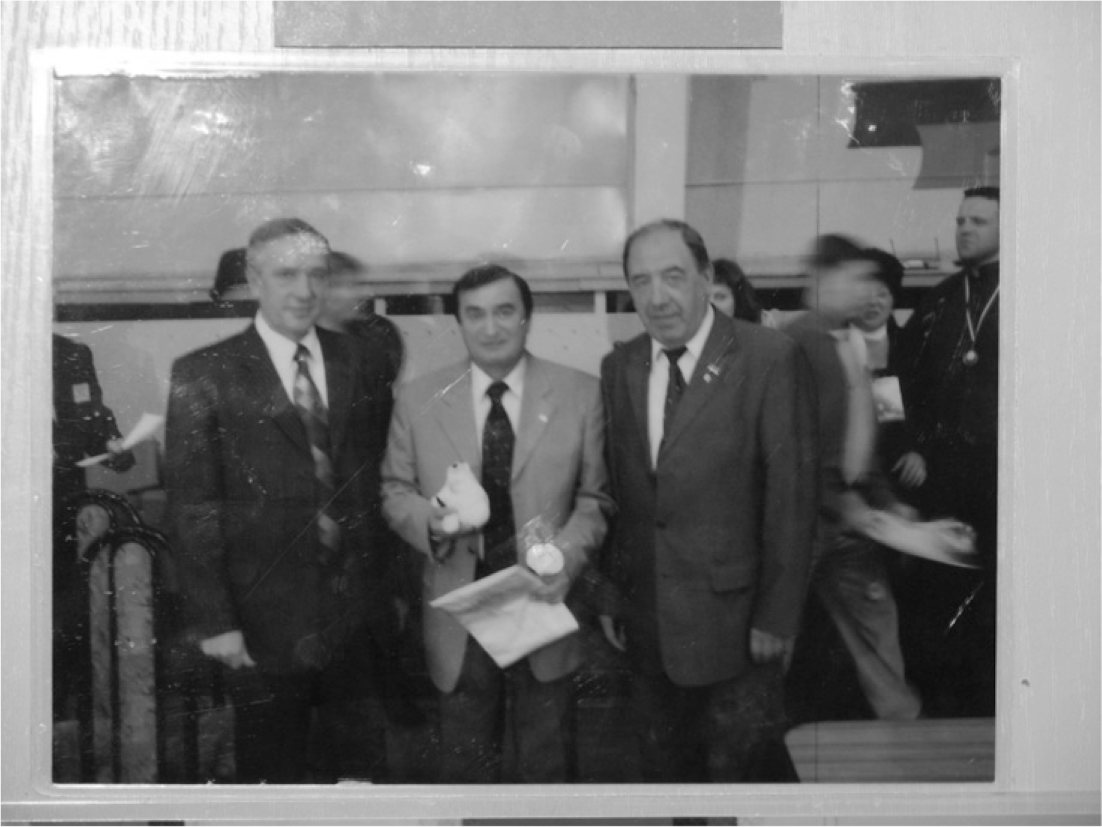
Igor' Shpektor (right) on photo displayed in the youth sports club Gorniak (Photo by Hilary Pilkington, 2006)
Respondent: Yes, because when you arrive, take Arkhangel'sk, for example, when you come out of the station, you see a grey sky, grey houses – they all merge into one. But here, when you arrive, first of all, the station, yeah? It's red, yellow and white, you can see it, and when you leave the station … when you go down Lenin Street there's a bit of blue, a bit of red, some yellow …
Interviewer: You mean this kind of … erodes that sensation?
Respondent: Yeah, yeah. And in winter, for example, when it gets dark early … we have four hours [of daylight] per day in December, from 9 in the morning until 1pm, sometimes only till 12 … And you go down Lenin Street … and there are lights hanging along it and all the trees are threaded with lights and you don't even notice when it gets light, whether it's day or night. (Zhenya, age not known)
Grisha also notes that the city had been ‘grey’ and had nowhere for young people to go until Shpektor came to power and began improving the city's squares and parks, renovating derelict houses and opening large retail outlets. Moreover, he had involved young people themselves in projects such as local tree planting and painting (Grisha, 20 years), thereby giving them a direct investment in the process.
The second narrative emanates from those respondents who believed the former mayor had made a direct, personal intervention in their lives.
… I really love Igor' Leonidovich Shpektor, our former mayor, because he is simply an amazing person … I think that it was he who taught our Vorkuta youth their patriotism. I am an extreme product of this. [Laughs] … Shpektor just showed people its uniqueness. Before that people just didn't recognize this in the city but he showed everyone that the city is unique. (Galya, 18 years)
The former mayor prided himself on personally knowing every young person in the city and on encouraging their active civic participation and this is reflected in stories recounted by respondents of their own personal acquaintance with Shpektor and a sense of being made to feel special by him.
The former mayor thus provided a physical, human, emotional focus for the expression by respondents of their relationship to the city. This sentiment, moreover, was not naive; respondents were aware that close connections with the local administration came with obligations. Tanya, who had been ‘picked out’ by the former mayor as a musical talent, described how she was regularly contacted by members of the local administration and asked to get involved in local programmes and activities organized by the Presidential party's (United Russia) youth organization Molodaya Gvardiya (Young Guard). Moreover, many respondents combined genuine respect for what they perceived as Shpektor's achievements with a clear recognition of his failings, especially his alleged widespread misappropriation of local government money and materials (Lida, 17 years; Anton, 16 years; Lesha, 21 years; Slava, 18 years).
‘Place-myths’ and ‘yarns’: imaginary geography and local subjectivity
Understanding how local subjectivities are forged actively and experientially, rather than unconsciously and discursively, is facilitated by reference to Shields' (1991: 7) notion of ‘imaginary geography’ of place. Imaginary geography, Shields suggests, frames both perceptions of place and our relationships with those perceptions. This is evident in the way it shapes both external place-images and place-myths but also insider ‘yarns’ that help forge a sense of local community. The role of imaginary geography is explored here via three routinely recounted place-myths that illustrate the complex relationship between expressions of self as local and national subjects among young people in Vorkuta.
Respondents nested their expressions of local and national belonging most comfortably when recounting Vorkuta's role in the Great Patriotic War. Vorkuta's coal, for example, was perceived as having been vital to the war effort, providing essential energy for the Soviet armaments industry (Anton, 16 years). Respondents' most vivid articulations of this place myth, however, concerned the help Vorkuta rendered Leningraders during the blockade. Thus Vova (18 years) declares, ‘Leningrad survived the blockade thanks to Vorkuta. And at one time in Leningrad there was a Vorkuta Street, named in honour of the city of Vorkuta.’ Lyuda also exudes pride in the fact that Vorkuta sacrificed its own welfare to help the people of Leningrad:
… When all this turmoil happened and Leningraders were dying, eating one another. It was an awful time. It was terrible. Vorkuta sent its people, its provisions… . (Lyuda, 17 years)
The continued centrality of the Great Patriotic War to the post-Soviet institutionalization of historical memory and patriotic education ensures that this place-myth allows a sense of oneself as a national and local subject to coalesce unproblematically and be rendered into an insider ‘yarn’ that marks community membership.
The other major historical association with the city – its Gulag origins – in contrast, constitutes an important external place-myth with which young people find it more difficult to identify. The city was described as a ‘prison-city’ (Sanya, 19 years), or as having developed out of ‘camps’ (Petr, 17 years) or the Gulag system (Lena, 20 years; Lesha, 21 years; Galya, 18 years; Valera, 20 years). However, the most recurrent place-image is of a city ‘built on human bones’:
I just know that our city was built on human bones. When Stalin was still in power, he sent various people here and forced them to lay the [railroad] tracks here. They died and they weren't even buried, they were just left there and houses and roads were built right on top of them. So the city is literally built on corpses. When I found out about that, I was in total shock. My Mum told me. (Polina, 17 years)
I know that Vorkuta used to be bigger than it is now and was built on human bones. Here there were massive Gulag camps in which people perished in their hundreds. There are a lot of stories of how, when construction began, whole human bones were dug up … (Lesha, 21 years)
The fact that this place-myth remains an external one is evident also in the natural impulse to silence it. This was articulated by Lyuda as she recounted her experience of having been struck out of an inter-city patriotic education competition for schools for failing to answer the question, ‘Do you know what your Vorkuta is built on?’, because she didn't think it reflected well on the city (Lyuda, 17 years).
A third key ‘place-myth’ centres on the city's mining heritage, whose iconography is ubiquitous (see Figure 3). The city was universally known by respondents to have been founded on the location of coal; the geologist who first discovered coal there, Chernov, was one of the few ‘local heroes’ named by respondents.
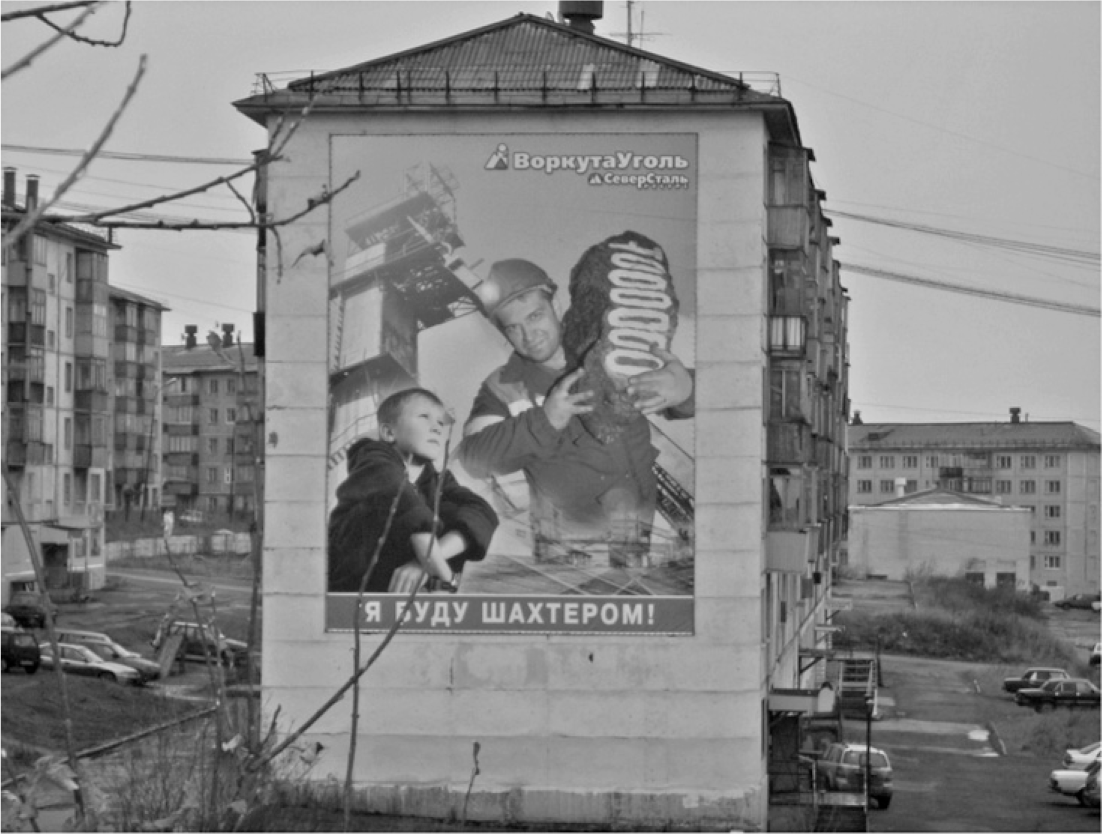
Vorkuta Coal poster: ‘I'm going to be a miner’ (Photo by Al'bina Garifzianova, 2009)
The city's past, present and future are identified with its mining heritage (See Figures 3 and 4) and national Miners' Day is appropriated as a city holiday (see Figure 5), which is described by Misha (18 years) as ‘the most significant day in Vorkuta’ and ‘probably celebrated more than New Year’.
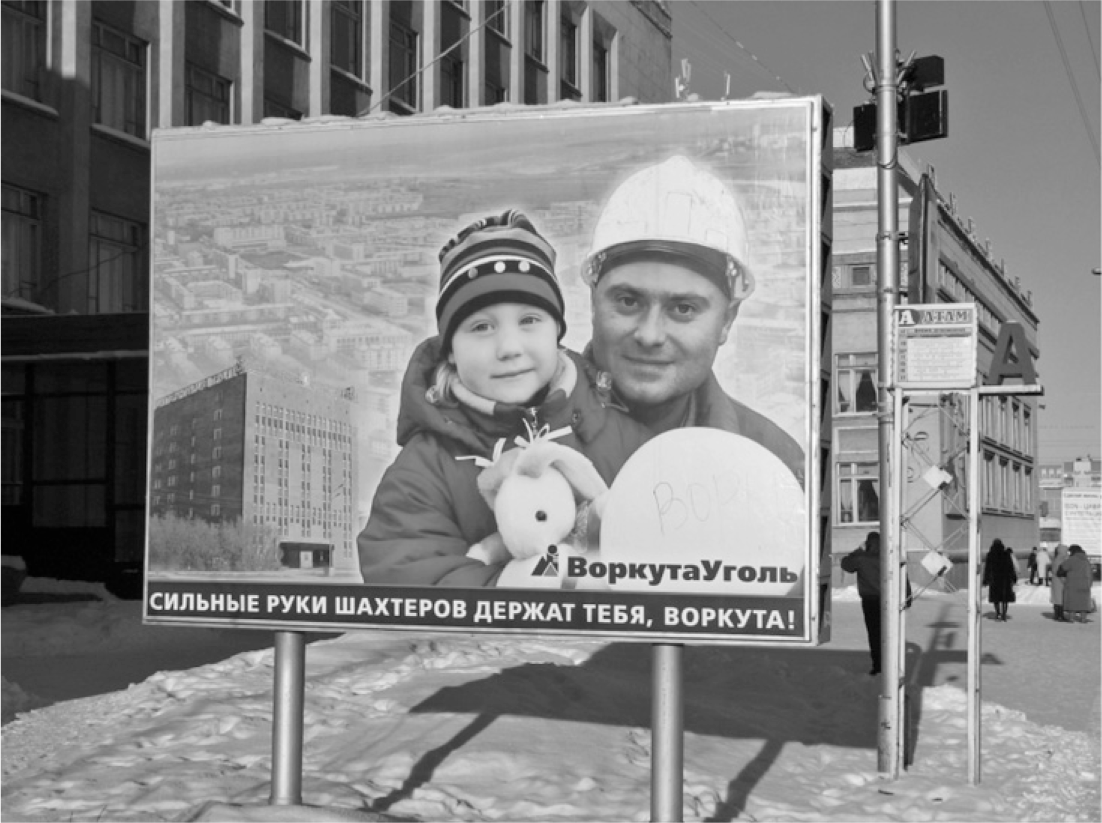
‘Vorkuta is in the strong arms of the miners’ (Photo by Hilary Pilkington, 2006)
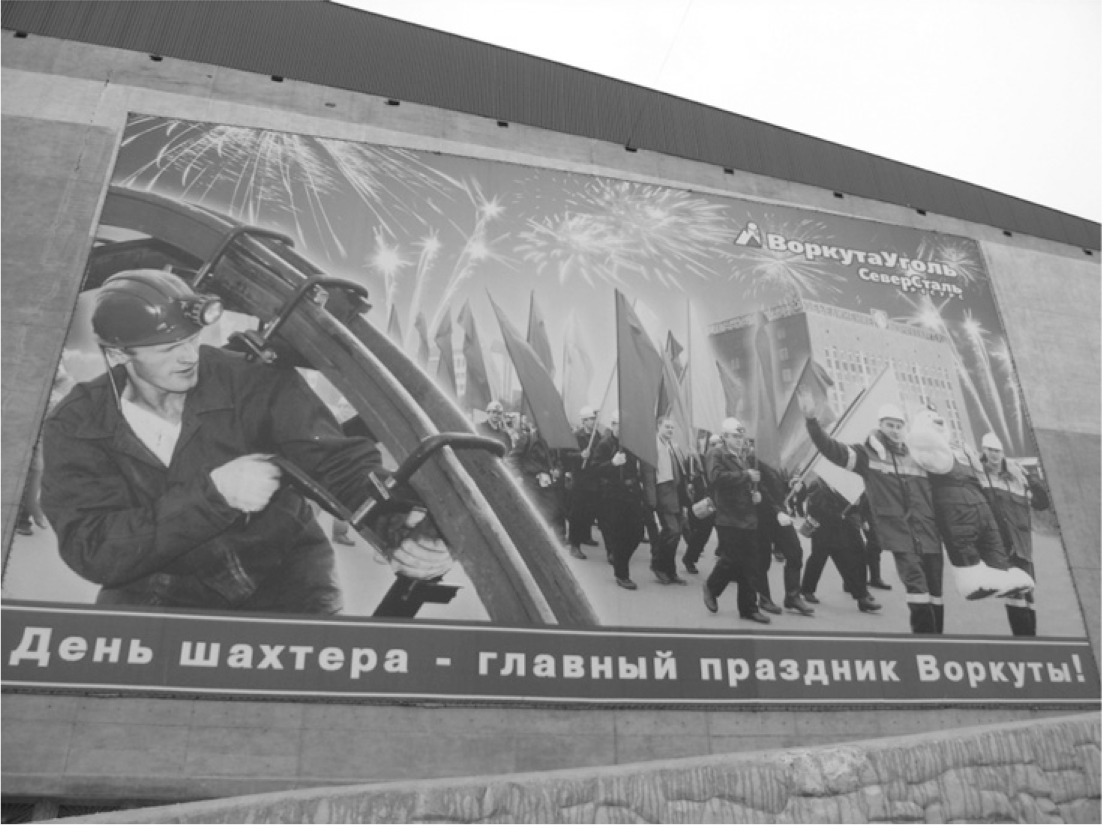
‘Miners’ Day – the most important holiday for Vorkuta (Photo by Al'bina Garifzianova 2009)
Pride in this mining heritage was expressed in relation to the role Vorkuta coal had played in the war effort (as noted above) but also as a quality in and of itself; ‘Vorkuta coal’, Zhenya (age not known) declared simply, ‘is the best … [it] burns better than Inta or Pechora coal …’. Of course these positive associations were generated not wholly spontaneously but with considerable effort on the part of the local government and mining company through the social advertising evident in the images above as well as targeted educational programmes and competitions at schools and colleges. Moreover, as is evident from the images, the active subject of Vorkuta is almost exclusively a male subject. Perhaps not surprisingly, therefore, this element of the place-myth evoked some ambivalence among young women. Sveta, for example, expressed irritation at the efforts expended at promoting pride in the mining industry at the same time as she empathized with the city's miners themselves:
… It just gets on your nerves. These miners everywhere. Although when you think about it, you feel sorry for the miners, for goodness sake. And then children for some reason … on one poster … there's a slogan, something like ‘Our future – is youth’, something like that ‘become miners’ … Good God, save our youth from becoming miners for heaven's sake … (Sveta, 18 years)
Place-myths can thus take on the status of insider yarns notwithstanding their exclusionary nature and dissenting voices and are developed in conjunction, but also in tension, with external perceptions of place (Shields, 1991; Massey, 1994).
On the edge (and proud of it): affective, embodied and relational dimensions of subjectivity
The local subject is not simply the by-product of the discursive production of place in the conditions of structural constraint. It emerges, rather, through the interaction of: profoundly individual, sensual encounters with place; the sharing of these encounters with others; and the understanding of these in the context of the ‘imaginary geography’ of place. The imaginary geography of Vorkuta places it physically on the very edges of inhabitability – a place too remote and inhospitable to even contemplate coming to by those outside. ‘People from other cities don't even think of coming here,’ laughs Polina (17 years), ‘they think Vorkuta is, excuse my language, the pits …’
As Shields (1991: 3) notes, however, the marginal status of ‘marginal places’ derives not only from their geographic peripherality but from the fact that, ‘they have been placed on the periphery of cultural systems of space’. Awareness of this can induce a perverse pride in the city's marginality:
When you say you are from Vorkuta, somehow people know what that means. It's the edge … The trains stop at Vorkuta – there's no further to go. So … well there is a tiny bit of patriotism in that … (Lyuda, 17 years)
Thus, in a manner reminiscent of Žižek's (1997: 41) understanding of the transubstantiation of primary identifications (with family or local community) that come to oppose universal secondary identifications (for example with nation-state), we see here ‘edgeness’ being transformed into a ‘place’ as important as the ‘centre’ in marking the nation state. In this way local community identification is reintegrated into, and makes ‘concrete’ (ibid.), identification with the nation state.
The climactic and geographic extremes of the city also evoke a tangibly emotional and sensual connection. This can be seen in references to the city's freakish summers, when hail might fall in July (Zhenya, age not known), or more commonly its fantastically ‘beautiful’ winters (Valera, 20 years; Nastya, 16 years) when ‘everything shines’ (Sveta, 18 years). Respondents also shared the very physical sensations they experienced from their engagement with the local landscape (Figure 6). The following two quotes articulate clearly divergent but profoundly sensual responses to the Vorkuta sky:
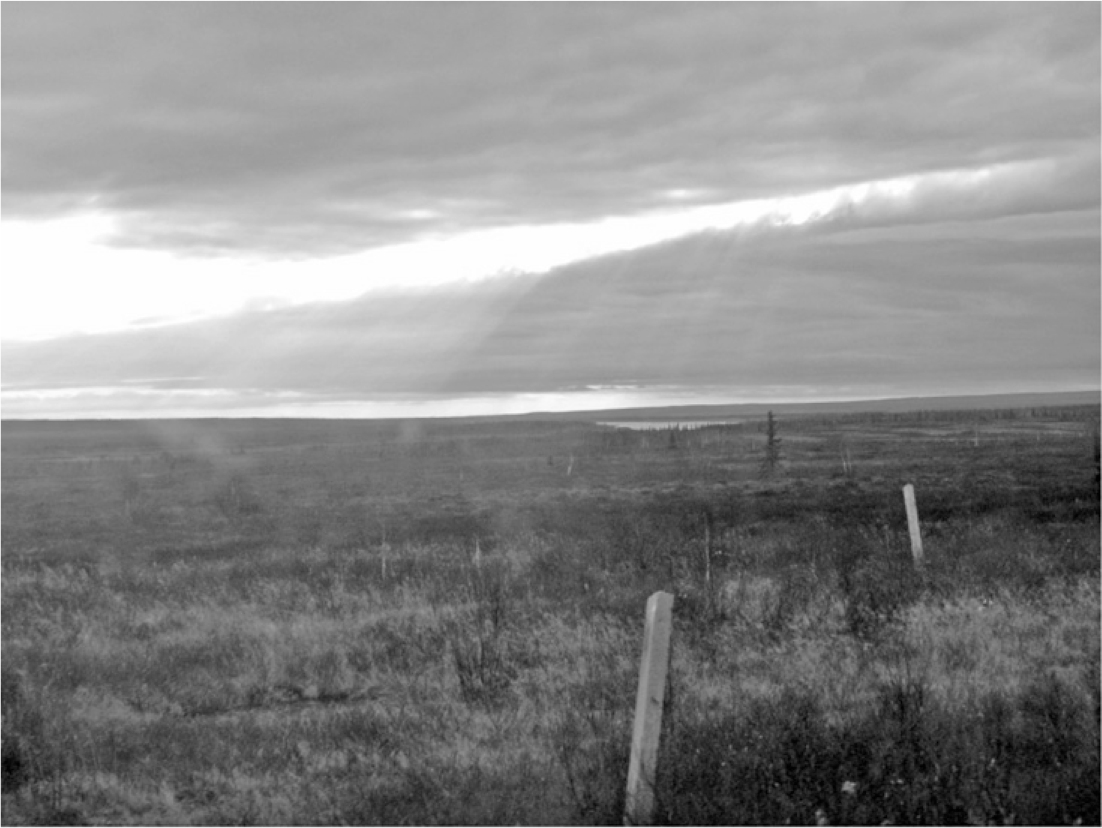
View across the tundra as the sun breaks through (Photo by Hilary Pilkington, 2007)
Respondent: … And you know, we also have this thing – I've rarely seen it anywhere else. I've seen it only here and in the South. When there are grey clouds and the sun's rays poke through, it's fantastic. You can see it, like a projector.
Interviewer: Shining through kind of?
Respondent: Yeah, yeah, yeah. (Zhenya, age not known)
Respondent: … The natural landscape of course is fine, I like it, but you know it's also oppressive … And the sky, that sky constantly bearing down on you. It's like I'm really in a cage. I'm caged in by this sky.
Interviewer: [You feel] like you are inside?
Respondent: Yeah, like indoors, seriously. You look up and it's like you might as well just get rid of the ceiling and put in a glass window. Why do you need it [the ceiling]? Here the sky is like [a ceiling] … (Slava M., 20 years) 5
In their very divergence, these two respondents exemplify how elements of the physical, natural landscape that appear inert in fact contain movements and energies that complicate our understanding of the relationship between physical reality and the sensible and physiological reality of human being (Lefebvre, 2004). Yet, from the ‘polyphony of individual experiences and sensations’ there emerges a shared affective sense of place (Shields, 1991: 263).
Alongside the affective dimensions of subjectivity, embodied and relational practices are central to the formation of the subject (Edensor, 2006). Shields' (1991:263) claim that people transcend their own experience in order to affirm place identities is hard to evidence empirically, of course, since it is located in the unspectacular, everyday interactions with environment and people that go largely unverbalised. 6 Nonetheless, respondents noted that, in Vorkuta, everybody talks to everyone else (Tanya, 17 years) and people always smile or say hello when they pass each other on the street rather than push each other out of way (Volodya, 16 years). Thus, in stark contrast to the place-images of Vorkuta as cold, harsh and difficult to live in, the locality as community is constructed and experienced as warm, comfortable and familiar:
In comparison to other cities, it's a lot easier living here than in others … people are more responsive here. They are ready to help, no matter what, they don't look down on people, they will share their happiness and sadness. (Nastya, 16 years)
This responsiveness is contrasted sharply to people in other cities, especially Moscow. That this relational aspect of subjectivity is deeply embodied is captured in Zhenya's (age not known) description of how, whilst in Moscow, he found his own behaviour adapting to Moscow norms; ‘Just going round the metro, I was elbowing everybody.’
Particularly significant in the formation of the local subject are moments when the whole city comes together such as on holidays and for celebrations. On New Year's Eve, for example, ‘… the whole of Vorkuta gathers’ (Volodya, 16 years) and this celebration, with its traditional ‘ice city’ and impressive Christmas tree, was mentioned frequently by respondents as something on which Vorkuta could pride itself:
… you were asking what our favourite holiday is – [well, it's] New Year, because it is celebrated in Vorkuta better than in the capital of Komi Republic. When I showed my friends photographs of this ice city, the fireworks, what goes on, they were like ‘Ohh – how beautiful’. There are ice figures, taller than you … and the square is … one of those places where in the evening sometimes I have just been out walking, gone out for an hour or an hour and a half and I always know that I will bump into people I know … (Tanya, 17 years)
A photograph (Figure 7) of the New Year's celebrations in the city evoked particular affection and romantic reflection on the night-time aura of the city by respondents.
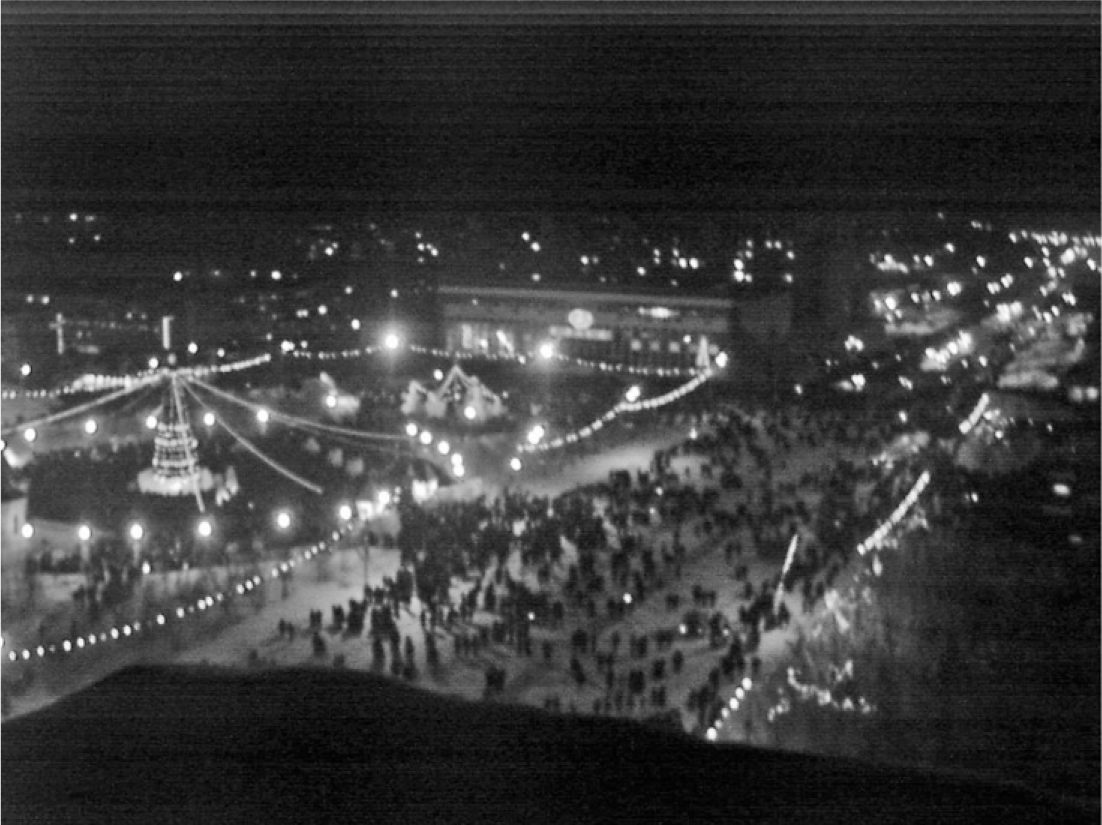
Ice City – New Year Celebrations in Vorkuta (Respondent's photo)
Yes. Yes. This is also a beautiful photograph, the city at night … At night, especially at New Year. There are lots of lights. It's very beautiful … It all looks beautiful. I don't know. Well, it's my native city, I like everything about it probably. (Ul'yana, 14 years)
It is important to note that this ‘unicity’ (Maffesoli, 1996: 19) is experienced not in the performance of national belonging (see, for example, Fox and Miller-Idriss, 2008a: 545) but in a highly local experience of a national and global celebration of New Year in a particular square described, quite simply, as the ‘place where the life of our city is conducted’ (Tanya, 17 years). This verbalizes perfectly the ‘polarization of matter’ in the city space (Deleuze and Guattari, 2004: 477) making tangible the sense that this square is the nucleus, the dense matter, that constitutes the entry and exit point of the city to national and global networks. The importance of the synchronicity of the global, national and local that is achieved at the New Year celebration should not be ignored either. It signals for respondents a rare moment when the margins appear to speak for the nation rather than act as an alternative to it (Russell, 2004: 285) and this itself evokes local pride and enhances the enjoyment of it.
Reimagining Vorkuta: performing the local
While the marginal may be despised in the official discourse of central power it is, at the same time, ‘constitutive of the imaginary and emotional repertoires of that dominant culture’ (Shields, 1991: 5). Thus although, as evidenced above, centre and margin, national and local, are sometimes ‘out of sync’, they are nonetheless mutually constitutive. Thus expressions of the local subject in Vorkuta are imbued with, and enact, marginal status (not only as northern frontier but also as Gulag city and Soviet relic). At the same time, however, local belonging may be performed in ways that resist, ironize and invert those hierarchies.
One example of the inversion of centre and periphery is captured in young people's resistance to what appears to be the terminal condition of Vorkuta. Lyuda (17 years) counters this expressly, claiming that, ‘Vorkuta is not dying. Vorkuta is blossoming.’ while Tanya imagines how the flow of people and skills from margin to centre could be reversed through a simple act of individual and collective agency; by encouraging friends and acquaintances to come and work in the city, she says, ‘We could grow our city really significantly!’ (Tanya, 17 years).
A more common strategy among respondents is a playful or ironic engagement with outside perceptions of the city that act to empower those on the margins through their superior local knowledge. Thus knowing that ‘lots of people think that Vorkuta has bears roaming the streets, that people don't travel by taxi or car but on reindeer drawn sledges’ (Lyuda, 17 years), respondents play with such ‘place-images’ to exoticize and centre (albeit temporarily) Vorkuta in the imaginary geography of Russia:
Respondent: As you know, the city really is unique. Even when you're at [summer] camp, when you start to ask those from other cities what's special about where they come from, they can't think of anything. But when you start to tell them that we have penguins smoking at the bus stops with their polar bear mates and that we don't travel by taxi but by reindeer, then they are all really fascinated …
Interviewer: You say that deliberately?
Respondent: Yeah …
Interviewer: And they believe it?
Respondent: Of course they believe it … (Zhenya, age not known)
Nowhere is this more manifest than in the direct inversion of centre and periphery expressed in the phrase frequently repeated by respondents when asked to sum up the city of Vorkuta in a short phrase or slogan: ‘Vorkuta is the capital of the world’ (Volodya, 16 years; Sasha, 16 years; Vova, 18 years; Daniil, 19 years). This was a slogan initially devised and promoted by the former mayor, Igor’ Shpektor, and can now be found splashed across T-shirts made in the Vorkuta textile factory and emblazoned on local memorabilia (see Figure 8). Of course many cities and their inhabitants create and adopt marketing slogans or popular epithets (Birmingham is ‘the heart of England’, St Petersburg ‘an open air museum’ etc). What is interesting about this slogan is its circulation in the ‘affective economy’ (Ahmed, 2004). In its movement from local government to young people's rhetoric, it accumulates affective value< (ibid.) through a process of overidentification with the statement (a practice known as styeb, see Yurchak, 2006: 250) that at once celebrates and parodies its sentiment.
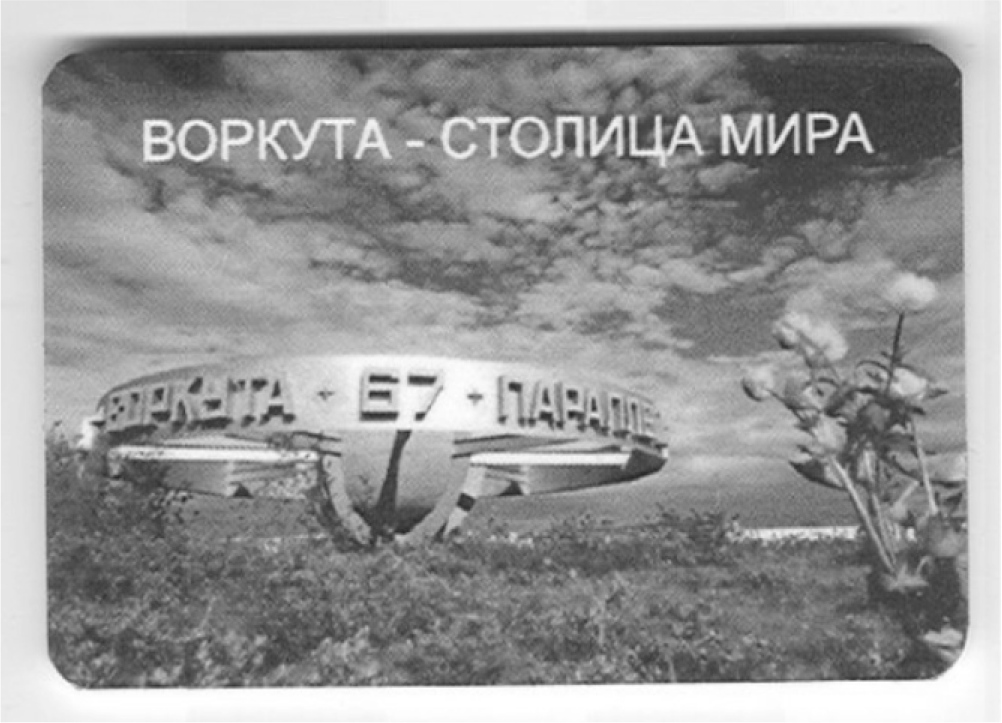
Fridge magnet with slogan ‘Vorkuta is the capital of the world’
Interviewer: … and how would you characterize Vorkuta in a few words – what kind of city is Vorkuta?
Respondent: The capital of the world.
Interviewer: The capital of the world? Respondent: If you compare it to Syktyvkar then Vorkuta is really the capital. (Daniil, 19 years)
Thus, when invited to position Vorkuta for themselves in the geographic imagination, respondents do not accept its post-1991 reconfiguration as marginal but enact at least a symbolic inversion of centre and periphery. Here again we see Lefebvre's (1996: 117) vision of the urban as the ‘oeuvre of its citizens’ as through a series ‘of acts and encounters … urban life tends to turn against themselves the messages, orders and constraints coming from above …’.
Conclusion
The process of deterritorialization has required scholars to question the natural or essential connection between culture and place. Nowhere is the need for this more evident than in a city such as Vorkuta which, for the last two decades has been physically emptied and symbolically drained by post-Soviet deindustrialization and deideologization. The empirical research presented here, has suggested that, notwithstanding this, both national and local identities remain salient for young people in the city. The discursive production of the national has been traced hitherto to a post-Soviet project of nationalism which, through programmes of patriotic education, has primarily targeted young people. However, this research has shown that local belonging too has been produced by active ‘flagging’ (Billig, 1995) undertaken by a local administration that prides itself on engaging young people civically.
It has been argued here, however, that charting the web of interlocking discursive positionings alone is insufficient to understand how ties between people and place are forged and lived out. Indeed the data presented suggest that self as local and national subject are far from comfortably nested through discourse for young people, who struggle to map the new national patriotic agenda on to the ‘place-myths’ of Vorkuta, past, present and future. Thus, they often experience the local subject as out of sync with the national, expressed in a sense that ‘there is nothing to be proud of here’. For many this is resolved through imagining and enacting their lives elsewhere (as they plan and implement active out-migration). For others, however, identification with the local community is realigned with, and grounds, connections with the national, and global, body (Žižek, 1997) through a reworking of the city's peripherality. Pride is attached to marking ‘the edge’ rather than the core of the nation state. Such ‘pride’, it has been shown, is a sentiment that far from all young people in the city share. Nonetheless, and despite individual differences in their experience and perceptions of the local, young people routinely express profound affective ties to Vorkuta. These take the form of sensual appreciations of the city and its landscape and an emotional connection to others that share them. Moreover, it has been argued, these signs of affect themselves shape the local subject as a collective body with its own insider stories. One such ‘yarn’ is encapsulated in the ironic adoption and deployment of the local administration's patriotic slogan that declares, ‘Vorkuta is the capital of the world’, in a way that actively repositions the local subject from the margin to the centre, from a position of exclusion to one of power and critique (Shields, 1991: 277). Of course such actions or gestures do not change the material constellation of the locality itself but they do reveal empirically that place is not a static, constraining force but a dynamic, provisional category with potentially transformative capacity and that subjects of place are not only unconsciously and discursively produced but are formed through the sensual and emotive experience of it.
Footnotes
Acknowledgements
The research upon which this article is based was conducted as part of an AHRC-funded project ‘Russian National Identity: Traditions and Deterritorialisation since 1961’ (September 2007–March 2011) Grant no. AH/E509967/1. The project was coordinated by Catriona Kelly, University of Oxford. The sociological element of the research reported here was designed and conducted collaboratively by the author with Elena Omel'chenko (Department of Sociology, Higher School of Economics, St Petersburg and Director, ‘Region’, Ul'ianovsk) and included additionally: Yuliya Andreeva, Natal'ya Goncharova, Gusel’ Sabirova, Evgeniya Lyukyanova, El'vira Arif, Al'bina Garifzianova and Ol'ga Brednikova.
Research visits to Vorkuta were made by the author also in 2006 under the auspices of the ‘Society and Lifestyles: Towards Enhancing Social Harmonisation through Knowledge of Subcultural Communities’ project (STREP-CT-CIT5-029013) and in 2009 to conduct research for the AHRC ‘Post-socialist punk: The double irony of self-abasement’ project (Grant no: AH/G011966/1). Where primary materials are cited with these dates, they were generated by these projects respectively.
The author would like to thank Christina Hughes and Robert Carter, Department of Sociology, University of Warwick, as well as the three anonymous reviewers for their extremely helpful comments.
1
The larger research project upon which this article draws was concerned primarily with the articulation of young people's affective ties to the national (post-Soviet Russia). The particular focus of this article, however, is the articulation of such ties to the local (Vorkuta city).
2
When asked, in the survey, what was meant by ‘patriotism’, Vorkuta respondents associated it most frequently with ‘Pride in one's country’ (62.3 per cent), ‘Love for the place one was born’ (42.8 per cent) and ‘Willingness to work and serve the good of the homeland’ (42.7 per cent).
3
Of course  is concerned primarily with the production of space in the particular location of the contemporary capitalist mode of production and transposing his arguments to a socialist context, let alone a post-socialist one, is problematic. Indeed Lefebvre himself fails to answer the question as to whether state socialism had produced a distinctive ‘space of its own’, concluding that to answer this question ‘is difficult at the present time, for lack of information or comprehension’ (1991: 54). This article does not seek to answer that question either only to acknowledge the general relevance of Lefebvre's understanding of the social production of space to the particular context addressed here.
4
It is helpful here to compare these findings with the responses of young people in the other site of research, St Petersburg. While respondents in St Petersburg also cited the Great Patriotic War more frequently than any other event as a source of national pride (60.5 per cent), thereafter their responses showed a close association between things the country could be proud of and historic events in St Petersburg itself (eg the ‘blockade’ or the ‘defence’ of Leningrad, events related to the rule of Peter the Great and the city's architecture, art and culture). In contrast also to Vorkuta, for St Petersburg respondents, ‘shame’ was attached most frequently to the Soviet system; the 1917 October revolution and the subsequent establishment of s/Soviet power and the ensuing civil war was cited by 16 per cent of respondents as a shameful event, while second on the list were events connected with the Stalin regime (repression, totalitarianism, the Gulag system), cited by 14 per cent of respondents.
5
6
Research in Vorkuta undertaken for an earlier project on drug use (ESRC Grant no. R000239439), had an explicitly ethnographic dimension and was able to capture the embodied nature of community through a peculiar Vorkuta gait (see Pilkington, 2007).