






Abstract
Most of the young people enrolling on modern apprenticeships in the horse racing industry are women and many hope to become jockeys. The majority of those who realise these ambitions are, however, men. This paper explores this process of attrition, focussing on gendered embodiment and its relation to the development of the bodily hexis and habitus characteristic of the racing field. We argue that women engage in the bodily labour of engenderment in a context of hostility and harassment and that they develop a contradictorily gendered habitus which brings together attributes which are culturally associated with both masculinity and femininity. In order to achieve this they subject themselves to a disciplining and punishing of the body which creates a ‘tortured’ masculinity. Female bodies are, however, ‘imprisoned’ by the workings of the habitus and, within the racing field, their bodies are read as weak, not fit for hard work and as more suited to an office (or home) than a race horse. These embodied processes and practices place them at a severe disadvantage and result in women being a very small minority of jockeys.
Every year in the UK several hundred trainees enrol on modern apprenticeships in the racing industry, many of them wishing to become jockeys; the majority are young women but it is the young men who are most likely to realize their ambitions. Within the racing industry this attrition is explained in terms of women's embodiment: women are ‘not strong enough’, their bodies are the ‘wrong’ shape, or they are not ‘man’ enough. Indeed Lester Piggott, formerly a top jockey in the UK, is on record as saying that women's ‘bottoms are the wrong shape’ for race riding (Alcock, 1978: 2). In this paper we explore the extent to which female embodiment is seen as an obstacle to women's participation in race riding, what forms of masculinity are embodied by those working in the racing industry, and whether women working in the racing industry, as stable staff or as jockeys, can be regarded as embodying masculinity.
Embodying gender
Women's entry into male-dominated occupations, including sport, and men's reactions to this have long been a topic of feminist research (Cockburn, 1991; Walby, 1986; Witz, 1992); a focus on women's embodiment has, however, been relatively recent (Howson, 2005) and is more commonly found in studies of sport than of work (Wolkowitz, 2006). Sociological studies of sport have explored male and female embodiment including: the ways in which bodies are disciplined, the ways in which women come to embody different masculinities, and how women negotiate changes in their bodies which could be understood as rendering them more ‘masculine’.
One of the issues to emerge from these studies is the way women embody certain aspects of masculinity while also embodying aspects of a heterosexual femininity. This is often understood in terms of hegemonic masculinity and emphasized femininity (Connell, 1995), however it has also been conceptualized in terms of ‘female masculinities’ (Halberstam, 1998) or ‘bi-gendered embodiment’ (Wedgwood, 2004). Such conceptualizations draw attention to the fact that it is not only male bodies that embody masculinity but that there are ‘masculine women’ and ‘boyish girls’ (Halberstam, 1998: 15) and that women and girls can embody ‘coexistent masculine and feminine identities’ involving ‘tensions and contradictions’ (Wedgwood, 2004: 155). Aspects of masculinity that are discussed include physical strength, muscularity, violence, control, the ability to ‘play tough’, to play through pain and to withstand injuries (Mennesson, 2000; Schyfter, 2008; Theberge, 1997; Ezzell, 2009).
Women's embodiment of different aspects of masculinity is, however, limited by those who control sport – as we saw in the way that Caster Semenya was treated by South Africa and the International Association of Athletics Federations (Levy, 2009; McRae, 2009; for body building see Mansfield and McGinn, 1993; Brown, 2006) – by their families and men (Brace-Govan, 2004) and by women themselves (Dworkin, 2001). Women rugby players, for instance, embody toughness, fitness, femininity and heterosexuality, displaying a contemporary form of emphasized femininity which has been termed ‘heterosexy-fit’ and which counteracts their embodiment of some elements of masculinity (Ezzell, 2009). Other women, however, do not appear to be concerned with ensuring that they are recognized as embodying a stereotypical femininity and strive to develop bodies that are fit for the purpose of the sport in which they are engaged (George, 2005; Mennesson, 2000; Throsby, 2011); there are indications that this relates to age, race/ethnicity and class and is an area which is in need of further investigation. For most women, however, there appears to be a self-imposed ‘glass ceiling’ on how they develop their sporting bodies (Dworkin, 2001). This concern with appearing ‘feminine’ extends to women consciously embodying emphasized – or exaggerated – femininity ‘off the course’ in order to ensure that their heterosexuality as well as their femininity is recognized (Cox and Thompson, 2000; George, 2005; Mansfield and McGinn, 1993; Sisjord and Kristiansen, 2009).
Some have understood these processes of embodying gender in terms of Bourdieu's concept of habitus. Thus Terry Lovell, in discussing women who pass as ‘military men’, points out that in Bourdieu's terms they were able to ‘assume the bodily hexis and the habitus characteristic of the militia’ (Lovell, 2000: 13); she asks the question ‘How do some women manage to develop [a] masculine habitus’? (Lovell, 2000: 14). This is a critical question and is partially answered by studies that show that women who engage in masculinized sports activities are inclined to define their childhood selves as tomboys (Mennesson, 2000; Cox and Thompson, 2000; Wedgwood, 2004; Scraton et al., 1999). It also points to the importance of the material body and embodiment in developing a gendered habitus – it is not something that can be put on and taken off at will (Lovell, 2000; McNay, 1999; Brown, 2006). Wacquant, in his study of male boxers, suggests that ‘the bodily labour of fighters is fundamentally a work of engenderment in the sense that it creates a new being but also a gendered being embodying and exemplifying a definite form of masculinity: plebeian, heterosexual, and heroic’ (1995: 90 fn). Not all those who rely on Bourdieu, however, explore this ‘bodily labour’ of ‘engenderment’. In their study of ballet dancers, Wainwright and Turner (2006) fail to address the gendered habitus and its embodiment; this is surprising given the commonly held view that male ballet dancers call into question their masculinity by embodying what might be called a ‘feminine masculinity’ (Sisjord and Kristiansen, 2009). Jockeys could also be seen as embodying a feminine masculinity and it is the bodily labour which is undertaken to develop this form of engenderment with which we are concerned here. In what follows we outline the relevance of Bourdieu's concepts of habitus and capital to the racing field before describing the study.
Habitus, capital and the racing field
Habitus is a medium and outcome of social practice; it is a bodily state of being (Wainwright and Turner, 2006), a ‘series of dispositions, attitudes and tastes’ (Lawler, 2004: 111) and it expresses the ways in which individuals become themselves and engage in practices (Webb et al., 2002). For a young (male) indentured apprentice the instruction they received and the practices they engaged in within the racing field embodied them with a ‘racing habitus’ that involved ‘the practical mastery that people have of their situations’ (Robbins, 1991:1); that is a ‘second sense’, ‘practical sense’ or ‘second nature’ (Johnson, 1993) which allows for the development of a life ‘that becomes meaningful, reasonable and normal once you get close to it’ (Goffman, 1968: 62).
A racing habitus is classed, gendered and ‘raced’ and is developed in the context of the social values and practices which predominate within the racing field. As Moi (1991) points out, the distinctions in entitlement based on gender, class and ‘race’ become embedded not only in the dispositions in the habitus, but also as attributes of the field. She uses the example of the military where masculinity is not just an attribute of masculine habitus, but the military is itself a powerful arena in which the embodied cultural capital of masculinity can be invested and legitimated because it ‘fits’ and is recognized by the nomos or rules of the field. The military field, like the racing field, is gendered masculine as a field of power; entitlement and legitimacy are embedded in both the habitus and the field.
As with habitus, cultural, physical and symbolic capital assume a fairly ‘field specific’ form and their value may be tied to particular social ‘worlds’. Thus boxers build and mould their bodies to suit the field in which they are operating, namely, the boxing ring and gym (Wacquant, 1995, 2004). Whilst not as physically demanding on the body as boxing, working in racing has its inherent dangers and demands of its participants a body that is light yet strong, able to withstand falls and kicks and have deep reserves of stamina. Both racing and boxing are sports which must be mastered if they are to have a value to the participants and both require the development of physical capital which is not only appropriate for the field but which is also gendered (Wacquant, 1995; Bridges, 2009).
Racing exists within a world that has its own rules, practices and interests and, in the past, gave many working-class boys the opportunity to strive for success, not unlike football today; it is intersected with notions of classed and gendered bodies. Given the widely held view within the racing field that women have ‘weaker’ bodies and so cannot withstand the physical nature of race riding, the concept of bodily (Wacquant, 1995) or physical capital (Shilling, 1991) is potentially useful for an exploration of gendered embodiment (Sparkes et al., 2007). It is the gendering of physical capital and the way in which it affects the ability of gendered social agents to be accepted as stable staff and as professional jockeys which is a central concern of this paper.
The study
The research reported here is part of a larger study investigating gender and apprenticeships in the horse racing industry; in this paper our focus is on the bodily labour involved in developing the ‘bodily hexis’ and habitus characteristic of the racing field. Some light can be shed on this process by the life experience of one of us, Deborah Butler, who grew up in a family whose members were involved in horse racing as jockeys, racehorse trainers or racegoers. Her biography shows how a racing habitus involves an acceptance of the doxic values of the field and reveals the symbolic violence that is exercised upon women. Her family's involvement in racing predisposed her to pursue a certain biographical path that was orchestrated, not by her family's wish that she should work in racing, but by a habitus, a product of history, which in turn, produced its own history. Working in horseracing produced, for her, a ‘racing habitus’ that involves not just a state of mind but a bodily state of being and a mastery of practical skills. These skills have, to a great extent, been misrecognized, by her and by others within the racing field, through an acceptance of the masculine domination of the field. As a result, she rarely questioned why only a small proportion of ‘girls’ 1 who enter the workforce become jockeys, especially professional ones, earning their living through race riding. For herself, she unconditionally accepted that she would not have the opportunity to race ride. Her interest in the topic of this research is, therefore, personal, emerging from her previous and current employment in racing and her interest in tracing a personal experience of initiation into a bodily craft that can, to the outsider, appear confusing and mysterious.
This also means that the study could be considered to be auto-ethnography. As Paul Atkinson (2006) notes, there have been many ethnographic studies that draw upon a personal commitment to the research and which, without the researcher having prior experience of the field, would have been impossible to complete (see Scott, 1968 and Cassidy, 2002); indeed auto-ethnography has been part of the ethnographic imagination for a considerable period of time. For this study ethnographic fieldwork was carried out between 2008 and 2009. It consisted of a year working as a ‘lad’ 2 in a racing yard; 23 interviews with indentured and modern apprentices; 12 interviews with women who had either ridden as apprentice jockeys (4) or had worked and were still working in racing (8); participant observation at the British Racing School, where a cohort of trainees were followed through their 9-week course; and documentary analysis. In this paper we mainly draw on the interviews with trainees and women stable staff, some of whom have race ridden, and the ethnographic field work in the racing yard which involved participant observation and the recording of detailed field notes.
Women in a masculine field
The racing field, since the formation of the Jockey Club in the late 18th century, has been gendered masculine as a field of power and, until 1976, entry into the racing workforce was governed by male-only indentured apprenticeships. Historically apprenticeship can be seen as constituting a rite of passage not only from unskilled to skilled worker but also from boy to man (Cockburn, 1983). During the apprenticeship knowledge was passed from expert to novice and experience was gained within a community of practice (Lave and Wenger, 1991; see also Paechter, 2003). This enabled apprentices to develop a specific habitus and the cultural capital needed to progress within the racing field although it did not necessarily mean that they would graduate to professional jockey status. Indeed, for many trainers, the main aim was to produce hard working and conscientious stable lads who could care for the horses that were in training. Apprenticeship therefore was not about producing jockeys per se, it was more to do with learning a craft and being classed as a ‘trainee horseman’; for the racing apprentice the race riding was an extra. He (and they were always male) first had to learn his craft and prove that he was capable of doing so. The chance to ride was governed by his master, the trainer, who, once the apprentice had gained the experience and had the necessary riding ability, would give him the opportunity to race ride.
Women have only been legitimate members of the racing field since the mid-1970s. Prior to that, although some women trained their own horses, very few were employed in racing in the UK and it is estimated that they constituted only 10 per cent of the work force (Joint Racing Board, 1974). It was during the late 1960s and early 1970s that increasing numbers of young women were employed in racing and, in an official report, the Joint Racing Board predicted that this trend was ‘likely to continue’ (Joint Racing Board, 1974: 25). They were right and, by 2009, 60 per cent of the annual intake at one of the two training providers for the racing industry in the UK were women and, in 2010, women constituted 42 per cent of the industry's workforce (www.britishhorseracing.com, accessed 15 January 2012).
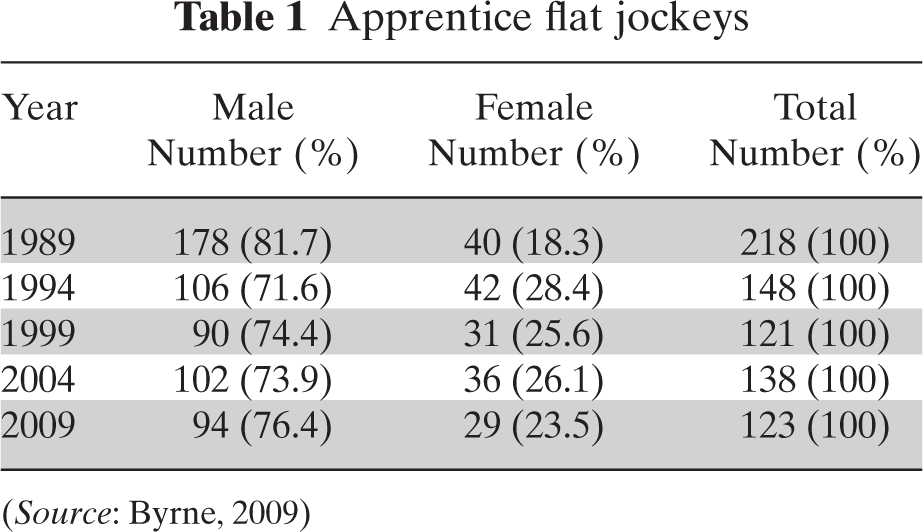
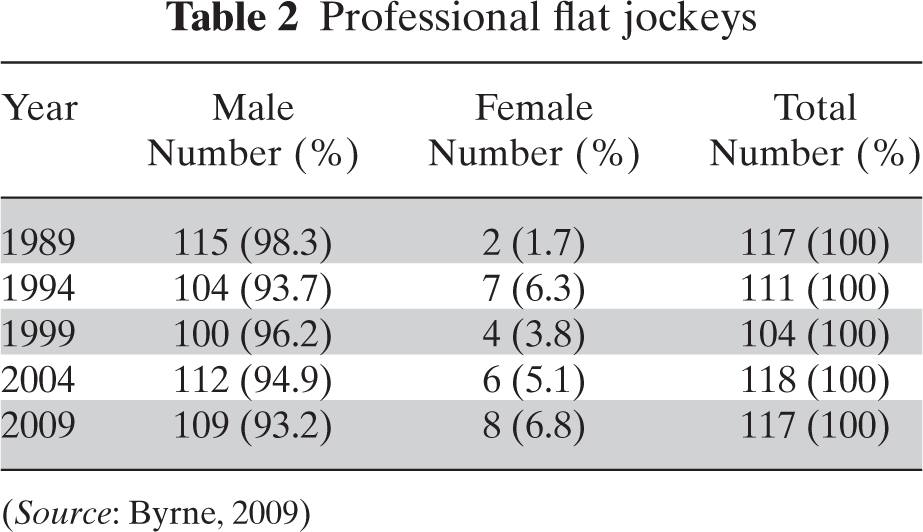
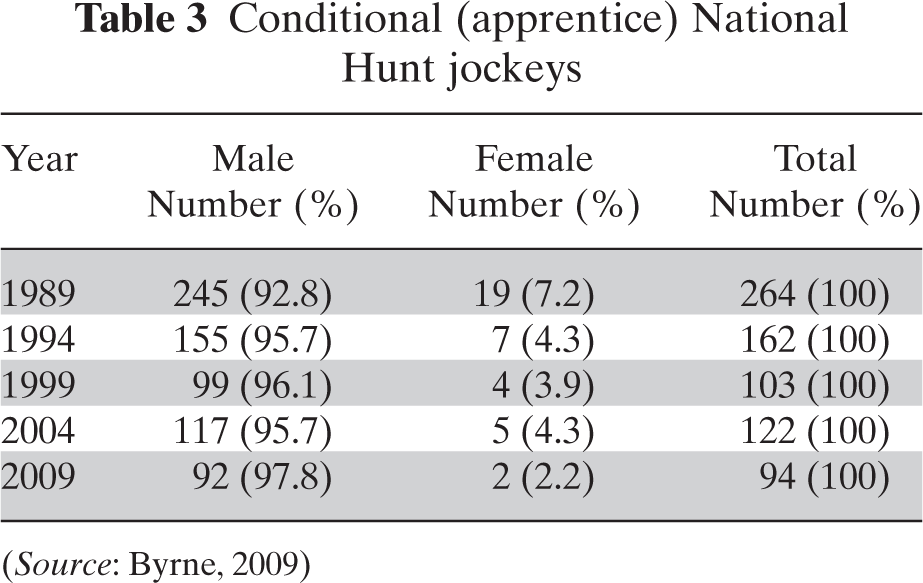
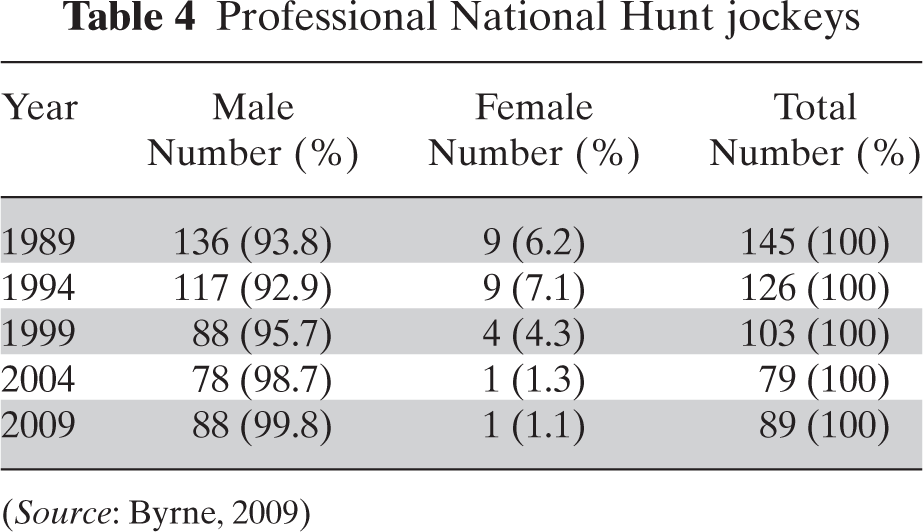
Racing in the UK is divided into racing on the flat, which does not involve riding over jumps, and National Hunt racing, which does. In order to become a professional jockey (flat or National Hunt) a licence has to be obtained from the British Horseracing Authority and, prior to 2008, the Jockey Club; initially this enables the holder to ride as an apprentice jockey and, once the British Horse Racing Authority deems them to have had sufficient experience of race riding, they are permitted to ride as a professional. It was as a result of the sex discrimination legislation that, in 1975, women were first allowed to apply for apprentice licences on the flat and, in 1976, the Jockey Club allowed them to apply for National Hunt licences. However, as the tables below indicate, race riding is still overwhelmingly a male occupation, particularly National Hunt racing. Tables 1 and 2 show that, in 2009 on the flat, women constituted just under a quarter of apprentice jockeys and less than 10 per cent of professional jockeys. In National Hunt racing, which is considerably more dangerous than flat racing, the proportion of women is even lower with women constituting only 1.1 per cent of professional and 2 per cent of conditional (apprentice) jockeys (Tables 3 and 4).
Apprentice flat jockeys
(Source: Byrne, 2009)
Professional flat jockeys
(Source: Byrne, 2009)
Conditional (apprentice) National Hunt jockeys
(Source: Byrne, 2009)
Professional National Hunt jockeys
(Source: Byrne, 2009)
In what follows we explore the experiences of women working in racing, drawing on interviews conducted with women who have entered the racing field at different times since the 1970s. Our concern is to explore how they have challenged the view that female bodies are out of place in the racing industry and how, in order to begin to be accepted, they have had to develop a racing habitus which involves engaging in particular bodily practices and developing the appropriately gendered physical capital. They have to develop qualities associated with masculinity, such as physical strength, risk taking, toughness and fitness and, at the same time, to cultivate bodily slenderness and low weight – attributes which are more often associated with femininity in western culture.
Embodying a masculine habitus?
In the 1970s women's suitability for employment was couched in terms of their ‘natural love of horses’; it was assumed that this ‘natural’ disposition would make work in racing attractive to them and that they would already have ‘mastered the basic arts of riding and grooming a horse’ (Joint Racing Board, 1974: 25). This was corroborated by the women interviewees. One who had entered the racing field prior to the abolition of indentured apprenticeships said:
Girls went into racing for one thing. They didn't go in for a career. Although lads went in for apprenticeships to be a jockey but the girls didn't go into racing years ago to be jockeys because you couldn't be jockeys. It was the horses. (entered industry late 1960s, did not race ride)
This alleged affinity with horses meant that women's entry into the ranks of the ‘lads’ was on a different basis from their male counterparts; they were in racing because of their gendered aptitude rather than because they were seen as suitable material for race riding. The logic of the field positioned women in a caring role in relation to the horses rather than as potential jockeys thereby emphasizing their ‘feminine’ qualities, their gendered habitus. Their difference from the ‘lads’, even after indentured apprenticeship had been abolished, was articulated in terms of women not looking right on a horse, their need for protection from physical danger, and their not being strong and tough enough to be able to do what had hitherto been a ‘man's’ job. In other words assumptions about their female bodies and feminine gender precluded them from being accepted as equals in the male-dominated world of racing.
Looking ‘wrong’, risk and bodies out of place
Objections to women's entry into male-dominated spheres of work are often couched in terms of their bodies being ‘out of place’ (see, eg, Wajcman, 1998) and this was certainly true of the racing industry. As women began to challenge dominant ideas of what was appropriate for them and what women's bodies were capable of doing, men's discomfort with women riding and the paternalistic and patriarchal nature of the racing field became evident. Women's bodies allegedly looked ‘wrong’ and women's riding style was referred to in derogatory terms as the ‘fanny crouch: legs back, bottoms up, all bust and backside’ (Alcock, 1978: 63). This, together with their assumed lack of physical strength, were put forward as reasons why women should not be race riding. When women did race ride they were often ‘the subject of much patronising ribaldry from the male racing establishment’ (Waterson, 2009a) with the press and others in the racing field reporting their exploits with a mixture of derision and animosity, calling them ‘jockettes’ and denying that they could ever be the equivalent of their male counterparts in the saddle.
National Hunt racing was seen as particularly inappropriate for women. National Hunt jockeys embody a specific form of masculinity characterized by mental and physical toughness, strength and stamina. The horses themselves tend to be bigger than in other types of racing and there is more risk of injury and accident with horses falling and bodies being broken. The accepted view of many in racing in the 1970s was that women needed protecting from the possibility of accident and that they should not be riding as their bodies were not strong enough to withstand any falls they might have. In other sporting fields, it is also argued that women's bodies mean that they run greater risks of injury than men (Brown, 2006; Ezzell, 2009). Former jockey, Bob Champion, thought National Hunt racing was too tough for women as they were not competitive enough and their bodies were the wrong shape for falls. This meant that chest first falls could hurt a woman more than they would hurt a man (Alcock, 1978: 62; see also Pink, 1996). Trainers also felt that allowing women to do something which, in their view, women did not have the physical capital (or the right bodies) for set a dangerous precedent. Some were ‘horrified’ and thought it ‘ridiculous’ women riding in National Hunt races. One of them, when speaking about injuries, took the view that:
There will be an uproar when a lady-ridden horse comes into the last at the NH festival at Cheltenham and both are laid out cold. People will demand to know who allowed women into NH racing in the first place. Hurdles need not be too bad but chasing – never! I hate the idea of a woman being smashed up. It needn't be in a fall either. In the heat of the moment with the taps turned on, a professional isn't going to politely ask a girl to move over; he'll chop her into the rails smashing her leg up and only stop to think of her sex when it's all over. (Alcock, 1978: 64)
Here the risks associated with National Hunt riding are emphasized; risks which are unproblematic for a male jockey but quite inappropriate for a woman. This sort of objection is similar to those made about women being allowed in combat roles in the army (Cohn, 2000) as well as in sport; danger and risk are seen as something that women should be protected from rather than exposed to (Pink, 1996).
The risk of injury and accident that accompanies race riding was not only seen as a problem by men, some women were not prepared to run the risk of injury unnecessarily because of its threat to their femininity and (hetero) sexual attractiveness. One of the pioneering women jockeys of the late 1970s said that she ‘wouldn't get up on any old lunatic [horse] for the sake of it. I don't want to go looking for a broken nose and no teeth. A woman has got her looks to think about’ (Alcock, 1978: 68). These comments point to the value placed on the preservation of a heterosexual femininity alongside the embodiment of allegedly masculine characteristics.
Exaggerated femininity
In racing, as in other sports, women's femininity was emphasized – or exaggerated – as a means of countering the view that women who participated in a masculine sport were somehow not ‘real women’ and ‘to avoid the lesbian or manly stigma frequently attached to female athletes’ (George, 2005: 328; see also Hargreaves, 1994). This is evident in Ann Alcock's published account of the struggle waged by women in order to be taken seriously as National Hunt jockeys; she herself race rode and therefore wrote as a woman who was part of the racing field. She argued that women took on a male persona on the racetrack but, once the race was over, they reverted to their ‘normal’ feminine persona which needed protecting and preserving. In her words, ‘[S]he [is] treated like a jockey on the course, and as feminine off it’ (Alcock, 1978: 66).
Implicit in her account is an acknowledgment that in order to be accepted women must conform to the doxic values of the field. Women themselves draw upon the illusio that race riding creates and become part of the orthodoxy, that is, the beliefs and values that constitute the received wisdom of the racing field. So, while believing that they could ride as well as any male jockey – a view which arguably went against the doxic values of the field – they were concerned to emphasize their femininity and, indeed, their heterosexuality; their embodiment of elements of masculinity on the race course did not mean that they were no longer women. In Alcock's words:
One school of thought holds that racing is too masculine a sport for women, but when it comes to femininity, we have only to look at the girls who go steeplechasing and hurdling to realise … that they are not weatherbeaten horse faced, tough old hags! Their features may be disguised beneath skull caps, goggles, back protectors and grimacing faces in the thick of the race, but they come bouncing back with pretty smiles! (Alcock, 1978: 62).
Femininity and sexual difference were emphasized off the course while similarity and equality (within limits) were emphasized on it (see Alcock, 1978: 61).
The younger women interviewees seemed to have a different attitude. As Emma saw it, to be able to work ‘in racing, I'd just say, and it's very bad face but, “get some balls about you”’ (entered industry late 1970s has ridden), that is, be assertive, strong and tough and neither embody nor perform the stereotypical femininity expected of ‘normal’ women (cf. Pink, 1996; Sparkes et al., 2007; Brown, 2006; George, 2005).
Developing the body
This is indeed what most of the women interviewed had done. As stable staff they had developed the capacity for hard, physical work and their working roles were the same as their male counterparts; they were required to ride the same horses and do the same tasks and did not expect any different treatment or working conditions. They had to develop their bodily character in and through the exigencies of discrimination and hostility which came across in their accounts of how they were treated and how they worked on their bodies in order to be able to do what the ‘lads’ could do. This involved being very determined.
No, sod you, I'm gonna do this and that's it. It's more, it was more being stubborn, and saying, I'm not gonna let you bastards beat me down, … you have got to stand your ground more and you just got on with it, but yeah, I think, even now, girls have just got to be a bit more oomphie. (entered industry in 1970s, has ridden as apprentice jockey on the flat)
Women also responded to men's assumptions about their physical abilities by engaging in practices which would show the men they were wrong. One woman had overheard,
a couple of [male] apprentices talking one day saying, ‘bloody girls in racing, they can't jump up, they can't do this’, which never entered my head you see … and I thought, ‘I've never tried to jump up’. 3 So I spent the next couple of days, evening stables, getting on my horse, so when I suddenly had to do it outside [it] was quite a plus and I went up about 7 steps in the lads' eyes. Yeah, that made a big difference … and I enjoyed riding the silly ones which was another plus. (entered industry late 1960s, did not race ride)
A more recent recruit to the racing field reported similar experiences.
Cause you think, well if they can do that, I can do that and that's the thing, if they can get on that and ride that, I can ride that, and if they can push that, lift that bale of straw, I can lift that bale of straw, and I – I've always been a bit like that, at a young age as well, just …it's not for you anyway if you're a girlie-girl, … it's a man's world isn't it? And …it's a pretty tough life isn't it? (entered industry in 1990s, did not race ride)
In addition, women have to avoid being a ‘girlie-girl’, that is, displaying allegedly feminine characteristics or relying on men to assist them. Then and now women are determined to show that they are able to do as well as if not better than the men. If they do not, the men make it difficult for them.
And any of the girls that didn't pull their weight got put in the trough or had … mice tied in their hat or [if they] thought they were a bit special they used to, you know, they would get clayed up. 4 … it wasn't really funny though they [the lads] thought it was. (entered industry late 1970s, licence to ride on flat, did not race ride)
Men's resistance to women also takes the form of verbal abuse which serves to emphasize the alleged incompatibility of female bodies with race riding. Tessa can remember the abuse that she and the other ‘girls’ used to get while riding out:
‘Oh, you split arse’, and ‘if you can ride that horse you can ride me’, the usual sexual and derogatory comments, you know, ‘if you can't hold that love, get underneath me’. (entered industry mid 1970s, has ridden as apprentice jockey on the flat)
This helps to illustrate how power in the field of racing operates linguistically, through embodied and verbal interactional behaviours which are linked to the (re)constitution of shared meanings concerning gender. Such verbal interactional performances reproduce patterns of domination, subjugation and subordination and consist of stereotypical verbal performances of gender shaped around masculine heterosexual norms. To an outsider, with little knowledge of yard terminology, the phrases, ‘that's a bird's ride’ or ‘a bird's horse’ would probably mean very little yet they are used to indicate that a horse is a safe, sensible ride, is not too strong and will not usually do anything too silly (hence the significance of the earlier quote on being able to ride the silly ones). For the insider, however, it reinforces the corporeal understanding that women's bodies are weaker, less capable and competent and that women will only be safe riding the quieter horses. It is a way of keeping ‘girls’ in their place, operating as a form of surveillance, and adds credence to the paternalistic attitude that ‘girls’ need looking after and protecting. Giving a ‘girl’ ‘a bird's ride’ is a chivalrous gesture which also reinforces women's inferiority. The use of the term ‘girl’ similarly reflects the paternalistic sexism of the industry (Pink, 1996; see also Cassidy, 2002). Such practices serve both to reinforce gendered boundaries and to emphasize that women's bodies are different from men's (George, 2005; Cockburn, 1991).
Women therefore have to work to ensure that they embody masculine attributes such as physical strength, toughness and stamina and do not behave like a ‘girlie-girl’ if they are to be accepted as legitimate members of the racing workforce. They engage in this bodily labour of engenderment in a context of hostility and harassment. Similar observations have been made about women wrestlers who are not taken seriously by their male counterparts if they are ‘giggly’, ‘silly’ and ‘insincere’; in contrast those ‘who are tough and don't whine’ are respected (Sisjord and Kristiansen, 2009: 240).
Tortured masculinity
Earlier we suggested that jockeys, like ballet dancers, embody a contradictorily gendered habitus which brings together attributes which are culturally associated with both masculinity and femininity; here we focus on low body weight which is an important element of a jockey's physical capital (cf. Aalten, 2007 for ballet dancers). The small stature and light weight characteristic of the jockey represents a very particular form of masculinity and there are subtle differences between flat and National Hunt masculinities. They both need the lightness and balance of a ballet dancer but jockeys who ride on the flat have to be lighter and smaller than their National Hunt counterparts. This could be seen as a feminine masculinity, and within the racing industry it is often implied that flat jockeys are ‘wimps’ and lacking in ‘bottle’, particularly by National Hunt jockeys (cf. Bridges, 2009; Schyfter, 2008). National Hunt jockeys, in contrast, epitomize all that is masculine about racing despite the need for low body weight. The requirement for a slight build might, in theory, be something that would favour women as they are more likely to have the physical capital that can be developed in accordance with the demands of the field. These demands are for strength, fitness and hard work which, if a woman is to have a chance of race riding, must be embodied as part of her habitus. Even if a ‘girl’ is light, however, this physical capital has to be developed and maintained through a rigorous, ritualistic process of mortification (cf. Wacquant, 1995), as Emma, a former apprentice jockey, explains.
I used to finish work and I used to get home, put my bin liners on, go running up this horrible hill and down and round the next village, come back and some people I knew had a sauna, so then I'd go and sit in their sauna for a bit and then I used to have a piece of fish, you know, about that big [tiny], and half a cup of coffee, … and that was it, I mean if, and then, I started swimming then, after, you know, if I didn't ride I swam. (entered industry in 1970s, did not race ride)
One of the male modern apprentices who was riding as an amateur (unpaid) jockey in National Hunt races also described this ritual process:
I went and sat in the steam room two evenings … I just ate tea and biscuits, nothing much else. Dad said to take a bottle of the Lucozade in the orange bottle in with me, the normal stuff and keep having a swig of that but don't swallow it. Just to keep my mouth from going dry then spit it out onto the coals as it makes it even hotter…. That was good as I lost over 7 pounds in two days. I have slept, rested in the steam room and the sweat all collected in, like, a big pool just under my ribs where my tummy was hollow. (modern apprentice, entered industry in 2000s, has ridden as apprentice NH jockey)
As we have already seen, the racing field demands a certain type of physical capital that is light, tough, able to withstand pain, and is imbued with endless amounts of stamina. This in turn generates a form of bodily labour where the body is routinely starved of food and liquid, is regularly dehydrated through the use of saunas or, although they have been banned, ‘pee pills’ such as lasix to speed up the loss of fluid from the body. Riding out in ‘sweat suits’, rubber lined jackets and leggings that are worn under clothing helps to squeeze out that last drop of moisture so that when a jockey comes to ‘weigh out’ 5 they are not overweight, one of the cardinal sins in racing. As well as disciplining the body and subjecting it to this ritual process of mortification with the aim of achieving the necessary low weight, jockeys' clothing has to be very light and many jockeys wear women's tights underneath their racing breeches. As a result of this ‘wasting’ a jockey can be too weak even to speak, something also observed amongst body builders. This physical weakness contradicts the belief that physical strength is needed to be able to ‘push a horse out’ at the end of a race and puts a question mark over the idea of physical strength being critical. Moreover women as well as men subject themselves to this disciplining and punishing of the body and both can therefore be seen as embodying what we might term a ‘tortured’ masculinity.
Physical strength
Despite the weakness associated with wasting, physical strength is regarded as particularly important especially in the final stages of a race and women's alleged lack of physical strength is put forward as one of the many explanations for women's inability to be successful jockeys. Similar arguments, or discourses, have been noted in other contexts (Cox and Thompson, 2000: 8); thus women's arms are allegedly ‘too weak’ for the kill in a bullfight (Pink, 1996) and women's inability to do the same number of press ups as their male colleagues is taken as a sign of their inferiority and unsuitability for a career in the US military (Cohn, 2000). Men's superior physical strength is something that women working in racing tend to accept.
But, I think really it's the strength of pushing out 6 and I really, even now I think that's just, no matter how super fit you are, I mean you look at the girls now riding, you know, Hayley 7 … a real strong rider, pushes out really strong but, she has had to work so hard at that … perfecting that technique and I think, lads do find that easier. (entered industry 1970s, has ridden as apprentice jockey on the flat)
These comments indicate an acceptance of the illusio of the field that men are better than women at winning a race. Women have to perfect a ‘technique’ rather than being able to ‘push the horse out’ by dint of sheer physical strength. There are those within the field who do not share this view. One of the interviewees referred to a racehorse trainer who,
made a quote once to the press, somebody had said to him, ‘Why do you only have girls ride for you? Girls aren't strong enough, de, de, de, de, de’, and he said, ‘Strength is nothing to do with it because … if you had to be strong to ride a winner Willie Schumaker would never have made it, and he rode four thousand winners and he was seven stone wet through’. (entered industry mid 1970s, has ridden as apprentice jockey on the flat).
These comments indicate that technique may be rather more important than ‘strength’, indeed it is often said that women have a better technique than men. The distinction between physical strength, which is associated with masculinity, and technique, which is associated with femininity, is also found in other studies (Bridges, 2009; Theberge, 2003) and is evident in one of the women's comments on ‘girls’ riding fillies.
It's like, you know, girls riding fillies and lads riding fillies, girls can, get more out of a filly or, more out of even a colt sometimes, just by their horsemanship skills and the way they approach things. (entered industry 1970s, has ridden as apprentice jockey on the flat).
Women therefore develop skills that are potentially as valuable as physical strength but are misrecognized by all but a few, an effect of the symbolic violence of the field.
Conclusions
The racing field, like the military and political field, is gendered masculine. Within this field the success of the few women who want to be recognized as ‘one of the lads’ (Waterson, 2009b) has been achieved by relentless hard work and self-discipline, together with the patronage of trainers and owners, something that all jockeys, whatever their gender, require in order to be able to race ride. In addition, toughness, fitness, assertiveness, strength and stamina are characteristics which are regarded as mandatory in order to be able to work in racing, and any woman or man who is unable to embody these is singled out as being different and out of place. The racing field therefore both shapes the individuals who work within it – male and female – and is dependent on their actions and dispositions for its existence (Crossley, 2001).
The habitus found in the racing field, both amongst the racing workforce and the racing establishment, is one that accepts women's subordinate position and that women are physically weaker and not as tough or strong as men (cf. Krais, 2006). Women are subjected to symbolic violence; they are treated as inferior, limited in their social mobility and occupational aspirations, and their skills are misrecognized. In the words of one young woman currently riding as an apprentice jockey:
The lads are chauvinist pigs. The older ones say it's a man's sport. Women shouldn't come into it, they have wrecked it. (entered industry as young modern apprentice, 2007, has ridden as apprentice jockey on the flat)
Female bodies are, in critical ways, ‘imprisoned’ by the workings of the habitus. They are read as weak, not fit for hard work and as more suited to an office (or home) than a race horse. Women accept these views as ‘the natural order of things’; they are caught up in the illusio of racing and develop a racing habitus which accepts the doxic values of the field. Developing a racing habitus involves the bodily work of engenderment, creating a ‘gendered being embodying a definite form of masculinity’ (Wacquant, 1995: 90 fn) which is associated with physical strength, lightness of build, toughness and stamina which we have called ‘tortured masculinity’.
Physical strength and lightness of body are crucial elements of masculinity within the racing field, but even though women have to ‘pull their weight’ as stable staff, a job which requires considerable physical strength (see also Pink, 1996), it is physical strength that they allegedly lack when it comes to race riding. Women's bodies are weak, the wrong shape and prone to being easily broken while men's are tough and resilient and taken as the norm. References to bodily and sexual difference are used as a means of legitimizing women's exclusion from race riding (see also Brown, 2006). They have bodily parts such as breasts which could be injured; men also have vulnerable genitalia but this is not advanced as a reason to exclude them from race riding (see also Pink, 1996, for bullfighting). This highlights a further distinction between women's and men's bodies in so far as men's are treated as expendable in ways that women's are not; the exposure of men's bodies to risk is acceptable while women's bodies are in need of protection.
Although we have argued that women working in racing accept the doxic values of the field, we have also shown that they resist their positioning as weak, subordinate and inferior. Their accounts show them challenging these assumptions and, through bodily practice, demonstrating that they are unfounded. As part of this challenge women engage in the practices that characterize racing in the 21st century, both as jockeys (although they are as yet a very small minority) and as stable staff. In order to become jockeys they undertake the bodily labour of engenderment involved in embodying a ‘tortured’ masculinity which is hegemonic amongst jockeys in the racing field. This involves an extreme form of weight management which is also found in other sports such as boxing, body building and in mainstream body management practices amongst women who are attempting to lose weight; there is therefore a sense in which engaging in such practices can be seen as feminizing. The aim is not only to achieve a low body weight but an androgynous body, one which displays a feminine masculinity and whose gender is therefore visually indeterminate.
Even when women have the appropriate physical capital in terms of being light and small, their female bodies may be in contradiction and tension with the masculine attributes that they embody. Thus a recognizably female body produces a visual shock when a woman is seen on a horse; the unity of horse and rider is disrupted by a body which is perceived as different and ‘out of place’. Pink makes a similar observation for bullfighting when she writes, ‘the obvious visual presence of a female body in the bullring, precisely in place of a male body, is blatant and unforgettable’ (Pink, 1996: 49). Having said this, however, there are some women riding now whose bodies – when they are in a race – are visually indistinguishable from those of their male counterparts; they could be said to embody a cross-gender habitus (Lovell, 2000). For most, however, there is a visual contradiction between their female bodies and the masculinity which is hegemonic within the racing field; this means that their embodiment of masculinity is incomplete, their engenderment is contradictory. For as long as it is masculine physical capital that is valued in the racing field, women will have to minimize this contradiction in order to succeed as a jockey; this is precisely what those who are currently race riding are doing when they claim that they simply want to be ‘one of the lads’.
Footnotes
Acknowledgments
We would like to thank our colleagues, Karen Throsby and Carol Wolkowitz in the Centre for the Study of Women and Gender at Warwick, for reading and commenting on several versions of this paper. Deb Butler would, in addition, like to thank the women and men who gave up their time to participate in the ethnographic study and interviews on which this paper is based and which were part of her doctoral research.
1
The word ‘girl’ is used within the racing field (and elsewhere in the sporting field) and applies to women of all ages. It can be used to indicate a subordinate position and is sometimes replaced by the term ‘bird’. It may initially have come into use as the feminine equivalent of ‘boy’ which was originally the term for young indentured apprentices. It implies both gender inequality and paternalistic relations of power and many women in racing find it patronizing (Cassidy, 2002).
2
Lad is a term used to refer to stable staff and, although it can include women, it operates in a similar way to the allegedly generic ‘man’.
3
Getting on the horse by vaulting on from the ground without using a stirrup iron or getting a leg up from someone on the ground who provides the lift up, into the saddle.
4
Claying up is when a pungent, sticky white clay which is normally pasted onto the lower part of a horse's front legs to reduce bruising, is plastered onto a women's breasts and chest after her clothes have been forcibly removed by the ‘lads’. This is an example of the ways in which young women have to learn to ‘give as good as they get’ and can be seen as an ‘initiation ritual’.
5
‘Weighing out’ is an integral part of a jockey's working life; it takes place in what is known as the ‘weighing room’ and is recorded by an official from the British Horseracing Authority known as the Clerk of the Scales. The official must ensure that the jockey is carrying the weight allotted to her horse and that she does not ‘put up’ (ride) overweight, thereby reducing her chance of success in the race.
6
Pushing out refers to the last push as the race is nearing its end and the horse is urged to pull away from the rest of the field to win.
7
In 2008 Hayley Turner became the first woman to have ridden 100 winners on the flat.