






Abstract
This study extends the research on objectification theory by examining the effect of anticipating a male or female gaze on appearance-related concerns in 105 female undergraduates. Gaze anticipation was manipulated by having participants believe they would be interacting with a man or woman before completing several self-report measures. Results demonstrated that anticipating a male gaze produced significantly greater body shame and social physique anxiety than anticipating a female gaze, while no differences were observed for dietary intent. Discussion centers on the pervasiveness of the experience of self-objectification and the implications of these findings for future research.
According to objectification theory, the implicit and explicit sexual objectification of the female body in Western culture produces a multitude of negative consequences for women (Fredrickson & Roberts, 1997). The primary psychological consequence of sexual objectification is the development of an unnatural perspective on the self known as self-objectification. Women who self-objectify have internalized observers' perspectives on their bodies and chronically monitor themselves in anticipation of how others will judge their appearance, and subsequently treat them. Fredrickson and Roberts (1997) have focused on the costs this objectification may have on the quality and productivity of women's lives. Increasingly, researchers have investigated diverse samples of women and demonstrated a variety of detrimental effects associated with self-objectification including increased body shame, appearance anxiety, disordered eating, self-surveillance, and diminished mental performance and capacity to achieve peak motivational states (Fredrickson, Roberts, Noll, Quinn, & Twenge, 1998; McKinley & Hyde, 1996; Noll & Fredrickson, 1998; Parsons & Betz, 2001; Tiggemann & Slater, 2001).
In addition to identifying relatively stable individual differences in self-objectification, objectification theory predicts that self-objectification can be triggered and magnified by particular social contexts. Recent research has linked situations in which weight and body shape are salient to the negative effects of self-objectification. Fredrickson et al. (1998) demonstrated that trying on a swimsuit primed a sense of being on display even though no actual observers were present. Women wearing a swimsuit experienced greater body shame, performed the worst on a math test, and consumed less food compared to women wearing a sweater or men in either condition.
Tiggemann (2001) demonstrated that imagined situational factors could negatively influence how women feel about their bodies. Women who imagined themselves in social and nonsocial body-focused situations (i.e., beach, dressing room) reported higher body dissatisfaction and lower self-esteem and body esteem than women who imagined themselves in non-body-focused situations (i.e., refectory, home). Although these findings were influenced additionally by body mass index (BMI), high social comparison, and high dietary restraint, women needed only to imagine their bodies being on display to experience low body esteem.
The present study was designed to build upon research that has examined the situational effects of self-objectification. Situations may not have to be explicitly body-focused (e.g., trying on a swimsuit, imagining oneself at a public beach) to produce negative affective experiences or restrained eating. Rather, even in seemingly innocuous environments the mere anticipation of being the object of an observer's gaze may trigger the negative consequences associated with self-objectification. The anticipation of being gazed at and evaluated is a defining feature of self-objectification and how it exerts its effects. It is not just the anticipation of any gaze, however. According to objectification theory, self-objectification is the result of internalizing the sexually objectifying male gaze. Therefore, it was reasoned here that anticipating a male gaze would produce greater body shame, social physique anxiety, and intent to diet when compared to anticipating a female gaze. It was also reasoned that anticipating a male or female gaze would produce greater body shame, social physique anxiety, and intent to diet when compared to a control condition in which no gaze was anticipated.
METHOD
Participants
Participants were 105 undergraduate women at a small southeastern university enrolled in introductory psychology courses who received course credit for their participation. Data from one participant was excluded because the experimental procedure was not followed. This left 104 participants randomly assigned to one of three experimental conditions (i.e., anticipate male gaze, anticipate female gaze, or no gaze). Eighty-three percent were European American, 5% African American, 4% Asian American, 3% Hispanic, and 5% were of other (unspecified) ethnicity. Mean height was 65.28 in. (1.66 m; SD = 2.7), ranging from 59 to 74 in. (1.50 to 1.88 m). Mean weight was 131.20 lb (59.70 kg; SD = 20.81), ranging from 100 to 200 lb (45.40 to 90.80 kg). Mean BMI was 21.71 (SD = 3.36), ranging from 16.31 to 37.79.
For women of this age group, a BMI less than 20.80 indicates underweight, and a BMI greater than 25.85 indicates overweight (Must, Dallal, & Dietz, 1991). In this sample, 43 participants were classified as underweight (41%), 53 were classified as average weight (51%), and 9 were classified as overweight (8%). Self-reported weight and height lend themselves to response error, which may account for the large number of underweight women in this sample (Cash, Grant, Shovlin, & Lewis, 1992; DelPrete, Caldwell, English, Banspach, & Lefebvre, 1992). Error in body weight reporting may be particularly true for women high in self-objectification (Cash, Counts, Hangen, & Huffine, 1989). To examine this possibility, a median split divided the women into high and low self-objectifiers. No significant differences were found between the two groups for self-reported weight, height, or calculated BMI.
Measures
Body Mass Index (BMI). Self-reported weight and height information was collected to calculate relative weight to height ratios using BMI: weight/height2 (kg/m2; Garrow & Webster, 1985).
Self-Objectification Questionnaire. The Self-Objectification Questionnaire (Fredrickson et al., 1998; Noll & Fredrickson, 1998) is a measure of the extent to which individuals are concerned with observable, appearance-based items (e.g., weight, sex appeal) relative to nonobservable, competence-based items (e.g., strength, health). Participants rank order 10 attributes by how important each is to their physical self-concept from the least (rank = 0) to most (rank = 9) important. Difference scores were computed by subtracting the sum of the five competence attributes from the sum of the five appearance attributes. Scores range from −25 to 25, with higher scores indicating greater emphasis on appearance, which is interpreted as higher trait self-objectification. Satisfactory construct validity has been demonstrated.
Body Shame Questionnaire. The Body Shame Questionnaire (Noll & Fredrickson, 1998) measures the motivational and behavioral components of shame (e.g., “I wish I were invisible;” “I wish I could disappear”) that are part of the phenomenological experience of body shame. It consists of 18 items scored on a 5-point Likert scale (1 = not at all; 5 = extremely). Scores range from 18 to 90 with higher scores indicating greater body shame. The BSQ has demonstrated high internal reliability (α = .94).
Social Physique Anxiety Scale. The Social Physique Anxiety Scale (Hart, Leary, & Rejeski, 1989) measures self-presentational anxiety related to the physique. It consists of 12 items (e.g., “In the presence of others, I feel apprehensive about my physique/figure”) scored on a 5-point Likert scale (1 = not at all; 5 = extremely). Scores range from 12 to 60 with higher scores indicating greater social physique anxiety. Research has shown that women who scored high on this construct experienced more distress when confronted with a fitness evaluation than women who scored low (Hart et al., 1989). This scale has demonstrated high internal reliability (α = .90), good test-retest reliability (r = .82), and good construct validity.
Dietary Intent Scale. The Dietary Intent Scale (Stice, 1998) includes nine items that measure intended (rather than current) eating behavior (e.g., “I will eat only one or two meals today to try to limit my weight;” “I will count calories to try to prevent weight gain”). Items are scored on a 5-point Likert scale (1 = never; 5 = always). Scores range from 9 to 45, with higher scores indicating greater intent to eat less. This scale has demonstrated high internal reliability (α = .94) and one month test-retest reliability (r = .92).
Procedure
Women in undergraduate psychology courses were invited to participate in a study related to mind, body, and health issues. In an effort to maintain participant confidentiality, interested participants were not asked for their contact information, but rather were provided with the experimenter's contact information in their psychology classes to enroll. A total of 105 women volunteered to complete a one-hour test session. Upon arrival, the experimenter, a female European American graduate student in her early twenties, informed participants of the study protocol and consent to participate was obtained. Each participant was first escorted individually into a private room and asked to complete a packet of questionnaires. This packet contained the demographics questionnaire (height, weight, age, and ethnicity), the measure of self-objectification, and a bogus questionnaire about physical health conditions in counterbalanced order. This first packet of questionnaires was administered privately and separately from the other measures to encourage accurate reporting of body weight as well as obtain a baseline score of self-objectification uncontaminated by the experimental condition.
Means and (Standard Deviations) for Measures by Experimental Condition
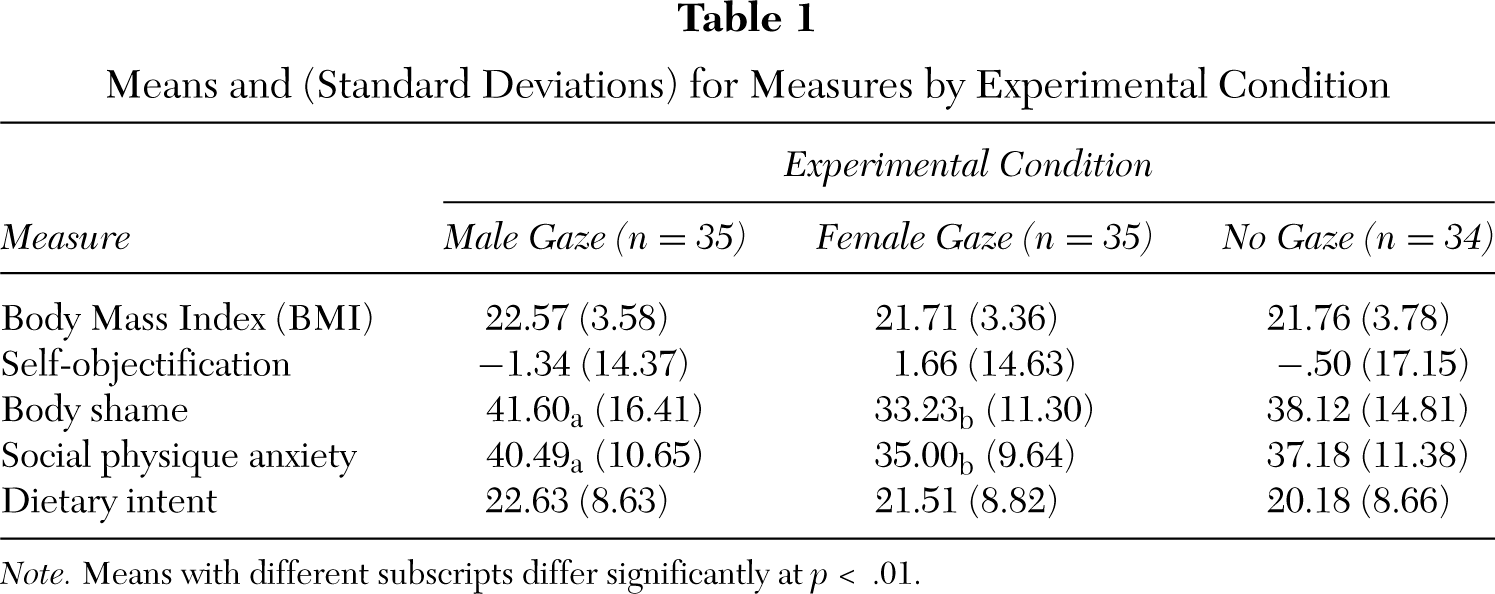
Note. Means with different subscripts differ significantly at p < .01.
When the packet was completed, participants were escorted to a different room and seated at a table with two chairs. The participant sat in one chair and the experimenter sat across the table from the participant in the other chair. Participants were asked to read the instruction sheet first and then complete the second packet of questionnaires. The instruction sheet indicated that the second half of the study involved interactions between strangers and the emergence of friendships. One-third of the participants were told they would be interacting with a male stranger, one-third with a female stranger, and one-third were not told they would be interacting with a stranger. Participants in the experimental conditions read they would be engaging in conversation, or “small talk,” for approximately five minutes with a male or female stranger at which time the experimenter would join them. The participants were then asked to complete the last three questionnaires before notifying the experimenter they were ready. The control group read only that they were to complete the questionnaires and then notify the experimenter. This second packet included measures of body shame, social physique anxiety, and dietary intent in counterbalanced order. To provide anonymity, all questionnaires were administered and returned in closed packets coded by number.
When participants alerted the experimenter they had completed the second packet of questionnaires, the debriefing process began. To check for participant knowledge of the purpose of the study, all women were asked what they believed the study was designed to investigate. None of the women mentioned body image or eating-related issues as part of the study, which suggests reporting weight and height information did not alert them and thus affect responses on subsequent measures. Participants were thoroughly debriefed and the experimenter ensured that they felt comfortable with their experience before leaving the laboratory. None of the participants expressed discomfort with their participation. Participants were told to look for a posting of the study results when it was completed. Following the format of the psychology department for conveying study results to participants, a summary of the study and its results was posted in an area frequented by most students. The experimenter's contact information was provided to allow for questions or concerns with the study.
RESULTS
Descriptive Statistics and Analyses of Covariates
An alpha level of .05 was used for all statistical tests. Means and standard deviations for the experimental conditions are displayed in Table 1. Correlations among BMI, self-objectification, body shame, social physique anxiety, and dietary intent are displayed in Table 2. BMI did not correlate significantly with self-objectification, which is consistent with objectification theory, or dietary intent. A one-way analysis of variance (ANOVA) was conducted on BMI and self-objectification to test for differences between experimental conditions. Results revealed no significant differences on BMI, F(2, 103) = .92, p = .402, or self-objectification, F(2, 103) = .35, p = .704. BMI and self-objectification were entered as covariates in the following analyses based on their low to moderate correlations with the dependent measures.
Correlations Among Control and Dependent Variables
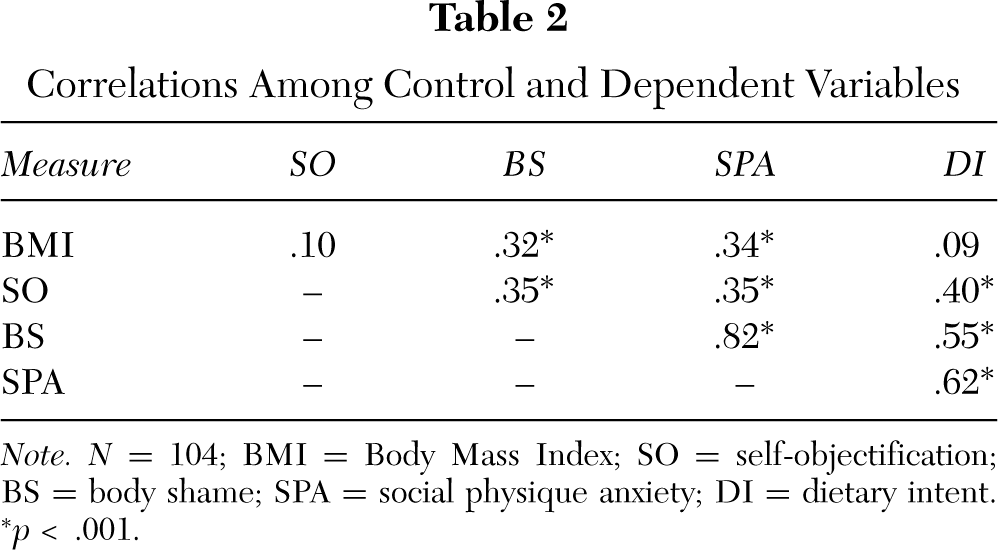
Note. N = 104; BMI = Body Mass Index; SO = self-objectification; BS = body shame; SPA = social physique anxiety; DI = dietary intent.
∗ p < .001.
Test of Hypotheses
The first prediction was that participants who anticipated a male gaze would report greater body shame, social physique anxiety, and intent to diet when compared to participants who anticipated a female gaze. The second prediction was that participants who anticipated a male or female gaze would report greater body shame, social physique anxiety, and intent to diet when compared to participants who did not anticipate a gaze.
A one-way multivariate analysis of covariance (MANCOVA) was used to analyze body shame, social physique anxiety, and dietary intent scores, with BMI and self-objectification as covariates. A significant covariate effect was found for BMI, F(2, 103) = 4.34, p = .01, and self-objectification, F(2, 103) = 8.17, p = .0001. The MANCOVA also yielded an omnibus effect for experimental condition on body shame, F(2, 103) = 4.39, p = .01, and social physique anxiety, F(2, 103) = 3.53, p = .03. Dietary intent did not differ by experimental condition and thus was not included in further analyses, F(2, 103) = .89, p = .420. Follow-up univariate tests revealed that the male gaze condition reported higher scores for body shame, F(1, 69) = 7.70, p = .007, and social physique anxiety, F(1, 69) = 6.56, p = .01, compared to the female gaze condition. Although the means were in the predicted direction, follow-up univariate tests revealed no significant differences between the male gaze and no gaze condition for body shame, F(1, 68) = .85, p = .400, or social physique anxiety, F(1, 68) = 1.41, p = .240. The female gaze condition did not differ from the no gaze condition for social physique anxiety, F(1, 68) = .77, p = .383, and was marginally different for body shame, F(1, 68) = 3.65, p = .06, although not in the expected direction.
DISCUSSION
A number of studies have supported the propositions of objectification theory indicating that the objectification of one's own body produces negative emotional experiences and has a detrimental impact on mental health. The present study contributes to this prior work by demonstrating that the negative effects of self-objectification can be experienced by college women in non-body-focused situations and without actual observers present. It also supports a fundamental proposition of objectification theory, which is that the internalized male gaze, and not just any gaze, negatively affects women. As predicted, when compared to participants who anticipated a female gaze, participants who anticipated a male gaze reported significantly greater body shame and social physique anxiety. The women did not have to interact with a man; they merely had to anticipate interacting with a man for negative effects to occur. The implications of this finding are unsettling if we imagine the number of seemingly innocuous social contexts women enter in and out of on a daily basis that include the potentially objectifying male gaze.
In contrast, women who anticipated a female gaze reported the lowest means for body shame and social physique anxiety when compared to the other experimental conditions. This suggests that anticipating the female gaze somehow acted to reduce the negative effects of self-objectification. This is an interesting, unexpected outcome. Previous research has shown that women do compare to and evaluate other women, and this leads to experiences of negative affect (Pike & Rodin, 1991; Thornton & Maurice, 1997; Thornton & Moore, 1993). One possible explanation for this finding involves the design of the present study. First, a great deal of the research demonstrating that women respond negatively to other women involves asking women to compare themselves to or exposing them to visual images of women, often ultrathin models in magazines. Second, the negative influence of women on other women has been specifically related to attitudes and behaviors surrounding eating and physical appearance (Chaiken & Pliner, 1987; Smolak & Murnen, 2001), and is not necessarily a general phenomenon. In the present study, participants were not exposed to actual women or images of women, and they did not associate the nature of the study with eating or body image issues. It is possible that in conditions where eating and body image issues are not salient, other women are perceived positively and as providing social support rather than negatively and as a marker for social comparison.
The nature of self-objectification itself may also account for this finding. Self-objectification is described as an adaptive strategy adopted by women to anticipate the repercussions of their appearance on an observer, specifically a male observer. Anticipating the gaze of a woman may not have triggered the same association between appearance and treatment as when anticipating the gaze of a man. Overall, this finding suggests that anticipating a female gaze in non-body-focused situations may decrease shame and anxiety about the body, and therefore may be a protective factor against the consequences of self-objectification.
The male and female conditions were not significantly different from the no gaze condition on body shame and social physique anxiety. The control condition was included to allow for a comparison against baseline levels of the dependent measures. If these baseline levels reflected the preexisting effects of objectification on women in this culture, then anticipating a male gaze may have been insufficient to override these effects. Another possibility is that women in the control condition did anticipate an interaction with someone given the way the table and two chairs were arranged. Considering males are the norm, it is possible that participants in the control condition anticipated a male interaction, which would account for the lack of differences from the male gaze condition.
No significant differences were found between experimental conditions for dietary intent. Two explanations are plausible for this null result. First, similar to the argument above, this one-time anticipation of a male or female gaze may not have been sufficient to change the degree to which participants intended to restrain their eating. Perhaps the anticipated brevity of the interaction experience (i.e., engage in “small talk” for five minutes) reduced the power of the situation to a level that altered affective experiences, but did not change dieting intent. Second, in an attempt to suggest causal relationships between the gaze conditions and dietary intent, the scale items were worded to measure intent to restrain eating and not current degree of restraint. If current restraint was already present, and in particular if it was already high, participants may not have reported greater intentions to restrain more. If the body weights reported by participants were accurate, the low BMIs calculated suggest almost half of the sample practiced restrained eating. A measure of the current level of restrained eating may have been sufficient to capture what women are already doing in response to objectification and how they would respond to the male gaze. Moreover, it is possible that using actual food consumption as the measure of restrained eating, as in Fredrickson et al.'s (1998) study, may have demonstrated differences between conditions. Actual eating behavior is potentially observable behavior and thus more likely to be inhibited than self-reported behavior which does not carry the same threat.
The results of this study are limited to a predominantly European American, college-aged, college-educated sample of women. The effect of the male gaze on affective experiences and eating behavior in other subpopulations of women requires further research. Also, an observable difference between the experimental conditions was limited to the dependent measures administered. Although it was expected that the male gaze condition would trigger the phenomenological experience of body shame, anxiety related to self-presentation, and intent to restrain eating, other measures of body dissatisfaction, disordered eating, and non-body-focused experiences may have demonstrated different results. The manipulation of anticipating the male gaze may be enhanced in future studies by incorporating features of social contexts that have been identified as most predictive of the experiential consequences of objectification (Fredrickson & Roberts, 1997) including contexts that are public, mixed-gender, and unstructured. Based on the unexpected findings in the female gaze condition, future research may also examine if anticipating both a male and female gaze together exacerbates or negates the effect of the male gaze.
All women who live in a culture where the female body is treated as an object to be evaluated and measured are at risk for self-objectification. Thus far, research on objectification theory has demonstrated that the negative consequences of self-objectification are real and far-reaching in their effect on women's lives. This is not surprising when we consider that girls are treated as sexual objects at a very young age. Murnen and Smolak (2000) found that 75% of girls in elementary school (third through fifth grade) reported experiencing sexual harassment. In their examination of former dancers, Tiggeman and Slater (2001) demonstrated that prolonged experiences in objectifying situations at a young age could lead to the development of an enduring pattern of self-objectification. If we take the consequences of self-objectification seriously, we must take collective action toward identifying, challenging, and changing sexually objectifying messages and behaviors.