







Abstract
A model in which future orientation links perceived fathers' and girls' beliefs about traditional women's roles and academic achievement was tested on data collected from traditional Israeli Palestinian girls (N = 295) attending a Moslem all-girl senior high school. LISREL analyses estimated two empirical models pertaining to educational and family future orientation. The estimated models showed that fathers' perceived beliefs were directly linked to academic achievement and future orientation partially mediated the relationships between girls' beliefs about women's roles and academic achievement. Girls' beliefs were negatively linked to the educational future orientation and positively linked to the family future orientation, and the educational model explained a larger percent of the variance of academic achievement than did the family model.
In a recent study of the future orientation of Israeli Palestinian adolescents, one girl wrote:
Nowadays I think a lot about my future. That is, what I would like to happen and what is the subject I would like to study at the university. And after thinking for a long time I decided to study teaching at a teachers' college, and want to start immediately after [graduating from] high school and don't want to take a year off and rest at home or get a job (Seginer, in press).
The concern about her prospective education is not unique to this girl. Research about the future orientation of Israeli Jewish and Palestinian adolescents conducted in the last 15 years (e.g., Seginer, 1988, in press) has consistently shown that Israeli Palestinian girls differed from Palestinian boys and Jewish girls and boys in two respects: They were more concerned about prospective education, and their desire for education was intertwined with concerns that early marriage would interfere with their higher education. These issues were particularly voiced by traditional girls for whom the incompatibility between education and early marriage has been strongest (Mahajna, 2000).
Consequently, the objective of this study was to examine the antecedents and outcomes of future orientation regarding education and family. Specifically, we asked whether beliefs about women's roles as the girls hear articulated by significant others and construct themselves would be linked to future orientation and future orientation would be related to academic achievement. The patriarchal nature of the Arab society (e.g., Barakat, 1993; Haj-Yahia, 2002) and the significance of experienced environment (e.g., Kelly, 1955; Lewin, 1936) in general and parenting in particular (Steinberg, 2001) led us to focus on fathers' beliefs about women's roles as perceived by their daughters. Academic achievement was selected as the outcome variable for its relevance to prospective higher education and the significance of education for the psychological and economic well being of women (Hyde & Kling, 2001; Slaughter-Defoe, Addae, & Bell, 2002) and their children (Slaughter-Defoe et al., 2002).
The integration of these considerations resulted in a hierarchical model in which future orientation linked the beliefs about women's roles and academic achievement. Its presentation is preceded by review of the participants' sociocultural setting and the two main conceptual topics of this study: beliefs about women's roles and future orientation.
The Sociocultural Setting
Three spheres make up the sociocultural setting of the participants of this study: the Israeli Palestinian society, their rural town, and the religious all-girl school they attend.
Pertinent features of Israeli Palestinian society. The establishment of the State of Israel has been a major landmark in the history of Palestinians, particularly because they had become a minority and many of their families were dislocated and stripped of their property and land and were for several years under military administration. Its overall consequences have been multiple. Here we focus on the civic (private) and collective identities of the Israeli Palestinian population. Although differing in their interpretations, researchers agree that over the years Israeli Palestinians have gone through parallel processes of Palestinization and Israelization (Smooha, 1992, 1998) that led to the strengthening of both their national-Palestinian and civic-Israeli identities (Suleiman, 2002). The first has been reflected in national self-awareness, identification with the Palestinian struggle, and pursuit of the Arabic culture and language, and the latter in attributing high value to an improved standard of living and higher education and the endorsement of democratic values.
Of particular relevance to this study are the growing value and ensuing changes in the educational realm. The growing awareness of the importance of education as “capital” that may replace lost land supported by the introduction of compulsory education during the 1950s led to the gradual increase of the level of education of Israeli Palestinians. Nevertheless, in the higher levels of education the gap between Jews and Palestinians and within the Palestinian society between women and men still exists. To illustrate, to date twice as many Jewish as Palestinian adults (in the 25 to 54 age group) have completed 13 to 15 years of education, and two-thirds of the Israeli Palestinians with 16 or more years of education are men (Israel Bureau of Statistics, 2002).
Given the impact of events, it is important to note that as our respondents have been entering adolescence they witnessed the growing tension between the Palestinian Authority and Israel. Its direct bearing on the Israeli Palestinians culminated in the killing of 13 Israeli Palestinians in clashes with the Israeli police in the wake of the second Intifada in October 2000. The 3 months preceding data collection (June 2002) were marked by much violence on both the Israeli and the Palestinian sides and a growing tension between the Palestinian Authority and the Israeli government, widely covered by the media. Although our respondents were not directly affected, the Israeli Palestinian violence may have indirectly influenced the girls' responses in two ways. The first was that public discourse about Palestinian struggle for national independence was translated by women into a quest for personal—rather than merely national—independence (Seginer & Mahajna, 2003; Tawil, 1980), and the second and less prevalent was a concern that Israeli Palestinian students were discriminated against in admission to Israeli universities.
The locality. Originally a village in central Israel, this community has grown into a town of 40,000 inhabitants. Its population is all Moslem and young: 48% are children and youths under the age of 18 and 34% in the 18 to 35 age group. Like the majority of rural Palestinians, the men of this town have moved away from agriculture to other jobs. Their low level of education and few occupational opportunities pushed them into low paying jobs outside their area. Paid employment for women is rare and associated with a higher level of education and professional training mainly in education. Since the municipal election in 1989, the town has been governed by the Islamic Movement, a radical religious organization active only on the local level of Israeli Palestinian settlements. Its emphasis on Islamic tradition and concern for welfare, health, and educational issues has led to improvement of these services and the growing power of the Islamic movement among the town's inhabitants (Rabinowitz, 1995).
The school. This all-girl religious school serves the town as well as the villages in the region. Its heterogeneous academic level is the result of a dual emphasis on education to all and encouragement of high academic achievement. The former has led to the participation of the school in government-supported academic intervention programs for underachieving students and the latter to its participation in statewide science competitions in which its students won several prizes.
Beliefs About Women's Roles
At the core of the beliefs about women's roles (also referred to as attitudes toward women's roles, McHugh & Frieze, 1997) has been the tension between women's traditional roles as wives and mothers and the pursuit of equal opportunities for education and occupational pursuit (Buhrke, 1988; Spence & Hahn, 1997). Thus, across different cultural settings and age groups, women have expressed more liberal beliefs than men, particularly endorsing women's rights for equality of opportunities (e.g., McHugh & Frieze, 1997; Tashakkori & Thompson, 1991). In this analysis, we focus on beliefs about women's roles from two perspectives: fathers' beliefs about women's roles as specifically applying to girls' education and early marriage as perceived by their daughters, and girls' self-reported beliefs focusing on traditional versus liberal women's roles.
Perceived fathers' traditional beliefs about women's roles. The selection of fathers emanated from the nature of the Arab society as a patriarchal society (e.g., Barakat, 1993; Haj-Yahia, 2002) in which fathers act as authority figures and chief decision makers within their families. Drawing from similar considerations, other analyses of traditional societies (e.g., Serpell, 1993) followed a similar reasoning and collected data from fathers only. The specification of fathers' beliefs about women's roles in terms of higher education and early marriage drew on the prevalence of early marriage among rural Israeli Palestinians and the conflict it has created for traditional Palestinian girls who wish to continue their education.
The conceptualization of parenting as perceived by adolescents has become the common approach in research on adolescents' parenting (e.g., Chao, 2001; Gray & Steinberg, 1999). Its endorsement resulted from weighing two considerations: the methodological assumption that shared source variance inflates observed relationships between variables and the psychological premise that the meaning of the environment is derived mainly from how individuals subjectively experience it. This premise dwells on the importance of subjective representations (e.g., Kelly, 1955; Lewin, 1936), the dissimilarity between the objective (alpha press) and subjectively experienced environment (beta press; Murray, 1938), and the attribution theory distinction between the reality as observed by the observer and experienced by the actor (e.g., Jones & Nisbett, 1971; Kelley, 1967).
Girls' traditional beliefs about women's roles. Previous studies in Israel of the traditional versus liberal beliefs about women's roles have shown that girls held more liberal beliefs than boys, and that for Palestinian girls (but not for boys) liberal beliefs were directly related to their age and level of education (Mar'i, 1983; Seginer, Karayani, & Mar'i, 1990). Although no earlier study has examined the relationship between girls' traditional versus liberal beliefs and future orientation, the tendency of Palestinian girls to describe their desire for higher education as a means for securing independence (Seginer & Mahajna, 2003) suggests that their beliefs would be compatible with their future orientation regarding higher education.
Future Orientation
The importance of future orientation draws on its agentic nature (Bandura, 2001) implying that by orienting themselves to the future, individuals may influence their present behavior (e.g., Nuttin & Lens, 1985). Specifically for adolescents, its relevance emanates also from the normative developmental task of preparing for the future. A core definition of future orientation describes it as the images individuals have regarding their future, as self-constructed and consciously represented. This definition applied particularly to early future orientation research (e.g., Nurmi, 1991; Trommsdorff, 1983) that focused on the cognitive representation of multiple thematic domains and has been described as the thematic approach to future orientation (Seginer, in press).
In this study we employ an expanded conceptualization that views future orientation as a multidimensional process and describes each prospective life domain in terms of three components: motivational, cognitive representation, and behavioral (Seginer, 2000, in press; Seginer & Mahajna, 2003; Seginer, Nurmi, & Poole, 1991). The prospective life domains and the three-component model are described below.
Prospective life domains. The two domains studied in this analysis are prospective education (higher education) and prospective family (marriage and family). Their relevance stems from the rival trajectories they represent for traditional Israeli Palestinian girls, particularly because in recent years the traditional trajectory of early marriage, and thus an early entry to adulthood, has been contested by their desire for higher education and postponed marriage. In analyzing future orientation as it applies to each of these domains, we will use the terms educational future orientation and family future orientation.
The three-component model. Underlying this conceptualization has been the proposition that future orientation consists of (a) the motivation that prompts, (b) the cognitive representation of the future by images and thoughts, and (c) behaviors of exploration of future options and commitment to one choice. As noted earlier, the model is generic in the sense that it can be applied to any prospective life domain—in this study to education and family—and is hierarchical: motivational component → cognitive representation component → behavioral component, and motivational processes → behavioral component. Thus, the behavioral component is linked to the motivational component both directly and indirectly via cognitive representations. Altogether, the future orientation model is domain-specific and partially mediated.
The motivational component. The motivational properties of future orientation as they apply to each prospective life domain emanate from the needs (Nuttin & Lens, 1985; Trommsdorff, 1986), value of expected behavior outcomes, and the subjective appraisal of their attainability (Atkinson, 1964; Atkinson & Feather, 1966; Eccles & Wigfield, 1995; Raynor & Entin, 1983), and of internal (i.e., ability and effort) factors for satisfying personal needs (Weiner, 1974). The motivational component subsumes three variables: the value of a prospective life domain; expectance (i.e., subjective probability) of materialization of plans and its affective outcomes (Carver & Scheier, 2001); and a sense of internal (ability and effort) control regarding prospective materialization of plans. Altogether the motivation to engage in future-related thinking and behavior is domain specific and draws on individuals' appraisal of the domain (i.e., the value of the educational and family domains) and the self in relation to this domain (i.e., expectance of materialization of plans and attribution of internal control to predict or interpret success in the education and family domains; Weiner, 1974).
The cognitive representation component. This component consists of domain-specific images and thoughts, reflecting preoccupation with domain-related issues (i.e., educational and family issues). Underlying it is the assumption that the frequency with which individuals think about a domain reflects its salience and centrality in the life-space representing the future.
The behavioral component. This component consists of exploration of future options (i.e., gathering information, seeking advice, and probing the suitability of educational and family options) and a decision about commitment to one specific option. Similar terminology notwithstanding, the meaning of exploration and commitment in the future orientation and identity formation conceptualizations is different. Although in the theoretical framework of ego identity, exploration and commitment are the observable indicators of intrapsychic processes of identity formation, and their combined presence or absence defines the identity statuses (Marcia, 1993). In the future orientation conceptualization they are treated separately and active engagement in each is assumed to lead toward the delineation and pursuit of domain-specific plans. However, their different functions in the two theoretical frameworks do not refute the developmental relationship between them (Erikson, 1958, 1968) and the relevance of future orientation to ego identity (Marcia, Waterman, Matteson, Archer, & Orlofsky, 1993).
The Hierarchical Model of Beliefs, Future Orientation, and Academic Achievement
Our model consists of six hierarchical steps (Figure 1): fathers' (perceived) and girls' beliefs about women's roles; the motivational, cognitive representation, and behavioral components of future orientation; and academic achievement. This model will be estimated separately for the education and the family domains. As noted above, the empirically estimated models will be referred to as the educational future orientation and the family future orientation. The rationale for the hierarchy and hypotheses regarding links among the different variables are presented below. Underlying this hierarchy was the assumption that parent-child reciprocity notwithstanding, examination of the effect of parents on their children was important for both theoretical and policymaking reasons.
The relationship between perceived fathers' traditional beliefs and girls' traditional beliefs about women's roles. Our first hypothesis regarding the relationship between perceived fathers' traditional beliefs and girls' traditional beliefs about women's roles drew on two assumptions: that as their daughters approach the age of 17 (Israeli minimum marriage age for women), the beliefs of traditional Palestinian fathers about women's roles as they apply to the choice between higher education and early marriage become particularly salient and known to their daughters, and that in traditional settings the similarity between parents' and children's beliefs is supported by the endorsement of these beliefs by other social settings as well. Hence, our first hypothesis postulated that perceived fathers' traditional beliefs about women's roles would be linked to girls' traditional beliefs about women's roles. That is, more traditional fathers' beliefs about women's education and early marriage, as perceived by their daughters, would be linked to more traditional girls' beliefs about women's roles.
The relationship between girls' traditional beliefs about women's roles and future orientation. The hypothesis on the link between beliefs and future orientation stemmed from the premise that beliefs organize individuals' thinking and guide their behavior. Given the direct relevance of girls' beliefs about women's roles to their motivation to think about the future, construct images about it and engage in relevant behaviors regarding further education and prospective family, our second hypothesis was that girls' traditional beliefs about women's roles would be linked to variables subsumed under the motivational, cognitive representation, and behavioral components of future orientation. However, traditional beliefs would be negatively (inversely) linked to future orientation applying to the education domain and positively linked to future orientation applying to the family domain.
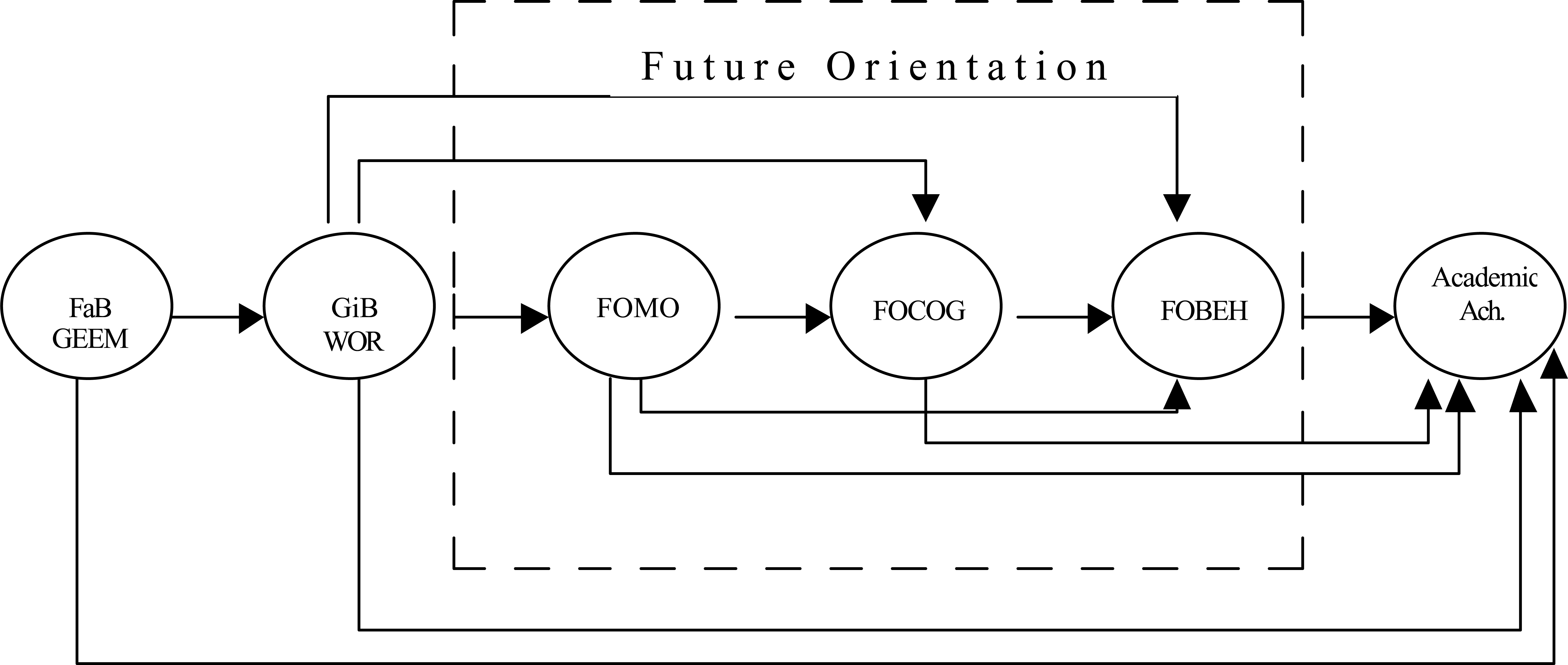
The theoretical six-step hierarchical model of the relationships between beliefs, future orientation, and academic achievement.
The relationships between perceived fathers' traditional beliefs and girls' traditional beliefs and academic achievement. Our hypothesis about the links between perceived fathers' beliefs and academic achievement drew on the premise that like parental aspirations and expectations, which have an effect on academic achievement (e.g., Juang & Silbereisen, 2002), fathers' traditional beliefs are relevant to academic achievement. By endorsing early marriage that inevitably obstructs higher education, fathers discourage their daughters and hence lower their academic achievement. Moreover, academic achievement, like other behavioral outcomes, is particularly linked to fathers' beliefs as perceived by their daughters. Hence, our third hypothesis predicted that perceived fathers' traditional beliefs about women's roles would be negatively related to academic achievement. In light of the behavior-guiding properties of beliefs, our fourth hypothesis predicted that girls' traditional beliefs about women's roles would be negatively related to academic achievement.
The relationships between future orientation and academic achievement. The relevance of academic achievement to a future orientation model rests on a basic premise regarding “the possibilities of harnessing the future for the present” (Israeli, 1930, p.121). A similar idea was developed by Nuttin and Lens (1985) contending that “the dynamics thus invested in the goal object are channeled towards the instrumental act to the extent that the act is perceived as a good path or instrument towards the goal (perceived instrumentality)” (p. 34). Specific to this design, the goal is higher education and the instrumental act is schoolwork leading to high grades.
Our hypothesis about the future orientation—academic achievement links was domain specific. The prediction on the links between education future orientation and academic achievement drew on the fact that university admission is dependent on matriculation (i.e., high school diploma) and grades obtained by successfully passing the matriculation examinations (administered by the Ministry of Education). The prediction on the links between family future orientation and academic achievement drew on the fact that in the traditional Palestinian society early marriage is incompatible with plans for higher education and hence should be negatively (inversely) related to academic achievement. Consequently, our fifth hypothesis predicted direct links between the future orientation motivational, cognitive, and behavioral variables and academic achievement; however, for the educational future orientation these links would be positive and for the family future orientation they would be negative.
METHOD
Participants
Participants were 295 girls attending 10th to 12th grade (age range 16-18 years old) in the school described earlier. Participants came from large Moslem families (number of children: M = 6.70, SD = 2.29). Parents' education was relatively low (M = 8.60 [SD = 3.20] and 9.95 [SD = 2.95] years of education for mothers and fathers, respectively). The majority of mothers (93%) were not employed outside their homes and the majority of fathers (60%) were semi-or unskilled workers.
Instruments
The questionnaires used in this study are described below. Information about number of items, sample items, and internal consistency coefficients (Cronbach's α) for each scale are presented in Table 1. The order of presentation corresponds to the variables' position in the hierarchical model.
Perceived Fathers' Traditional Beliefs About Girls' Education and Early Marriage (Mahajna, 2000). This Likert-type questionnaire (1 = does not describe him at all, 5 = describes him very well) was developed in Arabic. It consists of items pertaining to beliefs about girls' education and early marriage in general and as applying to their daughters, recoded so that high scores represent traditional beliefs.
Girls' Traditional Beliefs About Women's Roles (Seginer et al., 1990). This Likert-type scale (1 = strongly agree, 5 = strongly disagree) describes girls' beliefs about women's roles as traditional versus liberal (the higher the score the more traditional the beliefs). The scale was developed in Hebrew and translated into Arabic and English by employing the translation and back-translation procedure (Seginer et al., 1990). For the present analysis, we selected 10 items from the Traditional Women's Roles factor of the Attitudes Toward Women's Roles questionnaire (Seginer et al., 1990) that had the highest factor loadings (>.50) and phrased them as beliefs statements.
The Future Orientation questionnaire. This questionnaire consisted of two parts: the Prospective Life Course questionnaire, and the Hopes and Fears protocol. The Arabic version was created by translation (and backtranslation) of the questionnaire into Arabic by two native speaking Arab graduate assistants and used in earlier studies (e.g., Seginer, 2001; Seginer & Mahajna, 2003).
Scales, Sample Items, and Internal Consistency Coefficients (Cronbach's α)
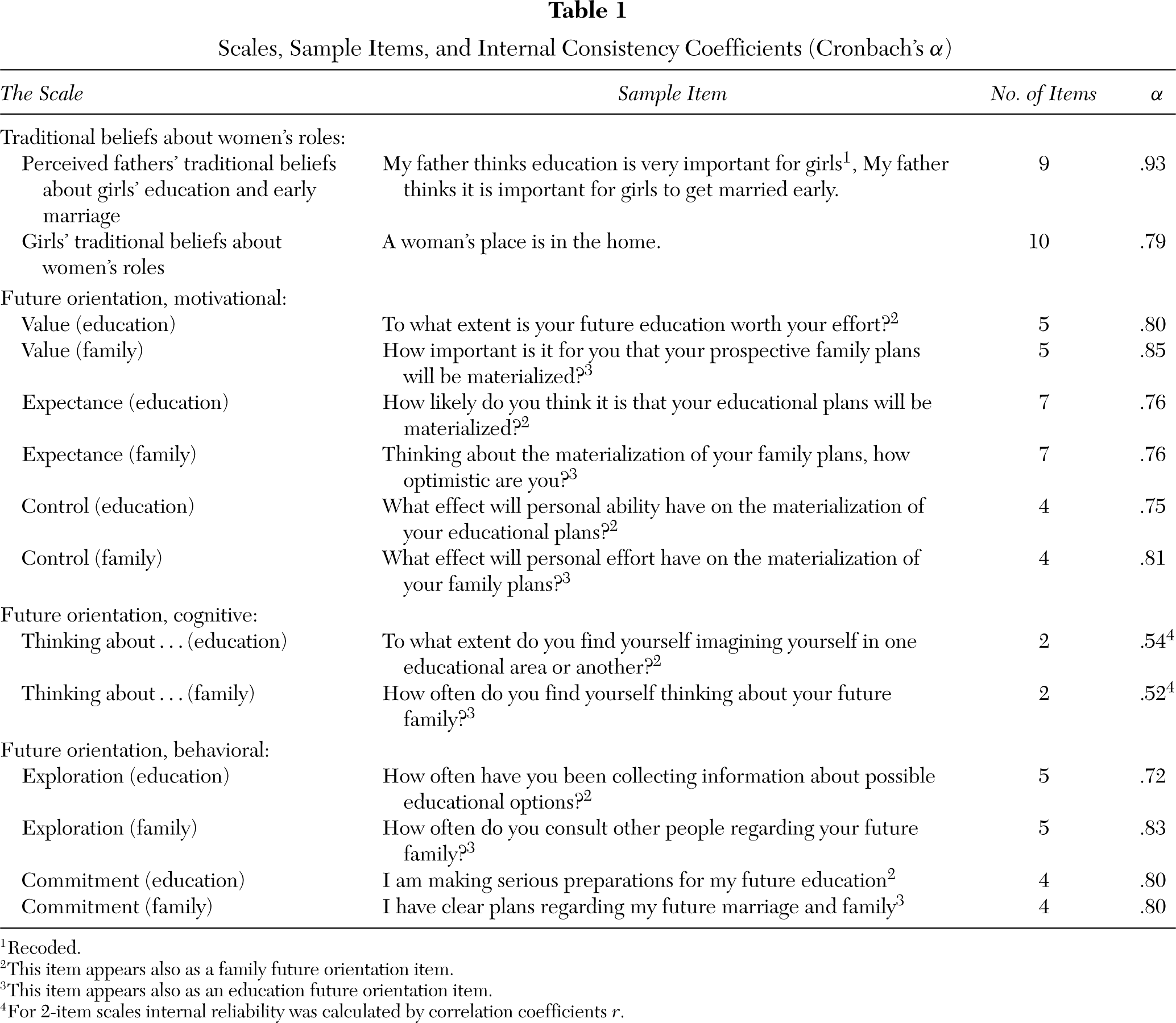
Recoded.
This item appears also as a family future orientation item.
This item appears also as an education future orientation item.
For 2-item scales internal reliability was calculated by correlation coefficients r.
The Prospective Life Course questionnaire (Seginer, Nurmi, & Poole, 1994) consisted of two sections pertaining to education and family, each including Likert-type and semantic differential items (all ranging from 1 = low to 5 = high). Sample items for the scales assessing each future orientation variable as it applies to the education and the family domains, respectively, number of items, and internal consistency coefficients for each are presented in Table 1. The three motivational variables pertained to the value of the domain (i.e., the importance of issues related to the education and marriage and family, respectively), expectance (i.e., the subjective chances of materialization of plans and hopes concerning education and marriage and family, respectively), and internal control (i.e., subjective appraisal of the extent to which materialization of plans and hopes concerning education and marriage and family, respectively, depends on one's ability and effort). Cognitive representation pertained to preoccupation with issues related to education and marriage and family, respectively (i.e., the frequency of thoughts about one's future education and marriage and family). The behavioral variables pertained to exploration of domain-specific options for the future (i.e., engagement in gathering information regarding future education and marriage and marriage and family, respectively), and commitment to one preferred alternative (i.e., decision regarding future education and marriage and family, respectively).
Earlier versions of the Prospective Life Course questionnaire were employed in several studies with Israeli Jewish (e.g., Seginer, 2000, 2001) and Israeli Palestinian adolescents (Seginer, 2001; Seginer & Mahajna, 2003). Its construct validity has been demonstrated by studies of Israeli Jewish and Palestinian adolescents focusing on the relationship between future orientation and optimism and pessimism (Seginer, 2000), self-evaluation (Seginer, Vermulst, & Shoyer, 2003), and academic achievement (Seginer & Mahajna, 2003).
The Hopes and Fears protocol (Seginer, 1988; Trommsdorff, Lamm, & Schmidt, 1979) is an open-ended questionnaire where respondents write down their hopes and fears for the future (in two separate sections). Earlier research analyzed these protocols by coding the narrative units into seven life domains (e.g., higher education, marriage and family, self) and computing domain density scores. Since the open-ended nature of this instrument has led to much missing data, in this analysis hopes and fears narratives were used only for supporting the empirical estimates of the model.
Academic achievement. The grade average was calculated by the school as the mean of the final grades of six core courses (Arabic, English, Hebrew, History, Islam religious studies, and Mathematics) and an electives cluster (e.g., Biology, Chemistry, and Physics; or Psychology and Sociology). On a scale ranging from 0 to 100, with 55 as a passing grade, grades ranged from 55 to 96 (M = 87.17, SD = 8.29).
Procedure
Data for this analysis were collected from participants during the last month of the school year. Questionnaires were group-administered by the second author who was a teacher in this school (about 25% of the respondents participated in his classes). In introducing the research project to the participants, three points were made clear: (a) the purpose of the study was “to learn about important aspects in the lives of girls like you,” (b) participation was voluntary, and (c) their responses would be used for research purposes only, and the content of their responses would not be disclosed. Grade averages were reported by the school at the end of the 2002 school year.
RESULTS
Preliminary Analyses
The analysis was preceded by examination of grade (10th to 12th) differences for each variable included in the analysis and the relationship between parents' educational level and the study variables. ANOVAs for testing grade differences and parental education-study variables correlation coefficients showed nonsignificant results, thus excluding these variables from the analysis.
Empirical Estimates of the Model
Analyses were carried out for each of the two domains by standard equation modeling (Jöreskog & Sörbom, 1996) on covariance matrices, employing the Maximum Likelihood estimation method, thus empirically estimating the educational future orientation and the family future orientation. Correlation coefficients, means, and standard deviations for the educational future orientation and marriage future orientation are presented in Table 2. In this analysis, all but one of the latent variables in the theoretical model were linked to one indicator; the exception was the behavioral future orientation latent variable that, because of the high correlations between the exploration and commitment manifest variables (r = .53 and .57 for the educational and family future orientation, respectively), was linked to both. The error terms of the indicators (except for the behavioral variable and the academic achievement outcome) were estimated using Cronbach's α and the variances of the indicators, so that the error variance of an indicator X is Var(X) (1-α Bollen, 1989; Jöreskog & Sörbom, 1996), and their resulting values are fixed in the LISREL analysis, rather than estimated by it. For clarity purposes, measurement models were omitted from the graphic presentations (Figures 2a, 2b). Although the lambdas and the error terms are related (λ = α2 and the error term = 1 - α for the completely standardized model), for the readers' convenience both are presented in Table 3.
Means, Standard Deviations, and Pearson Correlation Coefficients for Variables Included in Analyses
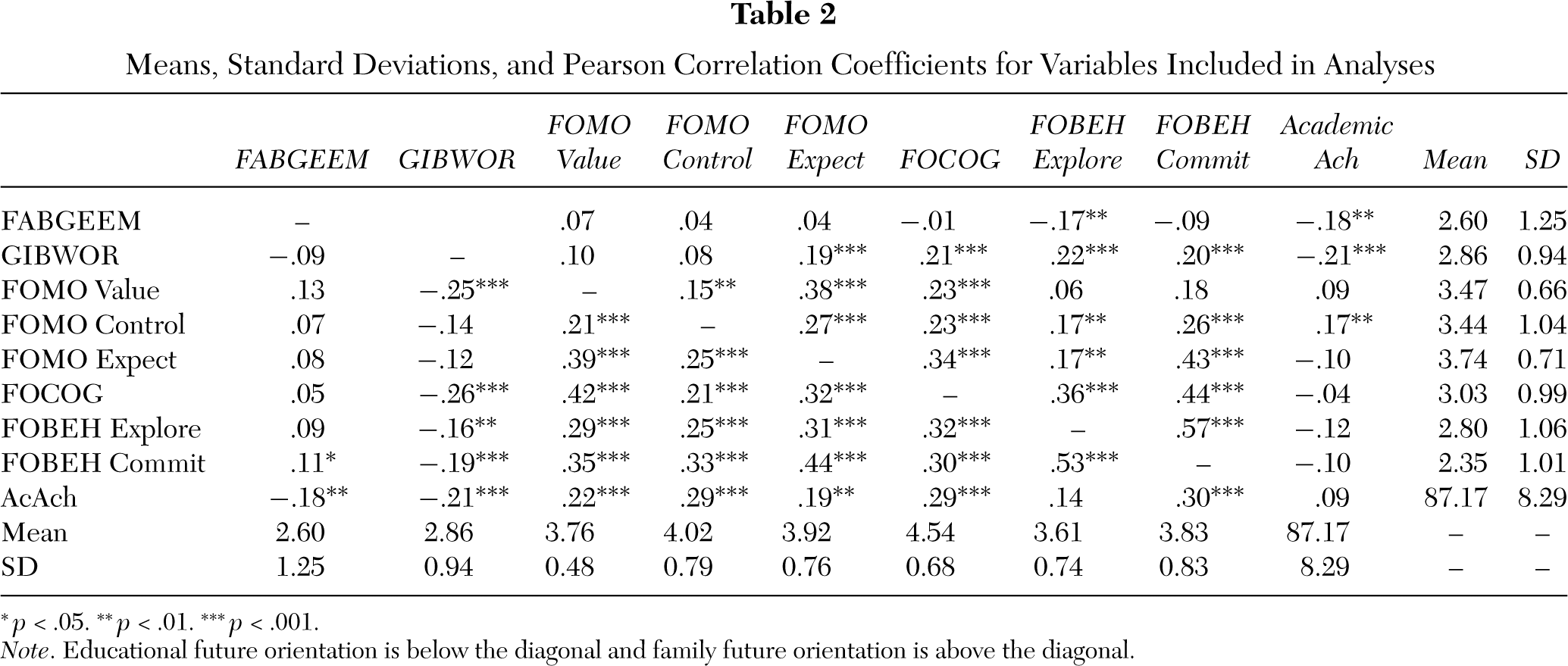
∗ p < .05. ∗∗ p < .01. ∗∗∗ p < .001.
Note. Educational future orientation is below the diagonal and family future orientation is above the diagonal.
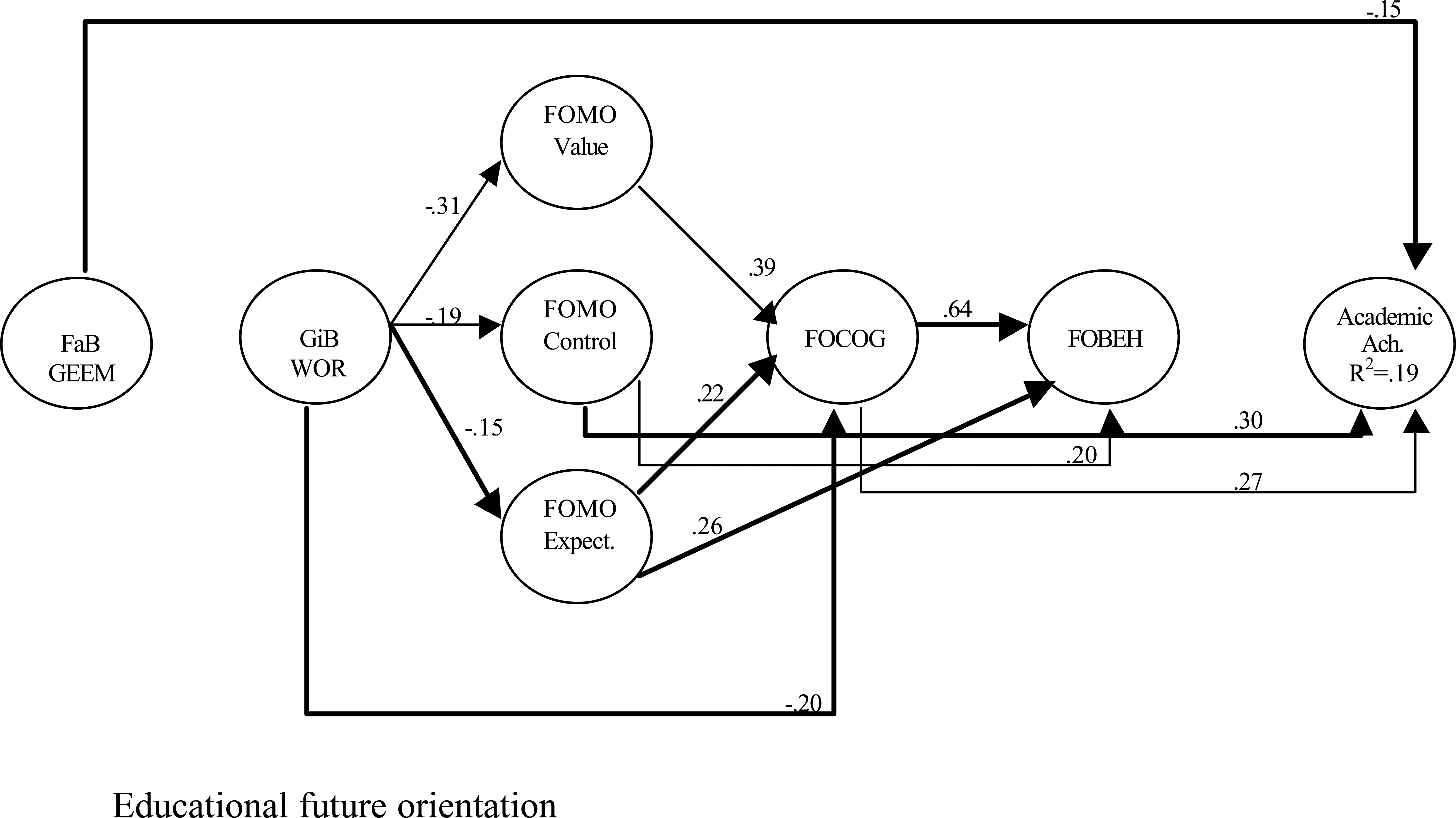
Structural equation model for educational future orientation. X 2(19) = 28.18, p = .080, RMSEA = .04, SRMR = .04, CFI = 0.98, AGFI = .95
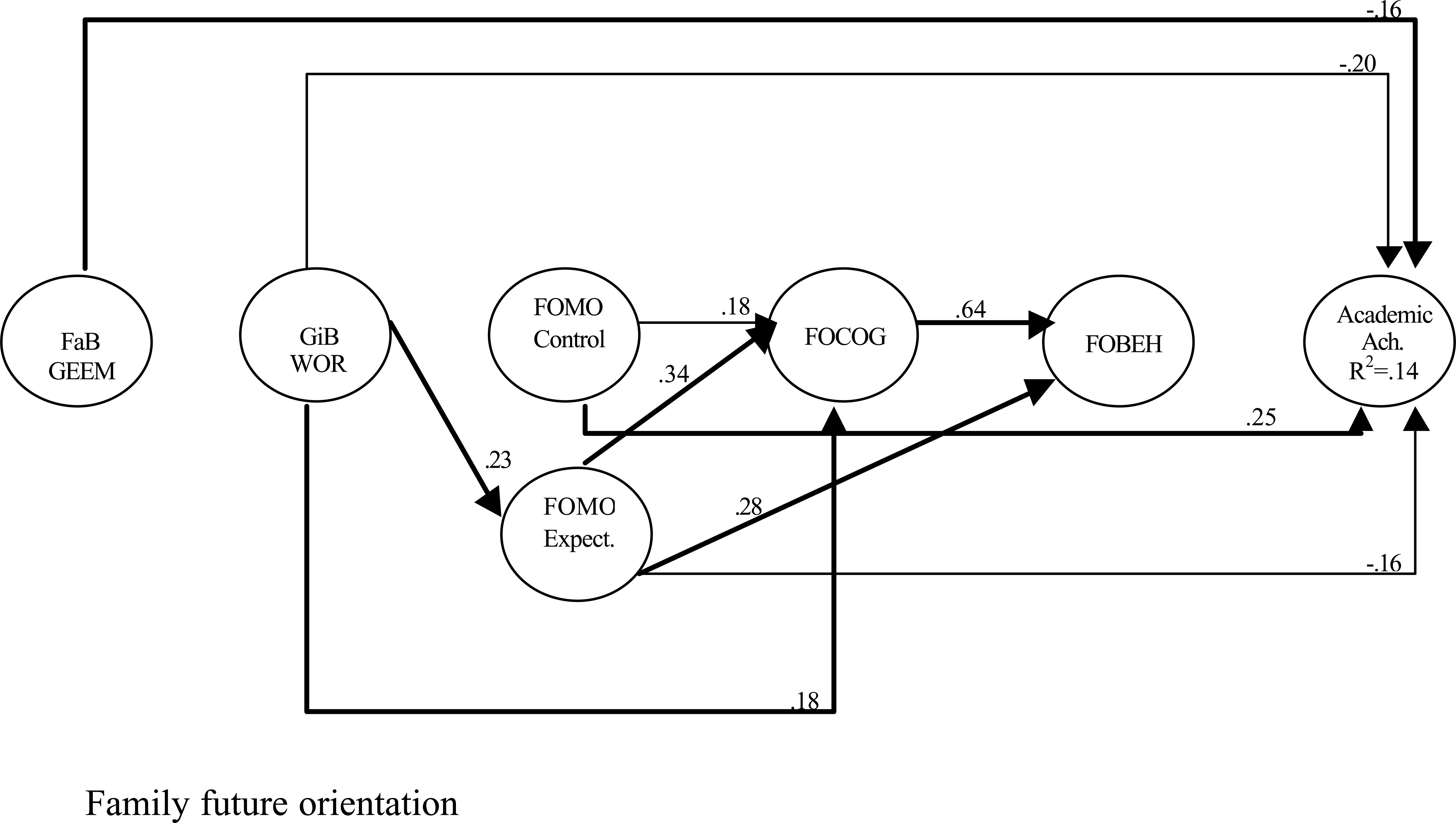
Structural equation model for family future orientation. X 2(14) = 21.71, p = .080, RMSEA = .04, SRMR = .04, CFI = 0.98, AGFI = .95
To test our hypotheses, two LISREL analyses, for the educational and family future orientation, respectively, were carried out. As indicated in Figures 2a and 2b, the two LISREL analyses included the same variables; however, the analysis for the educational future orientation included the Prospective Life Course items applying to education and the analysis for the family future orientation included the Prospective Life Course items applying to the family future orientation. Results pertain to the overall goodness-of-fit of the estimated models and the specific hypothesized links.
Factor Loadings (lambdas) and Error Terms for the Estimated Models of Educational Future Orientation and Family Future Orientation
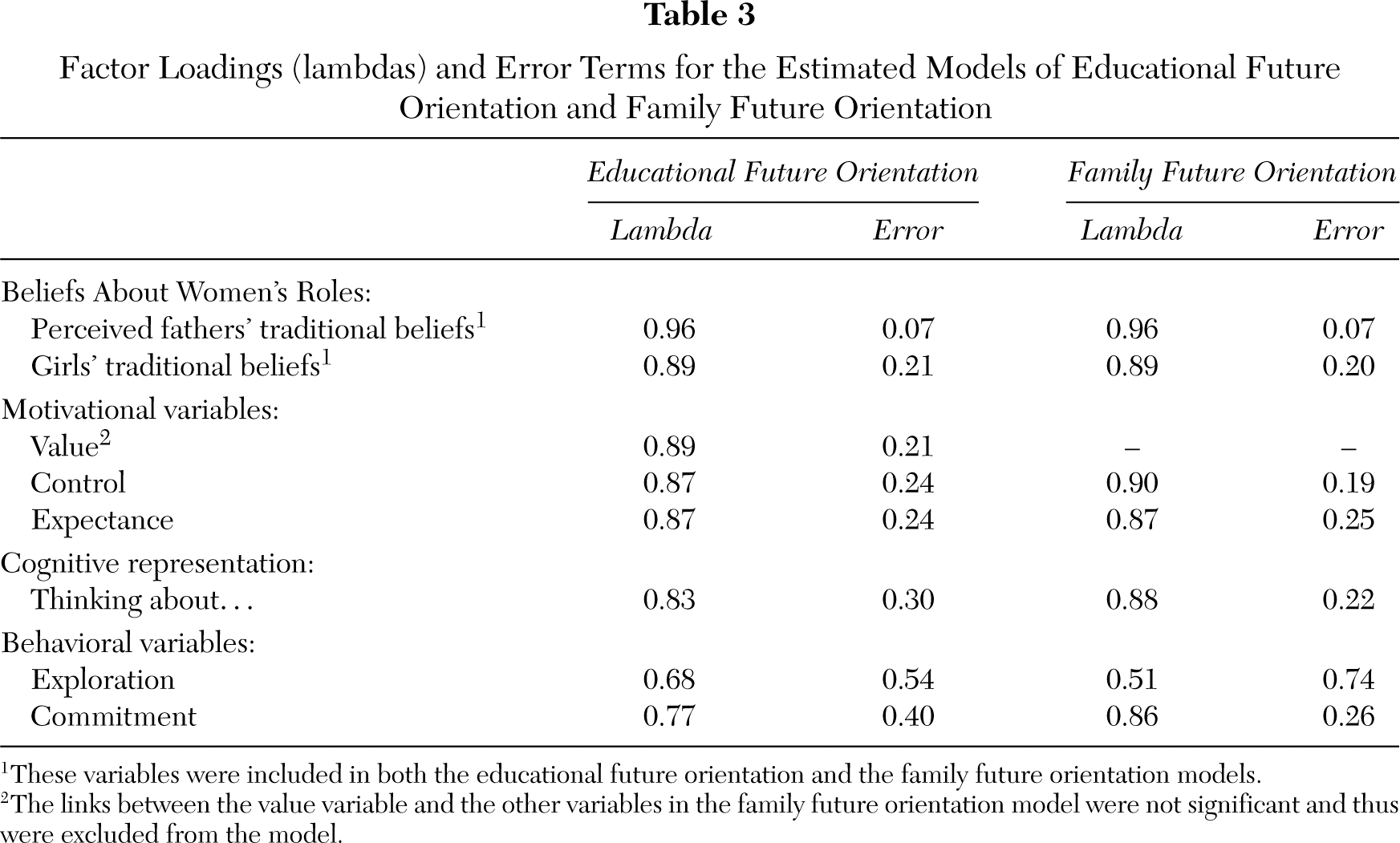
These variables were included in both the educational future orientation and the family future orientation models.
The links between the value variable and the other variables in the family future orientation model were not significant and thus were excluded from the model.
The Models' Goodness-of-Fit
As indicated by Figures 2a and 2b both models showed an acceptable fit (Byrne, 1998; Marsh, Balla, & Hau, 1996) with nonsignificant chi-squares, RMSEA = .04 for both models, SRMR = .04 for both models, CFI = .98 for both models, and AGFI = 0.95. The estimates of the coefficients in Figures 2a and 2b are completely standardized. The educational future orientation and the family future orientation models explain 19% and 14% of the variance of academic achievement, respectively.
Specific Hypothesized Links
Our first hypothesis postulating that perceived fathers' traditional beliefs about girls' education and marriage would be linked to girls' traditional beliefs about women's roles was rejected, because the link between them was not significant (Figures 2a and 2b). Our second hypothesis positing direct links between girls' traditional beliefs and the motivational, cognitive representation, and behavioral components of the educational future orientation (negative links) and the family future orientation (positive links) was partly supported. For the educational future orientation (Figure 2a), girls' beliefs were negatively linked to the value, expectance, and control (motivational variables) and the cognitive representation variables, but not to the behavioral variable. For the family future orientation (Figure 2b), girls' traditional beliefs were positively linked only to expectance (motivational) and the cognitive representation variables, but not to the behavioral variable. The value variable did not enter the analysis of the family future orientation and therefore is not represented in Figure 2b and Table 3.
Our third hypothesis predicting a negative link between perceived fathers' traditional beliefs and academic achievement was supported for both the educational and the family future orientation models (Figures 2a and 2b). Our fourth hypothesis predicting a negative link between girls' beliefs and academic achievement was confirmed for the family future orientation model (Figure 2b) but not for the education future orientation model (Figure 2a), where girls' beliefs were linked to academic achievement only indirectly via value, expectance (motivational variables), and cognitive representation.
The first part of our fifth hypothesis predicted positive links between the motivational, cognitive representation, and behavioral variables of the educational future orientation and academic achievement. This hypothesis was partly supported: Academic achievement was positively linked to control (motivational) and to the cognitive representation, but not to the behavioral variable. The second part of the hypothesis predicted negative links between the motivational, cognitive representation, and behavioral variables of the family future orientation and academic achievement. This hypothesis too was only partly confirmed: internal control (motivational) was positively linked (contrary to the hypothesis), and expectance (motivational) was negatively linked to academic achievement, but the cognitive and behavioral variables were not linked to academic achievement.
In sum, the LISREL analyses of the two models only partly confirmed the hypotheses. Specifically, they rejected the hypothesis that perceived fathers' traditional beliefs about girls' education and marriage would be linked to girls' traditional beliefs about women's roles. However, the analyses confirmed the negative links between perceived fathers' traditional beliefs and academic achievement in both the education and the family future orientation models, and the negative link between the girls' traditional beliefs about women's roles and academic achievement for the family future orientation model. It also showed that the links between girls' beliefs about women's roles and future orientation and the link between future orientation and academic achievement were domain specific and only partly confirmed the hypotheses. Altogether, the education future orientation model explained a larger percentage of the variance of academic achievement than did the family future orientation model.
DISCUSSION
Results of the empirical estimates suggested that the model linking perceived fathers' beliefs and academic achievement only partly fit the reality experienced by Israeli Palestinian girls. We discuss these findings by focusing on the three major issues of this study: (a) the links between perceived fathers' traditional beliefs about girls' education, and marriage and girls' traditional beliefs about women's roles and academic achievement, (b) the links between girls' traditional beliefs about women's roles, future orientation, and academic achievement, and (c) the links between future orientation and academic achievement.
Fathers' Beliefs, Girls' Beliefs, and Academic Achievement
Underlying the theoretical model was the assumption that in the traditional setting in which our study took place, fathers' authority was inclusive and affected both the beliefs and the behavior (as reflected in academic achievement) of their daughters. Our findings indicated that perceived fathers' beliefs were directly linked to girls' academic achievement, but not to girls' traditional beliefs regarding women's roles.
Of the few studies on the topic, one (Cashmore & Goodnow, 1985) is especially relevant here. This study examined parent-adolescent agreement about beliefs for two groups: Anglo Australians (parents born in Australia) and Italian Australians (parents immigrated to Australia as adults from southern Italy). It showed that girls of Italian Australian background had lower agreement with their parents than Anglo Australian girls. The low girl-father agreement found in the Italian Australian and the traditional Israeli Palestinian groups similarly reflected the greater tendency of girls than of their fathers to adapt to the social change their communities had been undergoing.
Thus, in constructing their beliefs about women's roles, these girls did not abide by the authority of their fathers. Although the theoretical model did not include alternative antecedents of girls' beliefs about women's roles, earlier evidence may suggest that the girls' ideas of equality and independence were transmitted from sources outside the family and translated from the national struggle of the Palestinian people to women's personal quest for independence (Tawil, 1980). Moreover, the direct link between perceived fathers' beliefs and academic achievement shows that although girls develop their ideas independently of fathers' beliefs as perceived by the girls, their academic achievement is linked to perceived fathers' beliefs about girls' developmental trajectories.
Their limited freedom of behavior was echoed in the hopes and fears, as illustrated by the following narratives (translated from the Arabic as close to the original as possible).
Honestly, I hope to continue my studies and gain an academic degree that will allow me to continue working. However, my situation is strange. On the one hand, I like studying and especially studying at the university. On the other hand, my family strongly opposes it and wants me to continue in the Shari'a college [Islamic teachers' college for girls], something I do not want. At the end, I will agree, [only] to secure my future and my life (No. 013).
It is plausible that all my dreams will remain stored in the canister of values and norms, because it is not proper for a woman to either study or work. Everything in our society is forbidden on account of religion (No. 029).
As to studying, I always wanted to be a university professor. Today, I know this is not possible because we live in a very rigid and uncompromising society that confines girls inside a very narrow frame [boundaries] in which they are allowed to move. This frame indicates that “a girl stays a girl,” and if she wants to study it [her choices] is very limited: a teacher or any occupation that doesn't take her away from home for long hours. (No. 171).
In sum, these girls clearly distinguished between their freedom to construct ideas about women's roles in general and their future orientation about education and family in particular, and their restricted choices regarding education and marriage. Of all the girls participating in this study, one girl described her family as supporting her studies and her father as a person who “does not discriminate between a girl and a boy” (No. 169). At the other extreme, one girl felt that not only her behavior but also her hopes were appropriated by her parents: “My hopes for the future are not my own property because I always have to consult my parents who have a strong influence on me” (No. 156). Although for the Western eye the contradiction ensuing from the freedom to think but not to act prompts cognitive dissonance, as illustrated in the girls' narratives quoted above, traditional Moslem girls are aware of the discrepancy between their hopes and the options open to them in a traditional society (e.g., “At the end, I will agree, [only] to secure my future and my life,” No. 013). However, it seems that their hopes for the future provide them with a sense of agency (for the importance of a sense of agency for adolescents in times of social change in a Western society, see Wyn & White, 2000). This is illustrated in the following narratives:
My desire is to study chemistry at Tel Aviv University. But [religious] tradition would not allow me; therefore, I will enter the [Islamic] college. But when I grow up and am able to take care of myself, I will continue my graduate studies at the University (No. 12).
“I hope to continue my education and be a strong woman, encountering life's difficulties and obstacles” (No. 29). “My hopes are to raise an exemplary family, to be a successful student, to have control over my life and fulfill some of my dreams” (No. 245).
Girls' Beliefs, Future Orientation, and Academic Achievement
Overall, the hypothesis predicting that girls' beliefs would be linked to each of the future orientation variables was only partly corroborated. Instead, the emergent pattern was that the links between girls' beliefs and the motivational variables were domain specific: Girls' beliefs were negatively linked to all three educational motivational variables but only to expectancy regarding family future orientation; as predicted, this link was positive.
However, girls' traditional beliefs were directly linked to cognitive representation. Specifically, girls' traditional beliefs were negatively linked to the extent to which they were engaged in thinking about educational issues and positively linked to the extent to which they were engaged in thinking about family issues. However, girls' traditional beliefs were linked to the behavioral variable only indirectly via the motivational and the cognitive representation variables. Future research should explore whether these findings are specific to the present sample or represent the closer links of beliefs with the motivational and cognitive aspects of future orientation than with its behavioral aspect.
The links between girls' beliefs and academic achievement were also domain specific. In the educational future orientation model, beliefs about women's roles were linked via the control and the cognitive representation variables, whereas in the family future orientation model it was directly linked to academic achievement. Thus, the lower grades of girls opting for traditional women's beliefs may be explained by the possibility that academic achievement had no instrumental value for them.
Future Orientation and Academic Achievement
The prediction that all future orientation variables pertaining to education would be positively linked and all future orientation variables pertaining to family would be negatively linked to academic achievement was only partly corroborated. Instead, each domain (model) resulted in partly different links: The educational future orientation was directly linked by its motivational and cognitive variables and the family future orientation only by its motivational variables. Domain specificity applied also to percent of explained variance, which was higher for the educational than for the family future orientation.
The perceived instrumentality (Husman & Lens, 1999; Nuttin & Lens, 1985) of high academic achievement for prospective education was articulated in the hopes and fears narratives of our respondents. “To do well in the matriculation exams and in the psychometric tests [state-wide university entrance examinations]. After that I could continue at the university; therefore, it is important to get as many good grades as possible” (No. 239). “Every girl sets a promising future for herself. I am like that. The first step I have set for myself is high matriculation grades that will allow me to be admitted to the university” (No. 049). “All depends on God. I hope God will help me to get high grades so that I could study at the university. I want to study in the Medical School in Jerusalem [Hebrew University]” (No. 180). “Hope to graduate from high school with distinction, get high psychometric score and be accepted to Psychology at the University of Haifa” (No. 154).
Two findings are especially instructive: the direct links between internal control and academic achievement and the absence of the behavioral variable-academic achievement link. Internal control regarding education and marriage and family were correlated, and both were directly and positively linked to academic achievement. Thus, regardless of the domain to which their sense of control applied, it was positively linked to academic achievement. This finding has two explanations. One views control as a personality disposition and hence as having similar effects across domains. The other dwells on the girls' milieu suggesting that while Palestinian girls have understood the interdependency of the education and family trajectories in general and the interrelatedness of control over their materialization in particular, they have also understood the instrumentality of high academic achievement for gaining it.
Support for this interpretation has been provided by hopes and fears narratives expressing an understanding that high grades are a necessary condition for higher education that in turn may facilitate postponed marriage.
I hope to become a medical doctor. I am very determined to achieve this goal this is why I invest so much in studying. As to marriage now I am not concerned about it. Its turn would come only after I fulfill my educational objectives (No. 142).
“For me marriage is very important but not at the expense of the girl's education. Marriage is inescapable but it has its conditions and criteria. Therefore, my hope is first study and only later on get married” (No. 52).
Sometimes I sit by myself imagining I am a married teacher with wonderful husband and children. I don't want much. I want only to have a respectable job so that I can be economically independent so that my husband will not control my economic life because as a result he will also control my opinions, behavior, and ideas (No. 77).
Finally, the finding showing no direct links between the behavioral variable and academic achievement suggests that the perceived instrumentality of academic achievement for higher education pertains mainly to the motivational and cognitive representation aspects of future orientation, particularly as it applies to educational future orientation. Thus, although earlier analyses of perceived instrumentality (e.g., Simons, Dewitte, & Lens, 2000) addressed future orientation as a global tendency, this analysis has unpacked it into its specific aspects. However, the generalizability of this interpretation beyond the group studied in this research should be further explored.
Directions for Future Research
Directions for future research draw on conceptual and methodological limitations of the present study. Conceptually, the links between the proximal environments represented in the present analysis by perceived fathers' beliefs should be further studied by focusing on two issues. One is three other aspects of the proximal environments: (a) mothers' beliefs; (b) other family setting variables and particularly autonomous-accepting parenting (Seginer, in press) and older siblings (Seginer, 1992, 1998); and (c) non-family settings such as peers, teachers, and distal sources like the media. The second is the extension of the model to include parenting as self-reported by parents. It is important to note that although perceived parenting is of high relevance to adolescents' functioning (e.g., Chao, 2001; Gray & Steinberg, 1999), the extent to which parents' self-report is related directly and indirectly via daughters' perception to adolescent future orientation and academic achievement is important for both theoretical and policymaking purposes. Finally, the methodological directions pertain to two issues: (a) the uniqueness of this sample calls for testing the model on samples of girls growing up in other non-Western and Western settings, and (b) a longitudinal design that will allow testing the hierarchical links along the dimension of time.
In sum, this study showed that the relevance of future orientation for the academic achievement of traditional Israeli Palestinian girls was domain specific. The educational future orientation linked their beliefs about women's role and academic achievement more than the family future orientation and the educational future orientation model explained a larger part of the variance of academic achievement than did the family future orientation model. These models should be examined in other cultural settings and applied to other aspects of the proximal environment.