






Abstract
This study was designed as a first step to explore sexual harassment in the electronic domain. One hundred six students read 10 e-mail messages ranging from jokes to spam to a sexual proposition from a stranger and rated them on an offensiveness evaluative scale. Participants also completed social desirability and attitudes toward sexual harassment scales. Messages with sexual content were generally perceived less favourably than e-mail without such content. Gender was critical to the experience of receiving many types of e-mail messages. When the e-mail content was perceived to be offensive, women found it more offensive than did men. Marked gender differences emerged in response to the sexual proposition, which women perceived to be extremely offensive while men rated it as somewhat enjoyable. Tolerance of sexual harassment and familiarity with a type of e-mail were also related to lower offensiveness evaluations for some messages.
E-mail is a powerful electronic communication tool used by millions of people globally. The world online population has increased from 50 million in 1996 to 649 million in 2003 (Global Reach, 2003). It is estimated that the online population will reach 940 million by 2004 (Global Reach, 2003). E-mail is an important feature of this explosion in usage. Eighty-four percent of Canadians who are online use e-mail (Dryburgh, 2001). Men use e-mail more often than women, however, differences between male and female usage appear to be diminishing (Dryburgh, 2001). These trends are mimicked in other parts of North America (Thomas, 2001). With such large numbers of users and an ever-increasing quantity of e-mail messages, it is perhaps not surprising that there has also been an increase in unsolicited e-mail including e-mail that is inappropriate or harassing. In the U.S., a worker receives an average of 30 e-mail messages per day (Armour, 1998). A survey conducted by the Society for Human Resource Management found that 20% of employers had received complaints from employees about improper or harassing e-mail at work (cited in Armour, 1999). Dealing with these issues is increasingly problematic. Peter Hampton, founder of Web Police, a group dealing with online crime, reported that in 1998 over 30% of the very large number of complaints they received “involved harassing or threatening e-mail” (Masters, 1998, p. 2). Educational institutions have also been affected by this trend. Complaints about e-mail harassment at North American universities have increased substantially in recent years (Harmon, 1995). This is an important issue for researchers to explore since harassment, particularly sexual harassment, has been found to have profound negative effects on people's attitudes toward their work, their work performance, and on general emotional and physical well-being (Tangri, Burt, & Johnson, 1982).
Harassment in workplaces and educational institutions is nothing new. However, online harassment brings some new twists to an old problem. As Tyler (2002) pointed out, “the Internet seems to have created a new way of doing old things … ” (p. 195). But beyond complaints submitted to employers and authorities, we do not yet know much about people's responses to e-mail harassment. Further, there is a need in sexual harassment research more generally to focus on “immediate responses” (Woodzicka & LaFrance, 2001, p. 19) to understand more about the experience of harassment when it occurs. The current study was intended as a first step to explore harassment in the domain of the new technology. We designed the study to assess students' reactions to experimentally created sexually harassing and offensive e-mail messages.
Harassment that exists in conventional communication and in society more generally also exists in online communities. The dynamics and features of the harassment are similar, just in different formats (i.e., e-mail, chat rooms, and homepages; Spertus, 1996). Generally, e-mail harassment includes “forwarding offensive jokes (e.g., sexist or racist jokes), sexually explicit materials (e.g., explicit sexual requests, pornography, or sexual comics), chain letters (that often contain threats of dire consequences for non-response)” (Moulton, 1998, p. 138), and on occasion, other unsolicited materials (Moulton, 1998; Spertus, 1996). An e-mail can be deemed as harassing when the sender intentionally inflicts emotional or physical distress (Moulton, 1998) or creates a hostile environment (intent is not necessary here). Sexual harassment in real space includes unsolicited requests for sexual favors, sexist comments, or visual displays that insult, degrade, embarrass, or create a hostile environment (U.S. Equal Employment Opportunity Commission, 1997; Gruber, 1992). These are common features of e-mail harassment. In short, e-mail harassment can be any message or series of messages sent via e-mail that meet the legal definition of harassment (Frazier, Cochran, & Olson, 1995; Townsend, Aalberts, & Whitman, 1997).
E-mail messages that contain harassing or offensive content in many ways seem to compare most directly to the least researched types of harassment (Gruber, 1992), namely obscene phone calls and verbal sexual harassment, for example, letters, display of pornographic materials, or sexually oriented jokes. They can come from known individuals or they can be sent anonymously and can be seemingly or actually from strangers; they can be part of a pattern of other sexually harassing or inappropriate behaviors, a one-time occurrence, or a barrage of messages. While standard definitions of harassment usually require persistent or repeated behaviors, even a single e-mail message can be stored in a computer's memory and then be forwarded widely to create a negative social environment (Moulton, 1998) and simultaneously, a record that the harassment took place. For the current study, we chose e-mail stimuli that would represent a range of potentially sexually harassing content and the types of harassment possible in the e-mail domain (Gruber, 1992). We included sexually hostile jokes which, according to Gruber's categorization, are “verbal remarks” targeting a group (which makes the harassment more ambiguous than personally targeted remarks), pornographic spam (categorized as a nonverbal display), and an explicit sexual proposition (an unambiguous verbal request).
At this point, we do not know much about e-mail harassment, but we can extrapolate from the little we do know and from what we know about face-to-face harassment. We can also see some points of divergence where the electronic version of harassment may be different. Communication through typed e-mail messages does not require face-to-face contact and e-mail addresses may or may not indicate the sex of the user, thus, the probability of receiving harassing e-mail may be more similar for men and women than it would be in face-to-face sexual harassment where the probability of being harassed is greatly increased if one is female (McCormick & Leonard, 1996; Reilly, Lott, & Gallogly, 1986). For this reason, we included both men and women as participants in our study. However, women tend to be more sensitized to and report being aware of more incidents of sexually suggestive comments and gender harassment of women as a group than do men (Reilly et al., 1986; Lott, Reilly, & Howard, 1982). Moreover, women are by far the majority of victims of sexual harassment of every type (Gutek, 1985; Lott et al., 1982). Even very young women have had experiences of harassment and intimidation in school and on the street (Hand & Sanchez, 2000; Larkin & Popaleni, 1994; Murnen & Smolak, 2000; Timmerman, 2003). Further, men are more likely than women to have experience as perpetrators of harassment (Murnen & Smolak, 2000; Lott et al., 1982), whether it is rating female students at school, spreading rumors about a classmates sexual availability, or more severe behaviors.
Some researchers such as Frazier et al. (1995) and Gutek and O'Connor (1995) have suggested that these male/female differences have been overblown. The differences in perceptions of sexual harassment between women and men are reported to be small or nonexistent when rating more severe forms of harassing behaviors such as “explicit sexual propositions” (Frazier et al., 1995). Men and women are most likely to disagree in their perceptions of harassing behaviors when the behavior or situation is more ambiguous (Gutek & O'Connor, 1995). There is still strong evidence, however, that women include a greater range of behaviors in their definitions of harassment than do men (e.g., Mazer & Percival, 1989). Further, the impact of all forms of sexual harassment seems to be greater for women than for men (Tangri et al., 1982).
We get clues about reasons for differential emotional responses that may underlie these gender differences from recent qualitative investigations of harassment. In explorations of children and young adults' perceptions of sexual harassment in real space, it has been found that in some cases boys and men perceive as nonthreatening “bantering” behavior what girls and women perceive as frightening and harassing (Hand & Sanchez, 2000; Timmerman & Bajema, 1999; Murnen & Smolak, 2000). For women and girls, sexualized comments or propositions are often not experienced separately from their more general fear of sexualized violence (Stanko, 1985, 1990; Sheffield, 1989). Therefore, in the current study we expected that women and men would have qualitatively and quantitatively different reactions to e-mail with sexual or harassing content. With more ambiguous materials, we expected that women would perceive some materials to be offensive that men did not. With more clear-cut materials, we hypothesized that men and women would be in agreement that the content is offensive but that any gender differences would be in the direction of women giving higher offensiveness ratings.
According to Simon, Scherer, and Rau (1999), gender roles, knowledge, and ideology of the perceivers affect perceptions of sexual harassment. While there are vast individual differences among women and among men in attitudes toward sexual harassment, women are generally less tolerant of harassment (Reilly et al., 1986; Mazer & Percival, 1989). We expected that in the current study, beyond the effects of gender, those participants who had higher acceptance and tolerance of sexual harassment would rate potentially harassing e-mail as less offensive than participants with low tolerance or acceptance of harassment.
There were a few factors that we felt it important to include to rule out alternative explanations for any observed relationships between gender and attitudes toward sexual harassment and reactions to the e-mail content. It seemed possible that participants with a great deal of experience with e-mail generally may react differently toe-mail content than their novice peers. Remembering our own early e-mail experiences, we thought it possible that people who have never been sent large quantities of pornographic spam, for example, might have a different reaction to such an e-mail message compared to someone who is used to receiving many of them each day. We therefore included questions asking how much time participants spent using e-mail each week, and for each e-mail message in the study, we asked participants how familiar it was to them (i.e., have they received many like it before). As is the case in most studies of sexuality or other sensitive topics, we also included a measure of social desirability to be able to test for, and then control for if necessary, any pressure participants felt to give socially desirable responses.
Woodzicka and LaFrance (2001) clearly demonstrated that people's imagined responses to sexual harassment are often completely different from their responses under more realistic conditions. We therefore used realistic simulation of the e-mail user interface as well as authentic e-mail content found in real e-mail inboxes to investigate perceptions of different types of e-mail messages. The following questions were addressed:
Are there differences in perceptions of e-mail of similar types but with varied sexist or sexual content? We hypothesized that sexist and/or sexual content would increase offensiveness ratings over control materials. Which types of e-mail do men, women, or both women and men find harassing? We expected that women and men would be in agreement that the explicit sexual proposition was offensive/harassing but that they would differ on the more ambiguous materials (i.e., sexist jokes and pornographic spam) with women finding these materials more offensive. What are the factors (i.e., gender, attitude toward sexual harassment, familiarity with an e-mail type, e-mail experience more generally, and social desirability) that are related to perceptions of different types of content? We hypothesized that women and those who were less accepting of sexual harassment would be more sensitized to the sexist and sexual content and would find it more offensive. Further, effects of familiarity and e-mail experience should be in the direction of desensitization, with those with the most experience reacting the least to materials with sexist and/or sexual content.
METHOD
Participants
One hundred six undergraduates (50 males and 56 females) from a medium-sized university in southern Ontario were randomly selected (with sex balance criterion) from the psychology department participant pool.1 The mean age of the participants was 21.02 (SD = 3.87) years with a range of 18 to 43 years. Seventy-eight percent of the participants identified themselves as White, 9% as South Asian, 7% as East Asian, and 6% as Black. Participants were compensated with a bonus of 1% added to their psychology course grade.
Procedure
Students were recruited by telephone to participate in a study investigating peoples responses to e-mail and were scheduled for an appointment in the Department of Psychology computer lab. A maximum of six people were run in a single time slot by the first author. To ensure that the computer lab setting was as realistic as possible, no attempt was made to segregate males and females during the study. Other students were also present in the computer lab working on unrelated activities. When participants arrived, they read and signed a paper consent form, were given a login ID, and were assigned to one of the computer terminals in the lab. When participants clicked on the “Login” button, a background information form appeared on the screen. After completing this form, they clicked on the “Submit” button, causing the first e-mail to appear on the computer screen. Participants were instructed to “think about this part of the study as if you were checking your personal e-mail from your e-mail account at your room, personal terminal or wherever you normally check your e-mail. Please read each e-mail and then respond […]. Please try to keep in mind what you would normally do when you are checking your e-mail. […] Please respond as carefully and honestly as possible.” Participants read 10 e-mail messages in random order. An exception to the random order function was programmed so that no participant received either of the harassing e-mail messages first. To simulate real e-mail in-box response options, at the bottom of each e-mail message, there were five response buttons for users to choose from: (a) Delete, (b) Reply, (c) Forward, (d) Save, and (e) Block Sender. If participants clicked on the “Reply” or “Forward” response buttons, the computer prompted them to enter the content of their reply or to identify the person they wished to forward the e-mail messages to before going on to the next page.2 The qualitative data collected from this step are used only for illustrative purposes in the current article. Otherwise, the computer switched directly from the page with e-mail to a page with a rating form and then to the next simulated e-mail.
Following each e-mail, participants were asked to provide their perceptions of the e-mail by completing a rating form. This procedure continued until the users completed the last rating form for the last e-mail in the mailbox. Next, they were taken to another screen asking them to answer a series of questions (the Social Desirability Scale and Sexual Harassment Attitude Scale). The sexual harassment questionnaire was placed last in the order of completion to reduce priming effects. Then, the debriefing statement and suggestions on protective measures against e-mail harassment appeared on the computer screen. Participants were given a printed copy of these materials and a sticker with contact information for the Information Technology (IT) Services on campus before they left the lab. The handout advised them to contact our campus IT services about harassing and inappropriate e-mail messages that they receive.
Measures and Stimuli
Background information. Background questions included login ID (assigned for study), age, sex, major, year in university, ethnicity, and time (in hours) spent using computers per week and checking e-mail per week.
Social desirability. The 13-item short form of Marlowe-Crowne Social Desirability Scale (Reynolds, 1982) was used to assess the degree to which participants responded in a socially desirable or normative manner (true/false response format). The 13 items chosen from the original 33-item Marlowe-Crowne scale have been shown to be reliable and valid. High scores represent a greater tendency toward socially desirable responding. The internal consistency of the scale was .68 in the current study.
Sexual harassment attitude scale. This scale, developed by Mazer and Percival (1989), was used to assess participants' attitude toward sexual harassment. A sample item is, “An attractive woman has to expect sexual advances and should learn how to handle them” (reverse coded). Participants were asked to indicate their degree of agreement with the 19 items on a 5-point scale ranging from strongly agree (1) to strongly disagree (5). Higher scores indicate more tolerance of sexual harassment. The internal consistency was confirmed in the current study (Cronbach's alpha = .84).
Rating form. This 10-item rating form was designed for the current study. Eight items were used to assess participants' evaluations of each e-mail message. Participants were asked to rate their degree of agreement with the items on a 5-point Likert scale ranging from strongly agree (1) to strongly disagree (5). They rated the e-mail content on a number of dimensions. The eight statements were as follows: “I find this e-mail offensive” (reverse coded); “This e-mail is not harassing”; “This is an annoying e-mail” (reverse coded); “I do not find this e-mail upsetting”; “This e-mail has no effect on me at all”; “This e-mail is funny”; “I did not enjoy reading this e-mail” (reverse coded); and “I like receiving e-mail like this.” Reliability for the 8 items within the 10 e-mail messages was acceptable (ranging from a low of .60 for nonsexual spam to .89 for the sexist joke targeting women). These 8 items were therefore treated as an evaluative scale. Scores could range from 8 to 40. Scores over the midpoint of 24 meant that a participant rated the e-mail on the 8 items at an average score of 3 or higher on the 5-point scale. We therefore interpreted scores above this point on the continuum to indicate evaluations of offensiveness, harassment, upset, and/or annoyance. Scores under 24, in contrast, indicate some degree of humor, enjoyment, and/or that participants evaluated the e-mail as not harassing, offensive, upsetting, or annoying. To ensure that in our discussion of these reactions we adequately represent both negative and positive responses, we refer to scores at or above 24 as representing evaluations of offensiveness and scores under 24 as representing evaluations of enjoyment and/or nonoffensiveness.
The final 2 items of the scale measured degree of familiarity with the e-mail type (“I receive e-mail like this all the time”) and prior experience in distributing the e-mail type (“I send e-mail like this all the time”). We used the first item as our measure of familiarity. Low scores indicate less experience with or greater novelty of the type of e-mail. The second item had severely restricted variability for a number of e-mail types and so is not discussed further here.
Stimuli. Ten e-mail messages in a simulated inbox were used as stimuli. The e-mail messages were chosen to represent the types of e-mail messages commonly received by users without their consent with a focus on messages that have sexist, sexual, and/or harassing content. The full range was represented from jokes to personal attacks. All e-mail messages were adapted (i.e., shortened, made more generic, toned down) from real e-mail messages received by the authors in the year prior to the study. We chose blatant rather than subtle examples, for example, we chose jokes that were clearly hostile, dismissive, and derogatory toward one sex rather than jokes where some people might not detect the more subtle sexism. The e-mail messages were of the following types: jokes (two sexist and two nonsexist), spam (two sexual and two nonsexual), and personally harassing (one sexual and one nonsexual). In each category, the nonsexist or nonsexual e-mails were included as controls (see Table 1 for more detail about e-mail content).
The number of e-mail messages was chosen to give a variety of content type while not being too long or boring a task for the participants. We presented two e-mails of one type, with the exception of personal harassing e-mails. Before analyzing the data, we tested whether e-mails of the same type could be collapsed for the analyses. We conducted t tests on the evaluations of the pair of e-mail messages within a type. If these tests were nonsignificant, that is, if reactions to the e-mails did not differ, we averaged evaluative ratings across the two. On this basis, eight e-mail stimuli representing three major categories of e-mail were used in the analyses: jokes: control—general joke (two collapsed), sexist—a sexist joke targeting women, a sexist joke targeting men; spam: control—spam promoting a lottery or compact discs (two collapsed), sexual—sexual spam promoting pornographic Web site (two collapsed); and harassment: control—nonsexual personal criticism, sexual—sexual proposition by a stranger.
Descriptive Statistics on Perceptions of Each Category of E-mail Messages
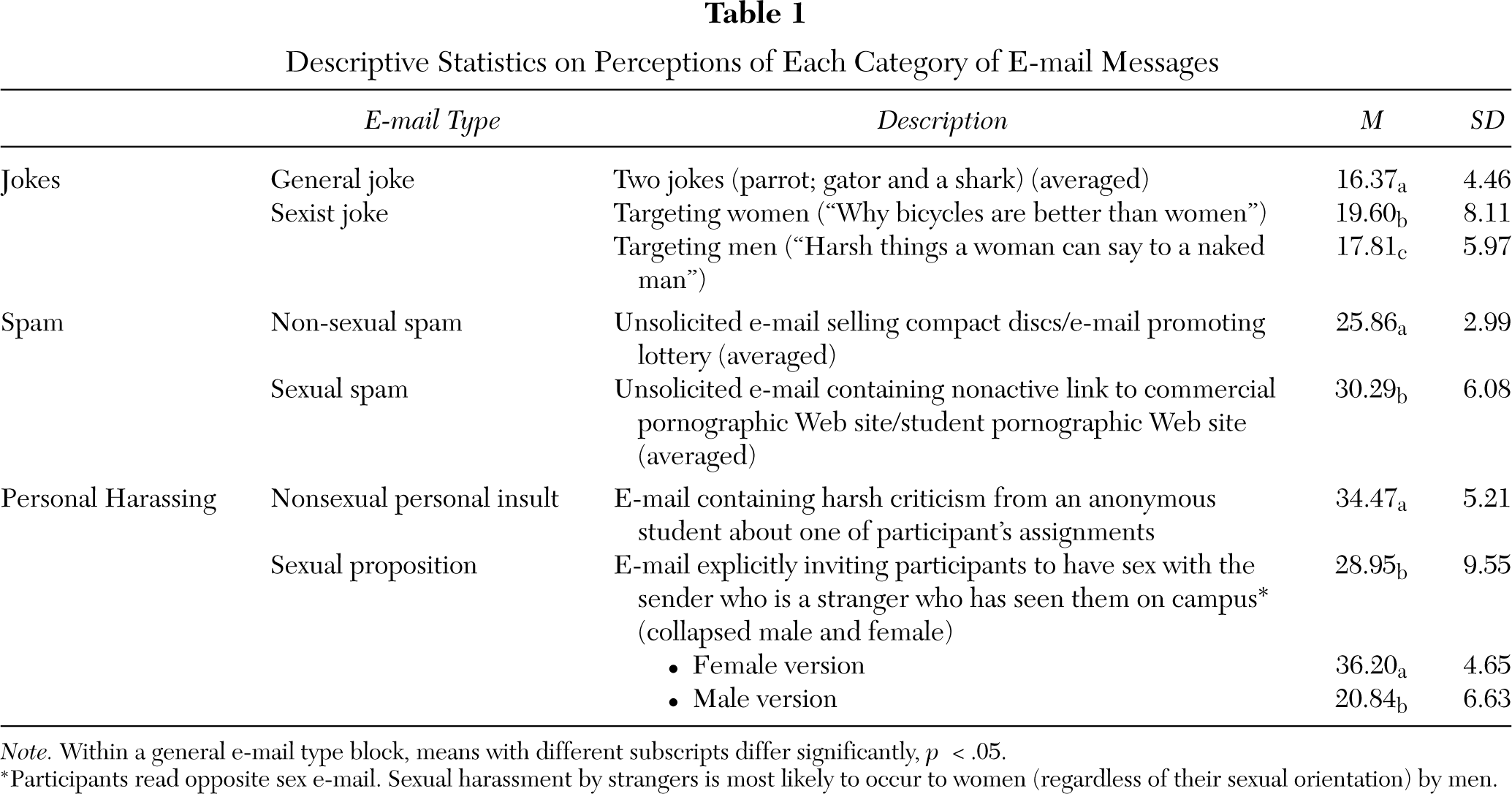
Note. Within a general e-mail type block, means with different subscripts differ significantly, p < .05.
Participants read opposite sex e-mail. Sexual harassment by strangers is most likely to occur to women (regardless of their sexual orientation) by men.
Apparatus
The interface for the simulated e-mail mailbox was written in HTML code. The e-mail pages, forms, and questionnaires written in HTML code were combined with ASP scripting to create an interactive simulated mailbox. Although the user did not actually go online to access the e-mail inbox, a server was simulated in the personal computers in the computer lab to store data entered by the user and retrieve forms and e-mail. ASP stored the data (i.e., responses of users, content of reply and forward messages and answers to questionnaires) on Microsoft Access spreadsheets. The data in the spreadsheet were then saved to the computer's hard disk, converted to Microsoft Excel 4.0, merged, and converted to an SPSS data file.
RESULTS
To establish that reactions to the various types of e-mail were specific to the sexist, sexual, and/or harassing content, we first performed repeated measures ANOVAs to compare the ratings on the e-mails of specific interest to the control e-mail in each category. We included gender as a factor in all analyses. We then moved to the primary focus of the study to test the factors that predict participants' ratings of e-mail of different content. Correlations were computed among possible predictor and criterion variables (see Table 2). Regression analyses were performed with evaluations of the sexist jokes, sexual spam, sexual proposition, and personal harassment as the criterion variables and participant gender, familiarity with e-mail type (i.e., previous experience receiving that type of e-mail), experience with e-mail more generally (i.e., time spent checking e-mail per week), social desirability, and sexual harassment attitude scale scores as the predictors. For each analysis, a forced entry regression procedure was performed with all predictors included (see Table 3). To test the relative importance of each variable, zero-order and semipartial correlations were examined.
Sexist Jokes
A repeated measures ANOVA was conducted with perceptions of the three joke types as the within-subjects factor (general, sexist targeting women, sexist targeting men) and participant gender as the between-subjects factor. All jokes were perceived to be enjoyable (falling in the <24 end of the rating scale); however, a main effect for the type of joke revealed was that there were differences in reactions to the varied types of jokes, F(2, 206) = 10.47, p = .000. Planned contrasts with comparisons of the sexist jokes to the general joke (see Table 1 for means) showed that the general jokes were perceived as significantly more humorous than the sexist joke targeting men, F(1, 103) = 5.40, p = .02, and the sexist joke targeting women, F(1, 103) = 18.11, p = .000. The sexist jokes were also significantly different from each other with the sexist joke targeting men evaluated as being more humorous than the sexist joke targeting women (p = .02). While there was no main effect for sex (p = .12), there was a joke type by sex interaction, F(2, 206) = 3.56, p = .03. Men thought the sexist joke targeting women was more enjoyable (M = 17.82, SD = 7.52) than did women (M = 21.20, SD = 8.36), F(1, 103) = 4.58, p = .04.
Correlations Between Evaluations of E-mail Types and Predictor Variables (N = 106)
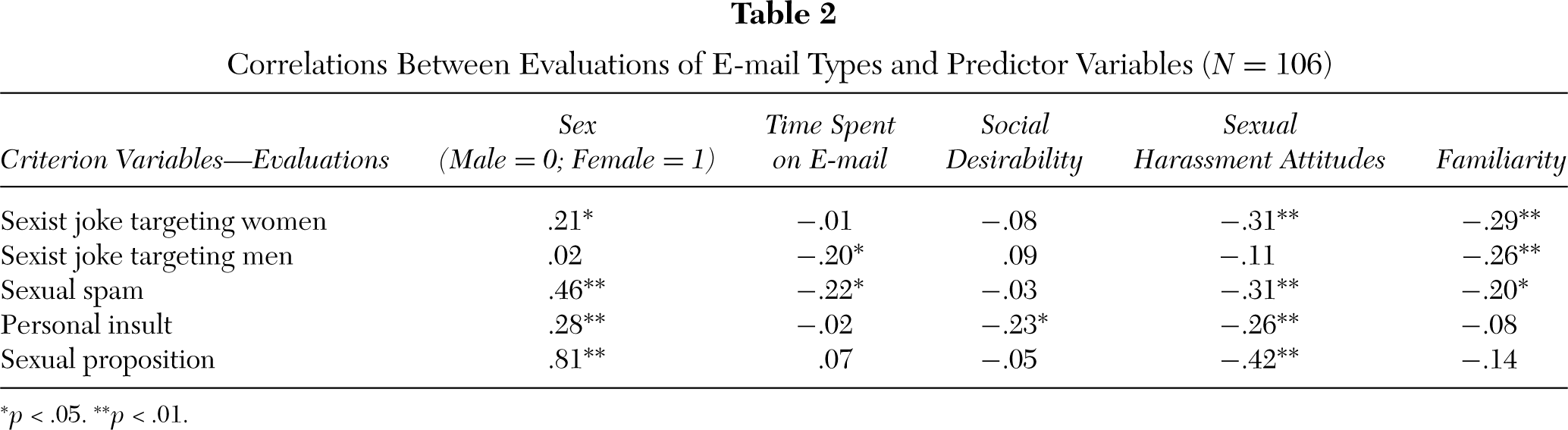
p < .05.
p < .01.
Forced Entry Regression Analysis Summary of Predictors of Perceptions of Offensiveness of E-mail Varying in Content
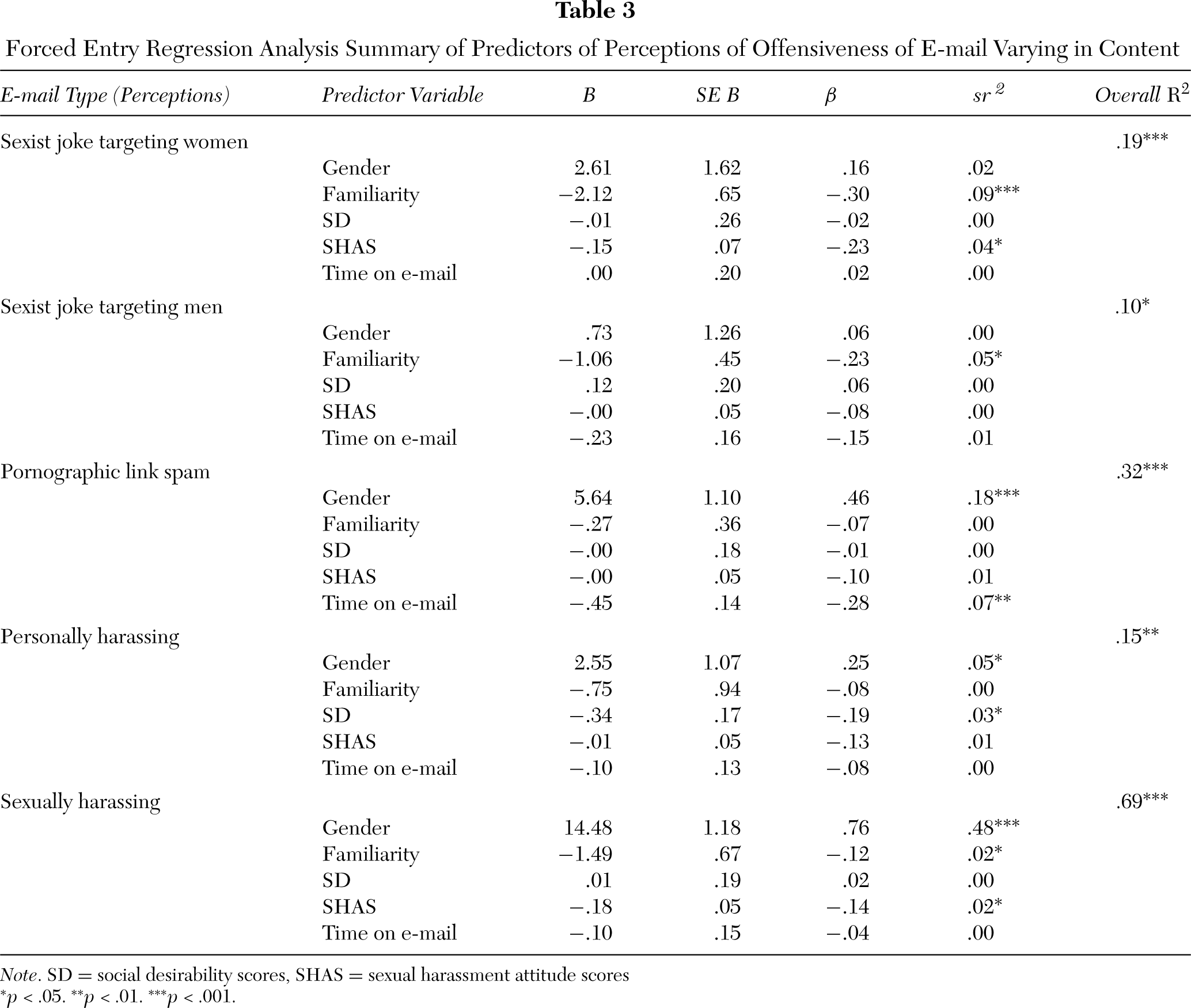
Note. SD = social desirability scores, SHAS = sexual harassment attitude scores
p < .05.
p < .01.
p < .001.
Regression analysis showed that the ratings for the sexist jokes targeting women were predicted by the full model, R 2 = .19, F(5, 105) = 4.81, p = .001, (see Table 3). Participant gender, familiarity, and sexual harassment attitudes had significant zero-order correlations with ratings of these jokes (see Table 2); however, when all variables were entered into the equation, only familiarity and sexual harassment attitudes were significant predictors of the ratings. Participants who had more commonly received e-mail like this in the past or had higher tolerance of sexual harassment found the sexist joke targeting women more enjoyable and less offensive than did others.
Ratings for the sexist joke targeting men were also predicted by the full model, R 2 = .10, F(5, 105) = 2.33, p = .05. Only one variable, familiarity, was a significant predictor of ratings of the joke. The more often participants received e-mail like this, the more enjoyable or less offensive they thought the joke was. Time spent checking e-mail was correlated with ratings but this variable did not stay significant when familiarity with the particular type of content was in the regression equation.
Sexually Oriented Spam
A repeated measures ANOVA was conducted with perceptions of the two spam types as the within-subjects factor (nonsexual, links to commercial pornography Web site) and gender as the between-subjects factor. Overall, spam was not perceived to be enjoyable and was seen as somewhat offensive (means ≥ 24). There was a main effect for spam type, F(2, 104) = 65.45, p = .000. The nonsexual spam was evaluated as significantly less offensive than the spam with a link to a commercial pornography Web site (see Table 1 for means). A main effect of gender was also present, F(1, 104) = 17.02, p = .000, with women finding the spam more offensive overall than did men (M = 29.38 and 26.62, SD = 3.06 and 3.82, respectively). A gender by spam type interaction, F(1, 104) = 29.31, p = .000, clarified this finding. There was no difference between men (M = 25.91, SD = 3.00) and women (M = 25.82, SD = 3.02) in their evaluations of the nonsexual spam, t(104) = .15, p = .99. However, women rated the sexual spam (M = 32.94, SD = 4.75) as significantly more offensive and harassing than the nonsexual spam, dependent t(56) = 10.49, p = .000, whereas men did not make a significant distinction (for sexual spam: M = 27.32, SD = 6.08), t(50) = 1.73, p = .09.
The regression model for evaluations of the sexual spam was significant, R 2 = .32, F(5, 105) = 9.52, p = .000. All variables except social desirability had significant zero-order correlations with perceptions of the sexual spam. In the regression model, ratings were best predicted by participant gender and time spent checking e-mail. Women and individuals who spent less time checking e-mail found the sexual spam most offensive and harassing.
Harassment
A repeated measures ANOVA was conducted with evaluations of the two types of harassment (nonsexual personal harassment, sexual proposition) as the within-subjects factor and gender as the between-subjects factor. Both e-mail messages designed for the study to be harassing were perceived as such by the participants. A main effect for e-mail type was found, F(1, 104) = 84.04, p = .000 (see Table 1 for means). Overall, the nonsexual harassing e-mail (personal attack on abilities) was rated as more offensive than the sexually harassing e-mail (sexual proposition). A gender main effect was also evident, F(1, 104) = 123.87, p = .000. Across the e-mail, women gave higher offensiveness ratings than did men (overall M = 36.03 and 26.88, SD = 4.57 and 6.09, respectively). A gender by e-mail type interaction clarified this phenomenon further, F(1, 104) = 94.03, p = .000. A gender difference was evident within both types of e-mail with women rating both as more offensive (p = .003 and .000, respectively). Women rated both the sexual proposition (M = 36.20, SD = 4.65) and the personally harassing e-mail (M = 35.86, SD = 4.49) as extremely harassing and offensive with no significant difference between these ratings, dependent t(56) = –.50, p = .62. Men rated the sexual proposition (M = 20.84, SD = 6.63) as somewhat enjoyable and not very offensive whereas they perceived the personally harassing e-mail to be offensive and harassing (M = 32.92, SD = 5.55), dependent t(50) = 10.71, p = .000.
Evaluations of the personally harassing e-mail were also predicted by the model, R 2 = .15, F(5, 105) = 3.58, p = .005. Gender was the best predictor of evaluations with women rating the e-mail as more offensive than did men. Social desirability was also related to ratings with those high in social desirability reporting less offence taken to the harassing e-mail than those who were lower in social desirability. Attitudes toward sexual harassment had significant zero-order correlations with evaluations but this relationship dropped out of the equation when gender was taken into account.
An unusually high proportion of the variance in ratings for the sexual proposition was predicted by the regression model, R 2 = .69, F(5, 105) = 43.72, p = .000. Not surprisingly given our earlier reported findings, gender accounted for the majority of the variance (sr 2 = .48) in reactions to the sexual proposition. Women viewed the sexual proposition as much more harassing and offensive than did men. Familiarity and attitudes toward sexual harassment also contributed to the prediction of evaluations of the sexual proposition. Those who had received more e-mail of this type and those with higher tolerance for sexual harassment found the content less offensive than did other participants.
DISCUSSION
Electronic harassment is becoming a serious problem for universities, colleges, and businesses (Moulton, 1998). While many materials, “akin to postal junk mail” (Moulton, 1998, p. 138), may be described as harassing by computer experts, our first hypothesis was that sexual and/or sexist content above and beyond the unsolicited nature of the e-mail would make the materials more offensive to the recipient than those e-mails without sexual or sexist content. This hypothesis was supported. In general, e-mail messages with sexual content were perceived less favorably than similar e-mail messages without such content. Sexually hostile jokes targeted at women or men, while not seen as offensive, are not perceived to be as enjoyable as regular jokes without sexual content. Spam with links to pornographic sites was rated as more offensive than spam selling compact discs and lotteries. The exception in our study was that targeted personal harassment containing a criticism of personal abilities by a stranger was seen to be more offensive and harassing than a targeted sexual proposition from a stranger. Given the strength of the personal criticism we used, this is perhaps not surprising. In all cases, participants' perceptions of e-mail messages differentiated across types of e-mail based on their specific content.
Sexually Oriented Jokes
Sexist humor has been identified as contributing to a poisoned or hostile work environment (Gruber, 1992). We expected that this would also be the case in cyberspace. We chose as stimuli some of the most explicit and hostile sexual jokes being circulated and yet they were not perceived to be offensive or harassing by these university students. Others (e.g., Frazier et al., 1995) have similarly found that when undergraduate students are compared to faculty, graduate students, and civil service employees, they perceive “suggestive jokes” to be less harassing than the other groups. Frazier et al. (1995) worried that this finding would be misinterpreted, pointing out that “[suggestive jokes] may very well be harassing if they occur repeatedly over time” (p. 26). In fact, some people have suggested that denial of the harassing nature of sexist and sexual comments or materials may actually be a symptom of a hostile or poisoned environment where desensitization has occurred. Gutek and O'Connor (1995) say, “[p]eople who work in sexualized environments, for example, who are constantly exposed to sexual comments, sexual jokes, sexist language, and the like may become habituated to it so they define sexual harassment quite narrowly around only the most offensive behavior” (p. 156–157). This interpretation is supported by our regression findings, which suggest that familiarity with these kinds of jokes (targeting men or women) is related to lowered offensiveness rates. Familiarity was in fact the only variable that predicted reactions to the less common hostile sexual humor targeting men. For the more common sexual joke that targets women, sexual harassment attitudes were also related to perceptions of the joke even though the mean scores did not fall in the “offensive” end of the scale continuum. This suggests that enjoyment of sexist and sexually hostile jokes about women is related to tolerance for sexual harassment even in the absence of overall judgments of offensiveness. Our hypothesis that these more ambiguous materials would show the greatest gender differences was not upheld here. Although women enjoyed the sexist joke targeting women less than did men, this was not a large difference and could be partially accounted for by the differential attitudes toward sexual harassment of men and women in our sample.
Pornographic Spam
Pornography on the Web has expanded rapidly in recent years. Some pornographic Web sites send out spam to encourage people to visit their Web sites. Not surprisingly, participants found all spam to be somewhat offensive and annoying regardless of its content. This may be the same phenomenon as annoyance at junk mail or at telemarketers on the phone at home. It may be that the cyber experience is more upsetting because the unknown sender could have accessed the e-mail user's personal information recorded online (e.g., e-mail address, Internet Relay Chat's nickname, age, country of origin, phone number, etc., depending on what the users had entered into the database when registering; Spertus, 1996). This may lower the users' sense of control and increase their sense of powerlessness. Exploring reactions to spam in comparison to similar experiences in noncyberspace contexts could be an interesting area for future research but was beyond the scope of the current study.
Gender played an important role in the experience of receiving e-mail messages containing links to pornography. Women considered the pornographic spam to be much more offensive than other spam whereas men did not. This finding extends Solomon and Williams' (1997) finding that women are more likely to find sexually explicit content harassing than are men, into the cyber realm. Based on research on women's reactions to male-oriented sexually explicit images (e.g., Senn & Radtke, 1990), we would expect to find an even larger gender difference to the e-mail messages had they contained graphics. Further, with ratings of offensiveness this high, we would expect that the psychological effects of receiving quantities of unsolicited sexual materials could be similar to the effects of other forms of sexual harassment that have been shown to be detrimental to women's mental and physical health and well-being (Tangri et al., 1982).
The more often the participants used e-mail, the less offensive they rated the sexual spam to be. Familiarity with this specific type of e-mail message (i.e., spam containing links to pornographic Web sites), however, was not related to reactions. One possible explanation for this finding is a more general familiarity and desensitization effect. Students who spend more time each week checking e-mail are likely to have received a higher volume of spam of every type than students who use their e-mail less frequently. It may be that these experiences inure students somewhat to sexual spam; it is just one more piece of trash in their in-box. Another explanation may be that these students have more highly developed avoidance strategies, quickly skipping over these e-mails without reading them (as they could have done in the current study) or deleting them without opening them (in real life) which might decrease the negativity of their ratings.3 It should be noted that neither desensitization nor coping through avoidance would necessarily protect the computer user from the negative psychological effects of receiving sexualized spam that is still perceived as harassing and offensive, just somewhat less so. These issues of effects remain to be explored by future researchers.
Targeted Harassment
We used an e-mail message from an unknown student (gender masked) criticizing the participant's assignment as the personal (but nonsexual) harassing e-mail. We included this type of e-mail, even though it is likely to be less common than the other types of offensive content, in order to compare reactions to this kind of harassment versus sexual harassment. The data ended up being interesting in its own right. As predicted, both men and women reacted strongly and negatively to this e-mail message with scores near the ceiling of the scale, however, women assigned higher harassment ratings than did men. People with higher social desirability scores tended to downplay their upset at the critical e-mail. This finding, although tentative prior to replication, may be important information for research on workplace harassment and grievance complaints. It appears that people who have the highest level of concern about the way others view them may be more likely to downplay the impact of general harassing behavior.
For the sexually harassing content, we used a sexual proposition of the participant received from a stranger. This is the type of request that Gruber (1992) and others (Frazier et al., 1995; Gutek & O'Connor, 1995) report is clearly viewed as sexual harassment by both women and men. In our sample, the evaluations were much more equivocal with gender accounting for a striking 48% of the variance in perceptions. Women clearly perceived the sexual proposition by a stranger to be sexual harassment, strongly agreeing that the e-mail was offensive, harassing, not at all funny, etc. whereas men rated it in the enjoyable and non-harassing end of the continuum, as less offensive and more enjoyable than any of the spam and roughly similar to the jokes. In other words, receiving an e-mail message containing a sexual proposition from a stranger is an entirely different event for men and women in our sample.
It is our belief based on our reading of the literature (e.g., Stanko, 1985) and a brief examination of the comments that our participants typed into their “responses,” that women often experience this kind of sexual proposition similarly to obscene phone calls (Sheffield, 1989; Smith & Morra, 1994). A few women dismissed the behavior (e.g., “Thanks, but no thanks.”); however, most found it fear-provoking, threatening, and/or upsetting (e.g., “You are rude, out of line and very perverted! I'm definitely not interested, please leave me alone.”). Men are unlikely to have been on the receiving end of this type of “sexual terrorism” (Sheffield, 1989, p. 483) and for the most part seem to interpret the situation as humorous or enjoyable (e.g., “I have a girlfriend, but I am flattered!!!”), perhaps even as a potential positive sexual interaction (e.g., “Who is this??? I would like to meet you sometime to find out who you are. I like having a good time as well. If you reply back give me a time and date and we'll have a beer.”).
Frazier et al. (1995) and Gutek and O'Connor (1995) have suggested that male/female differences in perceptions of harassment have been overblown and this may well be true under some conditions. The research evidence seems clear that when people are rating behaviors presented to them by researchers in lists or scenarios in the nonelectronic domain and are asked to rate behaviors directed at women (or gender is not specified, which may lead participants to presume that they are directed at women) by superiors (see Frazier et al., 1995, for a review) then few or small gender differences occur for sexual propositions. Our findings show that when participants were faced with e-mail messages directed at them personally by peers within a simulated e-mail environment, large gender differences emerged for exactly the type of content that is supposed to result in the smallest gender divide. This conclusion is supported by recent investigations using much younger samples in the world outside of cyberspace (Hand & Sanchez, 2000; Murnen & Smolak, 2000; Timmerman, 2003) and by one older study of peer harassment (Kenig & Ryan, 1986). These studies confirm that some behaviors or remarks that fit firmly into definitions of sexual harassment are sometimes not perceived as such when boys or men receive them.
More positive perceptions of a sexual proposition by a stranger were also predicted by higher tolerance of sexual harassment and greater familiarity with receiving this type of e-mail. Again, we are drawn to Gutek and O'Connor's (1995) suggestion that individuals who work and study in a sexualized environment may be, as a result, less sensitive to identifying sexual harassment and more tolerant of it when it occurs. We tend not to view the university or college atmosphere as a sexualized environment, however, this phenomenon of desensitization may be occurring in cyberspace. Prospective studies following students from the beginning of their cyber experience would be required to establish or refute the causal relationship here.
Strengths and Limitations
In recent years, there has been a call for research on sexual harassment that goes beyond the scenarios and vignettes of the studies in the 1980s and 1990s. New research has shown that people are not very good at predicting how they would react or feel in imaginary situations and these predictions often contrast sharply with the way real harassment is experienced (Woodzicka & LaFrance, 2001). And yet, the ethical difficulties of creating a harassing environment in the laboratory are hard to surmount. From our personal observations of the behavior of participants in the computer lab and their qualitative responses to the e-mail messages, it appears that we were successful in creating a simulated inbox environment that drew participants in and felt quite realistic to them.
The strengths of this exploratory study are the realistic simulation of an inbox environment, the random selection of participants to eliminate subject selection biases, and the variety of content types examined. Limitations of the study include the reliance on a measure of offensiveness/enjoyment specifically designed for the pilot study and not tested and refined a priori as well as e-mail messages not previously rated for their content. Overall, we have considerable confidence that our results are not simply experimental artifacts.
Conclusions
Undergraduates commonly use e-mail for exchange of academic information, minor personal disclosure, and exchange of jokes or mild flirtation to foster social relationships (McCormick & McCormick, 1992). In contrast, a sexualized environment and sexual harassment have a negative impact on the work lives and emotional and physical health of people, particularly women, exposed to them (Tangri et al., 1982). We need to provide clear guidelines about appropriate and inappropriate electronic communication behavior on campus to facilitate the positive aspects of the communication and reduce the negative. We also need to educate students, faculty, and staff on university campuses about the similarities and differences in perceptions of men and women toward harassing actions to prevent misunderstandings and abuse. Our findings support the suggestion that using the “reasonable woman” standard (APA amicus brief to U.S. Supreme Court, 1993, cited in Frazier et al., 1995) to decide what behavior is acceptable in the cyber domain is advisable. Circulation of unsolicited spam of all kinds and harassing e-mail, both sexual and nonsexual, is clearly perceived as offensive and should be avoided.
There has not been much research exploring the process of decision making about sexual harassment so our knowledge is incomplete. However, if men were found to use their own experiences or judgments about how they would react in a situation as a guide for deciding how to respond to women's complaints about e-mail sexual harassment or about how to behave toward women in cyberspace, our findings suggest that there could be very serious consequences. For men, personal criticism was the only type of content that received high offensiveness or harassment ratings. None of the stimulus materials we used, which are considered sexually harassing by computer experts (Moulton, 1998), would be judged to be a serious matter by the men in this sample if they use their own perceptions as a guide. Our study was not designed to answer these process questions but future research could test this possibility. Certainly educators who wish to prevent sexual harassment on university campuses would need to directly and specifically address gender differences in perceptions in order to overcome misconceptions.
NOTES
1.All introductory psychology students and most upper year psychology students register for the participant pool. Once they are registered, random sampling ensures no subject selection biases for the particular content of the study.
2.The behavioral responses to the e-mail messages are not reported here.
3.Our thanks to an anonymous reviewer for this alternative explanation.