






Abstract
Two studies compared Dutch college students' individuation of women and men. Participants read trait descriptions and formed impressions of male and female targets. They then attempted to recall which traits had described each target. Consistent with the status hypothesis, participants viewed men as higher status and made fewer recall errors overall for male targets, indicating greater individuation of men. However, this effect was moderated by attitudes. Participants with more traditional attitudes toward women's roles individuated men more than women, whereas those with less traditional views individuated women and men equally.
Being perceived in a depersonalized versus an individuated manner can lead to considerable negative social consequences for people, placing them at risk for stereotyping and discrimination. But what determines the extent to which a person will be individuated? Recent studies in the United States have found that the extent to which women and men are individuated—seen as unique individuals versus simply as category members—is determined by the perceiver's attitude toward women's societal roles (Stewart et al., 2003; Stewart, Vassar, Sanchez, & David, 2000). Women and men with more traditional attitudes toward women's roles, as measured by the Attitudes Toward Women Scale (AWS; Spence & Helmreich, 1972), individuated men more than women, whereas individuals with less traditional attitudes better individuated women. The effects of attitudes on relative individuation of women and men overrode tendencies toward outgroup homogeneity (e.g., Park & Rothbart, 1982), which would predict better individuation of one's own gender group, and toward lower-status group homogeneity (e.g., Lorenzi-Cioldi, 1998), which would predict better individuation of the male gender group perceived as higher status. In the present research, we investigated the generalizability of the influence of attitudes toward women on the relative individuation of women and men. Specifically, we examined whether the pattern of data obtained for American participants in Stewart et al. (2000) would be replicated with a particular college sample in the Netherlands.
Prior research in both the U.S. and the Netherlands has demonstrated that, when the moderating influence of attitude toward women's societal roles is not considered, men tend to better individuate men than women whereas women tend to individuate men and women equally or, in some circumstances, to individuate men more than members of their own gender group (Lorenzi-Cioldi, Eagly, & Stewart, 1995; Young, van Knippenberg, Ellemers, & DeVries, 1997). Male participants' more consistent display of out-group homogeneity was attributed in these studies to the perceived higher status of men. The authors argued that it is perceived to be important to clearly attend to those who hold higher status, given that higher status individuals may control important outcomes for other individuals (Fiske, 1993). Consequently, both male and female participants may have been motivated to pay particular attention to men.
Drawing from prior research on the lower status group homogeneity hypothesis (Lorenzi-Cioldi et al., 1995; Young et al., 1997), Stewart et al. (2000) attributed the greater individuation of men than women by participants with a more traditional attitude toward women's roles to the perception that men hold higher status than women in the U.S. A report by the Ministerie van Sociale Zaken en Werkgelegenheid (Dutch Ministry of Social Affairs and Employment, 2000) supports our prediction that the present participants will perceive men to hold higher status than women in the Netherlands. The report stated that 61% of Dutch women of working age were not financially independent and that women were underrepresented in government, upper management, and top university positions in the Netherlands (e.g., only 5% of full professors in the Netherlands are women). It should be noted that status was not explicitly manipulated in either the present experiments or the studies presented by Lorenzi-Cioldi et al. (1995), Young et al. (1997), or Stewart et al. (2000). Therefore, it is prudent to distinguish that, although an association between perceived status and relative individuation can be assessed, a causal relationship cannot be clearly established. However, it is also important to note that a series of studies in which status was explicitly manipulated (Lorenzi-Cioldi, 1998) similarly found a pattern of greater individuation of higher status targets.
Stewart et al. (2000) attributed “nontraditional” (as measured by the AWS) participants' greater individuation of women than men, despite their reported perception that men hold higher status, to motivation to improve women's status. The authors argued “gender inequality might become a chronically accessible dimension for these individuals, and a tendency to counteract this inequality by individuating women could become a habitual cognitive strategy” (p. 144). The results of several studies suggest that egalitarian views in the Netherlands might lead to a considerable number of less traditional men and women in the Netherlands who, according to Stewart et al., would be expected to individuate women to a greater degree than men. Cross-cultural research by Williams and Best (1990) revealed that the Netherlands had the most egalitarian gender role ideology of any of the 14 countries in their study. More recently, Stewart, Berkvens, Engels, and Pass (2003) found that female professors in the Netherlands were not evaluatively penalized for displaying high-status cues (i.e., being addressed by title rather than first name) as were their American counterparts (Takiff, Sanchez, & Stewart, 2001).
However, other research found considerable evidence of subtle prejudice toward women in the Netherlands, although blatant prejudice was not displayed to the same degree as was found in a comparable study in the United States (Vrugt & Nauta, 1995). Furthermore, Stewart, Berkvens et al. (2003) found that, even though female professors were not penalized for holding high status cues in the Netherlands, they were nonetheless perceived to be significantly lower in status than male professors with the same status cues. Interestingly, Neve (1995) reported that, although attitudes toward “women's emancipation” have generally become more positive in the Netherlands over time, positive attitudes toward women's emancipation are least likely to be displayed by younger adults (aged 16–25), the age group of the present participants. These findings question whether the pattern of greater individuation of women than men found for less traditional American college students will be replicated in the Netherlands.
We predicted that attitudes toward women would moderate the relative individuation of women and men for participants in the Netherlands, just as for participants in the United States. We expected Dutch participants with more traditional attitudes toward women, like more traditional American participants, to individuate men more than women. However, for the reasons discussed above, we were not as confident that less traditional Dutch participants would show the converse pattern of individuating women more than men found for American participants.
METHOD
Participants
Participants were college students at a large university in the southeastern region of the Netherlands. A total of 34 women and 29 men with mean age of 20.86 years (SD = 3.23) participated in Experiment 1, and 74 women and 40 men with mean age 21.64 years (SD = 3.13) participated in Experiment 2. The majority of participants in both experiments were Caucasian. Mean age, percentage of male and female participants, previous experimental participation, and average AWS score did not significantly differ between experiments; therefore, the data sets were merged. Participants were recruited through either a posted advertisement or announcements made in classes and at a local feminist group. All participants were paid 10 guilders (approx. $5).
Overview
Male and female Dutch college students participated in two experiments similar to that of Stewart et al. (2000) and modeled after a paradigm created by Taylor, Fiske, Etcoff, and Ruderman (1978). Participants in both experiments were asked to form impressions of two male and two female students, each of whom was described by four traits. They then completed an unexpected memory test, in which they attempted to match each trait with the person it had described. After performing filler tasks, participants completed the AWS, along with various filler questionnaires.
The materials and procedure for Experiments 1 and 2 were identical, with the following exceptions. Before beginning the impression formation task, participants in Experiment 2 read essays concerning either disadvantages or advantages experienced by contemporary Dutch women or read no essay. The essays had been pretested to engender differential concern with women's issues. Participants in Experiment 1 were given 20 seconds to read each description during the impression formation task, whereas participants in Experiment 2 were given either 4 or 20 seconds. Neither the essay nor the presentation time manipulation produced significant effects relevant to our research questions and are therefore not discussed in greater detail. Participants in Experiment 2 completed an additional questionnaire in which they estimated the percentages of women and men in the Netherlands who possessed the target traits employed in the impression formation task and various status characteristics. Certain filler tasks also varied between the experiments. All materials were presented in Dutch (after standard back translation).
Procedure
In both experiments, two female experimenters conducted sessions consisting of 1 to 6 participants. The experimenters obtained informed consent and told the participants that they were participating in a study designed to investigate how impressions are formed (this explanation followed the essay task in Experiment 2).
Impression formation task. The impression formation task utilized in the present study was identical to that employed by Stewart et al. (2000, Experiment 1a), with the exception that the present task was presented via MacIntosh computers utilizing Author ware software. Participants were informed that they would be presented with descriptions of two male and two female students who attended their university and would be asked to form impressions of these individuals. They then read descriptions of two male and two female targets, each described by two positive and two negative traits. Target gender was indicated by the targets' names. An assessment of the target traits' perceived typicality for women and men completed by Experiment 2 participants at the end of the session indicated that the traits were not perceived to be more typical of either gender, F(1, 91) = 1.71, p = .20.
The presentation order of the target names was counterbalanced such that either the two male targets or the two female targets appeared first. The order of the trait descriptions was held constant for all participants, such that each trait description was paired equally often with a male and a female target. For example, participants first read that either Rob or Els was “tense, independent, timid, and kind.” Each target description page was displayed for an interval of 20 seconds in Experiment 1 and for an interval of either 4 or 20 seconds in Experiment 2.
Name-matching task. Following the impression formation task, the computer instructed participants that there would be a short wait while the program for the next task was compiled. After a one-minute delay, participants were given the surprise name-matching task. Participants were allowed 5 minutes to attempt to match each of the 16 traits with the target person who had been described by the trait during the impression formation task. The name-matching task comprised a 4 × 16 matrix. The target names headed the four columns and one target trait comprised the left-hand side heading of each of the 16 rows. At the intersection of each column and row, a rectangle was displayed which designated where participants should click to indicate if the name appearing in the column above that rectangle had been paired with the trait that appeared to the left. Once a rectangle had been clicked, an “X” would appear in that rectangle. The program prevented participants from clicking more than one rectangle per row.
Memory errors on the name-matching task were recorded. Two types of memory errors were possible: within-group memory errors and between-group memory errors. Within-group memory errors were defined as confusions between either the two male targets or the two female targets (e.g., assigning one of Rob's traits to Peter). Between-group memory errors were defined as confusions between a male and a female target. Relative individuation of men and women was assessed by comparing the number of within-group errors for male and female targets. Lesser individuation of targets of a particular gender would be indicated by more memory confusions between targets of that gender than between targets of the other gender.
Questionnaires. After finishing various filler tasks, participants completed a series of counterbalanced questionnaires including the 25-item AWS (Cronbach's alpha = .88) and a demographics questionnaire. Participants rated their agreement with AWS items on a scale ranging from 0 (strongly disagree) to 3 (strongly agree), with some items reverse-scored such that higher numbers indicated more traditional attitudes on all items. Scores on the items were averaged to produce an overall AWS composite score. Participants in Experiment 2 also estimated the percentage of men and women in the Netherlands who possessed each of nine status characteristics (e.g., What percentage of men/women in Dutch society are influential? have high status?). Similarly, these participants estimated the percentages of men and women likely to display the 16 target traits employed in the impression formation task.
RESULTS
Preliminary Analyses
The items assessing men's and women's status comprised a reliable measure (Cronbach's alpha = .85). A 2 (Attitude: high vs. low AWS Score, as determined by a median split) × 2 (Participant Gender) × 2 (Target of Percentage Estimates: men vs. women) ANOVA, with the latter factor being a within-subjects measure, revealed that significantly higher status was perceived for men (M averaged across 9 status items = 23.63; SD = 12.41) than for women (M = 17.47; SD = 9.15), F(1, 91) = 48.54, p < .0001. No other effects were significant in this analysis.
Consistent with prior research, men reported significantly more traditional attitudes (M = .74; SD = .39) than did women (M = .43; SD = .24), r = .43, p < .0001. A correlation matrix comprised of participant gender, mean AWS score (overall M = .56; SD = .34), and difference scores for perceived status of men and women and relative within-group memory errors for male and female targets produced only one significant effect. The correlation of mean AWS score and the difference score for male and female target errors did not reach significance; however, the trend toward increasingly fewer errors for men relative to women as mean AWS score increased (indicating more traditional attitudes) was in the predicted direction, r = .10, p = .09. The correlation between the difference scores for perceived status of men and women and relative individuation of male and female targets was also nonsignificant (r = .01; p = .48).
An additional analysis revealed significantly more within-group errors (M = 1.69; SD = 1.82) than between-group errors (M = .95; SD = 1.04 after dividing between-group errors by 2, to control for the opportunity for twice as many between-group than within-group errors), demonstrating categorization by gender, t(177) = 5.53, p < .0001, two-tailed.
Relative Individuation of Women and Men
We next compared within-group memory errors for male and female targets and examined whether the relative number of memory errors differed according to participants' attitudes or gender or between experiments. These questions were examined in a 2 (Attitude: high vs. low AWS Score) × 2 (Participant Gender) × 2 (Experiment) × 2 (Target Gender) mixed design, with target order entered as a covariate. Consistent with the lower status group homogeneity hypothesis, significantly more memory errors were observed for female targets (M = .95; SD = 1.38) than for male targets (M = .74; SD = 1.24), F(1, 168) = 7.26, p < .008. In addition, there was a significant Target Order × Target Gender interaction, F(1, 168) = 6.96, p < .009. Follow-up analyses continued to reveal a significantly greater number of memory errors for women than men when the male targets were presented first (M = 1.16 and .61; SD = 1.32 and 1.11, respectively), F(1, 84) = 5.10, p < .03; however, female targets presented first did not reap the same benefits of this primacy effect and received memory errors equivalent to those of the male targets presented last (M = .74 and .88; SD = 1.41 and 1.35, respectively), F(1, 83) < 1.
Mean Within-Group Memory Errors for Male and Female Targets as a Function of Participants' Attitudes Toward Women's Societal Roles
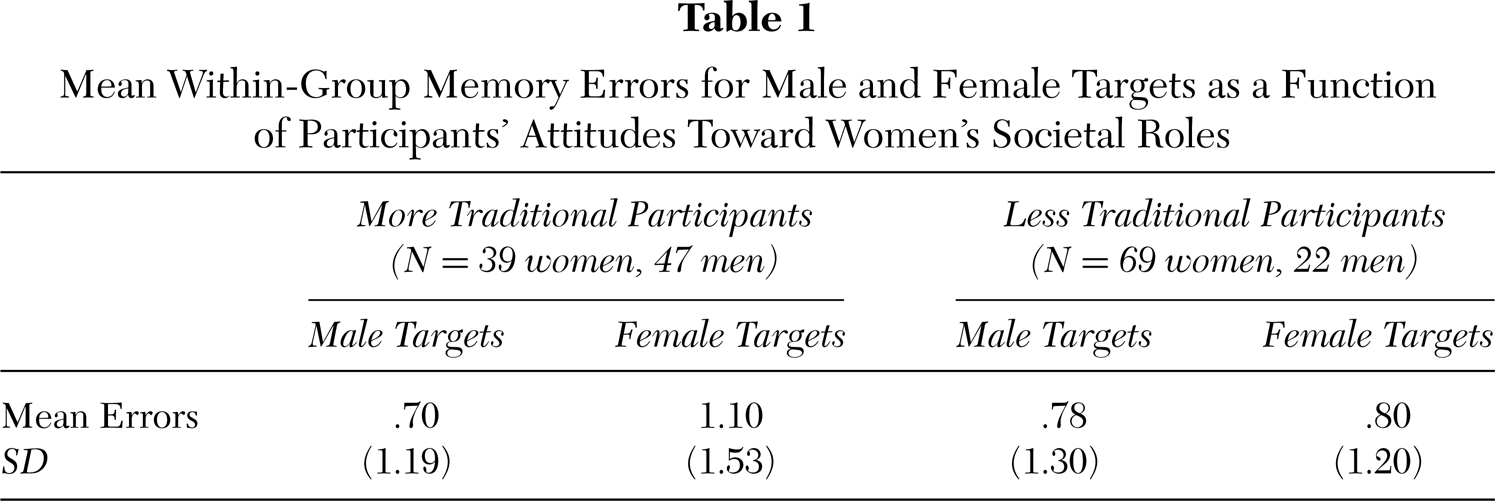
Replicating Stewart et al. (2000), the Attitude × Target Gender interaction was also significant, F(1, 168) = 4.55, p < .04. More traditional participants averaged significantly more within-group errors for female targets than for male targets, t(86) = 1.93, p < .03, one-tailed (see Table 1). However, the less traditional participants made an equivalent number of errors for female and male targets, t(91) < 1. No other effects were significant in the overall ANOVA.
Attitudes Toward Women in the Netherlands and the U.S.
A univariate analysis compared mean AWS scores for the present participants with those of the American participants in Stewart et al. (2000). This analysis revealed significantly more traditional attitudes for the American participants (M = .97; SD = .42) than for the Dutch participants in the present experiments (M = .56; SD = .34), F(1, 353) = 105.80, p < .0001.
DISCUSSION
Despite the particularly nontraditional attitudes toward women held by Dutch participants in the two present experiments, men were perceived to hold higher status than women, and male targets were individuated to a greater degree overall than were female targets, a pattern of results consistent with the lower status group homogeneity findings obtained by Lorenzi-Cioldi et al. (1995). However, replicating Stewart et al.'s (2000) findings, attitudes toward women's roles moderated this effect. As found in the previous studies, more traditional participants in the present experiments individuated male targets to a greater degree than female targets. But whereas Stewart et al. found that less traditional individuals individuated female targets to a greater degree than male targets, less traditional participants in the present experiments individuated female and male targets equally. A comparison of AWS scores for the American participants in Stewart et al.'s studies and the present Dutch participants indicated that the divergent findings for less traditional individuals across studies were not due to Dutch participants simply being more traditional overall than the American participants. In fact, the present Dutch participants reported significantly less traditional attitudes toward women's roles than did the American respondents.
There are several possible reasons why less traditional Dutch participants individuated female and male targets equally whereas less traditional participants in the U.S. better individuated female targets. One possibility is that less traditional Americans are more likely than less traditional Dutch individuals to display a chronic tendency to overcompensate for gender inequality by better individuating women. Less traditional Dutch participants may not feel a need to overcompensate because they perceive gender inequality to no longer be a significant problem. This interpretation is consistent with the finding that Dutch participants report particularly nontraditional gender attitudes compared with American participants but inconsistent with the finding that both more traditional and less traditional Dutch participants report that men hold higher status than women. Alternatively less traditional Dutch individuals may perceive gender inequality to be a problem but have a less activist response to this inequality than less traditional Americans. A lower likelihood of engaging in implicit and explicit strategies to protest inequality may be related to the Dutch concept of “gedogen,” which refers to a valuing of tolerance over extremism in legal and social issues (Van Oenen, 2000). Feminist activism may be seen as extremist and criticized as an “overreaction.” Relatedly, less traditional Dutch participants' egalitarian individuation may reflect a long-standing and pervasive tendency in Dutch culture to solve societal problems by negotiation rather than with the conflict associated with activism (e.g., the collaborative socioeconomic policy introduced in 1982 known as “the polder model”). In summary, less traditional Dutch participants' pattern of individuation might reflect an egalitarian orientation rather than an egalitarian activist goal of reducing gender inequality.
In future studies, it would be of interest to examine the responses of Dutch individuals actively involved in women's issues. This endeavor proved difficult in the present research due to the small number of participants in the university's only feminist group. Increasing the number of participants active in women's issues might be achieved by recruiting participants from feminist groups in various cities across the Netherlands. It would be interesting to discover whether this group would display equivalent individuation of female and male targets or, alternatively, greater individuation of female targets, as found for less traditional participants in Stewart et al. (2000). Older participants might also be recruited, given that prior research has shown that older adults in the Netherlands have more positive attitudes toward women's emancipation than do younger adults. Given the particularly nontraditional attitudes of the present sample overall, it might also be of interest in future research to recruit a sample of participants who might be expected to hold particularly traditional views of women's roles.
Future studies designed from a cross-cultural perspective (Smith & Bond, 1999) could better elucidate whether the divergent findings in Stewart et al. (2000) and the present studies truly represent “cultural” differences. However, the present findings do point to limitations in the generalizability of Stewart et al.'s findings for less traditional participants, suggesting that the effects of attitudes toward women on the individuation of men and women may vary across social contexts.