







Abstract
In this study we investigated how alcohol consumption affects women's responses to unwanted sexual advances in a hypothetical dating situation. Sixty female social drinkers participated in a 2 × 2 between-subjects experiment, which examined the effects of moderate alcohol intoxication and relationship characteristics on behavioral responses to unwanted sexual advances. Hypotheses were tested regarding the influence of inhibition conflict on intoxicated participants. As predicted, intoxicated women were more likely than sober women to consent to their dating partner's sexual advances in high conflict situations. Additionally, alcohol consumption increased women's estimated likelihood of responding passively. These findings aid in explicating the relationship between alcohol consumption and women's increased vulnerability to sexual assault.
Several studies have indicated that at least half of all acquaintance sexual assaults involve the consumption of alcohol by the victim (Koss, 1988; Muehlenhard & Linton, 1987; Testa & Parks, 1996; Ullman, 2003). Despite the strong relationship between alcohol consumption and sexual assault, the mechanisms underlying this relationship have not been substantiated. One possibility may lie in the impairment of cognitive functioning on the part of intoxicated victims (Testa & Parks, 1996; Abbey, 2002). That is, alcohol's direct effects on women's sexual decision making may ultimately lead them to engage in behaviors that increase their vulnerability to sexual assault (Testa, Livingston, & Collins, 2000). One scenario whereby postdrinking sexual decision making may heighten assault risk is engaging in consensual sexual contact with a dating partner even though sexual intercourse is not ultimately desired. Although women ideally should have the right to consent to sexual activity without increasing their risk of sexual assault, previous studies have found that this ideal may not be met in all circumstances. For example, Testa and Livingston (1999) found that in dating situations, sexual assaults were often preceded by consensual sexual activities. In their study comparing sexually aggressive dates to “worst” dates, Abbey, McAuslan, Zawacki, Clinton, and Buck (2001) found that alcohol consumption, amount of consensual sexual activity during the date, and the man's misperception of the woman's cues during the date significantly discriminated between dates that were merely “bad” and dates that ended in assault. Additionally, Harrington and Leitenberg (1994) found that women who reported some intoxication at the time of their sexual assault were more likely to have engaged in consensual sexual activities immediately prior to the assault than women who were sober. Perhaps, then, intoxicated women are more likely than sober women to consent to some sexual contact even though they do not desire to have sexual intercourse. This consent may then be misinterpreted by some men as indicating a desire to have sexual intercourse, particularly men who are intoxicated (Abbey, 2002) or men who believe that women who drink or engage in petting are signaling a desire for sex (Nurius, Norris, Dimeff, & Graham, 1996). Such miscommunications about sexual interest are frequently associated with sexually aggressive dates (Abbey, Ross, McDuffie, & McAuslan, 1996; Muehlenhard & Linton, 1987; Shotland & Hunter, 1995). Additionally, some men may use higher levels of prior consensual sexual activities to justify later sexual assault (Goodchilds & Zellman, 1984; Scully & Marolla, 1984). Thus, by being more likely to consent to a man's initial sexual advances, an intoxicated woman may inadvertently put herself at increased risk for sexual victimization due to an increased potential for sexual miscommunication (Harrington & Leitenberg, 1994).
Inhibition Conflict and Sexual Consent
One framework which may be particularly useful in understanding the influence of alcohol-induced cognitive impairment on women's likelihood of consenting to early sexual advances is the inhibition conflict model (Steele & Josephs, 1990; Steele & Southwick, 1985). This model posits that alcohol intoxication is most influential in situations involving a high degree of conflict: situations involving both strong instigatory cues and strong inhibitory cues regarding a particular behavior. Steele and Josephs (1990) hypothesize that instigating cues are typically more immediate and concrete than inhibitory cues, which are often more removed and abstract. Thus, because alcohol impairs cognitive processing, an intoxicated person is less able to perform the additional cognitive processing necessary for inhibitory cues. Due to this alcohol myopia, he or she would only be able to respond to the most salient instigatory cues in the situation and would thus be more likely to engage in the behavior than would an unimpaired sober person (Steele & Josephs, 1990; Steele & Southwick, 1985). For low-conflict situations, where both or either of the instigatory or inhibitory cues are weak, sober and intoxicated persons would be expected to act similarly.
Nurius and Norris (1996) have postulated that dating situations in which the man desires intercourse but the woman does not often involve a sense of conflict for the female dating partner. Depending on the type of relationship, she may be very interested in pleasing her partner in order to develop and maintain their affiliation and consequently may feel impelled to consent to sexual activities with him. However, because she does not wish to have intercourse, she may also feel inhibited from consenting to sexual activities in order to prevent the possibility of miscommunication and subsequent increased vulnerability to sexual aggression. Thus, dating women are often caught in a situation in which they attempt to develop an affiliation with their partner while also maintaining their vigilance about the potential risks he might present; they are indeed “walking a cognitive tightrope” (Norris, Nurius, & Dimeff, 1996, p. 137). Although balancing on this tightrope may be possible for sober women, it presents more of a challenge to intoxicated women. According to the inhibition conflict model, intoxicated women's cognitive inability to focus on both aspects of this conflict may result in a greater focus on instigatory consent cues and, ultimately, increased likelihood of consenting to some sexual activity.
In their examination of the role of inhibition conflict and alcohol intoxication on women's sexual decision making, Murphy, Monahan, and Miller (1998) found that alcohol enhanced women's estimations of a partner's relationship potential only under high inhibitory conflict (e.g., an attractive but sexually risky partner). For low conflict situations, intoxicated and sober women did not have significantly different ratings of relationship potential. In another study, Testa et al. (2000) found that in high-conflict situations, intoxicated women were more likely than sober women to rate their hypothetical dating partner more positively, to perceive less risk and more benefit from engaging in consensual sexual activities with this partner, and to estimate a higher likelihood of engaging in such behaviors. This study provides evidence that intoxicated women in high-conflict situations may indeed be more likely than sober women to engage in behaviors (e.g., consensual sexual contact) that increase their relationship potential while simultaneously increasing their risk of unwanted sexual advances. One limitation of this study, however, is the use of only a high-conflict situation. Because low-conflict situations were not examined, it is possible that intoxicated women might also be more likely than sober women to engage in consensual sexual activities across both types of situations. In the present study, we built on this previous work by manipulating the amount of conflict through factors present in the situation.
Inhibition Conflict and Situational Factors
When faced with unwanted sexual advances from her dating partner, the amount of conflict experienced by a woman may be influenced by a number of factors. Women in shorter, less committed relationships may feel less conflict about responding negatively to a man's initial sexual advances than women in longer, more committed relationships (Shotland & Hunter, 1995). That is, a woman on a first or second date with a man whom she does not know well should experience low conflict about not consenting to his sexual behavior because she has not yet invested a great deal of time, energy, or emotional attachment into their relationship. For her, the instigatory cues of romance and affiliation are relatively weak, while the inhibitory cues, such as vulnerability to sexual aggression, are strong. As a result, a woman in a casual relationship should be less likely to consent to her date's sexual advances regardless of whether or not she is drinking. By not consenting to early sexual activity, this woman may decrease her vulnerability to potential later sexual aggression by clearly communicating her sexual intent before the situation turns aggressive.
Alternatively, a woman in a serious relationship may feel highly conflicted about consenting to her partner's sexual advances. On the one hand, she strongly desires a romantic relationship with her partner, and may even desire to engage in some consensual sexual acts with him (instigatory cues); on the other hand, she also strongly desires to avoid increasing the potential for sexual miscommunication, as well as her vulnerability to sexual aggression (inhibitory cues). Importantly, the amount of conflict in a situation may change over time, especially if the man's level of sexual advances escalates. For example, in a situation involving a serious relationship, a man's initial sexual advances such as kissing and fondling may have more of an affiliative nature than an aggressive one. Such cues may thus serve to instigate consent to such activity, although the woman does not desire later intercourse. However, once her dating partner begins to engage in more intimate sexual behaviors or states his desire to have sexual intercourse, both instigatory and inhibitory cues are strong, resulting in a high-conflict situation. When intoxicated, this woman may be more likely to increase her sexual vulnerability by consenting to some sexual activity due to her narrowed attention to the instigatory consent cues (Testa et al., 2000). When sober, however, she should be less likely to consent because she has the cognitive capacity to attend to both the instigatory and inhibitory cues present in this high-conflict situation. Further, if the male dating partner's behavior eventually turns aggressive and violent, the instigatory consent cues are weakened while the inhibitory cues are strengthened, thus reducing a woman's conflict about how to respond to such a situation.
Alcohol and Resistance Behavior
Apart from an increased likelihood of consenting to sexual activities when in high-conflict situations, alcohol consumption may also affect women's other possible responses to unwanted sexual advances. For example, studies have shown that physical resistance decreases the likelihood of acquaintance sexual aggression resulting in a completed rape (Levine-MacCombie & Koss, 1986; Amick & Calhoun, 1987). However, intoxicated women are less likely than sober women to respond to sexual aggression with effective refusal strategies, namely assertive verbal and physical resistance, thereby increasing their likelihood of having an assault against them completed (Abbey, Clinton, McAuslan, Zawacki, & Buck, 2002; Norris et al., 1996; Harrington & Leitenberg, 1994). Intoxicated women may also be more likely than sober women to respond passively when faced with unwanted sexual advances (Norris, George, Stoner, & Masters, 2002). Because decreased resistance and increased passivity may ultimately lead to increased sexual assault likelihood, we examined the effects of alcohol intoxication on these responses, as well as consent, to escalating levels of unwanted sexual advances.
Hypotheses
Due to inhibition conflict effects, we predicted that intoxicated women in a high-conflict situation—those in a serious relationship at the time point involving genital fondling and a statement of desire for intercourse—would be more likely than sober women to consent to such fondling. In low conflict situations, we expected that sober and intoxicated women's responses would not differ significantly.
Based on previous naturalistic studies of assault (e.g., Ullman, 1998; Ullman, Karabatsos, & Koss, 1999), we expected that as the male dating partner's sexual advances escalated, women's estimated likelihood of consent and passive responding would decrease while resistance would increase. We also expected intoxicated women to report a higher likelihood of passive responding and a lower likelihood of resistance than sober women, regardless of relationship type.
METHOD
Design Overview
A 2 × 2 between-subjects experimental design was employed in which alcohol consumption and type of relationship were manipulated. Each participant received either a nonalcoholic drink or an alcoholic drink with a target breath alcohol concentration (BAC) of .06 gm%. Type of relationship was manipulated through the use of a stimulus vignette in which the main characters were a hypothetical male dating partner and the participant. In this vignette, the participant was described as having either a casual or serious dating relationship with a fictional man and as not wanting to have intercourse with him on the date described. Dependent measures consisted of participants' estimates of how they would respond to escalating levels of unwanted sexual advances by their male dating partner at three time points throughout the vignette (after kissing/breast fondling, after genital fondling/statement regarding desire for intercourse, and after a rape threat).
Participants
Participants were 62 women from a large western university who were recruited through an advertisement in the university newspaper. They received $10 an hour for their participation. Participants' mean (SD) age was 22.6 (2.1) years and their self-reported ethnic status was as follows: 75% White, 20% Asian American, 3.3% African American, and 1.7% other. The majority of participants was single (78.3%) and reported having had between 1 and 10 sexual partners (73.3%). Participants drank a mean (SD) of 4.4 (4.7) drinks per week.
When women called the laboratory, they were given a brief description of the study by a female interviewer and were screened to ensure that they were free of health problems that would contraindicate alcohol consumption. Abstainers and heavy drinkers were also eliminated. Scheduled participants were given a set of preexperimental guidelines regarding food and beverage consumption to follow the day of their participation.
Materials
Stimulus vignette.
A vignette 1 was developed to manipulate the type of relationship participants imagined having with the hypothetical dating partner. The story was written in the second person, and the participant was instructed to project herself into it as if it were really happening to her at her current level of intoxication. For the casual dating relationship, the participant was described as having gone on a couple of dates with “Jeff,” as having a casual relationship with him, and as liking him but not being in love with him. In the vignette, the participant experienced uncertainty about how serious she would like the relationship to become. Jeff kissed her on their last date, but the participant clearly indicated in the story that she does not want to have sex with him. For the serious dating relationship, the participant was described as having a boyfriend whom she had been dating for a couple of months. Their relationship was “getting serious,” and she believed she might be in love with him. Sexually, they had engaged in heavy petting, but she was clearly described as wanting to wait to have intercourse with him until they discussed their relationship together. She was depicted as wanting their relationship to last long-term.
This vignette then described a single dating episode between the participant and the male character in which a variety of risk cues were present, such as the couple being isolated from others, the man driving during the date, and the man drinking during the date (Muehlenhard & Linton, 1987). Additionally, toward the end of the date, the male character began to make sexual advances toward the participant, beginning with kissing and breast fondling, proceeding to genital fondling and a stated desire to have intercourse, and concluding with the threat of rape. Thus, the salience of the affiliative cues and sexual risk cues shifted over time in the story. After each level of sexual advance by the male dating partner, participants stopped reading the scenario, completed a set of dependent measures concerning how they would respond to his advances, and then proceeded to read the scenario until the next time point, at which they again completed the dependent measures. Both the story and the dependent measures were administered on paper.
Each vignette was designed to convey either a low or high level of conflict within the participant regarding her response to the male characters escalation of sexual advances. Based on the theoretical rationale presented earlier, the casual relationship was intended to convey a low-conflict situation across each of the three time points. For the serious relationship vignette, the amount of conflict was intended to change overtime. That is, we expected that women in the serious relationship would experience low conflict regarding consenting to kissing and breast fondling (time point 1) given the high salience of instigatory cues at that point in the story. In a similar vein, due to the high level of inhibitory cues at the time of the rape threat (time point 3), we expected that women in the serious relationship would experience low conflict about deciding not to consent to sexual intercourse at that time. However, at the point of genital fondling and a stated desire for intercourse by the male dating partner (time point 2), we expected women in the serious relationship to experience high conflict due to the presence of both instigatory and inhibitory cues.
Pilot study.
In order to confirm this manipulation of conflict, a pilot study was conducted. Thirty-two undergraduate women were recruited from the Psychology Department Human Subject Pool. After providing informed consent, they were randomly assigned to one of the relationship conditions. In addition to completing the behavioral response measures, participants completed an original measure designed to assess the level of conflict they experienced while reading the vignette. Two items concerned the amount of conflict the participant felt regarding consenting to sexual intercourse (time point 2) with the male character. The first was an overall measure assessing the difficulty of making the decision on a Likert scale ranging from 1 (not at all difficult) to 7 (very difficult). The second item assessed participants' own estimation of whether instigatory or inhibitory cues were stronger by instructing them to choose one of five options, ranging from 1 (the reasons for consenting to have sex are much stronger) to 5 (the reasons against consenting to have sex are much stronger). Two participants were dropped from analyses—one for a manipulation check failure, the other for noncompletion.
We conducted t tests on the two conflict items. There was a significant effect for the overall measure of difficulty of deciding to consent, t (1,28) = −3.14, p < .01. Participants in the serious relationship condition had more difficulty with their decision to consent to sexual intercourse than did participants in the casual relationship condition, M (SD) = 2.88 (1.71) and 1.36 (.63), respectively. There was also a significant effect for participants' comparisons of the strength of reasons for and against consenting, t(1,27) = 2.18, p < .05. Every participant in the casual relationship condition rated the reasons against consenting as much stronger than the reasons for consenting, M (SD) = 5.00 (.00), whereas participants in the serious relationship condition showed more variability in their ratings, M (SD) = 4.63 (.62). In sum, there appears to be a clear difference between the two relationship conditions with respect to the amount of conflict experienced about consenting to sexual intercourse, with those in the serious relationship condition feeling more conflict about consenting to sexual intercourse than those in the casual relationship condition.
Dependent measures.
After the participants read the description of their relationship with the male character and the description of the first part of the date, the male character began to make sexual advances. After each level of sexual advance (kissing/breast fondling, genital touching/intercourse desire, and rape threat), participants were given a 14-item questionnaire that assessed the estimated likelihood of how they would respond to the sexual advance in question. Items were chosen to represent the general categories of responses described by Norris, Nurius, and Gaylord (1998): assertive resistance (e.g., “Push him away”), polite resistance (e.g., “Nicely or apologetically tell him that I don't want to have sex”), and passive responding (e.g., “Not try to do anything because it seems hopeless”). In addition, one item was included regarding the likelihood of wanting and consenting to the sexual activity. Items were rated on Likert scales (1 as not at all likely and 5 as very likely).
Manipulation checks.
A post-experimental questionnaire assessed length of relationship, commitment level of relationship, and amount of alcohol consumed during the study. Of the 62 participants, one did not pass the relationship manipulation checks and was dropped from the statistical analyses. Another participant, self-identified as lesbian, reported at the end of the experiment that she had great difficulty answering the dependent measures because the story was unrealistic for her. Her data were also eliminated from the analyses.
Procedure
Each participant was conducted through the study procedures individually by a female experimenter. Upon entering the laboratory, the experimenter verified the participant's age, as well as whether or not she had complied with the preexperimental guidelines regarding food and beverage consumption. The participant then read and signed an informed consent form, was weighed for the later alcohol administration, and completed a pregnancy screening. She was then given an initial Breathalyzer test to confirm that her BAC was .00 gm%.
The experimenter then informed the participant of her beverage condition, and poured three drinks, the contents of which differed according to experimental condition. A moderate dose (1.51 ml/kg) of 80-proof vodka, determined by body weight, was mixed in a 1:4 ratio with orange juice and administered to those in the alcohol condition, to target a BAC of .06 gm%. Control participants were given drinks of plain orange juice. Each participant was given 3 minutes to consume each drink and was told to pace her drinking evenly over the 3-minute consumption periods.
During a 15-minute absorption period, Breathalyzer tests were administered once every 5 minutes by the experimenter. At the end of this period, the experimenter gave the participant one of the two dating vignettes and left the room to ensure the participant's privacy while reading the story and completing the measures. The participant was then debriefed, given a resource sheet listing available services for acquaintance rape victims, and paid $10/hour for her participation. Participants who had consumed alcohol were required to remain in the laboratory until their BAC dropped below .03 gm%.
Although no participant was unable to complete the study due to her reactions to the stimulus materials, we wanted to assess the possibility of negative reactions to the materials after the study had been completed. Consequently, every participant was sent a follow-up survey by mail approximately 3 weeks later, which she was paid $5 to return. The survey inquired about any negative effects experienced after participating. Participants were also asked if they wanted to discuss any aspect of their participation with the principal investigator. If so, they were instructed to provide a telephone number. The survey return rate was greater than 90%. The returned surveys indicated that participants did not experience negative effects as a result of their participation in the study. In general, they indicated that it had been a positive experience and would participate again if given the opportunity.
Means and Standard Deviations for Behavioral Responses for Within-Subjects Factor
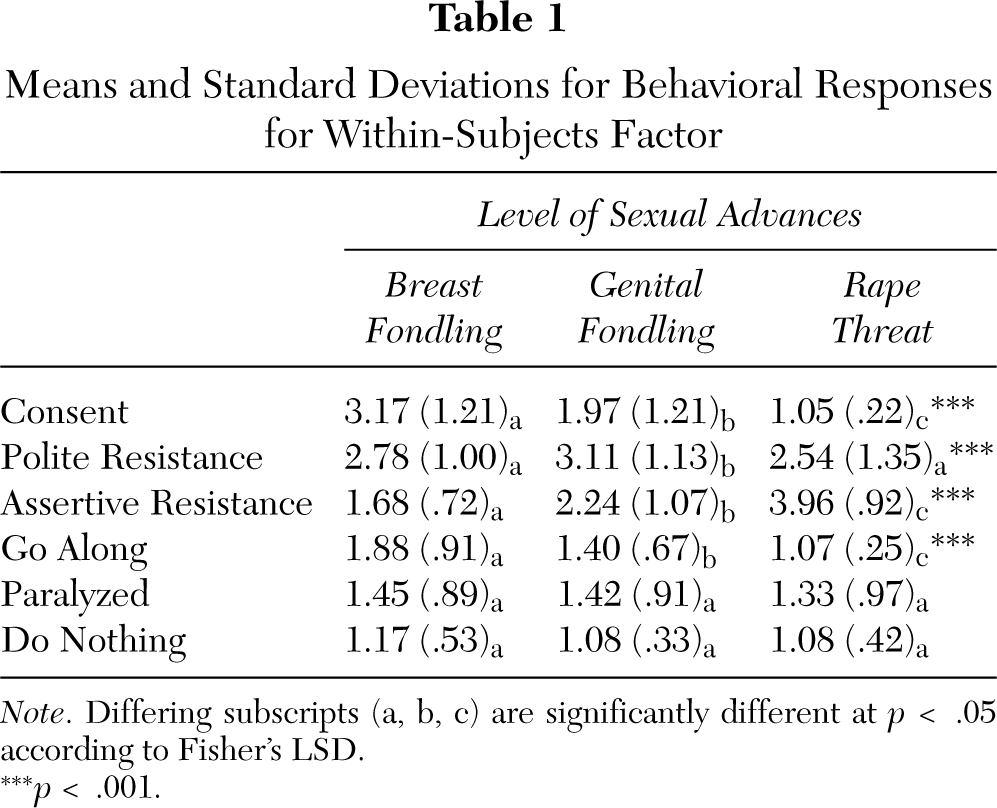
Note. Differing subscripts (a, b, c) are significantly different at p < .05 according to Fisher's LSD.
p < .001.
Scale Development
For purposes of data reduction, principal components factor analysis with varimax rotation was utilized on the behavioral responding questionnaire separately for each of the three assessments. Because we had only one item pertaining to consent at each time point, this item was not included in these analyses. For each time point, the factor analysis yielded three factors with eigenvalues greater than one—a three-item factor for passive responding, a three-item factor for polite responding, and a seven-item factor for assertive responding. The three passive items were not reliable at time points 1, 2, or 3; as a result, these items were analyzed individually. For the polite resistance items, the Cronbach's alphas at times 1, 2, and 3 were .69, .81, and .83, respectively. The Cronbach's alphas for the assertive resistance items at time points 1, 2, and 3 were .84, .91, and .87, respectively. (See Table 1 for means.)
RESULTS
Achieved Blood Alcohol Levels
A t test on the means of the blood alcohol measurement taken at the end of the 15-minute absorption period, t (1, 58) = −14.16, p < .0001, indicated that participants in the alcohol condition (M = .047, SD = .018) reached a significantly higher BAC than did participants in the control condition (M = .000, SD = .000). Additionally, because the mean BAC for alcohol condition participants after the completion of the dependent measures (M = .052, SD = .011) was greater than the mean obtained at the end of the waiting period, intoxicated participants were on the ascending limb of the BAC curve while completing the dependent measures. Because prior research has found greater stimulant effects of alcohol on the ascending limb and greater sedative effects on the descending limb of the BAC curve (Martin, Earleywine, Musty, Perrine, & Swift, 1993), it was important to control BAC limb during dependent measurement completion.
Data Analytic Approach
To test hypotheses regarding the role of inhibition conflict, planned comparisons were used. Specifically, hypotheses predicted that due to inhibition conflict, women in high-conflict situations would be more likely to consent to sexual intercourse when drinking than when sober. Instigatory and inhibitory cues were both high only at time point 2 (genital fondling/intercourse desire) and only for women in the serious relationship condition. Thus, a t test with the independent variable of beverage condition was performed on the dependent measure of consent for participants in the serious relationship condition at time point 2. Additional t tests were conducted comparing sober and intoxicated women at the low-conflict time points to verify that these groups did not differ significantly in their responses.
In order to assess more general alcohol effects on behavioral responses, as well as how behavioral responses changed in relation to escalating sexual advances, repeated measures univariate analyses of variance (ANOVAs) were performed. For each ANOVA, the two between-subject variables included beverage condition and relationship condition, while the three-level within-subjects factor was level of unwanted sexual advances (kissing/breast touching, genital touching/intercourse desire, rape threat). Dependent measures included the consent item, the polite resistance scale, and the assertive resistance scale. Additionally, due to low reliability, the three passive response items were examined separately as individual items. Wilks' lambda was used to determine multivariate significance. Fisher's LSD post hoc tests were conducted as necessary to determine which specific means differed from one another.
Consenting Under High Conflict
We hypothesized that women in high-conflict situations would be more likely to consent when intoxicated than when sober. As predicted, a t test for women in the serious relationship condition at time point 2 indicated that intoxicated women estimated a greater likelihood of consent than sober women, t(28) = −1.70, p < .05 (one-tailed). As shown in Figure 1, similar t tests conducted for women in low-conflict situations (casual relationship at times 1, 2, and 3; serious relationship at times 1 and 3) were not significant.
Consent
Repeated measures analysis of the consent item revealed a significant main effect for level of sexual advances, F(2, 55) = 117.99, p < .001. As predicted, women's estimated likelihood of consenting decreased significantly as the aggressiveness of the sexual advances increased. Means are presented in Table 1. There was also a significant between-subjects effect for relationship condition, F(1, 56) = 14.99, p < .001, with women in the serious relationship condition estimating a greater likelihood of consent than women in the casual relationship condition. Means are presented in Table 2. However, each of these main effects was subsumed under a significant level of advance by relationship condition interaction, F(2, 55) = 9.87, p < .001. As illustrated in Figure 2, women in the serious relationship condition were significantly more likely than women in the casual relationship condition to consent after kissing/breast touching and genital touching/intercourse desire. However, women's likelihood of consent after a rape threat did not vary according to relationship condition—women in both conditions were very unlikely to consent at that time point.
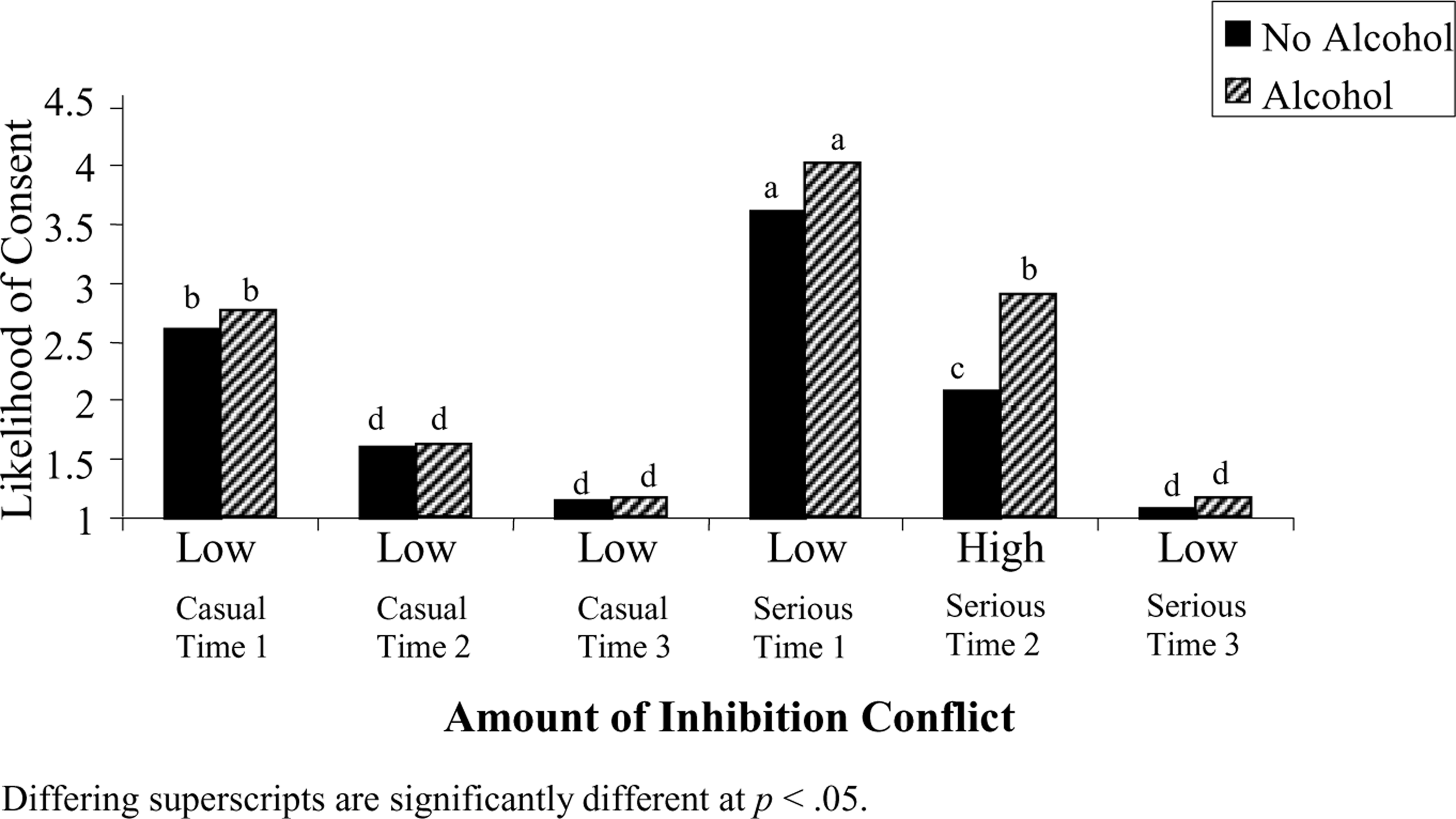
Estimated likelihood of consent in low- and high-conflict situations.
Polite Resistance
Repeated measures analysis of the polite resistance scale revealed a significant within-subjects effect for level of sexual advances, F(2, 55) = 6.75, p < .005. The within-subjects contrast testing the quadratic nature of this effect was significant, F(1, 56) = 13.73, p < .001, suggesting a curvilinear effect. As presented in Table 1, women were more likely to resist politely after genital touching/intercourse desire than after kissing/breast touching or rape threat. Polite resistance after kissing/breast touching and rape threat did not differ significantly. Additionally, there was a significant main effect for the between-subjects factor of relationship condition, F(1, 56) = 4.68, p < .05, with women in the casual relationship reporting a higher likelihood of using polite resistance than women in the serious relationship. (See Table 2 for means.)
Means and Standard Deviations for Behavioral Responses for Between-Subjects Factors
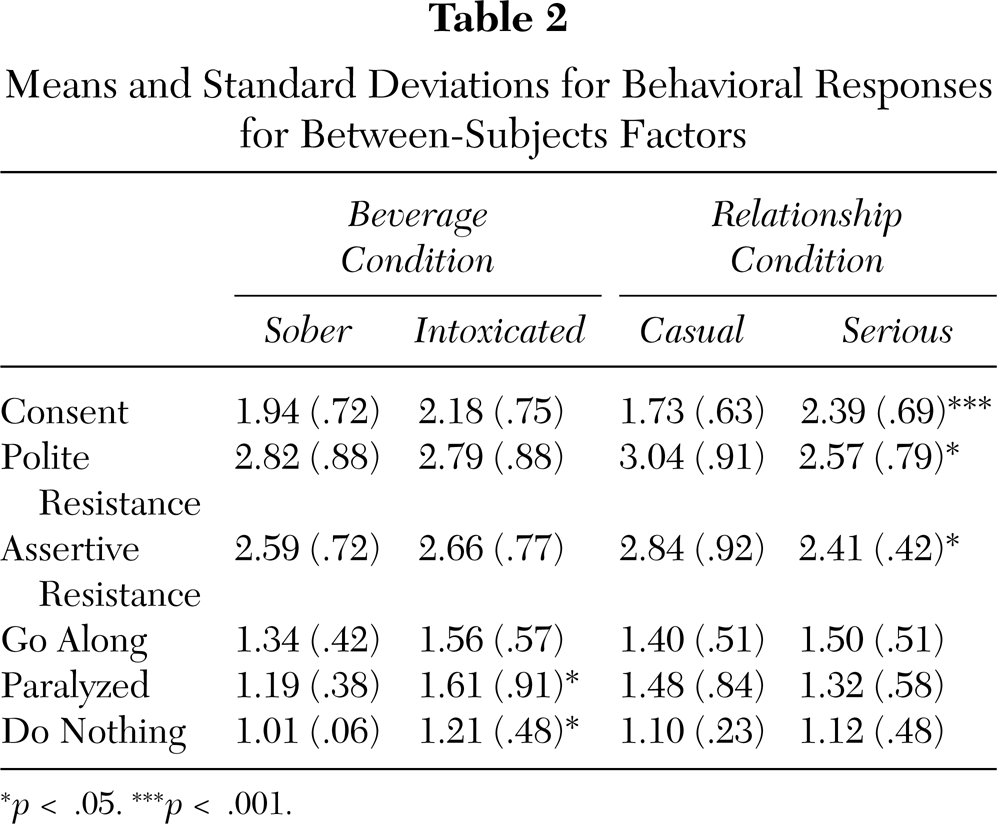
p < .05.
p < .001.
Assertive Resistance
Repeated measures analysis of the assertive resistance scales indicated a significant within-subjects effect for level of sexual advances, F(2, 55) = 184.39, p < .001. Women's estimated use of assertive resistance strategies increased significantly at each level of sexual advance (see Table 1 for means). There was also a significant between-subjects main effect for relationship condition, F(1, 56) = 8.31, p < .05, with women in the casual relationship reporting a higher likelihood of using assertive resistance than women in the serious relationship (see Table 2 for means). However, both of these significant findings were qualified by a significant level of sexual advance by relationship condition interaction, F(2, 55) = 9.47, p < .001. As illustrated in Figure 3, women in the casual relationship rated their likelihood of using assertive resistance after kissing/breast touching and genital touching/intercourse desire higher than did women in the serious relationship. However, after the threat of rape, there was no difference in estimates of assertive resistance for the two relationship types.
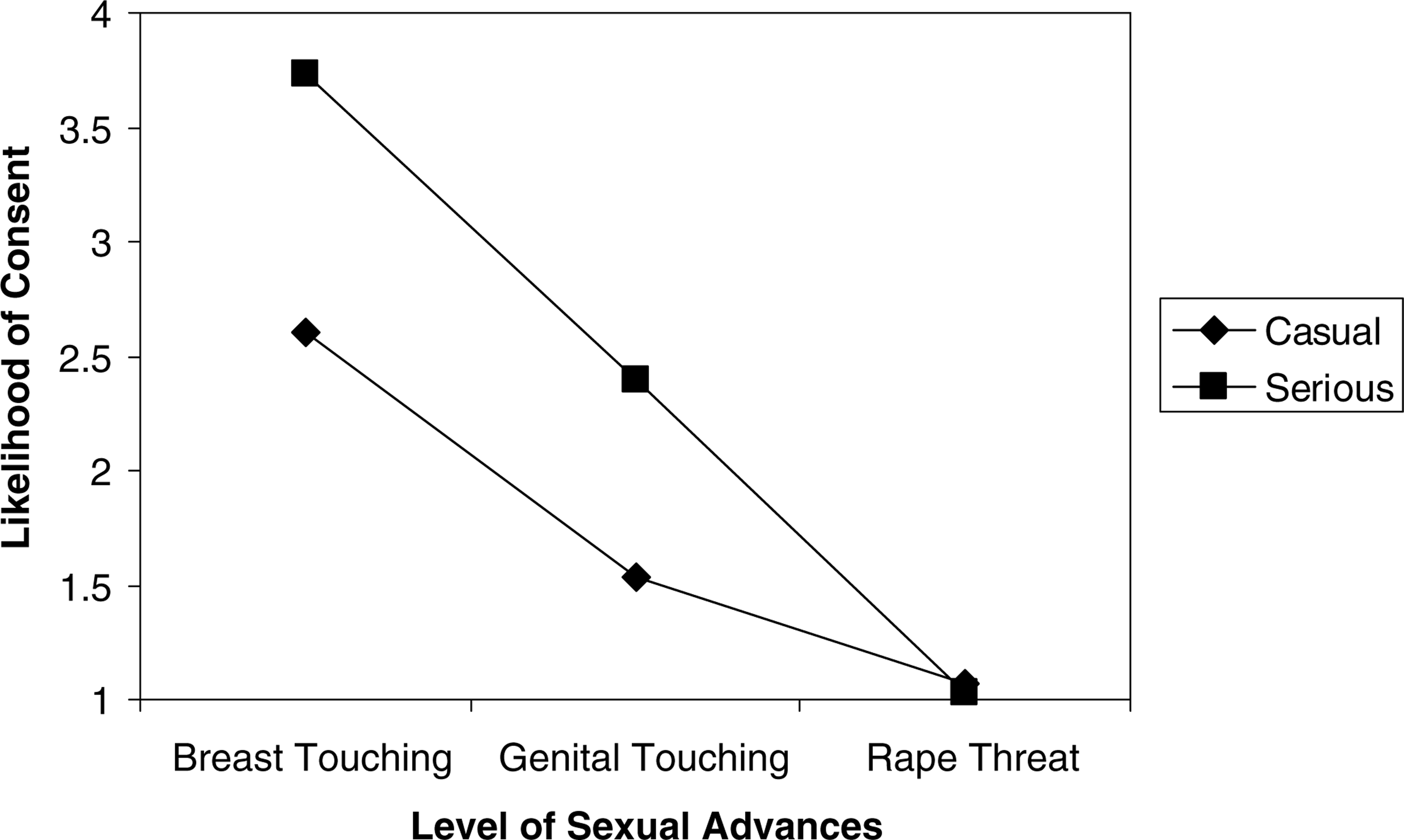
Estimated likelihood of consent as a function of level of sexual advances and relationship type.
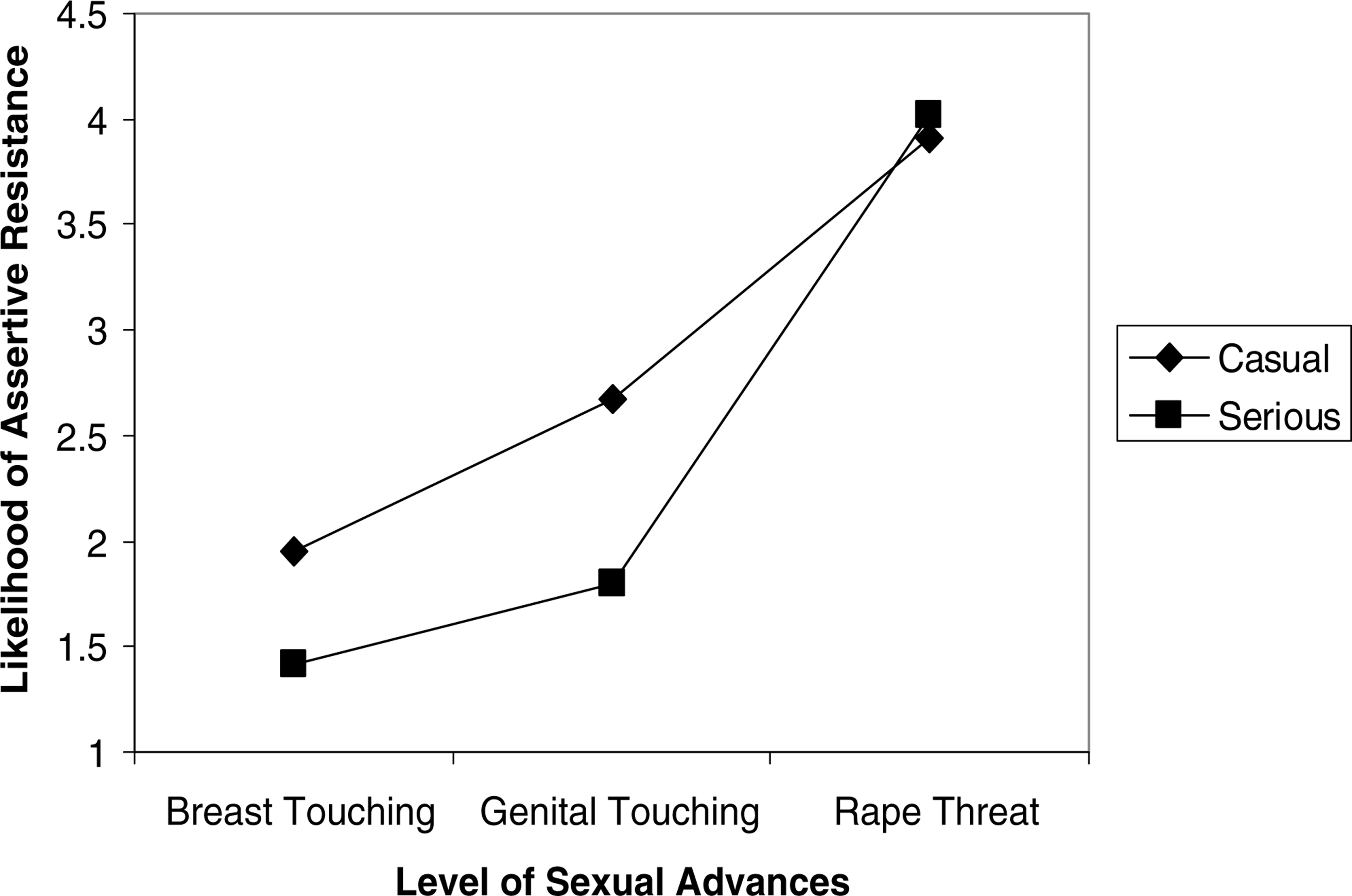
Estimated likelihood of assertive resistance as a function of level of sexual advances and relationship type.
Passive Responses
As mentioned previously, the three items depicting passive responding (“just go along with what he is doing, even though I don't really want to”; “become paralyzed and unresponsive to what he is doing because I feel so overwhelmed”; “not try to do anything because it seems hopeless”) were analyzed individually due to low reliability. For the “go along” item, there was a significant main effect for the within-subjects variable of level of sexual advances, F(2, 55) = 24.73, p < .001, such that going along decreased significantly at each level of sexual advance. There were no other significant effects for this item.
For the “paralyzed and unresponsive” item, there was a significant between-subjects main effect for beverage condition, F(1, 56) = 5.45, p < .05. Intoxicated participants reported a greater likelihood of becoming paralyzed and unresponsive than did sober participants. There were no other significant effects for this item.
For the “do nothing” item, there was a significant between-subjects main effect for beverage condition, F(1, 56) = 5.07, p < .05, with intoxicated participants reporting a greater likelihood of doing nothing than did sober participants. Additionally, there was a significant level of sexual advance × relationship condition interaction, F(2, 55) = 3.60, p < .05. Post hoc simple effects testing of the means indicated that participants in the casual relationship reported a greater likelihood of doing nothing after breast fondling (M = 1.23) than they did after a rape threat (M = 1.00). None of the other means were significantly different from one another.
DISCUSSION
The results of this study highlight the influence of alcohol consumption, as well as situational factors, on women's responses to unwanted sexual advances. First, when projecting themselves into a high-conflict situation, intoxicated women were more likely than sober women to consent to intimate sexual activity. Second, intoxicated women reported a greater likelihood of passive responding when faced with unwanted sexual advances by a dating partner. Finally, women in a serious relationship were more likely to consent and less likely to resist initial sexual advances than were women in a casual relationship; however, once faced with the threat of rape, women's responses did not vary according to relationship type.
Effects of Alcohol on Women's Responses
Consistent with Testa et al. (2000) and Murphy et al. (1998), our findings provide evidence that women's sexual decision making may be especially influenced by alcohol in situations of high conflict. Women described as being in a serious relationship, yet as not wanting to have sexual intercourse, were faced with strong instigatory and inhibitory cues when presented with intimate sexual contact by a partner expressing his desire to have intercourse. Although women have affiliative goals in this situation, they also have self-protective goals—goals that may be at odds with one another (Nurius & Norris, 1996). As predicted, in such a situation, intoxicated women were more likely than sober women to consent to sexual activity. Because some men are prone to interpreting women's behavior as more indicative of sexual interest than the women themselves intend (Abbey & Harnish, 1995), a woman's consent to some sexual contact may be misinterpreted by her dating partner as a willingness to engage in sexual intercourse as well (Nurius et al., 1996). Given that both sexual miscommunications and prior consensual sexual activities are associated with sexual assault (Abbey, 2002; Muehlenhard & Linton, 1987; Harrington & Leitenberg, 1994; Testa & Livingston, 1999), intoxicated women faced with high-conflict situations may unwittingly place themselves at greater risk for sexual assault by consenting to unwanted sexual advances.
As predicted, regardless of relationship, women who had consumed alcohol rated themselves as more likely to respond passively (becoming paralyzed and doing nothing) than did women who were sober. Similar to consent, responding passively to unwanted sexual advances may increase women's sexual vulnerability. Specifically, some men may interpret a mere lack of resistance as indicative of sexual willingness. Although physical incapacitation may account for some of the relationship between alcohol intoxication and passive responding in real sexual assault events, this seems an unlikely rationale to explain the current finding given the moderate alcohol dosage utilized in this study. One possibility is that cognitive factors are playing a role in increased passivity when moderately intoxicated. Norris et al. (1996) found that sober women viewed alcohol impairment as a barrier to engaging in resistance to sexual aggression. Perhaps women who have consumed a moderate amount of alcohol believe themselves to be less able to respond effectively to a man's unwanted sexual advances—regardless of their actual ability—and thus they do nothing. An alternative explanation is that the anxiolytic effects of moderate drinking cause intoxicated women to relax a bit more than their sober counterparts and thereby make them more likely to respond passively. Further, prior research has found that intoxicated women are more likely to be viewed as sexually available and more likely to be blamed for an assault against them (George, Cue, Lopez, Crowe, & Norris, 1995; Norris et al., 1996). If a woman has internalized these societal norms regarding the drinking woman, she may be more likely to respond passively to sexual aggression when intoxicated due to a belief that she is getting what she deserves. Thus, the increased immobilization of intoxicated women in response to unwanted sexual advances may be due not only to physical incapacitation at high levels of alcohol consumption, but also to cognitive factors, anxiolytic effects, and societal norms at moderate alcohol dosages. It should be noted, however, that although intoxicated women estimated a greater likelihood of responding passively than did sober women, these estimations were still quite low—both sober and intoxicated women viewed themselves as highly unlikely to be passive in the face of unwanted sexual advances.
Unlike studies of alcohol and resistance behavior in actual assaults (Abbey et al., 2002; Harrington & Leitenberg, 1994), our study did not find that intoxicated women were less likely to use resistance measures when considering a hypothetical assault. One possible explanation for this lack of replication is that only a moderate alcohol dosage was used; perhaps women would have reported less resistance at higher alcohol intoxication levels. Additionally, although the male character does threaten to rape the woman at the end of the story, no other sexual aggression was presented. It is possible that reduction in resistance due to intoxication may occur primarily in situations involving more severe aggression. Finally, as Norris et al. (1996) point out, women may tend to overestimate their likelihood of and efficacy in resisting sexual assault when presented with situations that are purely hypothetical. Thus, it is important to evaluate findings from experimental analogue studies such as this one in conjunction with survey work based on real-life incidents to obtain a more complete picture of women's sexual aggression resistance behavior.
Effects of Situational Factors on Women's Responses
Women's estimations of the likelihood of their responses were significantly influenced by the level of sexual advance engaged in by their dating partner, as well as their type of relationship. As expected, women's responses changed over time in relation to the escalation of sexual advances. As the man's level of sexual advances increased, women's likelihood of consenting and going along decreased, while their likelihood of using assertive resistance increased. Interestingly, we found that polite resistance occurred in a curvilinear fashion. That is, women were most likely to use polite resistance when presented with the highly intimate sexual act of genital fondling, and less likely to use polite resistance against kissing/breast fondling and the threat of rape. It thus appears that women do indeed tailor their responses to the type of sexual advance (Ullman, 1998; Ullman et al., 1999), with women generally being more likely to consent to low-intimacy sexual contacts, more likely to resist high-intimacy sexual contact in a polite manner, and more likely to resist sexual aggression in an assertive manner.
Importantly, though, responses were also influenced by relationship type, with women in a serious relationship being more likely to consent and less likely to resist either politely or assertively than women in a casual relationship. Moreover, for both consent and assertive resistance, these relationship type effects interacted with level of sexual advance. Women in the serious relationship were more likely than women in the casual relationship to consent to both kissing/breast fondling and genital fondling. However, once the man became aggressive and threatened rape, relationship type had no impact on consent: Almost all women reported that they would be highly unlikely to consent at that time point. Similarly, women in the serious relationship were less likely than women in the casual relationship to use assertive resistance for kissing/breast fondling and genital fondling; yet, once the man threatened rape, both groups reported a similarly high likelihood of using assertive resistance. Because women in serious relationships were more likely to wait to use assertive resistance until actual sexual aggression had already occurred, it is possible that some of these types of situations may involve a greater likelihood of miscommunication occurring between the partners, potentially increasing the woman's sexual vulnerability.
These findings indicate some of the complexities involved for women in making decisions about responding to unwanted sexual advances. Women considered not only the level of behaviors engaged in by the man, but also the nature of their relationship, in formulating a response. Although these findings did not interact with alcohol consumption, it would seem that attending to each of these factors would become more difficult as intoxication level increases. Moreover, because of the hypothetical nature of the scenario presented, it would be important to examine how relationships of varying intimacy impact women's responses to rape threats in real-life situations. Future studies could examine these issues.
Limitations and Conclusions
One limitation of this study is the relatively homogeneous, small sample. Most of the participants were college-educated, young, and White. Replication of this study with a larger, more diverse sample would be quite useful, for women who have different backgrounds and are at different stages in their lives might respond quite differently to the type of sexual aggression presented in this study. However, it is important to point out that given the high incidence of sexual assault when drinking among college students (Koss, 1988), samples of college women are important to include in sexual assault studies of this kind. Another limitation of this study is the use of a written vignette. Although written vignettes can never capture the full complexity of real-life situations, every attempt was made to make this vignette as realistic as possible. Additionally, although pilot study data indicated that women projecting themselves into the serious relationship vignette reported greater difficulty in deciding to consent than did women reading the casual relationship vignette, it is certainly possible that other types of dating relationships (e.g., ones in which consensual sexual intercourse has occurred on a prior occasion) could result in an even higher sense of conflict regarding the decision to consent to unwanted sexual intercourse. However, based on the inhibition conflict model, we would expect that our finding of greater consent by intoxicated women in high conflict situations would be replicated, and perhaps further strengthened, in situations involving an even higher degree of conflict than the one presented here.
Another limitation of this study is the lack of an alcohol placebo group. As a result, we cannot disentangle the expectancy and physiological effects of alcohol on women's responses to unwanted sexual advances. Given that our results indicate that even moderately intoxicated women may believe themselves less capable of effectively responding to an assault, future studies should incorporate a placebo group when assessing women's responses to unwanted sexual advances. Additionally, the findings of this study cannot be generalized beyond a moderate alcohol dosage level. However, although experimental methodology has some limitations regarding real-world generalizability, it also has distinct advantages over retrospective survey methodology: Alcohol dosage can be precisely manipulated and measured, inaccurate reporting of events due to memory distortion can be eliminated, and causal linkages can be examined. By allowing for greater control over variables of interest, experimental methodology provides information that both complements and augments knowledge gained from retrospective surveys.
Future experimental investigations could include several alcohol dosage levels to determine if amount of intoxication impacts women's responses to unwanted sexual advances. Additionally, one important direction might be to examine various kinds of high-conflict sexual assault situations, such as advances from a boss or an ex-partner. It would also be useful to explore other factors, such as emotion or personality variables that might influence women's responses to sexual assault. Finally, and most important, it should be noted that our focus on women's alcohol consumption and behavior is not intended to imply that women are to blame for sexual aggression; indeed, potential perpetrators hold the ultimate responsibility for preventing sexual assault. It is our hope, however, that these findings are incorporated into sexual assault prevention efforts, such that both men and women better understand the ways in which the presence of alcohol in a dating situation may contribute to the potential occurrence of sexual assault.
Footnotes
1.
The vignette may be obtained from the first author.