







Abstract
Many women, even as they embrace feminist principles, are loath to be labeled feminists. This study presents a measure of feminist identity that accounts for beliefs and behaviors of self-identified feminists and nonfeminists, and for a third group, egalitarians, who endorse liberal feminist beliefs but reject the feminist label. In a sample of 272 college-educated women, a MANOVA showed egalitarians had levels of feminist consciousness between nonfeminists and feminists. Egalitarians did not differ from nonfeminists on favorable conditions for feminist identity or on feminist activism, but both groups scored lower on these measures than feminists. In a hierarchical multiple regression, feminist identity was a significant predictor of feminist activism, above and beyond favorable conditions and barriers. The importance of self-labeling for invisible and stigmatized social identities is discussed.
Every person holds many different identities. For instance, one individual may identify as extraverted, a parent, a Democrat, and a White person, among other identities. Erikson (1959) posited that there are multiple components to the concept of identity: “it will appear to refer to a conscious sense of individual identity … and a maintenance of an innersolidarity with a group's ideals and identity” (p. 109, emphasis in the original). More recently, social psychologists have named these distinct types of identity personal and social (Deaux, Reid, Mizrahi, & Ethier, 1995; Thoits & Virshup, 1997; Turner, Oakes, Haslam, & McGarty, 1994). Personal identity consists of “traits or characteristics people use to describe themselves as unique individuals” (Deaux et al., 1995, p. 280), such as friendly and conscientious. In contrast, social identity emphasizes the characteristics people share with others who are members of a particular group, based on categories such as gender, ethnicity, occupation, and political affiliation.
Individuals with salient social identities are likely to engage in behaviors related to those identities (Deaux, Reid, Mizrahi, & Cotting, 1999; Stryker & Serpe, 1994). Identity has been shown to relate to behavior in many domains, including work and party politics (Jackson & Smith, 1999), African American ethnicity (Sellers, Rowley, Chavous, Shelton, & Smith, 1997), and sports fan behavior (Platow et al., 1999). In general, “when a person defines him- or herself in terms of a category or group of somehow similar people, the person takes on shared meanings of that categorical label's implication, as well as assuming elements of a common agenda for action” (Deaux et al., 1999, p. 91).
Thus, when individuals disavow a particular social identity, there are consequences for their behavior. What types of social identities are disavowed? Members of stigmatized groups are known to experience psychological marginality (e.g., Frable, 1993; Frable, Blackstone, & Scherbaum, 1990) and thus may disavow their social identity to avoid dealing with other people's reactions to them (Smart & Wegner, 1999). Such disavowal will be particularly successful when the social identity is invisible as well as marginal. For instance, an individual with a hidden disability such as diabetes is much more able to disavow his or her identity as disabled than someone who uses a wheelchair. Similarly, someone with a political belief that is marginalized, such as feminism, may choose to disavow that identity.
Many women, even as they embrace feminist principles, are loath to be labeled as feminists. This is evident, for example, in the oft heard statement, “I'm not a feminist, but …,” in which, as a precursor to aligning herself with any particular feminist principle, a woman outright rejects the label or identity of feminist (Aronson, 2003; Burn, Aboud, & Moyles, 2000; Buschman & Lenart, 1996; Cowan, Mestlin, & Masek, 1992; Griffin, 1989; Liss, O'Connor, Morosky, & Crawford, 2001; Misciagno, 1997; Myaskovsky & Wittig, 1997; Percy & Kremer, 1995; Renzetti, 1987; Sigel; 1996; Williams & Wittig, 1997; Wolf, 1993). Rejection of feminist identity by many individuals prevails even as support for the goals of the women's movement has increased since the 1970s (Cook, 1993; Hall & Rodriguez, 2003; Huddy, Neely, & Lafay, 2000; Mason & Lu, 1988; Twenge, 1997) and individual women acknowledge that gender-based discrimination is problematic (e.g., Crosby, 1984; Sigel, 1996). The present study suggests a new way of theorizing about and measuring feminist identity that accounts not only for beliefs and behaviors of self-identified feminists and nonfeminists, but for a third group of women who endorse feminist beliefs but reject the feminist label.
Theorizing Feminist Identity
Feminist identity can be construed within the broader literature on social identity theory (e.g., Deaux et al., 1995). Tajfel (1982) defined group identification as that part of an individual's self-concept that derives from knowledge of one's membership in a social group, together with the value and emotional significance attached to that group membership. Gurin and her colleagues (Gurin, 1985; Gurin & Markus, 1989; Gurin, Miller, & Gurin, 1980; Gurin & Townsend, 1986) applied this framework to women; they argued that women who are cognitively aware of belonging to the women social group, feel close to other women, are conscious of power inequities related to gender, and attribute these inequities to systemic rather than individual causes, can be considered to have high levels of gender consciousness. This conception of group consciousness has been one of the prevailing ways of measuring feminist identity (Rhodebeck, 1996).
An alternate approach employs a stage-based developmental paradigm. Here, feminist identity is conceptualized as a progression through successive stages, from passive acceptance of sexist society to the recognition of sexism, to embeddedness in women's culture, to a final synthesis of feminist beliefs with one's identity, and a commitment to act on those beliefs (Downing & Roush, 1985). This model of feminist identity has been found to relate to women's transformative experiences in women's and gender studies classes (Bargad & Hyde, 1991; Henderson-King & Stewart, 1994) and to women's dating choices and perceptions of art (Rickard, 1989, 1990).
A third approach was developed by Henley and her colleagues (Henley, Meng, O'Brien, McCarthy, & Sockloskie, 1998; Henley, Spalding, & Kosta, 2000). They drew on a wealth of literature from feminist theory that argues that there is not one feminist position, but many. Thus, they developed scales to assess liberal, radical, socialist, cultural, and womanist perspectives on feminist identity development. This approach begins to integrate social and personality psychologists' concerns with identity processes with feminist theorists' concerns that no one feminist position will accurately express the many lived feminisms of today. Whereas a woman of color might score low on the Downing and Roush model (1985) because it does not integrate the struggles for racial and gender justice, she may score high on the womanist scale of the Henley et al. (1998) model.
These useful approaches are not without limitations. For example, the stage-based model was developed to account for the experiences of women who became feminists during the second wave of the women's movement in the 1970s and may be less relevant to the experiences of younger women, who grew up in an era that was influenced by the changes wrought by the women's movement. Younger women may never have experienced passive acceptance of sexism, nor had a single period of revelation about gender inequalities (Horne, Mathews, Detrie, Burke, & Cook, 2001). Furthermore, individuals, regardless of cohort, may not pass through the stages in a linear sequence (Fischer et al., 2000), and the studies based on this model have been limited to mostly White samples of college-aged women (Moradi, Subich, & Phillips, 2002).
Perhaps most seriously, with few exceptions, previous feminist identity research grounded in the three perspectives described above does not account for an individual's self-labeling as a feminist. These approaches fail to address the phenomenon of nonfeminist liberal egalitarianism, in which women espouse feminist beliefs regarding the equality of women and men, while simultaneously rejecting feminist identity. Some scholarly work indirectly addresses the existence of this group of women. For instance, Rhodebeck (1996) argued that feminist identity and feminist opinion were distinct, but she did not account for self-labeling. Misciagno (1997) maintained that traditional models of feminist consciousness exclude de facto feminists, women who hold feminist beliefs but do not take on the feminist identity. Her analysis was, however, grounded in political theory and did not explore the existence of this group empirically. Cook (1989) theorized that women could be classified as members of three groups: nonfeminists, potential feminists, and feminists, but this classification scheme was not adopted in subsequent research. Wittig and colleagues (Myaskovsky & Wittig, 1997; Williams & Wittig, 1997) have contributed most directly to separating individuals who have a profeminist orientation from those who actively identify as feminists. They found that a positive evaluation of feminists, belief in collective action, and exposure to feminism all contributed to self-identification as a feminist. The present study elaborates on these concepts by examining the predictors and consequences of three types of feminist identity—nonfeminist, liberal egalitarian, and feminist. A major goal was the development of an empirical measure that permits identification of a distinct group of women who are neither feminists nor nonfeminists, labeled here as egalitarians.
What Predicts Categorization as a Nonfeminist, Egalitarian, or Feminist?
Several conditions may contribute positively toward an individual adopting a feminist identity. Due to the overwhelmingly negative portrayal of feminism and feminists by the popular media, one crucial factor seems to be exposure to favorable information about feminism (see, e.g., Myaskovsky & Wittig, 1997; Williams & Wittig, 1997); this may occur in an explicitly educational context, such as in learning about feminism through women's and gender studies coursework or other experiences on college campuses (Aronson, 2003; Bargad & Hyde, 1991; Dabrowski, 1985; Henderson-King & Stewart, 1994; Stake, Roades, Rose, Ellis, & West, 1994; Stake & Rose, 1994), or through reading feminist texts (Findlen, 1995; Horne et al., 2001). Other sources of a more personal nature include being friends with or related to self-identified feminists (Findlen, 1995; Glickman, 1993), experiencing personal struggles related to sexism (Cowan et al., 1992; Duncan, 1999; Evans, 1979; Giddings, 1984; Renzetti, 1987; Ruddick & Daniels, 1977), or participating in consciousness-raising groups (Morgan, 1970; Popkin, 1990).
Women considering adopting a feminist identity face a number of potential barriers. Disavowal of feminist social identity may be caused by the negative cultural stereotypes of feminism, particularly as propagated by the media (e.g., Rhode, 1995). Douglas (1994) argued that “there is no doubt that the news media of the early 1970s played an absolutely central role in turning feminism into a dirty word” (p. 165) by depicting feminists as deviant, man-hating, unrepresentative radicals who were a threat to society. Therefore, reliance on mass media as a main source of information about feminists and feminism is likely to be related to low levels of commitment to feminist identity. Furthermore, Lull, Mulac, and Rosen (1983) found that individuals who identified with women's movement ideals watched less television than those who did not identify. Thus, although a causal direction is not clear, high levels of media exposure should be related to low levels of feminist identity.
Whereas some research studies have found a qualified, positive perception of feminists among college students (Berryman-Fink & Verderber, 1985; Twenge & Zucker, 1999), the preponderance of evidence suggests that the perception of feminists as deviants, and the perceived threat of feminism to heterosexuality, figures prominently in the minds of young women and men (Aronson, 2003; Banziger & Hooker, 1979; Fox & Auerbach, 1983; Glickman, 1993; Griffin, 1989; Haddock & Zanna, 1994; Horne et al., 2001; Kamen, 1991; Kelly & Breinlinger, 1995; Liss et al., 2001; Swim, Ferguson, & Hyers, 1999; Williams & Wittig, 1997). Therefore, associating feminism with extremism is also likely to be related to low levels of feminist identity.
In summary, exposure to feminism through education, personal relationships, or personal struggles are favorable conditions for feminist identity, whereas exposure to mass media and the association of feminism with extremism are barriers to feminist identity.
Consequences of Feminist Identity
As posited earlier, individuals who hold social identities are known to engage in certain behaviors, including activism on behalf of the group. Does this relation also hold for feminist identity? Most of the research in this domain has examined gender identity rather than feminist identity. In one study gender identity was highly correlated with several types of political participation (Kelly & Breinlinger, 1995). In another, when women's social identity was defined in social terms it was positively related to participation in collective action, but when defined stereotypically, there was a negative relation to collective action (Foster, 1999). The latter study illustrates a liability of using women rather than feminists as the target social identity—it can be unclear to both participants and researchers whether identifying with women is a feminist political act or not. Furthermore, one study demonstrated that individuals who were strongly identified with women, but not with feminists, were different from women who identified with feminists on a variety of measures of consciousness—including scoring lower on common fate with women and higher on passive acceptance of sexism (Henderson-King & Stewart, 1994). It is, therefore, important to examine the relation of feminist identity to collective action directly.
It might be surmised that women who adopt feminist as an accurate self-descriptor are more likely than those who reject this designation to pursue activism on behalf of women's rights. Public identification as a feminist presumably represents a greater commitment to the goals of feminism because champions of feminist positions are likely to be targeted with the negative stereotypes of feminists. Willingness to contend with such negative perceptions or backlash (e.g., Faludi, 1991) may represent, or perhaps even elicit, a deeper commitment to social change, resulting in greater collective action on behalf of women than is true of those who simply endorse egalitarian beliefs. Duncan (1999) offered evidence that group consciousness can provide a psychological mechanism that helps translate individual life experiences into activist behavior. For instance, many women are exposed to women's and gender studies courses and may find some of the information about sexism compelling, but not all of them go on to engage in women's rights activities to remedy those situations. Perhaps there is something about the willingness to claim the identity that helps people engage in activism. By contrast, egalitarian women, who espouse equal rights for women and other equality-based ideals, but who do not accept the feminist label, may be less inclined to feminist activism. It is unclear whether egalitarians would also engage in more feminist behavior than women who similarly reject feminist identity but also reject egalitarian beliefs. Consequently, a second major goal of this investigation was to test the prediction that, above and beyond favorable conditions for and barriers to feminism, feminist identity itself would be a significant predictor of feminist activism.
Cohort
Women's relation to feminism is likely to differ by birth cohort. Stewart and Healy (1989) offered a theory linking personality to social changes that argued that the same event (e.g., the women's movement) has different effects on different birth cohorts, depending on the stage of development each cohort was in at the time of the event. In particular, they argued that events experienced in childhood and early adolescence influence fundamental values and expectations; events experienced in early adulthood influence opportunities, life choices, and conscious identity; events experienced in mature adulthood influence behavior; and events experienced in later adulthood influence new opportunities and choices, and encourage a revision of identity. Support for this theory comes from a number of studies (Cook, 1993; Duncan & Agronick, 1995; Stewart & Healy, 1986, 1989). Based on this body of work, it seems likely that women who came of age during the second wave of the women's movement would have a stronger conscious feminist identity than women who were one generation older or younger and thus would be the most likely to identify as feminists, rather than as egalitarians or nonfeminists.
According to Stewart and Healy's (1989) model, young women who grew up in an era influenced by the sweeping changes wrought by the women's movement should be more likely to have absorbed feminist ideas as part of their fundamental values and background expectations about the world than older cohorts of women. Whether these fundamental values appear in young women's current attitudes only, or in their conscious identity, remains to be tested. Hall and Rodriguez (2003) recently found that young women were not less feminist than older women (see Peltola, Milkie, & Presser, 2004, for a partial exception).
Hypotheses
Women who came of age before the 1970s will be the least feminist group. They will experience fewer favorable conditions and more barriers to identifying as feminists than women in the other two cohorts.
There will be a distinctive group of women, (egalitarians) who endorse egalitarian gender beliefs but reject the feminist label.
Egalitarians will have higher levels of feminist consciousness than nonfeminists (who reject egalitarian gender beliefs and reject the feminist label), but lower levels of feminist consciousness than feminists (who endorse egalitarian gender beliefs and accept the feminist label). Egalitarians will be significantly higher than nonfeminists, and lower than feminists, on favorable conditions for feminist identity: exposure to feminism through education, personal relationships, and personal struggles. Egalitarians will be significantly lower than nonfeminists and higher than feminists on barriers to feminist identity: exposure to media and associating feminism with extremism. Egalitarians will be significantly higher than nonfeminists, but lower than feminists, on levels of activism on behalf of women's rights.
In a combined analysis predicting feminist activism, feminist identity will contribute unique predictive power above and beyond favorable conditions and barriers.
METHOD
Participants
Participants in this study were an age heterogeneous sample of 333 alumnae of the University of Michigan: 99 (30%) from the Class of 1951 or 1952, 144 (43%) from the Class of 1972, and 90 (27%) from the Class of 1992. A random sample of women from each graduating class was contacted in 1996 and sent a questionnaire through the mail; participants were sent follow-up reminders and encouraged to participate for up to one year after the initial mailing; final response rate was 30% overall (25% from ′51/52; 37% from ′72; and 27% from ′92). This response rate is comparable to other studies in which samples of university alumni were contacted for the first time long after they had graduated (e.g., Abramowitz & Nassi, 1981; Cole, Zucker, & Ostrove, 1998). Certain factors, such as length of time since graduation and age-related mobility, may have contributed to the different rates of response for each cohort.
Demographic information for participants is presented in Table 1. Ethnic composition of the three groups reflected the demographics of the university at different times. Of the women of color, 3 were African American, 11 were Asian American, 2 were Latina, 1 was Native American, and 4 were mixed heritage.
Measures
Feminist identification.
There were two components to the definition of feminist identification: holding feminist beliefs and accepting the label feminist. Operationalizing feminist beliefs is not a simple task, because it requires sifting through the many and complex definitions of feminism (Buschman & Lenart, 1996). There is, however, consensus that a major component among otherwise divergent views of feminism is an emphasis on equal rights for women. Therefore, a measure of cardinal beliefs of feminists was developed consisting of three items that assessed participants' agreement with the basic feminist principle of equality between the sexes. The three items, “Girls and women have not been treated as well as boys and men in our society,” “Women and men should be paid equally for the same work,” and “Women's unpaid work should be more socially valued” were answered in a yes/no format. Four women (1%) rejected all three beliefs, 19 women (6%) endorsed only one belief, 81 women (24%) endorsed two beliefs, 219 women (66%) endorsed all three beliefs, and 10 women (3%) did not complete these questions.
Demographic Characteristics of the Sample by Cohort (N = 272)
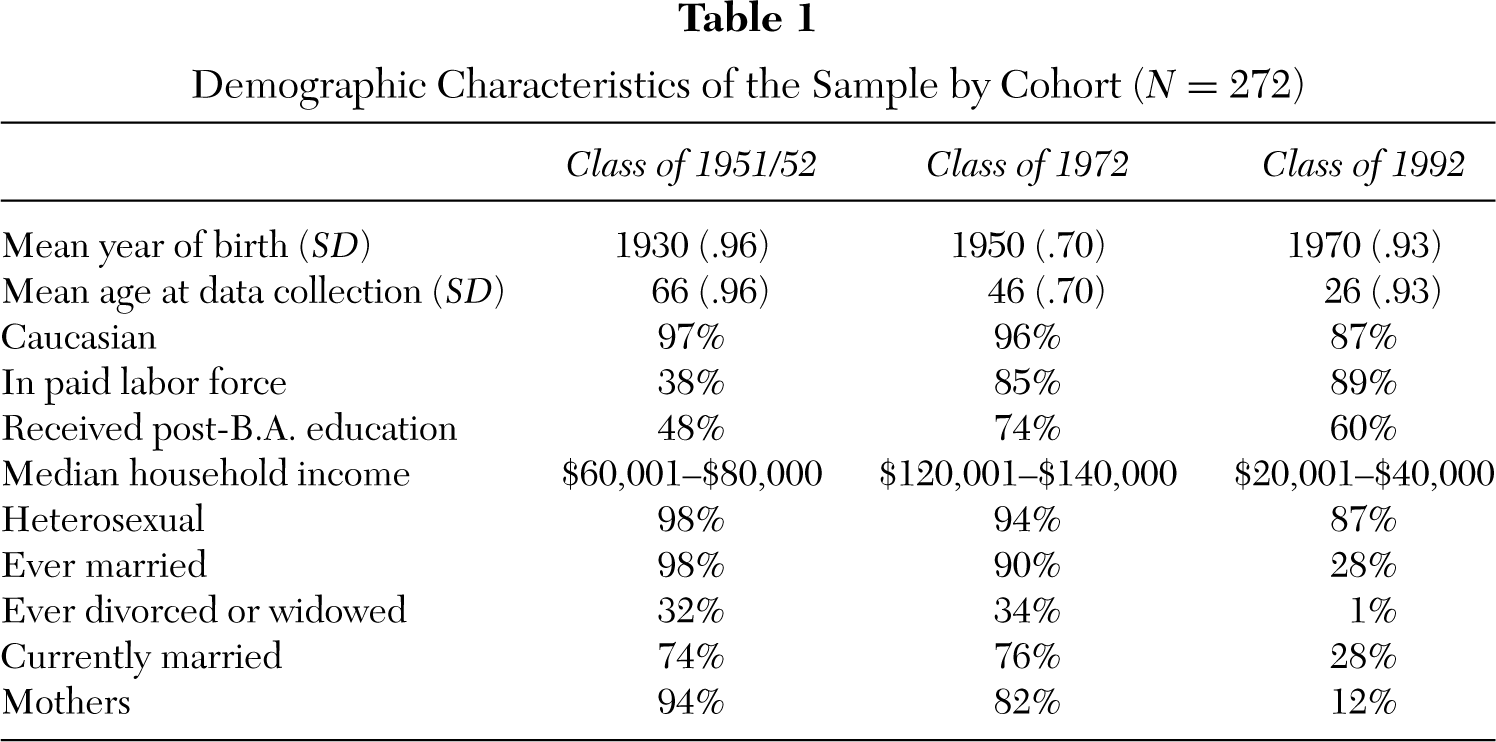
The second component of the definition, accepting the label, was assessed with a behavioral measure. At one point in the questionnaire, participants were asked to answer a series of questions if they considered themselves feminists and another similar series of questions if they considered themselves to be nonfeminists; in this way, participants were forced to make a behavioral choice about whether they were willing to align themselves with feminists. One hundred fifty-two women (46%) answered the feminist page; 138 women (41%) answered the nonfeminist page; 11 women (3%) answered on both, indicating that they could not decide; and 32 women (10%) did not complete this section of the questionnaire.
Based on these two measures, three feminist identity groups were created. Women were considered feminists (N = 123) if they endorsed all three of the cardinal beliefs and completed the questions for feminists. Thus, they can be considered both to hold feminist beliefs and accept the feminist label. Women were considered egalitarians (N = 84) if they endorsed all three cardinal beliefs of feminists, but completed the questions for nonfeminists; or if they were among the small group who could not choose between the feminist and nonfeminist pages, and completed both. Thus, they can be considered to hold feminist beliefs but to reject or hold mixed feelings toward the label “feminist.” Finally, women were considered nonfeminists (N = 65) if they rejected at least one cardinal belief of feminists and completed the questions for nonfeminists. These women both rejected feminist beliefs and the feminist label. Thirty-eight women (11%) could not be classified into one of the feminist identity groups due to missing data. An additional 26 women did not fit into this classification scheme because they were in the fourth group—women who endorsed fewer than 3 cardinal beliefs, but completed the questions for feminists. These women, who appear to have a non-egalitarian definition of feminism, are an important group to understand, but due to their low frequency here are not addressed further in this paper. Excluding the women who could not be categorized, 45% of the women were feminists, 31% were egalitarians, and 24% were non-feminists, with a final total of 272 women included in the analyses below.
Feminist consciousness.
Feminist consciousness consisted of measures that map on to the group consciousness and developmental conceptualizations of feminist identity described above. Because the current data were collected before the publication of Henley et al.'s (1998, 2000) scales, they were not included here.
The first three measures of feminist group consciousness were adapted from Gurin et al. (1980). Power discontent represents individuals' sense of grievance over their position in society as compared with other groups' positions (Gurin et al., 1980). Respondents were presented with the statement: “Some people think that certain groups have too much power and influence in our society and that others do not have as much as they deserve. Please indicate whether you think the following groups have too much power, just the right amount of power, or too little power.” Participants rated a number of groups; for the present purposes, only their rating of feminists was used on a scale ranging from 1 (too little) to 3 (about right) to 5 (too much). Evaluation of legitimacy of status differentials (Gurin et al., 1980) assesses individuals' awareness that power disparities are the result of structural forces. Five items were used to measure rejection of legitimacy for sex (e.g., “By nature women are happiest when they are making a home and caring for children”); α = .64. Items were rated on a scale ranging from 1 (strongly disagree) to 7 (strongly agree). Items were reverse-coded when necessary so that high scores always reflected a rejection of legitimacy of these disparities.
Evaluative stance toward social groups measures how an individual feels about a social group, which Tajfel (1982) argued was often a component of social identity. Participants were asked to rate feminists by choosing a number on a feeling thermometer to measure how cool or warm they felt about them (Gurin et al., 1980). The thermometer ran continuously from 0 to 100 degrees, where 0–49 represented cool, 50 represented neutral, and 51–100 represented warm feelings. The final measure of group consciousness, the Attitudes Toward Feminism and the Women's Movement Scale (Fassinger, 1994) was used to capture respondents' feelings of favorability toward feminism and the women's movement. The scale consisted of 10 items rated on a Likert scale ranging from 1 (strongly disagree) to 7 (strongly agree). Sample items are: “Feminist principles should be adopted everywhere,” and “Feminists are a menace to this nation and the world.” Items were recoded when necessary so that high scores indicated support for the movement in all cases and a summary scale was created by taking the mean of all items; α = .86.
The developmental perspective was measured with four subscales from the modified 37-item version of the Feminist Identity Scale (FIS; Rickard, 1989; see Henderson-King & Stewart, 1994, 1997, for the modified version), which was developed to measure Downing and Roush's (1985) hypothesized stages of feminist identity development. There are four stages of the FIS: passive acceptance, revelation, embeddedness/emanation, and synthesis. All items were measured on a Likert scale, ranging from 1 (strongly disagree) to 5 (strongly agree). The first stage, passive acceptance, represents a passive acceptance of traditional sex roles and consists of five items (e.g., “I like to refer to my female friends as ‘girls.’”); α = .63. The second stage, revelation, represents a woman's growing awareness of and anger about traditional sex roles, and consists of 14 items (e.g., “My female friends are like me in that we are all angry at men and the ways we have been treated as women.”); α = .83. The third stage, embeddedness/emanation, represents a woman's growing interest in “women's culture” and the potential for community with women, and consists of 6 items (e.g., “I am very interested in women artists.”); α = .77. The fourth stage, synthesis, represents a woman's integration of her feminist thoughts with her own personality and her willingness and capacity to evaluate men and women as individuals, rather than as members of a group. It consists of 12 items (e.g., “I have incorporated what is female and feminine into my own unique personality.”); α = .68. Although the scale scores can be compared to determine what stage a woman is highest on, and thus what stage of feminist identity she occupies, past researchers have used women's scores on each stage as separate measures of different aspects of feminist consciousness (Henderson-King & Stewart, 1997).
Favorable conditions.
Favorable conditions for adopting feminist identity were assessed in three domains. First, education was content-coded from the question, “Please describe when and how you became a feminist/decided that feminism wasn't for you.” This question was content-coded by raters who were unaware of the participant's feminist identity (interrater reliability ranged from .85 to .96, and instances of disagreement were discussed and resolved). Any mentions of higher education, such as classes, peers, teachers, and groups at college (e.g., “While at the university I witnessed different women's groups and heard about ‘women's issues' classes.”) were coded as 0 (absent) or 1 (present). The second, personal relationships, included two types of relationships. Participants were asked “Is/was anyone in your family of origin a feminist,” and responses were scored as 0 (no) or 1 (yes). In addition, in the open-ended question described above about how the participant came to (dis)identify with feminism, any mentions of personal relationships with feminists (e.g., “My parents were feminists, I always saw a father assisting in child care, cooking, household details.”) were coded as 0 (absent) or 1 (present). Third, personal struggles, were coded from the same question and included any mention of one's own or others' suffering due to sexism (e.g., “I was going through the crisis of dealing with my aimless life as a wife and mother.”).
Barriers.
Measures of barriers to adopting feminist identity were drawn from two domains. The first, mass media exposure, was the average number of hours of television viewed per week (open-ended; responses ranged from 0 to 65). The second, perceiving feminists as extreme, was coded from the questions, “What about feminism is unattractive to you?” and “Please describe when and how you became a feminist/decided that feminism wasn't for you.” Mentions that feminists are dogmatic, radical, militant, shrill, carried away, close-minded, or one-sided were coded here. Responses were coded as 0 (absent) or 1 (present).
Feminist activism.
There were two measures of feminist activism. The first, an attitudinal index, was measured by a modified version of the active commitment subscale from the Feminist Identity Development Scale (Bargad & Hyde, 1991). This scale includes five items assessing commitment to feminist activism (e.g., “I have a lifelong commitment to working for social, economic, and political equality for women.”) that are rated on a Likert scale ranging from 1 (strongly disagree) to 5 (strongly agree). Scores on this scale were computed by taking the mean of the five items, α = .86.
Second, a behavioral index, was created out of a larger measure of types of activism (Duncan, 1999). Participants were asked whether they had engaged in any of six types of political participation (signed a petition; contributed money; attended a meeting; wrote a letter, called, or called on a public official; was an active member of an organization; attended a rally or demonstration) on behalf of three types of activist causes pertaining to feminist causes (women's rights, lesbian/gay rights, and pro-choice). Thus, for each activist cause (e.g., women's rights), a woman could have a score ranging from 0 (if she did not engage in any of the types of political participation) to 6 (if she engaged in all six types). An overall composite score was created by taking the mean of the number of ways of participating across these three types of activism; scores on this index ranged from 0 to 6.
RESULTS
Cohort Effects
Cohort was related to the new measure of feminist identity in interesting ways. As predicted, members of the Class of 1952 were more likely to be in the nonfeminist (34%) or egalitarian (39%) groups than in the feminist group (27%). Members of the Class of 1972 were more likely to be in the feminist group (51%) than the egalitarian group (30%) or the nonfeminist group (19%). Members of the Class of 1992 were much more likely to be in the feminist group (58%) than in the egalitarian (22%) or nonfeminist (20%) groups, χ2 (4, 272) = 19.28, p < .001. The relation of cohort to all other variables in the study is displayed in Table 2. Women from the Class of 1952 were significantly lower than women in the other two groups on most measures of feminist consciousness and two of the favorable conditions. They were also higher on one of the barriers. Notably, there were no cohort differences in feminist activism.
Feminist Identity: Distinguishing Egalitarians
One goal of the study was to compare the new feminist identity measure to existing measures. Table 3 shows that the existing measures are all moderately and positively correlated, with the exception of the FIS-Synthesis measure. To compare the new feminist identity measure to existing measures of feminism, a MANOVA was performed on the five types of feminist consciousness, four favorable conditions, two barriers, and two types of feminist activism, by feminist identity group. The overall test was significant (F = 8.34, p < .001), and each univariate test was significant, with the exception of FIS-Synthesis and hours per week of TV (see Table 4).
The Relation of Cohort to Feminist Variables
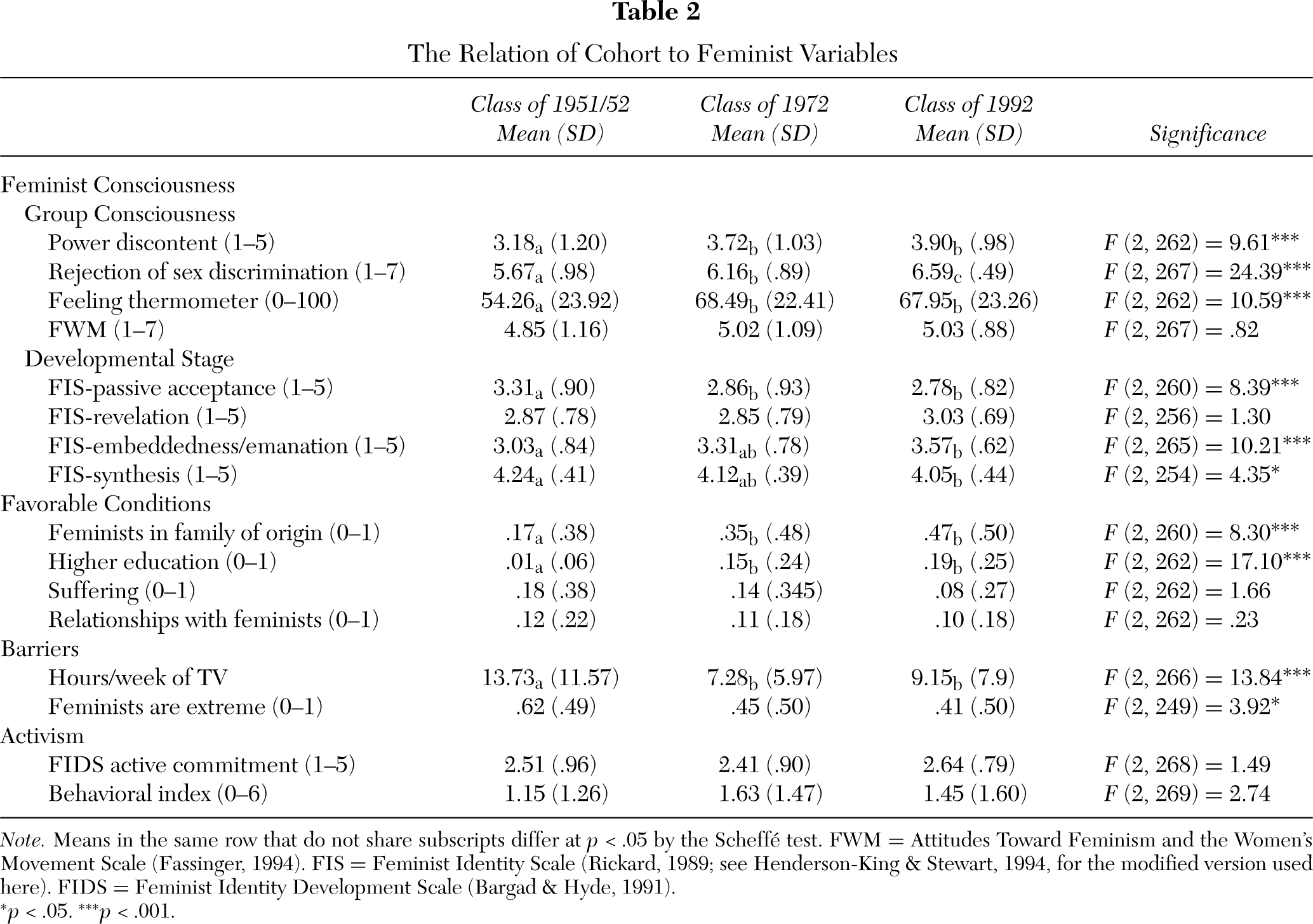
Note. Means in the same row that do not share subscripts differ at p < .05 by the Scheffé test. FWM = Attitudes Toward Feminism and the Women's Movement Scale (Fassinger, 1994). FIS = Feminist Identity Scale (Rickard, 1989; see Henderson-King & Stewart, 1994, for the modified version used here). FIDS = Feminist Identity Development Scale (Bargad & Hyde, 1991).
p < .05. ∗∗∗p < .001.
The pattern of the post hoc tests shown in Table 4 indicates that egalitarians scored between feminists and nonfeminists, and were significantly different from at least one of the other groups, in 7 out of 8 feminist consciousness variables measured. In five of those, they were both significantly higher than nonfeminists and significantly lower than feminists. Feminists scored significantly higher than nonfeminists and egalitarians on all four favorable conditions. There were no feminist identity group differences on either barrier. Feminists scored significantly higher than nonfeminists and egalitarians on both the attitudinal and the behavioral measure of feminist activism.
Intercorrelations of Feminist Consciousness Measures (N = 249–268)
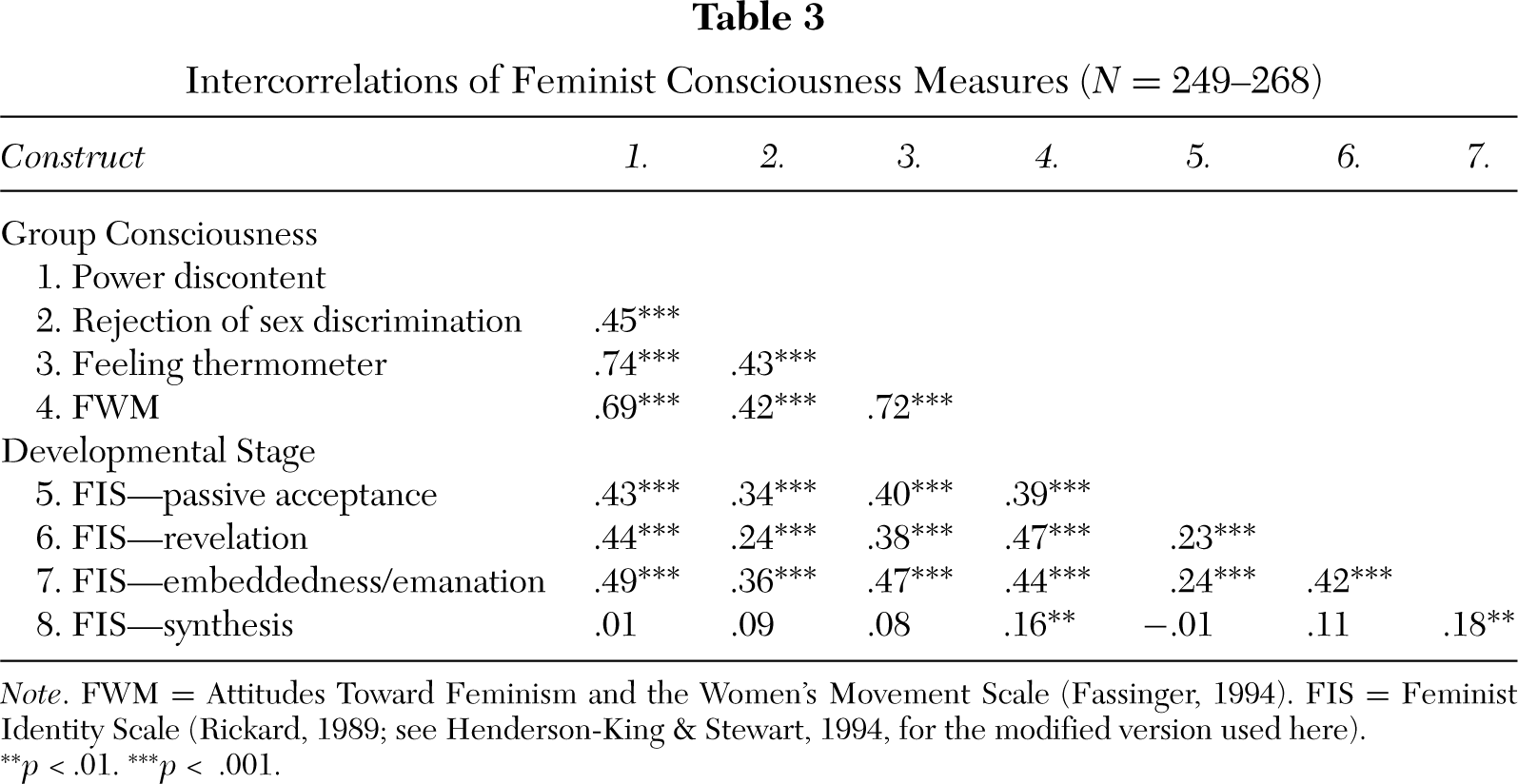
Note. FWM = Attitudes Toward Feminism and the Women's Movement Scale (Fassinger, 1994). FIS = Feminist Identity Scale (Rickard, 1989; see Henderson-King & Stewart, 1994, for the modified version used here).
p < .01.
p < .001.
Univariate F Tests on Feminist Consciousness, Favorable Conditions, and Barriers, by Feminist Identity (N = 265–272)
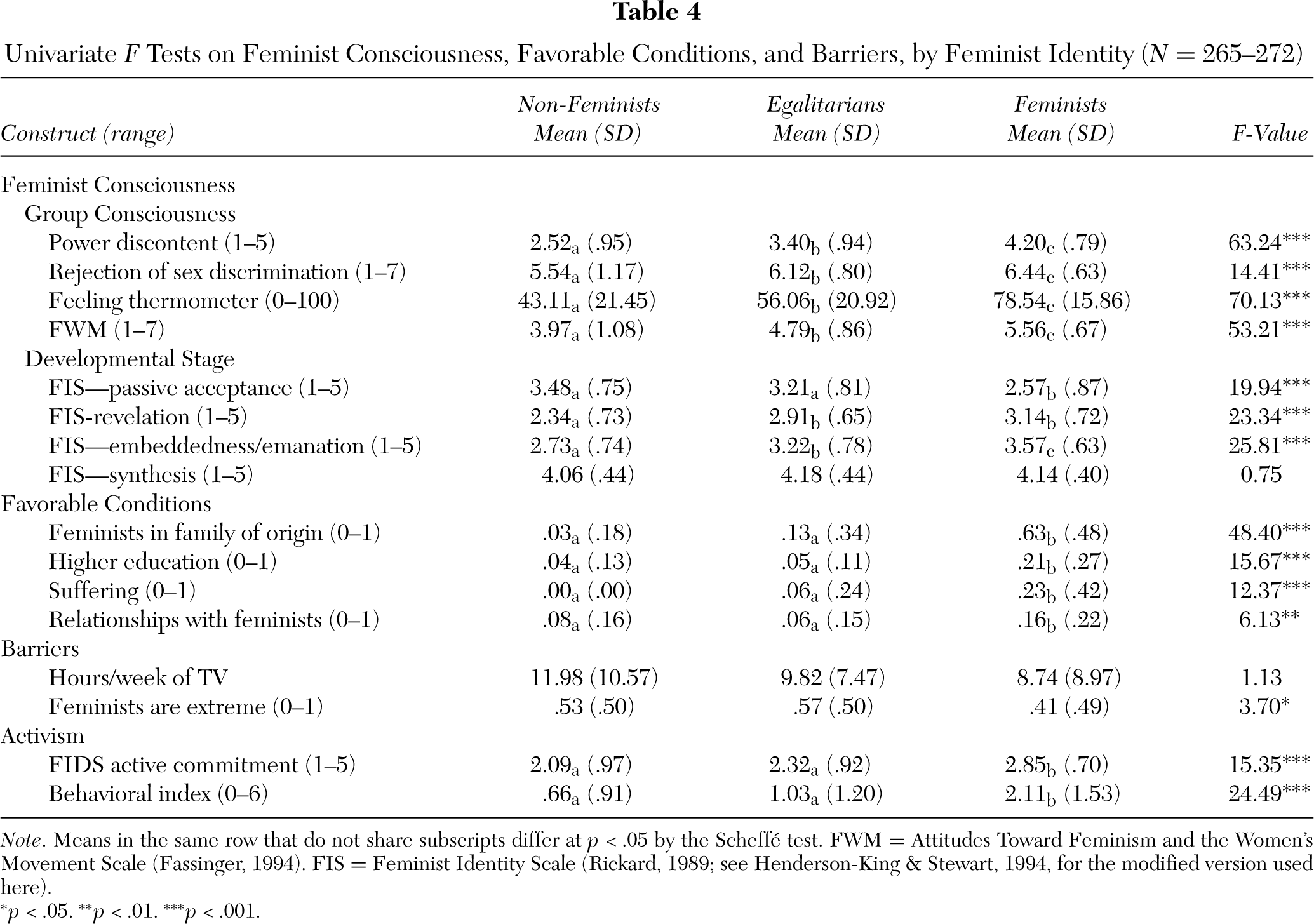
Note. Means in the same row that do not share subscripts differ at p < .05 by the Scheffé test. FWM = Attitudes Toward Feminism and the Women's Movement Scale (Fassinger, 1994). FIS = Feminist Identity Scale (Rickard, 1989; see Henderson-King & Stewart, 1994, for the modified version used here).
p < .05.
p < .01.
p < .001.
Predicting Feminist Activism
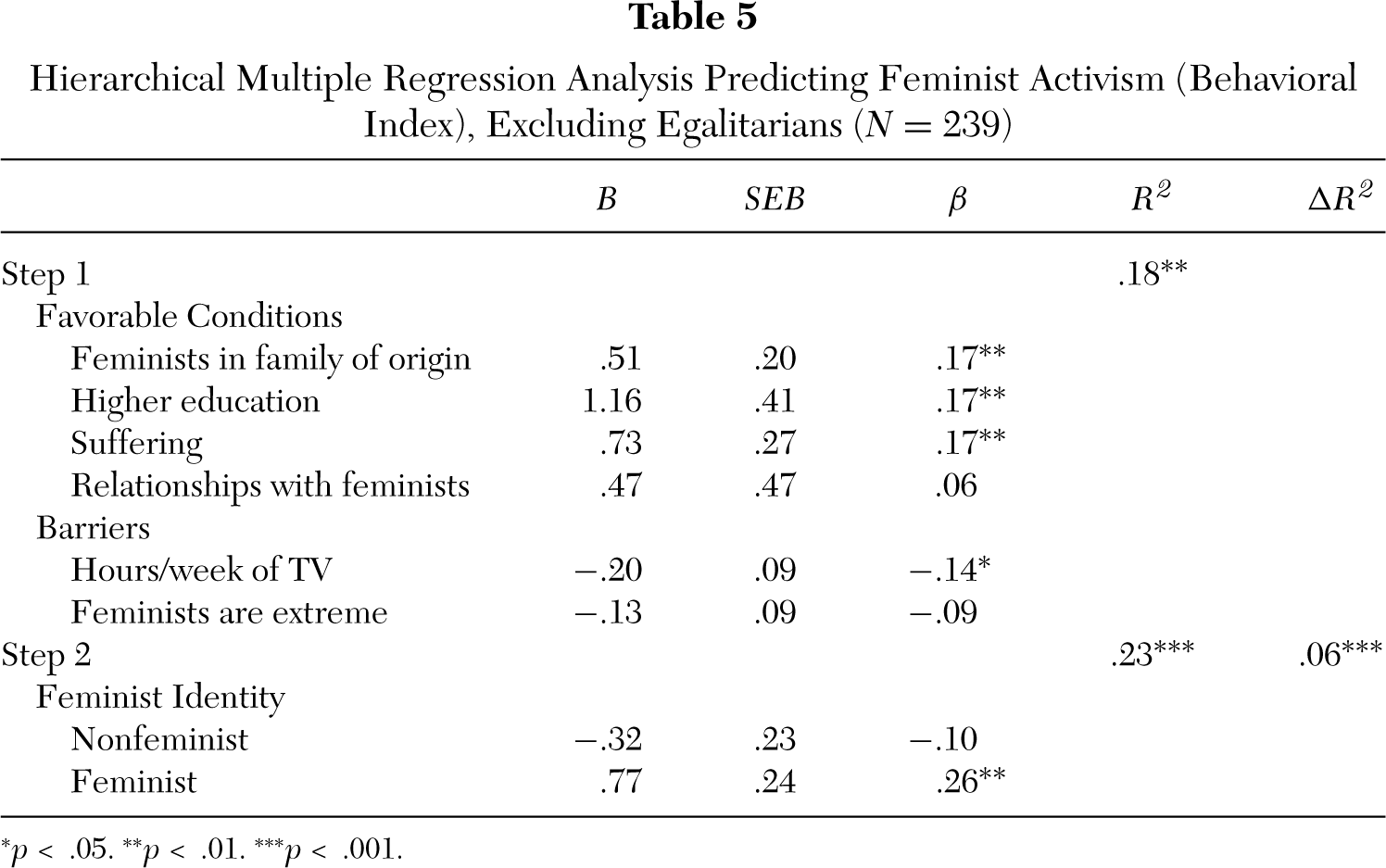
In a hierarchical multiple regression, the behavioral index of activism was regressed on favorable conditions for and barriers to feminism in step one, and dummy variables for feminist identity in step two. Because cohort was unrelated to feminist activism, this variable was excluded from the analyses. Table 5 shows that the model was significant at both steps and that the change in R2 was also significant. All favorable conditions except relationships with feminists were positive predictors of feminist activism, whereas watching a greater number of hours of television in a week was a negative predictor. Above and beyond those measures, being a feminist (as compared to being an egalitarian, the excluded group) was a significant positive predictor. When the model was run a second time, excluding nonfeminists, the beta for being a feminist increased to .37, p < .001. Repeating this analysis with the attitudinal measure of activism yielded similar, but slightly weaker, results. In step one, only having a feminist in one's family of origin and experiencing suffering were positive predictors (data not shown), R2 = .13, p < .001. In step two, being a feminist (as compared to being an egalitarian) was a significant positive predictor, R2 = .17, p < .001, AR2 = .04, p < .01.
Hierarchical Multiple Regression Analysis Predicting Feminist Activism (Behavioral Index), Excluding Egalitarians (N = 239)
p < .05.
p < .01.
p < .001.
DISCUSSION
The data provide support for the hypothesis that women who came of age before the second wave of the women's movement in the U.S. are less involved with feminism on a variety of levels. Consistent with Stewart and Healy's (1989) theory, the oldest women were less likely to adopt the label feminist and to experience favorable conditions for feminism, and more likely to engage in watching television (a barrier activity), than younger women in the sample. Interestingly, there did not appear to be cohort differences in feminism between women who came of age during the women's movement and those who were born into its aftermath. Rather than being in a post-feminist era, these data suggest that contemporary young adults are still engaged with feminism and feminist identity at a high level. These findings mirror recent large-scale surveys that demonstrate support for feminism is still high (e.g., Hall & Rodriguez, 2003; Huddy et al., 2000). Future studies should examine whether there are ways these two cohorts may differ, for instance, in terms of their fundamental values and expectations about the world.
The results offer support for the new measure of feminist identity that distinguishes among nonfeminists, egalitarians, and feminists. In particular, the data on feminist consciousness showed a distinct pattern whereby egalitarians scored higher than nonfeminists, but lower than feminists. This constitutes preliminary evidence that willingness to adopt the feminist label publicly is related to higher levels of feminist consciousness, although causal directionality cannot be determined. Identification of this kind of distinctive third group may help sharpen predictions about the consequences of feminist identity. Using analogous reasoning, Stewart, Settles, and Winter (1998) differentiated “engaged observers” of social movements from both activists and disengaged non-participants. They found that it was possible to make more precise predictions using those three groups than from more conventional comparisons of activists and nonactivists that conceal the existence of engaged observers who are politically informed and opinionated but not active. Similarly, separation of egalitarians from nonfeminists may sharpen predictions of different kinds of behavior. Perhaps only self-labeled feminists will take risky, public actions in support of women's rights. However, egalitarians may—like feminists—take less risky and/or less public actions, such as voting, mentoring, and working to improve the climate for women and girls.
Consistent with previous research (e.g., Myaskovsky & Wittig, 1997; Williams & Wittig, 1997), the data show clearly that being exposed to feminism in a variety of ways is related to feminist identity. In contrast to the findings for feminist consciousness, where egalitarians were a true middle group between nonfeminists and feminists, in the case of favorable conditions they were statistically indistinguishable from nonfeminists. Feminists were significantly more likely than both egalitarians and nonfeminists to have feminists in their families of origin; they also mentioned relationships with feminists more frequently than the other groups in describing how they arrived at their personal stance. Both of these findings, and those regarding educational experiences, suggest powerful tools for the political identification process. Whether through childhood socialization of norms in the family, or through non-familial ties, knowing or learning about “real, live” feminists may help dispel myths about feminists as unpleasant, deviant, and so on, and also personalize the cause of feminism.
Feminists were also more likely than the other two groups to mention experiences of suffering due to sexism—either their own or that of someone close to them—as formative experiences. It seems likely that it was not the experience of suffering per se, but rather a recognition that the suffering was due to sexism, and the injustice of it, that was important (Cowan et al., 1992; Renzetti, 1987). Experiencing severe economic hardship as a result of divorce, for example, happens to many women, not all of who subsequently identify as feminists. Rather, it is likely that something about the experience serves as a consciousness-raising function for some women. Future research on what enables some women to have a critical consciousness about these events is needed. Taken together, these data suggest that a number of factors may help tip women from the point of simply endorsing liberal feminist ideology to actually claiming the feminist identity.
In terms of barriers, there were not significant group differences in hours per week of television and perceiving feminists as extreme. Measurement difficulties may account for some of these nonsignificant results. First, hours per week of television may be too general an indicator of media exposure. In future research a more fine-grained measure—for instance, one that distinguishes between news and entertainment, or, for example, between PBS and MTV, might yield different results. It seems likely that all television shows do not portray equal representations of women and feminists, and thus a better indicator of the types of programs, as well as amount of exposure generally, may be needed.
The relation of feminist identity to feminist activism looks remarkably similar to that of feminist identity to favorable conditions, with feminists scoring significantly higher than both egalitarians and nonfeminists on active commitment to women's rights and on actual activist behavior on behalf of women. It is interesting that with respect to feminist consciousness, egalitarians are a group that is distinct from both nonfeminists and feminists, but in the case of favorable conditions and activism, they are indistinguishable from nonfeminists. Self-labeling, or willingness to adopt a marginalized identity publicly, appears to be consequential. Although egalitarians have higher levels of feminist consciousness than nonfeminists, this does not translate into more feminist behavior, at least as measured here. The importance of self-labeling is further underscored by the regression analysis in which feminist identity served as a significant predictor of feminist activism even when favorable conditions and barriers were already in the model. It is possible that in domains of feminist behavior that are less public or risky than activism—for example, working for equitable division of household labor or nonsexist childrearing in one's own family—egalitarians would appear to be more of a middle group, or more like feminists than nonfeminists, and this should be explored further.
There are several limitations to this study. First, the response rate was fairly low and differed somewhat by cohort. Although it is comparable with other studies of alumni/ae, we must be cautious in making generalizations. This may be the case particularly in terms of percentage of women in each feminist identity category. Because so much of the questionnaire related to feminist concerns, it is possible that fewer nonfeminists participated, and thus the picture portrayed here may not be representative. A number of the potential participants were excluded from the data analysis, primarily because of missing data, but in part because they did not fit into one of the three feminist identity groups, and this may have affected the outcomes. In addition to the measurement concerns discussed above, some of the scales were limited by low internal consistency.
Additionally, this is a highly privileged, educated sample that is primarily White and heterosexual. Although the diversity of age provides a difference from the typical subject pool sample, it is important to understand the relation of working-class women, women of color, and lesbian/bisexual/queer women to feminism. In fact, a number of scholars have suggested that one reason for not identifying as a feminist is that feminism is seen as a White, middle-class issue (Brown, 1989; White, 1999). Thus, it is possible under certain conditions that women would have a number of reasons to reject the feminist identity label that do not represent a lesser commitment to the goals of feminism (see, e.g., Hurtado, 2003). The majority of women in this sample likely do not fall into that category, but it will be important to sort out these reasons and how they relate to feminist identity in future studies. Future research combining Henley et al.'s (1998, 2000) conception of womanist feminism with the current labeling component may be quite fruitful.
These findings have the potential to be generalized to other marginal and invisible groups. This study demonstrates that disavowal of feminist identity has consequences for an individual's behavior. Feminism as a social identity is both concealable and often stigmatized or socially devalued, and thus public identification as a feminist is both optional and potentially costly (see also Frable, 1993; Frable et al., 1990; Smart & Wegner, 1999, for discussions of psychological marginality and costliness for members of stigmatized groups). Is self-labeling also important for other marginal and invisible social identities (e.g., Jewish, diabetic, political extremist, etc.)? Public identification in these domains might be related to heightened group consciousness and collective action on behalf of that group, as it was for feminist identity in the present study. Notably, among invisible identities, the effects of public identification may cut across the achieved (e.g., political) versus ascribed (e.g., ethnicity) divide in terms of types of identities. Public identification involves not only a greater expression of commitment to the identity, but also may provide individuals with a collectivity. For example, a Jew who takes on the identity publicly may thereby create or become part of a larger social network of Jews, with a common set of goals, beliefs, and practices. Through such public group membership, systemic rather than individual causes and cures for social injustices may be promoted. These people are not only announcing their identity directly, but they may be less likely to allow indirect disavowals to occur as well (e.g., by interrupting anti-Jewish jokes, instead of remaining silent).
Women, as a social group, are notably difficult to mobilize politically (e.g., Gurin et al., 1980). Even when they admit that gender discrimination exists, they are unlikely to acknowledge its structural basis or else think that individual remedies are the best course of action (Crosby, 1984; Crosby, Cordova, & Jaskar, 1993; Sigel, 1996). This study has demonstrated the importance of considering life experiences, beliefs, and self-labeling in order to predict collective action. The data suggest that if more women adopted the feminist label, this might help promote identification in others and diminish negative perceptions of the social group. This study has also identified a set of favorable conditions that distinguish egalitarians from feminists. It was not, however, possible to distinguish between egalitarians and nonfeminists in terms of barriers or favorable conditions and that is an area ripe for future exploration.