







Abstract
The purpose of this study was to examine the contributions of attachment, separation, and Jewish identity to psychological well-being in a sample of 115 late adolescent Jewish women. Results from multiple regression analyses demonstrated that attachment to parents, separation from parents, and Jewish identity collectively accounted for variance in psychological distress, as measured by anxiety, depression, self-esteem problems, and interpersonal problems. Thus, late adolescent Jewish women's psychological functioning may be fostered by therapeutic interventions addressing their relationships with parents and Jewish identity.
Researchers have theorized that the psychological development of Jewish women may be shaped by Jewish cultural values that encourage maintaining a strong bond to family (Hertz & Rosen, 1982). Jewish cultural values, such as family closeness and cherishing children, of ten correspond to parents being highly involved in their children's lives, particularly regarding success (i.e., academic performance) and leaving home (Hines, Garcia-Preto, McGoldrick, Almeida, & Weltman, 1992). Moreover, with in the context of historical oppression and anti-Semitism, including the Holocaust, keeping close contact with one's children is a way for parents to ensure their children's health, safety, and survival (Kaye/Kantrowitz, 1991). Because late adolescence is a critical life stage when Jewish children may attempt to maintain closeness with their parents while establishing autonomy and identity (Goldberg, 1986), empirical research examining the individuation process may further advance knowledge about Jewish women's development and subsequent psychological functioning. Thus, the purpose of this study was to investigate the relative contributions of attachment, separation, and Jewish identity to the psychological health of a sample of young Jewish women.
Attachment to Parents, Separation From Parents, and Psychological Functioning
Attachment can be defined as “an enduring affectional bond of substantial intensity” (Armsden & Greenberg, 1987, p. 428). Although attachment theory was originally proposed to describe infant development (Ainsworth, Blehar, Waters, & Wall, 1978; Bowlby, 1988), psychologists have investigated the applicability of attachment theory to the fields of adolescent and adult development (Kenny & Rice, 1995). Drawing from empirical studies by Ainsworth and her colleagues who found that when infants were presented with a “strange situation” (i.e., being separated from and then reunited with their attachment figure), their working models of self and relationships were evoked, Kenny and Rice proposed that the college environment may be a “strange situation” for late adolescents and young adults. As a result, the college environment may activate their attachment systems, including proximity-seeking behaviors and internal representations of self and others. A stable and supportive relationship with parents may serve as a secure base from which individuals can negotiate the multiple demands of college. In fact, Vivona (2000) determined that for female college students, secure attachment to parents was related to academic, emotional, and social adjustment.
Based on Bowlby's (1988) theory that attachment shapes the internal working models of self and relationships with others, researchers established that secure attachment was associated with self-esteem, social competence, and intimacy (Rice & Cummins, 1996; Tidwell, Reis, & Shaver, 1996; Vivona, 2000). Furthermore, researchers have demonstrated that parental attachment accounted for variance in psychological distress, including depression and anxiety (Lopez & Gormley, 2002; Lopez, Mauricio, Gormley, Simto, & Berger, 2001).
Historically, traditional models of development define separation from parents (rather than attachment) as the precursor to healthy development (i.e., Erikson, 1968). Separation has been conceptualized as the process where by individuals develop a sense of self and an independent identity from parents. Josselson (1988) emphasized that, during adolescence, females attempt to balance asserting individuality while remaining connected with parents. In fact, researchers have documented empirical support for the importance of emotional connection in the development of adolescent women (Lapsley, Rice, & Shadid, 1989). For example, Lapsley and his colleagues found that, although women demonstrated more psychological dependence on their parents than men, there were no differences between women and men in level of adjustment to college.
Additionally, researchers demonstrated that dependency on parents, when accompanied by a secure attachment to parents, fostered adjustment in late adolescence (Lapsley & Edgerton, 2002; Rice, Fitzgerald, Whaley, & Gibbs, 1995). Based on a longitudinal analysis, Rice and his colleagues determined that securely attached students in their first year of college reported greater functional, emotional, and attitudinal dependency on parents and higher levels of adjustment in their junior year than insecurely attached students. Further more, college women who experienced secure parental attachment and were free of conflictual issues about separation (i.e., anger and guilt toward their parents) experienced personal-emotional and academic adjustment (Kenny & Donaldson, 1992).
Other researchers noted that secure attachment to parents may play an important role in the separation process (Mattanah, Hancock, & Brand, 2004). For example, Mattanah and his colleagues established that secure attachment to parents (particularly maternal attachment) fosters the development of positive feelings about individuating from parents and, in turn, leads to higher levels of adjustment. Further more, Kenny and Donaldson (1991) found women who perceived their families as experiencing anxiety about separating but received emotional support from their parents reported high levels of social competence and psychological well-being. In contrast, women who experienced anxiety about separation and had insecure parental attachment tended to have higher levels of psychological distress.
Attachment and Individuation Among Jewish Women
The earliest empirical studies examining the separation-individuation process within Jewish families emerged when children of Holocaust survivors entered adolescence. In a comprehensive review, Kuperstein (1981) found that many children of survivors experienced difficulty in establishing independence from their parents. In contrast, other researchers found that many of the Jewish families who survived the Holocaust coped well with the challenges of raising children and attributed this ability to the family members' developmental histories, personality, and coping styles (Leo, Butcher, Kleinman, Goldberg, & Almagor, 1981). Collectively, these findings highlight the complex interplay between Jewish cultural factors and individual characteristics of Jewish parents and children in the separation-individuation process.
Researchers have noted that the Jewish cultural value to sustain familial closeness may require Jewish adolescents to carefully balance establishing autonomy while maintaining close relationships with family members. Specifically, Hertz and Rosen (1982) asserted that because adolescence is a developmental transition when families are challenged to redefine the family boundaries, a Jewish adolescent's emerging independence may be experienced as a threat to family cohesion. Additionally, Goldberg (1986) found that young Jewish adults who reported both separation from and emotional closeness to their parents were likely to experience greater psychological well-being (i.e., general positive affect and life satisfaction) and fewer symptoms of psychological distress (i.e., anxiety, depression) than young Jewish adults who did not establish relatedness and autonomy.
The importance of maintaining familial closeness in Jewish tradition may also be expressed in Jewish families by passing on Jewish cultural values, traditions, and, ultimately, Jewish identity. In fact, Goldberg (1986) documented that familial relationships are an important aspect of Jewish identity. Specifically, by measuring the participant's level of Jewish observance, Goldberg determined that the number of Jewish ceremonies and practices that young Jewish adults observed was correlated positively with how close they felt to their parents. Further more, Reach (1993) found positive associations between fathers' and mothers' Jewish identity and participation in Jewish life and daughters' participation in Jewish activities. Thus, Jewish identity formation may play a critical role in the lives of Jewish women.
Jewish Identity and Psychological Functioning
Extensive diversity among Jews challenges researchers to identify unifying elements and to construct an inclusive definition of Jewish identity. In this study, Jewish identity is defined as “a person's felt degree or intensity of Jewish-ness” (London & Chazan, 1990, p. 13) and “the aggregate of one's feelings, attitudes, meanings, concerns, and ideas that together express the importance to the individual of being Jewish” (Reach, 1993, p. 4). Interestingly, Klein (1980) established an association between Jewish ethnic identity and self-esteem. Additionally, Ressler (1991) determined that participants who sustained their Jewish identification through out their lives (experienced high levels of Jewish socialization as a child and Jewish identification as an adult) reported healthy psychosocial adjustment.
Conversely, several studies have shown that the marginalization of women within the Jewish community and of Jews within the larger Gentile community may be associated with decreased mental health. For example, Klein (1980) found that Jewish women who described a strong inner identity and a personal, subjective and internal sense of Jewish identity (i.e., a Jewish soul, deep sense of historical connection) reported high levels of self-esteem. However, women who demonstrated a strong religious Jewish identity suffered from lower self-esteem and greater self-denigration, distrust, and alienation (Klein, 1980). The author hypothesized that internalizing religious facets of Jewish identity may result in decreased mental health because of the social sanctions against Jewish women studying the Torah and partaking in leadership roles in Jewish religious learning. Recent theorists proposed that it is difficult to assess how the efforts in the last two decades to expand women's participation in Judaism presently shape women's experiences (Weiner & Moon, 1995). Thus, research is needed to examine the relations between Jewish identity and psychological functioning for Jewish women in the current decade.
Given the cultural mores and historical factors related to attachment and individuation among Jewish people, and the fact that the experiences of Jewish women have been studied infrequently (Kiselica, 2003; Weinrach, 2002), the purpose of this study was to further explicate the contributions of attachment, separation, and Jewish identity to the psychological well-being of young Jewish women. We seek to study Jewish women as a group (not to compare them to other groups of women) and to further knowledge regarding this subgroup of women. We hypothesized that this sample of Jewish women would be similar to previous samples of women and would report moderate associations between parental relationships (attachment and separation) and psychological functioning as well as a low relation between Jewish identity and well-being. In turn, we predicted that parental attachment, separation (attitudinal, conflictual, emotional, and functional), and Jewish identity (religious and ethnic/cultural) would account for variance in psychological functioning (as measured by anxiety, depression, self-esteem problems, and interpersonal problems) among young Jewish women.
METHOD
Procedure
Undergraduate women enrolled in a large mid-Atlantic university were invited to complete counterbalanced research measures for a study on Jewish women's experiences in college if they identified as Jewish (i.e., were raised by at least one Jewish parent or they had formally converted to Judaism). Students enrolled in introductory psychology classes earned one credit toward their class requirement and women recruited through academic departments (Jewish Studies, Psychology, and Women's Studies) and Jewish student organizations (e.g., Hillel) had their names placed in a lottery for gift certificates. Surveys were administered to 167 Jewish women and 124 were returned, resulting in a 74% return rate. Nine questionnaires were not included in the analyses because the participants did not meet the criteria for the study or did not fully complete the measures; thus, 115 surveys were included in the statistical analyses.
Participants
The mean age of the participants was 19.0 years (SD = 1.16), with a range of 17 to 23. All participants reported that they were born Jewish. Percentages for university class standing were 47% first-year students, 20% sophomores, 15% juniors, and 18% seniors. Most participants reported that they came from intact families (84%) and had a family annual income of $80,000 and above (65%). All participants lived outside of their parents' homes and the majority reported living in the residential halls on campus (77%). Additionally, all participants grew up in the United States and the majority (84%) identified themselves as Ashkenazi (from Eastern European and Russian descent); 6% identified as Sephardic (Spanish and Portuguese) or Mazarchi (North African and Middle Eastern) descent. Most of the participants were affiliated with the Conservative or Reform (80%) religious sects of Judaism, whereas others identified themselves as Orthodox (8%), Traditionalist (between Conservative and Orthodox, 4%), Reconstructionist (2%), and Renewal (2%). Four percent of the participants were not affiliated with any religious group within Judaism.
Instruments
Attachment to parents. The Inventory of Parent and Peer Attachment was developed by Armsden and Greenberg (1989) to measure the perceived quality of close relationships (parental and peer) in adolescence and young adulthood, including the degree of mutual trust, quality of communication, and extent of anger and alienation within the relationship. The instrument is a 75-item self-report measure and includes three independently scored subscales that each contain 25 items (i.e., mother, father, and peer attachment). Only the mother and father attachment sub-scales were used in this study.
Participants rated the items on a 5-point Likert-type scale ranging from 0 (almost never or never true) to 4 (almost always or always true). The reverse-scored items were recoded and items were summed to yield separate attachment scores for mother and father, with high scores indicating a strong level of attachment. An item example includes, “My mother accepts me as I am.” Internal consistency reliability estimates were reported for mother and father subscales as .96 and .95, respectively (Papini, Roggman, & Anderson, 1991). Support for the validity of this measure for late adolescents was demonstrated by a negative correlation between attachment and depression (Lapsley, Rice, & Fitzgerald, 1990).
Psychological separation from parents. Psychological separation from parents was measured by a shortened version (O'Brien, 1996) of the Psychological Separation Inventory (Hoffman, 1984). This instrument, in its original form (Hoffman, 1984), included 138 items that assessed dimensions of psychological separation from parents (attitudinal, conflictual, emotional, and functional independence). The shortened version of the instrument contained four sub-scales and 70 items (35 for each parent) rated on a 5-point Likert-type scale ranging from 0 (not at all true of me) to 4 (very much true of me).
The Attitudinal Independence subscale (10 items) assessed the extent to which respondents maintained beliefs separate from their parents (e.g., “My religious beliefs are similar to my father's”). High scores on the Conflictual Independence subscale (10 items) assessed the degree to which the respondent felt free from conflict (e.g., excessive guilt, anxiety, and anger) with her parents (e.g., “I argue with my mother over little things”). The Emotional Independence subscale (10 items) focused on need for approval, closeness, togetherness, and emotional support from their parents (e.g., “I sometimes feel like an extension of my father”). The Functional Independence scale (5 items) measured whether the adolescent was able to direct personal and practical matters without parental assistance (e.g., “I of ten ask my mother to assist me in solving my personal problems”).
Items were summed and then subtracted from the total possible score for the scale. Elevated scale scores therefore indicate that a young woman has achieved independence from her parents, such that she maintains separate beliefs from her parents (Attitudinal Independence), experiences few conflicts with her parents regarding her separation (Conflictual Independence), and does not seek emotional reassurance and daily assistance from her parents (Emotional and Functional Independence). O'Brien (1996) reported that internal consistency reliability estimates for the subscales ranged from .77 to .88. Validity for the original instrument was supported by negative correlations between psychological separation and problems with adjustment to college (Lapsley et al., 1989).
Jewish identity. The London Jewish Identity Questionnaire (London, Carr, Reach, Frank, & Minkin, 1988) is a 156-item scale designed to assess the meaning and significance of being Jewish and the level of participation in the Jewish community. Based on revisions by Reach (1993), the Jewish identity section of the instrument included nine subscales; in this study, the Ethnicity and Culture scale and the Religion scale were used to assess the level of Jewish identity based on the theoretical assumption that Jewish identity includes both ethnicity/culture and religion (Beck, Goldberg, & Knefelkamp, 2003).
The Ethnicity and Culture subscale (8 items) measured the extent to which Jewish ethnicity and culture were important to the individual's sense of being Jewish (e.g., “It is important to me to deepen my understanding of my Jewish heritage”). The Religion subscale (14 items) measured the degree to which religious elements of Judaism were considered an important part of the individual's Jewish identity (e.g., “I learn as much as I can about Jewish religion”). Respondents rated items using a 7-point Likert-type scale ranging from 1 (not at all, strongly disagree, or never) to 7 (very much, strongly agree, or always). The reverse-scored items were recoded and items were summed to yield sub-scale scores. High scores indicated that the dimension measured (religion or ethnicity/culture) played an important role in the respondent's Jewish identity. Internal consistency reliability estimates were .88 and .81 for the Ethnicity and Culture and Religion subscales, respectively, and support for the validity of the instrument was demonstrated by positive correlations between the scales and measures of Jewish participation (Reach, 1993).
College Adjustment Scales. The College Adjustment Scales were developed by Anton and Reed (1991) to identify psychological and adjustment problems experienced by college students. In this study, dimensions of psychological adjustment related to Bowlby's internal working models of self and relationships with others were used (i.e., anxiety, depression, self-esteem problems, and interpersonal problems; Kenny & Perez, 1996).
Participants responded to 12 items on each of four sub-scales using a 4-point Likert-type scale ranging from 1 (false or not true at all) to 4 (very true). Reverse-scored items were recoded and items were summed. The Anxiety and Depression subscales assessed the physical and psychological symptoms of anxiety (e.g., “I feel tense much of the time”) and depression (e.g., “Lately, I feel sad or blue most of the time”). The Self-Esteem Problems subscale reflected problems with self-worth and esteem (e.g., “I'm afraid to ask for what I need”). Items on the Interpersonal Problems subscale measured difficulty relating to others (e.g., “I always get hurt when I let others get close to me”). Anton (1991) found the following internal consistency reliability estimates: Anxiety (.89), Depression (.84), Self-Esteem Problems (.86), and Interpersonal Problems (.80).
RESULTS
Preliminary Analysis
To examine the levels and relations among attachment to and separation from parents, Jewish identity, and psychological functioning in late adolescent Jewish females, descriptive statistics and two-tailed Pearson product-moment correlation analyses were calculated using all of the sub-scales described above. With regard to attachment, this sample of women evidenced moderate levels of attachment to parents and separation from their parents (see Table 1). Generally, the respondents reported that the items for attachment to father were “sometimes true” and the items for attachment to mother were “often true.”
Descriptive Data and Intercorrelations Between All Study Variables

Note. N = 115.
p < .0001.
Similar to previous research, the maternal and paternal Attitudinal, Emotional, and Functional Independence PSI subscales were highly intercorrelated (ranging from .49 to .76, p < .01), but not correlated with the maternal and paternal Conflictual Independence subscales (Lopez & Grover, 1993; Rice, 1992; Rice, Cole, & Lapsley, 1990). Drawing from Rice and his colleagues (1990) who found that when using factor analysis, the Attitudinal, Emotional, and Functional Independence scales loaded together as “General Independence,” while Conflictual Independence subscale loaded with items from other instruments measuring participants' feelings about separation, we investigated the potential need to regroup the PSI subscales.
We performed a principal components analysis (using varimax rotation) with the data from this sample of Jewish women. Examination of the scree plot and eigenvalues indicated that three factors yielded eigenvalues greater than 1.00, accounting for 80% of the variance (see Table 2). The first factor accounted for 45% of the variance and contained the items for maternal Attitudinal, Emotional, and Functional Independence. Based on this factor structure, the mean score for the three maternal independence scales was used to create a new scale named “General Independence From Mother.” Similarly, the second factor included items for paternal Attitudinal, Emotional, and Functional Independence and accounted for 20% of the variance. Therefore, the “General Independence From Father” scale was constructed by using the mean score for these three paternal PSI subscales. Finally, the third factor included both maternal and paternal Conflictual Independence and accounted for 14% of the variance. Thus, the final scale was constructed by calculating the mean of the maternal and paternal Conflictual Independence scales. Because this scale measured a participant's freedom from negative affect toward her parents regarding issues of separation, it was titled “Freedom From Parental Conflict.” Descriptive statistics and alpha coefficients for these new scales are reported in Table 1.
Exploratory Factor Analysis (Rotated With Varimax With Kaiser Normalization) of the PSI
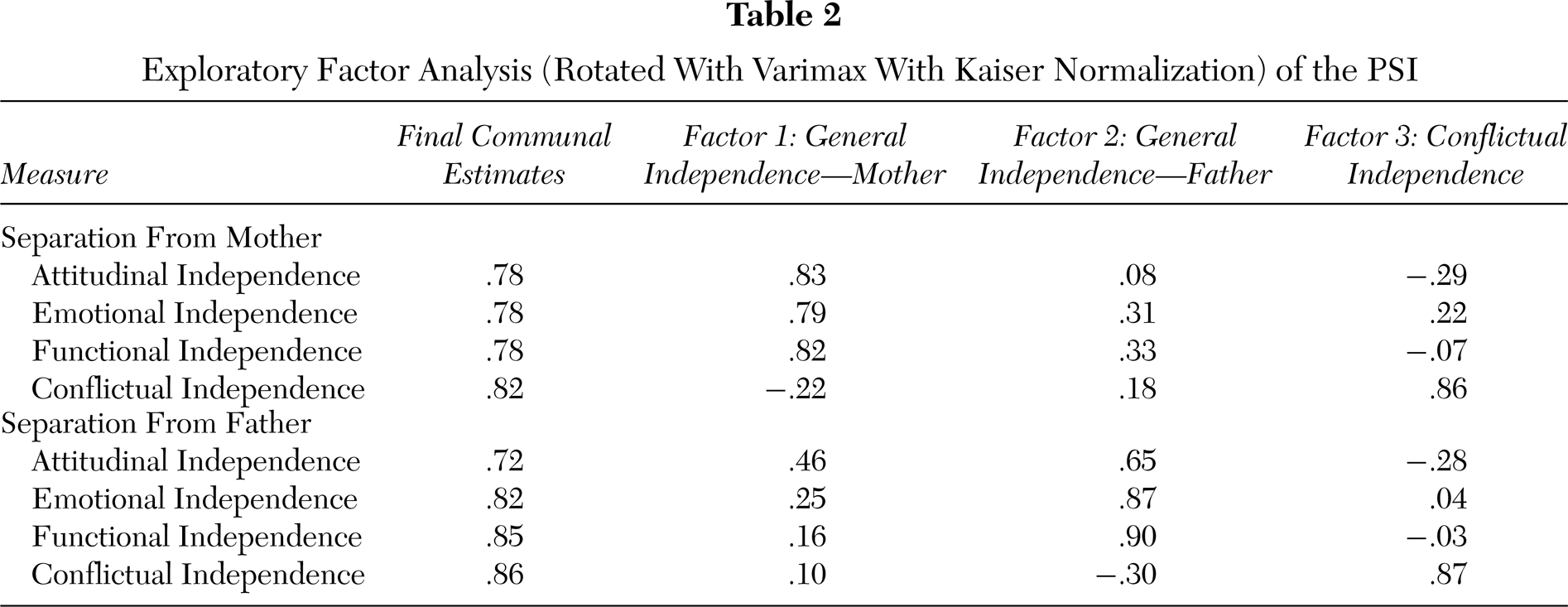
Examination of the means indicated that the women in this sample were only slightly separated from their parents. Specifically, they reported that items describing conflictual independence from their parents were “moderately true” and items describing attitudinal, emotional, and functional independence from their parents were “a little bit true.” In other words, on average, this sample appeared to feel generally free from anger, resentment, and guilt toward their parents regarding their emerging independence (conflictual independence). However, they remained connected to their parents with regard to relying on them for assistance with practical matters (functional independence); sharing similar values and attitudes (attitudinal independence); and needing approval, closeness, and emotional support from parents (emotional independence). Overall, scores for this sample were similar to those reported by a previous sample of young women (O'Brien, Friedman, Tipton, & Linn, 2000).
By examining the distribution of scores, we determined tha tall of the scales were normally distributed except for the Depression and Ethnic Jewish identity scales (the kurtosis was above 2 for both scales). The skewed Ethnic Jewish identity scale was transformed using a natural logarithm, and the revised scores were used for the main analyses, including the two-tailed Pearson product-moment correlation analyses and multiple regression analyses. Overall, the women in this study reported, on average, moderate levels of religious and high levels of ethnic Jewish identity, which is comparable to previous samples of Jewish women(Reach, 1993).
The non-normal distribution of the Depression scale was addressed by creating a composite measure of psychological distress, which generated a normal distribution of scores. Specifically, because the high positive intercorrelations among the four dependent variables (ranging from .66 to .74, p < .01) increase the likelihood of multicollinarity when calculating a multiple regression analysis, the mean score of the College Adjustment Scales (Anxiety, Depression, Interpersonal Problems, and Self-Esteem Problems) was used to construct a new composite scale, “Psychological Distress.” The item mean of the combined distress scale demonstrated that participants, on average, reported healthy psychological functioning and endorsed few symptoms of distress (see Table 1). Specifically, the women in this sample reported that the items describing interpersonal problems and self-esteem problems as well as the physical and psychological symptoms of depression and anxiety were “slightly true.” Moreover, the participants' scores were comparable to the scores of healthy college students (Anton & Reed, 1991).
Summary of Hierarchical Regression Analysis Predicting Psychological Distress
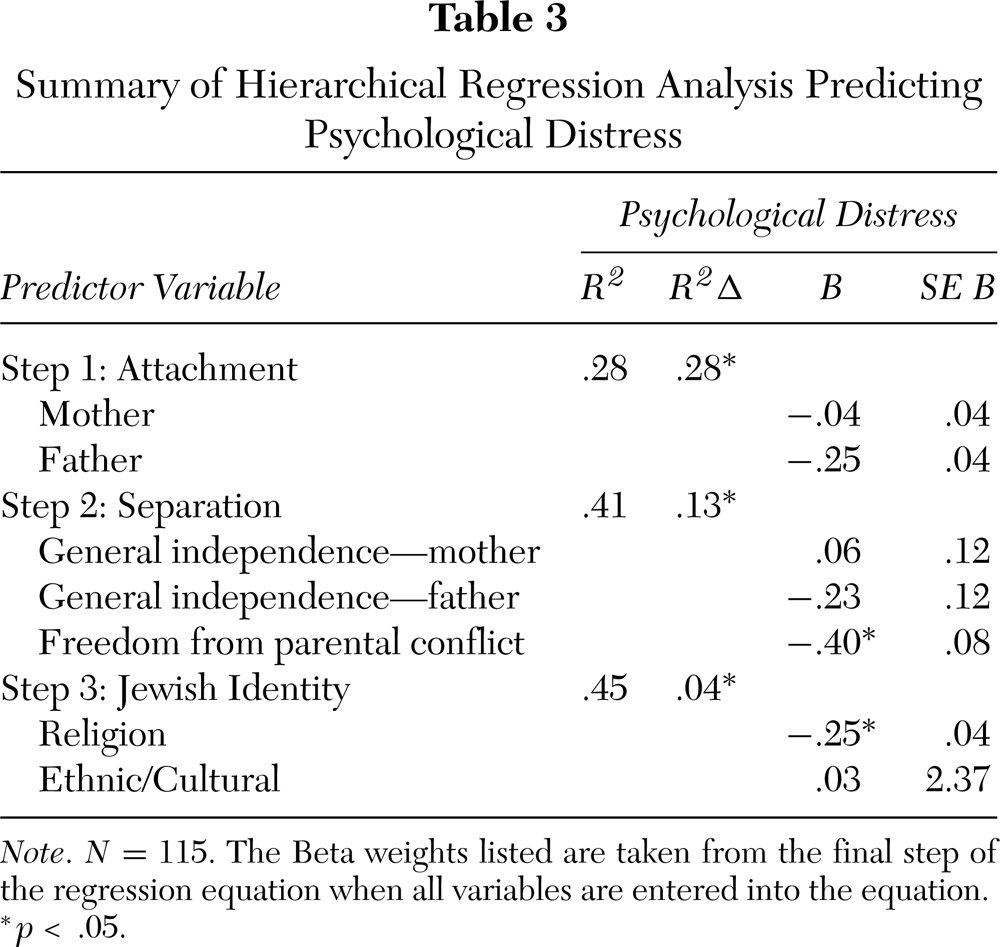
Note. N = 115. The Beta weights listed are taken from the final step of the regression equation when all variables are entered into the equation.
∗ p < .05.
Main Analysis
The intercorrelations of all measures, including the newly formed scales, were calculated using the two-tailed Pearson product-moment correlation analyses (see Table 1). Multiple regression analysis was calculated to examine the hypothesis by entering the attachment variables (maternal and paternal) as the first block, followed by the separation variables (maternal and paternal general independence as well as parental conflictual independence), and then the Jewish identity variables (religious and ethnic/cultural identity). Entering the variables in this order was based on previous research demonstrating that attachment precedes separation (Mattanah et al., 2004) and that the process of attaching to and separating from parents contributes to identity development (Josselson, 1988).
Collectively, parental attachment, separation, and Jewish identity accounted for 45% of the total variance in distress (see Table 3). Parental attachment accounted for 28% of the variance in psychological distress while separation accounted for 13% of the variance over and above parental attachment. Jewish identity accounted for 4% of the variance over and above the previously entered variables. Additionally, when examining the independent contributions of the variables, conflictual independence from parents and religious Jewish identity were significant predictors of psychological distress.
DISCUSSION
Collectively, parental attachment, separation, and Jewish identity accounted for robust levels of variance in psychological functioning among late adolescent Jewish women. Overall, these results were consistent with previous empirical research on contemporary models of female adolescence (Jordan, Kaplan, Miller, Stiver, & Surrey, 1991) and with literature that suggested balancing autonomy with related-ness and embracing a Jewish identity were contributors to well-being (Goldberg, 1986; Klein, 1980).
The Role of Parental Attachment in Predicting Psychological Distress
As hypothesized, attachment explained variance in Jewish women's psychological functioning. Jewish women in this sample reported a moderate negative relation between parental attachment and psychological distress, which suggested that Jewish women who had close relationships with their parents (characterized by mutual trust, effective communication, and little anger and alienation) evidenced low levels of anxiety, depression, self-esteem problems, and interpersonal problems. This finding is consistent with the empirical research documenting attachment patterns: specifically, previous researchers have found a moderate negative association between attachment and anxiety, depression, and self-confidence for late adolescents (Lopez et al., 2001; Vivona, 2000). Similar to other groups of late adolescents, it is likely that Jewish women whose parents provided a secure base may have felt confident in dealing with stressors and as a result envisioned themselves as capable of coping with challenges, and acted effectively to minimize anxiety and depression. Alternatively, Jewish women who were attached to their parents may have sought and received their parents' support and assistance when they encountered difficulties or personal struggles.
Bowlby (1988) hypothesized that consistent caretaking contributes to the development of positive internal working models characterized by a coherent sense of self, a belief that one is worthy of satisfying relationships, and trust in one's ability to sustain relationships. It is possible that Jewish women who had a strong attachment to their parents internalized healthy levels of self-esteem and the belief that others were dependable and that relationships were enhancing. Individuals with these beliefs are probably unlikely to experience serious psychological distress and more likely to develop healthy relationships with others. Because correlational analyses do not allow for the determination of causality, an alternative interpretation of these data is that women who experienced symptoms of anxiety, depression, self-esteem problems, or interpersonal problems may have been unable to fully participate in healthy relationships with their parents, which may have contributed to their parents' withdrawal, inability to provide consistent care, or low levels of attachment.
Finally, recent research has suggested that the relation between attachment and psychological functioning may be mediated by coping style (Lopez et al., 2001) or self-regulatory mechanisms (Lopez, Mitchell, & Gormley, 2002). Most notably, Mattanah and his colleagues (2004) found that the relation between attachment and adjustment to college was mediated by feelings about separation such that secure attachment leads to less anxiety about individuating and, in turn, to higher levels of functioning in late adolescence. Our study of the role of attachment in Jewish women's distress did not investigate the presence of mediators. Future researchers studying Jewish women's development should examine whether these potential mediators account for additional variance in psychological functioning.
The Role of Parental Separation in Predicting Psychological Distress
The process of separating from parents emerged as an important predictor of anxiety, depression, interpersonal problems, and self-esteem problems, with conflictual independence from parents contributing unique variance to the prediction of distress. In particular, Jewish women who were free of anger, hurt, and blame toward their parents were less likely to report symptoms of anxiety, depression, and problems with self-esteem and interpersonal relationships. These findings were consistent with previous studies by researchers who found that being able to resolve conflict with parents was an important element in female adolescent psychological functioning (Kenny & Donaldson, 1992). Specifically, Kaplan (1991) noted that college women seek to amend conflict with their mothers and that working through conflicts with their mothers may be a meaningful way for daughters to maintain engagement as well as build competencies. Finally, Jenkins, Goodness, and Buhrmester (2002) found that daughters who experienced grave conflict with their parents reported symptoms of depression, particularly daughters who encountered disagreement and quarrels with their fathers.
Taken in combination with the attachment findings (and consistent with previous literature, e.g., Kenny & Donaldson, 1992), Jewish women in this study who evidenced close attachment relationships with their parents, were separated from their parents, and were particularly free from negative affect toward their parents demonstrated low levels of psychological distress. It is important to note that for this sample of Jewish women, there was a slight trend (although not significant) between father/daughter relationship and psychological functioning such that attachment to and separation (attitudinal, emotional, and functional) from father approached significance in the multiple regression analysis. Because the previous attachment and separation literature does not provide support for the conclusion that paternal relationships are more strongly associated with daughters' well-being than maternal relationships, our finding may be spurious. However, should this trend be replicated and emerge as significant in future studies, it may suggest that balancing a strong attachment to fathers while separating from fathers serves as a buffer against psychological distress for late adolescent Jewish women. Furthermore, the importance of a healthy father/daughter relationship may stem from the historical power that fathers hold in society and Jewish families. Specifically, Jewish women who establish a healthy connection with their fathers may be afforded the opportunity to cultivate a sense of agency and power in the world and, in turn, develop psychological well-being.
Finally, further research is needed to understand other variables that may be important to the association between separating from parents and healthy development during adolescence. For example, following the work of Lapsley and Edgerton (2002), future studies may examine whether symptoms of dysfunctional separation (difficulty differentiating from others and splitting of self and others into representations of “good” and “bad”) may complicate a Jewish daughter's struggle to balance connection and separation and may account for some of the variance in psychological health.
The Role of Jewish Identity in Predicting Psychological Distress
Collectively, ethnic/cultural and religious Jewish identity contributed a small proportion of variance to the prediction of psychological functioning. However, religious Jewish identity emerged as a significant unique predictor. It may be that identifying as part of a religious Jewish community assists young Jewish women in coping with the potentially anxiety-provoking experiences of college and serves as a protection against depression. Additionally, practicing Jewish religious traditions and values that espouse that each person has unique and special qualities and reinforce building and maintaining relationships (e.g., one is expected to ask for forgiveness and forgive others during the holiday of Yom Kippur) may foster a young Jewish woman's self-esteem and ability to relate to others. Conversely, the Jewish women who are not feeling psychologically distressed, may have more opportunity and emotional capacity to actively engage in Jewish religious activities.
Although the finding that religious Jewish identity accounted for variance in Jewish women's psychological health was small, the relation among these variables was positive. This finding is contrary to Klein's (1980) conclusion that religious Jewish identification was associated with high levels of psychological distress. Klein attributed the distress among women who reported high religious Jewish identification to the denigration of women within Judaism. Thus, it may be that the growing inclusion of women in contemporary Judaism (i.e., the recognition of matriarch figures and women's leadership role in religious institutions) contributes to psychological well-being of young Jewish women. Furthermore, it is possible that establishing a sense of connection with other Jews through religious rituals, seeking solace through a relationship with God, and using the principles of the Torah assist young women in coping with the developmental tasks and challenges of late adolescence.
Because only two dimensions of Jewish identity (religious and ethnic/cultural) were measured in this study, researchers should examine the impact other facets of Jewish identity (e.g., sense of peoplehood, values, internalized anti-Semitism) have on Jewish women's psychological functioning. Furthermore, the methodology implemented in this study captures Jewish identity at one point in time. Thus, an area for future research may be to assess the development of Jewish identity at several points in adolescence and adulthood as a means of better understanding its confluence with mental health.
Limitations of the Study
First, the Jewish women who participated in this study were psychologically healthy, moderately attached to and separated from parents, financially stable, and in college. These findings cannot be generalized to other groups of women, and the results must be replicated prior to the development of clinical interventions. Additionally, the majority of the participants came from intact families. Because researchers have documented that marital conflict directly impacts adolescent adjustment, with adolescents from high-conflict homes demonstrating more difficulty adjusting (Turner & Barrett, 1998), research is needed to determine how marital conflict and divorce may influence the psychological health of Jewish women. Moreover, the use of self-report measures always introduces the possibility of respondents answering in a socially desirable manner, especially because items assessed sensitive topics (i.e., relationships with parents and symptoms of distress). Thus, including measures that identify social desirability tendencies may strengthen further research in this area.
Finally, additional work is needed to explicate the psychometric properties of the London Jewish Identity Questionnaire (London et al., 1988). The instrument was originally developed with a sample of high school students and later tested on a group of adults; thus, additional reliability and validity data for use of the measure with college women are needed.
Implications for Psychotherapy
Overall, these results inform practitioners that attachment to parents, separation from parents, and Jewish identity contribute to Jewish women's psychological health during late adolescence. Specifically, our research suggests that both attachment to and separation from parents, particularly being free of feeling intense resentment, anger, and guilt toward parents, are central to Jewish women's well-being. Within this context, clinicians working with adolescent Jewish women who experience anxiety, depression, or relationship and self-esteem problems may need to assess for the presence of these underlying factors, including an insecure parental attachment and conflict with parents regarding the separation process. These findings implied that therapeutic interventions aimed at providing Jewish female clients with opportunities to explore and mend their childhood and current relationships with their parents may serve as a buffer against anxiety and depression and assist in fostering self-esteem and positive relationships.
Should our results be replicated, based on the negative relations (although small) between Jewish identity and distress, it may be important for clinicians to assess for Jewish identity and attend to issues related to ethnic and religious identity development for Jewish women. Working with Jewish women regarding identity issues requires that therapists familiarize themselves with Jewish religious rituals and culture. This may be accomplished by using a consciousness-raising program developed by Kaye/Kantrowitz and Klepfisz (1986) to assist Jewish women in assessing knowledge of Jewish culture and their Jewish identity, and facilitating healing from internalized anti-Semitism. This program may be used by non-Jewish therapists to develop competence in providing culturally sensitive psychotherapy, an area needing attention in the counseling profession (see Weinrach, 2002).
To conclude, further research is needed to explicate the pathways of Jewish women's psychological development and construct a comprehensive understanding of the factors contributing to Jewish women's mental health. This program of research could assist clinicians in improving therapeutic interventions to this understudied population.