






Abstract
We compared the subtlety of four measures of sexism and sources of variation in male and female psychology students' judgments that beliefs from these scales and everyday behaviors were sexist. Participants judged traditional gender role and hostile sexist beliefs as more sexist than benevolent and modern sexist beliefs, indicating the latter were more subtle measures of sexism. Participants also judged traditional gender role behaviors as more sexist than unwanted sexual attention, suggesting the latter may less readily be identified as sexist. Variation in judgments of beliefs as sexist was related to differences in likelihood of endorsing such beliefs. This relation fully accounted for the tendency for men to be less likely to judge beliefs as sexist in comparison to women. Endorsement of Modern and Hostile Sexist beliefs was related to judgments of behaviors as sexist. The implications of the results for scale usage and identifying sexist behavior are discussed.
Societal changes and greater attention to sexism over the past few decades have resulted in greater sophistication about the complex ways in which sexism can be manifested as well as the consequences of sexism (McHugh & Frieze, 1997; Swim & Campbell, 2001). However, not all individuals may be aware of this complexity or agree with the characterization of certain beliefs and behaviors as being sexist. This variation in awareness and agreement can have methodological consequences in terms of the measurement of sexism as well as practical consequences in terms of the likelihood that people will consider behaviors as sexist (Inman & Baron, 1996). The present research examines variability in people's beliefs about the extent to which different types of beliefs and behaviors are considered sexist.
Over the last decade, a more diversified conceptualization of sexism has resulted in the development of scales that assess various types of sexism. Historically, measures of sexism assessed endorsement of traditional gender roles and stereotypes, with those who endorse traditional gender roles and stereotypes being labeled as more sexist than those not endorsing such beliefs. Yet, the tendency to endorse traditional gender roles has declined over the years (Spence & Hahn, 1997; Twenge, 1997), suggesting a need to develop the construct and measurement of sexism. Turning to the research on modern racism as a guide, Swim, Aiken, Hall, and Hunter (1995) and Tougas, Brown, Beaton, and Joly (1995) developed similar alternatives to traditional measures of sexism. Their Modern and Neo Sexism Scales, respectively, assessed doubts about the current prevalence of sexism, unfavorable responses to people who complained about sexism, and unfavorable responses to efforts to reduce sexism. Theoretically, these beliefs represent resistance to efforts to address sexism and a preference to maintain the status quo. Therefore, these scales were designed to indirectly assess preference for gender inequality and, hence, more subtly assess sexist beliefs.
Glick and Fiske (1996) developed another conceptualization of sexism, following research on ambivalent racism (Katz & Hass, 1988). They argued that there are positive and negative beliefs about women—benevolent sexist and hostile sexist beliefs—and characterized those who endorse both beliefs as ambivalent. Unlike pro-Black beliefs (the favorable component of ambivalent racist beliefs), benevolent sexist beliefs have positive characteristics only superficially. Benevolent sexist beliefs consist of endorsement of complementary gender differentiation, heterosexual intimacy, and paternalism that can lead to justification for men's social power over women, fear of the dependency that they might have on women, and perceptions of women as incompetent adults. The justification, fear of dependency, and perceptions of women as incompetent characterize hostile sexist beliefs. The Benevolent Sexism Scale was not designed as a subtle measure of sexism, but because the sexist statements can be interpreted as favorable to women, they may be considered a relatively subtle measure of sexism (cf. Kilianski & Rudman, 1998).
In the present study, we examined the extent to which women and men judge different gender-related beliefs to be sexist. Knowing the extent to which beliefs described in the various types of sexism scales are judged as sexist has important implications for the extent to which various scales measure subtle sexism. Although all explicit measures are subject to some social desirability effects, some scales might be less subject to these effects than others. Scales that describe beliefs that are less readily identified as sexist might be the least subject to social desirability because respondents might be less likely to avoid giving sexist answers on these scales.
We also examined judgments about the extent to which different behaviors are sexist. Understanding variations in the extent to which beliefs and behaviors are judged to be sexist has important implications for understanding which beliefs and behaviors are likely to be labeled as sexist in everyday life. With regard to behaviors, diary studies indicate that women experience sexist behaviors related to traditional gender roles (e.g., expectations about women's and men's behaviors, and expressions of traditional gender stereotypes) and gender harassment in the form of unwanted sexual attention (e.g., staring at body parts or unwanted sexual touching; Fitzgerald & Ormerod, 1993; Swim, Hyers, Cohen, & Ferguson, 2001). Gender harassment is similar to benevolent sexism because sexual attention can, at least on the surface, suggest positive evaluations of women's bodies or sexual attraction. Yet these evaluations also have a negative component in that they can be forms of sexual objectification that result in self-objectification, and women can experience them as possible threats of assault (American Association of University Women, 1993; Fredrickson & Roberts, 1997). Even so, people may be relatively more likely to identify traditional gender role behaviors as sexist than behaviors associated with gender harassment.
It is both theoretically and practically useful to understand sources of variation in judgments of sexism. We predicted that one's own endorsement of gender-related beliefs would relate to judgments of sexism. We anticipated this finding because people who endorse sexist beliefs would not want to see their own beliefs as sexist given the negative reactions from others associated with being prejudiced. That is, they may have internal or external motivations not to appear sexist (Plant & Devine, 1998). When gender differences in judgments of behaviors emerge, men are less likely to perceive sexism (e.g., Swim, Scott, Sechrist, Campbell, & Stangor, 2003). Therefore, we also predicted that men would be less likely than women to judge beliefs and behaviors as sexist. Furthermore, men may be less likely to label such beliefs as sexist because they are more likely to endorse sexist beliefs (Swim et al., 1995; Twenge, 1997). That is, we predicted that endorsement of beliefs would mediate the relation between gender and judgments of the beliefs as sexist.
We also explored whether endorsement of the different types of sexist beliefs is related to judging different sexist beliefs as sexist and judging everyday sexist behaviors as sexist. Because all the scales tap into some aspects of sexism, endorsement of any of the sexist beliefs may relate negatively to judging any type of sexist belief or behavior as sexist. However, some interesting differences might emerge. For instance, one aspect of benevolent sexism concerns the protection of women. Those who endorse benevolent sexist beliefs may be critical of sexist behaviors directed at women. As such, benevolent sexists may be more likely to perceive everyday sexist behaviors as sexist.
In sum, we predicted that (a) traditional gender roles and hostile sexist beliefs would be judged as more sexist than modern and benevolent sexist beliefs, (b) behaviors related to traditional gender roles would be judged as more sexist than behaviors related to unwanted sexual attention, (c) endorsed sexist beliefs would be less likely to be judged as sexist, and (d) men would be less likely than women to judge beliefs as sexist and this relation would be mediated by endorsement of the beliefs. Finally, we explored the relations between endorsement of the four types of sexist beliefs and judgments about the beliefs and behaviors.
METHOD
Participants
Fifty-six women and 41 men who participated in psychology group testing sessions were recruited to participate in the study. In exchange for completing the measures, they received credit in an introductory psychology course. Their introductory psychology course from which this sample was drawn comprised approximately 90% White/European Americans, 3% Latino/a Americans, 3% Black/African Americans, and 3% Asian Americans. About 90% of the students in this course were between the ages of 18 and 22 years old.
Procedure
As part of a psychology department group test, participants completed a packet of several questionnaires at home and returned them to their psychology class. Included in this packet were several measures of sexist beliefs. Several weeks later, participants rated the extent to which these beliefs were sexist and the extent to which several different types of behaviors were sexist. This second portion of the study was completed by participants in small group settings.
Measures
Measures of sexist beliefs.
Participants completed Spence, Helmreich, and Stapp's (1973) 15-item shortened version of the Attitudes Toward Women Scale (AWS; Cronbach's alpha = .91), Glick and Fiske's (1996) 11-item Hostile Sexism (Cronbach's alpha = .69) and 11-item Benevolent Sexism Scales (Cronbach's alpha = .74), and Swim et al.'s (1995) 8-item Modern Sexism Scale (Cronbach's alpha = .78). Participants rated their agreement with these beliefs on a scale ranging from 0 (strongly agree)to6(strongly disagree). Responses were coded such that higher scores indicated more endorsement of sexist beliefs.
Judgments of beliefs and behaviors.
Participants rated the extent to which the beliefs from each of the sexism scales were sexist on a 7-point scale ranging from 0 (not at all sex-ist)to6(very sexist). Participants also evaluated the extent to which 22 mundane behaviors were sexist and offensive on the same 7-point scale. 1 These behaviors were derived from diary studies in which college students reported their everyday experiences with sexism (Swim et al., 2001). Examples included treating individuals stereotypically or prejudicially (e.g., “Expressing disapproval for someone because he or she exhibited behavior inconsistent with stereotypes about his or her gender” or “Referring to someone with a demeaning or degrading label specific to his or her gender such as bitch, chick, bastard, faggot, etc.”); expressing stereotypes or prejudice against women (e.g., “Making stereotypical comments about women's traits, abilities, or preferences” or “Telling derogatory jokes about women”); and unwanted sexual attention (e.g., “One person staring or ogling at the body of another person whom they don't know well” or “Touching someone when it is inappropriate for the situation or relationship”). Oblique factor analyses confirmed that these behaviors represented traditional gender-role behaviors and unwanted sexual behaviors. All judgment measures had acceptable reliabilities: AWS (Cronbach alpha = .83), Hostile Sexism Scale (Cronbach alpha = .88), Benevolent Sexism Scale (Cronbach alpha = .82), Modern Sexism Scale (Cronbach alpha = .79), unwanted sexual attention (Cronbach alpha = .92), and traditional gender role behaviors (Cronbach alpha = .75). 2
RESULTS
We compared judgments of the beliefs from the four sexism scales and the two ratings of everyday sexist behaviors in a 6 (judgments) × 2 (participant gender) mixed-model analysis of variance (ANOVA). Participants differentially judged the six beliefs and behaviors as sexist, F(5, 475) = 85.67, p < .001, and men (M = 3.68, SD = .82) judged the beliefs and behaviors as less sexist than women did (M = 4.11, SD = .74), F(1, 95) = 7.25, p = .01. Bonferroni follow-up tests showed that each of the beliefs scales was judged as significantly differently sexist. The ordering of the judgments of sexist beliefs, from most to least sexist, was: traditional gender role beliefs from the AWS (M = 5.15, SD = .88), hostile sexist beliefs (M = 4.11, SD = 1.06), benevolent sexist beliefs (M = 3.63, SD = 1.18), and modern sexism beliefs (M = 2.67, SD = 1.43). Additionally, participants judged traditional gender role behaviors as more sexist (M = 4.56, SD = .77) than unwanted sexual attention (M = 3.44, SD = 1.48).
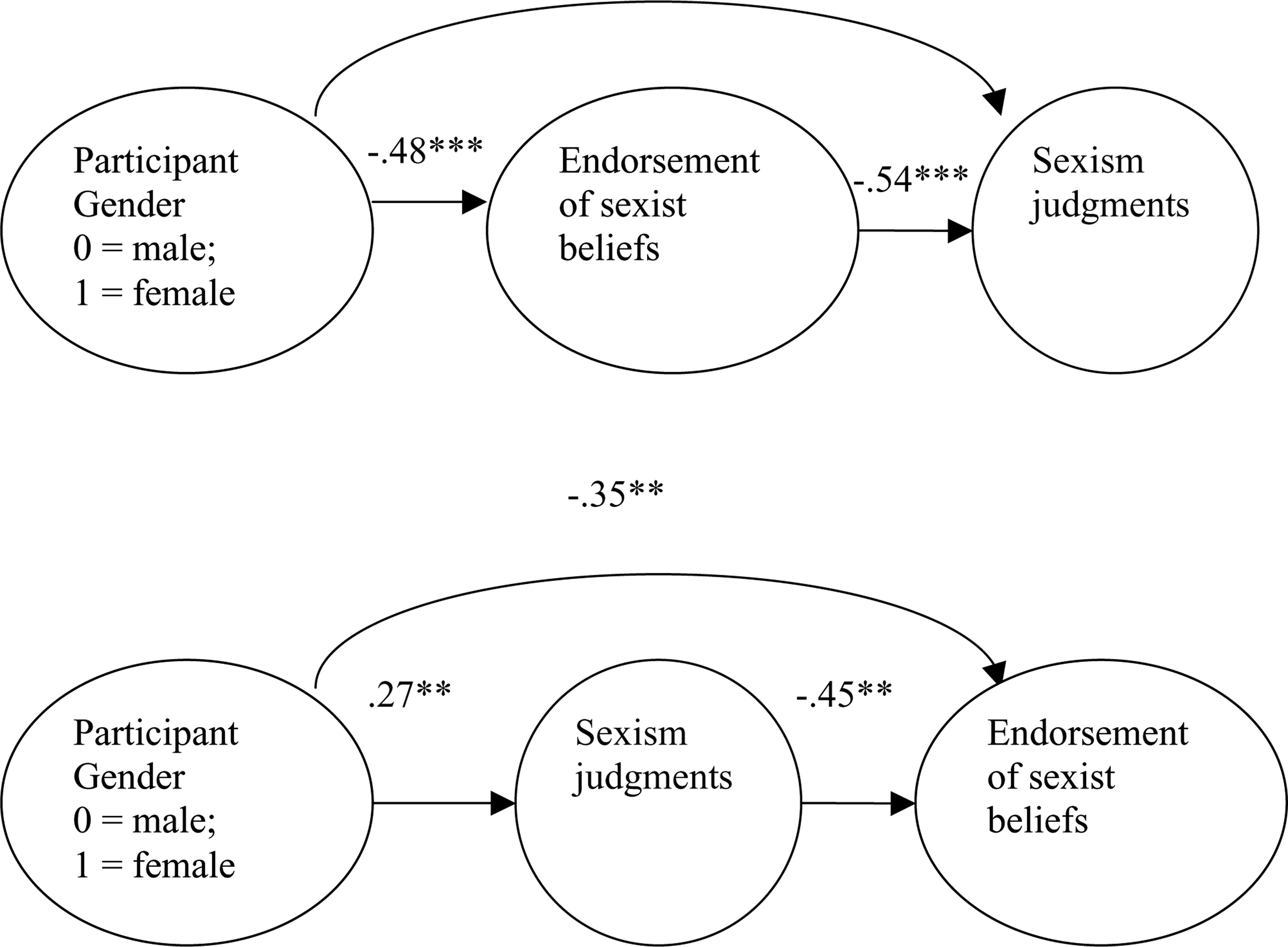
Standardized path coefficients for mediation models. Note. Model fit indices are the same for both models: χ2 (25) = 48.79, p < .001; Normed fit index = .98; Incremental fit index = .99; Tucker-Lewis = .98; Root mean square residual = .09 (lower value = .04 and upper value = .14). ** p < .01. *** p < .001.
To help explain gender differences in judgments of the sexist beliefs, we used structural equation modeling to test whether endorsement of sexist beliefs mediated the relation between gender and judgments of the beliefs (see Figure 1). The indicators for the latent construct of endorsement of sexist beliefs were endorsement of the four types of sexist beliefs and the indicator variables for the latent variable of judging the beliefs as sexist were judgments of each of the four types of beliefs. We also tested an alternative model with judgments of sexism as the mediator and endorsement of the beliefs as the endogenous variable. The Sobel test of the mediation effect was significant for the former, χ2 (1) = 2.54, p = .02, and not the latter model, χ2 (1) = 2.27, p = .15.
To obtain a better understanding of relations between endorsement of sexist beliefs and judgments of sexism, we correlated participants' endorsement of the beliefs with their judgments of the beliefs and behaviors, controlling for participant gender. In addition, because benevolent sexism and hostile sexism are highly correlated, r(88) = .65, p < .001, but distinct constructs, we followed procedures used by Glick and Fiske (1996), controlling for endorsement of hostile sexist beliefs when testing the relation between endorsement of benevolent sexist beliefs and these judgments and controlling for endorsement of benevolent sexist beliefs when testing the relation between endorsement of hostile sexist beliefs and these judgments. For the most part, endorsement of the different sexist beliefs was negatively related to judgments of the different beliefs and behaviors (see Table 1). However, there were some notable differences. First, there were differences in judgments of the behaviors. Endorsement of modern and hostile sexist beliefs but not benevolent sexist and traditional gender-role beliefs was related to judgments about unwanted sexual behavior. Endorsement of modern sexist, hostile sexist, and traditional gender-role beliefs but not benevolent sexist beliefs was related to judgments about traditional gender-role behaviors. It is interesting to note that endorsement of benevolent sexist beliefs, controlling for endorsement of hostile sexist beliefs, was the only measure that had positive correlations with any of the judgments. The correlation between endorsement of benevolent sexist beliefs and judgments about unwanted sexual attention was the strongest (albeit not significant). Second, the data indicate that the Hostile Sexism Scale was more closely related to judgments of sexism than was the Benevolent Sexism Scale. When controlling for endorsement of hostile sexist beliefs, endorsement of benevolent sexist beliefs was unrelated to judgments of the other beliefs and behaviors as sexist. In contrast, endorsement of hostile sexist beliefs was related to all the measures except judgments of traditional gender-roles and benevolent sexist beliefs when endorsements of benevolent sexist beliefs were controlled. Third, the entire Ambivalent Sexism Inventory was uncorrelated with judgments of sexism. The latter effect indicates that combining the two scales into one measure does not add anything over and above the effects for the separate scales. 3
DISCUSSION
Some researchers have questioned whether measures of subtle prejudice (such as modern racism and modern sexism) are actually subtle (e.g., Fazio, Jackson, Dunton, & Williams, 1995). However, the present research showed that participants judged traditional gender-role beliefs and hostile sexist beliefs as more sexist than benevolent and modern sexist beliefs. Because respondents were least likely to perceive the benevolent sexist and modern sexist beliefs to be sexist, our results suggest that the Modern and Benevolent Sexism Scales are relatively more subtle measures of sexism than the AWS and the Hostile Sexism Scale.
It should be kept in mind that these findings do not indicate that the Modern and Benevolent Sexism Scales are as subtle as some other measures, such as those based on reaction-time data. However, they are relatively more subtle than those based on traditional gender roles (i.e., AWS) and more obvious negative attitudes about women (i.e., Hostile Sexism Scale). The results also do not indicate that the AWS and the Hostile Sexism Scale do not measure sexism. Rather, the results indicate that researchers should recognize that respondents may be more aware that researchers are assessing sexist beliefs when using the AWS and the Hostile Sexism Scale than when they use the Modern and Benevolent Sexism Scales.
The findings also have relevance for understanding when people may identify themselves or others as targets of sexism. Past research indicates that people use prototypes when determining whether they have observed sexism and racism (Inman & Baron, 1996). Prototypical perpetrators (e.g., men) are more likely to be identified as sexist than nonprototypic perpetrators (e.g., women). Our results reveal that certain beliefs and behaviors are also more likely to be identified as more prototypically sexist than other beliefs and behaviors. Specifically, expressions of traditional gender-role and hostile sexist beliefs are more likely to be identified as sexist than expressions of modern and benevolent sexist beliefs. Similarly, everyday traditional gender-role behaviors are more likely to be identified as sexist than everyday unwanted sexual attention. Judgments that certain behaviors are sexist likely generalize to judgments that the person enacting the behaviors is sexist as well (Swim et al., 2003). This can explain Kilianski and Rudman's (1998) finding that women were more likely to perceive a man who stated hostile sexist beliefs to be sexist than a man who stated benevolent sexist beliefs. That is, the tendency to see hostile sexist beliefs as more prototypic of sexism than benevolent sexist beliefs is a likely reason for this effect on judgments of the person as sexist. These judgments could translate into judgments about one's own behaviors as well as judgments of others' behaviors.
Partial Correlations Between Endorsement of Beliefs and Judgments of Sexism Controlling for Participant Gender

Note. AWS = Attitudes toward Women Scale and ASI = Ambivalent Sexism Inventory (i.e., average of Benevolent and Hostile Sexism Scales). N = 85 with list wise deletion.
Partial correlations controlling for Hostile Sexism Scale and gender.
Partial correlations controlling for Benevolent Sexism Scale and gender.
Partial correlations controlling for Hostile and Benevolent Sexism Scale and gender.
p < .05.
p < .01.
p < .001.
The findings provide possible explanations for variations in judgments of sexism. Variations in judgments of beliefs as sexist were negatively related to one's own endorsement of the beliefs. Perhaps people do not define themselves as sexist and conclude that the beliefs must not be sexist because they endorse them. Alternatively, people may endorse the sexist beliefs because they do not see the beliefs as sexist. The mediation analyses suggest that the latter may explain gender differences in judgments of sexism. These analyses indicate that endorsement of sexist beliefs mediated the relation between gender and judgments of sexism. These analyses did not indicate that judgments of sexism mediated the relation between gender and endorsement of sexist beliefs. Although the data are correlational, this pattern supports the argument that one reason men are more reluctant than women to label beliefs as sexist is because men are more likely to agree with the beliefs. The data do not support the argument that men are more likely to endorse the beliefs because they do judge the beliefs as less sexist.
Variations in judgments of the behaviors, especially unwanted sexual attention, were more likely to be related to modern and hostile sexist beliefs than benevolent sexist or traditional gender-role beliefs. Perhaps those who endorse the latter beliefs tend to believe that treating women in a sexualized manner is inappropriate because it violates socially appropriate behavior, not because it is sexist. As such they are reluctant to give or to make judgments that indicate their approval of such behavior. Interestingly, the lack of a significant correlation indicates that this pattern of responses makes these individuals less distinguishable from those who do not endorse such beliefs.
In sum, the results from the present study indicate that sexist beliefs and various behaviors differ in the extent to which they are readily identified as sexist. These findings have implications for the measurement of these beliefs, especially in regard to which scales are more subtle measures of sexism. These findings also have potential implications for whether other people's and one's own comments and behaviors are judged as sexist and whether people are judged to be sexist. Finally, the correlations suggest that people may be reluctant to define their own beliefs as sexist. Men may be less likely to judge beliefs as sexist than women because they endorse them, and endorsement of modern and hostile sexist beliefs is a more consistent predictor of judgments of behaviors, especially unwanted sexual attention, as sexist than is endorsement of traditional gender-role beliefs and benevolent sexist beliefs. In general, the findings highlight the value of examining nuanced views of sexist beliefs and behaviors both for practical research purposes and for understanding when people will be more or less likely to identify beliefs and behaviors, and by inference, people as sexist.
NOTES
1. Four of the behaviors included references to gender stereotypes and could potentially create demand to label these behaviors as sexist. We reanalyzed the data excluding ratings of these four behaviors and the results were very similar. Only one difference emerged and it was not relevant to the hypotheses being tested. When these behaviors were excluded, the judgments of the traditional gender-role behaviors did not differ from judgments of the traditional gender-role beliefs. When they were included, the traditional gender-role behaviors were judged as less sexist than the traditional gender-role beliefs. Participants also rated four behaviors that targeted everyday discrimination against men. When these items were included in the scale construction, the results were virtually the same as those presented here.
2. Participants also judged how offensive the beliefs and behaviors were. Results for these judgments were very similar to ratings of sexism. These were included for a different purpose than presented in this article and are therefore not reported here.
3. We also used regressions to test for the unique effect of endorsing both benevolent and hostile sexist beliefs on judgments by entering the interaction between the two scales after entering the individual scale and participant gender in the equations. None of the interactions were significant.