







Abstract
This study examined relations between feminist identity development, gender-role orientation, and psychological well-being in 244 women of varying ages and backgrounds. As hypothesized, both feminist identity development and gender-role orientation contributed independently to the explanation of variance in psychological well-being. Instrumentality, expressiveness, and a more developed feminist identity were all related positively to psychological well-being. In addition, instrumentality and a more developed feminist identity were correlated positively. Implications of these findings as well as limitations and future directions are discussed.
Feminist theorists have often proposed that empowerment and solidarity among women, as well as the promotion of equality of the sexes, will lead to the advancement of the women's movement and better conditions for women (Harlan, 1998). Many feminist theorists believe that being feminist can improve women's lives by increasing awareness concerning the personal and social impact of a male-dominated culture. In turn, this awareness can lead women to better differentiate what is healthy from socially ingrained behavior, empowering women to have personal freedom and choice in regard to healthy life alternatives (Prochaska & Norcross, 1999). In this fashion, most feminists believe that a feminist identity is good for women, yet empirical evidence of such a relationship has been lacking.
Psychology's emphasis on women's issues and feminist concerns has led to research investigating the relationship between feminism and psychological distress (American Psychological Association, 1999; Enns, 1993; Meara, 1999). For example, research suggests a negative correlation between depression and exposure to feminist views (Mauthner, 1998; Weitz, 1982). Furthermore, most research suggests that women who adhere to a feminist ideology are more likely to have a positive or healthy body image and are less likely to exhibit eating disordered behavior (Snyder & Hasbrouch, 1996; Zone, 1998). Taken together, research and feminist theory imply that a feminist orientation or identity decreases features of psychological distress among women. However, this research and theory have been criticized for being mostly conceptual, anecdotal, or based on clinical case studies; as noted by Markson (1984) and Werner-Wilson, Zimmerman, Daniels, and Bowling (1999), there has been a lack of empirical research in this area.
The field of psychology has recently reemphasized the topic of positive psychology (see January 2000 and March 2001 issues of the American Psychologist). The positive psychology perspective emphasizes aspects of the human condition that make life worth living and help an individual feel happy and fulfilled (Seligman & Csikszentmihalyi, 2000). A part of the recent interest in positive psychology among mental health professionals has been an increase in attention to the concept of wellness. Psychological well-being includes feeling good about one's self and one's life, the sense that one is continuing to grow and develop as a person, the belief that life has meaning and purpose, having good relationships with others, the ability to manage life effectively, and a sense of self-determination (Ryff, 1995).
Much of the research on exposure to feminism or possession of a feminist identity investigates relations with aspects of positive functioning. For example, research suggests that women who have a feminist identity or who take a course on feminism are more likely to have a high or healthy self-esteem compared to women who are not feminist or who are not exposed to feminism in this way (Alyn & Becker, 1984; Ossana, Helms, & Leonard, 1992; Weitz, 1982). Additional research suggests that women who take a women's studies course on feminist theory or who participate in a feminist consciousness-raising group are more likely to experience enhanced self-confidence, increased assertiveness, and a higher internal locus of control than women who are not exposed to feminist views in these ways (Harris, Melaas, & Rodacker, 1999; Malkin & Stake, 2004; Stake & Rose, 1994). However, no published studies could be found that have examined the relationship between feminist identity development and a conceptually driven measure of psychological well-being.
According to Ryff (1989b), previous measures of psychological health have had little or no theoretical foundation and neglected possible components of psychological well-being. Ryff (1989a) reported that six dimensions of positive functioning have been mentioned repeatedly among psychologists throughout history and that these dimensions can be used to create a theoretical formulation of psychological well-being. These theory-guided dimensions include: (a) self-acceptance, (b) positive relations with others, (c) autonomy, (d) environmental mastery, (e) purpose in life, and (f) personal growth. Ryff (1989a, 1989b) stated that researchers who study psychological well-being suggest that a model including these six dimensions is an improvement over previous models of psychological well-being.
In addition to a lack of research investigating the relationship between feminist identity and a conceptually driven measure of well-being, previous studies investigating feminism and aspects of wellness have also neglected to include a discussion of gender-role orientation (the level of stereotypically masculine or feminine characteristics an individual possesses) in their research. This omission is important because studies suggest that having a feminist orientation or being a member of a feminist organization is positively related to a more androgynous or stereotypically masculine gender-role type (Baucom & Sanders, 1978; Jordan-Viola, Fassberg, & Viola, 1976; Peters & Cantrell, 1993). At the same time, both androgynous and traditionally masculine gender-role types have been shown to correlate with measures of psychological well-being (Castlebury & Durham, 1997; Lubinski, Tellegen, & Butcher, 1981; Stake, 1997; Taylor & Hall, 1982).
Thus, research indicates a relationship between feminist identity development and gender-role orientation, and between gender-role orientation and psychological well-being. However, several questions remain unanswered. For example, is it possible that feminist identity development is only related to psychological well-being because women who are more feminist tend to be more instrumental or androgynous than women who are not feminist? Conversely, is it possible that stereotypic masculinity and androgyny are only related to psychological well-being in women because women who are high in instrumentality are more likely to be feminist? To date, the relations between feminist identity development, gender-role orientation, and psychological well-being remain unclear. Therefore, the primary purpose of this study was to explore and clarify the relations between feminist identity development, gender-role orientation, and psychological well-being utilizing Ryff's (1989a, 1989b) conceptualization and measurement of psychological well-being.
To explore the relations between feminist identity development, gender-role orientation, and psychological well-being, we assessed the unique contributions made by feminist identity development and gender-role orientation in the prediction of psychological well-being. Regression analyses were conducted to determine the amount of unique variance associated with each set of variables. It was hypothesized that feminist identity development and gender-role orientation each would contribute variance above that contributed by the other. We anticipated that the relations between psychological well-being and both feminist identity development and gender-role orientation are not due solely to overlap in gender-role orientation and feminist identity development in women because correlations between feminist identity development and gender-role orientation are not so high as to suggest a large degree of overlap in the constructs. No hypothesis was made about which factor (feminist identity development or gender-role orientation) would contribute the most unique variance in psychological well-being.
Given that previous studies have demonstrated a correlation between exposure to feminism and a feminist identity with components of mental health (e.g., self-esteem), it was hypothesized that reporting a more developed feminist identity would be related positively to overall psychological well-being. In addition, because the literature suggests that feminism enhances self-confidence and assertiveness (Ossana et al., 1992; Stake & Rose, 1994; Weitz, 1982), it was hypothesized that a greater degree of feminist identity would be related to increased autonomy. Given research indicating that feminists have an enhanced sense of internal locus of control, and because feminist theorists view empowerment as an important component of feminism (Harlan, 1998; Harris et al., 1999), it was also hypothesized that an advanced feminist identity would be related to greater environmental mastery. Research also suggests that women have an increased sense of positive personal change after having taken a women's studies course (Stake & Rose, 1994), lending support to the hypothesis that a more developed feminist identity would be positively related to an orientation toward personal growth. Finally, given research linking exposure to feminism and feminist beliefs with a more healthy self-esteem (Ossana et al., 1992; Weitz, 1982), it was predicted that a stronger feminist identity would be related to enhanced self-acceptance. Although the feminist identity development literature did not support hypotheses related to the last two components of psychological well-being, purpose in life and positive relations with others, for exploratory purposes these components were also examined. It should be noted that the last five hypotheses are embedded in the overall relations between feminist identity development, gender-role orientation, and psychological well-being that are assessed under the first hypothesis.
Next, as other research suggests, it was hypothesized that differences in psychological well-being would exist among women with different gender-role types. For example, it seemed likely that women who were gender-role typed as stereotypically masculine or androgynous would exhibit significantly greater levels of psychological well-being than women who were typed as stereotypically feminine or undifferentiated (Bassoff & Glass, 1982; Lubinski et al., 1981; Spence, Helmreich, & Stapp, 1975). In addition, similar to previous findings (Baucom & Sanders, 1978; Peters & Cantrell, 1993), it was predicted that women with a more developed or advanced feminist identity would exhibit greater levels of instrumentality compared to women scoring highest in earlier stages of feminist identity development.
METHOD
Participants
A sample of 244 women affiliated with a university campus in the southwestern United States participated in this study. The ethnic breakdown of the sample was 57% European American; 13% African American; 11% Hispanic/Latina; 8% Asian American; 7% biracial, multiracial, or another ethnic background; and 4% Native American. About 27% of the sample was undergraduates, 27% was graduate students, 19% was faculty, and 26% was staff. Participants' ages ranged from 17 to 72 years, with a mean age of 33 years (SD = 13 years). Additional demographic information revealed that 40% of participants indicated a middle-class background, 16% were lower middle class, 20% working class, 21% upper middle class, and 2.7% upper class. About 46% of the sample was single, 39% married or partnered, 7% divorced, 4% cohabiting, and 3% “other.” Ninety-five percent identified as heterosexual, and the dominant religious affiliation was Protestant (50%).
Measures
Demographics. Demographic information was assessed with a short questionnaire. The questionnaire asked the participant's age, race/ethnicity, relationship status, affiliation with the university, self-perceived socioeconomic status, sexual orientation, and religious affiliation.
Psychological well-being. Ryff's (1989b) measure of psychological well-being was used in this study. This scale consists of 84 statements, each of which measures one of six dimensions (14 items per dimension) of psychological well-being: autonomy (being independent and able to resist social pressures; e.g., “I judge myself by what I think is important, not by the values of what others think is important”), environmental mastery (a sense of mastery and capability in managing the environment; e.g., “In general, I feel I am in charge of the situation in which I live”), personal growth (a feeling of continued development and change; e.g., “For me, life has been a continuous process of learning, changing, and growth”), positive relations with others (satisfying, warm, and trusting relationships with others; e.g., “Maintaining close relationships has been difficult and frustrating for me”), purpose in life (having goals in life and a sense of purpose; e.g., “Some people wander aimlessly through life, but I am not one of them”), and self-acceptance (a positive attitude toward the self; e.g., “When I look at the story of my life, I am pleased with how things have turned out”). Strength of agreement with each statement is indicated by responses on a 6-point Likert-type scale ranging from 1 (strongly disagree) to 5 (strongly agree). Higher mean sub-scale scores indicate higher self-ratings on the dimensions of psychological well-being. Mean scores on each dimension were summed to form an overall psychological well-being score, with a possible range of 6 to 36.
Ryff's (1989a, 1989b; Ryff & Keyes, 1995) articles indicate that her measure of psychological well-being has yielded encouraging psychometric properties. For example, internal consistency estimates for the subscales are all above .80. Confirmatory factor analysis lent support for Ryff's six-factor model, and further analysis suggested to Ryff that her six-factor model was an improvement over preceding models of psychological well-being. Additionally, the results indicated that Ryff's measure contained six factors that were a function of another latent construct, namely, psychological well-being. Reliability coefficients for this measure and the other main measures are presented in Table 1.
Feminist identity development. Level or degree of feminist identity development was measured by the Feminist Identity Composite scale (FIC; Fisher et al., 2000). The FIC consists of 33 statements designed to assess a person's acquisition of a positive feminist identity according to Downing and Roush's (1985) model of feminist identity development. Strength of agreement or disagreement with each statement was indicated by responses on a Likert-type scale ranging from 1 (strongly agree) to 5 (strongly disagree). Subscale scores were created by calculating means across items within each subscale. Higher mean scores for each subscale suggest a greater level of agreement with the analogous feminist identity stage of Downing and Roush's model. Subscale scores can be used as continuous variables or a person can be typed by identifying the subscale with the highest mean score.
The FIC consists of five subscales: (1) Passive Acceptance (seven items that reflect acceptance of traditional gender roles; e.g., “One thing I especially like about being a woman is that men will offer me their seat on a crowded bus or open doors for me because I am a woman”); (2) Revelation (eight items that examine a life event or crisis that leads an individual to question the benefit of traditional gender roles; e.g., “I feel angry when I think about the way I am treated by men and boys”); (3) Embeddedness-Emanation (four items marked by a feeling of connection with other women; e.g., “I am very interested in women writers”); (4) Synthesis (five items reflecting the development of a positive feminist identity; e.g., “I enjoy the pride and self-assurance that comes from being a strong female”); and (5) Active Commitment (nine items reflecting a commitment to social change and the belief that men and women are equals; e.g., “I am willing to make certain sacrifices to effect change in this society in order to create a nonsexist, peaceful place where all people have equal opportunities”). Because the first two subscales (Passive Acceptance and Revelation) are indicative of little or no feminist identity, these two subscales were expected to be related negatively to psychological well-being.
Correlations, Means, and Standard Deviations Among Primary Variables With Reliability Estimates (alpha) on the Diagonal.
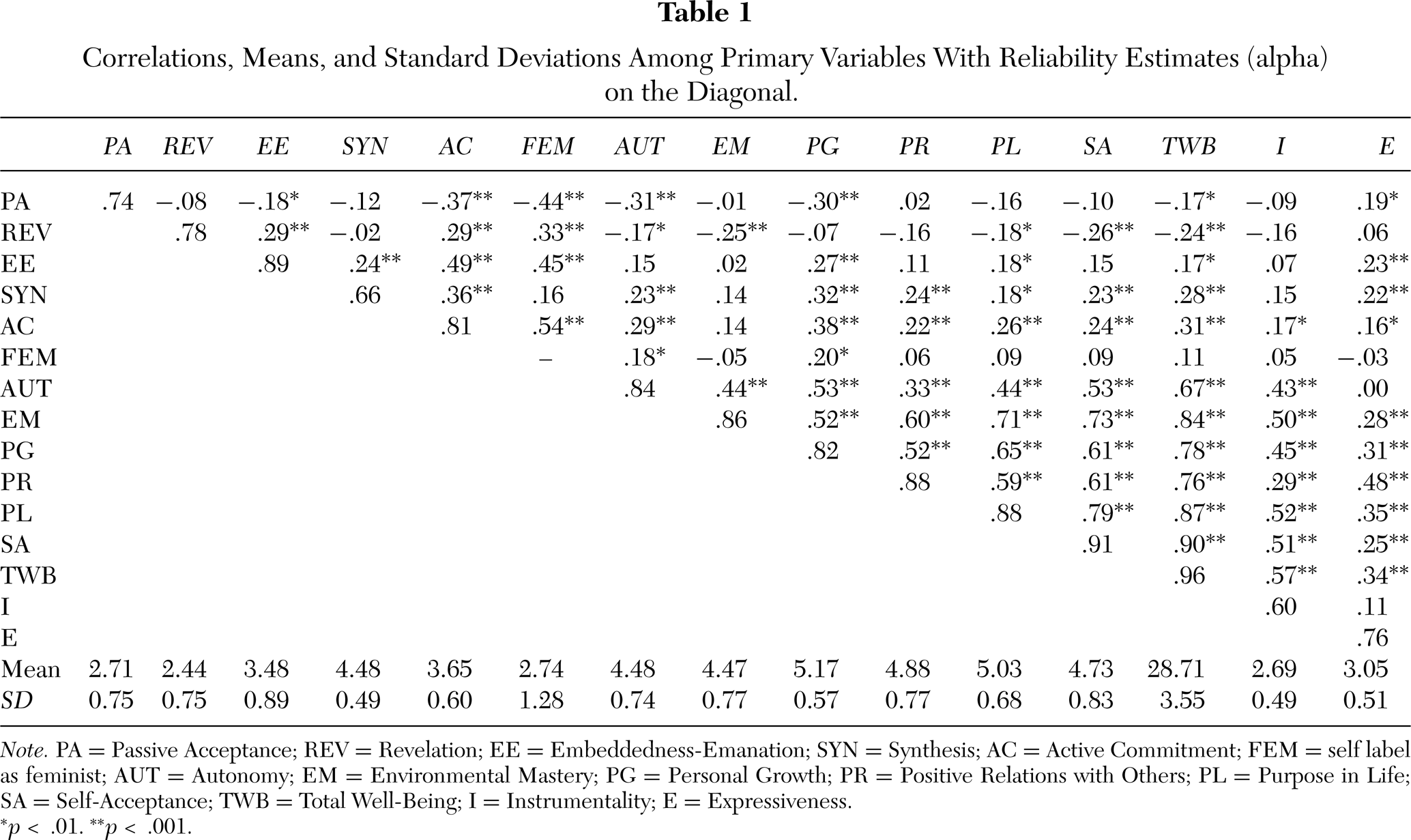
Note. PA = Passive Acceptance; REV = Revelation; EE = Embeddedness-Emanation; SYN = Synthesis; AC = Active Commitment; FEM = self label as feminist; AUT = Autonomy; EM = Environmental Mastery; PG = Personal Growth; PR = Positive Relations with Others; PL = Purpose in Life; SA = Self-Acceptance; TWB = Total Well-Being; I = Instrumentality; E = Expressiveness.
∗p < .01.
∗∗p < .001.
The FIC was derived from the Feminist Identity Scale (Rickard, 1989) and the Feminist Identity Development Scale (Bargad & Hyde, 1991). Fisher et al. (2000) reported alpha coefficients for the FIC ranging from .68 to .84 for each subscale. No test-retest reliability for the FIC was available. The Fisher et al. (2000) study also supported the measure's discriminant validity, and the use of structural equation modeling suggested the feminist identity subscales provided an “excellent” fit to the data (goodness of fit index = .96). Moradi and Subich (2002) reported that the FIC was an improvement over previous measures of feminist identity development due to its superior structural validity and internal consistency.
In addition, participants were asked: Do you consider yourself to be a feminist? Respondents answered using a Likert-type scale ranging from 1 (definitely not) to 5 (definitely yes).
Gender-role orientation. Gender-role orientation was assessed via the Personal Attributes Questionnaire-Short Form (PAQ; Spence & Helmreich, 1978). The PAQ-short form consists of 16 bipolar items (e.g., not at all independent—very independent) in which respondents rated personal characteristics on a 5-point scale ranging from A to E (coded as 0 to 4 in this study). There are two eight-item subscales, Instrumentality (I) and Expressiveness (E). The I subscale consists of instrumental traits considered to be more prevalent among males, and the E scale consists of expressive characteristics that are more common among females. All items are socially desirable for both sexes. Scores are averaged across subscales and range from 0 to 4; the higher the score, the more a respondent identifies as possessing the characteristics of that subscale. The two scales are then used to place individuals into one of four gender-role types: traditionally feminine, traditionally masculine, androgynous (high in both instrumental and expressive traits), or undifferentiated (low in both instrumental and expressive traits). Rather than using a median split in this study to form gender-role types, we used the top and bottom thirds of the distributions on the I and E scales to classify individuals with a gender-role type. Individuals (n = 74) who scored in the middle third of the distribution on the I and E scales were not assigned a gender-role type and were excluded from analyses examining gender-role type. For example, to be typed as stereotypically feminine, a participant would score in the top third of the E distribution (but not in the top third of the I distribution). In this fashion, respondents were classified as stereotypically masculine, stereotypically feminine, androgynous, or undifferentiated. This procedure was followed because the distribution of scores (although normal) on the PAQ scales was at the higher end of the possible range of scores. By creating groups that were more distinct from each other, we could ascertain whether differences in levels of stereotypic characteristics were associated with differences in psychological well-being and feminist identity development.
The PAQ has demonstrated internal consistency, with Cronbach alpha coefficients for the college population of .85 and .82 for the I and E subscales, respectively (Spence & Helmreich, 1978). The short version of the PAQ correlates higher than .90 with the original version of the PAQ. Moreover, a factor analysis by Spence and Helmreich (1979) produced two factors, Instrumentality and Expressiveness.
Procedure
Two approaches were used to recruit participants for this study. The first method involved sending questionnaires to female graduate students, faculty, and staff at a large southwestern university. Women were randomly selected within ethnic background groups (as identified by the university office of institutional research) to obtain an ethnically diverse sample. To increase the response rate, a prenotification letter was mailed approximately 2 weeks prior to mailing the questionnaire packet (Fox, Crask, & Kim, 1988). In addition, a follow-up letter was sent reminding potential participants of the importance of their participation. Using this method, 178 questionnaires (of 404 mailed) were returned, a response rate of 44%. Additional undergraduate participants (n = 67) were obtained through the subject pool of students enrolled in an introductory psychology class. Participants recruited in this fashion completed questionnaires in small groups and received course credit for their participation. All participants were asked to complete the questionnaires in the order presented, and the order of the questionnaires was counterbalanced, with the exception of the demographic sheet, which was presented first.
RESULTS
Prior to analysis, data were screened for missing values and violations of normality. One participant was dropped due to an unusual response pattern, resulting in a final sample size of 244. The average score of each question for all participants was calculated and used to replace missing data. Dummy variables were created to represent all levels of categorical demographic information.
In terms of level of self-reported feminism, 16.3% of participants stated that they definitely did not consider themselves a feminist, 36.3% of participants indicated that they probably did not consider themselves to be a feminist; 15.1% did not know or were unsure, 20.0% indicated that they probably were a feminist, and 11.4% stated that they definitely considered themselves to be a feminist. In regard to response patterns on the FIC, the majority of participants were typed as being in the Synthesis stage of feminist identity development (78.4%), with an additional 2.9% in the Passive Acceptance stage, 12.7% in the Embeddedness-Emanation stage, and 5.7% in the Active Commitment stage. No participants fell into the Revelation stage. The average score for total psychological well-being was 28.71 (SD = 3.55), which indicates relatively high psychological well-being. Participants scored relatively equally on all six subscales (see Table 1 for additional information). Mean scores on the PAQ indicated relatively high levels of self-reported instrumentality and expressiveness.
A correlation analysis was performed to examine whether any demographic variables were correlated with main variables of interest. Due to the high number of possible correlations (465), a correlation was considered to be significant when ρ was less than or equal to .001. There were two significant correlations that were directly related to one or more statistical analyses, age and married/partnered status. These two demographic variables were included in the statistical analyses as covariates when relevant. Correlations between the main variables in this study, as well as reliability coefficients, are presented in Table 1.
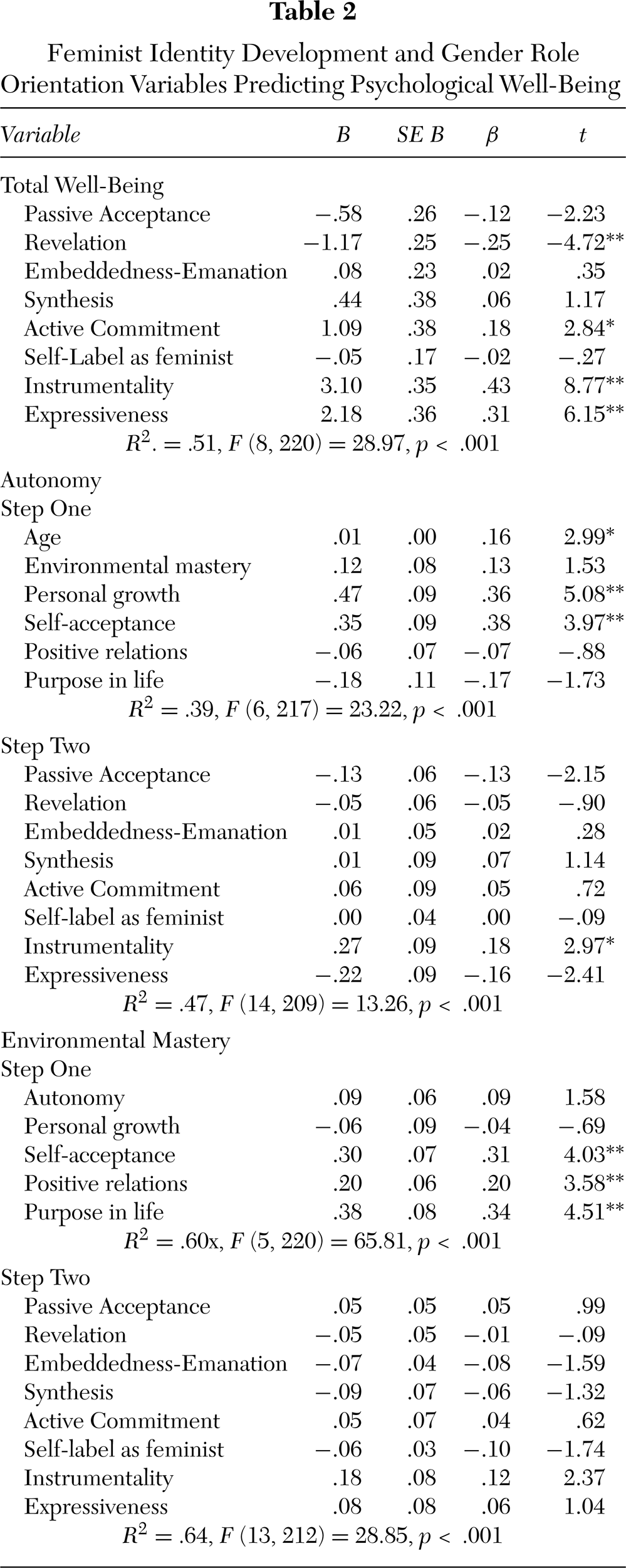
The primary purpose of this study was to investigate the relations between feminist identity development, gender-role orientation, and psychological well-being. Regression analyses were used to investigate the first six hypotheses. In the first set of these analyses, relevant demographic variables (if any) were entered in the first step, followed by scores on each individual subscale of the FIC and the item assessing self-identified feminism in the next step. I and E subscales scores were entered last. The second set of regressions was identical, save for reversing the order of entry of the I and E scores with the feminist identity development scores. A third set of regression analyses was conducted in which all of the feminist identity and gender-role orientation variables were entered simultaneously to provide information on the unique contribution to explained variance for each of the individual predictors, controlling for all other predictors. For all of these regression analyses, an alpha level of .01 was used to reduce the possibility of a Type I error. The results of the third set of analyses (with all variables entered simultaneously in the model) are presented in Table 2.
The first hypothesis proposed that feminist identity development and gender-role orientation would each account for unique variance beyond that accounted for by the other when predicting well-being. To test this hypothesis, we conducted the regressions noted above. Overall psychological well-being was examined first, followed by regressions examining each of the six dimensions of psychological well-being. For overall psychological well-being, the first hierarchical regression indicated that feminist identity variables accounted for approximately 24% of the variance in psychological well-being, R 2 = .24, F(6, 222) = 11.55, p <.001. In addition, self-described gender-role orientation accounted for an additional 28% of variance in the next step, R 2 change = .28, F change (2, 220) = 62.15, p <.001. A second regression with gender-role orientation scores entered before feminist identity scores revealed that the gender-role orientation variables accounted for 41% of the variance in total well-being in the first step, R 2 = .41, F(2, 226) = 78.36, p <.001. Feminist identity variables accounted for an additional 10% of the variance when added in step two, R 2 change = .10, F change (6, 220) = 7.79, p <.001. Thus, in support of the first hypothesis, both gender-role orientation and feminist identity development accounted for unique variance in psychological well-being. In the third regression, all the feminist identity and gender-role orientation variables were entered simultaneously (see Table 2). Lower scores on Revelation (a low level of feminist identity development) and higher scores on Active Commitment (reflecting the most developed level of feminist identity), as well as both Instrumentality and Expressiveness, predicted greater well-being.
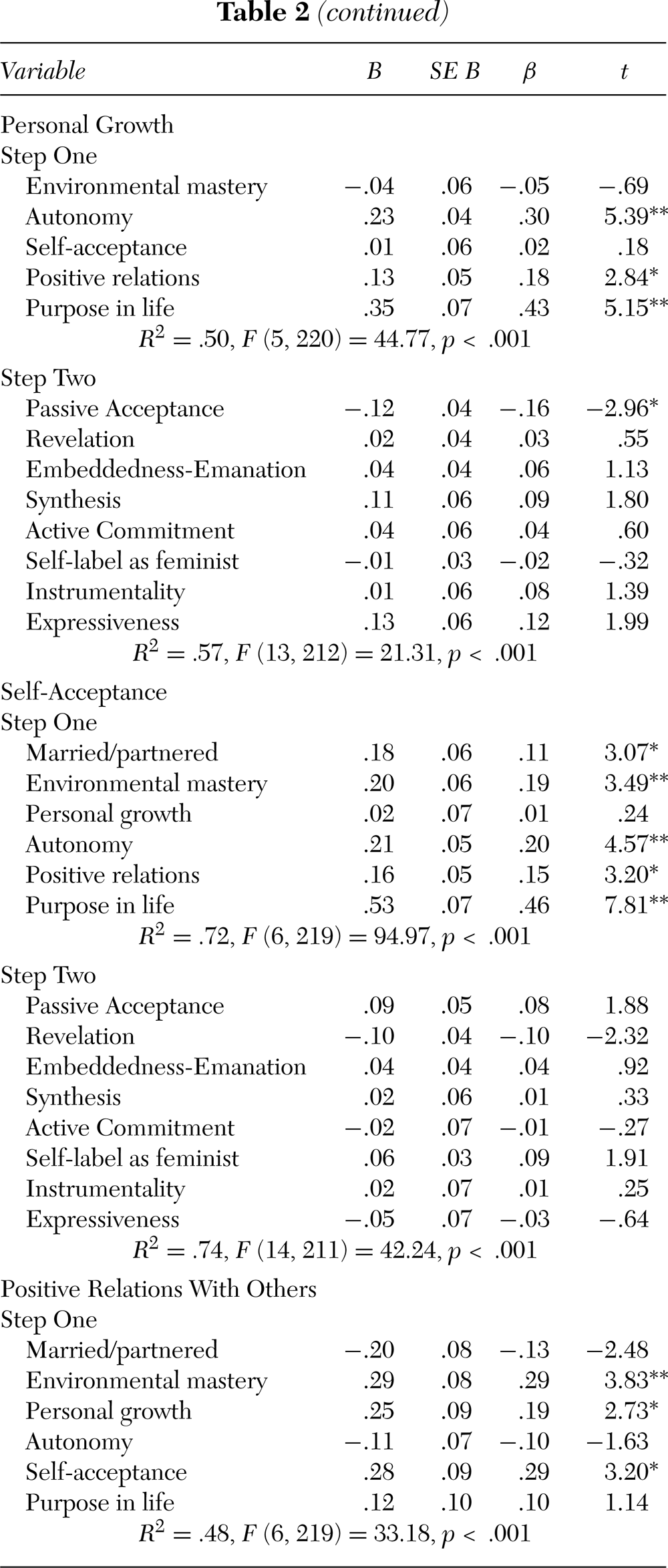
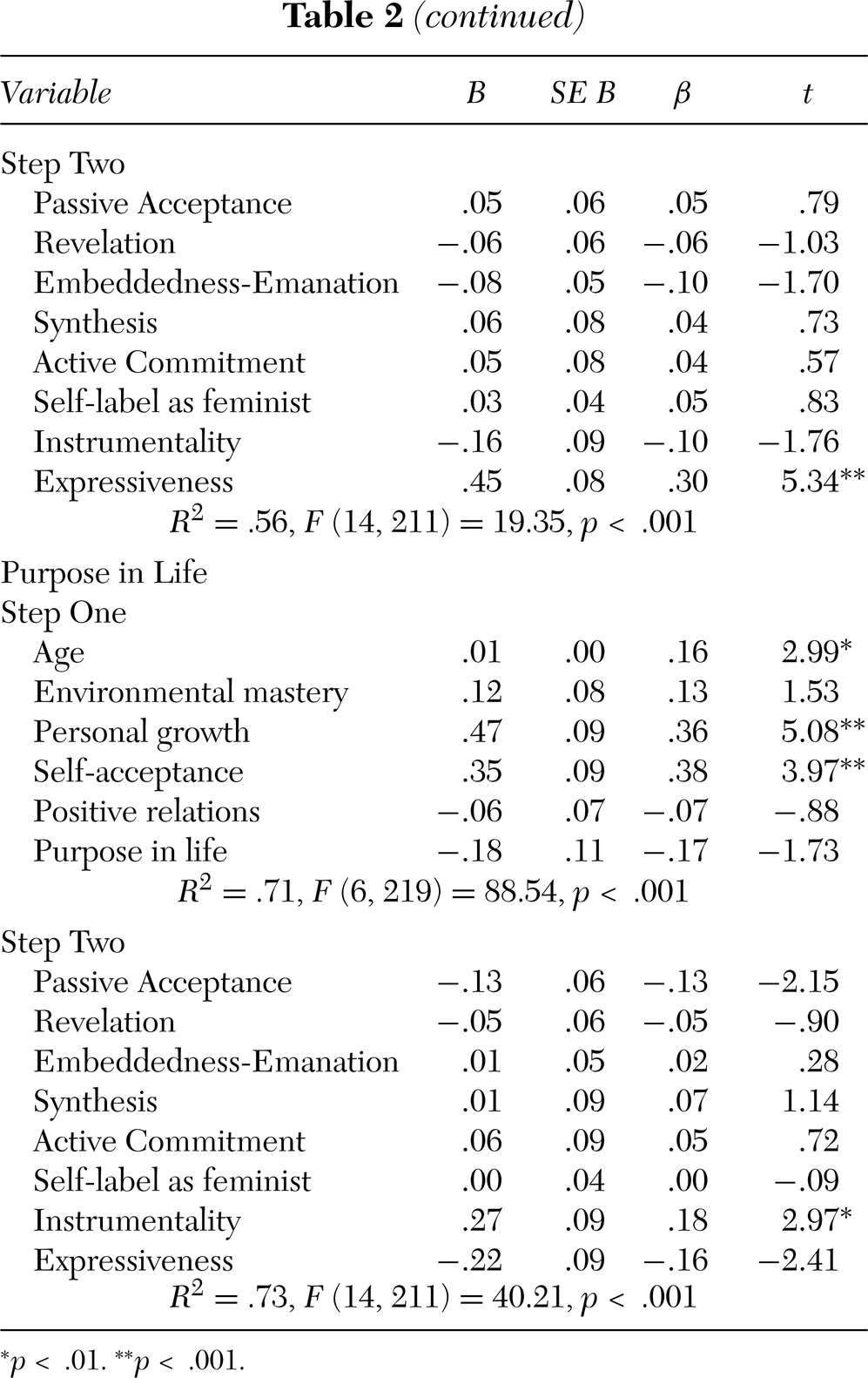
Feminist Identity Development and Gender Role Orientation Variables Predicting Psychological Well-Being
p <.01.
p < .001.
The second hypothesis predicted that a more advanced feminist identity would be positively related to overall psychological well-being. The hierarchical regressions conducted above supported this hypothesis (see Table 2). As noted, there was a positive association between Active Commitment subscale scores and overall psychological well-being. In addition, the finding that lower scores on Revelation are related to greater well-being provided indirect support for this hypothesis.
Turning to the individual dimensions of psychological well-being, for each hierarchical analysis the five dimensions of well-being that were not the dimension of interest were entered in the first step (along with any relevant demographic variables). This enabled us to control for the inter-correlated nature of the well-being scales and to analyze the unique variance associated with each well-being scale. To begin, a hierarchical regression analysis was conducted in which autonomy was used as the criterion variable; age and the five other well-being variables were entered in the first step followed by the feminist identity variables in the second step and PAQ scores in the last step. Age and the other well-being dimensions accounted for 39% of the variance in autonomy in step one, R 2 = .39, F(6, 217) = 23.22, p<.001. In the second step, the feminist identity variables accounted for 4% of the variance in autonomy, R 2 change = .04, F(6, 211) = 2.36, p <.03. In the last step, the gender-role orientation variables accounted for an additional 4% of variance, R 2 change = .04, F(2, 209) = 8.12, p <.001. The second regression analysis with gender-role orientation variables entered before the feminist identity variables indicated that the I and E scores accounted for 5% of variance in autonomy scores, R 2 change = .05, F change (2, 215) = 10.30, p <.001. The feminist identity variables entered in the third step did not account for a significant amount of variance. In the third regression (see Table 2), age and the other well-being dimensions were entered in the first step and the feminist identity development and gender-role orientation variables were entered simultaneously on the second step. Of these variables entered on the second step, only Instrumentality scores accounted for unique variance in autonomy, with higher scores on traditional masculinity associated with greater autonomy. Thus, the hypothesis that predicted that an advanced feminist identity would be related to higher autonomy was not supported.
Environmental mastery was used as a criterion variable in the next set of regression analyses. In the first regression, well-being subscale variables were entered in the first step, feminist identity variables in the second step, and gender-role variables in the third step. The five other well-being variables explained 60% of the variance in environmental mastery, R 2 = .60, F (5, 220) = 65.81, p <.001. Feminist identity development variables accounted for an additional 3% of the variance, R 2 = .03, F (6, 214) = 2.73, p <.01.
Adding the gender-role orientation variables in the third step accounted for a nonsignificant additional 1% of the variance in environmental mastery. A second regression, changing the order of variables entered, revealed that neither the I or E scores, nor the feminist identity development variables, accounted for significant amounts of the variance in environmental mastery. The third regression indicated (see Table 2) that although the set of feminist identity development and gender-role variables entered on the second step accounted for a significant (but small) amount of variance, none of the individual predictor variables were significant. Thus, the hypothesis that greater feminist identity development would be predictive of heightened environmental mastery was not supported.
The third dimension of psychological well-being, personal growth, was used as the criterion variable in the next three regressions. The other well-being variables accounted for 50% of the variance in personal growth, R 2 = .50, F(5, 220) = 44.77, p <.001. In the second step, feminist identity development variables accounted for an additional 5% of the variance in personal growth, R 2 change = .05, F(6, 214) = 4.06, p<.001. The gender-role variables entered in the third step did not account for significant additional variance. In the second regression, the I and E scores explained a nonsignificant 1.5% of the variance in personal growth, R 2 change = .02, F(2, 218) = 3.29, p <.04. Adding the feminist identity variables in the third step explained an additional 5% of the variance in personal growth, R 2 change = .05, F change (6, 212) = 3.88, p <.001. In the third regression, the gender-role orientation and feminist identity development variables, entered simultaneously in the second step, explained about 6% of unique variance in personal growth (see Table 2). It had been predicted that greater feminist identity development would be related to greater personal growth. Indicating indirect support of the hypothesis, Passive Acceptance predicted unique variance in personal growth. Individuals who scored high on Passive Acceptance (who therefore possessed little feminist identity) scored lower on the personal growth dimension of well-being.
Turning to the self-acceptance dimension of psychological well-being, the demographic and well-being variables entered in the first step accounted for 72% of the variance in self-acceptance, R 2 = .2, F(6, 219) = 94.97, p <.001. Neither the feminist identity variables, nor the gender-role variables, accounted for additional variance in self-acceptance. Reversing the entry order of the PAQ scores and feminist identity variables did not vary the findings significantly. Not surprisingly, the third regression showed that the feminist identity development and gender-role orientation variables (entered simultaneously in the second step) did not account for a significant portion of variance in self-acceptance. Therefore, the hypothesis that advanced feminist identity development would predict greater self-acceptance in women was not supported.
Although no hypotheses were put forward for the last two dimensions of psychological well-being, positive relations with others and purpose in life, regression analyses similar to those above were conducted for exploratory purposes. For the positive relations with others dimension, married/partnered status and the other well-being variables were entered in the first step of the first regression, feminist identity variables in the second step, and PAQ scores in the last step. The variables in step one accounted for 48% of the variance in positive relations with others, R 2 = .48, F (6, 219) = 33.18, p <.001. The feminist identity variables added in step two accounted for a nonsignificant 2% of the variance. In the last step, the gender-role orientation variables explained an additional 7% of the variance in positive relations with others, R 2 change = .07, F change (2, 211) = 17.04, p <.001. Reversing the order of entry in the second regression, the I and E scores accounted for 7% of the variance in positive relations with others, R 2 change = .07, F change (2, 217) = 17.98, p <.001. Adding the feminist identity variables explained a nonsignificant 1% of additional variance. For the third regression, after the demographic and well-being variables were entered in the first step, all of the feminist identity development and gender-role orientation variables were entered simultaneously in the second step. The results indicated that this second set of variables (see Table 2) accounted for a significant 9% of variance in positive relations with others. The significant individual predictor was Expressiveness, with higher scores on traditional stereotypic femininity associated with higher scores on positive relations with others.
Examining the purpose in life dimension, the first regression analysis was conducted with married/partnered status and other well-being variables entered in the first step, feminist identity variables in the second step, and PAQ scores in the last step. The variables in the first step accounted for 71% of the variance in purpose in life, R 2 = .71, F(6, 219) = 88.54, p <.001. The results from step two indicated that feminist identity development variables accounted for less than a nonsignificant 1% of the variance in purpose in life. The gender-role orientation variables entered in step three also explained only 1% of variance, which was nonsignificant. A second regression changing the order of predictors showed that I and E scores explained 1% of the variance in purpose in life, R 2 change = .01, F change (2, 217) = 3.96, p <.02. Similarly, the feminist identity development variables accounted for a nonsignificant 1% of variance. The third regression analysis (see Table 2) revealed that the feminist identity and gender-role orientation variables did not account for a significant amount of variance in purpose in life.
Another hypothesis predicted differences in total psychological well-being based on gender-role type. An analysis of variance (ANOVA) was used to test this hypothesis, with gender-role type (masculine, androgynous, feminine, undifferentiated) as the independent variable and total psychological well-being as the dependent variable. As noted above, gender-role types were created using the top and bottom thirds of the distributions on the I and E scales to create more distinct gender-role types, given the high overall scores on I and E. The ANOVA was significant, F(3, 160) = 18.16, p <.001, eta2 = .25. A post hoc (Tukey) comparison of means (see Table 3) revealed that women typed as undifferentiated scored lower on total psychological well-being than women typed as stereotypically feminine, stereotypically masculine, or androgynous. In addition, androgynous-typed women scored higher than stereotypically feminine-typed women on total psychological well-being.
Means and Standard Deviations for Psychological Well-Being by Gender Role Type
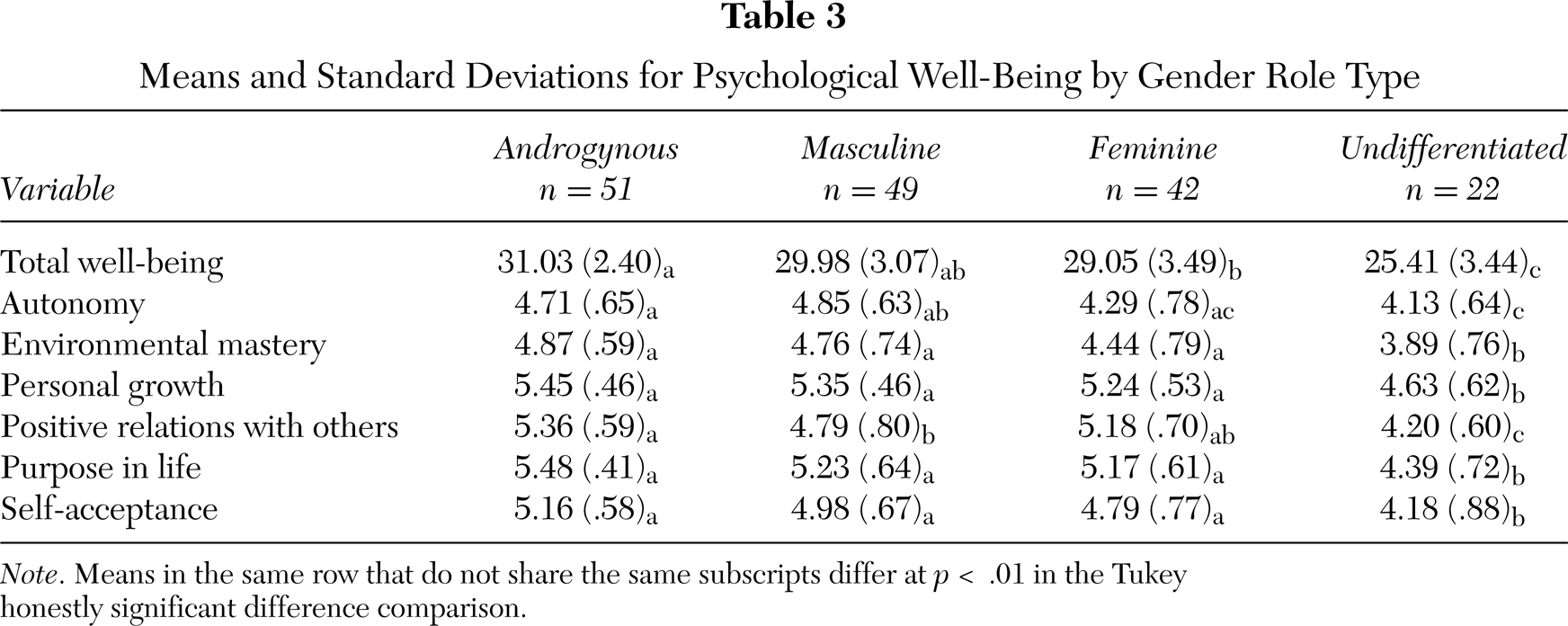
Note. Means in the same row that do not share the same subscripts differ at p <.01 in the Tukey honestly significant difference comparison.
To follow up the significant findings related to overall psychological well-being, differences between gender-role type and individual subscales of psychological well-being also were investigated using MANOVA with follow-up ANOVAs (see Table 3). Gender-role type was the independent variable, individual psychological well-being subscales were the dependent variables, and three demographic variables (age, married/partnered status, and staff status) correlated with one or more of the dependent variables were used as blocking variables (the only continuous variable, age, was converted to a categorical variable by tri-chotomizing the data). The MANOVA was significant, revealing a main effect for gender-role type, F(18, 360) = 3.41, p <.001, eta2 = .15. There were no significant main effects for any of the demographic variables or significant interactions between any of the demographic variables and gender-role type. Follow-up ANOVAs revealed significant main effects of gender-role type on all six subscales: autonomy, F(3, 123) = 6.39, p <.001, eta2 = .14; environmental mastery, F(3, 123) = 9.17, p <.001, eta2 = .18; personal growth, F(3, 123) = 11.62, p <.001, eta2 = .22; positive relations with others, F(3, 123) = 8.57, p <.001, eta2 = .17; purpose in life, F(3, 123) = 12.33, p <.001, eta2 = .23; and self-acceptance, F(3, 123) = 7.95, p<.001, eta2 = .16. Post hoc (Tukey) tests were conducted to determine the sources of the significant gender-role type effects. To reduce the threat of Type I error, a ρ value of .01 or less was required for significance. For autonomy, women typed as androgynous or stereotypically masculine scored higher than women typed as undifferentiated, and women typed as stereotypically masculine scored higher than women typed as stereotypically feminine. For environmental mastery, personal growth, purpose in life, self-acceptance, and positive relations with others, women typed as undifferentiated scored lower than women typed as stereotypically feminine, stereotypically masculine, or as androgynous. In addition, women typed as androgynous scored higher than women typed as stereotypically masculine on positive relations with others.
The last hypothesis pertained to differences between level of stereotypical masculinity and levels of feminist development. Specifically, this hypothesis stated that women with a more developed or advanced feminist identity would exhibit greater levels of stereotypic masculinity compared to women scoring highest in earlier stages of feminist identity development. However, because the distribution of women across levels of feminist identity development was uneven, with the majority of women in the Synthesis stage, an ANOVA could not be used to test this hypothesis. An examination of the correlations between scores on the five FIC subscales and Instrumentality (see Table 1) revealed one significant correlation: Women who scored higher on Active Commitment reported more instrumentality.
DISCUSSION
The primary purpose of this study was to investigate the relations among feminist identity development, gender-role orientation, and psychological well-being. The results indicated that both feminist identity development and gender-role orientation contributed uniquely to the explanation of variance in psychological well-being, suggesting that both factors are important in understanding the mental health of women. Indeed, both variables together accounted for over 50% of the variance in overall psychological well-being, an impressive finding. The results of this study clarify the relations among these variables, suggesting that feminist identity development is related to psychological well-being independent of gender-role orientation and not solely because feminist attitudes are correlated with more instrumental or androgynous gender-role orientations. Similarly, gender-role orientation (both instrumentality and expressiveness) is related to psychological well-being independent of feminist identity development and not just because women with an advanced feminist identity may be higher in instrumentality.
Regarding the relationship between feminism and psychological well-being, the results revealed that women who scored higher on more advanced stages of feminist identity reported higher levels of overall psychological well-being. In addition, women who scored higher on less developed stages of feminist identity reported less overall psychological well-being. It may be that women with a more advanced feminist identity are able to better differentiate between healthy behavior and socially ingrained behavior, empowering them to choose more beneficial life alternatives. Women with a more developed feminist identity may also experience an increased sense of solidarity among women and validation of their experiences as women, both of which may lead to improved mental health. On the other hand, women who score high on less developed stages of feminist identity may be more prone to engaging in socially approved behaviors that may not be beneficial for their mental health. More exploration of the relations between feminist identity development and specific behaviors that might affect psychological well-being is needed.
Examining psychological well-being in terms of individual subscales resulted in few significant findings. Much of the variance (often more than 50%) in each subscale overlapped with the other well-being subscales. Because part of that shared variance is associated with feminist identity development and gender-role orientation, the result is that the analyses underestimated the relations between the individual subscales of well-being and both feminist identity development and gender-role orientation. Thus, hypotheses related to more advanced levels of feminist identity development and higher levels of autonomy, environmental mastery, and self-acceptance were not supported. The hypothesis related to personal growth was indirectly supported, as women who scored high on lower levels of feminist identity reported less personal growth. Perhaps women who support traditional roles and expectations for women are less engaged in the process of personal development. If this finding is replicated with other samples, it will be important to examine this relationship longitudinally. For example, it may be that women who internalize societal messages about how women should be are less likely to engage in important processes related to personal growth and development. Conversely, women who are low in personal growth may be less likely to show interest in feminist principles.
The finding of a relationship between a more developed feminist identity and a heightened sense of overall psychological well-being is significant because feminist identity development measures were originally created to aid the counseling process and to assess the effectiveness of feminist therapy (Downing & Roush, 1985; Enns, 1993). Underlying the creation of these feminist identity development measures, and feminist psychotherapy in general, is the assumption that advancing a client's feminist identity development will improve the outcome of therapy. Surprisingly, however, this assumption has not been investigated empirically (Moradi, Subich, & Phillips, 2002). This study provides support for this assumption, albeit indirectly. If these results are replicated with other samples, they provide support for the use of feminist therapy to help women develop a heightened belief in feminist principles. Such changes might lead to improved psychological well-being for women. However, it is possible that greater well-being may lead to more feminist identity development, given the correlational nature of all findings thus far. Establishing whether well-being or feminist identity development comes first or whether the relationship is bidirectional has important implications for feminist therapy.
Participants' gender-role orientation strongly predicted their levels of psychological well-being, with higher scores on instrumentality and expressiveness predicting higher levels of overall psychological well-being. Thus, perceiving that one possesses positive stereotypic traits associated with males and females is related to perceiving that one has better psychological health. Indeed, gender-role orientation variables accounted for more unique variance in overall psychological well-being than the feminist identity development variables. One implication of these findings is that using feminist therapy to help women explore, and potentially broaden, their own perceived gender-role characteristics might result in better psychological well-being. Another explanation for these findings is that the masculine supremacy effect, in which our society values and rewards stereotypically masculine qualities, leads to increased happiness and hence a higher score on psychological well-being in women who see themselves as possessing these characteristics (Cook, 1990). However, such an explanation would only relate to the findings for traditional masculinity in this study. Finally, it is also possible that because instrumental behaviors tend to be viewed as more healthy (Cook, 1990), psychological well-being may be defined and measured in a way that is biased toward individuals who demonstrate these traits. Indeed, while the items on the measure of psychological well-being were much more specific than and did not overlap in wording with those on the PAQ, a few items assessed the same general area (e.g., confidence). Our findings that women who scored higher on Expressiveness had higher scores on positive relations with others and women who scored higher on Instrumentality had higher scores on autonomy support the notion that well-being may be defined in stereotypic ways. Further research in this area is needed.
The results of this study revealed that androgynous women scored significantly higher than women typed as stereotypically feminine on overall well-being. These results are consistent with previous findings (Bassoff & Glass, 1982; Lubinski et al., 1981; Spence et al., 1975) that women typed as androgynous or stereotypically masculine report greater psychological health than women typed as stereotypically feminine or undifferentiated. In addition, women in this study who were typed as undifferentiated scored lower than all other women on total psychological well-being and on four of the six individual dimensions of psychological well-being; undifferentiated women also scored lower than androgynous women and stereotypically masculine-typed women on autonomy and environmental mastery. Thus, perceiving oneself as lacking positive qualities associated with men or women was related to lower psychological well-being. It is not surprising that women who do not ascribe many positive qualities to themselves would report lower psychological well-being. Finally, androgynous women scored higher than women typed as stereotypically masculine on positive relations with others, suggesting that perceiving oneself as having both instrumental and expressive characteristics is related to feeling positive about the quality of relationships one has with others.
In line with expectations, women with a more developed feminist identity reported higher levels of instrumental characteristics. This result supported previous findings that women who were members of feminist organizations tended to self-report as more stereotypically masculine than women who were not feminist (Baucom & Sanders, 1978; Jordan-Viola et al., 1976; Peters & Cantrell, 1993). Although the correlation between feminist identity development and instrumentality is small, it suggests that women who have a more developed or advanced feminist identity may be less bound by cultural stereotypes regarding women. On the other hand, it is possible that women who do not identify with traditional stereotypes of femininity may be more likely to explore a feminist identity. Longitudinal research would be helpful in identifying the nature of the relationship between feminist identity development and instrumentality.
An interesting finding was that although many women indicated that they adhered to the ideals of a more advanced level of feminism (76% scored in the Synthesis stage and 6% scored in the Active Commitment stage), only 11% of participants indicated that they definitely considered themselves to be a feminist and 20% indicated they probably were feminists. This finding is similar to the results of related studies (Twenge & Zucker, 1999; Williams & Wittig, 1997) and suggests that women may be reluctant to self-identify as feminist, possibly due to fears of being negatively evaluated by others. As suggested by Renzetti (1987), it also is possible women may not view collective or overt feminist efforts as a useful way to resist personal difficulties related to gender. Finally, another possibility is that women are reluctant to identify themselves as feminist because most feminists and nonfeminists alike view the typical feminist as being more extreme in ideology than actually is the case (Liss, Hoffner, & Crawford, 2000). Therefore, women who score high in feminist identity development according to the FIC may not view their orientation to be similar to that of the “typical” feminist. Indeed, the items on the FIC measure feminist attitudes (beliefs in feminist goals) more so than they measure feminist identity.
Although an advanced level of feminism as measured by the FIC was related to a heightened sense of psychological well-being, level of self-identified feminism was correlated only with two subscales of psychological well-being (personal growth and autonomy) and was not a significant predictor of psychological well-being in any of the regression analyses. Thus, an advanced level of feminist development (or, more precisely, a stronger belief in the goals of feminism) appeared to be related to psychological well-being; however, a more explicit, self-reported adherence to feminism (i.e., feminist identity) was generally found not to be related to psychological well-being. As noted above, one possibility is that the self-label of feminist only captures a subset of individuals who believe in feminist principles. Thus, using the variable of self-identified feminist identity may not be helpful in understanding the relationship between feminist identity and psychological well-being. Perhaps outwardly labeling oneself as a feminist has negative consequences to one's psychological well-being that may counteract any positive effects of possessing a feminist orientation, given that many individuals view feminism or feminists in a negative light (Twenge & Zuker, 1999; Williams & Wittig, 1997). Hence, calling oneself a feminist may draw negative reactions and hardship from others. Another possibility is that having feminist attitudes may be significantly different from possessing a feminist identity. Finally, self-identified feminism was assessed with only one item, resulting in less power to predict variance compared to a multi-item scale. Perhaps use of a better measure of self-identified feminism would have resulted in more relations between self-identified feminism and psychological well-being.
The significant correlation between level of self-identified feminism and personal growth is consistent with findings from the FIC data discussed above and suggests that women who identify as feminist may experience an orientation toward continued development compared to women who do not identify themselves as feminist. Previous research supports this finding, as Stake and Rose (1994) reported that women who completed a women's studies course reported an increased sense of positive personal change and also experienced heightened self-confidence and assertiveness. Thus, feminist therapists who are focused on their own continued personal growth may be good role models for their clients.
Limitations
Although this study contained a large and relatively diverse sample size in terms of age and ethnicity, in addition to a sound response rate, there are also limitations to this research. All participants were affiliated with a university and were also residing in a conservative area of the southwestern United States. Therefore, the generalizability or external validity of this study is limited, especially when considering how a more conservative environment may affect women's responses to questions regarding feminist identity and gender-role orientation (Pair, 1994). Another limitation includes the use of self-report, nonexperimental data. Self-report data are always susceptible to distortion by participants through hypothesis guessing or general subject bias (Heppner, Kivlighan, & Wampold, 1992). Because all of the data collected were self-report, there is also the possibility of shared method variance artificially inflating the size of the relationships that were found. In addition, the lower internal consistencies of the I subscale and the Synthesis scale suggest that caution is warranted in interpreting the findings. Finally, as noted by Twenge (1999), the complexities of gender-role orientation are not assessed by scales such as the PAQ, which focus primarily on positive stereotypic characteristics associated with men and women.
Future Directions
This study investigated the relations between feminist identity development, gender-role orientation, and psychological well-being, and clearly, more research in this area is needed. Both the current study and past research indicate that gender-role orientation is related to psychological well-being. Findings from this study also suggest that a more advanced feminist identity is related to a heightened sense of psychological well-being. In addition, both feminist identity development and gender-role orientation contributed independently to the prediction of well-being. Women with a more advanced feminist identity appeared to be more likely to see themselves as possessing more instrumental characteristics, and additional research in this area is needed. In addition, the relations between feminist identity development and psychological well-being, and between feminist identity development and gender-role orientation could be further clarified by research utilizing a more regionally diverse sample. Research regarding the relations between feminist identity, gender-role orientation, and psychological well-being in men is also needed. Furthermore, these relationships may be illuminated by the use of multiple and varying measures of feminism or feminist identity. Similarly, feminist conceptions of well-being may not be adequately encompassed by mainstream measures of psychological well-being; use of measures of well-being that fully capture the various qualities associated with feminist definitions of well-being is needed. For example, Worell (2001) included qualities such as awareness of culture and its impact upon behavior in her conceptualization of feminist empowerment. Finally, given that there are diverse views and stereotypes about feminism, it would be useful if qualitative data were collected in future studies. Qualitative data may help clarify the relations between possessing a feminist identity and psychological well-being, why women are reluctant to self-identify as feminist, and how women tend to define the term feminist.