







Abstract
Gender-role conflict theory has suggested that women athletes will experience role conflict because they are attempting to enact both feminine and masculine gender roles, yet research findings have shown mixed support for this notion. The purpose of this study was to explore how women rugby players negotiate gender-role expectations and conflict as women participating in a traditionally masculine sport. Eleven Caucasian women, noncollege rugby players between the ages of 25 and 38 were interviewed. The results indicated that women rugby players perceived numerous discrepant gender-role expectations. In addition, three different types of gender-role conflict emerged; however, similar to previous findings, participants perceived conflicting expectations for their gender-role behavior more than they seemed to experience conflict about those expectations. Participants actively employed various strategies to resolve or avoid experiencing gender-role conflict. The resiliency displayed by the women athletes in coping with discrepant gender-role messages provides new considerations for gender-role conflict theory.
Women experience a number of advantages associated with participation in athletics, including increased self-esteem (Hall, Durborow, & Progen, 1986), athletic competence (Miller & Levy, 1996), body image (Miller & Levy, 1996), mental health (International Society of Sports Psychology [ISSP], 2000), and academic achievement (Hanson & Kraus, 1998). Although the number of women participating in sports has increased since the passage of Title IX (Acosta & Carpenter, 2004), women participate in sports with less frequency than men (Hanson & Kraus, 1998), and they participate in a limited range of sports (Matteo, 1986). Regardless of the benefits for women and girls who participate in sports, obstacles to participation in sports persist. The gender-role conflict theory has been debated as a pivotal obstacle to women in sports.
It has been suggested that participation in athletics violates ascribed gender roles for women (Desertrain & Weiss, 1988; Sage & Loudermilk, 1979). Gender-role conflict theory suggests that women who perceive contrasting expectations for their gender-role behavior will experience role conflict (Allison, 1991; Rohrbaugh, 1979; Sage & Loudermilk, 1979; Wetzig, 1990). Participation in sports is perceived to be a traditionally masculine activity, and women athletes are assumed to enact the masculine gender role when they pursue athletic activities (Desertrain & Weiss, 1988; Sage & Loudermilk, 1979). Given that women athletes are still expected to enact the socially ascribed feminine gender role, they are assumed to experience role conflict as a result of trying to fulfill both the masculine and feminine gender roles (Desertrain & Weiss, 1988; Rohrbaugh, 1979; Sage & Loudermilk, 1979; Wetzig, 1990). Gender-role conflict describes a woman's struggle with her self-concept as stemming from the discrepant expectations of masculine (athlete) and feminine (gender-role) behavior (Allison, 1991). Anthrop and Allison (1983) maintained that role conflict occurs when an individual cannot fulfill one or either role completely and is thus judged as inadequate by the dominant reference group.
This presumption of conflict for women athletes derives from a conceptualization of gender-role behavior as a bipolar dimension with masculinity and femininity as opposite poles on a continuum. This model suggests that masculine and feminine gender roles require opposite and conflicting behaviors (Bem, 1993). These traditional notions of gender-role behavior have contributed to the assumption that women athletes experience gender-role distress. Women's participation in sports is sometimes seen as a social “aberration,” and women athletes often are assumed to be homosexual because of their violation of traditional gender-role behavior (Disch & Kane, 2000, p. 127). Lenskyi (1999) suggested that some women athletes are in jeopardy of being victims of homophobic harassment because of a long-held cultural belief that women who play men's sports are “sexually suspect” (p. 172). Allison (1991) noted that gender-role conflict theory contributes to the traditional conceptualization of women athletes as stigmatized, conflicted, misplaced, or otherwise abnormal (Allison, 1991). Additionally, she argued that, despite insufficient evidence to support the belief that women athletes experience gender-role conflict, women athletes are still assumed to be abnormal or conflicted as a result of the persistence of traditional and rigid gender-role stereotypes.
Gender-Role Attitudes and Conflict
Research on gender-role expectations and conflict among women athletes has generally explored whether differences in gender-role orientation or gender-role conflict occur between women athletes and women nonathletes or between women athletes in more gender-traditional, socially approved sports (e.g., tennis, golf, swimming) and women in more gender-nontraditional or non-socially approved sports (e.g., rugby, basketball, track and field). The research findings suggest that women athletes differ from their nonathlete peers on their gender-role orientation. Women athletes tend to identify more highly with the masculine role (Hall et al., 1986; Lantz & Shroeder, 1999; Marsh & Jackson, 1986; Miller & Levy, 1996) than their nonathlete peers. Similarly, women athletes participating in gender nontraditional sports score higher on masculinity than women athletes participating in more traditionally feminine sports (Burke, 1986). Some research suggests that women athletes report lower levels of femininity compared to women nonathletes (Lantz & Shroeder, 1999; Miller & Levy, 1996), while other studies find no differences between women athletes and nonathletes or women participating in feminine or masculine sports on level of feminine gender-role orientation (Burke, 1986; Hall et al., 1986; Marsh & Jackson, 1986). Women athletes report more liberal or feminist gender-role attitudes than their nonathletic peers (Salisbury & Passer, 1982).
Research more clearly focused on gender-role conflict has not yielded definitive findings. Sage and Loudermilk (1979) compared women college athletes in traditionally feminine and masculine sports on the degree to which they perceived and experienced gender-role conflict. Perceived gender-role conflict refers to the “perception of conflicting expectations or orientations,” and experienced role conflict concerns “personally experienced role incompatibilities in enacting the roles of women/women athlete” (p. 91). In separating perceptions from experiences, the authors discriminated between the athlete's awareness of discrepant external gender-role expectations and the internal experience of conflict resulting from the violation of ascribed gender-role behavior. For the entire sample of women athletes, they found that 56% reported perceiving some gender-role conflict; however, only 44% of respondents reported experiencing some conflict. Women athletes in traditionally feminine sports did not differ significantly from those in masculine sports in the amount of perceived role conflict they reported (i.e., 57.2% of women athletes in traditionally feminine sports and 56.0% of women athletes in traditionally masculine sports reported perceiving conflict to a moderate, great, or very great degree). However, women athletes in masculine sports reported experiencing greater gender-role conflict (45.1% in masculine sports compared to 34.2% in feminine sports reported experiencing conflict to a moderate, great, or very great degree). Anthrop and Allison (1983) found similar results for female high school athletes such that 66.2% of the participants reported perceiving at least some gender-role conflict, and 49.6% reported experiencing some gender-role conflict. In addition, they found that the amount of perceived role conflict did not differ by type of sport. The results suggest that women athletes do perceive and experience some role conflict; however, because they perceive more conflict than they experience, they may not necessarily internalize all the conflict they perceive.
In a more recent study of gender-role conflict among women athletes, Miller and Levy (1996) found no differences in the level of reported gender-role conflict between women athletes and nonathletes. Qualitative studies on gender-role conflict have noted that, although women athletes may experience conflict, the conflict is not necessarily about gender-role behavior; rather, it may stem from the need to balance multiple social roles (Jambor & Weeks, 1996) or perform conflicting social roles (Krane, Choi, Baird, Aimar, & Kauer, 2004). Considering the research as a whole, there seems to be some evidence that women athletes report more masculine gender-role orientation than their nonathlete peers. It also appears that female athletes do perceive gender-role conflict and experience some degree of gender-role conflict; however, it is not clear how women athletes negotiate these gender-role expectations and conflict.
Rugby as a Highly Masculine Sport
Rugby was chosen as the sport of investigation because it represents a very nontraditional sport for women and is consistently rated as a masculine sport (Matteo, 1986; Salisbury & Passer, 1982; Schacht, 1996). Rugby is a team sport in which players attempt to score by moving the ball across the field by carrying, passing, kicking, or grounding (International Rugby Board, 2007). An identifiable characteristic of rugby is the scrum, in which eight players of the same team bind together tightly and oppose the other team's scrum by trying to drive them back over the ball, which is placed in the middle of the opposing scrums. There is a high risk of injury for this sport due to the tackling and various legal forms of physically fighting for the ball.
Sage and Loudermilk (1979) noted that “the degree of role conflict is likely to be related to the sport in which one participates, since acceptability of female participation varies according to type of sport” (p. 90). If women athletes experience gender-role conflict, it would seem likely that they would experience it with a masculine sport such as rugby. Various aspects of the game and the culture of rugby encourage violation of traditional feminine gender roles. Not only do players engage in physical struggle on the field (International Rugby Board, 2007), but the culture surrounding rugby includes public nudity (few rugby clubs have access to locker rooms, so players commonly change for matches in public view at the rugby pitch), consumption of alcohol, and singing of rugby songs that glorify one's team and contain sexually explicit lyrics.
Purpose of the Study
The research and literature in this area raise questions about the phenomena of gender-role conflict for women athletes and suggest that the construct of gender-role conflict may be more complex than current gender-role conflict theories can explain. Previous research has tended to focus solely on whether gender-role conflict exists for women athletes. It may be more valuable to know how women athletes negotiate gender-role expectations, how gender-role conflict might manifest itself, and how women athletes resolve or manage any conflicts or discrepant gender-role expectations. Therefore, the aim of this study was to present an in-depth exploration of how women athletes who participate in a traditionally masculine sport perceive and negotiate gender-role expectations and conflict.
A qualitative method was chosen for the study because it provides the participants an opportunity to offer a more complex, specific, and nonlimiting method of describing their experiences than allowed by quantitative assessment procedures. The areas of investigation in this study reflect important determinants of participation in sports, self-perceptions in terms of gender and athlete identity, and the negotiation of multiple roles and expectations. The questions addressed in this study were:
What gender-role expectations do women athletes perceive?
What discrepant messages do they receive about their gender-role behavior and participation in rugby?
Do the discrepant messages they receive result in internal conflict or distress?
How do they respond to the discrepant messages?
METHOD
Participants and Procedure
Women rugby players who played on a noncollege rugby team organized through USA Rugby in the eastern United States were recruited for participation. USA Rugby is a national organization of rugby clubs with rankings of Division I, II, or III to designate level of competition. Potential participants were solicited through rugby team Web sites and e-mail list serves. Specifically, team captains were asked to distribute an e-mail or flyer requesting women rugby players to participate in a research study about “how being a women athlete affects other roles in her life.” Criteria for inclusion in the study were: (a) the player was between the ages of 25 and 40 years old, (b) the player had been playing rugby for the two seasons immediately prior to the interview, (c) the player was on the current team roster and this team was not associated with a college, (d) the player had no major injuries that prevented her from participating in team matches, and (e) the player was employed full-time (to ensure that the role of athlete was not a participant's primary social identity and that she had other salient identities).
Over 20 individuals responded to e-mails to solicit volunteers, and 12 individuals that met the inclusion criteria were chosen to be interviewed based on the order in which they responded to requests for participation in the study; however, one interview was not recorded due to equipment malfunction. Given travel constraints, one interview was conducted in person and 10 were conducted by telephone. The first author conducted all the interviews to ensure consistency (Hill, Thompson, & Williams, 1997). She was highly familiar with the sport of rugby, having played it for 4 years. All interview questions were asked of each participant; however, follow-up or clarification questions were added as necessary. The interviews were between 45 minutes and 1 1/2 hours in length.
All participants identified as Caucasian and ranged in age from 25 to 38, with a mean age of 28.5 years (SD = 4.12). All participants had a bachelor's degree and five had some form of graduate education; none had children. Participants' involvement in rugby ranged from 3 to 12 years (M = 5.73, SD = 2.69), and only three participants reported participating in organized sports other than rugby. Although the researcher did not explicitly ask participants to identify their sexual orientation, all participants volunteered the gender of their past or present romantic partners in the context of the interview. Six women described relationships with male partners, four reported having romantic relationships with women, and one participant discussed her relationships with both men and women.
Interview Protocol
The interview questions were designed to investigate areas identified in the literature as important determinants of women athletes' participation in sports or gender-role behavior. Specifically, the interview protocol asked women rugby players about the following areas: (a) role models (Eccles & Harold, 1991; Miller & Levy, 1996; Sarason, Sarason, & Pierce, 1990), (b) social support for sports during childhood and adulthood (Anthrop & Allison, 1983; Eccles & Harold, 1991; Jambor & Weekes, 1996; Miller & Levy, 1996; Sarason et al., 1990; Weiss & Barber, 1995), (c) athletic ability level and salience of feminine identity and athlete identity (Burke, 1986; Eccles & Harold, 1991; Hall et al., 1986; Hannover, 2000; Marsh & Jackson, 1986; Richman & Shaffer, 2000; Salisbury & Passer, 1982; Sarason et al., 1990; Shamir, 1992; Stryker & Serpe, 1994), and (d) body image (Miller & Levy, 1996; Richman & Shaffer, 2000). In addition, participants were provided with information about gender-role conflict theory applied to women athletes, and the interviewer solicited participants' opinions about the degree to which the theory fit their experience and how they may have negotiated discrepant gender-role messages and expectations. This research protocol is consistent with the feminist view that the client is the expert of her own life (Dutton-Douglas & Walker, 1988; Hill & Ballou, 1998).
Analysis
The interviews were audio taped and transcribed by the first author. The narrative data was coded using the Consensual Qualitative Research (CQR; Hill et al., 1997; Hill et al., 2005) methodology. CQR allows for the intensive study and description of phenomena and places the meaning of the research question in the context of the participants' lives. Following this methodology, a group of raters read the transcribed interviews and coded the data into content domains. The domains were constructed by the coders to develop core ideas or themes, and a cross analysis was conducted to identify the consistency of these core ideas.
The coding team initially consisted of four women aged 23 to 32 who had familiarity with the topic, with one additional coder joining the team after coding had begun. Four coders (including the first author) were current members of a noncollege rugby team and participated in rugby events during the coding process. The fifth member did not play rugby but was a former track-and-field athlete in high school. The inclusion of women rugby players among the coders served to enhance the validity of the study by using members who could help avoid misinterpretation of the data (Maxwell, 1996). The coders were trained in CQR methods (Hill et al., 1997) by the investigator. Additionally, coders were asked to discuss their feelings and biases in reference to the research question and were encouraged to record personal reactions throughout the coding process to guard against and monitor bias (Maxwell, 1996).
Using Hill et al.'s (1997) recommended steps, coders worked individually to develop a start list of domains. Initially, all four coders read the same interview transcript independently and developed a list of domains or content areas. Subsequently, all coders discussed the appropriateness of the domains and constructed a final list of domain categories. Preliminary descriptions of the kind of material belonging to each domain were also generated at this time, and the raw data were designated as belonging to one or more domains. The group discussed and came to consensus on the rationale and criteria for coding raw data into domains.
The four coders worked in rotating coding teams of two, and transcripts were randomly assigned to coding teams. In the first phase of coding, the coders individually classified raw data into domains and then met with their partner to discuss and come to consensus on the classification of all the raw data in a transcript. In the case that consensus about a domain area could not be reached, coders were instructed to note both domains in their coding. Coders then individually reread all transcripts with the data coded into domains and summarized the content within each domain. Coders came together in rotating teams of two to review their summaries, and they submitted a final summary of coded domain material that was audited by another member of the coding team. Following the CQR (Hill et al., 1997, 2005) method, the coders rotated the role of auditor. The auditor's task was to review the coding for accuracy and provide feedback to the coders at each step of the coding process. Finally, the investigator summarized core ideas and domains across each case, and descriptions of clusters among core ideas and domains were developed in consultation with the project advisor.
In the CQR method, the data is organized by domains, categories, and core constructs. A core construct refers to the simplest or most basic theme describing the data. Groups of core constructs unite to illustrate larger themes called categories, which in turn can combine to depict even larger ideas called domains. Hill et al. (1997, 2005) suggested that core constructs that are endorsed by all or mostly all participants be referred to as “general” and core constructs endorsed by greater than half of all participants be referred to as “typical” phenomena. Core constructs that are endorsed by less than half but more than two or three participants are referred to as “variant.” Core constructs endorsed by fewer than two or three participants are considered “rare” and are not discussed in the results.
RESULTS
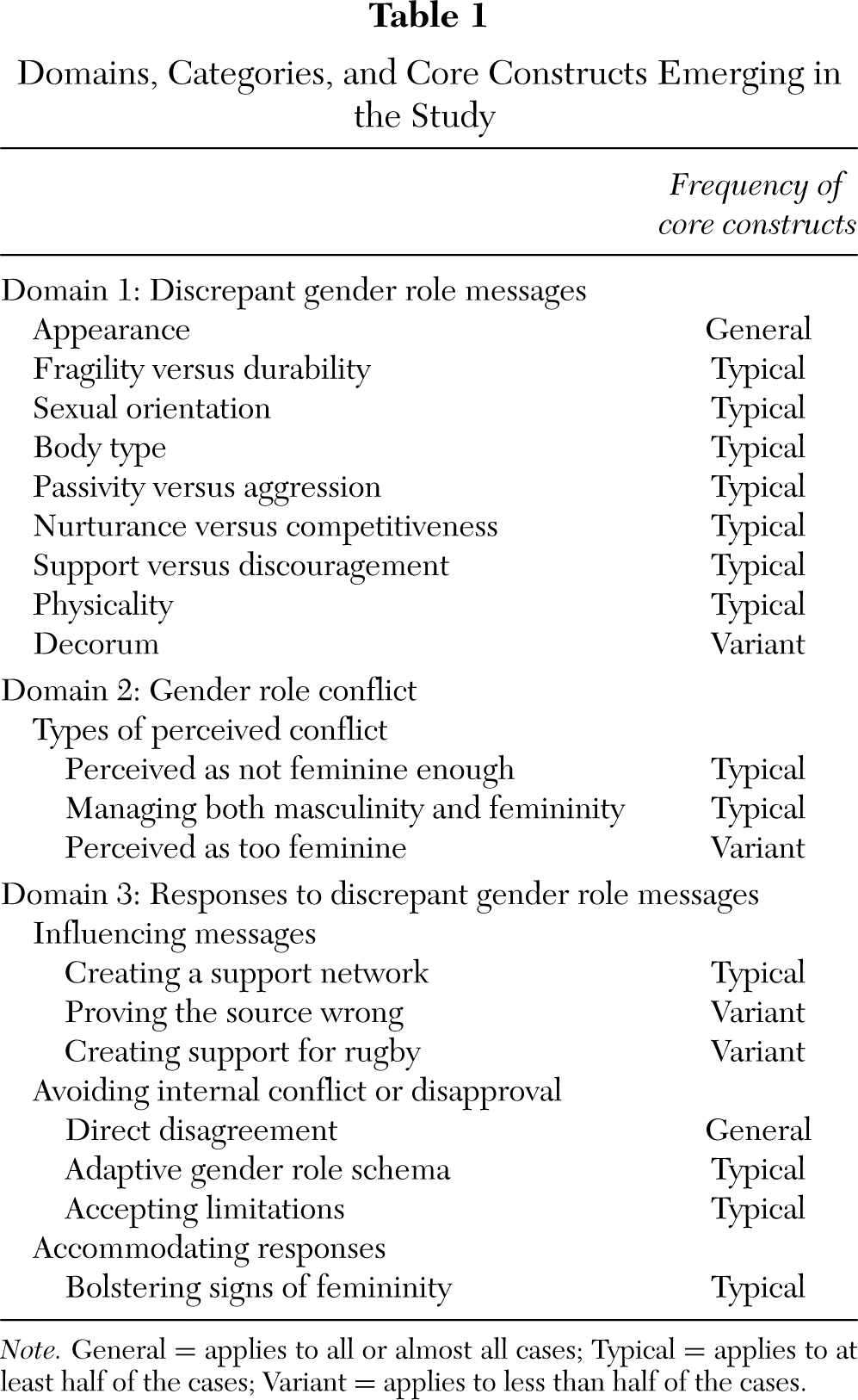
The results are framed around three domains that emerged from the data. The first domain captured the various discrepant messages participants received about their gender-role behavior and participation in rugby. The second domain illustrated the ways in which participants perceive gender-role conflict as well as their experience of gender-role conflict. The third domain captured the various strategies the women rugby players used to respond to and manage the discrepant gender-role messages they received. Table 1 lists the domains, categories, and core constructs of the study.
Domains, Categories, and Core Constructs Emerging in the Study
Note. General = applies to all or almost all cases; Typical = applies to at least half of the cases; Variant = applies to less than half of the cases.
Domain 1: Discrepant Messages
This domain reflected the various discrepant messages participants received about their gender-role behavior and their participation in rugby. They described receiving messages about their gender-role behavior from their families, friends, peers, and coworkers via direct statements as well as through implicit messages regarding their violation of gender-role stereotypes. They received both messages of approval and disapproval for their gender-role behavior and their participation in rugby. A number of core constructs emerged that reflected the content of the messages participants received.
General Core Construct: Appearance
All 11 participants received messages indicating that they should have a feminine appearance (as characterized by external markers such as wearing makeup, doing their hair, and wearing feminine clothing) and that their participation in rugby detracted from their feminine appearance. Participants noted that the stereotype of women rugby players (i.e., as large, round, and unattractive women who do not shave their legs and who wear their hair in a crew-cut fashion) directly contradicts the traditional feminine gender role.
Typical Core Construct: Fragility Versus Durability
Ten participants recounted discrepant messages regarding the conflict between the fragility of women and the durability needed to play rugby. Participants described messages that women are fragile and that the risk of physical injury in rugby is too great for women. Many of their friends or family members were unsupportive of their participation in rugby until they proved that they were not fragile or susceptible to injury.
Typical Core Construct: Sexual Orientation
Nine participants noted discrepant messages related to their sexual orientation. Specifically, participants explained that women rugby players are stereotypically assumed to be lesbian and although this was not seen as a discrepant message for players who identify as lesbian, participants considered this a discrepant message for players who identify as heterosexual and bisexual. Participants stated that heterosexual women occasionally have their sexual orientation questioned because of their involvement in rugby.
Typical Core Construct: Body Type
Eight participants revealed discrepant messages more specifically about the bodies of women rugby players, such that the body type associated with the feminine gender role is incompatible with the body type of women rugby players. Participants depicted the body image of a feminine woman as petite and thin, which is in direct contrast to the body image associated with the woman rugby player, characterized by participants as large, fat, and round. Participants perceived a discrepancy between the message that they need to be thin and petite to be feminine and that they have to be big, strong, and athletic to succeed in rugby.
Typical Core Construct: Passivity Versus Aggression
Eight participants mentioned contrasting expectations for the level of assertiveness displayed by women rugby players. Messages about typical feminine behavior in terms of being passive or playing a “supporting role” contrasted with the assertiveness required by the sport. Feminine behavior was portrayed as “passive,” “prissy,” “weak,” and “unassertive.” In contrast, they depicted the woman rugby player as aggressive, independent, driven, competitive, powerful, confident, and brash. One participant reported that rugby players use “brute force” to accomplish the task of their sport, and this is indirect opposition to traditionally feminine behavior.
Typical Core Construct: Nurturance Versus Competitiveness
Eight participants discussed the contrast between the nurturance associated with femininity and the competitiveness associated with athletic competition. Participants received messages that they should be nurturing to be perceived as feminine and that the competitiveness of rugby violates this expectation for nurturance. Emotionality, nurturance, friendliness, and approachability were offered as essential characteristics of the feminine gender role, while a competitive or assertive woman was characterized as a “bitch” or someone who is “hard” and “icy.”
Typical Core Construct: Support Versus Discouragement
Eight participants noted receiving both positive and negative messages about their participation in rugby. The ongoing support of family and friends was identified as essential to participants' athletic careers, and participants reported receiving a great deal of support for playing. However, participants also recounted emotionally laden experiences of disrespect or lack of support for women athletes. They described encounters with men, including male coaches, who directly told them that women should not participate in masculine sports, women were inferior athletes, and women's sports were inferior versions of men's sports.
Typical Core Construct: Physicality
Six participants reported receiving messages that feminine women avoid physical activity. They are thought to be afraid to get dirty or to get hurt, they do not work hard, they let men do the “yucky” work, and they are easily “grossed out.” Playing rugby requires an amount of physical activity that violates the feminine gender role. Participants reported that it is this quality of physicality that leads their coworkers and friends to identify them as more masculine.
Variant Core Construct: Decorum
Five participants indicated that women receive messages about engaging in decorous and polite social behavior, yet, in contrast, women rugby players exhibit behaviors characterized as “rude,” “crude,” and “lewd.” To exemplify this concept, participants explained that players sing traditional rugby songs with sexually explicit lyrics about women's sexual gratification. Participants noted that male friends and coworkers treated them differently because of their association with the rugby culture, such as making sexual comments about other women to them. Interestingly, participants who reported dating men and participants who reported dating women both perceived being treated differently by men because of their participation in the sport.
Domain 2: Gender-Role Conflict
The second domain describes the types of conflict participants witnessed or experienced and how the conflict manifested itself in the athletes' lives. In describing the gender-role conflict participants perceived in themselves and their teammates, three types of conflict emerged.
Typical Core Construct: Not Feminine Enough
The first type of conflict reflected seven participants' awareness that other people perceived them or their teammates as “not feminine enough.” Participants described a range of physical characteristics or behaviors that influenced whether they would be perceived as “feminine enough,” such as their height, shoulder span, musculature, body shape, facial traits, and athleticism. Women who appeared less feminine received invalidating messages. For example, three participants discussed the uncomfortable experience of being mistaken for a man. Another participant recounted how her peers perceived her as masculine because of her level of competitiveness and dedication to sports. Participants noted that social consequences exist such that women who were more feminine were perceived to receive more social acceptance as rugby players (from those outside the rugby community). Less feminine women were seen as risking rejection because they acted outside of prescribed norms.
Typical Core Construct: Managing Both Masculinity and Femininity
The second type of gender-role conflict that emerged from seven participants reflected conflict about managing both masculinity and femininity. This conflict referred to the assumption that women who engage in masculine behavior are presumed to be homosexual. Participants indicated that players with this type of conflict exerted a considerable effort to ensure that they were perceived as heterosexual. A common example used to illustrate this conflict was that women with this type of conflict would take a shower after the rugby match before going to the after-game party so that they would be more attractive to men. (Although showering before postcompetition celebrations is common among most athletes, showering before a rugby party is considered a major social infraction in this league because the visiting team usually does not have access to showers.) Additional examples of this type of conflict described by participants include uncharacteristic attempts to bolster femininity by wearing makeup, jewelry, or feminine clothing. In depicting the demands on women rugby players to bolster their femininity, participants noted that there is pressure in professional women's sports for athletes to appear heterosexual and feminine so as to be perceived as attractive and receive attention and sponsorship.
Variant Core Construct: Perceived as Too Feminine
The third type of gender-role conflict, described by five participants, concerned struggle with being perceived as too feminine to play rugby. Participants indicated that this type of conflict was evident in women who expressed interest in playing rugby but whose ability was questioned because of their perceived high level of femininity. Several participants stated that occasionally highly feminine women attempted to join their team but could not play rugby because of the physicality of the sport. Participants indicated that rugby requires behaviors that are antithetical to the feminine gender role and described how feminine women are often teased or regarded with suspicion until they prove they can shed enough femininity to complete the tasks of rugby. This type of conflict depicted women who have interest in playing rugby but are unable—or perceived to be unable—to be flexible enough in their femininity so as to complete the tasks of the sport.
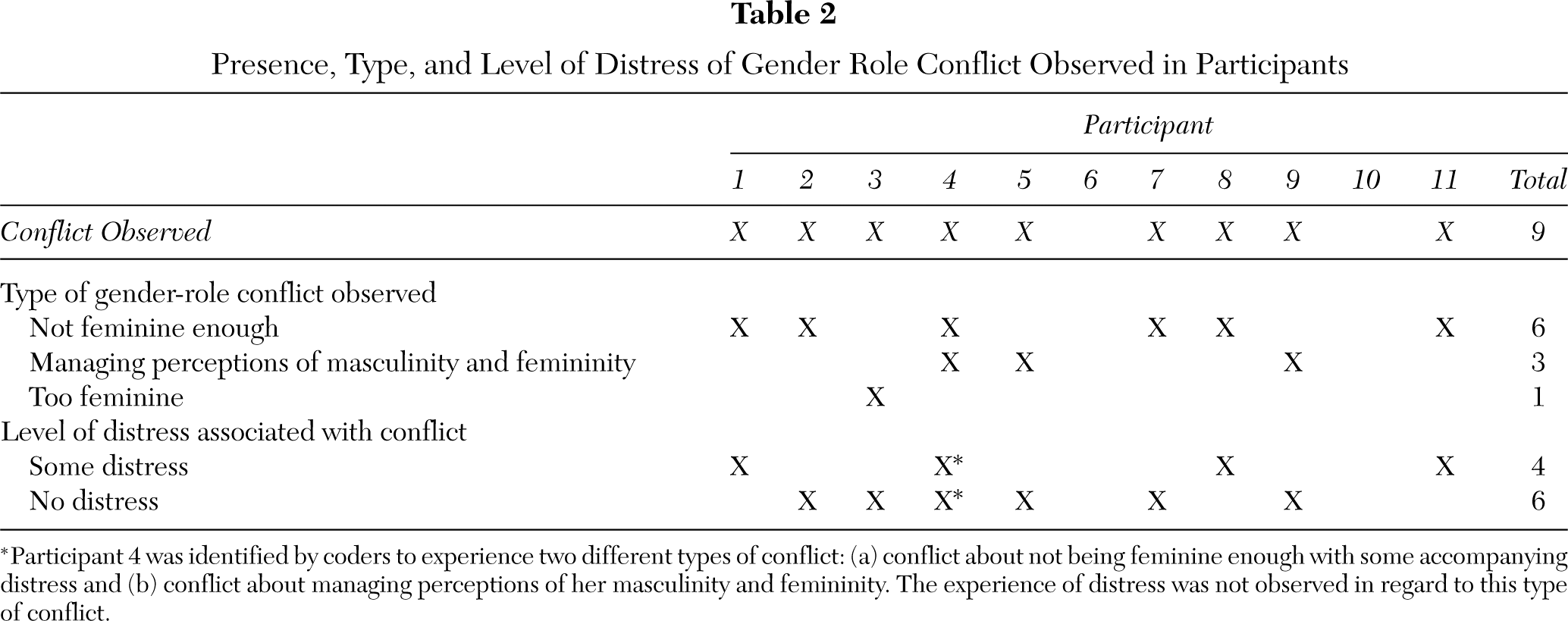
Presence, Type, and Level of Distress of Gender Role Conflict Observed in Participants
∗Participant 4 was identified by coders to experience two different types of conflict: (a) conflict about not being feminine enough with some accompanying distress and (b) conflict about managing perceptions of her masculinity and femininity. The experience of distress was not observed in regard to this type of conflict.
Observed Gender-Role Conflict and Distress
In the coding process, once the three types of gender-role conflict were categorized, the raters searched for signs of these conflicts in participants' narratives as well as any indication that the conflict involved some internal distress. Table 2 displays the results. Nine participants were rated as experiencing at least one type of gender-role conflict, and one of these participants was rated as experiencing two types of conflict. Two participants were rated as not showing any of the three types of conflict. Six participants were rated as experiencing conflict in not being feminine enough; one of these participants was identified as experiencing both conflict regarding being not feminine enough as well as conflict in managing both femininity and masculinity. Two additional participants were observed to display conflict related to managing both masculinity and femininity, and one participant was rated as experiencing conflict as a result of being perceived as too feminine. Additionally, the raters identified the degree to which participants reported feeling distress about the conflict. Four participants indicated some type of distress regarding not being feminine enough, and six participants reported no distress regarding the conflict.
Given that managing perceptions of both masculinity and femininity conflict was primarily focused on the struggles of heterosexual or bisexual women rugby players to maintain both their masculinity (as rugby players) and femininity (in terms of being attractive to men), the data were analyzed to see if there was a relationship between participants' sexual orientation (based on how they identified the gender of their romantic partner) and the observation of this type of conflict. Of the eight participants who were presumed to be heterosexual or bisexual, five participants were observed to show this conflict. None of the participants presumed to be lesbian were observed to experience this type of conflict.
Domain 3: Responses to the Discrepant Messages
The third domain captured the three categories of strategies participants used or saw teammates use in negotiating discrepant or negative gender-role messages related to being a woman playing rugby.
Influencing Messages
The first category identified ways in which women rugby players attempted to respond to discrepant gender-role messages by influencing the expectation or the source of the message.
Typical core construct: creating a support network. Eight participants described the strategy of seeking out other—more supportive—reference groups in coping with the messages of disapproval or social rejection from peers. Participants reported finding refuge and acceptance in the rugby community, which is tight-knit, supportive, and highly accepting of individual differences, especially of lesbian and bisexual women. Participants characterized the rugby culture as a “cult” or a “family” that shelters and insulates players from mainstream culture and provides nontraditional role models for women (e.g., role modeling accepting one's “larger” body type, accepting one's athleticism).
Variant core construct: proving the source wrong. Four participants noted that, in response to negative messages about women playing rugby, participants worked to change the opinion of the other person and “prove them wrong.” Participants noted that negative comments often fueled their desire to become better athletes and also inspired them to become active proponents of women's sports so they could dispel myths such as “girls can't do that” or “girls aren't as good as guys.”
Variant core construct: creating support for rugby. Four participants described their efforts to present positive information about rugby so that family and friends would eventually support their participation in rugby or would at least withhold their negative opinions. Participants stated that presenting information in a positive way and with confidence helped shape the reactions of the people in their lives and create support for their endeavors.
Avoiding Internal Conflict or Disapproval
The second category of responses to discrepant messages captured participants' efforts to avoid or to manage any internal conflict or disapproval from others.
General core construct: direct disagreement. Ten participants indicated that they could avoid feeling distressed about a negative message by actively disagreeing with the message or discrediting the source of the message. For example, one participant recounted being mistaken for a man and that she responded by assuming that the person must be “ignorant or stupid … like just careless, you know, not paying attention.” Other examples included messages disapproving of women playing rugby. Participants stated that generally people do not know a lot about rugby, so they educate others about rugby to dismiss negative biases or information about the sport.
Typical core construct: adaptive gender-role schema. Nine participants indicated that when they were faced with disapproval or internal confusion about discrepant gender-role behavior, they employed an adaptive gender-role schema such that different contexts required different behaviors. Flexibility and moderation in gender-role behavior were identified by participants as valuable because they helped the person fulfill the different gender-role expectations required in the different situations. Specifically, participants noted that feminine behavior was expected in formal or professional situations, whereas aggressive and masculine behavior was expected and appropriate on the rugby pitch.
Typical core construct: accepting limitations. Eight participants indicated that they accepted the idea that they could not fulfill all gender-role expectations. Accepting that they did not match the ideal feminine body type helped participants avoid feelings of failure regarding their inability to be perceived as feminine. Another component of the acceptance strategy was that participants redefined femininity as a means of retaining a feminine identity. Participants stated that they identified less with the external or appearance aspects of the feminine gender role and instead identified more with the interpersonal aspects of femininity, such as being nurturing, empathic, tender, emotional, compassionate, and having good listening skills.
Accommodation Responses
The third category describes participants' attempts to accommodate and conform to gender-role expectations in response to discrepant messages.
This construct reflected six participants' observation that some women rugby players attempted to appear more feminine by wearing feminine clothing, putting on makeup, and wearing jewelry to counteract the negative stereotypes of women rugby players as short, fat, unattractive, or lesbian. Participants noted that some women rugby players bolstered the perception of their femininity by drinking and flirting with men to emotionally manage or compensate for the disapproval of not appearing feminine.
DISCUSSION
The purpose of this qualitative study was to explore how women rugby players perceive and negotiate gender-role expectations and conflict with respect to their participation in a masculine sport. The results indicated that the women rugby players perceived a number of specific discrepant or conflicting expectations for their gender-role behavior. Participants also perceived that women rugby players experience gender-role conflict regarding these discrepant expectations in three different ways, yet participants reported little distress stemming from the conflict. Rather, participants demonstrated numerous strategies for negotiating expectations and resolving conflict to avoid distress from discrepant expectations.
Consistent with past research and theory on women athletes, these results suggested that women rugby players perceive discrepant or conflicting expectations regarding their gender-role behavior. Participants acknowledged that feminine gender-role expectations contrast with the expectations of their role as athlete; that is, their participation in rugby violates many aspects of the feminine gender role. Similar to other research on women athletes (Krane et al., 2004), participants were cognizant of the conflicting messages they received, and they acknowledged that they often defied or failed to fulfill the feminine gender role, especially regarding discrepant expectations for their body shape and type. Perhaps participants were so aware of the discrepant gender-role messages because they knew they violated feminine gender-role norms by playing rugby, and they identified more highly with aspects of the masculine gender role. Supplemental analyses found that the participants scored higher on the masculinity scale of the Bem Sex Role Inventory (Bem, 1974) compared to samples of college women (Bem, 1974) and college women athletes (Burke, 1986), yet they scored similarly on the femininity scale.
The specific content of the discrepant messages largely centered on the women rugby players' appearance. Stryker and Serpe (1994) suggested that, for a particular identity to become salient, an individual needs to receive positive reinforcement for its enactment. Many participants did not receive external validation for their feminine identity, and their physical characteristics seemed to be important in determining their ability to enact a more feminine gender role and/or be recognized as feminine by others.
One of the most interesting findings was that gender-role conflict was manifested in a variety of ways, rather than as one distinct experience of conflict. The experience of gender-role conflict historically has been viewed as a one-dimensional construct (Chusmir & Koberg, 1986; Sage & Loudermilk, 1979). In this study, the women rugby players' experience of gender-role conflict varied according to their gender-role behavior and sexual orientation. The conflict related to being perceived as not feminine enough highlighted the physical limits of a woman's ability to realize a feminine appearance.
Interestingly, participants observed to experience conflict about not being feminine enough sought out opportunities and environments (such as sports) that valued their body shape. The conflict related to managing both femininity and masculinity was manifest in heterosexual and bisexual rugby players whose sexual orientation was questioned because of their involvement in rugby. The emergence of this type of conflict supported the observation that women who act outside the prescribed gender role have their sexual orientation questioned (Bem, 1993; Lenskyi, 1999).
The third type of conflict, being perceived as too feminine, described women who want to play rugby yet are viewed as too feminine to perform the tasks of the sport. Although only one participant was rated as showing signs of this type of conflict, about half the participants noted that they had observed this conflict in other women rugby players. Previous researchers (Miller & Levy, 1996; Sage & Loudermilk, 1979) surmised that the low levels of gender-role conflict found in some studies reflected that women who experienced gender-role conflict had dropped out of sports. It may be that women with this type of conflict have more obstacles to participating and are less likely to play a very masculine sport such as rugby.
Participants developed a number of strategies for resolving the gender-role conflict they perceived or experienced, and some of these strategies have been found in other research on women athletes. For example, Krane et al. (2004) described women athletes' attempts to bolster their feminine appearance through different methods, including wearing ribbons in their hair during competition. Some of the strategies used supported the concept of androgyny (Bem, 1993) such that participants strove to be flexible in their gender-role behavior and used the context of a situation as cues to appropriate behavior. Other scholars have noted how women athletes prioritize different identities or enact gender-congruent behavior depending on the situational context (Hannover, 2000; Royce, Gebelt, & Duff, 2003).
There was overlap between the discrepant gender-role messages perceived (Domain 1) and the strategies participants used to resolve or cope with these conflicting messages (Domain 3). The overlap of these constructs may suggest that participants may have experienced an internal state of gender-role conflict related to the discrepant messages, yet they may have avoided staying in a state of conflict and sought strategies for resolving the conflict. The discrepant messages and resolution strategies discussed by participants may more accurately reflect Sage and Loudermilk's (1979) notion of perceived, rather than experienced, gender-role conflict. Similar to previous findings (Miller & Levy, 1996; Sage & Loudermilk, 1979), participants in the present study seemed to perceive conflicting expectations for their gender-role behavior; however, they experienced internal conflict or distress due to enacting both feminine and masculine roles to a much lesser extent. In addition, women athletes may not experience an intense internal state of conflict because any apparent gender-role conflict might perhaps be better understood as the external environment projecting stereotypes upon them.
Previous findings have suggested that women athletes with gender-role conflict must quit playing sports to resolve the conflict (Miller & Levy, 1996; Sage & Loudermilk, 1979); however, the participants in this study appeared to actively cope with any perceived or experienced gender-role conflict. They did not behave as passive victims of social norms and expectations; rather, they were active and powerful in shaping their environment. Perhaps the resilience and control observed in these women athletes reflects societal changes in gender-role attitudes and behavior. Additionally, it supports Allison's (1991) notion that gender-role conflict theory should avoid assuming that women athletes will manifest some type of psychopathology in their attempts to resolve gender-role conflict. The resilient coping strategies shown by these athletes should be incorporated into future conceptualizations of gender-role behavior.
Limitations of the Study
Attempts were made to reduce bias in the study by having a diverse coding team that was knowledgeable about the subject manner, maintaining awareness of the expectations of the coders. However, as in all qualitative studies, the research findings need to be replicated. Women rugby players are a unique population and these results may not generalize to women athletes in other sports. In addition, the average age of the women in this study was 28.5 years, and it is possible that their conflict about gender-role behavior may have been resolved already, whereas younger women athletes may be more susceptible to gender-role conflict because their gender-role identity is still evolving. Additionally, this particular pool of participants lives in a specific historical context such that they have witnessed the creation of several professional sports leagues and associations for women, and they have witnessed a tremendous societal shift in attitudes toward women athletes. These were some of the first women to benefit from the increased opportunities provided by Title IX legislation (20 U.S.C. § 1681). Finally, the participants in this study were all Caucasian, highly educated, and of middle-to-upper socioeconomic status; these characteristics may make it possible for them to pursue a sport as a hobby, as they balance other roles in their lives.
Study Implications
Documentation of gender-role behavior in a rapidly changing and diverse social context is a difficult yet worthwhile challenge. The portraits of these women rugby players can provide information for improving psychological and educational services to women athletes and reduce obstacles for women and girls in sports. Educational programs could be designed to garner more support for women athletes, to preempt conflict from discrepant messages about the value of women's sports, and to instruct athletes in ways to cope with the conflicting messages. These strategies could be used to improve psychological services not only for women athletes but also to all clients struggling with the experience of disapproval or discrepant messages about their identities.