







Abstract
This study used an experimental paradigm to investigate the role of secondary cognitive appraisals in women's sexual assault resistance and whether these appraisals mediated influences of alcohol and prior victimization. After consuming a beverage (control, placebo, moderate, or high dose), 351 women projected themselves into a simulated interaction with a sexually aggressive man. Four types of secondary appraisals (shock at the man's behavior, concern about his feelings, uncertainty in the situation, conflict about what to do) and three resistance strategies (assertive, polite, passive) were examined. Path modeling revealed that, as expected, intoxication and prior sexual victimization influenced secondary appraisals, which in turn influenced intended resistance. Prior adult sexual assault (ASA) and childhood sexual abuse (CSA) also had direct effects: ASA negatively predicted assertive resistance and CSA positively predicted passivity. Findings suggest that secondary appraisals are key targets for intervention to facilitate effective resistance, thereby reducing the risk of adult sexual victimization.
Sexual assault continues to be a serious problem facing women. Conservative estimates suggest that 20% of women have experienced adult sexual assault (ASA; Brener, McMahon, Warren, & Douglas, 1999; Koss, Gidycz, & Wisniewski, 1987). The National Crime Victimization Survey indicated that there were nearly 189,000 sexual assaults in the United States in 2005, and over 65% were perpetrated by nonstrangers (U.S. Bureau of Justice Statistics, 2005). Although the responsibility for sexual assault rests with its perpetrators, women can sometimes thwart an attempted assault with assertive resistance (Ullman & Knight, 1993). Thus, it is important to understand influences on the types and strength of sexual assault resistance that women use. Women's backgrounds and immediate situational factors may affect how women respond to a sexual assault. Research suggests that a prior history of sexual victimization in childhood or adulthood is negatively associated with assertive resistance (Atkeson, Calhoun, & Morris, 1989; VanZile-Tamsen, Testa, & Livingston, 2005). Alcohol intoxication is also negatively related to resistance, even when a woman is not physically incapacitated (Davis, George, & Norris, 2004; Testa, VanZile-Tamsen, Livingston, & Buddie, 2006). The mechanisms underlying these effects are not well understood. In both cases, women's appraisals at the time of a sexual assault may play an important role in guiding resistance responses. The purpose of this study was to investigate the influence of secondary appraisals on sexual assault resistance intentions in an experimental paradigm and to examine whether secondary appraisals are, in turn, influenced by prior sexual victimization and situational alcohol intoxication.
Cognitive Appraisals and Sexual Assault Resistance
Sexual assault resistance is not a unitary phenomenon. The types and strength of resistance that women use vary according to social and situational contexts (Ullman, 1997; Ullman & Knight, 1992). Because most sexual assaults are committed by acquaintances, they often occur in the context of dating or socializing. Nurius and Norris (1996) proposed a Cognitive Ecological Model (CEM) to account for women's responses to sexual coercion by an acquaintance. According to the CEM, women's responses are mediated through cognitive processing of background and situational influences. Responding to sexual coercion involves two types of cognitive appraisals (Nurius & Norris, 1996; Nurius, Norris, Macy, & Huang, 2004). First, a woman must appraise that she is in a sexually dangerous situation. These primary appraisals are what cause red flags to go up when the woman begins to sense that something is not quite right and realizes that her interaction with a man has taken a dangerous turn.
Once a woman perceives that she is at risk, she further appraises the situation to interpret the source and nature of the threat, considers options for responding to the threat, and evaluates possible outcomes of various responses. These secondary appraisals have been described as “a multivariate cost-benefit analysis [of whether and how to resist sexual assault] involving potentially conflicting goals and concerns” (Nurius, Norris, Young, Graham, & Gaylord, 2000, p. 190). What a woman thinks in such a situation is theoretically an important determinant of how she responds (Nurius & Norris, 1996). When socializing with a man, a woman must balance the positive and negative elements of the situation. Especially if a man becomes sexually demanding, she must weigh the risks and the benefits of continuing to engage with him. This has been termed “walking a cognitive tightrope” (Norris, Nurius, & Dimeff, 1996). As the woman makes these determinations, a variety of secondary appraisals can influence her decision-making process, such as concern about whether he will be offended if she resists his sexual advances, uncertainty about the meaning of the man's behavior, or shock and confusion about the turn of events. Competing desires and concerns can coalesce in a feeling of conflict about what to do. Because a high degree of decisional conflict can result in avoidance (Janis & Mann, 1977), a woman who is conflicted about whether to resist a sexually aggressive man may hold back behaviorally, resulting in less assertive resistance, more indirect resistance, and more passivity.
Survey and experimental studies have examined the relationship between primary appraisals of sexual coercion (risk perception) and resistance (for a review, see Gidycz, McNamara, & Edwards, 2006); however, relatively little work has focused on secondary appraisals. In a pioneering study using focus groups and survey methodology, Norris et al. (1996) examined sorority women's self-reported resistance to hypothetical unwanted sexual advances. They found that concerns about embarrassment, rejection by the man, and disabling effects of alcohol consumption were negatively related to verbal assertiveness and physical resistance and positively related to indirect resistance, such as making a joke in an effort to defuse the situation. In a retrospective survey of women who had experienced some form of verbal or physical coercion, Nurius et al. (2000) found that concern about preserving a relationship with the aggressor was associated with lower assertive resistance, and self-consciousness (e.g., not wanting to overreact) was associated with higher indirect or diplomatic resistance. In another retrospective study, Nurius and colleagues (2004) found that assertive resistance in actual experiences of acquaintance sexual assault was negatively associated with concern about the assailant's judgments and self-blame. Self-blame also positively predicted diplomatic resistance and passivity or immobilization. Thus, survey studies have suggested that women's concerns in a number of domains are important determinants of their chosen resistance strategies. Although these studies are noteworthy, they have limitations. Retrospective surveys rely on memories of an event that may have blurred and been reinterpreted over time. Furthermore, surveys cannot establish the temporal relationship between secondary appraisals and behavioral responses.
The present study employed an experimental paradigm to examine in-the-moment secondary appraisals related to sexual assault resistance in a simulated interaction with a man. Although primary appraisals of risk must precede secondary appraisals in a real-world sexual assault situation, the nature of our experimental paradigm made it clear that the woman was at risk, enabling us to focus exclusively on secondary appraisals. Drawing on findings from earlier survey research, we examined whether secondary appraisals related to concern about the man's feelings or judgment, uncertainty about the situation (similar to self-consciousness), shock, and conflict about what to do predicted three types of sexual assault resistance: assertive, polite (similar to indirect or diplomatic), and passive (similar to immobilization).
Effects of Alcohol Intoxication
Studies have shown that approximately half of adult sexual assaults involve alcohol consumption by the perpetrator, the victim, or both (for reviews, see Abbey, Zawacki, Buck, Clinton, & McAuslan, 2004; Testa & Parks, 1996; Ullman, 1997). Both survey and experimental studies have found a negative relationship between women's alcohol consumption and their resistance to sexual assault (Abbey, Clinton, McAuslan, Zawacki, & Buck, 2002; Davis et al., 2004; Harrington & Leitenberg, 1994; Norris et al., 1996; Testa et al., 2006; Ullman, Karabatsos, & Koss, 1999). Alcohol consumption produces cognitive impairment at higher doses, potentially disrupting the ability to process information from the environment (National Institute on Alcohol Abuse and Alcoholism, 1994). In a sexual assault situation, if a woman is cognitively impaired, she may simply not notice subtle or ambiguous risk cues. Indeed, experimental studies have shown that alcohol intoxication interferes with sexual assault risk perception (Davis, 2000; Testa, Livingston, & Collins, 2000). Cognitive impairment could also affect a woman's secondary appraisals, after she (perhaps belatedly) identifies that she is at risk. A disrupted ability to process information could interfere with resistance by making it difficult for a woman to ascertain what is happening and appropriately weigh competing concerns. For example, faced with an imminent sexual assault, a woman may not resist assertively if she is questioning her perceptions or holding onto a desire not to hurt the assailant's feelings. In addition to its physiological effects, alcohol may have psychological effects that can be examined by administering a placebo and thereby manipulating expectancy set. Research has shown that the mere belief that one has consumed alcohol can affect one's responses in the absence of any actual alcohol (e.g., George, Stoner, Norris, Lopez, & Lehman, 2000). In a previous study examining alcohol's physiological versus expectancy set effects on primary appraisals of sexual assault, Testa and colleagues (2000) found that a placebo exerted weaker but similar effects compared to actual alcohol consumption. Thus, the current study included a placebo condition. Women were randomly assigned to receive a low or high dose of alcohol, a placebo, or a control beverage before rating their in-the-moment secondary appraisals and resistance intentions in the experimental sexual assault analogue.
Influences of Prior Victimization
Several studies have indicated that women with a history of child sexual abuse are at increased risk for later sexual victimization relative to women without such a history (for reviews, see Arata, 2002; Messman-Moore & Long, 2003; Muehlenhard, Highby, Lee, Bryan, & Dodrill, 1998). Women who are sexually victimized in adulthood are also at elevated risk of repeat victimization (Sorenson, Siegel, Golding, & Stein, 1991). In Nurius and Norris's (1996) CEM, prior victimization is considered to be an important background influence that may hamper a woman's ability to mount assertive resistance via effects on cognitive processing. Studies of whether prior adult sexual victimization interferes with primary appraisals of risk have been equivocal (for a review, see Gidycz et al., 2006). Norris and colleagues’ (1996) survey showed differences between victimized and nonvictimized women in their secondary appraisals of hypothetical sexual aggression. Compared to nonvictimized counterparts, previously victimized women reported a significantly higher likelihood that embarrassment, fear of rejection, and alcohol impairment would interfere with assertive resistance. To our knowledge, this survey was the only previous study to compare sexual assault–related secondary appraisals in victimized versus nonvictimized women. In the present study, we measured participants’ history of three types of victimization: ASA, childhood sexual abuse (CSA), and childhood physical abuse (CPA). All three types of victimization were included in the model to examine their independent effects on secondary appraisals and resistance intentions.
The Present Study
To date, no research has examined both acute alcohol intoxication and in-the-moment secondary appraisal processes within victimized versus nonvictimized women as they pertain to the risk of subsequent victimization. The present study used path analysis to investigate how secondary appraisals might mediate the effects of victimization history and acute alcohol intoxication on resistance intentions. Two doses of alcohol (target blood alcohol levels of .04% and .08%) were compared to a placebo condition and a control condition to examine whether alcohol effects are psychological or physiological in nature. If physiological, examining two doses allows for the possibility that physiological effects are dose dependent. We hypothesized that alcohol effects would be most pronounced at the higher dosage, when cognitive impairment would be highest. Histories of CSA, CPA, and ASA were considered independently. Path analysis permitted simultaneous consideration of alcohol intoxication and victimization factors as they pertain to secondary appraisals and resistance intentions in a hypothetical encounter with a sexually aggressive man.
The hypothesized model is shown in Figure 1. Based on previous survey research, we hypothesized that conflict about what to do, concern about the man's feelings/judgment, and uncertainty about the situation would decrease intended assertive resistance and increase polite resistance. Conflict and being shocked were expected to increase passivity. Conflict was also expected to increase consent. We also hypothesized that secondary appraisals would mediate the effects of alcohol intoxication and prior victimization on resistance intentions. Specifically we predicted that intoxication and prior victimization would increase uncertainty and feeling conflicted in the situation. Consistent with previous studies, we predicted that concern about the man's feelings or judgment would be negatively related to intoxication (Nurius et al., 2004) and positively related to prior victimization (Norris et al., 1996). Because women generally have expectations about how they should behave when they are drunk, we hypothesized that alcohol expectancy set would have effects similar to but weaker than those of low alcohol intoxication. Finally, we hypothesized that adult sexual victimization history would mediate effects of childhood victimization, especially CSA, on appraisals and resistance intentions in the sexual assault scenario.
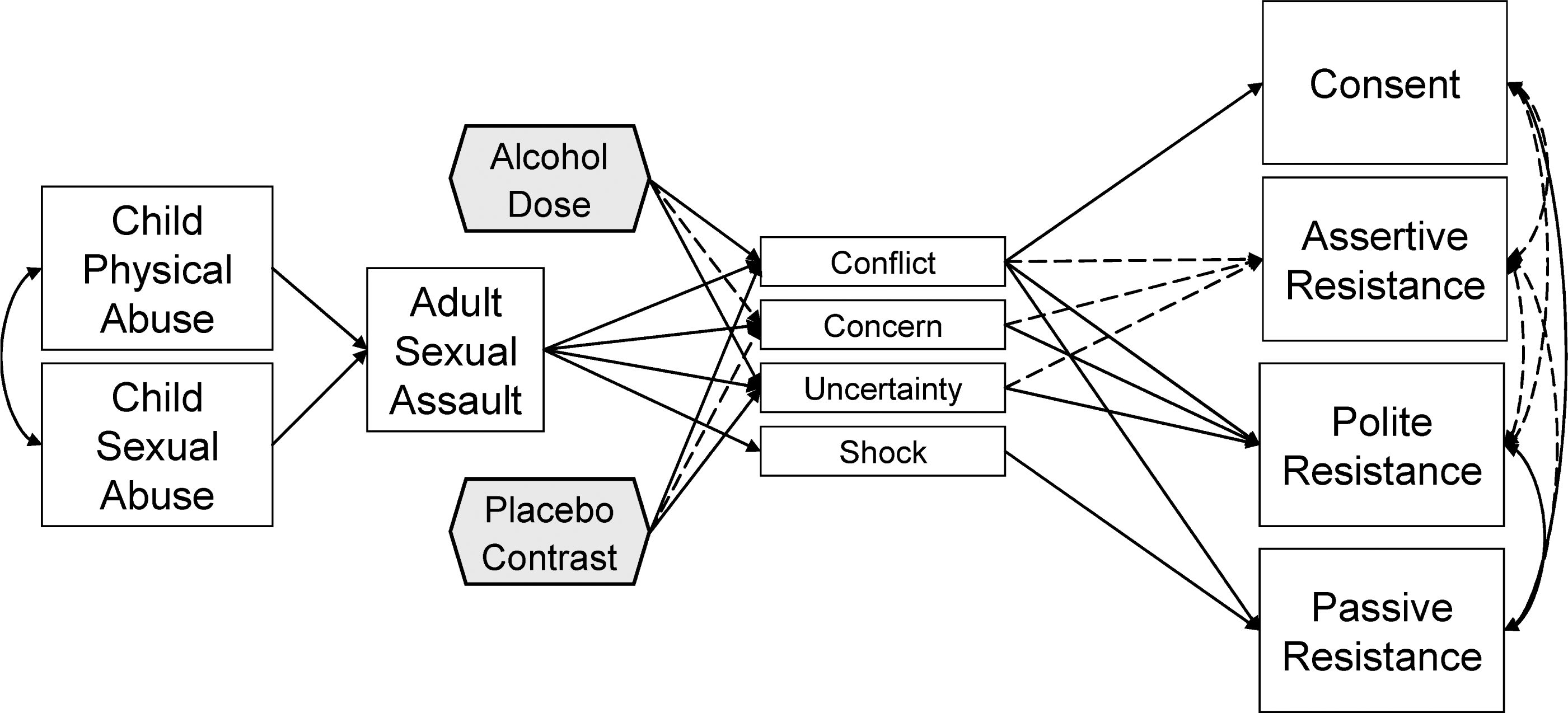
Model showing the hypothesized relationships among victimization history variables, secondary appraisals, and resistance intentions and the influence of alcohol intoxication. Solid lines represent hypothesized positive relationships whereas dashed lines represent hypothesized negative relationships.
METHOD
Participants
Participants were recruited via newspaper advertisements and flyers placed both on a large university campus and in the surrounding community. Advertisements and flyers stated that “unattached female social drinkers, age 21 to 35, [were] wanted for participation in studies on alcohol and male-female social interactions.” Respondents were screened over the telephone before being invited to participate. Women who typically consumed less than 1 or more than 35 drinks per week were excluded from the study, as were individuals with any contraindications for alcohol consumption, including pregnancy, a history of problem drinking, and certain medical conditions. To maximize participants’ ability to relate to the stimulus story, respondents were screened out if they were currently in a steady, exclusive relationship or if they reported no interest in dating men.
The study was conducted in two sessions separated by at least 7 days (M = 14.0, SD = 19.2). Four hundred twenty-six women completed Session 1. Of those, 351 women (82%) completed Session 2. Women who did not return for the second session were less likely to be unemployed (19%) than those who did (32%), χ 2(1) = 4.69, p < .05. There were no significant differences between those who attended Session 2 and those who did not in age, racial minority status, education level, student status, annual income, religiosity, or political orientation. Participants’ mean age was 24.8 years, (SD = 3.7). Seventy-eight percent identified themselves as European American, 8% as Asian/Pacific Islander, 5% as Latina, 3% as African American, and 6% as multiracial or other. Forty-seven percent were students, 48% had earned at least a bachelor's degree, 68% were employed, and 67% earned greater than $21,000 per year.
Procedure
All procedures and materials were reviewed and approved by the university's Human Subjects Division. Both sessions were conducted by female experimenters.
Questionnaire session.
The experimenter checked the participant's identification, verified her age, and obtained informed consent for the questionnaire session only. After instructing the participant on how to use the computer, the experimenter left the room to provide the participant with maximum privacy. Upon completion, the participant signaled the experimenter, who then debriefed her and paid her $10 per hour. At this point, the experimenter described the second session and scheduled the participant if she indicated interest. 1 The participant was instructed to fast for 3 hours prior to her appointment (consuming only noncaloric beverages) and not to drive to the laboratory due to the possibility of receiving alcohol.
Experimental session.
As in the first session, the experimenter checked the participant's identification, verified her age, and obtained informed consent for the experimental session. The consent form stated that “the purpose of this research is to study the effect of alcohol on women's responses to men's unwanted sexual advances … You will read a story presented on the computer … [and] be asked to imagine that you are a character in the story. This story will depict an interaction between you and a man, in which you will be asked how you would respond to the man's unwanted sexual advances.” Participants were told that they were free not to answer any questions that they did not wish to answer and that they could withdraw at any time without penalty. A breathalyzer (CMI Intoxilyzer 5000) was used to ensure that the participant's blood alcohol level (BAL) was at 0.00%. Participants who had not complied with the preexperimental instructions or who had a nonzero BAL were rescheduled. Participants who had been randomly assigned to an alcohol or placebo condition were required to complete a pregnancy test. Each participant was weighed to determine the volume of beverage that she would receive, reminded how to operate the computer system, and instructed to project herself into the story.
Beverage Administration
Participants were randomly assigned to receive a moderate dose of alcohol (target peak BAL = .04%), a high dose of alcohol (target peak BAL = .08%), a placebo, or a control beverage. Alcohol dosages were .33 g ethanol/kg body weight for the moderate dose and .68 g/kg for the high dose. Alcoholic beverages comprised 100 proof vodka and orange juice in a 1:4 ratio. Placebo beverages contained decarbonated tonic with an inert amount of vodka and orange juice in a 1:4 ratio. 2 Control beverages consisted of five parts unadulterated orange juice. Participants were required to consume their beverages within 9 minutes. Moderate-dose participants were breathalyzed approximately every 2 minutes until they reached the criterion BAL of .025%, and high-dose participants were breathalyzed approximately every 5 minutes until they reached the criterion BAL of.055%. These criterion BALs were selected to ensure that participants began reading the stimulus story while their BALs were ascending. To control for variation in the time it took for participants in the two alcohol conditions to reach their criterion BALs and differences in the volume of the beverages (kilogram for kilogram, participants in the high-dose condition received twice as much liquid as those in the low-dose condition), each participant in an alcohol or placebo condition had a random control participant yoked to her. Each control received an equivalent volume of liquid relative to her body weight and, to control for physical exertion, was administered a breathalyzer the same number of times over the same time frame as the alcohol or placebo participant to whom she was yoked (George et al., 2004; Giancola & Zeichner, 1997).
Once criterion BALs were reached, the experimenter left the room to ensure participants’ privacy while reading the story and completing dependent measures. A master's-level or above counselor was on site at all times in case a participant became upset while completing the experimental session. No participant indicated any distress. At the conclusion of the session, all participants were debriefed and offered food and water. Control and placebo participants were then paid and released. Alcohol participants remained in the lab until their BALs fell below .03%. Participants were paid $10 per hour, with total payment for both sessions ranging from $25 to $75. All participants were provided with a resource sheet listing referral resources for sexual assault. Two weeks after their laboratory session, participants were mailed a follow-up survey to assess whether their participation in the study had any negative impact on them. Those who returned the survey (> 80%) received a $5 payment. No participant reported any negative effects.
Materials
Stimulus story.
The stimulus story was written in the second person (e.g., “You are on the phone with your friend …”). Participants were instructed to project themselves into the story as if they were experiencing the events as the main female character. To facilitate participants’ ability to project themselves into the story and enhance the manipulation of the independent variable, participant beverage condition, the female character's alcohol consumption in the story was matched to the participant's expected drinking status (sober or intoxicated). The story began with a conversation between the woman and a female friend in which they discussed the male character (Michael), the woman's attraction to him, and her intention not to have sex with him. The story went on to depict an evening spent watching movies with a group of friends at the female friend's house. At the end of the evening, the woman and Michael were left alone in the living room, watching a third movie. The story depicted Michael making escalating unwanted sexual advances toward the woman. The story was stopped as Michael said that he wanted to make love to her and began to forcefully maneuver on top of her. Secondary appraisals, including conflict, were assessed at this time. The story continued and concluded with Michael on top of her, holding her down, unbuttoning his pants, and stating his intention to rape her (“Oh, come on … I've seen the way you look at me, and I know you want me, too. We're gonna do it now, you little tease.”). No actual rape was portrayed. Resistance intentions were assessed at this time.
Background measures.
Along with a demographics questionnaire, the Childhood Trauma Questionnaire (Bernstein et al., 1994) was administered as part of a larger package of background measures. For the purposes of the present study, we were interested in delineating effects of CSA and CPA. Instructions were as follows: “These questions ask about some of your experiences growing up as a child and a teenager. For each question, choose the number that best describes how you feel. Although some of these questions are of a personal nature, please try to answer as honestly as you can. Remember, as always, your answers are confidential.” Participants used a 5-point Likert scale ranging from 1 (never true) to 5 (very often true) to respond to items beginning with the stem, “When I was growing up…” Scores were determined by taking a mean of the constituent items of each subscale. The CSA subscale consisted of three items: “… I had sex with an adult, or with someone who was a lot older than me (someone at least 5 years older than me),” “… someone tried to touch me in a sexual way, or tried to make me touch them,” and “… I believe that I was sexually abused.” Cronbach's alpha was .81, and the mean for the sample was 1.49 (SD = .92). The CPA subscale consisted of five items: “… someone in my family hit or beat me,” “… I got hit so hard by someone in my family that I had to see a doctor or go to the hospital,” “… people in my family hit me so hard that it left me with bruises or marks,” “… I was punished with a cord, a belt, a board, or some other hard object,” and “… I believe that I was physically abused.” Cronbach's alpha was .82, and the sample mean was 1.50 (SD = .76). The correlation between the CSA and CPA subscales was .34 (p < .001).
Sixteen items, rated on a Likert scale ranging from 0 times to 5 or more times, were adapted from the Sexual Experiences Survey (SES; Koss & Oros, 1982) to assess ASA by an acquaintance or a stranger. Responses were used to classify participants into three mutually exclusive categories: no history of rape (n = 162; 46.2%), attempted but not completed rape (n = 55; 15.7%), and completed rape (n = 134; 38.2%), regardless of whether the assailant was a stranger or an acquaintance. 3 Rape was defined as vaginal, oral, or anal sex that occurred by force or threat of force. Example items defined as completed rape include the following: “[After you were 16 years old… how many times have you]… had a man perform oral sex on you (mouth/tongue to vagina) even though you indicated you did not want him to by saying something, moving away, or pushing him away,” “… had a man force you to perform oral sex on him (mouth to penis) against your will,” and “… had sexual intercourse when you didn't want to because a man used some degree of physical force like holding you down, twisting your arm, etc.” Example items defined as attempted rape include the following: “… had a man try to force you to perform oral sex on him (mouth to penis) even though you indicated you did not want him to by saying something, moving away, or pushing him away, but did not succeed” and “… had a man use physical force like holding you down, twisting your arm, etc. to TRY to get you to have sexual intercourse when you did not want to, but sexual intercourse DID NOT occur.” Women were categorized according to the most severe level of sexual victimization that they had experienced.
One hundred eleven (31.6%) women had no history of childhood or adult victimization, and 240 (68.2%) had experienced some form of prior victimization. Figure 2 shows the overlap between CPA, CSA, and ASA in the present sample. For the purpose of Figure 2 only, CPA was defined as a mean score of greater than or equal to two on the physical abuse items of the CTQ (i.e., occurring rarely or more, on average), CSA as a mean score greater than one on the sexual items of the CTQ (i.e., occurring more than never, on average), and ASA as greater than zero on items representing sexual assault or attempted assault on the SES (i.e., any occurrence of attempted or completed sexual assault).
Mediators: Secondary appraisals.
Items representing three types of secondary appraisals were drawn from earlier research (Norris et al., 1996; Nurius et al., 2004). Concern about the man's feelings or judgment of her consisted of three items (α = .90): “I don't want to hurt his feelings,” “I don't want him to get mad at me or be upset with me,” and “I don't want him to judge me negatively.” Uncertainty about the situation consisted of three items (α = .67): “I'm not sure if I'm reading him right; maybe I'm misinterpreting his intentions,” “Maybe if I give in a little he'll leave me alone,” and “I shouldn't overreact and make a big deal of this.” Shock consisted of two items (α = .81): “This just can't be happening; it's not real” and “I'm stunned; I don't know what to think.” Participants were instructed to “rate how much these thoughts are like your thoughts in the story.” Items employed 7-point Likert scales that ranged from 0 (not at all) to 6 (very much). Scores on each subscale were computed as means of the constituent items.
Subsequently, but prior to resistance intentions, two items assessed the participant's sense of conflict about what to do: “How difficult was it for you, as the woman in the story, to decide whether to go along with Michael's insistence on having sex?” and “How difficult was it for you to decide whether to resist Michael's insistence on having sex (for example, try to talk him out of having sex or push him away)?” (α = .77). These items employed 7-point Likert scales that ranged from 0 (not at all difficult) to 6 (very difficult). Scores were computed as a mean of the items.
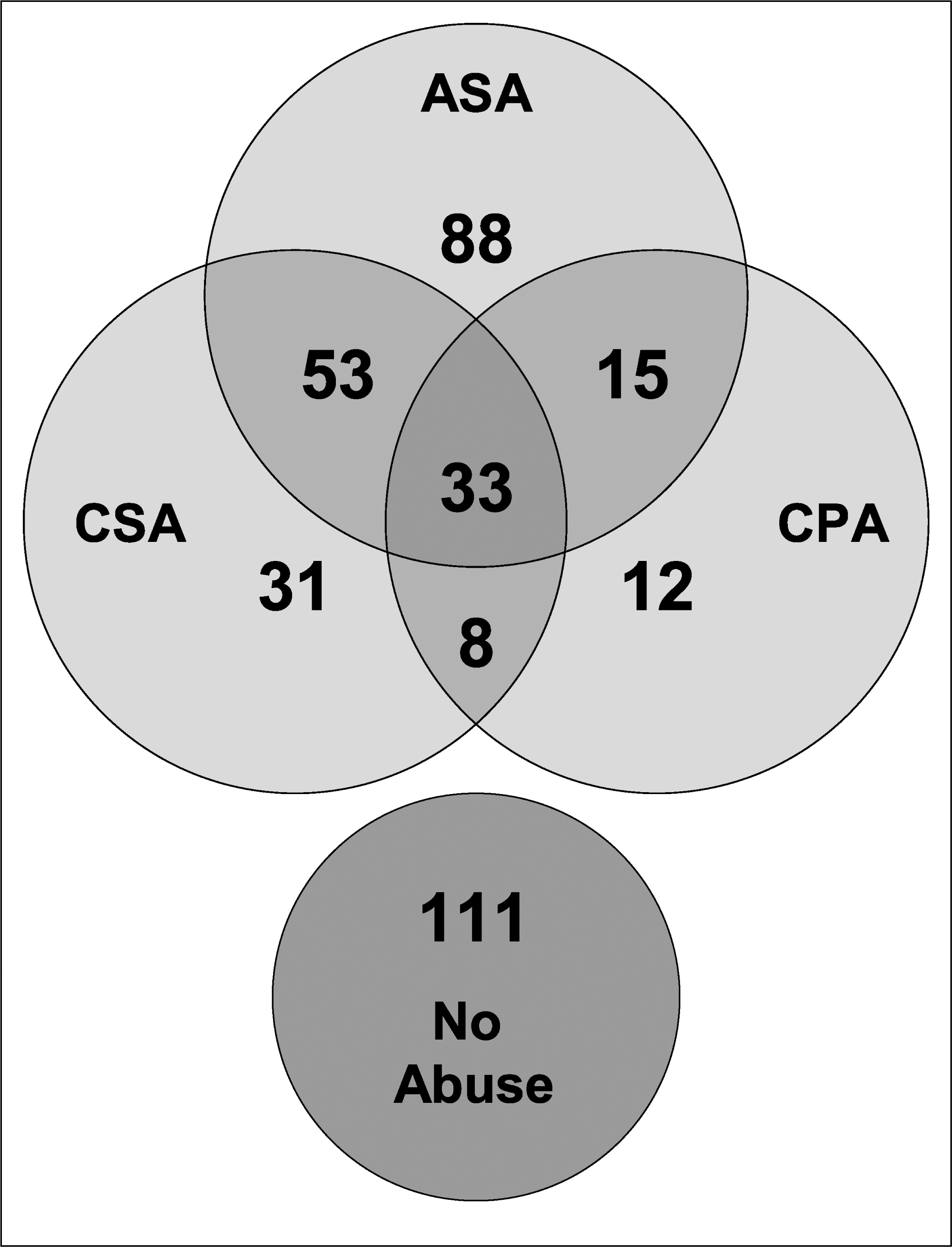
Venn diagram representing number of participants with various victimization histories. Total N = 351. For purposes of this figure only, Child Physical Abuse (CPA) was defined as a mean score of ≥ 2 on the physical abuse items of the Childhood Trauma Questionnaire (CTQ), Child Sexual Abuse (CSA) as a mean score > 1 on the sexual abuse items of the CTQ, and Adult Sexual Assault (ASA) as > 0 on items representing sexual assault or attempted assault on the Sexual Experiences Survey (not including alcohol-assisted sexual assault).
Dependent measures: Resistance intentions.
Twelve items representing intentions to engage in assertive, polite, and passive resistance were drawn from prior research (Davis et al., 2004; Norris et al., 2006). Participants were instructed to “rate how likely you would be to respond in each of these ways.” Items employed 7-point Likert scales that ranged from 0 (not at all likely) to 6 (very likely). Assertive resistance consisted of five items (α = .90), for example, “get up and try to leave,” “push him away,” “raise my voice and use strong language.” Polite resistance consisted of three items (α = .84): “nicely or apologetically tell him I don't want to have sex,” “make an excuse as to why I don't want to have sex,” and “tell him I like him but I'm not ready for this.” Passive resistance consisted of three items (α = .78): “go along with what he is doing even though I don't really want to,” “become paralyzed and unresponsive because I feel so overwhelmed,” and “not try to do anything because it seems hopeless.” Scores on each subscale were computed as means of the constituent items. To control for the possibility that a woman might not resist because she, in fact, wanted to consent to the man, we also measured consent using one item: “want him to continue and consent to it.”
Data Analytic Approach
To examine the relationships among all variables and to consider the potential mediating role of secondary appraisals, path analysis was performed using Mplus statistical modeling software for Windows (Muthén & Muthén, 2004). Maximum likelihood estimation with robust standard errors was used to adjust for non-normality among the appraisals and resistance intentions. An interval-level alcohol variable was created to represent the dosage of alcohol that each participant received: control and placebo = 0, moderate dose = 1, and high dose = 2. An expectancy contrast variable was created to represent the placebo manipulation; participants in the placebo group were coded as 1, their yoked controls were coded as −1, and all others were coded as 0. To examine ASA as a mediator, an ordinal variable was created such that no ASA was coded as 0, attempted ASA was coded as 1, and completed ASA was coded as 2. The CSA and CPA variables used were participants’ scores (means) on the subscales of the CTQ, as described above. Covariances among resistance intentions, among appraisals, and between CSA and CPA were included in the model. Because participants had been randomly assigned to beverage conditions, the covariances between alcohol and the victimization variables and between expectancy and the victimization variables were fixed to zero. The covariance between the alcohol and expectancy conditions was also fixed to zero because these variables were manipulated independently and the correlation between them was nonsignificant.
RESULTS
Model Specification and Trimming
Descriptives and correlations among the variables are shown in Table 1. Fit indices and results of model comparisons using Satorra-Bentler scaled chi-square difference testing 4 are given in Table 2. Model trimming was conducted following procedures recommended by Chou and Bentler (2002). First, all paths, other than those described above as being fixed to zero a priori, were estimated freely (Model A). Next, we inspected the estimated regression coefficients in Model A, and all that were not at least marginally significantly different from zero (z > 1.87, p < .0615) were fixed to zero (Model B). This process was repeated incrementally, and three additional paths were fixed to zero in subsequent models. The final model (Model E) is shown in Figure 3. All paths in Model E are significantly different from zero (p < .05).
Descriptive Statistics for and Relationships Among Measured Variables
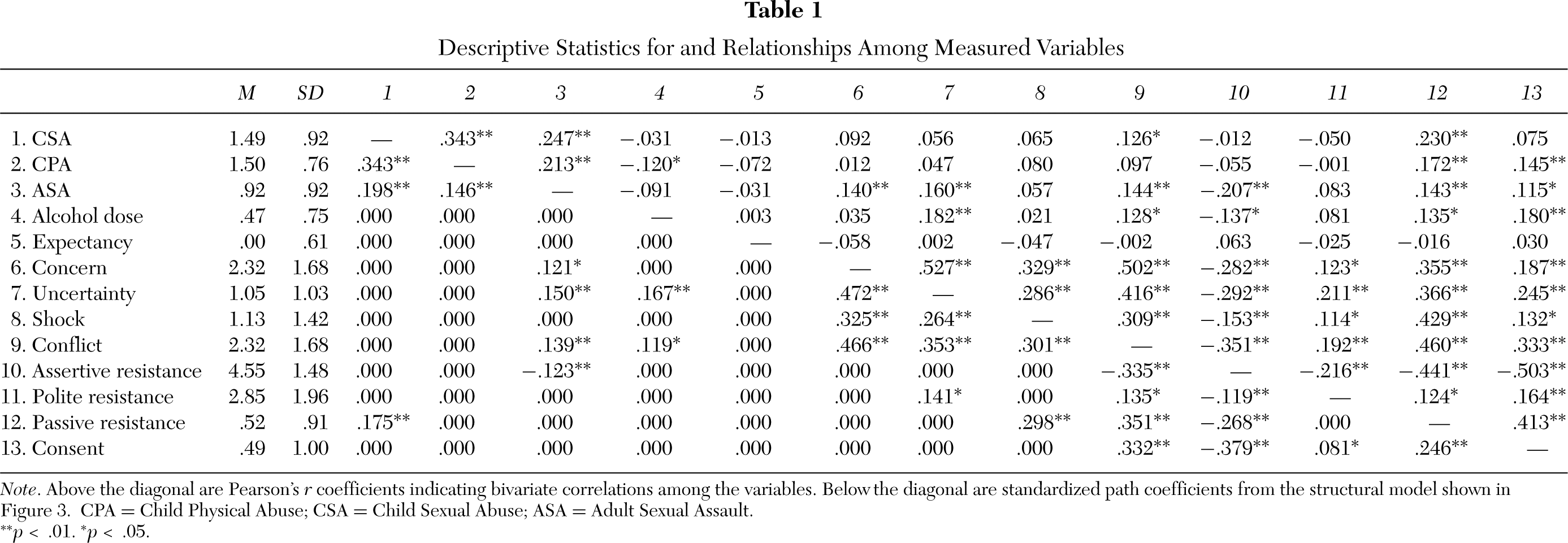
Note. Above the diagonal are Pearson's r coefficients indicating bivariate correlations among the variables. Below the diagonal are standardized path coefficients from the structural model shown in Figure 3. CPA = Child Physical Abuse; CSA = Child Sexual Abuse; ASA = Adult Sexual Assault.
∗∗ p < .01. ∗ p < .05.
Comparing Alternative Nested Models to the Free Model for Model Trimming
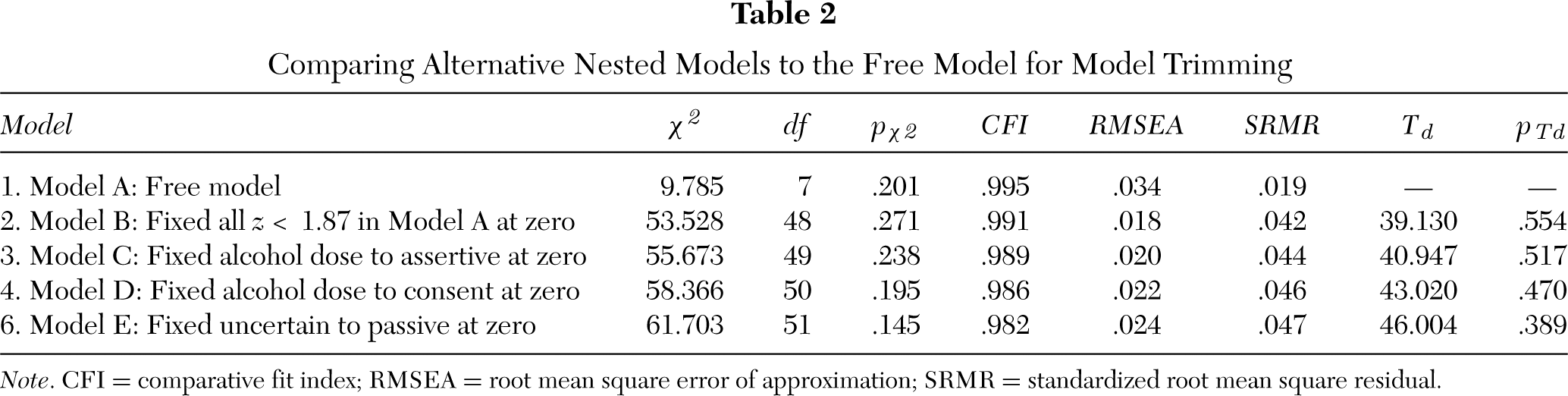
Note. CFI = comparative fit index; RMSEA = root mean square error of approximation; SRMR = standardized root mean square residual.
Path Analysis: Direct and Indirect Effects
Direct effects of appraisals on resistance intentions.
As shown in Figure 3, all of the secondary appraisals except for concern about the man's feelings/judgment had some significant relationship to resistance intentions. Conflict about whether to go along with or resist the man's sexual advances predicted each of the resistance intentions. The more conflicted participants felt, the less likely they were to resist assertively (β = −.34) and the more likely they were to resist politely (β = .14) or passively (β = .35) or to consent (β = .33). In addition, polite resistance was predicted by uncertainty (β = .14), and passive resistance was predicted by shock (β = .30).
Direct effects of victimization history on appraisals and resistance intentions.
ASA was positively associated with both CSA (β = .20) and CPA (β = .15). CSA and CPA were moderately correlated (r = .34). Neither CSA nor CPA directly predicted the secondary appraisals; however, CSA directly positively predicted passive resistance (β = .18). A history of ASA positively predicted conflict (β = .14), concern about the man's feelings/judgment (β = .12), and uncertainty (β = .15) and negatively predicted assertive resistance (β = −.12). Post hoc tests indicated that participants with a history of completed rape indicated significantly higher concern (M = 2.59, SD = 1.61) than did those with no history of attempted or completed rape (M = 2.08, SD = 1.69); participants with a history of attempted (but not completed) rape (M = 2.39, SD = 1.70) did not differ from either group. With regard to uncertainty, participants with a history of completed rape (M = 1.20, SD = 1.04) did not differ from those with a history of attempted rape (M = 1.25, SD = 1.21); both groups indicated significantly higher uncertainty than did those with no history of attempted or completed rape (M = .85, SD = .93). With regard to assertive resistance, participants with a history of completed rape (M = 4.12, SD = 1.61) rated their assertive resistance intentions significantly lower than did those with no history of attempted or completed rape (M = 4.85, SD = 1.32); participants with a history of attempted rape (M = 4.58, SD = 1.39) did not differ from either group.
Direct effects of alcohol on appraisals and resistance intentions.
Alcohol dose positively predicted conflict (β = .12) and uncertainty (β = .17). Post hoc tests indicated that participants in the high-dose condition indicated significantly higher conflict (M = 2.69, SD = 1.91) than did those who received no alcohol (M = 2.17, SD = 1.62); participants in the low-dose condition (M = 2.62, SD = 1.66) did not differ from either group. Similarly, participants in the high-dose condition indicated significantly higher uncertainty (M= 1.46, SD= 1.17) than did those who received no alcohol (M = .94, SD = .98); participants in the low-dose condition (M = 1.12, SD = 1.03) did not differ from either group. Alcohol dose did not have any significant direct effects on the resistance intentions. Alcohol expectancy set had no significant effects on any of the appraisals or resistance intentions.
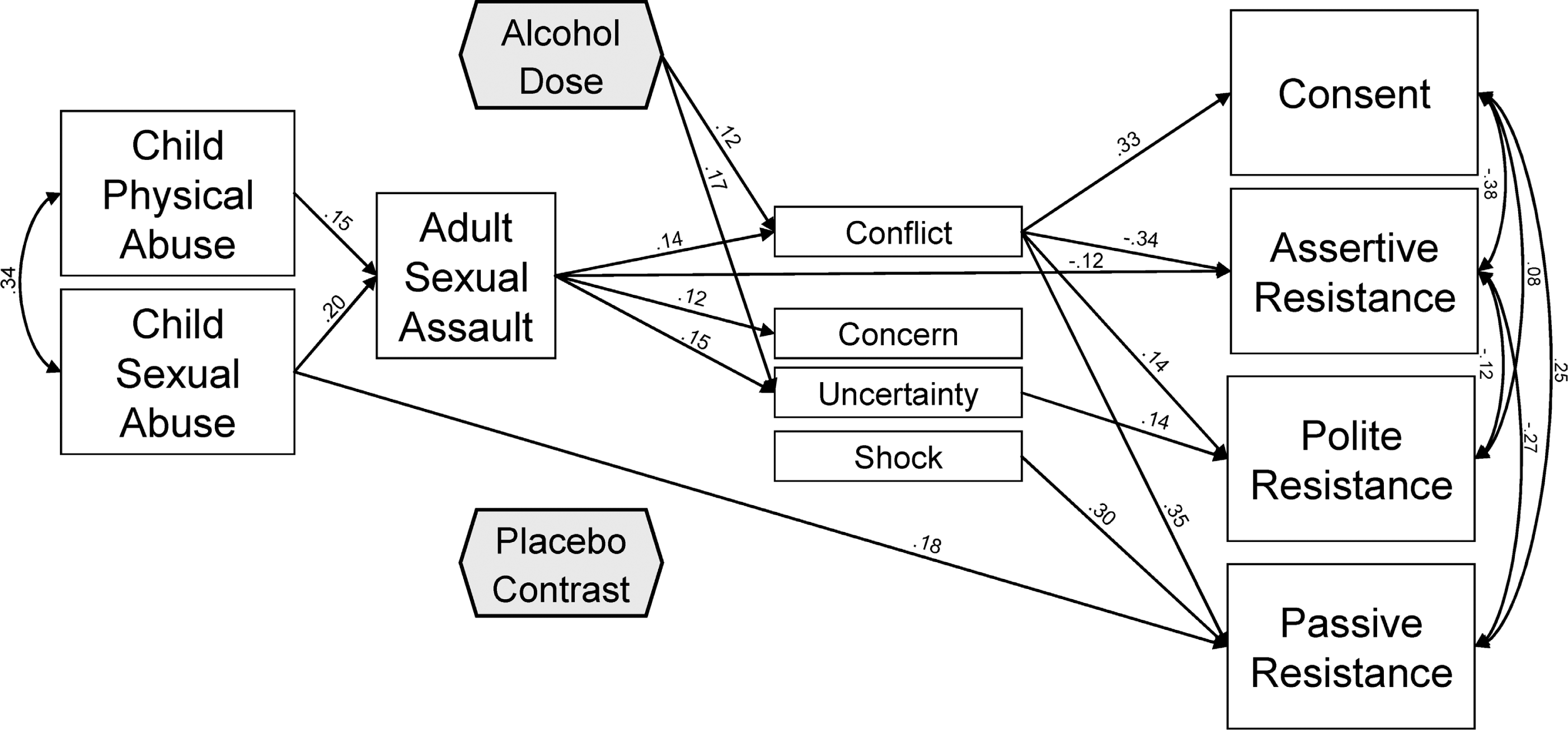
Path diagram showing the relationships among Child Physical Abuse, Child Sexual Abuse, Adult Sexual Assault, secondary appraisals, and resistance intentions in the experimental scenario. Alcohol expectancy (placebo) was included in the model, but was not significantly related to any other variable. For standardized covariances among secondary appraisals and levels of statistical significance not shown in this figure, see Table 1, below the diagonal.
Indirect effects of alcohol on resistance intentions.
Following procedures recommended by Bryan, Schmiege, and Broaddus (2007) for evaluating multiple mediator models in a structural equation modeling framework (Bryan et al., 2007), we tested the significance of specific indirect effects and total indirect effects of sexual victimization and alcohol on resistance intentions. Results are shown in Table 3. Although, as stated above, alcohol had no direct effects on resistance intentions, through its effects on conflict it had a significant indirect effect on assertive resistance (β = −.078), passive resistance (β = .050), and consent (β = .052). Through its effects on uncertainty, alcohol had a significant indirect effect on polite resistance (β = .061).
Indirect effects of victimization on resistance intentions.
As shown in Table 3, in addition to its direct effect on assertive resistance, through its association with conflict, ASA had significant indirect effects on assertive resistance (β = −.075), passive resistance (β = .048), and consent (β = .050). Through its association with uncertainty, ASA had a significant indirect effect on polite resistance (β = .045). CSA, through its association with ASA, had significant indirect effects on assertive resistance (β = −.054), polite resistance (β = .017), passive resistance (β = .009), and consent (β = .010), in addition to a direct effect on passive resistance. CPA, through its association with ASA, had significant indirect effects on assertive resistance (β = −.048) and polite resistance (β = .015).
DISCUSSION
This is the first experimental study to examine the relationship between secondary appraisals and sexual assault resistance intentions. Findings from the present study indicate that secondary appraisals are important determinants of resistance intentions. As expected, conflict about what to do in the situation decreased assertive resistance and increased polite resistance and passivity, uncertainty increased polite resistance, and shock increased passivity. Although more studies are needed to replicate and build upon these results, overall, our findings support Nurius and Norris's (1996) Cognitive Ecological Model, which states that secondary appraisals mediate the effects of background and situational variables on women's responses to male sexual coercion.
Testing Significance of Total and Specific Indirect Effects
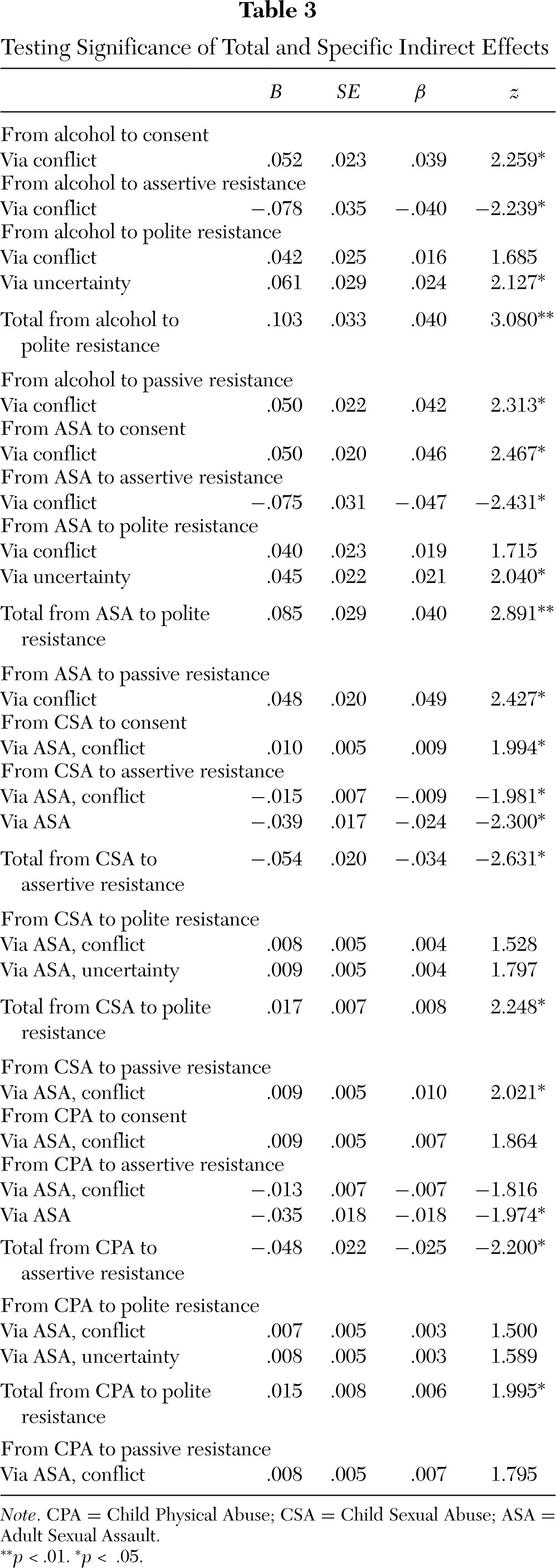
Note. CPA = Child Physical Abuse; CSA = Child Sexual Abuse; ASA = Adult Sexual Assault.
∗∗ p < .01. ∗ p < .05.
Such findings are important not only because they help to clarify social and situational influences on women's sexual assault resistance, but also because they have strong potential to inform sexual assault risk reduction interventions. In the tradition of cognitive-behavioral approaches, cognitions are often important targets for intervention, and the present findings support the notion that secondary appraisals of acquaintance sexual aggression are key intervention targets that may facilitate assertive resistance and thereby reduce women's risk of completed sexual assault. Therefore, to reinforce women's resistence in sexual assault situations, risk reduction programs might benefit by educating about women's secondary appraisals. For example, because findings indicated that conflict reduced assertive resistance and increased passivity, it could be useful to help women understand this phenomenon and be prepared for feelings of conflict about what to do when a man becomes sexually aggressive. Identifying what makes it difficult for them to decide how to resist such a man might aid in developing quicker and more decisive resistance responses.
Effects of Alcohol Intoxication
In the present study, there were no significant effects of alcohol expectancy set; thus, alcohol's effects appeared to be largely, if not completely, physiological. Alcohol dose had indirect effects on resistance intentions through secondary appraisals. Intoxication increased uncertainty, which in turn increased polite resistance. Conceptually, uncertainty is similar to conflict; however, in the present study, the items represent a woman's questioning of her perceptions and appropriate courses of action, which metaphorically evokes an image of an intoxicated woman teetering on the “cognitive tightrope” (Norris et al., 1996) even more than a sober woman would be expected to do. Cognizant that she is drunk, and perhaps cognitively and physically impaired, an intoxicated woman may be especially unsure of her perceptions and her options. The association with alcohol dosage may have occurred because women are, in fact, cognitively impaired at higher doses (National Institute on Alcohol Abuse and Alcoholism, 1994). In this kind of situation, cognitive impairment may have fostered confusion among highly intoxicated women, exacerbating this kind of questioning.
A high-dose alcohol effect was observed such that alcohol increased conflict: Compared to sober women, highly intoxicated women indicated that they had a more difficult time deciding whether to go along with or resist the man's insistence on having sex. To understand what made the decision more difficult for them, one must consider with what such conflict was associated. Among the secondary appraisals, conflict was positively associated with concern about the man's feelings or judgment, uncertainty about the situation, and shock. Although concern did not directly predict any resistance intentions, and shock and uncertainty each directly predicted only one type of resistance intention, all of these were associated with conflict. Each of these can make it more difficult for a woman to decide what to do in this situation. Also note that conflict was positively associated with the intention to consent. Again, this suggests a greater degree of teetering on the cognitive tightrope for intoxicated women, which may be exacerbated by the common association between alcohol and consensual sex. The presence of alcohol in a dyadic heterosexual encounter tends to imbue it with sexual meaning (George & Stoner, 2000). When a man and a woman are drinking together, there may be an enhanced expectation on either part that consensual sex will occur. For an intoxicated woman, this could increase conflict by leading her to wonder whether she gave the man the wrong impression by drinking with him, whether she mistakenly led him on, whether she now ought to consent to him, or whether she really did want to have sex with him in the first place, either prior to the encounter or in the early stages of it.
Effects of Victimization Histories
In this study, different types of victimization histories were associated with different types of resistance intentions. CSA was directly positively related to passive resistance, whereas ASA was directly negatively related to assertive resistance. Childhood sexual abuse is distinct from other forms of child abuse insofar as the abuse is specifically related to sexuality, and this distinction has implications for sexual interactions in adulthood. Faced with unwanted sexual advances, a woman with a history of CSA may recall sexual experiences from childhood that she was powerless to prevent and reactively or automatically shut down in response to a sexual aggressor. In general, CSA has been associated with passivity and withdrawal (Davis & Petretic-Jackson, 2000). Briere and Elliott (1994) describe these as accommodation responses to ongoing abuse. Leitenberg, Gibson, and Novy (2004) showed that a history of childhood victimization, including sexual and physical abuse, is associated with withdrawal or other forms of coping involving disengagement from the stressor. In a sexual assault situation, shutting down and withdrawing from the assailant could have harmful consequences, increasing the likelihood of completed sexual assault (Ullman & Knight, 1993). Indeed, research suggests that women with a history of CSA are two to three times more likely than those without such a history to be sexually victimized as adults (Arata, 2002; Roodman & Clum, 2001). Our findings suggest that passive resistance to sexual aggression may be one mechanism underlying child-to-adult sexual revictimization.
ASA has been linked with low sexual refusal assertiveness (Corbin, Bernat, Calhoun, McNair, & Seals, 2001; VanZile-Tamsen et al., 2005), and findings from the present study support such a link. Moreover, this study extends previous work by demonstrating that, in women with histories of ASA, secondary appraisals partially mediate the relationship between victimization history and resistance intentions. ASA was directly negatively related to assertive resistance intentions and indirectly positively related to passive and polite resistance intentions through conflict and uncertainty about the situation. Deficits in risk recognition among women with histories of ASA (Gidycz et al., 2006) may affect their secondary appraisals, resulting in uncertainty about how to interpret and conflict about what to do in the situation. For example, if a woman does not perceive that a man intends to force her to have sex, she may continue to harbor concern about his feelings and perceptions of her. In any event, given the apparent relationships between appraisals and resistance intentions, it may be possible to mitigate nonassertive or passive resistance tendencies in women with ASA histories by intervening on the level of secondary appraisals, helping them to be prepared for potential sources of conflict about how to react (e.g., concern about the man's feelings).
Limitations and Conclusions
This experimental analogue of an interaction between a man and a woman leading to the threat of rape has provided insight into the dynamics of women's resistance in several ways. In this study, the wide range of responses to a potential sexual assault, although hypothetical, reflects the multifaceted reality of such a situation from the woman's perspective. However, an experimental analogue investigation is inherently limited in realism and generalizability. Hypothetical judgments of intended behavior do not necessarily represent what women would do when confronted with a real-life assailant. On the other hand, what women think they would do in such a situation is undoubtedly important when it comes to being prepared for such a situation. Although great care was taken to construct a scenario with a high level of external validity to which young, single women could relate, it remains a single situation; future studies should explore other types of situations and elaborate on our findings by expanding the breadth and depth of the examination of secondary appraisals of sexual assault as well as resistance strategies.
It should be noted that the measures of CPA and CSA used in the present study did not specify an age range for the occurrence of victimization; instructions framed these questions as referring to experiences when one was “growing up as a child and a teenager.” Thus, no distinction is made between experiences that occurred in childhood and those that occurred in adolescence. Furthermore, the items that were used do not represent the full range of experiences that may be considered sexual or physical abuse. The measure of ASA assessed experiences that occurred after the age of 16. Although this measure covered a wider range of experiences that could be considered sexual assault, for the present study we chose to focus on experiences that clearly met criteria for rape as it is defined in the state where the research was conducted. Future studies should examine a wider range of experiences of sexual and nonsexual victimization in childhood and adulthood and specify precise age ranges to delineate the outcomes of childhood, adolescent, and adult victimization.
The alcohol administration aspect of the current study produced additional limitations; when administering alcohol in a laboratory setting, it is necessary to screen out individuals who might be at risk for problem drinking. This can often include women with persistent difficulties stemming from child or adult victimization, such as posttraumatic stress disorder. Had heavier- or problem-drinking women been included, our sample might have encompassed women with more severe victimization histories, and victimization effects might have been more pronounced. Nonetheless, we found effects of prior victimization among women who, because of their relative high functioning, may not be targeted for risk reduction programming. Our findings suggest that these women should not be overlooked. In a related vein, for both ethical and practical reasons, this study did not investigate extremely high alcohol doses. It is possible that the alcohol effects found in this study would be more pronounced at higher levels. Even so, it should be noted that this study found potential deficits in sexual assault resistance at levels of intoxication well below those commonly achieved during binge drinking episodes (Wechsler & Nelson, 2001). 5 Therefore, an important message for sexual assault risk reduction programs is that alcohol-related impairment in sexual assault resistance may occur at lower levels of intoxication than one might think, certainly well below levels sufficient to produce physical incapacitation. Finally, although we did not examine this in the present study, it is certainly possible that alcohol intoxication moderates effects of victimization history on resistance; in other words, alcohol may affect women with different victimization histories differently. Future studies should examine whether alcohol intoxication interacts with victimization history to affect secondary appraisals of sexual assault and use of various resistance strategies.
Despite these limitations, this research has provided insight into potential determinants of women's sexual assault resistance: secondary appraisals, alcohol intoxication, and victimization history. Women's sexual assault resistance is clearly a complex phenomenon. In keeping with Nurius and Norris's (1996) Cognitive Ecological Model, secondary appraisals appear to serve as important mediators of the influences of alcohol and victimization history on coping with acquaintance sexual aggression. Therefore, in-the-moment secondary appraisals could be important targets for facilitating assertive resistance in sexual assault situations. Therapists and prevention educators may be able to teach women to use secondary appraisals for their own self-protection. Although the responsibility for preventing sexual assault ultimately lies with potential perpetrators, it is hoped that, through psychoeducation, women can be empowered to effectively resist assaults when they do occur. In doing so, women who have not previously been victimized may be able to avoid the many potential harmful consequences of sexual assault, and those who have previously been victimized can avoid revictimization.
Footnotes
1.
Most participants indicated interest and scheduled an appointment for the second session. Cancellations, no-shows, and other scheduling difficulties accounted for most nonparticipation in the second session.
2.
In the placebo condition, participants were told that they had been randomly assigned to the low alcohol condition and led to believe that they were to receive a dose of alcohol that would produce a peak BAL of .04%; however, they received only a trace amount of alcohol. A number of steps were taken to bolster the deception. In the beverage preparation, flat tonic was substituted for vodka. To reduce their taste acuity, placebo participants (and their yoked controls) were directed to rinse with a nonalcoholic cinnamon-mint mouthwash prior to beverage administration and told that this would allow for a more accurate breathalyzer reading. In view of placebo participants, tonic was poured from a vodka bottle into a cup that had been previously misted with vodka to create a strong alcohol smell. A trace amount of vodka in lime juice was floated on top of the beverage. To minimize the amount of time placebo participants spent tasting their beverages, they (and their yoked controls) were given only 4 minutes to consume them (all others were given 9 minutes). After a 10-minute waiting period, the experimenter administered a breath analysis test. The Intoxilyzer 5000 was rigged to print a card bearing a bogus BAL of .027%, which was read aloud and shown to each placebo participant. Special care was taken in debriefing placebo participants to explain the alcohol deception. Manipulation checks showed that all women in the placebo condition believed that they had received alcohol.
3.
Although there are important differences between sexual assault by an acquaintance and by a stranger, we collapsed across assailant types due to insufficient numbers for independent consideration. In our sample, 11 women indicated a history of rape by a stranger.
4.
Because we used maximum likelihood estimation with robust standard errors (the MLR estimator in Mplus statistical software), simple chi-square difference testing, customarily used to compare nested models, was contraindicated. Satorra-Bentler scaled chi-square difference testing (Satorra & Bentler, 2001) corrects for inaccuracies in simple chi-square difference testing under conditions of non-normality. The test statistic, Td , is nonetheless distributed as chi-square and evaluated under the number of degrees of freedom that corresponds to the difference in the number of independent parameters estimated by the two models being compared.
5.
For a frame of reference, note that a woman who weighs 140 lbs (63.5 kg) and drinks four standard drinks (e.g., 5 oz wine, 12 oz beer, 1.5 oz liquor) over 2 hours will generally achieve a BAL above .10%, well above the levels examined in this study (e.g., see http://pathwayscourses.samhsa.gov/aaap/aaap 3 pg4 pop1.htm).