







Abstract
Two studies examined how the social construction of heroism affects the representation of women and men as heroes. In the first study, community participants defined heroism or identified heroes. Although the most common defining elements of heroism were benefiting others, acting selflessly, and confronting risk, participants reported more male than female public heroes. However, when naming heroes whom they personally know, participants represented women and men equally. In the second study, undergraduates read a scenario describing a male or female protagonist who confronted high or low risk in rescuing a child in a situation yielding high or low benefit to the endangered child. Consistent with Study 1's typical definitions of heroism, both risk and benefit increased participants' ascription of heroism to the protagonist. Although participants perceived that men are in general more likely than women to perform heroic rescues, reading about a female protagonist caused the participants to perceive female heroism as increasingly likely.
When Private Jessica Lynch was taken prisoner in 2003 in the Iraq War after reportedly defending her fellow soldiers under fire, the media presented her as a hero. Her story became murkier after reports that a male soldier, not Private Lynch, had bravely defended her unit from attack. Some accused the military of concocting the account to shore up public support for the war (e.g., Kampfner, 2003). Nonetheless, the portrayal of this incident vividly illustrates the fact that heroism, like many other social phenomena, is not an intentional act so much as a social construction that reflects the motives and ideologies of observers. These construals have infrequently credited women with heroism, in part accounting for the celebrity of Jessica Lynch. This cultural domination of heroism by men caused a leading scholar of heroism to write that “The hero is undeniably he, the male of the human species” (Lash, 1995, p. 5).
The main purpose of the present research is to illuminate the cultural construal of heroism and to explore its implications for the opportunities that women and men have to become heroic. This project thus fits within the social constructionist tradition of feminist theorizing (e.g., Bohan, 1993; Gergen, 2001). With respect to heroism, dictionary definitions (e.g., Oxford English Dictionary, 2006) indicate that the consensual meaning of heroism resides in taking risks, often risks of injury or death, to benefit others (see discussion by Becker & Eagly, 2004; Franco & Zimbardo, 2006). One goal of our research is to determine whether people's spontaneous definitions of heroism generally contain these elements of taking risks and benefiting others. We address this issue in Study 1 by analyzing the content of participants' personal definitions of heroism. In Study 2 we manipulated the key elements of the typical definition and observed effects on the perceived heroism of women and men.
The construal of heroism as involving both risk to the hero and benefit to others is provocative in relation to cultural stereotypes of men and women. As Becker and Eagly (2004) demonstrated, risk taking is stereotypically and actually associated with men, whereas empathic concern for others' welfare is stereotypically and actually associated with women. Given this definition of heroism as combining masculine and feminine elements, heroism would seem to be culturally androgynous, and women as well as men might be well represented as heroes. However, one important caveat is that risk taking that imposes demands of physical strength (e.g., rescuing people from fires or drowning) advantages men because of their greater physical prowess. As Wood and Eagly (2002) argued in their biosocial model, the role occupancies of women and men are constrained in many contexts by women's lesser physical prowess, as well as by women's reproductive activity of childbearing and lactation.
In general, opportunities for heroism reflect the access of women and men to social roles. If people recognize heroism mainly in some occupational roles, women's access to heroic status is reduced to the extent that they lack access to these roles, even for heroic acts that do not require high levels of physical strength. In fact, many occupations with particular opportunities for heroism are male dominated, such as firefighter, law enforcement officer, and soldier, despite the increasing access of women. Also, roles such as political leader and leader of a social movement, which can occasionally yield heroic status, have not been as accessible to women as to men.
To study heroism in women as well as men, Becker and Eagly (2004) circumvented these difficulties of role access by using archival records pertaining to situations that do allow roughly equal access for women and men. Specifically, their research showed that women do behave heroically in situations that involve risk to the hero and benefit to others, albeit usually in contexts that are unlikely to yield widespread public recognition for heroism. In archival data, women appeared to be well represented, and even better represented than men, as holocaust rescuers, Peace Corps volunteers, kidney donors, and medical volunteers in dangerous settings. Still, consistent with data showing that mainly men have received Carnegie Hero Medals (Carnegie Hero Fund Commission, 2008), spontaneous acts of rescuing people in emergency situations, such as saving people from fires, assaults, or drowning, appear to be highly male dominated (see also Lyons, 2005). In addition, most occupations that entail rescuing others in emergency situations, such as firefighter and law enforcement officer, are also male dominated.
Given Becker and Eagly's (2004) choice of settings to which women and men have equal access, the records that they consulted did not represent the full range of persons and actions ordinarily identified as heroic, nor was their research intended to provide estimates that represented the prevalence of heroic women and men across a wide range of natural settings. In contrast, our research obtained beliefs about a wider representation of male and female heroism by asking people to name heroes.
Our assumption that women's access to heroism is constricted by their limited access to relevant social roles led us to probe the roles occupied by the people recognized as heroic by our participants. We expected that the majority of the individuals and groups who came spontaneously to mind as heroic occupy male-dominated roles. However, consistent with Becker and Eagly's (2004) findings, heroic women should sometimes come to mind, perhaps more often in less publicly visible roles. To reveal such possibilities, our participants in Study 1 were asked to name not only public heroes famous for their actions, but also heroes among individuals whom they know personally. These tasks of defining heroism and naming public and private heroes were expected to reveal some of the contours of the social construction of heroism.
STUDY 1
Method
Participants and Procedure
A community sample of 110 people (43 men, 63 women, and 4 sex not reported) participated. Excluded from the sample were 6 individuals who were not U.S. citizens and 2 who collaborated in completing one questionnaire. Participants had a median age of 25 years with a range of 18 to 55, and were 74.5% Caucasian, 8.2% Hispanic, 4.5% African American, 2.7% Asian American, and 10.0% other or unknown.
The first author approached every third group or individual appearing at least 18 years old in downtown Chicago at a beach, a food court, or a park during a food festival. Those approached were seated and not engaged in an activity that would prevent them from writing (e.g., holding a child). They were asked to complete a 5-minute survey on “people's beliefs about heroism or heroic things.” The 60% who consented received a questionnaire in which they either defined heroism (n = 33 women, 21 men) or named heroes (n = 30 women, 22 men, and 4 sex not reported). After participants completed the questionnaire, the surveyor thanked them and gave them a written debriefing.
Measuring Instruments
We derived the coding systems described in this section to accommodate the majority of the participants' responses. The first author served as a coder and trained a second coder on a randomly selected 10% of the questionnaires, which were excluded from the reliability calculation. Disagreements were resolved by discussion.
Definition of heroism. Participants wrote down the “required components or characteristics that make an individual's or a group's actions or behaviors heroic.” The instructions indicated that they should “give a definition or list the components” of heroism.
The coders evaluated each participant's definition in relation to 12 categories, using multiple categories if appropriate: (a) benefits others (e.g., showing compassion and doing something for others, including for society or humanity, or the common good), (b) acts selflessly (e.g., sacrificing oneself or not seeking personal benefit), (c) confronts risk (e.g., risking or sacrificing one's life or showing bravery and courage), (d) supports beliefs (e.g., benefiting a belief, purpose, or ideal), (e) acts morally (e.g., doing the right thing or following one's faith), (f) acts supernormally (e.g., acting in very difficult and challenging circumstances), (g) dissents (e.g., going against popular opinion or not going along with the crowd), (h) acts for self (e.g., doing something for one's own success or goals and not for others), (i) serves as role model, (j) accepts others (e.g., being open-minded, patient, and forgiving), (k) acts normally (e.g., lives a routine ordinary life with normal difficulties and everyday role expectations), and (l) cultural relativism (e.g., indicating that the definition depends on the cultural or historical context). Inter-rater agreement (Cohen's kappa) was .75.
Naming of heroes. The instructions avoided the terms “herO” and “heroine” because of their gender-specific connotations and instead substituted the terms “heroic” and “heroism.” The first section, designed to identify public heroes, asked participants to write in three numbered spaces whom they “would identify as heroic individuals or groups from our society, the world, or in history.” In a second section designed to elicit personal heroes, participants indicated “anyone you may personally know that you would identify as heroic” in an open space, but the instructions noted that the section could be left blank in the absence of personal acquaintance with a heroic person. The personal hero section also asked for (a) a description of what the named person had done to become heroic; (b) the participant's personal relationship to the named person; and (c) the sex, age, and race of the named person. Finally, in a third section, participants were instructed to explain what their first-named public hero had done that is heroic.
The coders classified the sex and role of the public heroes and the sex, role, and relationship to the participant of the personal heroes. The explanation of public heroes in the third section was used to provide greater context for the role coding, and participants often spontaneously provided descriptions in the first section. If only a name was given for a public hero, the coders used the consensus of other participants' explanations for commonly named heroes (e.g., Gandhi was much more frequently named for his activist role than his political leadership position). For less frequently named heroes, coders used their best judgment to identify the hero's role. Individuals and groups (e.g., firefighters of 9/11, law enforcement officers) were counted as single responses. Only the first three public and the first three personal heroes were included in these analyses if more were named.
The roles of each of these public and personal heroes were classified into 14 categories: (a) activists (e.g., worked for political or social goals, including influencing through creative or artistic media), (b) rescuers (e.g., saved others in nonmilitary emergency rescues or in rescue occupations such as firefighters), (c) soldiers (e.g., acted heroically in military service), (d) political leaders (e.g., acted heroically in an official political position, including those officials who had also served as activists or soldiers), (e) caretakers (e.g., directly cared for the emotional or physical well-being of individuals who were not related to them), (f) family guardians (e.g., cared for relatives or carried out other family obligations), (g) volunteers (e.g., donated time or self [including organ or blood donation] or were nonprofit workers for humanitarian or charitable purposes other than those of caretakers), (h) teachers, (i) athletes, (j) explorers (e.g., performed risky ventures into uncharted physical locations or dangerous new ways of reaching locations), (k) religious people (e.g., showed devotion to their faith through teaching or spreading their faith or were figures central to religious beliefs), (l) people who met challenges (e.g., faced life challenges or hardships beyond the norms of typical daily life), (m) people who succeeded (e.g., pursued their own dreams, stayed true to themselves, or sought personal success for themselves), and (n) other (e.g., other roles, multiple roles, unknown roles, and irrelevant responses). The coders classified religious figures based on their actions if they were well-known public figures admired well beyond the bounds of their religion (e.g., Mother Teresa was classified as a caretaker). In contrast, Jesus's disciples, for example, were coded as religious people.
The sex of the heroes was coded as male or female for individual heroes and single-sex groups (e.g., mothers, founding fathers). Groups containing both sexes were classified as “mostly male” or “mostly female” if, based on U.S. census figures, the group contained 75% or more of one sex (e.g., firefighters, teachers) and as “mixed sex” if the percentage of each sex was between 25% and 75%. Sex of the personal heroes was coded, as well as participants' description of the personal heroes' relationship to them, such as a parent, relative, child, friend, or neighbor.
Inter-rater agreement (Cohen's kappa) was .89 for the public hero role, .73 for the personal hero role, .93 for the public hero sex, .98 for the personal hero sex, and 1.00 for the personal hero relationship.
Demographics. After completing the other questions, the participants indicated their age, sex, race, and U.S. citizenship status.
Results
Definition of Heroism
The mean number of components in participants' definitions was 3.3, with a range of 1 to 7. The frequency and percent of participants whose definitions fit each category appear in Table 1. Benefits others and acts selflessly were the most frequent components. Phrases such as “putting others before oneself” were common and coded as containing both components. As expected, another frequent component was confronts risk.
Consistent with our hypothesis that heroism is most commonly defined by the conjunction of taking risks and serving others, among those participants whose definitions included confronts risks, 67.9% also included benefits others (e.g., “an individual that risks his/her life for the sake of someone else”). Only one participant, a 44-year-old woman, explicitly indicated that risk without benefit to others could be heroic (“Anyone who is willing to take a chance and do something they are afraid of and do it just for the sake of overcoming fear”).
Study 1: Components of Participants' Definitions of Heroism
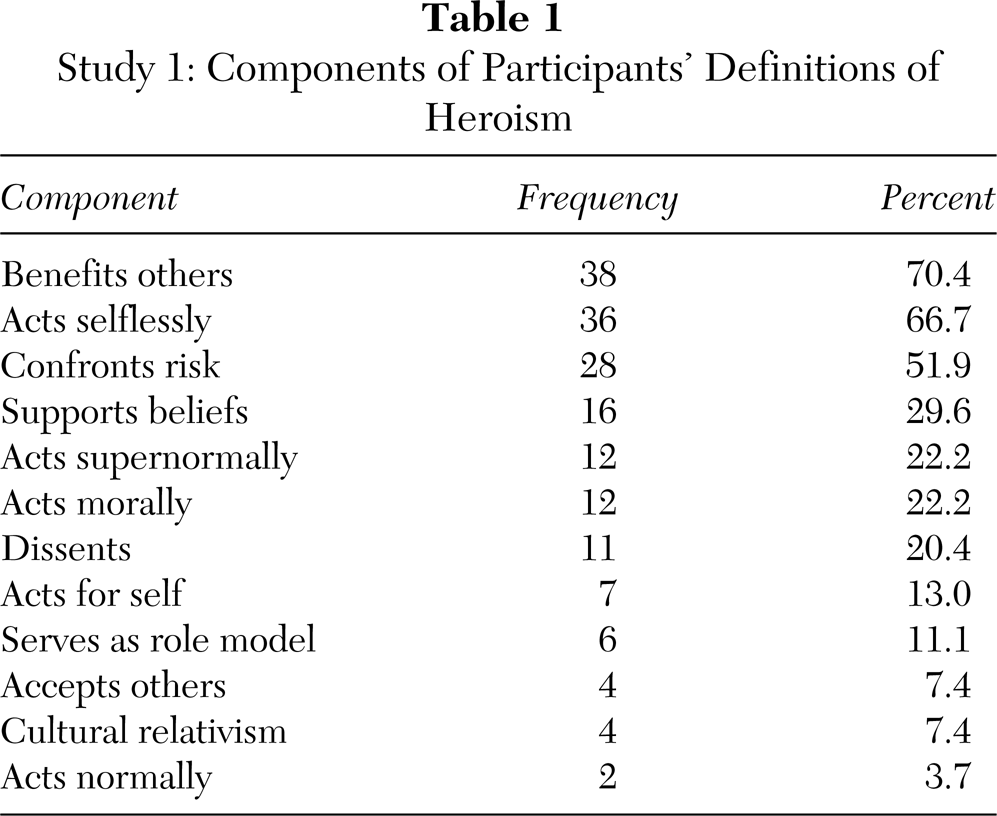
Other frequent components included (a) supports beliefs (e.g., “standing up for what you believe”), (b) acts supernormally (e.g., “doing something beyond what is expected”), (c) acts morally (e.g., “doing what is just and right”), and (d) dissents (e.g., “going against popular opinion”). Participants occasionally had atypical definitions. For example, in contrast to the more frequent acts super-normally, a small number of participants cited as heroic the component acts normally (e.g., “they live an average everyday life and struggles”). Some participants had opposing components within their definition. For example, 3 of the 7 participants who included acts for self (e.g., “putting all their efforts into achieving their own definition of success”), which is inconsistent with the more typical definitions, also included acts selflessly elsewhere in their definition.
Although four participants included cultural relativism in their definitions (e.g., “it changes with time. Society's norms define heroes, which differs year to year, and even day to day”), they all included other components as well.
Identification of Heroes
On the naming task, participants reported 157 public heroes and 42 personal heroes. For public heroes, 48 participants reported three heroes, 6 reported two, 1 reported one, and 1 reported none. For personal heroes, 1 participant reported three heroes, 7 reported two, 25 reported one, and 23 reported none.
Table 2 displays the frequency of each role category for the public and personal heroes. The most common roles for public heroes were activists (e.g., Martin Luther King Jr.), political leaders (e.g., Abraham Lincoln), rescuers (e.g., firefighters), and soldiers (e.g., troops in Iraq, World War II veterans). The most common roles for personal heroes were family guardians (e.g., parental caretaking and sacrifice) and people who met challenges (e.g., cancer survivors). Among these personal heroes, (a) 61.9% were related to the participants, 31.0% as parents and 19.0% as grandparents, and (b) 21.4% were friends or family friends.
Study 1: Roles of Individuals and Groups Named as Public and Personal Heroes
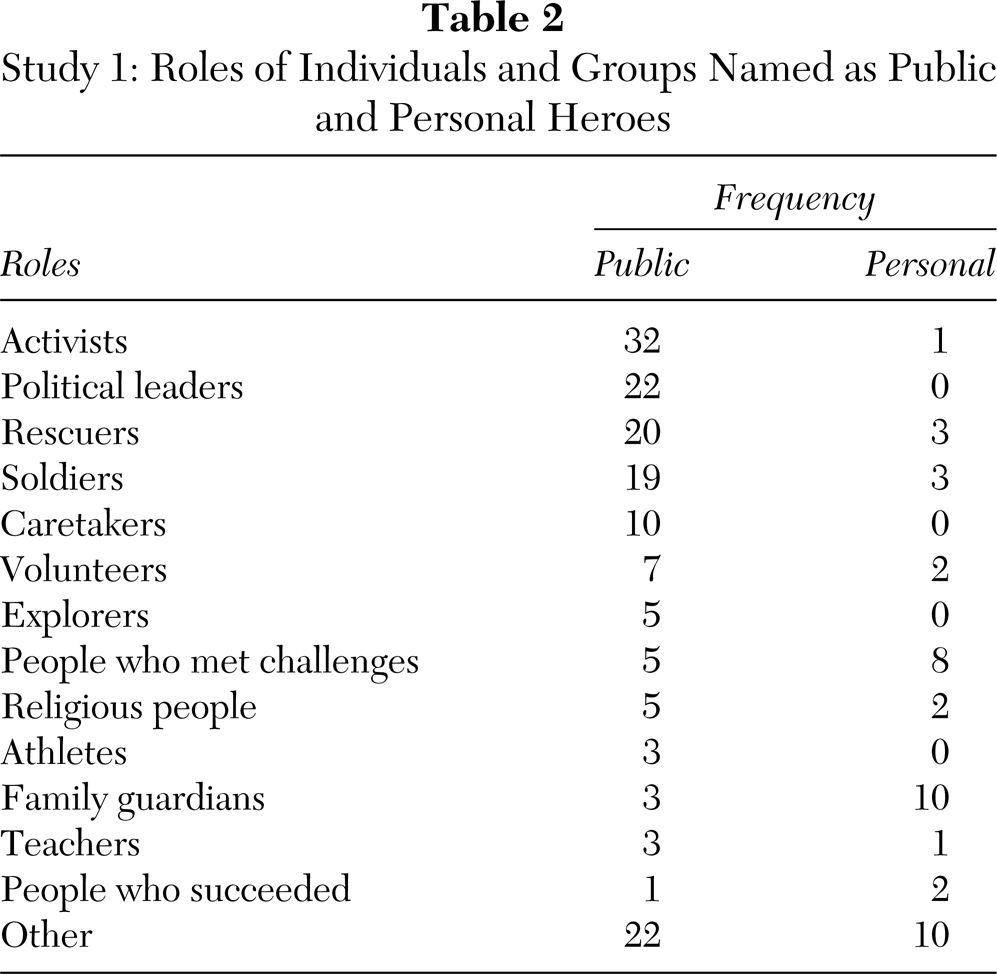
The four most commonly named individual public heroes and their classification in our coding system were Martin Luther King, Jr. (n = 14), an activist; Abraham Lincoln (n = 8), a political leader; Mother Teresa (n = 7), a caretaker; and Mohandas Gandhi (n = 5), an activist. King and Gandhi accounted for over half of the activists, the most frequent role.
We do not report the most commonly named groups because their identities often overlapped, as, for example, firefighters, police officers, and emergency personnel involved in 9/11 (all coded as rescuers), who were sometimes named together and sometimes cited separately. The groups firefighters and police officers were common as public heroes in the rescuers category, with a few participants naming less specific rescuers such as “Anyone who puts themselves in danger for the life of someone else.” Also, among rescuers, no public heroes and only two personal heroes were specified as carrying out spontaneous emergency rescues not prescribed by an occupational role (e.g., “A family member jumped into a manure pump station … trying to save another [family] member and both were trapped”). Also, only groups were cited in the soldiers category (e.g., military, soldiers in Iraq, Army Rangers, veterans of World War II).
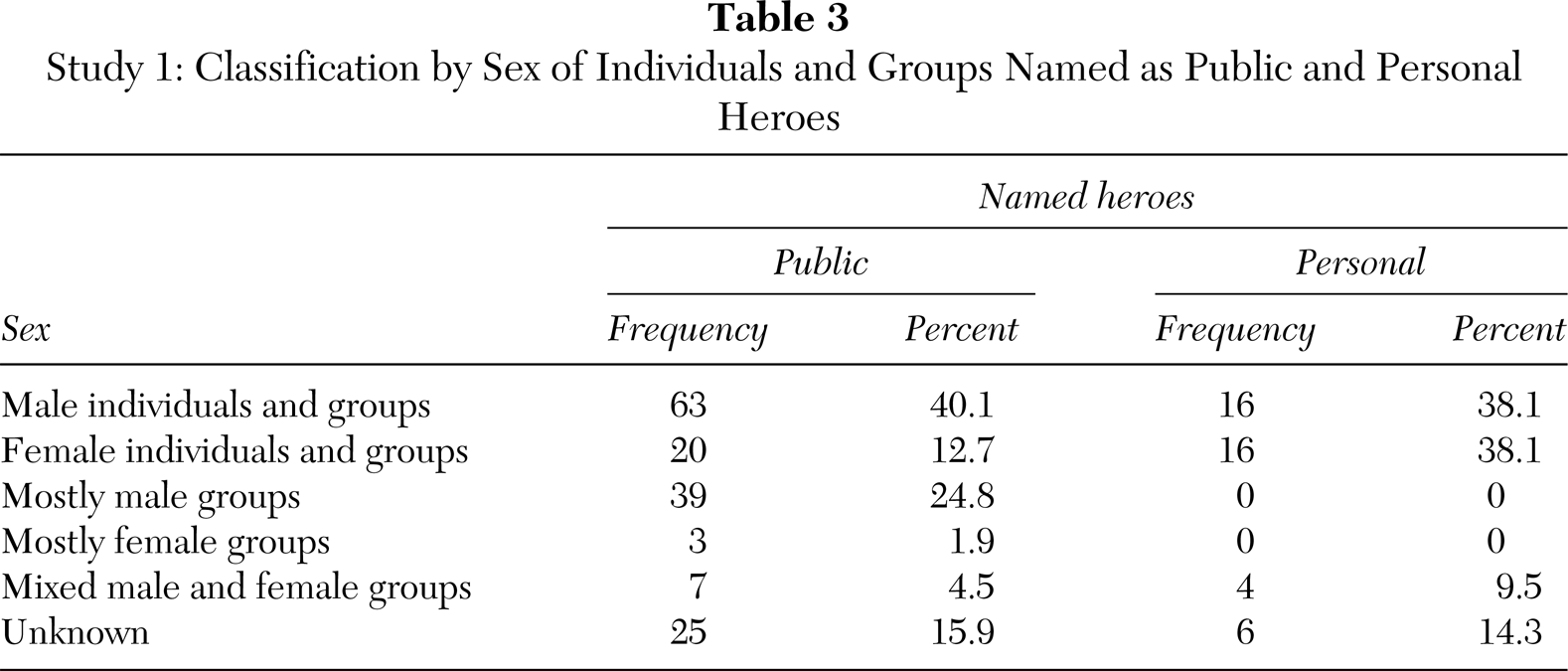
Table 3 contains the frequency and percent of public and personal heroes in each sex category. Comparing the sex distributions of the public heroes versus personal heroes showed that a larger proportion of female (vs. male) heroes were named as personal heroes than public heroes, χ2(1, n = 115) = 6.05, p = .014. In addition, the proportion of female heroes was greater for personal than public heroes if the mostly female category was combined with the female heroes, and the mostly male category was combined with the male heroes, χ2(1, n = 157) = 11.99, p <.001. Finally, a larger proportion of female than male participants named public heroes who were female (vs. male), χ2(1, n = 80) = 5.05, p = .025, and, on a marginal basis, who were in the combined categories of female and mostly female (vs. male and mostly male), χ2(1, n = 117) = 3.13, p = .08. Also, a larger proportion of female than male participants named personal heroes who were female (vs. male), χ2(1, n = 29) = 7.96, p = .005.
Study 1: Classification by Sex of Individuals and Groups Named as Public and Personal Heroes
Discussion
Overall, the findings supported the hypothesis that risking oneself to benefit others is regarded as heroic. Both of these risk and benefit elements were common in participants' definitions and often appeared together. In these definitions, risk was usually described in general terms and thus did not necessarily refer to physical risk. The element acts selflessly was also common and connoted risk and benefit because it referred to showing more concern for others' welfare than one's own.
Definitions of heroism sometimes contained other elements. One of these additional themes was supports beliefs or dissents, showing that people who take ideological stances can be regarded as heroic. Such heroism benefits abstract ideas, whereas our benefits others category focused on benefitting specific people. The additional themes of acts morally and role model suggest that heroism can be embodied by people who symbolize important community norms and values. The theme of acting supernormally is more ambiguous and could reflect any of a variety of behaviors, including those that involve risk taking, dissent, or moral action.
People identified as heroes appeared in a range of social roles. For public heroes, activists, political leaders, rescuers, and soldiers predominated, with some political leaders also acting as soldiers or activists. Less commonly, public heroes emerged as caretakers, volunteers, and religious people.
The role distribution of the heroes known personally by the respondents differed markedly from that of the public heroes. For personal heroes, family guardians and people who met challenges predominated, and the majority of these people were related to the participant. These findings show that people do recognize heroism in everyday life, primarily in family contexts. Family members, and sometimes friends, become heroic when they care for others and meet challenges, for example, involving disease or disability. These findings reflect the flexibility of definitions of heroism, whereby in everyday life the term hero is often used to label friends or family members recognized as virtuous or admirable. Also, because such acts occur in private settings and are not observed by a wider audience, they ordinarily yield acclaim only within small circles of family and friends.
Consistent with the cultural association of heroism with men and masculinity, men and mostly male groups predominated as public heroes. Among the four most frequently named individual heroes, three were male activists or political leaders who were assassinated (King, Lincoln, and Gandhi), thereby giving testimony to the risks that they faced. The only individual woman who was mentioned by several participants, Mother Teresa, was a caretaker on a grand scale, personally serving the sick and dispossessed and organizing others to perform such acts.
The predominance of men and mostly male groups among the public heroes is inherent in the types of roles that have yielded heroism. Rescuers appeared primarily in male-dominated occupational roles, such as firefighter and law enforcement officer, that have become accessible to women only in recent years. Soldier and political leader are similarly male-dominated roles. Although women led social movements (e.g., women's suffrage, temperance, and feminist movements), men such as Martin Luther King have occupied more of the activist leadership roles that bring maximum public recognition. In contrast to public heroes, personal heroes encountered in everyday life were male or female in equal frequencies. Thus, women as well as men emerged as extraordinary for serving as family guardians and for meeting life's unusual challenges, activities that rarely yield widespread public recognition and admiration.
STUDY 2
Our second study pursued the definition of heroism in terms of risk and benefit to others using a scenario method, which allowed the manipulation of these two definitional components, along with the sex of the potentially heroic protagonist. We hypothesized that greater heroism would be ascribed to acts that entailed greater risk to the protagonist and greater benefit to others. Our scenario pertained to the prototypical heroic act of rescuing an endangered person, which is a generally male-dominated action (Becker & Eagly, 2004). To increase the plausibility of female as well as male heroism in this context, the scenarios portrayed (a) the protagonist as a rescuer who did not act within a male-dominated occupational role but instead happened to observe an emergency situation and (b) the victim as a “young neighborhood boy,” who thereby could be picked up by a woman or man, thus lessening the need for physical prowess. Other frequent roles that emerged in Study 1 were more problematic as potential candidates for the Study 2 scenarios. For example, the activist role might appear heroic only when consistent with observers' ideological beliefs; the roles of political leader and soldier are male dominated and also likely to elicit reactions that depend on observers' beliefs. Therefore, we selected a spontaneous rescue because it likely would be universally commended and, in appropriate circumstances, negotiable by both women and men. In such equal-opportunity contexts, the social construction of heroism should depend not on the protagonist's gender, but on the riskiness of the action and its benefit to the rescued person.
Method
Participants and Procedure
Participants were 222 introductory psychology students (82 men, 140 women) who participated for partial course credit. Their median age was 19 years with a range of 18 to 22, and they were 69.8% Caucasian, 13.1% Asian American, 6.3% African American, 6.3% Hispanic, and 4.5% other or unreported. Because of potential cultural differences, 13 students who were not U.S. citizens were excluded from the sample. Participants read about a heroic rescue, rated the rescuer's act, reported their demographic information, and then answered questions pertaining to their perceptions of gender.
Experimental Design and Manipulations
Participants read a scenario of a heroic rescue of an endangered young boy who had been playing ice hockey on a neighborhood pond and fell into the water when the ice broke. The boy was portrayed as trying to pull himself out but unable to do so because the ice kept breaking away. The protagonist slid across the ice and onto the water to rescue the child while the child's playmates phoned emergency services.
The protagonist was identified by a male or female name (Gary or Lisa, names that Kasof [1993] found to be similar in perceived competence and attractiveness). To manipulate risk, the protagonist reached the child using a device that he or she found at the edge of the pond and that allowed her or him to slide across the ice and float on the water. This device was (a) a plastic sled (high risk) or (b) a small rowboat (low risk). To manipulate benefit, the endangered child was portrayed as (a) tiring fast from trying to tread water and at risk of hypothermia and death (high benefit) or (b) able to hold on to an inflatable hockey net that kept him afloat but at risk of hypothermia (low benefit). The resulting between-subjects design was Risk (high vs. low) x Benefit (high vs. low) x Sex of Protagonist (male vs. female) x Sex of Participant (male vs. female).
Measurement of Dependent Variables
Perceptions of heroism, courage, virtue, and danger. On 7-point unipolar scales, participants rated the rescue on 12 items, the first of which was “heroic.” An exploratory factor analysis (maximum likelihood with promax rotation) of the other 11 items (excluding heroic), followed by inspection of the scree plot and eigenvalues, yielded two factors: courage (brave, daring, courageous, risky, self-sacrificing) and virtue (altruistic, noble, generous, unselfish, virtuous, beneficial). Scores on each set of items were averaged to produce measures of courage (α = .92) and virtue (α = .87). When heroic was included in the factor analysis, it loaded on both factors (.44 on courage and .41 on virtue), consistent with the expectation that heroism reflects both risk and benefit to others. Also, to assess danger to the protagonist, participants estimated (on scales ranging from 0% to 100%) the likelihoods of death, serious injury, or some injury for persons performing rescues in situations like the one in the scenario (α = .90).
Other measures. On 0% to 100% scales, participants estimated the likelihood that (a) they would perform the action depicted if they were present and had the necessary skills, (b) the percentage of men present in such a situation who would perform similar rescues, and (c) the percentage of women present in such a situation who would perform similar rescues. Then participants estimated the percentages of men (vs. women) among the people who generally witness such emergencies.
Results
Manipulation Checks
Study 2: Perceptions of Scenario by Manipulations of Risk, Benefit, and Sex of Protagonist
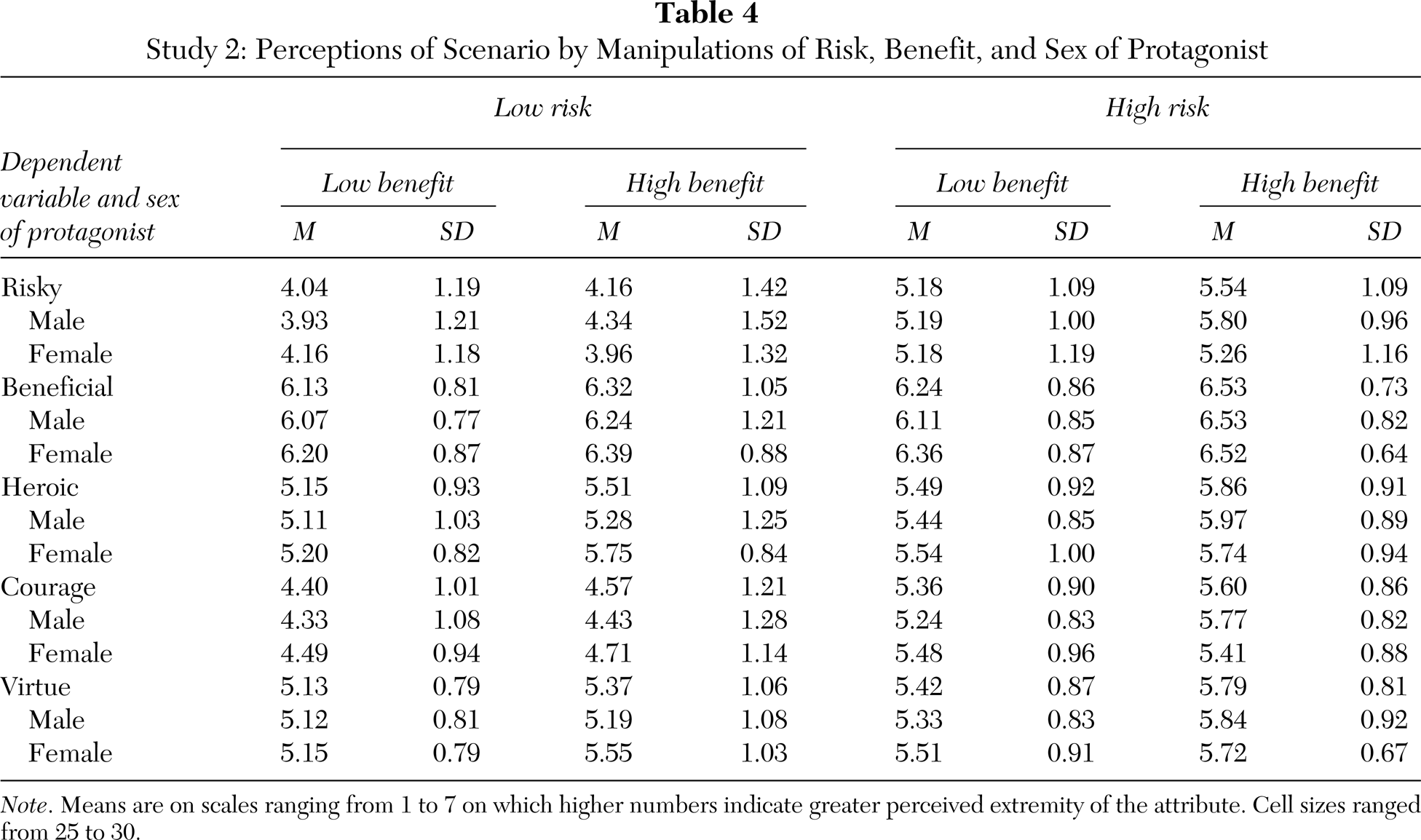
Note. Means are on scales ranging from 1 to 7 on which higher numbers indicate greater perceived extremity of the attribute. Cell sizes ranged from 25 to 30.
If the single items of risky and beneficial are treated as manipulation checks, they indicate that the risk and benefit manipulations were successful. Perceived riskiness was greater with high risk than low risk, F(1, 218) = 60.86, p <.001, ηp = .22, and unaffected by the level of benefit, F(1,218) = 2.21, p = .14. Perceived benefit was somewhat greater with high benefit than low benefit, F(1, 218) = 4.07, p = .05, ηp = .02, and unaffected by the level of risk, F(1, 218) = 1.80, p = .18. See Table 4 for means and standard deviations pertaining to these and other dependent variables.
Perceptions of Heroic Act
As predicted, the findings were consistent with the typical definitions of heroism in Study 1. Specifically, perceived heroism was greater with high risk than low risk, F(1, 206) = 6.76, p = .01, ηp = .03, and with high benefit than low benefit, F(1, 206) = 6.82, p = .01, ηp = .03. Male and female participants did not differ in their perceptions of the heroism of the protagonist, F(1, 206) = 0.07, p = .80, and male and female protagonists were rated as equally heroic, F(1, 206) = 0.76, p = .38.
Participants perceived the protagonist as showing greater courage with high risk than low risk, F(1, 206) = 54.21, p <.001, ηp = .21, and facing greater danger, F(1, 206) = 41.43, p <.001, ηp = .17. Participants perceived the protagonist as manifesting greater virtue with high benefit than low benefit, F(1, 206) = 5.27, p = .02, ηp = .02, and also with high risk than low risk, F(1, 206) = 9.15, p = .003, ηp = .04.
Participants reported a greater likelihood of performing the act themselves with low risk (M = 75.45, SD = 23.76) than high risk (M = 67.23, SD = 25.01), F(1, 206) = 5.37, p = .02, ηp = .03, and when they had read about a female protagonist (M = 75.65, SD = 20.70) rather than a male protagonist (M = 67.19, SD = 27.41), F(1, 206) = 6.88, p = .009, ηp = .03. The Benefit x Sex of Participant interaction was also significant, F(1, 206) = 5.30, p = .02, ηp = .03. Male participants reported somewhat greater likelihood of performing the act with low benefit than high benefit, F(1, 206) = 3.89, p = .05, whereas female participants were unaffected by the level of benefit, F(1, 206) = 1.46, p = .23.
Perceptions of Heroism by Women and Men
Overall, participants perceived men in general (M = 71.95, SD = 16.86) as more likely to perform such a rescue than women in general (M = 61.09, SD = 19.27), t(219) = 10.19, p <.001, given that they were present in the situation. Women's perceived likelihood of rescuing was greater when participants had read about the female protagonist (M = 65.33, SD = 17.98) compared to the male protagonist (M = 57.08, SD = 19.67), F(1, 204) = 10.42, p = .001, ηp = .05, and when the participants were female (M = 64.29, SD = 17.76) compared to male (M = 55.50, SD = 20.62), F(1, 204) = 8.91, p = .003, ηp = .04.
Participants perceived men as present more often than women when such emergency situations occur (M = 55.32, SD = 13.12 for comparison with 50% equal representation, 0% no men and 100% only men), t(219) = 6.01, p <.001. The estimated presence of women was greater with the female protagonist (M = 52.06, SD = 12.34) than the male protagonist (M = 58.41, SD = 13.13), F(1, 204) = 12.18, p = .001, ηp = .06.
Discussion
The findings support the hypothesis that an act's perceived risk to a protagonist and benefit to others underlie the social construction of heroism. Greater risk to the rescuer increased the ascription of heroism to him or her, as did greater benefit for the endangered child. The ascription of virtue to the protagonist, like heroism, reflected both risk and benefit, whereas the ascription of courage and danger reflected only risk.
These findings are consistent with the most common definitions of heroism offered by Study 1's community participants. Apparently, the elements of risk and benefit contribute independently to heroism, at least in the emergency situation described in our scenario—that is, the combination of high risk and high benefit did not convey heroism beyond that of the two elements. Nor did the sex of the protagonist affect the perceived heroism of the rescue.
The cultural association of men with heroism emerged in the perception of men as more likely than women to perform similar rescue actions and as more likely to be present in such emergency situations. The fact that the endangered child was a boy no doubt contributed to these perceptions. Nevertheless, there was no difference in male and female participants' self-reported likelihood of performing the rescue behavior. The inclusion of a female protagonist influenced participants to perceive women as relatively more likely to perform similar rescues and as having more opportunity to be present during such emergencies. This finding suggests that observation of heroic women can change the perception of women in general.
GENERAL DISCUSSION
In this research on the social construction of heroism, we sought, first of all, to establish the consensuality of the seemingly androgynous dictionary definitions of heroism in terms of risking oneself for the benefit of others. Because definitions of this type combine a culturally masculine element (taking risks) with a culturally feminine element (devoting oneself to others), it is not clear on definitional grounds why heroism is associated with men and masculinity. Therefore, we sought to explain why such a construal of heroism does not result in people regarding heroism as equally prevalent in women and men. As initial research into the social construction of heroism, our studies have limitations (e.g., lack of large, representative participant samples). Nonetheless, they yielded a number of important findings.
As expected, participants in Study 1 typically volunteered risk to oneself and benefit for others as separate components of the definition of heroism or merged these components in the idea of selfless action. Yet, some participants reported additional meanings of heroism, including supporting beliefs or dissenting, acting supernormally, acting morally, acting for oneself, serving as a role model, and accepting others. A few participants even noted the influence of cultural or historical context on how heroism is defined.
To provide additional evidence that the apparently common risk plus benefit definition of heroism is widely accepted, Study 2 manipulated these two definitional elements of heroism in a rescue scenario. Both risk and benefit increased the perception of heroism, as expected, and male and female protagonists emerged as equally heroic. Although the association of men with heroism appeared in estimates of the greater likelihood that men in general would perform such heroic acts, exposure to a female protagonist increased estimates that women would be heroic in such situations.
Our first study provided at least a partial answer to the question of why heroism is male dominated, despite its defining elements of risk to oneself and benefit to others. We found that people widely recognized as heroic (public heroes) generally performed their extraordinary actions within social roles to which women do not enjoy equal access. Occupations in which people perform emergency rescues are highly male dominated, as are leadership roles in politics and many social movements. Biosocial challenges pertaining to women's lesser size and strength, along with cultural stereotypes, may discourage women's participation in some of these occupations (e.g., firefighter; Wood & Eagly, 2002). Although historically women have had access to important leadership roles in some social movements, it is the civil rights movement, led primarily by men, that remains most salient in the United States. Yet, roles less commonly occupied by the public heroes nominated by our respondents (e.g., caretakers, volunteers, people who met challenges, teachers) have offered greater opportunities for women's heroism.
Women emerged relatively more often as heroes who were personally known to participants. In this context, the most common types of heroes were people who met challenges and family guardians. These heroes generally reflect looser definitions of heroism than the risk plus benefit concept that appears to be maximally consensual. People who meet challenges, such as fighting cancer, for example, may serve as role models of courageous endurance, but their behavior does not ordinarily consist of taking risks for others' benefit.
The relatively greater concentration of women as personal than public heroes reflects the still present but ever-weakening division of labor in society wherein the activities of women are concentrated in the private sphere and those of men in the public sphere. This division of labor influences not merely heroism, but other forms of altruism (Eagly & Crowley, 1986). Yet, even if the labor force participation of women comes to equal that of men, it is unlikely that men and women will be distributed equally into all occupations and jobs. Nevertheless, to the extent that women increase in number in rescuer occupations, military roles, and leadership roles, public heroism would be recognized more commonly in women as well as men, and the cultural association with men and masculinity may weaken.