







Abstract
The purpose of this study was to articulate a model of how Latinas cope with childhood sexual abuse (CSA) and the ways in which personal and cultural variables influence their coping strategies. Nine women who identified as Latina and as survivors of CSA participated in an in-depth interview. The data were analyzed using a grounded theory methodology. Results suggested that participants' coping efforts were influenced by a variety of cultural factors and that they engaged in a wide range of coping behaviors, all of which served two main functions: (1) seeking relief from negative emotions and (2) protecting one's self from further abuse.
In the last two decades, much theoretical and empirical attention has been given to the area of childhood sexual abuse (CSA), and more recently, scholars have begun to focus on how cultural factors may influence how one experiences and copes with sexual abuse (Fontes, 1995, 2005; Fontes, Cruz, & Tabachnik, 2001; Franco, 2006; Mennen, 1995). However, further attention is still needed to expand on current models of coping by examining socially, culturally, and individually determined mechanisms that influence how a woman copes with the experience of being sexually abused.
A few scholars have suggested that values, beliefs, and practices that are specific to a certain cultural group may influence how a survivor copes with her experience of CSA. For example, Fontes (1993a) argues that CSA should be viewed through an ecological lens. According to ecological theory, an individual is seen as nested in various layers of social domains that are highly interconnected and interactive. The individual level consists of the experiences and characteristics of the individual, which may include interpersonal experiences such as a history of abuse, as well as personal conditions such as developmental level, personality traits, and health. The family level includes the victim's and/or offender's family history; the interactions of family members; and family beliefs, norms, and practices (Fontes, 1993a).
The cultural level consists of the parts of an individual and family's culture that stem from the community in which he or she is embedded. Finally, the wider societal level includes social institutions, such as the legal system; indicators of social standing, such as economic class; and social forces, such as discrimination. Most of the writing on CSA has focused on the inner two levels: the levels of the individual and the family. It seems important, however, to redirect attention to the outer two levels of culture and the wider society. In fact, it could be argued that coping with an experience such as CSA is likely to be influenced by all four levels.
Similarly, some theorists have suggested that certain characteristics of Latino culture may influence how a survivor copes with CSA. Some of these characteristics include values and beliefs such as respect, familismo, and the clear demarcation of gender roles, which include machismo and marianismo. Whereas machismo refers to male characteristics that are valued within the cultural context, such as physical strength, power over women, and sexual prowess, marianismo includes the ideals of feminine passivity and sexual purity, where the ideal woman is emotional, kind, docile, compliant, vulnerable, and unassertive. Such cultural norms in Latino culture also dictate that women must remain sexually pure and abstain from sexual activity unless explicitly for procreation. Any deviance from these prescribed behaviors is believed to be a woman's fault, which in cases of sexual violence can translate into blaming the victim and exonerating the perpetrator. Familismo refers to the high level of interpersonal bonding within the family, resulting in greater integration and dependence within this group (Arredondo, 2002; Comas-Diaz, 1995). The aim of the present study was to develop a deeper understanding of the lived experiences of Latinas 1 who were sexually abused as children and of how the Latino culture may affect these experiences.
METHOD
Design
Because this was a discovery-oriented study, the investigation used a qualitative methodology. Specifically, a grounded theory method (Strauss & Corbin, 1998) was used, based on open-ended, semi-structured, in-depth interviews. This particular method utilizes a set of structured procedures to generate constructs grounded in the participants' experiences.
This study was conducted by a research team consisting of seven individuals. The study was designed and implemented by the primary researcher, a graduate student in Counseling Psychology who identified as Latina (having grown up in Paraguay and Brazil). The remainder of the research team was composed of a faculty member, a graduate student, and four undergraduate students from a variety of ethnic backgrounds. The research team met weekly for 2 hours during a 1-year period for the purpose of data analysis and theory articulation.
Participants
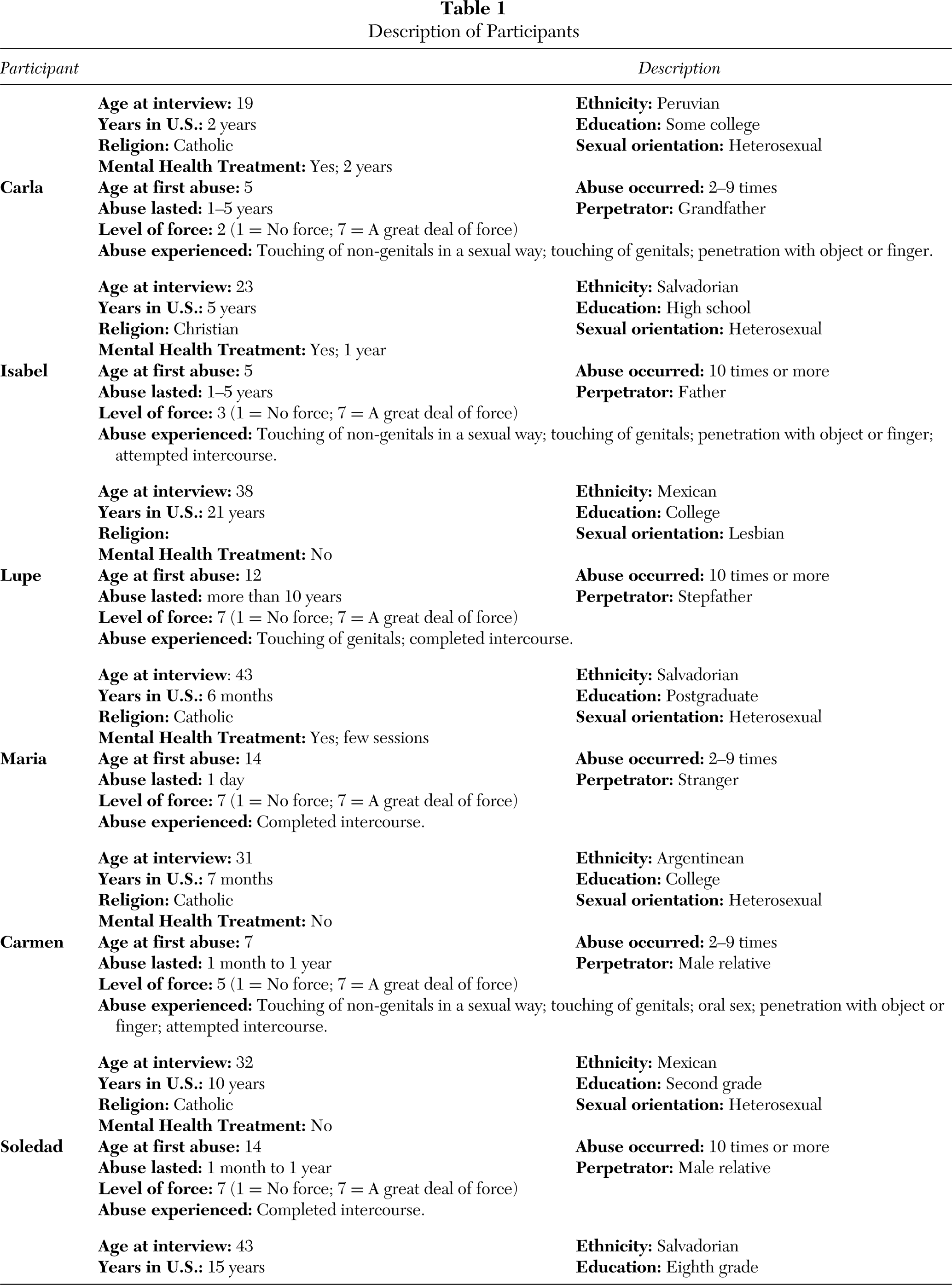
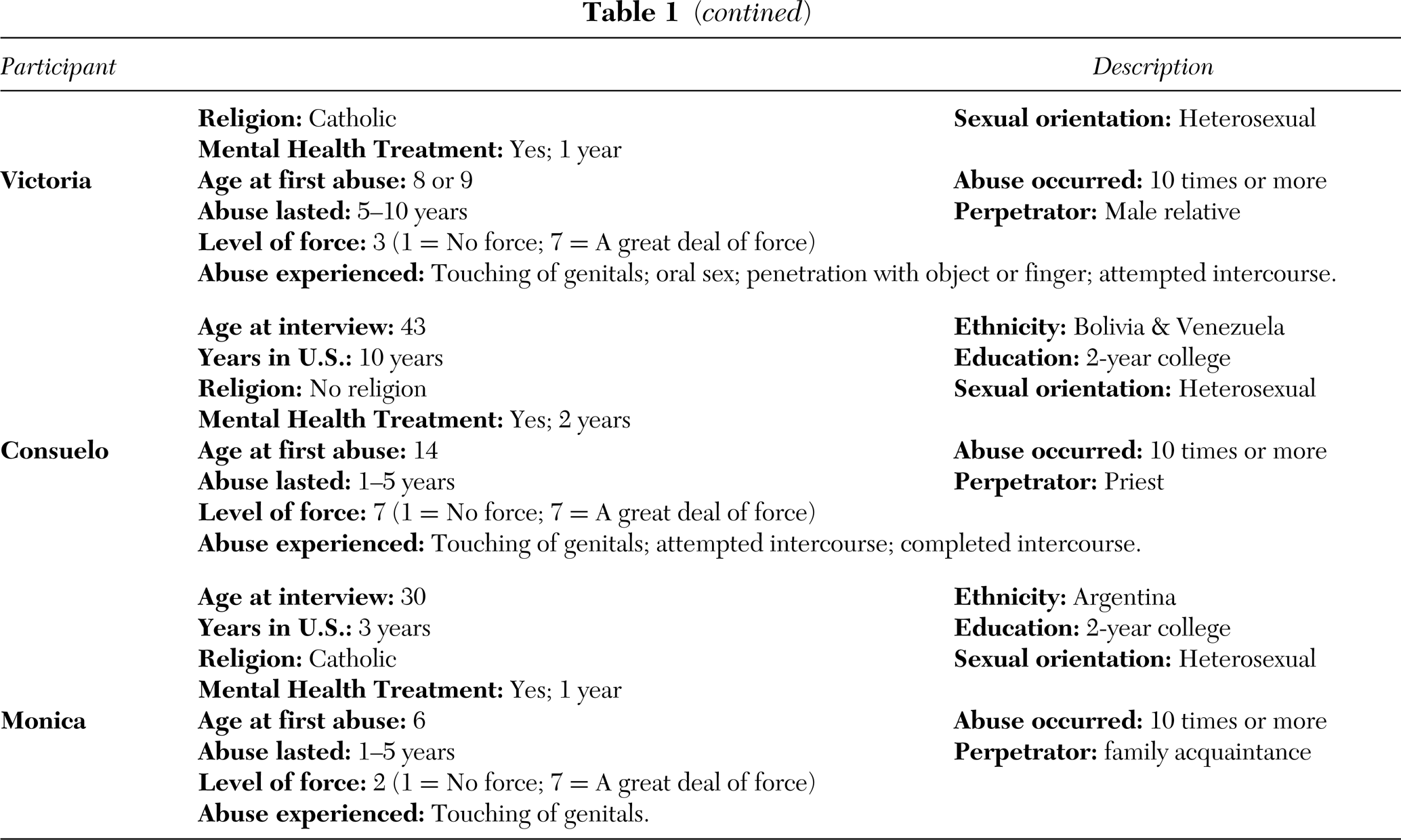
The participants were nine Latinas who had experienced CSA. To participate in the study, women had to meet the following criteria: (a) experience of some form of CSA before the age of 15, (b) be willing to discuss issues related to their abuse, (c) feel able (emotionally and cognitively) to participate in an extended interview, and (d) identify themselves as Latina. The nine women represented a diverse cross-section of the Latina population in terms of age, country of origin, marital status, and educational level. Additionally, there was a great deal of variation in terms of the sexual abuse they experienced (e.g., age of onset, frequency, level of force, etc.). Table 1 includes a complete description of each of the participants using pseudonyms to describe them. Participants were recruited through advertisements on a Spanish-speaking radio station and in several Hispanic and non-Hispanic newspapers.
Instruments
Because this study focused on Latinas, participants' ability to read and speak English was unknown. Therefore, all instruments, flyers, letters, and forms were available in both English and Spanish. In addition, because the primary researcher is fluent in Spanish, all participants were given the option of completing the interview in English or in Spanish.
Demographic questionnaire. Prior to the interview, participants were given a brief demographic questionnaire, which requested personal information and information about the participants' experiences of CSA.
Interview protocol. The primary instrument in this study was an in-depth, semi-structured interview protocol. It included primarily open-ended questions in order to avoid imposing existing constructs on the participants and biasing their responses. An initial interview protocol was piloted with two Latinas and revised based on their feedback.
Procedure
After contacting the primary researcher and being given a detailed explanation of the study, women were asked if they would agree to participate, and if they did, an interview was scheduled. All interviews were conducted at a local community mental health clinic for Latinos. The rationale for conducting the interviews at this location was that, if women were interested in seeking counseling to continue discussing their abuse or any other problems, it would be easier to schedule an appointment, as they would already be familiar with the facility. This seemed especially important for women who were not receiving professional help and who may have had a strong emotional reaction to participating in the study.
The interview. All interviews were conducted by the primary researcher, a bilingual Latina with 5 years of experience conducting assessment and counseling interviews. Participants were given the choice of completing the interview in English or in Spanish. Seven women chose to complete the interview in Spanish, and two chose to complete it in English. The interviews lasted from 60 to 90 minutes, with most lasting approximately 60 minutes. At the end of the interview, participants were given a short debriefing form and a list of resources.
Strategies for enhancing interview rapport. Because qualitative research depends on personal interactions for data collection, establishing rapport with the participants was essential. The establishment of rapport was particularly important to this study because the topic discussed during the interview was highly sensitive and personal. To establish strong rapport with the participants, some Latino cultural norms were included as part of the methodology at the beginning of the interview. These norms included building trust and the cultural script of “simpatia,” through approximately 10 minutes of initial small talk. In addition, the use of Spanish also contributed to the establishment of trust and rapport (Gomez et al., 2001).
Description of Participants
Data Analysis
The data collected through the interviews were analyzed using the basic principles of grounded theory. The goal of this method is to allow constructs to emerge directly from the data and thus presumably reflect the participants' experiences accurately. Strauss and Corbin's (1998) grounded theory involves several steps in which researchers extract basic concepts from the transcripts and organize them into increasingly comprehensive categories.
Transcriptions. The primary researcher transcribed all interviews and also translated the seven interviews that had been conducted in Spanish. To ensure the quality of the translation, two of the seven translated transcripts were selected randomly and reviewed by a professional translator. No problems were evident in these two transcripts, and the other transcripts were assumed to be adequately translated.
Coding. Theoretical constructs describing how Latinas cope with CSA were generated by the successive organization of concepts, categories, key categories, and the core category found in the transcribed data. This process involved coding at three different levels. In Level I coding, or open coding, the transcripts were broken down into minute and discrete parts, such as a word, phrase, or sentences (Strauss & Corbin, 1998). These discrete parts were then categorized and labeled as a concept, using participants' own words. Each concept consisted of a concept label, the participant's exact words, and an address that provided the location in the transcript.
The next step in open coding, referred to as Level II coding, involved the development and naming of categories (Strauss & Corbin, 1998). Categories are higher order labels that encompass several concepts. Once the master list of categories was generated, the categories were further understood by describing them in terms of properties (the characteristics of a category) and dimensions (the location of a property along a continuum; Strauss & Corbin, 1998). Categories were deemed by the researchers to be saturated when all of the participants' experiences fit into existing categories and all researchers agreed that the creation of new categories did not add any new information. In other words, once all the concepts described by the participants could fit into the smallest number of categories, and categories reflected the experience of all participants, the researchers agreed that saturation had been reached.
The next level of coding, Level III or axial coding, was used to determine explicitly how the categories generated in open coding were related (Strauss & Corbin, 1998). By comparing and contrasting categories in Level II coding, relationships among them emerged and were made explicit. Once the relationships among categories had been explicated, key categories were developed (Strauss & Corbin, 1998). Key categories provide a higher-level abstraction of the meaning of and relationship among the categories.
The final level of coding, selective coding, involved “the process of selecting the core category, systematically relating it to other categories, validating those relationships, and filling in categories that need further refinement and development” (Strauss & Corbin, 1998, p.116). The theory was then developed during several research team meetings in which team members expressed and discussed, both visually and verbally, their conceptualization of the emerging theory until consensus was reached.
RESULTS
Overview of the Emerging Model
The emergent theory is a dynamic, fluid model of person-environment interaction, based on personal and cultural spheres of influence, which affected how the women in this study saw themselves, what they felt and thought, and how they behaved. This model depicts the process of surviving CSA, as well as other forms of abuse and violence, and reflects the strength and resilience of the nine women in this study who so bravely shared their stories. An illustration of the emerging theory is presented in Figure 1.
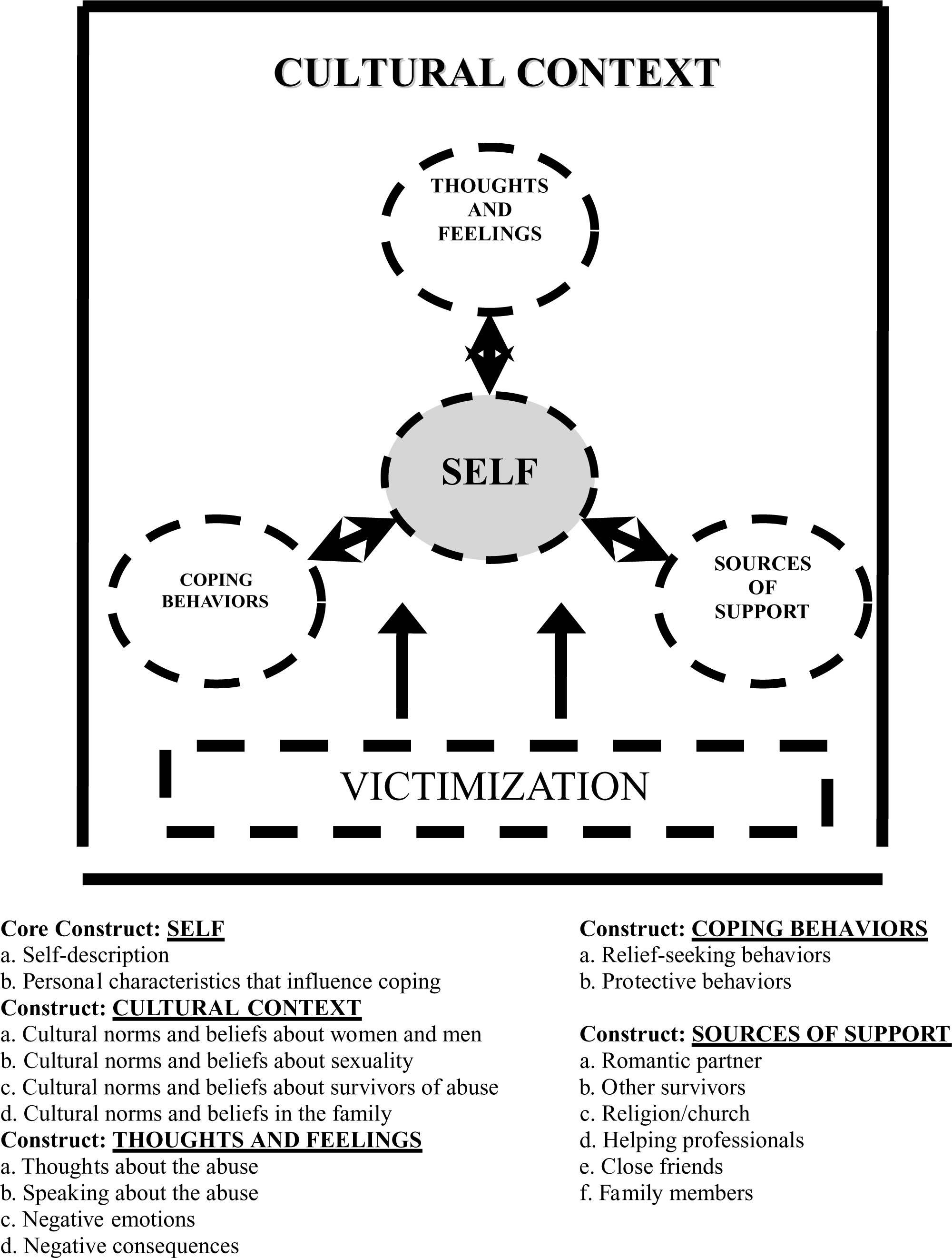
Graphic representation of the emerging model of Latinas coping with childhood sexual abuse.
The core story, or Self, is represented in the middle of the diagram. It affects and is affected by all the other parts of the model, all of which are embedded in the Cultural Context. The Cultural Context includes cultural norms about women and men, about sexuality, about survivors of abuse, and about family. All main parts of the model are depicted in permeable circles to indicate that the Cultural Context influences every part of the model.
Core Category: Self
The core category in grounded theory is the central phenomenon around which all other categories are organized (Strauss & Corbin, 1998). As illustrated in Figure 1, at the center of the emergent theory is the essence of who these women are, or Self. This Self is composed of the women's self-descriptions and their personal characteristics that influence coping.
Self-description. The women in this study described themselves in a variety of ways, which indicated that, from their perspective, there was much more to them than the abuse they had experienced. In other words, although all the women talked about their abuse as something that had affected them very deeply, they also talked about other important parts of their identity that made them who they were.
All of the women talked about their ethnicity as an important part of who they were. Several of the women described personal characteristics that they felt described them as people: “I'm joyful, sentimental, hard-working” (Isabel); “I'm a very outgoing person, I like people a lot” (Lupe). For several of the women, family was an important part of how they described themselves.
Personal characteristics that influence coping. Another component of the Self for the women in this study included personal characteristics that helped them cope with their abuse. All of the women described being strong and not giving up as one of the most important aspects that allows them to cope with the abuse they experienced. This strength is exemplified in a variety of ways. Consuelo talked about her courage and her constant search for a better life: “I am courageous, and I am always looking for something better for me.”
Several of the women indicated that this strength and persistence not only helped them cope with abuse they had already experienced, but it also helped them prevent or stop ongoing abuse. Soledad talked about her physically abusive older brother, with whom she lived in the United States: “When he hit me once, I told him, ‘You're not my father! My father never hit me and you want to hit me, you don't have the right! I stood up to him.” The strength was also characterized by a strong desire to live a better life and to be freed of the negative impact of their abusive experiences. This desire to be freed from their pain was characteristic of all the women in this study: “I believe that trauma is like a big chain with handcuffs that enslaves you. As I'm able to let go of these chains, I become free” (Maria).
Another personal characteristic that affected how the women coped with their abuse was being secretive. Most of the women described being very secretive and not telling others about their abuse or their feelings while they were being abused. For some women, this was a way of surviving what they were going through: “I've been strong. I have pretended and not said things, even though I felt bad inside” (Isabel).
Cultural Context
This section details the cultural norms, beliefs, and expectations that the women in this study perceived as being part of their lives. Culture, in this case, refers primarily to the ethnic group with which each woman identified. All the women identified themselves as Latina or Hispanic and also as coming from a specific Latin American country. Each woman responded according to what was salient to her in her life experience as a Latina and as a member of a specific subgroup of Latinos. The main Cultural Context that the participants identified included cultural norms and beliefs about women and men, sexuality, survivors of abuse, and norms in the family.
Additionally, the experience of victimization was also part of the context in which these women lived or continue to live. It is important to note that, although all the women in this study were selected based on their experience of CSA, six of the nine had experienced repeated forms of victimization. These included CSA by another perpetrator, sexual assault, attempted sexual assault, relationship violence, and/or sexual harassment. All of the participants described their cultural context as being one in which the sexual exploitation and/or subjugation of women was acceptable, with men having more rights than women in this area.
Cultural norms and beliefs about women and men. One of the main characteristics of the participants' cultural context was the presence of machismo. All of the women described in various ways how machismo was ever present in all facets of their lives: It affected how they behaved, what they believed about themselves, and how they interacted with the people around them. Most of the women in the sample explained that a common cultural norm or belief they experienced is that men feel they own women, and women often are viewed as property. Maria explained: “Men consider themselves owners of women; women are property, objects, so the men can do whatever they want with women.” Victoria also shared her thoughts: “Our men, Latinos, treat their partners like someone below them, like they're taking a slave into their house, someone that needs to do everything they say so that the relationship works.”
All of the women in the study also described the fact that women are taught to be wives and to be responsible for domestic tasks and chores. Several of the women also described the fact that women are taught to be submissive and to obey men. In other words, to be considered to be a “good woman,” it is necessary to obey male authority figures, such as fathers and husbands: “When I was a child, I was always taught that a man is the boss of the house, and that women should be submissive, that she should not say anything, or make any decisions” (Consuelo).
Finally, several women described how what people in one's community think or say about women is very important. For example, Carla explained: “Well, once you get married, if the husband is not good to you, you are not supposed to leave him because of what people might say.”
Cultural norms and beliefs about sexuality. All of the women noted that sex was not something that was openly talked about or taught, especially by women. Consuelo explained: “Sex was seen as something dirty, something that we were not supposed to talk about,” and Carmen shared her experience: “We're taught very little, actually. We are taught the very basics of sexual development and to be careful so that we will not get pregnant. But there is no sexual education for women. So I have turned to books a lot.”
Most of the women also described the fact that virginity before marriage is valued a great deal for women: “[Y]ou're not supposed to have sex before you get married” (Monica). For Isabel, for example, this was particularly important in terms of having a church wedding, which she saw as something most women are expected to have: “If a man wants to marry a woman, especially in the Church, she must be a virgin, or else he will not marry her.”
Several of the women also described the fact that women who do have sex before marriage are seen as dirty or worthless: “[Sex is] something that makes women dirty, it leaves women tainted” (Victoria). Many women in the sample described the fact that men use women for sexual pleasure and that women are not supposed to enjoy sex. Sexual pleasure is seen as the man's domain, and women's pleasure is considered secondary to the man's: “The woman is there to reproduce only, not for pleasure” (Monica). Maria also explained her experience: “The truth is you're a sexual object, but not for your own sexuality, but for that of the man.”
Cultural norms and beliefs about survivors of abuse. Most of the women in the study felt CSA, as well as other forms of sexual violence, is not talked about: “Sexual abuse is something that they silence, it is not something people talk about, it's like people don't want to hear this” (Carmen). Additionally, these women explained that talking about abuse is made harder by all of the negative stereotypes associated with survivors of abuse.
As previously described, some of the women explained that talking about the sexual abuse might cause further abuse due to not being believed or being blamed for the abuse. Furthermore, the women also explained that having the label of being “tainted” or “used goods” could open the door to have other men abuse them further.
All of the women also indicated that a very common cultural belief about survivors of sexual abuse is that they somehow caused or provoked the abuse: “They see it like maybe it was their fault, that they provoked that themselves” (Lupe). Victoria also explained: “Sometimes they also think it's your fault, when this happens, like you ask for it or something. Like they ask you, what were you wearing, or something, like you made it happen.” Most of the participants also reported that, within their cultures, women who experienced sexual abuse are seen as different or tainted: “… that we are rameras, that we are whores” (Consuelo). Carla expressed her views, indicating that people in Peruvian culture view survivors “like you are very different, like a different group of persons. We are not the girl next door anymore, we are the girl next door who was sexually abused; so, we have that name wrapped around us.” According to Carla, this further leads to the notion that women who are sexually abused are damaged or tainted.
Finally, several of the women also indicated that men do not see abuse as important, nor do they take it seriously: “If she is raped or abused, I believe that, well, men don't really pay much attention” (Victoria). For example, Isabel noted that Latino men “would probably say that she is saying this [sexual abuse] because she wants to cover up, because she is not a virgin.”
Cultural norms and beliefs in the family. Some of the cultural norms and beliefs the women identified as part of their cultures in general were also very present in their family. Several of the women felt that they were not able to talk about their problems, like sexual abuse, because the silencing of problems was a norm in their families. For example, Carmen explained that, in her family, “it's always the same, yes everything is fine, all is going well. You talk about anything that is OK, and things that are more difficult, especially something like abuse, this is always silenced.”
Another cultural norm in the family that a few of the women mentioned was the protection of elderly family members. These women felt that they could not talk about the abuse because they feared the effects of disclosure on the health of elderly family members. For example, Isabel explained: “She [grandmother] still doesn't know. She is very old, and I love her very much, I know this would affect her a lot, her heart and everything.”
Finally, a few of the women felt that children were undervalued in their families. For example, Victoria explained what she felt in her family: “With children in general, it's like they are not real people. People do not usually ask, how was your day, how are you feeling, what happened at school today.”
Thoughts and Feelings
Thoughts about the abuse. The participants shared a variety of thoughts they had about their sexual abuse while they were being abused or shortly after it happened. For example, several participants experienced confusion around the time of the abuse or soon after it happened. The women experienced confusion primarily because they did not know for sure whether the abuse was wrong and because they did not know what to do about the situation: “I didn't know what to do, I didn't know who to tell, or anything like that” (Consuelo).
Speaking about the abuse. All of the women in the study described thoughts and feelings linked to the idea of speaking about the abuse they had experienced. Several of the women explained that they feared speaking about the abuse because they thought they would not be believed: “So for me, to say, this is happening in this group [the Church], I think they never would have believed me” (Consuelo). Isabel shared similar feelings: “… because one is scared, scared that they won't believe you.”
In addition to not being believed, some participants worried a great deal about other consequences that might result from speaking about their abuse. Soledad explained that she was scared that if she talked about the abuse she would be kicked out of her home: “I was scared to tell people what happened. If I talk, they will kick me out of the house and then where will I live?”
Even though many participants were afraid to talk about their abuse, particularly at the time that it was going on, most said that today they think talking about their experience is helpful. Carla explained: “… [T]here are too many things in your head and if you don't talk you go crazy; so always speak, talk about what happened.” In fact, a few participants wished they had spoken about their experience earlier. Most participants felt that, while the abuse was going on or soon after it happened, they had to learn how to deal with it on their own. Consuelo shared: “I felt I had no one; even though I had a great deal of family, I felt very alone, I felt alone.”
Negative emotions. The participants described several negative emotions that were a direct result of being sexually abused. These feelings were labeled as negative because the participants themselves described having these feelings as “difficult,” “hard,” “painful,” and so on. Although some of these negative emotions were felt only during certain periods of these women's lives, the majority of these feelings continued to surface and affected the women throughout their lives.
One of the negative emotions some of the women described was blaming themselves for the abuse. Some participants blamed themselves a great deal, as Consuelo did for years before seeking help: “I thought it was my fault, that I was a bad person, that I was dirty, that I did not deserve to be loved for several, several years.” A few participants experienced some thoughts of blaming themselves for the abuse, but not as intensely as the ones mentioned above. For example, Carla explained she continued to question why she was abused and sometimes still wonders if she had any blame: “Why did this have to happen to me? I don't know, I still don't know if it was something about me …”
A few of the women experienced shame at the time of the abuse and throughout their lives. In fact, shame has stopped these women from talking about the abuse with people who were close to them: “I don't know, I think, I feel ashamed, I don't want my family to look bad” (Consuelo). A few participants explained that they are no longer ashamed about what happened to them. Carla shared her feelings:
If I feel very comfortable with the person, like I know them for a long time, and I talk to them about everything, why shouldn't I share with them, it's a part of my life. I don't feel ashamed about it, it's just something that happened to me.
Most of the women described experiencing a great deal of anger. Some participants felt a great deal of anger toward the person who abused them. This was described as an ongoing feeling that they continue to experience whenever they think of what happened. Carmen explained: “Sometimes I feel anger. I was only seven; if he wanted to mess around why couldn't he find a prostitute or someone else?”
Although some participants described feeling a great deal of anger at the perpetrators, most participants described feeling a more general anger about the situation or at several people in their lives. Carla explained that, before entering therapy and dealing with her abuse, she was a very angry person: “I used to be very angry with myself and every single person. I would think why not her, why me? Why did this have to happen to me?”
Many of the participants described feeling a great deal of sadness, both while they were abused and throughout their adult lives. Monica explained: “I have a picture of myself when I was that age, and I look at it and feel sad.” Finally, several participants described feeling very lonely and isolated as a result of the abuse. This feeling was particularly present for the women while they had not told others about their abuse. Soledad explained: “I felt very empty and alone, even with a room full of people.”
Negative consequences. In addition to describing negative emotions associated with being sexually abused, the women in this study also described negative consequences of the abuse that affected their lives and relationships with others. For example, some participants described experiencing recurring images of the abuse, even years after it happened. These images were usually in the form of dreams or vivid memories. Lupe shared her experiences with bad dreams: “It's still kind of haunting me sometimes. I have a lot of bad dreams, I'm still dreaming about it, and I get angry more than when I was little.”
Most participants also described experiencing recurring thoughts about the abuse. For Monica, a lot of these thoughts make her feel vulnerable, but she tries to reassure herself that today she is safe: “I know that today I am an adult and I can help myself, that this will not happen again unless I want it to.”
Another negative consequence of the abuse was experiencing fear and distrust. Some participants felt a great deal of fear and distrust of people in general. Several women also described that a negative consequence of the abuse was experiencing fear or distrust of men. These feelings ranged from having a hard time getting close to men to fearing physical harm from men.
Finally, several of the participants believed that their history of sexual abuse affected the way they respond to sexual partners. For example, Carla thought that sexual activities were not as pleasurable as she would like them to be: “Like, when I first kissed a guy, it was like oh my God! I felt disgusted, instead of feeling pleasure or something.”
Coping Behaviors
Relief-seeking behaviors. These behaviors were used by the women to help them find relief from the various difficult and negative thoughts and feelings they experienced as the result of being sexually abused. Several of the women explained that one way they sought relief from their negative emotions and thoughts was by isolating themselves from other people. These women described that, often, having to act as if they were doing well, when in fact they were not, was draining and exhausting. Additionally, when painful feelings came up, these women found it difficult to function and to fulfill all their responsibilities. They explained that spending time alone helps them rest, recuperate their energy, and feel better:
Sometimes, I have two small children, I don't want anyone to talk to me. I feel like being alone, locked up in my room, that no one talk to me, nobody. Sometimes I tell my husband, take the children, I can't do it anymore (Soledad).
A few women described using drugs and/or alcohol as a way of seeking relief from feelings and thoughts they did not want to experience. Consuelo explained: “I found in alcohol, it was like a support, a way to overcome my pain, so I started drinking … I was a heavy drinker for some years.”
All of the women in the sample also described trying to bury the abuse and not think about it as a way to seek relief from thoughts and feelings that were overwhelming. In fact, some women used this behavior a great deal and explained that it helped them to continue functioning and living: “I think that to be able to continue living, I found a way of blocking it all out” (Victoria). Carmen explained: “I don't have a lot of memories about this; maybe it's because my attitude is that the best thing is to forget, it's the best way to let go of some things, so that one can continue to fight and live.”
Another behavior that the women used as a way to find relief from their pain was attempting and/or gesturing suicide. Most of the women reported attempting and/or gesturing suicide at some point in their lives. Lupe explained: “I tried to kill myself once when I was 13, and again when I was older. I don't know, I just felt a deep sadness about all that happened, and like there was really nothing [else] I could do.”
Some women in the sample described turning to the arts as a way of helping them feel better. This included reading, writing, and artistic expression, all of which helped the women find some form of relief. Carmen, for example, explained that, for her, books and literature are a safe haven and have been for several years: “In order to forget, I find refuge in literature. I love to read. I have a very special relationship with books, ever since I was very little … literature makes me very happy.” For Lupe, art is a way of transforming her painful experiences into something positive: “I like art, and I'm very artistic. And I try, somehow, to turn everything I went through in my life, to do creative things, to make them into something nice.”
Most of the women in this study found that seeking professional help allowed them to find a great deal of relief from their pain and suffering. For many, professional help was a last resort, when they no longer knew what to do to help themselves: “… [A]nd, well, finally I realized that I really needed help and I started therapy” (Victoria). Isabel explained: “[Talking to a psychologist] helped me a lot, because I could tell her everything.”
Finally, the majority of the women found that talking about the abuse, whether it was with friends, family, or professionals, was extremely helpful. Maria explained that, for her, speaking is the key to her healing, as it helps her organize her experiences and reactions:
And for me, the key is to speak. As long as you keep silent, you're only thinking about it and creating a labyrinth in your mind. But if you hear yourself you begin to organize it. If you organize it in your mind you can organize it in your life.
Protective behaviors. This section describes behaviors that served to protect the women or others from further abuse or from negative feelings. While the abuse was going on, or soon after it occurred, most of the women kept their experiences to themselves and did not share them with anyone. Most of them disclosed the abuse only years after it happened. The primary reason for this was fearing that they would not be believed, which could lead to punishment for lying or further abuse. Carla, for example, explained that she did not speak up because she feared the perpetrator would hurt others in her family if she did: “He implied that if I talked he would hurt somebody else. He never said it straight to my face, but he implied that. I was scared and I didn't know what to do, so I decided not to talk.”
Another way several of the women protected themselves was by straying from the traditional gender roles for women in their culture of origin. That is, they behaved in what was considered a less feminine manner as a way of protecting themselves. For example, Victoria explained that as a teenager she remembers she “did not want to be like the girls.” She explained: “I wanted to dress and be like a boy. I didn't like dresses. I did not want to feel like a woman. I would wear pants and dress just like a boy, I liked that.” For her, not being attractive to men was a way of protecting herself from further abuse. Defying traditional gender roles included getting bad grades, running away, and being violent: not being a “good girl” (Isabel); “when I was younger I was terrible!” (Monica).
The majority of the women also explained that, after they experienced the initial sexual abuse, they tried throughout their lives to actively protect themselves from other forms of abuse. Monica, for example, explained that “if someone grabbed me, like my ass or something, like if I was downtown, I would follow him until I reached him to scare him off.”
As a way of protecting themselves from future abuse, three of the women learned martial arts: “I went to karate on purpose, I wanted to learn how to defend myself” (Monica). Maria explained that, after being abused, “that's when I decided I would learn to defend myself.” Not only was this a way of protecting themselves, primarily from abusive men, but also a way of releasing aggressive and violent feelings in a socially acceptable way. Carla described really enjoying karate: “I can [fight], I can punch, and because it's karate they won't say anything; or I can do something violent and they won't say, ‘Oh my God! What's wrong with her?’”
Another way that many of the women in the sample used to protect themselves from abuse and from overwhelming feelings was to run away from their surroundings, including their family and country of origin. Victoria described her experience:
I came from El Salvador; I came here a while ago. The truth is that the situation over there is very difficult, especially with everything that happened to me. You know, I spent almost 15 years without going back to my country, it's like I didn't have the courage.
Finally, some women described avoiding the person who abused them as a way of protecting themselves. Victoria explained that, for her, it was a conscious choice: “Because while my mother was alive, I felt I needed to see him, for her. But after she died, I decided never again. I told him never to call me, never to speak to me again.”
Sources of Support
Romantic partner. The women in this study found highly differing levels of support from their romantic partners. A few of the women in this study felt that talking about their experience with their significant other was very helpful. Isabel, for example, had a positive experience:
With my husband, the most important thing is respect. From the beginning, I was honest with him. I think God has compensated me with my husband for all the pain I have lived with since I was a child. Because I have never been as happy as I am today … [Telling him] helped a lot, because we have no secrets. He is very supportive.
At the same time, a few of the women indicated that the support/help they received from their relationships was only somewhat helpful. For example, Soledad explained that talking to her husband was helpful, but he also revealed something to her that was not very supportive: “He told me, ‘if you had had a child, I would not have accepted you.’”
A few women indicated that their romantic partners were not at all supportive. Victoria explained that her husband was very hurtful: “[When I was depressed], it was too much, I was desperate, I could not get out of bed. And my husband at the time, he was not understanding, he kept telling me, you're lazy, all you want to do is lay around. He kept getting angry at me.”
In fact, two of the women talked about the fact that they seemed to choose abusive men as partners and that they think this was somehow a projection of how they felt about themselves. Consuelo explained:
I didn't like myself, so it was very hard for me to value myself for who I was … I always looked for very destructive relationships. I thought that people only liked me because they wanted to sleep with me.
Organizations and other survivors. Some women in the study found a great deal of support in organizations, primarily those where they could talk to other survivors of abuse and victimization. For example, Consuelo found a great deal of support in a shelter for battered women: “I was in this shelter a couple of times, and they supported me, they gave me resources, and I realized I was not the only one with these experiences, and I started looking for a therapist.”
Religion/church. A few of the women explained that they found a great deal of comfort and support in their church/religion. These women indicated that having a connection with their spiritual side was extremely important. However, although a few women felt that religion was helpful in dealing with their experience, some indicated that it was not. In fact, some described religion as making things more difficult. For example, Monica explained her experience with Catholicism:
They taught me what was right and wrong. And they made me feel bad because I was doing everything that I was not supposed to do … I felt guilty for everything that happened to me, like it was my fault … That I had to be forgiven for this abuse.
Helping professional(s). Several participants indicated that they felt very supported by a helping professional who aided them in working through their experience of sexual abuse. Carla explained: “I think it was very helpful because I never talked. And when I talked it wasn't easy. I felt like I was kind of alone. And when I came [to therapy] and talked, I just felt so great.” Likewise, Monica mentioned that having a therapist available to discuss what she feels is helpful, particularly in terms of helping her avoid thoughts or actions of self-harm. She explained:
A psychologist or anyone else here [at Clinica del Pueblo]; I wanted them to help me. I knew that alone I couldn't do anything. I think mostly I was scared of myself, I know I can get to the point of hurting myself a great deal. So, seeing someone now is very helpful.
Although several women found it helpful to talk to a therapist about their experience, a few did not. These women indicated being disappointed with the helping sessions they attended. Maria described her experience:
Two weeks ago I started with someone here (at Clinica del Pueblo), I have talked to her about other things but not this. But I haven't gone back, all of a sudden I realized that there are so many people who are not trained to deal with this. I don't know, I have lost so much faith, right now I have little faith in professionals.
Close friend(s). A few women in the sample explained that they felt understood and supported by a close friend regarding the abuse they had experienced. Lupe shared her experience as:
[I have told] only one person about the abuse. There was this lady that I used to talk about this with. I lived with her for like 4 years, well, like with her daughter. So she was like my mother-in-law. She was very understanding, and I talked a lot to her about what happened to me. She always listened to me. This is the only person, really, that I could open up to.
However, a few women felt that they could not trust their friends or that they would not be helpful or supportive. Consuelo, for example, described how her friends were not supportive when she wanted to get a divorce from her abusive husband:
I think a lot of people, like some friends, who were around me then [were not helpful]. I felt I could not trust them. They thought that in order to be happy, that women need to be in a relationship, because they're not worth anything if they don't have a man. I heard that many times. And so, in that aspect, I did not feel a lot of support. And, among all my friends, I'm the only one that is divorced.
Family members. Even though it was seen as extremely difficult to do, most of the women described disclosing the abuse to someone in their family—a concept that for Latinas often includes extended family—before telling a professional or friend. However, the responses to the disclosure varied a great deal. Some of the women in the study said they felt supported by certain members of their families. For these women, being able to talk about their experience with family felt comforting and reassuring. Isabel explained:
She (aunt) supported me by giving me advice, by trying to console me, and taking me to the psychologist. That everything had already happened, and now I needed to try to get over it, and not allow that (abuse) to destroy my life … it helped me a lot.
However, although some of the participants found comfort in disclosing their experience to family members, others did not. For example, Carmen shared her experience of wanting to talk about her abuse with her parents, who somehow realized she was being abused and sent her to see a therapist. However, Carmen was never sure how they knew and wanted to talk to them about her experience: “When I was older I tried asking them [her parents] about it but they never answered me, they would change the subject or ignore me.” This was very painful and confusing to Carmen, who felt ignored and silenced by her parents.
DISCUSSION
Relationship of Emerging Theory to Existing Theories of Cultural Influences and Coping With CSA
A useful model for understanding CSA within a cultural context was proposed by Fontes (1993a). In her model, she argued that CSA should be viewed through an ecological lens. This means that individuals are seen as nested in various layers of social domains that are highly interconnected and interactive. As previously discussed, these levels include the individual level, the family level, the cultural level (country of origin, ethnicity, class, language, etc.), and the wider societal level (institutions and social forces). The results of the present study suggest that coping with CSA is influenced by all levels and therefore the discussion will be framed using an ecological lens.
In this study, the Self, Thoughts and Feelings, and Coping Behaviors of the emerging theory can be understood as occurring primarily at the individual level. The Sources of Support construct can be understood primarily at the family and cultural levels, and the Cultural Context construct refers to both the cultural and wider societal levels. The family and individual levels are, of course, embedded within the cultural and societal levels and characterized by several determinants, including cultural norms and beliefs about women and men, female sexuality, and survivors of abuse. These would include perceptions of being tainted due to lack of sexual purity and men's rights over women's bodies, which is evident in repeated experiences of sexual violence. Although the distinctions between the cultural and societal levels are not as clear in the present study, the participants' coping was influenced by both. For instance, at the wider societal level, the women cited the broad forces of machismo and marianismo as well as how institutions such as the police could not be trusted to deal with CSA. These different levels and their interactions in the emerging theory will be further discussed in the next sections.
Individual and Family Levels
The women in this study described themselves in a variety of ways, including ethnicity, personal characteristics, and family relations. Above all, it is clear that they saw their ability to be strong and not give up as central to helping them survive the abuse they experienced in childhood as well as the abuse that many experienced during their adolescence and adulthood. This strength and resistance are similar to the self-control coping mechanism described by Comas-Diaz (1995), or what she calls the concept of controlarse. It includes the ability to withstand stressing times of adversity as well as sobreponerse, or the ability to overcome adversity.
Additionally, the women described as a personal characteristic the notion of being secretive, or keeping the experience of abuse to oneself. Interestingly, not speaking about the abuse was described both as a personal characteristic and as one that resulted from contextual factors. For example, many women did not speak about the abuse because they feared negative consequences, such as not being believed and being blamed or punished for it. Similarly, Romero and Wyatt (1999), in their study of Latinas who had been sexually abused, found that the number-one reason women gave for not telling anyone about the abuse was the anticipation of a negative response, such as not being believed, being blamed or physically injured, and getting into trouble. Many felt they had no one to tell or felt ashamed about the abuse.
The Sources of Support construct relates to family, romantic partners, and friends, which would fall under the family level of an ecological lens, as well as religion/church, which relates more to the cultural and societal levels of an ecological framework. This indicates that at times the various levels of the model are so interconnected that it becomes difficult to tease out the different effects on coping (e.g., family vs. cultural), further emphasizing the need for a comprehensive view of coping processes.
Cultural and Societal Levels
Some theorists, such as McCloskey (1997), have pointed out that a cultural and gender analysis shows how the individual survivor in her symptomatology reflects back the beliefs of her culture. She argues that stigmatization of women following sexual abuse results from traditional cultural tendencies to exonerate men who commit rape, to blame women victims, and to define women's worth in terms of ancient notions of chastity. The results of this study confirm this idea and indicate that, for these women, many of the traumatic effects of CSA were related to the internalization of cultural models of proscribed sexuality as well as gendered scripts of power and subjugation: for example, the traditional Latino scripts of female subjugation to men and sexual purity for women inherent in the machismo and marianismo paradigms.
The sexual abuse these women survived, therefore, was not experienced as a gender-neutral trauma, but as intrinsically tied to their culturally embedded sexual self. Given this experience, McCloskey's argument that sexual abuse “engenders depression by diminishing women's self-worth according to standards that denigrate or elevate her appeal depending on the degree to which she is considered tainted” (1997, p. 563) is quite appropriate. In fact, this study is an important first step toward the empirical validation of the negative effects of women's subordination and lack of power within Latino culture, particularly for those who have experienced sexual violence. Many of the women in the study experienced repeated forms of violence throughout their lives, which could be related in part to lowered self-esteem and the interaction with a cultural context that blames the victim while exonerating the perpetrator.
The women in this study described reacting to prescribed gender roles and expectations as a driving force in their lives. Thus, the paradigms of machismo and marianismo served as a roadmap for what the women did not want to be, forcing them to create new roads for themselves. It seems that not being able to fit into the proscribed role for women, given the fact that they were already tainted by their abuse, allowed women to question the appropriateness and desirability of such clearly demarcated roles in women's lives. Sometimes in small ways, and sometimes in significant ways, the participants' trauma seemed to propel them to question and resist societal norms and expectations.
Comas-Diaz (1995) suggested that, based on several cultural factors and influences, Latinas may use four main coping mechanisms for dealing with CSA. These include cultural fatalism, Catholic endurance and suffering, self-control, and no pensar (avoid thinking about the problem). Results from this study indicate that the participants did not mention coping mechanisms related to cultural fatalism—the belief that things were meant to happen regardless of the individual's intervention—or Catholic endurance and suffering—also known as the self-sacrifice syndrome. However, the participants did mention the use of self-control, or controlarse. According to Comas-Diaz (1995), the Latin American concept of controlarse includes (a) the ability to withstand stressing times of adversity; (b) aguantarse (endurance), a passive resignation in which the person accepts his or her fate; (c) resignarse (resignation), an active withdrawal or relinquishing of power; and (d) sobreponerse, the ability to overcome adversity. Thus, individuals who embrace the controlarse paradigm are unlikely to seek professional mental health treatment when first facing a problem of sexual abuse. Their help-seeking pathway tends to include family and other support systems first; only as a last resort will they turn to professionals. The current study confirms the use of controlarse as a coping mechanism as well as the use of professionals as a last resort.
Additionally, the women in this study also tried, at many times during their lives, not to think about the abuse they experienced, which Comas-Diaz (1995) characterized as the no pensar coping response. This response is directly linked to the notion of self-control, or controlarse, described above. Therefore, the women in this study engaged in two of the four coping mechanisms described by Comas-Diaz (1995). However, this study also found a variety of other coping behaviors and thoughts not described by Comas-Diaz (1995) and therefore offers a more complex understanding of such coping strategies. Similar findings appear in Fontes's (1993b) research on disclosure of sexual abuse by Puerto Rican children.
In sum, results from the present study indicate that a systemic approach to understanding the effects of CSA and coping strategies is of paramount importance, as it reflects survivors' full spectrum of experiences. In other words, focusing exclusively on the individual level, such as family dynamics, and ignoring the cultural context offers a limited understanding of a survivor's experience and reactions. In fact, other models, such as those focusing on resilience, also indicate that it is important to understand this construct not only at the individual level. For example, current views place resilience in an ecosystemic perspective, that is, they stress that resilience is not an outcome attributable to an individual, but the product of multiple systems (within the individual and the environment) all in dynamic interaction (Waller, 2001).
Limitations and Strengths of the Study
The limitations associated with researcher bias in qualitative research are considered an inevitable part of the evolving understanding and analysis of a phenomenon (Strauss & Corbin, 1998). The results of the present investigation were, thus, bound by the biases of the researchers and were made explicit by research team members throughout the study. Another limitation of qualitative research and the present study is that of sampling. Most women in this study were identified through newspaper ads and flyers and were self-selected. These women were willing and able to share their traumatic experiences with a stranger in a professional role. It is not surprising, therefore, that several of the women had some experience with helping professionals. Thus, the women in this study may not adequately reflect the population of Latinas who have experienced CSA. In fact, it is unclear whether their experience with helping professionals reflects a sample that experienced more intense abuse or had greater difficulty in coping with it or whether these women were a well-functioning and resilient sample of Latinas who have experienced CSA. In spite of its limitations, the present study had numerous strengths: (a) the methodology was modified to be sensitive and receptive to Latina cultural norms, and as a result the trustworthiness of the emergent theory was increased; (b) the investigation included multiple researchers and implemented a series of deliberate strategies so as to address bias and increase trustworthiness; (c) the emergent model is one of the few theories of how Latinas cope with CSA that takes into account personal and cultural factors; and (d) the findings articulated in the emergent model raise interesting future research questions and can be used to guide the development of appropriate interventions for the treatment and prevention of CSA in Latino populations.
Implications for Research and Practice
Research. It is hoped that this study will stimulate further research on coping with CSA in diverse populations of women and men as well as research on the context within which coping occurs. One such program of research might conduct a series of studies investigating one part of the emerging theory or the complete model. These studies might focus on using large samples and quantitative methodology to test the generalization of the theory to different Latina sampling subgroups, taking into account socioeconomic status, country of origin, and level of acculturation. Another program of research might focus on the development of a coping measure specifically designed for survivors of CSA that would be framed within the cultural context of Latinas.
Practice. The results of this study underscore the importance of considering contextual variables when counseling Latinas who have experienced CSA. Therapists and counselors can incorporate the emerging theoretical framework of the present study in individual and group therapy by initiating discussions that encourage Latina clients to explore the influence of individual, family, and cultural variables in their coping efforts and in the development of their self-concept. This approach may serve to empower Latina clients by fostering a critical examination of the messages they received and how these have been internalized over the years. This approach might benefit survivors of CSA in any cultural group and has often been suggested by feminist therapists to be an important part of the healing process.
Another important theme to consider with Latinas who have experienced CSA is the importance and role of the family. Results indicate that Latinas are more likely to tell a family member than a friend or professional about their abuse and that they value their families a great deal. Therefore, therapists may benefit survivors by helping them to strengthen bonds with more supportive family members and by valuing a survivor's need for family connection even in the presence of severe dysfunction.
Finally, our results point to the need for culturally sensitive resources for Latinas who have experienced CSA. In addition to difficulties related to taking legal recourse because of immigration status, Latinas may not otherwise trust legal authorities. In addition, Latinas may have difficulty finding therapists or support groups who are sensitive to Latino culture, which may add to their feeling of power-lessness and isolation. It may be helpful, therefore, for practitioners to set up resources for survivors of CSA or sexual violence especially targeted at Latinas in their communities (e.g., churches, community organizations). Additionally, it is important that psychologists understand that efforts to prevent CSA among Latino populations need to address various systems, including the individual, the family, and the broader culture. For example, interventions might target young children in school, educating them about sexual abuse, as well as these children's families. Early interventions targeted at both boys and girls could address cultural norms and beliefs and encourage respect for women and girls as well as the questioning of norms that suggest CSA is the victim's fault.
Footnotes
1
The terms Latina and Hispanic are used interchangeably throughout this article. Latina/Hispanic women are those living in the United States whose cultural and ethnic heritage originates from the varying mixtures of Spanish, indigenous, and African cultures in the southwest United States, Mexico, the Caribbean, Central America, and South America. Women from these different backgrounds have different historical, cultural, political, and immigration backgrounds. However, the fact that all the women in this study identified themselves as Latina or Hispanic leads the researchers to believe that, in spite of the inherent limitations stemming from this generalization, the categorization as Latina offered significant insight and benefit to understanding how cultural aspects shaped participants' reactions and coping with CSA.