







Abstract
This study provides evidence that the effects of perceived pervasive discrimination may be dynamic over time. It was expected that participants who perceived discrimination to be highly pervasive would initially be more likely to engage in inactive coping strategies than those who perceived low pervasiveness; however, those who continued to perceive high pervasiveness over time were expected ultimately to engage in more active strategies than those perceiving low pervasiveness. Using a 28-day diary, women and ethnic minorities described their daily experiences of discrimination and indicated their appraisals of its pervasiveness as well as their coping strategies. Results showed that participants who initially perceived low pervasiveness reported more active coping and religion use as well as less behavioral disengagement than those initially perceiving high pervasiveness. However, this pattern was reversed by the end of the study. Implications for integrating time into the assessment of coping with discrimination are discussed.
When the media report discrimination, it is often depicted as an isolated situation. For instance, the media often referred to the “Anita Hill incident” or the “Rodney King incident,” thereby attaching these situations to the individuals themselves rather than to the larger issues of sexual harassment or systemic racism. In Canada, the “Montreal Massacre” was most often described as being due to one psychotic individual, rather than due to the widespread issue of violence against women (e.g., Malette & Chalouh, 1991). Indeed, one reason people may minimize the pervasiveness of discrimination is that it may be a less threatening way to depict such experiences. If upon experiencing an incident of discrimination (e.g., negative remark, exclusion etc.) we reason that “it won't happen again” or “it was just that situation,” we may feel better than if we think “it's forever” or “everywhere.” In support of this reasoning, research has shown that perceiving discrimination as pervasive in time (Branscombe, Schmitt, & Harvey, 1999) and across contexts (Foster & Dion, 2003; Romero & Roberts, 2003; Schmitt, Branscombe, Kobrynowicz, & Owen, 2002) is associated with decreased psychological well-being (life satisfaction, personal self-esteem, positive affect, anxiety, and depression).
Given that perceiving pervasive discrimination is associated with negative outcomes, it becomes important to understand the strategies people use to cope with discrimination. Previous research on coping has tended to focus on coping outcomes at one point in time, and little research has explored the coping efforts people use to manage stressors over time. Understanding people's coping strategies longitudinally may help to gain a more comprehensive understanding of why discrimination negatively impacts wellbeing and ultimately how to enhance well-being. Thus, this study examined how people's strategies to cope with discrimination change over time.
More specifically, this study examined coping strategies from a dynamic perspective. According to the process approach to coping (Folkman & Lazarus, 1985; Lazarus & Folkman, 1984), our responses to stress are less a function of the actual stressor than of our appraisals of the stressor (e.g., how severe, threatening is the stressor) and our strategies to cope (e.g., problem solving, social support seeking). Because the stressor itself changes with the environment, the coping process will therefore change with time (Lazarus & Folkman, 1984). For instance, upon first experiencing a stressor, it may be appraised as severe (e.g., getting fired). If a chosen strategy is effective at alleviating some distress (e.g., meeting with a job counselor), the stressor may be reappraised as less severe, and a new strategy (e.g., cognitive restructuring) may be used as the process continues. Alternatively, if the strategy is not successful at alleviating some distress, the situation may be reappraised as even more overwhelming, and another strategy may be chosen (e.g., behavioral disengagement) in response to the new appraisal. In this way, Lazarus and Folkman (1984) argued that the coping process is best understood over time. Further, the role of time may be particularly important to coping with discrimination because it is a stressor that can be repetitive and/or chronic. Minority group members will often experience discrimination over a lifetime (Landrine, Klonoff, Corral, Fernandez, & Roesch, 2006; Landrine, Klonoff, Gibbs, Manning, & Lund, 1995) and, as such, the process of coping will likely change over time as well.
Consistent with the process approach to coping (Lazarus & Folkman, 1984), stage theorists of political consciousness (e.g., Cross, 1978; Downing & Rousch, 1985) incorporate the role of time in understanding how people cope with discrimination. They acknowledge that experiences of discrimination can have different meanings and implications at the beginning stages than at the later stages of developing a political consciousness. For example, the chronic and widespread nature of discrimination led women to “aha experiences,” whereby they began to reinterpret what was previously thought to be short-term and/or isolated incidents into experiences that were considered to be pervasive across time and contexts. That is, discrimination was happening “not just to me” or “not just to them,” but to “all of us” and “everywhere.” Realizing the extent to which discrimination is pervasive was often associated with fear, anxiety, and depression, as women began to feel betrayed by the societal institutions in which they tried to participate. Consequently, inactivity and acceptance were common initial responses (Downing & Rousch, 1985).
However, as time progressed, the understanding that discrimination is pervasive became motivating: The more women recognized that discrimination was a long-term problem and could affect them in any aspect of their lives, the more they recognized that women's historical and political status was affecting them personally. As such, the need for active responses to change women's status became more strongly supported (Downing & Rousch, 1985). Thus, although recognizing discrimination as pervasive was initially an overwhelming experience, it ultimately became motivating for dealing with the problem of discrimination.
Within social psychology's examination of coping with discrimination, however, less attention has been paid to the role of time. Instead, the most popular ways of measuring experiences and responses to discrimination is to do so at one point in time using questionnaires (Branscombe et al., 1999; Eccleston & Major, 2006; Kaiser & Miller, 2004; Schmitt et al., 2002) and experimental paradigms, whereby a lab simulation of discrimination is portrayed to participants (Foster, 2001; Foster & Tsarfati, 2005; Kaiser, Major, & McCoy, 2004; McCoy & Major, 2003; Schmitt, Branscombe, & Postmes, 2003). Although these methodologies do provide crucial information (e.g., how past events can affect current responses and understanding causal relationships), these studies were nevertheless conducted at one point in time. Thus, there is still little understanding about how perceived pervasiveness of discrimination may affect coping over time.
One way to examine the possible dynamic nature of perceived pervasiveness is with diary studies. Diary studies have been noted as an effective way to understand responses to stressors because they provide the methodological advantages of capturing the changing nature of the coping process, assessing how responses will vary across multiple stressors, and reducing retrospection bias (Bolger, Davis, & Rafaeli, 2003; DeLongis, Hemphill, & Lehman, 1992; Porter & Stone, 1996). The few studies that have examined discrimination using diary studies, however, did not examine changes over time (Swim, Hyers, Cohen, & Ferguson, 2001; Swim, Hyers, Cohen, Fitzgerald, & Bylsma, 2003), or if changes over time were examined, the effect of perceived pervasiveness of discrimination on coping strategies was not the theoretical focus (Mendoza-Denton, Downey, Purdie, Davis, & Pietrzak, 2002; Yip, 2005). To examine the consequences of perceived pervasiveness over time, a 28-day diary study was conducted. Each day dis-advantaged group members (White women and ethnic minority group members) completed an online diary entry describing their discrimination experience, the extent to which they viewed the incident as isolated or pervasive, and their coping strategies.
As group consciousness theories suggest (Downing & Rousch, 1985), initial recognition that discrimination is pervasive can be overwhelming. Thus, it was expected that those who perceived discrimination to be highly pervasive would initially utilize coping strategies indicative of inactivity or helplessness. Also consistent with group consciousness theories, perceived pervasiveness may ultimately be motivational for taking action against discrimination. Thus, it was further predicted that those who continued to perceive discrimination to be highly pervasive would ultimately show greater evidence of using problem-focused or active coping strategies (i.e., strategies aimed at resolving the problem itself; Carver, Scheier, & Weintraub, 1989) than those who continued to perceive low pervasiveness.1
METHOD
Participants
Participants (N = 32; mean age = 20, SD = 4.9) were recruited from the psychology department participant pool at Wilfrid Laurier University in Waterloo, Ontario, Canada.
They volunteered to participate by signing up for a study advertised as an examination of “daily experiences of discrimination due to gender or ethnicity.” Self-reported ethnicity was 42.4% White Canadian; 21.3% Chinese; 15.2% South Asian (e.g., East Indian, Pakistani); 9.1% Latin American; and 3% each Black, South East Asian (e.g., Cambodian), Arabic, and Filipino. Reported academic major was 24.2% in Psychology, 18.2% in Business, 10.2% in Science disciplines (e.g., Biology), 18.1% in Arts disciplines (e.g., English), 18.31% in Social Science disciplines (e.g., Sociology), and 11% were unknown. Three participants (2 White women, 1 ethnic minority woman) dropped out of the study early for personal reasons (final N = 29; 27 women (93%), 2 men (7%)). Those who completed the study received $75.00.
Procedure
Given the potential burden of daily diary research, diary methodologists (e.g., Bolger et al., 2003) suggest several ways to raise compliance among participants, all of which were utilized. First, because fewer reports per day are less intrusive, participants logged in once each day. Second, convenience of reporting was enhanced by matching the time of daily reports to daily activities (e.g., dinner, homework). Participants had access to the Web site between the hours of 6 P.M. and midnight because they had indicated that was the most flexible time period of the day for them. In addition, participants were instructed to use a time-stamping method to record when an entry was made, and financial incentive was given. Finally, one-on-one meetings were held to establish participant-researcher rapport. Participants entered the lab for an initial meeting in which they were told about their role as “collaborators” in this research, in which they would play the role of “participant/observer” (Swim et al., 2003). If a discrimination experience had happened to them on a given day, they would respond as participants. If no discrimination experience had happened to them but they had witnessed discrimination happening to someone in their ethnic/gender group, they would report their observation and how they had coped with watching another group member experience discrimination.
Given the robustness of the personal/group discrimination discrepancy, whereby individuals recognize that discrimination happens to their group but not to themselves (Crosby, 1984), it was expected that participants may struggle with how and/or whether to define their personal experiences as discrimination. As such, a broad definition of discrimination was provided during the meeting:
Sometimes, people are not clear on what discrimination really is, or whether you've really experienced it. Discrimination is defined as negative behaviors or policies that are directed at socially devalued groups—that is, groups who traditionally have been less valued in society. Different groups may experience different forms of discrimination—White women often experience sexism, visible minority2 men often experience racism, and visible minority women may experience either sexism or racism, or even both. Discrimination also differs in its severity—some things are very obvious and severe, like hate crimes or rape. Other experiences you might think aren't as severe can still be considered discrimination—like sexist or racist jokes, name-calling, or stereotyping. Any kind of treatment you think is associated with your gender and/or ethnicity can be included in the daily experiences that you record.
Another goal of the meeting was to collect possible covariate measures, including neuroticism, group identification, and past experiences of discrimination. Thus, participants were given a questionnaire package of pre-measures to complete. Finally, participants were trained on how to complete the online diary.
Using methods similar to Park, Armeli, and Tennen (2004), daily diary entries were completed online using a password protected site. Participants began the entries the day after their interview and received daily reminder e-mail messages. Upon logging in each day, participants saw a text box in which they could describe their discrimination experience for that day. If no discrimination was experienced or observed, they were told to indicate that in their entry, and they could instead describe a stressful experience if they desired. Each time participants recorded discrimination, they were then instructed to complete the measures of appraisals and coping in response to their experience.
Measures
Pre-measures. During the initial interview, several individual difference factors were assessed as possible covari-ates. First, because negative affectivity increases sensitivity and responses to negative events in general (McCrae, 1990), the Neuroticism subscale from the NEO Five-Factor Inventory-Short Form was included (John & Srivastava, 1999). Participants indicated on a scale ranging from 1 (strongly disagree) to 5 (strongly agree) the extent to which they agreed or disagreed with eight self-descriptions (e.g., “I see myself as someone who is depressed, blue”). The sum of the items were used as the overall score (Cronbach alpha = .73).
Given the relationship between group identity and perceived discrimination with psychological (e.g., Branscombe et al., 1999) and social responses to discrimination (e.g., Foster & Matheson, 1995), measures of group identity and past discrimination were included. For both of these measures, participants were instructed to respond in terms of either their gender or ethnic identity, whichever was most salient to them. However, they were not asked to indicate which was more salient because the primary interest was an overall perception of group identification and discrimination (which could involve both gender and ethnic experiences) rather than one type. First, Contrada et al.'s (2001) Ethnic Group Membership Questionnaire was used to assess group identity. This measure, which is an adaptation of Luhtanen and Crocker's (1992) collective selfesteem scale, includes 12 statements that assess how people feel about their group. Original items referred only to ethnic identity; thus, gender group was added to the items (e.g., “Overall my gender/ethnic group is viewed positively by others,” “The gender/ethnic group that I belong to is an important reflection of who I am,” “I feel good about my gender/ethnic group”). A seven-point scale ranging from 1 (strongly disagree) to 7 (strongly agree) was used. The sum across all 12 statements was used as the overall score (Cronbach alpha = .70).
Amount of discrimination was assessed using the Perceived Ethnic Discrimination Questionnaire (Contrada et al., 2001), which assessed how often participants had experienced various forms (e.g., verbal rejection, avoidance, aggression) of discrimination using a scale ranging from 1 (never) to 7 (very often). Again, the terms “sexism” or “gender” were added where necessary (e.g., “How often have you been exposed to offensive ethnic/sexist comments aimed directly at you, spoken either in your presence or behind your back?”) The sum across all 22 items was used as the overall score (Cronbach alpha = .83). Contrada et al. (2001) demonstrated reliability across several samples, ranging from .71 to .80 for the Ethnic Group Membership Questionnaire and from .71 to .90 for the Perceived Ethnic Discrimination Questionnaire.
Daily diary entries. When participants logged in each day, they first saw a review of the instructions for describing their experience:
Please consider yourself a “participant-observer.” That is, you are not only a participant, documenting experiences that happen to you personally, but also, you may be an observer of discrimination happening to members of your group. As participant, your role will be to describe in detail, what happened to you today—that is, what kind of experience of discrimination did you have today. If nothing happened to you personally, then consider yourself the observer—that is, please describe an incident of discrimination that you observed happening to someone in your group. Finally, if an incident of discrimination did not occur today, please feel free to describe a stressful experience you experienced—this could be anything that made you feel “stressed out” today.
If discrimination to either the participant or an observed other had occurred that day, participants then completed three appraisal measures. First, the severity of the experience was rated from 1 (not at all severe) to 7 (severe) as another potential covariate. Second, participants indicated the degree to which today's experience would be likely to happen again in the future (i.e., pervasiveness across time) and whether today's experience would be likely to affect other areas of their lives or happen in other situations (i.e., pervasiveness across contexts) on a scale ranging from 1 (not at all likely) to 7 (extremely likely; Foster, Jackson, Hartmann, & Woulfe, 2004).
Following the appraisals, participants completed the BriefCope, which contains 28 items (Carver, 1997) reflecting 14 coping strategies that are computed by summing two items for each strategy. Carver et al. (1989) recommend examining each strategy separately, rather than creating aggregate or overall coping scores. Strategies included self-distraction (e.g., “turned to work or other activities to take my mind off things”), active coping (e.g., “concentrating my efforts on doing something about the situation”), denial (e.g., “refused to believe it happened”), substance use (e.g., “used alcohol or drugs to make myself feel better”), emotional support (e.g., “received emotional support from others”), instrumental support (e.g., “tried to get help and advice from other people about what to do”), behavioral disengagement (e.g., “gave up trying to deal with it”), venting (e.g., “said things to let my unpleasant feelings escape”), positive reframing (e.g., “looked for something good in what was happening”), planning (e.g., “tried to come up with a strategy about what to do”), humor (e.g., “made jokes about it”), acceptance (e.g., “learned to live with it”), religion (e.g., “prayed or meditated”), and self-blame (e.g., “criticized myself”). Participants were asked to indicate the extent to which they used each strategy when responding to each day's experience. The scale ranged from 1 (I didn't do this at all) to 4 (I did this a lot). In longitudinal data, test-retest reliability estimates reflect how reliable each outcome is across the 28 days. These reliability estimates were computed using a formula (3.21) provided by Snijders and Bosker (1999) and ranged from .91 to .99.
RESULTS
Descriptive Statistics
Out of a possible 812 (N = 29 × 28 days) daily entries, participants completed their entries on 657 days (81% participation rate). Each participant logged in on average 22.7 out of 28 days (SD = 2.7; minimum number of days = 16, maximum number of days = 26). Participants indicated experiencing discrimination 45.3% of the time they logged in (SD = 26.2%; minimum = 10%, maximum = 100%), and the majority of events were personally experienced (81.3%) rather than observed events.
The qualitative content of the daily entries was coded using a coding schema developed in past work (Foster, 2005), although coders were instructed to be flexible, allowing for the possibility that different themes would arise. Coded responses revealed three common forms of discrimination: negative (derogatory) comments/stereotypes (58.1%); “exclusion,” defined as being prevented from achieving a goal, or being ignored (32.9%); and sexual harassment, that is, unwanted comments of a sexual nature, or unwanted physical contact (9%).
Responses were also coded for whether the experience was perceived as an instance of racism or sexism. Across all participants, 50.2% of the discrimination incidents were perceived as sexism and 49.8% as racism. Among ethnic minority respondents, 67.7% of the discrimination incidents were perceived as racism and 32.3% as sexism. Among White women, 76% of the discrimination incidents were perceived as sexism and 24% as racism. Fifteen percent of the racist incidents reported by White women were observed racism targeted at minority others. The remainder of racist incidents personally experienced by White women were accounted for by two participants, one referring to negative comments from another White minority (Eastern European) and one referring to negative comments from an ethnic minority.
Means and standard deviations (aggregated across time) for all variables appear in Table 1. Participants indicated pervasiveness scores that were slightly above the midpoint of the scale and severity scores that were just at the midpoint of the scale. Consistent with past research (e.g., Gill & Matheson, 2006), the most commonly used strategy for coping with discrimination was acceptance.
Means and Standard Deviations for All Variables
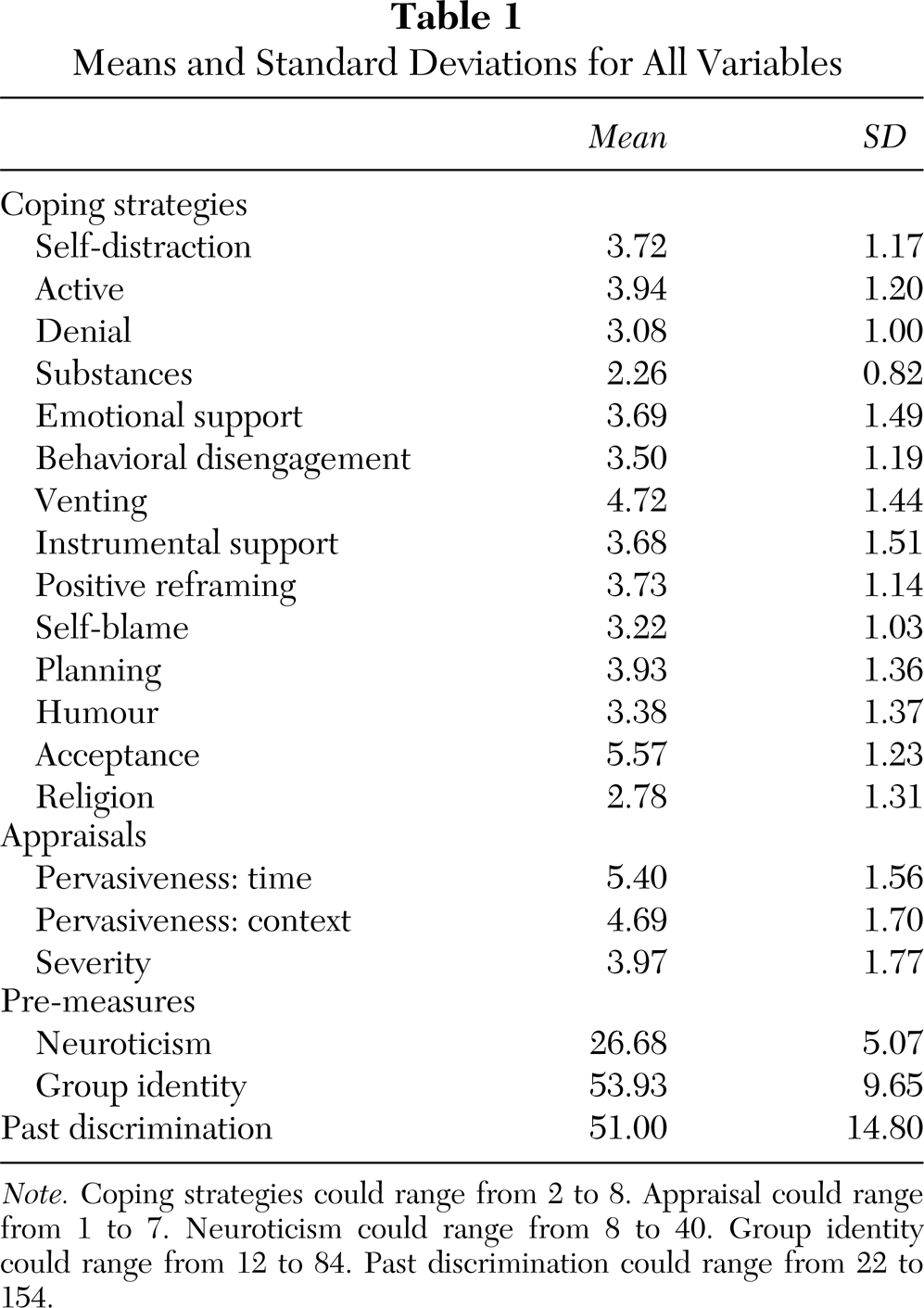
Note. Coping strategies could range from 2 to 8. Appraisal could range from 1 to 7. Neuroticism could range from 8 to 40. Group identity could range from 12 to 84. Past discrimination could range from 22 to 154.
Multilevel Modeling (MLM) Analyses
Because it is necessary to account for the nonindependence issues that are inherent in daily diary data, MLM was used to analyze the hypotheses (e.g., Singer & Willet, 2003). Similar to multiple regression, MLM can be conceptualized as prediction of a criterion variable (coping strategies) from predictor variables (appraisals). However, MLM allows for the criterion variable and predictor variables to be assessed longitudinally. MLM allows researchers to ask two primary questions when assessing longitudinal data (Singer & Wil-let, 2003). First, how do individuals change over time? This part of the model is referred to as Level 1, assessing the within-person differences over time. Second, MLM addresses whether there are predictors that will affect this change over time. This part of the model is referred to as Level 2, assessing whether people differ in their rates of change and what may predict those differences (e.g., Do some people increase their use of specific strategies while others decrease it, and do those differences depend on how they appraise their experiences of discrimination?).
Model-building and hypothesis-testing procedures described by Singer and Willet (2003) were used. Day and pervasiveness appraisals were centered at one. As such, the intercept refers to participants' expected initial coping scores (i.e., on the first day of diary writing) when the reported appraisal is one.
Researchers often note the difficulty in establishing causal relationships in daily process data (e.g., Singer & Willet, 2003). When using a time-varying predictor (appraisals) that is assessed in the same diary entry as the criterion (coping), there is the possibility of reciprocal relationships; appraisals could influence coping strategies, but coping strategies could also influence appraisals. One way to address this problem is to create lagged predictor variables (e.g., Singer & Willet, 2003). For example, to predict coping on day 5, yesterday's (day 4) appraisal score is used. As such, the model asks whether appraising discrimination on any given day can predict the next day's coping strategy.
Goodness of fit was tested by examining the changes in the deviance statistics (ΔD) across models.3 A significant decrease in the deviance statistic indicates the current model is a better fit than the previous model. The change in deviance is evaluated using the difference in the number of parameters across the two models as the degrees of freedom and is then compared to the appropriate critical value in the chi-square distribution (Singer & Willet, 2003).
Null model. First, the “unconditional means” model (null model) is tested to assess the overall variation in the criterion variables (i.e., Do people's coping strategies vary?). All models were significant (p < .01).
In addition, potential covariates (neuroticism, group identity, past discrimination, severity of experience as well as the total number of incidents reported over the month) were entered into the null model individually, and only significant predictors are maintained in subsequent analyses (e.g., Snijders & Bosker, 1999). Group identity and number of incidents significantly predicted active coping, such that the more people identified with their group, the more they used active coping, b = .05, t (25.10) = 2.1, p = .04. Further, the more incidents of discrimination were reported, the less participants used active coping, b = -. 13, t(30.26) = −3.33, p = .001. Number of incidents also predicted instrumental and emotional support such that the more incidents were reported, the less participants used emotional, b = -.10, t(29.89) = −2.21, p = .04, and instrumental support, b = -.12, t(30.45) = −2.76, p = .02. Thus, those covariates were included for their respective analyses. Neuroticism, past discrimination, and severity were unrelated to coping.
Unstandardized Estimates for Interaction Models
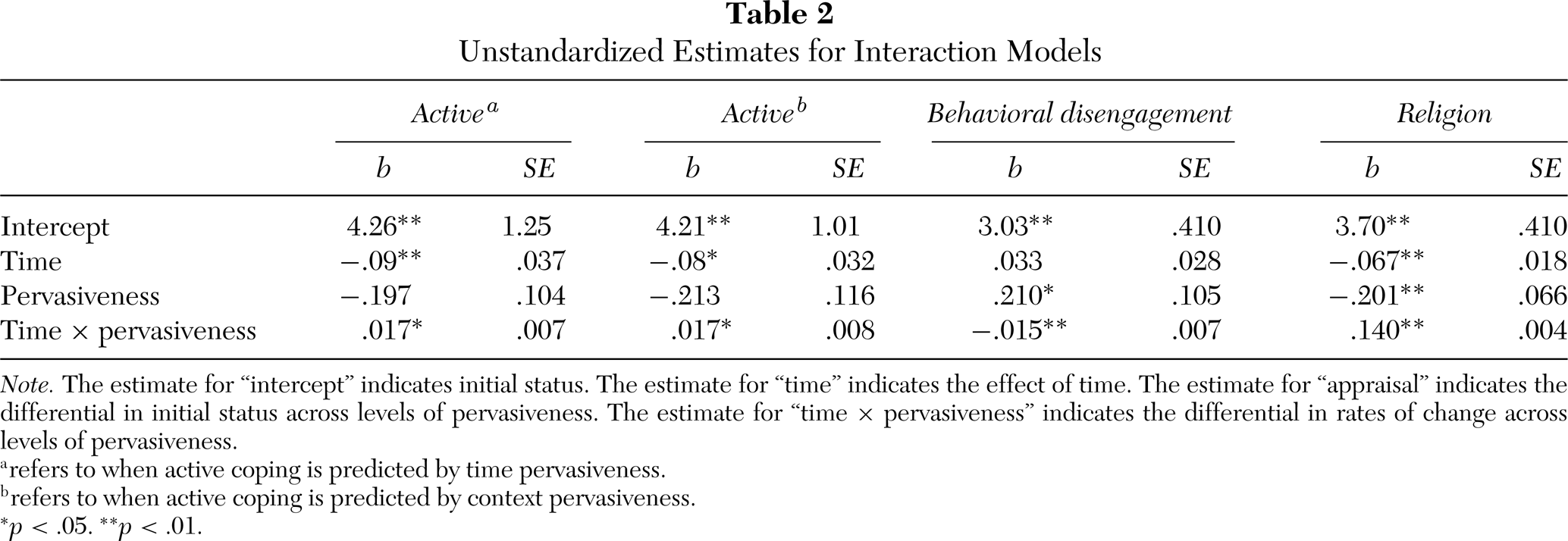
Note. The estimate for “intercept” indicates initial status. The estimate for “time” indicates the effect of time. The estimate for “appraisal” indicates the differential in initial status across levels of pervasiveness. The estimate for “time × pervasiveness” indicates the differential in rates of change across levels of pervasiveness.
arefers to when active coping is predicted by time pervasiveness.
brefers to when active coping is predicted by context pervasiveness.
*p < .05. **p < .01.
Main effect for time. Second, the “unconditional growth” model is specified to examine whether there is systematic growth in one direction over time—that is, whether there is a main effect for time. Controlling for incidents of discrimination, there was a significant main effect for time on emotional support, b = -.03, t(21.32) = −2.55, p = .04. In particular, on the first day of diary writing, participants began with an emotional support score of 4.98 and decreased their use of this strategy .03 units per day. Thus, by the end of the month, participants' use of emotional support had decreased to 4.11. The change in deviance statistic was significant, indicating goodness of fit of the growth model, χ2(3) = 19, p = .001. There was no other significant main effect for time on the coping strategies.
Importantly, the growth models for both time pervasiveness, b = -.02, t(16.29) = −1.75, p = .10, and context pervasiveness, b = −.01, t(14.88) = −.73, p = .49, were nonsignificant, indicating no changes in perceived pervasiveness over time. Thus, the methodology itself (i.e., attending to discrimination each day) did not appear to increase sensitivity to discrimination.
Main effect for appraisal. This model assesses the research question, “Do pervasiveness appraisals affect initial coping strategy use?” If a main effect is significant, it indicates that pervasiveness appraisals differentially affect coping at day 1. However, there were no significant main effects for either time pervasiveness or context pervasiveness.
Time × Pervasiveness Interactions
The interaction models address the question, “Do pervasiveness appraisals affect rates of change in coping strategies?” Using the chi-square statistic, interaction models were tested against the previous main effects models (means and growth) to ensure they were a better fit of the data (Singer & Willet, 2003). Unstandardized estimates and standard errors appear in Table 2. Interactions were plotted and simple effects tested using procedures described by Aiken and West (1991).
Controlling for group identity and number of incidents of discrimination, the estimate for pervasiveness (see Table 2) indicates that initial active coping scores varied across the levels of time pervasiveness, albeit only marginally, t(204.72) = −1.83, p = .06. The estimate for time further indicates that active coping changed systematically across the 28 days, t(158.07) = −2.41, p = .017. These effects were qualified by a significant interaction between time and time pervasiveness, t(206.89) = 2.30, p = .023 (see Figure 1). Simple effects indicated that those who perceived low time pervasiveness decreased their use of active coping over time, b = −.056, t(76.52) = −2.24, p = .025, but those who perceived high time pervasiveness maintained their use of active coping over the month, b = −.002, t(22.57) = −.22, p = .893. By the end of the month, those perceiving high time pervasiveness reported higher active coping than those perceiving low pervasiveness, b = .27, t(203.33) = 2.08, p = .05. This model showed significantly better fit of the data than previous models, χ2(1) = 6, p = .05.
Similarly, controlling for group identity and number of incidents of discrimination, the estimate for pervasiveness (see Table 2) indicates that initial active coping scores also marginally varied across the levels of context pervasiveness, t(176.11) = −.183, p = .06. The estimate for time further indicates that active coping changed systematically over 28 days, t(128.47) = −2.35, p = .02. Again, these effects were qualified by a significant interaction between time pervasiveness and context pervasiveness, t(213.79) = 2.23, p = .027 (see Figure 2). Simple effects show that those who perceived low context pervasiveness decreased their use of active coping over time, b = −.059, t(85.81) = −2.26, p = .02, but those who perceived high context pervasiveness maintained their active coping, b = −.006, t(21.34) = −.42, p = .709. By the end of the month, participants perceiving high pervasiveness were reporting more active coping than those perceiving low pervasiveness, b = .25, t(196.01) = 1.98, p = .05. The interaction model showed significantly better fit than the previous models, χ2(1) = 10, p = .01.
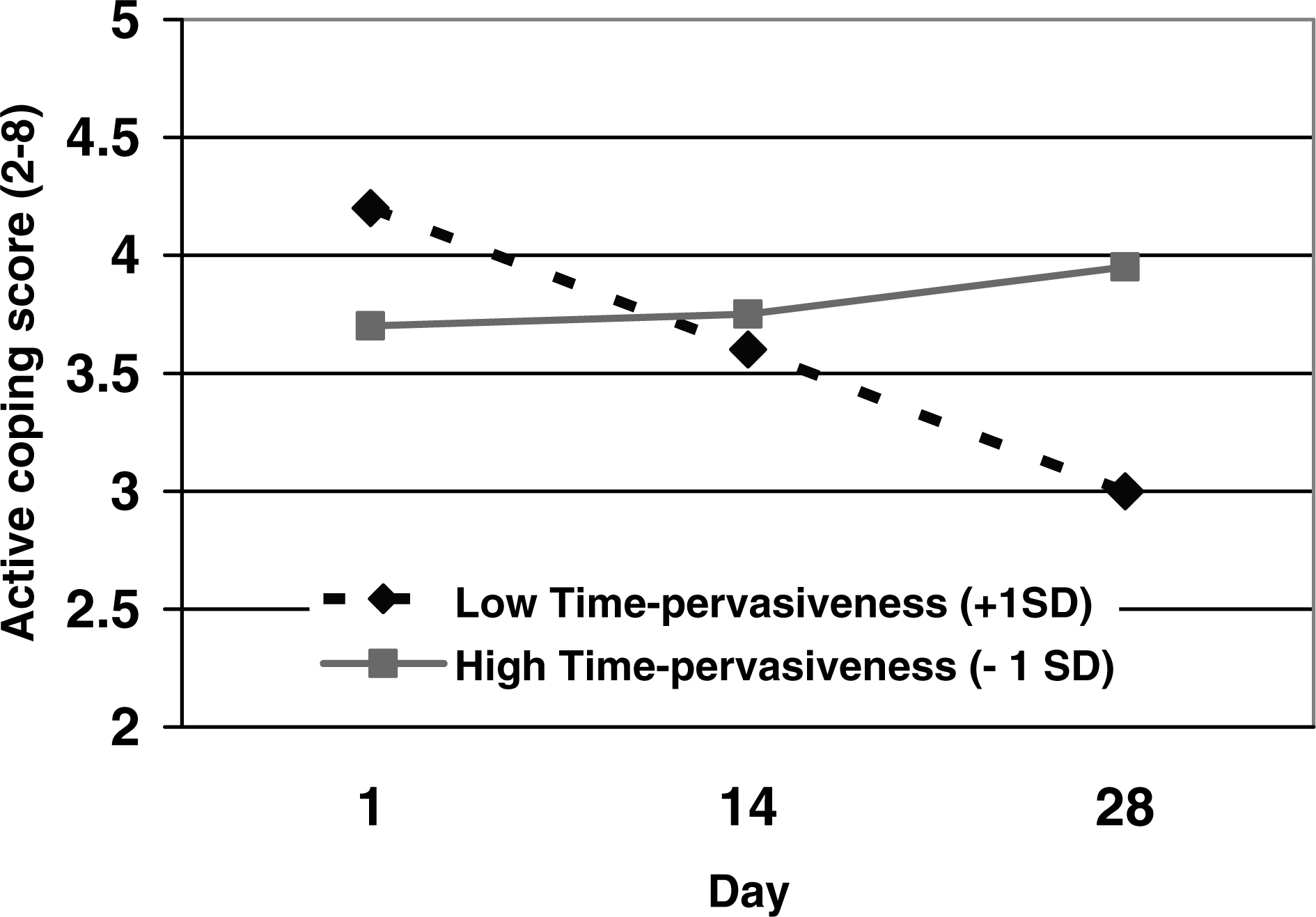
Interaction between time pervasiveness and day on active coping.
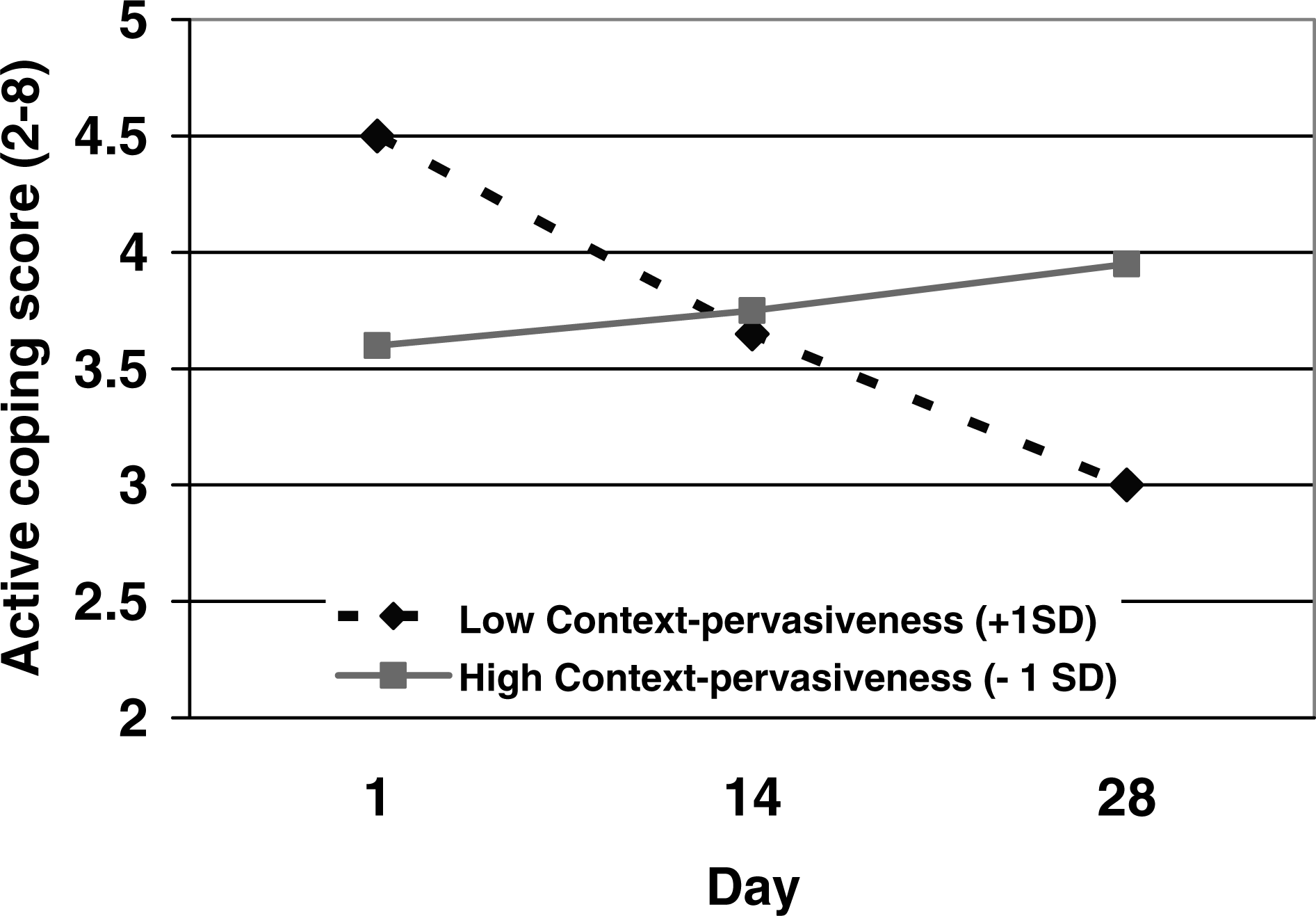
Interaction between context pervasiveness and day on active coping.
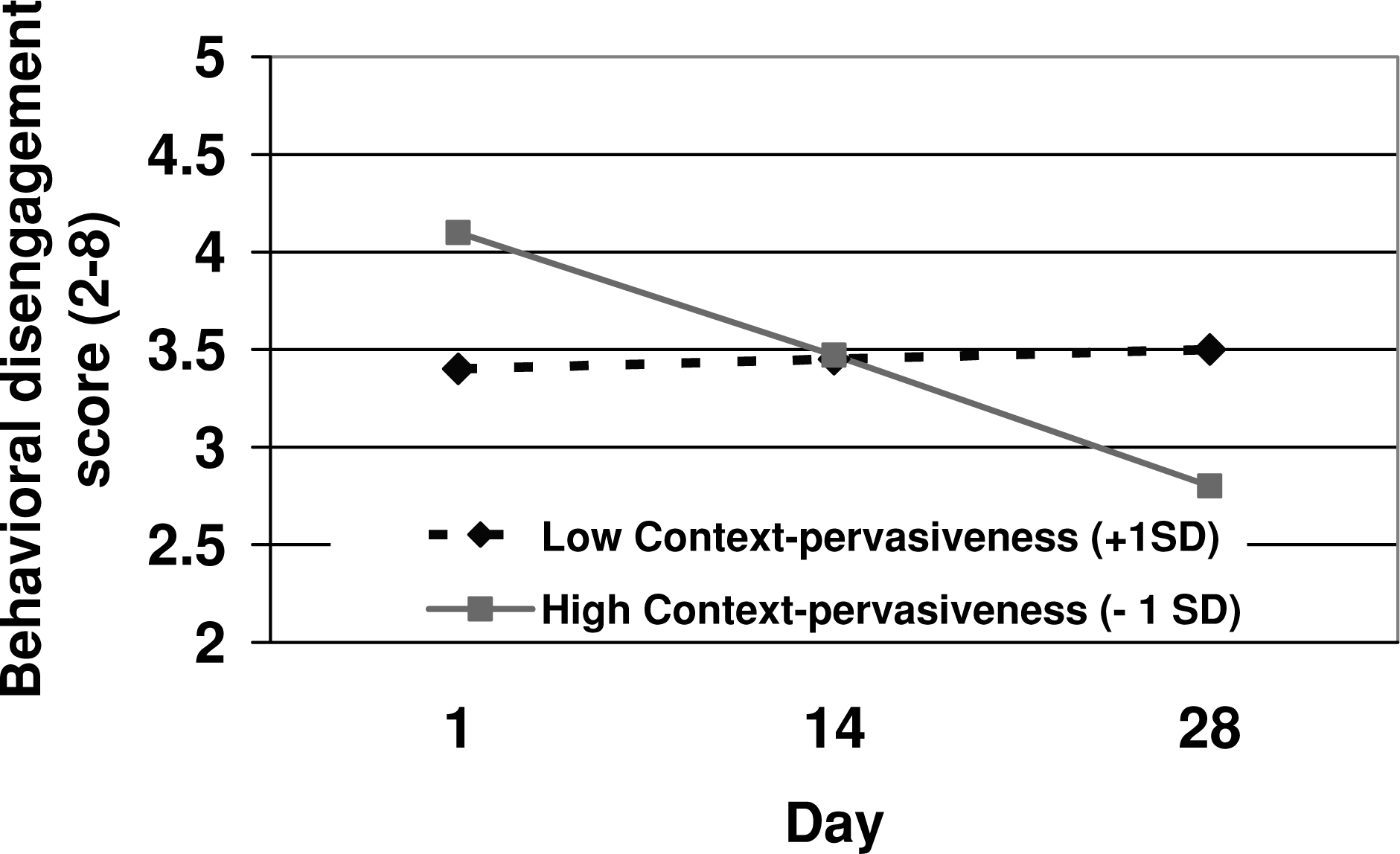
Interaction between context pervasiveness and day on behavioral disengagement.
The estimate for pervasiveness (see Table 2) also shows that initial scores on behavioral disengagement vary across the levels of context pervasiveness, t(163.90) = 1.99, p = .048. Although there was no effect for time, there was a significant interaction between time pervasiveness and context pervasiveness on behavioral disengagement, t(180.99) = −2.21, p = .029 (see Figure 3). Simple effects indicate that, over time, those who continued to perceive high context pervasiveness decreased their use of behavioral disengagement, b = −.028, t(24.24) = −2.36, p = .027, but those who continued to perceive low context pervasiveness maintained their initial use of behavioral disengagement, b = .017, t(97.98) = .79, p = .431. By the end of the month, those perceiving high context pervasiveness reported marginally less behavioral disengagement than those reporting low context pervasiveness, b = −.21, t(184.21) = −1.78, p = .07. The interaction model showed significantly better fit than the previous models, χ2(1) = 5, p = .01.
Finally, the estimate for pervasiveness (see Table 2) indicates that initial scores on religious coping vary across the levels of pervasiveness, t(197.57) = −3.02, p = .003. There was a significant effect for time, t(102.54) = −3.74, p = .0001, as well as a significant interaction between time pervasiveness and context pervasiveness on religion, t(174.68) = 4.41, p = .001 (see Figure 4). At the beginning of the study, those perceiving low context pervasiveness were more likely to report using religion than those perceiving high context pervasiveness, b = 3.70, t(58.81) = 9.04, p = .0001. However, those who continued to perceive low context pervasiveness decreased their use of religion over time, b = −.053, t(67.94) = −.301, p = .001, but those who continued to perceive high context pervasiveness maintained their level of religion use, b = −.011, t(21.47) = −1.09, p = .287. By the end of the month, those reporting high context pervasiveness reported greater use of religion than those perceiving low context pervasiveness, b = .18, t(158.09) = 2.77, p = .01. The interaction model showed significantly greater fit of the data than the previous models, χ2(1) = 11, p = .01.
To test whether any of the a priori hypothesized interactions were further moderated by ethnicity (White, non-White) or type of discrimination (racism, sexism), 3-way interactions were also tested (day × pervasiveness × ethnicity; day × pervasiveness × discrimination). However, these models were not good fits of the data, p > .05.
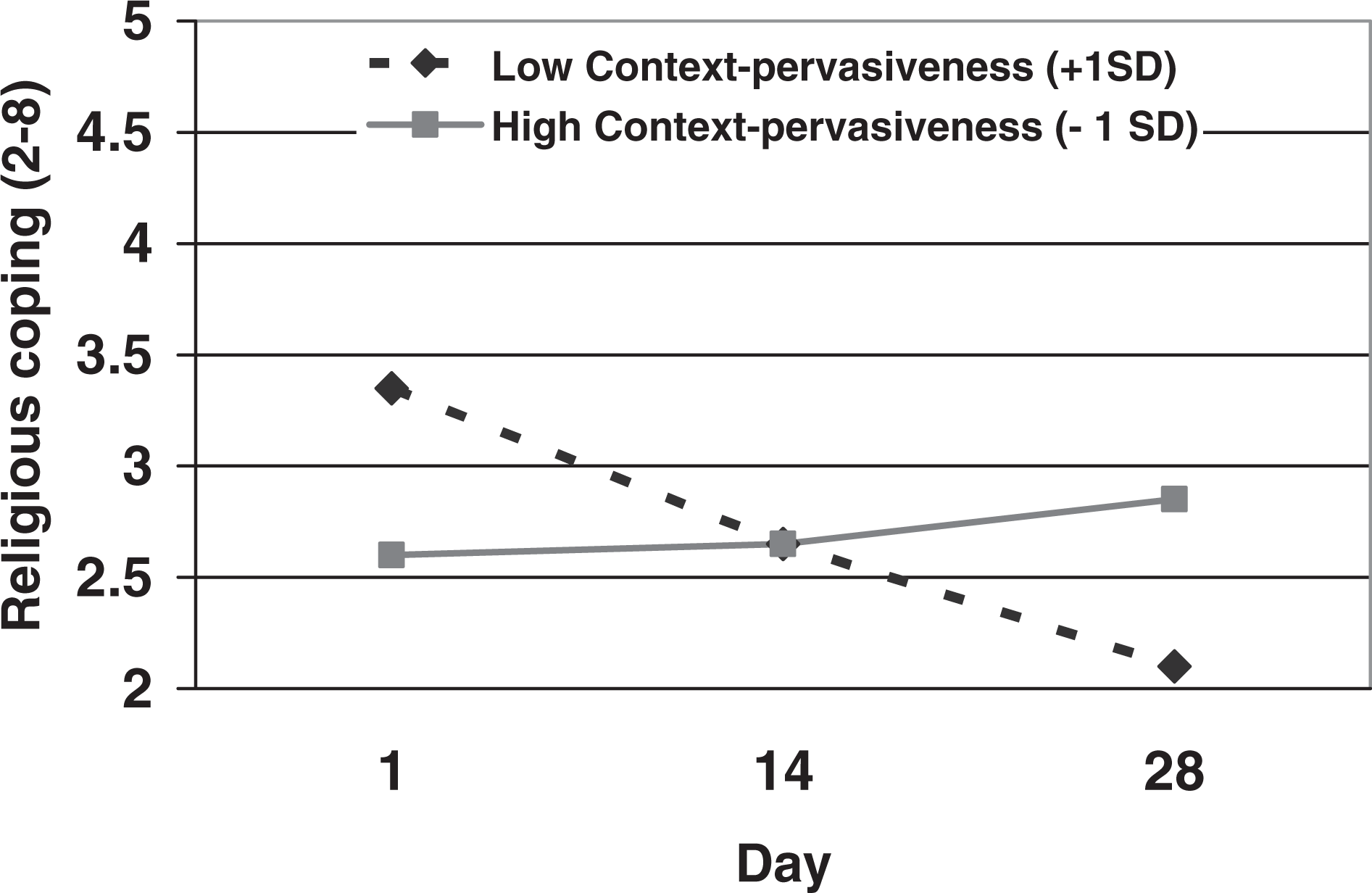
Interaction between context pervasiveness and day on religion.
DISCUSSION
This study addressed a gap in the literature, namely how strategies to cope with discrimination may vary over time as a function of pervasiveness appraisals. The hypothesis was that, consistent with group consciousness theories (Cross, 1978; Downing & Rousch, 1985), participants who perceived discrimination to be highly pervasive would initially show more inactive coping than those who perceived low pervasiveness. However, those who continued to perceive high pervasiveness would ultimately show greater evidence of using active strategies than those perceiving low pervasiveness.
Consistent with hypotheses, participants who perceived discrimination to be highly pervasive began the study reporting marginally lower levels of active coping and significantly more behavioral disengagement than those who perceived discrimination to be low in pervasiveness. Thus, consistent with research showing that pervasive discrimination is linked to depression and anxiety (e.g., Branscombe et al., 1999), such psychological difficulties may initially inhibit taking action against it. However, over time, those who continued to perceive high pervasiveness maintained their initial activity level and decreased their behavioral disengagement, whereas those low in pervasiveness decreased their activity and maintained their disengagement. By the end of the month, those who perceived high pervasiveness were significantly more likely to engage in active coping and marginally less likely to use behavioral disengagement than those perceiving low pervasiveness. Thus, consistent with group consciousness theories (e.g., Downing & Rousch, 1985), perceiving discrimination to be isolated appears to ultimately promote an acceptance of the status quo, but recognizing the pervasiveness of discrimination can have motivational qualities over time.
Context pervasiveness also interacted with day to predict use of religion in a similar pattern as was seen with active coping. Those initially perceiving low pervasiveness used religion more than those perceiving high pervasiveness. However, those who continued to perceive low pervasiveness decreased their use of religion, and those who continued to perceive high pervasiveness maintained their use of religion over time. Ultimately, those perceiving high pervasiveness used religion more than those perceiving low pervasiveness. Of course, it is questionable whether religion reflects an active strategy. If active coping is defined as any behavior directed at resolving the discrimination (i.e., problem focused), then indeed religion does not appear to be a strategy that will actively resolve discrimination. Yet, the use of religion may reflect an empowered strategy in other ways. For example, religion may provide a form of social support, which as Carver et al. (1989) suggest, may be an active means of seeking advice on how to deal with the problem. Alternatively, religion may be a form of “meaning making” (Park, 2005). When stressors are not amenable to a problem-focused strategy (e.g., death of a loved one, terminal illness), meaning-making strategies are actively sought to help victims feel in control over something uncontrollable (Park, 2005). To the extent that discrimination is viewed by its victims as something often uncontrollable, recurring religious beliefs may help victims find meaning (e.g., karma, higher power, etc.). Indeed, future research may benefit from understanding what benefits victims of discrimination are deriving from religion, whether it be support seeking, meaning making, or another.
Taken together, those who perceived high pervasiveness were, by the end of the month, more active, less disengaged, and more likely to use religion as a coping strategy than those who perceived low pervasiveness. It is still arguable, however, whether those who perceived high pervasiveness were becoming more motivated over time or whether those perceiving low pervasiveness were simply becoming less motivated. Indeed, the data suggests that those low in pervasiveness were becoming less motivated over time; in addition to remaining disengaged, they decreased active coping and, to the extent that religion reflected meaning making, made less sense of their experiences. Those who believe discrimination is isolated may become less active over time because the issue of discrimination becomes less of a concern to worry about and/or combat. As such, minimizing the perception of the pervasiveness of discrimination may ultimately promote an acceptance of the status quo. However, those high in pervasiveness only decreased their disengagement, rather than their active coping. Thus, although this group did not become more active, what may have been captured over the month-long assessment was an initial part of the consciousness-raising process whereby this group was becoming less helpless. Such a reaction may be a precursor to becoming actively engaged in combating discrimination (e.g., Downing & Rousch, 1985). Had the observation period been longer, it may have been possible to capture a later part of the consciousness-raising process, namely more active coping.
What is interesting is that the impact of perceived pervasiveness on active coping does not appear to be a function of enhanced group identity. On the one hand, it could be argued that perceived pervasiveness is related to active coping through group identity. The Rejection Identification Model (Branscombe et al., 1999) states that, as a response to perceiving discrimination to be pervasive, minority group members increase their identification with the in-group as a coping response. Further, consistent with past research (e.g., Tropp & Brown, 2004), this study showed a relationship between group identity and taking action against discrimination. Thus, perhaps perceived pervasiveness is motivational because it also increases group identity. However, this explanation may not be adequate because the effect of perceived pervasiveness on active coping remained after controlling for group identity, suggesting that, over time, high perceived pervasiveness can be beneficial, over and above group identity.
What is the unique quality that may be provided by perceiving pervasive discrimination? Research in my own lab (Foster, 2001) suggests it may be “common fate,” the belief that the group and the individual have a similar fate or experience—whatever affects the group affects the individual and vice versa (Gurin & Markus, 1989). Gurin and Markus (1989) argued that common fate is distinct from group identity. Group identity, they argued, is conceptualized more so as an individual characteristic, often measured as how much the individual values their group, whereas common fate reflects an interdependence between the group and individual. Although common fate was not measured in this study, past work (Foster, 2001) has shown that increasing perceived pervasiveness is related to increasing common fate, which in turn is associated with greater collective action. This is consistent with experiences reported in consciousness-raising groups (Driefus, 1973) whereby a recognition of pervasiveness (“it's everywhere”) promotes the realization that whatever happens to women generally also happens to “me too” (personal as political). In turn, responding to discrimination may become more urgent. Thus, although group identity may certainly be one positive outcome of perceived pervasiveness (Branscombe et al., 1999), it does not appear to completely explain its ultimate positive consequences. Future research will need to assess how changes in perceived pervasiveness accompany changes in group identity and common fate to further understand this distinction and its implications for coping.
Interestingly, the effects of perceived pervasiveness on active coping also remained, despite controlling for number of incidents of discrimination. This finding supports a distinction between amount of discrimination experienced and its perceived pervasiveness. There is research showing the relationship between frequency of experiencing discrimination and negative psychological and physical outcomes (Landrine et al., 2006; Matheson, Gill, Kelly, & Anisman, 2007). However, amount of discrimination and whether it is appraised as pervasive have also been found to be unrelated (Foster et al., 2004). We may experience discrimination but appraise it as either isolated or pervasive. Branscombe et al. (1999) note that disadvantaged group members may realize they have encountered a situation of discrimination, but it will have more negative psychological consequences if they appraise that incident as pervasive than if it is considered to be an isolated incident. Similarly, the current study suggests that perceived pervasiveness still appears to play an important role in active coping beyond how much discrimination is experienced.
Diary methodologists note that the burden of repeated measures over time may have several unintended consequences (e.g., Bolger et al., 2003). First, the length of the current diary (28 days) may have limited the number of participants willing to undertake such a workload, and, as such, the current sample size was small, limiting external validity. In addition, the small sample size may have also contributed to issues with Type 1 error. Indeed, given the number of criterion variables, Type 1 error may have been inflated. Although a possible solution may have been to reduce variables using a factor analysis, the small sample size precluded a reliable factor structure (e.g., Byrne, 1994). Thus, lack of power was a limitation of the current study. At the same time, however, the ability to achieve significant interactions in nonexperimental research (McClelland & Judd, 1993) may attest to the strength of these relationships. Future research will nevertheless need to include larger samples.
Small sample size also precluded attention to a possible modifying variable—whether the discrimination was personally experienced or observed. The large majority of experiences were personally experienced, making potential effects difficult to analyze due to unequal sample sizes across the two groups. On the one hand, it might be expected that coping with a personal experience is more difficult than coping with an observed experience. On the other hand, it is also possible to predict similar patterns of coping, given research on relative deprivation on behalf of others (Tougas & Veilleux, 1990). That is, majority group members have felt deprived on behalf of women; minority group members will likely feel great empathy when someone in their minority group or another is discriminated against. In future research, increasing sample size may provide a greater opportunity to examine these potential differential effects.
Finally, some suggest that diary research may serve to increase sensitivity to the problem of interest; asking participants to attend to their daily moods, pain, and incidents of discrimination may inflate their self-reports (e.g., Bolger et al., 2003). This possibility may be less likely, however, for discrimination research because the more robust finding is that individuals minimize their reports of personally experiencing discrimination (Crosby, 1984). Indeed, the current study showed that self-reports of the perceived pervasiveness of discrimination did not change over time and that effects remained after controlling for number of incidents. Thus, the dynamic effects of perceived pervasiveness were not likely a function of changes in sensitivity to discrimination. At the same time, however, there may have been a cumulative change in participants as a function of completing the diary that could not be observed after 28 days. Future research should consider longer-term follow-up assessments as well.
Despite the potential pitfalls of diary research, one of its greatest benefits is the ability to examine changes over time. In doing so, this study suggests that time itself had little effect on coping. In fact, time alone may have a negative impact on coping, as seen in the decreased use of emotional support over the study. Yet, time is clearly important to the coping process because it allows for the dynamic nature of pervasiveness appraisals to emerge, showing that perceiving discrimination to be pervasive may ultimately enhance well-being through the use of active coping skills.
Footnotes
1.
Labeling which strategies may indicate “active” coping is debatable depending on the discipline (e.g., psychology, education, social work), subdiscipline (e.g., social, community, clinical, organizational psychology), or even level of analysis (e.g., individual, social; Carver et al., 1989). Given such nuances in the various strategies,  recommend examining each strategy, rather than creating aggregate or overall coping scores.
2.
The term “visible minority” is the official term used to ensure employment equity in Canada and, as such, is meaningful in a Canadian context. Visible minorities are those “other than Aboriginal peoples, who are non-Caucasian in race or non-white in color” (Employment and Immigration Canada, 1987, p. B-3).
3.
To assess the model, goodness of fit was used rather than pseudo-R2 measures. Although pseudo-R2 may be considered more intuitive, statisticians are often wary of this measure within the context of MLM and therefore warn of its limited utility because negative R2 values are often possible (Kreft & DeLeeuw, 1998; Singer & Willet, 2003).