






Abstract
The negative consequences for victims of sexual harassment are well documented. However, one area unexamined is the process that leads to harm. Researchers have proposed three influences (i.e., objective or stimulus factors, individual factors, and contextual factors) on the psychological, health-related, and organizational outcomes of sexual harassment. This article examines the relative contribution of these influences on psychological distress following sexual harassment. Two studies were conducted. First, we examined approximately 1,200 women in a financial industry class-action lawsuit. A series of hierarchical regressions and subsequent dominance analysis revealed that the severity of the experiences and attributions made about them were the most important influences on symptoms of psychological distress. Study 2 examined 85 female plaintiffs in sexual harassment litigation. Dominance analysis again showed that the magnitude of their experiences had the strongest relationship with distress. Implications of these findings are discussed.
From a legal perspective, sexual harassment in the workplace is a recent phenomenon, although the experience itself pervades everyday life so thoroughly that some have suggested it represents a normal extension of heterosexual sexuality (Lobel, 1993; Stockdale, 1993; Studd & Gattiker, 1991). The U.S. Supreme Court first addressed the issue in 1986 with its unanimous ruling in Meritor Savings Bank v. Vinson (1986), affirming that harassment constitutes a cause of action under Title VII of the Civil Rights Act of 1964. Seven years later, the Court addressed the issue of the psychological impact of sexual harassment in Harris v. Forklift Systems, Inc. (1993), ruling that plaintiffs need not have suffered psychological injury to prevail on sexual harassment charges. As Justice Sandra Day O'Conner asserted in her majority opinion, “Title VII comes into play before the harassing conduct leads to a nervous breakdown” (p. 371).
Although not necessary to a legal cause of action, psychological distress is nonetheless common following sexual harassment; indeed, the literature is replete with studies documenting a variety of psychological sequelae. Summarizing early research, Gutek and Koss (1993) reported that emotional responses included anger, fear, depression, anxiety, irritability, lowered self-esteem, humiliation, alienation, helplessness, and vulnerability. Schneider, Swan, and Fitzgerald (1997) reported that victims could be reliably characterized by lowered satisfaction with coworkers and supervision, increased work withdrawal, decreased psychological well-being, and symptoms of posttraumatic stress disorder (PTSD). Fitzgerald, Drasgow, Hulin, Gelfand, and Magley (1997) reported significant negative relationships between harassment and psychological outcomes, as well as an indirect relationship with health conditions, mediated through psychological distress. Others have linked harassment to a variety of psychological sequelae, including lowered self-confidence and self-esteem (Satterfield & Muehlenhard, 1997; Van Roosmalen & McDaniel, 1998), alcohol and drug abuse (Richman, Flaherty, & Rospenda, 1996; Rospenda, Richman, Wislar, & Flaherty, 2000), nervousness (Van Roosmalen & McDaniel, 1998), and disordered eating (Harned, 2000).
Symptomatology associated with PTSD has been widely noted. The Institute for Research on Women's Health (1988) reported that victims often describe emotional numbing, restricted affect, and flashbacks. Schneider et al.'s (1997) multiple-group discriminant function analyses found that symptoms of posttraumatic stress (e.g., sleep disturbance, physiological arousal) were the best predictors of who had been sexually harassed, supporting arguments by Koss (1990) and others that a PTSD model is the best framework for understanding the psychological impact of sexual harassment. Dansky and Kilpatrick (1997) reported the first systematic examination of sexual harassment, depression, and PTSD at the diagnostic level, finding that unwanted sexual attention and sexual coercion significantly predicted both diagnoses, even after accounting for the effects of sexual assault.
A smaller number of studies have addressed whether and how experiences of harassment might qualify for a PTSD diagnosis under Diagnostic and Statistical Manual of Mental Disorders criteria. Fitzgerald, Buchanan, Collinsworth, Magley, and Ramos (1999) examined psychological damages among sexual harassment litigants, reporting that 68% (n = 33) qualified for a SCID-I diagnosis of PTSD. Avina and O'Donohue (2002) argued that experiences falling short of the generally agreed qualifier of sexual assault can sometimes meet the “gate” criterion; Palmieri and Fitzgerald (2005) provided empirical support.
Little work has been done to explore the process that leads to such distress. Dansky and Kilpatrick (1997) described possible pathways to explain the impact of harassment. These include Miller and Seligman's (1975) learned helplessness framework, conditioning attribution theory (e.g., Janoff-Bulman, 1989), and Hobfoll's (1989) conservation of resources model. They point out, however, that, given the range of conduct constituting sexual harassment, no single theory is likely to be sufficient. In this vein, Fitzgerald et al. (1997) proposed a Model of Harm that incorporates multiple influences, including stressor (i.e., stimulus), individual (i.e., vulnerability), and contextual (i.e., organizational) factors.1
Stimulus factors are characteristics of the stressor, the sexually harassing experience itself. The model proposes three general categories: frequency, duration, and intensity. Frequency refers to the number of incidents, whereas duration is the length of time the target is subjected to the experiences. Intensity, or the magnitude of the stressor, is conceptualized along lines proposed by Salisbury and Dominick (2004) and includes six components: (a) multiple perpetrators, (b) physical as opposed to solely verbal behavior, (c) frightening as opposed to solely offensive conduct, (d) behavior directed specifically at the target as opposed to women more generally, (e) powerful perpetrators, and (f) restricted possibilities for escape.
Empirical support has been found for a number of these factors including both frequency (Brooks & Perot, 1991; Fitzgerald & Shullman, 1993; Gutek & Koss, 1993; Langhout et al., 2005; Terpstra & Cook, 1985) and powerful perpetrators (Cortina, Fitzgerald, & Drasgow, 2002; Gruber & Bjorn, 1982; Langhout et al., 2005; Loy & Stewart, 1984; Pryor, 1994; Terpstra & Cook, 1985). Certainly there is strong evidence that frequency of harassment is a powerful predictor of negative outcomes regardless of the kind of harassment a woman experiences (Schneider et al., 1997; Langhout et al., 2005). However, evidence is sparse regarding the other stimulus factors in the model.
Vulnerability factors are characteristics of the individual; drawing on classic stress and coping theory (Lazarus & Folkman, 1984), Fitzgerald et al. (1997) propose that such factors contribute to the victim's appraisal of her experience, as well as independently to distress. Such factors are preexisting to or concomitant with the harassment, including victimization history, personal resources (e.g., financial security, personal support), attributions, attitudes, and the like. Of these, victimization history may be the most salient individual influence. Certainly, considerable research has shown that previous victimization is related to subsequent victimization, although the causal path is hotly debated, and the compounding of multiple abuses may well exacerbate the impact of later experiences (Kilpatrick, Saunders, Veronen, Best, & Von, 1987; Koss et al., 1994; Sorenson & Golding, 1990; Polusny & Folette, 1995). Nonetheless, the only empirical research examining this topic concluded that previous victimization was not a significant predictor of harassment outcomes at the level of group analysis (Fitzgerald et al., 1999).
Among remaining individual factors, the victim's personal resources may be most important. Certainly, women who are the sole support of their families, whose job provides health insurance, or whose career goals are threatened have more at stake (Fitzgerald et al., 1997). Such reasoning parallels Hobfall's (1989) Conservation of Resources theory discussed by Dansky and Kilpatrick (1997). Causal attributions may also be an important predictor of outcomes. Although these have yet to be examined in the context of harassment, Frazier (1990) found that rape attributions accounted for 67% of the variance in 3-day postrape depression. Closely connected was the degree to which the victim believed she had control over the situation.
Perhaps the most widely researched component of the model has been its contextual aspects. These include organizational tolerance (Fitzgerald et al., 1997; Hulin, Fitzgerald, & Drasgow, 1996; Pryor, LaVite, & Stoller, 1993), management norms (Pryor et al., 1993), the existence of other forms of harassment (e.g., racial, age; Buchanan, 2002; Salisbury & Dominick, 2004), and job gender context (Fitzgerald et al., 1997). These variables are not examined in the current study.
The present studies attempted an initial examination of key components of the Model of Harm by examining the relative contribution of stimulus and individual influences on the psychological damage associated with sexual harassment. Because harassment is a legal cause of action with significant financial implications for organizations, the relative role of stimulus and individual influences is often hotly contested in court. Defense authorities suggest that individual factors do more than “moderate” the effects of sexual harassment, arguing that childhood sexual abuse, in particular, should be proffered as an “alternative [cause] of damages” (McDonald, 1998, p. 82).
We conducted two studies of female victims of sexual harassment. The first involved a large sample of women employed by a national financial services firm who were surveyed about their experiences, whereas the second extended the work to an additional sample for whom we obtained in-depth assessments, including various standardized clinical and research instruments. Study 1 participants were contacted and responded by regular mail and e-mail, whereas Study 2 participants, each a plaintiff involved in sexual harassment litigation, participated in in-person clinical interviews and assessments.
Summary Statistics and Reliabilities for Study 1 Measures

This measure is not intended as a scale but rather as an index. Therefore, reliabilities are not presented.
Because items used different scoring procedures, scores were standardized before summing.
Single item. PTSD = posttraumatic stress disorder.
STUDY 1
Method
Participants were women (N = 1,218) involved in class-action litigation against a nationwide financial organization. Participants were offered the opportunity to complete an online survey, accessed via a unique login identification number, or a paper-and-pencil survey sent by regular mail. Comparison analysis indicated that the two data sources were comparable, and therefore the data were merged.2 The overall response rate from this group was 67%.
The sample ranged in age from 21 to 71 years old, with a mean age of 39.6 (SD = 10.1). The majority (57.9%) were married and well educated (over half held a minimum of a bachelor's degree [53.7%]) and consisted largely of self-identified White women (82.6%). Their average tenure at the organization was 5.0 years (SD = 5.0), although the great majority had left the organization at the time of the data collection (89.5%). Most participants were sales assistants (n = 709; 58.2%) or brokers (n = 220; 18.1%), and the remaining were scattered across a variety of other positions. Demographics revealed that participants were drawn from branch offices throughout the continental United States.
Brief descriptions of the survey instrument and the measures appear below, with summary statistics and reliability coefficients appearing in Table 1.3 The instrument was designed and formatted to facilitate ease and reliability of responding and to minimize possible response bias or demand effects. The survey begins with a series of questions regarding demographic information (gender, age, education, ethnicity and race, marital status), followed by questions regarding current employment status, length of employment, and job security. Respondents were then presented with measures of work-related, psychological, and health outcomes known to be affected by sexually harassing experiences. Assessments of sexually harassing and discriminatory experiences and respondents' reactions were presented next. Other types of negative workplace experiences, including discrimination based on race, religion, and sexual orientation, were also assessed.
Stimulus Factors
Harassment frequency. A 32-item version of the Sexual Experiences Questionnaire (SEQ; Fitzgerald, Gelfand, & Drasgow, 1995; Fitzgerald et al., 1988) assessed unwanted sex-related experiences received from managers, supervisors, or coworkers during respondents' tenure at the organization. The original SEQ demonstrated an internal consistency coefficient of .92; the authors also reported test-retest reliability of .86 over a 2-week period (Fitzgerald et al., 1988). Since that time, the measure has been used in numerous studies, examining sexual harassment in a variety of contexts and across cultures (Wasti, Bergman, Glomb, & Drasgow, 2000) with consistent indication as a reliable and valid measure (Arvey & Cavanaugh, 1995). In the current study, the response options were on a 5-point scale ranging from 0 (never) to 4 (many times). The responses were summed so that the higher the score, the greater the frequency of harassing experiences reported.
Objective severity. Based on Salisbury's work (later published as Salisbury and Dominick, 2004), Fitzgerald et al. (1997) proposed several objective indicators of harassment severity and constructed a 9-item measure to assess this variable (Swan, 1997; see the Appendix for a complete list of items). Participants responded on a 5-point scale ranging from 0 (never) to 4 (many times), and the scale was scored by summing items such that the higher the score, the greater the objective severity of the harassment reported.
Perpetrator factors. Although perpetrator characteristics are conceptualized in the Model of Harm as part of the intensity of the stressor, the objective severity scale used in this study did not contain items measuring these factors. Therefore, an additional measure was employed, the Perpetrator Power Scale (Swan, 1997). It consists of seven items that assess perceptions of the perpetrator's power over the employee (see the Appendix for a complete list of items). Response options include 1 (no), 2 (?), and 3 (yes). The scale was scored by summing the seven items such that higher scores indicate greater perpetrator power.
One additional item assessed the number of perpetrators (“Altogether, how many people bothered you?”) as a measure of the stimulus factor, multiple perpetrators.
Individual Factors
Practical vulnerability. Individual practical vulnerability was assessed via the sum of 10 items tapping respondents' financial and emotional dependence on their jobs. For example, number of children and whether the respondent relied on the company's health insurance were considered indicative of financial vulnerability. Items such as “How important was/is [the job] to your identity?” measured emotional involvement in the job. This measure was not intended as a scale (i.e., typical scale reliability was not expected); rather it served as an index such that the higher the score on any one item, the more financially dependent or emotionally vulnerable the respondents were in their situations at work. Response options varied across the 10 items; therefore, the responses were standardized and then summed such that the higher the score, the greater practical vulnerability the women reported.
Attributions. Respondents' thoughts and opinions about why their experiences happened were assessed using an adaptation of Frazier's (1990) scale4 assessing rape victims' attributions for their experience. Frazier's (1990) scale has four subscales that were employed in the present study: Chance (5 items; events are unavoidable and random), Self-Blame (6 items; individual's own behavior led to the events), Society (4 items; men are socialized to abuse and society does not protect women), and Harasser (4 items; the offender has character defects). Respondents rated the extent to which each attributional statement characterized their thoughts on a 5-point scale ranging from 0 (not at all descriptive) to 4 (very descriptive). Each subscale was summed so that higher scores indicated more attributions of that type.
Outcome Variables
PTSD symptoms. The PTSD Checklist (Weathers, Litz, Herman, Huska, & Keane, 1993) is a 17-item self-report measure of the severity of posttraumatic stress symptoms. In the present case, the instructions inquired specifically about respondents' experiences while employed at the defendant organization. Individuals responded on a 5-point scale ranging from 0 (not at all) to 4 (extremely), rather than the original 1 to 5 scale, to render the response scale consistent with other survey measures. Weathers et al. (1993) reported coefficient alphas above .90 for the items constituting each of the three PTSD symptom clusters (reexperiencing, avoidance, and hyperarousal) as well as for the entire measure. The PTSD Checklist has been shown to correlate highly with other measures of PTSD and demonstrates excellent test-retest reliability (r = .96 over a 3-day interval). Although developed on a sample of war veterans, it has since been used to measure posttraumatic stress more generally, including cancer patients, motor vehicle accident victims, and victims of sexual assault. For this study, it was scored by summing all items to create a total PTSD score reflecting symptom severity; the higher the score, the more PTSD symptoms reported by the individual.
Psychological distress. An abbreviated version of the Brief Symptom Inventory (BSI; Derogatis & Spencer, 1982), a self-report symptom scale designed to measure symptoms of psychopathology, was used as an additional measure of psychological distress. The BSI includes items describing a variety of psychic problems and complaints. In the present study, five dimensions of the BSI were assessed: Depression (6 items), Anxiety (6 items), Somatization (7 items), Phobic Anxiety (5 items), and Paranoid Ideation (7 items). Respondents were asked whether they had experienced the symptoms during the past week, and items were rated on a 5-point scale from 0 (not at all) to 4 (extremely). The BSI score for this study was obtained by summing scores on all the items on the subscales such that higher scores reflect greater distress.
Zero-Order Correlation Matrix for Measures in the Regression Analysis in Sample A (Above the Diagonal) and Sample B (Below the Diagonal) Study 1
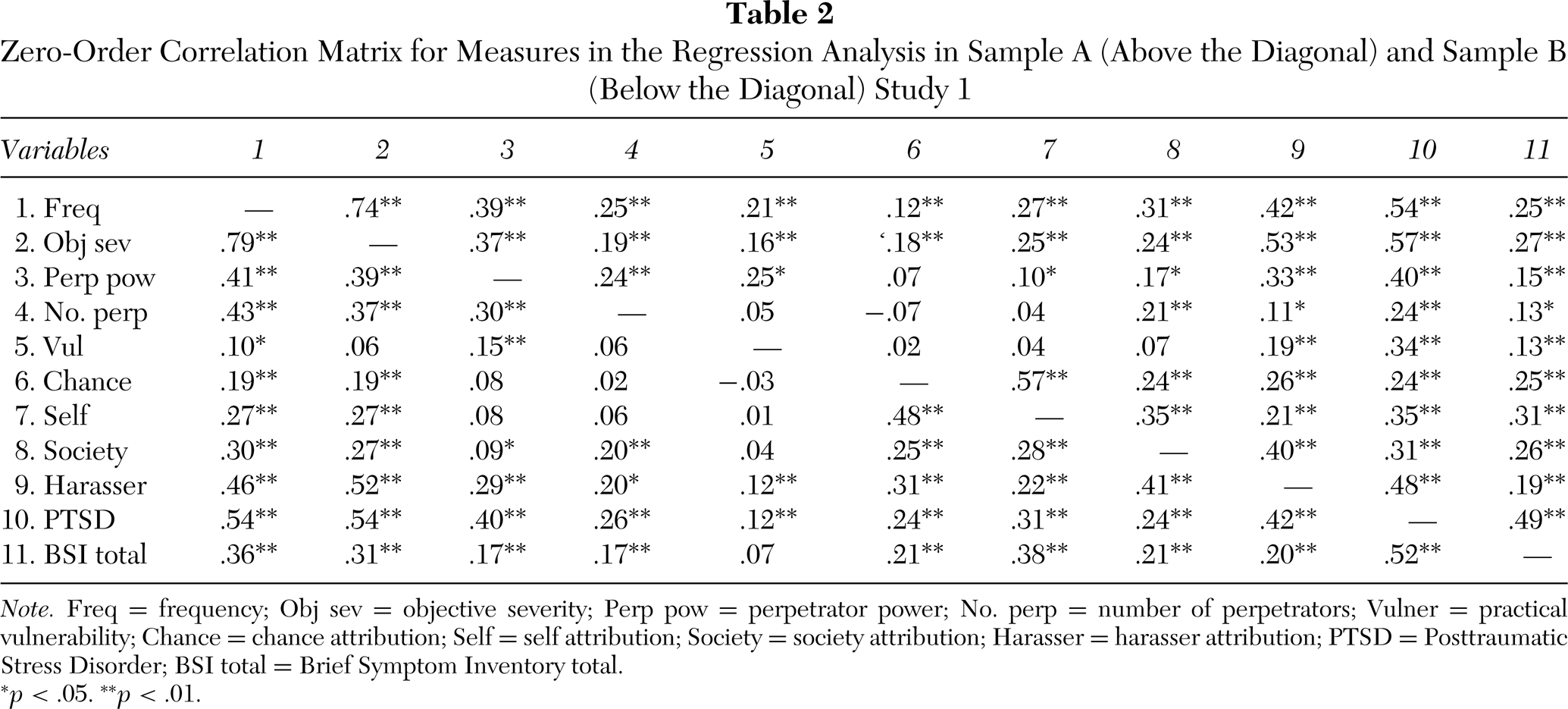
Note. Freq = frequency; Obj sev = objective severity; Perp pow = perpetrator power; No. perp = number of perpetrators; Vulner = practical vulnerability; Chance = chance attribution; Self = self attribution; Society = society attribution; Harasser = harasser attribution; PTSD = Posttraumatic Stress Disorder; BSI total = Brief Symptom Inventory total.
p < .05.
p < .01.
Data Preparation
To maximize the amount of data available for analysis, missing data were imputed according to the following formula: Item mean + Person mean - Mean of item means. For scales containing up to 9 items, imputation was used in cases missing a single item. For scales consisting of 10–19 items, imputation was allowed with up to two missing items. Finally, up to three missing items were imputed for scales containing 20 or more items. For scales whose total score is substantively meaningful, imputation employed all items for that scale; if scoring was computed solely at the subscale level (i.e., total scores were substantively meaningless), imputation was conducted by subscale.
Analysis
The sample was randomly divided into two equal parts (A and B), and multiple hierarchical linear regressions were conducted on Sample A to identify the most promising predictors of outcome variables; Sample A results were then cross-validated in Sample B. Given the known relationship between sexual harassment and psychological distress, frequency was entered in the first block of each regression; to examine the role of individual factors while controlling for stimulus, the latter were added ahead of the former. To avoid undue emphasis on weak effects, a criterion of one percent of variance explained was used in addition to statistical significance. Table 2 presents the zero-order correlation matrices for Samples A and B.
Results
Results appear in Table 3, revealing that harassment frequency accounts for 20.7% of the variance in PTSD Checklist scores, with objective severity accounting for an additional 13.3%. Perpetrator power yielded an additional 3.8% increase in explained variance; perpetrator number, although significant, did not meet the 1% variance criterion and was thus dropped from further analysis.
With respect to individual characteristics, practical vulnerability (in this case, primarily financial vulnerability) yielded a 3.3% increase in symptoms over and above that explained by stimulus (stressor) factors. All four attribution scales were then entered as a block, producing a 7.0% increase over and above the previous variables. When the analyses were cross-validated, only the vulnerability factor failed to replicate.
Analyses proceeded similarly for the second outcome variable, general distress. Using a split sample, we conducted a series of multiple hierarchical regressions entering objective stimulus factors ahead of individual characteristics. Models and results appear in Table 4, revealing that harassment frequency accounts for 5.2% of the variance in BSI scores, and severity accounts for an additional 3.6% increase above this amount. Perpetrator number, perpetrator power, and practical vulnerability failed to yield a significant increase in explained variance and were therefore dropped from further analysis. Attributions, entered as a block, contributed substantially over and above the stimulus variables. Frequency, severity, and attributions remained significant upon cross validation.
Dominance Analysis
We then examined the relative power of each of the model factors to predict psychological outcomes. Dominance analysis (Azen & Budescu, 2003; Budescu, 1993) was used to accomplish this goal. Citing the lack of an intuitive measure of importance in traditional regression analysis, Azen and Budescu (2003) recommended dominance analysis because “it (a) measures relative importance in a pairwise fashion, and (b) the two predictors are compared in the context of all 2(p-2) models that contain some subset of the other predictors” (p. 134). They define a variable as “more important than another' if it contributes more to the prediction of the criterion than does its competitor at a given level of analysis” (p. 133).
Summary of Regression Analysis for Models Predicting Posttraumatic Stress Disorder Checklist Scores in Study 1
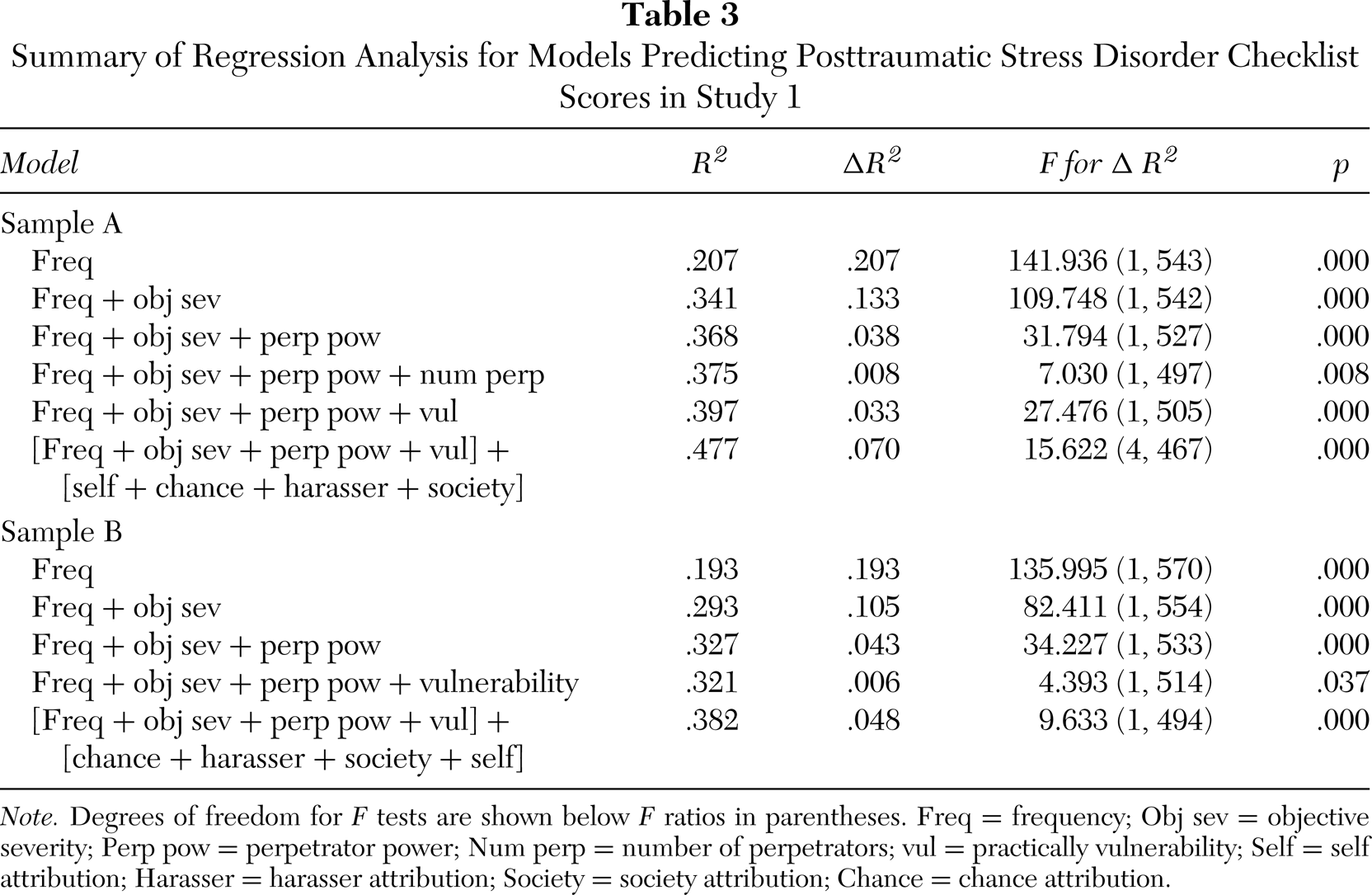
Note. Degrees of freedom for F tests are shown below F ratios in parentheses. Freq = frequency; Obj sev = objective severity; Perp pow = perpetrator power; Num perp = number of perpetrators; vul = practically vulnerability; Self = self attribution; Harasser = harasser attribution; Society = society attribution; Chance = chance attribution.
Summary of Regression Analysis for Models Predicting General Distress in Study 1
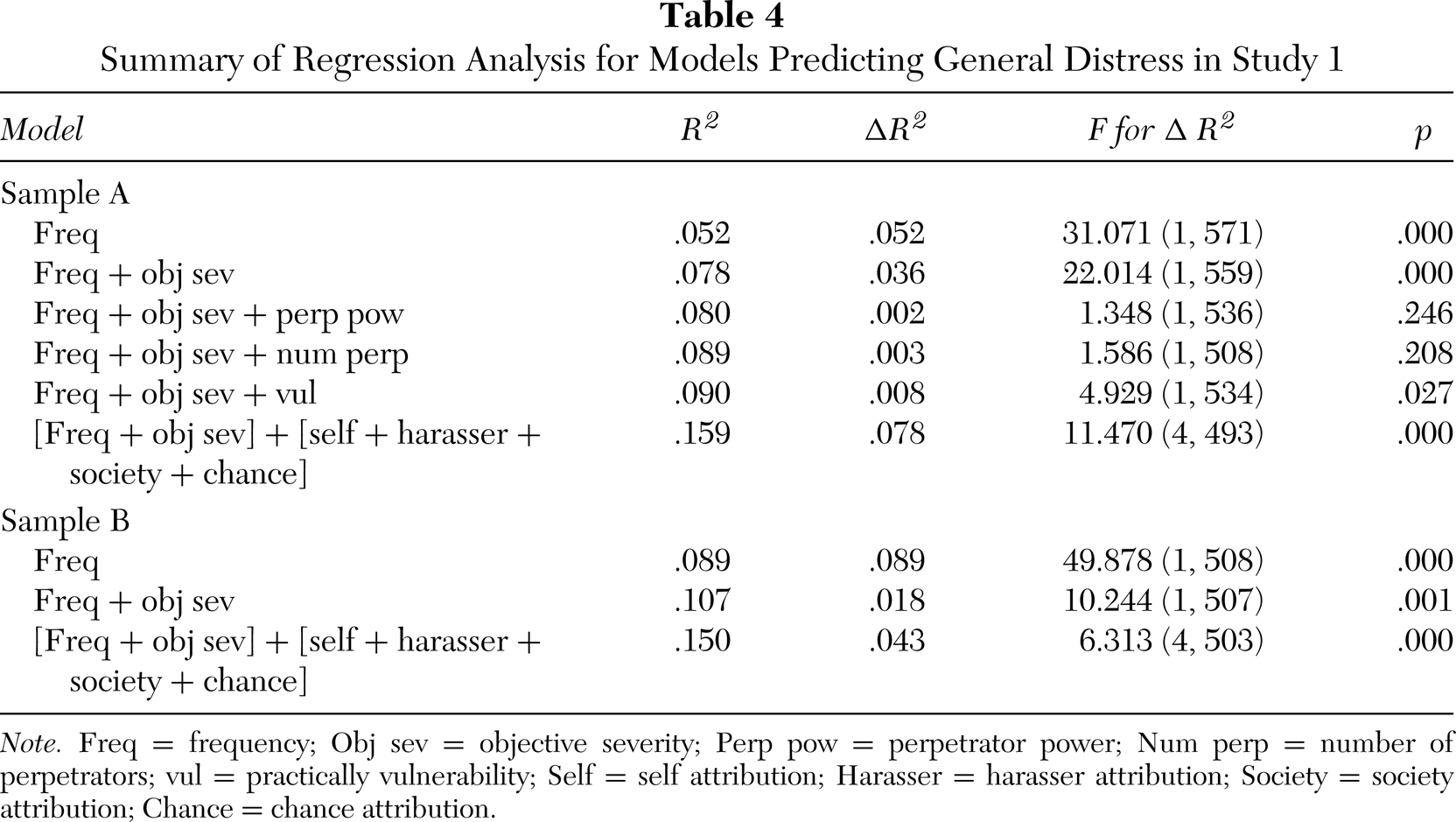
Note. Freq = frequency; Obj sev = objective severity; Perp pow = perpetrator power; Num perp = number of perpetrators; vul = practically vulnerability; Self = self attribution; Harasser = harasser attribution; Society = society attribution; Chance = chance attribution.
The procedure requires that one pre-identify the variables to be examined in the various models (Budescu, 1993); we accomplished this by use of conventional regression analysis with cross-validation. Once the variables in the models have been identified, split samples for validation are unnecessary; instead, all cases can be examined together (Budescu, personal communications Jan. 10, 2003; Budescu & Azen, 2004). Therefore, the complete sample (N = 1,218) was used for further analysis.
Dominance analysis (Budescu, 1993; Azen & Budescu, 2003) involves the examination in a regression context of the additional variance accounted for in the criterion variable for each predictor variable while controlling for every possible combination of predictor variables. The process begins by first examining the additional variance accounted for by predictor variables when examining those variables head to head. The process continues by examining the additional variance of each predictor variable while controlling for each possible combination of other predictors (e.g., additional contribution of X1 when controlling for X2 and X3). Creation of a table containing these values allows for easy comparisons of the numbers (see Table 5).
In this particular case, four predictor variables (i.e., frequency, objective severity, perpetrator power, and attributions) are examined in relation to the criterion variable of PTSD symptomatology. The first column of the table contains a list of the predictor variables. The second column is the R 2 for each predictor variable solely and every possible combination of predictor variables relative to the criterion variable until ultimately all four variables are included. The subsequent four columns report all possible combinations of comparisons of models to determine, “What additional variance did each predictor contribute?” For example, what additional contribution does Frequency make over and above the contribution of Objective Severity when those two predictors are the only variables analyzed? We find the answer to this question by seeing that when Frequency and Objective Severity are entered together into the regression equation, the R 2 is .308. The contribution of Objective Severity alone is .303. So the contribution of Frequency over and above (i.e., controlling for) Objective Severity is .308 -.303 = .005. The values in each cell of the table are the results of this kind of repeated comparison.
Dominance Analysis for PTSD Symptoms and Relevant Measures in Model Study 1
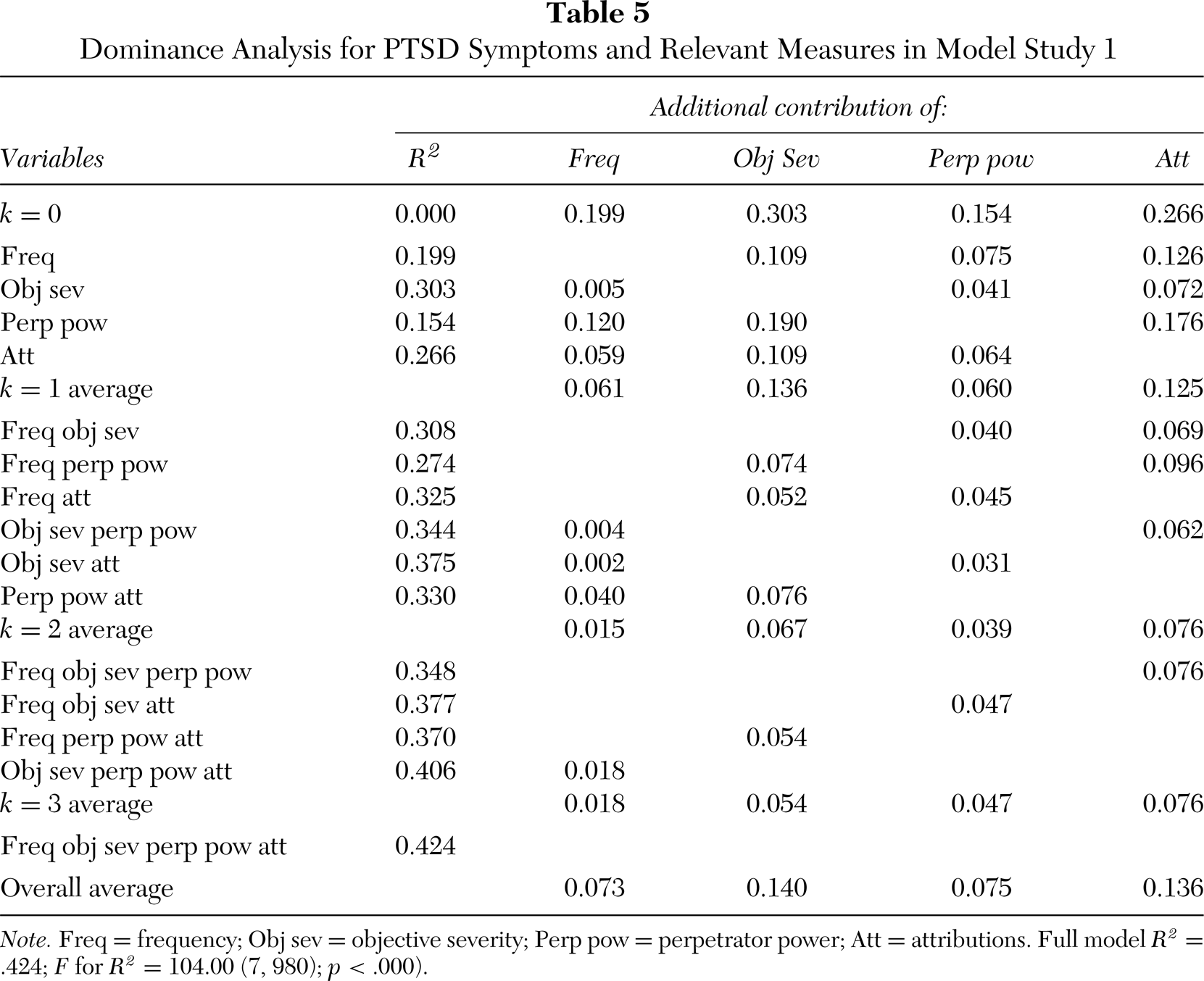
Note. Freq = frequency; Obj sev = objective severity; Perp pow = perpetrator power; Att = attributions. Full model R2 = .424; F for R2 = 104.00 (7, 980); p < .000).
Of additional importance are the rows marked k = 1, k = 2, and k = 3. These are the averages of the R 2 in that section of the table. For example, the row “k = 1 average” for Frequency is .061. Finally, the “Overall average” row is the average of the conditional averages. The importance of these rows is explained below.
Azen and Budescu (2003) describe three different levels of dominance: complete, conditional, and general. Complete dominance holds if all pairwise comparisons across all models indicate that one variable has a greater contribution than another. Because complete dominance is not always achieved, weaker levels can be determined. When complete dominance is not achieved, one examines aggregated measures of variance. For example, in conditional dominance, the average additional contribution in a subset based on model size is used as the metric of measurement (see Table 5; conditional dominance is determined by examining rows for k = 0, k = 1 average, k = 2 average, and k = 3 average). Finally, general dominance is the weakest of conclusions and is determined by examining the overall averages. To reduce the complexity of the results of our study, only one dominance analysis table is provided. All other dominance tables are available by contacting the first author.
For PTSD symptoms, four predictors were examined: sexual harassment frequency and severity, perpetrator power, and attributions. As Table 5 reveals, objective severity was the most important predictor of PTSD symptoms, completely dominating frequency and perpetrator power and generally dominating attributions. Attributions about the harassment taken as a whole were the next most powerful variable, completely dominating frequency and perpetrator power. Perpetrator power generally dominated the frequency of the harassment. Ranking the predictors from most dominant to least yields the following hierarchy: severity, attributions about the harassment, perpetrator power, and frequency.
Further analysis examined the relative importance of each type of attribution. Frequency, severity, and perpetrator power were first entered as a block, and each attribution was then examined in turn. Perpetrator attribution was found to be the dominant cognitive predictor of PTSD symptoms; attributions to the perpetrator completely dominated attributions to society, conditionally dominated attributions to chance, and generally dominated attributions to the self. Self-attributions ranked as the next most important, completely dominating both society and chance. Finally, societal attribution generally dominated chance. Overall, the rank order of importance was harasser, self, society, and chance.
For the general distress outcome variable, frequency, severity, and attributions were examined through dominance analysis. Attributions were clearly the dominant predictor, completely dominating all other influences. Severity completely dominated frequency. The overall order of importance was attributions, severity, and frequency. Further examination revealed self-attributions to be the most dominant of the attributions, completely dominating harasser attributions and generally dominating society and chance. Attributions to chance were next most influential, conditionally dominating society and harasser. Society completely dominated harasser, producing the final order of self, chance, society, and harasser.
Summary
Overall, harassment severity and victim attributions were the most powerful predictors of psychological distress. Severity exerted the most influence on PTSD symptoms, whereas attributions were most influential for more global distress. Dominance analysis revealed that self-blame was the dominant predictor compared to the other attributions for both PTSD and general psychological distress, ranking second and first, respectively; in general, the more the victim blamed herself, the more psychological disruption she experienced. The impact of harasser attributions was inconsistent, ranking first for PTSD but last for more general psychological distress.
STUDY 2
Method
Participants were 86 individual plaintiffs in sexual harassment litigation. Each had been referred for psychological evaluation as a part of the damages determination in her case. Unlike Sample 1, participants were employed in a broad range of occupations, with a disproportionate number in nontraditional jobs (e.g., strip miners, police officers, factory workers) at the time their experiences occurred.5 Educational level ranged from less than a high school diploma to postgraduate academic degrees. Participants gave permission for data from their evaluations to be used in an anonymous manner for research, and only those who gave consent were included.6
Participants underwent comprehensive evaluation lasting a minimum of 7 hours, and in some cases 2 full days (see Fitzgerald & Collinsworth, 2003, for a general description). Included were a psychosocial history, structured interviews of psychological symptoms and workplace experiences, and various standardized psychological instruments. Summary statistics and reliability coefficients appear in Table 6; correlations of all variables appear in Table 7.
Measures of Stimulus Factors
Harassment frequency. Sexual harassment frequency was assessed via a 20-item version of the SEQ as part of a larger structured interview (i.e., the Indepth Interview Schedule [IDIS]; see Fitzgerald & Collinsworth, 2003, for a more complete explanation of the IDIS).7 The theoretical and psychometric underpinnings of the SEQ were described in detail in Study 1. Unlike the items on the SEQ in Study 1, the SEQ items in the IDIS are conservative in identifying harassing experiences; this measurement method prevents inflated frequency scores by excluding experiences that were not bothersome. Follow-up questions are designed to identify only behaviors that the woman found distressing. For each specific behavior reported, the plaintiff was asked to rate the degree to which it bothered her. Respondents were told that “bothered” refers to “any negative emotion: upset, angry, offended, etc.” The participants rated their level of “bothered-ness” on a 5-point scale ranging from 0 (not at all) to 4 (extremely upset). Scores for behaviors eliciting no distress were set at 0;8 responses were summed to provide an overall frequency estimate such that the higher the score, the greater frequency of harassment reported.
Objective severity. The Objective Severity scale described in Study 1 was employed in Study 2.
Duration. Duration of the harassing experience was assessed via one item on the IDIS that asks, “From beginning to end, how long did this whole situation last?” and analyzed in terms of months.
Perpetrator power. The scale used in Study 1 to assess the perceived power of the perpetrator was again used in Study 2.
Measures of Individual Factors
Previous victimization. Participants in litigation are routinely assessed for previous victimization as part of their evaluation. Systematic questioning was conducted using modified items from the Sexual Experiences Survey (Koss & Oros, 1982) and the Conflict Tactics Scale (Strauss, 1990). Respondents were asked about their exposure to various abusive experiences on a 5-point scale ranging from 0 (never) to 5 (many times). This procedure yields information for all possible combinations of childhood sexual and physical abuse, adolescent and adult sexual assault, and adult battering.
Scale Descriptives for Measures in Study 2

Note. MMPI-2 = Minnesota Multiphasic Personality Inventory-2; PK = MMPI-2 Posttraumatic Stress Disorder scale; CR-PTSD = Crime-Related Posttraumatic Stress Disorder scale; Freq = frequency; Obj sev = objective severity; Perp pow = perpetrator power; Chance = chance attribution; Self = self attribution; Society = society attribution; Harasser = harasser attribution; Prac vul = practical vulnerability; Prev vict = previous victimization.
This measure is not intended as a scale but rather as an index. Therefore, reliabilities are not presented.
Single item.
Scores were standardized before summing.
Correlations of Measures in Study 2
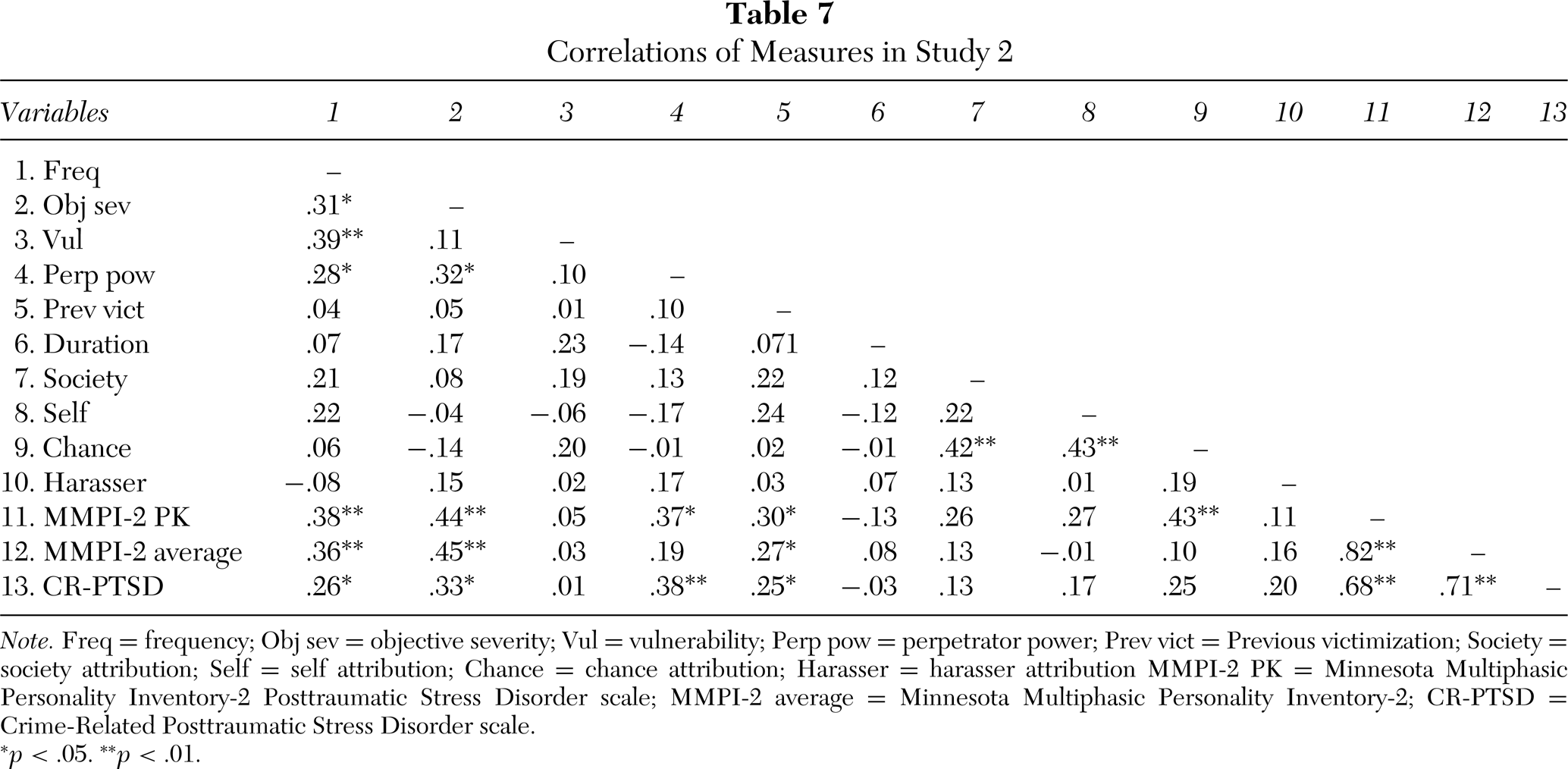
Note. Freq = frequency; Obj sev = objective severity; Vul = vulnerability; Perp pow = perpetrator power; Prev vict = Previous victimization; Society = society attribution; Self = self attribution; Chance = chance attribution; Harasser = harasser attribution MMPI-2 PK = Minnesota Multiphasic Personality Inventory-2 Posttraumatic Stress Disorder scale; MMPI-2 average = Minnesota Multiphasic Personality Inventory-2; CR-PTSD = Crime-Related Posttraumatic Stress Disorder scale.
p < .05.
p < .01.
For this study, respondents' experiences were coded present or absent for Childhood Sexual Abuse, Childhood Physical Abuse, Adolescent Sexual Abuse, Adult Sexual Abuse, and Adult Physical Abuse. In all cases, the participant had to have experienced physically intrusive behavior as the minimum criterion to be assigned to the abused category (i.e., verbal abuse or voyeur behavior was not counted). Previous work with a subset of this sample indicated no distinction on psychological outcomes between sexually abused and physically abused plaintiffs (Fitzgerald et al., 1999), and the five abuse scales were thus summed to create a cumulative previous victimization score, ranging from 0 (indicating they had experienced no previous abuse) to 5 (indicating they had experienced all five categories of abuse). The higher the score, the more types of abuse they had experienced.
Practical vulnerability. For purposes of the study, vulnerability was measured by six items in the IDIS protocol addressing financial as well as career goal vulnerability. These items were similar, although not identical, to those used in Study 1 (see the Appendix for a list of the items). Scores were standardized and summed to create a practical vulnerability score. The higher the score, the more vulnerable the woman was to job interruption or job loss.
Attributions. Participants completed a modified version of Frazier's (1990) Attributions scale, described earlier for Study 1. However, the scales for Study 2 consisted of a total of 25 items, a superset of the 19 used in Study 1. The measure for Study 2 consisted of 5 items for Society Attributions, 10 items for Self-Blame Attributions, 5 items for Chance Attributions, and 5 items for Harasser Attributions. The scores for the items were summed for each scale such that higher scores indicate greater endorsement of that attribution.
Measures of Outcomes
Psychological distress. The Minnesota Multiphasic Personality Inventory-2 (MMPI-2) is a 567-item, standardized instrument that measures various personality characteristics. Participants respond True or False to individual items that load onto various scales; the raw scores for scales are converted to T scores for elevation interpretation. In the present study, the MMPI-2 was used to provide estimates of the level of participant distress. First, examination began with the average level of the clinical profile, generally viewed as a good global measure of psychological distress (Graham, 2006). T scores on the clinical scales (1, 2, 3, 4, 6, 7, 8, and 9) were averaged to create a global measure of psychological distress. We also employed the PK subscale developed by Keane, Malloy, and Fairbank (1984) as an estimate of PTSD. The average T score for PK in this sample was 61.43.
Crime-related PTSD (CR-PTSD). The CR-PTSD scale (Saunders, Arata, & Kilpatrick, 1990) was developed from Symptom Checklist-90-Revised items. Respondents were given a list of 28 symptoms and asked how much the symptom had bothered them in the last week, using a Likert-type scale ranging from 0 (not at all) to 4 (very much). The average score in this sample was 1.33, very similar to the mean of those identified as experiencing PTSD in the original norming study (i.e., 1.34). An average score is calculated such that the higher the score, the more PTSD symptomatology reported.
Analysis
Given the findings of Study 1, severity, frequency, perpetrator power, vulnerability, and attributions were identified as important predictors of psychological outcomes. Also, the sample in Study 2 allowed for the examination of additional individual variables hypothesized in the Model of Harm, specifically duration and previous victimization. However, this clinical sample posed problems with statistical analyses related to sample size. Although there were data from 86 plaintiffs, the sample size varied by each variable, and there was sufficient missing data that when listwise deletion was employed, the sample size was reduced to as low as 24 in some instances. Therefore, data analysis proceeded in two steps: Zero-order correlations were first calculated to determine important relationships and to narrow the number of predictor variables. Dominance analysis was then undertaken when the sample size was sufficient.
Results
Zero-order correlations are provided in Table 7. As expected, frequency, severity, and previous victimization were all significantly correlated with each of the outcome variables. The attributions were analyzed singly. Only Chance Attribution revealed any significance, and it was significantly correlated with the MMPI-2-PK; follow-up analysis was conducted with only this outcome. Duration was not significantly associated with any of the outcome variables and was dropped from further analysis. Perpetrator power was significantly related to MMPI-2-PK and to CR-PTSD. However, because dominance analysis is inappropriate with small samples (Budescu, 1993), the follow-up analysis of perpetrator power could not be conducted—listwise deletion in models that contained perpetrator power reduced the n to 24.
MMPI-2 Average
Dominance analysis for predictors of the MMPI-2 profile average revealed that severity completely dominated frequency and generally dominated previous victimization. Previous victimization conditionally dominated frequency. The order of dominance for the MMPI-2 average was severity, previous victimization, and frequency.
MMPI-2 PK
For the MMPI-2-PK subscale, severity was the most important factor, completely dominating frequency and chance attribution and generally dominating previous victimization. Previous victimization was the next most important factor, generally dominating frequency and conditionally dominating chance attributions. Finally, chance attributions conditionally dominated frequency. The order of dominance for the MMPI-2-PK was severity, previous victimization, chance attributions, and frequency, similar to results from the MMPI-2 average distress score analysis.
CR-PTSD
Results indicate that severity was the dominant predictor of CR-PTSD, completely dominating frequency, and previous victimization generally dominated frequency. However, there was no clear picture when severity and previous victimization were compared; the general dominance comparison has them with identical scores. The order of dominance was severity, previous victimization, and frequency.
In summary, the results of the study parallel those of Study 1 in that severity of harassment was the dominant predictor of psychological distress with previous victimization also showing considerable importance. Frequency of harassment appears to have greater importance than chance attributions.
DISCUSSION
Social science research has repeatedly documented a connection between sexually harassing experiences and negative psychological outcomes. From anecdotal therapist accounts to sophisticated statistical analysis of individuals across the country, sexual harassment has been shown to be associated with major psychological distress and damage, including PTSD and Major Depressive Disorder. Paralleling these developments, the judicial courts of this country have grappled with issues related to the psychological damage from workplace harassment. The present studies contribute to the body of research on factors related to psychological harm resulting from sexually harassing experiences.
It is important to note at the outset that the studies reported here merely begin the process of teasing out the impact of various characteristics of the sexually harassing experience (both person and environment) that contribute to the psychic consequences so frequently cited in the social science literature. Nonetheless, we believe that the current findings provide support for several hypothesized factors in the Fitzgerald et al. (1997) Model of Harm. The results consistently indicate that it is generally what happens to a victim—the severity of the experience—that is most prominently associated with psychic damage. How frequently the harassment occurs and (to some degree) the nature and status of the offender are also important predictors of a victim's outcomes. Such factors are objective stressor dimensions related to the harassment experience itself and operate independently of the victim's conduct or vulnerability. Certainly one of the limitations of the current study was the inability to examine the status of the offender in Study 2 as it related to the other variables. It is a variable that should be studied in future research with clinical samples.
Not surprisingly, the attributions made about the experiences also appear to be important. Cognitions figured very prominently in Study 1; attributions were of lesser importance in Study 2. This difference may be related to the size or nature of the sample in Study 2. Certainly the area of cognitive processing merits further research. Other characteristics that are more closely associated with the victim (e.g., financial vulnerability) failed to make significant contributions to psychological distress.
The one personal characteristic that contributed importantly to negative psychological outcomes was previous victimization. This result is not surprising for a number of reasons. First, psychological research has repeatedly demonstrated that symptoms associated with previous victimization can be exacerbated by subsequent trauma, leading perhaps to a cumulative effect created by multiple victimizations. Second, three of the five outcome measures in the present studies were assessments of PTSD symptomatology, and epidemiological data indicate that the largest population group at risk for PTSD consists of women who have been sexually victimized. It is logical that those victims of sexual harassment who have been victimized in the past are more likely to develop PTSD symptomatology. Even the law recognizes this connection in the tort-related concept of the “eggshell plaintiff.” It is important to remember too that, even given its importance, previous victimization was completely dominated by the severity of the harassment itself.
As mentioned above, the role of attributions is less clear. Although taken together they created a very important influence on psychological outcomes, at least in Study 1; they were of considerably less importance in Study 2. Further, examining the relative importance of the various attributions revealed no consistent results. Traditional attribution theory (e.g., Weiner, 1985) suggests that self-blame should be associated with worse outcomes, whereas placing responsibility outside the self should lead to better results. That was clearly not the case here. Harasser attributions were most important for one outcome and least important for a second outcome. Self-blame was most important for one outcome and second in importance for a second outcome. Chance was last for one outcome, second for another. Societal attribution was ranked third in importance for both outcomes in Study 1. In Study 2, chance was the only attribution that was significantly related to the outcomes. No clear pattern emerges as to the relative importance of the individual attributions' relationship to psychological outcomes, However, taken together, they appear important.
The present results have a number of important implications for the psychological and legal arenas. First, a number of hypothesized elements of the Model of Harm are supported by the present studies. There is strong support for the role of severity in its relationship to negative psychological outcomes, including PTSD symptomatology. Clearly, the nature of the offensive behavior can predict the negative impact of that behavior. Certain characteristics of the experience—such as being physical, the presence of threat, restricted access to escape, and being the sole target—are important predictors of PTSD and other psychic distress. Other aspects of severity included in the measure of severity in these studies suggest additions to the model, such as the unexpectedness of the behavior; hostility associated with the behavior; and sexual, vague, or frightening behaviors.
This is not the entire picture, however. Other characteristics of the event have a negative impact as well. For example, the frequency of the behavior was another strong predictor of psychological distress. Not surprisingly, the power of the perpetrator was also confirmed as a significant predictor of harm. However, the impact of multiple perpetrators and the duration of the experiences were not found to be important, at least in the present case.
Three individual factors were examined with mixed results. The roles of previous victimization and cognitive attributions were confirmed as strong predictors of PTSD symptoms and other psychological distress, although the latter was inconsistent across studies. Practical vulnerability (operationalized generally as financial resources, career saliency, and career opportunity) was not found to be a significant predictor of psychological distress.
Taken together, the studies provide important support for Fitzgerald et al.'s (1997) theory of the process by which the psychological damage of sexual harassment occurs. However, the complexity of parsing out the sources of harm is also confirmed by these studies. Predicting the psychological outcomes associated with sexual harassment is clearly not a simple matter, and future research should consider this complexity when designing new investigations.
Public Policy
The present results have implications for public policy as well. First, the issue of damages is a central focus in most sexual harassment litigation. Although sorting out the various factors that any particular individual may bring to a situation will always remain complex, these studies supply empirical support for the general proposition that it is the behavior of the perpetrator and the objective circumstances surrounding the events that should remain the focus of inquiry and examination. Although a victim may have a preexisting vulnerability to greater harm, there is no escaping the factors inherent in the events, especially the severity and frequency.
Such results can and should be used to educate the larger community because it is from this pool that jurors will come. Considering the widespread acceptance of rape myths by the public (e.g., she lied, she asked for it, it didn't matter) and new research that shows similarly held myths about sexual harassment (Lonsway, Cortina, & Magley, 2008), women are typically held responsible for sexual experiences, and these results may help dispel some of the erroneous conclusions that many people hold.
Finally, the implications for organizations are important as well. Policies and standards with the goal of protecting employees can best be focused on offenders, especially those in positions of management who have control over important employment issues such as promotions, pay raises, and evaluations.
Interventions
Mental health professionals, especially those who treat individuals in the aftermath of sexual harassment experiences, can be informed by these results as well. In a longitudinal study, Frazier (2003) found that blaming the perpetrator and blaming oneself were associated with higher postrape distress, suggesting that these attributions keep a victim focused on the past. This focus on both her own behavior and that of the perpetrator (two aspects of the events over which she no longer has any control) may be maladaptive for recovery from a trauma. Indeed, Frazier (2003) argues that any focus other than the recovery process may impede recovery. Frazier's (2003) reasoning may explain the results from Study 1 that suggest that attributions in general (regardless of their type) were a very important predictor of negative psychological outcome. Certainly, women who are involved in ongoing litigation are obliged to remain focused on the past due to the demands of testimony, and civil trials are unfortunately known for their lengthy delays, further inhibiting recovery. The implication for professionals is that treatment for women recovering from sexual harassment may be well served by including an emphasis on coping in the present, rather than seeking a person or entity to blame. This is not to say that individuals and organizations should not be held responsible for past actions and failures to act, but, rather, that a focus for recovery might be present coping strategies and the fostering of a sense of control over the recovery process.
A final implication for practitioners pertains more to those who act as expert witnesses in sexual harassment litigation. Perusing the reports of dozens of psychologists in sexual harassment litigation reveals that widespread misconceptions about the issues of sexual harassment are not reserved for the general population (see Fitzgerald, 2003, for examples). Forensic psychologists in this area frequently delve into a woman's psyche during the interviews and their reports discuss at length the victim's personality and other tangential factors to cite factors for which there is no empirical justification. Professionals have an ethical responsibility to be knowledgeable about the scientific literature on sexual harassment and its sequelae before offering opinions for the courts on such issues. These two studies add to this scientific body of research that has relevance for expert testimony.
Limitations
As with any study, a number of limitations exist. First, the participants were involved in litigation. Although data on this issue are very limited, clinical observation suggests that the impact of contentious litigation on psychological well-being is not small. Future research should investigate our questions in nonlitigation samples to better understand the potential role of litigation in predicting psychological distress among harassment victims. Relatedly, because participants were in some stage of litigation, they were required to revisit their experiences in sometimes hostile circumstances. Longitudinal research to examine the process of recovery can provide a clearer understanding of the process of harm and recovery.
There are measurement issues that are important to highlight as limitations. For example, the practical vulnerability measure is one that intuitively should be related to negative outcomes. Having dependent children, needing a job for health insurance, and having one's identity linked with one's career are all examples of factors that would cause disruption and distress if one were to lose her job. Yet, neither study supported this expectation. This negative finding could be due to problems with the vulnerability measure used in the studies. Future research should investigate the development of a reliable measure of practical vulnerability so that the construct can be better tested. Other variables (e.g., perpetrator power, number of perpetrators) may require additional measurement development as well.
Caution is needed in generalizing to nonlitigant samples. Furthermore, as is the case in working with clinical samples, the sample size in Study 2 hampered analysis of important variables. An additional concern in attempting to consolidate the results of these two studies is the differences between the two samples. The women in Study 1 were members of a class-action suit in which participation can be as simple as failing to respond to a letter from an attorney opting out. The personal time and investment required will vary from minimal to considerable. In this case, the woman is one of a thousand. The situation for these women contrasts markedly with the participants in Study 2, who were involved in contested litigation, were subjected to hostile examination by defense attorneys, and whose personal lives were frequently exposed. The personal time and investment of women in this sample considerably exceeded that of the women in Study 1.
Ultimately, our research needs to be placed in the context of sex discrimination and the impact it has on women's day-to-day work lives and careers. Sexual harassment is a form of sex discrimination and an impediment to a woman's right and ability to earn a living. One need only to sit once with a woman whose life career has been forfeited in the aftermath of sexual harassment to appreciate the magnitude of these events in women's lives.
NOTES
See Fitzgerald et al. (1997) for a more complete discussion of the Model of Harm. In case of duplicate responses from online and paper-and-pencil surveys, the survey with more complete data was used and the other deleted. A copy of the complete instrument is available from the second author. Nineteen of the 25 original items were modified and used in this study. As all of the women in this sample were involved in litigation at the time of their assessment, all of the harassment experiences were “alleged” at the time. There is no implication by the omission of the word “alleged” throughout this article that legal adjudication of the issues has occurred. To avoid undue influence on this vulnerable group, participants were assured that the evaluator would not know their decision until after the assessment was completed; given this assurance, and other assurances of anonymity, only two women declined to participate. A copy of the instrument is available on request from the second author. Across all SEQ data provided by the 86 respondents, only 10 SEQ items were rated as “not at all” bothersome and scored as 0.
APPENDIX
Objective severity. Participants responded on a 5-point scale ranging from 0 (never) to 4 (many times). The scale consisted of the following 9 items (Swan, 1997):
You were surprised by the behavior because you weren't expecting it. The behavior seemed deliberately hostile and meanspirited. The behavior was sexual or implied something sexual. The behavior was unclear or vague, so that you thought the person was suggesting something but you weren't sure. The behavior was directed just at you, not to a group of people. It was hard to get away from the behavior (for example, by leaving). You were touched in a way that made you uncomfortable. The behavior seemed to be threatening. You were afraid that you might get hurt.
Perpetrator power. Respondents were asked whether the perpetrator(s) could affect various elements of their work status. Response options were 1 (no), 2 (?), and 3 (yes). The scale consisted of the following 7 items:
Professional reputation Performance Pay and financial opportunities Chances of advancement Enjoyment of your job Ability to succeed Relationship with your co-workers
Practical vulnerability: Study 1. Ten items were used to measure practical vulnerability with varying response options. They included the following:
Marital status (single; divorced/widowed; married/partnered [scoring reversed]) Do you have children? (no; yes, one child; yes, two children; yes, three or more children) What is the highest level of education you have completed? (high school diploma or GED; some college; graduated from college; some graduate school; graduate or professional degree [scoring reversed]) How secure was/is your job at YOUR ORGANIZATION? (5- point scale; 0 = not at all; 4 = very [scoring reversed]) How important was/is it financially? (5-point scale; 0 = not at all; 4 = very) How important was/is it to your identify? (5-point scale; 0 = not at all; 4 = very) How important was/is it to your career? (5-point scale; 0 = not at all; 4 = very) How much of your total household income did/does this job provide? (25%; 50%; 75%; 100%) How many people besides yourself were/are dependent or partially dependent on your income? (0; 1; 2; 3+) Did you use YOUR ORGANIZATION'S health coverage? (yes, for myself and my family; yes, for myself only; no [reverse coded])
Practical vulnerability: Study 2. The measure consisted of 6 items with varying response options. The measure consisted of the following items:
When this [the harassment] happened, were you married or in a significant relationship? (no; yes) How much of your income did this job provide? (25%; 50%; 75%; 100%) Did you have children? (no; yes) Did this job provide health insurance? (no; yes) How important was this job to your career goals? (0 = not at all; 4 = quite a lot) How hard would it be to find another job that paid as well as this one? (0 = very easy; 4 = very hard)