






Abstract
Sexual harassment can be conceptualized as a series of interactions between harassers and targets that either inhibit or increase outrage by third parties. The outrage management model predicts the kinds of actions likely to be used by perpetrators to minimize outrage, predicts the consequences of failing to use these tactics—namely backfire, and recommends countertactics to increase outrage. Using this framework, our archival study examined outrage-management tactics reported as evidence in 23 judicial decisions of sexual harassment cases in Australia. The decisions contained precise, detailed information about the circumstances leading to the claim; the events which transpired in the courtroom, including direct quotations; and the judges' interpretations and findings. We found evidence that harassers minimize outrage by covering up the actions, devaluing the target, reinterpreting the events, using official channels to give an appearance of justice, and intimidating or bribing people involved. Targets can respond using countertactics of exposure, validation, reframing, mobilization of support, and resistance. Although there are limitations to using judicial decisions as a source of information, our study points to the value of studying tactics and the importance to harassers of minimizing outrage from their actions. The findings also highlight that, given the limitations of statutory and organizational protections in reducing the incidence and severity of sexual harassment in the community, individual responses may be effective as part of a multilevel response in reducing the incidence and impact of workplace sexual harassment as a gendered harm.
Sexual harassment is inextricably linked with women's disadvantaged status at work and subordinate position in society (Wilson & Thompson, 2001). Although the phenomenon itself has ancient lineage (Thornton, 2002), the socio-legal recognition of sexual harassment is of recent origin, emerging in the United States in the mid 1970s through the work of prominent feminists such as MacKinnon (1979) and quickly entering feminist and equality of employment opportunity discourse throughout the industrialized world (Pringle, 1989). Sexual harassment comprises a continuum of behaviors, including personal insults and ridicule, leering, offensive comments, suggestive remarks, nonverbal gestures, and sexual and physical assault (Australian Human Rights Commission, 2008; Canadian Human Rights Commission, 2006; Hayes, 2004). Sexual harassment is characterized by power imbalances between the individuals involved (Easteal & Judd, 2008) and, unlike other forms of harassment such as those based on race or disability, the conduct may be excused as welcome attention (Samuels, 2003). Evidence also suggests that the individual and organizational costs of the problem remain profound (Chan, Chow, Lam, & Cheung, 2008; Firestone & Harris, 2003; Human Rights and Equal Opportunity Commission [HREOC], 2004). Hence, the way individuals and organizations should best deal with sexual harassment remains contentious (Bacchi & Jose, 1994).
In response to the problem, organizations have produced policies, issued guidance on complying with laws, conducted research and provided training, and introduced sexual harassment complaint procedures (McCann, 2005). However, these responses have worked only in limited ways in drawing attention to how individual behavior reinforces gendered workplace structures and are partly instigated to protect and shield organizations against litigation (Bisom-Rapp, 2002; Stockdale, Bisom-Rapp, O'Connor, & Gutek, 2003). The provision of policy and training as a legal defense was demonstrated in two landmark sexual harassment cases in 1998 (i.e., Burlington Industries v. Ellerth; Faragher v. City of Boca Raton) when the U.S. Supreme Court legitimated the defense if an organization exercised reasonable care in preventing and correcting sexual harassment behavior and if the plaintiff employee unreasonably failed to take advantage of preventive or corrective opportunities provided by the employer (Bisom-Rapp, 2002, p. 135).
Sexual harassment continues to be a problem in many organizations (Elkins, Phillips, & Ward, 2008) and, like other forms of sexual violence that remain seriously underreported (Allen, 2007), relatively few incidents are declared internally and even fewer outside the confines of the workplace or to a public hearing (Firestone & Harris, 2003; Illies, Hauserman, Schwochau, & Stibal, 2003; Wear, Aultman, & Borgers, 2007). Furthermore, feminist legal scholars have identified a number of significant limitations of the wording and interpretation of sex discrimination legislation. These limitations include the positioning of sexual harassment as individual, aberrant behavior rather than a systemic expression of gender inequality, the decontextualizing of discrimination complaints in formal proceedings, and judicial reluctance to transcend traditional gendered assumptions in subsequent case law (Easteal & Feerick, 2005; Fredman, 1997; Thornton, 2002). The limitations of formal statutory and grievance provisions mean that many targets feel unable or unwilling to use these avenues of redress. Rather, they often deal with the problem of sexual harassment in isolation or with the assistance of friends or coworkers, or by tolerating the behaviors, leaving the organization, or resisting in other informal ways. Hence, it is surprising how little attention has been given to nonformal methods of resistance.
We sought to systematically analyze, in an Australian context, the tactics used by harassers and the methods of resistance—in other words, countertactics—used by those subject to harassment who did not acquiescence or immediately leave the organization. Social science has given little attention to tactics and strategy (Jasper, 2006, p. xii), so we turned to a recently developed framework that we refer to as the “outrage management model,” which has been used for classifying tactics used by perpetrators of perceived injustice. In this article, we outline this model and describe how it can be applied to interpersonal struggles over injustices in cases of sexual harassment. We then use it to analyze evidence in Australian sexual harassment judicial decisions, concluding with an assessment of the approach in informing effective responses.
The Outrage Management Model Applied to Sexual Harassment
Gene Sharp, a central figure in research on nonviolent action, observed that, when peaceful protesters are brutally assaulted, this action sometimes generates much greater support for the protesters from third parties. He called this process “political jiu-jitsu” in analogy with jiu-jitsu, a system of unarmed combat in which an opponent's energy is used against them (Sharp, 1973, p. 657). Martin (2007) observed that in many assaults the jiu-jitsu effect does not occur and, to explain this anomaly, analyzed methods used by attackers to minimize adverse public reaction to their actions. Examining a wide range of cases, he found that, when powerful individuals or groups behave in a way that others might potentially perceive as unjust, they are likely to use one or more of the following five types of tactics to dampen public outrage: (a) cover up the action; (b) devalue the target; (c) reinterpret the events by lying, minimizing, framing, or blaming; (d) use official channels to give an appearance of justice; and (e) intimidate or bribe people involved. When these methods fail, the action may be counterproductive for the perpetrators; in other words, it backfires.
This framework has been applied to a wide range of case studies, many of them well outside Sharp's focus on violence versus nonviolence, including censorship (Jansen & Martin, 2003), defamation (Gray & Martin, 2006), refugees (Herd, 2006), corporate disasters (Engel & Martin, 2006), labor struggles (Smith & Martin, 2007), and genocide (Martin, 2009). Given that the same tactics are found in diverse arenas, it is plausible that this model would apply to sexual harassment. Martin usually refers to this framework for studying tactics as the backfire model, but here we call it the outrage management model because in sexual harassment cases the perpetrators' actions so seldom backfire.
An example of the application of the model to sexual harassment is the 1991 case of Anita Hill, who accused Clarence Thomas, then nominated to the U.S. Supreme Court, of sexually harassing her a decade earlier. Hill had worked for Thomas when he was head of the Equal Employment Opportunity Commission (EEOC). Evidence for all five methods of inhibiting outrage was found in the case (Scott & Martin, 2006). Some examples were that neither Hill nor her confidantes sought wider publicity about her experiences until after Thomas was nominated for the Supreme Court (cover-up); David Brock (1993) wrote a book, The Real Anita Hill, designed to discredit her (devaluation); Thomas described the hearings of the Senate Judiciary Committee as a “high-tech lynching for uppity blacks,” reframing the investigation of sexual harassment allegations as a racial attack (reinterpretation); Senator Danforth manipulated the hearings to Thomas's advantage, saying that in seeking affidavits he showed “no concern at all about fairness to Anita Hill” (Danforth, 1994, pp. 162–163) (official channels), while media coverage had broken open the case; and Hill received numerous abusive and threatening phone calls and hate mail (intimidation).
The Hill v. Thomas case was a spectacular one, generating significant media attention and resulting in a number of books written from different perspectives. It is not immediately obvious that less public cases, ones without high-stakes media fanfare and intense public scrutiny, would involve the same sorts of tactics. Accordingly, we set out to determine whether the outrage management framework applies as readily to lower-profile sexual harassment cases. First, however, we outline the five types of tactics that reduce outrage.
Cover-up. Cover-up is common in sexual harassment, which often occurs in a one-on-one situation away from witnesses. Perpetrators seldom reveal their actions, and targets often keep quiet because of shame and/or fear. Senior managers rarely publicize cases in their organization, fearing bad publicity more than they anticipate benefits of deterring potential harassers. Gettman and Gelfand (2007) illustrated behaviors consistent with cover-up in a study of sexual harassment perpetrated by clients who perceived little accountability for their actions through lack of visibility or off-site engagement. The countertactic to cover-up is exposure—to friends, coworkers, managers, or the media. Often the most powerful exposure is directly to the harassers, letting them know that their behavior is unwelcome and constitutes harassment (Bingham & Scherer, 1993; Langelan, 1993).
Devaluation. Devaluation of the target is also common in cases of sexual harassment, openly and/or through rumors. This deprecation may involve derogatory labelling, such as being called a “slut,” “tight-ass,” or “poor sport.” It may involve criticism of performance, such as claims about dishonesty, sloppiness, or incompetence. Targets of harassment are often under intense scrutiny, and perpetrators will often seize on any weakness to justify their position. Devaluation in sexual harassment is analogous to the experiences of many sexual assault survivors who are subject to messages that they are to blame for the assault, that they caused it, and indeed that they deserved it (Campbell, Dworkin, & Cabral, 2009; Lonsway & Fitzgerald, 1994). The countertactic to devaluation is validation. Validation includes demonstrating good work performance, ethical behavior, and good character. These actions can be done by the target herself or, often more effectively, by supporters who are usually regarded as less self-interested.
Reinterpretation. Reinterpretation includes denying some of the actions, minimizing their seriousness, framing the events as something other than harassment, and blaming others. Perpetrators may say that their comments were innocent or have been misunderstood and that their actions have been misinterpreted. For example, they may suggest a grab or a kiss was just a friendly greeting. The counteraction to reinterpretation is to reassert the original or obvious interpretation, namely that inappropriate behavior has occurred.
Office channels. Using official channels includes reports to senior officials; grievance procedures; and appeals to organizational boards, internal ombudsmen, external bodies, or professional organizations. Most official channels emphasize formal processes, require confidentiality, and focus on technicalities. Despite the best intentions of those running the procedures, the effect of many official channels is to dampen outrage: The immediacy and urgency of the problem is lost in the slow, ponderous processes. Meanwhile, observers often believe justice is being done, although outcomes seldom live up to expectations.
In cases of sexual harassment, official channels are more likely to work against low-level perpetrators who do not have the support of organizational elites. Conversely, official channels are less likely to be effective against a perpetrator, and therefore more likely to inhibit outrage, when the harasser has a senior position or has powerful connections within the organization (Hulin, Fitzgerald, & Drasgow, 1996; Rowe, 1996). Indeed, reporting harassment experiences often does not improve, and sometimes worsens, outcomes for the target (Bergman, Langhout, Palmieri, Cortina, & Fitzgerald, 2002; Lee, Heilmann, & Near, 2004). A deeper problem is that the emphasis on in-house grievance management and ensuring legalistic procedural fairness works to recast complainants as an organizational risk or a managerial problem, thereby safeguarding the conventional gendering of workplaces (Charlesworth, 2002; Edelman, Uggen, & Erlanger, 1999; Thornton, 2002). The counteraction to official channels is to avoid or discredit such processes—or at least to not rely on them and instead to mobilize support via personal contact, support groups, and publicity. In practice, harassers as well as targets and their supporters often use a dual-track strategy, both using official channels and mobilizing support.
Intimidation. Intimidation often takes the form of threats, open or implied, such as poor references, unwelcome job assignments, or dismissal. Bribery is a parallel process of promising favorable references, comfortable job assignments, and promotions. These techniques are often used to encourage cover-up, discouraging action against harassment. Third parties such as coworkers may also be influenced by fear of reprisals (e.g., withdrawal of annual leave, pay reductions, work-hour restrictions, or dismissals) or the promise of rewards (e.g., pay increases, options of extra work, or promotion). The counteraction to intimidation and bribery is resistance, which includes both persistence in challenging the problem and exposure of threats and incentives.
Outrage Management in Context
Perpetrators often initiate techniques of outrage minimization, but sometimes targets do so too: for example, when they do not speak out about harassment due to fear or shame or when they pursue official channels, believing them to provide redress. Targets may also have other goals such as public vindication or a monetary settlement. The focus of our framework is on perpetrators' actions that prevent or reduce outrage. Because perpetrators usually have more power, their tactics often succeed rather than backfire.
The outrage management model focuses on actions, called tactics or methods, but the choice of these actions has psychological underpinnings. Many people react emotionally to what they perceive as an injustice in ways that can be described as anger, outrage, concern, disgust, or revulsion. These psychological dynamics can be understood using various frameworks (Reis & Martin, 2008). Examples are Albert Bandura's (1990) “methods of moral disengagement,” by which a perpetrator can psychologically minimize concern and guilt about an action, and “just world theory,” which posits that those who believe the world is just are more likely to blame victims for what is done to them (Lerner, 1980). However, our focus here is on tactics used in sexual harassment cases rather than the associated psychological dynamics.
The outrage management model applied to sexual harassment complements the framework developed by Louise Fitzgerald for classifying women's responses to sexual harassment (e.g., Fitzgerald, Swan, & Fischer, 1995, pp. 119–121; Gruber & Smith, 1995, p. 545). Fitzgerald's framework has 10 strategies, of which 5 are focused internally (denial, detachment, relabeling, endurance, and illusory control) and 5 focused externally (avoidance, appeasement, assertion, seeking social support, and seeking organizational relief). Several of Fitzgerald's externally focused strategies can be linked to responses by targets in the outrage management model: Assertion is similar to resistance, the counter to intimidation; seeking social support is similar to mobilization, an alternative to official channels; and seeking organizational relief is one use of official channels. However, there are also significant differences between the frameworks. Fitzgerald's framework includes internally focused strategies, which are not addressed in the outrage management model. It also deals with women's responses to sexual harassment whereas the outrage management model concentrates on perpetrator tactics and the role of official channels in dampening outrage or, occasionally, vindicating targets.
In summary, the outrage management model predicts the kinds of actions likely to be used by perpetrators to minimize outrage, predicts the consequences of failing to use these tactics—namely backfire, and recommends countertactics to increase outrage. The use and choice of tactics is driven by the possibility of, and motivation to, reduce powerful emotional reactions by targets and observers epitomized by the term “outrage” and consequently avoid negative outcomes such as personal embarrassment, career consequences or job loss, revelations to family and friends, or financial penalties. However, the focus of our model is less on predicting the causes of behaviors than on the tactics themselves, especially on outrage-inhibiting methods used by perpetrators, by their allies, and sometimes by targets.
The objectives of the study were (a) to examine the utility of the outrage management framework in understanding tactics and countertactics used in interactions between perpetrators and targets in cases of workplace sexual harassment and (b) to provide practical recommendations for effective responses. To achieve these goals, we needed cases with extensive documentation that highlighted a wide variety of tactics and countertactics as well as ones where we could detect any tactics that did not fit the framework. Prominent sexual harassment cases, such as Hill v. Thomas, may be atypical of lower-profile sexual harassment cases, but few lower-profile cases are sufficiently documented to provide a sound basis for an analysis of tactics. There is, however, one valuable source of highly documented lower-profile cases: legal cases with judicial decisions.
METHOD
Materials
The 23 judicial decisions used for the study were accessed online via the AustLII Databases, a free, public resource which provides links to all Australian federal and state courts and tribunals. The decisions, when printed, were between 8 and 16 single-spaced pages in length and contained precise, detailed information about the circumstances leading to the claim; the events which transpired in the courtroom, including direct quotations; and the judges' interpretations and findings. The number and depth of the cases was consistent with the logic and strengths of qualitative inquiry in being sensitive to and contributing to understandings of complexity, detail, and context using fine-grained, interpretive analysis (Mason, 2002). Hence, the 23 cases were more than sufficient in detail to illustrate a wide range of tactics and to assess the relevance of the outrage management model's categories of perpetrator tactics and target countertactics.
For our purposes, we did not judge the veracity of claims by either the respondent (individual or organization responding to or defending the claim) or the target (the complainant or victim of sexual harassment); rather, we examined the tactics used in the struggle between them. We chose to examine all Australian judicial decisions (see Table 1) satisfying the following conditions: (a) the judgement was made in 2005 or 2006; (b) sexual harassment in the workplace was the central claim; (c) the case was brought under federal or state sex discrimination legislation and conducted infederal orstate/territory jurisdictions; (d) the court report contained detailed information about facts, allegations, and evidence which could be coded; and (e) the case was a “principal matter,” that is, it was not an appeal, interlocutory injunction, application for extension of time, application to continue a complaint, or decision of costs.
Table 1 details relevant characteristics of the sample judicial decisions. Twenty-one of the 23 cases involved a female complainant and all cases involved a male perpetrator. Fifteen cases (65%) were successful or partially successful (complaint upheld or part of complaint upheld), and eight (35%) were dismissed (complaint not upheld). Fourteen of the 15 successful cases were awarded financial compensation in the range of $1,000 AUS to $23,187 (mean = $10,809; SD = $7,622; median = $12,248). One third of the successful cases had a judgment entered against the respondent to pay the applicant's court costs. In 14 (61%) cases, the complainant worked in a small workplace, often where the individual employer was the respondent. Twenty complainants were engaged in lower-skilled occupations; the remaining three were state or federal government employees. In order to estimate whether the sample size was typical we conducted an identical search of decisions from 2003–04. Twenty decisions were identified from this comparative time period.
Characteristics of Judicial Decisions
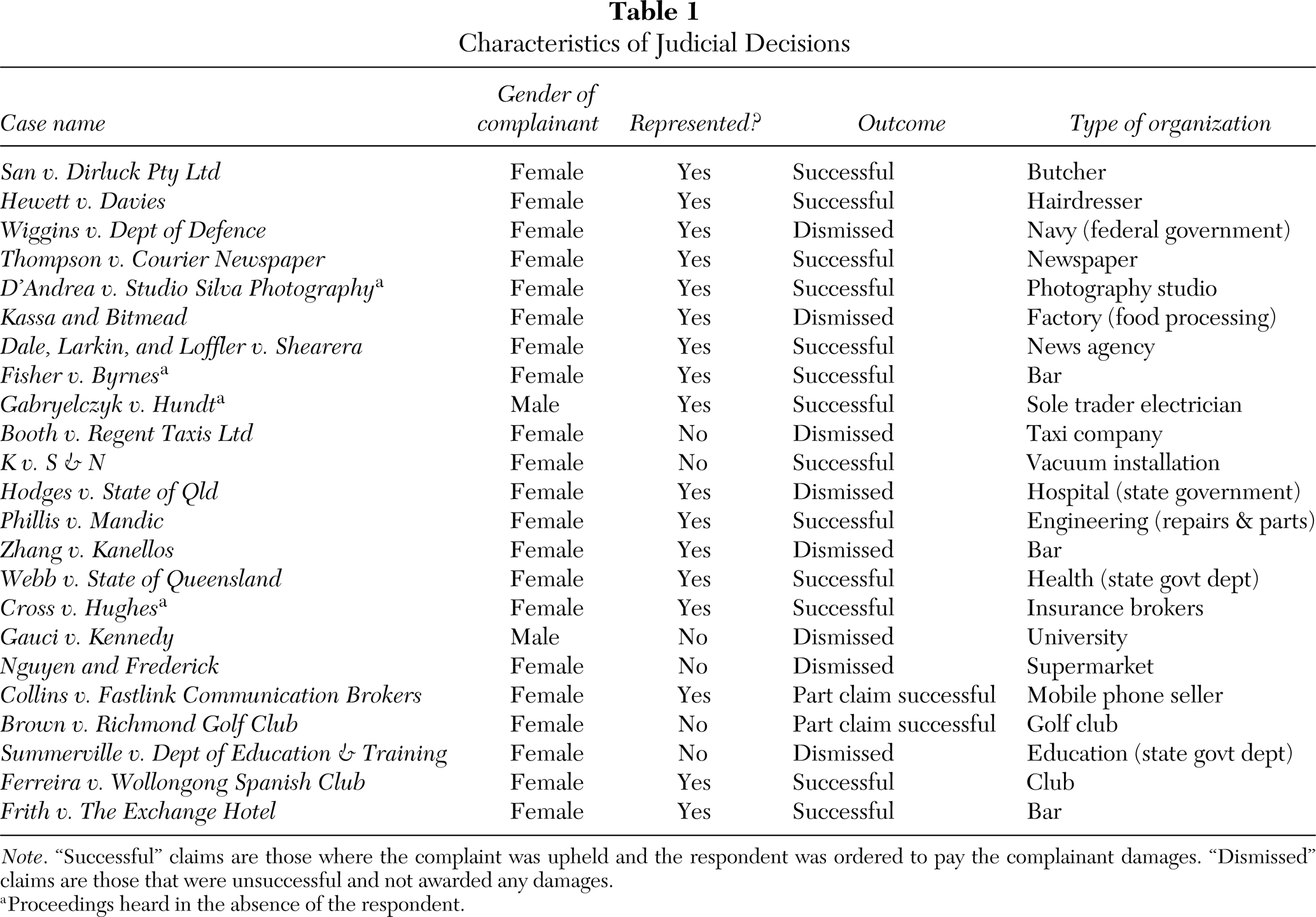
Note. “Successful” claims are those where the complaint was upheld and the respondent was ordered to pay the complainant damages. “Dismissed” claims are those that were unsuccessful and not awarded any damages.
Proceedings heard in the absence of the respondent.
Sexual harassment is defined by the Australian federal Sex Discrimination Act 1984 as “… an unwelcome sexual advance, or an unwelcome request for sexual favours … or other unwelcome conduct of a sexual nature … in circumstances in which a reasonable person … would have anticipated that the person harassed would be offended, humiliated or intimidated” (Section 28A). Various factors influence the choice of jurisdiction where a complaint is lodged, such as corresponding provisions and limits for damages across federal and state acts, time limits set for lodging a complaint, and personal preference (McDonald & Dear, 2008). All Australian federal and state legislation mandates the attempted conciliation of complaints in the first instance in a confidential setting (Thornton, 1999) before referring it to a hearing if conciliation fails. In the fiscal year 2006–07 at least 1,000 formal complaints about sexual harassment in employment were lodged with Australian state and federal human rights bodies, representing between 8% and 22% of all complaints received (Anti Discrimination Commission Northern Territory, 2007; Anti Discrimination Commission Queensland, 2007; Equal Opportunity Commission South Australia, 2007; Equal Opportunity Commission Victoria, 2007; Equal Opportunity Commission Western Australia, 2007; Human Rights Commission, Australian Capital Territory, 2007; HREOC, 2007). In terms of population, this range of percentages was roughly comparable to, in the same period, 12,025 charges filed with the EEOC and the state and local Fair Employment Practices agencies that have a work-sharing agreement with the Commission (see EEOC, 2009). The number of judicial decisions available for examination (23) provides an approximate indication of the small proportion of formally reported sexual harassment claims which are subsequently litigated (i.e., 2.3% in Australia). U.S. estimates of numbers of trials compared to charges in employment discrimination overall in 2001 are only slightly higher (3.8%; Nielsen & Nelson, 2005). Complaints across all cases most commonly related to suggestive sexual comments and innuendo, unwanted physical touching, and exposure to pornographic images.
Coding Procedure
In reading each judicial decision, we first searched for text which represented perpetrator tactics and corresponding target countertactics. Given that a court case is a facet of a sexual harassment conflict, these included retrospective accounts of tactics used in the workplace as well as tactics used in the courtroom. We then assigned relevant codes to segments of text which were consistent with the categories identified in the outrage management model. In this way, examples and descriptions of events and direct quotations were allocated to up to 10 cells (5 tactics, 5 countertactics) for each case. By default, we also identified where countertactics were not typically evident. Ten (43%) randomly selected cases were first coded by two authors to ensure that themes arising in the data were being interpreted in the same way. High agreement (over 90%) between coders was evident, both in terms of identifying the same text as a tactic as well as its assignment to a category. In the few cases where discrepancies arose, mutual agreement was reached through a discussion of interpretations provided in previous literature on the topic about how the remaining decisions would be analyzed.
RESULTS
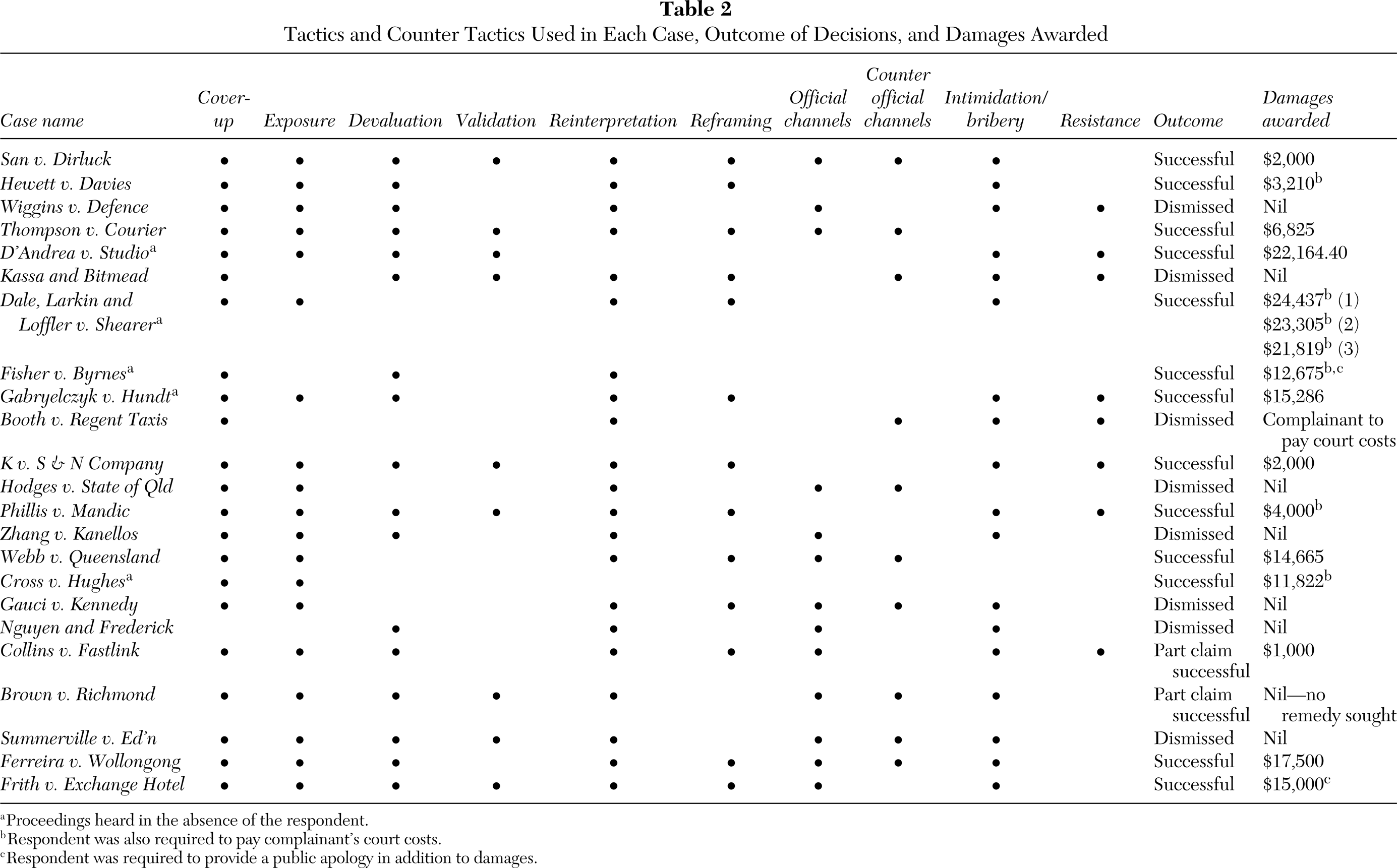
Within each of the five tactic and five countertactic categories, relevant themes were identified. For example, devaluing tactics included questioning the credibility of the targets, labeling them in a derogatory way, undermining their moral worth, and insinuating poor work performance. We now turn to the tactics revealed, presented alternately as perpetrator or respondent tactics and corresponding target countertactics. The results are summarized in Table 2.
Cover-Up and Exposure
Tactics. Cover-up was evident in the cases as operating in secrecy and through censorship. In 21 (91%) cases, there was evidence that the perpetrator operated in secrecy at least some of the time, with incidents occurring out of the public eye and when the complainant and respondent were alone. Consequently, independent eyewitnesses to misconduct were rare. Illustrating secrecy, the respondent in Zhang v. Kanellos stated during the proceedings, “Lucky the camera can only see my back,” and in Ferreira v. Spanish Club, the applicant reported that the respondent had cornered her in a room and told her, “Who's going to listen to you, we are alone.” In two cases the perpetrator harassed not only the complainant but a number of her coworkers. In Webb v. Queensland, there was evidence that the respondent openly asked female staff members on dates, asked them for hugs, and made a practice of staring at their cleavage. The women came to a consensus that the respondent was the “office sleaze bag.” However, their view that the conduct was inappropriate and unwelcome was not communicated to the perpetrator himself, his coworkers, or anyone in authority. This silence, which was likely related to the power imbalance that often lies at “the fulcrum of assault and harassment” (Easteal & Judd, 2008, p. 337), facilitated the continued secrecy associated with the behaviors.
Censorship, another form of cover-up, was identified in three cases (13%). For example, in Wiggins v. Defence, the Defence Department attempted to censor the complainant by advising her that she was not to use work time and resources to seek information from other employees regarding the case. This restriction hindered her efforts to collect supporting evidence for her case.
Countertactics. In 10 cases (43%), the complainant resisted the harassment by making it known to the perpetrator that the conduct was not acceptable and/or by exposing the harassment immediately to a supervisor or coworker. However, a negative outcome of exposing the harassment was that many complainants resigned from their positions immediately or shortly afterwards. In contrast to actively and openly exposing the harassment, the other 13 (57%) complainants chose not to confront the harasser and/or delayed exposing the harassment to coworkers or managers. In Hodges v. Queensland, the complainant stated in a meeting with her supervisor, “I haven't reported it before now as I thought I could deal with it myself, but it is getting worse and now it has become physical.” This response is consistent with Conaghan's (2004) assertion that those who complain have typically reached a point where the workplace disadvantages or detriment are sufficient to threaten or preclude their ongoing employment. Case descriptions revealed a number of reasons for targets to initially remain silent, including fear of losing their job (8 cases; 35%; e.g., Ferreira v. Spanish Club), feeling responsible for the harasser potentially losing their job (1 case, 4%; Hodges v. Queensland), fear of the reactions of partners or coworkers (10 cases; 43%; e.g., Collins v. Fastlink), and a lack of assertiveness in confronting the harasser (12 cases; 52%; e.g., San v. Dirluck).
Instead of open confrontation, these complainants initially attempted to employ more subtle techniques to communicate that the harassers' behaviors were unwanted. In Webb v. Queensland, the complainant believed that her body language (e.g., ignoring the behavior or leaving the room) had made it clear that the harasser's behavior was not welcome. In Ferreira v. Spanish Club, the complainant did not confront the harasser initially when he tried to kiss her, but rather pushed him away and said she was going home. While avoidant strategies may be effective counter-tactics in response to some episodes of sexual harassment, clearly, given that these cases proceeded all the way to court, they did not prevent the escalation of the problem. However, targets are often in a difficult position where they must carefully balance the potential benefits of directly and openly communicating opposition and concern about the sexual harassment with the potential side effects of disclosure.
Tactics and Counter Tactics Used in Each Case, Outcome of Decisions, and Damages Awarded
Proceedings heard in the absence of the respondent.
Respondent was also required to pay complainant's court costs.
Respondent was required to provide a public apology in addition to damages.
Devaluation and Validation
Tactics. In 17 (74%) cases, the perpetrator used one or more devaluing tactics, including questioning the credibility of the targets or their motives for making reports (13 cases; 57%), labelling the target in a derogatory way (7 cases; 30%; e.g., as troublemaking or deceitful), questioning or undermining the moral worth of the individual (3 cases; 13%), or insinuating poor work performance (4 cases; 17%). Despite the frequency and range of devaluing tactics used, the prevalence of devaluation is likely understated given that spreading of rumors can seldom be documented. An example of a devaluing tactic which questioned the target's motivation for making a report was in K v. S & N, where the respondent referred to a previous report of sexual harassment made by the complainant, alleging that she had deliberately embarked on a process of accusations from the commencement of her employment. An example of referring to inconsistencies was Ferreira v. Spanish Club in which the target's credibility was questioned by putting forward that she socialized with the perpetrator in the club after her shifts, which was argued to be incompatible with her account of sexual harassment.
In San v. Dirluck, the target was accused of swearing and making lewd references, the same behaviors of which the perpetrators had been accused, and in Thompson v. Courier, the target was accused of being a troublemaker, manipulative, and deceitful. Devaluation was also evident in Kassa and Bitmead, where the complainant was painted as “troublesome” and, overall, a “difficult employee who argued with managers and other staff about her conditions of employment.” Devaluing tactics may, of course, be based on seeds of truth. It is possible that a complainant may truly be manipulative, troublesome, or deceitful. However, it is not so much the extent to which the devaluation is true that is important in understanding how outrage is minimized, but rather the use of the tactic itself.
In three cases (13%), the moral worth of the target was questioned. For example, in Zhang v. Kanellos, the respondents presented evidence that the target had appeared in an article in FHM, a men's magazine, wearing a bikini along with an interview on sexual topics. Such tactics are reminiscent of rape trials where admissibility of evidence of a victim's lifestyle and sexual attitudes transforms it into a trial of the victim rather than the perpetrator (Fredman, 1997). In four cases (17%), the targets' credibility was undermined by alleging poor work performance. In Nguyen and Frederick, it was insinuated that the target was uncooperative, did poor work, was slow, and did not take instruction. The respondent further argued that the motivation for raising the current sexual harassment claims was to divert attention away from her poor work performance.
Countertactics. Countertactics to devaluation included establishing credibility as a witness, posing a direct challenge to statements made by the perpetrator, and launching a counterattack by finding and exposing negative information about the perpetrator. Surprisingly, in nine cases (39%) where devaluation was used as a tactic, the complainant did not respond at all and, in some instances, agreed with what was presented. This lack of direct response to devaluation was harmful to five (22%) of these nine cases. For example, in K v. S & N, the judge made mention of the target's limitations in cross-examination due to self-representation and in her failure to question discrediting statements by the perpetrator. However, in two other cases (9%), being prepared to admit fault in certain areas had a positive effect in that it helped establish credibility as a witness. In San v. Dirluck, where devaluation involved the target being accused of swearing and making lewd references in the workplace, the target in her evidence admitted that she did swear in the workplace and made other admissions against her interest. The judge in his summation found, “Ms. San answered the questions put to her in cross-examination carefully, with thought and consideration … she also made admissions against interest … I am prepared to accept her evidence … because I found her evidence credible.”
In contrast, the complainant in Kassa and Bitmead, in response to devaluating tactics about her being troublesome and a difficult employee, denied all statements that denigrated her. Indeed, she was not prepared to make any admissions, even though in some instances her position was contradicted by others or was not reconciled with her own claims. She instead brought forward witnesses who testified that the perpetrator was a “womaniser” and had sexually harassed others in the workplace. She also claimed that the culture of the organization was one of sexual innuendo, sexual relationships, and exploitation by managers of the mostly immigrant employees. The judge in his summation stated he believed she had not been truthful about some matters and was not satisfied that she was a credible witness.
Compared with directly discrediting the respondent as a response to devaluation, a countertactic that appeared to elicit more positive responses from judges was to directly challenge negative statements. In Thompson v. Courier, the organization devalued the complainant by painting her as a liar and troublemaker who intimidated coworkers, resisted weekend work, and manipulated procedures to her advantage. The complainant, in response to these devaluing tactics, challenged the label of troublemaker by asserting that it had only been used after she made formal written complaints. She also asserted that she was reluctant to work on Saturdays due to religious beliefs. Further, she produced witnesses who agreed she was assertive and that management resented her assertiveness, singling her out for intimidatory treatment.
Reinterpretation and Reframing
Tactics. Tactics identified in this category consisted of denying the facts (14 cases; 61%); construing actions as friendly, innocent, or misunderstood (6 cases; 26%); interpreting the target's responses as reciprocating or encouraging the behavior (2 cases; 9%); and attesting harm to be nonexistent or less than claimed (3 cases; 13%). With respect to construing actions, statements were given such as “We were only joking” (San v. Dirluck), “Everybody in the room laughed” (Hewett v. Davies), and “There was a misunderstanding of behaviour, or misinterpretation of body language” (Webb v. Queensland). In Brown v. Richmond, the respondent admitted he did try to kiss the female complainant, but in an innocent manner—as one would kiss a friend on the cheek before leaving.
Another type of reinterpretation was claiming that harm to the target was nonexistent or less than claimed. In Gabryelczyk v. Hundt, the target was told by the perpetrator, “It's all character building.” Several cases also involved claims of management dismissing or explaining away sexually harassing behavior. In Hodges v. Queensland, for example, a supervisor responded to an internal complaint with the comment, “Boys will be boys.” In some cases, the respondents signaled the target's responses as reciprocating or encouraging the behavior. In San v. Dirluck, the female target admitted the workplace was permeated with the use of strong swearing, slang, and jocularity and that she herself swore regularly at work. The respondent claimed, therefore, that any sexual conversations he had with the complainant could not be unwanted. In many cases, the details of sexually harassing incidents were simply denied, sometimes with no alternative explanation offered. Where there were no witnesses to the event, it was simply one person's word against another.
Countertactics. Reframing countertactics identified in the judicial decisions examined included documenting the harassment and its consequences (7 cases; 30%), seeking corroboration from witnesses to support the original interpretation (10 cases; 43%), providing evidence to support the claim (4 cases; 17%), using independent experts (5 cases; 22%), and rebutting the reinterpretation (2 cases; 9%). Noting dates, times, details of behaviors, and the consequences of actions in an “unemotional manner” (Phillis v. Mandic) were important components of reframing. The effective use of reframing, compared with other counter-tactics used in the context of the court proceedings, was especially critical to the success of the entire case. Indeed, in six of the eight dismissed cases, there was no evidence of reframing as a response to reinterpreting tactics (see Table 2). In these cases, judges reported statements such as “the allegations are vague and ill defined … [and the] evidence is inconsistent” (Summerville v. Dept of Education).
Evidence used in reframing included notes from diaries and meetings, photos, e-mails, and written formal complaints to supervisors. If a target had both documentary evidence and a clear recollection of details, this combination led to stronger credibility as a witness, as evidenced in summative quotations by judges and the relative likelihood of damages being awarded compared to cases where complainants who had difficulty recalling sequences of events. As the judge in Frith v. Exchange noted, “Recollection is notoriously unreliable.” The emphasis on documenting events at an early stage for later evidential purposes is a critical strategy for targets, but it occurs uncommonly. Most women's initial reaction to harassment is to pretend it is not happening (Hunter, 2002).
Another significant reframing countertactic available to targets is having corroboration from witnesses. Witnesses included relatives or friends who had been informed of the incidents immediately after they occurred and coworkers who experienced similar behavior or who witnessed the alleged incidents. Corroboration is especially important in the face of strong denials from perpetrators. In San v. Dirluck, the judge stated, “I am prepared to accept her evidence … because I found her evidence credible and more importantly it was corroborated …”. In 9 (39%) of the 10 cases that were either unsuccessful or only partly successful, the judge made mention of a lack of corroborating evidence to rebut the reinterpretation. The remaining unsuccessful case was dismissed because the acts were found not to have breached the act. The use of independent experts and evidence, such as reports from general practitioners, psychologists, or psychiatrists, to support reframing was especially important for claims to be framed as credible and for the case to be successful in seeking remedy. Indeed, all five cases (22%) which used independent experts were successful. For example, in Gabryelczyk v. Hundt, in response to the reinterpretation of events by the perpetrator as not harmful and “character building,” the complainant produced medical reports testifying to the treatment received for the psychological effects of the harassment. This strategy lent weight to the target's interpretation of events. The complainant in Hewett v. Davies also testified that she had experienced psychological harm, in contrast to the reinterpretation of the alleged harassing incidents as something that others found amusing. However, she did not provide to the court any documentary evidence of her reported visits to a psychologist. The judge noted in his decision that, although the case was successful, the awarding of damages was made difficult by the absence of this evidence.
Official Channels and Challenges
Tactics. Official channels were used both by targets (10 cases; 43%), in an attempt to stop the sexual harassment, and by respondents (13 cases; 57%), who, consistent with the outrage management framework, used them to give the promise and appearance of moral justice (Rosenbaum, 2004). Indeed, respondents in the judicial decisions examined typically claimed the issue had been dealt with through formal procedures and, consequently, that justice had been served. In Hodges v. Queensland, the target accused a regional hospital of a lack of response and of not providing adequate support to her. In response, the organization denied responsibility because the female complainant refused to submit a formal written complaint, instead reporting the harassment during a meeting. The judge decided that, although in all probability she had been sexually harassed, the complainant failed to establish breach of duty of care by the hospital because she chose not to use the clearly established systems for dealing with harassment. This decision was analogous to several U.S. landmark cases where plaintiffs who failed to avail themselves of a complaint procedure were denied relief (Bisom-Rapp, 2002).
In 10 other cases (43%), respondents relied on official policies and procedures to argue that the alleged conduct could not, or would have been highly unlikely to, have occurred. In Thompson v. Courier, the target reported that she was exposed to pornographic images and accused the organization of allowing their employees unrestricted access to the Internet, which enabled the sharing and viewing of such material. The organization argued in response that it had restricted staff access to the Internet immediately after it became aware that employees were accessing adult sites. The complainant's manager stated he was not aware of pornographic images being shown on computer screens after this date, and that, if he had, he would have used formal organizational sanctions to put a stop to it.
Another variation on the use of official channels was to use clean employment histories as evidence that it was unlikely that the alleged perpetrator could have engaged in sexually harassing behavior (3 cases; 13%). In Wiggins v. Defence, the organization put forward untainted past performance evaluations as evidence that wrongdoing was extremely unlikely: “Nowhere is any reference made in any of the reports to any form of discriminatory behaviour.”
Countertactics. Arguing against the official channels tactics described in the previous section, complainants in 10 cases (43%) attempted to discredit and show the failings of these systems and/or challenge the motivations of the people who were responsible for using them. Four complainants told how internal organizational procedures were of little or no use to them, did not treat complaints seriously or investigate them adequately, or were ineffectual in taking reasonable steps to prevent further harassment. In Thompson v. Courier, where the target was exposed to pornographic images, the organization used an official channels tactic to argue moral justice and deny any failure. In challenging this tactic, the target produced a memo containing the computer passwords of 18 employees who could freely access the Internet, thereby discrediting the organization's claims that it had taken measures to restrict Internet access.
It was also asserted by some complainants who worked in larger organizations that staff were not properly inducted or trained in the issue of sexual harassment. In Hodges v. Queensland, where the organization denied responsibility on the basis that the target had not used official channels adequately by making a formal complaint, the target pointed out in her statement that she did not report the harassment initially because she did not know to whom to report it. When she did find a nominated person, she was informed hers was the first case of harassment with which they had dealt. In contrast to the 9 larger organizations, which were often able to provide evidence of the systems in place to deal with sexual harassment, there were fewer procedures for targets to utilize in the 14 smaller organizations. In San v. Dirluck, the organization, a butcher shop, was criticized for its lack of response. The complainant explained how her supervisor advised her not to let it get to her, to ignore the remarks, or say something smart in return. In five cases involving very small organizations, the respondent was the employer, negating any opportunity for a target to complain using internal systems.
Intimidation/Bribery and Resistance
Tactics. Intimidation or bribery was identified in 18 cases, including threats of reprisals (9 cases; 39%), physically intimidating behavior (3 cases; 13%), intimidation of witnesses (1 case; 4%), ostracism or victimization (4 cases; 17%), and the offer of incentives to remain silent (1 case; 4%). Threats of reprisals, such as job loss and reductions in work hours or pay, resulted in targets feeling isolated and segregated. In Brown v. Richmond, the complainant was demoted, her performance was criticized, and there was an attempt to change her hours of work. Physical threats were also evident, such as in Dale v. Shearer, where the target was physically restrained in a room and told by the perpetrator she would be released only after she gave him a hug. In the male-to-male case Gabryelczyk v. Hundt, the complainant kicked the harasser after he was subjected to unwanted physical touching and was told subsequently by the perpetrator, “If I get a black eye I will punch you in the face and give you one because I am going out tonight with my wife.”
Countertactics. The complainant in Gabryelczyk v. Hundt who kicked the harasser certainly resisted intimidation, but resistance to intimidation or bribery was the least frequent countertactic found in the data. The outrage management framework suggests such actions include exposing, standing up to, or documenting the intimidation and bribery, a countertactic that is distinct from exposing the harassment itself. The relative infrequency of this response (8 cases; 35%) may in part be due to the small organizational environments in which many of the targets were employed and where it was difficult to expose intimidation and encourage outrage among others. In two cases, complainants who had been physically threatened sought an apprehended violence order (a court order which restricts the behavior of an alleged perpetrator and which protects a victim from violence, harassment, or intimidation in the future) against the harasser. In Gabryelczyk v. Hundt, one of only two male-to-male cases, the target's mother had phoned her son's supervisor about signs of physical abuse to him. A few weeks later, the target, an apprentice electrician, resigned. Wiggins v. Defence was the only case where the target was able to provide documented evidence of intimidation by the respondent or the organization, producing a letter instructing her not to use company time to seek information about her case.
DISCUSSION
Using 23 Australian judicial decisions, we found evidence of a wide range of perpetrator tactics and target countertactics used in sexual harassment scenarios in everyday workplaces. These tactics can be readily fitted into the outrage management framework, which proposes that powerful perpetrators of acts potentially perceived as unjust are likely to cover up the actions, devalue the target, reinterpret the events, use official channels to give an appearance of justice, and intimidate or bribe people involved. Targets can respond using countertactics of exposure, validation, reframing, mobilization of support, and resistance, respectively.
All five perpetrator tactics identified by the outrage management framework were used frequently both within and across judicial decisions examined. At least one tactic was used in each case and a minimum of three tactics were evident in 22 out of the 23 cases (96%). Evidence for all five tactics was found in eight cases (35%). Cover-up (found in all cases) and reinterpretation (21 cases) were the most common tactics used. Target countertactics were less frequently utilized than perpetrator tactics, though only 2 cases showed no evidence of countertactics at all and in 13 cases (57%) at least three countertactics were evident. Exposure (found in 19 cases) and reframing (13 cases) were the most commonly used countertactics. Conversely, resistance, in response to intimidation/bribery, was the least frequent countertactic and was found in only eight cases 35%).
Despite their lesser frequency, countertactics were vital in allowing targets to respond to, or defend themselves from, sexual harassment in their workplaces as well as in mounting legal claims and receiving damages. Particularly important to establishing credibility was, in the context of the workplace, the use of active rather than passive or nonverbal exposure of the sexual harassment, and in the context of the court case, the effective use of reframing by providing corroboration from witnesses and accurately documenting dates, times, and other events related to the harassment. In reframing and other countertactics, however, admitting flaws in court was also important in establishing credibility. Although such admissions may appear weak, they paradoxically appear to demonstrate a commitment to honesty in that complainants' accounts are believed more readily.
Targets' responses to sexual harassment in the cases examined generally proceeded from initially passive, such as avoiding the harasser or using body language to communicate unwanted behavior, to more assertive responses as the harassment escalated and became more frequent or threatening. This finding suggests targets are more likely to confront the perpetrator or use official channels if the harassment is threatening (Cochran, Frazier, & Olson, 1997; Gruber & Smith, 1995), such as sexual assault or solicitation of sexual activity. Low-level responses and a reticence to report the harassment in the early stages of the problem are related to a myriad of factors which act as powerful deterrents to seeking formal redress. These factors include fear of job loss, fear of retribution or retaliation, reluctance to be viewed as a victim, self-doubt or the fear of being seen as “too sensitive,” the belief that the harasser will not receive any penalty, lack of knowledge of rights, and lack of accessibility to external supports such as unions or counseling professionals (Handy, 2006; Hayes, 2004; HREOC, 2004; Wear, Aultman, & Borgers, 2007). Drawing on feminist psychological theories of women's development, Cairns (1997) suggests that remaining silent makes women complicit in their own subjugation. She argues silence is perpetuated through psychological disempowerment due to patriarchal socialization, a circumscribed sense of personal agency rather than entitlement, and its use as a form of resistance or refusal to participate. However, even when targets do access grievance mechanisms, the time frame of reporting (often the subject of intense scrutiny in investigations of formal complaints) has been argued to put complainants in a catch-22 situation. Delaying reports beyond an immediate response or within a few days threatens credibility and the likelihood of a successful legal claim, whereas immediate reporting and forthright rejections may discount claims of ongoing psychological trauma and reduce associated awards of damages (Easteal & Judd, 2008).
The targets in these judicial decisions who reported sexual harassment through internal organizational channels experienced widespread system deficits, including failure to investigate complaints or treat them seriously, train staff adequately, or take reasonable steps to prevent further harassment. Previous work has also found that organizations often fail to issue warnings, mediation, or disciplinary action against the offender (European Commission, 1999; Handy, 2006; Ronalds, 2006); minimize or excuse the perpetrator's behavior as understandable or justified (Charlesworth, 2006); or ignore, victimize, or defame the reporting individual (Hayes, 2004; HREOC, 2004; McDonald, Backstrom, & Dear, 2008). Compounding the problem of ineffectual organizational responses found in our study was that the majority of cases involved small workplaces where the harasser was also the employer or supervisor and where few opportunities were available for assistance to be enlisted. Indeed, Knapp, Faley, Ekeberg, and DuBois (1997) argue that the smaller the organization, the more likely the perpetrator is to be the owner or supervisor and the less likely the target is to report the behavior. Hence, although it is desirable that all organizations respond more appropriately to complaints from individual targets, in very small workplaces, effective individual-level responses may be the only means of arresting the harassment prior to seeking formal legal redress. Our data showed that the lack of internal reporting mechanisms available to counteract perpetrator tactics magnified the asymmetrical power relationships which are often at the core of sexual harassment and which are disproportionately evident in certain organizational contexts. Such contexts include highly masculinized work cultures (Ragins & Scandura, 1995) and where employment relationships are tenuous or temporary (Krasas Rogers & Henson, 1997).
The outrage management framework contributes to an understanding of the way the phenomenon typically occurs in organizations, aside from its underlying causes and specific behaviors, and could be utilized for the development of targeted organizational policies designed to address this workplace harm. For example, a potential policy implication is that the framework could be used to develop employee training modules that make transparent the types of tactics often used by harassers to dampen outrage, as well as corresponding countertactics which effectively respond to injustices. Improved awareness of the typical strategies used by harassers as a means of dampening outrage among potential supporters, coupled with an understanding of typical behaviors associated with sexual harassment (personal insults, ridicule, leering, offensive comments and nonverbal gestures, sexual and physical assault), assists targets in recognizing sexual harassment as a form of discrimination which warrants action. As Felstiner, Abel, and Sarat (1980–1981) suggested, the way employees understand what is happening to them as discrimination involves a complex process of “naming, blaming, claiming.” An individual must see an action as detrimental (naming); hold another person responsible (blaming); and voice his/her grievance and seek a remedy (claiming). The resistance implicit in the outrage management model is therefore useful in illuminating sexually harassing strategies as unwelcome and unreasonable. As a theoretical model which identifies interactions between those who subject employees to disadvantage and intimidation and those who are the targets of it, the outrage management framework could also contribute to understandings of other pervasive, sex-based discriminatory practices in organizations (e.g., sex discrimination and pregnancy discrimination) that affect the career and life opportunities of women and some men.
The lengthy durations, high costs, and low compensation of legal proceedings (Fredman, 2002; Hunter, 2002) means that few targets are willing to go to court over sexual harassment, even today with the relative benefit of a body of case law and a more understanding and supportive community. The damages awarded in the cases examined (an average of $10,000 AUS) were small given the financial and psychological consequences of the harassment reported in the decisions, including loss of employment. However, the level was consistent with previous work indicating median settlements of around $10,000 AUS and €3,713 in cases of sexual harassment and sex discrimination in Australia and the United Kingdom, respectively (Fredman, 2002; Gaze, 2004; McDonald et al., 2008; Parker, 1999). Similarly, low levels of compensation for employment discrimination generally (including sexual harassment) achieved in U.S. conciliated cases were reported by Nielsen and Nelson (2005), who revealed an average monetary benefit of $14,000. This amount was calculated by dividing the benefits procured by the EEOC by the number of complaints that survive administrative closures and no reasonable cause findings. The level of damages across the cases examined in our study appeared to be closely related to whether the respondent was present for the case: In five of the eight cases awarded more than $10,000, the respondent did not appear in court to provide testimony. However, even damages amounting to $10,000+ do not approach the scale of penalties in the hundreds of thousands or millions of dollars that may be awarded in other areas of corporate regulation or the damages men are often awarded for much less tangible damage in defamation proceedings (Gaze, 2004; Parker, 1999).
Four of the six complainants who represented themselves had their cases dismissed and, of the remaining two, one received no damages and the other received only $2,000. This pattern suggests that legal counsel is critical to winning a claim, but with the disadvantage of significant financial costs. Further, even when legal representation is used, it can be inadequate in such a technical area of law and when individuals are opposed by well-resourced corporate players (Gaze, 2004). Compounding the disadvantage for complainants is that in formal tribunal hearings in Australia, there appears to have been a swing away from a complainant orientation toward favoring respondents (organizations or harassers defending claims) generally, and corporate respondents in particular. This shift is evidenced in the increasing requirement by courts of proof of a clear causative nexus between the impugned conduct and the respondent, as well as the trend toward awarding costs against complainants who cannot prove their cases (Thornton, 2002). Costs were awarded against only one complainant in the eight decisions that were dismissed in our sample. However, awarding costs against any complainant is especially punitive and has broad ramifications because it works as a strong disincentive to those considering litigation and encourages complainants to accept low settlements in conciliation.
Limitations of the Study
Because we used judicial decisions to examine tactics, by necessity we have only analyzed cases in which an official channel—a court—was chosen as a prime tactic. Hence we are in the curious situation of using information based on a legal framing of sexual harassment to analyze tactics, where one tactic is the very process of moving the issue to a legal jurisdiction. It is possible to distinguish between sexual harassment as an occurrence in a workplace and an occurrence in a court case, as different arenas in which sexual harassment claims are adjudicated. Another perspective, though, and one adopted in our study, is that a court case is a facet of a sexual harassment conflict. The outrage management model looks at tactics that can occur before, during, or long after something was perceived as unjust, such as the smearing of Anita Hill in David Brock's book which occurred after the confirmation of Clarence Thomas to the U.S. Supreme Court. Hence, the struggle over Thomas's reputation in relation to Hill's sexual harassment allegations was an ongoing issue. In the context of our study, the use of devaluation techniques in court cases can also be considered as part of a sexual harassment struggle. That devaluation of opponents in court cases is a typical part of the adversarial process is a complicating factor, to be sure. However, our data indicate devaluation often occurred in the workplace, prior to the court case, as well as in the court cases themselves.
Nevertheless, a limitation of using court reports to study tactics is that, because of the adversarial nature of the cases, tactics and countertactics are emphasized and the facts shaped to prove the case. For example, questioning the complainant's credibility within the constraints of evidentiary rules is a standard litigation tactic—legitimate in the context of a courtroom and one which is often considered critical to a competent defense. Furthermore, as a consequence of the emphasis on some tactics over others, the documentation itself may minimize or omit covert strategies such as spreading rumors or falsifying documents. Given that our analysis was confined to judicial decisions and did not include other sources of information (e.g., original claim documents, notes from conciliation attempts, verbatim reports from complainants and respondents), distinguishing between those tactics emphasized in the courtroom and those used before the case came to trial cannot be precisely assessed.
There is also no way to directly judge the dress and demeanor of participants in the proceedings, yet on the basis of comments by judges, it seems that factors such as appearance and behavior play a significant role in establishing or undermining credibility. Previous legal analyses also suggest reasonableness and credibility are often in the eye of the beholder, determined through the evaluation of identity, history, and behavior of the (usually female) complainant (Easteal & Judd, 2008).
The generalizability of our sample can be assessed at three levels. First, we examined decisions in a wide range of state and federal jurisdictions over a 2-year period. No changes to the wording of sexual harassment provisions in Australian federal sex discrimination legislation have occurred since 1992 (HREOC, 2008), and the number of cases examined was similar to those using the same search parameters in the 2 years prior to the study. These factors indicate a high degree of confidence in the representativeness of the sample with respect to all legal cases which go to Australian courts with sexual harassment as the principal issue. Second, with respect to generalizability to legal cases internationally, the harassing behaviors described in the decisions were similar to those usually identified in U.S., UK, and European studies examining sexual harassment. However, the way legislation is worded and applied does vary across countries, affecting the types of cases heard in legal forums. Important statutory variations include the wording of definitions of sexual harassment, the way the “reasonable person” standard is applied, and the actions an employer must take to satisfy the requirement that it took reasonable care to prevent or stop sexual harassment and therefore discharge vicarious responsibility (e.g., Clarke, 2006; Zugelder, Champagne, & Maurer, 2006). Third, the sample may be atypical of cases in Australia and internationally that do not go to court. Cases of sexual harassment that do not go to court may involve targets who are less willing or able to seek legal redress; who are more effective in employing countertactics against the harasser; or who have insufficient evidence, perhaps due to cover-up, to proceed to a relevant jurisdiction. Hence, the findings derived from legal cases cannot be directly contrasted with cases of sexual harassment involving the mobilization of alternative means of support. A much broader study, using well-documented cases not involving courts, would be needed to make such a comparison.
Conclusions
The outrage management framework draws attention to tactics used by perpetrators, in particular five kinds of tactics that minimize outrage from perceived injustice. Judicial decisions of sexual harassment cases provide a rich lode of material about tactics used by both harassers and targets both before and during the cases themselves. The evidence about tactics from 23 Australian court cases indicates the value of the framework for predicting likely patterns of action by harassers and suggesting avenues for countering them. Although there are limitations to using judicial decisions as a source of information, our study points to the value of studying tactics and the importance to harassers of minimizing outrage from their actions.
The findings also highlight that, given the limitations of statutory and organizational protections in reducing the incidence and severity of sexual harassment in the community, individual responses to sexual harassment may be effective as part of a multilevel response in reducing the incidence and impact of workplace sexual harassment as a gendered harm. Future research should continue to examine the utility of the outrage management framework as a way of understanding the methods likely to be used to reduce outrage and make recommendations to potential targets of harassment—nearly everyone in principle—for effective responses to such tactics, including exposure, validation, reframing, mobilizing support, and resisting intimidation.
Because outrage management occurs in relation to diverse injustices, as disparate as censorship (Jansen & Martin, 2003) and genocide (Martin, 2009), insights can be gained by investigating the techniques used in different arenas: When certain types of tactics are observed in one arena, this provides a prompt to look for analogous tactics in sexual harassment cases—or for their absence. Further insight on sexual harassment tactics is likely to be gained through more intensive investigation into specific cases, especially as they occur in real time. Because tactics occur as part of a strategic interpersonal encounter (Jasper, 2006), there is an enormous amount to be learned by varying a target's countertactics and examining how the perpetrator and allies respond. This sort of experimental approach by targets is recommended by Elbing and Elbing (1994) in relation to dealing with bullying at work. The outrage management model can be an initial guide to the likely tactics used by perpetrators; in developing and testing responses, the target and allies can become both agents of resistance and researchers into how best to oppose sexual harassment.