







Abstract
Feminist and liberation psychologies have emerged in contexts of marginalization and oppression and have developed in diverse, and sometimes synergistic, ways. I identify key themes for fostering critical consciousness and political action that arise from the intersections of feminist and liberation psychology. These themes include the need for more complex and diverse understandings of the personal and the political and of the connections between the two. These themes form the basis for a three-component model for courses and workshops that were delivered in communities in Ireland over a 5-year period. Questionnaires completed at the end of the courses and workshops indicated that participants benefited from a clear structural analysis, from making links between the personal and the political, and from exploring political action as a cyclical or developmental process. Political action is also seen as relational, that is, as involving interpersonal processes such as support, solidarity, and engagement with diversity in groups and communities.
An important aim of women's studies, psychology of women, and feminist psychology is to engage in knowledge production and interventions that are based on the feminist insight that “the personal is political” and on feminist values of equality, inclusiveness, and valuing of diversity (Denmark & Paludi, 1993; Richardson & Robinson, 2008; Unger, 1998; Yoder, 2007). This article aims to link feminist understandings of the “personal is political” with insights and strategies from the emerging field of liberation psychology. Both feminist and liberation psychologies have common roots in liberation movements and share efforts to foster liberating social transformations that would help to attain social justice. In this article, I focus specifically on understandings of critical consciousness, sociopolitical development, agency, and action that have emerged through research, education, and interventions based on combining feminist and liberation psychologies in global and Irish contexts of marginalization and oppression.
The radical changes that have occurred in the last decade (which include increasing diversity and plurality, globalization, and climate change) point to the need for new and more complex understandings of the nature and location of power, agency, identity, and activism (Stokols, Misra, Runnserstrom, & Hipp 2009). Research and interventions in diverse areas including feminist psychotherapy and counseling, political psychology, and community psychology have recognized the need for multileveled understandings that link the personal or micro level with the sociopolitical or macro level and that acknowledge an intermediate group or community level. There has been a convergence in recognizing that oppression and liberation involve the political, structural, or collective (macro) level; the group, community, or interpersonal (meso) level; and the personal or individual (micro) level (Bronfenbrenner, 1979; Fine, 2006; Goodman et al., 2004; Morrow & Hawxhurst, 1998; Nelson & Prilleltensky, 2005).
Globalization and other social and cultural changes have also expanded understandings of political awareness and political action. The term “consciousness-raising” has been elaborated by research on concepts such as feminist consciousness, political understanding, and motivation for political activism (Cole, Zucker, & Ostrove, 1998; Duncan, 2010; Stake & Hoffman, 2000; Stewart, Settles, & Winter, 1998; White, Russo, & Travis, 2001). The outcomes of the development of political awareness and identity, though, have traditionally been seen as engagement with political structures—for example, voting or involvement in social movement and other organized movements for change (Taylor & Whittier, 1999). However, research on women's involvement in activism has demonstrated women's alienation from traditional political action and also has acknowledged the complexity and variety of women's engagement in political activism (Biglia, 2006; Stewart et al., 1998). Interviews with women activists have demonstrated that women seek broader understandings of the political and also recognize the interconnections of the personal and the political (Andrews, 2006; Biglia, 2006; Capdevila, 2010; Moane, 2003, 2010). Postmodern, global, and third-wave feminist writings have opened up new possibilities for agency and actions that include deconstructing popular culture, networks that link the local with the global, and strategic consumerism (Naples & Bojar, 2002; Valenti, 2007). These shifts require new understandings that acknowledge multiple levels of political influence and agency, as well as new forms of solidarity and collective action. Recent developments combining feminist and liberation psychologies can offer such new understandings (Lykes & Moane, 2009; Montero & Sonn, 2009).
The emergence of liberation psychology in the 1980s in Latin America was linked to political turbulence across many Latin American countries that ranged from social revolution to totalitarian military regimes. In setting out possible roles for psychology in the process of liberation, Martín-Baró (1994, p. 22) argued that psychology's main focus should be to “transform both people and societies” and argued that this must involve incorporating “truth from within the population masses.” Thus liberation psychology offers epistemological and methodological challenges that are parallel to feminist calls for psychology to include women's perspectives and develop emancipatory methodologies. Both feminist and liberation psychologies that have addressed these challenges have engaged with diverse and multiple configurations of context and identity in a globalized and transnational world (Hesse-Biber, 2007; Landrine & Russo, 2009; Lykes & Moane, 2009; Montero & Sonn, 2009). Feminists have drawn on liberation psychology to enhance their praxis, particularly when working in contexts of marginalization and oppression—whether in Northern European and American contexts or in South American, African, Australian, and Asian contexts (Lykes & Moane, 2009; Montero & Sonn, 2009).
My aim here is to discuss themes in Latin American liberation psychology that articulate with feminist understandings of activism and social transformation and that provide the basis for a model used in the Irish context to be described below. A first theme noted above is that oppression involves both political and personal patterns so that liberation necessarily involves personal and political transformation. Liberation, as Martín-Baró (1994, p. 27) points out, “involves breaking the chains of personal oppression as much as the chains of social oppression.” At the personal level, this process involves recognition of psychological patterns associated with oppression that may act as barriers to taking action—including fear, helplessness, lack of awareness/education, self blame, silence, and distrust (Moane, 2010). Oppression may also be linked at the personal level with what Martín-Baró (1994, p. 123) calls “virtues of the people”—strengths such as courage, generosity, and perseverance that can be resources for change. Such strengths have also been recognized in feminist analyses of domination and oppression (Goodman et al., 2004; Miller, 1986).
Social oppression is theorized at a socio-political level, recognizing both the structural and ideological nature of oppression and similar to feminist analyses of patriarchy as a system of male domination. The emphasis on class and ethnic oppression in liberation psychology is enhanced by the feminist emphasis on gender oppression and its intersections with class, ethnicity, disability, age, and sexual orientation (Cole & Sabik, 2010; Richardson & Robertson, 2008). Oppression involves economic, political, and cultural forms in which power is concentrated in a largely male minority, where violence permeates society, and where constructions of gender contribute to sexual violence and to control of sexuality. Ideology that justifies the status quo plays a key role in maintaining oppression, making de-ideologization or critical analysis essential to liberation (Montero, 2009). A structural approach emphasizes that micro contexts are embedded in macro level patterns (not only at the national but also at transnational or global levels) in a multileveled approach that links the micro to the macro. Research and interventions with issues as diverse as Malayan Muslim women's view of the head scarf (Noor, 2009), Palestinian children's experiences of house demolitions (Shalhoub-Kevorkian, 2009), and Spanish women living in poverty (Luque-Ribelles, García-Ramírez, & Portillo, 2009) show that those living with oppression are aware of these multilayered connections and seek to give voice to, and develop an analysis of, these interconnections.
These structures and ideologies create the everyday experiences of violence, poverty, discrimination, and social exclusion that form specific manifestations of oppression. Martín-Baró (1994) and others developed Freire's (1973) concept of “limit situation” to refer to the particular configuration of structural inequalities that include gender, ethnicity, sexual orientation, and migrant status and that shape the specific contexts of people's lives (Chaudhry & Bertram, 2009; Lykes & Moane, 2009). Applications of liberation psychology often involve limited situations characterized by poverty, violence, conflict, and breakdowns of justice interlinked with global and local conflict and warfare where there are severe constraints on possibilities for action. As Chaudhry and Bertram (2009) point out in their research with migrant women in postconflict Karachi, research and interventions may necessitate acceptance of the limits of agency while acknowledging choices that emphasize maintaining family and community ties.
Latin American liberation psychology has developed Freire's (1973) concept of conscientization to refer to an iterative process of analysis and action that works from the bottom up and that has obvious parallels to consciousness raising (Freeman, 1975). Conscientization, consciousness raising, and critical consciousness all share a process of linking personal experience to political analysis, particularly through educational processes. Understandings of conscientization have tended to develop in community contexts characterized by poverty and lack of education, and thus they emphasize a bottom-up participatory and dialogical process in which analysis and action develop together in a specific limited situation. As awareness of context-specific patterns develops, possibilities for action become apparent; as these possibilities for action are explored, further awareness develops in a cyclical process (Montero, 2009). Such a process is demonstrated in the account by Billies, Johnson, Murungi, and Pugh (2009) of a collaborative project between homeless and impoverished lesbian, gay, bisexual, and transgendered residents of a homeless shelter, support workers, and researchers. Through weekly meetings, which involved sharing experiences and training in research methodologies, participants developed analyses, skills and strategies for action. Strategies included confronting shelter workers about violence, informing each other about resources and information, and advocating for policy changes, while reflections on these strategies further the analysis of structural dimensions of poverty, racism, and LGBT (lesbian, gay, bisexual, and transgendered) oppression.
There is thus a particular emphasis in liberation psychology on change from the bottom up, or on strategies for change that are developed by those who are in situations of oppression and that involve their participation. This bottom-up view of developing critical consciousness and of taking action for change poses a challenge to many approaches in psychology that liberation psychologists argue aim to work “for” rather than “with” people in situations of oppression (Comas-Díaz, Lykes, & Alarcon, 1998; Burton & Kagan, 2005; Montero, 2007). In working “with” people, psychologists (and other professionals) are no longer experts, but rather acknowledge the extent to which knowledge is situated in, and interventions and strategies for action are tailored to, specific situations (Harding, 2007).
Participatory methods are an essential element in bottom-up approaches to conscientization and transformative action. Such methods include Participatory Action Research and participatory pedagogies that involve creating dialogical spaces, often across differences of class, ethnicity, nationality, and other dimensions of privilege and inequality, posing challenges that have been much discussed in feminist and liberation psychology (Hesse-Biber, 2007; Landrine & Russo, 2009; Mohanty, 2003; Montero, 2009). In contexts of marginalization and oppression, feminist and liberation psychologists have further developed concepts such as flexibility, fluidity, ambiguity, and dual (or multiple) consciousness to describe efforts to negotiate an “in-between” space that aims to disrupt stereotypes and binaries based, for example, on class, ethnicity, sexual orientation, and gender. Lykes, Coquillon, and Rabenstein (2009) argue for the importance of fluidity as one means by which conflict and suspicions can be circumvented, while Torre and Ayala (2009) envision such disruptions and conflicts as opening opportunities for creative engagement and new forms of listening. The challenges posed by engagement across boundaries are highlighted by the description of Ostrove, Cole, and Oliva (2009) of the dual desire of women who are deaf or hard of hearing to have their experiences of oppression understood—but not to be the only focus of working in alliances with hearing people.
Liberation psychology, like feminist psychology, uses a variety of methodologies in group and community settings (Burton & Kagan, 2005). Feminists who work in or with communities marked by marginalization, poverty, conflict, and warfare found the emphasis in liberation psychology on participatory and bottom-up approaches to developing awareness (conscientization), giving voice, recording experiences, and acting for change in group and community contexts worked synergistically with the multiple methodologies developed by feminist psychologists in education and health settings (Whelan & Lawthom, 2009). Conversely, liberation psychologists working with women in such contexts drew on feminist psychologies to further their gender analysis and to develop participatory methods (Luque-Ribelles et al., 2009).
Multiple key themes have thus emerged from the links between feminist and liberation psychology that form the basis for methodologies that facilitate the development of critical consciousness and transformative action, two key elements of sociopolitical development. These themes are: (a) linking structural inequalities to specific micro or limited situations; (b) acknowledging both strengths and vulnerabilities in working with the personal or psychological level of oppression; (c) developing critical consciousness or conscientization through participatory and dialogical research and educational methods, especially in group and community contexts; and (d) adopting a bottom-up and situated view of political activism and political change. Here I would like to illustrate this cyclical and bottom-up approach to sociopolitical development and political action through my experiences with applying a liberation model in courses and workshops in different Irish contexts that involve oppression and marginalization (Moane, 2003, 2008).
METHOD
Content and Methodology of Courses and Workshops
Themes from feminist and liberation psychology were incorporated into a three-component model that has been described in detail (Moane, 2010). The first component is a social analysis that examines patriarchy and colonialism as systems of domination with modes of control that are linked to the micro or personal level (“the limit situation”). Six modes of control identified through research on patriarchy and colonialism are used: namely violence, political exclusion, economic exploitation, cultural control, control of sexuality, and fragmentation (Moane, 2003). The second component, called the “cycle of oppression,” involves identifying personal reactions to, and experiences of, oppression. This component emphasizes vulnerabilities or negative reactions to oppression as well as strengths that arise in situations of oppression. The third component is an analysis of change, called the “cycle of liberation,” that analyzes change from the bottom up through three levels: namely the personal, the interpersonal, and the political.
Courses and workshops were delivered as part of community-based certificate programs that were developed in partnership between community groups and the Women's Studies program in University College Dublin (UCD). Two certificate programs were offered: namely a certificate in Women's Studies and a certificate in Lesbian and Queer Studies. The Certificate in Women's Studies was a 2-year program with six modules, each involving 30 hours of tuition. For over a decade (since 1999), the Certificate in Women's Studies was offered at 14 locations throughout Ireland, with the majority being deprived communities in the Dublin area. The Certificate in Lesbian and Queer Studies also involved six modules, most of which were offered in lesbian or in LGBT community resource centres over a 5-year period (1999–2004). Both certificates had multiple goals that included empowering communities through education and providing a pathway to further education. Both programs were funded through government or local funding, and they were extensively evaluated by funders and by the Women's Studies program in UCD (Women's Education Research and Resource Centre, 2005, 2006). A module in psychology was delivered for both certificate programs.
The module for the certificate in Women's Studies was entitled “Liberation Psychology for Women.” It was delivered as a 10-week course that met for 3 hours each week. The structure of the course was based on the model outlined above, beginning in the first 3 weeks with a social analysis that developed knowledge about the six modes of control by using the experiences of course participants. This introduction was followed by examining the impact of oppression on specific areas of psychological functioning (such as body image, anger, sexuality, and spirituality) in terms of how they were shaped by society and what alternative models and experiences in these areas could be explored. The final part of the course focused on understandings of change by exploring the three levels. It started by considering options for change at the personal level, which was an area where there already was a sense of agency and where options for change were apparent, and then developed the analysis of change to encompass the interpersonal and political levels (Moane, 2010).
The module for the Certificate in Lesbian and Queer Studies was entitled “Liberation Psychology: Lesbian and Queer Perspectives.” It was delivered over a weekend as part of the certificate and was delivered in a workshop format. Additionally, three 1-day workshops that were not part of the certificate were delivered in community settings. The three-component model was modified for a workshop format and for the specific experiences of homophobia and heterosexism. Thus, in the social analysis, participants described social institutions associated with homophobia, which included religion, health, and education. Psychological reactions to oppression included anger and shame whereas strengths included courage, humour, and sense of history. The cycle of liberation again started by exploring options for change at the personal level, moving on to the community and then the sociopolitical level—with an emphasis on the interconnections between the levels (Moane, 2010).
Participatory and group work methods (including small and large group discussion, brainstorming, and drama) were used throughout the courses and workshops. For example, a structural analysis (referred to as the social analysis) was facilitated by focusing on society as a pyramid and then drawing on participants' familiarity with methods of domination used during Ireland's colonial history. Participants identified modes of control that included the six modes described above. In small groups, they then provided examples of their own experiences of these modes, thus linking the macro and the micro level. Because participants were living with day-to-day manifestations of oppression that included poverty, violence, prejudice, and powerlessness, they were well able to make links from the political to the personal. Several methods were used to associate political and personal psychological reactions; for example, by brainstorming or role playing reactions to poverty, political powerlessness, and other manifestations of oppression. Emerging points were recorded on flip charts throughout the courses and workshops. Explorations of change (the cycle of liberation) involved exploring change as a process over time (often starting with small acts) and with participants providing examples of where they had made, or could make, changes in their own lives, identifying resources and supports that they needed in their communities, and developing links to structural change (Moane, 2006). Courses and workshops thus employed participatory and dialogical methodologies that drew on participants' lived experiences.
Course and Workshop Participants
Table 1 provides details about the number of participants in courses and workshops, along with their age range and the completion rates for each course or workshop and for the questionnaire. Course participants in both the courses and workshops were drawn from the local community, and there was a high completion rate across all. Additionally, all courses included a wide age range of participants.
Participants in Courses and Workshops
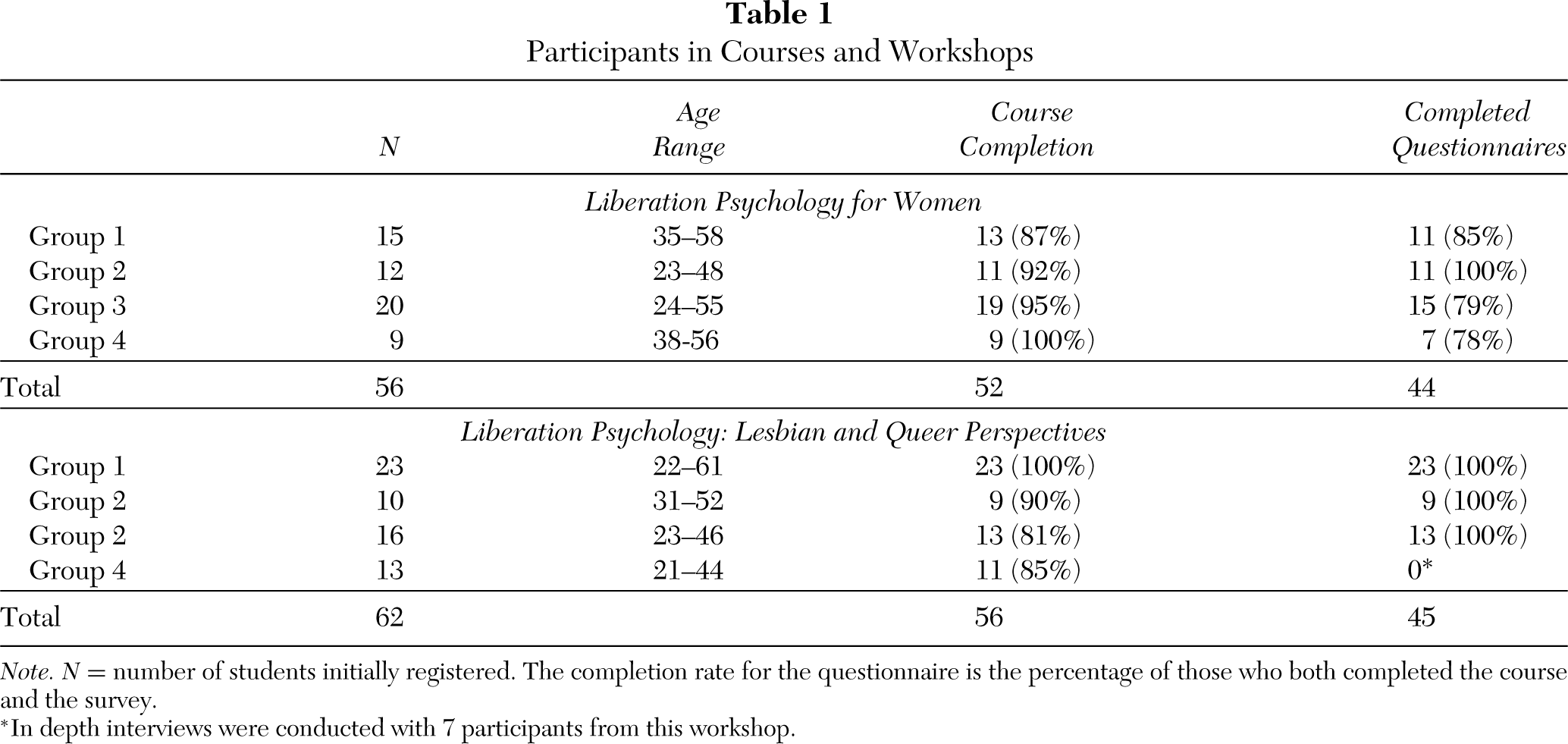
Note. N = number of students initially registered. The completion rate for the questionnaire is the percentage of those who both completed the course and the survey.
In depth interviews were conducted with 7 participants from this workshop.
Measures
At the end of the Liberation Psychology for Women course, participants were asked to complete a two-page questionnaire that was constructed for the purpose of assessing the relevance and usefulness of the methodologies and topics covered and whether the courses had achieved the goals of: (a) providing a social analysis, (b) linking the personal and the political (cycle of oppression), and (c) getting involved in change (cycle of liberation). The questionnaire began with a yes/no question that was required of all courses for overall evaluation purposes: “Did you find this course useful?” The questionnaire then listed the topics covered and asked participants to rank order the topics. The precise list of topics varied depending on course and workshop content, but all included the social analysis and the cycle of liberation, along with between 2 and 5 psychological topics. Participants were then asked to rank order methodologies. The list of methodologies also varied but always included: structured input, small group discussions, brainstorms, and drama. This item was followed by four semi-structured questions that were used to assess the three goals of the courses and workshops: “Did the course help you to identify the social patterns associated with oppression?” (social analysis); “Did the course help you to see connections between your own ways of behaving and the social patterns?” (cycle of oppression); and “Are there changes in your own life that you might make as a result of the course?” and “Would the course encourage you to get involved in a group aimed at bringing about social change?” (cycle of liberation).
A content analysis was performed on the comments written in response to the semi-structured questions, where all comments for each goal were categorized by the researcher and with independent verification by a second researcher for two of the groups in courses and workshops. There was over 90% rater agreement with categories and categorization, and where there were disagreements, comments were coded by discussion. In the majority of cases, respondents provided one comment for each question; where multiple comments were offered, the most dominant theme was coded so that each participant's comments were assigned to one category per question.
In-depth interviews were conducted with 7 participants in Group 4 of the Liberation Psychology: Lesbian and Queer Perspectives workshop by a master's student who also participated in the workshop. Participants were recruited at the workshop and interviewed afterwards using a semi-structured questionnaire that focused on their understanding of liberation psychology and the impact of the workshop at personal and social levels. Interviews were analyzed by the researcher using Interpretative Phenomenological Analysis and presented elsewhere (Keane, 2006).
RESULTS
Quantitative results from the Liberation Psychology for Women course indicated that participants found the course useful and that they appreciated both structured input and participatory methodologies. All but two (95%) answered “yes” to the question of whether they had found the course useful. Students often ignored the ranking direction and instead rated all items with 1's and 2's. The topic of “social analysis” received very high rankings, receiving a 1 (where only 1 and 2 were used) or a 1 or 2 (where a 5–6 point ranking was used), except for two cases (5%) who ranked it very low (a 4 and 5). Of the psychological topics, anger and sexuality obtained the highest rankings. The analysis of change received lower rankings as a topic. Analysis of methods indicated that “structured input” received very high rankings (1 or 2), followed by small group discussions, role plays, and open discussion. Quantitative results from the workshop Liberation Psychology: Lesbian and Queer Perspectives also indicated that all participants found the course useful along with very strong informal endorsements such as “wonderful,” “fabulous,” and “inspiring.” In this instance the questionnaire did not include questions on methods and topics.
Frequency of Themes From Semi-Structured Questions
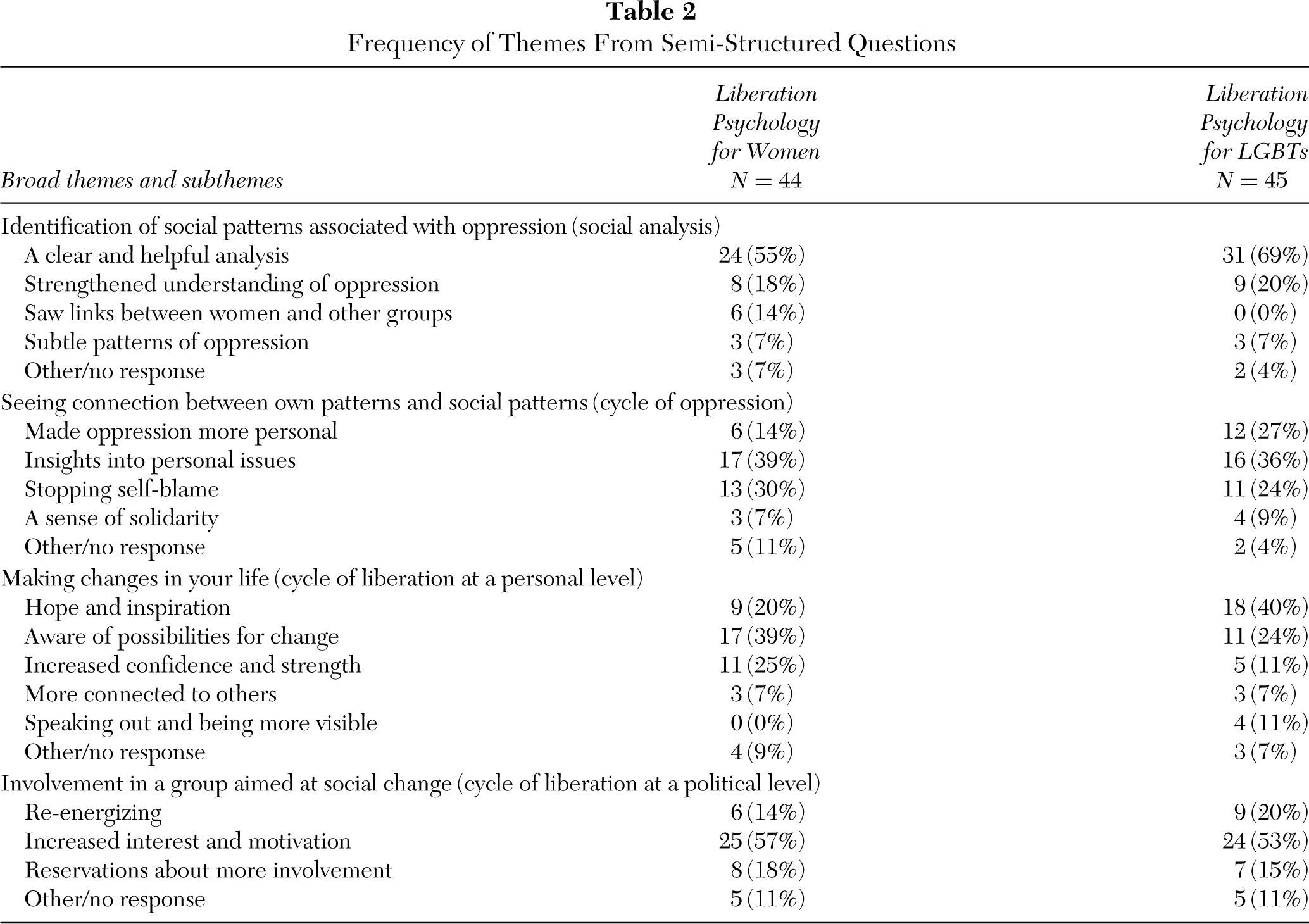
Table 2 presents the themes that were identified in the content analysis of the questionnaire. Here the aim is to evaluate whether the themes of liberation psychology that were operationalized in courses and workshops were useful to participants. The three areas addressed by the questions described above along with identified themes are presented in Table 2.
Social Analysis
The results indicate that a substantial majority of participants in the courses (93%) and workshops (96%) found the social analysis to be clear and useful. A majority in courses and workshops (56% and 75%, respectively) ranked the social analysis as the most valuable part of the course. In responding to the first open-ended question, 93% of course participants and 96% of workshops participants provided responses that indicated that the analysis of the social patterns associated with oppression was of benefit in understanding oppression. Predominant themes were that it provided a clear analysis that strengthened their understanding of oppression.
More in-depth understanding of the value of a clear structural analysis of oppression was gained through interviews with seven participants in one workshop with lesbian and queer participants (Keane, 2006). Interviews indicated that participants felt that they could understand the systemic nature of oppression and had a better analysis that they could apply not only to homophobia but also to other areas of their lives. They felt that the opportunity to focus on oppression was beneficial. Rather than increasing the negative impact of oppression, such awareness helped to remove self blame and broadened their sense of understanding and solidarity. Their understanding of oppression raised their awareness of obstacles and opportunities, gave them a greater sense of choice, and enabled them to be clearer about their lives. They were also able to observe the reactions of others in the group, which both validated their own experience and gave them insight into the diversity of experiences and reactions. Sharing of experiences thus led to greater understanding, tolerance, and solidarity.
The Cycle of Oppression
Psychological oppression was identified through exploring personal reactions to experiences of oppression or through exploring the shaping of psychological patterns by the modes of control. Negative reactions recorded on flip charts during the workshops included anger, fear, withdrawal, isolation, eating and sleeping problems, and helplessness; strengths included humor, pride, support, and solidarity. Exploring personal reactions was a further step in linking the personal and the political because it highlighted the external shaping of psychological patterns. A majority of participants in both courses (89%) and workshops (96%) commented that the course/workshop helped to make the connection between personal patterns and the social patterns associated with oppression. They reported that it helped to make oppression more personal, provided insights into personal issues, and helped them to stop blaming themselves. Making this connection and sharing reactions helped to break the sense of isolation, allowing participants to develop solidarity on the basis of their shared reactions and to be more aware of the external shaping of their reactions.
The Cycle of Liberation
An area that provoked much discussion and debate throughout the courses and workshops concerned the understanding of change, particularly of political change. Narrow views of political activism as involving engagement with agencies of the State contribute to women's sense that their actions were not considered “political.” Looking at change from the bottom up (that is, from the personal to the political) through the cycle of liberation brought an appreciation and enthusiasm for what were labelled “small acts” and for the hope that small acts could accumulate into system change. A greater variety of actions could be seen as political, including those undertaken in sites not traditionally considered political (such as the family, neighborhood, school, or church). In developing a bottom-up view of change, participants gained a developmental view of agency and activism: Change could begin at the personal level with “small acts,” and this first step might be followed by involvement in groups and communities. Over 90% of participants in courses and workshops indicated that they could see changes that they could make in their lives at a personal level (Table 2). Five themes emerged, with hope and inspiration, awareness of possibilities for change, and increased confidence the most common.
Because, as noted above, courses and workshops were offered in partnership with community centers, participants had ready access to connecting with groups and communities. Participants could see the value of the support, solidarity, and social contacts that are available in groups and communities. Involvement at the socio-political level could be envisioned through direct actions such as voting, or through advocacy and other actions undertaken in groups and communities. Exploring the different levels of change could thus expand understandings of how political change came about and also could provide more motivation to get involved in groups and communities oriented towards change. Further levels of involvement became apparent through identifying the different kinds of women's groups and organizations with whom they had contact, which ranged from local support groups to national representative bodies to transnational nongovernmental organizations. As Table 2 shows, a majority of participants in courses (57%) and workshops (53%) indicated increased interest and motivation for involvement in a group aimed at social change. Still, some participants expressed reservations about more involvement and a few in both groups did not provide a response, highlighting the continuing barriers for women getting involved in social change.
Among LGBT participants, there was an awareness that being visible and speaking out were important areas of change for them. Interviews indicated that participants expressed a strong wish for more involvement in change (Keane, 2006). They saw that they could change the impact of oppression in their own lives through a variety of actions. These actions could involve taking steps to develop a broader and more positive view of lesbian existence through cultural activities such as reading, education, and video, by being out and speaking up more as a lesbian, by becoming more involved in community, and by looking for opportunities to get involved in political activism.
DISCUSSION
The methodology and findings presented here illustrate several of the themes derived from the synergies of liberation and feminist psychologies. Both share a focus on furthering critical consciousness and transformative action through bottom-up participatory processes. Both aim to draw on experiential knowledge that is linked to a multilevel structural analysis and to a developmental or cyclical view of activism and change.
More specifically, the outcomes described here indicate that the three-component model that aimed to incorporate these themes and that was used in courses and workshops had several positive outcomes for participants. It provided a focused framework that increased political awareness and understanding, provided personal strength and insight, and motivated participants to become involved in social change. The specific components of the model each contributed to these outcomes. In line with new developments in understandings of oppression and liberation from feminist, political, liberation, and community psychologies reviewed above, it provided a social analysis that clearly focuses on systems and structures associated with inequality and oppression. It also provides an extended analysis of social and political change through considering change at three levels of the personal, interpersonal, and political (the cycle of liberation). These political understandings were enhanced by the insights into the impact of structures of inequality on psychological patterns and on the everyday micro or “limit situations,” thereby providing a personal motivation for involvement in change.
There were also reservations expressed by approximately one-fifth of participants across both modules about getting involved in a group aimed at social change. These reservations were often listed as external constraints (e.g., lack of time and other commitments). Informal feedback also indicated that some participants still did not see involvement in social change as appealing and that this assessment was related to an ongoing sense of alienation from the word “political.” In addition, the relatively narrow focus of the question, which asked specifically and exclusively about joining groups, seemed to preclude more informal actions such as speaking out or supporting other groups. These responses highlight the barriers to women's involvement in groups and communities and also suggest the need to explore the variety of contexts, including family and work, in which women can see themselves as agents for change.
The content, process, and outcomes of the courses and workshops described here, as well as other examples (e.g., Billies et al., 2009; Chaudhry & Bertram, 2009; Luque-Ribelles et al., 2009; Noor, 2009; Shalhoub-Kevorkian, 2009), illustrate the possibilities for knowledge production created by bottom-up participatory methodologies. They also exemplify the cyclical or iterative nature of conscientization. Awareness and possibilities for action may be at first limited by lack of education or analysis and by contextual constraints; as possibilities for action emerge and are reflected upon, a broader understanding develops that in turn offers new possibilities for action. As Montero (2007, p. 527) writes: “actions produce modes of knowing that produce enriched actions.” Socio-political development is thus a process that involves change over time through reflection on transformative action (Watts, Williams, & Jagers, 2003), which I have called “the cycle of liberation.” Such an analysis furthers understandings of feminist consciousness, critical consciousness, and political awareness. This bottom-up approach to change highlights the diversity of contexts or sites in which women seek to engage in transformative or political action—with family, group, and community contexts being particularly salient (Moane, 2010).
The examples I described in this article also illustrate the relational dimension to sociopolitical development, highlighting the importance of groups and communities for processes such as giving voice, listening, solidarity, support, and appreciation of diversity. As participants share their knowledge, experience, and reactions, they become aware of both similarities and differences as well as the connections between oppressions. These relational and collective aspects of political activism can be seen as enhancing the more personalized and individualized forms of activism described, for example, by third wave feminists. Emphasizing liberation as a relational process makes the group or community a vital context for transformative action.
Finally, the analysis presented here provides further understandings of the inseparability of the personal and the political that is captured in the phrase “the personal is political.” Engaging in transformative action—whether at personal, interpersonal, political, or transnational levels; whether in families, groups, communities, universities, or nongovernmental organizations; or whether through traditional political actions or new forms such as internet or consumer strategies—involves both psychological as well as social processes. Understanding their dynamic interrelationships over time remains an important focus for feminist political psychology.