







Abstract
Prior to the leadership of Margaret Thatcher, traditional academic assumptions about the British Conservative party focused on its emphasis on party unity, the centrality of loyalty to the party, and its ideological pragmatism in the pursuit of power. The leadership of her successor, John Major, was undermined by disunity, disloyalty and ideological conflict, which contributed to the Tory party's removal from power. The ideological implosion of one the most disciplined and electorally successful parties in Western Europe, has stimulated considerable academic appraisal. This article considers the design and utilisation of the ideological typologies of contemporary British conservatism that have been used by academics to help explain the nature of this ideological conflict. By analysing these developments in typological design, we can enhance our understanding of the ideological realignment of contemporary British conservatism in the immediate post-Thatcherite era.
The Conservative party has been described as a pragmatic rather than an ideological party. Traditionally, conservatives believed that abstract ideological doctrines had to be subordinated to the realities of governing (the politics of power) and the need to win elections (the politics of support) (Baker, Gamble and Ludlam, 1994, p. 279). The interaction of the ‘ethos’ of the Conservative party with the ideological ‘doctrines’ of conservatism was resolved, with the conservative party adhering to a theory of party statecraft geared towards the pursuit of the ‘governing code’ rather than an ‘ideological creed’ (Bulpitt, 1992, p. 265). The emphasis on party discipline, loyalty and political adaptability enabled the party leader to pursue the major dimensions of party statecraft: successful party management, a winning electoral strategy, political argument hegemony, governing competence and another winning electoral strategy (Bulpitt, 1986, pp. 19–39).
The electoral decline and fall of the Conservative party in the immediate post-Thatcherite era demonstrates that contemporary British conservatism has been characterised by a failure of party statecraft. The capacity of her successor, John Major, to successfully pursue the major dimensions of party statecraft was eroded in part by the unresolved ideological contradictions inherited from Thatcherite conservatism, which had imposed an ideological dogma upon the traditionally non-ideological conservative party.
A fratricidal ideological struggle over the question of European integration dominated and disfigured the Major era (1990–97). This would destroy the conservative party's reputation for unity, ideological pragmatism and governing competence and altered the historical interaction of the ‘ethos’ of the party with its ideological ‘doctrines’. The traditional commitment to internal party unity and loyalty was abandoned, as the Parliamentary Conservative Party (PCP) chose to pursue an ‘ideological creed’ in preference to the ‘governing code’ (Heppell, 2002, p. 320).
The implosion of the Conservative party during the immediate post-Thatcherite era (1990–97) acted as the stimuli to re-consider an oft-neglected aspect of British political science – academic research of intra-party ideological conflict. The following academics constructed ideological typologies of contemporary British conservatism: Norton (1990), Dunleavy (1993), Baker, Gamble and Ludlam (1993), Sowemimo (1995), Garry (1995) and Heppell (2002). 1
The purpose of this article is to evaluate this burgeoning body of academic literature on ideological typologies of contemporary British conservatism relating to the immediate post-Thatcherite era. It will focus on two interrelated tasks: first, it will provide an overview of developments in typological design, and, second, it will analyse the ways in which these typologies can be utilised. The article will distinguish between one-dimensional typologies (Norton); two-dimensional typologies (Dunleavy, Sowemimo, Baker, Gamble and Ludlam); and three-dimensional typologies (Garry, Heppell). The analysis will differentiate between typologies in which the typological design is the end product of research (Dunleavy, Sowemimo), and typologies in which the typology drives further research activity (Norton, Baker, Gamble and Ludlam, Garry and Heppell). By evaluating these ideological typologies, we can acquire greater knowledge of the process of ideological realignment within contemporary British conservatism in the immediate post-Thatcherite era.
Ideology and Conservatism
Before analysing the design and use of ideological typologies of contemporary British conservatism, it is necessary to define the following: first, what we mean by the term ideology; second, what we mean by the term conservatism, from both a pre-Thatcherite and a Thatcherite perspective; and third, how do we define the relationship between ideology, conservatism and statecraft and what was the nature of this relationship at the onset of the post-Thatcherite era.
When referring to the term ‘ideology’, three observations can be made. First, it is one of the most over-utilised concepts within political debate. Second, it is one of the most contested concepts within political science, encapsulating a myriad of definitional elements. Finally, the pejorative connotations that have been associated with the concept of ideology represent the unifying element of these definitions. This has seen ‘ideology’ being used as a label to attach to those adopting a doctrinaire, dogmatic or extremist position (Leach, 1996, p. 15; Goodwin, 1998, p. 17).
This article will adopt the following inclusive and neutral definition of ideology. Ideologies represent a set of assumptions about the political world, which inform political behaviour and offer an explanation of the past and present, thus providing a recommendation of an ideal society to be attained in the future. Political parties have evolved around conflicting ideological perspectives and offer a set of policies that need to be implemented to achieve that ideal (Leach, 1996, p. 15; Coxall, Robins and Leach, 2004, pp. 51, 118).
When referring to the term conservatism, it is important to recognise that pre-Thatcherite conservatism claimed to ‘eschew theory altogether and appears to have no ideal society to which to work to’ (Adams, 1998, p. 7). The emphasis on pragmatism reflected a conservative belief that political behaviour should offer practical solutions that take account of the prevailing political circumstances (that is, what works). As conservatives perceived conservatism to be a disposition and attitude of mind, as opposed to a creed or doctrine, they argued that the conservative party did not possess an ideology (Heywood, 2002, p. 47).
Such interpretations endorse the governing code/ideological creed dichotomy advocated earlier, which was seen to be central to the execution of party statecraft. Although, the conservative party had pursued a version of party statecraft, characterised by a desire to win elections and governing competently, rather than implementing grand ideological strategies, most political scientists have rejected the conservative claim to be non-ideological (Adams, 1998, p. 7). Evans and Taylor have described conservatism as a protean ideology. They have argued that to secure and maintain electoral and governing hegemony within a changing political environment, ideological adaptation has been a necessary and essential feature of conservative politics (Evans and Taylor, 1996, p. 1).
This process of ideological adaptation demonstrates two factors. First, there are several core tenets within conservatism, which have formed the basis of their unity of purpose and electoral success (Smith and Ludlam, 1996, p. 5). Second, the tenets of conservatism provide inherent tensions and the potential for internal conflict (Evans and Taylor, 1996, p. 1).
First, conservatives believe in wealth creation, private property and a limited role for government. Conservatism is the belief in society as an organic and evolutionary entity, encapsulating the importance of order, tradition and nation. Implicit within the attempt to secure order is the desire to retain peace and ensure the preservation of the established social order. Although conservatives acknowledge the inevitability of human inequality, they do acknowledge that the necessary role of government is to guarantee social cohesion and minimum welfare. Limited social reform, to guarantee social stability, encapsulates the belief in ‘one nation’ at home, which is complemented by the belief in ‘one-nation’ abroad, which involves the expansion/defence of British interests abroad (Norton, 1996, p. 93; Morris, 1996, p. 123).
Second, there are inherent tensions within conservatism. The one-nation emphasis on social stability may be incompatible with the pursuit of wealth creation. The capacity to maintain order and discipline could be undermined by the belief in a limited state. The pragmatic need to accept limited change contradicts the emphasis on tradition and maintaining the status quo (Norton, 1996, pp. 93–4).
These ideological tensions form the basis for strands of conservative thought. Post-war British conservatism can be subdivided into two broad ideological stages. The 1945–75 period witnessed the ascendancy of progressive conservatism in the Disraelian one-nation tradition. One-nation conservatives supported the welfare state and the pursuit of full employment. They accepted the need for government intervention in the management of the economy to moderate the social inequalities of the market economy. This ‘new conservatism’ of the post-war era embraced the state. It enabled the conservative party to make an accommodation with the post-war political environment and the belief in statist economic policy solutions (Coxall and Robins, 1998, pp. 172–3).
The period from 1975 saw Thatcherite conservatism replace progressive conservatism as the dominant strand of conservative thought. Thatcherite conservatism was neo-liberal in the economic sphere – that is, a limited state; the control of inflation rather than the pursuit of full employment; the free market instead of the mixed economy; and the reduction of union power. Complementing neo-liberalism in the economic sphere was neo-conservatism within the social and moral sphere, as Thatcherite conservatism promoted social conservatism – that is, the preservation of traditional moral standards and a rejection of liberal morality. Implicit within Thatcherite conservatism was a desire to defend British sovereignty and emphasise British national identity, by protecting British institutions and traditions (Coxall and Robins, 1998, pp. 173–4).
Thatcherite conservatism sought to redefine the Conservatives as a party of economic liberalism, national independence and moral authoritarianism (Gamble, 1996, pp. 23–8). Therefore, the ideological configurations within contemporary British conservatism in the immediate post-Thatcherite era can be understood in terms of three ideological policy variables: economic policy, European policy, and social, sexual and moral policy (Cowley and Garry, 1998, p. 479; Heppell, 2002, p. 302).
The economic policy divide differentiated interventionist ‘wets’ who advocated an extended state, from Thatcherite ‘dries’ who promoted a limited state. Interventionist wets favoured measures to reduce unemployment and maintain growth, whilst advocating a positivist approach towards the public sector and maintaining good relations with the trade unions. Thatcherite dries prioritised the prevention of inflation and advocated tax and spending cuts, anti-union legislation and privatisation (Cowley and Garry, 1998, p. 479).
The European policy divide differentiated pro-Europeans or advocates of interdependence from Eurosceptics or advocates of independence. Pro-Europeans argued that further European integration, with an implicit ‘pooling’ of sovereignty, was essential to renewed British influence on the world stage. Eurosceptics opposed further European integration because it entailed surrendering sovereignty to a supranational body that Britain could not control (Norton, 1998, p. 97).
The social, sexual and moral policy divide differentiated social liberals from social conservatives. Social conservatives opposed homosexual rights, freedom of contraception and abortion whilst supporting the family, capital and corporal punishment, censorship and restrictions on immigration. Social liberals adopted a more tolerant and less authoritarian attitude to issues of morality (Cowley and Garry, 1998, p. 479).
These ideological policy divides provide the basis for understanding the development of ideological typologies of contemporary British conservatism in the post-Thatcherite era. However, before attempting to evaluate the development of ideological typologies of contemporary British conservatism in the post-Thatcherite era, it is important to consider the relationship between ideology, conservatism and statecraft and the nature of this relationship at the onset of the post-Thatcherite era.
Traditional party statecraft theory suggested that pre-Thatcherite conservatism was predominantly characterised by its orientation towards government rather than its adherence to doctrinal commitments. This perspective fuelled the distinction drawn between ideologically motivated parties, who seek to obtain votes for a specific ideologically driven programme, and pragmatic parties, whose flexibility and adaptability enables them to respond to shifting voting preferences and thus maximise their vote share (Coxall, Robins and Leach, 2004, p. 118). A dichotomy had been applied to pre-Thatcherite British party politics, which assumed that the Labour party was an ideologically motivated party, whilst within the conservative party doctrine and theory were subordinate to political calculation, the pursuit of office and the management of power (Gamble, 1988, pp. 141–2).
This interpretation of pre-Thatcherite Conservative party politics reflected the fact that pre-Thatcherite conservatism was viewed as ‘positional’ rather than ‘doctrinal’. However, it is a simplistic narrative that assumes that pre-Thatcherite conservatism was ‘positional’, non-ideological and geared towards party statecraft, whilst Thatcherite conservatism was ‘doctrinal’ and contradicted the fundamental principles of traditional party statecraft (Gamble, 1988, pp. 144–5, 153). Not only is the distinction between ideologically motivated and pragmatically driven parties an over-simplification (and clearly is not applicable in the post-Thatcherite era) but the distinction between ‘positional’ and ‘doctrinal’ conservatism is more complex than implied.
First, the supposed ‘positional’ conservatism of the pre-Thatcherite conservatism era was not devoid of ideology, as has been implied. To argue that pre-Thatcherite conservatism was non-ideological is to reject the depth of abstract theory that underpinned traditional conservative thought. The emphasis on experience and history constituted a set of specific beliefs and political values about societal development, based on the limited rational capacities of humans. As such, conservatism went beyond a basic desire to resist change; its ideological content was derived from the doctrinal motivated values that underpinned their policy prescriptions, which were designed to enable the conservative party to defend the existing social order (Heywood, 2002, pp. 71–2).
Second, the supposed ‘doctrinal’ nature of Thatcherite conservatism should not imply that it was devoid of pragmatism. Thatcherite conservatism, whilst ideologically motivated, carried with it a substantial dose of traditional conservative pragmatism (Coxall, Robins and Leach, 2004, p. 118). Thatcherite conservatism has been defined as ‘doctrinal’ conservatism, as it subordinated questions of party statecraft on how to win and how to hold power and preserve hegemony ‘to questions of ideology, of the correctness of policies measured against abstract principles’, yet Gamble argues that Thatcherite conservatism never really subordinated party statecraft to ideology as has been implied (Gamble, 1988, p. 153). Thatcherite conservatism offered reformulated party statecraft: the primary motivation was the traditional goal of winning the next election and governing competence, rather than implementing an ideological driven project (Evans and Taylor, 1996, p. 224). It simply constituted an alternative view of party statecraft that rejected the traditional conservative theory that pragmatism and the surrendering of doctrinal aspirations were essential – that is, Thatcherite conservatism was overtly ideological vis-à-vis pre-Thatcherite conservatism, but its ideological motivation was to facilitate the pursuit of party statecraft, rather than to subordinate it (Bulpitt, 1986, p. 26).
Gamble argued that Thatcherite conservatism constituted a reformulated form of party statecraft geared towards restoring the electoral, political, economic and ideological dominance of the conservative party within British politics, yet he predicted that the short-term success of Thatcherite conservatism as an instrument of party statecraft would not be sustainable over the longer term (Gamble, 1988, p. 154; Gamble, 1994, p. 4) Ultimately, the post-Thatcherite era would be characterised by a dichotomy of ideological strength and electoral weakness, that is, a failure of party statecraft.
Therefore, ideology is an important factor when evaluating the implosion of the conservative party in the immediate post-Thatcherite era (Buller, 2000, p. 319). Journalists described conservative parliamentarians as ‘wet’, ‘dry’, ‘Europhile’, or ‘Eurosceptic’ without defining what these terms meant. How academics have interpreted the three main ideological divides – economic policy, European policy, and social, sexual and moral policy – informed the development of ideological typologies of post-Thatcherite British conservatism.
Designing Typologies of Conservatism
Having identified the ideological tensions within contemporary British conservatism, it is necessary to define what we mean by the term ‘typology’. Ideological typologies of contemporary British conservatism have attempted to locate distinct ideological groupings based on attitudes and/or behaviour in relation to one or more of the following policy divides identified – economic policy, European policy, and social, sexual and moral policy.
However, to avoid the accusation that typologies of contemporary British conservatism are an academic phenomenon specific to the late and post-Thatcherite era, it is important to recognise that pre-Thatcherite typologies of conservative thought have been advanced by academics. The range of typologies of contemporary British conservatism pre-dating the post-Thatcherite era differed according to the subject matter that informed how the typologies were constructed, that is, were they informed by behavioural indicators; were they informed by policy-based considerations; or were they primarily ideologically based typologies.
Those based on the behaviour of Conservative parliamentarians, included Finer, Berrington and Bartholomew, who categorised conservatism in the Macmillan era according to conservative MPs parliamentary behaviour with regard to European policy which led to the development of five categorisations (European stalwarts, Europe and Empire, Empire moderates, Empire stalwarts and the uncommitted), and Rose who categorised conservative parliamentarians who were reactionary, those who defended the status quo, and those who advocated reform and amelioration (Finer, Berrington and Bartholomew, 1961; Rose, 1964) In more contemporary analysis, Gamble offered a typology based on the policy positions of conservative parliamentarians. Focusing on attitudes (not behaviour) towards European policy, Gamble identified the following categorisations: isolationist nationalists; Atlanticist nationalists; market liberal nationalists; market liberal federalists; unionist federalists; and realist federalists (Gamble, 1990).
However, as implied by the title of this article, most typologies of contemporary British conservatism have been based around ideology, as opposed to policy-based or behaviourally driven typologies. Notable pre-Thatcherite typologies of conservative ideology included Greenleaf, who offered a left/right or collectivist/libertarian distinction, which reflected the fact that the central ideological dilemma was the role of the state (Greenleaf, 1973, p. 19). Further ideologically motivated typologies of conservative thought were subsequently advanced by Gamble (1974), Norton and Aughey (1981), and Crewe and Searing (1988). The Gamble typology evaluated attitudes towards the post-war consensus, and advanced four distinct groupings within post-war conservatism: right progressive, whig diehard, imperialist diehard and new right (Gamble, 1974; Baker, Gamble and Ludlam, 1994, p. 281). The Norton and Aughey typology identified the twin values of community, focusing on the maintenance of an ordered and harmonious society, and the economy, highlighting the centrality of free enterprise and property ownership, within the conservative tradition. They argued that these twin traditions were indicative of the respective concerns of Toryism and Whiggery. These constituted the defining ideological pivots of conservatism, although Norton and Aughey constructed subtypes within each tradition, leading to the creation of the following six categorisations: pessimistic tories; paternalistic tories; progressive tories; combative tories; corporate whigs; and neo-liberals (Norton and Aughey, 1981, pp. 66–79; Crewe and Searing, 1988, pp. 366–7). The Crewe and Searing typology refined the Norton and Aughey typology by endorsing the basic Tory/Whig distinction and simplifying the subtypes and offering a pattern of conservative ideology on the eve of Thatcherite conservatism that comprised four categories: traditional and progressive tories; and corporate and liberal whigs (Crewe and Searing, 1988, pp. 366–7; Baker, Gamble and Ludlam, 1994, pp. 280–4). 2
Therefore, pre-Thatcherite typologies of conservatism were driven by behaviour (Finer, Berrington and Barthelomew, 1961; Rose, 1964); or policy (Gamble, 1990); or by ideology (Greenleaf, 1973; Gamble, 1974; Norton and Aughey, 1981; Crewe and Searing, 1988). For the purposes of evaluating post-Thatcherite typologies of conservative thought we will use the behavioural and policy motivated and ideologically informed typology constructed by Norton (1990) as our starting point, before evaluating ideologically motivated typologies (Dunleavy, Garry and Heppell) and ideologically/policy motivated typologies (Baker, Gamble and Ludlam, Sowemimo)
However, when evaluating the ideological typologies, the most pressing concern relates to questions of ideological typological design. We can identify one-dimensional typologies (Norton), two-dimensional typologies (Dunleavy, Baker, Gamble and Ludlam, Sowemimo) and three-dimensional typologies (Garry, Heppell).
One-Dimensional Typologies of Conservatism
The seminal typology is that of Norton (1990, pp. 41–58). The Norton typology was viewed by Baker, Gamble and Ludlam and Dunleavy as a one-dimensional typology, as its basis is a standard wet (left)/dry (right) divide (Dunleavy, 1993, p. 125; Baker, Gamble and Ludlam, 1994, p. 286). Norton divided conservatism into four subsections, with further subdivisions creating the following seven groups, from left to right: wets and damps (grouped together as the critics); party loyalists; populists; and the three Thatcherite sub-groupings: the Tory right; pure Thatcherites; and neo-liberals (see Table 1). Within the critics grouping, the wets justified government intervention, opposed public expenditure cuts and were pro-European. Damps were broadly similar to wets but less vocal in expressing their disapproval with Thatcherite politics. The party loyalists were loyal to the party, rather than to any personality, leader or ideology, whilst the populists adopted right-wing tendencies on law and order and issues of morality (as well as being Eurosceptic), but were broadly left wing on economic policy. The Thatcherites were subdivided into three groupings. The socially conservative Tory right focused their attention on questions of morality and law and order. The Thatcher group of pure Thatcherites were wedded to the leadership ‘style’ of Margaret Thatcher. Neo-liberals advocated a minimal state, both in the economic and social sphere, and were generally Eurosceptic (Norton, 1990, pp. 46–50).
The Norton Typology
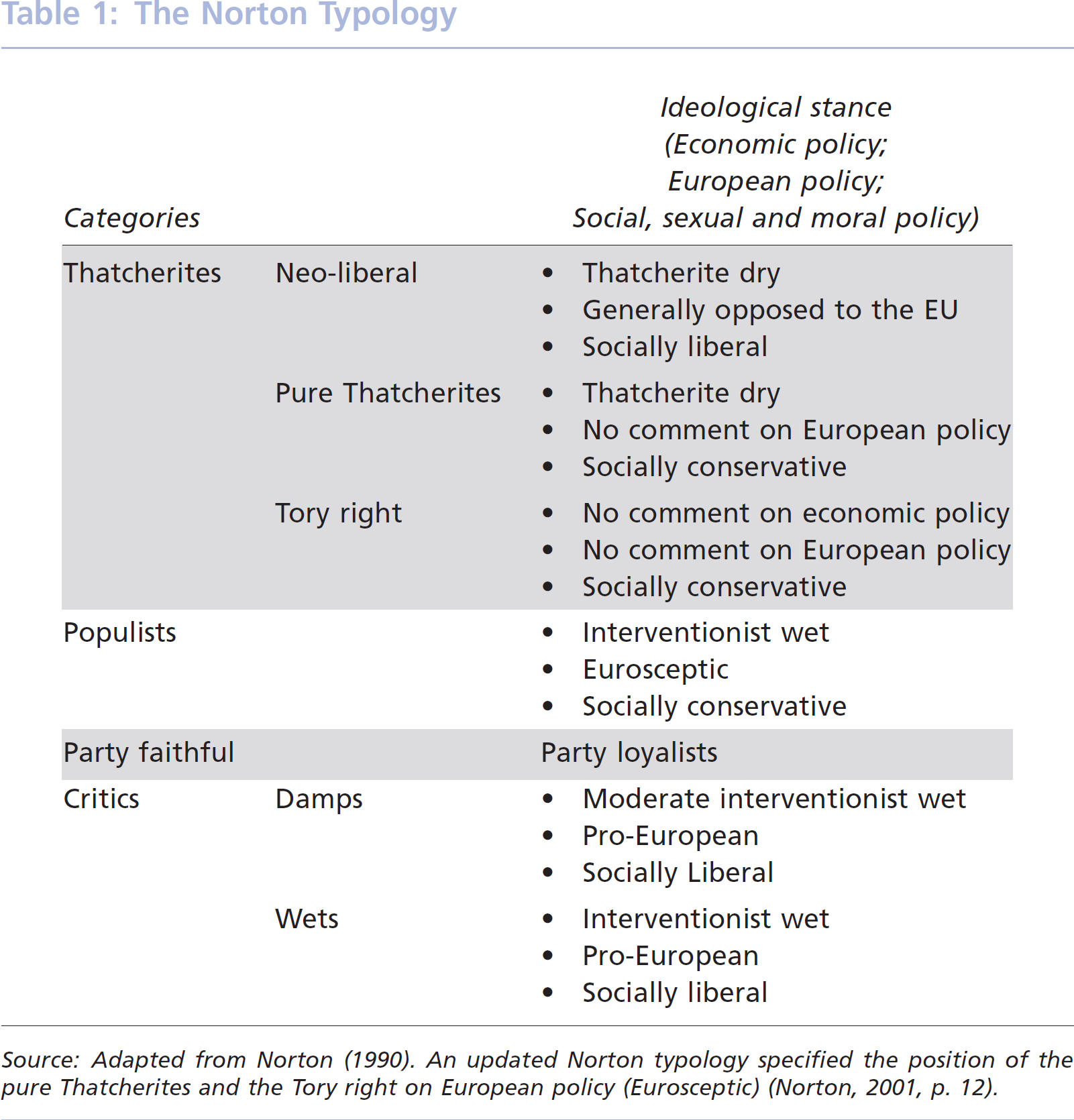
Source: Adapted from Norton (1990). An updated Norton typology specified the position of the pure Thatcherites and the Tory right on European policy (Eurosceptic) (Norton, 2001, p. 12).
The Norton typology has been subject to significant academic appraisal (Dunleavy, 1993; Sowemimo, 1995; Baker, Gamble and Ludlam, 1994; Cowley and Garry, 1998; Heppell, 2002). Although it would appear to be a one-dimensional linear typology, Cowley and Garry claimed in 1998 that the Norton typology was actually two-dimensional (Cowley and Garry, 1998, p. 482). They argued that as aspects of social policy were incorporated, the typology was a composite, in that ‘the groups identified are identified on the basis of more than one policy dimension’ (Cowley and Garry, 1998, p. 482). For example, neo-liberals ‘are [economically] dry and morally liberal’ (Cowley and Garry, 1998, p. 494).
Heppell has argued that ‘the validity of the composite economic and social, sexual, moral policy variable is open to question as it explains too little and excludes too much’ (Heppell, 2002, p. 305). Although the Norton typology does incorporate aspects of social, sexual and moral policy – for example, law and order, immigration and capital punishment – it can be argued that to truly differentiate social liberals from social conservatives, it is necessary to consider morality issues such as divorce, abortion and homosexual rights. Furthermore, the Norton typology assumes that an economic wet is by implication a social liberal. Heppell concludes that the Norton typology does not seek to identify divisions on issues relating to social, sexual and moral issues amongst economic wets (Heppell, 2002, pp. 305–6).
By 2002, Cowley and Norton argued that the Norton typology was an all-embracing, composite-based, three-dimensional analysis, as it integrated all three ideological dimensions – economic policy, social policy and European policy (Cowley and Norton, 2002, p. 328).
However, Dunleavy criticised Norton for constructing his typology along a one-dimensional wet (left)/dry (right) axis, as it does not recognise the ideological realignments caused by the European ideological policy divide. Baker et al. emphasised the centrality of this point by arguing that this is a ‘significant qualification, as the division over European integration is hardly an ideological sideshow’ (Baker, Gamble and Ludlam, 1994, p. 280). Cowley and Garry appear to tacitly acknowledge that if the Norton typology fails to identify the European divide ‘then its value is clearly limited’ and ‘a typology which fails to properly account for it may well not be very useful’ (Cowley and Garry, 1998, p. 482). Such observations appear to question the viability of the composite argument that has been implied.
Two-dimensional typologies of conservatism
By the mid-1990s, Dunleavy (1993), Baker, Gamble and Ludlam (1993), and Sowemimo (1995) had developed innovative two-dimensional typologies, which attempted to address the typological design problems of the original Norton typology.
The Dunleavy typology consists of a left/right split between those who accepted the welfare state and those who were inegalitarian. Cutting across this left/right divide was another split between the traditional conservative belief in the primacy of the British nation state and the centrality of the individual as the most important political consideration. The left/right divide combined with the nation state/individualist split gives four basic groupings: the traditional far right, Tory paternalists, Tory technocrats and market liberals. The traditional far right believe in strong government and the defence of hierarchy and tradition, whilst Tory paternalists represent the ‘one nation’ tradition within the party. Tory technocrats were strongly committed to Europe and an interventionist government industrial policy aimed at promoting efficiency, whilst market liberals were committed to a new right platform of free market economics and rolling back the state (Dunleavy, 1993, pp. 126–9).
The Dunleavy typology was two-dimensional, with a nation state conservatism/individual axis mapped onto the welfare state/inegalitarian axis (see Figure 1). Dunleavy emphasised how the European ideological policy divide cuts across, rather than down, the traditional wet (left)/dry (right) ideological divide. This is significant as the complex and evolving ideological configurations within post-Thatcherite conservatism revolved around the European ideological policy divide and the national sovereignty versus economic interdependence conflict (Sowemimo, 1995, p. 82). This ‘sovereignty’ dilemma constituted a source of factional division revolving around two conceptions of European integration – one that involved the rejection of the compromising of sovereignty (Eurosceptic independence) and the other, which accepted the principle of pooling sovereignty (pro-European interdependence) (Ludlam and Smith, 1996, p. 266).
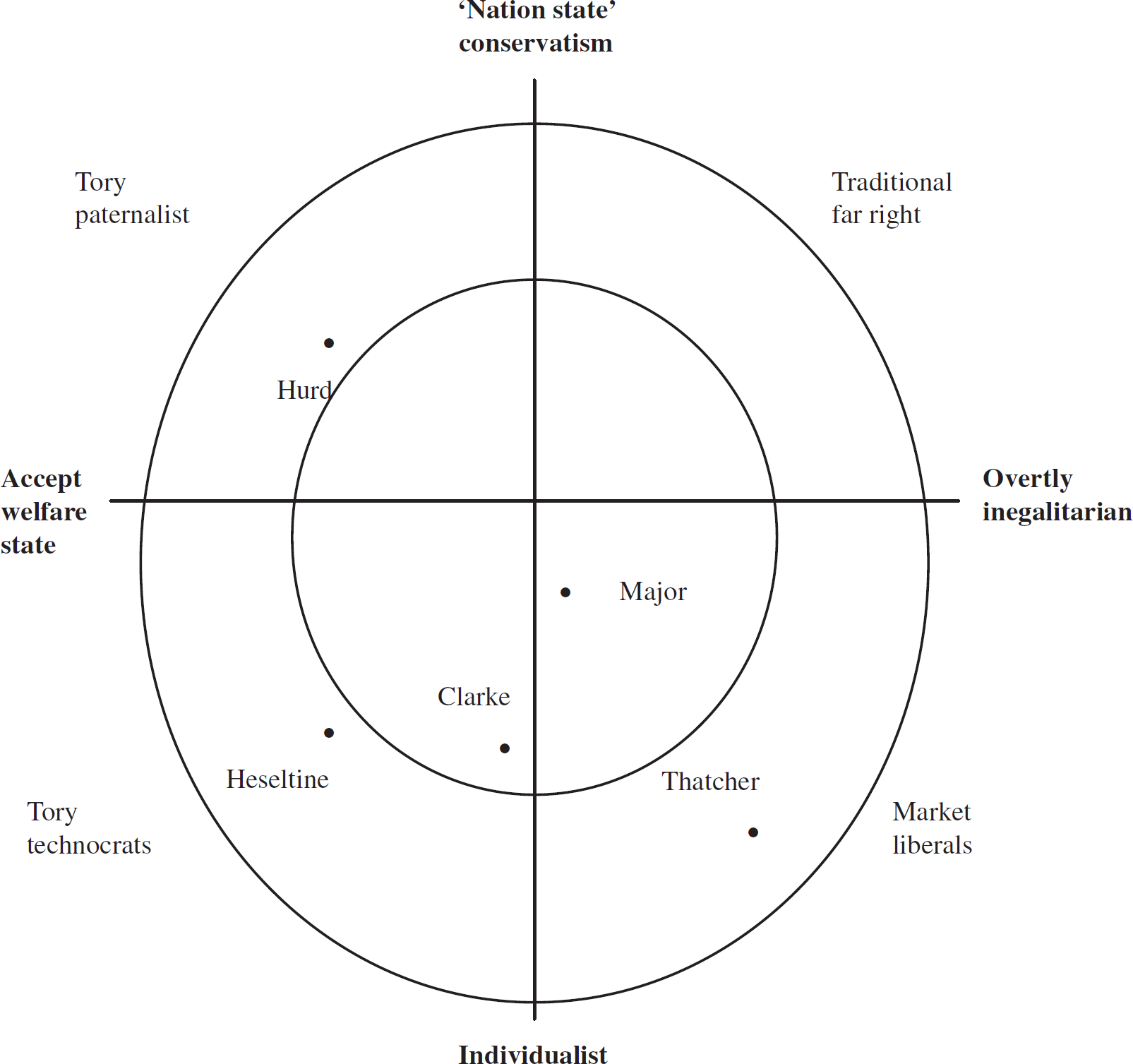
The Dunleavy Typology (1993)
Sowemimo developed a new typology that identified three conflicting groups within conservatism: Thatcherite nationalists, neo-liberal integrationists and interventionist-integrationists. This recognised the split within the Thatcherites on the question of European integration (see Figure 2).
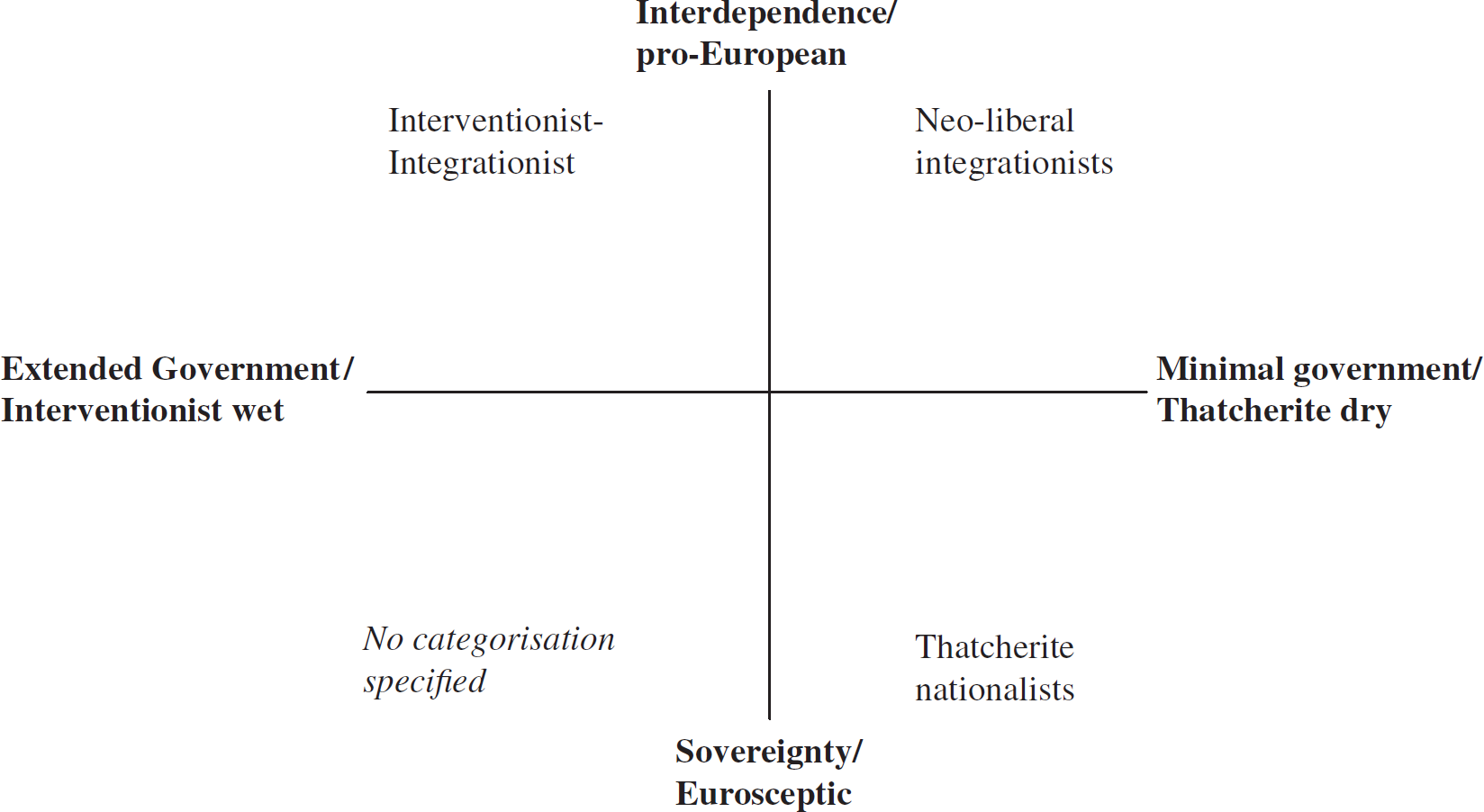
The Sowemimo Typology (1995)
The Thatcherite nationalists saw European monetary and political integration as a threat to British sovereignty and independence. They viewed the European Union (EU) as inherently interventionist and a threat to the Thatcherite neoliberal economic legacy. The neo-liberal integrationists shared an attachment to free market economic policies with their Thatcherite nationalist colleagues. However, neo-liberal integrationists believed that the EU could play a positive role in deciding monetary policy and were therefore willing to accept monetary union (Sowemimo, 1995, pp. 85–6). The interventionist-integrationists constituted ‘the residue of the old wet critics of Thatcherite conservatism’, essentially a Heathite rump (Sowemimo, 1995, p. 87).
In constructing his two-dimensional map, Sowemimo had been influenced by Baker, Gamble and Ludlam (1993). This is recognised by Sowemimo, who acknowledged Baker et al.'s view that ‘the best means of understanding the European divisions can be gleaned from an analysis that combines both the division over the role of the state in the economy and the conflict over sovereignty’ (Sowemimo, 1995, p. 83). Baker, Gamble and Ludlam developed a typology that involved placing an interdependence/independence axis within a two-dimensional map, which is mapped onto the extended (wet)/limited (dry) state axis. This promotes a four-fold typological design revolving around the two ideological fault lines: Eurosceptic/dry; Eurosceptic/wet; pro-European/dry; and finally pro-European/wet (see Figure 3).
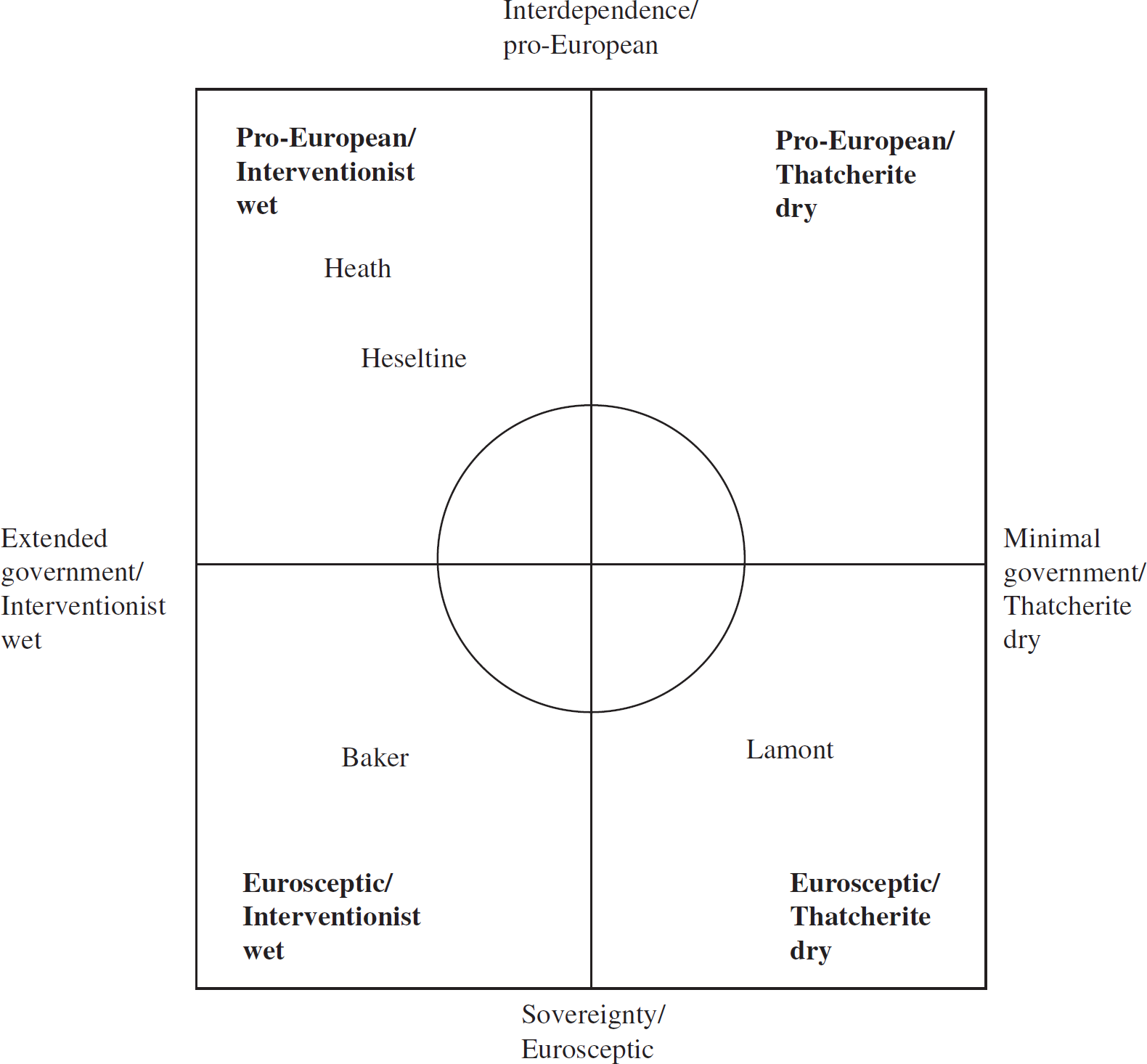
The Baker, Gamble and Ludlam Typology (1993)
The Sowemimo typology reaffirmed much of the Baker et al. typology. For example, Sowemimo's Thatcherite nationalists constituted the Eurosceptic/dry quadrant in the typological map of Baker et al. Sowemimo's neo-liberal integrationists mirrored their pro-European/dry grouping; and finally, Sowemimo's interventionist-integrationists covered their pro-European/wet grouping.
The Sowemimo typology was two-dimensional and offered cross-cutting axes that divided the Thatcherites but was not all encompassing: what of the quadrant in a two-dimensional map which relates to Eurosceptic/wet in Baker et al. typology? They made typological provision for the ideologically marginal Eurosceptic but economically wet grouping. Sowemimo makes no reference to this ideological grouping. This is a limitation in typological design, as it implies that Eurosceptism within contemporary British conservatism in the immediate post-Thatcherite era was exclusively the preserve of the economic dry neo-liberals and that all economic wets were pro-European.
A Three-Dimensional Typology of Conservatism
Baker, Gamble and Ludlam offered a two-dimensional typology, which integrated the two most significant ideological policy divides – economic policy and European policy. However, it did not embrace the social, sexual and moral policy ideological divide. By including the social, sexual and moral policy ideological variable, a three-dimensional typology can be created. This involves the creation of an extended versus limited state axis, which distinguishes wets from dries. An interdependence versus independence axis, which identified pro-Europeans and Eurosceptics, was mapped onto the extended (wet) versus limited (dry) state axis. The social policy ideological variable could be inserted by mapping a socially liberal/socially conservative axis, onto the existing two-dimensional typology, thus creating a three-dimensional typology (Heppell, 2002, p. 306). The Heppell typology, which identifies eight ideological groupings, corresponds, if in redefined terms, to the eight moral–economic–European opinion groups advocated by Garry (1995, pp. 170–89) (see Table 2).
The Three-Dimensional Typology of Conservatism (Garry, 1995/Heppell, 2002)
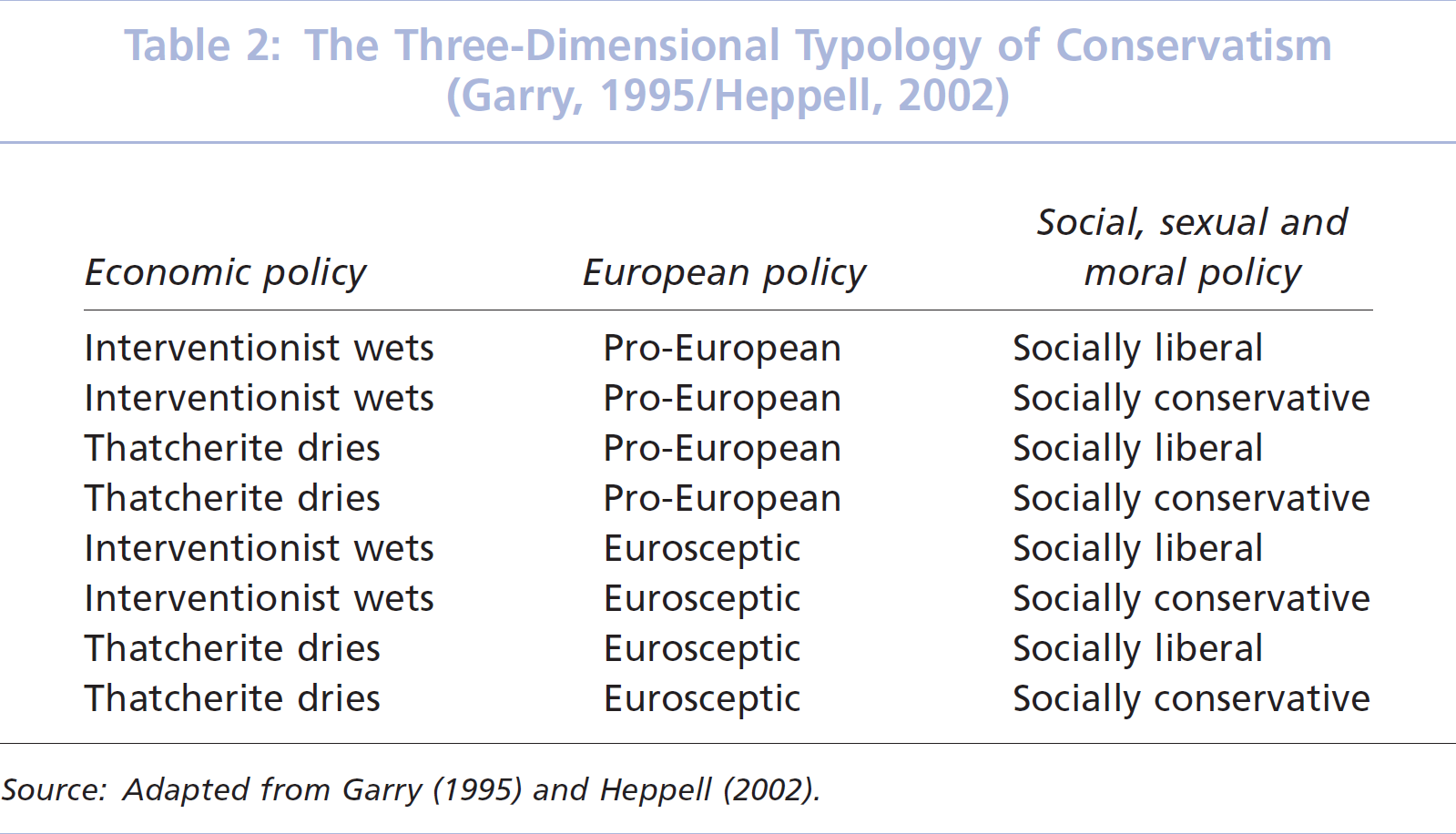
Source: Adapted from Garry (1995) and Heppell (2002).
However, despite seeking to embrace and extend the various principles of typological design advocated by other academics, the Heppell typology, and by implication the Garry opinion groups, is open to criticism on three levels.
First, it is immensely complex. Critics could argue that it offers more confusion than illumination. This is not actually a problem of typological design; it is a comment on the complex ideological configurations of contemporary British conservatism in the post-Thatcherite era. The complexity is derived from the non-alignment of the economic policy, European policy and social policy variables – it would be easier to interpret if all economic dries were Eurosceptic and socially conservative; and all economic wets were pro-European and socially liberal. It would easier, but it would not be a correct ideological reflection of contemporary British conservatism in the immediate post-Thatcherite era. The typology is acknowledged as being complex, but that is because post-Thatcherite ideological debates are complex.
Second, the Heppell typology has been criticised by Cowley and Norton. They argue that it not so much a challenge to the Norton typology as an update (Cowley and Norton, 2002, p. 328). They also argue that it was merely a re-working of the Norton typology as some of the Heppell groupings are similar to the Norton groupings: for example, the Norton populists grouping is the economic wet, Eurosceptic, social conservative grouping in the Heppell typology (Cowley and Norton, 2002, p. 328). There is nothing inappropriate or wrong about this. What distinguishes the Garry and Heppell typologies from the Norton typology is that it identifies the ideological tensions that Norton did not explicitly identify back in 1990 – for example, the existence of residual Euroscepticism within the economic wets; and the limited evidence of pro-Europeanism within the Thatcherites.
Third, Cowley and Norton argue that not only does the Heppell typology simply replicate the categories within the original Norton typology, but it also is a retrograde step in typological development (see Table 3). The basis for this assertion is the fact that the Heppell typology over-simplifies the complexities inherent within the Thatcherites. The original Norton typology had subdivided the Thatcherites into three groupings: neo-liberals, the Thatcher Group of pure Thatcherites, and the Tory right (Norton, 1990, pp. 46–7). For Cowley and Norton, there is a distinction between the primary ideological motivation of the pure Thatcherites and the Tory right – the former emphasised the economic dimension and political style of the Thatcherite ideology and the latter was predominantly interested in promoting social conservatism. They deride the fact that Heppell ignores this important distinction and combines the pure Thatcherites and the Tory right in his limited state, independence and socially conservative grouping (Cowley and Norton, 2002, p. 328). However, it could be argued that the distinction within the Thatcherites is somewhat ad hoc and conceptually inelegant as it is a distinction not made in relation to the non-Thatcherite groups. In contrast the explicitly three-dimensional typology utilised by both Garry and Heppell is more straightforward: there are three issues on which MPs are divided and this leads to eight possible groups (Garry, 1995, pp. 170–89; Heppell, 2002, pp. 299–324).
Comparing the Norton and Garry/Heppell Typologies of Contemporary British Conservatism
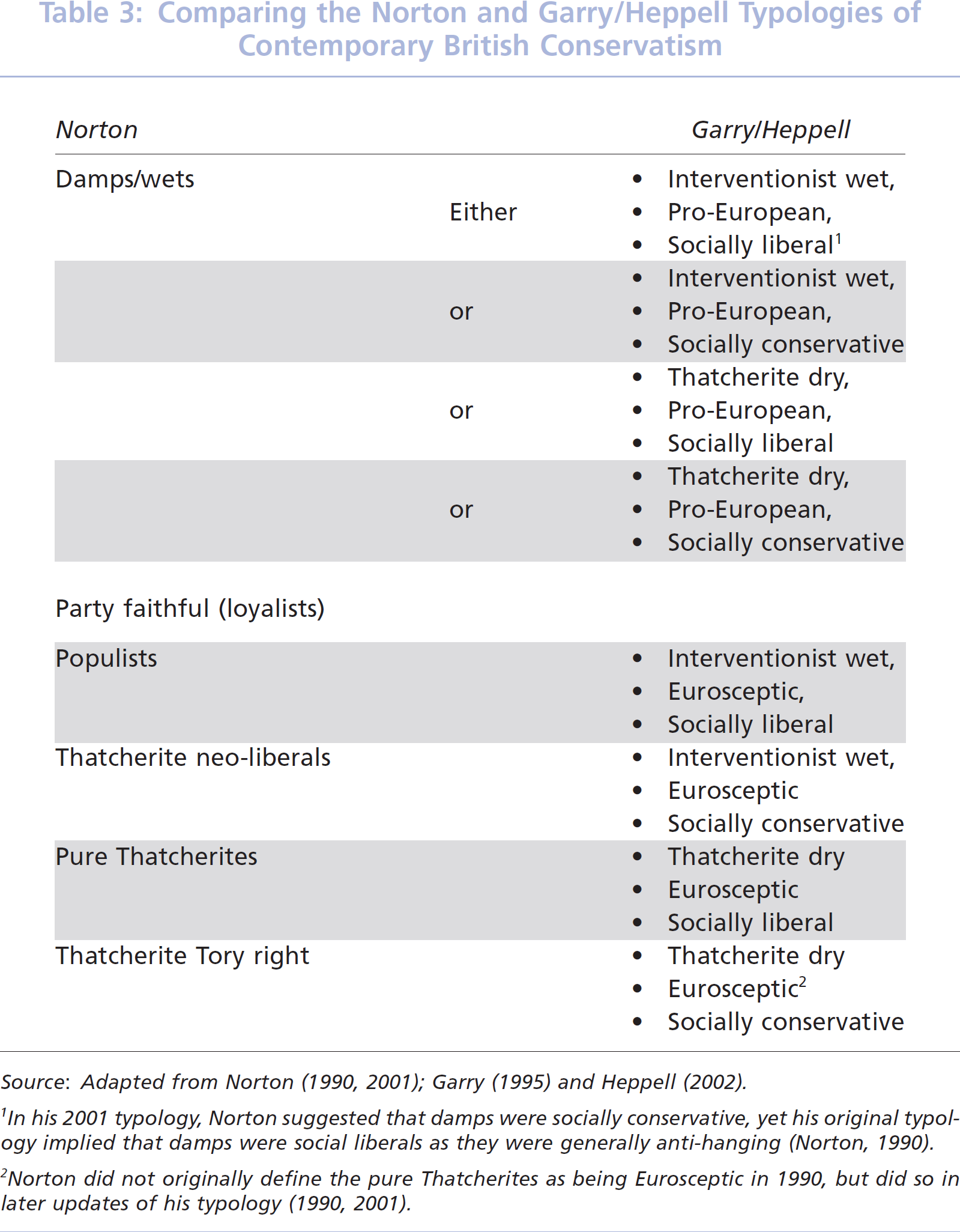
Source: Adapted from Norton (1990, 2001); Garry (1995) and Heppell (2002).
In his 2001 typology, Norton suggested that damps were socially conservative, yet his original typology implied that damps were social liberals as they were generally anti-hanging (Norton, 1990).
Norton did not originally define the pure Thatcherites as being Eurosceptic in 1990, but did so in later updates of his typology (1990, 2001).
Utilising Typologies of Conservatism
Having analysed the design of these ideological typologies, it is worth considering how the typologies have been utilised as drivers of further research activity. This distinguishes between typologies, in which the typological design is the end product of research (that is, Dunleavy, Sowemimo), and typologies in which the typology has underpinned further research (that is, Norton, Baker, Gamble and Ludlam, Garry and Heppell).
It is possible to evaluate the four remaining typologies (that is, Norton, Baker, Gamble and Ludlam, Garry and Heppell) according to the following issues: the purpose of the research, which flows from the design of the typology; the research methods employed to underpin this research; their subsequent research findings; and how this acts as a stimuli for further research. First, it is necessary to evaluate the purpose of the research and the research methods that underpin the research. For Norton, Baker et al., Garry and Heppell, the research aimed to determine the relative strength of the ideological groupings that their ideological typologies had identified. They utilised a wide range of methodological approaches and data sources, which integrate qualitative and quantitative analysis (Webb, 1997, p. 91).
The Norton and Heppell typologies utilised three different kinds of source materials: division lists, membership of party groups and public comment (Norton, 1990, pp. 41–58; Heppell, 2002, pp. 299–324). The Garry opinion groups were based upon a postal survey conducted in 1991, which analysed the opinions of the 1987–92 PCP (Garry, 1995, pp. 170–89). The various research findings of Baker et al. were derived from attitudes that were evident from parliamentary rebellions, public statements, and finally closed questionnaires (Baker, Gamble and Ludlam, 1994, p. 283).
There are limitations with survey-based and closed questionnaires (Webb, 1997, p. 92). With regard to the Garry research, only 168 conservative MPs or 45.7 percent of the 369 members of the PCP in November 1991 returned completed questionnaires (Garry, 1995, p. 187). With respect to Baker et al., the utilisation of closed questionnaires means that the respondents to the survey are non-identifiable. Baker et al.‘s research, which was conducted April–June 1994, secured an overall response rate of 33 percent of the PCP, including a 38 percent of backbench conservative parliamentarians and 19 percent of conservative ministers (Baker, Fountain, Gamble Ludlam, 1996, p. 70). Such approaches provide data on only a fraction of the PCP, which prevents us from identifying the precise membership of each intra-party ideological grouping, in the way that both Norton and Heppell do (Norton, 1990, pp. 46–50, Heppell, 2002, pp. 313–6).
Second, the various typologies identified have provided the basis for significant research findings that underpin academic appraisals of contemporary British conservatism and conservative party politics. When assessing typologies that have underpinned further research, this can be subdivided into the following: typologies utilised to assess the relative ‘size’ of ideological divisions within the PCP; typologies utilised to assess the relative ‘importance’ of ideological divisions within the PCP; and typologies utilised to analyse the voting behaviour of conservative MPs in conservative party leadership elections.
First, the Norton, Garry and Heppell typologies assessed the relative size of divisions within the PCP. The Norton typology was utilised to determine the ideological composition of the PCP. The Norton typology provided an ideological ‘snapshot’ of the ideological disposition of the PCP at the end of the Thatcherite era (Norton, 1990, p. 52). Norton identified 71 Thatcherites (15 neo-liberals, 30 Thatcher Groupists and 26 on the Tory right); 17 populists; and 67 critics (40 damps and 27 wets). The remaining 217 MPs were party loyalists (Norton, 1990, pp. 47–52).
The Garry economic–moral–European opinion groups, which assessed ideological attitudes prior to the 1992 general election, identified the following. On economic policy, Garry identified 70 percent dries and 30 percent wets. On European policy, 47.5 percent were pro-Europeans and 44.5 percent were anti-European. On morality, 51 percent were socially conservative and 37 percent socially liberal (Garry, 1995, pp. 173–4).
The Heppell typology evaluated the ideological disposition of the PCP 1992–97 and identified the following. On economic policy, there were 188 Thatcherite dries and 112 interventionist wets, with 31 agnostics. On European policy, there were 192 Eurosceptics and 98 pro-Europeans, with 41 agnostics. On the social, sexual and morality divide, there were 101 social liberals and 230 social conservatives (Heppell, 2002, pp. 309–12).
Second, in addition to assessing the relative size of the ideological divisions within the PCP, the Garry typology also assessed the relative importance of the ideological policy divisions. The Garry typology used the membership of the eight opinion groups to predict the proximity of conservative parliamentarians, in ideological and policy terms, to a range of leading figures in the party. Garry demonstrated that the ideological position that a conservative parliamentarian adopted in relation to the European ideological policy divide was the best predictor of how close they felt in policy terms to these leading figures, thus suggesting that the European Union divide was the most potent divide within the party (Garry, 1995, pp. 175–82).
Finally, academics have utilised typologies and membership of ideological groupings to ascertain the importance of ideological disposition as a voting variable in conservative party leadership elections. Cowley and Garry utilised the Norton typology to analyse the conservative party leadership election of 1990. The Garry research that confirmed that attitudes towards the European ideological policy divide was the most salient ideological policy divide was buttressed by the research conducted by Cowley and Garry, which demonstrated the attitudes to the European ideological policy divide was a better indicator of voting behaviour in the 1990 conservative party leadership election than attitudes towards the economic or social, sexual and morality ideological policy divides (Garry, 1995, pp. 182–5; Cowley and Garry, 1998, pp. 486–8). In addition, Alderman and Carter utilised the Heppell typology to inform their appraisal of the conservative party leadership election of 2001 (Alderman and Carter, 2002, pp. 569–85).
Conclusion
The paradox of a Conservative party that has been characterised by unity and loyalty ideologically imploding has stimulated considerable academic debate. This article has analysed the design and utilisation of the ideological typologies of contemporary British conservatism that have been developed by various academics in the immediate post-Thatcherite era.
The article evaluated the typologies of Norton, Dunleavy, Baker, Gamble and Ludlam, Sowemimo, Garry and Heppell and analysed their typological development in relation to the three dominant ideological policy divides: economic policy; European policy; and social, sexual and moral policies. It subdivided the analysis between one-dimensional typologies (Norton); two-dimensional typologies (Dunleavy, Sowemimo, and Baker, Gamble and Ludlam); and three-dimensional typologies (Garry, Heppell).
Attempts to construct typologies explaining the nature of the ideological divisions within contemporary British conservatism have clearly evolved since the seminal left–right Norton typology of 1990. Norton had mapped the European policy divide onto the existing economic policy divide, implying that wets are pro-Europeans and that dries are Eurosceptics. This implied an absolutist (that is, one-dimensional) distinction between the Eurosceptic right and the prointegrationist left (Cowley and Norton, 1999, pp. 94–103). Typological development has increasingly sought to delineate the traditional economic policy cleavage (wet/dry) from the European policy divide (Europhile/Eurosceptic). For example, both Sowemimo and Baker et al. promoted two-dimensional typologies, which integrated the cross-cutting question of European integration onto the traditional wet (left)/dry (right) economic policy axis (Sowemimo, 1995, p. 77; Baker, Gamble and Ludlam, 1993, p. 425). Endorsing the principle of cross-cutting ideological mapping, both Garry and Heppell inserted the increasingly significant morality ideological variable, thus creating a three-dimensional typology (Garry, 1995, p. 176; Heppell, 2002, p. 320).
The product of this process of typological development is a dispute between the linear one-dimensional Norton typology and the three-dimensional Garry/Heppell typologies (Garry, 1995, p. 176; Cowley and Norton, 2002, pp. 325–9). Cowley and Norton argue that the Norton typology is three-dimensional and integrates the same three ideological policy divides but within a linear typology. It can be argued that the Garry/Heppell distinctions reaffirm much of the Norton typology but with differing terminology (Cowley and Norton, 2002, p. 328). The wet/pro-European/socially liberal group equates to the wet/damp groupings in Norton typology; the wet/Eurosceptic/socially conservative grouping reaffirms the Norton populists group; the dry/Eurosceptic/socially liberal grouping relates to the Norton Thatcherite neoliberal group; and the dry/Eurosceptic/socially conservative group covers the pure Thatcherites in the Norton categories. The Garry/Heppell categorisations identify limited but significant pro-Europeanism within the dries, Eurosceptism amongst the wets, and social conservatism within the wets. The Norton typology can claim superiority in identifying the distinctions within the Thatcherites who prioritised economic liberalism (the neo-liberals and pure Thatcherites) and those primarily motivated by the promotion of social conservatism (Garry, 1995, pp. 175–6). In addition, the Norton typology offers the significant party loyalists grouping, which is mostly excluded from the typological design of other typologies. Although the immediate post-Thatcherite era was characterised by ideological turmoil, Norton makes typological provision for those whose main political preference was loyalty to the party – for example, John Major.
It can be argued that both the seminal Norton typology and all subsequent typologies offer distinct insights into the complex ideological configurations within contemporary British conservatism in the immediate post-Thatcherite era. The fact that typologies advocated by Norton, Baker et al., Garry and Heppell have been utilised by other academics indicates their methodological validity.
Therefore, to conclude, it is evident that political historians of British conservatism need to understand the process of ideological realignment that occurred during the Conservative leadership of John Major (1990–97). Understanding ideological typologies of contemporary British conservatism enhances our knowledge of the implosion within conservative party politics in the immediate post-Thatcherite era.
Footnotes
1
Academics have also utilised terms such as ‘taxonomy’ (Norton, 1990) or ‘opinion groups’ (Garry, 1995) instead of the term ‘typology’.
2
The purpose of this article is to evaluate ideological typologies in the immediate post-Thatcherite era. Typologies of conservatism pre-dating this have been evaluated in detail by Baker, Gamble and Ludlam (1994, pp. 278–98).