







Abstract
The paradox between an individual's decisions to head to the polls and the absence of strictly rational arguments for this action has intrigued – and troubled – many scholars. The present article surveys various theoretical contributions to resolve this paradox of (not) voting. We assess these approaches based on their ability to explain a number of ‘stylised facts’ with respect to voter turnout. The main conclusion is that straying away from the behavioural assumptions of the Downsian model provides more realistic models and leads to promising predictions as to the individual's decision to head to the polls. Incorporating the role of (social) groups and learning in particular can be regarded as important strides towards understanding the individual's decision to cast a vote.
‘Pure’ rational choice theory is unsuccessful in explaining voter turnout. Indeed, the instrumental voter axiom predicts large-scale abstention because no individual is likely to have an influence on the election outcome (Downs, 1957). International election results, however, indicate that a considerable number of people do turn out to cast their vote, although they are not obliged to do so. 1 This constitutes the paradox of (not) voting. Arguing that this paradox constitutes the downfall of the rational choice theory or that electoral turnout is ‘the paradox that ate rational choice theory’ (Fiorina, 1990; Grofman, 1993) may be putting things too strongly. Still, it is clear that the strict economic self-interest axiom ‘fails as a generally applicable model to explain economic behaviour’ (Van Winden, 2002, p. 190; see also Frey and Meier, 2004).
Importantly, high turnout levels are not the sole empirical fact that theories of turnout should address. Without intending to be exhaustive, several other ‘stylised facts’ can be mentioned. For one, ‘first-order’ elections (for national parliaments) tend to attract more voters than ‘second-order’ elections (for European, regional or local parliaments) (Reif and Schmitt, 1980; Marsh, 1998). Second, some people have a higher likelihood of showing up at the polls. This holds for richer or more-educated individuals, partisans and women. Younger voters, as well as the elderly, are less likely to cast a vote (for a review, see Lijphart, 1997). Third, people ‘abstain to a large extent because they are alienated’, that is, they feel that no party represents their ideas (Kirchgässner, 2003, p. 1; see also Zipp, 1985; Plane and Gershtenson, 2004). Fourth, voters are more likely to show up under proportional electoral systems and when the candidates are in a neck-and-neck race (Ladner and Milner, 1999; Shachar and Nalebuff, 1999; for a review, see Geys, 2006). And finally, voters defect from their true preferences in some cases to cast ‘insincere’ or ‘strategic’ votes. 2
Any satisfactory theory of voter turnout should (at least) be able to comply with each of these characteristics of real-world election results. Hence, while reviewing the myriad of theoretical models that aim to ‘solve’ the paradox of voting, we also assess their predictive power regarding our ‘stylised facts’. Importantly, our approach differs from other recent reviews of this theoretical literature. First, Dhillon and Peralta (2002) concentrated on the theoretical underpinnings of the various models and paid little attention to empirical verification (making our approach highly complementary to theirs). Second, Blais (2000), Mueller (2003) and Feddersen (2004) included empirical evidence concerning the models described, but focused on a limited number of theories. Finally, Dowding (2005) concentrates on the different approaches’ ability to explain positive turnout levels. Although providing excellent and thorough discussions of the elements these articles focused on, we provide a somewhat broader panorama of the (theoretical) literature. Our main conclusion is that recent modelling where group interactions and the ability to learn behaviour are crucial elements in particular allow us to take fruitful and interesting new strides in explaining voter turnout.
The article is structured as follows. The first section portrays the ‘pure’ (instrumental) rational voter model and shows how it leads to the paradox of (not) voting. The next four sections review the traditional ‘solutions’ to this paradox: the addition of consumption benefits (second section) or ethical/altruistic preferences (third section), and minimax regret (fourth section) and game theory (fifth section). Then, we turn to more recent additions to the literature. Specifically, the sixth section considers group-based models of turnout. The seventh section looks at models focusing on a voter's information level. Finally, models based on adaptive (or reinforcement) learning are presented in the eighth section. Conclusion and discussion are in the ninth section.
Foundations: Instrumental Voting
The instrumental view of rationality holds that an action has value only if it affects outcomes. Based on this behavioural assumption, the ‘expected utility’ model of voter turnout (Downs, 1957) states that a voter, in deciding whether to vote or abstain, calculates the expected utility of either action and votes if benefits exceed costs or if:

In this equation, R represents the net expected utility of voting. The benefits from voting (PB) have two elements. B stands for the difference in expected utilities from the policies of the two candidates. 3 These benefits have to be weighed with the probability (P) that one's vote influences the outcome. Finally, C refers to the costs of voting.
Crucially, it does not take much for the costs of turning out to exceed the benefits of that action. Because the probability of affecting the outcome (P) is low to non-existent (Owen and Grofman, 1984; Gelman et al., 1998; Mulligan and Hunter, 2003) 4 and the benefits of political action (B) are collective goods (Aldrich, 1993; Whiteley and Seyd, 1996; Opp, 2001), PB is likely to be close to zero. Hence, any positive cost (C) renders voting an unprofitable venture. These costs can be divided into two groups. On the one hand, there are costs that a voter makes before the election day (and which are sunk at the time of the election) for, say, gathering information about the candidates, their policy proposals and so on. Although Downs (1957) and Aldrich (1993) argue that these costs are only minor, Converse (1964, 1970, 2000) has repeatedly argued that citizens’ limited capabilities to accomplish political tasks may cause these costs to be significant. Moreover, registration procedures, if fulfilled by voters, also involve possibly significant costs (for example, Rosenstone and Wolfinger, 1978; Brians and Carter, 1999; Highton, 2004). On the other hand, there are costs that the voter incurs on election day. These comprise ‘shoe leather’ costs to get to the polling station and opportunity costs from the time spent in casting a vote. Several authors have claimed these costs to be small (Niemi, 1976; Palfrey and Rosenthal, 1985; Aldrich, 1993).
Hence, although one cannot reject the possibility that some voters vote instrumentally, it appears highly implausible that the level of real turnout rates can be explained on instrumental grounds. This inconsistency between the theory and real-world turnout rates is known as the ‘paradox of (not) voting’. 5 Although Downs’ (1957) model is unsuccessful at explaining turnout levels, it performs much better in explaining differences in turnout at the margin (see also Dowding, 2005, p. 444). Predictions that turnout falls with increasing costs or rises when elections are more important (that is, with a closer contest or in ‘first-order’ elections) are generally supported in the empirical literature (see above). The fact that all citizens in two-candidate plurality-rule elections necessarily vote sincerely (Ordeshook, 1976) may appear at odds with the observation of strategic voting. Moving to multiparty elections, nothing in the model prevents voters from making strategic choices.
Note, finally, that Downs’ (1957) model predicts that ‘voters will be disproportionately drawn from the extremes of the political distribution’ (Brennan and Hamlin, 1998, p. 154). The model thus cannot explain abstention because of alienation. Actually, it predicts that more alienated voters are more likely to turn out. Kirchgässner (2003), however, recently argued that the relative, rather than the absolute, difference between candidates is relevant. In such case, the further a voter is located from the parties’ (proposed) policies, the less likely it is that he or she casts a vote in the election. This clearly allows for abstention because of alienation.
Consumption Benefits of Voting
The inability of the Downsian model to adequately explain voter turnout has attracted a lot of scholarly attention. Downs (1957) argued that if no one votes, the democratic system fails. Therefore, some people may vote to see democracy continue, and derive a ‘consumption’ benefit of voting equal to the value of the increased chance of the survival of democracy. Several authors have elaborated upon such ‘consumption’ benefits of voting. Riker and Ordeshook (1968), for instance, reformulated the original equation into:

While leaving the other predictions of the expected utility model largely unaffected (see also Dowding, 2005, p. 453), 6 the addition of ‘consumption’ benefits to the calculus of voting can explain positive turnout levels. 7 However, it does so at a severe price. First, because it still holds that P, and thus PB, is close to zero, equation (2) can be reduced to R = D - C. This implies that turnout is essentially driven by reasons unrelated to the central element of the democratic process, namely electing a government. 8 Moreover, as any action can be explained by making the appropriate assumptions post hoc, the model loses all predictive value (Grossman and Helpman, 2001; Mueller, 2003). Importantly, the ‘expressive’ voter hypothesis will necessarily be tautological unless we can identify the reasons why some people wish to express a preference and others do not.
One possibility is to argue that a voter expresses a preference for the candidate that promises the highest utility after the election (Mueller, 2003, p. 320). The D-term then becomes a function of B. A more detailed theoretical argument is provided by Schuessler (2000a; 2000b). Building on social theory and anthropology, he argues that expressive voting is a form of ‘being’, rather than ‘doing’. An expressively motivated individual performs an action X, not to obtain result Y, but to ‘be an X-performer’ (Schuessler, 2000a, pp. 90–1). The action expresses and re-affirms who one is and who one is not. Interestingly, the expressive utility of voting is initially positively related to the number of other voters for the same candidate because of ‘some “herding” or “contagion” effect to voting’ (Schuessler, 2000a, p. 101). Still, if all voters vote for the same candidate, a voter cannot express himself or herself as belonging to a well-defined group (and not belonging to the competing group). Empirical evidence for this expected non-monotonicity is, to the best of our knowledge, not (yet) available. 9
The Ethical Voter
The pursuit of one's self-interest has often been matched with egocentric behaviour. This, however, is a profound misconception. People may also serve their self-interest by taking into account someone else's welfare. Hence, each voter might well have two sets of preferences.
10
A first set of selfish preferences includes only the individual's own utility. The second set of ethical or altruistic preferences contains (the individual's perception of) the utilities of others. Hence, we could write a given individual's utility function as:
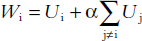
Goodin and Roberts (1975) were the first to introduce ethical preferences into the individual's turnout calculus. They argue that ethical behaviour occurs when the stakes are low and/or when any individual has little effect on the outcome (that is, low efficacy). Only when the stakes and personal efficacy are high, egoistic preferences are most important. Because the probability of affecting the electoral outcome is negligent, Goodin and Roberts (1975) state that ethical preferences are likely to dominate the individual's electoral decisions.
Jankowski (2002, 2004) more specifically distinguishes between ‘pure’ and ‘warm-glow’ altruism (see also Andreoni, 1989, 1990). In the former, the individual's happiness from altruistic behaviour is dependent upon the recipient's increased happiness. The effect thus depends on the consequences of one's action. In the latter, warm-glow altruism, people experience a personal satisfaction from altruistic behaviour independent of the outcome of that action. As such, including warm-glow altruism into the voter's calculus is very similar to introducing ‘consumption’ benefits of voting (compare with D-term in the second section). It, therefore, stands open to all criticisms associated with this approach (see above). This is not the case with pure altruism because the benefits derived from this form of altruism work to inflate the B-term in equation (1). The benefits of voting may then become sufficiently large to counterbalance the small probability of tipping the balance toward the preferred candidate (see also Edlin et al., 2005).
Fowler (2005) recently extended this model by arguing that, when political activity is redistributive, only those with different preferences with regard to the benefits of some groups within the population (‘discriminating altruists’) are motivated to vote by altruism. People caring equally about the benefits of all others (‘unconditional altruists’) in this case refrain from voting because there is no net gain from pure redistributive activity (as a zero-sum game). This argument bears close resemblance to Coate and Conlin's (2004) extension of Feddersen and Sandroni's (2002) argument. Feddersen and Sandroni (2002) assume that people are ‘rule utilitarians’ who receive a warm-glow pay-off from following ‘a rule that would maximize social utility if it were followed by everybody’ (Harsanyi, 1977, p. 626). Coate and Conlin (2004), however, assume that this warm glow from ‘doing one's part’ towards the common good is restricted to behaving like as should towards people on one's own side of the issue. 11 Importantly, both Fowler (2005) and Coate and Conlin (2004) thus provide an understanding of why people would turn out to vote when they are embedded in (or care about) a broader social group. We return to this issue while discussing group models of voter turnout (see the sixth section).
Minimax Regret
Ferejohn and Fiorina (1974) assert that the decision to vote is not made under risk, but under uncertainty. In this context, the ‘minimax regret’ criterion may be more appropriate. The rule here is to choose the action that yields a minimal regret in a worst-case scenario. The regret Ri,j the individual feels after some action ai in state of the world Sj can be defined as ‘the difference between what the decision maker could have attained had he known the true state of the world before he chose his action and what he actually gets by choosing ai’ (Ferejohn and Fiorina, 1974, p. 928). Tideman (1985) extends the minimax regret model by introducing the concepts of ‘remorse’ and ‘elation‘. These are ‘emotions that arise as a consequence of being responsible for one's circumstances by one's own actions’ (Tideman, 1985, p. 103). Consider a person who is confronted with some gain or loss. If he or she has no control over the event creating this gain or loss, he or she experiences its effect with magnitudes G or L, respectively. The individual, however, experiences a greater gain or loss if he or she perceives himself or herself as having some influence on the outcome. These additional magnitudes are ‘elation’ and ‘remorse’, respectively. The introduction of ‘remorse’ and ‘elation’ is intuitively appealing. Nonetheless, their inclusion does not change the bottom line, as they must again be multiplied by the probability of making a difference (P), making them very close to zero (Struthers and Young, 1989).
Although, as pointed out by Ferejohn and Fiorina (1974), the minimax regret model predicts higher levels of voter turnout than the expected utility model; several other predictions are (much) less satisfactory. First, if a voter is indifferent between two competing parties, it is rational for him or her to abstain. However, if a small third party – which the voter would hate to see winning – enters the race, he or she is forced to the polls to avoid the unlikely event that this party wins the race by a single vote (Mueller, 2003). Also, the predictions that voters always support their most preferred candidate – as voting for the least preferred candidate is a strictly dominated strategy – and that turnout is independent of the closeness of the election, are in contrast to the results from empirical analyses (see above).
Besides the failure to account for our ‘stylised facts’, the approach is also open to serious methodological criticisms. Goodin and Roberts (1975) point out that people often rationalise a wrong decision by the reflection that it seemed a good idea at the time. Regret avoidance might thus not be an element in a voter's decision process. This idea is supported by behaviour outside the ballot box. Although the loss one suffers from, say, a flood or an earthquake can be substantial, most people do not insure against such risks – even if the insurance is sold below actuarial value (see Mueller, 2003). It is not clear why people would be risk takers in insurance issues and turn extremely risk averse on election day. Moreover, the electorate's information about the probabilities of different outcomes is generally better than assumed under minimax regret. Although a voter is unable to make an exact estimate of the likelihood that an event will occur, he or she should be able to make a reasonable interval estimate. This makes turnout a so-called ‘quasi-risk’ situation where minimax regret strategies are not appropriate (Mayer and Good, 1975). 12
Game Theoretic Approach
The game theoretic approach to turnout – proposed by Ledyard (1984) and Palfrey and Rosenthal (1983, 1985) – holds that people take the decisions made by others into explicit account. The reasoning is as follows. If everybody votes, the chance of having an effect on the outcome of the election is very small. Because this holds for everybody, it would be rational for all to abstain – in which case one vote becomes decisive. If everybody came to this conclusion, all would vote – once again making it useless to vote. This line of reasoning can be repeated eternally. Hence, the probability of being decisive is not fixed and determined – as assumed under the expected utility and minimax regret models – but is instead determined through the strategic interaction between all potential voters. As such, P becomes endogenous to the model. A voter does not face a decision theoretic problem, but rather a strategic game with other voters.
The Ledyard (1984) and Palfrey and Rosenthal (1983, 1985) articles show that there are often multiple (mixed-strategy) equilibria. Some of these involve substantial turnout rates. However, the finding of positive turnout rests critically upon the assumption that all voters are certain about the voting costs and preferences of other voters (‘perfect information’). This assumption is not very realistic (see also the seventh section). Still, when it is abandoned, the rational individual once again abstains when he or she has positive net voting costs (Palfrey and Rosenthal, 1985). Moreover, as the strategic interaction between voters weakens in large electorates, the game theoretic approach can only perform well when considering small electorates (Aldrich, 1993). All in all, the attempt to explain voter turnout ‘by resorting to game theory does not succeed’ (Mueller, 2003, p. 307).
Group-based Models
The Aristotelian idea that man is a social animal has led a number of scholars to look at social networks to explain turnout at the polls. 13 The argument is that voting might be rational for a group of individuals because the expected benefits may exceed the voting costs at the group level (Filer et al., 1993; Grossman and Helpman, 2001). First, groups are likely to have larger benefits than individuals from political participation. The reason is that politicians may provide groups with extra benefits – in terms of policies that come closer to the group's optimum – to win the support of the group (Lapp, 1999). Second, as the political influence of a social group can be assumed to be proportional to its size (Schram and Van Winden, 1991), the group as a whole is more likely to have a non-negligible impact on the election outcome.
Models of turnout incorporating group behaviour show that positive turnout can be optimal for the group as a whole. However, as free riding upon the efforts of other group members is optimal for each individual, a satisfactory theoretical explanation why individuals would refrain from such behaviour is indispensable. This is missing in early work. Uhlaner (1989), for example, specifically relies upon ‘selective incentives’ such as sharing the feeling of group identity or loyalty to explain why individual group members vote. These amount to little more than the ad hoc inclusion of personal psychological benefits, leaving the model devoid of all predictive value (compare with the second section). 14
Schram (1991, Chapter 8, pp. 187–217) developed a theoretical model concerning an individual's decision within a group. He divided group members into producers and consumers of social pressure. Both have different reasons for turning out. Producers of social pressure try to induce other group members to turn out, and need credibility to obtain this goal. This credibility can be obtained by voting. Non-producing individuals may be induced to vote by the social pressure generated by other members of their group (that is, the leaders). 15 Bufacchi (2001) likewise differentiated between opinion leaders and other voters. While the former vote to increase or enhance their credibility, the latter turn out to invest in their reputation as trustworthy people in the eyes of the opinion leaders (Bufacchi, 2001). 16 17
Grossman and Helpman (2001) argue that turnout is stimulated by the enforcement of a social norm at the group level, whereby in contrast to Schram's (1991) and Bufacchi's (2001) models, every individual is both a producer and a consumer of social pressure. Three elements affect the voting norm's enforcement (Grossman and Helpman, 2001, p. 85). First, the frequency of interaction: more frequent interactions increase the opportunity to reward desirable behaviour and punish non-cooperation. This is also supported by experimental evidence indicating that within-group communication tends to increase cooperation in participation games (Schram and Sonnemans, 1996; Goren and Bornstein, 2000). Second, enforcement is more effective (and turnout higher) if the ‘deterrent effect from social isolation is larger’ (Grossman and Helpman, 2001, p. 85). Finally, enforcement is easier if group members can observe the action of other members without much effort.
As noted when discussing the ethical voter approach (see the fourth section), Coate and Conlin (2004) – building on the work of Harsanyi (1977) and Feddersen and Sandroni (2002) – argue that people are ‘rule utilitarians’ that receive a (warm-glow) pay-off for following the rule that maximises the aggregate utility of their group if it were followed by everybody in the group. Individuals may, thus, turn out because of the inclusion of other group members’ welfare in their utility function. Note, however, that in contrast to the view of voting as a ‘civic duty’ (see the second section), ‘doing one's duty’ in this case does not always involve voting. For example, if one of two groups is infinitesimally small, the optimal rule for the other group's members may be to minimise the number of people incurring the costs of voting (leading to marginal turnout levels). Turnout is, thus, regulated by wanting to do what is best for the group. (A closely related reasoning can be found in Fowler, 2005.)
The group-based approach has several important advantages. First, by embedding individuals into social groups, the group-based model is more realistic than the standard model in which voters are treated as isolated individuals (Lapp, 1999). Second, it is shown that turning out may well be rational in a group context in order to build a reputation of trustworthiness towards other group members (and/or opinion leaders) or because of the benefits from (discriminating) altruistic or rule-utilitarian behaviour. Note also that experimental evidence confirms that the social context matters. Turnout increases significantly with group identity (Schram and Sonnemans, 1996), and when one observes ‘allies’ voting (Großer and Schram, 2004). Finally, group-based models of turnout go a long way towards explaining our ‘stylised facts’ on voter turnout. They first lead to the expectation of significant levels of turnout. Moreover, given that the incentives to produce social pressure are likely to vary with the importance of elections, and that the deterrent effect from social isolation is likely to vary with socio-economic characteristics of the individual, the group-based approach to voter turnout also predicts differences in turnout at the margin. 18 Finally, individual voters might cast strategic votes for less-preferred candidates when this behaviour is optimal at the group level.
Information Models
Individuals are constrained both by a lack of knowledge about the different consequences of their decisions and by their limited intellectual capacity to analyse all available options. In other words, the information level of the population is likely to be (much) less than complete. This point of view was first expressed in Simon's (1957) theory of ‘bounded rationality’. It implies that people are not – and cannot be – utility maximisers, but can best be described as ‘satisficers’. They cannot choose the best alternative, but they have to content themselves with the most satisfactory alternative.
Matsusaka (1995) incorporated this idea of limited information in a theory of voter turnout. Starting from the assumption that people have a natural predisposition to vote, he argues that the probability of turning out increases with the individual's information level. The reason is that ‘the value of changing the election outcome (B) is higher when the voter is more confident that she is voting for the right candidate’ (Matsusaka, 1995, p. 93). 19 Larcinese (2000) added that the ideological preference of the voter influences the decision to acquire information. He showed that non-partisan citizens are most likely to acquire information, and thereby increase their likelihood to vote.
Another effort at incorporating information in the turnout model was made by Feddersen and Pesendorfer (1996, 1997). They employed a game-theoretic, rather than a decision-theoretic, reasoning. Nonetheless, in line with Matsusaka (1995) and Larcinese (2000), they found that uninformed voters have an incentive to abstain and – as such – to delegate their vote to those who are better informed. This holds even when voting is costless and is explained by the ‘swing-voters curse’. As informed voters are assumed to vote for what they see as the best option, uninformed voters are only able to affect the outcome by voting for the ‘wrong’ candidate. As such, uninformed voters are better off abstaining (Feddersen and Pesendorfer, 1996, 1997). Extending the model by Feddersen and Pesendorfer (1996, 1997), Caillaud and Tirole (1997) found that these information effects become much weaker in a setting where allowance is made for heterogeneous populations.
Recently, Degan and Merlo (2004) provided yet another attempt to incorporate information in a model of voter turnout. Indeed, from a perspective resembling that of the minimax approach (see the fourth section), they stated that uninformed voters are more uncertain about the optimal candidate. This increases their expected regret from voting (as the probability of choosing the ‘wrong’ candidate is higher), and thus implies a positive relation between information and turnout.
The central problem of the aforementioned models is that they cannot explain the mere existence of voter turnout. In fact, they assume some predisposition to vote to achieve positive turnout levels. This obviously begs the question why people would have such a predisposition. Without an appropriate theoretical explanation for this, the model adds little to explain voter turnout levels. However, as noted by Matsusaka (1995), information-based models help explain why some people have a higher likelihood of showing up at the polls and why turnout is higher in some elections than in others. Hence, the theory does not predict an actual level of turnout, but rather explains differences in the probability that a given individual turns out to cast a vote.
Learning Theory
An appealing class of relatively new models introduces elements of psychological learning theories into the calculus of voting model. 20 Such a theory of voter turnout builds on the ‘law of effect’, and assumes that people have the ability to learn ‘good’ strategies from observing what worked well in the past. Two sources for learning successful behaviour are available. First, people can learn from their own past actions. They perceive a relation between their action (vote or abstention) and the outcome of the election (win or loss of the candidate voted for) in the previous period and interpret this as a reinforcer or a punisher. Satisfactory actions are repeated while unsatisfactory ones are avoided. 21 The result is a so-called ‘win-stay, lose-shift’ strategy (Kanazawa, 2000, p. 435) – consistent with processes known from reinforcement learning (see, for example, Sutton and Barto, 1998). Second, people can learn from the behaviour of others. They observe the strategies followed by others and imitate these strategies if they prove successful (Sieg and Schulz, 1995).
A key difference between the original Downsian model and the learning models is that the former implicitly assumes a causal link between an action and an outcome in the upcoming election, whereas a link between an action and an outcome in the past is the central issue in most learning models. In other words, whereas Downs’ voters are utility maximising and forward looking (that is, ‘prospective optimizers’), they are backward looking and adaptive in the learning model (that is, ‘adaptive satisficers’) (Fowler, 2006). It is, however, important to note that not all learning models link action to outcome. Plutzer (2002) and Gerber et al., (2003), for example, argue that voting (abstaining) in a given election in and of itself makes people more likely to vote (abstain) in future elections, independent of rewards/punishments originating from the election outcome. ‘Voting and abstention, in other words, are habit forming’ (Gerber et al., 2003, p. 540).
It has been argued that learning mainly affects the D-term from the calculus of voting model (Kanazawa, 2000). Citizens who are rewarded for their vote (via the election of their preferred candidate) or punished for their abstention (through the election of a less-preferred candidate) acquire an increased preference for voting. In contrast, if their voting is punished or their abstention is rewarded, they lose some of their preference for voting. Still, this reliance on the D-term does not make the approach vulnerable to the criticism of tautology levelled at the ‘consumption’ models discussed in the second section. Indeed, ‘learning’ models provide a means to identify the reasons why some people have a preference for voting such that the consumption benefit of voting is made endogenous to the model. This can certainly be regarded as one of the key contributions of these models.
How successful are ‘learning’ models in predicting our ‘stylised facts’? First, substantial turnout rates are predicted, even for large electorates and in the presence of significant costs of voting. Although this finding is influenced by the specific method of updating the individual's probability of voting in Bendor et al. (2003), Fowler (2006) shows that a similar result holds for a model without ‘moderating feedback’. 22 Second, models based on adaptive learning theory focus on ‘the marginal effects of past reinforcement and punishment on the individual tendency to vote in the next election’ (Kanazawa, 1998, p. 984, italics in original). They thus explain changes in voting behaviour within the individual over time. However, given the variance in the costs of voting over different groups in the population and different types of elections, learning models are also compatible with the observed differences in turnout levels across groups (and types of elections). Finally, the approach mainly concentrates on voter turnout as such and makes no claims concerning which candidate one votes for. Nothing, however, prevents an individual casting a strategic vote.
Introducing ‘learning’ into the voter calculus appears highly promising with respect to the predictions that flow from the model. Still, despite the theoretical appeal of the approach, to the best of our knowledge no empirical evidence has as yet been brought forward to substantiate the presence of adaptive reasoning in a voter's turnout behaviour (let alone whether the learning process – if present – is driven by election outcomes, habit formation, peer pressures or something else). This may obviously be because of the recent introduction of learning models in the turnout literature. It is clear, however, that this is surely a much-needed avenue of future (experimental) research in this field.
Conclusion and Discussion
The homo ***œEconomicus refers to ‘the isolated individual that in all circumstances pursues his self-interest by choosing in a free and rational manner between diverse alternatives of which he has calculated the costs and benefits’ (Vandevelde, 1994, p. 89, own translation). Some authors have noted that this strict economic self-interest axiom is incapable of providing a general theoretical basis explaining each part of an individual's behaviour (for example, Van Winden, 2002; Frey and Meier, 2004). This ‘failure’ is especially apparent in theoretical research on electoral turnout. The prediction that instrumentally rational voters should abstain is at odds with the observation that people do turn out on election day, even in the absence of compulsory voting. This constitutes the paradox of (not) voting.
This paradox has triggered much debate, and a myriad of theoretical models have been proposed over the past 50 years to address the issue. This review first of all intended to trace the development of knowledge in this field. Hence, we provided a concise description of the most authoritative proposals to resolve the paradox brought forward thus far: ‘consumption’ or ‘expressive’ benefits of voting, ethical preferences, minimax regret, game theory, group involvement, bounded rationality and adaptive learning. The second aim of the article was to assess to what extent the various approaches are able to explain and predict certain key stylised facts of voter turnout. We specifically evaluated the various models’ capability in dealing with (a) positive (and significant) turnout levels, (b) differences in turnout over various types of elections and socio-economic groups and (c) phenomena such as strategic voting.
The early attempts to solve the paradox of voting by invoking assumptions about psychic benefits, minimax regret strategies or game theoretic reasoning proved not to be very successful. The latter two approaches lack the ability to answer for several key findings in the empirical literature on turnout. For example, positive turnout in game theoretic models disappears under realistic assumptions concerning voter information levels, and the use of the minimax regret criterion fails to account for strategic behaviour. The first approach – assuming that people derive benefits from voting itself – removes all predictive capacities from the model and makes it tautological. This can be remedied if the model explicitly accounts for the reasons why some people obtain these benefits and others do not (Grossman and Helpman, 2001; Mueller, 2003). This crucial link, however, was missing in early works incorporating ‘consumption’ benefits.
Despite – or perhaps rather because of – the severe criticism off the tautological nature of adding ‘consumption’ benefits, later scholars have often explicitly focused on (the need for) this ‘D-term’. Building on knowledge obtained from other fields within the social sciences, several interesting attempts have been made to explain why some people care to vote, while others do not. This constitutes an important improvement over previous modelling. Schuessler (2000a; 2000b), for example, builds on elements of social theory and anthropology to argue that expressive voting is meant to re-affirm to the voter (and to others) who he is and who he is not. Schram (1991) and Grossman and Helpman (2001) refer to the production and consumption of peer pressure within social groups to endogenise the ‘consumption’ benefit from voting. Being part of a broader social group may also lead to turnout as an investment in personal reputation 23 or because of (altruistic) benefits derived from ‘doing one's part’ with respect to other group members (Coate and Conlin, 2004; Fowler, 2005). Also, adaptive learning theories from social psychology have been brought forward in a claim that citizens acquire an increased preference for voting (or lose this taste for voting) by ‘learning’ from previous behaviour. Each of these recent approaches attempts to ‘delve properly into human psychology’ and thereby tackle the ‘desire for deeper reasons’ (Dowding, 2005, p. 454). Although some (or most) of these new approaches are only in their infancy and more work is clearly ahead, this review has highlighted that valuable steps to explain citizens’ behaviour on election day have been made in the recent theoretical literature.
In fact, the recent developments outlined in this article, first of all, make the theoretical work more realistic. Indeed, in the original purely instrumental approach ‘effects that, for example, culture and social psychology may have on individuals are simply put beyond consideration’ (Plantinga, 2000, p. 12). The added realism of the models is supplemented by an increased ability to explain the stylised facts put forward at the outset of this review. However, all that glitters is not gold. For example, although the use of adaptive learning mechanisms is in our opinion a very promising development in the turnout literature, abundant questions remain as to the specific effects of the assumptions made in these models (as shown by Fowler, 2006). More research on these issues is clearly warranted. How this approach interacts with the idea that man is a social animal is also an important issue to tackle in future work. It is indeed at least conceivable that learning behaviour is not only affected by the outcome of the action, but also by group members’ reactions to behaviour. More generally, we believe progress could be made by attempts to integrate current theoretical modelling. A recent example of a fruitful collision is the restriction of altruistic motivations towards members of one's own group to explain voter turnout in group-based models of voting (Coate and Conlin, 2004; Fowler, 2005). Although all roads may eventually lead to Rome, we may thus well benefit from a combination of efforts (that is, theories) in building a highway.
Footnotes
I am grateful to An Buysschaert, Benoît Crutzen, Bruno Heyndels and two anonymous referees for helpful comments.
1
Two comprehensive web sites reporting global turnout rates are www.electionworld.org and  .
.
3
The model was developed for two candidate plurality elections. Hence, it does not take into account the possible effects from coalition formations that frequently arise in multi-candidate elections. However, McKelvey and Ordeshook (1972) and argue that a similar model would apply to multi-candidate elections.
4
Voters may not perceive their influence on the election result to be negligible (for example, Brunk, 1980; Güth and Weck-Hannemann, 1997; Opp, 2001). Such an ‘illusion of control’ has also been noted in psychological research (see, for example, Langer, 1975) and in empirical studies on rebellious collective action (for example, Muller and Opp, 1986; Klosko et al., 1989).
5
It has been argued that this conclusion may derive from the assumption that the eventual policy outcome is an all-or-nothing issue (Stigler, 1972; Castanheira, 2002, 2003). If, however, the relative size of the parties influences the final policy outcome, the voter might appreciate a larger vote share for his or her party. This leads to non-negligible predicted turnout as ‘a vote can always affect the implemented platform at the margin’ (Castanheira, 2003, p. 829). Two problems, however, remain. First, empirical work is inconclusive on the question whether mandate matters for policy. Frey and Schneider (1978a; 1978b), Caplan (2001) and Solé Ollé (2003) found supportive evidence, while Volkerink and de Haan (2001) and failed to do so. Second, although the probability of affecting the implemented platform at the margin is positive, it is likely to be very small (such that the paradox is not magically disposed of).
6
Note, however, that the expressive voter model cannot explain why some people cast strategic votes for less-preferred candidates. Indeed, if a voter only wishes to express a preference for a given candidate, then there is no need to defect from this preference when, say, this candidate is unlikely to win.
7
This is not the case when adding the benefits of rescuing democracy, proposed by Downs (1957). The reason is that the probability of influencing the survival of the democratic system is infinitesimally small (Barry, 1970; Ashenfelter and Kelley, 1975; Brunk, 1980). Also, the maintenance of the democratic system is a public good, the benefits of which can be reaped whether or not one helps in bringing it about (Green and Shapiro, 1994; Wohlgemuth, 2001).
8
Barry, 1970; Strom, 1975; Struthers and Young, 1989; Lapp, 1999.
9
11
Note that such discriminating behaviour is supported in experimental work by, for example, Hoffman et al. (1996) and Fowler (2005), and is commonly accepted in social identity theory in social psychology (see, for example, Dovidio et al., 2005 and references therein).
12
Chu and Liu (2003, p. 4) take into account the quasi-risk nature of the voting decision by modelling a ‘range of values that the true probabilities [of the various states of the world] can take’. Assuming that voters are ‘uncertainty averse’, they then show that a voter derives some benefit from alleviating this uncertainty through casting a vote (for their most-preferred candidate). This additional benefit leads to positive turnout levels, but still fails to predict strategic voting.
13
14
Uhlaner's (1989) model, by emphasising selective incentives, is grounded in Olson's (1965) theory of collective action. Still, where Olson (1965) only mentions economic selective incentives (sharing of information, insurance and so on), Moe (1980) points to ‘solidary’ and ‘purposive’ incentives. These respectively relate to benefits from a social nature (friendship, feeling of belonging) and of a supernatural nature (religion, ideology and morality) (see Knack, 1992).
15
Schram (1991) leaves open why people would derive positive utility from giving into social pressure, and refers to this as a matter of social psychology. There, evidence suggests that ‘even when not directly, personally or publicly the target of other's disapproval, individuals may be driven to conform to restore their sense of belonging and self-esteem’ (Cialdini and Goldstein, 2004, p. 611).
16
This is an elaboration of Overbye's (1995) argument that any person may turn out as an investment in personal reputation (see also Posner, 2000; Funk, 2005). This builds on Alexander's (1987) work on indirect reciprocity where ‘a cooperative action is reciprocated by a third actor, not involved in the original exchange’ (Seinen and Schram, 2006, p. 2). argues that individuals are continually evaluated on how cooperative they are towards the common good. This results in a certain level of social prestige, which others use in their decision on how cooperatively they act towards a certain individual.
17
Related, Nelson (1994) argues that people imitate the political behaviour of desired friends, and derive private benefits from this behaviour (see also Greene and Nelson, 2002).
18
Experimental evidence from social psychology indeed indicates that people for whom social acceptance is more important are more likely to be influenced by peer pressures (Hardy, 1957; Pendry and Carrick, 2001). Furthermore, evidence shows that the desire for social acceptance may well vary across socio-economic groups. Cross and Madson (1997), for example, show that females tend to be more relationship oriented than males. found differences in conformity with the (actual or perceived) social status of individuals.
19
Recent empirical work supports this view by showing that ‘information is a major determinant of abstention’ (Coupé and Noury, 2004, p. 261; see also Larcinese, 2000; Wattenberg et al., 2000; Lassen, 2005).
20
21
Such ‘magical thinking’ also appears in the works of Cyr (1975), Quattrone and Tversky (1986), Grafstein (1991) and Güth and Weck-Hannemann (1997). The difference is that in these models, voters perceive an illusory correlation between their present behaviour and the concomitant behaviour of other voters (‘if I vote, others like me will also vote’) – thereby echoing evidential decision theory. In learning models, voters believe there is a correlation between their past behaviour and outcomes.
22
Also, in Bendor et al. (2003), most voters are casual voters, sometimes making it to the polls and sometimes not. On the other hand, Fowler (2006) predicts that a substantial part of the voters are habitual voters, voting either in every election or in no election at all. The latter prediction is in line with empirical work indicating that voting indeed tends to be a habit (Verba and Nie, 1972; Miller and Shanks, 1996; Plutzer, 2002).