






Abstract
Mathematics continues to be one of the most difficult components of the school curriculum for students with learning disabilities (LD). The National Council for Teachers of Mathematics, in conjunction with current educational legislation, challenges teachers to maintain high standards for student performance in mathematics. Fortunately, over the past two decades, researchers have identified and validated a number of instructional practices that help students with LD understand and use mathematics in meaningful ways. The purpose of this article is to discuss instructional guidelines and evidence–based practices for building conceptual, procedural, and declarative knowledge within a comprehensive mathematics curriculum. The importance of balancing these three knowledge areas across mathematics content areas is noted.
Current mathematics reform endeavors emphasize the importance of establishing rigorous mathematics standards for both students with and without disabilities (National Council of Teachers of Mathematics [NCTM], 2000). According to the NCTM, mathematics curricula should include five content areas: (1) numbers and operations, (2) algebra, (3) geometry, (4) measurement, and (5) data analysis and probability. Within each of these content areas, the NCTM suggests that five process standards be integrated: (1) problem solving, (2) reasoning and proof, (3) communication, (4) connections, and (5) representations. Clearly, the expectation is that mathematics curricula and instruction focus on a range of skill areas using a variety of thinking processes to understand the meaning of mathematics.
Concurrent to this mathematics reform movement, legislative acts have been passed (Individuals with Disabilities Education Improvement Act of 2004; No Child Left Behind Act of 2001) that further solidify the trend toward increased standards for students with and without disabilities and their respective teachers. The principle of accountability is evident in both pieces of legislation and relates specifically to the learning outcomes of students (Turnbull, 2005). Mandatory assessments of student proficiency now apply to students with and without disabilities, and failure to demonstrate annual yearly progress (AYP) places schools and districts at risk for serious consequences (Abedi & Dietel, 2004).
For students with learning disabilities (LD), mathematics is one of the most challenging aspects of the school curriculum. Researchers report that students with LD enrolled in 12th grade performed at high 5th–grade level in mathematics (Cawley & Miller, 1989), students with LD aged 9 through 14 demonstrated very little progress in computation from one year to the next (Cawley, Parmar, Yan, & Miller, 1998), and students with mild disabilities demonstrated computational performance considerably lower than their general education peers (Cawley, Parmar, Foley, Salmon, & Roy, 2001). Researchers also report only 34 percent of eighth–grade students with LD passed a basic standards mathematics test as compared to 83 percent of eighth–grade students without disabilities (Thurlow, Albus, Spicuzza, & Thompson, 1998). Based on the National Assessment of Educational Progress (NAEP), 14 percent of fourth–grade students with disabilities performed at the proficiency level whereas 33 percent of fourth–grade students without disabilities performed at the proficiency level. Both of these percentages represent improvement over the 1996 outcomes (i.e., 5 percent of students with disabilities and 20 percent of students without disabilities; U.S. Department of Education and the Institute of Education Sciences, 2005). This gain may be partly explained by increased instructional attention to all of the content standards measured. Historically, students with LD have been exposed to a narrow range of mathematical competencies that are not linked to the broader general education curriculum (Goldman, Hasselbring, & the Cognition and Technology Group at Vanderbilt, 1997; Maccini & Gagnon, 2002). Another possible explanation for this increase in performance may relate to the emergence of research related to evidence–based practices for mathematics instruction. Despite these recently reported gains, student performance in mathematics still needs to improve greatly in order to meet AYP expectations.
The challenges involved in enabling students with LD to meet AYP expectations are complex. An important factor that contributes to the potential difficulty students with LD experience in NCTM standards–based mathematics classrooms involves the specific instructional practices the NCTM promotes. These practices are largely student centered. Students spend time interacting with various materials, representing mathematical ideas in different ways, and sharing their knowledge with one another (Cathcart, Potlhier, Vance, & Bezuk, 2000). There is emphasis on problem solving within authentic contexts using active, social, and interactive processes (Gersten & Baker, 1998; Hudson, Miller, & Butler, 2006; Maccini & Gagnon, 2002; Woodward & Montague, 2002). Woodward (2004) observed that the cognitive load of the curricular activities and materials in reform–based classes was too challenging for students with LD. Undoubtedly, the characteristics of students with LD, including memory deficits (Keeler & Swanson, 2001; Kroesbergen & Van Luit, 2003), difficulty attending to key dimensions of tasks (Carnine, Dixon, & Silbert, 1992), and a passive approach to task completion (Doyle, 1983) contribute to the challenges they face. These deficits make it difficult for students with LD to be fully engaged in the types of problem solving promoted in reform–based classes. Furthermore, Bottge, Heinrichs, Mehta, and Hung (2002) found that students with disabilities working with partners without disabilities tended to let their partner do most of the thinking and work.
Given the difficulty students with LD experience in reform–based classrooms, as well as current legislation related to AYP expectations for students with disabilities, it is critical that teachers of students with LD implement mathematics instruction using evidence–based practices, as these practices are most likely to improve student achievement. However, using evidence–based practices alone is not sufficient. It is also imperative that these practices be applied to a balanced mathematics curriculum in terms of both the breadth of content taught (i.e., algebra, numbers and operations, geometry, measurement, and data analysis and probability) and the type of knowledge that is emphasized (i.e., conceptual, procedural, and declarative knowledge; Hudson & Miller, 2006).
The purpose of this article is to provide instructional guidelines for developing mathematics competence among students with LD. Specifically, an instructional framework for teaching mathematics is provided and then evidence–based practices for developing conceptual, procedural, and declarative mathematics knowledge are discussed. Finally, the importance of balancing instruction across all three types of mathematics knowledge is discussed.
Explicit Instruction Framework for Teaching Mathematics to Students with Ld
Research supporting the effectiveness of explicit instruction in mathematics classrooms first occurred nearly 30 years ago (e.g., Good & Grouws, 1979). This approach includes an instructional sequence that begins with an advance organizer (i.e., review of prerequisite knowledge, communication of the lesson objective, and rationale for learning the content) followed by teacher demonstration, guided practice (i.e., gradual shift of responsibility from teacher to student for solving the math problems), independent practice, and maintenance checks. Essential teaching practices embedded in the explicit teaching sequence include presentation of new information in small steps, the use of examples and nonexamples, and structured and continuous practice to develop student mastery. The demonstration and guided practice phases of instruction are characterized by a high level of teacher questioning with student responding, continuous monitoring of student performance, and positive and corrective teacher feedback (Rosenshine, 1995).
Some educators question whether an instructional approach that emerged over 30 years ago is still relevant today, particularly in light of the reform–based mathematics movement. However, recent meta–analyses consistently validate the effectiveness of explicit teaching practices for students with disabilities. For example, Kroesbergen and Van Luit (2003) found that explicit teaching was more effective for students with special needs than reform–based instructional practices for the learning of basic mathematics skills. In another meta–analysis, Swanson and Hoskyn (2001) found “those studies that included components related to explicit practice yielded larger effect sizes than those studies in the contrasting conditions” (p. 113). These findings are not surprising when learner characteristics of students with LD (e.g., memory deficits, attending to key task dimensions, passive approach to task completion) are taken into account.
In order to help students focus and engage their attention, teachers need to present material in small segments, model strategies to solve mathematics problems, and provide the practice and feedback necessary to develop accuracy and fluency (Mercer & Miller, 1991–1994). Using this explicit instruction framework is appropriate for developing mathematics competence related to conceptual, procedural, and declarative knowledge (Hudson & Miller, 2006).
Developing Conceptual Knowledge
Conceptual knowledge is defined as “a connected web of information in which the linking relationships are as important as the pieces of discrete information that are linked” (Goldman et al., 1997, p. 4). The linking process may involve two previously learned mathematics concepts that a student has stored in memory (Bulgren, Lenz, Deshler, & Schumaker, 1995; Goldman et al., 1997). For example, a student may understand that addition means joining two groups to get a bigger group and may also understand that subtraction means starting with a bigger group, taking some away to get a smaller group. The student's conceptual knowledge is increased when he recognizes that a relationship exists between addition and subtraction (i.e., the same quantities used in an addition problem can be used to represent a subtraction problem). A practical application of this conceptual knowledge might involve the student understanding that if he borrows 4 dollars from his 10–dollar emergency cash fund to buy lunch, he is going to have to add 4 dollars to get back to his original 10 dollar fund (i.e., 10 − 4 = 6 and 6 + 4 = 10).
Another type of linking that occurs when students develop conceptual knowledge involves linking a new concept to a concept the student previously learned and has stored in memory (Bulgren, Schumaker, & Deshler, 1994; Goldman et al., 1997). For example, a student may understand the concept of greater than and less than in terms of quantity of objects (e.g., five cookies is more than three cookies) and later links this understanding to a new concept such as liquid measurement (e.g., a quart of milk is more than a pint of milk).
Conceptual knowledge involves a deep understanding related to the meaning of mathematics. A concept (i.e., category or class into which ideas and subsequently problem types may be grouped) shares particular characteristics. As students begin to recognize the shared characteristics, they are better able to generalize the learning to other situations and settings (Kame'enui & Simmons, 1990). For example, once students understand the concept of money conversion (e.g., 4 quarters = 1.00, 10 dimes = 1.00, 3 quarters, 2 dimes, and 1 nickel = 1.00), they are able to purchase items regardless of the specific coins they have.
Student success in mathematics both in and outside of school is largely dependent on conceptual knowledge because this type of knowledge is an essential component for dealing with novel problems within a variety of settings (Hudson & Miller, 2006; NCTM, 2000). Thus, it is very important to develop mathematics lessons that include explicit instruction related to understanding the meaning attached to the various skills being taught.
Evidence–Based Practice Used to Develop Conceptual Knowledge
Analysis of reviews of literature (i.e., Kroesbergen & Van Luit, 2003; Miller, Butler, & Lee, 1998) reveal positive outcomes when manipulative devices and pictorial representations are used to teach mathematics to students with LD. Using such representations is particularly appropriate for helping students develop conceptual knowledge. A systematic way to integrate the use of manipulative devices and pictorial representations into explicit instruction designed to teach important concepts is through use of the concrete–representation–abstract (CRA) teaching sequence.
The CRA sequence begins with instruction at the concrete level. This involves the use of manipulative devices to represent the concept being taught. First, the teacher uses the manipulative devices to illustrate the concept and solve related problems. Then students are given opportunities to use the devices during guided and independent practice. When students have mastered the content using the manipulative devices (e.g., 80 percent accuracy on independent practice problems), instruction progresses to the representational level. Representational instruction involves the use of pictures of objects and/or tallies to represent the concept being taught. Again, the pictures or tallies are used in teacher demonstrations as well as guided and independent student practice. Researchers have noted that three concrete lessons (using manipulative devices) and three representational lessons (using pictures and/or tallies), with each lesson consisting of approximately 20 problems, is sufficient for many students with mathematics disabilities to understand the concept being taught (Butler, Miller, Crehan, Babbitt, & Pierce, 2003; Mercer & Miller, 1991–1994; Harris, Miller, & Mercer, 1995).
Once mastery is achieved at the representational level (e.g., 80 percent accuracy on independent practice problems), instruction proceeds to the abstract level. Abstract–level instruction involves solving numeric problems without manipulative devices, pictures, or tallies.
The CRA instructional approach has been used successfully to help students with LD master concepts related to a variety of mathematics standards. Specifically, it has be used to teach algebra skills (Huntington, 1995; Maccini & Hughes, 2000; Maccini & Ruhl, 2000; Witzel, Mercer, & Miller, 2003), basic math facts (Mercer & Miller, 1992), coin sums (Miller, Mercer, & Dillon, 1992), fractions (Butler et al., 2003; Jordan, Miller, & Mercer, 1998), multiplication (Harris et al., 1995; Miller, Harris, Strawser, Jones, & Mercer, 1998; Morin & Miller, 1998; Sigda, 1983), and place value (Hudson, Peterson, Mercer, & McLeod, 1988; Peterson, Mercer, & O'Shea, 1988).
Regardless of the specific mathematics content being taught, several instructional guidelines can be gleaned from the literature related to the development of conceptual knowledge. These guidelines are intended to enhance teacher effectiveness and efficiency.
Instructional Guidelines for Developing Conceptual Knowledge
When the goal of mathematics instruction is to help students understand the meaning associated with the procedures they are learning or the concepts being taught, it is important to provide various modes of representation. Use of the CRA sequence ensures that concepts are taught with both three–dimensional (i.e., manipulative devices) and two–dimensional representations (i.e., pictures). It is also helpful to vary the manipulative devices and pictures used (Mercer & Mercer, 2005). For example, when teaching the concept of addition students are taught that addition means combining two groups of objects and counting the combined total. The first concrete lesson may involve using cubes, while the second and third may involve using lima beans and buttons, respectively. Thus, students learn that addition is not only associated with cubes. The representational lessons may involve pictures of boxes in one lesson, pictures of circles in another, and the use of tallies in the third (Miller & Mercer, 1991).
When selecting modes of representation it is important to consider characteristics of the students. For example, it is important to select age–appropriate manipulative devices (e.g., counting bears for elementary school students and poker chips for high school students). This is also important when selecting pictures for representational lessons. Additionally, the fine motor abilities of the students need to be considered. Students that have difficulty with fine motor skills may need larger objects and/or virtual objects (e.g., IntelliTools Classroom Suite at http://www.intellitools.com). These same students may need additional white space on worksheets or separate sheets of paper to draw pictures/tallies during representational lessons.
Another important guideline related to teaching concepts is to select an appropriate structure (i.e., compare/contrast, example/nonexample, step–by–step) to represent the concept being taught (Hudson & Miller, 2006). The compare/contrast structure (Bulgren et al., 1995) is used when the identification of similarities and differences helps illustrate the concept. For example, when teaching the concept of equivalent fractions at the concrete level, circular pie pieces may be placed on top of one another to determine whether the two fractions are the same or equal. If a circular pie piece that represents 1/4 is placed on top of a circular pie piece that represents 1/2, the students see that 1/4 and 1/2 are not equivalent because the 1/4 piece does not completely cover the 1/2 piece. If two circular pie pieces, each representing 1/4, are placed on top of the pie piece that represents 1/2, the students determine that 2/4 and 1/2 are equivalent because they are exactly the same size. As instruction progresses to pictorial representations, the compare/contrast structure is still used. Two pictures that represent fractional parts are provided and visual comparisons are made to determine whether the two fractions are equivalent.
The example/nonexample structure is used when fine discriminations are needed to illustrate the concept (e.g., geometric shapes). For example, when teaching the concept of a rectangle at the concrete level, tangram manipulative devices (i.e., plastic rectangles and other plastic shapes) are randomly held up for students to see. Initially, the teacher says the shape name as it is held up and subsequently students are expected to discriminate between the shapes as each is held up. When teaching the concept of a rectangle at the representational level, various pictures may be displayed and students cross out those that are not rectangles or they circle those that are rectangles.
The step–by–step structure is used when multiple, sequential steps are needed to illustrate the concept. For example, when teaching the concept of addition at the concrete and representational levels, cubes or pictures of cubes may be used in conjunction with specific steps to solve the problem. Similarly, when teaching the concept of multiplication at the concrete and representational levels, paper plates and cubes or pictures of paper plates and cubes may be used in conjunction with specific steps to solve the problem. See Figure 1 for examples of these structures.
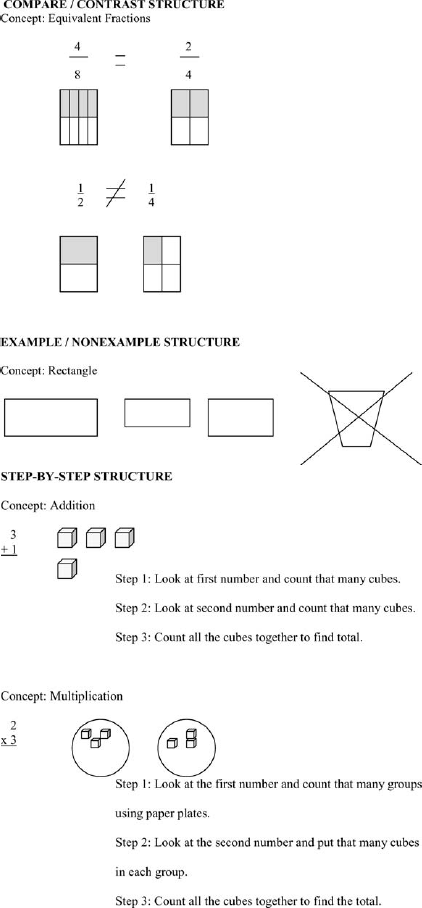
Sample of the Compare/Contrast, Example/Nonexample, and Step–By–Step Structures for Teaching Mathematics Concepts.
Developing Procedural Knowledge
The second type of knowledge that students must acquire to become competent in mathematics is called procedural knowledge. Procedural knowledge is the ability to follow a set of sequential steps to solve a mathematical task (Bottge, 2001; Carnine, 1997; Goldman et al., 1997). Procedural knowledge is used to solve computation problems as well as word problems or real–world tasks such as making change or calculating the area of a room. A number of studies have been conducted investigating the development of mathematical procedural knowledge for students with LD.
Evidence–Based Practice Used to Develop Procedural Knowledge
Research on the development of procedural knowledge has been conducted in the areas of solving word problems and computation problems or algorithms. Montague (1992) and Montague, Applegate, and Marquard (1993) conducted extensive research on the effects of a cognitive and metacognitive strategy on the word problem–solving performance of adolescents with LD. The strategy included seven cognitive steps (Read, Paraphrase, Visualize, Hypothesize, Estimate, Compute, Check) and three metacognitive steps (Say, Ask, Check). Students were successful in using the cognitive and metacognitve strategy to solve word problems, although periodic review was necessary to maintain the skill. Case, Harris, and Graham (1992) successfully used a five–step strategy (Read the problem aloud, Look for important words and circle them, Draw pictures to tell what's happening, Write down the math sentence, Write down the answer) that included a self–instruction component to help elementary school–age students with LD solve addition and subtraction word problems. Eight steps were followed for instruction: (1) pre–skill development; (2) conferencing with the student including feedback on the student's performance, description of the strategy, and gaining a commitment; (3) discussion of the strategy; (4) modeling of the strategy and self–instruction; (5) mastery of the strategy steps; (6) collaborative (guided) practice; (7) independent practice; and (8) generalization and maintenance.
In the area of computation problems, Brown and Frank (1990) used the “4 B's” strategy (Begin, Bigger, Borrow, and Basic Facts) to successfully teach elementary school students with LD to solve subtraction problems requiring regrouping. The teacher modeled the strategy and students memorized it before beginning practice. During practice, the strategy steps were included on the worksheet for students to self–monitor their performance. In another study, Rivera and Smith (1988) taught middle school students with LD to solve long division problems using a seven–step strategy (Place dot, Divide, Multiply, Subtract, Bring down, Repeat, and Put up remainder). Key words were used to prompt students to recall and follow the strategy steps. Demonstration of the strategy by the teacher was followed by imitation (i.e., guided practice), prior to moving to independent practice.
Regardless of whether the mathematics task is aimed at solving a word problem or a computation problem, instruction designed to develop procedural knowledge relies on a clear, well–defined procedural strategy (Harniss, Carnine, Silbert, & Dixon, 2002). In the following section, guidelines for developing a procedural strategy are provided.
Instructional Guidelines for Developing Procedural Knowledge
There are five guidelines to consider when developing or adapting an existing procedural strategy (Hudson & Miller, 2006; Ellis & Lenz, 1987). First, the strategy should include a sequential set of steps that leads to the problem's solution. Second, the steps of the strategy should be generalizable. This means the strategy steps should work with all examples of the problem type (e.g., two–digit + two–digit with regrouping). Third, each step should either prompt the student to perform an overt action (e.g., write the answer), use a cognitive or metacognitive technique (e.g., paraphrase the problem aloud), or apply a rule (e.g., use the rounding rule). Fourth, the wording of the steps should be simple and the length (i.e., the number of steps) brief. Finally, a mnemonic device is useful to help students remember the strategy steps. Using these five guidelines when designing procedural strategies will help keep instruction focused and efficient. The
Read the problem.
Identify the sign.
Add the ones column.
Write the answer in the ones column.
Add the tens column.
Write the answer in the tens column.
Check the addition.
Developing Declarative Knowledge
The third type of knowledge that students must acquire to be successful in mathematics is called declarative knowledge. Declarative knowledge is information that students retrieve from memory without hesitation. It is information that students know at a glance. For example, the student sees the number “3” and immediately says the name three or the student sees the problem “3 + 5” and immediately knows the sum is eight or the student sees a shape and immediately identifies it by name (e.g., rectangle). The ability to memorize mathematical information and quickly retrieve the information helps students as they progress through the hierarchical mathematics curriculum (i.e., sequence of skills that become increasingly complex; each skill builds on previous skill). It also helps with skill retention and generalization (Ivarie, 1986; Miller & Heward, 1992).
The development of declarative knowledge requires sufficient practice to ensure mastery with skills being taught. Fortunately, researchers have identified evidence–based methodology to provide this needed practice.
Evidence–Based Practices Used to Develop Declarative Knowledge
Constant Time Delay is an evidence–based instructional procedure designed to build declarative knowledge. The procedure involves a controlling prompt that results in near–errorless student responses. Specifically, the procedure involves the following steps:
Present stimulus to student (e.g., flashcard with math fact). Give student 3 to 5 seconds to provide answer. If student response is correct and provided within 3 to 5 seconds, reinforce (e.g., “that's correct”) and continue with next stimulus. If no response is provided in 3 to 5 seconds or if the student response is incorrect, provide a controlling prompt (e.g., model the correct response by stating the problem and correct answer). Student then repeats the model (e.g., “Three plus seven equals ten”) (Koscinski & Hoy, 1993).
Researchers have consistently noted benefits related to using constant time delay procedures when building declarative knowledge, especially related to multiplication skills (Koscinski & Gast, 1993a, 1993b; Koscinski & Hoy, 1993; Mattingly & Bott, 1990; Morton & Flynn, 1997; Williams & Collins, 1994; Wolery, Anthony, Caldwell, Synder, & Morgante, 2002).
Another evidence–based instructional practice designed to build declarative knowledge is the implementation of 1–Minute Timings. This practice involves giving students a Probe Sheet that includes more problems than what any student in the class can complete in 1 minute. The teacher says, “Please begin,” and students answer as many problems as they can in 1 minute. At the conclusion of the minute, the teacher says, “Please stop.” The Probe Sheet is scored. The number of correct digits and the number of incorrect digits written in the minute is determined and then plotted on a graph. The graph allows students to see their progress as it is made and serves as a motivator for increasing automaticity with the skill being practiced.
The use of 1–Minute Timings is an easy–to–implement practice that builds declarative knowledge in a highly efficient manner. When teaching students who are working on different skill levels, this practice is easy to individualize. Probe sheets designed to address different skills may be administered simultaneously with each student working on the specific skill that he or she needs.
Researchers have noted that students with math difficulties become more fluent with important skills when 1–Minute Timings are used. Specifically, timings have been successful when used for developing declarative knowledge in whole number operations (Le Grice, Mabin, & Graham, 1999), multiplication (Chapman, Ewing, & Mozzoni, 2005), division of two–digit numbers by one–digit numbers (Chiesa & Robertson, 2000), single–digit math facts (Miller, Hall, & Heward, 1995), place value (Le Grice et al., 1999), and telling time (Le Grice et al., 1999).
Instructional Guidelines for Developing Declarative Knowledge
Instruction designed to help students develop declarative knowledge requires a significant amount of practice and attention to several important guidelines. The first guideline to keep in mind when implementing instruction designed to build declarative knowledge is to integrate controlled response times and monitor accuracy (Hudson & Miller, 2006). Because declarative knowledge involves automatic, quick responses, limiting the response time for mathematics tasks is important. When using the constant time delay procedure, the student response time is limited to 3–5 seconds. It is important for teachers to develop a monitoring system to determine the problems that are answered correctly and those that are not. If flashcards are being used to present the problem, the teacher can simply make two piles (one for correct responses within the designated time and one for incorrect or non–responses during the designated time). This allows the teacher to determine which problems are already part of the student's declarative knowledge network and which problems need additional practice.
When using 1–Minute Timings to build declarative knowledge, the response time is limited to 1 minute and various methods may be used to monitor student performance. For example, teachers and students may read each problem and the correct answer in unison after the timing is complete and students can indicate problems answered correctly with a check mark and/or problems answered incorrectly with a slash mark. Another option is to have students use calculators or an answer key to check their responses. Finally, it may be desirable for the teacher to check the students’ timings and then provide feedback to the students at a later time. As with the constant time delay procedure, student performance is used to determine which problems need additional practice.
The second guideline related to declarative knowledge instruction is to consider student characteristics when selecting ways to implement necessary practice. For example, students with writing difficulties may develop declarative knowledge more efficiently with constant time delay procedures or with oral 1–Minute Timings instead of written 1–Minute Timings. Because a substantial amount of practice is required for the development of declarative knowledge, some students may benefit from using a variety of practice methodologies (e.g., constant time delay with teacher, constant time delay with a peer, 1–Minute Timings integrated into game formats, 1–Minute Timings integrated into class contests). This helps keep student motivation high and thus the willingness to continue practice is more likely. It is important to make practice motivating to keep students actively engaged.
Maintaining a Balanced Curriculum
As educators strive to provide students with LD access to the general education mathematics curriculum and respond to current standards–based AYP expectations, it is important to provide a balanced curriculum. A balanced curriculum means not only teaching across the five content standards (numbers and operations; algebra; geometry; measurement; and data analysis, statistics, and probability), but also addressing the three knowledge areas (i.e., conceptual, procedural, and declarative) within each standard. Understanding how the three types of knowledge build and work together is important and provides insight into why students have difficulties when one or more types of mathematics knowledge are ignored in the curriculum.
Although the three types of knowledge are distinct, they have important interactive relationships. Declarative knowledge provides an important foundation for procedural knowledge with the student accessing facts to complete a task (Bottge, 2001; Goldman et al., 1997). For example, finding a common denominator for two fractions is a procedural task, however students must be able to recall the multiples of each denominator (declarative knowledge) in order to identify the lowest common multiple. The relationship between procedural and conceptual knowledge is different and appears to develop interactively with improvements in one type of knowledge leading to improvements in the other (Rittle–Johnson & Alibali, 1999; Rittle–Johnson, Siegler, & Alibali, 2001). For example, when teaching the concept of addition with two–digit numbers (e.g., 23 + 52), the teacher may use base–ten blocks and a step–by–step process or procedure to guide the student:
Represent the top number with tens and ones blocks Represent the bottom number with tens and ones blocks Count the sum of the ones blocks and write the answer Count the sum of the tens blocks and write the answer.
The procedure clearly facilitates understanding of addition and place value concepts while using the blocks, but using the blocks in this systematic manner also reinforces understanding of the procedure that will be used when the blocks are no longer used.
Educators have traditionally placed a heavy emphasis on the development of declarative and procedural knowledge (NCTM, 2000). With the pressure to address all five content standards, it is tempting for educators to ignore what is known about the interactive relationship of the three types of mathematics knowledge, particularly building in time to develop conceptual understanding. Procedural knowledge, however, that is not tied to conceptual knowledge is extremely limiting because the student lacks the understanding necessary for generalization (Goldman et al., 1997). If students with LD do not have the ability to generalize mathematics procedures learned in the classroom to real–world problem solving, then the whole intent of mathematics instruction is undermined.
Summary
As special educators work to help students with LD meet AYP expectations in mathematics, it is important to provide balanced instruction across mathematics standards (i.e., numbers and operations, algebra, geometry, measurement, data analysis, and probability) and to address all three knowledge areas (i.e., conceptual, procedural, and declarative knowledge) within each standard. It is recommended that teachers use the explicit instruction framework and evidence–based practices when implementing their mathematics lessons. Examples of evidence–based practices and instructional guidelines for developing conceptual, procedural, and declarative knowledge have been described in this article to assist with the provision of high–quality mathematics instruction. Such instruction increases the likelihood that students with LD will develop mathematics competence in an effective and efficient manner.