






Abstract
This article synthesized the morphology intervention studies conducted in English with students in kindergarten through 12th grade between 1986 and 2006. Seven studies were identified as focusing primarily on morphology instruction, including roots and affixes, and measuring one or more reading–related outcomes (e.g., word identification, spelling, vocabulary, reading comprehension). Of those studies meeting the criteria, three studies were focused on word identification, three were focused on vocabulary acquisition, and one was focused on spelling. Although there was a wide range in effect sizes computed for the various outcome measures (−.93 to 9.13), findings indicated that stronger effects were associated with root word instruction (as opposed to affixes alone) and with morphology instruction that targeted students’ reading developmental level in an age of acquisition pattern. In addition, results suggested that morphology could successfully be combined with training in other skills without adding instructional time.
Considerable research documents the necessity of phonological awareness as a foundational skill for reading success (Fletcher et al., 1994; Wagner & Torgesen, 1987). Children who have not developed phonological awareness, graphophonemic knowledge, orthographic knowledge, and alphabetic reading skill are not likely to crack the code of printed words and become proficient readers. Yet, 25 percent of students at risk for reading problems who were provided with intensive, explicit, and systematic instruction in auditory discrimination, phonics, and word identification have still shown limited growth in foundational reading skills (Torgesen et al., 2001; Velluntino et al., 1996). Given the best scientifically based reading research practices available, there remain considerable numbers of students experiencing persistent reading difficulties.
At least for these at–risk children, phonology interventions appear to be insufficient to alter rate and level of reading development. It is, therefore, necessary to consider the potential contributions of other skills to students’ word identification, spelling, vocabulary, and reading comprehension abilities. Because English is a morphophonemic language, in that words are represented in both units of sound (i.e., phonemes) and units of meaning (i.e., morphemes), it seems reasonable to expect that morphological awareness would play a role distinct from that of phonological awareness. If that were true, another avenue for instruction would be available to intervene with students who did not adequately respond to explicit, systematic phonics instruction. Furthermore, it implies that morphology instruction may play a very important role by providing students of all ability levels enhanced access to word reading and word meaning. Yet, this area has received more attention in the field of linguistics than that of reading and/or learning disabilities.
Rationale and Research Questions
The Components of Morphology
It has been suggested that a dual route exists to the processing of morphemes: Full listing and decomposition (Verhoeven & Perfetti, 2003). In full listing, words are encoded into memory as whole units, regardless of their length or complexity. Full listing would account for students’ knowledge of sight words and of monomorphemic words, or words that consist of a single morpheme. That sole morpheme would be classified as “free” because it can stand alone as a meaningful word without any other morphemes attached to it.
Processing by decomposition, however, involves breaking a complex word into its meaningful parts, or morphemes, because only those parts are encoded in memory and not the word as a whole. It is unclear whether bimorphemic (i.e., consisting of two morphemes) and multimorphemic (i.e., consisting of three or more morphemes) words are processed through full listing, decomposition, or some combination thereof (Reichle & Perfetti, 2003). Both bimorphemic and multimorphemic words are formed by combining free and bound morphemes. Unlike free morphemes, bound morphemes such as prefixes and suffixes are not words unto themselves. The resulting combinations will be one of the following types (as identified by Anglin, Miller, & Wakefield, 1993):
Inflected words: One free morpheme and one suffix denoting the declension or conjugation of the base (e.g., students, reading) Derived words: At least one root (free or bound) and one or more affix (prefix or suffix) that can change the meaning and/or part of speech of the word (e.g., disability, fluently) Literal compounds: Two words occurring as one lexical entity (e.g., research –based, labor–intensive)
Perhaps because there are a limited number of inflectional suffixes, generally with a high frequency in oral language, longitudinal studies have demonstrated that normally achieving children acquire inflectional knowledge very early and in a fairly consistent developmental sequence (Berko, 1958; Brown, 1973; Cazden, 1968). Interestingly, older students and adults with language difficulties (Rubin, Patterson, & Kantor, 1991; Vogel, 2001) as well as second–language learners (Larsen–Freeman & Long, 1991) follow similar orders of acquisition for inflectional suffixes.
Knowledge of compound words also tends to develop earlier for most children (Anglin et al., 1993). As with inflections, students who struggle with reading continue to have difficulties identifying compound words into the mid–elementary grades (Nagy et al., 2003). This is particularly true with low–frequency compounds or those that involve phonological shifts.
Derivational affixes are more challenging for all populations, due in part to their greater number and lower frequency. Prefixes tend to be easier to acquire because they are almost always neutral, meaning they do not cause phonological shifts in the pronunciation of the newly formed words. Moreover, the addition of a prefix usually maintains the transparency of the word, or the ability to decompose it. Nonetheless, descriptive studies have shown that knowledge of prefixes does not substantially grow until around fourth grade when students encounter more significant numbers of prefixed words in texts (Nagy & Anderson, 1984; White, Power, & White, 1989). Suffixes, on the other hand, can be nonneutral and cause more complicated shifts in phonology and semantics. Descriptive studies on derivational suffixes suggest that frequency of related words (Carlisle & Katz, 2006; Nagy et al., 1989), neutrality of the suffix (Carlisle & Stone, 2005; White, Power, & White, 1989), and age of acquisition (Anglin et al., 1993) might be related to increases in students’ recognition of derived words.
Although students have some knowledge of derivatives in early grades, command of these morphologically complex words is acquired later (Anglin et al., 1993) and takes longer (Mahony, 1994). In addition, students with reading difficulties exhibit significantly lower recognition and spelling of derived words than their normally achieving counterparts (Carlisle & Katz, 2006; Tsesmeli & Seymour, 2006). Hence, much of the extant literature on morphology concerns derivatives. The next sections will review the existing knowledge regarding the contributions of morphology to word identification, spelling, vocabulary, and reading comprehension.
The Significance of Morphology in Word Identification
Given the strong correlations between phonological awareness and morphological awareness (r≥ 0.67), some have concluded that the two constructs are measuring the same skill or that morphological deficits are merely a consequence of phonological deficits (Fowler & Liberman, 1995; Shankweiler et al., 1995). However, functional magnetic resonance imaging (fMRI) studies have documented that different constellations of brain activation are associated with morphological, phonological, and orthographic word forms (Richards et al., 2005).
Moreover, studies employing hierarchical regression techniques have shown that morphology makes a unique contribution to word reading when entered after measures of intelligence, vocabulary, and phonology (Deacon & Kirby, 2004; Singson, Mahony, & Mann, 2000). Results rather consistently demonstrate that morphological awareness accounts for around 4 percent or 5 percent of the variance in decoding (Deacon & Kirby, 2004; Mahony, Singson, & Mann, 2000). Although this is, at minimum, half the amount of variance accounted for by phonological awareness (Shankweiler et al., 1995), it is important to note that the relative importance of phonological to morphological skills reportedly begins to shift around fourth grade (Carlisle, 2000; Green et al., 2003). In Chinese–English biliterate children enrolled in grades 3, 4, and 5, morphological tasks predicted 10 percent of the unique variance in English word identification for the more difficult derivational words (Wang, Cheng, & Chen, 2006). This is consistent with results of monolingual English children. Between grades 4 and 9, morphological awareness was found to be most significant for morphologically complex words, but not significant for phonologically transparent words (Nagy, Berninger, & Abbott, 2006). In the later elementary, middle, and high school years, it appears the contribution of phonological analysis steadily decreases as the contribution of morphological analysis increases (Carlisle & Stone, 2005; Deacon & Kirby, 2004; Mann & Singson, 2003; Singson et al., 2000). This has also been documented in French–speaking children (Casalis & Louis–Alexandre, 2000), which is noteworthy in that French is the only other orthographically deep alphabetic language on which studies of morphology could be identified in the extant literature. Where the relationship between the sounds and symbols of language is less transparent, morphology can become a more important factor to students’ reading success.
Research conducted with French– and English–speaking children identified as dyslexic has suggested that phonological and morphological skills develop separately (Casalis, Cole, & Sopo, 2004) and that older children with reading disabilities exhibit problems based more in morphology than in phonology (Champion, 1997). In addition, deaf college students matched with hearing middle school students on measures of reading achievement made significantly more errors on morpheme knowledge and word segmentation tasks (Gaustad & Kelly, 2004). Because morphemic knowledge typically follows an age–of–acquisition pattern, these findings seem to indicate morphological skill does not develop normally in children with reading and hearing disabilities. Hence, direct instruction in morphology has been proffered as a compensatory strategy for students with dyslexia (Casalis et al., 2004) and deafness (Gaustad & Kelly, 2004).
It is reasonable to be concerned about the extent to which morphemic analysis is an efficient component of an intervention when it accounts for only a small, albeit significant, amount of unique variance in word identification. However, such an intervention would provide another avenue of instruction for students who did not respond to interventions based in phonology. As Mahony (1994) found in a study of high school students, “it seems evident that sensitivity to word structure, like sensitivity to phonemes, is a necessary condition for successful reading since there were no good readers without it” (p. 38).
Certainly, one of the limitations of phonology interventions is the lack of grapheme consistency in the English language. As an orthographically deep language, the relations between the written and spoken word are often opaque and, thus, spelling is not directly governed by phonological syllable structure (Verhoeven & Perfetti, 2003). In contrast, the study of morphemes can often explain phonetic inconsistencies.
Evidence of Morphology in Spelling
Children who have knowledge of morphemes learn that these meaningful word parts are spelled similarly in different words where they appear, even if the pronunciation is altered. After controlling for such factors as age, intelligence, phonological ability, and vocabulary knowledge, children as young as 6 have shown a relation between morphological awareness and general spelling ability (Deacon & Bryant, 2006; Green et al., 2003; Nagy et al., 2006; Nunes, Bryant, & Bindman, 2006). When presented with words that had the same letter streams for phonological syllables and root morphemes (e.g., turn for turning and turnip, respectively), students spelled the inflected word better than the phonological control (Deacon & Bryant, 2006). This morphological awareness was also transferred to a standardized test of spelling where children with better morphological ability were more often able to choose the correct and reject the incorrect spelling of words with a wide range of morphological complexity. Moreover, multiple regression analyses indicate children's ability to spell both inflected and derived words is predictive of their morphological awareness on measures administered a year later (Nunes et al., 2006).
This is a particular concern for students with dyslexia, who exhibit severe spelling impairments. Similar to findings in word identification, adolescents with dyslexia misspell significantly more words than normally developing younger students matched by reading ability (Tsesmeli & Seymour, 2006). The results of the aforementioned study show that morphological awareness and derivational knowledge are in a linear relationship with reading age, rather than chronological age. Spelling error patterns reveal that dyslexic adolescents are attempting to use morphological strategies to spell words, but that their ability to do so is constrained by the level of their morphemic knowledge. Therefore, it seems plausible that instructional interventions in morphology could positively alter the spelling outcomes of students with severe reading difficulties.
Such an intervention would necessarily focus on the orthographic representation of morphemes, as opposed to their semantic representations that are of importance in vocabulary acquisition. In fact, Tsesmeli and Seymour (2006) found the spelling difficulties of students in their study were not attributable to vocabulary knowledge because correlations between their measures of word meaning and spelling were low and insignificant. However, differences between dyslexic adolescents and the reading level comparisons did emerge with less familiar Greek–origin derivatives. It is these types of words that become the key to vocabulary growth in grade 4 and beyond (Anglin et al., 1993; Nagy & Anderson, 1984).
The Role of Morphology in Vocabulary Development
More than 82 percent of the entries in the most recently developed Academic Word List (Coxhead, 2000) are “of Greek or Latin origin, indicating that the study of prefixes, suffixes, and stems may be one way to study this vocabulary” (p. 229). Whereas children in grades 1 and 3 know more monomorphemic and bimorphemic words than multimorphemic, grade 5 students know equal numbers of monomorphemic and multimorphemic words (Anglin et al., 1993). It is, in fact, the multimorphemic words that are associated with children's rapid vocabulary growth between grades 3 and 5. Knowledge and application of Latin roots in words continues to increase significantly between grade 7 and college (Nagy & Scott, 1990).
It should be noted that grade–level indicators are tenuous, given the interactions between socioeconomic status and vocabulary knowledge (Anglin et al., 1993; Biemiller & Slonim, 2001). Gaps between advantaged children and their normative peers are apparent from kindergarten, but can be ameliorated by grade 6 with accelerated learning of root words (Biemiller & Slonim, 2001). Although wide reading has been touted as the key means of accomplishing that needed growth (e.g., Swanborn & de Glopper, 1999), other studies indicate that incidental exposures to multimorphemic words are insufficient at bringing the vocabulary knowledge of deaf students on par with that of hearing students after 12 years of education (Gaustad & Kelly, 2004). Similarly, learning words from context is far less likely when the words are longer multimorphemic words and is nearly impossible when the words and surrounding context are conceptually difficult for students (Nagy, Anderson, & Herman, 1987).
What seems needed, then, is direct instruction in morphemic analysis. Morphological skill has been found to be a good predictor of vocabulary knowledge, even after phonological processing, word reading skill, and age were statistically controlled (McMride–Chang et al., 2005). Even when looking specifically at students at risk for reading failure, morphological awareness has demonstrated a unique contribution to vocabulary in grades 2 and 4 (Nagy et al., 2003).
The potential of morphology to alter the slope and level of students’ vocabulary acquisition is related to the morphological generalization hypothesis. As defined by Wysocki and Jenkins (1987), children engage in morphological generalization when they “draw upon knowledge of a familiar word to aid them in deriving the meaning of an unfamiliar, but related, word” (p. 69). Support for this process comes primarily from research that has attempted to quantify the numbers of words children acquire per day and under what circumstances. Students who are able to decompose words into their constituent parts and utilize morphological relatedness among words have been projected to learn approximately two to three more new words per day than if they did not (or could not) engage in any morphological problem solving (Anglin et al., 1993; Nagy & Anderson, 1984). Anglin and colleagues (1993) further suggested that “the very act of figuring out a word through morphological analysis might contribute substantially to its learning since such analysis exemplifies the type of deep processing that has been shown to facilitate remembering” (p. 148).
Despite some experimental evidence of morphological generalization, as will be discussed in the results of the synthesis, it seems as though roots and affixes are not being systematically taught in school (Moats, 2000; White, Power, & White, 1989) and that teachers themselves appear to have limited knowledge of morphemes (Moats, 1994). Hence, core reading instruction likely could be improved with greater attention to morphemic analysis prior to initiating an intervention. But for those students who are already significantly behind their same–age peers in vocabulary knowledge, more intensive instruction may be warranted. This is, in part, due to the correlation of vocabulary knowledge to reading achievement and the corresponding potential for the gap between students’ abilities to widen exponentially if left unaddressed over several years of school (Stanovich, 1986).
The Relationship of Morphology to Reading Comprehension
Although structured equation modeling has shown that morphological awareness makes its largest contribution to reading comprehension through its impact on vocabulary, it still makes a significant contribution to reading comprehension that is independent of its indirect impact (Nagy et al., 2006). This was true for normally achieving students at all grade levels from 4 through 9 and is consistent with the moderate and increasing contribution of combined morphological awareness factors to reading comprehension among middle– to upper– middle–class students in grades 3 and 5 (Carlisle, 2000). Even after controlling for prior reading ability, intelligence, and phonological awareness, morphological awareness made a significant contribution to reading comprehension for children in grades 4 and 5 (Deacon & Kirby, 2004). Moreover, this unique contribution increased dramatically between grades 3 and 4, surpassing the unique contribution of phonological awareness. Around fourth or fifth grade, students’ developing morphological problem–solving skills seem to be particularly important to their reading comprehension (Carlisle & Fleming, 2003; Green et al., 2003) and may be transferable to outcomes in biliterate children's first language (Wang et al., 2006).
As was true in word identification, spelling, and vocabulary, some children do not maintain this normal age of acquisition development related to morphology. For students identified as being at risk for reading difficulties, morphological awareness factors were strongly and increasingly correlated with reading comprehension at grades 2 (r=. 69) and 4 (r=. 80), but only accounted for unique variance in reading comprehension at grade 2 (Nagy et al., 2003). Interestingly, neither phonological, orthographic, morphological, nor oral vocabulary made unique contributions to the reading comprehension of the at–risk fourth graders in the study. However, the four language factors jointly accounted for 69 percent of the variance on a measure of reading comprehension. Of the four factors, morphological had the highest correlation with comprehension, and this correlation was considerably higher than that found in previous studies of normally achieving students around the same grade level (Carlisle, 2000).
The difference in the results between normally achieving and at–risk students at grade 4 further reinforces the supposition that morphology may play a critical role in improving the literacy outcomes of older students for whom phonology interventions are insufficient. In research with high school and undergraduate students, it is apparent that the correlation between measures of morphology and reading achievement persists with the better readers demonstrating better word–structure sensitivity (Mahony, 1994). Given the paucity of morphology intervention studies, the full effects of direct instruction in morphological awareness and problem solving remain unknown.
This article will present the findings of a synthesis conducted to determine the outcome of morphology interventions on word identification, spelling, vocabulary, and reading comprehension of students in grades K–12. The research question addressed is: What are the effects of morphemic analysis interventions in enhancing the reading and reading–related outcomes for students in grades K through 12?
Method
To identify relevant studies, the PsycINFO, ERIC, and MEDLINE electronic databases were searched using the following descriptors: morph*, analytic decoding, word part, affix*, root word, and reading. In addition, reference lists of correlation studies and research reviews were examined for articles that may not have appeared in the computerized search. To capture as many studies as possible while still reflecting current knowledge of the key components of reading, the earliest publication date was set at 1986. The over 400 abstracts identified were evaluated on the basis of the following criteria:
Published in a peer–reviewed journal between 1986 and 2006. Reported an experimental or quasi–experimental study. Participating students were in grades K–12. The language in which participants were using morphology was English. Intervention consisted primarily of English morphology instruction, including prefixes, roots, and suffixes. If morphology instruction was only a minor or incidental component of an intervention focused on phonology (e.g., Lovett & Steinbach, 1997) or on text–based vocabulary acquisition (e.g., Carlo et al., 2004), it was not included. At least one dependent measure assessed one or more aspects of reading in English, including spelling, writing, vocabulary development, and reading comprehension. When outcome measures only assessed oracy (e.g., Shankweiler et al., 1995), without a reading–related component, the study was not included. When reading outcomes were measured only by brain imaging (e.g., Richards et al., 2005), the study was not included.
All abstracts were sorted into three groups representing those that clearly violated one of more of the delimiters, those that seemed to meet all criteria, and those that needed further evaluation. The articles of the latter two groups were then read in their entirety. Only seven studies were judged to meet all criteria for inclusion in the synthesis.
Data Analysis
Coding Procedures
Studies were coded using a detailed code sheet adapted from that employed in previous syntheses (Edmonds et al., in press; Kim, Vaughn, Wanzek, & Wei, 2004). The code sheet included elements specified in the What Works Clearinghouse Design and Implementation Assessment Device (Institute of Education Sciences, 2003), a document used to evaluate the quality of studies. Information recorded included descriptions of the participants (e.g., number, grade level, mean age, ability levels), study design (e.g., number of conditions, assignment to conditions, fidelity of treatment check), conditions (e.g., duration, length of sessions, length of morphology component, type of morphology instruction, comparison components), and reported results (e.g., measures, measurement type, statistical information). In addition, information on the comparability of the treatment and comparison groups (e.g., sample sizes, attrition, equating procedures) was recorded to determine the clarity of causal inference that could be made.
Interrater Reliability
A colleague experienced in conducting syntheses and I participated in training on the use and interpretation of items from the code sheet. Interrater reliability was established by each of us independently coding two articles chosen at random. Our individual responses were used to calculate the percentage agreement (i.e., agreements divided by agreements plus disagreements). An interrater reliability of. 98 was achieved, and any disagreements were resolved by discussion.
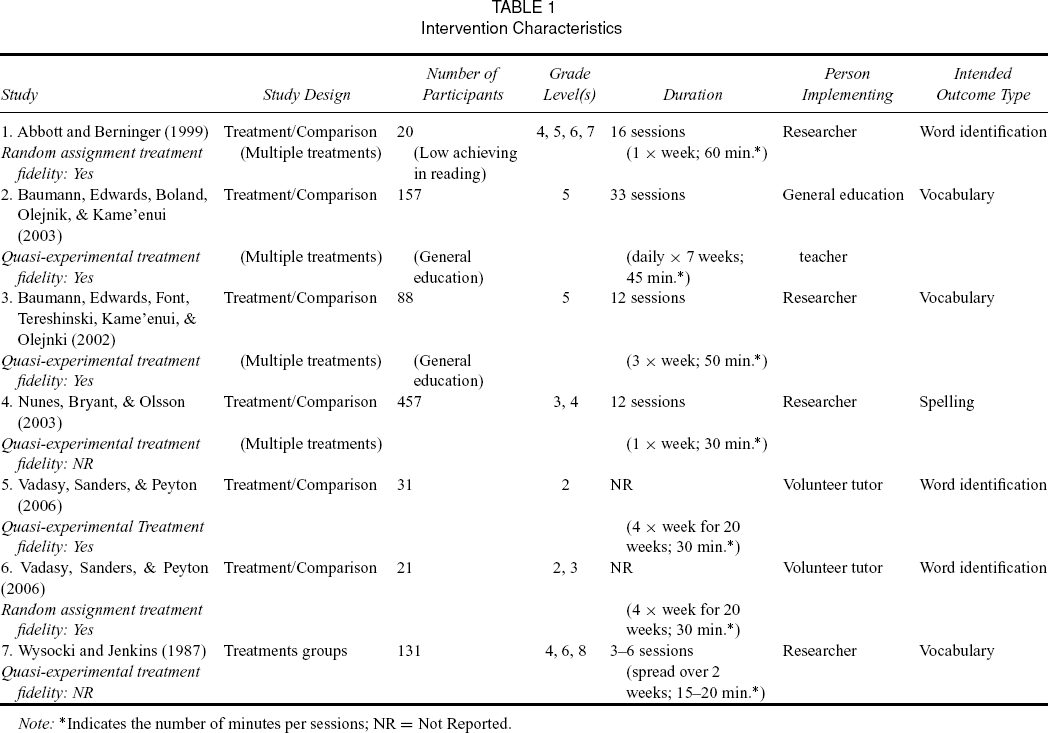
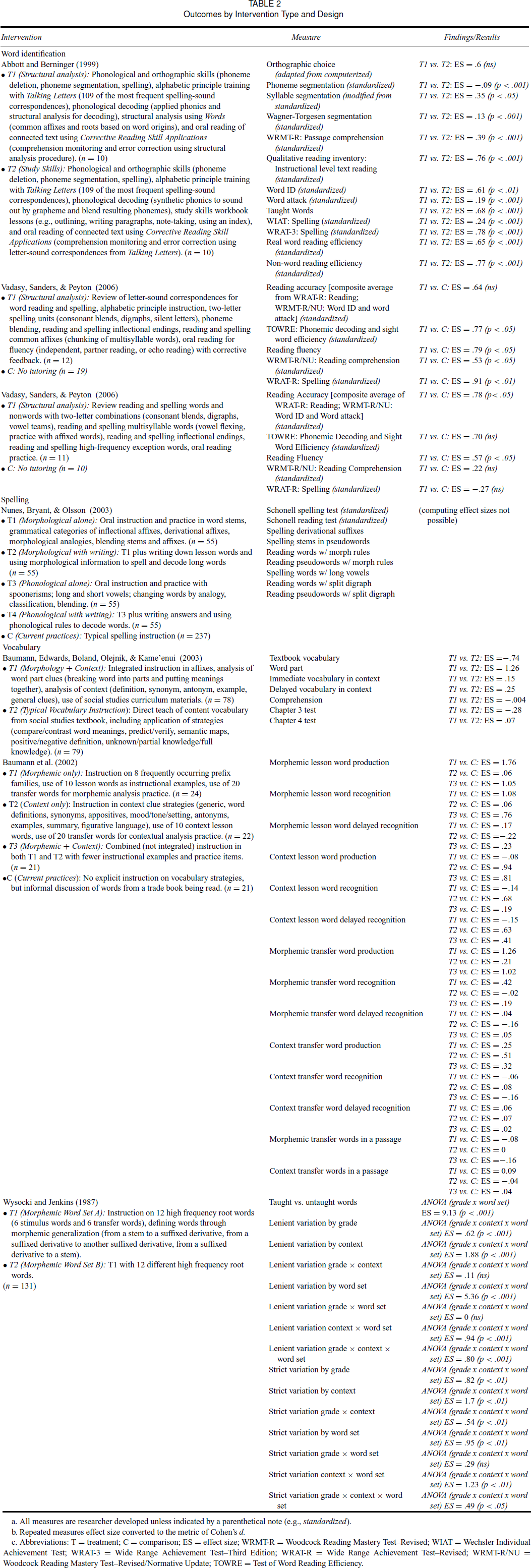
Information from all code sheets was then organized in tables to summarize the studies. Table 1 provides each study's design, participant information, and intended outcome type (i.e., word identification, spelling, vocabulary). Because the findings can be better interpreted within the context of the researchers’ intended purposes, Table 2 groups the studies by the aforementioned outcome types. Within those categories, the individual interventions are described and the effect sizes are recorded for every dependent measure utilized. Although none of the studies included in this synthesis designed an intervention specifically to address fluency or reading comprehension, some used dependent measures that assessed these other outcomes because improvements in one component of reading should impact the related key components.
Intervention Characteristics
Note:*Indicates the number of minutes per sessions; NR = Not Reported.
Outcomes by Intervention Type and Design
a. All measures are researcher developed unless indicated by a parenthetical note (e.g., standardized).
b. Repeated measures effect size converted to the metric of Cohen's d.
c. Abbreviations: T = treatment; C = comparison; ES = effect size; WRMT–R = Woodcock Reading Mastery Test–Revised; WIAT = Wechsler Individual Achievement Test; WRAT–3 = Wide Range Achievement Test–Third Edition; WRAT–R = Wide Range Achievement Test–Revised; WRMT–R/NU = Woodcock Reading Mastery Test–Revised/Normative Update; TOWRE = Test of Word Reading Efficiency.
Effect–Size Calculation
Six studies included statistical information suitable for the calculation of effect sizes. For most, this was calculated using the traditional formula for Cohen's d (Cohen, 1988), or the difference between the mean posttest score of the treatment and comparison group, divided by the pooled standard deviation. For one study (Wysocki & Jenkins, 1987), the effect size was calculated using a Web–based program for converting an F statistic into Cohen's d (Lyons & Morris, 2007). In all, there are 101 effect sizes ranging from −.93 to 9.13 (see Table 2). A mean weighted effect size was not calculated due to the limited number of and the lack of similarity among the studies in each category. Nor were effect sizes adjusted because the intervention studies synthesized here, unlike the correlation studies reviewed earlier in this article, did not attempt to address the effect of the morphological intervention over and above intelligence or phonological ability.
Results
Given the different foci of the morphology interventions, data analysis was conducted in two parts. First, the elements of the study features were synthesized to better identify what was and was not tested under what conditions and with what populations of students. Second, effect sizes were calculated for each dependent measure to determine the relative effects of morphology interventions on reading–related outcomes for English–speaking students in kindergarten through 12th grade.
Study Features
Of the seven studies that met the selection criteria, five were published in the last 5 years of the two–decade span that delimited the search (1986–2006). Although the specifics of each study's design are recorded in Table 1, the information is summarized in the following sections to better contextualize the findings and interpret the population and ecological validity.
Sample Characteristics
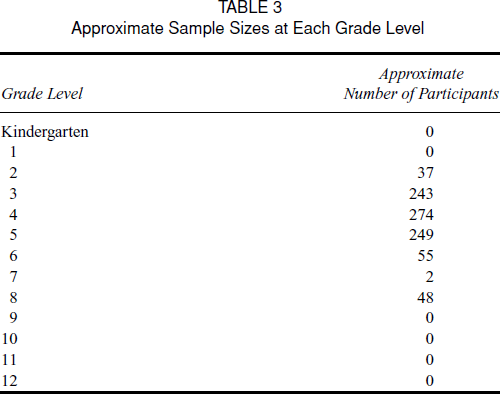
Despite the small number of studies, a total of 905 students were included, with a wide range of 20 to 457 participants per study. Averages, in this case, are not instructive unless examined in terms of student ability levels. Only three studies identified students who were low achieving in reading (Abbott & Berninger, 1999; Vadasy, Sanders, & Peyton, 2006), and these had the smallest sample sizes (between 20 and 31) with a mean of 24 students. Although selection criteria allowed for students in kindergarten through grade 12, the identified studies only included participants in grades 2 through 8, with most enrolled in grades 3 through 5 (see Table 3).
Approximate Sample Sizes at Each Grade Level
Study Design
The seven studies were divided equally between treatment/comparison and treatment group(s) designs. Only one treatment/comparison and one treatment groups design employed random assignment. All other studies were quasi–experimental utilizing either matched or intact student groups. Only two studies (Abbott & Berninger, 1999; Vadasy et al., 2006) included students identified as low achieving in reading, randomly assigned participants to conditions, reported implementation fidelity data, and employed standardized measures of student outcomes.
Intervention Design and Implementation
Intervention durations were anywhere from 2 to 20 weeks and totaled from 1 to 160 hours. As with sample sizes, this range is wide enough to make an average misleading. In terms of the intervention components, three of the studies instructed students on root words, and four studies used only affixes in the morphology instruction. Only two studies directly compared morphological analysis with phonological analysis (see Table 1 for a description of the interventions and comparisons). Six of the interventions were implemented by the researchers, one was implemented by school psychologists or graduate students, one by the general education teacher, and one by paraprofessionals/volunteer tutors.
Effect Sizes
To determine the effects of morphemic analysis interventions in enhancing reading and reading–related outcomes, the effect sizes obtained on relevant dependent measures were summarized and are reported in the following sections. Studies are grouped by the researchers’ intended outcomes in order to facilitate interpretation of the results.
Word Identification
There were three studies concerned with increasing students’ word identification skills in early– (Vadasy et al., 2006) and mid–elementary levels (Abbott & Berninger, 1999). All provided tutoring in structural analysis to students who were low achieving in reading. Results on standardized measures administered to treatment and comparison groups revealed medium effect sizes (.60 to. 79) for reading accuracy and efficiency. However, separate measures of syllable segmentation and word attack produced small effect sizes (.35 and. 19, respectively), and a separate measure of phoneme segmentation revealed no significant effect (−.05). These latter three results were all obtained in the Abbott and Berninger (1999) study, which compared structural analysis with alphabetic principle training to a treatment of alphabetic principle training alone. Therefore, it would not be expected that students would vary in their performance on phonetic tasks, and even a small effect size in favor of the treatment group that received morphological analysis instruction could be interpreted as promising.
Effect sizes for standardized measures of reading comprehension tended to be small (.22 and. 39) with the exception of the medium effect size (.53) for second–graders in the Vadasy et al. (2006) study. Spelling, on the other hand, showed the greatest variance (−.27 to. 91). This did not seem attributable to age, length of intervention, or assessment type, so the results are particularly intriguing. Intervention–specific measures of fluency, instructional text reading, and taught words all revealed medium effect sizes (.57 to. 79). In general, the morphology interventions were associated with positive, significant effects on word identification, which seem to then have impacted students’ fluency, vocabulary, and reading comprehension. Results for spelling were more equivocal and merit specific investigation.
Spelling
Nunes and colleagues’ (2003) study provided 7– and 8–year–old participants (not distinguished by ability levels) with either a morphological or phonological treatment. Due to significant pretest differences among groups, data were analyzed by one–way analyses of covariance (ANCOVA) and only reported in the form of F statistics for the group effect of all four interventions versus the control. Means and standard errors were provided for each individual intervention group, but not the standard deviations. Therefore, no effect sizes were calculated for this study (see Table 2). The authors report that only the morphological groups outperformed the control on researcher–developed measures assessing the preservation of the stem spelling in pseudowords and spelling derivational suffixes. Because most ANCOVA failed to achieve statistical significance, the authors interpreted the weak results as an indication that the interventions attempted to accomplish too much in only 30 minutes of tutoring, once a week, for 12 weeks. Yet, it is encouraging that morphology instruction showed some advantage for spelling derivational suffixes, which tend to be more difficult, and for preserving stems in pseudowords, which would seem to support the morphological generalization hypothesis.
Vocabulary
In perhaps the most widely cited morphology intervention study (Wysocki & Jenkins, 1987), students were trained in one of two word sets and then served as their own controls in tests on both sets of morphologically related words. Because both groups received training in morphology, effect sizes are not relative to a comparison condition, but are the effect of morpheme instruction on related versus unrelated words. Absent data on the means and standard deviations, the effect sizes were calculated by converting F statistics to Cohen's d (Lyons & Morris, 2007). There was an exceptionally high effect size (9.13) for all grade levels on the taught words and transfer words versus the untaught words and transfer words. This was obtained on a researcher–developed measure, specific to the set of six root words in each morphological treatment group, so results cannot be interpreted as indicative of students’ overall vocabulary growth.
To better assess morphological generalization, the authors tested students again 2 weeks after the intervention ended and examined whether there were differences in performance on (a) transfer words with weak versus strong contextual support and (b) transfer words versus stimulus words with weak contextual support. Responses were scored in two different ways. The lenient scoring awarded credit if the student's definition conveyed the general meaning of the word or if they knew the meaning and the correct syntactical usage. The strict scoring awarded credit only if the student's definition conveyed both semantic and syntactic understanding. Effect sizes for the interactions by grade level, grade level by contextual support, and grade level by word set all showed distinct advantages for the older students in the study, particularly when examining the difference between the lenient and strict scoring (see Table 2). For these interactions, effect sizes obtained in the lenient scoring ranged from 0 to. 62; in the strict scoring, however, they ranged from. 29 to. 82. The only interaction with grade level that did not follow this pattern of increasing under the strict scoring procedure was the effect size for grade by context by word set, which was. 80 with lenient and. 49 with strict scoring. All other effect sizes obtained on the researcher–developed measures were high whether looking at lenient or strict scoring (.94 to 5.36).
Overall, results seem to confirm that an age–of–acquisition pattern is discernable among grades 4, 6, and 8. The older students were more likely to provide the correct grammatical form of the words, and they were better at using both morphological and contextual information to determine the meanings of untaught words. The authors conclude that knowledge of derivational suffixes is somewhat accountable for children's vocabulary growth during these school years. This interpretation is subject to some limitation, though, because the intervention did not include a comparison condition, was of a brief duration (three sessions of 15 to 20 minutes each spread over 2 weeks), and only introduced students to six morphemically complex words. This is the shortest amount of time and the smallest number of morphemes covered by any of the intervention studies, but produced among the highest effect sizes.
Wysocki and Jenkins’ (1987) findings provided much stronger support for the morphological generalization hypothesis than Baumann and colleagues (2002) found. Here, different grade 5 classes were assigned to different vocabulary instruction conditions. One class received instruction in eight frequently occurring prefix families, another in context clue strategies, a third in the combined morphemic and contextual analysis with fewer practice items, and the comparison class received no explicit vocabulary instruction. Results revealed that students provided with morphemic instruction alone or in combination with contextual analysis could more accurately produce definitions for words containing the prefixes they learned. Effect sizes were large for both lesson and transfer words (1.02 to 1.76) on the researcher–developed test administered immediately at the end of the intervention. However, the results for recognizing correct definitions of words containing the prefixes were more mixed. Students who received only morphemic analysis instruction demonstrated high effect sizes on recognizing definitions of lesson words (.96 to 1.08), but small effect sizes on recognizing transfer words (.42 to. 44). There was virtually no effect on the delayed test administered 5 weeks after the end of the intervention, except for the small effect on the lesson words in comparison to students who received only contextual analysis instruction (.37).
Students who received a combination of morphemic and contextual analysis instruction had a medium effect size (.76) for the recognition of lesson words and a small effect size (.23) for the delayed test of lesson words. There was virtually no effect for their performance on the recognition or delayed test of transfer items. They did, though, demonstrate a high effect size on producing definitions of contextual analysis lesson words and small effect sizes (.41 and. 32) for the delayed test of contextual analysis lesson words and the recognition of transfer contextual analysis words, respectively.
This is in contrast to the treatment conditions that provided only morphemic or contextual analysis instruction. For those two groups, positive effects were evident for the measures related to the instruction, but not for the contrasting condition. In other words, students who received only contextual analysis instruction had positive effects on the tests of contextual analysis but negative effect sizes for the tests of morphemic analysis. The reverse was true for the students who received only morphemic analysis. None of the instructional treatments produced effects on reading comprehension tasks, which were dependent upon students’ vocabulary knowledge.
Although the results seem to indicate a lack of transfer effect, student interviews conducted in conjunction with the posttesting revealed that those in the morphemic analysis conditions were more likely to decompose words and reason strategically than students in the contextual analysis or comparison conditions. Therefore, it may be the nature of the morphology instruction that failed to produce discernable differences in students’ performance. Prefixes are generally easier to acquire, and student interviews in this study indicated that those in the contextual analysis and comparison groups were either familiar with or were intuiting the meanings of prefixes. The authors selected the eight most commonly occurring prefixes, so it would be expected that students would have some prior experience with them. In contrast, the Wysocki and Jenkins (1987) study used derivational suffixes, which are more difficult and cause syntactic changes. In addition, the Baumann et al. (2002) study did not provide instruction in root words, which carry the crux of the meaning in prefixed words and are the source of the word families around which affixed words are built (Coxhead, 2000; Nagy & Scott, 1990). To achieve a higher transfer effect or to impact comprehension, the previously discussed correlation research would suggest that instruction in Greek and Latin roots would be critical. The Wysocki and Jenkins (1987) study seems to confirm this notion.
The second Baumann study (Baumann, Edwards, Boland, Olejnik, & Kame'enui, 2003) did incorporate derivational suffixes along with prefix families. This time, grade 5 students were either provided a combined morphemic and contextual analysis intervention or they received direct instruction in lesson vocabulary words with strategies for deep processing (e.g., comparing and contrasting, predicting, and using semantic maps). The students in the morphemic and contextual analysis treatment demonstrated a large effect size (1.26) for defining transfer words or word parts and a small effect size (.25) for delayed production of meanings for both morphemically decodable and contextually supported vocabulary words. There was virtually no effect for the immediate production of meanings, for comprehension of an adapted textbook passage, or for performance on the textbook Chapter 4 test. Students in the direct instruction comparison condition performed better than treatment students on the test of textbook vocabulary items and the textbook Chapter 3 test, although the difference in the latter was not significant.
As with the other vocabulary studies, Baumann and colleagues (2003) only employed researcher–developed measures, which tend to produce higher effect sizes than standardized measures, so these results should be interpreted conservatively. Nevertheless, they appear to lend more support to the morphological generalization hypothesis than the first Baumann et al. (2002) study because the students in this intervention performed significantly better than the comparison group on defining novel words. Additionally, the results of the reading comprehension assessment could be interpreted more positively than would appear on the surface, based upon the lack of a discernable effect. That is because students in both groups received rich vocabulary instruction related to the textbook terminology. Their reading comprehension performance was comparable—that is not to say it was poor. Teaching students to reason strategically through decomposing the affixes did not disadvantage their comprehension over directly teaching them in full–listing fashion. Nor did the treatment impede their content learning, as was evidenced in the relatively equal performance on the chapter tests. It did, however, improve their retention of vocabulary knowledge and their ability to determine the meanings of unfamiliar related words. Given that the intervention students performed just as well as the comparison group when provided with instruction that concentrated on affixes, it could reasonably be hypothesized that they would show better performance were they given instruction in root words.
Discussion
This synthesis sought to determine the effects of morphemic analysis interventions in enhancing the reading and reading–related outcomes for students in grades K through 12. Results indicate that morphology holds promise as a means to improve reading performance, but the wide range in effect sizes (−.93 to 9.13) obtained in such a small number of studies likely reflects the range of outcomes (researcher–developed vocabulary measures as well as standardized spelling and decoding measures) and the range of interventions (e.g., spelling, word reading). This would suggest that much more research needs to be done before conclusive interpretations can be made.
The results of both correlation and intervention studies indicate that morphology can have a positive impact on students’ word identification, spelling, vocabulary, and reading comprehension. Descriptive studies suggest morphological knowledge, and the ability to generalize that knowledge, increase with students’ reading age and their exposure to more morphemically complex words. Therefore, students with reading difficulties may benefit from direct instruction in morphemic analysis.
Unfortunately, more is known about the linguistic aspects of morphology and its relationship to components of reading than is known about what type of morphological instruction works best in improving the reading–related outcomes of students for whom phonology interventions seem insufficient. Of the seven morphology intervention studies conducted with English–speaking students in grades K–12, only three specifically selected participants identified as low achieving in reading (Abbott & Berninger, 1999; Vadasy et al., 2006). Those three studies concentrated on word identification and produced medium effect sizes on measures of various reading–related outcomes. Given that these results are stronger than what is reported in other intervention studies synthesized here, it may be that morphological instruction specifically targeting students’ reading developmental level produces stronger effects. This was somewhat supported by the grade–level interaction results in the Wysocki and Jenkins (1987) study. Moreover, Abbott and Berninger (1999) achieved positive results when comparing morphology instruction to alphabetic principle training alone in the same amount of instructional time.
Similarly, the spelling interventions compared morphological and phonological approaches, and those showed at least some advantages for the morphemic analysis conditions. Moreover, Nunes and colleagues (2003) incorporated instruction in root words, as did Wysocki and Jenkins (1987), and Abbott and Berninger (1999). The findings of these latter two studies were, overall, more robust than for the Bauman et al. (2002, 2003) studies, which only used affixes in the intervention. However, the Baumann studies do lend support to the notion that morphological analysis instruction can be combined with contextual analysis and content instruction within the same time allotments.
The results of the seven intervention studies suggest that students would benefit from morphology instruction that is aligned to their reading developmental age and that includes root words. Furthermore, this instruction could be integrated with instruction in other reading skills and embedded in content area lessons without assuming greater amounts of class time. This guidance is preliminary, however, given the limitations of the few intervention studies conducted.
Limitations and Implications for Future Research
As noted earlier, only two studies (Abbott & Berninger, 1999; Vadasy et al., 2006) randomly assigned participants to conditions, reported implementation fidelity data, and employed standardized measures of student outcomes. The only study intended to investigate spelling (Nunes et al., 2003) had significant pretest differences among groups, and the three studies investigating vocabulary only used researcher–developed measures. Moreover, the Wysocki & Jenkins (1987) study did not have a comparison group, and the Baumann studies (2002, 2003) did not have a group receiving typical instruction. Hence, there are numerous concerns about the quality of causal inferences that can be made.
Future experimental research is warranted to better determine the impact of morphology on reading and reading–related outcomes, particularly for students with learning disabilities who are typically more sensitive to explicit and systematic interventions (Vaughn & Dammann, 2001). Neither the spelling nor vocabulary studies included in this synthesis looked specifically at the improvement of students identified as having reading difficulties. Among the three studies that did include such students, only one (Abbott & Berninger, 1999) directly compared structural analysis with alphabetic principle training alone. None of the research conducted in English attempted to directly intervene in students’ reading comprehension, although intervention research in more orthographically shallow languages would suggest it is profitable and independent of phonological improvement (Arnbak & Elbro, 2000; Lyster, 2002). Hence, morphology largely remains an untapped means for altering the slope and level of English–speaking students’ reading development. More research is needed to establish whether morphology could truly be exploited as a compensatory strategy for students with severe reading disabilities (Casalis et al., 2004; Gaustad & Kelly, 2004).
Finally, further research is needed to confirm the age of acquisition hypothesis and whether core instruction can be specifically designed to target those developmental levels. Most studies have been conducted with students in grades 3 through 5, and no intervention studies have targeted grades K–1 or grades 9–12. The lack of research with high school students is particularly surprising given that it is often assumed studying Greek and Latin morphemes improves students’ performance on college readiness tests. This practice has not, in fact, been substantiated for students of any ability level.
Certainly, the greater concern is for those children and adolescents who struggle with reading in the later elementary– and secondary–school years. If current systematic, explicit, and intensive interventions do not succeed in bringing their performance to a level commensurate with their age–related peers, it is incumbent upon the field to explore other avenues of intervention. The extant literature indicates there is a good potential for morphemic analysis to make a difference with those who do not adequately respond to phonological analysis instruction, but the extent of that effectiveness must be determined in future intervention research employing sound design principles and validated components of morphology instruction.
Acknowledgment
I would like to thank Dr. Sharon Vaughn for her guidance in conducting the synthesis and reviewing the article.