






Abstract
The importance of early identification of children at risk for reading failure is clearly established in the literature. The purpose of this longitudinal retrospective study was to further define the relationship between the development of prereading skills and later reading outcome in two groups of children; a group of reading–disabled children and a group of their normally reading peers. Children's alphabetic knowledge, phonological awareness, and rapid naming skills were explored at the beginning of kindergarten and again prior to first grade as a function of later reading outcomes. Results indicate that differences found between the groups in all measures at prekindergarten age diminish by prefirst grade with the exception of phonological awareness abilities. Findings have direct implications for screening children at risk for reading difficulties and the time–sensitive nature of these tasks during the preliteracy period.
The relationship between preliteracy skills and reading ability has been well established (e.g., Carroll, Snowling, Hulme, & Stevenson, 2003; Lonigan, Burgess, & Anthony, 2000; Wagner et al., 1997). For example, letter knowledge and phonological awareness are key precursors to early decoding skills (e.g., Caravolas, Violin, & Hulme, 2005; Frost, Madsbjerg, Neidersøe, Olofsson, & Sørenson, 2005; Lonigan et al., 2000; Muter, Hulme, Snowling, & Stevenson, 2004; Olofsson & Niedersøe, 1999; Wagner et al., 1997). Other tasks tapping phonological processing, such as rapid automatic naming (RAN), have also been shown to be highly predictive of later reading outcomes, but to a somewhat lesser degree than phonological awareness and letter identification (letter ID; e.g., Clarke, Hulme, & Snowling, 2005; Compton, 2003; Compton, Fuchs, Fuchs, & Bryant, 2006; Neuhaus & Swank, 2002). Furthermore, it is important to examine predictors of reading impairment over a period of time as their prognostic value may change as a function of school experience and developmental maturation (Muter et al., 2004; Wagner et al., 1997; Wesseling & Reitsma, 2001).
Although a few researchers have examined the development of preliterate children with later reading disorders (RD) using measures of phonological awareness, RAN, and alphabetic knowledge (e.g., Catts, Gillispie, Leonard, Kail, & Miller, 2002; O'Connor & Jenkins, 1999; Schatschneider, Carlson, Francis, Foorman, & Fletcher, 2002; Speece & Ritchey, 2005), fewer have examined performance on these tasks in children with RD during the period prior to and after formal reading instruction (O'Connor & Jenkins, 1999). We will briefly address these three important skills separately, and then turn to longitudinal evidence on the role of preliteracy skills in children with RD.
The Development of Phonological Awareness Skills
At the outset, it is important to define what is meant by “phonological awareness” and its role in broader phonological processing capabilities. Generally, phonological awareness may be thought of as sensitivity to sounds of the language at phoneme or syllable levels within words (e.g., Bryant, MacLean, Bradley, & Crossland, 1990). Although tasks used to measure phonological awareness skills vary, researchers generally agree that metalinguistic abilities such as rhyming and manipulating or blending phonemes within words constitute a subset of these skills (e.g., Lonigan et al., 2000; Torgeson, Wagner, & Rashotte, 1994).
Developmental changes in the nature of phonological skills have been well described (Lonigan et al., 2000; Schatschneider et al., 2002, 2004; Torgesen et al., 1994; Wagner, Torgesen, Laughon, Simmons, & Rashotte, 1993, 1997). Although phonological abilities appear to be quite stable over time, there are age–related differences associated with the prediction of reading outcome (Lonigan et al., 2000; Wagner et al., 1997). For example, Wagner et al. (1997) found that the amount of variance in word reading accounted for by phonological skills at the beginning of kindergarten was proportionally smaller 1 year later.
Additionally, several researchers have suggested that phonological sensitivity depends on the size of the phonological unit (e.g., phonemes, syllables) under consideration (Lonigan et al., 2000; Muter et al., 2004; Savage, Blair, & Rvachew, 2006). It has been proposed that phonological awareness tends to unfold in sequence (i.e., large phonological units to smaller phonological units) or in a distinct developmental pattern (Carroll et al., 2003). For example, Carroll et al. (2003) found that children's sensitivity to rime and syllables loaded onto a single variable that they termed “large–segment” awareness. These researchers examined phonological sensitivity in preschoolers over the course of a year. They found that the children could identify larger units (e.g., syllables) at younger ages, but did not experience much success with phoneme matching tasks (small segment awareness) until later in the same year following the beginning of formal schooling. Differentiated from rhyme, “rime” is considered another measure of syllable–level sensitivity, referring to that portion of the syllable following the initial consonant or consonants (e.g., Carroll et al., 2003). Consequently, syllable and rime matching may be thought of as tapping an implicit or larger grain of sensitivity, whereas an explicit level of awareness (e.g., smaller grain size) needs to be reached to detect units at the phoneme level. It seems then that, at all unit levels, phonological awareness is a significant player in predicting later word reading, (e.g., Wagner et al., 1997). Wagner et al. (1997) suggest that phonological awareness is not merely a byproduct of instruction but a “stable and coherent difference” (p. 476) among children that may be considered a critical corollary skill of reading along with other cognitive components such as verbal memory and fluency. Of some importance is whether the development of phonological processing occurs at the same rate and in the same manner for children at genetic risk of reading impairment. This issue will be addressed after briefly discussing the other variables in this study.
The Role of Alphabetic Knowledge in Preliteracy Skills
Alphabetic knowledge is a strong predictor of later decoding and overall reading achievement (Lonigan et al., 2000; Muter et al., 2004; Schatschneider et al., 2004; Wesseling & Reitsma, 2001). After following children for 3 years, Schatschneider et al. (2004) found that knowledge of letter names in kindergarten uniquely accounted for 25 percent of variance in letter word identification in first grade. The unique contribution of both letter naming and letter sound correspondences was slightly less for performance in second grade, but Schatschneider and his colleagues attributed this to ceiling effects for this task at older ages. This performance at ceiling levels at the end of kindergarten poses difficulty for the prediction of reading difficulties based on alphabetic tasks and thus warrants further examination in children who may later present with RD.
Additionally, letter knowledge appears to influence other preliteracy skills such as phonological awareness (Foy & Mann, 2001; Lonigan et al., 2000; Wagner et al., 1997). For example, Wagner et al. (1997) discovered that individual differences in letter naming in kindergarten had a significant influence on individual differences in later phonological awareness skills such as elision, blending, and rapid naming. This direction of influence was not found for word reading or phonological memory.
Changes in the predictiveness of alphabetic skills may be apparent for letter sound fluency as well. Speece and Ritchey (2005) examined the predictive capacity of letter sound fluency tasks along with several other measures on later reading skills including oral reading fluency. Letter sound fluency was measured by the number of correct sounds per minute given for presented letters. Children were determined to be at risk for reading difficulties based on their performance on this task in fall of their first–grade year. Children were tested again in the spring and followed to second grade to determine final reading outcome. Speece and Ritchey found that letter sound fluency significantly predicted performance on oral reading fluency in the spring of first grade. However, this pattern was not seen for second grade, as word–level reading skills became significant predictors of oral reading fluency and letter sound fluency was greatly reduced in this capacity. Certainly, these findings support the inclusion of measures of letter sound knowledge in the early elementary grades but they also strongly suggest that the potency of these measures for predicting word–level reading is time sensitive.
The Role of RAN
RAN has also been strongly implicated in the prediction of reading abilities (Compton, 2003; Lepola, Poskipart, Laakkonene, & Niemi, 2005; Neuhaus & Swank, 2002; Savage et al., 2005; Torgesen, Wagner, Simmons, & Laughon 1990). Compton (2003) reported that in first–grade children, RAN and decoding were highly related in those children who had the weakest decoding ability early in the year. This relationship was not seen for those children who had partial decoding skills. Compton suggested that these findings provide evidence for a bidirectional model of RAN and decoding. Additionally, researchers have found support for an indirect relationship between RAN and reading that is mediated by other skills such as phonological awareness (Lepola et al., 2005). Alternatively, RAN may represent a correlated but qualitatively different process, but one that is necessary and important to reading success (Catts et al., 2002; Clarke et al., 2005; Savage et al., 2005). For example, Clarke et al. (2005) found that the number of pauses in rapid digit naming was a predictor of word reading in school–age children. This, however, was limited to reading of exception words, and any significant contribution of RAN to the reading of nonwords disappeared once age and phonological awareness were controlled for. Perhaps the best way to summarize the multiple findings regarding RAN and phonological awareness with respect to reading is to regard them as “sources of variation” that are significant, but do not tap the same fundamental skills (Clarke et al., 2005, p. 82). Given these observations, RAN was considered as a possible variable of interest in this article that may contribute to identification of RD.
Longitudinal Evidence in Children with RD
The link between preliteracy skills and reading success may also be examined retrospectively in children who have been diagnosed with RD. Not surprisingly, such studies have established a strong link between weak phonological awareness and later RD (Lyytinen et al., 2004; O'Connor & Jenkins, 1999; Pennington & Lefly, 2001; van Alphen et al., 2004). Catts et al. (2002) followed a large group of children from kindergarten to fourth grade and identified cohorts of poor readers. When they controlled for IQ, phonological awareness contributed unique variance to word recognition and reading comprehension. Performance on response time tasks contributed significantly to variance in word recognition and poor readers were slower in naming colors and objects; however, RAN performance did not appear to contribute unique variance to reading tasks. Thus, while the role of phonological awareness was a solid predictor of RD, the role of RAN was less clear. Catts et al. (2002) concluded that poor readers presented with a general deficit in processing speed coupled with a specific deficit in phonological awareness. This is consistent with the view of O'Connor and Jenkins (1999), who reported that, in children who were later identified with RD, the best set of predictors for RD was segmenting phonemes, sound repetition, and rapid letter naming.
Developmental Shifts in Phonological Awareness and Predictiveness
Researchers have also examined preliteracy skills by identifying children who may be at risk of RD based on family history of RD. A clear advantage of studies based on familial risk, as opposed to waiting for the later identification of RD, is that children may be followed from earlier ages, often prior to preschool before reading instruction and formal academic exposure has occurred (Byrne et al., 2006; Locke et al., 1997; Lyytinen et al., 2004, 2005; Pennington & Lefly, 2001). Using this approach, Pennington and Lefly examined developmental changes in the prediction of RD based on risk status and later identification. They found that there were shifts in the predictiveness of preliteracy skills on later reading from kindergarten through first grade. Phonological awareness remained a strong predictor for a group of children at low genetic risk independent of age, while there were developmental shifts in this ability in the group at high genetic risk. In this latter group, letter name knowledge played a dominant role at earlier ages (i.e., prekindergarten), with phonological awareness emerging as a primary predictor in first grade. Similarly, O'Connor and Jenkins (1999) showed that, in children later identified with RD, the correlation between performance on measures of phonological awareness and reading status was reduced over the kindergarten year. They stated it was likely that problems with more difficult skills (e.g., segmentation), which highly impact early reading may be essentially hidden by a relatively successful performance on easier tasks such as syllable deletion.
Thus, several studies have examined the development of specific phonological processing skills or letter knowledge as a function of later reading (e.g., Caravolas et al., 2005; Lepola et al., 2005; Muter et al., 2004; Torgesen et al., 1994; Wagner et al., 1997). Although the literature establishes that there are time–sensitive shifts in these abilities over the course of beginning school years as a function of later RD (e.g., Compton et al., 2006; O'Connor & Jenkins, 1999; Schatschneider et al., 2004) or familial risk status (Catts et al., 2002; Pennington & Lefly, 2001), further work remains to be done in illuminating the time course of such skills during the period prior to formal reading instruction. For example, Schatschneider et al. (2004) found that whether measured at the end or beginning of kindergarten, phonological awareness, letter ID, and letter sound knowledge were the most predictive variables for later word identification, reading fluency, and passage comprehension. However, Schatschneider et al. (2004) did not examine these skills in a population at familial risk for RD or as a function of later RD.
The purpose of the present study was to further elucidate the relationship of prereading skills and later RD over the year before first grade in children at familial risk of reading impairment. This period of time is particularly salient, as screening for literacy difficulties often occurs during this period. Because this study employed a longitudinal design, it was possible to consider if there are time–sensitive constraints on using such measures for identification purposes. In other words, children who are later identified as having RD may perform differently than children who are normal readers on alphabetic, phonological awareness, and RAN tasks over the period prior to and following the kindergarten year.
Questions were addressed across two dimensions; first we asked whether differences would exist between children with RD and normal readers on tasks within the domains of letter knowledge, phonological awareness, and RAN. Second, we investigated how performance on these preliteracy tasks factored into their contributions to group differences as a function of age. The time period of pre– and postkindergarten was chosen due to the importance of early identification of children who experience RD.
Method
Participants
The participants were 44 children (23 girls and 21 boys) who had participated in a larger longitudinal study of dyslexia (Locke et al., 1997). Of these children, 25 participants (12 girls, 13 boys) were initially identified as at risk (or potentially RD based on familial risk), and 19 participants (11 girls, 8 boys) were included as a control group (with no reading impairment identified in their immediate families). Final group status for the present study was determined on the basis of later reading testing, which resulted in a total of 16 children who were identified as having RD and 28 control children who were normally reading.
Participants for the larger longitudinal study (n= 58) were recruited by word of mouth and newspaper advertisement in the greater Boston area. All participants came from homes in which English was the primary language. Half of the children in this original sample (n= 29) were recruited from families in which one or both parents were reading disabled because familial history of RD is known to increase risk of reading difficulties in children (e.g., Gallagher, Frith, & Snowling, 2000). Thus, a subset of the high–risk group was expected to be eventually identified as having RD. Parents describing themselves as having RD performed poorly on the Reading and Spelling subtests of the Wide Range Achievement Test–Revised (WRAT–R; Jastak & Wilkinson, 1984) and the Phonetic Analysis and Fast Reading subtests of the Stanford Diagnostic Reading Test–3rd Edition (SDRT–3; Karlsen, Madden, & Gardner, 1984), with scores falling below one standard deviation of the test–reported mean for most subtests.
Control children consisted of an equal number (n= 29) of individuals who had a negative history of RD in their immediate families. Parents of children in this group scored within a normal range on the WRAT–R and SDRT–3 subtests, with all scores in the average to above average range. For all 58 children, birth histories and early childhood medical history were unremarkable for medical complications. (Additional information on recruitment, assignment of familial risk, and additional participant characteristics can be found in Locke et al., 1997 and Smith et al., 2006.)
Participants from the larger pool who had completed alphabetic and phonological measures at prekindergarten (Pre–K) and prefirst grade (Pre–1) were selected for the present study. This included 44 children who were tested during the summer prior to their kindergarten year, and 28 children who were tested during the summer prior to their first–grade year. The mean ages at Pre–K and Pre–1 testing were 5.4 years, and 6.3 years, respectively. There were no significant differences in age of testing between risk groups based on their later literacy outcome at Pre–K (t(42) = 1.87, ns) or Pre–1 (t(26) = 1.87, ns).
Determination of RD
To determine reading status, reading assessments were administered to the participants in their homes by either a certified speech–language pathologist or developmental researcher, both with extensive experience in assessment and child development practices. Tests were administered in a quiet area in the participants’ homes. All tasks were administered in one session with breaks incorporated as needed. Descriptive statistics on the reading outcomes for both groups are provided in Table 1. Most of the children's reading abilities were tested in the second or third grade (n= 27). Another subset of participants was available for testing by the end of fifth grade (n= 13). There were a few cases in which children were tested later in seventh grade because the examiners experienced difficulty in locating families who had moved (n= 4). It was felt that, due to the relatively small n and the importance of including all possible participants, these last four participants would be included in the study. There was no significant difference in age of testing between the groups, t(39.58) =. 342. All standard scores for the reading measures were based on the published normative data for age. The mean age of the children at the time of testing was 8.64 (SD= 1.5) and 8.86 (SD= 2.04) for the RD and control groups, respectively.
Means and Standard Deviations of Reading Scores for the Reading Disabled (RD) and Control Groups
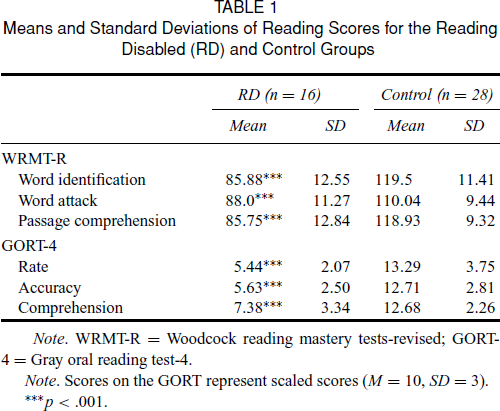
Note. WRMT–R = Woodcock reading mastery tests–revised; GORT– 4 = Gray oral reading test–4.
Note. Scores on the GORT represent scaled scores (M= 10, SD= 3).
***p <. 001.
A comprehensive reading battery was administered, which included the Word Identification, Word Attack, and Reading Comprehension subtests from the Woodcock Reading Mastery Test (WRMT–R; Woodcock, 1993) and the Rate, Accuracy, and Comprehension subtests from the Gray Oral Reading Test (GORT; Wiederholt & Bryant, 1992). In concordance with previous research on RD in children (e.g., Pennington & Lefly, 2001), the Word Identification and Word Attack subtests of the WRMT were administered as measures of decoding and the Rate and Accuracy subtests from the GORT were administered as measures of decoding skills. The Passage Comprehension (WRMT) and Comprehension (GORT) subtests were included as measures of reading comprehension.
Children were identified as having RD if they scored at or below one standard deviation on at least three out of six reading subtests administered. These cut–scores were established in accordance with standards typically used clinically as well as standards reported in the literature on children with RD (e.g., Catts, Adlof, Hogan, & Weismer, 2005). We further ensured that accurate identification was likely by making a classification of RD based upon poor performance in three or more reading measures. This resulted in identification of approximately half of the participants (51.9 percent) at genetic risk as RD and 12.0 percent of the controls as RD. These results are consistent with other genetic risk studies of children with RD (e.g., Gallagher et al., 2000; Scarborough, 1990). Of the 44 children participating in the present study, 16 (11 boys, 5 girls) were identified as having RD and 28 children (6 boys, 11 girls) tested as normal readers.
Other Measures
As part of the larger longitudinal study, cognitive measures were collected for both groups. Table 2 provides descriptive data for cognitive measures. Both groups were compared on cognitive performance using the Differential Ability Scales (DAS; Elliot, 1990) administered between 31 and 62 months. The average age of testing was 43 months. Efforts were made to test children as close to age 3 as possible. Thus, the great majority of children (n= 31) were tested between the ages of 31 and 42 months. When this was not possible, the examiners attempted to match the age of testing from the original control and risk samples. Therefore, the mean age of testing between the groups was similar; 42 months for the control group and 44 months for the RD group (t(42) =. 59, ns). The DAS is composed of six subtests that yield measures of general conceptual ability (GCA). In addition to a subtest of Early Number Concepts, the core subtests include Verbal Comprehension and Naming Vocabulary, which compose a Verbal Ability Composite, (VCOMP), and the Picture Similarities and Block Building, which compose a Special Nonverbal Composite (SNV). The SNV composite is provided for the lower age range for testing (30 months to 41 months). The VCOMP is available for the full range of testing ages. For the upper age extension (42 months to 59 month) a Nonverbal Cluster is composed of the Picture Similarities, Pattern Construction, and Copying subtests.
Means and Standard Deviations of Differential Abilities Scales Composite Scores for the Reading Disabled (RD) and Control Groups
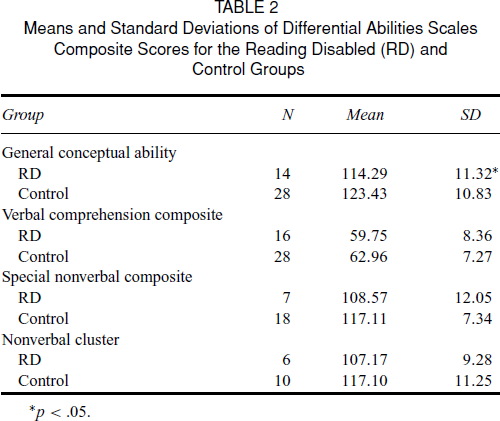
*p <. 05.
Multiple two–tailed t tests were utilized to examine group differences on these measures with Bonferroni comparisons applied to correct for the possibility of Type 1 errors (Portnoy & Watkins, 1993). Although the RD group evidenced a lower GCA score, both groups were performing above the average expected range, t(40) = 2.54, p <. 05. The overall mean for the RD group did not include scores for two participants who refused to complete all subtests. More importantly, performance on the VCOMP, t(42) = 1.34, indicated that there were no significant group differences. Additionally, analysis of nonverbal composites yielded no group differences at either the extended range of the DAS, t(14) = 1.82, ns, or at the lower level (SNV), t(23) = 2.18, ns.
Preliteracy Assessment
As stated earlier, the children were assessed at two points in time, first at the prekindergarten age and then again at the pre–first–grade age to determine the predictive accuracy of six preliteracy tasks (phonological awareness, alphabetic, and rapid naming skills) on later literacy outcomes. Six preliteracy tasks were administered in the Pre–K and Pre–1 sessions. These included a task of rhyme generation, a DIC task, two alphabetic tasks, and two rapid naming tasks. For the task of rhyme generation (following Stanovich, Cunningham, & Cramer, 1984), children were asked to generate as many rhymes as possible for word and nonword targets. This measure of rhyme was included as a proxy for large–segment awareness. In this task, a total of 10 words and 10 nonwords were presented to the child. The total number of words produced by the child was recorded. For the DIC task (following Stanovich et al., 1984), children were asked to produce new words by deleting the initial consonant of 10 target words. In this task, children were asked to repeat a word (e.g., “say bat”) and then asked to repeat that word without the initial consonant (e.g., “now say bat without saying ‘b’”). Two demonstration items were given in an instructional format. For the alphabetic measure two tasks were administered. The first task was a modified Brigance letter ID task (Brigance, 1990). Children were presented with letters arrayed randomly within four columns and asked to name each letter. Letters that were not named were noted, and then children were asked to point to these letters when they were named by the examiner. The total number of letters identified by naming or pointing was recorded as a letter ID score. The second alphabetic measure was a modified Brigance letter sound recognition task (Brigance, 1990). Children were asked to generate sounds associated with 15 consonant letters. The letters were presented in four columns. Two practice letters and their associated sounds were first presented to the child. Total number of correct consonant sounds provided by the child was recorded as a sound/symbol correspondence score. Finally, two RAN tasks were administered (Wolf, 1986). Initially, children were shown a practice card with a row of five colors in blocks. After ascertaining that children knew the colors of each block, they were then shown cards with blocks of colors presented in 5 rows of 10 (total of 50 colors). The children were shown the starting point at the top left corner and asked to name the colors in the rows as quickly as possible. When the children reached the end of the first row, cues (e.g., pointing) were given to start the second row if needed. The same procedure was followed for naming of objects (including the use of a practice card). Total time lapsed was recorded in seconds and accuracy of performance was recorded as the percentage of correct items. A measure of RAN for letters was not employed prior to kindergarten because not all of the children knew their letters at that juncture, thus reducing the possibility of confounding letter knowledge with RAN abilities.
Refusal to engage in any of the tasks resulted in a null value for that cell. As a result, the number of children completing each task varied slightly. Data were not available for the DIC task at the Pre–K and Pre–1 period for one child each in the RD and control groups, respectively. Two of the control children did not complete the letter ID task at the Pre–1 session.
Results
Reduction of Variables
Table 3 provides the bivariate correlations for the seven measures administered across the two sessions. Correlations were conducted to determine appropriate aggregation of variables that were theoretically related. These results indicated that generation of nonword rhyme and word rhyme measures were highly correlated (r2=. 75, p <. 001); therefore, an average of these two scores was entered as the variable rhyme for further analysis. Color and object naming times were also collapsed, based on their high correlation (r2=. 75, p <. 001) to yield a single RAN variable. The combined letter naming and letter pointing score of the Brigance were used to yield a single letter ID score. This resulted in five variables that were considered for further analysis: Letter ID, Sound/Symbol Correspondence, Rhyme, DIC, and RAN.
Bivariate Correlations Between Measures
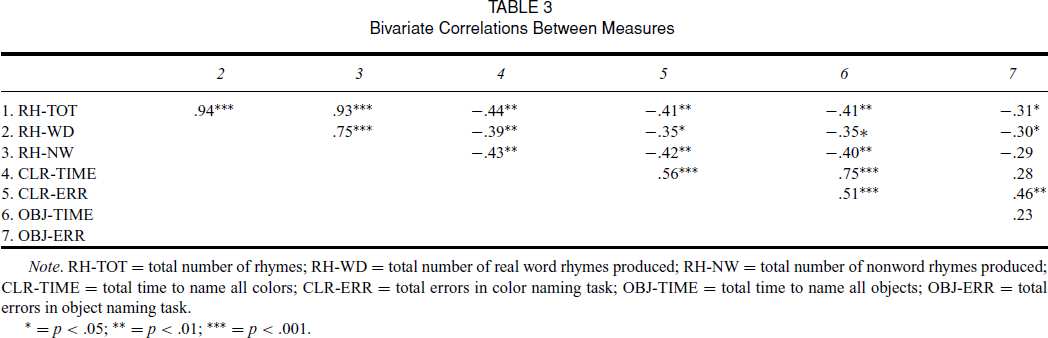
Note. RH–TOT = total number of rhymes; RH–WD = total number of real word rhymes produced; RH–NW = total number of nonword rhymes produced; CLR–TIME = total time to name all colors; CLR–ERR = total errors in color naming task; OBJ–TIME = total time to name all objects; OBJ–ERR = total errors in object naming task.
*=p <. 05; **=p <. 01; ***=p <. 001.
Data Analysis
Table 4 provides the means, standard deviations, effect sizes, and t–test results for the five variables for the RD and normally reading groups across the two test sessions. Multiple two–tailed t tests were utilized to examine group differences at each session. Bonferroni comparisons for multiple t tests were applied to correct for the possibility of Type 1 errors (Portnoy & Watkins, 1993). Additionally, fractional degrees of freedom indicate that between group variance was unequal and thus separate t values with adjusted degrees of freedom were used.
Means (and Standard Deviations) for Alphabetic, Phonological Awareness, and RAN Tasks
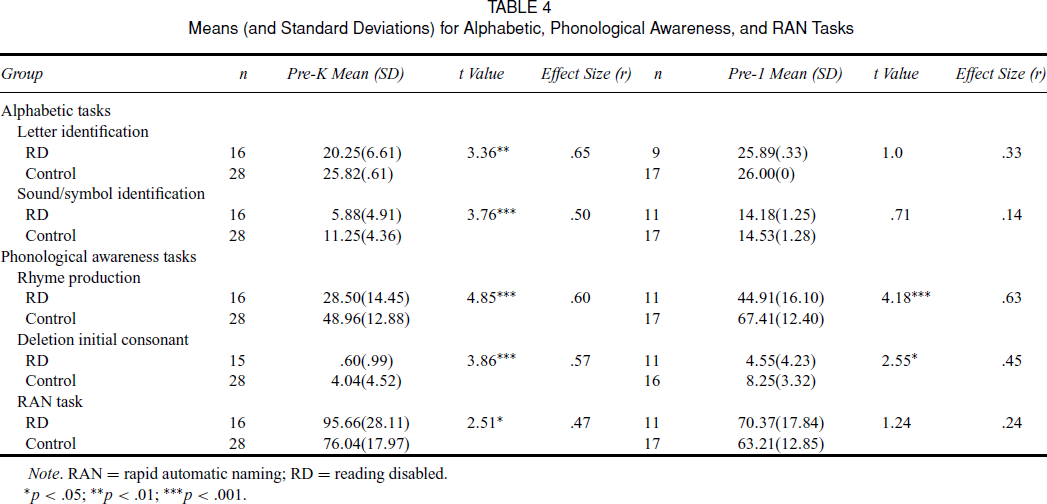
Note. RAN = rapid automatic naming; RD = reading disabled.
*p <. 05; **p <. 01; ***p <. 001.
Results indicated that there were significant group differences for all variables at the Pre–K test period, including Letter ID t(15.15) = 3.36, p <. 01, Sound/symbol correspondences = 3.76 (42), p <. 01, Rhyme, t(42) = 4.85, p <. 01, DIC, t(31.53) = 3.86, p <. 01, and RAN, t=−2.51(22.15), p <. 05. Across all five measures, means were greatest for the control group with the exception of the RAN scores. As expected, on this measure the RD group required more time to complete the task of naming colors and objects. Results of t tests conducted at the Pre–1 session indicated that there were significant group effects only for Rhyme, t(26) = 4.18, p <. 001, and DIC, t(25) = 2.55, p <. 05. There were no significant group effects found on the remaining four measures.
There were apparent floor effects for the DIC task at the Pre–K session as indicated by the relative difficulty on this task for both groups, who performed at less than 50 percent correct. By the Pre–1 testing, the control group no longer had difficulty on this task, although children who became RD continued to experience difficulty performing the task. Further inspection of the data for the Pre–K session revealed a dichotomous pattern of responses on this task such that children appeared to either perform the required task fairly well, or they appeared to be unable to respond correctly to very few items if any at all.
For example, at the Pre–K session, 28 out of the 42 participants achieved a score of 1 or below and 12 children had a score of 7 or higher. Only two of the children scored in between these values. Additional analyses were completed by categorizing Pre–K scores into three groups; as “good performers” (children who achieved a scores of 7 or better), “poor performers” (children who scored either a 2 or below), and “average performers” (children who did not fall into either category by scoring between 3 and 6 on the DIC task). Almost all of the children in the RD group (12 out of 13) fell proportionally in the “poor performer” group as opposed to about half of the control group (16 out of 29). Conversely, a greater number of children in the control group (12 out of 29) were “good performers” while no children in the RD group fell within this category. Chi–square statistics indicated that these differences were statistically significant, χ2(2, N= 43) = 26.0, p <. 001. Thus, floor effects on the DIC task appeared to be confined primarily to the children with RD, confirming that the task was more difficult for them to undertake than for controls. Interestingly, this dichotomous pattern of performance on the DIC task at the Pre–K session persisted through the second year as well. Similar results were seen with the Pre–1 DIC performance, where 8 out of 27 children were classified as “poor performers” and 16 were classified as “good performers.” Again, significantly more of the children with RD fell into the “poor performer” category (5 out of 11) than the control group (3 out of 16), and a greater proportion of the control children (13 out of 16) fell into the “good performer” category as opposed to only 3 out of the 11 children with RD, χ2(2, N= 27) = 9.556, p <. 01. These results highlight the inability of the children with RD to engage in a complex phonological awareness task (DIC), a difficulty that persists beyond the kindergarten year.
Overall, the results indicate that, first, performance on letter knowledge, phonological awareness (consonant deletion, rhyming), and RAN tasks differentiated the group of children later identified as RD and, second, that some of these differences were time sensitive during the prereading period. At the Pre–K testing period, children were already performing at high levels in the control group, whereas the children with RD performed significantly worse. After the kindergarten year, however, the performance of the RD group was similar to the performance level of the non–RD children on both letter knowledge and sound/symbol correspondence tasks. As shown in Figures 1 and 2, only in the two phonological awareness tasks of rhyme generation and consonant deletion did the performance of the RD and control groups continue to demonstrate a gap across both test sessions. For these two tasks, the RD group continued to perform more poorly than the non–RD group at both Pre–K and Pre–1 sessions. Figure 3 depicts group performances on the RAN task across test sessions. As illustrated in this figure, the RD group was significantly slower in their naming of colors and numbers than control children at the Pre–K testing, but while their naming times remained slower than control children at the Pre–1 session, they were not significantly different.
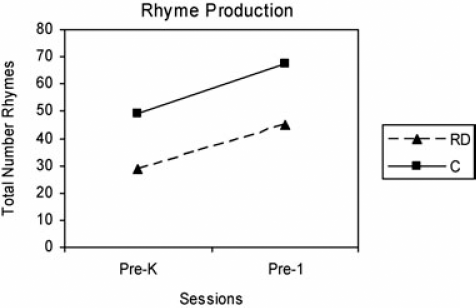
Total number of rhymes produced by reading disabled (RD) and control (C) groups across sessions.
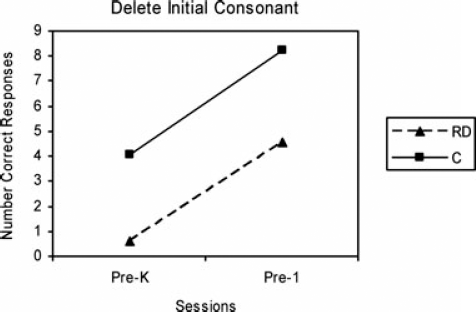
Percentage of correct responses on DIC task across sessions.
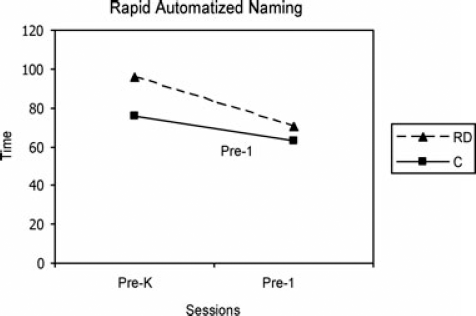
Average time on RAN task across sessions.
An exploratory analysis using discriminant function was employed to assess the ability of the variables to determine group placement. The analysis was run with RD group membership as the dependent variable, and Letter ID, Sound letter correspondence, Rhyme, DIC, and RAN were entered as predictor variables. A Wilk's Lambda indicated that group difference for the Pre–K session was significantly due to RD status, χ2(5) = 24.70, p <. 001. According to discriminant function coefficients reported in Table 5, all variables made significant contributions at the Pre–1 session and again, group differences were significantly due to RD status, χ2(5) = 16.23, p <. 01, however, this time only the rhyme production and the DIC tasks were significant contributors to group status. These findings suggest that, similar to findings reported earlier in this article, the relative importance of alphabetic skills (e.g., Letter ID) drops out after the kindergarten year. As seen in Table 5, there was a shift in the relative significance of rhyme production from the Pre–K to the Pre–1 session. The deletion initial consonant task also greatly shifted in the weight of its contribution between sessions, having a stronger influence at the Pre–1 session. Overall, the dependent variables successfully predicted group outcome for membership in 80.5 percent of the cases at the Pre–K session and in 91.7 percent of the cases at the Pre–1 session. Finally, as a caveat, results of this discriminant function analysis should be interpreted with caution, because a Box's test for equality of variances indicated significantly different variances at the Pre–K session (Box's M= 108.94, p <. 001).
Canonical Discrimination Functions Across Alphabetic, Phonological Awareness, and Rapid Automatic Naming Tasks
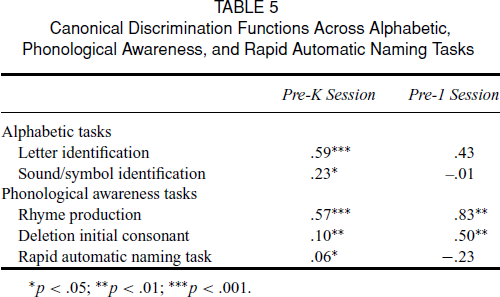
*p <. 05; **p <. 01; ***p <. 001.
Discussion
The results of this study show that, prior to kindergarten, children with RD were distinguished from their normally reading counterparts by their performance on tasks of letter knowledge, phonological awareness, and RAN. However, the primary finding indicates that, between these groups, only differences in skills related to phonological awareness persisted beyond the kindergarten year. In contrast with the time–related effects on letter knowledge performance and RAN, both measures of phonological awareness distinguished the RD group from the control group at Pre–K and Pre–1. These results are consistent with observations that phonological awareness is a strong predictor of RD in both children at general risk and genetic risk of reading difficulty (Frost et al., 2005; Lepola et al., 2005; Pennington & Lefly, 2001).
In this study, performance on a sound deletion task differentiated the control and RD groups at both the pre–K and pre–1 testing. While it is possible that floor effects apparent on the DIC task minimize these differences, further analysis indicated that it was more likely that the task was best analyzed dichotomously; children either “got” the task or they were unable to perform the task at all. In fact, in both groups, very few children scored in the mid–range on the DIC task. It is not inconsequential that a comparatively much larger proportion of the group with RD scored in the “poor” range (2 or less) on this task. Additionally, the RD group demonstrated persistent difficulties on this task during the Pre–1 session.
One possible explanation may be found in Wagner et al.'s (1993) investigation of latent phonological structures in kindergarteners. Wagner and colleagues found that tasks of phoneme analysis (e.g., phoneme deletion) and working memory (e.g., digit span) seemed to be tapped by a shared underlying source that was different than for tasks of phoneme synthesis (e.g., sound blending). They suggested that ability to blend sounds into words developmentally precedes the ability to recognize individual sound segments. Wagner et al. further iterated that phoneme analysis may reflect a deeper level of processing that is linked to the quality of phonological representation.
The relationship between rhyming, another measure of phonological sensitivity, and reading is perhaps more complex (Muter et al., 2004; Savage et al., 2006). The strong effect of rhyme production prior to first grade as a predictor of reading was somewhat surprising in the present study given evidence that rhyming skills do not appear to be a strong predictor at later preschool ages and beyond (Carroll et al., 2003; Muter et al., 2004). An explanation may be found in examining the specific nature of this task. In our study, rhyming was assessed with a generation task, during which children were asked to produce as many possible rhyming words or nonwords that they could when given a stimulus word. As ours was a rhyme production task, perhaps abilities at a more explicit are being tapped (see Carroll et al., 2003 for a similar argument). Explicit tasks, according to Carroll et al. (2003), are those tasks requiring phonological awareness knowledge at the phoneme level. Our results are supported by Muter et al. (2004), who discovered that factor loadings for later reading were higher for rhyme production than those for rhyme detection.
Additionally, findings in the present study indicate that children with RD experienced more difficulty than controls in deleting the initial phoneme from words, ostensibly another task tapping an explicit level of processing. Thus, the current findings related to rhyme production, taken together with differences in phoneme deletion performance, indicate that children who are later identified as having RD evidence differences in their phonological awareness skills that persist even after the kindergarten year.
In the present study, tasks of letter naming and sound/symbol correspondences were administered as tasks of letter knowledge. There were significant group differences at the beginning of kindergarten such that the RD group performed more poorly on both tasks. This is consistent with findings that prereading letter knowledge has been found to predict later decoding (Lonigan et al., 2000; Muter et al., 2004; Wesseling & Reitsma, 2001).
Differences between the performance of our children with RD and the control group on both letter ID and sound–symbol correspondences subsequently disappeared prior to the beginning of first grade. Similarly, Pennington and Lefly (2001) found that letter naming before the kindergarten year predicted later reading and that by first grade a shift occurred such that phonological awareness emerged as a more prominent predictor. However, in Pennington and Lefly's sample, children did not reach ceiling level on letter ID until prior to second grade. This shift occurred earlier for our RD groups, who performed at ceiling prior to first grade.
It is probable in the present study that in kindergarten the children received some instruction specifically addressing letter knowledge skills, thus improving performance of the RD participants on these tasks. It is also possible that the differences at Pre–K were, in part, an artifact of ceiling effects in the control group for letter naming. Rather than typifying a direct route to decoding, letter knowledge may serve to mediate other factors such as phonological awareness (Foy & Mann, 2001; Lonigan et al., 2000; Wagner et al., 1997). For instance, Lonigan and colleagues found a predictive relationship between measures of phonological sensitivity and letter knowledge in preschoolers. Thus, while letter ID may be a strong predictor of reading prior to kindergarten, results of this study indicate that the relationship may be fleeting, such that the ability of letter ID to identify children with RD after kindergarten may be limited. This is commensurate with past studies showing that developmental shifts occur in alphabetic knowledge in children with RD (Compton et al., 2006; O'Connor & Jenkins, 1999).
Another interpretation may be considered by taking into account Walsh, Price, and Gillingham's (1988) observation of differences between accuracy and fluency in letter naming. Walsh et al. (1988) found that when accuracy in letter naming was parsed from the speed at which children could read letters, the latter skill more strongly predicted later reading. We did not measure letter naming fluency, therefore we could not separate the effects of letter naming from letter naming speed in our data. However, Walsh et al. discovered that the relative predictive strength of speediness became weaker over time.
While converging evidence indicates that there is a linear association between phonological awareness and word–level reading, there have been mixed results in the literature in terms of the direct relationship between RAN and reading (Clarke et al., 2005; Compton, 2003; Neuhaus & Swank, 2002; Schatschneider et al., 2002; Waber, Wolff, Forbes, & Weiler, 2000). Wolf and colleagues (2002) posit a direct influence of RAN on reading, particularly word identification. In their study of severely impaired readers, Wolf et al. (2002) found that tasks of both phoneme elision and rapid naming of letters made unique contributions to variance in word identification and word attack tasks for second– and third–grade poor readers. The comparative contribution patterns were different for each task in that performance on phoneme elision played a much larger role in predicting word attack than RAN performance, and RAN performance was stronger in predicting word identification than phoneme elision. Wolf et al. (2002) concluded that RAN should not be considered as being under the umbrella of phonological processing tasks. The current findings do not necessarily refute this contention, as RAN was a significant predictor of reading outcome at the Pre–K period along with phonological awareness variables. Additionally, it is possible that more of the children in our sample evidence RD that are primarily phonologically based and would not be classified as children with a “double–deficit” in RAN and phonological awareness. Because children had not yet entered kindergarten at the beginning of the study, we did not include a measure of rapid letter naming, which has been shown to tap different processes than color or object naming (e.g., Walsh et al., 1988).
Finally, it is important to note the possible influence of other cognitive factors in reading outcome. While the difference between nonverbal measures of intelligence did not reach statistical significance, the means were lower for the group of children with RD than their normally reading controls. There is some evidence that measures of general intelligence have strong indirect effects on word–level reading (Floyd, Keith, Taub, & McGrew, 2007). However, it appears that measures of domain–specific abilities (e.g., phonological awareness) are, not surprisingly, more highly related to reading skills (Floyd et al., 2007; Shatil & Share, 2003), particularly word recognition (Shatil & Share, 2003).
Additionally, there may be shifts in domain–specific skills relative to intelligence level (Johnson & Morrison, 2007). For example, Johnson and Morrison (2007) recently discovered that poor readers with high IQs (>100) were poorer at reading nonwords than those with a low IQ (<100). The high–IQ group also showed a lack of regularity effect in reading high–frequency regular and irregular words, unlike their low–IQ counterparts. Johnson and Morrison interpreted this finding to mean that high–IQ readers are more likely to exhibit a phonologically based deficit. It is worth mentioning that all of the children with RD in the present study achieved standard scores higher than 100 on a measure of GCA. Thus, it is possible that, had children with lower IQs been included in both samples, the resultant patterns of phonological deficits in the RD group may have been weaker.
Summary and Conclusions
Outcomes of this study are in keeping with previous findings that letter knowledge distinguishes groups of RD and normally reading children early in their school years (e.g., Pennington & Lefly, 2001). However, while it may be tempting to equate early reading progress with such accomplishments in general alphabetic knowledge, our results further indicate that such skills may not be sufficiently sensitive to capture the requisite preliteracy skills missing in children with RD. As illustrated in our findings, children with RD no longer showed differences from controls on these tasks by the time they reached first grade. Furthermore, while the ability of rhyming to predict later reading has seen mixed results, (e.g., Muter, Hulme, Snowling, & Taylor, 1998) assessments of rhyming skills often include measures of rhyme awareness, thought to be one of the easier phonological awareness skills (Vloedgraven & Verhoeven, 2007). The present findings highlight rhyme production, ostensibly a more difficult task, as a prognostic indicator of RD.
Drawbacks of the current study include the small size of the participant groups, particularly the group of children with RD. The longitudinal nature of the larger study from which these data were drawn and the high level of family involvement requested may have limited the numbers of participants available. Despite these limitations, however, the results of this study are clearly consistent with studies having larger, and perhaps more diverse participant pools (Pennington & Lefly, 2001; O'Connor & Jenkins, 1999). A larger number of variables, particularly in the area of phonological awareness, would have been helpful in better defining the role, particularly of rhyme generation, as a predictor. However, although a greater number of variables may tease apart this relationship, the current findings strongly support the inclusion of phonological measures that are specific enough to identify those children at risk for RD.
These results have implications not only for initial assessment and identification, but also for how progress in early literacy skills is viewed. Acquisition of traditional early literacy skills such as alphabetic knowledge along with the developmental changes in skills such as rhyme generation and phonemic awareness provide a fuller profile from which to view the progress of preliteracy skills.
Acknowledgments
This research was supported by grants from the James S. McDonnell Foundation, the Cape Branch Foundation, and the Massachusetts Humane Society, awarded to the Neurolinguistics Laboratory at Massachusetts General Hospital. We are also extremely grateful to the families who participated in this project.