






Abstract
We evaluated whether having a naturally acquired mentor during adolescence was associated with improved adult outcomes among youth with learning disabilities (YLD). Mentored youth were more likely to have graduated from high school, reported a higher level of self–esteem, and reported a higher overall number of positive outcomes than nonmentored youth. Mentorship by teachers/guidance counselors was associated with larger differences in high school graduation rates and self–esteem compared to nonmentored youth whereas mentorship by nonteachers was associated with smaller changes in self–esteem and no differences in high school completion rates. Future research should include more in–depth, objective assessments of youths’ learning disabilities, consideration of interactions with concurrent risk factors, and efforts to clarify optimal strategies for mentoring support of YLD.
Mentoring relationships with nonparental adults are widely regarded as an important asset for promoting positive youth development and preparedness for successful transition to adulthood (America's Promise Alliance, 2006). Theory developed by Jean Rhodes and colleagues posits that once a bond is formed between a mentor and youth that involves trust, empathy and mutuality, the relationship has the potential to produce improvements in the youth's socioemotional, cognitive, and identity development (Rhodes, 2002, 2005; Rhodes, Spencer, Keller, Liang, & Noam, 2006). Gains in socioemotional development, in turn, are hypothesized to also produce improvements in relationships with parents and peers. These developmental and social gains are theorized to then contribute to positive outcomes such as academic performance, emotional well–being, and avoidance of involvement in problem behavior. Several different types of support have been suggested to mediate improvements in youth functioning that accrue from mentoring relationships, including role–modeling, emotional support, guidance/advice, and tangible or instrumental assistance with tasks such as school work or finding employment (America's Promise Alliance, 2006; McDonald, Erickson, Johnson, & Elder, 2007). Rhodes and colleagues (Rhodes, 2002, 2005; Rhodes et al., 2006) have also proposed that the effects of mentoring relationships may be moderated by several factors, including the length and quality of the relationship and the type of mentor.
In line with these theoretical perspectives, two recent meta–analyses found evidence that mentoring relationships for youth are associated with more favorable outcomes in a range of different areas (DuBois, Holloway, Valentine, & Cooper, 2002; Eby, Allen, Evans, Ng, & DuBois, 2008). Based on synthesis of findings from 40 studies comparing mentored and nonmentored youth, Eby et al. (2008) found that mentoring relationships were associated with significantly more favorable scores on measures of attitudes toward school, interpersonal relations, behavioral performance (e.g., academic achievement), and withdrawal behavior (e.g., skipping school). In their synthesis of 55 studies evaluating the effects of youth mentoring programs, DuBois et al. (2002) similarly found that mentored youth scored significantly higher on measures in each of the following domains: emotional/psychological, problem/high–risk behavior, social competence, academic/educational, and career/employment. In both studies, associations between mentoring and youth outcomes were modest in magnitude and generally did not exceed Cohen's suggested criteria for small effects (r=. 10 or d–index of standardized mean differences =. 20). In accordance with theory noted above, however, DuBois and colleagues (2002) did find that associations with positive outcomes were stronger for youth in programs who experienced higher–quality mentoring relationships based on criteria such as greater duration and more frequent contact, thus offering support for relationship factors as moderators of mentoring benefits as noted above. These investigators also found more favorable estimated effects on outcomes when programs targeted mentors with backgrounds in helping roles or professions (DuBois et al., 2002). In other research, mentoring relationships with teachers in particular have been found to be associated with, significant improvements in educational outcomes (Gastic & Johnson, 2009; Shanahan, Erickson, Valsey, & Smolen, 2007), thus suggesting that they may be especially well suited to promoting success within this arena.
Very little literature exists on the role of mentoring relationships specifically among youth with learning disabilities (YLD). In a review, McDonald, Balcazar, and Keys (2005) noted that available studies generally have reached favorable conclusions regarding the benefits of mentoring relationships for this population. Authors have specifically reported improvements in participants’ self–esteem (Buckner, 1993), social competence (Muscott, O'Brien, & College, 1999), academic performance and educational attainment (Buckner, 1993; Moccia, Schumaker, Hazel, Vernon, & Deshler, 1989), classroom conduct and performance (Buckner, 1993; Noll, 1997), employment and job–training skills (Ryerson–Espino et al., 2003; Taylor–Ritzler et al., 2001), and independent living skills (West, Targett, Steininger, & Anglin, 2001). However, as noted by McDonald et al. (2005), these investigations have several methodological limitations. These include samples sizes that included less than 50 mentored subjects (Buckner, 1993; Moccia et al., 1989; Muscott et al., 1999; Taylor–Ritzler et al., 2001; West et al., 2001), lack of a nonmentored comparison group (Buckner, 1993; Muscott et al., 1999; Noll, 1997; West et al., 2001), lack of longitudinal data (Buckner, 1993; Muscott et al., 1999; Noll, 1997; West et al., 2001) and, inclusion of youth with other types of disabilities (Muscott et al., 1999; Ryerson–Espino et al., 2003; Taylor–Ritzler et al., 2001; West et al., 2001).
Prior studies of mentoring relationships among YLD also have focused exclusively on mentoring relationships established through formal programs. Among youth in the general population, naturally acquired mentoring relationships (i.e., relationships that have been established outside of a program) have been found to be associated with improvements in a wide range of outcomes as well. In one study conducted by DuBois and Silverthorn (2005) using data from a nationally representative sample of 4,882 youth participating in the National Longitudinal Study of Adolescent Health (Add Health), positive associations between mentored status and improved outcomes were detected in the following categories: education/employment (increased odds of completing high school and attending college or working 10 or more hours per week), problem behaviors (decreased odds of being in a gang, hurting another in a fight, and engaging in risk–taking behaviors), psychological well–being (increased self–esteem and overall satisfaction with life), and physical health (increased physical activity and birth control use); youth were ages 18–26 years when outcomes were assessed. Mentors were reported from a variety of domains including nonparental family members, professionals (e.g., coaches, social workers), adults informally involved with the youth (e.g., teachers), and other types of adults. Studies of youth in another high–risk population—youth in foster care—similarly have found associations between natural mentoring relationships and improvements in outcomes across multiple domains of functioning using data from both the Add Health study (Ahrens et al., 2008; N= 310) and another longitudinal study of youth transitioning out of the foster system in Missouri (Munson & McMillen, 2009; N= 339).
This study had two primary objectives. Our first aim was to increase understanding of the descriptive characteristics of naturally occurring mentoring relationships among YLD. We focus in particular on relationship features indicated to be important moderators of the benefits of mentoring in research with other populations, including relationship duration, type of mentor and provision of different types of support within the relationship. The second objective was to investigate whether the presence of a natural mentoring relationship during adolescence is associated with improvements in young adult outcomes for YLD. In accordance with research on potential moderators of such associations, our analyses examine whether associations with outcomes are more apparent for mentoring relationships of longer reported duration as well as for those involving teachers or other school personnel. We address methodological limitations of earlier studies by focusing specifically on a population of YLD and by using data from a large, nationally representative sample taken from the Add Health study, thus allowing us to derive reliable descriptive information regarding the reported mentoring relationships of this population and to evaluate their associations with outcomes longitudinally.
Method
Study Design
The data for the present investigation come from the National Longitudinal Study of Adolescent Health (Add Health). This study includes a large, nationally representative sample of youth with three waves of data collected over 6 years. A sample of 80 high schools and 52 middle schools from the United States was recruited with unequal probability of selection. Systematic sampling methods and implicit stratification were incorporated to ensure that the resulting sample was representative of U.S. schools with respect to region of country, urbanicity, school size, school type, and ethnicity (Harris et al., 2008). Wave I, Stage 1 consisted of a staff administered questionnaire in schools when youth in the selected schools were in seventh to 12th grades (N= 90,118). In Wave I, Stage 2, computer–assisted face–to–face interviews with a trained interviewer were conducted with a subset of youth in the home environment approximately 1 year from the initial interview (N= 20,745); parent interviews were conducted during this stage as well. Wave II and Wave III interviews were conducted with the youth only approximately 2 and 6 years from the start of the study using the same procedure described above (N= 14,738 and 15,197, respectively (see Harris et al., 2008, for more details on the design of the Add Health study).
Sample
Youth were included if (1) there was complete data for a series of questions in Wave III regarding the presence of a mentor during adolescence, (2) a valid survey weight was available and (3) the youth's parent answered “yes” during the parent interview at Wave I to either of the following questions: “Does (he/she) have a specific learning disability, such as difficulties with attention, dyslexia, or some other reading, spelling, writing, or math disability?” or “During the past 12 months did (he/she) receive any type of special education service?” (N= 1,714). This definition is similar to that used with previous research on YLD using Add Health data (Blum, Kelly, & Ireland, 2001; Crosnoe, Riegle–Crumb, & Muller, 2007; Svetaz, Ireland, & Blum, 2000). Of the total sample of YLD, for criterion (3) 39 percent of youth qualified for inclusion in the sample based their parent answering “yes” to the question regarding having a “specific learning disability,” 45 percent answered “yes” to both questions and 17 percent qualified based on a parent reporting “yes” to the question regarding special education only. The YLD sample constituted 16 percent of the total Add Health study sample after design correction procedures. YLD were predominately male (65 percent) and their average age at the Wave I assessment was 16.0 years (SE =. 16). Of the total YLD sample, 54 percent were from urban settings and 46 percent were from nonurban (i.e., rural or suburban) settings.
Definitions
Mentorship Variable
As in a previous study using the Add Health data set (Ahrens et al., 2008), youth were considered mentored if they indicated “yes” to the following question: “Other than your parents or step–parents, has an adult made an important positive difference in your life at any time since you were 14 years old?” and then indicated in response to follow–up questions that the relationship had become important prior to age 18 years and had lasted for at least 2 years. Each youth reporting a mentor also was asked to indicate the role of this individual in his or her life. Based on previous research (Klaw, Rhodes, & Fitzgerald, 2003; Rhodes et al., 1994), any youth who reported that the person was a younger sibling or spouse was excluded from the “mentored” category. A total of 303 participants answered “yes” to the initial mentorship question but did not meet one or more of the additional criteria and were therefore excluded from the mentored group. A majority were excluded because the relationship had not lasted for more than 2 years (234 youth); smaller percentages were excluded due to the other criteria. Youth who answered “yes” to the initial question regarding mentoring but who were subsequently excluded from the mentored group because they failed to fulfill one of the other criteria subsequently will be referred to as “partially mentored” participants. Although grouped with other nonmentored youth in main study analyses, supplemental analyses examined the extent to which findings were sensitive to this decision.
Variables Used to Describe Mentoring Relationships
For youth who fit our definition of mentored, we examined responses to several questions from the mentoring portion of the Wave III assessment to better understand the descriptive characteristics of the relationships these youth had with their mentors. These questions addressed the duration of the relationship as well as both the frequency of contact between the youth and mentor (range of possible responses =“not at all:, “less than once a year,”“about once a “year,”“every few months,”“about once a month,”“about once a week,”“2–5 times a week,” and “almost every day”) and the closeness of their relationship (range of possible responses =“not close at all,”“only a little close,”“somewhat close,”“quite close,” and “very close”) at the time of the Wave III assessment. We also calculated the percentages of youth reporting different types of mentors (i.e., family member, teacher or guidance counselor, other professional, informal mentor such as a friend or coach, or other). In addition, in the Add Health survey, each youth who answered “yes” to the initial mentoring question was asked to answer an open–ended question about how his or her mentor had been helpful. Based on a framework used in two previous studies (Ahrens et al., 2008; McDonald et al., 2007), we coded statements into the following nonexclusive categories for all youth who met our criteria for being mentored: guidance/advice, emotional support, role modeling, tangible/instrumental support, and parental figure. Two of the study authors independently coded all the statements (Kappa coefficient of agreement ranging from. 68 to. 94 for the five categories), and differences were resolved through discussion.
Outcome Variables
We evaluated outcomes in four categories that are important domains of adjustment during early adulthood: education/employment, psychological well–being, physical health, and participation in unhealthy behaviors. All outcome measures were dichotomized to allow for comparison of findings across domains of functioning and with other populations of youth in previous studies (Ahrens et al., 2008; DuBois & Silverthorn, 2005). Outcomes examined for each domain included:
Education/employment: Outcomes for this domain included completion of high school (Y/N), participation in postsecondary education (Y/N; defined as current enrollment in a 2–or 4–year college program, previous higher education degree, or previous or current enrollment in a vocational program of at least 3 months duration), and a combined outcome of working 10 or more hours per week and/or currently being in any type of school (Y/N). Psychological well–being: Outcomes for this domain included an index of self–esteem (average of 4 items on a 5–point scale; coefficient alpha =. 73; dichotomized at median; see Ahrens et al., 2008; DuBois & Silverthorn, 2005), a depression scale (average of 9 items from the Center for Epidemiologic Studies Depression “CES–D” scale; alpha =. 80; dichotomized at median; see Ahrens et al., 2008), and a question regarding suicidal ideation within the past year (Y/N). Physical health: Outcomes for this domain included perceived general health (5–point scale; dichotomized between excellent/very good and good/fair/poor), level of physical activity in the past week (average of 7 questions; alpha =. 66; dichotomized at median), body mass index (BMI; calculated from self–report of height and weight; dichotomized at a BMI of 25), and having been diagnosed with a sexually transmitted disease (STD) within the past year (Y/N). Participation in unhealthy behaviors: Outcomes for this domain included youth reports of drug use in the past year (Y/N), ever belonging to a gang (Y/N), hurting someone in a physical fight in the past year (Y/N), arrest after age 18 years (Y/N), regular, current smoking (Y/N; defined as any participant reporting a history of regular smoking and having smoked in the past month; this definition was employed in order to distinguish youth with consistent smoking patterns from those with an experimentation pattern or who did not smoke at all), and drug use (Y/N; defined as use of drugs other than alcohol and marijuana as large proportions of the sample reported binge drinking and/or smoking marijuana, 49 percent and 34 percent, respectively, thus suggesting that these behaviors were normative).
Summary measure
We also computed a summary index of the youth's overall functioning/adjustment to early adulthood as in a prior study using Add Health study data (Ahrens et al., 2008). This score represented the participant's number of favorable outcomes out of the 15 measured. In computing this measure, all outcomes were coded in a positive direction (e.g., participation in postsecondary education, the absence of suicidal ideation).
Covariates
Covariates included gender, race, ethnicity, parental education level, parental income level, average neighborhood household income level (derived from U.S. Bureau of the Census data for the youth's neighborhood as identified at Wave I; see Billy, Wenzlow, & Grady, 1998, for details) and measures of the quality of youths’ relationships with their mothers and peers. All of these variables have been theoretically or empirically associated with the propensity of youth to report natural mentoring relationships, thus making them important to control in analyses predicting youth outcomes from mentoring. The measure of the mother–child relationship consisted of an average of five items (alpha =. 86; example item: “How close do you feel to your mother?”). The peer connectedness variable consisted of one question, “How much do you feel that your friends care about you?”
For each outcome, our analyses also controlled for baseline (Wave I, Stage 1) status with an appropriate measure when available. For example, in the education/employment category, the control for both the “participation in postsecondary education” and “completion of high school outcomes” outcomes was the youth's average self–reported grades at Wave I. The number of these baseline control variables with favorable scores also was computed and used as a control variable for the summary measure outcome. Linear or scaled baseline measures not dichotomized in the analyses of individual outcomes were dichotomized for the purposes of computing the summary measure at baseline. These measures were all dichotomized in the same manner as the corresponding Wave III outcome except for the following variables: average grades (dichotomized at median) and BMI (dichotomized at the age–specific, gender–specific 85th percentile).
Analysis
Stata SE version 9 was used for all analyses. Prior to conducting the study, we calculated our power to detect an association between having a mentoring relationship and one outcome in each category (participation in postsecondary education, self–esteem, perceived general health, and drug use in the past year outcomes). In all instances we found our power to be adequate (80 percent or greater) at a significance level of p <. 05.
The ICE multiple imputation program (Royston, 2005) with predictive matching was used to impute missing data for all variables, except the following which were excluded for theoretical reasons: the questions used to identify YLD, the questions used to identify mentored youth, race and ethnicity variables, BMI variables at both baseline and Wave III, and the arrest variable. In addition, the “current work or school” variable was added as an outcome after we performed the imputation procedure described above, and therefore contains some missing data. Imputation has been advocated as a technique to improve accuracy of analyses using self–report interview data for which there are missing values (Fox–Wasylyshyn & El–Masri, 2005; Rhaghunathan, 2004). After the above procedure, descriptive statistics for Wave I baseline characteristics were computed for four groups: youth in the general population, youth who fit our definition of YLD, mentored YLD, and nonmentored YLD. Wave I characteristics were compared for YLD vs. general population youth and mentored vs. nonmentored YLD. We also calculated and compared descriptive statistics on the Wave III outcome measures for general population youth and YLD. Effect sizes were computed for any significant group differences that were found in the preceding analyses by calculating the d statistic (Cohen, 1988; Cox, 1970). For this statistic, effect sizes of around. 2 are generally considered small, around. 5 are considered moderate, and. 8 and greater are considered large (Cohen, 1988). For youth who fit our definition of mentored, we also computed descriptive statistics for the mentoring relationship variables pertaining to relationship length, closeness, and frequency of contact, type of mentor, and support role(s) played by the mentor. We also evaluated calculated the proportions of youth reporting each of the different types of support (i.e., guidance/advice, emotional support, role–modeling, tangible support, and/or parental support) varied based on what type of mentor they reported (i.e., whether they reported that their mentor was a family member vs. teacher vs. professional vs. informal mentor vs. other).
Multiple logistic regressions then were performed to determine whether the reported presence of a natural mentor was a predictor of each outcome for YLD after taking into account the contributions of all covariates (i.e., we compared mentored YLD with nonmentored YLD). For the two educational outcomes (i.e., participation in postsecondary education and completion of high school) as well as the summary outcome measure, 25 youth who indicated that they were still in high school were excluded from the analysis. For participants with missing data for the other nonimputed outcome variables (e.g., BMI, arrest) were given a predicted score for the missing variable based on the participant's other outcomes in order to allow for comparison with participants with complete data. This technique is similar to using a propensity score, a strategy that has been used to improve accuracy of results in observational studies (Little & Rubin, 2000).
We performed four sets of sensitivity analyses to determine the robustness of our results from analyses predicting Wave III outcomes. First, linear or polychotomous logistic regressions were performed on any outcomes that were originally continuous or ordinal, respectively, to determine whether results changed when the data were used in their original form. Second, we recomputed the primary regression analyses with “partially mentored” participants excluded from the analyses instead of placing them in the “nonmentored” category. Third, we examined whether regression findings differed when the minimum duration of mentoring relationships was varied from two years to either one or three years. Fourth, we repeated the analyses using different criteria to define our YLD population. The revised criterion was that to be included the youth's parent had to have responded “yes” to the question regarding the youth having a specific learning disability (i.e., we did not include youth for whom the parent reported only involvement in special education).
Finally, we performed two sets of exploratory analyses. In the first set, we sought to further evaluate the relationship between mentoring and educational outcomes among YLD. Specifically, we assessed whether mentored and nonmentored youth had differential rates of participation in specific types of postsecondary education (i.e., participation in a 2–year, 4–year, or advanced degree program versus participation in a vocational program to evaluate the association between mentoring relationships and these specific educational outcomes). The second set of exploratory analyses examined whether associations with outcomes were differentially evident for youth who were mentored by a teacher or guidance counselor. In these analyses, we replaced our mentorship variable with two dummy variables (mentored by teacher/guidance counselor versus nonmentored and mentored by person other than teacher/guidance counselor vs. nonmentored) and reran all analyses. In accordance with prior research, our focus was on identifying instances in which associations with outcomes were significant for youth mentored by a teacher/guidance counselor and in these cases whether the corresponding association was potentially either nonsignificant or notably smaller in magnitude for youth mentored by other types of persons. For all study analyses, procedures developed by investigators conducting the Add Health study were used to correct for design effects and unequal selection probability in order to ensure unbiased results (Chantala & Tabor, 1999).
Results
Wave I Characteristics
The Wave I characteristics of YLD, the mentored and nonmentored subgroups of YLD, and youth in the general population are presented in Table 1. There were several significant differences between general population and YLD youth, most of which were in the direction of increased risk for YLD youth. Specifically, youth in the YLD sample were more likely to be male, reported feeling on average less connected with peers, were less likely to have a parent who reported having some college experience, and came from families with lower parent–reported annual incomes. YLD also reported poorer grades, scored higher on the depression scale, reported poorer general health, had a higher BMI, and scored higher on the delinquency scale than did their general population peers. With the exception of gender (d=. 42), the statistically significant differences between general population and YLD youth were small in magnitude (i.e., ds <.20). There were several significant differences between the demographic characteristics of mentored and nonmentored YLD as well. Compared to nonmentored youth, mentored YLD were on average younger, had more educated parents, lived in neighborhoods with a higher average household income, and had a different distribution across racial/ethnic categories although similar proportions were Caucasian versus nonwhite. Mentored YLD also had a higher average reported level of physical activity than nonmentored YLD. Once again, these differences were small in magnitude, with the exception of the differences in ethnicity and racial distribution for which there were larger differences.
Baseline Characteristics of Youth with Learning Disabilities (YLD), Mentored and Nonmentored (Wave I, Stage, 1)
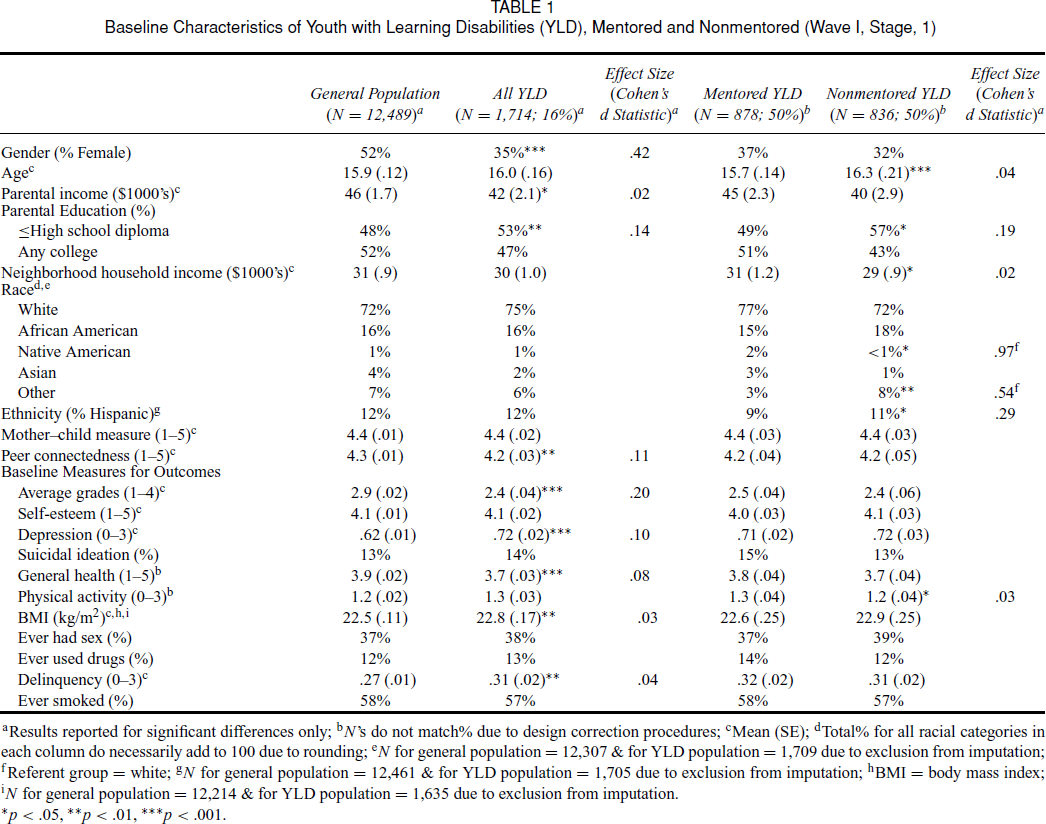
Results reported for significant differences only; bN's do not match% due to design correction procedures; cMean (SE); dTotal% for all racial categories in each column do necessarily add to 100 due to rounding; eN for general population = 12,307 & for YLD population = 1,709 due to exclusion from imputation; fReferent group = white; gN for general population = 12,461 & for YLD population = 1,705 due to exclusion from imputation; hBMI = body mass index; iN for general population = 12,214 & for YLD population = 1,635 due to exclusion from imputation.
*p <. 05, **p <. 01, ***p <. 001.
Wave III Outcomes for General Population versus YLD Youth
As shown in Table 2, in comparison to general population youth, YLD youth overall were significantly less likely at Wave III to report having a high–school diploma, participating in postsecondary education, or working/being currently enrolled in school. They also scored significantly higher on the depression scale, rated their general health as worse, had a higher BMI, and reported higher rates of risk behaviors including hurting someone else in a fight, being arrested, and being a current, regular smoker. The differences in educational and work outcomes were in the moderate to large range (d statistics ranging from. 43 to.65), whereas the remainders were smaller.
Comparison of Wave III Outcomes and Mentored Status for General Population Youth and Youth with Learning Disabilities
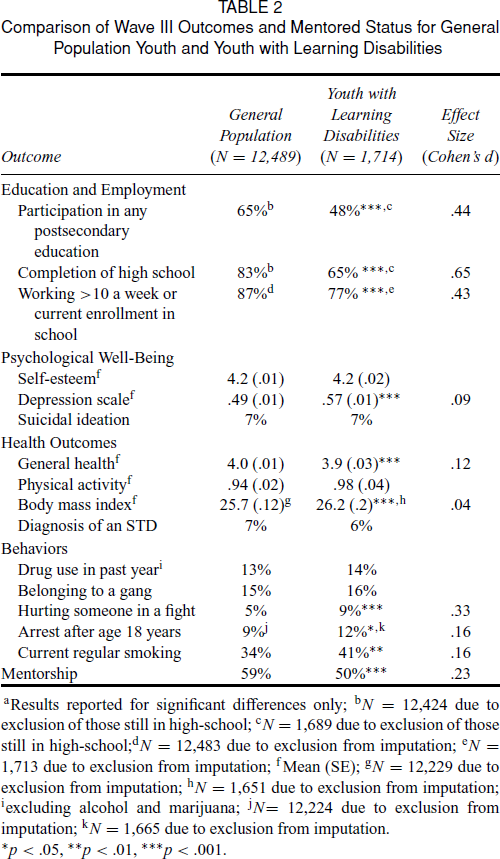
Results reported for significant differences only; bN= 12,424 due to exclusion of those still in high–school; cN= 1,689 due to exclusion of those still in high–school;dN= 12,483 due to exclusion from imputation; eN= 1,713 due to exclusion from imputation; fMean (SE); gN= 12,229 due to exclusion from imputation; hN= 1,651 due to exclusion from imputation; iexcluding alcohol and marijuana; jN= 12,224 due to exclusion from imputation; kN= 1,665 due to exclusion from imputation.
*p <. 05, **p <. 01, ***p <. 001.
Mentoring Relationship Characteristics
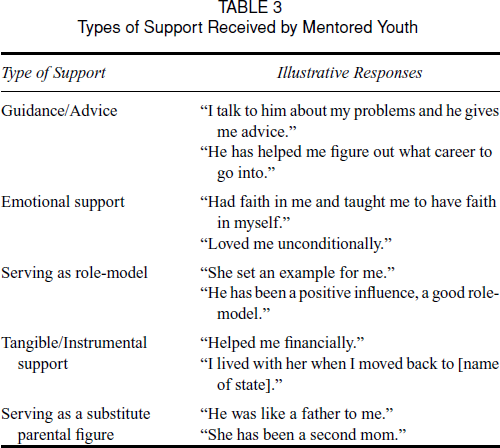
YLD overall were significantly less likely than youth in the general population to report having been mentored according to study criteria (50 percent vs. 59 percent, respectively). The average length of the mentoring relationships reported by mentored YLD was 9.5 years (SE =. 3). Most youth (61 percent) reported feeling either “quite close” or “very close” to their mentors; nearly three–quarters (73 percent) reported that they currently saw their mentors at least every few months, with 43 percent reporting contact on a weekly basis. Most often mentors were nonparental family members (40 percent; most commonly older siblings or aunts/uncles). Smaller percentages reported mentorship by teachers or guidance counselors (19 percent), other professionals such as doctors or ministers (4 percent) and other nonfamilial mentors (32 percent; most commonly described as friends); the remainder were in the “other” category (5 percent). In their responses to the open–ended question, mentored YLD most frequently indicated that their mentors provided guidance and/or advice (52 percent), followed by emotional support (51 percent). Fewer mentors were described as providing the other types of support: role–modeling (11 percent), tangible/instrumental support (18 percent), and serving as a substitute parental figure (5 percent). We found that these percentages did not vary greatly by mentor type (i.e., regardless of which type of mentor a youth reported, they were most likely to indicate they had received guidance/advice and emotional support, with much smaller percentages reporting the other types of support). Examples of statements made by mentored YLD from each of these categories is included in Table 3.
Types of Support Received by Mentored Youth
Comparison of Mentored versus Nonmentored YLD on Wave III Outcomes
Results of the multiple logistic regressions examining mentored status as a predictor of each of the individual outcomes at Wave III for YLD are presented in Table 4. Compared to nonmentored YLD, mentored YLD were significantly more likely to report having graduated from high–school and more likely to score above the median on the self–esteem scale. No other significant associations were evident between mentored status and outcomes. For the combined outcome measure, mentored youth reported a significantly higher number of positive outcomes than nonmentored youth, although this difference was small (4.02 vs. 3.76; p <. 05).
Association Between Mentoring and Outcomes for Youth with Learning Disabilities
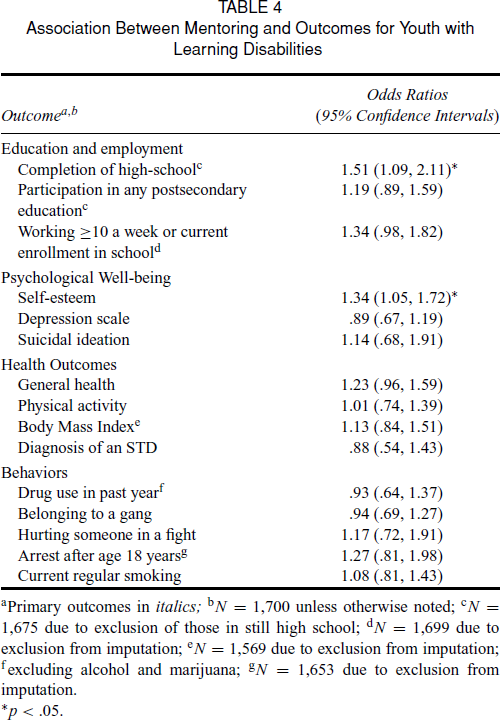
Primary outcomes in italics;bN= 1,700 unless otherwise noted; cN= 1,675 due to exclusion of those in still high school; dN= 1,699 due to exclusion from imputation; eN= 1,569 due to exclusion from imputation; fexcluding alcohol and marijuana; gN= 1,653 due to exclusion from imputation.
*p <. 05.
Results of our sensitivity analyses revealed similar point estimates compared with the above analyses in all instances. Results remained significant for the high school completion and self–esteem outcomes in all analyses as well. In the analyses that excluded partially mentored participants, mentored status also remained significantly associated with the combined outcomes measure. However, when a 1 or 3 year cutoff was used for the definition of mentored status, this association became nonsignificant. In addition, in analyses in which partially mentored participants were excluded or a 3 year cutoff was used, the association between mentored status and the current work or school outcome became significant in the positive direction. Finally, in the analysis using the alternate definition of a learning disability to define our sample, there was a significant positive association between mentored status and participants’ ratings of their general health.
Exploratory analyses focused on specific types of postsecondary education revealed that mentored youth were significantly more likely to participate in postsecondary education (a 2–year, 4–year, or advanced degree program) than nonmentored youth when vocational training was excluded from this outcome (OR 1.52, CI 1.07–2.15; p <. 05). Mentored youth participated in a vocational program at similar rates to nonmentored youth (OR 1.06, CI. 77–1.46). In the analyses in which we focused specifically on youth mentored by a teacher or guidance counselor, we found that odds ratios comparing these youth to nonmentored youth were significant and positive for both high school completion (OR 2.53, CI 1.31–4.90, p <. 01) and self–esteem (OR 1.52, CI 1.01–2.28, p <. 05). In comparison, youth who were mentored by persons other than a teacher/guidance counselor did not differ significantly from nonmentored youth with respect to high school completion (OR 1.37, CI. 95, 1.99, p=. 093), but did report higher self–esteem (1.31, CI 1.01, 1.70, p <. 05).
Discussion
To our knowledge, this is the first study to either describe or evaluate relationships between YLD and their naturally acquired mentors (our two main objectives for this study). We found that YLD were mentored by a wide variety of different types of adults, including nonparental family members and other adults involved with youth in both professional and informal capacities. This finding parallels those of other studies using the same data set that have focused on general population youth (McDonald et al., 2007) and on another population of youth with special needs—youth in foster care (Ahrens et al., 2008). Regardless of their type of relationship to the youth, mentors were reported most often to have helped youth by providing them with guidance and advice, which is as might be expected for a population of youth experiencing learning difficulties. This type of support was reported less often in the previously studied populations of youth (Ahrens et al., 2008; McDonald et al., 2007), suggesting that natural mentors may be tailoring their support to the needs of YLD.
When we evaluated the outcomes of mentored and nonmentored YLD, we found significant linkages between reports of having had a mentoring relationship with any type of adult during adolescence and improved outcomes in two specific domains—education (high–school completion) and mental health (improved self–esteem) and on a summary measure representing the overall functioning of the youth across multiple domains. In our sensitivity analyses, the findings for high–school completion and self–esteem were consistently robust to variations in scoring of outcome measures and in the criteria used for determining mentored status and for defining our sample of YLD. The evidence for benefits of mentoring relationships for YLD for these two outcomes thus appears to be especially strong. Additionally, the finding that participation in a 2–year, 4–year, or advanced degree program also was significantly associated with mentored status in our exploratory analyses further suggests that mentoring relationships provided significant support to YLD in the educational domain. Of further note in this regard is the finding that an association between mentored status and high school completion was evident only when the mentor was a teacher or guidance counselor. Similar to prior research (Gastic & Johnson, 2009; Shanahan et al., 2007), this finding suggests that teachers and other adults at school may be especially likely to provide mentoring that facilitates educational success for young people.
Previous studies of mentoring relationships among the general population (DuBois & Silverthorn, 2005) and youth in foster care (Ahrens et al., 2008) using the Add Health data have found associations with a broader array of positive outcomes. Similarly, those studies that have evaluated formal mentoring programs for YLD (Buckner, 1993; Moccia et al., 1989; Muscott et al., 1999; Noll, 1997; Ryerson–Espino et al., 2003; Taylor–Ritzler et al., 2001; West et al., 2001) have collectively indicated improvements in a wide range of areas, although it is important to note that the methodological limitations of these studies limit the conclusions that can be drawn from them (McDonald et al., 2005). Additionally, the difference in the summary outcome measure comparing mentored versus nonmentored YLD was smaller than was seen in the study of youth in foster care (Ahrens et al., 2008) and became nonsignificant in some of our sensitivity analyses. Collectively, these considerations suggest that naturally acquired mentoring relationships may be functioning in a more modest, focused manner for YLD in comparison to other groups (e.g., youth in the general population and youth in foster care) and possibly as well in comparison to formal mentoring programs specifically designed for YLD. This possibility notwithstanding, the evidence of benefits of naturally acquired mentoring relationships for educational attainment is noteworthy given both the trend toward poorer outcomes in this area for YLD (Fairweather & Shaver, 1991; Wagner & Blackorby, 1996) and the well–documented negative health correlates of failing to complete high school or a postsecondary degree program (Alliance for Excellent Education, 2006; Goesling, 2007; National Center for Education Statistics, 2004; Wong et al., 2002). The potential for improved self–esteem in association with mentoring among YLD similarly should be considered in the context of research that has linked feelings of self–worth with reduced risk for a wide range of negative outcomes, including mental health problems, health risk behaviors, and school dropout (for a review, see DuBois & Tevendale, 1999). Even limited contributions of mentoring to improvements in these areas thus could potentially have substantial consequences for the long–term outcomes and well–being of YLD.
The present research has several limitations. Because the design was observational we cannot draw firm conclusions in terms of causality. It is possible that both reports of a mentoring relationship and improved educational or emotional outcomes were a function of a third factor such as better overall social functioning. However, we did include control variables assessing baseline quality of the youth's peer relationships and mentored and nonmentored YLD did not differ on this measure. Second, although results have been interpreted as pertaining to natural mentoring relationships, some percentage of the relationships reported could have been cultivated via a formal mentoring program. Among general population youth who report having a mentoring relationship, however, only a small minority appear to have been established through a formal program (America's Promise Alliance, 2006; Keller et al., 2007). In addition, the presence of a learning disability was based on parent report and we were unable verify these reports with more objective data sources or adequately assess disability severity. It is noteworthy in this regard that the proportion of YLD we found to be participating in postsecondary education in our sample (48 percent) was higher than in previous research (30 percent; Fairweather & Shaver, 1991), suggesting that our sample may have included youth with less severe YLD compared with other studies. Finally, it was beyond the scope of this study to assess the potential impacts of other types of risk factors among YLD (for example, exposure to early childhood maltreatment, interparental violence, family disruption, life stress, and/or poverty). It is possible, in particular, that support offered via mentoring relationships could interact with such risk factors to buffer or attenuate their effects on outcomes for YLD. Future research should address the foregoing limitations through use of more controlled designs, objective assessments of learning disability status and severity, and incorporation of additional measures of risk factor exposure.
In conclusion, results of this investigation suggest that naturally acquired mentoring relationships experienced during adolescence contribute to improved educational outcomes and self–esteem among YLD as they transition into adulthood. Such relationships may be more circumscribed in their benefits for YLD in contrast to those established through formal mentoring programs. Our results should be viewed as preliminary and clearly underscore the need for further investigation of the potential impacts of mentoring relationships for this population. Such research should focus on identifying the intervention strategies and broader policies that are likely to best actualize the potential that both naturally and programmatically acquired mentoring relationships have to promote the long–term health and success of YLD.
Acknowledgments
This project was supported by an award to Dr. Ahrens from the Young Investigators Grant Program from the Ambulatory Pediatrics Association and by the following NIHT32 grants: 5T32PE010002 and 5T32MH020021. We thank the authors of Add Health; Ming–Yu Fan for help with the development and execution of the statistical methods for this project; Jim Mercy for help in developing our violence–related outcomes; Steve McDonald for sharing work with the open–ended mentoring question; and Patrick Royston for modifying the ICE program to allow us to use survey commands.