






Abstract
This study examined the school perceptions and educational aspirations of 6,599 rural high school students, a sample that included 428 students with learning disabilities (LD). Regardless of disability status, rural high school students who had negative perceptions of school had less well–defined postsecondary educational plans and less often aspired to complete college or pursue an advanced degree. Compared to nondisabled youth, rural students with LD were more likely to have negative perceptions of school and lower postsecondary aspirations. However, students with LD who had positive perceptions of school more often planned to pursue postsecondary education and aspired to complete college or an advanced degree. Implications for research and interventions pertaining to the educational attainment of students with LD are discussed.
Generally, the educational attainment of students with learning disabilities (LD) tends to lag behind that of their nondisabled peers. Compared to nondisabled youth, students with LD are less likely to complete high school (Kortering & Christenson, 2009) and to pursue or complete postsecondary educational or vocational training (Blackorby & Wagner, 1996; Phelps & Hanley–Maxwell, 1997; Wells, Sandefur, & Hogan, 2003). Truncated patterns of educational attainment for students with LD may be related to their postsecondary aspirations. Students with LD are more likely to be indecisive about their postsecondary educational and occupational plans and they appear to be less likely to aspire to high–prestige occupations that require sustained postsecondary education and training (Rojewski, 1996, 1999). However, very little is known about high school factors that contribute to students’ aspirations, particularly for students with LD. It is possible that how students with LD perceive high school may influence their desire to continue their education after school. Such perceptions may include students’ academic self–concept (i.e., believing in one's academic worth or capabilities), school valuing (i.e., viewing school as a pathway for later opportunities in life), and school belonging (i.e., feeling valued, respected, and supported in school) as various models indicate these perceptions influence students’ educational plans, aspirations, achievement, and school completion (e.g., Bandura, 2001, 2006; Connell & Wellborn, 1991; Eccles & Midgley, 1989; Eccles & Roeser, 2010; Finn, 1989; Lent, Brown, & Hackett, 1994; Osterman, 2000).
Yet, research on high school students’ educational attainment and postsecondary aspirations has largely focused on sociological and economic variables (Cooper, 2009). As a result, relatively little is known about how students’ perceptions of school are related to their aspirations. It seems reasonable that students’ educational self–concepts and their views of schooling may be linked to their achievement and their postsecondary goals (Crosnoe, Riegle–Crumb, & Muller, 2007; Hampton & Mason, 2003). If this is the case, it may help explain why students with LD have lower levels of educational attainment. Students with LD tend to have relatively low levels of academic self concept (Baird, Scott, & Dearing, 2009; Stone & May, 2002; Zeleke, 2004) and valuing or belonging to school (Dunn, Chambers, & Rabren, 2004; Reschly & Christenson, 2006). It is possible that students who view school negatively and who have low academic self–concept are less inclined to complete high school or to continue their education after high school (Kortering & Braziel, 2002). Therefore, to the extent that students with LD are more likely to have negative perceptions of school, it is likely that they may have constrained postsecondary aspirations compared to nondisabled peers.
The goal of the present study was to examine linkages between school perceptions and postsecondary aspirations in a national sample of rural high school students that included a substantial number of students with LD. Typically, research on educational outcomes has focused on youth from metropolitan areas. However, compared to metropolitan youth, students from rural schools are likely to have lower levels of educational and occupational attainment (Hardré & Sullivan, 2008; Roscigno & Crowley, 2001). Further, several studies have suggested that students with LD in rural areas have elevated levels of school dropout rates and inauspicious postsecondary outcomes compared to their nondisabled peers (deBettencourt, Zigmond, & Thorton, 1989; Dunn & Shumaker, 1997; Karpinski, Neubert, & Graham, 1992; Schalock, Holl, Elliott, & Ross, 1992). Yet, relatively little is known about the high school adjustment of rural students with LD, and there is a tremendous need for research that clarifies factors that are related to their postsecondary educational and occupational plans (Sheehey & Black, 2003).
Because this study focused on three distinct components of perceptions of school (i.e., academic self–concept, school valuing, school belonging), it was determined that cluster analytic procedures would permit the identification of subtypes of youth who had similar profiles of high school perceptions. The use of configurations compared to variable– oriented procedures provides a clearer picture of how distinct factors may come together to collectively contribute to specific outcomes in student development (Bergman & Trost, 2006; Cairns & Rodkin, 1997). Thus, rather than examining how academic self–concept, school valuing, and school belonging are individually related to students’ aspirations, the current analyses explore how distinct profiles of school perceptions are differentially related to students’ postsecondary aspirations.
Accordingly, this study was guided by five specific research aims. The first aim was to examine whether disability status was related to students’ educational plans. It was expected that students with LD would more often be unsure of their educational plans or not plan to continue their education beyond high school. The second aim was to examine whether disability status was related to students’ educational aspirations. It was expected that students with LD would have lower educational aspirations. The third aim was to examine whether rural high school students with LD differed from nondisabled peers in terms of configurations of perceptions of high school derived from school valuing, school belonging, and academic self–concept. It was expected that students with LD would be more likely to have profiles that were characterized by negative perceptions of school (e.g., lower school valuing, school belonging, and academic self–concept) while nondisabled students would be more likely to have profiles that would be characterized by positive perceptions (e.g., higher school valuing, school belonging, and academic self–concept). The fourth aim was to examine whether students’ high school perception profiles were related to their educational plans. It was expected that, regardless of disability status, students who had profiles of negative perceptions of school would be less likely to have plans to continue their education after high school. The fifth aim was to examine the relationship between students’ school perception profiles and their specific aspirations. Again, it was expected that profiles of negative school perceptions would be associated with truncated levels of postsecondary aspirations.
Method
The current study is part of a broader national investigation to examine students’ school adjustment and postsecondary aspirations in rural high schools across the United States. Youth in grades 9–12 were recruited from 73 schools. According to the new urban–centric locale codes developed by the National Center for Education Statistics, 89 percent of schools were from rural locale codes (41, 42, and 43) and 11 percent from small–town codes (31, 32, and 33). Thirty–six schools had 50 percent or more students who were eligible to receive free or reduced lunch and 15 schools had 50 percent or more students who were identified as ethnic minority. Participants in the overall sample were 51.5 percent female and 48.5 percent male. In terms of ethnicity, the largest ethnic and racial groups included Whites (61 percent), Hispanics or Latinos (11 percent), African Americans (7 percent), and Asian Americans (3.6 percent). Another 12 percent of the students selected multiple ethnic categories.
As agreed upon by the university Institutional Review Board, recruitment and consenting procedures followed participating districts’ local policies and administrative guidelines. In some districts, active consent procedures were used and a parental consent form was sent home with students. In these schools, students were allowed to participate only if they returned a signed parental consent form (unless they were legally emancipated). In other districts, passive consent procedures were used and a consent form was sent home to notify parents of the study. If parents did not want their children to participate, they were asked to return a signed form indicating this. All participating students also completed an assent form as part of their participation in the broader survey on their postsecondary aspirations and school adjustment.
Participants
For the current study, all students (n= 8,104) with complete data on academic self–concept, school valuing, and school belonging were included in cluster analyses to derive configurations of rural high school students’ perceptions of school. The purpose of the current study was to examine the relation between perceptions of school and postsecondary aspirations for students with LD and their nondisabled peers. Therefore, the sample for the current analyses consisted of 428 participants with LD (185 girls, 243 boys) and 6,171 nondisabled participants (3,359 girls; 2,807 boys; 5 unknown). Participating students with LD were more often male, χ2(1, N= 6,594) = 20.38, p <. 001, Cramér's V=. 06, and African American, χ2(1, N= 6,599) = 12.52, p <. 001, Cramér's V=. 04. All participants with LD were so identified by their school district. This study was conducted in 34 states and the definitions and identification procedures for LD were specific to the participating districts. See the Appendix for the criteria for the determination of LD in states across sample schools and the number of participants with LD within those states.
Data Collection Procedures
Following a protocol that has been used with middle– and high school students for nearly two decades, data were collected in a group administration format (e.g., Estell, Farmer, Cairns, & Cairns, 2002; Estell et al., 2007; Farmer, Estell, Bishop, O'Neal, & Cairns, 2003; Farmer & Hollowell, 1994). Consented participants were gathered in their school's cafeteria and were assigned alternating seats such that no student was directly beside or across from another student. They were informed about confidentiality and told that they were not required to participate and that they could withdraw from the study at any time. The instructions for completing the surveys and the individual survey items were read aloud by a trained administrator. Additional research staff provided mobile monitoring to assist students. The student surveys took an average of 45 min to complete. Small–group or individual assessments were conducted with students identified by teachers as having reading or writing difficulties, thus requiring accommodations. Small–group or individual assessments were done in separate administrations that did not draw attention to the students. Less than 1 percent of participating students were provided with this accommodation, thus accommodations had a minimal role in the results. Students who participated in the study received a special pencil for participation.
Measures
Multiple measures were used to assess students’ perceptions of school and their postsecondary aspirations. Specific measures are briefly described below.
Academic Self–Concept
Students were asked to rate how good they were in several subjects including math, science, English/language arts, social studies, and other classes on a seven–point scale (1 =not good at all to 7 =very good). This measure was adopted from and used by Jodl, Michael, Malanchuk, Eccles, and Sameroff (2001) who found that the measure correlated with school valuing, educational expectations and aspirations, and career aspirations. We undertook a factor analysis that indicated that these five items formed a single factor that accounted for 50 percent of the variance. Item loadings ranged from. 52 to. 79. Cronbach's alpha indicated that internal consistency reliability was. 73 in our sample, which was similar to the. 78 reported by Jodl et al. (2001). Items were coded such that a higher score was indicative of a higher academic self–concept. The composite score was obtained by computing the mean rating across items.
School Valuing
Twelve items on a six–point Likert–type scale (1 =strongly disagree to 6 =strongly agree) were included to assess participants’ value for school and whether they viewed it as a pathway for later opportunities in life. These items were adapted from previous measures created by Voelkl (1996), Lapan, Gysbers, and Petroski (2001), and Jodl et al. (2001), and used in studies by Voelkl (1997) and Finn and Frone (2004), which demonstrated that these measures predicted academic achievement and classroom engagement. Factor analyses indicated that these student–report items formed two factors. The first was future school value as the seven items that loaded on this factor referred to the future value of school. For example, these items included “most of what I learn in school will be useful when I get a job,”“the kind of education I'm getting here will help me later on,” and “dropping out of school would be a huge mistake for me.” These items accounted for 39 percent of the variance and item loadings ranged from. 54 to. 82. Cronbach's alpha indicated that internal consistency reliability was. 85. The second factor was present school value as these five items referred to participants’ current views regarding the value of school. For example, these items included “many of the things we learn in class are useless” and “school is often a waste of time.” These items accounted for 14 percent of the variance and item loadings ranged from. 62 to. 73. Cronbach's alpha demonstrated that internal consistency reliability was. 74. Items on both factors were coded such that a higher score was indicative of higher future and present school value. The composite score was obtained by computing the mean rating across items.
School Belonging
School belonging was captured by an abbreviated 11–item scale (Hagborg, 1994, 1998) derived from an initial measure developed by Goodenow (1993a, b). Specifically, Hagborg (1994, 1998) conducted factor analyses of the Goodenow (1993a, b) measure, which showed that the items formed a single factor and deleted items with low factor loadings. The 4–week test–retest reliability of the 11–item version was. 69 (Hagborg, 1998) and it was found to strongly correlate (r=. 95) with the original Goodenow scale (1993 a, b). This measure assessed the extent of personal belonging, respect, and support that students feel in school. Participants indicated on a five–point Likert scale (1 =completely false to 5 =completely true) how true the following types of statements were: “feel a real part of my school,”“included in lots of activities at my school,” and “treated with as much respect as other students.” Factor analyses confirmed that these student–report items formed a single factor, which accounted for 52 percent of the variance. Item loadings ranged from. 54 to. 79. According to Cronbach's alpha, internal consistency reliability was. 91. Items were coded such that a higher score was indicative of higher school belonging. The composite score was obtained by computing the mean rating across items.
Educational Plans
Participants’ educational plans were measured by an item asking students to indicate if they planned to continue their education beyond high school. Response options included “yes,”“no,” and “not sure.” This item was adapted from and has been used in numerous large–scale studies, such as the National Longitudinal Study of the High School Class of 1972 and the Education Longitudinal Study of 2002 (ELS:2002), and by various researchers (e.g., Alexander & Cook, 1979; Sewell & Shah, 1968).
Educational Aspirations
Participants’ educational aspirations were captured by an item asking students to rate how far in school they would most like to go (1 =“less than high school” to 7 =“M.D., Ph.D., or other advanced degree”, or “don't know”). This measure has been used in other large–scale survey studies, such as the National Education Longitudinal Study of 1988 (NELS:88) and ELS:2002, and other research (e.g., Kao & Tienda, 1998). Some options had few responses so these were collapsed into adjacent response options. The final measure used in analyses included the following categories: high school diploma/GED or less, attend but not complete college, graduate from college, obtain an advanced degree, and don't know.
Data Reduction
Configurations of School Perceptions
The first aim was to identify distinct configurations of school perceptions. These were derived to identify subtypes of students with unique patterns of school perceptions from participating students’ self–reports on academic self–concept, future school value, present school value, and school belonging. To facilitate analyses and interpretation, scores were first standardized by transforming values to z scores. Configurations of school perceptions were then derived using Ward's (1963) clustering algorithm. It should be noted that all student participants in the larger project with data on these measures were included in the identification of the school perception configurations.
With this method, the similarity between students’ profiles was measured by squared Euclidean differences to determine homogeneous subgroups of students. The number of configurations to retain was decided by examining a scree plot of distance coefficients as a function of the number of configurations at each agglomerative step and practical considerations such as cell size, theoretical interpretability, and utility (cf. Aldenderfer & Blashfield, 1984; Bergman, Magnusson, & El–Khouri, 2003; Milligan, 1981; Milligan & Cooper, 1985). Analyses indicated that a six–cluster solution was optimum. The inclusion of more clusters did not increase explanatory power more than a minimal amount. The clusters are shown in Table 1.
Configurations of School Perceptions
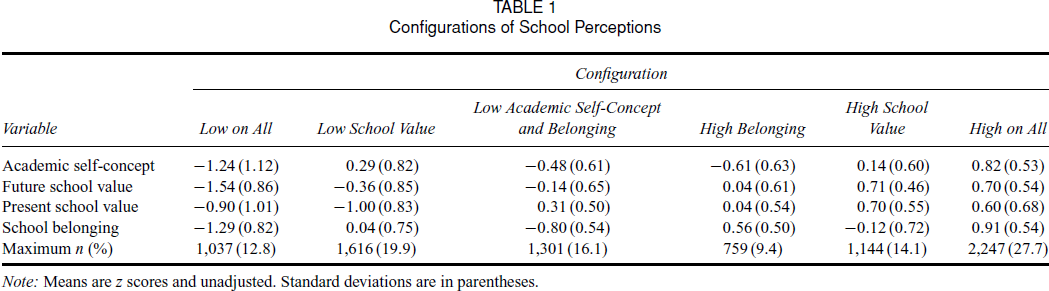
Note: Means are z scores and unadjusted. Standard deviations are in parentheses.
The clusters that emerged were
Low on all: well below average academic self–concept, future school value, present school value, and school belonging. Low school value: above average academic self–concept, below average future school value, well below average present school value, average school belonging. Low academic self–concept and belonging: below average academic self–concept, average future school value, above average present school value, and well below average school belonging. High belonging: well below average scores on academic self–concept, average future and present school value, above average school belonging. High school value: average scores on academic self–concept, well above average future and present school value, and average school belonging. High on all: well above average scores on academic self–concept, future and present school value, and school belonging.
Analysis Plans
Subsequent analyses examining the relationships between these variables involved contingency table analyses because the configurations of school perceptions, disability status, and educational plans and aspirations are categorical. The first and second aims examined whether disability status was related to educational plans and aspirations while the third aim examined whether students without and with LD were in different configurations. Therefore, these three research aims entailed a multiway analysis examining the association between two variables each with several values. Thus, the chi–square statistic was used to determine whether there was an overall relationship between the variables. If there was a relationship, then Fisher's exact probability was employed for cell–wise analyses to clarify which specific cells had an observed count that was significantly different from the expected count for that cell. The fourth and fifth aims examined whether students’ high school perception profiles were related to their educational plans. Similar analytic procedures were followed. However, it is important to note that the analyses to address these last aims were undertaken separately for students without and with LD. This is because contingency table analyses can only directly test the association between two variables (i.e., school perception configurations and educational plans or aspirations). Therefore, disability status would constitute a third variable. In addition, comparing selected cells between students without and with LD would provide misleading results as the expected cell counts would be inaccurate. That is, the expected cell counts are derived from the row, column, and grand totals and comparing selected cells between students without and with LD would use incorrect totals.
Results
The following sections summarize the results for each of the research aims. Each section corresponds with one of the guiding research aims of this study.
Relation of Disability Status to Students’ Educational Plans
This section examines the relation of disability status to students’ more concrete educational plans regarding whether they planned to continue their education beyond high school. Because an overarching aim of this study was to compare youth with LD and students without a disability, the analyses in this and following sections only involved participants with LD and those without a disability. That is, participants with other or multiple disabilities were excluded from subsequent analyses. There was a significant overall relation between disability status and educational plans, χ2(2, N= 6,544) = 115.72, p <. 001, Cramér's V=. 13. All cell–specific relations were significant. Specifically, participants without a disability were less often not planning to (4.6 percent) or unsure (5.3 percent) as to whether they planned to continue their education beyond high school (Fisher's exact probability ≤ .001 and ≤ .001, respectively) than expected by chance. Participants without a disability more often planned to continue their education beyond high school (90.1 percent, Fisher's exact probability ≤ .001) than expected by chance. In contrast, participants with LD were more likely to indicate that they were not planning to (9.6 percent) or unsure (16.6 percent) as to whether they planned to continue their education beyond high school (Fisher's exact probability ≤ .001 and ≤ .001, respectively) than expected by chance. Participants with LD were also less likely to indicate that they planned to continue their education beyond high school (73.7 percent, Fisher's exact probability ≤. 001) than expected by chance.
Relation of Disability Status to Students’ Educational Aspirations
This section examines the relation of disability status to students’ more idealized educational aspirations regarding how far they would most like to go in their education. There was a significant overall relation between disability status and educational aspirations, χ2(4, N= 6,542) = 194.45, p <. 001, Cramér's V=. 17. All cell–specific relations were significant. Importantly, participants without a disability more often aspired to graduate from college (36.2 percent) or obtain an advanced degree (39.4 percent) (Fisher's exact probability ≤ .05 and ≤ .001, respectively) than expected by chance. Participants with LD more often aspired to obtain a high–school diploma or General Education Development (GED) only (11.5 percent) and attend but not complete college (25.9 percent) (Fisher's exact probability ≤ .001 and ≤ .001, respectively) than expected by chance. In addition, participants with LD more often did not know the level of education they aspired to attain (15.3 percent) (Fisher's exact probability ≤ .001) than expected by chance.
Relation of School Perception Configurations to Disability Status
This section examines the relation of the school perception configurations to disability status. There was a significant overall relation between the school perceptions and disability status, χ2(5, N= 6,599) = 87.90, p <. 001, Cramér's V=. 12. As shown in Table 2, there were six cell–specific relations. Participants without a disability were less often in the low–on–all configuration (Fisher's exact probability ≤ .001) than expected by chance. Conversely, youth with LD were more often in the low–on–all configuration (Fisher's exact probability ≤ .001) than expected by chance. Likewise, participants without a disability were less often in the low–school–value configuration (Fisher's exact probability ≤ .05) whereas youth with LD were more often in the low–school–value configuration (Fisher's exact probability ≤ .05) than expected by chance. Finally, youth without disabilities were more often in the high–on–all configuration (Fisher's exact probability ≤ .001) while youth with LD were less often in the high–on–all configuration (Fisher's exact probability ≤ .001) than expected by chance.
Relation of School Perceptions Configurations to Disability Status
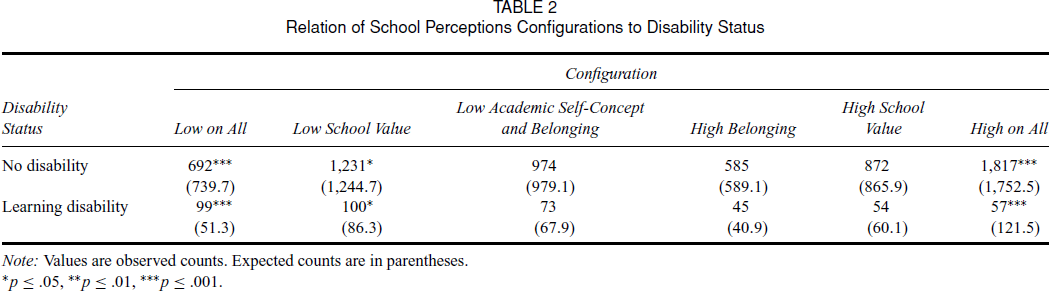
Note: Values are observed counts. Expected counts are in parentheses.
*p≤. 05, **p≤. 01, ***p≤. 001.
Relation of School Perception Configurations to Students’ Educational Plans
This section examines the relation of the school perceptions configurations to students’ educational plans. Analyses were undertaken separately for participants without a disability and those with LD. There was a significant overall relation between the school perceptions configurations and educational plans for students without a disability, χ2(10, N= 6,129) = 849.93, p <. 001, Cramér's V=. 26. As shown in Table 3, there were numerous cell–specific relations. For example, nondisabled youth in the low–on–all and low–school–value configurations more often did not plan to continue their education beyond high school (Fisher's exact probability ≤ .001 and ≤ .05, respectively) than expected by chance. Nondisabled youth in the low–academic–self–concept–and– belonging configuration were more often not sure about their plans to continue their education (Fisher's exact probability ≤ .05) than expected by chance. Nondisabled youth in the high–belonging, high–school–value, and high–on–all configurations were more often planning to continue their education beyond high school (Fisher's exact probability ≤ .001) than expected by chance.
Relation of School Perceptions Configurations to Educational Plans for Nondisabled Youth
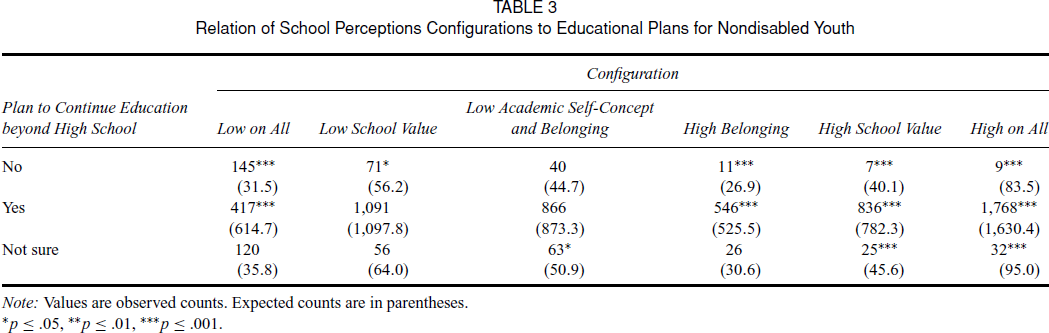
Note: Values are observed counts. Expected counts are in parentheses.
*p≤. 05, **p≤. 01, ***p≤. 001.
There was also a significant overall relation between the school perceptions configurations and educational plans for students with LD, χ2(10, N= 415) = 36.14, p <. 001, Cramér's V=. 21. As shown in Table 4, there were several cell–specific relations. Participants with LD in the low–on–all configuration were more likely to indicate that they did not plan to continue their education beyond high school (Fisher's exact probability ≤ .001) than expected by chance. Conversely, students with LD in the low–on–all configuration were less likely to report that they planned to continue their education beyond high school (Fisher's exact probability ≤ .001) than expected by chance. Youth with LD in the high–belonging and high–school–value configurations less often planned not to continue their education (Fisher's exact probability ≤ .01 and ≤ .05, respectively) than expected by chance. In addition, youth with LD in the high–school–value configuration more often planned to continue their education beyond high school (Fisher's exact probability ≤ .05) than expected by chance. Finally, youth with LD in the high–on–all configuration were also more likely to plan to continue their education beyond high school (Fisher's exact probability ≤ .05) and were less often not sure (Fisher's exact probability ≤ .01).
Relation of School Perceptions Configurations to Educational Plans for Youth with Learning Disabilities
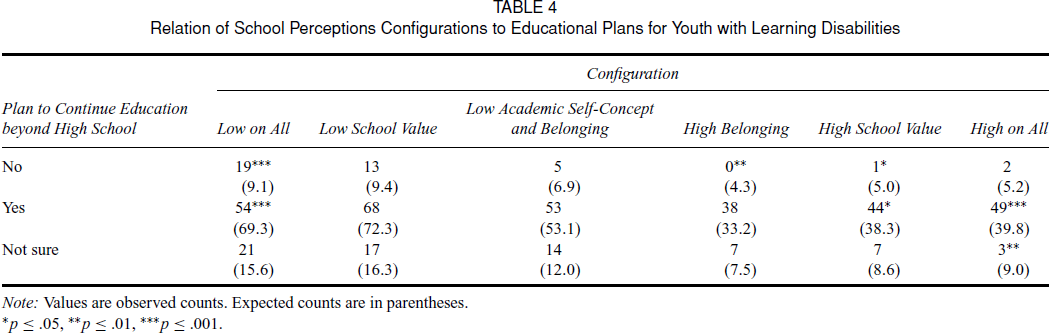
Note: Values are observed counts. Expected counts are in parentheses.
*p≤. 05, **p≤. 01, ***p≤. 001.
Relation of School Perception Configurations to Students’ Educational Aspirations
This section examines the relation of the school perceptions configurations to students’ educational aspirations. As with the above analyses addressing the fourth aim, analyses were undertaken separately for participants without a disability and those with LD. There was a significant overall relation between the school perceptions configurations and educational plans for students without a disability, χ2(20, N= 6,125) = 1,365.61, p <. 001, Cramér's V=. 24. As shown in Table 5, there were numerous cell–specific relations. For example, nondisabled youth in the low–on–all configuration more often aspired to obtain a high school diploma or GED only (Fisher's exact probability ≤ .001), attend but not complete college (Fisher's exact probability ≤ .001), and did not know how far they wanted to go in their education (Fisher's exact probability ≤ .001) than expected by chance. Nondisabled youth in the low–on–all and low–academic–self–concept–and–belonging configurations more often aspired to attend but not complete college (Fisher's exact probability ≤ .001) and less often wanted to obtain an advanced degree (Fisher's exact probability ≤ .001) than expected by chance. Nondisabled youth in the high–belonging configuration more often aspired to attend (but not complete) and graduate from college (Fisher's exact probability ≤ .01 and ≤ .001, respectively) than expected by chance. Nondisabled youth in the high–school–value and high–on–all configurations more often wanted to obtain an advanced degree (Fisher's exact probability ≤ .001 and ≤ .001, respectively) than expected by chance.
Relation of School Perceptions Configurations to Educational Aspirations for Nondisabled Youth
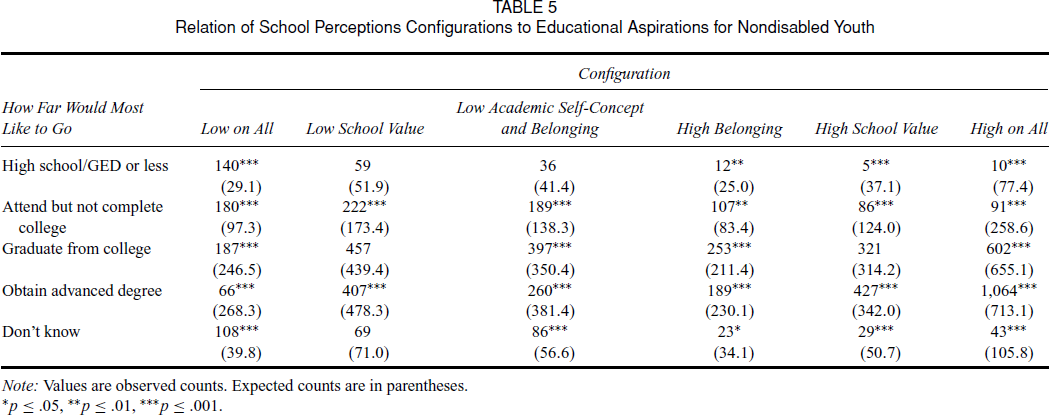
Note: Values are observed counts. Expected counts are in parentheses.
*p≤. 05, **p≤. 01, ***p≤. 001.
There was also a significant overall relation between the school perceptions configurations and educational plans for students with LD, χ2(20, N= 417) = 61.86, p <. 001, Cramér's V=. 19. As shown in Table 6, there were several cell–specific relations. Perhaps most importantly, participants with LD in the low–on–all configuration were more likely to aspire to obtain only a high school diploma or GED (Fisher's exact probability ≤ .001) and less often wanted to graduate from college or obtain an advanced degree (Fisher's exact probability ≤ .01 and ≤ .01, respectively) than expected by chance. In contrast, students with LD in the high–school–value configuration more often aspired to graduate from college and obtain an advanced degree (Fisher's exact probability ≤ .01 and ≤ .05, respectively) than expected by chance. Furthermore, students with LD in the high–on–all configuration more often wanted to obtain an advanced degree (Fisher's exact probability ≤ .01) than expected by chance.
Relation of School Perceptions Configurations to Educational Aspirations for Youth with Learning Disabilities
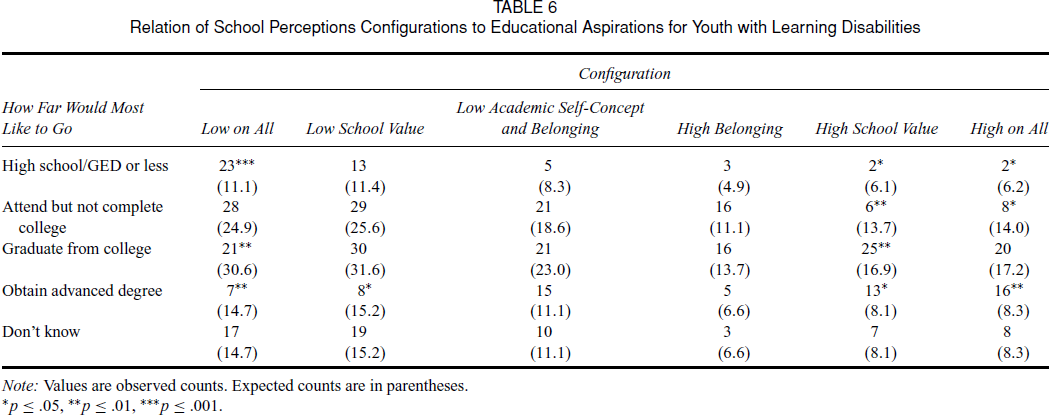
Note: Values are observed counts. Expected counts are in parentheses.
*p≤. 05, **p≤. 01, ***p≤. 001.
Discussion
By focusing on the school perceptions and aspirations of a national sample of rural high school students, this study builds upon and extends other research on the school adjustment and postsecondary educational goals of students with LD. Consistent with investigations of the educational plans and aspirations of adolescents with LD (e.g., Rojewski, 1996, 1999), rural high school students with LD were more likely to be unsure of their postsecondary plans and less likely to plan to continue their education after high school as compared to nondisabled students. Likewise, as compared to nondisabled students, rural high school students with LD were less likely to aspire to complete a 4–year or advanced degree and they were also less likely to know the level of education that they hoped to attain.
Why do rural students with LD have plans that are less clear for education after high school, and why do they report lower postsecondary aspirations as compared to their nondisabled peers? The current study was not designed to examine causal relations and did not focus on how students developed their educational plans and goals. Therefore, this question cannot be answered directly with the current data and analyses. However, the findings on the relation between perceptions of school and postsecondary aspirations may provide insight into factors that contribute to students’ educational plans and goals.
Reflecting research that suggests that high school students with disabilities are at risk for becoming disengaged in school (Reschly & Christenson, 2006), the current findings indicate that rural high school students with LD are at increased risk for having negative perceptions of school. Compared to nondisabled students, students with LD were more likely to have low school perceptions. The finding that rural high school students with LD tend to have relatively low perceptions of school is consistent with studies of the school disengagement of this population. Several studies have shown that many youth with LD perceive high school as not meaningful to their futures and have elevated levels of academic disengagement and school dropout (Kortering & Braziel, 2002; Kortering & Christenson, 2009; Reschly & Christenson, 2006). Thus, disentangling the relation between perceptions of school and postsecondary aspirations may not only provide important information for advancing the educational attainment of students with LD beyond school, it may also yield critical insights into preventing these students from dropping out of school.
Regardless of disability status, rural high school students who had low school perceptions were less likely to plan to attend college and had lower postsecondary educational aspirations. In addition, for both nondisabled students and students with LD, rural youth who had high positive perceptions of school were more likely to have plans to continue their education after high school and to aspire to complete 4–year or advanced postsecondary degrees. True to the heterogeneity of LD, students with LD were, in fact, distributed across all school perception configurations. These students were also distributed across all educational plan and aspiration groups. Though many do, it would be inaccurate to assume that all students with LD have negative school–related perceptions and, therefore, have limited educational plans and aspirations. Specifically, more than one–third of participants with LD were in the high–belonging, high–school–value, or high–on–all configurations. Perhaps more importantly, when students with LD were in the high–school–value and high–on–all configurations they more often planned to continue their education beyond high school. Likewise, when students with LD were in the high–school–value and high–on–all configurations they more often wanted to graduate from college or obtain an advanced degree. Yet, youth with LD were less often in the high–on–all configuration and more often did not plan on continuing their education beyond high school, wanted a high school diploma or GED only, and wanted to attend but not complete college.
Thus, it appears that differences in the postsecondary plans and goals of students with LD and nondisabled youth may rest in the relation between high school perceptions and postsecondary aspirations. It is possible that low perceptions result in low aspirations or that youth with low aspirations do not see much meaning and value in high school. It is also possible that there are other factors involved that mediate or moderate the links between school perceptions and postsecondary aspirations. Whatever the case, this appears to be an important area of inquiry as researchers work to identify ways to enhance the educational attainment of students with LD. As research efforts move forward, it is necessary to clarify why some students do not follow expected negative trajectories and maintain a strong interest and focus on their educational attainment (Feinstein & Peck, 2008). Such prodigal analyses can be critical in the identification of buffers that promote resilience in youth who experience potential developmental risks (Cadwallader, Farmer, & Cairns, 2003; Englund, Egeland, & Collins, 2008; Peck, Roeser, Zarrett, & Eccles, 2008).
When considered in light of the research on school engagement, the current findings suggest that the relation between students’ perceptions of school and their postsecondary educational plans and aspirations may be pivotal in high school completion. Aspirations refer to plans and goals for the future that are worth working toward in the present. They are important because they guide behavior in the direction of the goals (Bandura, 1986; Hansen & McIntire, 1989; Quaglia & Cobb, 1996; Sherwood, 1989). While aspirations are relevant throughout the life course, they are particularly critical during adolescence because the life decisions regarding schooling and career made during the teen years often direct the life path from that point forward (Bandura, 1986). Further, research has shown that educational and occupational aspirations are significant predictors of future educational and occupational attainment (Eccles, Wigfield, & Schiefele, 1998; Lent et al., 1994; Marjoribanks, 2003; Rumberger, 1983).
The current findings focus exclusively on rural schools. Thus, it is possible that the results reported here are unique to a rural population and do not generalize to high school students in metropolitan areas. As researchers work to clarify the educational attainment of students with LD, there is a need to examine these same variables in a range of metropolitan settings. It is possible that the school perceptions and aspirations of students with LD are impacted by the resources, social supports, and career opportunities that are available within a student's local community. On this count, it is possible that students with LD experience multiple factors that limit their interests and desires to pursue postsecondary education. In many rural areas, geographic isolation, the lack of institutional supports, and social and cultural expectations collectively operate in ways that constrain youths’ educational attainment (Duncan, 2001; Farmer et al., 2006; Hardré & Sullivan, 2008; Roscigno & Crowley, 2001).
For example, rural schools are the community social and activity centers and are characterized by long–standing and close student–teacher relations (Herzog & Pittman, 1995; Schafft, Alter, & Bridger, 2006). In order to further their education, rural youth typically need to move. Strong preferences to stay near family and the supportive ties exemplifying rural schools and communities often make moving stressful (Elder, King, & Conger, 1996; Hektner, 1995). Thus, rural students often lower their educational aspirations and attainment in order to maintain these connections and supports (Hardré & Sullivan, 2008; Rojewski, 1999). Fewer local educational and occupational opportunities also further reduce the importance of education for rural youth (Blackwell & McLaughlin, 1999; Elder & Conger, 2000).
The availability of school activities and advanced courses may also play a role in the educational aspirations and attainment of rural youth. Participation in school activities may improve students’ educational attainment, aspirations, and academic self–concept and may be especially important for youth who have difficulties maintaining a positive view of school (Finn, 1989; Mahoney, Larson, Eccles, & Lord, 2005). Yet, many rural schools have difficulties providing school activities due to, for example, financial limitations, extended travel distances, and a lack of public transportation (Farmer et al., 2006; Hardré, Crowson, Debacker, & White, 2007; Mahoney et al., 2005). In addition, completing advanced coursework predicts college enrollment more than family and academic background (Lee & Ready, 2009; Schneider, Swanson, & Riegle–Crumb, 1998). However, national reports indicate that rural youth have less access to advanced high school courses (Planty, Provasnik, & Daniel, 2007). This stems from the difficulty rural schools have attracting and retaining teachers to teach advanced courses because of geographic isolation, low salaries, and limited resources (Hammer, Hughes, McClure, Reeves, & Salgado, 2005; Monk, 2007). In sum, more research is needed to identify the various services, supports, and opportunities to help rural youth with and without LD complete high school and prepare for adult life (Schalock et al., 1992).
Limitations and Future Research Questions
There were several limitations to this study. As described, all measures were self–report and reflect students’ perceptions of their high school experience. Though the configurations of perceptions about high school may be useful as descriptors of students, they do not indicate causality of any of the components. In other words, we cannot say that improving a student's perceptions of belonging, school valuing, and academic self–concept will, in fact, result in more extended educational plans or aspirations.
In light of these limitations, the results of this study point to many future research questions. For example, given a rural sample of students with LD, how do their educational aspirations relate to their educational attainment? Are these configurations of perceptions about high school causal factors in students’ educational plans and aspirations? If so, are these perceptions malleable? Are these perceptions and aspirations related to a students’ high school educational achievement? Or placement? Or other variables? As previously stated, understanding the complexity of variables involved in the development of a student's educational aspirations and the link between these aspirations and actual attainment are critical in preparing students with LD for successful postsecondary options.
In conclusion, the current study brings to the forefront three complementary points regarding the school adjustment of high school students with LD. First, it appears that the relation between school perceptions and educational aspirations may play a critical role in students’ educational attainment. There is a significant need for longitudinal research to clarify this relation. Second, rural students with LD appear to be at increased risk for both lower school perceptions and lower postsecondary aspirations. This needs to be explored in suburban and urban schools. Further, longitudinal research that includes prodigal analyses to identify trajectories of resilience may be particularly productive in clarifying buffers that prevent against lower levels of school engagement and attainment in youth with LD. Third, there is a tremendous need for research on the school adjustment and service needs of rural youth with disabilities. This is a population that is often overlooked in the research literature, but it is one that appears to experience significant risk for poor outcomes during high school and beyond.
Acknowledgments
This work was supported by grant #R305A04056 from the Institute of Education Sciences. The views expressed in this article are ours and do not represent the granting agency.