






Abstract
Early writing interventions can help students develop the writing skills they need to experience positive educational and postsecondary outcomes, but effective intervention requires instructionally relevant assessment data. Shapiro's curriculum–based assessment (CBA) model integrates related yet distinct CBA approaches into a model that informs intervention. Extending this model to early writing poses challenges only recently addressed by research. On the basis of a review of relevant early writing research, this article outlines an instructionally relevant assessment model for early writing. Within the proposed model, the instructional hierarchy is suggested to directly connect early writing assessment with intervention. A discussion of potential limitations as well as future directions for research is included.
Students who successfully develop writing skills have a greater likelihood of experiencing positive outcomes throughout school and beyond. Writing is critical to overall literacy development and is associated with content–area learning (Bangert–Drowns, Hurley, & Wilkinson, 2004). Writing is also crucial for postsecondary success because it is frequently used in making college entrance decisions as well as employment and promotion decisions (National Commission on Writing, 2004, 2005).
Unfortunately, many students struggle with writing. In a recent national assessment, up to two–thirds of students did not acquire proficient writing skills (Salahu–Din, Persky, & Miller, 2008), and surveys show writing is the second most referred problem area in schools after reading (Bramlett, Murphy, Johnson, & Wallingsford, 2002). Moreover, students who are already struggling in school, such as those with learning disabilities, may be at greater risk for writing difficulties. Students with learning disabilities often create written products that contain fewer ideas, are more poorly organized, and are of lesser quality than their nondisabled peers (Graham & Harris, 2002).
Early intervention can optimize writing development for young and at–risk writers, minimizing the number of students who would subsequently develop more severe writing difficulties (Graham, Harris, & Larsen, 2001; Leinemann, Graham, Leader–Janssen, & Reid, 2006). Early intervention could occur as early as kindergarten and first grade (Graham et al., 2001); however, successful early intervention requires instructionally relevant assessment. Shapiro's (2004) integrated curriculum–based assessment (CBA) model is a validated approach to assessing academic skills that has resulted in positive outcomes for reading and math difficulties (Burns, 2002; Shapiro & Ager, 1992), but it has not been used to address early writing difficulties. The purpose for this article is to propose how the integrated CBA model could be applied to early writing.
Integrated Assessment Model
As shown in Figure 1, the integrated assessment model brings separate assessment approaches into a single assessment framework with multiple steps. In Step 1, the academic environment is assessed. Assessing the academic environment is the starting point for addressing any academic problem because instructional practices and behavioral contingencies in classrooms are known to affect learning processes (e.g., Gettinger & Seibert, 2008; Greenwood, Horton, & Utley, 2002). Assessment procedures in Step 1 include direct observations, record reviews, and interviews, and provide information for two purposes. First, data collected in this step help determine if inadequate academic skills might be related to instructional or environmental variables. Second, the data inform assessment practices in subsequent steps (e.g., record reviews indicate within which skill domains a student experiences difficulties).
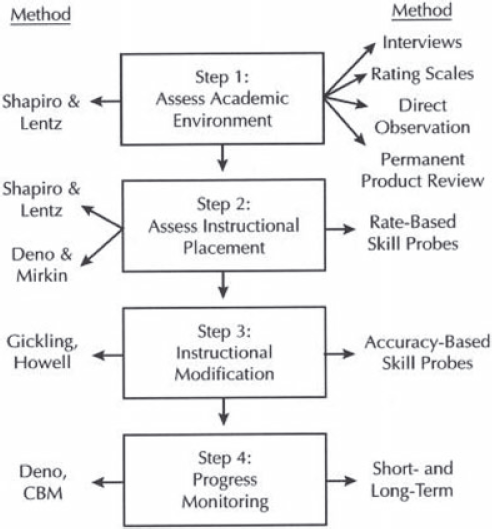
Shapiro's (1990; 2004) original integrated model of curriculum–based assessment. Reproduced from Shapiro (1990, p. 331; 2004, p. 20; 2011, p. 22). Copyright 2004 Guilford. Reproduced by permission of the author.
The goal of Step 2 is to identify instructional placement within the curriculum, which involves assessment procedures that determine the skills students have and have not acquired (Shapiro, 2004). In writing, the model specifies the use of story starters for Step 2 assessment. Story starters are timed writing prompts that include writing topics to which students respond. The student responses can be scored using a variety of numerical metrics (e.g., words written, correct word sequences), yielding quantitative data regarding the student's writing skills that can be compared to curricular or classwide expectations.
Once a curricular placement is obtained, assessment moves to Step 3 and focuses on identifying instructional modifications (Shapiro, 2004). In this step, the assessment information gathered in the previous two steps is analyzed and additional accuracy–focused assessments are administered to identify specific skill needs and appropriately challenging material. An intervention strategy is then identified that can address the academic skill deficit.
The last step of the integrated CBA model consists of monitoring the progress of the student during the intervention and making additional instructional modifications when necessary (Shapiro, 2004). The model specifies the use of accuracy–based measures that provide data regarding the attainment of short–term learning objectives. Curriculum–based measurements (CBM; Deno, 1985) are also used at this step because they (1) provide an objective index of the skill, (2) can be repeated and are of similar difficulty across forms so as to show skill growth, and (3) incorporate time–series designs and yield visual data regarding student progress and the effectiveness of the intervention.
Although assessment approaches in Step 1 of the model are generally consistent across academic skills and are therefore applicable to early writing, other aspects of this model may have led to limited application in early writing. First, Step 2 of the model describes writing assessments that have been validated only for writers starting in Grade 2 (McMaster & Campbell, 2008; McMaster & Espin, 2007). Second, although Step 3 assessment information helps specify the need for instructional modification, the nature of the required modification is less clear. Finally, as in Step 2, Step 4 uses assessment procedures that have been validated for older writers.
Purpose
For researchers to evaluate the use of Shapiro's (2004) integrated CBA model with early writing, it is necessary to highlight advances in research that allow such an extension. We focus our review around three related bodies of research. In the first section, we review models of early writing development to identify early writing skills that should be the focus for assessment and intervention. In the second section, we review research on writing assessment that is consistent with current knowledge on early writing development. In the third section, we review research that provides a direct link between assessment and intervention, which offers promise for clarifying what instructional modifications are necessary for struggling writers. We end by illustrating an integrated CBA model that may be applicable to early writing.
Early Writing Development
Although substantial research has focused on the writing development of adults and the purposes behind composing written text, less research has examined the development of early writing skills. Scardamalia and Bereiter (1987) discussed the difference between mature and immature writers and noted that immature writers typically use a knowledge–telling approach in which content and discourse knowledge account for writing quality. Early writers typically lack depth of knowledge in both content and writing discourse, but the main distinction between mature and immature writers is the use of complex problem–solving procedures during the writing process (Bereiter & Scardamalia, 1987). Models for both types of writers overlook the importance of basic compositional skills such as syntactic fluency (Bereiter & Scardamalia, 1987), which subsume other foundational writing skills that are important for successful writing.
The “simple view” model of writing development considers the writing of younger students beginning in the first grade (Juel, 1988; Juel, Griffith, & Gough, 1986), when basic compositional skills may not be fully developed. In an elaboration of the simple view of writing development, Berninger and Amtmann (2003) suggested that text production, which is the goal of writing, relies on self–regulation strategies such as goal setting and self–monitoring to guide the writing process, as well as transcription skills such as accurate and fluent (automatic) production of text (via handwriting or typing). Both transcription and self–regulatory processes draw on limited working memory resources, such that when more cognitive resources are required for transcription, less are available for self–regulatory processes and text generation (McCutchen, 1996). Conversely, as transcription skills become more automatic, more cognitive resources are available for higher level activities like planning and developing content, which align the simple view of writing with theories of automatic processing in other academic skills (e.g., reading fluently frees cognitive resources for comprehension; Laberge & Samuels, 1974). The simple view model may better account for early writing development than other models of mature versus immature writing, because it recognizes that basic compositional skills develop over time and affect writing outcomes.
Several lines of research have shown the importance of transcription skills to subsequent literacy skills. Abbott, Berninger, and Fayol (2010) found that early transcription skills (i.e., handwriting and spelling) are significant predictors of later writing skills and also predict subsequent reading skills. Earlier work showed that fluent letter writing was the best predictor of both writing quality and length in elementary school, explaining 25 percent and 66 percent of the variance, respectively (Graham, Berninger, Abbott, Abbott, & Whitaker, 1997). Moreover, the predictive strength of fluent letter writing with quality of text was maintained throughout high school and college (Connelly, Campbell, MacLean, & Barnes, 2006; Peverly, 2006). Other research showed that instruction in transcription skills (handwriting) transferred to compositional skills for struggling first–grade writers. Students who participated in scripted lessons designed to improve letter–writing automaticity showed improved performance in both letter writing fluency as well as compositional fluency (Berninger et al., 1997; Graham, Harris, & Fink, 2000; Jones & Christensen, 1999).
Although transcription skills take on special importance during early writing development, the goal of early writing instruction is not solely to develop transcription skills. The ultimate goal for early writing instruction remains the production of text that conveys meaning (Berninger & Amtmann, 2003), and the use of writing skills to further expand understanding of complex ideas (Bereiter & Scardamalia, 1987). High–quality instruction during early writing development should include plentiful opportunities for meaningful composition, modeling for skill (e.g., spelling or capitalization) and strategy (e.g., planning or revising) development, and exposure to expository and narrative genres (Graham et al., 2001). Some struggling young writers have sufficient transcription skills and may benefit more from intervention or instruction that focuses on other skills (e.g., self–regulatory strategy instruction; Graham & Harris, 2009), but transcription skills seem to be a particularly important consideration for struggling early writers.
Summary
The above research suggests that within a high–quality instructional program for early writing, transcription skills (1) exert an influence on the writing outcomes of early writers, and (2) are strongly related to more complex writing skills. Thus, transcription skills need to be accounted for in an assessment framework that spans the range of skills used in early writing. A focus on foundational writing skills including handwriting and spelling is well established in early elementary grades, but intervening to address early writing problems is difficult without instructionally relevant assessment approaches and could result in too much or too little emphasis on transcription skills. It is therefore necessary for early writing educators to have access to an assessment approach that is conceptually and theoretically linked to current understanding of early writing development, and that can help determine if an early writer would benefit from intervention in transcription skills or more complex skills (e.g., self–regulatory skills or building discourse knowledge).
Early Writing Assessment
All assessments for educational decision–making should have adequate psychometric (Thorndike, 2005) and practical characteristics (Choate, Enright, Miller, Poteet, & Rakes, 1992), and should be used with consideration of the potential consequences (Messick, 1995). Penner–Williams, Smith, and Gartin (2009) identified 17 standardized assessments for writing and reviewed the psychometric characteristics of each. Inherent strengths of formal assessments include the capacity to compare students to norm groups and well–developed standardized administration directions (Penner–Williams et al., 2009), but the data from formal assessments provide little direction for instructing struggling students (Stiggins, 2005) and lack the characteristics of practical tests such as simple administration, cost–effectiveness, and efficiency (Choate et al., 1992). The relative instructional deficiencies of formal measures limit their capacity to provide instructionally relevant data (Salvia, Ysseldyke, & Bolt, 2010) and suggest that alternative writing assessments should be considered.
Cbm
Alternative writing assessments should be used formatively, which assists educators in making instructional changes that lead to improved writing skills (Graham, Harris, & Hebert, 2011). CBM (Deno, 1985) is a potential alternative to standardized tests in writing, and CBM for writing (CBM–W) has been used with students of various ages with variants across one or more of three primary features: type of task, duration of sample, and scoring procedures (e.g., McMaster & Campbell, 2008). Generally, the task consists of a writing prompt (e.g., a passage to copy or a story starter) with students having between 3 and 7 minutes of writing time. The prompt can then be scored in a variety of metrics, including total words written, words spelled correctly, or a count that includes grammatical and structural accuracy such as correct word sequences (Videen, Marston, & Deno, 1982) or correct minus incorrect sequences (Espin et al., 2008).
Marston (1989) found that CBM–W generally yields scores with sufficient psychometric properties, but subsequent reviews of CBM–W research have found that existing measures may not be appropriate for assessing young students (McMaster & Campbell, 2008; McMaster & Espin, 2007), for whom some reliability coefficients have approached zero (e.g., r=. 006 in Gansle, Noell, VanDerHeyden, Naquin, & Slider, 2002). Thus, recent researchers have developed and investigated new CBM–W tasks to use with younger students. Many of these measures can be considered theoretically linked with the work identifying transcription skills as key early writing targets (Berninger et al., 1992), because their scoring procedures produce metrics of early writing skill, such as transcription fluency and spelling. For instance, Lembke, Deno, and Hall (2003) developed word copying, sentence copying, and dictation tasks, and later research found significant reliability (r=. 68 to. 85) and validity coefficients (r=. 32 to. 70) for 3–5 minutes samples of these and prompts using scoring procedures such as correct word sequences or correct letter sequences (McMaster, Du, & Petursdottir, 2009; Ritchey, 2006; 2008). Prompts that accounted for ideation in early writing (e.g., sentence writing based on picture or simple verbal prompts) also had promising technical characteristics (Coker & Ritchey, 2010; McMaster et al., 2009). Moreover, CBM–W prompts and scoring procedures showed promise for measuring the slopes of students’ growth in writing over time (Coker & Ritchey, 2010; McMaster et al., 2011), with some prompts and scoring procedures producing reliable growth slopes in as few as four time points (e.g., picture–word measures scored with correct word sequences; McMaster et al., 2011).
Cba Models for Early Writing
For assessment data to inform instruction, practitioners “must deliberately incorporate methods that help connect assessment information to instructional decisions” (Fuchs & Fuchs, 1999, p. 662). Methods that deliberately connect assessment information to instructional decisions include curricular assessment approaches referred to as CBA for instructional design (CBA–ID; Gravois & Gickling, 2008), which is a method of assessment with a goal of carefully controlling the difficulty of instructional material or task, and curriculum–based evaluation (CBE; Howell & Nolet, 2000), which is a method of assessment that facilitates specific decision making based on task analysis, skills probes, and direct observation. In early writing, however, research with CBA–ID and CBE is limited. Assessment information is used within some empirically supported interventions for struggling writers (e.g., self–regulated strategy development; Graham & Harris, 2005), but the role of assessment data in targeting interventions is not clearly understood.
In a study that was relevant to the CBA–ID approach, Parker, McMaster, and Burns (2011) empirically derived instructional–level criteria for young writers using methodology established by Burns, VanDerHeyden, and Jiban (2006). Burns and colleagues’ approach involved longitudinal data analysis to establish instructional–level criteria by identifying ranges of initial skill that corresponded to the most growth over a given period of time. For the early writing study, 87 first–grade students were tracked over 12 weeks on picture—word and sentence—copy measures using several scoring metrics (McMaster et al., 2011), and results showed that instructional–level criteria for early writing produced significant reliability (κ=. 37 to. 47) and validity coefficients (r=. 21 to. 50) (Parker et al., 2011). These results provide encouraging evidence that instructional–level criteria can be found and potentially applied with early writing, but future work should broaden the generalizability of instructional–level criteria for early writing as well as investigate the prospective utility of applying the criteria in designing interventions.
Summary
Recent advances in early writing assessment seem to align with current knowledge about early writing development, and both CBM–W and CBA–ID methods show promise for use within the integrated CBA model. In Step 2 of the model, instructional–level criteria (Parker et al., 2011) have been developed that hold potential for identifying writing tasks that are too difficult, appropriately challenging, or too easy. In Step 4 of the model, several CBM–Ws for early writing (Coker & Ritchey, 2010; Lembke et al., 2003; McMaster et al., 2009) have been developed that could be used to determine the progress of a student during intervention.
Linking Early Writing Assessment and Intervention
Although promising assessment approaches have been developed for use in identifying instructional placements (Step 2) and progress monitoring (Step 4) for struggling early writers, the integrated CBA model is less clear on how to interpret assessment data for the purposes of targeting interventions (Step 3). An illustrative example can be found in reading. An instructional modification is clearly needed for a student who reads 40 words correctly per minute in Grade 2 (compared to a grade norm of 55), but the nature of the instructional modification is unclear. Among other instructional modifications, the student could benefit more from an intervention with a high degree of modeling, or an intervention with a high degree of repeated practice. Similarly, a student who writes five correct word sequences in 3 minutes when his grade–level peers write 25 correct word sequences clearly needs an instructional modification, but the nature of the required modification is not clear. Assessment information is necessary to inform educators as to the best intervention approach, and assessment data are more instructionally useful if they are interpreted within a conceptual framework that links assessment and intervention. The instructional hierarchy (IH; Haring & Eaton, 1978) might fulfill this function within an integrated CBA model for early writing because it conceptualizes academic responding in a way that leads to specific suggestions for instructional strategies.
Ih
Within the IH conceptual framework, academic responding is characterized as a skill that passes through hierarchical stages of acquisition, fluency, generalization, and adaption (Haring & Eaton, 1978). Student performance in the acquisition stage is slow and inaccurate. After the student becomes accurate in the skill, but still performs slowly, he or she is operating in the fluency stage. In this stage, academic responding should become faster and more automatic. Once the student can perform the skill with accuracy and sufficient speed, he or she can then generalize the skill to different settings (stage three—generalization) and can apply it in different situations to solve problems (stage four—adaption).
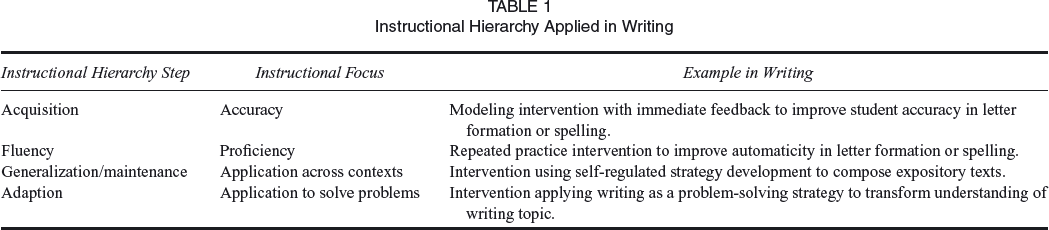
The IH conceptual framework specifies the focus for instruction depending on a student's current skills (Haring & Eaton, 1978), as summarized in Table 1. For example, a student who performs a skill slowly and inaccurately (acquisition stage) requires an instructional focus on modeling and immediate error correction; a student who performs a skill accurately but slowly (fluency stage) requires frequent and repeated opportunities to respond with less immediate error correction (Haring & Eaton, 1978). As such, the IH clarifies that academic responding changes as it strengthens and suggests that instructional approaches facilitate progression within and between the hierarchical levels of skill development (Ardoin & Daly, 2007). In early writing, the IH might be used to identify a student's skill level as needing intervention to be able to produce text accurately, proficiently, or alternatively, as needing intervention to apply writing skills for crafting well–written compositions or furthering understanding of a topic.
Instructional Hierarchy Applied in Writing
The IH has resulted in better understanding of the effects of different instructional procedures for academic behaviors (Martens & Eckert, 2007). Daly, Lentz, and Boyer (1996) observed that different reading interventions had functional elements that made them more or less effective depending on the learner's stage of skill development according to the IH. For example, reading interventions with listening previews or high modeling components were found to be differentially effective for students who were considered at the acquisition or fluency stages (Daly et al., 1996). Other researchers found that level of skill development predicted intervention effectiveness in math, with initial math fluency differentiating the effectiveness of interventions that targeted either acquisition or proficiency of skills (Codding et al., 2007).
Using Instructional Level to Determine Stage of Instruction
Although the IH may be a useful framework for clearly targeting intervention, the criteria by which students are judged to be in instructional stages (e.g., acquisition vs. proficiency) were not made explicit in the original conceptualization of the model. The study by Codding et al., (2007) marked the first use of instructional–level criteria for determining whether initial skill levels were within the acquisition or proficiency stages (Deno & Mirkin, 1977). Students who scored in the frustration range were considered at the acquisition stage of the IH, and students who scored within the instructional range were considered at the proficiency stage. Subsequent research has provided additional support for using instructional–level criteria to determine stage within the IH. Burns and Parker (2010) applied the instructional level of 93–97 percent accuracy (Gickling & Armstrong, 1978) as the criterion for students to move from a reading intervention that focused on acquisition (high modeling) to one that focused on proficiency (repeated practice), and results indicated greater growth in fluency interventions after acquisition was sufficiently met. Moreover, meta–analytic research of math interventions showed that students whose initial skill level was at the frustration level and received an acquisition intervention had larger effect sizes than students who were at the instructional level and received an acquisition intervention (Burns, Codding, Boice, & Lukito, 2010).
The empirically derived instructional–level criteria for early writing (Parker et al., 2011) might be used similarly in interpreting assessment data for the purpose of identifying an instructional modification. A student performing below the instructional level in early writing could be considered in the acquisition stage, requiring an accuracy–focused intervention that targets transcription skills. A student performing within the instructional–level criteria could be considered in the proficiency stage, needing additional practice to become a faster, more automatic writer. A student whose skills are above the instructional level could be considered in the generalization or adaptation stages, needing strategy instruction or continued development of discourse knowledge. As such, using the instructional–level criteria to identify a students’ stage within the IH might be a promising approach for the instructional modification step (i.e., Step 3) of the integrated CBA model.
The potential for such an approach is supported by comparing the theoretical overlap between the IH and the simple view model of writing development. In the IH, skill development is conceptualized as moving through acquisition and fluency stages to generalization and adaption (Haring & Eaton, 1978). Within the simple view (Berninger & Amtmann, 2003), writing development starts as the acquisition of basic letter formation and spelling skills, and the ability to fluently transcribe letters is highly predictive of future writing length and quality (Graham et al., 1997). The other skill domains in the simple view of writing (i.e., self–regulatory strategy development and text generation) are at least somewhat reliant on fluent transcription skills, which has led to suggestions that interventions using self–regulatory strategies be delayed until transcription skills are sufficiently developed (Graham & Harris, 2009). As such, self–regulatory strategy development (Graham, 2006; Graham & Harris, 2005) could be conceptualized as a form of generalization training within the IH for early writing, and generalization training is an oft–overlooked yet highly important part of instructional modifications within the IH (Ardoin & Daly, 2007). Using instructional–level criteria within an IH interpretive framework to inform instructional modifications might more successfully indicate if students need acquisition or fluency training in transcription skills, or if they need training in generalizing or adapting these skills (e.g., using self–regulatory strategy training).
Summary
Identifying a promising intervention for a struggling writer is difficult without assessment data and interpretive frameworks that are instructionally relevant. In Step 3 of the integrated CBA model, the IH offers a conceptualization of skill development that clearly suggests instructional strategies and is consistent with current understanding of early writing development. In early writing, instructional–level criteria have been developed that could be used to determine the instructional stage within the IH, which has been shown to be a promising approach in other academic domains. As such, a complete integrated CBA model for early writing, with promising assessment approaches at Steps 2, 3, and 4 can now be proposed.
A Proposed Integrated CBA Model for Early Writing
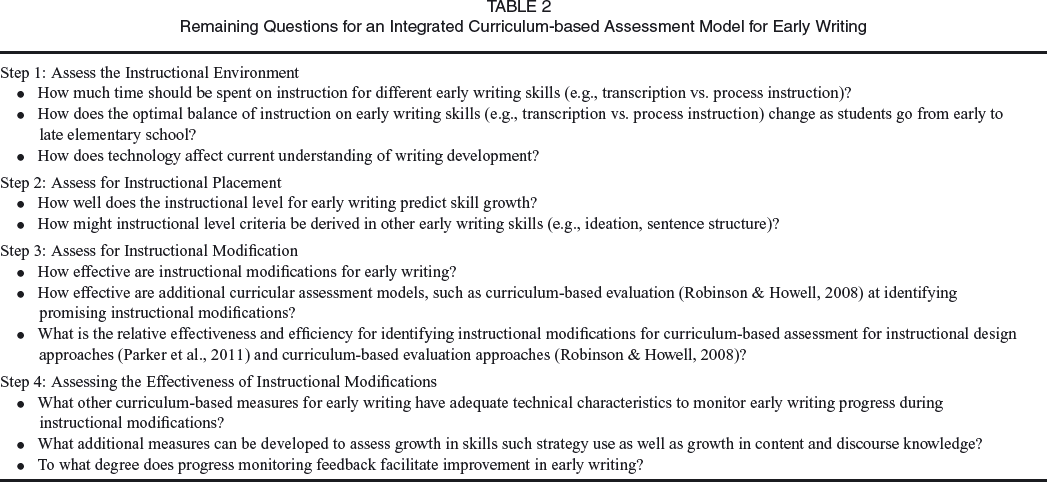
In Figure 2 we depict the inclusion of the instructional level and IH (Haring & Eaton, 1978) concepts in a revision to the integrated CBA model for early writing. The steps of the model remain intact, but by considering relevant research on early writing development, early writing assessment, and linking assessment to intervention, we can extend the model to early writing. Similar to the original model, the figure depicts both the general nature of the proposed assessment methods (right column), and the research on which the proposed methods are based (left column). Specific measures are suggested and described below, but other measures could also be used at each step of the model. Next, we outline the four steps of our proposed integrated CBA model for early writing. In addition to clarifying practical implications of the model for early writing assessment, we note areas where future research is needed (see Table 2 for research questions to be addressed within each step) as well as potential limitations to the model.
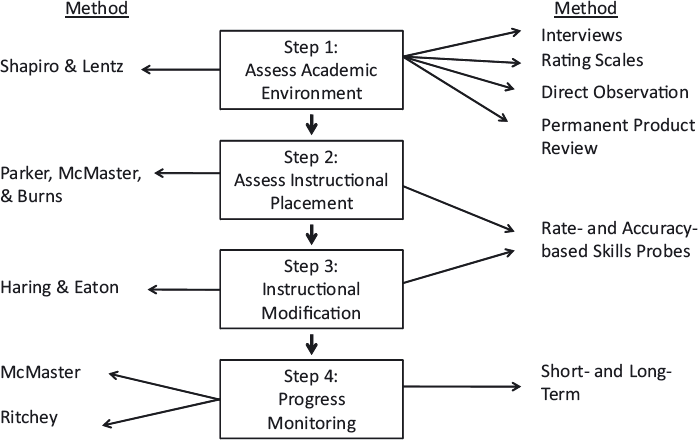
Proposed integrated curriculum–based assessment model for early writing highlighting promising methods based on related research.
Remaining Questions for an Integrated Curriculum–based Assessment Model for Early Writing
Step 1: Assessing the Instructional Environment
As is done with all academic skill problems, Step 1 in the integrated CBA model for early writing is to assess the instructional environment (Shapiro, 2004). Assessment data collected in this step consist of direct observations, record reviews, and interviews. Although there are no procedural differences for direct assessments at this step across skill domains, this is the step in which the classroom and instructional contexts are assessed, which has potential implications for assessment at subsequent steps of the model and also raises potential limitations and questions for future research related to early writing.
Assessment in Step 1 includes domain–general approaches that assess for academic engagement and academic responding in writing tasks (e.g., Ysseldyke & Christenson, 2002), and should also determine if instructional practices within the classroom are consistent with what is known about successful writing environments. For example, successful writing environments include frequent and meaningful opportunities to engage in varied writing tasks, overt modeling of writing processes and skills, and follow–up instruction by teachers to improve mastery of writing skills (Graham et al., 2001). Actual writing environments vary in the amount of time spent with each activity, and teachers report spending more time with basic writing skills than with process or strategy instruction (Cutler & Graham, 2008). In early writing, relatively more time is necessary to develop basic writing skills (i.e., transcription skills), but should not exclude process and strategy instruction.
The implications for subsequent assessment within the integrated model for early writing are clear. If a student demonstrates proficiency in transcription skills, but still struggles in writing, results from the integrated assessment model would suggest the student should receive intervention to generalize and adapt their writing skills. For example, intervention could focus on using self–regulatory strategies to compose expository text. However, if the student receives very little strategy instruction or has no experience writing expository texts, the skill problem may be more an issue of the instructional environment than a need for instructional modifications.
Research is needed to establish the best blend of instruction across the different component skills (e.g., transcription instruction vs. strategy instruction) during early writing, as well as how that blend changes as students progress from kindergarten and first grade through later elementary grades. Research suggests that an instructional environment that balances explicit skills instruction with contextualized instruction is differentially effective for normally achieving students versus struggling students (Conner, Morrison, & Petrella, 2004; Graham & Harris, 1994), which suggests that practitioners and researchers should carefully consider how the instructional environment interacts with the skills of early writers.
It is also important to consider that the instructional environment is becoming increasingly augmented by technology, which has implications for many of the assessment approaches currently proposed within the integrated CBA model for early writing. Changing media for written communication highlight the need for a broader discussion of transcription skills. Although fluent handwritten transcription skills are clearly related to the development of compositional skills (e.g., Graham et al., 2000), it is also clear that actual handwriting is much less often the medium of written expression than typed text for today's fully developed writer (MacArthur, 2006). It is possible that fluent transcription of text via other media will have an effect on the understanding of writing development currently offered by models of early writing, which would in turn have implications for the assessment practices used within the integrated CBA model.
Steps 2 and 3: Assessing for Instructional Placement and Instructional Modification
The next two steps of the integrated CBA model consist of assessing for instructional placement and instructional modification. In early writing, research indicates promise for CBA–ID practices that identify a student's instructional level using direct assessments of early writing skills (Parker et al., 2011). Research also suggests the promise of using instructional–level criteria to determine the instructional strategy that should be used according to the IH. In this approach, an initial skills assessment might find the student to be below the instructional–level criteria for early writing, suggesting an instructional modification at the acquisition level of the IH. Although receiving the acquisition–focused instructional modification, progress monitoring (i.e., Step 4 of the integrated CBA model) would be conducted to ensure its effectiveness. Subsequent assessments using CBA–ID would identify when the student has developed early writing skills to within the instructional range, suggesting an instructional modification at the fluency level of the IH. Once the student's skills are above the instructional level range, the appropriate instructional modification might include strategy instruction or intervention to build discourse knowledge.
Several lines of future research are necessary within the instructional placement and modification steps of the model. One important area of research is to examine the capacity of instructional–level criteria within the IH to inform effective instructional changes prospectively. To date, the majority of studies have used analyses to retrospectively identify patterns of effectiveness for which the IH offered explanatory power (Burns et al., 2010; Codding et al., 2007). Only one study used these criteria as part of its methodological procedures, and although results were encouraging in reading (Burns & Parker, 2010), this approach should be applied and tested across skills, including early writing.
An additional line of research includes identifying and testing intervention approaches that correspond to the instructional recommendations at the individual stages of the IH. Currently, the corpus of early writing interventions is not as large or well developed as those for later writing or other academic skills. Moreover, the interventions have focused on transcription skill acquisition (e.g., Berninger et al., 1997). Researchers should examine if repeated practice in writing has similar effects as those of repeated reading (Samuels, 1979) when targeted to students in the fluency stage of transcription. A similar investigation should examine the effects of established modeling procedures that incorporate immediate feedback (e.g., cover–copy–compare; Skinner, McLaughlin, & Logan, 1997) for students identified as in the acquisition stage of transcription.
An additional area of research within Steps 2 and 3 consists of evaluating different CBA approaches within the context of the integrated model. For example, the CBE approach for written expression (Robinson & Howell, 2008) might be an effective decision–making heuristic when updated to incorporate current understanding of early writing development (e.g., Bereiter & Scardamalia, 1987; Berninger & Amtmann, 2003) and assessment (Coker & Ritchey, 2010; McMaster et al., 2009; McMaster et al, 2011; Ritchey, 2006; 2008). Subsequent evaluation might then compare the effects of a task analytic approach (i.e., CBE), which uses complex sequences of assessment to determine specific instructional strategies, with a more heuristic approach as currently proposed (i.e., CBA–ID with IH), which makes suggestions as to intervention classes (e.g., strategies to instruct when students are within the acquisition phase) often based on a single assessment.
Two limitations related to the instructional placement and modification steps of the integrated CBA model with early writing warrant mention. The first limitation is related to the overlap of the direct assessment approach (Shapiro, 2004), as discussed here, with current understanding of early writing development. By employing direct assessments that focus on accurate and fluent text production in terms of grammar, usage, and spelling, the proposed integrated assessment model is limited in the component skills for writing that can be assessed. The current measures omit other skills related to early writing, such as orthographic motor skills (Abbott & Berninger, 1993) as well as qualitative features of early writing (e.g., Coker & Ritchey, 2010). Using direct assessments with known and acceptable technical characteristics that can be administered repeatedly to show growth has advantages over using assessments that are less practical or less technically adequate, but more research is necessary to develop early writing assessments that capture the full breadth of early writing skills. Direct assessments that capture a wider range of early writing skills could also allow for more contiguous use of the integrated CBA model across grades as students acquire more advanced writing skills.
The second limitation is related to the conceptualization of the instructional level in writing. The instructional–level criteria in math and early writing are in a fluency metric, which could lead to conceptual confusion when used as criteria for deciding at what stage in the IH a student is located. For example, it is theoretically possible that a student could be below the instructional–level criteria in early writing, yet still have 100 percent accuracy, because the instructional–level criteria are in a fluency metric. Thus, suggestions from a pure application of the IH (i.e., the student is accurate and therefore needs fluency–based instruction) would be different from that of the fluency–based instructional–level criteria (i.e., the student is accurate, but will still benefit from acquisition–based instruction). Despite this inconsistency, the finding that fluency–based criteria for the instructional level in math successfully explain patterns of results (Burns et al., 2010; Codding et al., 2007) is promising for the domain of early writing.
Step 4: Assessing the Effectiveness of Instructional Modifications
The final step of the integrated CBA model for early writing consists of applying CBM–W for the purpose of monitoring student progress in response to instructional modifications. Research suggests that progress monitoring may be done with newly developed measures that have promising technical characteristics for measuring skill growth (Coker & Ritchey, 2010; McMaster et al., 2009; McMaster et al., 2011). Direct assessment could thus consist of repeated, frequent (e.g., weekly) assessment of the student's writing skills using CBM–W measures and scoring procedures appropriate for early writers. Performance that exceeds expectations would indicate a need to increase the student's goal, and performance indicating stagnant growth or loss of skill would be an indication of the need for an additional instructional modification (Deno & Mirkin, 1977; Fuchs et al., 1984).
The history of CBM research includes investigations of approaches (i.e., diagnostic feedback and expert consultation) that have similar proposed functions to the instructional placement and modification steps within the integrated CBA model. These approaches were generally found to lead to better teaching and learning outcomes than CBM alone (Fuchs, Fuchs, Hamlett, & Ferguson, 1992; Fuchs, Fuchs, Hamlett, & Stecker, 1991), which suggests future research comparing the effects on student outcomes of CBM with additional decision–making components versus the integrated CBA model with only the CBM component. Research questions of interest would likely consider the effectiveness of the respective approaches as well as the efficiency and feasibility with which educators could apply them. Moreover, progress monitoring feedback improves the writing performance of students older than second grade (Graham et al., 2011), which suggests additional research could examine the effects of feedback for younger students.
Additional lines of research within this step of the integrated model of CBA for early writing include continued efforts to develop the most informative measures and procedures for early writing progress monitoring. Currently, several measures (e.g., picture–word, sentence copy, story prompt) have promising technical characteristics (Coker & Ritchey, 2010; McMaster et al., 2009), and although some measures are particularly promising for assessing growth, additional research is clearly indicated. One particular direction for future research might be to continue efforts to identify CBM–W approaches that are technically adequate and instructionally informative within and across grade levels (McMaster & Espin, 2007). As student writing continues to develop throughout later elementary grades, progress monitoring measures will be necessary to assess growth in skills such as strategy use (e.g., Graham & Harris, 2005) and knowledge related to writing content and discourse (Bereiter & Scardamalia, 1987). The CBM–W approaches discussed in this article are promising for the proposed uses, but research should continue to identify measures that assess broader sets of skills and that have even stronger technical“ characteristics.
Conclusion
The integrated model of CBA (Shapiro, 2004) applies direct assessment of the instructional environment and academic skills to identify instructional modifications and to monitor their effectiveness. In this article, we have attempted to advance the integrated CBA model to early writing by presenting current advances in writing research, and by describing how the instructional level can be combined with the IH to aid in instructional modification decisions. In doing so, we conclude that extending the integrated CBA model to early writing is plausible, but that future research is necessary to validate the model.
Educators will likely continue to spend large amounts of time making decisions related to academic skills problems, and writing problems in particular (Bramlett et al., 2002). It is therefore necessary to develop practices that improve the decision making of professionals and the outcomes of the students they serve. The integrated model for CBA (Shapiro, 2004) is an example of an assessment practice that can support intervention efforts within high–quality instructional environments, and although the use of CBA is increasing (Shapiro, Angello, & Eckert, 2004), future research could support using it with a broader range of academic skills problems..