






Abstract
Students who struggle with learning mathematics often have difficulties with geometry problem solving, which requires strong visual imagery skills. These difficulties have been correlated with deficiencies in visual working memory. Cognitive psychology has shown that chunking of visual items accommodates students’ working memory deficits. This study investigated the effects of visual–chunking representation as a testing accommodation for improving students’ geometry problem–solving performance. Participants were four third–graders with difficulties in mathematics. An adapted reversal design was employed to examine the students’ performance changes during standard testing conditions and accommodated testing conditions. During the accommodated condition, students were presented with visual–chunking images. Results suggested that the visual–chunking representation accommodation improved students’ performance on geometry problem–solving tasks, and an interview confirmed students’ preference for the visual–chunking representation approach.
Geometry and spatial sense are fundamental components of mathematics learning (Final Report of the National Mathematics Advisory Panel, 2008). Geometry is “a route for developing an understanding of two– and three–dimensional space” (NRC, 2001, p. 281). Geometry is relevant to many aspects of everyday life (Cass, Cates, Smith, & Jackson, 2003), such as planning a garden or calculating how much carpet to buy for a bedroom. Because geometry interprets and reflects on the physical environment, it can serve as a tool for the study of other topics in mathematics and science (National Council of Teachers of Mathematics; NCTM, 2000). To prepare for future mathematics and science courses, all students are expected to learn geometric shapes and spatial relationships, use visualization and spatial reasoning to transform shapes, and apply geometric modeling to solve problems (NCTM, 2000; NRC, 2001). Without proficient geometry knowledge and problem–solving skills, a student may not achieve grade level in state–wide standardized math tests or meet requirements for a high school diploma, and may lack the skills necessary to pursue advanced science and engineering studies at the post–secondary level.
Geometry instruction is a topic of increased importance in the U.S. mathematics curriculum (Mistretta, 2000), as demonstrated in the most recent Common Core State Standards (CCSS, 2010) calling for increased basic geometry emphasis in Grades 3 through 8. A recent study contrasting CCSS (2010) to individual state standards in mathematics found that 5.73 percent of all CCSS mathematics objectives included geometry concepts compared to only 0.74 percent in state standards (Porter, McMaken, Hwang, & Yang, 2011) and that additional geometry topics were recommended in earlier grades. In fact, according to CCSS (2010), students should begin formalizing geometry experiences in kindergarten and progress to using more precise definitions and developing careful proofs throughout their elementary and secondary math education. For example, kindergarteners are expected to identify and describe shapes (squares, circles, triangles, rectangles, hexagons, cubes, cones, cylinders, and spheres), and by third grade, students should be able to reason with shapes and their attributes (CCSS, 2010)
Geometry Standards (NCTM, 2000) and the CCSS in Mathematics (2010) called for effective geometry instructional programs from kindergarten through Grade 12 as a response to international research studies showing that the geometry problem–solving skills of U.S. students had fallen behind the skills of peers in other countries (Bybee & Stage, 2005; Lemke & Gonzales, 2006). Wong, Hsu, Wu, Lee, and Hsu (2007) reported that students may face special challenges with geometric problem solving because the comprehension of geometric problems are more difficult than in other mathematics domains, such as calculation. In other studies, Mistretta (2000) and Carroll (1998) reported that many eighth–grade students are not prepared for secondary classes in geometry. Adding to the complexity of these challenges, many students who struggle in mathematics have particular difficulties with learning geometry due to visual–spatial deficits. Many geometry skills depend on spatially representing mathematical relations, and students who struggle in mathematics frequently misunderstand spatial information (Geary, 2003; van Garderen, 2002).
In spite of the call for increased attention to geometry instruction, studies are scant that provide evidence–based strategies for improving instructional outcomes for students who are not achieving in geometry. In a recent meta–analysis of secondary mathematics interventions for students with learning disabilities (Maccini, Mulcahy, & Wilson, 2007), only one study (Cass et al., 2003) was based on geometry attainment. Moreover, no geometry accommodation or intervention research studies were available in a meta–analysis of elementary mathematics’ research studies (Kroesbergen & Van Luit, 2003). Although geometry skills are critical for student success, geometry research to determine appropriate accommodations for students with disabilities has been very sparse.
Much of the recent geometry research has involved geometry word problem solving (Forsythe, 2007; Wong et al., 2007), and these studies were limited to problems for finding the perimeter and the area of two–dimensional shapes. Existing research rarely has addressed three–dimensional geometric properties and visual spatial imagery, although students are frequently less proficient with three–dimensional geometric shapes than they are with two–dimensional shapes (NRC, 2001).
Mathematics Difficulties and Visual Working Memory
Mathematics difficulties can result from deficits in cognitive abilities that limit a student's ability to represent or process information in one or all of the mathematical domains, such as geometry (Geary, 2004). Various studies (Alloway & Alloway, 2009; Geary, 2003, 2004; Hitch & McAuley, 1991; McLean & Hitch, 1999; Swanson & Beebe–Frankenberger, 2004) have found that students with poor mathematics performance often have problems with working memory. Working memory is a limited capacity system that temporarily maintains and stores information which supports human mental processing (Baddeley, 2003; Baddeley & Hitch, 1974; Cowan, 2001). Therefore, working memory is highly relevant to students’ mathematics problem–solving skills (Geary & Hoard, 2005; Wilson & Swanson, 2001).
According to the multiple–component model of working memory (Baddeley & Hitch, 1974), the visual–spatial sketchpad is a critical part of working memory. The visual–spatial sketchpad, also named visual working memory, refers to the capacity to hold and manipulate a visual display in the mind (Philips, 1974). An important function of visual working memory is visual imagery, also called spatial imagery, which plays an essential role in geometry learning. Visual working memory predicts success in geometry–related fields, such as architecture and engineering (Purcell & Gero, 1998; Verstjinten, van Leeuwen, Goldschimdt, Haeml, & Hennessey, 1998), and supports many mathematical competencies, including geometry and complex word problem solving (Geary, 1996; Jeung, Chandler, & Sweller, 1997). Students with mathematics learning difficulties often have difficulties with spatially representing mathematics information and relationships and then manipulating the visual spatial relations (Geary, 2003; van Garderen & Montague, 2003); in addition, students with math difficulties are under–represented in geometry–related fields. McLean and Hitch (1999) reported that children with mathematic difficulties performed at a lower level in spatial working memory tasks than did their peers. However, visual working memory has not been researched as frequently as verbal working memory in children with mathematics difficulties.
A typical assessment of visual working memory requires subjects to remember and mentally manipulate shapes without drawing them. For example, one study asked students to mentally combine the capital letters J and D into an object, and a suitable answer could be an umbrella (Finke, Ward, & Smith, 1988). A number of similar geometric problems can be found in elementary mathematics textbooks. For example, students are presented with a shape and are asked to imagine manipulating (e.g., folding, sliding, turning) the shape to figure out what new shape can be created (see Figure 1). These problems require students to hold the visual information in memory and mentally manipulate the shapes; thus, they are cognitive tasks designed to test students’ visual imagery skills.
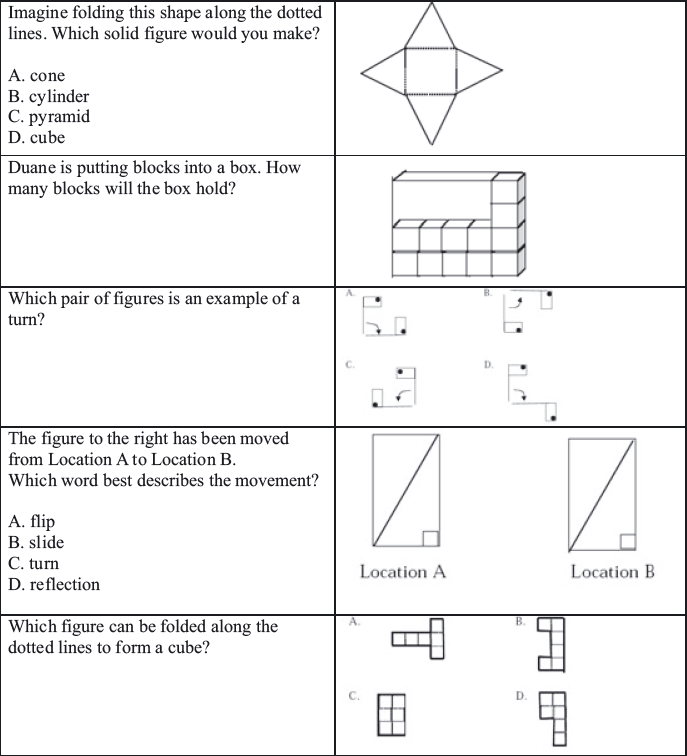
Geometry problems requiring visual imagery.
The capacity of visual working memory is typically limited to approximately four visual items, and people usually fail to hold or manipulate additional items beyond their visual working memory capacity (Alvarez & Cavanagh, 2004; Cowan, 2001; Pashler, 1988). Students with poor mathematics performance appear to have more problems with visual working memory than their normal–achieving peers (Wilson & Swanson, 2001). Meanwhile, the number of geometric features (such as color, location, orientation, and shape) of a geometric problem is likely to exceed the four visual–item capacity. For example, a two–dimensional geometry problem can be composed of two or three pairs of parallel lines plus a triangle. The process of manipulating or holding the complex information required to solve the geometric problem is particularly challenging for students who have difficulties with visual working memory. Therefore, identifying effective accommodations to increase visual working memory capacity for all students, particularly for students with math disabilities or difficulties, is a challenge facing educational researchers and practitioners.
Visual–Chunking Representation Accommodation
As stated, students with mathematic difficulties, many of whom have deficits in spatial visual capacity, have more difficulty holding and processing complex visual information due to their limited visual working memory (Geary & Hoard, 2005; Wilson & Swanson, 2001). According to the cognitive load theory (Sweller, 1993; Sweller & Chandler, 1994), an effective accommodation should maximally reduce students’ cognitive load.
Cognitive psychologists have found that visual–chunking representation (VCR) is an effective accommodation to increase visual working memory capacity (Lee & Chun, 2001; Luck & Vogel, 1997; Woodman, Vecera, & Luck, 2003). As stated previously, students typically can retain four visual features at one time; however, it is possible to retain more than four features through VCR with the conjunction of multiple features. According to Luck and Vogel (1997), four integrated objects each with a conjunction of four features can be retained in visual working memory as well as four single–feature objects, so by combining features, 16 features can be held. Similarly, multiple objects can be grouped as a pattern to increase the visual working memory capacity (Jiang, Olson, & Chun, 2000; Xu, 2002; Xu & Nakayama, 2003). In sum, it has been found that individuals can create higher order cognitive chunks through assimilation of individual elements according to their properties, and these chunks allow more features to be remembered than with remembering individual elements.
A classic experiment investigating visual chunking was conducted by Luck and Vogel (1997). During the visual chunking condition, participants were asked to remember four conjunction images, each of which was composed of a large square of one color and a small inner square of a different color. In the control condition, the same participants were asked to remember four inner square images or four outer square images. Results showed that the participants were as accurate with the conjunctions as they were with either the large outer square or the small inner square presented alone. These findings suggest that a problem solver who perceives a complex image as a whole image, regardless of how many small parts it contains, has better recall of the complex whole image than of the many small images.
Similar chunking effects have been found in verbal working memory. Humans normally can hold “seven plus–or–minus two” chunks in verbal working memory (Miller, 1956). When people group the first level elements (e.g., numbers, letters) into second level chunks, they can recall longer number or letter series (Miller, 1956). An illustration of the limited capacity of working memory and the use of chunking as suggested by Miller (1956) is recalling a phone number such as 7654961258, by grouping the digits as 765–496–1258. Therefore, instead of trying to remember 10 separate digits, which are beyond the “seven plus–or–minus two,” the person can more easily remember three groups of numbers, or three chunks. A successful application of verbal chunking is a subject who became able to remember sequences of more than 100 digits by using chunks and hierarchically representing the sequences (Ericsson, Chase, & Faloon, 1980).
Gestalt psychology (Humphrey, 1924) illustrated the principle that the human eye sees objects in their entirety before perceiving their individual parts. However, although generally people tend to view visual elements as wholes and automatically organize visual elements into groups, perceptions of chunking (groups) can be highly subjective because chunking depends on an individual's perception of the item features and position in their semantic network; consequently, individual differences are significant (Chase & Simon, 1973). Chase and Simon (1973) found that good problem solvers use substantially larger chunks than weak problem solvers, and thus have a larger working memory capacity during problem–solving tasks. For example, one person might perceive 765 as a whole conjunction while another person might perceive 765 as three element digits. Similarly, some students perceive a visual image as a conjunction of a few chunks, whereas others perceive many individual lines or angles in the same visual image. For example, a student might perceive the image in Figure 2a as 12 individual segments and angles with various orientations, whereas another student might perceive this image as a conjunction composed of four chunks (i.e., three triangles and a square). The student who successfully perceives information in chunks can retain more information than the student who perceives information as many individual elements because chunking allows for remembering more information.
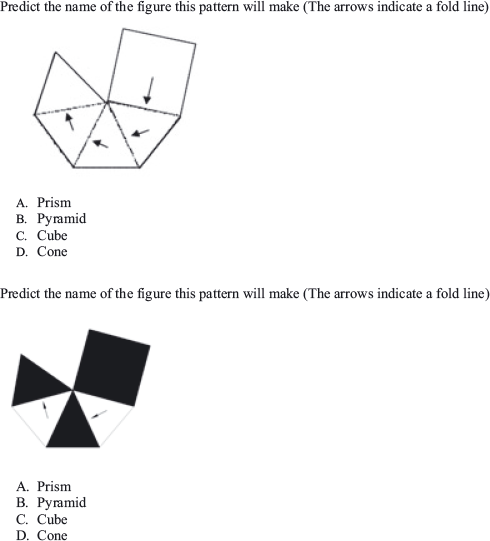
[a] A sample geometry problem with traditional–element representation. [Predict the name of the figure this pattern will make. (The arrows indicate a fold line.)][b]. A sample geometry problem with visual–chunking representation. [Predict the name of the figure this pattern will make. (The arrows indicate a fold line.)]
Therefore, a critical question for educators is how to help students create visual chunks when solving geometry problems that demand strong visual working memory. Elements’ semantic relatedness and perceptual features are critical for individuals to apply the “chunking” accommodation (Gobet et al., 2001; Miller, 1956; Sakai, Kitaguchi, & Hikosaka, 2003). In other words, increasing students’ abilities to identify elements’ similarities, relatedness, and distinctive parts helps to create complex visual chunks. This is similar to chunking phone numbers so that the number 8004961258 is remembered as 800–496–1258. When using dashes to highlight the connection within certain numbers, this phone number can be remembered as three chunks instead of ten pieces and the phone number can be held more easily in working memory.
Geometric problems in the elementary school curriculum often require complex visual working memory capacity; thus, students would benefit by perceiving the geometric problems as composed of a few complex visual chunks rather than many geometrical elements (i.e., lines, angles). Unfortunately, most geometric figures in published textbooks and mathematics tests are represented with a large number of elements (i.e., lines, angles) instead of with visual chunks. As shown in Figure 2a, such standard–element testing representations make it difficult for some students to self–recognize the visual chunks, and such a large number of elements (i.e., 12 segments and 15 angles) compete with each other for the limited capacity of visual working memory, resulting in an overload. As stated, a potential approach is to help problem solvers to construct larger visual chunks by strengthening semantic relatedness and perceptual features of the visual elements. For example, as in Figure 2b, the same problem can be perceived as a few visual chunks (four triangles and a square) versus 12 segments and 15 angles, allowing the same geometric information to be held in memory and manipulated more efficiently than with the standard–element representation.
Purpose of the Study
In the current study, we tested the effects of a VCR accommodation for students with mathematics difficulties in geometry through visual–imagery testing. VCR is an approach that highlights the semantic relatedness and perceptual features of visual elements in order to facilitate students’ perception of visual elements as larger chunks. We hypothesized that students with math difficulties would perform better in solving geometry problems with the VCR accommodation condition than with the standard–representation condition.
Method
Design
The present study used an adapted reversal design. This design was used to examine the effects of an accommodation (i.e., VCR) by alternating the baseline condition (Condition A, or the standard–element representation condition) when no accommodation was in effect, with the accommodation condition (Condition B, or the VCR accommodation condition). The effects of the treatment would be clear if performance improved during the first accommodation phase, reverted to original baseline levels when the accommodation was withdrawn, and improved when accommodation was re–instated in the second accommodation phase.
Therefore, each student was tested with two parallel probes, and each probe was tested with two representation conditions. To avoid possible memory effects caused by testing the same items in two conditions (e.g., A1 and B1; A2 and B2, A3 and B3, A4 and B4, etc.), we counterbalanced the order in which each participant was exposed to the probe formats. For example, Chad and Kelly were tested with A1–4 first and then with B1–4 whereas Betty and Tina were tested with B 1–4 first and then with A1–4. To avoid possible bias because Chad and Kelly were always tested with the A condition first, for probes 5–8, the researchers changed the testing order for the four participants. Specifically, Tina and Betty were tested with A5–8 first and then with B5–8, whereas Chad and Kelly were tested with B5–8 first and then with A5–8. In this way, the order of testing formats was counterbalanced both intra–individually (i.e., each student experienced both A–B and B–A sequences of testing) and inter–individually (i.e., for each pair of probes such as A1 and B1, two students received the A1–B1 sequence and the other two students received the B1–A1 sequence).
Participants and Setting
Participants were four students with math difficulties who were recruited from an elementary school in the Midwestern United States. Participant recruitment was initially based on teachers’ recommendations of students who were experiencing difficulties in solving mathematics problems. All four participants scored average or above average on IQ tests and scored lower than the 35th percentile on the Woodcock Johnson Test of Achievement in the subtest for mathematics fluency (Woodcock, McGrew, & Mather, 2001). One participant did not pass and the other three students scored below 40 percent on the state standard test in mathematics for their grade level. All testing sessions for this study were conducted in an empty and quiet teachers’ meeting room within the school. Students were taught geometry concepts, such as rays, segments, angles, basic parallel or perpendicular lines, as part of the math grade–level curriculum. However, geometry instruction did not occur during the experiment period and was not a confounding variable that threatened the validity of this study. Students’ demographic data are presented in Table 1.
Student Demographics
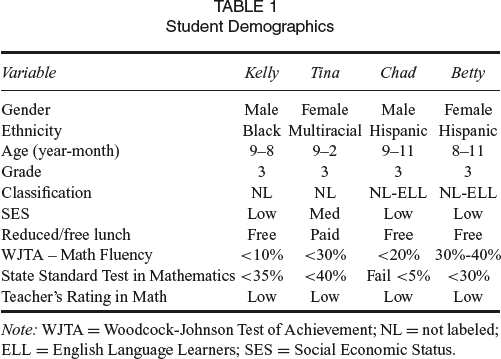
Note: WJTA = Woodcock–Johnson Test of Achievement; NL = not labeled; ELL = English Language Learners; SES = Social Economic Status.
Dependent Measures
The dependent measure included eight parallel geometry probes with two conditions: (a) a standard testing condition with traditional–element representation and (b) an accommodation testing condition with VCR. Each of the eight probes, except one that had five problems, contained four geometry problems selected from the elementary mathematics curriculum supplemental materials (Florida Comprehensive Assessment Test [FCAT] daily questions, developed by the School Board of Broward County, Florida). These geometry problems asked students to imagine manipulating (e.g., folding, sliding, turning) a shape and to choose the new shape that could be formed. All eight probes were presented in two formats: the unmodified form with traditional–element representation and the modified form with VCR, and all participants were asked to complete all eight probes during the two testing conditions.
Standard Testing Condition (Individual–Element Representation)
Each probe contained four geometry problems. Each problem had a figure that was structured with individual lines. Although these individual elements might contain certain shapes, such as triangles or squares, these shapes were not explicitly highlighted and thus the problem solver might not perceive them as whole shapes but merely as individual elements. In this situation, the image of a triangle could be perceived as made of three individual lines, the image of a square as made of four individual segments and four right angles, and the image of a cube as constructed of 12 individual segments. For example, in one problem, a triangle was represented with three black segments; these three segments met each other end–to–end to represent the three sides of a triangle. On average, there were 11.36 visual elements for each figure in the problems to be solved under this testing condition. Sample items for the standard–element condition are found in Appendix A.
Accommodation Testing Condition (Visual–Chunking Representation or VCR)
Each probe contained four geometric problems as in the standard condition. However, this version of the test adopted visual chunks to represent the faces of the geometric object rather than the individual lines. For example, in one problem, a triangle was represented with a chunk in triangle shape instead of three lines. The researchers used shades to highlight the relatedness of certain elements to facilitate the participants’ perception of whole shapes instead of many elements. In this way, the participants saw only one object and thus needed to hold only one item in their visual working memory. On average, researchers expected participants to perceive 3.05 visual chunks for each problem under this testing condition. Sample items for the VCR condition are found in Appendix B.
Testing Procedures
The testing was implemented individually with the participants in an empty room of the school by two trained graduate students. The participants were directed to complete the geometry testing probes. The experimenter read each problem to the participant and checked whether the participant understood complex words, such as “pyramid,”“flip,” or “clockwise.” Each participant was given an example item at the beginning of the first testing session to check for understanding. For two participants who were English Language Learners, the experimenters asked the participants at the beginning of the testing to demonstrate movements of certain key words in the problems such as “slide,”“flip,”“turn,” and “fold” to ensure they understood the geometry terminology. After the participants demonstrated an understanding of the requirements of the tasks, regardless of their accuracy on the example problem, the example was taken away and participants were asked to proceed to the formal testing.
Each testing session was conducted for appropriately 5 to 10 minutes. After a participant completed one probe, the participant was given a short break and then began another probe. Four probes were completed per day. There were 2 to 3 days between each testing day and the entire testing period lasted for 2 weeks. No repeated items/probes were tested successively or during the same day; therefore, no memory effects occurred for the repeated items.
Inter–rater Reliability
Inter–rater agreement was determined for scoring student answers on all probes. Agreement was calculated by dividing the number of agreements by the number of agreements and disagreements and then multiplying by 100 percent. The inter–rater agreement was approximately 97 percent.
Results
Effects of VCR Accommodation on Geometry Problem Solving
Figure 3 represents the four participants’ geometry problem–solving performance with both the VCR accommodation and the standard–element representation. All participants performed better using VCR than using standard–element representation. In general, the participants demonstrated lower accuracy when solving the geometry problems using the standard–element representation (Condition A). In the standard–element representation condition, the average percent correct was 39.375 percent for Betty, 50 percent for Chad, 42.815 percent for Kelly, and 53.44 percent for Tina. In contrast, all four participants enhanced their accuracy when solving the problems using the VCR accommodation (Condition B). Specifically, Betty improved to an average of 73.13 percent correct, Chad improved to an average of 82.188 percent correct, Kelly improved to an average of 79.375 percent correct, and Tina improved to an average of 77.188 percent correct.
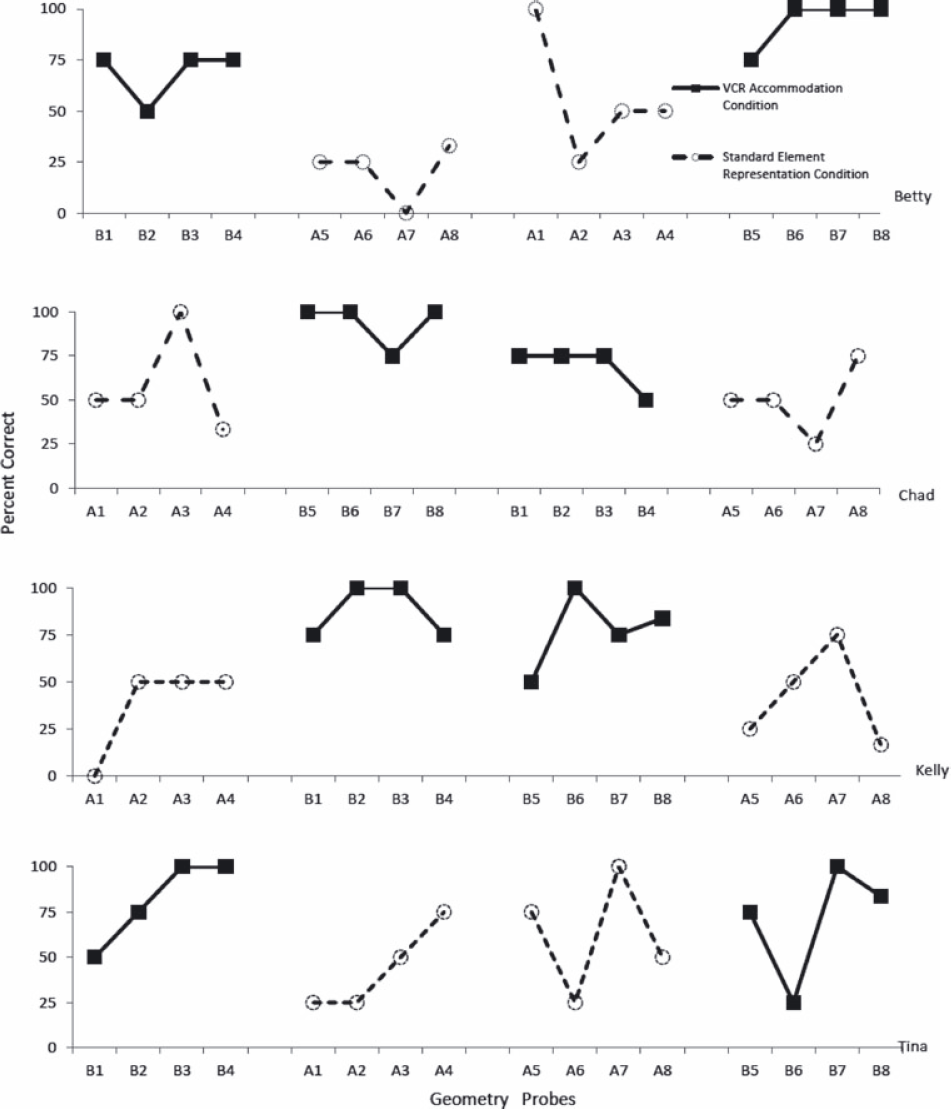
The participants’ performance in the standard–element representation condition and the visual–chunking representation accommodation condition. A = standard–element representation; B = visual–chunking representation (VCR).
In addition, researchers compared the participants’ performance in two conditions for each probe. Results suggested that most students performed better in the VCR accommodation condition than in the standard testing condition on the same probe. Three out of the four participants (with exception of Betty) performed better in Condition B (VCR) than in Condition A on Probe 1; all four participants performed better in Condition B than in Condition A on Probe 2; three out of four participants, except Chad, performed better in Condition B than in Condition A on Probe 3; and all four participants performed better in Condition B than in Condition A on Probe 4. Three participants (Chad, Betty and Kelly) performed better in Condition B than in Condition A on Probes 5–8; and Tina's scores were tied between Conditions A and B on these three probes. All four students performed better in Condition B on Probe 8.
A possible confounding variable could be memory effects. Specifically, when students were tested in a later condition, they might have remembered the answers they gave for the same items tested in the earlier condition. To control for such memory effects, the researchers varied the order of the probes tested among the four students. Inter–individually, the order of presenting a probe in Condition A and Condition B differed among the four participants. For example, Tina and Betty took Probes 1 through 4 in Condition B (VCR) before they took these four probes in Condition A (standard–element representation), whereas Kelly and Chad took Probes 1 through 4 in A–B order (i.e., taking the probes in Condition A before taking the same probes in Condition B). Results suggested that regardless of the order of taking the two conditions of Probes 1 through 4, all four participants achieved higher accuracy when solving problems in Condition B with the VCR accommodation. Similarly, Chad and Kelly took Probes 5 to 8 in B–A order, whereas Tina and Betty took Probes 5 to 8 in A–B order. Results also showed that all four participants achieved higher accuracy when taking these four probes in Condition B rather than in Condition A, regardless of the condition orders.
Intra–individually, researchers also counter–balanced the sequence of presenting Condition A and Condition B for each participant to ensure that each participant experienced testing with both A–B and B–A sequences. For example, Betty and Tina took Probes 1 through 4 in B–A order while taking Probes 5 through 8 in A–B order; Chad and Kelly took Probes 1 through 4 in A–B order while taking Probes 5 through 8 in B–A order. Results did not show a carry–over effect indicating that participants would perform better in a later condition of a probe than in an earlier condition. Instead, participants demonstrated consistent superiority in their performance when solving problems with the VCR accommodation compared to solving problems with the standard–element representation.
Social Validity
An interview was conducted to assess participants’ evaluations of the VCR accommodation. Participants were asked to respond orally to two questions about the helpfulness of the VCR accommodation after the testing was completed. The first question was, “Which condition of testing did you like better?” All four participants reported that they liked testing in the VCR accommodation condition better than in the traditional condition. The second question was, “Which test did you think was easier?” Three of the four participants reported that problem solving was easier with the VCR accommodation condition than with the standard–element representation condition.
Discussion
The present study aimed to examine the effectiveness of visual–chunking representation as an accommodation for improving students’ geometry problem–solving skills via enhancing their visual imagery skills. The results showed that students with mathematic difficulties performed better when solving geometry problems with the VCR accommodation than with the traditional–element representation. The survey results demonstrated that the students with mathematic difficulties found the modified version (VCR) tests easier than the traditional–element tests.
These findings support our hypotheses that VCR is effective in helping students with math difficulties improve their visual working memory while solving geometry problems. There is a subtype of students who struggle with math who have particular difficulties with visual imagery because of their short visual–working memory span (Geary & Hoard, 2005; Kyttälä, Aunio, Lehto, Van Luit, & Hautamäki, 2003). Consequently, their limited visual working memory span interferes with their geometry problem–solving abilities. Very few research studies have explored effective accommodations to assist students with math difficulties learn essential geometry skills. Although construction activities involving foldout shapes of solids may help students learn 3–D geometry (NRC, 2001), other promising activities need to be developed and investigated for assisting students with 3–D geometry shapes.
The results of the present study provide important implications for educational practitioners about accommodating students’ geometry problem–solving skills. Instructing students with math difficulties in geometry presents a challenge for teachers. A possible cause of such challenges is the students’ inefficiency in holding and manipulating visual information in memory; such a limitation arises from students’ cognitive deficits, regardless of their conceptual understanding of problem–solving concepts or procedures. Consequently, mental manipulation skills are difficult to teach with explicit instruction, which was commonly believed to be effective for students with math disabilities (Gersten et al., 2009). The present research demonstrates an accommodation approach to help children with math difficulties to perceive visual chunks to enhance their visual working memory capacity and to accommodate for cognitive deficits that affect geometry problem solving. Although the problems in the present study were fundamental three–dimensional problems without complex geometric calculations or theorem proofing, the findings can provide implications for more complex three–dimensional problems encountered in the high school mathematics curriculum. Many complex geometry problems at higher grade levels require similar visual imagery skills as part of the problem–solving procedures. For example, to understand the area algorithm for a parallelogram, a student needs the mental representation of the action–based embodiment of transforming one form into another (“if you push the top of this one [a parallelogram] to the side, it makes a rectangle”) (Lehrer, Jenkins, & Osana, 1998; NRC, 2001). Apparently such problem–solving tasks will benefit from activities that improve a student's visual imagery. The findings also suggest that textbook writers should include visual–chunking examples to facilitate students’ problem–solving processes.
Regarding implications for educational researchers, this was a pilot study to apply findings from basic cognitive psychology research to educational practice—a leap from the lab to real classroom settings. The present study provides accommodations to address the cognitive deficits of students struggling with geometry problem solving. To provide appropriate and effective special education services, it is critical to understand the special difficulties students with disabilities may encounter and the related deficits they may have. For students with math learning disabilities, deficits in working memory significantly affect their math problem–solving skills (Geary & Hoard, 2005). As a result, students with mathematic difficulties need effective accommodations to help them overcome cognitive deficiencies. Cognitive accommodations are analogous to a child with a visual disability wearing a pair of glasses. Various accommodations have been provided to students with disabilities, including lengthening their testing time, reading problems aloud, providing calculators, and so on. However, most accommodations are provided on a physical level rather than on a cognitive level. More cognitive accommodations are recommended for students with disabilities.
The findings from this study provide implications for future research into geometry instruction for students who have difficulties with mathematics. Although the current study provided a testing accommodation to struggling students through a visual–chunking strategy, further studies can research methods for providing educational scaffolding to assist with students’ visual chunking during instruction. VCR can be incorporated into the curriculum by teaching students an encoding strategy to group visual elements in a figure to single units or chunks. To do so, the students must be able to recognize the visual groups as some known chunks, such as parallel lines, perpendicular, angles, triangles, etcetera, and consequently enhance their manipulating and reasoning with correlated attributes of such chunks. In this way, only a small number of chunks at the higher level must be retained in working memory. Successful chunking interventions have been reported for improving learning in verbal (Ericsson & Kintsch, 1995) and numeric areas via training participants to form a hierarchy of chunks; such chunking interventions also should be effective for enhancing students’ working memory in visual areas. Moreover, the perception of chunks depends on two aspects; in addition to the objective features and relatedness of the presented objects (Gobet et al., 2001; Miller, 1956; Sakai et al., 2003), a student's internal semantic knowledge structure or network is also critical for effectively constructing meaningful chunks (Chase & Simon, 1973). Follow–up research can look into instructing students to better construct their geometric schemata to find meaningful chunks in complex visual figures.
As a pilot study, the present research contains several limitations. First, the single–subject design does not allow for generalization of the findings to the overall population of students with math difficulties. An additional limitation is that the participants were not required to explain how they chose their answers. Asking the reasons for students’ choices can be a useful research question in a follow–up study. Also, students in the accommodation condition might perform better when they verbally describe the decisions they made. Second, it is still unclear whether the VCR accommodation functions as a true accommodation or as a modification in geometry testing. According to Fuchs and Fuchs (1999), a testing accommodation should be provided only if it offers a differential “boost” to the individual with disabilities. In other words, if VCR benefits students with mathematical cognitive deficits (i.e., with deficits in visual working memory) more than it benefits peers without math cognitive deficits, then the VCR technique should be recommended as an effective accommodation for children with math learning difficulties. However, if VCR benefits students both with and without math learning difficulties with the same magnitude, then VCR should be considered as a modification of math geometry testing and, therefore, administering geometry testing with VCR only to students with math difficulties would be unfair to students without math difficulties. To address the above limitations, the authors are conducting a large–scale study to make group comparisons regarding whether VCR results in universal performance gains for individuals with or without math difficulties or results in performance gains only for individuals with math difficulties.