







Abstract
No television show about urban life has received as much praise as The Wire, a dramatic series about Baltimore that was broadcast on HBO for 5 years, ending in 2008. the entire show is now available in a five–CD set.
Although not a major commercial success with viewers, it was a huge hit with critics, who applauded its gritty depiction of urban life. the show won praise from reviewers across the political spectrum—from the New York Times to the Wall Street Journal, from the liberal American Prospect to the libertarian Reason magazine. Jack Dumphy, a columnist for the right–wing National Review, wrote that The Wire is “still the best show on television.” Slate's Jacob Weisberg called it “ … the best TV show ever broadcast in America.” Novelist Stephen King, writing in Entertainment Weekly, called the show “a staggering achievement.”
The show was a sociological treasure chest. the main focus of The Wire was life on the mean streets of Baltimore's inner city, especially its African American neighborhoods, and particularly the world of the gangs that controlled the city's drug trade. But each season, the show focused on a different aspect of life in Baltimore—the police, the docks, City Hall, the schools, and the daily newspaper. the show juggled over 65 vivid characters. the large ensemble cast (disproportionately African American actors) included cops, teachers, reporters, drug dealers, dockworkers, politicians, and other characters in the real dramas of a major American city. Each year of the show, at least 25 of the characters had important parts. the writers wove these settings and characters into the show throughout its 5–year run. as a result, viewers got a sense of how people were shaped by the larger system—their relationships with each other and with the web of institutions.
This wasn't just a formulaic cops–robbers–and–lawyers show (like Law & Order). Some critics compared The Wire to a great literary novel. Unpredictable plot twists, deft foreshadowing, and complex characters justify that judgment. Like most great stories, the main characters were morally ambiguous, but so finely etched that we cared about them. Even the gangsters were complex personalities, not the stereotypes typical of TV crime dramas. We ended up taking sides in gangland battles, rooting for Omar, Proposition Joe, and Bodie, and wanting Marlo annihilated. Unlike other TV crime shows, The Wire allowed viewers to see the characters and situations from multiple perspectives, not just through the point–of–view of the police and prosecutors.
David Simon, the show's creator and chief writer, is a former Baltimore Sun reporter; the other major co–writer, Ed Burns, is a former Baltimore cop and school teacher. Before writing The Wire, Simon wrote two books about Baltimore—Homicide: a Year on the Killing Streets (the basis for the excellent NBC television series, Homicide, which he served as a writer), and (with Burns), The Corner: a Year in the Life of an Inner–City Neighborhood (which Simon adapted into an HBO mini–series, The Corner). Both books are full of sociological insights about urban life.
The writers paid attention to detail. the workplaces, neighborhoods, language, and events portrayed in The Wire had the kind of verisimilitude that justifies the torrent of praise. the show really captured Baltimore's nuances, flavor, language, and culture. Police detectives drank “Natty Boh”—National Bohemian, a beer originally brewed in Baltimore. and the dialogue rang true. Snoop, second in command to drug thug Marlo, explained to a hesitant gang member how she'd retaliate if he didn't cooperate: “We will be brief with all you motherfuckers—I think you know.” Another drug kingpin, Avon, locked in jail and eager for stories in the street, asked Marlo: “What about you? How you been?” Marlo shrugs: “You know. the game is the game.”
But in most ways, The Wire could have been about any older American city, facing the realities of the past decade—the loss of blue–collar union jobs, a shrinking tax base, racial segregation and the concentration of poverty, street gangs and the drug trade, and troubled schools. 2
The show's two creators had a political agenda. They wanted The Wire not only to examine the realities of urban life, but also to provoke moral outrage. in interviews during and after the show's 5–year run, they explained that they considered The Wire to be a form of muckraking reporting. Simon said he considered himself a “gadfly” and called the show “a political tract masquerading as a cop show” and a “critique of what … has gone wrong in America.” 3 They didn't simply want to entertain. They wanted to expose injustice. They wanted to get people upset—perhaps upset enough to actually do something about the conditions portrayed in the show.
But if that was their goal, they failed. They failed not because the show wasn't upsetting, but because it portrayed urban life as hopeless. They portrayed the characters in the show as victims of a “system” beyond reform.
The show's writers may have thought that they were presenting a radical critique of American society and its neglect of its poor, its African Americans, and its cities. But there's nothing radical about a show that portrays nearly every character—clergy and cops, teachers and principals, reporters and editors, union members and leaders, politicians and city employees, social workers and everyday people—as corrupt, cynical, or well–intentioned but ineffective.
In an interview, Simon observed that, “The Wire is dissent.” 4 But when asked “Do you think change is possible?” Simon answered, “No, I don't. Not within the current political structure.” 5 This view is reflected in the show. All writers make choices about what to include and what to exclude. This is called “artistic license.” But those choices have consequences. The Wire was the opposite of radical; it was hopeless and nihilistic. the city portrayed in The Wire is a dystopian nightmare, a web of oppression and social pathology that is impossible to escape. The Wire's unrelentingly bleak portrayal missed what's hopeful in Baltimore and, indeed, in other major American cities.
The Wire's last season ends with a critique of the press for failing to tell the true story of the inner–city. Simon criticized the Baltimore Sun for its inadequate reporting about poverty and its decision to drop its poverty beat in the early 1990s. 6 In The Wire, however, Simon made the opposite error. He was so determined to expose Baltimore's problems that he provided viewers with an unrealistically negative picture of the inner city. in five seasons, the show didn't even hint at the possibility that residents, if well organized and strategic, can push powerbrokers to change policies and institutions to make the city more humane and livable. the effective organizing work over the past two decades of progressive union, community, and environmental groups in many cities and metropolitan areas—including Baltimore—is entirely missing from The Wire. 7
In this regard, The Wire is similar to much of American sociology, which, despite its reform impulse, is better at describing the various forms of inequality and injustice in society than at identifying the political opportunities that make mobilization and reform possible. Sociologists are typically sensitive to examining what's wrong, but not as useful at offering solutions. There are, of course, many important exceptions to this characterization, but, in general, sociologists—even the radicals among them—are typically more comfortable emphasizing the structures of oppression over human agency, political strategy, and public policies that promote greater fairness, equality, and opportunity.
The Wire was broadcast from 2002 through 2008—the George W. Bush era. During that period, America faced the biggest concentration of income and wealth since 1928. a growing number of Americans—not only the poor but also the middle class—found that their jobs, their health insurance, their pensions, even their homes were increasingly at risk. 8 the cost of housing, food, health care, gas, and college tuition rose faster than incomes. During Bush's presidency, the number of Americans in poverty increased dramatically—from 32.9 million (11.7 percent of the population) in 2001 to 37.3 million (12.5 percent) in 2007—many of them among the growing army of the “working poor.”
These conditions should provoke outrage. But simply being aware of these outrageous conditions doesn't guarantee that middle–class Americans, faced with their own economic insecurities, will identify with and make common cause with the poor. for that to occur, they need to believe three things:
First, that the plight of the poor is the result of political and social forces, not self–inflicted by the poor themselves; Second, that lifting up the poor will not come at the expense of middle–income Americans; and Third, that the problems of the urban poor—and the magnitude of urban poverty—can be solved.
In other words, they need some sense that all, or most, Americans share a common fate. They also need some sense of hope that things can change for the better. Hope springs from a combination of political leadership and grassroots activism.
Each of these three conditions has taken root in the past decade. Polls show that more and more Americans want the government to address the issues of poverty, housing, health care, and the environment. Even before the nation's economy took a sharp nosedive in late 2008, a growing number of Americans, including those in the middle class, believed that the widening gap between the rich and everyone else is a serious problem that government should deal with.
Since welfare reform was enacted in 1996, pushing more and more low–income people into the workforce, Americans have changed their views about the poor. They now increasingly view poverty through the prism of work and working conditions. They view people who remain in poverty despite working as the “deserving” poor. as a result, polls reveal that a vast majority of Americans want to raise the federal minimum wage so that it is above the poverty level—in other words, they believe that work should be rewarded. the popularity of Barbara Ehrenreich's book, Nickel and Dimed, the challenges to Wal–Mart (the world's largest employer, with a large low–wage workforce), and the remarkable success of the “living wage” movement in about 200 cities all reflect an upsurge of concern about poverty. Polls also show that support for labor unions has reached its highest level in more than three decades.
What does this have to do with The Wire? Three things:
First, to the extent that The Wire helped raise awareness of these problems—and the systemic nature of the urban crisis—it deserves all the praise it received. No other major industrial nation has allowed the level of sheer destitution that we have in the United States. We accept as “normal” levels of poverty, inequality, hunger, crime, homelessness, and inadequate and unequal school funding that would cause national alarm in Canada, Western Europe, or Australia. The Wire brilliantly portrayed these realities, putting a human face on the “urban crisis.”
Second, The Wire showed how people cope with “the system” and the overwhelming obstacles they face in just trying to get by or do their jobs. It showed how even people with good intentions and some idealism face enormous hurdles. By exploring the dysfunction of many key urban institutions—including politics and municipal government, the schools, the criminal justice system, and the media—The Wire revealed how urban politics is often a struggle over crumbs, whether the issue is funding for schools, police, housing subsidies, or drug–rehab programs.
But third—and most important—The Wire failed to offer viewers any understanding that the problems facing cities and the urban poor are solvable.
To bring about the change that the show's writers hoped for, people need to feel not only that things should be better but that they can be better. The Wire offered viewers little reason for hope that the lives of the people depicted in it could be improved not only by individual initiative but also (and primarily) by collective action and changes in public policy. It offered viewers no hint that in Baltimore there was a small but growing movement to mobilize urban residents and their allies to address these problems—a movement that exists in every major city in the country and that has borne fruit in many ways.
The Wire's portrayal of Baltimore buttresses the myth that the poor, especially the black poor and the black working class, are helpless victims, unable to engage in collective efforts to bring about change. in other words, the Wire reinforced the notion that the harsh status quo cannot be changed. 9
The Wire was populated by low–income African–Americans and a handful of working class and middle–class people whose jobs—cop, teacher, social worker, government bureaucrat, reporter, minister—involve relating to the poor as “problems” or “clients” rather than as fellow citizens.
The show virtually ignored Baltimore's black working class. Although the show portrayed African Americans in a wide range of occupations (police administrators and cops, principals and teachers, union leaders and dockworkers, social workers and clergy, editors and reporters), almost all of the African Americans living in Baltimore's ghetto were depicted as dangerous criminals, drug addicts, welfare recipients—an unemployed underclass—culturally damaged, a class of people whose behavior and values separate them from respectable society.
Much of the Baltimore we see in The Wire focused on the residents of the low–income black neighborhoods. in 2006, blacks comprised 65 percent of the city's population. Among them, 23 percent were poor. 10 True, many were jobless. Baltimore has been hemorrhaging jobs for decades, an issue that The Wire addressed in its second season, when it looked at the decline of the city's port. as a result, finding a job has become a problem, especially for African Americans. the black unemployment rate in Baltimore in 2006 was 13.7 percent, more than double the white rate of 5.7 percent. in 2006, 42,300 black Baltimoreans were jobless. That's a big number, but that means that 86.3 percent of Baltimore's black adults in the labor force were working.
Virtually absent from The Wire were the working poor—those who earn their poverty in low–wage jobs. Among the 180,000 Baltimore residents who worked full–time, 38 percent earned less than $30,000. Among the 105,266 African–Americans in Baltimore working full–time, almost half (46 percent) earned below $30,000.
The show offered a few small rays of hope by portraying some characters as people who were able to maintain their dignity and pride amid enormous turmoil. One such character was Bubbles, a recovering heroin addict and homeless person who displays an incredible will to live and extraordinary survival skills. Slate magazine's Jacob Weisberg lauded this aspect of the show. The Wire, he wrote, “is filled with characters who should quit but don't, not only the boys themselves but teachers, cops, ex–cops, and ex–cons. … This refusal to give up in the face of defeat is the reality of ghetto life as well. Feel me: It's what The Wire is all about.” 11
But the few heroes depicted in The Wire were individualist renegades and gadflies. These include cops like James McNulty and Lester Freeman and the stick–up artist Omar, as well as the social worker Whalen (a Narcotics Anonymous sponsor played by the singer Steve Earle), the Deacon (an influential West side clergyman played by Melvin Williams), and Dennis “Cutty” Wise (whose boxing program may stop a teenager from succumbing to life of drugs).
Unlike unions and community organizing groups, the few do–gooders portrayed in The Wire didn't seek to empower people as a collective force. They tried to help individuals, one at a time, rather than trying to reform the institutions that fail to address their needs. One person alone, no matter how well–intentioned, can't save a school system, create jobs, or make a neighborhood safer.
But Baltimore was (and is) filled with labor and community activists who were doing just that—mobilizing people to reform institutions, to change the system, to change the relationships of power in the city. Those people were completely absent from the show over the entire 5 years and 60 episodes.
Baltimore's recent history is filled with examples of effective grassroots organizing that Simon and Burns could have used to portray a different slice of the city's sociological and political realities.
For example, in 1994, a community group known as BUILD (Baltimoreans United in Leadership Development) led a campaign that mobilized ordinary people to fight for higher wages for the working poor. One of those people was Valerie Bell. She lived in a small row house in Baltimore. With just a high school degree, she secured a job with a private, non–union custodial firm that contracted with the city to scrub floors and take out the garbage at Southern High School. Baltimore was trying to cut costs by outsourcing jobs to private firms. Bell earned $4.25 an hour with no health benefits. Like so many others who earned a minimum wage each month, Bell coped with how to pay the electricity bill, groceries, and the rent.
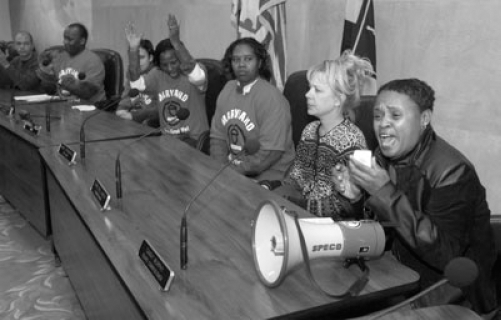
ACORN members protest at a school board meeting.
BUILD put together a coalition of churches and labor unions, and lobbied the city to pass a “living wage” law that would increase wages above federal poverty line. the law would apply to employees who worked for private firms that had contracts with the city. It would affect 1,500 workers, hired by private bus, security, and janitorial companies. the ordinance would force wages up from $4.25 to $8.80 an hour over 3 years, and then increase each year to account for inflation.
At some risk to herself, Bell organized other custodians to join the living wage campaign. When the company discovered Bell's activities, it fired her. Undeterred, Bell stayed active with BUILD and helped gather petition signatures and organize demonstrations. BUILD recruited academics who produced studies showing that it made no sense for the city government to save money in the short term by underpaying workers, who then had to resort to a variety of government–supported homeless shelters and soup kitchens to supplement their low wages. Working with BUILD, Bell and others put so much pressure on the city, they convinced then–Mayor Kurt Schmoke to support them. as a result of this grassroots organizing effort, Baltimore passed the nation's first living–wage ordinance. the current rate is $9.62. in 2007, community and labor activists led a successful campaign to get the state of Maryland to enact a state living wage law—the first state in the country to do so.
Economists estimate that the Baltimore living wage law puts millions of dollars into the pockets of the city's working poor each year, and has had a ripple effect pushing up wages in other low–paid jobs in the city. Following Baltimore's lead, there are now similar laws in about 200 cities across the country. the political momentum created by these local living wage victories changed the political climate at the national level. in May 2007, President George W. Bush reluctantly signed a bill increasing the minimum wage from $5.15 to $7.25 over 2 years—the first increase in the federal minimum wage in almost a decade.
For 30 years, BUILD—which is part of the Industrial Areas Foundation network founded by organizer Saul Alinsky and which has affiliates in many cities—has been dedicated to transforming Baltimore's struggling inner–city neighborhoods. BUILD has not only won the nation's first living wage campaign, it also has built hundreds of affordable housing units called Nehemiah Homes (named after the Biblical prophet who rebuilt Jerusalem and modeled on a similar program in New York City).
BUILD also created a network of after–school youth programs called Child First. That program began in 1996 with city and private money, and provides free after–school care for over 1,000 children every year at the city public schools. Child First is an academic enrichment program. the program involves parents, staff, administrators, church members, and other community members to help students, a real “it takes a village” approach. Child First trains parents to take part in their kids’ education by volunteering at schools and coming together to discuss how they can improve the school system. Volunteers tutor students in math and English, help them with study skills, and nurture their artistic talents.
During the 2007 election, BUILD signed up 10,000 voters as part of its “Save Our Youth” campaign. Every candidate for City Council and Mayor, including Mayor Sheila Dixon, committed to the agenda, which included doubling the number of summer jobs for young people and funding neighborhood recreation centers.
In December 2007, after several years of working with Dixon (as a City Council member and then as Mayor) to renew the run down section of Baltimore, known as Oliver—where much of The Wire was filmed—BUILD persuaded the city to transfer 155 abandoned properties to the community group, which will either rehab the homes or tear them down and build new ones, then sell them to working–class homebuyers.
“BUILD is making steady progress in eliminating blight throughout the Oliver neighborhood, where 44 percent of properties are vacant,” said Bishop Douglas Miles, 59, pastor of Koinonia Baptist Church.
A native Baltimorean, Bishop Miles, BUILD's co–chair, grew up in public housing projects. He's been involved with BUILD for 30 years. Under his leadership, Koinonia Baptist Church initiated a number of innovative ministries including an after–school program called Project Safe Haven, a juvenile alternative sentencing program that has saved many teenagers from the fate of a life in and out of jail.
Bishop Miles, who watched every episode of The Wire, was outraged at the way the church community was portrayed. “The Wire ignores all the good work the faith community had done,” he complained.
BUILD isn't the only group in Baltimore engaged in successful grassroots organizing.
The fourth year of The Wire focused on Baltimore's school crisis through the lives of several young boys barely coping with problems at home and lured by the illegal drug business. At one point in the show (Episode 50, “Final Grades”), the boyish but cynical Mayor Thomas “Tommy” Carcetti lobbies Maryland's governor to help bail out the city's bankrupt public school system.
Missing from the storyline is what actually occurred in 2004 when two groups—ACORN and the Algebra Project—mobilized parents, students, and teachers to pressure then–Mayor Martin O'Malley (now Maryland's governor) to ask for state funds to avoid massive lay–offs and school closings. 12
ACORN, a community organizing group, built a coalition that included public employee unions and the Algebra Project (a group founded by civil rights icon Bob Moses to organize young people around school issues). the community and union activists hit the streets and filed lawsuits to get more money pumped into the school system.
In November 2003, ACORN members rallied at City Hall to deliver Maryland ACORN's second annual “Turkey of the Year Award” to Mayor O'Malley for his plan to balance the school district's budget at the expense of Baltimore students’ education, in part by laying off a thousand school employees. the next month, ACORN organized a confrontation at a board of education meeting. With hundreds of ACORN members attending, and one member shouting through a bullhorn, ACORN took over the meeting before police hauled them out of the room.
The protests were part of a months–long campaign of agitation that forced O'Malley to come up with the money and avoid unnecessary layoffs and a state takeover.
“The system is in meltdown,” Mitch Klein, an ACORN organizer, told us. “Cutting funds is like the Baghdad version of putting back together the Baltimore city public schools.”
School reform is only one of several issues that Baltimore ACORN—an affiliate of a national organization with chapters in over 100 cities—has addressed. Its young organizers have identified and trained tenant leaders to wage a campaign to clean up hundreds of lead–contaminated rental units. ACORN's tenants organized a rent strike to pressure slumlords to remove lead hazards in thousands of apartments. ACORN's members also closed corner stores dealing drugs, improved the city's housing code enforcement program, and pressured the police department to assign more foot patrols to the low–income Cherry Hill section of Baltimore.
Banks have persistently redlined Baltimore's minority neighborhoods or engaged in abusive, discriminatory predatory lending practices, leading to a recent wave of widespread foreclosures. Lobbied by ACORN and other community groups, Mayor Dixon and the City Council sued Wells Fargo Bank in January 2008 for targeting risky subprime loans in the city's black neighborhoods that led to a wave of foreclosures that reduced city tax revenues and increased its costs of dealing with abandoned properties. It was the first lawsuit filed by a municipality seeking to recover costs of foreclosure caused by racially discriminatory lending practices.
“Some things I can't accomplish by myself,” said Sonja Merchant–Jones, a former public housing resident who is active in Baltimore ACORN, “but together we've been able to confront elected officials, banks, and the utility companies, and get them to meet with us, negotiate with us, and change things. But I'm disappointed that I never see things like this on The Wire.”
Robert Mathews is a 64–year–old janitor in an 11–story office building in downtown Baltimore. He rents a small house in Montebello, one of Baltimore's most troubled neighborhoods, with his wife and two grown sons. the former Merchant Marine has been a deacon in his church for many years and a mentor for many of the church's youth. He takes them on trips and counsels them when they appear to be heading in the wrong direction. for almost three decades, Mathews has also been a union activist, utilizing the same skills to counsel, mentor, and organize his fellow low–wage janitors across the city.
After 30 years cleaning office buildings, he was making $9.10 an hour.
In December 2007, Mathews helped lead a campaign of thousands of janitors in Baltimore, Philadelphia, and Washington, D.C., to win a better contract, among them 700 cleaners, most of them African–American, at over 40 Baltimore buildings, including the high–rise Candler, Legg Mason, and Bank of America buildings downtown.
After months of protesting, picketing, threatening to strike, and negotiating, the janitors–part of the Service Employees International Union's Justice for Janitors campaign–won a 28 percent pay increase. the janitors also won up to two weeks vacation and employer–paid family prescription drug coverage. the agreement added dental and vision benefits to the employer–paid health plan.
Mathews, who remembers when Baltimore's schools, movie theaters, and restaurants were segregated, participated in civil rights protests in the 1960s. “To make change, you have to take a stand,” he told us.
Mathews only occasionally watched The Wire. He was offended by its bad language, but also by its unrealistic depiction of the Baltimore he's lived in his entire life. “It's more negative than positive,” he said. “The people on the show don't have anything to live for. the young people have no vision. If you want change, you have to believe things can change.”
These real–life organizing campaigns by BUILD, ACORN, and SEIU's Justice for Janitors were reported in the Baltimore Sun and by local TV and radio stations. Yet David Simon, the show's creator, found no room to tell any of these stories in the 60 episodes of The Wire over its 5–year run.
Rob English, a 38–year–old organizer for BUILD, is hardly a romantic radical. He served for 4 years as a platoon leader in Somalia.
Referring to The Wire, he said: “The show does an excellent job of telling one side of the story. But it's missing all the pastors, parents and teachers, principles, young people who are doing amazing work, radically trying to change and improve Baltimore.”
People like Valerie Bell, Bishop Miles, Sonja Merchant–Jones, Robert Mathews, and Rob English are committed activists who have persisted in their organizing efforts through victories and disappointments. They never succumb to cynicism or corruption. the people organized by BUILD, ACORN, the Algebra Project, SEIU, and other community, labor, and environmental justice groups maintain a sense of hope and possibility in the face of difficult odds. And, slowly and steadily, their organizations have won significant victories that improve the lives of Baltimore's poor and working–class residents.
These community activists are not superheroes or naive idealists. They are ordinary people who sometimes manage to do extraordinary things. What distinguishes them is their patience, political savvy, street smarts, empathy, faith, and people skills required to build strong organizations that can mount grassroots organizing campaigns. They harness what organizers call “cold anger” and turn it into outrage against injustice rather than indiscriminate rage.
They do not expect to turn Baltimore upside down. Rather, they mobilize people to win small, concrete victories that improve people's living and working conditions, and whet their appetites for further battles. They challenge the city's political and business establishment and seek to get Baltimore's power players and institutions—employers, landlords, politicians, police chiefs, school superintendents, and others—to the bargaining table, where they can negotiate on a somewhat level playing field. They don't always win, but by their persistence and their ability to recruit people to join them, they have to be taken seriously by the city's powerbrokers.
They know that there are limits to what can be accomplished in one city—that many of the problems facing America's cities can only be solved with changes in federal policy. They recognize that organizing people in their communities and workplaces is a precondition for mobilizing people from across the country into a broader movement for social justice. 13
Those who lead union– and community–organizing fights have the same foibles and human weaknesses we witnessed in the characters in The Wire. But incorporating their stories into the series would have shown a different aspect of Baltimore, one in which the poor and their allies seek change, not charity, and learn how to marshal their collective power. Unfortunately, community activists and leaders like these didn't exist in the Baltimore depicted in The Wire. Without them, and the organizations they belong to, we were left with a view of Baltimore's poor as people sentenced for life to an unchanging prison of social pathology. This, in fact, was how The Wire viewed the poor.
David Simon, The Wire's creator, told Slate magazine that “Thematically, [The Wire is] about the very simple idea that, in this Postmodern world of ours, human beings—all of us—are worth less. We're worth less every day, despite the fact that some of us are achieving more and more. It's the triumph of capitalism.” 14
He added, “It's the triumph of capitalism over human value. This country has embraced the idea that this is a viable domestic policy. It is. It's viable for the few.”
But Simon's world view—at least as it revealed in The Wire—is hardly radical. He generally views the poor as helpless victims rather than as people with the capacity to act on their own behalf to bring about change. He may think he's the crusading journalist exposing injustice, but, based on the show, he's really a cynic who takes pity on the poor but can't imagine a world where things could be different.
It is probably no accident that The Wire ended its 5–year run just as the Bush era was ending. the zeitgeist of the Bush era was a culture of fend–for–yourself cynicism, with no agenda to address the needs of cities like Baltimore. It appears that Americans may be ready to feel hopeful again, as evidenced by the election of Barack Obama.
Perhaps, a year or two from now, Simon or another writer will propose a new series to TV networks about the inner workings of the White House and an idealistic young president, a former community organizer, who uses his bully pulpit to mobilize the American people around their better instincts.
This president would challenge the influence of big business and its political allies, to build a movement, a New Deal for the 21st century, to revitalize an economy brought to its knees by Wall Street greed, address the nation's health care and environmental problems, provide adequate funding for inner–city schools, reduce poverty and homelessness, and strengthen the power of unions and community groups.
In May 2008, Simon and Burns received an award from the Liberty Hill Foundation, a Los Angeles organization that provides funding for cutting–edge grassroots community, environmental, and labor organizing. in accepting the award, they offered congratulations to the activist groups whose leaders were represented in the audience.
Simon said, “The Wire spoke to a world in which human beings—individuals—matter less, a world in which every day, the triumph of capital results in the diminution of human labor and human value. Is that world an accurate depiction of America? I hope not. But we live in interesting times, and perhaps the only thing that is left to us as individuals is the power to hope, and to commit that hope to action.”
Unfortunately, that attitude was not evident in The Wire. But in that statement, Simon reflected a new spirit of possibility that is a precondition to transforming the country.