







Abstract
What are the mechanisms responsible for homeowners’ better mental health? Social disorganization theory suggests that the relationship between homeownership and mental health is mediated by perceived sense of control, trust in neighbors, and residential stability. This hypothesis is tested using data collected from respondents in 30 low–wealth urban areas. Using propensity score matching and regression models, I find that low–income homeowners report a greater sense of control and trust in their neighbors than comparable renters. Homeownership likewise has an impact on mental health, but the effect is entirely mediated by perceived sense of control. Part of that mediating effect is related to avoiding serious delinquency in mortgage payments. However, subjective trust and residential mobility did not mediate the relationship between homeownership and mental health. The study findings are discussed in light of the need for a cohesive theory of homeownership, particularly given changing economic realities.
Introduction
Several studies have examined the relationship between homeownership and outcomes related to mental health such as self–esteem or life satisfaction, but the findings have been mixed (Rossi and Weber 1996). One possible reason for these inconsistent results is that researchers have generally failed to examine the potential mechanisms that associate homeownership with mental health. It is crucial to move beyond simply linking homeownership to individual outcomes and ask why homeownership does (or does not) have a given effect. What is it specifically about the homeownership experience that produces the outcome? Answering this question allows us to expand our theoretical understanding of the homeownership experience.
In this study, I test three potential mediating effects that may explain a link between homeownership and mental health. My hypothesis is that homeownership reduces the risk of mental health problems by doing three things: it increases perceptions of being in control of the important aspects of one's life, it gives one a sense of trust in one's neighbors, and it increases the length of time one lives in the same place. In this way, I look inside the proverbial “black box” to gain a better understanding of not only how homeownership affects mental health but why. This advances research on theories of homeownership and contributes to scholarship on the sociology of mental health by examining how perceptions of control, trust, and stability are linked to mental health.
This study also makes a second contribution to research on urban homeownership. Past research in this area has generally failed to account for selection bias. People self–select whether to buy or rent a home, and it is likely that this selection effect has resulted in some overestimation of the impact of homeownership (Dietz 2003). It is probable that some of the same resources which facilitate buying a home, such as having higher education or income, also decrease the risk of untreated mental health difficulties. In this study, I explicitly model selection bias using propensity score analysis to account for sociodemographic differences between homeowners and renters. Because this study employs a rich data set with a wide range of measures, I am able to model selection and derive robust estimates of the effects of homeownership, perceptions of trust, stability, and sense of control.
Finally, this study offers a valuable contribution to current debates about the costs and benefits of homeownership in lower wealth urban communities. Until the recent boom and bust in the housing market, homeownership had been a central element of American social policy since the 1930s and has been considered an integral part of wealth building and urban revitalization (Herbert and Belsky 2006). 1 These questions became even more urgent since the housing market downturn which began in 2007 has generated negative financial and social consequences for vulnerable homeowners. Homeowners have lost a total of over $7 billion in housing wealth (Federal Reserve Flow of Funds Report 2010), and there is emerging evidence that homeowners facing foreclosure or experiencing negative equity are at greater risk for depression, chronic health problems, and undertaking risky behaviors such as smoking and drug use (Bennett et al. 2009). This study uses data collected in 2009, well after the housing market downturn began, to examine the relationship between homeownership and mental health in light of the new economic reality of the postdownturn environment. This unique data set offers an unparalleled opportunity to analyze the social impacts of homeownership among lower–wealth households during and after the financial crisis.
Social Disorganization Theory
Research on the sociology of mental health has developed strong evidence to support the claim that external social factors can play a significant role in one's risk of experiencing mental health problems. People who live in disadvantaged neighborhoods with little shared trust are at greater risk of experiencing mental health impairments (Roach and Gursslin 1965; Sampson et al. 2002). However, even within the most disadvantaged communities there is great variation in outcomes. It remains unclear what protective factors serve to reduce the risk of mental health difficulties for some residents. In this research, I draw on social disorganization theory (Sampson and Groves 1989; Sampson 1991; Sampson and Raudenbush 1999) to derive hypotheses about the relationship between homeownership, an individual decision with structural significance, and mental health outcomes within low–wealth urban neighborhoods. This emphasis on within–neighborhood variation highlights the importance of understanding how diverse outcomes can emerge from similar neighborhood contexts.
Social disorganization theory has been used widely to explore community–level differences in crime and delinquency (Sampson and Groves 1989; Shaw and McKay 1942). Originally proposed by Shaw and McKay in 1942, social disorganization theory posits that the instability and economic deprivation which characterize disadvantaged urban neighborhoods lead to an inability to solve shared problems or accomplish common goals. This lack of regulatory capacity, in turn, causes increases in crime. This theoretical model has been supported across a variety of settings including public housing projects (Roncek et al. 1981), neighborhoods in Chicago (Sampson and Groves 1989; Sampson and Raudenbush 1999), and rural communities (Lee and Bartkowski 2004).
Since its initial formulation, social disorganization theory has also been shown to explain outcomes other than crime rates. In research examining child development, for example, Sampson (1991) found that children who lived in neighborhoods with high levels of disorder were at greater risk of experiencing health problems. Sampson proposed that community instability matters because it prevents the development of social capital—the shared sense of trust and support for common goals that underlie cohesive and efficacious communities. Without social capital, it becomes difficult for communities to maintain social controls and sustain prosocial behavior, whether it be refraining from crime or obtaining medical care for a child (Bursik 1988; Kornhauser 1978; Sampson 1988).
There have been some attempts to link social disorganization with mental health outcomes. Latkin and Curry (2003) found that people who thought their neighborhoods had problems with crime were more likely to experience an increase in symptoms of depression. Ross (2000) found that the increase in depression associated with poverty was entirely mediated by perceptions of neighborhood disorder. Other researchers have linked perceptions of neighborhood instability to feeling a lack of control (Geis and Ross 1998) and to mistrusting others (Ross et al. 2001). Residents of unstable neighborhoods are less likely to feel in control of their lives because the external environment around them is less dependable and predictable. For the same reasons, there is also an association between individual–level residential instability and mental health. Among adolescents, frequent relocations are associated with an increased risk of experiencing anxiety or depression (Evans 2003). However, none of these studies have explored which factors may be associated with perceptions of social disorganization. What affects whether someone feels that their neighborhood is stable and the extent to which they trust their neighbors? In this study, I test whether homeownership is one such factor.
Residential Stability
Residential instability is a key component of social disorganization theory. Institutions of control and regulation are difficult to maintain when people are not invested in remaining in a given community (Kornhauser 1978:78). Residents who do not expect to remain in an area very long have few incentives to devote their resources toward community institutions since they would not benefit from them in the long term. Interpersonal connections likewise are not durable when people expect to be leaving a neighborhood (Berry and Kasarda 1977). It is difficult for people to form social bonds with their neighbors if they do not have sufficient time to get to know them. This is one way homeownership status may color perceptions of a neighborhood.
Homeownership reduces residential mobility. One study found the median length of time a household stayed in any given dwelling was 2 years for renters but eight years for homeowners (Rohe et al. 2002). Since they anticipate being neighbors for a considerable period of time, homeowners should be more likely than renters to form social ties with neighbors. However, research has also found that long–term renters and homeowners shared similarly favorable assessments of their neighborhoods (Rohe and Stegman 1994). One study of homeowners in the Midwest found that people became more satisfied with their neighborhoods the longer they lived in them (Glaster 1987). These social bonds with others and positive assessment of one's neighborhood may be key elements that reduce the risk of mental health problems for homeowners.
Perceptions of Trust
Homeownership is also associated with perceptions of trust in one's neighbors. Owning a home means owning part of a neighborhood. Brown et al. (2003) refer to this as “place attachment”—a sense of attachment and commitment to the home and those in the immediate neighborhood. Overall, place attachment is stronger for homeowners and long–term renters than for more transient residents. Woldoff (2002) found that the strongest predictor of place attachment is homeownership; it was even more influential than the actual attributes of the neighborhood. Place attachment, in turn, generates feelings of trust toward one's neighbors.
There is some evidence to suggest that place attachment is not simply a function of how long someone has lived in a neighborhood. Rather, an individual's homeownership status may independently affect the extent to which they feel they can trust their neighbors. As Haurin et al. (2002) write in their review of the literature on impacts of homeownership rates, “…a high homeownership rate in a neighborhood may not convey the expected benefit if a household is not ‘connected’ to the neighborhood.” It is possible that being a homeowner is one of the attributes that connects people to a neighborhood and, in turn, increases their sense of trust in their neighbors.
There is empirical evidence to suggest a link between homeownership status and individual perceptions of trust. Rothwell (2010) analyzed data from the General Social Survey and found, unexpectedly, he notes, that homeowners were more likely than renters to report feeling that they could not trust people in general. Looking more directly at relationships with neighbors, however, Oh (2004) found that within urban neighborhoods, homeowners interacted more with their neighbors and reported trusting their neighbors more. Recent work by Carson et al. (2010) is especially illustrative of how individual homeownership status can affect perceptions of one's neighbors. Using qualitative data collected within one neighborhood, they found that homeowners and neighborhood leaders often talked about renters as being transient residents who would be unlikely to form social ties with others or contribute to the neighborhood. They followed this with quantitative analysis of survey data from the same neighborhood, however, and found limited support for the residents’ perceptions. Homeowners were more likely to form emotional bonds with their neighbors, yet homeownership status explained only 1 percent of the variation in their measure of emotional bonds. While the evidence thus far is mixed on the relationship between homeownership and perceptions of trust, there is sufficient evidence to merit further consideration.
Sense of Control
In addition to stability and trust, I test another potential mechanism which may mediate the relationship between homeownership and mental health—sense of control. In much the same way that social disorganization and instability erode trust within a community, it also diminishes residents’ sense of being in control of their lives. Conversely, people who live in neighborhoods with low crime rates and strong social ties are more likely to feel empowered to control and direct the important aspects of their lives (Furstenberg and Hughes 1995).
Sense of control is “an individual's belief that he or she is largely in command of important life events” (Rohe and Basolo 1997). This is closely akin to the psychological concept of “global perceived stress” proposed by Cohen et al. (1983) to describe the degree to which people felt that they had control over their lives and could handle unexpected or difficult events. Specifically, they believed that a given trigger event will produce stress when it causes a person to feel that his/her life is “unpredictable, uncontrollable, and overloading.” Prior to Cohen et al.'s work, researchers had generally focused on objective measures of life stressors to evaluate the extent to which people could control key aspects of their lives. People who experienced events such as unemployment, living in a densely populated area, or loss of a family member were assumed to have a lower sense of control as a result of these experiences. However, this overlooked the fact that stressful events impact people differently based on factors such as coping skills, social supports, or structural advantages. As Cohen, Kamarck, and Mermelstein point out, “persons actively interact with their environments, appraising potentially threatening or challenging events in the light of available coping resources.” Stress is not caused by a given event, but by a person's ability to cope with the event. Therefore, the Cohen scale was developed specifically to measure the extent to which people feel a sense of control when approaching potentially stressful life events.
Homeownership is linked to sense of control in three ways. First, Rohe et al. (2002) theorized that homeowners have higher self–efficacy than renters because they have more actual control over the physical structure of their residence, as well as more control over if they move from the property. This actual control over one's living space and security of tenure lead to a generalized sense of control over important life events (Rohe and Basolo 1997).
The normative nature of homeownership also increases sense of control (Rohe et al. 2002). American housing policy subsidizes homeownership through tax deductions, infrastructure investments, and other advantages. Partly as a consequence, owning a home is a goal of the majority of Americans and is, rightly or otherwise, viewed as a symbol that one has achieved financial security or social status (Doling and Stafford 1989; Perrin 1977). Some research has found that people who become homeowners experience a greater sense of self–esteem and control over their lives due to accomplishing the goal of purchasing a home (Rossi and Weber 1996). Having successfully completed the often–difficult task of purchasing a home, homeowners may feel more empowered to take on other important tasks.
Third, “homeowner” is not just a social symbol; it is also a social identity. Within the context of the “American Dream,” homeownership has been socially constructed as the ideal tenure form while renting, at least for most families, is considered substandard. Therefore one way that homeownership “causes” a greater sense of control is that it places people in advantaged positions within a social structure that values and rewards homeownership. Homeowners are more likely than renters to have access to good schools and more amenities, live in neighborhoods with low residential turnover, and even have better quality physical dwellings. In this sense, homeownership is a proxy for social advantage in the stratification system, and any effects associated with homeownership are a result of that advantage. Homeowners may perceive a greater sense of control because, across multiple domains, they do have more control over important aspects of their lives.
On the other hand, some studies have found no correlation between homeownership and sense of control. Rohe and Stegman (1994) found that women who purchased homes through a subsidy program in Baltimore reported no increase in their sense of control in the year after they became homeowners. Rohe and Basolo (1997) analyzed the same sample after 3 years and again found no significant relationship between homeownership and sense of control. It is not clear whether this finding represents a generalizable conclusion, yet it suggests that the link between homeownership and sense of control must be tested rather than assumed.
The “Urban” in Urban Homeownership
This study focuses exclusively on the impacts of homeownership on residential stability, perceptions of trust, and sense of control in urban areas, and it is important to note that such impacts would likely be different in nonurban areas. Social disorganization theory was developed specifically to explain how the instability and lack of social integration in disadvantaged urban communities affects residents. Like Wilson's (1987) theory of the urban “underclass,” social disorganization theory is situated in the larger human ecology paradigm of the metropolis as portrayed by the Chicago School of Urban Sociology.
In recent years, some researchers have explored whether the same general principle can explain crime in rural communities. Results have highlighted some important differences in how social disorganization operates in urban neighborhoods compared to nonmetropolitan or rural communities. Rural communities generally have higher levels of social integration and interpersonal trust than urban areas, and research reveals that rural crime rates are more correlated with poverty and lack of economic opportunities than with a lack of social cohesion (Wilkinson 1984; Bouffard and Muftić 2006). In Granovetter's (1973) terms, rural social relationships are predominantly strong ties while urban areas have far weaker ties. In fact, one study found that while crime rates in urban areas increase as the population increases, rural communities experience the opposite effect; crime rates are higher in areas that have significant population loss (Barnett and Mencken 2002). Because social cohesion is already high in nonurban areas, it is unlikely that homeownership status there would generate an increase in trust in one's neighbors; renters likely know their neighbors as well as homeowners do, simply because there are fewer people in the community and less residential turnover.
Hypotheses
The goal of this research is twofold. First, I aim to contribute toward a general theory of homeownership by moving towards an understanding of both if and why homeownership is related to mental health. Second, the study investigates three potential linking mechanisms—residential stability, trust in neighbors, and sense of control—which may mediate the relationship between homeownership and mental health.
First, homeowners will move less often than renters and therefore will report having been in the same neighborhoods longer than renters. Social disorganization theory suggests that homeowners will be more likely to report feeling that they can trust their neighbors because their lower mobility enables them to form social ties within the neighborhood. Likewise, theories of homeownership indicate that homeowners will feel a greater sense of control over their lives as a result of their actual control over their living spaces and their experience of having successfully accomplished the goal of purchasing a home. My first three hypotheses are follows:
H1a: Homeowners will have lived in the same neighborhoods longer than renters.
H1b: Homeowners will report a greater sense of control over their lives than renters.
H1c: Homeowners will be more likely to feel that they can trust their neighbors than renters.
Social disorganization theory suggests that residential stability, trust in neighbors, and sense of control are related to mental health. The second two hypotheses are:
H2a: People who have been in the same neighborhood longer will be less likely to experience mental health difficulties.
H2b: People who feel a greater sense of control over their lives will be less likely to experience mental health difficulties.
H2b: People who feel that they can trust their neighbors will be less likely to experience mental health difficulties.
If these hypotheses are confirmed, then the final focus of this study will be to evaluate to what extent the relationship between homeownership and mental health is mediated by stability, sense of control, or trust in neighbors. The final hypothesis is:
H3: Homeownership has only an indirect effect on mental health which is entirely mediated by residential stability, sense of control, and trust in neighbors.
Data
This research uses the Community Advantage Panel Study (CAPS) data set. CAPS began in 2004 as a random survey of homeowners who received mortgages funded by the Community Advantage Program (CAP), a secondary mortgage market program, and renters living in similar neighborhoods as the selected CAP homeowners. The goal of CAP was to increase the flow of mortgage funding to borrowers who likely would not have qualified for prime mortgages. All borrowers met one of the following criteria: (1) having an annual income of no more than 80 percent of the area median income (AMI), (2) being a minority with an income not in excess of 115 percent of AMI, (3) purchasing a home in a high–minority (>30 percent) or low–income (median income <80 percent of AMI) census tract and having an income not in excess of 115 percent of AMI. These criteria ensured that, at the beginning of the study, all the CAP homeowners were low– to moderate–income (maximum 115 percent AMI) and most lived in moderate–income neighborhoods. By the end of 2004, CAP had funded 28,573 mortgages.
In 2004, 3,743 CAP homeowners were randomly selected to participate in CAPS, as were 1,530 renters who lived in similar neighborhoods 2 as the homeowners. The renters met the same income limits that the owners met in order to qualify for a CAP mortgage. The data set was limited to the 30 metropolitan areas in the United States with the highest number of CAP owners and includes only urban residents. The renter sample was obtained by randomly calling households within the same general areas as selected CAP homeowners, based on public telephone directory lists.
Since 2004, CAPS participants have responded to annual surveys on a wide range of topics. While a core set of questions are asked annually, survey modules vary from year to year. The data used in this research come from questions asked for the first time in the 2009 survey. The initial analytic sample comprises respondents who participated in that survey and had valid data on all variables of interest—a total of 2,153 homeowners and 811 renters. The majority of attrition, around 30 percent for both groups, occurred between the year 1 and year 2 surveys. 3 The overall panel attrition rate between 2004 and 2009 was 40.34 percent. As with most surveys, attrition is higher among minorities, respondents with less education, and those over age 40. The vast majority of attrition was due to respondents who could not be located; very few participants declined to be reinterviewed.
In order to assess how representative the CAPS is, Riley and Ru (2009) compared the 2004 CAPS sample of homeowners with a random national sample of low–income homeowners who participated in the 2004 Current Population Survey (CPS). The sociodemographic composition of CAPS is very similar to the CPS sample. The CAPS sample of homeowners includes a greater percentage of minority respondents than the CPS sample of homeowners since one of the goals of the original program was to increase minority access to homeownership, in line with the general American prohomeownership ideology. The other notable difference between CAPS and CPS is that over 90 percent of CAPS homeowners are employed compared to only 70 percent of CPS low–income homeowners. We presume this is because all CAPS owners purchased their homes fairly recently and therefore had to have a steady source of income to do so, while the CPS owners likely include more retirees who purchased their homes much earlier.
Measures
The independent variable of interest is homeownership. Homeownership is measuring using a dichotomous variable coded 1 for homeowners and 0 for renters. Respondents were coded based on their primary residence; people who lived in a rental property but owned another property were coded as renters.
Residential stability, sense of control, and trust are variables which potentially mediate the relationship between homeownership and mental health. Residential stability is measured as the number of months the respondent has lived in the same dwelling.
Following Rohe and Basolo (1997), I define “sense of control” as the degree to which someone generally believes they can direct important aspects of their lives and resolve problems. I operationalize sense of control with “global perceived stress” (Cohen et al. 1983) measured with Cohen's Perceived Stress Scale (PSS). 4 The PSS has been regularly used in a wide variety of studies and was designed to measure the “degree to which people feel they have control over the important aspects of their lives” (Cohen et al. 1983). The scale contains four items, two of which are reverse coded. The four items in the PSS are (1) in the last month, how often have you felt that you were unable to control the important things in your life, (2) in the last month, how often have you felt confident about your ability to handle your personal problems, (3) in the last month, how often have you felt that things were going your way, and (4) in the last month, how often have you felt difficulties were piling up so high that you could not overcome them? Each of the four items in the scale have the following response options: 0 = never, 1 = almost never, 2 = sometimes, 3 = fairly often, 4 = very often. Scores range from 0 (low sense of control) to 16 (high sense of control).
The third mediating variable is trust in one's neighbors. Respondents were asked, “How much would you say you can trust your neighbors: a lot, some, only a little, or not at all?” Respondents who said they trusted their neighbors a lot were coded 1, and all others were coded 0. While most studies on interpersonal trust rely on a similar single–item measure, there are some limitations inherent in using a binary variable instead of a scale measure (Stolle et al. 2008). Single–item measures that lack context tend to measure an abstract notion of trust which does not change over time, rather than measuring trust as it is perceived in a specific context. However, because the trust question is anchored to perceptions specifically about one's neighbors, it is likely that the responses represent an accurate measure of whether or not a respondent feels he/she can trust his/her neighbors 5 .
The dependent variable is mental health. This is measured using the question, “During the past four weeks, have you accomplished less than you would like to as a result of any emotional problems, such as feeling depressed or anxious?” People who answered yes were coded 1, all others 0. This question was adopted from the mental health component of the SF–12, a reliable health status scale which measures physical and mental health (Jenkinson et al. 1997). This question has been used in other studies as a reliable single–item indicator of mental health (Elo et al. 2003; Zhang et al. 2007) and yields similar results as the full SF–12 scale (Diehr et al. 2005). Just over 14 percent of the sample reported that they had experienced a mental health problem in the prior month.
The models include the following control variables: age, education, marital status, employment, race, the presence of children in the home, and dwelling type. These variables are first used to predict homeownership and calculate propensity scores. In subsequent models, these variables are controls predicting residential stability, sense of control, trust, and mental health. These variables have been shown in past research to be correlated with homeownership (Manturuk et al. 2009; Manturuk et al. 2010).
Age is measured as a continuous variable. Education is measured as a categorical variable with the following categories: high school degree or less, some college, 2–year degree, 4–year degree, and advanced degree. The reference group is high school degree or less. Marital status is also measured categorically with the following categories: married, divorced/separated, widowed, single, and cohabiting. The reference group is married. Employment is measured with the following five categories: employed full–time, employed part–time, unemployed, retired, and not in the labor force. The reference category is employed full–time. Race is measured using the categories white, black, Asian, and other race. The reference is white. An indicator variable is used to measure whether there are any children under age 18 in the home. Dwelling type is included as a categorical variable with the following three categories: single–family detached dwelling, multi–family dwelling, and other dwelling type. The reference is single–family detached dwelling.
Methods
The research employs propensity score analysis, OLS regression, and logistic regression models to evaluate the relationship between homeownership, sense of control and trust, and mental health. Propensity score analysis aims to address the selection bias that is inherent in observational studies (Guo and Fraser 2009). There are two primary flaws in traditional regression analysis. First, the selection variable is specified by these models as exogenous but is actually endogenous. In this research, for example, a traditional covariate control model would model homeownership as exogenous when it is not. In order to derive robust estimates, selection needs to be explicitly modeled (Heckman 1978; Heckman 1979). Second, traditional regression models assume that selection is independent from the outcome of interest. When this assumption is violated, as it often is, regression models yield biased and inconsistent estimation of the regression coefficients (Berk 2004; Imbens 2004; Rosenbaum and Rubin 1983). In the present study, respondents selected whether to purchase or rent their homes, and this selection must be modeled in order to obtain unbiased results.
This study uses the Neyman–Rubin counterfactual framework (Morgan and Winship 2007; Neyman et al. 1935; Rubin 2006, 1974) to guide the theoretical model of causality. Within this framework, a counterfactual is a potential outcome that is not observed in the data. In order to evaluate the causal effect of a treatment, we must be able to evaluate the counterfactuals—what outcomes the treated participants would have manifested if they had not received treatment. In this study, there are the following four counterfactuals: (1) the risk of mental health issues a homeowner would have if s/he were renting, (2) how long s/he would live in the same dwelling, (3) the level of sense of control s/he would have, and (4) the likelihood of trusting his/her neighbors. A key assumption of the Neyman–Rubin counterfactual framework is that we can not assume that the counterfactual for the homeowners is the same as the observed outcome for the renters. If the homeowners in this study had remained renters, they might still have a different risk of mental health issues or report a different level of sense of control.
The analysis relies on propensity score within–caliper one–to–one matching (Rosenbaum and Rubin 1983, 1985) which uses binary logistic regression to estimate propensity score of receiving treatment (i.e., owning a home). By definition, a propensity score is a conditional probability of a participant receiving treatment given observed covariates. In this study, the propensity score represents the probability a respondent is a homeowner given the following covariates: age, education, marital status, employment status, race, the presence of children in the home, and the dwelling type. Following Rosenbaum and Rubin (1985), this study employs the logit of the predicted probability:

where
After calculating the propensity score for each participant, homeowners were matched to renters based on the estimated propensity scores. The matching algorithm, nearest neighbor within caliper matching (Rosenbaum and Rubin 1985), selects a control participant j as a match for treated participant i, if and only if the absolute distance of propensity scores between the two participants (i.e., the difference between propensity scores Pi and Pj) meets the following condition:
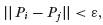
where ε is a prespecified tolerance for matching, or a caliper. Rosenbaum and Rubin (1985) suggest using a caliper size of a quarter of a standard deviation of the sample estimated propensity scores (i.e., ε ≤.25σP, where σP denotes standard deviation of the estimated propensity scores of the sample). For this analysis, the caliper is 0.31.
Results
Descriptive statistics for all variables, before matching, are available online. The overall sample is about 70 percent homeowners and 30 percent renters. The sample shows an even distribution of education, and almost half the respondents were married in 2009. Just over 65 percent of the sample was employed full–time, and no other employment category was over ten percent. Almost 60 percent of the sample was white, and almost half the respondents had children under of the age of 18 living at home. The majority of respondents lived in single–family detached dwellings, although almost 23 percent lived in apartments, townhouses, condominiums, or other attached housing. Almost 15 percent of the sample reported that they had a mental health problem in the prior month, although the mean PSS score was a fairly low 9.5, indicating that participants generally felt a good deal of control over their lives. Forty–six percent of people reported that they felt a lot of trust in their neighbors.
In order to calculate the propensity scores, I first run a logistic regression model predicting homeownership. The results of this are available online as Supporting materials. The model indicates that three of the covariates were not significant; age, having some college, and having children in the home did not predict whether someone was a homeowner within this sample. All the other variables were significant and had the expected effects. Using the matching procedure described earlier, 692 owners were matched to renters, resulting in a matched sample of 1,384 owners and renters. Table 1 presents descriptive statistics on all variables after matching. As shown, the distribution of the sample is very similar before and after matching.
Descriptive Statistics—Propensity Score Matched Sample (N = 1394)
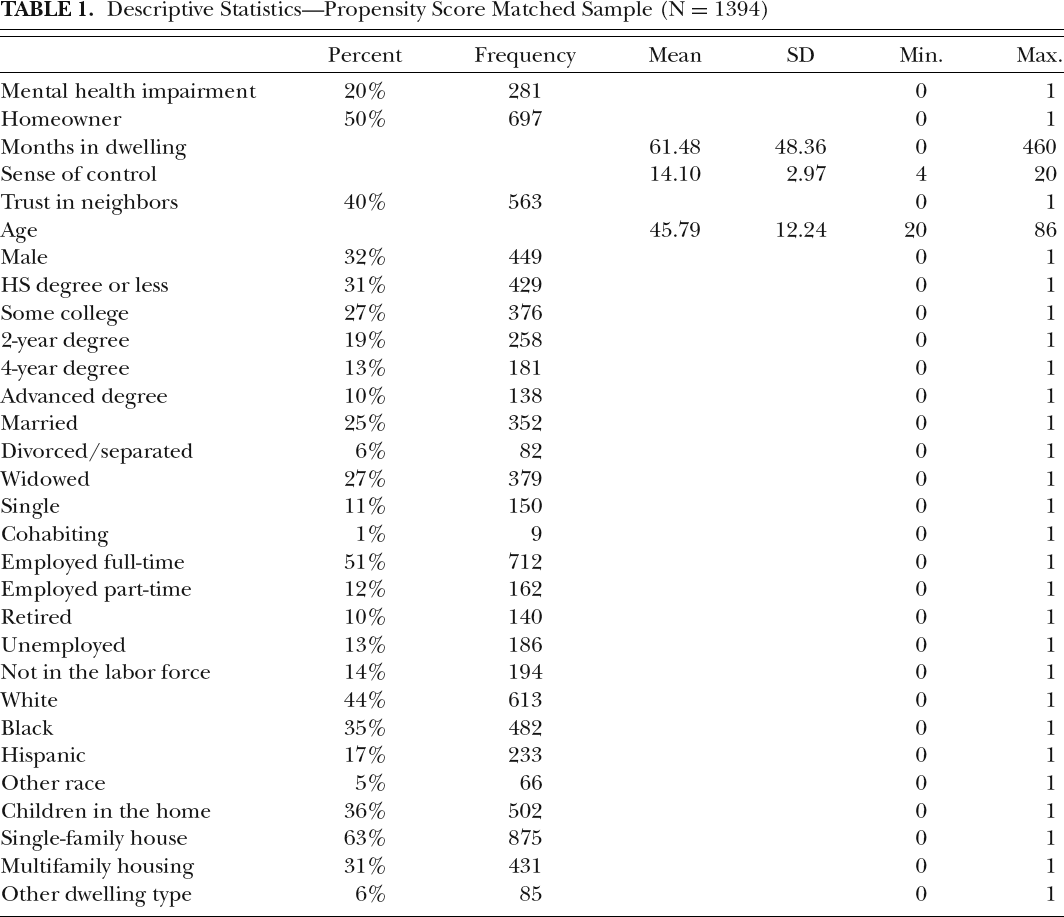
Table 1 also indicates that the matched sample has a low average mobility rate. The mean number of months in the same dwelling is 68 months, or around 5.5 years. This low mobility is probably an artifact of the unique timeframe of this research. The housing market decline and subsequent recession have depressed mobility so people who might have moved are not doing so. Several recent analyses of Census data have concluded that Americans are less mobile now than at any point since WWII; in 2010 only 3.5 percent of people moved between counties (Frey 2010). Low–income families have also been disproportionately affected by the decline in house values, which has resulted in the loss of equity and a sharp jump in foreclosures in many urban neighborhoods (Squires and Hyra 2010). It is difficult for a homeowner to move when doing so requires finding a buyer for a property that is surrounded by foreclosed properties and may be worth less than the owner owes on the mortgage.
In spite of this overall decline in mobility, there are differences in the length of time in the home reported for homeowners compared to renters; the mean for renters is about 1 year less than for owners. Furthermore, the distribution for renters is highly skewed by 20 very long–term renters who have been in the same dwelling for over a decade. This supports the hypothesis that residential stability may mediate the relationship between homeownership and mental health, since it appears that homeowners and renters have very different patterns of residential mobility.
Using the matched sample, I run three models, one predicting each potential mediating variable. I run a bivariate model including only the homeownership variable, and then a full model with all the control measures. The output from these models is available online. The models predicting residential stability and sense of control are OLS models, since those measures are continuous, and the model predicting trust in neighbors is logistic.
The results show that homeownership predicts all three potential mediators. Being a homeowner is associated with a 16–month increase in the length of time someone lives in the same place. Homeowners score 0.539 points higher on the sense of control scale compared to renters, and homeownership increases the odds of trusting one's neighbors by 82 percent.
Very few of the control variables are significant, which is to be expected given the propensity score matching. Employment status has the greatest effect; people who are unemployed, not in the labor force, or working part–time all have a lower sense of control than people who are working full–time. Part–time employment is also associated with increased residential mobility and decreased likelihood of trust in neighbors. Clearly, full–time employment, at least within a lower income population, gives people a sense of control over their lives.
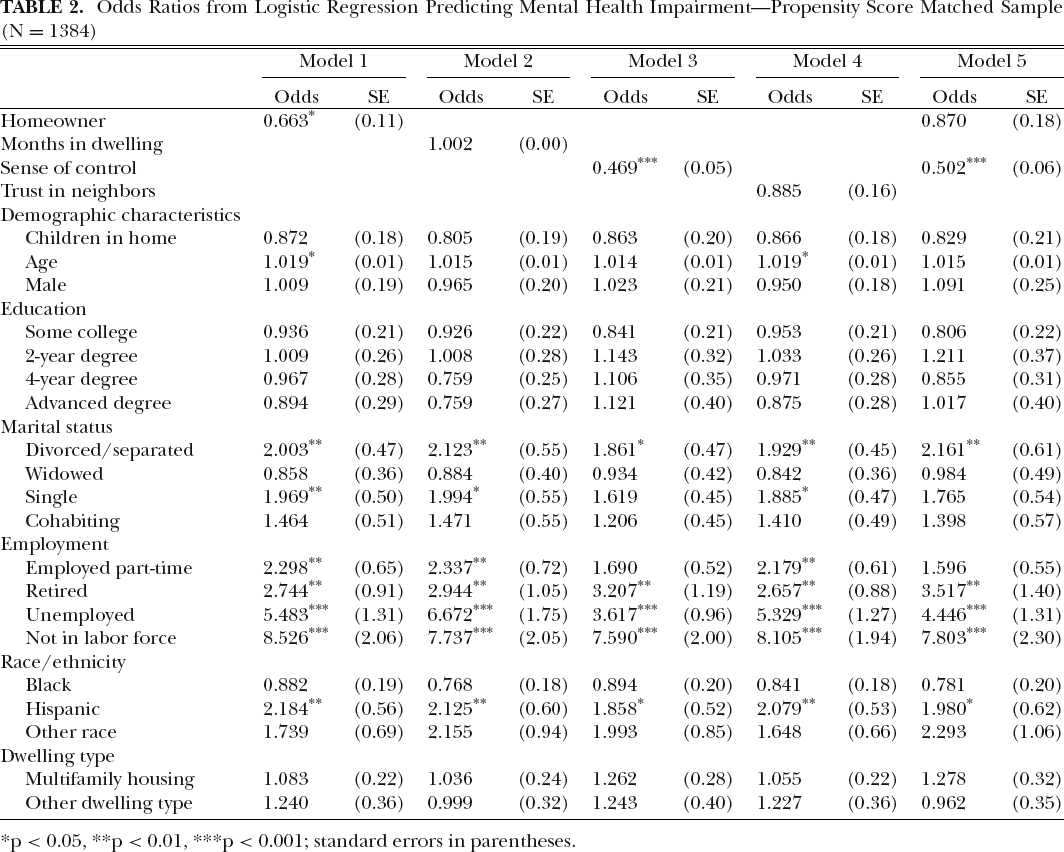
The model also reveals that Hispanic respondents have a lower sense of control than other racial/ethnic groups, which may be related to immigration status. While we do not collect information about immigration status, it is intuitive that undocumented residents would feel much less in control of their lives. Similarly, language barriers could have an impact. Just over 7 percent of CAPS respondents are interviewed in Spanish. People who are not English proficient may feel a lower sense of control because it is more difficult for them to interact with mainstream institutions. The final step in the analysis is to determine whether any of the three potential mechanisms translates to a decreased likelihood of mental health problems. Is homeownership associated with mental health via stability, sense of control, or trust? Table 2 presents the logistic odds ratios from models predicting whether a respondent reported having experienced a mental health impairment in the prior four weeks. Model 1 includes only the homeownership variable and the control variables. As shown, homeowners are 66.3 percent as likely as renters to have experienced a mental health problem.
Odds Ratios from Logistic Regression Predicting Mental Health Impairment—Propensity Score Matched Sample (N = 1384)
p < 0.05,
p < 0.01,
p < 0.001; standard errors in parentheses.
Again due to the propensity score matching, very few of the control variables are significant. People who are divorced were more likely to report a mental health impairment, as were people who were never married. However, people who were cohabiting were not, suggesting that this effect could be related to the presence of two incomes in a household. The employment variables lend further support to this possibility; people who were working full–time were significantly less likely to report a mental health impairment. On the other hand, there could be reverse causality between these two variables. People who are experiencing a mental health impairment may find it challenging to maintain full–time employment.
Model 2 tests whether there is a link between residential mobility and mental health. Results show no association between the length of time someone has lived in the same dwelling and their risk of a mental health impairment. All the significant control variables are consistent with model 1.
Model 3 tests whether there is a relationship between sense of control and mental health. The model shows that a 1–point increase in sense of control is associated with a 32 percent decline (odds ratio of 0.68) in the risk of mental health impairment. Thus sense of control remains a potential mediator between homeownership and mental health.
Model 4 tests whether people who feel a great deal of trust in their neighbors are less likely to report mental health concerns. Like mobility, this variable is not significant, indicating that perceptions of trust in neighbors does not decrease a respondent's risk of mental health difficulties. While prior models documented an association between homeownership and trust, and homeownership and mental health, model 4 indicates that perceived trust is unrelated to mental health. In fact, adding the trust–in–neighbors measure does not substantially change any of the coefficients in the model.
The first four models determined that homeownership and perceived control decrease the risk of mental health issues. Model five tests whether perceived control mediates the homeownership effect. The model includes the variables for both homeownership and sense of control, and it is nearly identical to model 3; people with a greater sense of control over their lives are less likely to have mental health difficulties. Homeownership is notable for its lack of statistical significance. Once the model accounts for the increased sense of control derived from homeownership, there is no independent relationship between homeownership and mental health.
The models confirmed the following four relationships which satisfy the criteria for mediation: (1) homeownership predicts sense of control, (2) homeownership predicts mental health when sense of control is excluded, (3) sense of control predicts mental health, and (4) the effect of homeownership on mental health is reduced upon including sense of control in the model. The Sobel–Goodman mediation test indicates that sense of control mediated 72.36 percent of the effect of homeownership on mental health.
Effects of Mortgage Delinquency
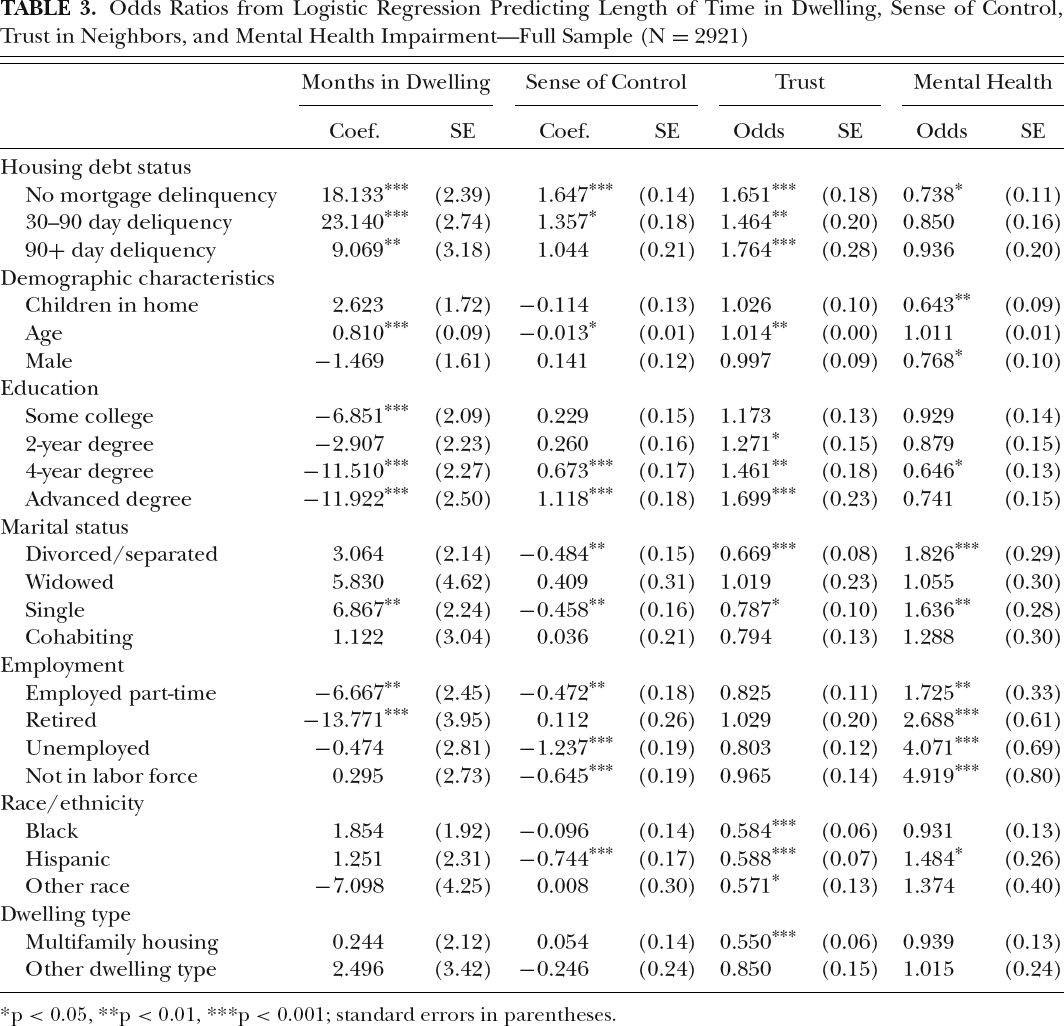
As an ancillary question, I tested whether the effects we observed in the analysis would vary based on mortgage delinquency. In light of the housing market decline and the rise in mortgage delinquencies, it is worth differentiating between struggling homeowners and those who are not. It is possible that homeowners who become delinquent may actually experience a lower sense of control than renters since they may have fewer options to easily obtain less–expensive housing. Therefore, we went back to the full, unmatched sample and classified the homeowners based on their worst mortgage delinquency in the prior five years. 6 Using standard mortgage service categories, we coded homeowners as having no delinquencies, a “minor delinquency” of more than 30 days but less than 90 days, and a “serious delinquency” of greater than 90 days. The reference category for these categories is being a renter. Table 3 shows the results of models predicting all four outcomes based on mortgage delinquency.
Odds Ratios from Logistic Regression Predicting Length of Time in Dwelling, Sense of Control, Trust in Neighbors, and Mental Health Impairment—Full Sample (N = 2921)
p < 0.05,
p < 0.01,
p < 0.001; standard errors in parentheses.
The first model finds that all groups of homeowners have greater residential stability than renters. However, the increase in stability for those who have experienced a serious delinquency is half what it is for those who have never had a mortgage delinquency. It would likely be much lower if the sample included people most at risk of foreclosure and subsequently instability—those who refinanced to a subprime mortgage.
The sense of control model shows that homeowners who have never been delinquent have a higher sense of control than renters. Homeowners who have had a minor delinquency also have a higher sense of control than renters, but the effect size is roughly half of what it was for the never–delinquent homeowners. Finally, we find no significant differences between renters and seriously delinquent homeowners. This suggests that the sense of control homeowners experience is, at least in part, tied to their ability to avoid financial hardships.
The third model predicts trust in neighbors, and here there are no differences among the homeowners; people with serious delinquencies are just as likely to trust their neighbors as those with none. All the homeowners are significantly more likely to trust their neighbors than renters. This result underscores the structural advantages of homeownership. Even seriously delinquent homeowners are still living in neighborhoods with lower turn–over and more opportunities to form ties to others.
Finally, the last model predicts the likelihood of experiencing a mental health concern in the prior four weeks. The results find that homeowners with no delinquencies are 26 percent less likely to report a mental health issue, but homeowners with either a minor or a serious delinquency were indistinguishable from renters. This underscores Ding et al.'s (2011) call to differentiate between homeowners and mortgage holders. It is likely that homeownership “done right” with a mortgage based on the borrower's ability to repay has very different effects than homeownership “at any cost.”
These results should be taken as suggestive only; the low numbers of mortgage delinquencies in this data set make it impossible conduct this analysis with a matched sample. Also, all CAP mortgages were fixed–rate prime mortgages made to qualifying buyers. Therefore, delinquencies are more likely to be due to changes in individual circumstances such as unemployment than due to unaffordable mortgage terms. Further research is needed to understand how mortgage delinquency factors into evaluating the costs and benefits of homeownership. However, there is suggestive evidence that the social benefits of homeownership may be dependent on homeownership being a positive financial experience.
Conclusion
This study looks inside the “black box” of homeownership and finds that homeownership is linked with mental health through the mediating factor of sense of control. The increased sense of control that comes from homeownership entirely explains the associated decrease in mental health difficulties. While the analysis reveals that homeowners are more likely than renters to feel they can trust their neighbors and have greater residential stability, these factors do not translate into a reduced risk of mental health problems.
These findings diverge from past research by Rohe and Stegman (1994) and Rohe and Basolo (1997), who found no relationship between homeownership and sense of control. There are two possible reasons for this difference. First, both of the previous studies were based on 171 homeowners who purchased a townhome through a program sponsored by the Enterprise Foundation and the City of Baltimore. Furthermore, all the renters from that study were receiving section 8 rental assistance. It is possible that the unique geographic location and individual characteristics of the Baltimore sample means the results from the prior studies do not generalize to a more nationally representative sample such as CAPS. Secondly, it is possible that the housing market downturn has actually amplified the sense of control experienced by homeowners who have good mortgage terms. As it has become increasingly difficult for renters to become homeowners due to changes in underwriting standards, renters may feel less control over their housing situation.
These findings also diverge from the expectation, based on social disorganization theory, view that residential instability is associated with mental health problems. This study finds no link between the length of time someone has lived in their home and their likelihood of a mental health problem. This may be because the CAP homeowners tend to be in lower wealth neighborhoods with relatively high turnover.
I also tested whether several tract–level measures of instability 7 were significant predictors of mental health, and none were significant. This is important because policies aimed at promoting homeownership are often justified based on the claim that homeownership—particularly in disadvantaged urban neighborhoods—increases neighborhood stability and therefore causes positive individual–level outcomes. While this can be the case, it is not always true. In the case of the CAP homeowners, for example, individual perceptions of being in control of their lives were vastly more important drivers of mental health than macro–level factors such as neighborhood homeownership rate.
These findings advance scholarly research in two ways. First, the findings speak to the need to expand social disorganization theory beyond objective measures of neighborhood conditions. Social bonds and trust in one's neighbors have traditionally been measured at the community level and taken to be objective features of a community. However, I find that people perceive neighborhood conditions differently based on their social positions within the neighborhood. Whether by virtue of their financial interest in the neighborhood or their social sense of ownership in the community, homeowners are more likely than renters to feel a sense of trust in their neighbors. While objective measures of disorganization are clearly influential, it is possible that subjective measures matter as well. To borrow from the Thomas Theorem, the sense of trust that homeowners believe to be real may be real in its consequences. While individual–level differences in perceptions of trust were not linked in this research with differences in mental health outcomes, further research is needed to fully explore the impacts of perceived trust on other outcomes of social disorganization.
Second, much of the previous research on homeownership has focused on exploring what impacts homeownership has on people by asking whether homeowners are more or less likely to manifest some outcome (Dietz and Haurin 2003). The current analysis advances the field by demonstrating not only what homeownership does—reduces the risk of mental health difficulties—but also why it has this impact. The analysis demonstrates that homeownership reduces their risk of mental health problems because it provides people with a sense of control over their lives. The analysis takes a valuable step toward developing a comprehensive theory of homeownership by specifying the linking mechanism that connects homeownership with a specific social outcome. For too long, scholars have conducted research on the perceived benefits and costs of homeownership without unpacking the mechanisms through which these are delivered. There is a need to assess whether or not homeownership can be linked to outcomes, but it is crucial after doing so to assess what mediating factors might, in fact, be responsible for the outcomes. This paper has shown that homeownership is correlated with a reduced likelihood of mental health problems; it has analyzed the causal mechanism and determined the mediating factor is the sense of control that homeownership provides. By determining the means through which homeownership provides any associated benefits, scholars will be able to inform policymakers as they seek to make the benefits of homeownership available to both owners and renters alike.
Supporting Information
Supporting Information, cico1415-sup-0001 - Urban Homeownership and Mental Health: Mediating Effect of Perceived Sense of Control
Table S1: Descriptive Statistics-Full Sample (N=2964)
Table S2: Odds Ratios from Logistic Regression Model Predicting Homeownership (N=2926)
Table S3: Coefficients from OLS Regression Predicting Length of Time in the Dwelling-Propensity Score Matched Sample (N=1384)
Table S4: Coefficients from OLS Regression Predicting Sense of Control Score-Propensity Score Matched Sample (N=1382)
Table S5: Odds Ratios from Logistic Regression Predicting Trust in Neighbors-Propensity Score Matched Sample (N=1384)
Supporting Information, cico1415-sup-0001 for Urban Homeownership and Mental Health: Mediating Effect of Perceived Sense of Control by Kim R. Manturuk, in City & Community
Table S1: Descriptive Statistics-Full Sample (N=2964)
Table S2: Odds Ratios from Logistic Regression Model Predicting Homeownership (N=2926)
Table S3: Coefficients from OLS Regression Predicting Length of Time in the Dwelling-Propensity Score Matched Sample (N=1384)
Table S4: Coefficients from OLS Regression Predicting Sense of Control Score-Propensity Score Matched Sample (N=1382)
Table S5: Odds Ratios from Logistic Regression Predicting Trust in Neighbors-Propensity Score Matched Sample (N=1384)
Footnotes
Supporting Information
Additional Supporting Information may be found in the online version of this article at the publisher's web site:
Acknowledgments
The author wishes to thank Sarah Riley, Mark Lindblad, Roberto Quercia, Peggy Thoits, Allison Freeman, and Ellen Granberg for their assistance and feedback on this research. Any remaining errors are entirely the author's responsibility. This project was supported by a grant from the Ford Foundation to the Center for Community Capital at the University of North Carolina at Chapel Hill. A version of this paper was presented at the 2011 American Sociological Association annual meeting.