







Abstract
The founders and employees at Proceedo, an eProcurement firm based in Stockholm, were looking for a new CEO, an older, experienced executive with a track record in sales to mature companies. They had achieved many of their early growth and product development goals; now they need a new CEO to expand their customer base. The founders wanted to create a large, international company, and they believed new leadership was needed to push to the next level of growth.
As Proceedo's management team prepared in early September 2000 for the next board meeting, only one week away, they needed to identify what type of person they should hire as the new CEO. They were hoping to rely on their own and the external board members’ networks to identify possible candidates for the position. The external members were an investment manager from their venture capitalist, a senior partner of Boston Consulting Group (BCG), and the CEO of a major Scandinavian service provider, all of whom Proceedo felt could provide valuable referrals. As Lars emphasized, the founders wanted Proceedo to be a major international success, and they were willing to make room for anyone who could deliver that success.
Background
Proceedo, founded in 1998 as Scandinavian Procurement Solutions (SPS), provided an eProcurement solution to large and medium–sized companies and organizations. The company's business model was to offer medium and large companies a marketplace accessed through the Internet and customized to reflect each company's supplier contracts and employee task and budget responsibilities. Proceedo's objective was to make it easier and cheaper for client companies to procure non–manufacturing supplies and equipment. For example, Proceedo would not try to assist Volvo in its efforts to procure core raw materials such as the tires or gearboxes, which go directly into their production assembly process. Instead, Proceedo's system would focus on procurement of peripherals and sundry goods from office stationery to travel services to research laboratory supplies and furniture. (See Exhibit 1 for an eProcurement model developed by the founders.)
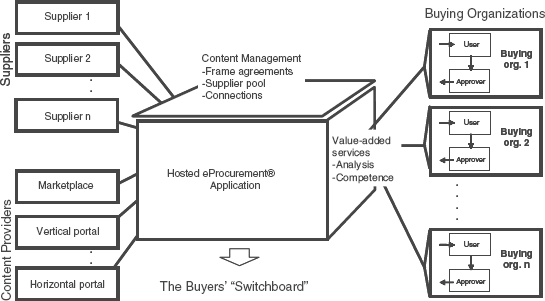
Proceedo's origins can be traced back to an informal exploratory study carried out by Lars and his co–founders in the summer and fall of 1998. After graduating from Stockholm School of Economics (SSE) in 1996, Lars joined the Stockholm office of Bain & Company, the management–consulting firm. While traveling between Europe and America on Bain–related business, Lars became interested in Internet–based procurement solutions. During the summer of 1998, while still working for Bain, Lars and his partners carried out the first investigative research assignment in San Francisco and by early fall 1998 they were ready to speak to the main industry players. They visited the likes of Commerce One, Ariba, and Netscape, all the while gaining valuable knowledge and insight into their products, people, and customers. This series of introductory visits as well as a handful of interviews with procurement directors in large Nordic organizations, marked the end of the “due diligence” process.
Earlier on, Lars had discussed his potential business idea with Magnus Ellström, an old friend from SSE who had similarly opted for the consulting track after graduating from SSE. Initially, Magnus had joined Andersen Consulting's SAP implementation department in Stockholm but soon found this to be “quite boring.” Spurred by a “desire to participate in starting something new” Magnus soon left for Norway to originate an Enterprise Resource Planning (ERP) practice for PriceWaterhouse Coopers. Thus, besides being an old friend from university, Magnus’ experience with implementing ERP systems such as SAP R/3 from scratch made him an ideal business partner for Lars. Joining Lars and Magnus as the third and fourth members of Proceedo's founding team were Rickard Hansen and Henrik Stridsberg, two engineering graduates from the Royal Institute of Technology. The two previously had worked with Andersen Consulting and AU–System, respectively.
The decision to formally launch Proceedo was taken at the end of 1998 when all the co–founders officially severed ties with their employers. Armed with what they thought was a sound business idea and with an initial product already under development, the founders were able to attract key potential business partners. Johan Ljunberg and Håkan Cervin, two qualified engineers, had sufficient belief in the team to quit their positions as technology consultants at Andersen Consulting, while Anders Jansson also decided to leave his position as a software developer with AU–System. By the time Mattias Jonsson, an old SSE connection with a background in business–to–business (B2B) customer relationship management joined the project, a seemingly well–balanced core group had been assembled.
Differentiating the Business Concept
While Lars and his fellow partners had no illusions about the strengths of their rivals, they were convinced they could carve out their own niche in the market. Even if their main rivals, such as Ariba, Commerce One, and Oracle, were all entrenched industry “heavies,” they believed Proceedo could still exploit certain drawbacks in their rivals’ products by becoming both a software developer and a service provider. This meant that their competitors sold their eProcurement software to customers as IT systems and at a very high cost. The customers still had to integrate the eProcurement solution with their existing systems, create and maintain an extensive database of product information for chosen suppliers, set up electronic ordering and accounting procedures, and also were saddled with the responsibility of ensuring the system functioned reliably on their IT servers and network. The concept of eProcurement looked good on paper, but few test cases existed. The up–front costs over and above the cost of the software were considerable, and few companies could afford to experiment with unproven eProcurement systems.
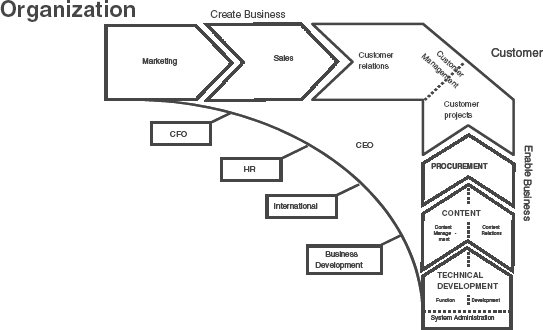
From the onset, Proceedo had always wanted to differentiate its product from those purveyed by its bigger competitors in the United States. Their solution would not entail substantial, up–front payments for an entire system and they would deliver both the technology and a continually updated database of suppliers’ products, all accessible through the Internet from Proceedo's servers. Proceedo's solution was a “hosted application” and thus the client did not own the technology. Instead a client company had its own personalized section within Proceedo's system which employees accessed via user names and passwords. In this private domain, the clients could then view customized product, price, and supplier information as well as immediately execute on–line purchases. For each client, further customization could include unique portals for each employee, which reflected their responsibilities and budget responsibilities. Purchase orders could also be routed electronically to the necessary people to approve larger purchases. Thus, the processes and contracts of the company's procurement and accounting departments were completely computerized and integrated into the system. The combination of software and service was reflected in Proceedo's organization structure. Not only did Proceedo develop software, but they had several people cultivating relations with suppliers (see Exhibit 2).
EProcurement systems are best adapted for decentralized demand, in contrast to the demand generated by core manufacturing processes, which is best served by highly structured and centralized forecasting and purchasing through enterprise resource planning (ERP) systems. Although some companies have a small department dedicated to purchasing office supplies, most companies distribute or decentralize general purchasing requirements to each department. Office supplies are a trivial example, of course, but decentralized demand also includes supplies for an R&D or quality control laboratory, or computers and software for the accounting departments, or new office furniture. The demand for these products is distributed throughout the company, and the amount required is not predictable. As a result, many companies will have their purchasing departments negotiate contracts with suppliers for discounts based on volume purchasing (frame agreements), but allow individuals throughout the company to order and control their purchases (thus, distributed procurement). In this area, ERP systems typically are not used at all. Also, because the amount of money spent by any one department tends to seem relatively small, few companies have tried to systematize distributed procurement, so many people believed new efficiencies could be realized.
The main reason for ignoring potential cost savings in distributed procurement, apparently, was the high cost of creating dedicated, integrated software systems. By using Internet protocols and programming tools, coupled with existing browsers, the development costs lowered dramatically for creating desktop interfaces, creating and maintaining a database of products and suppliers, and facilitating information flow. EProcurement emerged as a new niche.
Proceedo's competitors used the new Internet tools on top of an essentially tradi–tional ERP structure. To further differentiate Proceedo, an entirely new system based on the Internet was envisioned. In January 1999, product development commenced in earnest.
Product Development
The pace at which Proceedo developed its product was determined largely by the amount of financing available. Rather than scrambling to secure venture capital financing solely on the strength of a due diligence report and a business plan, the partners preferred to wait. It was agreed the company would only seek external financing once two criteria had been satisfied. First of all, they would have a complete product, and second they would have at least one customer already signed up.
A lower cost of capital was the main motivation for such criteria. As one of the partners explained, “if you are just four guys with an idea, more than 50 percent of the company goes.” If external financing had to wait, how would the company finance early product development? They could each contribute what they had saved from their earlier jobs but this would soon be exhausted. Their solution was to put their consultant caps back on and hire themselves out to companies. Thus, in February 1999 they were hired by Pharmacia 1 to perform a major study that entailed developing an eProcurement strategy as well as providing market intelligence and technical analysis.
Besides providing a reliable income stream, the consulting relationship with Pharmacia also aided their product's development. The technology development team would feed any information and insight gleaned from the Pharmacia study into the technical development project. Henrik and Anders, as engineers, were naturally assigned responsibility for technical development and as the consultancy income grew, they were able to hire more personnel to assist them. The consultancy team spent the entire spring and summer of 1999 working with Pharmacia. As Magnus emphasised, “By working on the Pharmacia project we were really able to check our ideas and hone our product.”
By the end of the summer, however, the focus had shifted gradually from consultancy to technical development. At least ten people were now working on a full–time basis to have the first product completed and ready for marketing. Finally the first product (version 1.0) was released in September and promptly taken up by a division of Unilever. City Mail 2 also signed up for this product. Thus, by December 1999, Proceedo had completed a large assignment for Pharmacia, lined up a product ready for wider release, set up a dedicated technical team and sealed contracts with two companies. They had surpassed their self–imposed threshold for external financing.
Financing
The time was now right to seek funding. The shift from consulting to technical development had sapped the fledgling company's cash flow, while the income generated from the Pharmacia work had been exhausted by operating expenses. The company was now paying rent for office space acquired back in May 1999 and there were now eight more employees, all on monthly salaries. Furthermore, as the partners were not going to take the risk of releasing a product that had not been vetted and approved by outside experts, they were going to solicit the assistance of external (and expensive) engineering consultants from Cap Gemini. 3 While the company had arranged a “last resort” line of credit through a major bank, SEB, a large injection of external cash was absolutely necessary.
The strategy of waiting before approaching external investors worked. On 21 February 2000, Novare provided an initial round of growth capital amounting to 25M SEK ($2.85M) for 20% equity in preferred shares. Proceedo's short–term survival was secure.
Proceedo's founders were excited about Novare's involvement. Novare (later named Investor Growth Fund) was part of Investor AB, the holding company of Sweden's oldest and most powerful family, the Wallenbergs. The Investor AB mission is “To deliver superior returns to shareholders by establishing Investor AB as a globally recognized entrepreneurial and active owner of companies with high growth and profit potential.” The holding company has significant influence through special voting rights shares in a wide range of major Swedish companies, including SEB Bank, ABB, Ericsson, and Saab. Novare/Investor Growth Capital, Inc. was launched in 1998 to invest in technology and healthcare ventures. The Web site states that “As a result of its affiliation with Investor AB, Investor Growth Capital has the ability to contribute more than capital to an investee company.” (See http://www.investorab.com for more information.)
Current Challenges
With the new funds, the company could implement expansion plans. The first priority, they decided, was to develop a new system (hardware and software) that would be very reliable and stable, and able to handle a large number of demanding customers. By the end of the summer, Proceedo had spent about 15M SEK (about $1.7M) on the system. During the summer, they turned their energy to sales, hiring new staff and opening representative offices in Germany and Finland. Like many other Internet start–ups, Proceedo's founders believed that internationalization was essential to a successful eventual IPO. They chose neighboring Finland and Germany because they felt non–English–speaking countries would present less competitive challenge.
By September, Proceedo founders had to acknowledge that the sales process was long, that key decision makers were much older and far less technically oriented than they were, and that the product concept itself needed extensive explaining before any attempt to sell Proceedo's service. Nonetheless, they anticipated fast growth as they moved into the market.
When making the sales pitch to potential customers, Proceedo emphasized three benefits of eProcurement. These benefits perhaps applied to all eProcurement systems, but as an early entrant in the Swedish market, Proceedo had to sell both the concept and their product/service. First, and easiest to quantify, the system helped ensure that employees complied with frame agreements with key suppliers. These agreements provided significant price cuts if the company bought sufficient volumes; the challenge was ensuring that employees bought from suppliers named in the frame agreements and not from other suppliers. Companies had no feasible way to control the way individuals chose suppliers, and as a result missed the large volumes needed for valuable discounts and rebates. This factor alone could contribute 5 to 20% in cost savings, with a direct impact on the bottom line—a key selling point for Proceedo.
Second, Proceedo argued that eliminating paper–based processes would reduce costs. Published studies by specialized operations researchers estimated the cost of handling and filing paperwork from purchase order to billing and payment to cost at least $10 per order. Automating the process was expected to halve the costs, if not more. These cost savings were hard to quantify for a specific company, but industry studies showed potentially significant savings.
Third, Proceedo founders believed other long–term benefits were possible. For example, the system would allow analysis of usage by department and by product for the first time ever. Potential savings and best practice benchmarking could be supported by the eProcurement system. Also, as former consultants, the founders believed that the process of creating user profiles and automating processes could challenge long– standing practices and attitudes, and open the door for transforming the organizational structure and culture. These benefits were hard to quantify, and depended on management to initiate changes. Ideally, the customers would hire Proceedo for consulting projects to realize these benefits.
What value did Proceedo's solution add for the customer? First of all, the product came without the technical logistics associated with the ownership of a technology product. The client simply paid for access to an online information channel and market place. Second, it offered operational and financial flexibility. While rivals such as Oracle took an initial, up–front charge of millions of dollars for the eProcurement system, plus a further 18% maintenance fee per year, the cost of Proceedo's package was roughly $300,000 to 500,000 per year for user rights plus a transaction–based charge. With Proceedo, the client also had the option to discontinue after one year. Such flexibility was not possible with Oracle's product and this could sometimes leave the client saddled with large sunk costs. Furthermore, Proceedo eProcurement delivered not only a customized system, but also a database of product information.
Another unique feature of Proceedo's solution was that it could offer procurement advisory services as an additional support service to clients. As its marketplace stored each client's purchase history, Proceedo could quickly identify profligate clients. For example if Company A and Company B were similar in size but Proceedo noticed that Company A was spending twice as much as Company B on office stationery, Proceedo could help Company A save money by cutting costs. Another support service offered was the pooling of purchasing power into “procurement consortiums.” Initially, Proceedo did indeed offer these complementary procurement services in addition to its main product, but soon decided to scale down, at least in the medium term, in “order to focus on the core product.”
All the benefits of eProcurement and the features of Proceedo's solution were theoretical, however. Although Proceedo had signed on initial clients, it was far too early to measure the actual performance, and the industry as a whole was too young to provide common exemplars.
Day–to–Day Operations
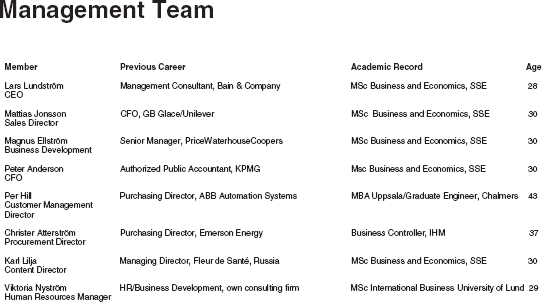
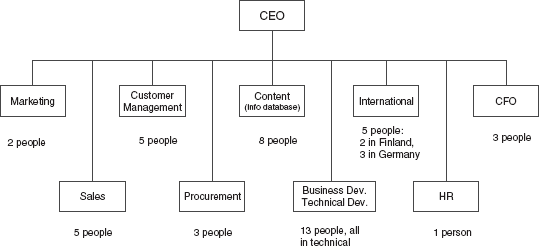
As of September 2000, Proceedo's 50 employees were dispersed around different teams comprising technical development, human resources, marketing/sales, and project management. The company's operational strategy was overseen by the CEO, who worked with a management team comprising the founding partners and the heads of the different functional teams. Indeed a deliberate effort was made to select the heads of these functional teams from outside the original pool of founder members in order to wean Proceedo from the self–concept of a founder–run company. Exhibit 2 displays Proceedo's organizational chart, showing their ideal of a business focused on the customer, with the CEO and other functional heads serving the employees. Exhibit 3 details the members of the management team. Exhibit 4 is a more traditional organization chart and shows that most employees were actively involved in developing and maintaining the software and database of supplier information.
Day–to–day life at Proceedo appeared consistent with a growing young firm. While employees were hired to work under specific team banners such as human resources or sales, the reality was that “everyone ended up doing a little of everything.” Anders, the technical project leader, remembered working solely as a systems engineer at AU–System, a larger firm with about 450 employees. At Proceedo, however, he “not only did systems engineering but also got involved in buying PCs, fixing the network, conducting interviews and meeting representatives from other companies.”
Viktoria, the head of human resources had a similar tale. “My job description covers attracting, recruiting, retaining and developing personnel, but so far ‘employee development’ has suffered because everyone is either focused on the sales issue or on improving the product.” She would also have liked more time to arrange visits to job fairs and schools, but that was impossible at the time. However, she did praise Proceedo for at least recognizing the need for a full–fledged, multi–faceted HR department: “There were only 22 employees here when I was called in to run HR. Most start–ups only piece together an HR department once people start to leave . . . at least Proceedo was proactive.” Nearly two years after commencing business, only one employee had left Proceedo.
The sales and marketing team also had experienced teething problems. “Cold telephone calls” to potential client company switchboards was the preferred way until Proceedo gradually resorted to using popular media such as newspaper advertising. However, the process of clinching new contracts was still slow and fraught with difficulty. One of the main problems was that the sales team first would have to explain the benefits of eProcurement as a concept before even discussing the merits of Proceedo's particular solution. As many prospective clients were not familiar with the concept of eProcurement, much time was consumed just for “arranging meeting after meeting.” The need to meet many people from different branches within a single company also made the process arduous and tortuous. All this made it difficult for the sales team to make significant progress in the all–important area of “brand–building.”
To help ameliorate the sales problem, the firm enlisted the assistance of Andersen Consulting, hoping their brand name would lend credibility to Proceedo and make potential clients more open to eProcurement. The consulting giant visited Proceedo's offices on a weekly basis and helped the firm develop its methodology for product implementation. This involved a blueprint encompassing every stage from pre–study to roll–out. Both parties viewed this as a symbiotic relationship: Andersen got the exposure and experience working on an Internet business model while Proceedo could prospect for clients with a big, recognized brand name behind it. As Mathias expanded, “This is not straightforward like civil engineering . . . we are dealing with people and people have preconceptions when they meet us. Right now potential clients are skeptical about any new IT/E–Commerce solutions so Andersen is the ace in our back–pocket.”
The sales problem was troubling. After initially snapping up its first clients and receiving external financing, Proceedo's financial future seemed secure. However, since then only two new contracts had been secured. Indeed, this failure to add new sales had left the company's books in the red for the last six months. With the partners harboring ambitious plans for an IPO in “two to three years time,” something just had to be done about sales. (See Exhibit 5 for financial statements.)
PROCEEDO: Income Statement
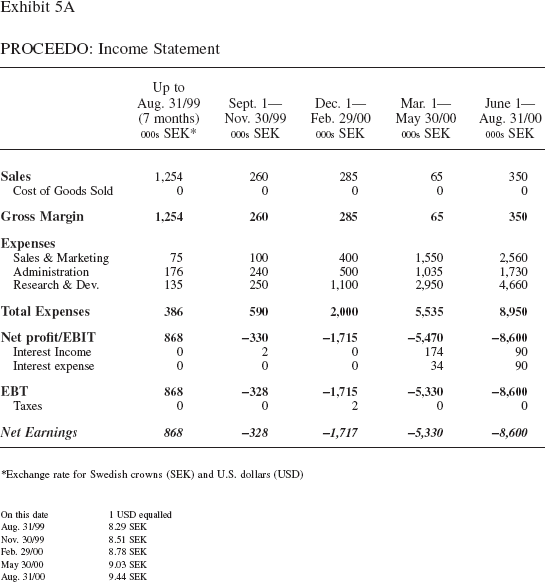
Exchange rate for Swedish crowns (SEK) and U.S. dollars (USD)
On this date 1 USD equalled
Aug. 31/99 8.29 SEK
Nov. 30/99 8.51 SEK
Feb. 29/00 8.78 SEK
May 30/00 9.03 SEK
Aug. 31/00 9.44 SEK
PROCEEDO: Balance Sheet
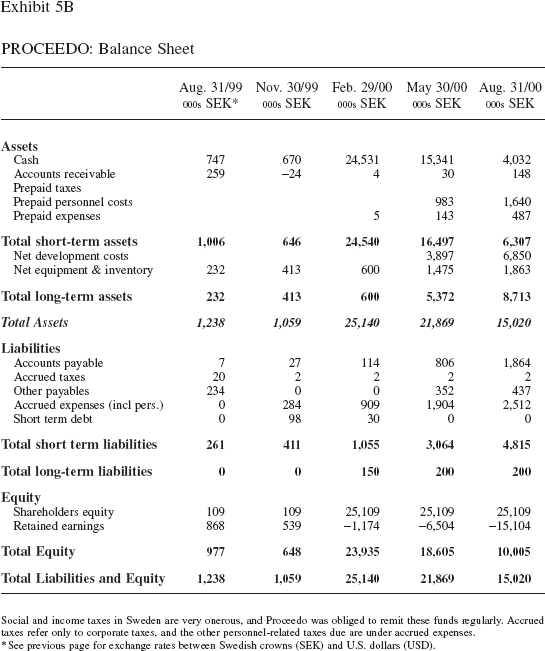
Social and income taxes in Sweden are very onerous, and Proceedo was obliged to remit these funds regularly. Accrued taxes refer only to corporate taxes, and the other personnel–related taxes due are under accrued expenses.
See previous page for exchange rates between Swedish crowns (SEK) and U.S. dollars (USD).
The CEO Search
At the time Proceedo was contemplating a new CEO they had agreements with 40 suppliers covering more than 100,000 products that comprised services, travel, office and printing, mobile phones, and hotel products. However, customers on the buy side were proving harder to clinch. With only four client companies on its books—City Mail, Allgon, 4 Pharmacia and Unilever—the young company needed to add to its sales ledger. Furthermore, while Proceedo's management was pleased with them, these contracts actually represented only limited involvement with smaller divisions of these large companies. For example, the contract with Unilever was actually with Diverseylever, its local subsidiary. Given this sales dilemma, there was universal consensus at Proceedo that a new CEO could help turn the problem around.
However, Proceedo's management team and advisors believed that rather than being a blemish on Lars's capabilities, the sales dilemma was more a reflection of the company's industry environment. Essentially, Proceedo operated in the business–to–business space (B2B) with a focus on large, mature companies. As these companies generally operate within a relatively conservative business environment, the decision makers in such companies were typically older and experienced executives and senior managers. This would pose a problem for Proceedo. According to Lars, most senior managers they encountered saw them as young upstarts and found it difficult to accept young executives (such as himself) as equal business partners. “B2B is tricky . . . as young owners you confront older, experienced guys so it may be better to have a more senior management facade.” There was also a shared feeling that this credibility issue was exacerbated by the typically conservative Nordic style of business that was unaccustomed to “twenty–something” business executives. Mathias Dyberg, one of Proceedo's project managers, lamented that “even with our knowledge we are not taken seriously. . . . It could be a Nordic thing.” Proceedo believed that a CEO recruited from older, experienced executives would help, and prepared to convince the board to help with the search.
Footnotes
1
2
3
4
Allgon began in 1946 with car antennas, and in 2000 developed, manufactured, and marketed radio–based solutions and other products for wireless telephony and data communications, selling on four continents. Allgon had been publicly traded since 1994, and had approximately 1,335 employees at the end of 2000. See  for more information.