







Abstract
This article examines the determinants of success in self–employment, with a focus on the effects of the time spent caring for children. Many public policies are designed to encourage self–employment, especially among women. In addition, it has been argued that one of the reasons individuals, and women in particular, choose self–employment over wage and salary sector employment is to spend more time with their children. The effect of time spent with children on the probability of continuing in self–employment has not been studied in previous work, however. This study analyzes spells of self–employment among workers in eight European nations. Using data from the European Community Household Panel survey for 1994–1999, we estimate the effect of time spent caring for children on the duration of self–employment, controlling for other factors that affect self–employment success rates. The estimates indicate that caring for children significantly reduces the duration of self–employment ventures, for both males and females, and in most countries studied. The results suggest that policy makers need to consider child care policies in conjunction with self–employment policies.
Introduction
It is often argued that many workers, especially women, engage in self–employment in order to have more time to spend with their children. In theory such activity should have negative effects on the successfulness of a self–employment venture. Consequently, individuals who spend more time caring for their children should be less likely to survive in self–employment. We examine this hypothesis using data on the lengths of spells of self–employment for a sample of individuals from eight countries in the European Community Household Panel (ECHP).
Great interest in the determinants and consequences of self–employment and entrepreneurship in general has emerged in the past decade. Much of this interest arises from the perceived role of small business enterprises in employment and economic growth. In addition, self–employment has been viewed as a means of alleviating poverty or unemployment, especially among youth, minorities, and women.
Previous research has been fairly comprehensive in its analysis of self–employment, including time–series analyses of aggregate self–employment rates, cross–sectional analyses of the probability of self–employment, and longitudinal analyses of rates of entry into and exit from self–employment. 1 In addition, analysts have studied the relative earnings of and earnings differences among the self–employed, and some have studied the longer–term consequences of self–employment, in terms of future earnings or employment. 2 Finally, researchers have studied cross–national differences in self–employment behavior (e.g., Blanchflower, 2000).
The articles are far too numerous to list here. Some of the most important early work includes Blau (1987), Evans and Leighton (1989) and Evans and Jovanovich (1989).
Examples of the latter include Ferber and Waldfogel (1998) and Williams (2000, forthcoming).
A near constant among the research on self–employment is recognition of the role of children. That is, most studies of the self–employed include controls for the presence of, the number of, or the ages of children in the household. The results suggest that the number of children in the home is positively related to the probability of self–employment, at least among women, as is the number of young children (Boden, 1999; Caputo & Dolinsky, 1998; Connely, 1992). Similarly, the number of children at home is correlated with home–based work, which suggests a correlation with self–employment (Edwards & Field–Hendrey, 1996). Authors have inferred from these results that the desire for self–employment among women is related to their household responsibilities, including caring for children (Boden, 1999; Caputo & Dolinsky, 1998; Connely, 1992; Hundley, 2000; Presser, 1989). 3 Self–employment is perceived as providing greater flexibility in the timing of work, the place of work, the quantity of work, and the amount of effort at work (Hildebrand & Williams, 2003), all of which might provide the ability to spend more time caring for children. 4
Connely (1992) studies the interesting case of women who choose to be child care providers.
Of course there are other reasons that women choose self–employment, some economic, social and psychological. For recent analyses of these determinants, see for example Rosa and Hamilton (1994), Buttner and Moore (1997), Arai (2000), Cowling and Taylor (2001), Lombard (2001), Taniguchi (2002), and DeMartino and Barbato (2003).
Recent studies have called into question the validity of this relationship, however. There is some evidence in the literature, for example, suggesting that caring for children has a negative effect on the self–employed. Hundley (2001) finds that the presence of young children in the household significantly reduces the earnings of self–employed females, and contributes to the male–female self–employment earnings differential. 5 Some evidence also exists that suggests a negative relationship between self–employment and time spent caring for children. Gustafsson and Kjulin (1994) include a control variable for male self–employment in their analysis of child care activity among parents in Sweden. They find that females spend less time on child care when the spouse is self–employed. 6 Hildebrand and Williams (2003) find that self–employed men and women in other countries in Europe also tend to spend less time caring for their children, in most countries studied.
It is not clear, however, whether this effect arises because women with young children spend more time caring for them, which takes away from time spent in entrepreneurial activities, or because of unobserved characteristics that might affect, for example, motivation.
For recent analyses of other determinants of time spent caring for children, but not including self–employment status, see Bryant and Zick (1996), Zick and Bryant (1996), Bianchi (2000), Sousa–Poza et al., (2001), and Sandberg and Hofferth (2001).
This article adds to the existing literature by directly measuring the effect of time spent caring for children, measured in hours, on the survival of men and women in self–employment. The analysis is conducted for eight different countries in Europe, which provides the opportunity to compare the effects across countries that differ in culture, institutions, and child care policies. The article is part of a broader research agenda in which we attempt to analyze the relationships between entrepreneurship and child care policies. The ultimate goal is to provide a research basis for an integrated set of policies to encourage entrepreneurship and that recognize the role that child care policies must play.
Previous Work
The relationship between time spent caring for children and success in self–employment, as measured by self–employment duration, has not to our knowledge been studied in previous work. Indirect evidence of the effect may be found in studies that include controls for the number of children or dependents in the household, however, to the extent that a greater number of children implies that more time is required to care for them. 7
This can depend on the ages of the children, however, as described below.
A review of several articles that include such controls suggests that the empirical evidence regarding the effect of children on the duration of self–employment is mixed. Holtz–Eakin et al. (1994) present results indicating that the number of dependents in the household is negatively related to survival in self–employment in the United States (more children increases the exit rate, reducing the duration), but the effect is not statistically significant. Fairlie (1999) finds a similar result for whites in the United States, but finds that for blacks there is a positive and significant effect of the number of children in the household on survival rates (negative effect on the rate of exit). Using Canadian data, however, Kuhn and Schuetze (2001) find that older children increase exit rates for the female self–employed. Nziramasanga and Lee (2001) provide evidence of a negative and significant effect of children in a sample of self–employed workers in Zimbabwe. Finally, Bruce (2002) finds a negative and significant effect of children in the 6– to 13–year–old age group on self–employment duration in the United States. He also finds positive, but insignificant, effects for other ages.
One reason for the conflicting results is that children have effects on the probability of success in self–employment through many channels, not only the time spent caring for them, and some effects are positive. Depending on their ages, children might provide labor services that contribute to the success of the self–employed. In addition, children can provide “motivation” for the self–employed (as for the wage employed), which could contribute to their success. These factors would lead to a positive relationship between the number of children and self–employment duration. The effect of the number of children also might be nonlinear, if older children are able to assist in the care of younger children. In a linear empirical analysis, this could result in an estimation of no effect. But on the other hand, children can absorb resources that might otherwise be devoted to the business and ultimately lead to a greater likelihood of failure. As noted above, additional children can require more time spent caring for them, which takes away from time and effort expended on the self–employment venture and also will reduce its probability of success. Therefore, the theoretical effect of the number of children on self–employment duration is ambiguous, such that empirical studies might find a positive, zero, or negative effect.
The effect of time spent caring for children, however, should be unambiguously negative, for the reasons given above. The present article provides direct evidence of this effect by measuring the (reported) time spent caring for children, and estimating its relationship with the duration of self–employment.
Methodology and Data
We use standard survival analysis to estimate the effect that time spent caring for children has on the probability of continued self–employment, holding constant other factors that have been found to affect self–employment survival rates. In general, the length of time (duration) of a spell of self–employment, DUR, is modeled as a function of the time spent caring for children (CAREi), a set of other explanatory variables, X, and a random error term, e:

for each individual i, where the error is assumed to follow the extreme value (Weibull) distribution. 8 Our hypothesis is that the coefficient on the CARE variable is negative and significant. The control variables in the vector X (described below) include educational attainment, household income, financial wealth, age, gender, occupation and industry, among others. 9 Given the different child care responsibilities that men and women traditionally have, separate analyses are conducted for males and females. Unfortunately, not all variables that have been studied in previous work, such as measures of entrepreneurial ability or motivation, are available in the data set used here, so they are not included in the analysis.
See Judge et al., (1980) for a description of duration (or survival) analysis. Generally the log of duration is modeled as a linear function of the independent variables and the random error. Other possible assumptions for the error term include the log–normal and exponential distributions.
For recent analyses of the determinants of entrepreneurial success, in addition to those cited above, see Taylor (1999), Kangasharju and Pekkala (2002), and Baron and Markman (2003).
The data for this analysis is from the European Community Household Panel survey (ECHP). 10 The ECHP is a cross–national, longitudinal survey of the populations of 15 European nations, begun in 1994. 11 In 1995, over 60,000 households were surveyed. The most recent data available is from the year 2000. The intention of the survey is to have a longitudinal data set with a common set of questions asked in all of the countries.
See Peracchi (2002) for a description of the ECHP data.
Data for some nations is not available until later years.
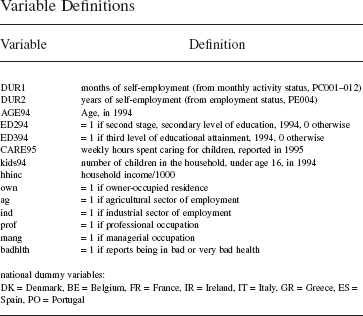
Using this data, we construct duration variables for each spell of self–employment among the adult population, measured alternatively as months (DUR1) and years (DUR2) of self–employment. The self–employment variable is constructed from a “status in employment” variable for each individual. The time spent caring for children variable is measured as the number of hours per week that the individual reports he or she normally spends looking after children, following Hildebrand and Williams (2003). The data set includes many other personal, family, and job–related variables that are included as control variables in the hazard analyses. Variable definitions are presented in Appendix table A1. The analysis is conducted both for a merged data set with all countries included (and country–specific dummy variables) and separately by country.
Not all of the countries covered by the ECHP are used in the analysis. Data for the United Kingdom, Germany, and Luxembourg are available in the ECHP after 1996 only from each country's separate longitudinal survey (BHPS, SOEP, and PSELL, respectively), and unfortunately the questions about time spent caring for children are not included in those surveys. As a result, we have dropped these countries from the analysis. Other data restrictions also cause us to exclude Austria, Finland, and Sweden, and, for the monthly analyses, the Netherlands. The eight countries that are included in all of the analyses are Belgium, Denmark, France, Greece, Ireland, Italy, Portugal, and Spain. Depending on the sample restrictions imposed, the analysis is conducted for approximately 6,000 spells of self–employment in these eight countries.
In order to provide a large sample size with the longest possible spell lengths, the first wave is used as the starting point for all spells. Unfortunately, this means that an unknown proportion of the spells are left–censored. That is, spells that started prior to 1994 are included in the data, but with 1994 as the start date. We are not able in the empirical analysis to adjust for any bias this may introduce to the results. Standard methods are used to control for the right–censored (uncompleted) spells, however. Lastly, only single spells of self–employment are used for any individual. Individuals with multiple spells therefore appear in the sample only once.
Results
Descriptive Statistics
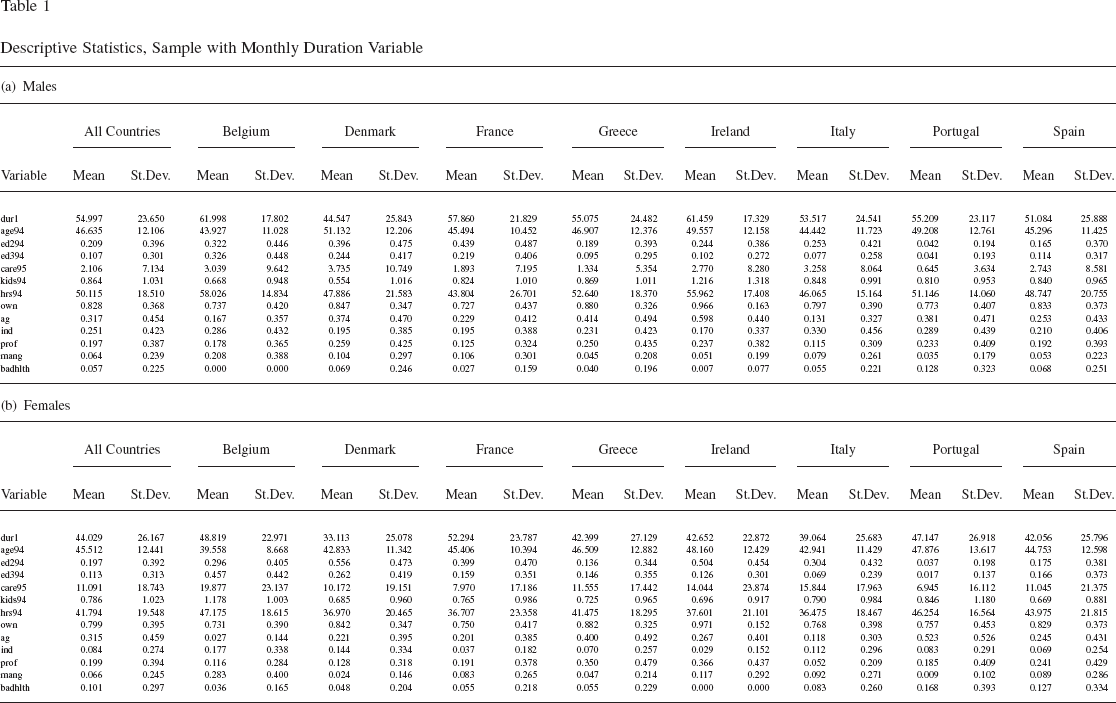
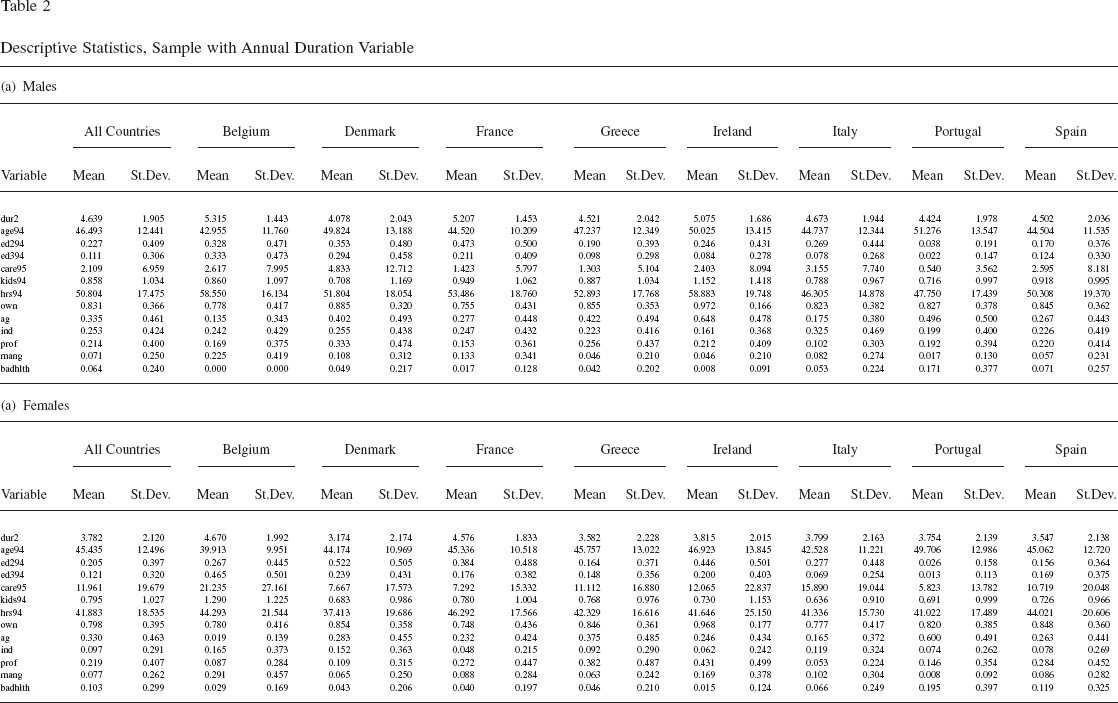
Means and standard deviations are presented for each of the variables utilized in this analysis in Tables 1 and 2, by country and gender. The results in Table 1 are for a balanced sample of individuals who were self–employed in 1994 and are present in the data in all waves 1 through 6 (1994–1999). 12 All variables (except duration of self–employment) take values for 1994 or 1995. The sample is also limited to those observations that have nonmissing values for all variables, including the monthly self–employment duration variable DUR1. Table 2 presents the same information for a balanced sample of individuals who have nonmissing values including the annual self–employment duration variable DUR2. The sample size is slightly larger in Table 2. Person–level sample weights are utilized, using the values from the first wave, such that the samples are representative of the country–specific population. 13
Results for an unbalanced sample are presented in Appendix Tables A2 and A3, available from the author upon request.
Therefore, the “all country” statistics are not weighted so as to be representative of the European population as a whole.
Descriptive Statistics, Sample with Monthly Duration Variable
Descriptive Statistics, Sample with Annual Duration Variable
Two key variables of interest are the duration of self–employment and the time spent caring for children. Both variables are seen to vary considerably across countries and by gender. Referring to Table 1, among males, the duration of self–employment is highest in Belgium and Ireland and lowest in Denmark. Among females, the duration of self–employment is highest in France, and lowest in Denmark. The duration of self–employment is higher for males than for females in all of the countries studied, although the gender difference is small in France. Holding constant rates of entry, these differences in duration contribute to the gender differences in self–employment rates found in these countries.
Time spent caring for children is found to be highest among males in Denmark, and lowest among males in Portugal. Among females, the average time spent caring for children is highest in Belgium, and lowest in France and Portugal. In all of the countries studied, the average time spent caring for children is considerably higher for females than for males. These patterns are found in the results for the slightly different sample presented in Table 2 as well, and for the unbalanced sample results in Appendix Tables A2 and A3 (available upon request). 14
See Hildebrand and Williams (2003) for an analysis of the determinants of time spent caring for children.
Duration Analysis
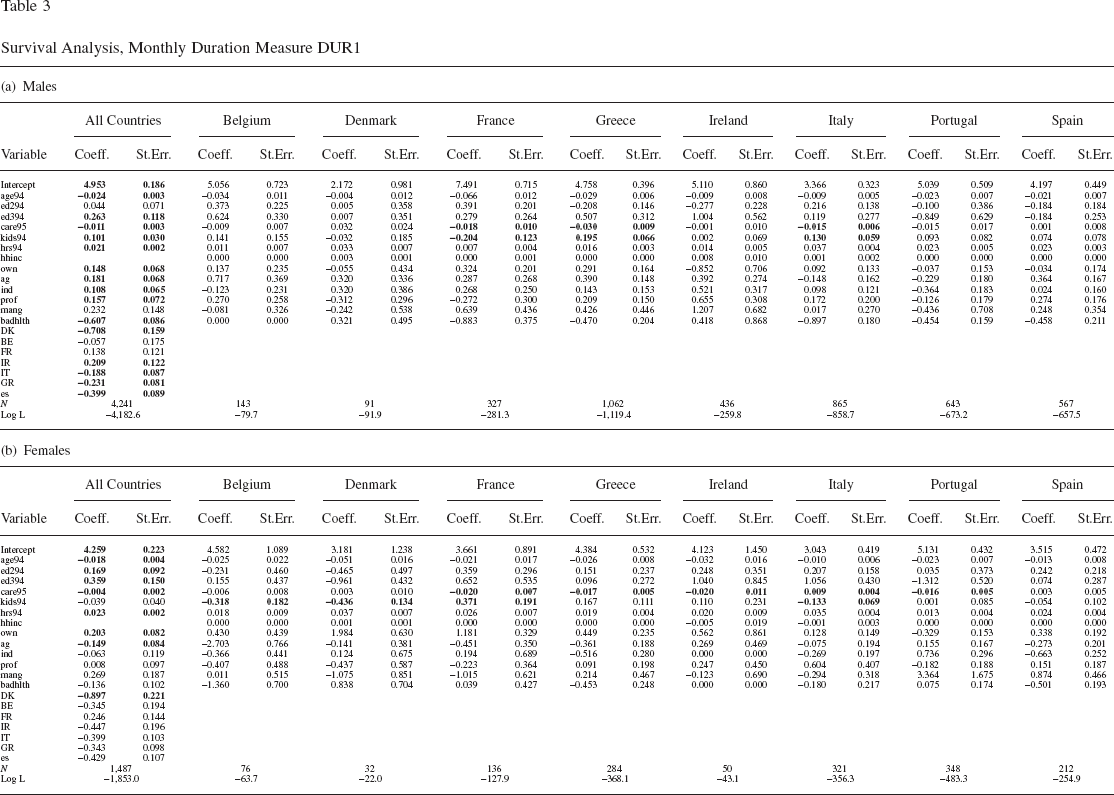
The estimated coefficients and their standard errors for the duration analysis are presented in Tables 3 and 4, by gender and country. The coefficients are estimated using the LIFEREG procedure in SAS, Version 8. The first column in each table gives the coefficients from a pooled analysis for all countries, with a set of country–specific dummy variables. The remaining columns present the country–specific estimates. In the first column, all coefficients that are statistically significant at least at the .10 level are in bold face. In the remaining columns, the significance levels are indicated only for the CARE95 and KIDS94 variables. Tables 3 and 4 differ in the measurement of duration, as monthly or annually. Since the annual (but not monthly) measure is available for the Netherlands, the “all countries” column in Table 4 also includes the Netherlands sample.
Survival Analysis, Monthly Duration Measure DUR1
Survival Analysis, Annual Duration Measure DUR2
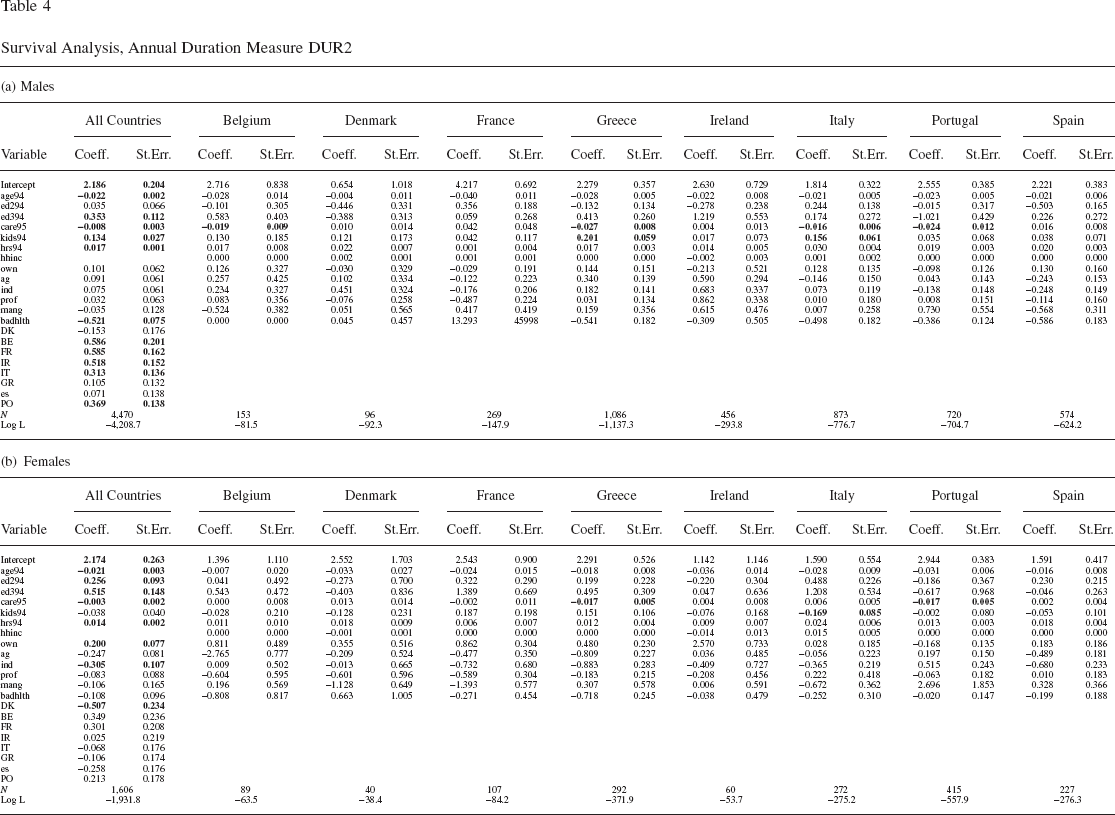
Referring first to the results for all countries in both tables, we find that most of the control variables have significant effects on the duration of self–employment in these samples. Age is found to have a negative and significant effect on duration, while attainment of higher levels of education has a positive effect, as does ownership of one's residence, a proxy for financial wealth. Among males, reporting that one is in “bad health” significantly decreases the duration of self–employment. A very important determinant of survival in self–employment is the number of hours worked per week (HRS94), for both genders and for both measures of duration. This variable is also highly significant in all of the individual country estimates (not indicated in the tables).
The results regarding the effects of children, as measured by the number of children in the household, are mixed. The number of children is found to have a positive and significant effect on months and years of duration of self–employment for males, but negative (and insignificant) effects for females. This could indicate, for example, that children provide additional motivation for males, but increase the level of supervision for females. The estimated coefficients for the time spent caring for children variable, however, are consistently negative and significant for both genders and both definitions of duration. The coefficient does appear to be larger for males than for females.
The results are more mixed when looking at the nation–specific estimates. In Table 3, for example, the coefficient on the CARE95 variable is negative in six of the eight countries for the male samples, but negative and significant in only three (France, Greece, and Italy). Among females, the coefficient is negative in five of the countries, and significantly negative in four (France, Greece, Ireland, and Portugal). Some of the sample sizes are quite small (e.g., for Denmark and Belgium), which might make the coefficient estimates less precise. Counter to our expectations, however, the coefficient is positive and significant for females in Italy. The results are generally similar in Table 4, with some negative and significant coefficients on the CARE95 variable. The results for the Netherlands, available using the annual measure but not reported here, support the hypothesis of a negative relationship, with negative coefficients for both males and females, and statistically significant for females.
We should note that the results using the larger, unbalanced sample are consistent with those reported above. 15 The estimates for all countries combined yield negative and significant coefficients on the CARE95 variable for both males and females. The estimates for individual nations are even slightly stronger than those from the balanced sample. The CARE95 coefficient for males is negative for six countries, and significantly so for four of them (Belgium, France, Italy, and Greece). The coefficient for females also is negative for six countries, and significant in four (France, Ireland, Greece, and Portugal).
The estimates are presented in Appendix Tables A4 and A5, available upon request. The unbalanced sample includes more than 10,000 individual spells of self–employment.
The results also appear to be consistent across alternative specifications and distributional assumptions. For example, the strong negative effect of time spent caring for children is found when the model does not include a control for the number of children in the household (KIDS94). Indeed, removal of that variable also causes the CARE95 variable to be negative and significant for females in Italy, reversing the anomalous result found earlier. In addition, the qualitative results remain when the model is estimated with exponential and log–normal (as opposed to Weibull) assumptions about the error term. Finally, negative and significant effects of time spent caring for children are found in France, Greece, and Portugal when the sample is limited to households with children.
In general, we conclude that the evidence supports the hypothesis that caring for children has a negative impact on self–employment duration in many, but not all countries. The effect appears to be strongest in France, Greece, Italy, and Portugal. One might conclude that the effect is consistent among the southern European nations, except for the fact that we find positive (but insignificant) coefficients for Spain.
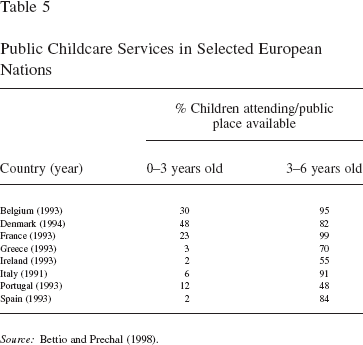
One characteristic of the southern countries included in this analysis is that they all have relatively low levels of public support for child care for the youngest children (0–3 years old) (Bettio & Prechal, 1998). In Table 5 we present a summary of the Bettio and Prechal data, for a sample of European nations. As seen there, the proportions of children enrolled in publicly provided child care range from only 2 to 12 percent. Among the northern countries, France has the lowest proportion, at 23 percent. This implies that a higher proportion of time spent caring for children in these countries may involve caring for younger children, which would be expected to have a larger (more significant) negative impact on continuing in self–employment than does caring for older children.
Public Childcare Services in Selected European Nations
Source: Bettio and Prechal (1998).
Summary and Topics for Further Research
The empirical analysis conducted here presents estimates of the effect that time spent caring for children, measured as hours per week, has on the duration of spells of self–employment in eight countries in the 1994–1999 time period. The negative effects found in many countries suggest that programs to encourage self–employment, especially among women, may be most effective if they are coordinated with programs to improve child care opportunities as well. This is especially true in the southern European nations where public support for care of young children is quite low.
One explanation for the less than universal support for the maintained hypothesis is that the care variable is poorly defined, in that it refers only to the 1995 time period. We are implicitly assuming that the level of care in 1995 is indicative of the level of care in other periods, including 1994. An analysis wherein the care variable is allowed to vary over time might yield better estimates of its effect. Such an analysis, using pooled data with multiple spells, is a topic for further research. Other extensions, including alternative definitions for the CARE variable and inclusion of a household income variable for the multinational estimates, could also be conducted. Finally, a binary analysis of the probability of exiting from self–employment for the early period 1994–96 would allow inclusion of the United Kingdom, Germany, and Luxembourg in the analysis. This is highly desirable given the importance of these countries in Europe and its economy.
The extensions described above are intended to improve our evidence of the effect of time spent caring for children on the self–employed in Europe. Other, broader extensions of this work might include the following: First, in order to fully understand the role that children play among the self–employed, we should construct a model of the joint determination of the number of children, the time spent caring for them, and the probability of self–employment, as well as the duration of self–employment. Second, cultural and institutional differences across Europe, with regard to family and family policy, should be explored in the context of these results (or conversely, the results should be considered in the context of these differences). Third, we should extend the analysis to other outcomes associated with self–employment, such as income or job satisfaction. An increased level of job satisfaction due to additional time spent caring for children might compensate for lower income or a shorter duration of self–employment.
Footnotes
Table A1
Variable Definitions
| Variable | Definition |
|---|---|
| DUR1 | months of self–employment (from monthly activity status, PC001–012) |
| DUR2 | years of self–employment (from employment status, PE004) |
| AGE94 | Age, in 1994 |
| ED294 | = 1 if second stage, secondary level of education, 1994, 0 otherwise |
| ED394 | = 1 if third level of educational attainment, 1994, 0 otherwise |
| CARE95 | weekly hours spent caring for children, reported in 1995 |
| kids94 | number of children in the household, under age 16, in 1994 |
| hhinc | household income/1000 |
| own | = 1 if owner–occupied residence |
| ag | = 1 if agricultural sector of employment |
| ind | = 1 if industrial sector of employment |
| prof | = 1 if professional occupation |
| mang | = 1 if managerial occupation |
| badhlth | = 1 if reports being in bad or very bad health |
| national dummy variables: | |
| DK=Denmark, BE=Belgium, FR=France, IR=Ireland, IT=Italy, GR=Greece, ES=Spain, PO=Portugal | |